Paulo Sérgio Martins Int. Journal of Engineering Research and Applications www.ijera.com 
ISSN : 2248-9622, Vol. 4, Issue 9( Version 6), September 2014, pp.23-29 
www.ijera.com 23 | P a g e 
Analysis Of The Structure Of A Material Used In The Manufacture Of Thermal Chucks For Fixing Tools Cutting Using Finite Elements P. Martins1, J. Carneiro1, Pedro A¹, P. Brito1, A. Vieira1, R. Braga1 & L. Vilela1 1Pontifical Catholic University of Minas Gerais Av. Dom José Gaspar 500, Belo Horizonte 30535-901, Brazil, 2Centro Universitário Una, endereço para correspondência, Avenida Raja Gabaglia Prédio 1: 3.950, Prédio 2: 4.133, Correspondence: P. Martins, Pontifical Catholic University of Minas Gerais Av. Dom José Gaspar 500, Belo Horizonte 30535-901, Brazil. Tel: 55-31-8392-8400. E-ma il: paulosabara@yahoo.com.br Abstract, The dynamic stability of machine has its own importance in the quality of the machined product. With the development of new technologies for cutting tools, as the geometries and materials, cutting speeds used today reach values inconceivable for two decades. In the automotive industry steel and cast iron are gradually being replaced by lower density material and even lower costs. In complex shapes tools, heterogeneous material removal in roughing, sudden changes of sections, etc. Stress relieving treatment should be carried out to minimize dimensional variations of form during quenching and tempering. Materials for manufacture of thermal fixing most appropriate for that operating system still needs to be further investigated. Therefore, this study investigated the elastic behavior of the material used in the manufacture of tooling systems for cutting tools. Has been evaluated In fastening system, the temperature variation exerted on the mandrel body region and the thermal expansion where H13 steel can withstand the assembly process by thermal interference. This method can determine the amount of number of cycles until the onset of fatigue that material. Keywords: elastic behavior, thermal fixing, drilling, drill, Temperature clamping systems. 
I. INTRODUCTION 
Machining is a process used in the manufacture of components in various industrial sectors. The auto industry is a sector of large-scale commercial manufacturing in which the emphasis is to reduce environmental impact and manufacturing costs (Harris, 2000). It is estimated that around 15-20 % of all steel produced in the world is transformed and removed by machining in the form of chips which shows that this process offers real prospects for improvement both in terms of equipment and in operation. (DINIZ, AE; MARCONDES, FC; COPPINI, NL, 2001) define machinability as a comparative technology magnitude, that is, expressed by a numerical value of the confrontation of a set of achining properties. The machinability of a material can be obtained taking into account the number of parts produced per hour, the cost of machining the component or final quality of the worked surface (TRENT, Wright, 2000). The machining process is nonlinear phenomena as involving plastic deformation, fracture, impact, touch points intermittent, continuous and tear, and is characterized by the generation of heat and high cutting temperature. Due to the complexity of the cutting process, it is often not possible to obtain a mathematical description of the process dynamics which can be overcome, sometimes through the use of indirect measurement by sensors. At high temperatures, the cutting tool may lose its shape or wear quickly resulting in increase in the cutting force, dimensional inaccuracy of the product, reduced life, mechanical and chemical damage the finished surface. High temperature may be controlled by injection of cutting oil in the tool - chip interface. Evaluated the influence of different types of hard 
RESEARCH ARTICLE OPEN ACCESS
Paulo Sérgio Martins Int. Journal of Engineering Research and Applications www.ijera.com 
ISSN : 2248-9622, Vol. 4, Issue 9( Version 6), September 2014, pp.23-29 
www.ijera.com 24 | P a g e 
coatings on thermal fatigue of steel H13. Starting 
from hardened steel H13 and tempered with hardness 
37 HRC, used coatings TiN, CrN and duplex coatings 
on this steel, and performed 500 cycles of thermal 
fatigue with induction heating, interspersed with 
cooling in shower water in a controlled manner 
between 750 º C and 50 º C. They found that the 
different types of hard coatings can inhibit thermal 
fatigue. The best results were obtained with the CrN 
and TiN, while the duplex coating did not lead to 
good results. 
The thermal fatigue due to the constant variation 
in the surface temperature of the matrix, can result in 
the appearance of fine cracks arrangement that may 
also preclude use of the matrix in certain cases. This 
failure mechanism is found more often in die casting 
matrix and may also occur in situations other than hot 
forming. (In the case of thermal fatigue, it is essential 
to use steels with higher toughness, in order to 
inhibit. Propagation of cracks and reduce demages. 
The structural characterization of the material is 
required for the determination of failures arising parts 
as those produced during machining itself. Several 
techniques can be used to provide this study. As an 
example we can mention the optical microscopy, 
scanning electron microscopy, transmission electron 
microscopy and others. 
Each of these techniques can provide certain 
characteristics of the piece. According PADILHA 
(2002), optical microscopy is an excellent tool for 
analyzing large areas in a short time, besides being 
easy to use and cost less. The scanning electron 
microscopy (SEM) due to depth of focus, allows the 
analysis with large increases of irregular surfaces 
such as fracture surfaces, ideal for viewing the 
machining tool wear. The transmission electron 
microscopy (TEM) allows the analysis of defects and 
internal phases of materials, such as dislocations, 
stacking faults and small second phase particles. 
Kress (1974) found worse results in the diversion 
of roundness in misaligned holes, and recommends 
an alignment error between the pre-drilled hole and 
less than 0.020 mm reamer. The system for setting 
tool operates in especially difficult circumstances, 
since it is located directly on the action of the force 
between the workpiece and the machine. Besides the 
normal stiffness conditions and general cutting 
requirements (torque transmission and machining 
forces), the system must ensure optimal geometric 
conditions (beat, concentricity) and enable rapid tool 
change (Schultz, H, Moriwaki, T .1993). Tool holder 
is a device which acts with an interchangeable 
interface between the spindle of the machine tool and 
a cutting tool so that the efficiency is not lowered 
concentricity of the mentioned elements: the axis of 
rotation of the machine spindle and the tool cutting 
must be kept concentric. The clamping force of the 
cutting tool must be held firmly to prevent their 
rotation within the mandrel. 
With the generic name of Tool Steels it mean 
the materials used in the manufacture of various 
types of tools used in various sectors of our economy. 
These steels are mainly used in: dies, molds, 
intermittent and continuous cutting tools, sheet metal 
forming tools, cold cutting, machine components, 
among others. Although there are over 100 types of 
tool steels standardized internationally, trying to 
attain various applications and requirements, tooling 
industry works with a smaller range of steels which 
have devoted their properties and performance over 
time, for example, AISI H13, AISI D2, D6 and AISI 
M2 , among others. From the requirement required 
for the various manufactured tools is a clear need for 
high quality in procurement of materials for the 
manufacture of tools, as well as the correct addition 
of specific alloys to obtain the properties of each tool 
and its application. 
Due to the high speed of the injection process 
Aluminium pressure cycle resulting heating is very 
fast initially and in all probability stabilization for 
injection cycles of medium duration. It is known that 
aluminum during injection, the temperature is the 
highest at the surface of the matrix, causing 
expansions as a consequence, the stresses of thermal 
origin, which can be described by the equation 1 . 
t     T 
(Eq1) 
 t  Thermal stress. 
  Module of elasticity. 
  Coefficient of Thermal Expansion. 
 T Temperature Gradient. 
When the applied voltage exceeds the yield 
strength of the material, depending on the extent of 
these deformations. Can be taken basically two types 
of deformations, the first known as plastic 
deformation, defined as a material that exceeds its 
flow will deform even when the load is removed 
(Beeret al. 1995). 
As Klobcar et al. (2008), to increase the number 
of life cycles of an array injection pressure 
differences in temperatures during the injection 
molding process should be kept as low as possible. It 
should also prevent further overheating concentrated 
thermal shock, because without such care will be 
possible to have catastrophic failures in the tool. 
According to Beer et al. (1995), is classified as 
an isotropic material, when its properties do not vary 
with direction. Isotropic materials have elastic 
moduli, Poisson's ratio, coefficient of expansion and 
thermal conductivity equal in all directions. 
The properties vary with direction, mainly due to 
microstructural variations linked to microsegregation,
Paulo Sérgio Martins Int. Journal of Engineering Research and Applications www.ijera.com 
ISSN : 2248-9622, Vol. 4, Issue 9( Version 6), September 2014, pp.23-29 
www.ijera.com 25 | P a g e 
which may negatively affect the mechanical properties of the tool, especially the toughness of the material in the transverse direction. The maximum deformation is considerably smaller than the characteristic dimension of the model. For example, the maximum displacement of a board must be considerably smaller than its thickness. And the maximum displacement of one beam must be considerably smaller than the smallest dimension of its cross section, loads will not cause any permanent deformation. In other words, it is assumed that the model is perfectly elastic, a perfectly elastic model returns to its original shape when the load is removed (Cosmos, 2011). As Meyers et al. (1999) for an endurance test where it keeps the strain amplitude non variable shape , and is easier to control , more accurately reflects the practical conditions for most of the mechanical components subject the phenomenon of fatigue. Mitchell (2001) found that the materials which suffer plastic deformation in a given type of loading may exhibit hardening or softening during its test According Ugural (1981) and Conte et al. (1980), the direct method are more reliable because they generate the exact solution , ie , less than rounding errors in a finite number of arithmetic operations . Importantly, in most applications in linear engineering problems are used direct techniques. Conte et al. (1980 ) , points out that the iterative method provide approximate solutions which usually end up converging to exact solution sequence. When a number of iterations tends to infinity, this methodology is widely used in engineering problems of great complexity, problems which may be linear or nonlinear . 
According to the definition of Chiaverini (1979 ), the " Steel is an iron - carbon alloy generally 0.008 % to about 2.0 containing 17 % carbon , and certain residual elements resulting from the manufacturing process." Its preparation depends on three basic components: coke (or charcoal), limestone and iron ore. In its manufacture, is made primarily the introduction of coke, 18 limestone and iron ore in a blast furnace 131. The coke is used as fuel and as a "catcher" of oxygen associated with iron ore . Once heated, limestone decomposes into lime and CO2, so that the lime is incorporated into the slag , reducing its melting temperature and allowing the liquid slag above the skirt iron. Thus, limestone facilitates the separation of iron from "dross" , 19 performing a preliminary extraction of the metal impurities . The resulting cast iron still contains a high content of impurities, contaminants (sulfur, silicon and magnesium) and carbon, is called pig iron. To evaluate the influence of austenitizing temperature, we analyze the results for each tempering temperature. In 1 derevenimento temperatures observed a common behavior: the lower impact energies are associated with austenitizing temperature of 1100 º C. This result is not surprising since preliminary tests coarse grain microstructure exhibit low toughness and intergranular fracture mode occurs, indicating an obvious weakening. showed that at this temperature the austenitic grain grew significantly due to complete. 
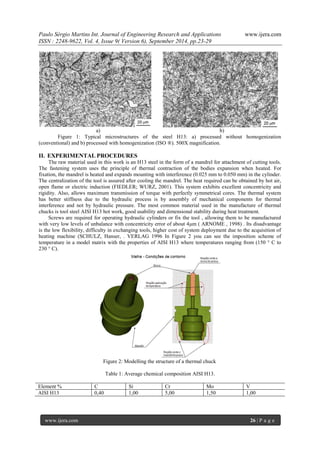
Dissolution of secondary carbides had indicated that matrices made of quenched and tempered steel H13 , casting and extrusion of aluminum alloys are usually performed with arrays of tool steel for hot working . Among the various steels of this class, the steel AISI H13 is used for combining of the high hardenability, strength , toughness and thermal fatigue . For systems with interference, by principle of elastic deformation of the material of the toolholder, there is the Tribes of Schunk system in Germany and distributed to parents by Sanches Blanes, which has been highlighting globally by the ability to present excellent results both in roughing as well as finishing, it has in its construction details that provide great rigidity and vibration absorption machining and have excellent surface finishes. According to Roberts, G, Krauss, G. and KennedyAços (1998) Hot work tool form a special group of high-alloy steels , tools for industrial metal forming at high temperature, typically above 500 ° C. Examples of such applications are pressure die casting and extrusion of non-ferrous alloys such as Al alloys , and tools for hot forging Besides these properties , the toughness is fundamental property for the good performance of the tools . In local stress concentration, lack of toughness can generate coarse cracks, depending on the size imply that the suspension of the use of the array. Figure 1 shows typical microstructures core bars produced using the conventional process and the process ISO ® after quenching and tempering. The microstructure of the conventional material (Fig. 1 ª) is heterogeneous , with the presence of primary carbides , vanadium- rich , grouped and marking in the grain boundaries. The VH13 ISO ® is more uniform, no clusters of primary carbides and contour markings as shown in Figure 1b.
Paulo Sérgio Martins Int. Journal of Engineering Research and Applications www.ijera.com 
ISSN : 2248-9622, Vol. 4, Issue 9( Version 6), September 2014, pp.23-29 
www.ijera.com 26 | P a g e 
a) b) 
Figure 1: Typical microstructures of the steel H13: a) processed without homogenization 
(conventional) and b) processed with homogenization (ISO ®). 500X magnification. 
II. EXPERIMENTAL PROCEDURES 
The raw material used in this work is an H13 steel in the form of a mandrel for attachment of cutting tools. 
The fastening system uses the principle of thermal contraction of the bodies expansion when heated. For 
fixation, the mandrel is heated and expands mounting with interference (0.025 mm to 0.050 mm) in the cylinder. 
The centralization of the tool is assured after cooling the mandrel. The heat required can be obtained by hot air, 
open flame or electric induction (FIEDLER; WURZ, 2001). This system exhibits excellent concentricity and 
rigidity. Also, allows maximum transmission of torque with perfectly symmetrical cores. The thermal system 
has better stiffness due to the hydraulic process is by assembly of mechanical components for thermal 
interference and not by hydraulic pressure. The most common material used in the manufacture of thermal 
chucks is tool steel AISI H13 hot work, good usability and dimensional stability during heat treatment. 
Screws are required for operating hydraulic cylinders or fix the tool , allowing them to be manufactured 
with very low levels of unbalance with concentricity error of about 4μm ( ARNOME , 1998) . Its disadvantage 
is the low flexibility, difficulty in exchanging tools, higher cost of system deployment due to the acquisition of 
heating machine (SCHULZ, Hanser, . VERLAG 1996 In Figure 2 you can see the imposition scheme of 
temperature in a model matrix with the properties of AISI H13 where temperatures ranging from (150 ° C to 
230 ° C). 
Figure 2: Modelling the structure of a thermal chuck 
Table 1: Average chemical composition AISI H13. 
Element % C Si Cr Mo V 
AISI H13 0,40 1,00 5,00 1,50 1,00
Paulo Sérgio Martins Int. Journal of Engineering Research and Applications www.ijera.com 
ISSN : 2248-9622, Vol. 4, Issue 9( Version 6), September 2014, pp.23-29 
www.ijera.com 27 | P a g e 
The AISI H13 steel is a hot-work containing chromium, vanadium, silicon and molybdenum as chemical composition table 1. The H13 steel was developed for injection molding and extrusion of hot metals such as aluminum, zinc and copper, as well as hot forming presses and hammers. Due to its chemical composition, steel H13 features: Large hardenability High resistance to softening by heat Good wear resistance at high temperatures Excellent toughness Good machinability in the category of tool steels Excellent thermal shock resistance due to heating and continuous colds, Was fixed diameter drill rod 8 mm in diameter; Evaluate the heating time as diameter; Measure strains diameter; Was simulated temperature variations apart from 150 º C to 230 º C ranging from 10 º C. After the introduction of the desired 3D geometry, this was the extent exported and imported in Abaqus STEP program in order to generate a model using MEF. Resource use finite element implies a discretization of the model that will be done by generating a mesh. Whereas the matrix would not deform during the process of injection pressure, they were considered rigid bodies. 
III. RESULTS AND DISCUSSION 
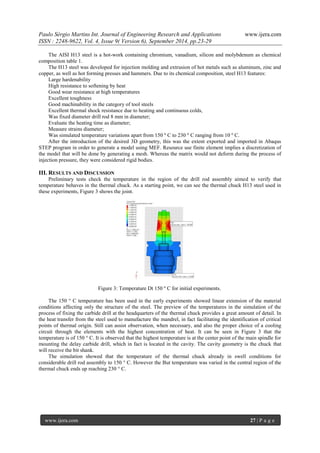
Preliminary tests check the temperature in the region of the drill rod assembly aimed to verify that temperature behaves in the thermal chuck. As a starting point, we can see the thermal chuck H13 steel used in these experiments, Figure 3 shows the joint. 
Figure 3: Temperature Dt 150 º C for initial experiments. 
The 150 ° C temperature has been used in the early experiments showed linear extension of the material conditions affecting only the structure of the steel. The preview of the temperatures in the simulation of the process of fixing the carbide drill at the headquarters of the thermal chuck provides a great amount of detail. In the heat transfer from the steel used to manufacture the mandrel, in fact facilitating the identification of critical points of thermal origin. Still can assist observation, when necessary, and also the proper choice of a cooling circuit through the elements with the highest concentration of heat. It can be seen in Figure 3 that the temperature is of 150 ° C. It is observed that the highest temperature is at the center point of the main spindle for mounting the delay carbide drill, which in fact is located in the cavity. The cavity geometry is the chuck that will receive the bit shank. The simulation showed that the temperature of the thermal chuck already in swell conditions for considerable drill rod assembly to 150 ° C. However the But temperature was varied in the central region of the thermal chuck ends up reaching 230 ° C.
Paulo Sérgio Martins Int. Journal of Engineering Research and Applications www.ijera.com 
ISSN : 2248-9622, Vol. 4, Issue 9( Version 6), September 2014, pp.23-29 
www.ijera.com 28 | P a g e 
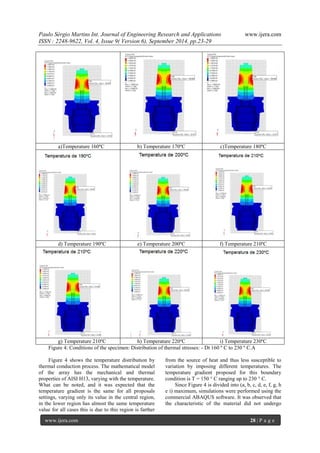
a)Temperature 160ºC 
b) Temperature 170ºC 
c)Temperature 180ºC 
d) Temperature 190ºC 
e) Temperature 200ºC 
f) Temperature 210ºC 
g) Temperature 210ºC 
h) Temperature 220ºC 
i) Temperature 230ºC 
Figure 4: Conditions of the specimen: Distribution of thermal stresses: - Dt 160 º C to 230 º C.A 
Figure 4 shows the temperature distribution by thermal conduction process. The mathematical model of the array has the mechanical and thermal properties of AISI H13, varying with the temperature. What can be noted, and it was expected that the temperature gradient is the same for all proposals settings, varying only its value in the central region, in the lower region has almost the same temperature value for all cases this is due to this region is farther from the source of heat and thus less susceptible to variation by imposing different temperatures. The temperature gradient proposed for this boundary condition is T = 150 ° C ranging up to 230 ° C. 
Since Figure 4 is divided into (a, b, c, d, e, f, g, h e i) maximum, simulations were performed using the commercial ABAQUS software. It was observed that the characteristic of the material did not undergo
Paulo Sérgio Martins Int. Journal of Engineering Research and Applications www.ijera.com 
ISSN : 2248-9622, Vol. 4, Issue 9( Version 6), September 2014, pp.23-29 
www.ijera.com 29 | P a g e 
large deformations after the temperature variation, this is due to elastic deformation of the steel H13. 
IV. CONCLUSIONS 
Simulations using the finite element method helped in raising the temperature gradients, thermal conduction through the thermal chuck Concerning the behavior of AISI H13 before charging different temperature. It was observed that thermal fatigue is the physical phenomenon of magnitude higher among others. This phenomenon is not observed, because the number of temperature cycles was not sufficient to determine this deformation. Which may be represented by different thermal stresses during the process of assembly and disassembly of the thermal chuck tools. For future work simulation should be correlated with the physical part and thereby aiding in the creation of models of cooling and check mounting tensions between drill and chuck, predicting possible failures. 
REFERENCES 
[1.] ABAQUS/Standard User Manual, Version 6.10, 2011. 
[2.] BEER, F.; JOHNSTON, R.; Resistência dos Materiais, 3. ed. São Paulo: Makron Books, 1995 
[3.] CHIAVERINI, V. Aços e ferros fundidos. 4ª ed. São Paulo: Associação Brasileira de Metais, 1979, p. 19. 
[4.] COSMOS/CAE, User’s Manual, Version 2011, 2011. 
[5.] HARRIS, S.G.; VLASVED, A.C; DOYLE, E.D;DOLDER, P.J. Dry machining – commercial viability through filtered arc vapour deposited coating Surface and Coating Technology , n.133-134, pp 383-388, 2000. 
[6.] Roberts, G., Krauss, G. and Kennedy, R. Tool Steels.ASM, 5th edition, EUA, p. 30-32 and 220-250, 1998. 
[7.] DINIZ, A. E.; MARCONDES, F. C.; COPPINI, N. L., Tecnologia da Usinagem dos Materiais. 4. ed. São Paulo: Artliber, 2001. 
[8.] KRESS, D. EL.,Escariadocon altas velocidades. Stuttgard, Tese de Doutorado - Universidad de Stuttgard, 1974. 
[9.] KLOBCAR, D.; TUSEK, J.; Thermal Stresses in Aluminium Alloy Die Casting Dies, University of Ljubljana, Faculty of Mechanical Engineering, Laboratory for Welding, Askerceva, Slovenia, 2008. 
[10.] MESQUITA, R. A., LEIVA, D. R., BARBOSA, C. A., “El Efecto de las Condicionesde Tratamiento Térmico 
enlaMicroestructura y PropiedadesMecánicas de losAcerosHerramienta”. Pt1. Maquinas e Equipos: Herramientas e InsumosIndustriales, n547, Buenos Aires, Argentina, Set., 2006, p. 152-160.NADCA Recommended Procedures for H13 Tool Steel, EUA, 1997. 
[11.] MEYERS, M. A.; CHAWLA, K. K.; Mechanical Behavior of Marerials, Prentice Hall : New Jersey cap. 14, 1999. 
[12.] Padilha, Helio,: Desenvolvimento “IN SITU” de intermetálicos em superfícies de aço inoxidável, tese dourado, Universidade Federal do Paraná, 2002. 
[13.] ROBERTS, G, KRAUSS, G., KENNEDY, R., “Tool Steels.” ASM, 5th edition, EUA,1988, p. 30-32 e 220-250. 
[14.] ROBERTS, G., KRAUSS, G., KENNEDY, R., “Tool Steels.“ASM, 4th edition, EUA,1980, p. 393-395 e 563-585. 
[15.] SCHULTZ, H.; MORIWAKI, T., High Speed Machining.Annals of the CIRP, v. 41, n.2, pp 637-643, 1993. 
[16.] TRENT, E.M.; WRIGHT, P.K., Metal Cutting ,Butteworths-Heinemann. 4.ed. Ltd, London, 2000. 
[17.] UGURAL, A. C.; FENSTER, S.K.; Advanced Strength and Applied Elasticity, The SI version. London, Elsevier Science Publishimg Co.,Inc., 1981.

Analysis Of The Structure Of A Material Used In The Manufacture Of Thermal Chucks For Fixing Tools Cutting Using Finite Elements

  • 1.
    Paulo Sérgio MartinsInt. Journal of Engineering Research and Applications www.ijera.com ISSN : 2248-9622, Vol. 4, Issue 9( Version 6), September 2014, pp.23-29 www.ijera.com 23 | P a g e Analysis Of The Structure Of A Material Used In The Manufacture Of Thermal Chucks For Fixing Tools Cutting Using Finite Elements P. Martins1, J. Carneiro1, Pedro A¹, P. Brito1, A. Vieira1, R. Braga1 & L. Vilela1 1Pontifical Catholic University of Minas Gerais Av. Dom José Gaspar 500, Belo Horizonte 30535-901, Brazil, 2Centro Universitário Una, endereço para correspondência, Avenida Raja Gabaglia Prédio 1: 3.950, Prédio 2: 4.133, Correspondence: P. Martins, Pontifical Catholic University of Minas Gerais Av. Dom José Gaspar 500, Belo Horizonte 30535-901, Brazil. Tel: 55-31-8392-8400. E-ma il: paulosabara@yahoo.com.br Abstract, The dynamic stability of machine has its own importance in the quality of the machined product. With the development of new technologies for cutting tools, as the geometries and materials, cutting speeds used today reach values inconceivable for two decades. In the automotive industry steel and cast iron are gradually being replaced by lower density material and even lower costs. In complex shapes tools, heterogeneous material removal in roughing, sudden changes of sections, etc. Stress relieving treatment should be carried out to minimize dimensional variations of form during quenching and tempering. Materials for manufacture of thermal fixing most appropriate for that operating system still needs to be further investigated. Therefore, this study investigated the elastic behavior of the material used in the manufacture of tooling systems for cutting tools. Has been evaluated In fastening system, the temperature variation exerted on the mandrel body region and the thermal expansion where H13 steel can withstand the assembly process by thermal interference. This method can determine the amount of number of cycles until the onset of fatigue that material. Keywords: elastic behavior, thermal fixing, drilling, drill, Temperature clamping systems. I. INTRODUCTION Machining is a process used in the manufacture of components in various industrial sectors. The auto industry is a sector of large-scale commercial manufacturing in which the emphasis is to reduce environmental impact and manufacturing costs (Harris, 2000). It is estimated that around 15-20 % of all steel produced in the world is transformed and removed by machining in the form of chips which shows that this process offers real prospects for improvement both in terms of equipment and in operation. (DINIZ, AE; MARCONDES, FC; COPPINI, NL, 2001) define machinability as a comparative technology magnitude, that is, expressed by a numerical value of the confrontation of a set of achining properties. The machinability of a material can be obtained taking into account the number of parts produced per hour, the cost of machining the component or final quality of the worked surface (TRENT, Wright, 2000). The machining process is nonlinear phenomena as involving plastic deformation, fracture, impact, touch points intermittent, continuous and tear, and is characterized by the generation of heat and high cutting temperature. Due to the complexity of the cutting process, it is often not possible to obtain a mathematical description of the process dynamics which can be overcome, sometimes through the use of indirect measurement by sensors. At high temperatures, the cutting tool may lose its shape or wear quickly resulting in increase in the cutting force, dimensional inaccuracy of the product, reduced life, mechanical and chemical damage the finished surface. High temperature may be controlled by injection of cutting oil in the tool - chip interface. Evaluated the influence of different types of hard RESEARCH ARTICLE OPEN ACCESS
  • 2.
    Paulo Sérgio MartinsInt. Journal of Engineering Research and Applications www.ijera.com ISSN : 2248-9622, Vol. 4, Issue 9( Version 6), September 2014, pp.23-29 www.ijera.com 24 | P a g e coatings on thermal fatigue of steel H13. Starting from hardened steel H13 and tempered with hardness 37 HRC, used coatings TiN, CrN and duplex coatings on this steel, and performed 500 cycles of thermal fatigue with induction heating, interspersed with cooling in shower water in a controlled manner between 750 º C and 50 º C. They found that the different types of hard coatings can inhibit thermal fatigue. The best results were obtained with the CrN and TiN, while the duplex coating did not lead to good results. The thermal fatigue due to the constant variation in the surface temperature of the matrix, can result in the appearance of fine cracks arrangement that may also preclude use of the matrix in certain cases. This failure mechanism is found more often in die casting matrix and may also occur in situations other than hot forming. (In the case of thermal fatigue, it is essential to use steels with higher toughness, in order to inhibit. Propagation of cracks and reduce demages. The structural characterization of the material is required for the determination of failures arising parts as those produced during machining itself. Several techniques can be used to provide this study. As an example we can mention the optical microscopy, scanning electron microscopy, transmission electron microscopy and others. Each of these techniques can provide certain characteristics of the piece. According PADILHA (2002), optical microscopy is an excellent tool for analyzing large areas in a short time, besides being easy to use and cost less. The scanning electron microscopy (SEM) due to depth of focus, allows the analysis with large increases of irregular surfaces such as fracture surfaces, ideal for viewing the machining tool wear. The transmission electron microscopy (TEM) allows the analysis of defects and internal phases of materials, such as dislocations, stacking faults and small second phase particles. Kress (1974) found worse results in the diversion of roundness in misaligned holes, and recommends an alignment error between the pre-drilled hole and less than 0.020 mm reamer. The system for setting tool operates in especially difficult circumstances, since it is located directly on the action of the force between the workpiece and the machine. Besides the normal stiffness conditions and general cutting requirements (torque transmission and machining forces), the system must ensure optimal geometric conditions (beat, concentricity) and enable rapid tool change (Schultz, H, Moriwaki, T .1993). Tool holder is a device which acts with an interchangeable interface between the spindle of the machine tool and a cutting tool so that the efficiency is not lowered concentricity of the mentioned elements: the axis of rotation of the machine spindle and the tool cutting must be kept concentric. The clamping force of the cutting tool must be held firmly to prevent their rotation within the mandrel. With the generic name of Tool Steels it mean the materials used in the manufacture of various types of tools used in various sectors of our economy. These steels are mainly used in: dies, molds, intermittent and continuous cutting tools, sheet metal forming tools, cold cutting, machine components, among others. Although there are over 100 types of tool steels standardized internationally, trying to attain various applications and requirements, tooling industry works with a smaller range of steels which have devoted their properties and performance over time, for example, AISI H13, AISI D2, D6 and AISI M2 , among others. From the requirement required for the various manufactured tools is a clear need for high quality in procurement of materials for the manufacture of tools, as well as the correct addition of specific alloys to obtain the properties of each tool and its application. Due to the high speed of the injection process Aluminium pressure cycle resulting heating is very fast initially and in all probability stabilization for injection cycles of medium duration. It is known that aluminum during injection, the temperature is the highest at the surface of the matrix, causing expansions as a consequence, the stresses of thermal origin, which can be described by the equation 1 . t     T (Eq1)  t  Thermal stress.   Module of elasticity.   Coefficient of Thermal Expansion.  T Temperature Gradient. When the applied voltage exceeds the yield strength of the material, depending on the extent of these deformations. Can be taken basically two types of deformations, the first known as plastic deformation, defined as a material that exceeds its flow will deform even when the load is removed (Beeret al. 1995). As Klobcar et al. (2008), to increase the number of life cycles of an array injection pressure differences in temperatures during the injection molding process should be kept as low as possible. It should also prevent further overheating concentrated thermal shock, because without such care will be possible to have catastrophic failures in the tool. According to Beer et al. (1995), is classified as an isotropic material, when its properties do not vary with direction. Isotropic materials have elastic moduli, Poisson's ratio, coefficient of expansion and thermal conductivity equal in all directions. The properties vary with direction, mainly due to microstructural variations linked to microsegregation,
  • 3.
    Paulo Sérgio MartinsInt. Journal of Engineering Research and Applications www.ijera.com ISSN : 2248-9622, Vol. 4, Issue 9( Version 6), September 2014, pp.23-29 www.ijera.com 25 | P a g e which may negatively affect the mechanical properties of the tool, especially the toughness of the material in the transverse direction. The maximum deformation is considerably smaller than the characteristic dimension of the model. For example, the maximum displacement of a board must be considerably smaller than its thickness. And the maximum displacement of one beam must be considerably smaller than the smallest dimension of its cross section, loads will not cause any permanent deformation. In other words, it is assumed that the model is perfectly elastic, a perfectly elastic model returns to its original shape when the load is removed (Cosmos, 2011). As Meyers et al. (1999) for an endurance test where it keeps the strain amplitude non variable shape , and is easier to control , more accurately reflects the practical conditions for most of the mechanical components subject the phenomenon of fatigue. Mitchell (2001) found that the materials which suffer plastic deformation in a given type of loading may exhibit hardening or softening during its test According Ugural (1981) and Conte et al. (1980), the direct method are more reliable because they generate the exact solution , ie , less than rounding errors in a finite number of arithmetic operations . Importantly, in most applications in linear engineering problems are used direct techniques. Conte et al. (1980 ) , points out that the iterative method provide approximate solutions which usually end up converging to exact solution sequence. When a number of iterations tends to infinity, this methodology is widely used in engineering problems of great complexity, problems which may be linear or nonlinear . According to the definition of Chiaverini (1979 ), the " Steel is an iron - carbon alloy generally 0.008 % to about 2.0 containing 17 % carbon , and certain residual elements resulting from the manufacturing process." Its preparation depends on three basic components: coke (or charcoal), limestone and iron ore. In its manufacture, is made primarily the introduction of coke, 18 limestone and iron ore in a blast furnace 131. The coke is used as fuel and as a "catcher" of oxygen associated with iron ore . Once heated, limestone decomposes into lime and CO2, so that the lime is incorporated into the slag , reducing its melting temperature and allowing the liquid slag above the skirt iron. Thus, limestone facilitates the separation of iron from "dross" , 19 performing a preliminary extraction of the metal impurities . The resulting cast iron still contains a high content of impurities, contaminants (sulfur, silicon and magnesium) and carbon, is called pig iron. To evaluate the influence of austenitizing temperature, we analyze the results for each tempering temperature. In 1 derevenimento temperatures observed a common behavior: the lower impact energies are associated with austenitizing temperature of 1100 º C. This result is not surprising since preliminary tests coarse grain microstructure exhibit low toughness and intergranular fracture mode occurs, indicating an obvious weakening. showed that at this temperature the austenitic grain grew significantly due to complete. Dissolution of secondary carbides had indicated that matrices made of quenched and tempered steel H13 , casting and extrusion of aluminum alloys are usually performed with arrays of tool steel for hot working . Among the various steels of this class, the steel AISI H13 is used for combining of the high hardenability, strength , toughness and thermal fatigue . For systems with interference, by principle of elastic deformation of the material of the toolholder, there is the Tribes of Schunk system in Germany and distributed to parents by Sanches Blanes, which has been highlighting globally by the ability to present excellent results both in roughing as well as finishing, it has in its construction details that provide great rigidity and vibration absorption machining and have excellent surface finishes. According to Roberts, G, Krauss, G. and KennedyAços (1998) Hot work tool form a special group of high-alloy steels , tools for industrial metal forming at high temperature, typically above 500 ° C. Examples of such applications are pressure die casting and extrusion of non-ferrous alloys such as Al alloys , and tools for hot forging Besides these properties , the toughness is fundamental property for the good performance of the tools . In local stress concentration, lack of toughness can generate coarse cracks, depending on the size imply that the suspension of the use of the array. Figure 1 shows typical microstructures core bars produced using the conventional process and the process ISO ® after quenching and tempering. The microstructure of the conventional material (Fig. 1 ª) is heterogeneous , with the presence of primary carbides , vanadium- rich , grouped and marking in the grain boundaries. The VH13 ISO ® is more uniform, no clusters of primary carbides and contour markings as shown in Figure 1b.
  • 4.
    Paulo Sérgio MartinsInt. Journal of Engineering Research and Applications www.ijera.com ISSN : 2248-9622, Vol. 4, Issue 9( Version 6), September 2014, pp.23-29 www.ijera.com 26 | P a g e a) b) Figure 1: Typical microstructures of the steel H13: a) processed without homogenization (conventional) and b) processed with homogenization (ISO ®). 500X magnification. II. EXPERIMENTAL PROCEDURES The raw material used in this work is an H13 steel in the form of a mandrel for attachment of cutting tools. The fastening system uses the principle of thermal contraction of the bodies expansion when heated. For fixation, the mandrel is heated and expands mounting with interference (0.025 mm to 0.050 mm) in the cylinder. The centralization of the tool is assured after cooling the mandrel. The heat required can be obtained by hot air, open flame or electric induction (FIEDLER; WURZ, 2001). This system exhibits excellent concentricity and rigidity. Also, allows maximum transmission of torque with perfectly symmetrical cores. The thermal system has better stiffness due to the hydraulic process is by assembly of mechanical components for thermal interference and not by hydraulic pressure. The most common material used in the manufacture of thermal chucks is tool steel AISI H13 hot work, good usability and dimensional stability during heat treatment. Screws are required for operating hydraulic cylinders or fix the tool , allowing them to be manufactured with very low levels of unbalance with concentricity error of about 4μm ( ARNOME , 1998) . Its disadvantage is the low flexibility, difficulty in exchanging tools, higher cost of system deployment due to the acquisition of heating machine (SCHULZ, Hanser, . VERLAG 1996 In Figure 2 you can see the imposition scheme of temperature in a model matrix with the properties of AISI H13 where temperatures ranging from (150 ° C to 230 ° C). Figure 2: Modelling the structure of a thermal chuck Table 1: Average chemical composition AISI H13. Element % C Si Cr Mo V AISI H13 0,40 1,00 5,00 1,50 1,00
  • 5.
    Paulo Sérgio MartinsInt. Journal of Engineering Research and Applications www.ijera.com ISSN : 2248-9622, Vol. 4, Issue 9( Version 6), September 2014, pp.23-29 www.ijera.com 27 | P a g e The AISI H13 steel is a hot-work containing chromium, vanadium, silicon and molybdenum as chemical composition table 1. The H13 steel was developed for injection molding and extrusion of hot metals such as aluminum, zinc and copper, as well as hot forming presses and hammers. Due to its chemical composition, steel H13 features: Large hardenability High resistance to softening by heat Good wear resistance at high temperatures Excellent toughness Good machinability in the category of tool steels Excellent thermal shock resistance due to heating and continuous colds, Was fixed diameter drill rod 8 mm in diameter; Evaluate the heating time as diameter; Measure strains diameter; Was simulated temperature variations apart from 150 º C to 230 º C ranging from 10 º C. After the introduction of the desired 3D geometry, this was the extent exported and imported in Abaqus STEP program in order to generate a model using MEF. Resource use finite element implies a discretization of the model that will be done by generating a mesh. Whereas the matrix would not deform during the process of injection pressure, they were considered rigid bodies. III. RESULTS AND DISCUSSION Preliminary tests check the temperature in the region of the drill rod assembly aimed to verify that temperature behaves in the thermal chuck. As a starting point, we can see the thermal chuck H13 steel used in these experiments, Figure 3 shows the joint. Figure 3: Temperature Dt 150 º C for initial experiments. The 150 ° C temperature has been used in the early experiments showed linear extension of the material conditions affecting only the structure of the steel. The preview of the temperatures in the simulation of the process of fixing the carbide drill at the headquarters of the thermal chuck provides a great amount of detail. In the heat transfer from the steel used to manufacture the mandrel, in fact facilitating the identification of critical points of thermal origin. Still can assist observation, when necessary, and also the proper choice of a cooling circuit through the elements with the highest concentration of heat. It can be seen in Figure 3 that the temperature is of 150 ° C. It is observed that the highest temperature is at the center point of the main spindle for mounting the delay carbide drill, which in fact is located in the cavity. The cavity geometry is the chuck that will receive the bit shank. The simulation showed that the temperature of the thermal chuck already in swell conditions for considerable drill rod assembly to 150 ° C. However the But temperature was varied in the central region of the thermal chuck ends up reaching 230 ° C.
  • 6.
    Paulo Sérgio MartinsInt. Journal of Engineering Research and Applications www.ijera.com ISSN : 2248-9622, Vol. 4, Issue 9( Version 6), September 2014, pp.23-29 www.ijera.com 28 | P a g e a)Temperature 160ºC b) Temperature 170ºC c)Temperature 180ºC d) Temperature 190ºC e) Temperature 200ºC f) Temperature 210ºC g) Temperature 210ºC h) Temperature 220ºC i) Temperature 230ºC Figure 4: Conditions of the specimen: Distribution of thermal stresses: - Dt 160 º C to 230 º C.A Figure 4 shows the temperature distribution by thermal conduction process. The mathematical model of the array has the mechanical and thermal properties of AISI H13, varying with the temperature. What can be noted, and it was expected that the temperature gradient is the same for all proposals settings, varying only its value in the central region, in the lower region has almost the same temperature value for all cases this is due to this region is farther from the source of heat and thus less susceptible to variation by imposing different temperatures. The temperature gradient proposed for this boundary condition is T = 150 ° C ranging up to 230 ° C. Since Figure 4 is divided into (a, b, c, d, e, f, g, h e i) maximum, simulations were performed using the commercial ABAQUS software. It was observed that the characteristic of the material did not undergo
  • 7.
    Paulo Sérgio MartinsInt. Journal of Engineering Research and Applications www.ijera.com ISSN : 2248-9622, Vol. 4, Issue 9( Version 6), September 2014, pp.23-29 www.ijera.com 29 | P a g e large deformations after the temperature variation, this is due to elastic deformation of the steel H13. IV. CONCLUSIONS Simulations using the finite element method helped in raising the temperature gradients, thermal conduction through the thermal chuck Concerning the behavior of AISI H13 before charging different temperature. It was observed that thermal fatigue is the physical phenomenon of magnitude higher among others. This phenomenon is not observed, because the number of temperature cycles was not sufficient to determine this deformation. Which may be represented by different thermal stresses during the process of assembly and disassembly of the thermal chuck tools. For future work simulation should be correlated with the physical part and thereby aiding in the creation of models of cooling and check mounting tensions between drill and chuck, predicting possible failures. REFERENCES [1.] ABAQUS/Standard User Manual, Version 6.10, 2011. [2.] BEER, F.; JOHNSTON, R.; Resistência dos Materiais, 3. ed. São Paulo: Makron Books, 1995 [3.] CHIAVERINI, V. Aços e ferros fundidos. 4ª ed. São Paulo: Associação Brasileira de Metais, 1979, p. 19. [4.] COSMOS/CAE, User’s Manual, Version 2011, 2011. [5.] HARRIS, S.G.; VLASVED, A.C; DOYLE, E.D;DOLDER, P.J. Dry machining – commercial viability through filtered arc vapour deposited coating Surface and Coating Technology , n.133-134, pp 383-388, 2000. [6.] Roberts, G., Krauss, G. and Kennedy, R. Tool Steels.ASM, 5th edition, EUA, p. 30-32 and 220-250, 1998. [7.] DINIZ, A. E.; MARCONDES, F. C.; COPPINI, N. L., Tecnologia da Usinagem dos Materiais. 4. ed. São Paulo: Artliber, 2001. [8.] KRESS, D. EL.,Escariadocon altas velocidades. Stuttgard, Tese de Doutorado - Universidad de Stuttgard, 1974. [9.] KLOBCAR, D.; TUSEK, J.; Thermal Stresses in Aluminium Alloy Die Casting Dies, University of Ljubljana, Faculty of Mechanical Engineering, Laboratory for Welding, Askerceva, Slovenia, 2008. [10.] MESQUITA, R. A., LEIVA, D. R., BARBOSA, C. A., “El Efecto de las Condicionesde Tratamiento Térmico enlaMicroestructura y PropiedadesMecánicas de losAcerosHerramienta”. Pt1. Maquinas e Equipos: Herramientas e InsumosIndustriales, n547, Buenos Aires, Argentina, Set., 2006, p. 152-160.NADCA Recommended Procedures for H13 Tool Steel, EUA, 1997. [11.] MEYERS, M. A.; CHAWLA, K. K.; Mechanical Behavior of Marerials, Prentice Hall : New Jersey cap. 14, 1999. [12.] Padilha, Helio,: Desenvolvimento “IN SITU” de intermetálicos em superfícies de aço inoxidável, tese dourado, Universidade Federal do Paraná, 2002. [13.] ROBERTS, G, KRAUSS, G., KENNEDY, R., “Tool Steels.” ASM, 5th edition, EUA,1988, p. 30-32 e 220-250. [14.] ROBERTS, G., KRAUSS, G., KENNEDY, R., “Tool Steels.“ASM, 4th edition, EUA,1980, p. 393-395 e 563-585. [15.] SCHULTZ, H.; MORIWAKI, T., High Speed Machining.Annals of the CIRP, v. 41, n.2, pp 637-643, 1993. [16.] TRENT, E.M.; WRIGHT, P.K., Metal Cutting ,Butteworths-Heinemann. 4.ed. Ltd, London, 2000. [17.] UGURAL, A. C.; FENSTER, S.K.; Advanced Strength and Applied Elasticity, The SI version. London, Elsevier Science Publishimg Co.,Inc., 1981.