Jason Soltis, MBA, CCRC
Preparing for Your Educational
Experience
Jason Soltis, MBA, CCRC
 Program/Presentation Objectives
1. Identify why Regulatory Agencies inspect Clinical
Investigators? What are inspectors like? Who could
be inspected? How long will the inspection take?
2. Outline the process needed to prepare for an FDA
Inspection – Starting from Pre-inspection to Post-
inspection and everything in between.
3. Incorporate examples of a successful inspection to
streamline your inspection visit and to keep
yourself “relatively” stress-free.
Jason Soltis, MBA, CCRC
 Why do Regulatory Agencies inspect Clinical
Investigators?
 “To ensure the safety, quality and efficacy of medical
products/devices, Regulatory Agencies may
perform GCP inspections either during or after a
study is completed.”
 Common goal – to ensure safety, quality, efficacy of
marketed product
Jason Soltis, MBA, CCRC
 Why was my site selected?
 The Agency will not usually inform you or the
sponsor of the type of inspection to be performed.
 Take all inspections seriously and be prepared!
 Inspectors must comply with their SOPs for inspection.
They will inspect against GCP and local regulations.
Jason Soltis, MBA, CCRC
 Why was my site selected?
 Regulatory Agencies typically select a few sites for
inspection. The inspections may be classified as
either routine or for-cause.
 You were/are a high enroller (usually in the top 3)
 You had/have data that significantly differs from other
sites
 You were selected as a representative random sample
 Agency’s prior experience with the investigator
 Study outside area of investigator expertise
 Approximately 3 sites per pivotal study
 Within 1-6 months of any regulatory submission
Jason Soltis, MBA, CCRC
 Why was my site selected? cont’d
 For-cause Inspections
 There may be issues with the quality and/or integrity
of the data;
 There may be issues where the rights of subjects may
have infringed
 A Regulatory Agency may have received a “complaint”
from someone.
Jason Soltis, MBA, CCRC
 Who will notify me of the inspection?
 Sometimes the agency will inform the sponsor of
selected sites and the sponsor will alert you.
 If you are first notified by the agency or if an agency
inspector arrives unannounced, please immediately
inform your monitor.
 Typically short advance notice – 1-2 weeks
 In some cases, somewhat compassionate inspectors
will call you in advance and send you a list of
materials to have prepared
 Best to have all of the items on the list ready upon their
visit if that is the case
Jason Soltis, MBA, CCRC
 Who could be inspected?
 Investigators and Study Coordinators
 Sponsor
 Contract Research Organization
 Central Laboratories and Readers
 Pharmacy (i.e., Investigational Drug Services)
 IRB
Jason Soltis, MBA, CCRC
 How long will the inspection take?
 Typical – about 1 week
 Depends on the amount of data to be reviewed at
your site
 Clear your schedule
 How many agency inspectors will conduct the
inspection?
 Normally – one or two
Jason Soltis, MBA, CCRC
 What are inspectors like?
 They are all different
 They are individuals with their own personalities
 The approach they take to the inspection will depend on
their personalities and experience
 Difficult to predict unless you have had a past experience
with that inspector
 They are professionals. They will be serious about
accomplishing their mission. They will be very data-
driven.
 They will not offer perspective or aid so you must be
prepared to “read between the lines”
 They may pose questions in such a way that gets you to
offer more information than was actually asked.
Jason Soltis, MBA, CCRC
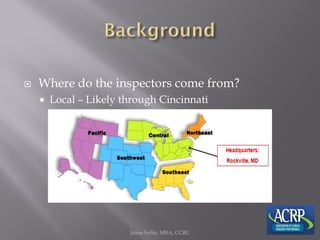
 Where do the inspectors come from?
 Local – Likely through Cincinnati
Jason Soltis, MBA, CCRC
 When you are contacted
 Notify all staff involved in AND/OR knowledgeable
about the study
 Notify applicable Sponsors/IRBs/CRO
 Get your study materials out of storage/archives
 If an agenda is presented before an inspection
 Great – get working on the list
 Assign a site escort/facilitator
 Assign subject experts
 Review institutional procedures
 Site SOPs – should be updated approximately every 2
years
Jason Soltis, MBA, CCRC
 When you are contacted – cont’d
 Assemble all study documents in one place
 Review staff responsibilities & training
 Request all patient charts – ensure 21CFRpart11
compliance and access to electronic medical records
 Prepare a list of:
 Investigator’s studies
 Any SAEs
 Numbers of enrolled/screen failures/Lost to Follow-up
 Any pregnancies/deaths
 Percent of total enrollments consented and/or enrolled by
the PI
 Protocol violations – be knowledgeable/aware of these
 Etc.
Jason Soltis, MBA, CCRC
 When you are contacted – cont’d
 Timelines – be prepared to answer questions in this
area
 When was the first subject enrolled?
 When data entry was completed?
 How often did the site review electronic diary data for
safety – when first able to access the site?
 When was the first subject enrolled under the subsequent
amendment? Etc.
 Reserve adequate work space – away from
traffic/water cooler talk
 Keep chatter/gossip exposure to a minimum
Jason Soltis, MBA, CCRC
 Upon Inspector Arrival
 Ask for them to display:
 Their credentials/badge, expiration date
 Form FDA 482 – Notice of Inspection
 These do not contain information for the cause of the
inspection. Serves as an official, form notice of inspection.
 Take notes throughout inspection process
 Inspection normally during business hours
 Inspectors should be aware of your operating hours but
be prepared to accommodate some as you do not want
to hinder the inspector’s ability to complete their work
Jason Soltis, MBA, CCRC
 Opening Meeting
 Allow time for the inspector to get settled
 Promptly review the agenda and inform the inspector of
the landscape of study materials available
 Indicate the available office equipment
 Identify an individual as the FDA contact person
 Do show the inspector the location of the restroom
 Must otherwise have an escort when navigating the
building.
 Determine purpose and scope of the inspection
 Discuss agenda, logistics, phone, photocopier
requirements, etc
Jason Soltis, MBA, CCRC
 The Inspection
 Personnel interviews
 Have subject experts predetermined
 Redirect questions you cannot answer to appropriate staff –
(i.e., if you were the study phlebotomist – don’t try
answering site delegation log/regulatory questions unless
that was also your role. Have the person best equipped
handle those types of questions.)
 The inspector may request to interview any staff
member directly involved in the study conduct
 Fair game – PI (should make themselves available
regardless) and Sub-Is, Study Coordinator, Pharmacists,
Laboratory Personnel, Regulatory Staff
Jason Soltis, MBA, CCRC
 The Inspection
 Personnel interviews – cont’d
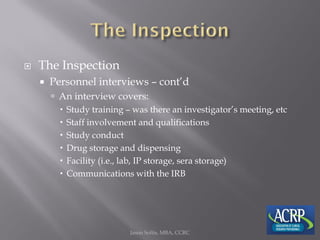
 An interview covers:
 Study training – was there an investigator’s meeting, etc
 Staff involvement and qualifications
 Study conduct
 Drug storage and dispensing
 Facility (i.e., lab, IP storage, sera storage)
 Communications with the IRB
Jason Soltis, MBA, CCRC
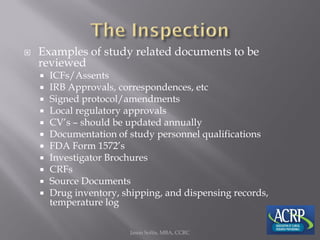
 Examples of study related documents to be
reviewed
 ICFs/Assents
 IRB Approvals, correspondences, etc
 Signed protocol/amendments
 Local regulatory approvals
 CV’s – should be updated annually
 Documentation of study personnel qualifications
 FDA Form 1572’s
 Investigator Brochures
 CRFs
 Source Documents
 Drug inventory, shipping, and dispensing records,
temperature log
Jason Soltis, MBA, CCRC
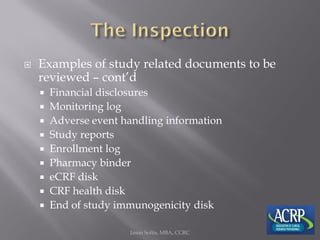
 Examples of study related documents to be
reviewed – cont’d
 Financial disclosures
 Monitoring log
 Adverse event handling information
 Study reports
 Enrollment log
 Pharmacy binder
 eCRF disk
 CRF health disk
 End of study immunogenicity disk
Jason Soltis, MBA, CCRC
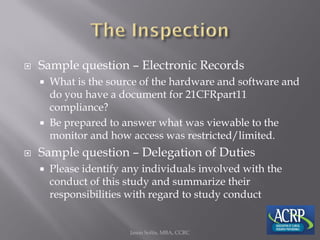
 Sample question – Electronic Records
 What is the source of the hardware and software and
do you have a document for 21CFRpart11
compliance?
 Be prepared to answer what was viewable to the
monitor and how access was restricted/limited.
 Sample question – Delegation of Duties
 Please identify any individuals involved with the
conduct of this study and summarize their
responsibilities with regard to study conduct
Jason Soltis, MBA, CCRC
 Other interview topics
 Facility
 Subject recruitment
 Study conduct
 PI oversight – How did you assure adequate PI oversight for the study?
 Staff involvement (blinded/unblinded)
 Training
 ICF process
 Evaluation of labs/test results
 Communications and interactions with Sponsor, IRB, Investigators, CRO,
Lab, Data management, etc
 Data transcription from source to eCRFs
 Drug storage and dispensing
 Monitoring activities
 Computer systems
 eCRF data system entry
 eDiary review
Jason Soltis, MBA, CCRC
 The Do’s
 Do assume a friendly, open, honest, professional, polite,
cooperative attitude
 But…don’t over do it
 Do project an attitude of confidence and professionalism
 Do make sure you understand all questions and their contexts
before you answer
 Ask for clarification, if needed
 Repeat questions back to the inspector to be clear
 Answer succintly
 Do make extra copies for site records of inspection
 Do take notes of your discussions
 Note what was asked, what was answered
 Record any items requested by or promised to FDA
 Do take the inspection as a learning experience! Don’t be
intimidated.
Jason Soltis, MBA, CCRC
 The Don’ts
 Don’t guess, lie, deny the obvious, or make
misleading statements, be evasive
 Don’t engage in unconstructive arguments with the
inspector
 Don’t volunteer information
 Don’t volunteer tours of the facility
 If they do not ask, do not offer to show them
 Don’t offer special favors
Jason Soltis, MBA, CCRC
 The Don’ts – cont’d
 Don’t respond to questions outside your area of
expertise or responsibility
 Do not rely on memory, refer to the protocol, SOPs, etc
 If you do not know the answer, say so
 Do not give false, misleading information
 Don’t attempt to answer “what if” questions –
always refer to facts
 Do not answer leading questions
 Don’t delay in providing requested records or copies
 Delays may be perceived as suspicious to an inspector
Jason Soltis, MBA, CCRC
 The Don’ts – cont’d
 Don’t contradict something being said by a colleague
 Confirm the correct answer in private
 Follow-up with the correct information
 Don’t offer audit reports/findings from internal or sponsor
audits
 Don’t give copies of patient names/personal identifiers
 Patient names and other personal identifiers on the inspector’s
copies should be redacted and replaced with study subject
number and initials only
 Post-it notes work well for photocopying
 Ideally, copies supplied to the inspector should be stamped
“confidential”
Jason Soltis, MBA, CCRC
 The exit meeting
 Take notes
 You could get offered “read between the lines” tips for
your response
 Have the PI available - is responsible for the conduct
of the study at the site
 The inspector may present a FDA Form 483
 This is a list of observations the inspector found
objectionable
 Should be nonconformities with FDA regulations
 May be any deviations to the protocol, lack of proper
documentation of study procedures, may be violations of
temporary exclusion/study delay criteria
Jason Soltis, MBA, CCRC
 The exit meeting
 The inspector may present a FDA Form 483 – cont’d
 Does not represent a final Agency determination of
your compliance.
 If you have an objection regarding an observation, or
have implemented, or plan to implement, corrective
action in response to an observation, you may discuss
the objection or action with the FDA representative
during the inspection or submit this information to the
address provided in the 483.
 The inspector may not present you a FDA Form 483
 Good job
Jason Soltis, MBA, CCRC
 Responding to a FDA Form 483
 Prepare and submit a response to the Agency within
2 weeks (recommended)
 State how and when you intend to correct findings
 Be descriptive, provide examples/exhibits
 “Preventative” vs “Corrective” actions
 It is better to indicate step implemented to prevent the
same mistake from ever occurring again.
 Acknowledge the findings if they are accurate
 If you disagree, give reasons, referencing regulations
Jason Soltis, MBA, CCRC
 What happens after you submit a response to
the FDA?
 The post-inspection activities inspector composes an
Establishment Inspection Report (EIR)
 Composes a Warning Letter (if applicable)
 Issues EIR with supporting documentation to FDA
HQ
 FDA HQ reviews documents and gives a rating
 FDA provides EIR to the site
 This is the government – may take several months for a
response
Jason Soltis, MBA, CCRC
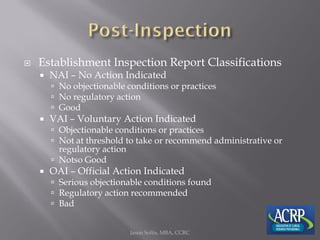
 Establishment Inspection Report Classifications
 NAI – No Action Indicated
 No objectionable conditions or practices
 No regulatory action
 Good
 VAI – Voluntary Action Indicated
 Objectionable conditions or practices
 Not at threshold to take or recommend administrative or
regulatory action
 Notso Good
 OAI – Official Action Indicated
 Serious objectionable conditions found
 Regulatory action recommended
 Bad
Jason Soltis, MBA, CCRC
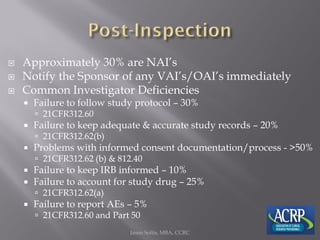
 Approximately 30% are NAI’s
 Notify the Sponsor of any VAI’s/OAI’s immediately
 Common Investigator Deficiencies
 Failure to follow study protocol – 30%
 21CFR312.60
 Failure to keep adequate & accurate study records – 20%
 21CFR312.62(b)
 Problems with informed consent documentation/process - >50%
 21CFR312.62 (b) & 812.40
 Failure to keep IRB informed – 10%
 Failure to account for study drug – 25%
 21CFR312.62(a)
 Failure to report AEs – 5%
 21CFR312.60 and Part 50
Jason Soltis, MBA, CCRC
 Recent Inspection Findings: General
 Study oversight
 Lack of involvement of Principal Investigator
 Subject existence
 No confirmation of identity of volunteers
 Subject confidentiality
 Subject details sent into Sponsor company
 Ineligible subjects enrolled
 SAEs not reported to Sponsor and/or IRB
 Records/CRF with numerous write-over corrections
 Lacked dates and initials
Jason Soltis, MBA, CCRC
 Recent Inspection Findings: Informed Consent
 Missing elements
 Not updated with protocol amendments
 Incorrect form used
 Version control
 Language
 Unclear process
 Provide some documentation of any questions asked in
your source and be sure to indicate the time the ICF
process was conducted
Jason Soltis, MBA, CCRC
 You’re not in this alone – Sponsors are just as interested in inspection
success as you are. They will help you answer questions and possibly
provide additional information. They will provide you counsel.
 Become familiar with your inspection resources
 References attached
 A clinical research motto to live by is “Be inspection ready at all
times”
 Finish each study out as though it will be inspected
 Have all documents organized – i.e., subject visit tabs, communication
filing (an ongoing process)
 Facilitate the flow of work for the inspector
 If the study has been closed – do not alter materials in any way. (i.e.,
too late for corrections)
 Yes – the world does stop for an inspection, in a sense (i.e., cancel
vacations/trips/out of office time…)
 BUT the research departments do not have to shut down. Just make sure you
have the appropriate personnel available to work alongside the inspector.
Schedule staff accordingly.
Jason Soltis, MBA, CCRC
 FDA BIMO - Compliance Program Guidance
Manual (CPMG 7348.811)
http://www.fda.gov/downloads/ICECI/Enfo
rcementActions/BioresearchMonitoring/UCM
133773.pdf
 FDA – Information Sheet Guidance
http://www.fda.gov/downloads/RegulatoryI
nformation/Guidances/UCM126555.pdf
 FDA - Warning Letters
http://www.fda.gov/ICECI/EnforcementActi
ons/WarningLetters/default.htm
Jason Soltis, MBA, CCRC

FDA Inspections_jasonsoltisMBAccrc_ACRPpresentation2012

  • 1.
  • 2.
    Preparing for YourEducational Experience Jason Soltis, MBA, CCRC
  • 3.
     Program/Presentation Objectives 1.Identify why Regulatory Agencies inspect Clinical Investigators? What are inspectors like? Who could be inspected? How long will the inspection take? 2. Outline the process needed to prepare for an FDA Inspection – Starting from Pre-inspection to Post- inspection and everything in between. 3. Incorporate examples of a successful inspection to streamline your inspection visit and to keep yourself “relatively” stress-free. Jason Soltis, MBA, CCRC
  • 4.
     Why doRegulatory Agencies inspect Clinical Investigators?  “To ensure the safety, quality and efficacy of medical products/devices, Regulatory Agencies may perform GCP inspections either during or after a study is completed.”  Common goal – to ensure safety, quality, efficacy of marketed product Jason Soltis, MBA, CCRC
  • 5.
     Why wasmy site selected?  The Agency will not usually inform you or the sponsor of the type of inspection to be performed.  Take all inspections seriously and be prepared!  Inspectors must comply with their SOPs for inspection. They will inspect against GCP and local regulations. Jason Soltis, MBA, CCRC
  • 6.
     Why wasmy site selected?  Regulatory Agencies typically select a few sites for inspection. The inspections may be classified as either routine or for-cause.  You were/are a high enroller (usually in the top 3)  You had/have data that significantly differs from other sites  You were selected as a representative random sample  Agency’s prior experience with the investigator  Study outside area of investigator expertise  Approximately 3 sites per pivotal study  Within 1-6 months of any regulatory submission Jason Soltis, MBA, CCRC
  • 7.
     Why wasmy site selected? cont’d  For-cause Inspections  There may be issues with the quality and/or integrity of the data;  There may be issues where the rights of subjects may have infringed  A Regulatory Agency may have received a “complaint” from someone. Jason Soltis, MBA, CCRC
  • 8.
     Who willnotify me of the inspection?  Sometimes the agency will inform the sponsor of selected sites and the sponsor will alert you.  If you are first notified by the agency or if an agency inspector arrives unannounced, please immediately inform your monitor.  Typically short advance notice – 1-2 weeks  In some cases, somewhat compassionate inspectors will call you in advance and send you a list of materials to have prepared  Best to have all of the items on the list ready upon their visit if that is the case Jason Soltis, MBA, CCRC
  • 9.
     Who couldbe inspected?  Investigators and Study Coordinators  Sponsor  Contract Research Organization  Central Laboratories and Readers  Pharmacy (i.e., Investigational Drug Services)  IRB Jason Soltis, MBA, CCRC
  • 10.
     How longwill the inspection take?  Typical – about 1 week  Depends on the amount of data to be reviewed at your site  Clear your schedule  How many agency inspectors will conduct the inspection?  Normally – one or two Jason Soltis, MBA, CCRC
  • 11.
     What areinspectors like?  They are all different  They are individuals with their own personalities  The approach they take to the inspection will depend on their personalities and experience  Difficult to predict unless you have had a past experience with that inspector  They are professionals. They will be serious about accomplishing their mission. They will be very data- driven.  They will not offer perspective or aid so you must be prepared to “read between the lines”  They may pose questions in such a way that gets you to offer more information than was actually asked. Jason Soltis, MBA, CCRC
  • 12.
     Where dothe inspectors come from?  Local – Likely through Cincinnati Jason Soltis, MBA, CCRC
  • 13.
     When youare contacted  Notify all staff involved in AND/OR knowledgeable about the study  Notify applicable Sponsors/IRBs/CRO  Get your study materials out of storage/archives  If an agenda is presented before an inspection  Great – get working on the list  Assign a site escort/facilitator  Assign subject experts  Review institutional procedures  Site SOPs – should be updated approximately every 2 years Jason Soltis, MBA, CCRC
  • 14.
     When youare contacted – cont’d  Assemble all study documents in one place  Review staff responsibilities & training  Request all patient charts – ensure 21CFRpart11 compliance and access to electronic medical records  Prepare a list of:  Investigator’s studies  Any SAEs  Numbers of enrolled/screen failures/Lost to Follow-up  Any pregnancies/deaths  Percent of total enrollments consented and/or enrolled by the PI  Protocol violations – be knowledgeable/aware of these  Etc. Jason Soltis, MBA, CCRC
  • 15.
     When youare contacted – cont’d  Timelines – be prepared to answer questions in this area  When was the first subject enrolled?  When data entry was completed?  How often did the site review electronic diary data for safety – when first able to access the site?  When was the first subject enrolled under the subsequent amendment? Etc.  Reserve adequate work space – away from traffic/water cooler talk  Keep chatter/gossip exposure to a minimum Jason Soltis, MBA, CCRC
  • 16.
     Upon InspectorArrival  Ask for them to display:  Their credentials/badge, expiration date  Form FDA 482 – Notice of Inspection  These do not contain information for the cause of the inspection. Serves as an official, form notice of inspection.  Take notes throughout inspection process  Inspection normally during business hours  Inspectors should be aware of your operating hours but be prepared to accommodate some as you do not want to hinder the inspector’s ability to complete their work Jason Soltis, MBA, CCRC
  • 17.
     Opening Meeting Allow time for the inspector to get settled  Promptly review the agenda and inform the inspector of the landscape of study materials available  Indicate the available office equipment  Identify an individual as the FDA contact person  Do show the inspector the location of the restroom  Must otherwise have an escort when navigating the building.  Determine purpose and scope of the inspection  Discuss agenda, logistics, phone, photocopier requirements, etc Jason Soltis, MBA, CCRC
  • 18.
     The Inspection Personnel interviews  Have subject experts predetermined  Redirect questions you cannot answer to appropriate staff – (i.e., if you were the study phlebotomist – don’t try answering site delegation log/regulatory questions unless that was also your role. Have the person best equipped handle those types of questions.)  The inspector may request to interview any staff member directly involved in the study conduct  Fair game – PI (should make themselves available regardless) and Sub-Is, Study Coordinator, Pharmacists, Laboratory Personnel, Regulatory Staff Jason Soltis, MBA, CCRC
  • 19.
     The Inspection Personnel interviews – cont’d  An interview covers:  Study training – was there an investigator’s meeting, etc  Staff involvement and qualifications  Study conduct  Drug storage and dispensing  Facility (i.e., lab, IP storage, sera storage)  Communications with the IRB Jason Soltis, MBA, CCRC
  • 20.
     Examples ofstudy related documents to be reviewed  ICFs/Assents  IRB Approvals, correspondences, etc  Signed protocol/amendments  Local regulatory approvals  CV’s – should be updated annually  Documentation of study personnel qualifications  FDA Form 1572’s  Investigator Brochures  CRFs  Source Documents  Drug inventory, shipping, and dispensing records, temperature log Jason Soltis, MBA, CCRC
  • 21.
     Examples ofstudy related documents to be reviewed – cont’d  Financial disclosures  Monitoring log  Adverse event handling information  Study reports  Enrollment log  Pharmacy binder  eCRF disk  CRF health disk  End of study immunogenicity disk Jason Soltis, MBA, CCRC
  • 22.
     Sample question– Electronic Records  What is the source of the hardware and software and do you have a document for 21CFRpart11 compliance?  Be prepared to answer what was viewable to the monitor and how access was restricted/limited.  Sample question – Delegation of Duties  Please identify any individuals involved with the conduct of this study and summarize their responsibilities with regard to study conduct Jason Soltis, MBA, CCRC
  • 23.
     Other interviewtopics  Facility  Subject recruitment  Study conduct  PI oversight – How did you assure adequate PI oversight for the study?  Staff involvement (blinded/unblinded)  Training  ICF process  Evaluation of labs/test results  Communications and interactions with Sponsor, IRB, Investigators, CRO, Lab, Data management, etc  Data transcription from source to eCRFs  Drug storage and dispensing  Monitoring activities  Computer systems  eCRF data system entry  eDiary review Jason Soltis, MBA, CCRC
  • 24.
     The Do’s Do assume a friendly, open, honest, professional, polite, cooperative attitude  But…don’t over do it  Do project an attitude of confidence and professionalism  Do make sure you understand all questions and their contexts before you answer  Ask for clarification, if needed  Repeat questions back to the inspector to be clear  Answer succintly  Do make extra copies for site records of inspection  Do take notes of your discussions  Note what was asked, what was answered  Record any items requested by or promised to FDA  Do take the inspection as a learning experience! Don’t be intimidated. Jason Soltis, MBA, CCRC
  • 25.
     The Don’ts Don’t guess, lie, deny the obvious, or make misleading statements, be evasive  Don’t engage in unconstructive arguments with the inspector  Don’t volunteer information  Don’t volunteer tours of the facility  If they do not ask, do not offer to show them  Don’t offer special favors Jason Soltis, MBA, CCRC
  • 26.
     The Don’ts– cont’d  Don’t respond to questions outside your area of expertise or responsibility  Do not rely on memory, refer to the protocol, SOPs, etc  If you do not know the answer, say so  Do not give false, misleading information  Don’t attempt to answer “what if” questions – always refer to facts  Do not answer leading questions  Don’t delay in providing requested records or copies  Delays may be perceived as suspicious to an inspector Jason Soltis, MBA, CCRC
  • 27.
     The Don’ts– cont’d  Don’t contradict something being said by a colleague  Confirm the correct answer in private  Follow-up with the correct information  Don’t offer audit reports/findings from internal or sponsor audits  Don’t give copies of patient names/personal identifiers  Patient names and other personal identifiers on the inspector’s copies should be redacted and replaced with study subject number and initials only  Post-it notes work well for photocopying  Ideally, copies supplied to the inspector should be stamped “confidential” Jason Soltis, MBA, CCRC
  • 28.
     The exitmeeting  Take notes  You could get offered “read between the lines” tips for your response  Have the PI available - is responsible for the conduct of the study at the site  The inspector may present a FDA Form 483  This is a list of observations the inspector found objectionable  Should be nonconformities with FDA regulations  May be any deviations to the protocol, lack of proper documentation of study procedures, may be violations of temporary exclusion/study delay criteria Jason Soltis, MBA, CCRC
  • 29.
     The exitmeeting  The inspector may present a FDA Form 483 – cont’d  Does not represent a final Agency determination of your compliance.  If you have an objection regarding an observation, or have implemented, or plan to implement, corrective action in response to an observation, you may discuss the objection or action with the FDA representative during the inspection or submit this information to the address provided in the 483.  The inspector may not present you a FDA Form 483  Good job Jason Soltis, MBA, CCRC
  • 30.
     Responding toa FDA Form 483  Prepare and submit a response to the Agency within 2 weeks (recommended)  State how and when you intend to correct findings  Be descriptive, provide examples/exhibits  “Preventative” vs “Corrective” actions  It is better to indicate step implemented to prevent the same mistake from ever occurring again.  Acknowledge the findings if they are accurate  If you disagree, give reasons, referencing regulations Jason Soltis, MBA, CCRC
  • 31.
     What happensafter you submit a response to the FDA?  The post-inspection activities inspector composes an Establishment Inspection Report (EIR)  Composes a Warning Letter (if applicable)  Issues EIR with supporting documentation to FDA HQ  FDA HQ reviews documents and gives a rating  FDA provides EIR to the site  This is the government – may take several months for a response Jason Soltis, MBA, CCRC
  • 32.
     Establishment InspectionReport Classifications  NAI – No Action Indicated  No objectionable conditions or practices  No regulatory action  Good  VAI – Voluntary Action Indicated  Objectionable conditions or practices  Not at threshold to take or recommend administrative or regulatory action  Notso Good  OAI – Official Action Indicated  Serious objectionable conditions found  Regulatory action recommended  Bad Jason Soltis, MBA, CCRC
  • 33.
     Approximately 30%are NAI’s  Notify the Sponsor of any VAI’s/OAI’s immediately  Common Investigator Deficiencies  Failure to follow study protocol – 30%  21CFR312.60  Failure to keep adequate & accurate study records – 20%  21CFR312.62(b)  Problems with informed consent documentation/process - >50%  21CFR312.62 (b) & 812.40  Failure to keep IRB informed – 10%  Failure to account for study drug – 25%  21CFR312.62(a)  Failure to report AEs – 5%  21CFR312.60 and Part 50 Jason Soltis, MBA, CCRC
  • 34.
     Recent InspectionFindings: General  Study oversight  Lack of involvement of Principal Investigator  Subject existence  No confirmation of identity of volunteers  Subject confidentiality  Subject details sent into Sponsor company  Ineligible subjects enrolled  SAEs not reported to Sponsor and/or IRB  Records/CRF with numerous write-over corrections  Lacked dates and initials Jason Soltis, MBA, CCRC
  • 35.
     Recent InspectionFindings: Informed Consent  Missing elements  Not updated with protocol amendments  Incorrect form used  Version control  Language  Unclear process  Provide some documentation of any questions asked in your source and be sure to indicate the time the ICF process was conducted Jason Soltis, MBA, CCRC
  • 36.
     You’re notin this alone – Sponsors are just as interested in inspection success as you are. They will help you answer questions and possibly provide additional information. They will provide you counsel.  Become familiar with your inspection resources  References attached  A clinical research motto to live by is “Be inspection ready at all times”  Finish each study out as though it will be inspected  Have all documents organized – i.e., subject visit tabs, communication filing (an ongoing process)  Facilitate the flow of work for the inspector  If the study has been closed – do not alter materials in any way. (i.e., too late for corrections)  Yes – the world does stop for an inspection, in a sense (i.e., cancel vacations/trips/out of office time…)  BUT the research departments do not have to shut down. Just make sure you have the appropriate personnel available to work alongside the inspector. Schedule staff accordingly. Jason Soltis, MBA, CCRC
  • 37.
     FDA BIMO- Compliance Program Guidance Manual (CPMG 7348.811) http://www.fda.gov/downloads/ICECI/Enfo rcementActions/BioresearchMonitoring/UCM 133773.pdf  FDA – Information Sheet Guidance http://www.fda.gov/downloads/RegulatoryI nformation/Guidances/UCM126555.pdf  FDA - Warning Letters http://www.fda.gov/ICECI/EnforcementActi ons/WarningLetters/default.htm Jason Soltis, MBA, CCRC