
Foundation Course
on
Information Technology
Ankit Rajpal
Assistant Professor
Dept. of Computer Science
DDUC
UNIT 4- Internet, Security & Legal Aspects
Topics to be covered
Network, Internet, History – important people, events and agencies
Major Internet Services – WWW, Email , File Transfer, Chat, Instant Messaging WWW Web Page - Linked Pages, URL, Websites, Browser, connecting to Internet – Dial Up, LAN,
WiFi, Mobile.
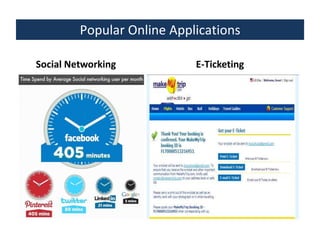
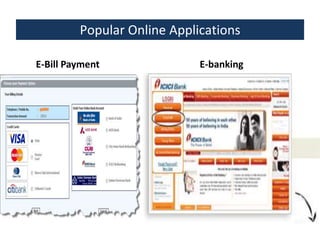
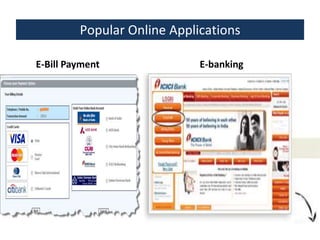
Popular Online Applications - social networking, e-ticketing, e-banking, bill pay and epayment etc.
The ill effects of Internet
-virus, malware, spam, phishing, copyright, cybercrime, addiction, health issues,
environmental impact, plagiarism , emotional torture, abuse, defamation.
Ways to minimize ill effects
-Improved search, Back up, Password management, Encryption, digital signature, net
etiquettes
Information Legal Literacy
- IT Act 2000 : Offenses and penalties
Copyright and problems thereof; Open Source Philosophy, Licensing of Open source,
Open source development
Popular Open source software
- Linux, Open office, Gimp, Mobile apps
Network and Internet
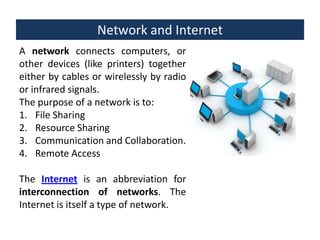
A network connects computers, or
other devices (like printers) together
either by cables or wirelessly by radio
or infrared signals.
The purpose of a network is to:
1. File Sharing
2. Resource Sharing
3. Communication and Collaboration.
4. Remote Access
The Internet is an abbreviation for
interconnection of networks. The
Internet is itself a type of network.
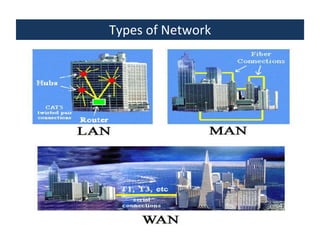
Types of Network
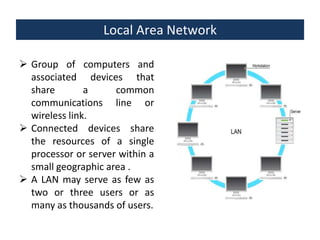
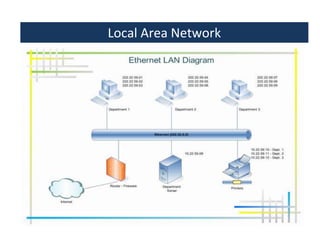
Local Area Network
 Group of computers and
associated devices that
share
a
common
communications line or
wireless link.
 Connected devices share
the resources of a single
processor or server within a
small geographic area .
 A LAN may serve as few as
two or three users or as
many as thousands of users.
Local Area Network
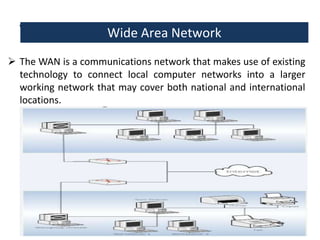
Wide Area Network: Network
Wide Area
 The WAN is a communications network that makes use of existing
technology to connect local computer networks into a larger
working network that may cover both national and international
locations.

7
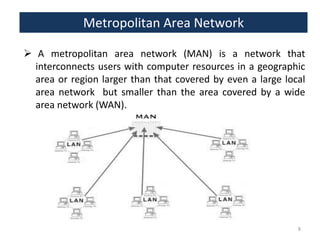
Metropolitan Area Network
 A metropolitan area network (MAN) is a network that
interconnects users with computer resources in a geographic
area or region larger than that covered by even a large local
area network but smaller than the area covered by a wide
area network (WAN).

8
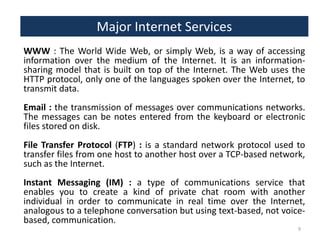
Major Internet Services
WWW : The World Wide Web, or simply Web, is a way of accessing
information over the medium of the Internet. It is an informationsharing model that is built on top of the Internet. The Web uses the
HTTP protocol, only one of the languages spoken over the Internet, to
transmit data.
Email : the transmission of messages over communications networks.
The messages can be notes entered from the keyboard or electronic
files stored on disk.
File Transfer Protocol (FTP) : is a standard network protocol used to
transfer files from one host to another host over a TCP-based network,
such as the Internet.
Instant Messaging (IM) : a type of communications service that
enables you to create a kind of private chat room with another
individual in order to communicate in real time over the Internet,
analogous to a telephone conversation but using text-based, not voicebased, communication.
9
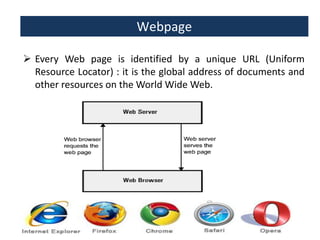
Webpage
 Every Web page is identified by a unique URL (Uniform
Resource Locator) : it is the global address of documents and
other resources on the World Wide Web.
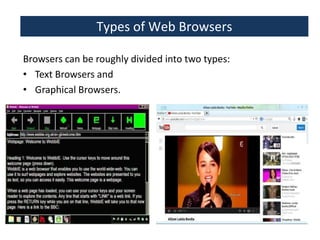
Types of Web Browsers
Browsers can be roughly divided into two types:
• Text Browsers and
• Graphical Browsers.
Connecting to Internet
 Dial-Up Networking : an analog Internet connection is both
economical and slow. Using a modem connected to your PC,
users connect to the Internet when the computer dials a
phone number (which is provided by your ISP) and connects
to the network.
 DSL – Digital Subscriber Line: service is delivered
simultaneously with wired telephone service -- it will not tie
up your phone line as an analog dial-up connection does. The
two main categories of DSL for home subscribers are called
ADSL and SDSL.
Connecting to Internet
 Cable Broadband Internet Connection : a broadband Internet
connection that is designed to operate over cable TV lines.
 WiFi : is the name of a popular wireless networking
technology that uses radio waves to provide wireless highspeed Internet and network connections. A common
misconception is that the term Wi-Fi is short for "wireless
fidelity“.
 Mobile Internet : The first wireless Internet access became
available in 1991 as part of the second generation (2G) of
mobile phone technology. Higher speeds became available in
2001 and 2006 as part of the third (3G) and fourth (4G)
generations.
Popular Online Applications
Social Networking

E-Ticketing
Popular Online Applications
E-Bill Payment

E-banking
Popular Online Applications
E-Bill Payment

E-banking
Ill Effects of Internet
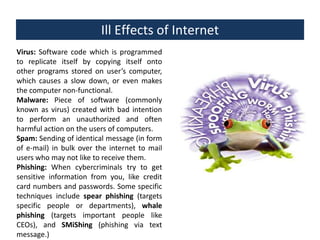
Virus: Software code which is programmed
to replicate itself by copying itself onto
other programs stored on user’s computer,
which causes a slow down, or even makes
the computer non-functional.
Malware: Piece of software (commonly
known as virus) created with bad intention
to perform an unauthorized and often
harmful action on the users of computers.
Spam: Sending of identical message (in form
of e-mail) in bulk over the internet to mail
users who may not like to receive them.
Phishing: When cybercriminals try to get
sensitive information from you, like credit
card numbers and passwords. Some specific
techniques include spear phishing (targets
specific people or departments), whale
phishing (targets important people like
CEOs), and SMiShing (phishing via text
message.)
Important Terms of Internet
Copyright: Set of rules, framed as laws, meant
to provide protection to the authors or
creators of ‘original works’, which includes
works of drama, music, literature, art and
certain other intellectual creations in both
published and unpublished category.
Cybercrime: Some forms of the cyber crimes
are listed below:• Generating spam mails.
• Cyber terrorism.
• Hacking.
• Phishing/ Fraud.
• Drug Trafficking.
• Disseminating/ sending obscene or
offensive messages via chat/emails, blog.
• publishing websites with obscene or
offensive content.
Plagiarism
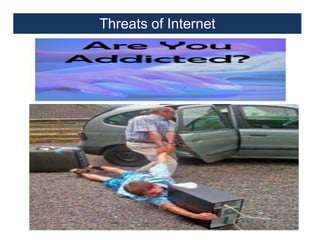
Threats of Internet
Internet Addiction

• Internet – The New Way of
Communication
• A Growing Epidemic
• Internet Addiction Disorders
Internet Addiction Disorder (IAD)
• Internet addiction disorder (IAD) is excessive
computer use that interferes with daily life.
• IAD was originally proposed as a disorder by Ivan
Goldberg in 1995.
• He took pathological gambling as diagnosed by the
Diagnostic and Statistical Manual of Mental Disorders
(DSM-IV) as his model for the description of IAD.
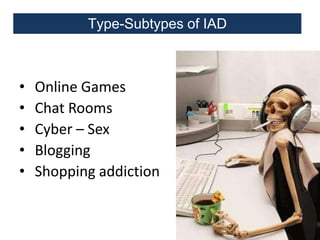
Type-Subtypes of IAD

•
•
•
•
•

Online Games
Chat Rooms
Cyber – Sex
Blogging
Shopping addiction
Symptoms of IAD

• Constantly thinking and talking about
internet
• Not being able to limit time online
• Prefer online communication rather than
real one, etc.
Problems of Internet Addiction

• Ruined marriages and dating
relationships,
• Ruined parent-child relationships,
• Close friendships
• Neglecting family activities, social
events, work, school.
Academic Problems
•
•
•
•
•
•

Decline in study habits
Significant drop in grades
Missed classes
Surfing irrelevant web sites
Engage in chat room gossip
Playing interactive games at the cost of
productive activity
Ways to minimize the Ill Effects
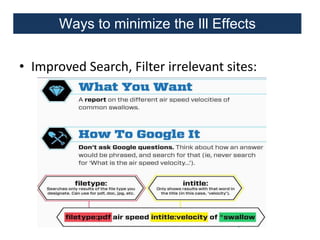
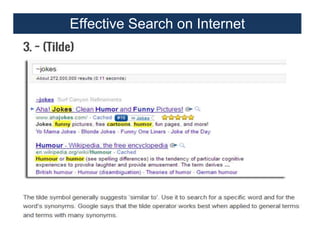
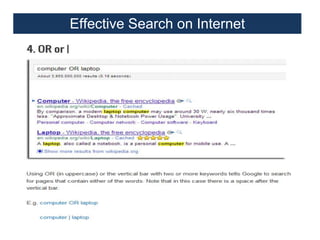
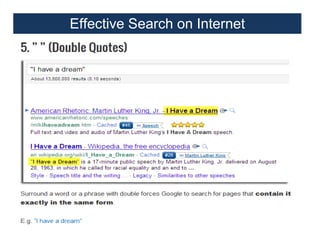
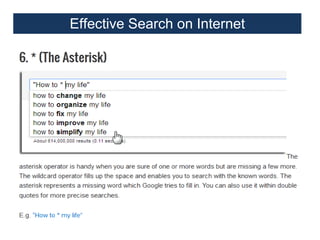
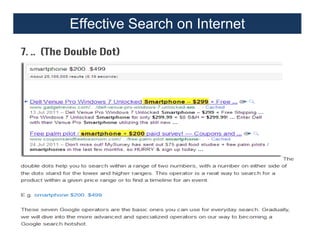
• Improved Search, Filter irrelevant sites:
Effective Search on Internet
Ways to deal with Ill Effects of Internet
Backup: Copying and archiving of computer data so that it may be used to restore the
original after a data loss event.
Password manager : software that helps a user organize passwords and PIN codes. The
software typically has a local database or a file that holds the encrypted password data for
secure logon onto computers, networks, web sites and application data files.
Encryption: process of encoding messages (or information) in such a way that hackers
cannot read it, but that authorized parties can. In an encryption scheme, the message or
information (referred to as plaintext) is encrypted using an encryption algorithm, turning
it into an unreadable ciphertext.
Digital signature: mathematical scheme for demonstrating the authenticity of a digital
message or document. A valid digital signature gives a recipient reason to believe that the
message was created by a known sender, such that the sender cannot deny having sent
the message (authentication and non-repudiation). Digital signatures are commonly used
for financial transactions and where it is important to detect forgery.
Net Etiquettes…..
Information Legal Literacy
• The Information Technology Act (or The IT
Act) which came into effect in 2000, is the
legal recognition of electronic transactions
in India. It provides legal support to the
computer users against cyber crimes.
• Substantial amendments have been made
to the IT Act 2000 through the IT
Amendment Act 2008, which was
approved by both the houses of the Indian
Parliament in Dec 2008.
Licenses: GPL
The GNU General Public License (GNU GPL or GPL) is the most widely
used free software license, which guarantees end users (individuals,
organizations, companies) the freedoms to use, study, share (copy),
and modify the software. Software that ensures that these rights are
retained is called free software. General Public License v3
• Created by Richard Stallman
• Fundamental example of an open-source license.
• Highly restrictive.
What is open source?
• Source code is free to look at.
• Compiled application is (typically) free to use.

• Licensed under one of many OSS licenses.
• Licenses are typically GPL compatible.
Popular Open source software
• Linux Kernel
• BSD (Berkeley Software Distribution) -Derived Operating
Systems
• Mozilla Firefox
• OpenOffice.org
• Apache Web Server
• Many, Many, Many more
Contributors to open source
Foundation Course: Information Technology UNIT 4

Foundation Course: Information Technology UNIT 4

  • 1.
    Foundation Course on Information Technology AnkitRajpal Assistant Professor Dept. of Computer Science DDUC
  • 2.
    UNIT 4- Internet,Security & Legal Aspects Topics to be covered Network, Internet, History – important people, events and agencies Major Internet Services – WWW, Email , File Transfer, Chat, Instant Messaging WWW Web Page - Linked Pages, URL, Websites, Browser, connecting to Internet – Dial Up, LAN, WiFi, Mobile. Popular Online Applications - social networking, e-ticketing, e-banking, bill pay and epayment etc. The ill effects of Internet -virus, malware, spam, phishing, copyright, cybercrime, addiction, health issues, environmental impact, plagiarism , emotional torture, abuse, defamation. Ways to minimize ill effects -Improved search, Back up, Password management, Encryption, digital signature, net etiquettes Information Legal Literacy - IT Act 2000 : Offenses and penalties Copyright and problems thereof; Open Source Philosophy, Licensing of Open source, Open source development Popular Open source software - Linux, Open office, Gimp, Mobile apps
  • 3.
    Network and Internet Anetwork connects computers, or other devices (like printers) together either by cables or wirelessly by radio or infrared signals. The purpose of a network is to: 1. File Sharing 2. Resource Sharing 3. Communication and Collaboration. 4. Remote Access The Internet is an abbreviation for interconnection of networks. The Internet is itself a type of network.
  • 4.
  • 5.
    Local Area Network Group of computers and associated devices that share a common communications line or wireless link.  Connected devices share the resources of a single processor or server within a small geographic area .  A LAN may serve as few as two or three users or as many as thousands of users.
  • 6.
  • 7.
    Wide Area Network:Network Wide Area  The WAN is a communications network that makes use of existing technology to connect local computer networks into a larger working network that may cover both national and international locations. 7
  • 8.
    Metropolitan Area Network A metropolitan area network (MAN) is a network that interconnects users with computer resources in a geographic area or region larger than that covered by even a large local area network but smaller than the area covered by a wide area network (WAN). 8
  • 9.
    Major Internet Services WWW: The World Wide Web, or simply Web, is a way of accessing information over the medium of the Internet. It is an informationsharing model that is built on top of the Internet. The Web uses the HTTP protocol, only one of the languages spoken over the Internet, to transmit data. Email : the transmission of messages over communications networks. The messages can be notes entered from the keyboard or electronic files stored on disk. File Transfer Protocol (FTP) : is a standard network protocol used to transfer files from one host to another host over a TCP-based network, such as the Internet. Instant Messaging (IM) : a type of communications service that enables you to create a kind of private chat room with another individual in order to communicate in real time over the Internet, analogous to a telephone conversation but using text-based, not voicebased, communication. 9
  • 10.
    Webpage  Every Webpage is identified by a unique URL (Uniform Resource Locator) : it is the global address of documents and other resources on the World Wide Web.
  • 11.
    Types of WebBrowsers Browsers can be roughly divided into two types: • Text Browsers and • Graphical Browsers.
  • 12.
    Connecting to Internet Dial-Up Networking : an analog Internet connection is both economical and slow. Using a modem connected to your PC, users connect to the Internet when the computer dials a phone number (which is provided by your ISP) and connects to the network.  DSL – Digital Subscriber Line: service is delivered simultaneously with wired telephone service -- it will not tie up your phone line as an analog dial-up connection does. The two main categories of DSL for home subscribers are called ADSL and SDSL.
  • 13.
    Connecting to Internet Cable Broadband Internet Connection : a broadband Internet connection that is designed to operate over cable TV lines.  WiFi : is the name of a popular wireless networking technology that uses radio waves to provide wireless highspeed Internet and network connections. A common misconception is that the term Wi-Fi is short for "wireless fidelity“.  Mobile Internet : The first wireless Internet access became available in 1991 as part of the second generation (2G) of mobile phone technology. Higher speeds became available in 2001 and 2006 as part of the third (3G) and fourth (4G) generations.
  • 14.
    Popular Online Applications SocialNetworking E-Ticketing
  • 15.
  • 16.
  • 17.
    Ill Effects ofInternet Virus: Software code which is programmed to replicate itself by copying itself onto other programs stored on user’s computer, which causes a slow down, or even makes the computer non-functional. Malware: Piece of software (commonly known as virus) created with bad intention to perform an unauthorized and often harmful action on the users of computers. Spam: Sending of identical message (in form of e-mail) in bulk over the internet to mail users who may not like to receive them. Phishing: When cybercriminals try to get sensitive information from you, like credit card numbers and passwords. Some specific techniques include spear phishing (targets specific people or departments), whale phishing (targets important people like CEOs), and SMiShing (phishing via text message.)
  • 18.
    Important Terms ofInternet Copyright: Set of rules, framed as laws, meant to provide protection to the authors or creators of ‘original works’, which includes works of drama, music, literature, art and certain other intellectual creations in both published and unpublished category. Cybercrime: Some forms of the cyber crimes are listed below:• Generating spam mails. • Cyber terrorism. • Hacking. • Phishing/ Fraud. • Drug Trafficking. • Disseminating/ sending obscene or offensive messages via chat/emails, blog. • publishing websites with obscene or offensive content. Plagiarism
  • 19.
  • 20.
    Internet Addiction • Internet– The New Way of Communication • A Growing Epidemic • Internet Addiction Disorders
  • 21.
    Internet Addiction Disorder(IAD) • Internet addiction disorder (IAD) is excessive computer use that interferes with daily life. • IAD was originally proposed as a disorder by Ivan Goldberg in 1995. • He took pathological gambling as diagnosed by the Diagnostic and Statistical Manual of Mental Disorders (DSM-IV) as his model for the description of IAD.
  • 22.
    Type-Subtypes of IAD • • • • • OnlineGames Chat Rooms Cyber – Sex Blogging Shopping addiction
  • 23.
    Symptoms of IAD •Constantly thinking and talking about internet • Not being able to limit time online • Prefer online communication rather than real one, etc.
  • 24.
    Problems of InternetAddiction • Ruined marriages and dating relationships, • Ruined parent-child relationships, • Close friendships • Neglecting family activities, social events, work, school.
  • 25.
    Academic Problems • • • • • • Decline instudy habits Significant drop in grades Missed classes Surfing irrelevant web sites Engage in chat room gossip Playing interactive games at the cost of productive activity
  • 26.
    Ways to minimizethe Ill Effects • Improved Search, Filter irrelevant sites:
  • 27.
  • 28.
  • 29.
  • 30.
  • 31.
  • 32.
  • 33.
  • 34.
    Ways to dealwith Ill Effects of Internet Backup: Copying and archiving of computer data so that it may be used to restore the original after a data loss event. Password manager : software that helps a user organize passwords and PIN codes. The software typically has a local database or a file that holds the encrypted password data for secure logon onto computers, networks, web sites and application data files. Encryption: process of encoding messages (or information) in such a way that hackers cannot read it, but that authorized parties can. In an encryption scheme, the message or information (referred to as plaintext) is encrypted using an encryption algorithm, turning it into an unreadable ciphertext. Digital signature: mathematical scheme for demonstrating the authenticity of a digital message or document. A valid digital signature gives a recipient reason to believe that the message was created by a known sender, such that the sender cannot deny having sent the message (authentication and non-repudiation). Digital signatures are commonly used for financial transactions and where it is important to detect forgery. Net Etiquettes…..
  • 35.
    Information Legal Literacy •The Information Technology Act (or The IT Act) which came into effect in 2000, is the legal recognition of electronic transactions in India. It provides legal support to the computer users against cyber crimes. • Substantial amendments have been made to the IT Act 2000 through the IT Amendment Act 2008, which was approved by both the houses of the Indian Parliament in Dec 2008.
  • 36.
    Licenses: GPL The GNUGeneral Public License (GNU GPL or GPL) is the most widely used free software license, which guarantees end users (individuals, organizations, companies) the freedoms to use, study, share (copy), and modify the software. Software that ensures that these rights are retained is called free software. General Public License v3 • Created by Richard Stallman • Fundamental example of an open-source license. • Highly restrictive.
  • 37.
    What is opensource? • Source code is free to look at. • Compiled application is (typically) free to use. • Licensed under one of many OSS licenses. • Licenses are typically GPL compatible.
  • 38.
    Popular Open sourcesoftware • Linux Kernel • BSD (Berkeley Software Distribution) -Derived Operating Systems • Mozilla Firefox • OpenOffice.org • Apache Web Server • Many, Many, Many more
  • 39.