T H E R E S T A U R A N T I N D U S T R Y I N M O T I O N
C H A I R E F O O D & B E V E R A G E
The uberization of goods and services is provoking important changes in all sectors,
including foodservice and hospitality. New business models arise from consumers’
changing needs, opening up opportunities for new types of offers in our industry.
This technology shift will require courage, flexibility, adaptation, even cooperation.
We are very thankful to the Food & Beverage Chair team (École hôtelière de
Lausanne) for the skills and expertise they provide.
André Hüsler,
CEO Saviva
In 2016, the Saviva Food & Beverage Chair sought to understand how traditional
foodservice companies are impacted by the development of the collaborative
economy and by the “uberization” phenomenon. A survey of nearly 500 people
shed light on Swiss consumers’ perception of innovative F&B concepts and
on their expectations of these new kinds of offers. We were thus able to map
emerging foodservice concepts and suggest ways in which traditional actors could
adapt their offer to consumers’ needs and preferences.
The Saviva Food & Beverage Chair
June 2017
What are alternative economies?	4
Alternative economies in the foodservice industry	11
Methodology and sample	 14
Table of contents
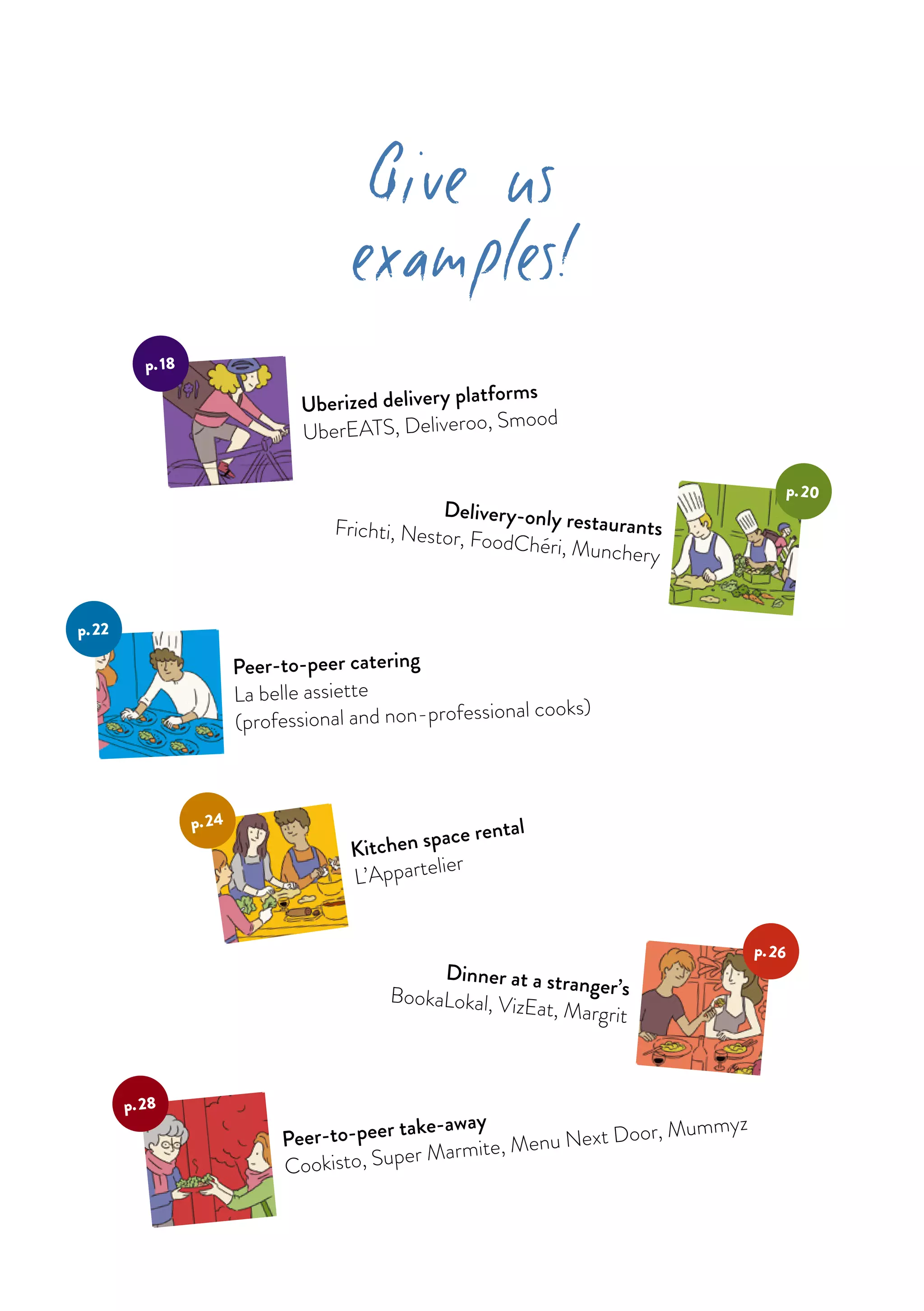
Give us examples!	
30
In conclusion	
31
Peer-to-peer catering
p. 22
Uberized delivery platforms
p. 18
Delivery-only restaurants
p. 20
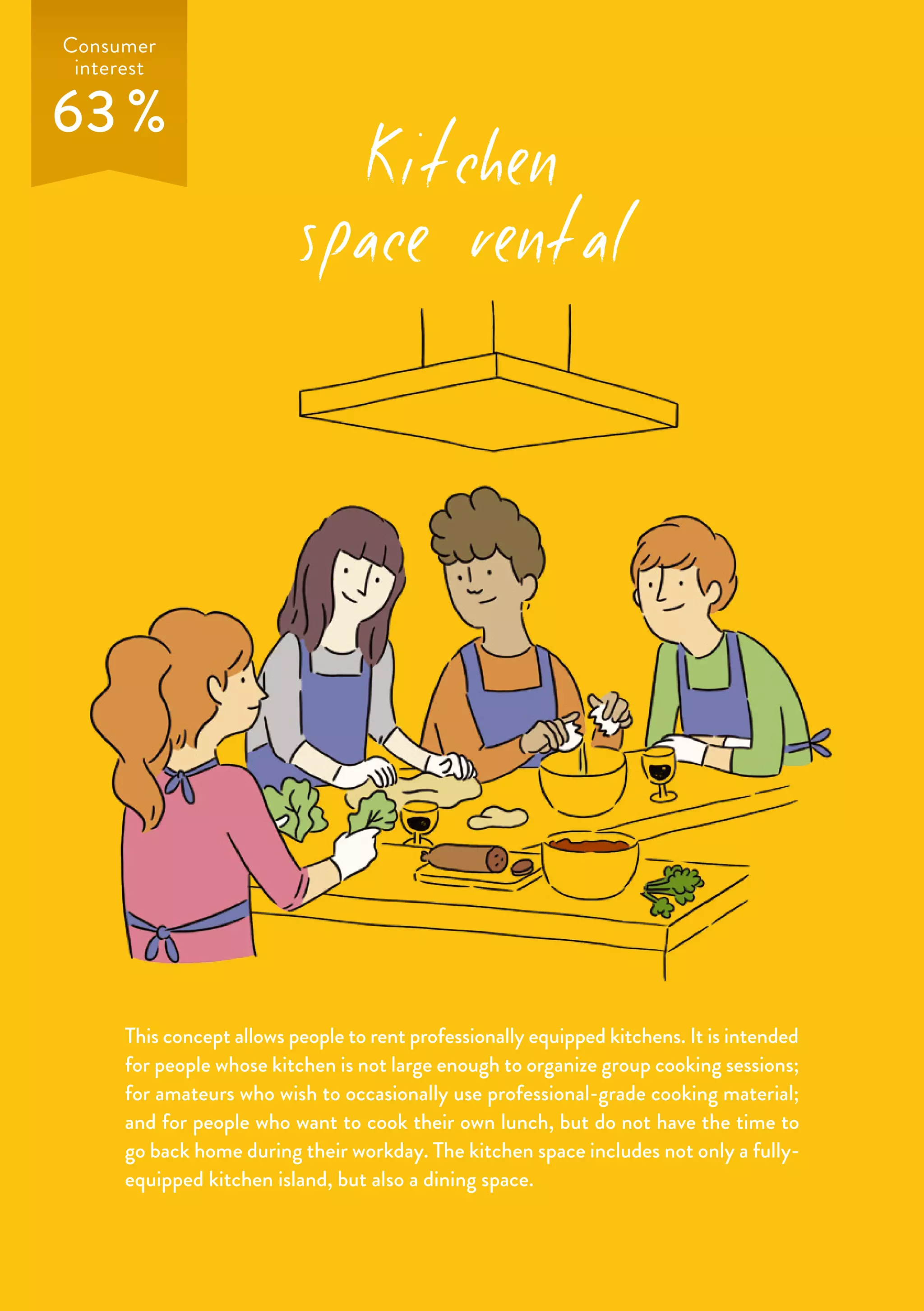
Kitchen space rental
p. 24
Dinner at a stranger’s
p. 26
Peer-to-peer take-away
p. 28
PwC, 2014 & AWP, 2015
Definitions on page 6
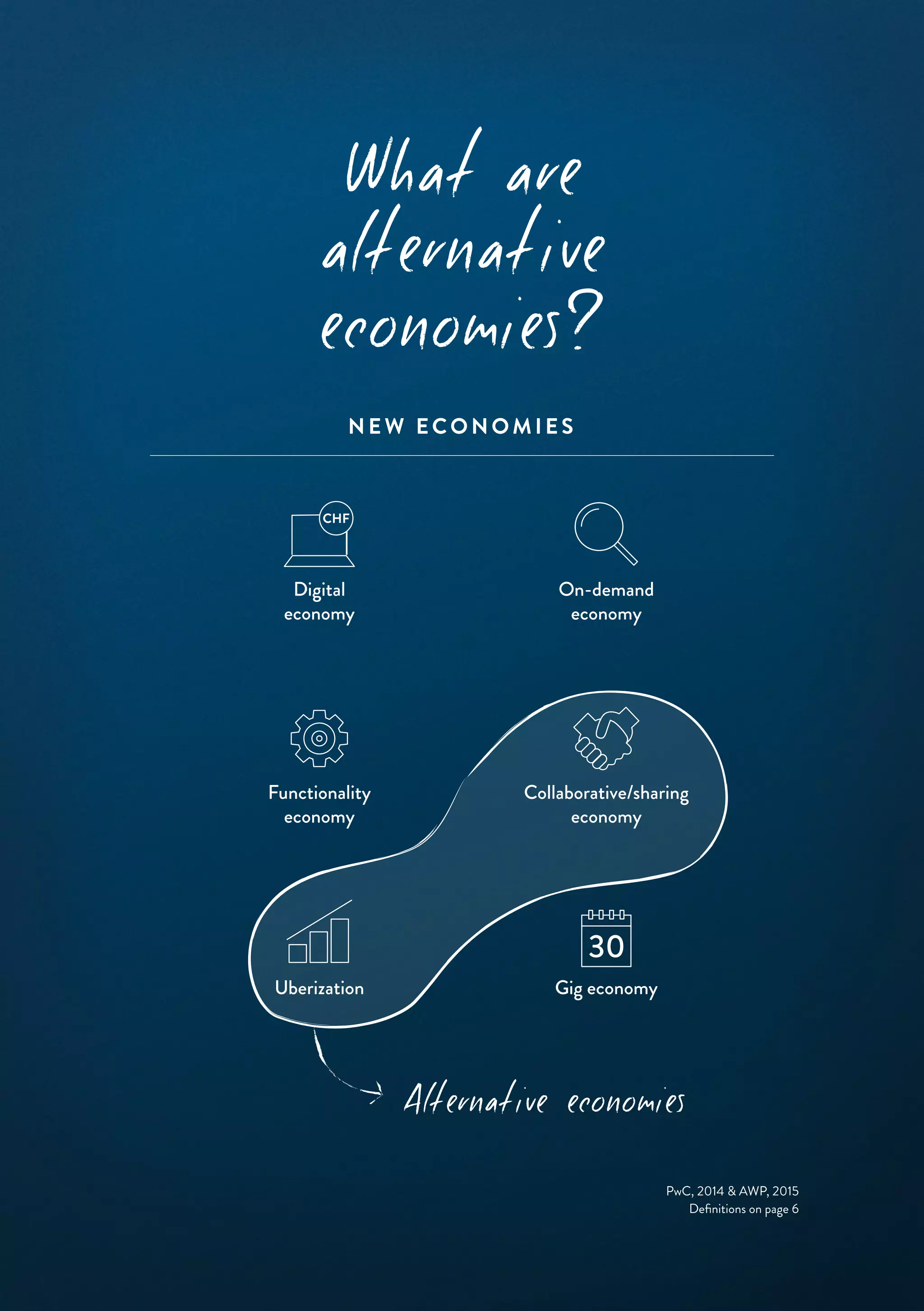
Alternative economies
NEW ECONOMIESNEW ECONOMIES
Digital
economy
On-demand
economy
Collaborative/sharing
economy
Uberization Gig economy
Functionality
economy
What are
alternative
economies?
4
5
ALTERNATIVE ECONOMIES
65%
French-speaking
32%
German-speaking
Are in favor of alternative economies
GROWTH OF ALTERNATIVE
ECONOMIES REVENUE
GROWTH OF ALTERNATIVE
ECONOMIES REVENUE
2013 revenue
1 5
B N $
2025 forecast
3 3 5
B N $
Deloitte, 2015
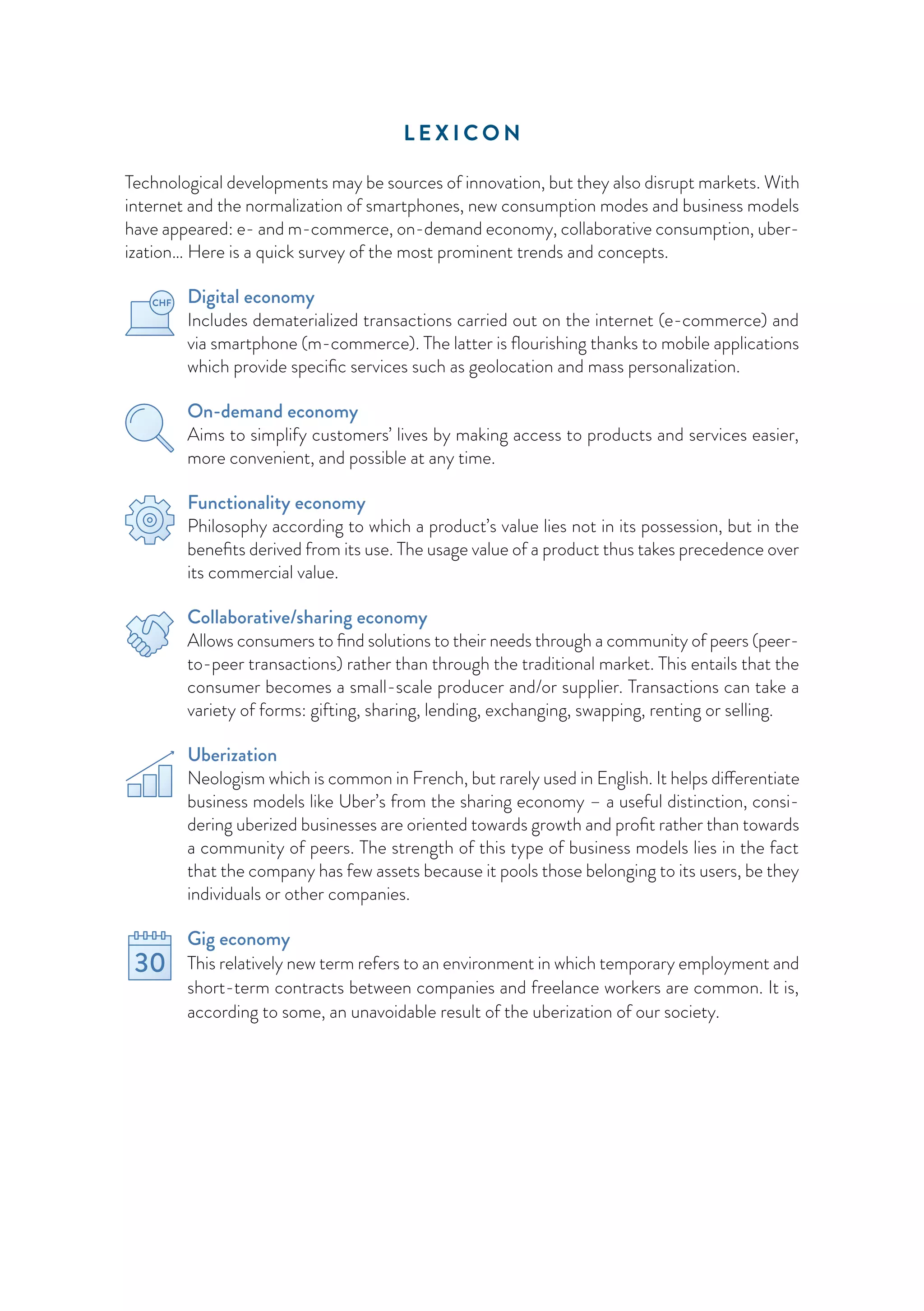
L E X I C O N
Technological developments may be sources of innovation, but they also disrupt markets. With
internet and the normalization of smartphones, new consumption modes and business models
have appeared: e- and m-commerce, on-demand economy, collaborative consumption, uber-
ization… Here is a quick survey of the most prominent trends and concepts.
Digital economy
Includes dematerialized transactions carried out on the internet (e-commerce) and
via smartphone (m-commerce). The latter is flourishing thanks to mobile applications
which provide specific services such as geolocation and mass personalization.
On-demand economy
Aims to simplify customers’ lives by making access to products and services easier,
more convenient, and possible at any time.
Functionality economy
Philosophy according to which a product’s value lies not in its possession, but in the
benefits derived from its use. The usage value of a product thus takes precedence over
its commercial value.
Collaborative/sharing economy
Allows consumers to find solutions to their needs through a community of peers (peer-
to-peer transactions) rather than through the traditional market. This entails that the
consumer becomes a small-scale producer and/or supplier. Transactions can take a
variety of forms: gifting, sharing, lending, exchanging, swapping, renting or selling.
Uberization
Neologism which is common in French, but rarely used in English. It helps differentiate
business models like Uber’s from the sharing economy – a useful distinction, consi­
dering uberized businesses are oriented towards growth and profit rather than towards
a community of peers. The strength of this type of business models lies in the fact
that the company has few assets because it pools those belonging to its users, be they
individuals or other companies.
Gig economy
This relatively new term refers to an environment in which temporary employment and
short-term contracts between companies and freelance workers are common. It is,
according to some, an unavoidable result of the uberization of our society.
6
7
64%
share personal data to benefit
from a higher quality-service
share personal data to benefit
from a higher quality-service
collaborate with businesses
in the creation of new services
collaborate with businesses
in the creation of new services
55%
experience a better quality of service
44%
find it more affordable
65%
CONSUMERS ARE READY TO:
REASONS FOR USE (French consumers)
A F E W K E Y F I G U R E S
Capgemini Consulting, 2015
D I F F E R E N C E S B E T W E E N T H E C O L L A B O R AT I V E /
S H A R I N G E C O N O M Y A N D U B E R I Z AT I O N
C O L L A B O R A T I V E /
S H A R I N G E C O N O M Y
U B E R I Z A T I O N
Market
orientation
Community Profit
Market structure P2P B2C
Revenue source Commission per transaction (flat rate)
Commission per transaction
(variable rate)
Sale of users’ data
Advantages
and risks for
companies
+
Little investment needed
Creation of a community
+
Innovation
High growth
Flexibility
Control over service providers
–
Little to no profit
Difficult to find service providers
Non-professional
service providers
–
Many companies in deficit
Semi-professional
service providers
Discontent of
traditional players
Consequences for
service providers
+
Sense of belonging
to a community
Making the best use of
one’s purchases
+
Adaptability
Immediacy
Easily accessible jobs
–
Lack of trust towards
other users (strangers) –
Power imbalance between
the platform and the
service providers
Precarity
Consequences
for customers
+
Profit/savings
Socialization
Practicality
Service can be rated
Goods and services are
easily accessible
+
Profit
Practicality
Improved experience
Service can be rated
–
Security (scams, strangers)
Quality of services
User community can be small
–
Social system put at risk
(unreported incomes)
Quality of services
(non-/semi-professionals)
Security (scams, strangers)
8
9
PwC, 2014
Job market
Appropriate legislation is the only way
to avoid unfair competition
TransparencyPricing and commissionpolicies can be opaque
Trust
Towards companies,
service providers and customers
TaxesThis type of micro-entrepreneurship
requires clear laws and inspections
TaxesThis type of micro-entrepreneurship
requires clear laws and inspections
CHALLENGES FOR SWITZERL A ND
Social protection
These new business models put at risk micro-entrepreneurs
(precarity) and the social system (unreported incomes)Social protection
These new business models put at risk micro-entrepreneurs
(precarity) and the social system (unreported incomes)
GROWTH FORECAST 2013-2025
+37%
Online staffing services
+31%
Peer-to-peer housing
+23%
Car sharing
+5%
Equipment
rental
+4%
Hotels
+2%
Car rental
-5%
DVD rental
+3%
Book lending
+63%
Peer-to-peer money
lending and crowdfunding
Alternativeeconomies
Tradi
tionaleconomies
PwC, 2014
10
11
R E A C T I O N S O F T R A D I T I O N A L C O M PA N I E S
Alternative economies are now an integral part of our society. Traditional
companies must find ways to embrace this trend, otherwise they risk falling behind.
To face alternative concepts, traditional companies can activate two types of
responses:
>> Improvement of the product/offer
>> Improvement of the associated service
Each of these options can be carried out either internally or by buying out another
company.
TWO POSSIBLE REACTIONS
Leverage internal tools, i.e....
Rethink the customer experience
Redesign
the offer
Redefine
the relationship
Collaborate with others, i.e.…
Form a partnership
Buy out
an uber-like company
Incubate a future
uber-like company
Capgemini Consulting, 2015
Alternative economies
in the foodservice
industry
12
13
One objective of this study was to identify consumers’ perception of alternative
concepts. Our survey hence described six scenarios, all based on existing, but not
necessarily well-know, innovative concepts:
Uberized
delivery platforms
Kitchen space rental
Delivery-only restaurants
Dinner at a stranger’s
Peer-to-peer take-away
Peer-to-peer catering
SCENARI OS WI T H
A COLL ABOR AT I VE
ORIENTAT I ON
S CENARIOS WITH
A N UBERIZ ATION
ORIENTATION
Respondents were first asked about their restaurant habits, and then presented
the six scenarios. For each scenario, they had to indicate one or two elements that
they found interesting and as one or two elements that put them off.
This booklet provides a summary of our results that will help traditional restaurateurs
anticipate the evolution of the market. We also suggest ways for them to adapt
their practices to emerging trends and changing customer expectations.
Methodology &
sample group
Nearly 500 people took part in the survey, including 284 from the French-speaking
part of the country, 157 from the German-speaking part, and 41 from Ticino.
Because technology plays a big role in most of our scenarios, we primarily targeted
respondents younger than 35 years old, which explains their overrepresentation
in our sample group.
S A M PL E D I S T R I BU T I ON BY GENDER
42%
men
42%
men
58%
women
58%
women
SAMPL E D I S T R I BU T I ON BY AG E GROUP
46%
18-24
46%
18-24
28%
25-34
28%
25-34
11%
35-44
11%
35-44
7%
45-54
7%
45-54
6%
55-64
6%
55-64
2%
65 +
2%
65 +
14
15
The high number of students in the sample group makes sense, since it reflects
the age distribution. Likewise, the proportion of retired people in the sample is
lower than in the Swiss population, as this segment is underrepresented in the
target population for this survey.
50%
student
50%
student 8%
full-time employee
8%
full-time employee
15%
part-time employee
15%
part-time employee
9%
middle manager
9%
middle manager
6%
senior executive
6%
senior executive
5%
independent
5%
independent
1%
retired
1%
retired
1%
stay-at-home parent
1%
stay-at-home parent
1%
unemployed
1%
unemployed
SAMPLE D I S T R I BU T I ON BY PR OF E SSIONAL STATUS
SAMPLE DI S T R I BU T I ON BY HOU S E HOLD T YPE
20%
living alone
20%
living alone
26%
flatsharing
26%
flatsharing
25%
family (parents and children
under the same roof)
25%
family (parents and children
under the same roof)
10%
couple living apart
10%
couple living apart
19%
couple living together
19%
couple living together
In this sample, people living in large cities are the most represented. In 2015,
44.7% of the Swiss population lived in an urban area; our sample is not too far
off, with 51% of respondents living in a large or peripheral city.
Swiss residents are also numerous in less urban areas. The remaining 49% of the
sample corresponds to that category.
18%
small or isolated
(countryside, mountain) town
18%
small or isolated
(countryside, mountain) town
34%
large city
(>65,000 inhabitants)
34%
large city
(>65,000 inhabitants)
11%
medium city
(25-60,000 inhabitants)
11%
medium city
(25-60,000 inhabitants)18%
city
(10-25,000 inhabitants)
18%
city
(10-25,000 inhabitants)
17%
peripheral city
17%
peripheral city
2%
ski resort
2%
ski resort
SAMPL E D I S T R I BU T I ON BY PL ACE OF RESIDENC E
16
17
R A N K I N G O F T H E S C E N A R I O S A C C O R D I N G
T O C U S T O M E R P R E F E R E N C E
Uberizeddeliveryplatforms
Delivery-onlyrestaurants
Peer-to-peercatering
Kitchenspacerental
Dinneratastranger’s
Peer-to-peer
take-away
REASONS
FORUSE
>> Ease of ordering
>> Allows for culinary discoveries
These two aspects correspond to the trends
currently dominating the foodservice sector.
>> Socialization
>> Allows for culinary discoveries
These three scenarios encourage
socialization on several levels: with relatives,
with neighbors or with strangers.
REASONSFOR
DISINTEREST
>> Price and delivery fees
>> Worried about quality
Consumers are wary of the commissions
and hidden costs that an intermediary
might entail. They also fear that the
food might be of low quality.
>> Seems untrustworthy
>> Not needed
Consumers are worried not only about food
quality, but also about the non-professional
nature of the service. In addition, many
respondents simply find that they have
no real need for these concepts.
Uberized delivery
platforms
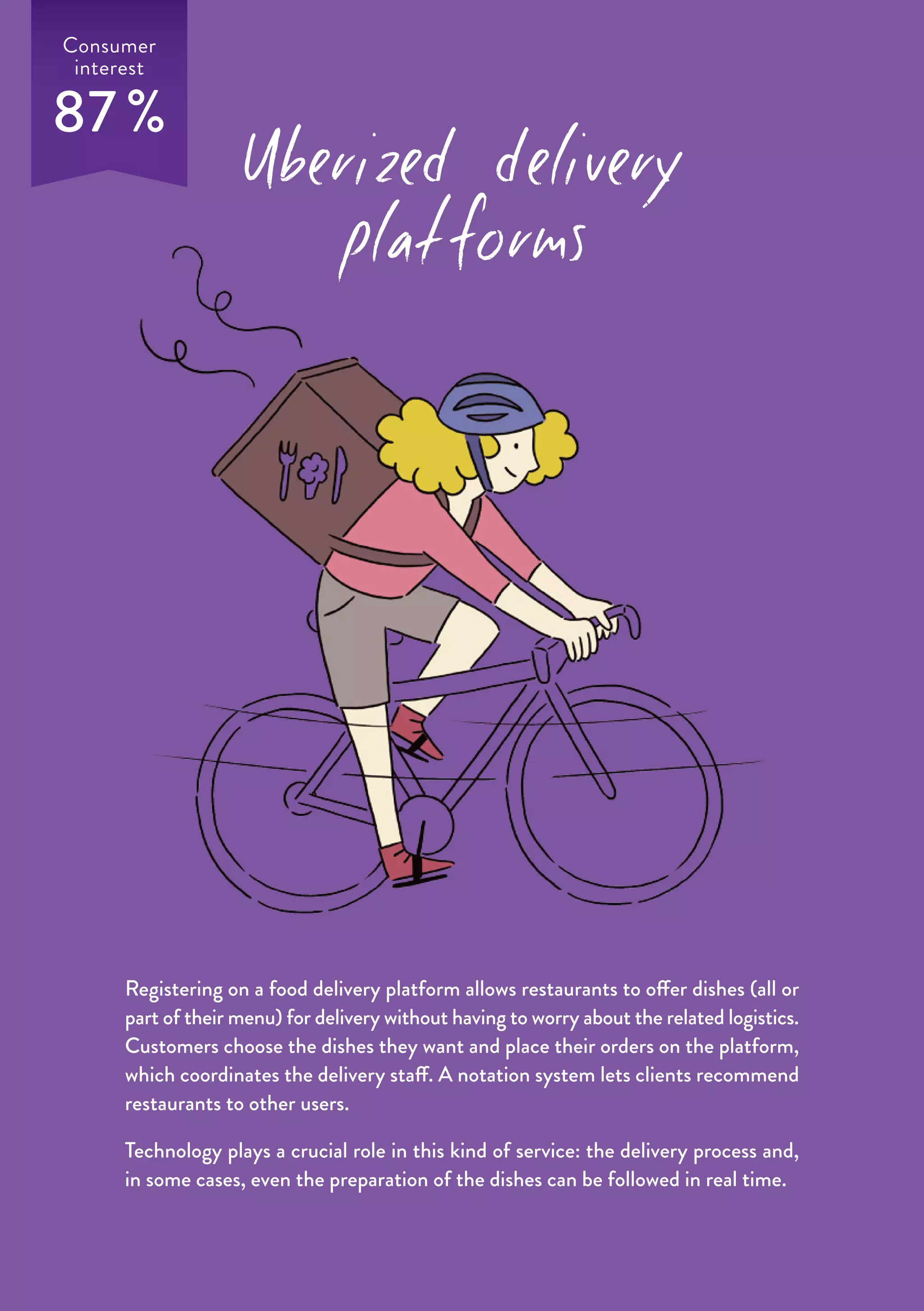
Registering on a food delivery platform allows restaurants to offer dishes (all or
part of their menu) for delivery without having to worry about the related logistics.
Customers choose the dishes they want and place their orders on the platform,
which coordinates the delivery staff. A notation system lets clients recommend
restaurants to other users.
Technology plays a crucial role in this kind of service: the delivery process and,
in some cases, even the preparation of the dishes can be followed in real time.
Consumer
interest
87 %
18
19P R O S
Ease of ordering
Convenience (extended operating hours, flexibility, speed of delivery)
C O N S
Waiting time (delivery)
State of the dishes upon delivery
Delivery cost
R E C O M M E N D AT I O N S
Basic
We recommend that restaurateurs register on a well-known delivery
platform. These marketplaces indeed have many advantages: they
increase visibility and production capacity, adapt the offer to new customer
expectations, and provide the benefits of a delivery service without the
hassle of its implementation and management.
A small assortment of inexpensive dishes should be proposed. This would
help counter the impression that the process degrades restaurant dishes
and make customers feel like they are using a higher quality take-away
service.
Advanced
Restaurateurs who are familiar with technology could give clients the
possibility to access the platform from the restaurant’s website and social
media profiles, linking directly to their menu to make orders quicker and
simpler.
Restaurateurs who are wary of technology could create an equivalent
service by entering into a partnership with other restaurants and pooling
the deliveries.
Consumer
interest
74 %
Delivery-only
restaurants
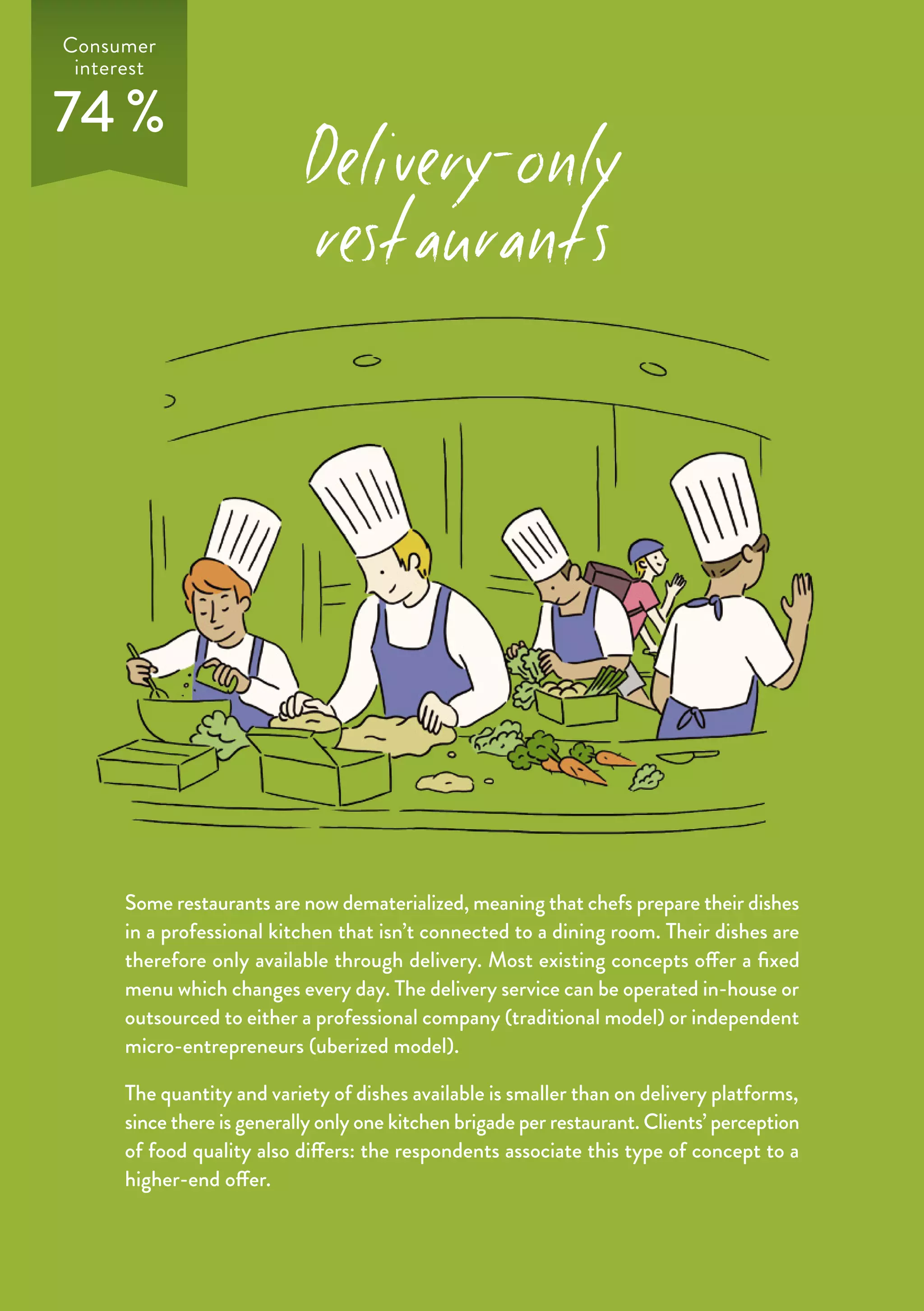
Some restaurants are now dematerialized, meaning that chefs prepare their dishes
in a professional kitchen that isn’t connected to a dining room. Their dishes are
therefore only available through delivery. Most existing concepts offer a fixed
menu which changes every day. The delivery service can be operated in-house or
outsourced to either a professional company (traditional model) or independent
micro-entrepreneurs (uberized model).
The quantity and variety of dishes available is smaller than on delivery platforms,
since there is generally only one kitchen brigade per restaurant. Clients’ perception
of food quality also differs: the respondents associate this type of concept to a
higher-end offer.
20
21P R O S
Allows for culinary discoveries
Ease of ordering
C O N S
Price might be too high
Seems untrustworthy because there is no physical restaurant
Not needed
R E C O M M E N D AT I O N S
Basic
The best way for traditional restaurateurs to not have their market share
stolen by delivery-only restaurants is to find ways to (re)attract clients.
They therefore need to improve the quality of the service and of the overall
experience so as to provide an original offer which can be adapted to any
moment of the day.
Advanced
Young (and not so young!) chefs can take inspiration from this concept
and develop a shared workspace. The costs of opening a restaurant are a
significant barrier to market entry; with such a solution, professionals could
test concepts with minimal risk – and build a support network to boot.
Peer-to-peer
catering
It is customary to call upon a caterer or an at-home chef for special occasions. But
there are now online platforms dedicated to amateurs who offer similar services
for a lower price. The menu is determined in agreement with the amateur cook,
who takes care of the purchases.
Consumer
interest
73 %
22
23P R O S
Allows for culinary discoveries
Originality of the concept
Makes a costly service more accessible
C O N S
Price might be too high
Concerns about hygiene and quality
Lack of trust towards a non-professional cook
R E C O M M E N D AT I O N
Advanced
An innovative way for restaurateurs to adapt to the emergence of peer-
to-peer catering services would be to create a pool of certified amateur
cooks. The restaurateur would assess the amateurs’ cooking skills and
confer a certification label to those deemed sufficiently qualified. This
process would empower the amateur cooks, reassure the clients, and allow
the restaurateur to levy a small commission on the certified cooks’ gigs.
Kitchen
space rental
This concept allows people to rent professionally equipped kitchens. It is intended
for people whose kitchen is not large enough to organize group cooking sessions;
for amateurs who wish to occasionally use professional-grade cooking material;
and for people who want to cook their own lunch, but do not have the time to
go back home during their workday. The kitchen space includes not only a fully-
equipped kitchen island, but also a dining space.
Consumer
interest
63 %
24
25P R O S
Socialization with relatives and colleagues
Novelty of the concept
Provides access to professional-grade cooking material
C O N S
Price might be too high
Not needed
R E C O M M E N D AT I O N S
Basic
Restaurateurs generally balk at the idea of letting amateurs use their
facilities, and for good reason: not only is it complicated to organize, but
the company also carries a legal responsibility for any accident that might
happen on its premises. However, an option worth considering would
be to rent the kitchen and equipment to another professional when the
restaurant is closed.
Advanced
Entrepreneurs who seek to develop an F&B-related concept could create
a workspace for businesses that require food preparation and/or storage
spaces only intermittently, such as pop-up restaurants and food trucks.
Companies providing this type of service are starting to emerge; examples
include L’Office (France) and Food Room (Canada).
Consumer
interest
57 %
Dinner at
a stranger’s
There are platforms on which anyone can register to invite strangers for a meal
in their home. The menu is communicated in advance, the price (per guest) is
determined by the host, and the meal only takes place if a minimal number of
guests is reached.
26
27P R O S
Novelty of the concept
Allows for culinary discoveries
Socialization
Authentic experience
C O N S
Not needed
No desire to dine with a stranger, much less in their home
Worried about hygiene and quality
R E C O M M E N D AT I O N S
Basic
Restaurateurs can take inspiration from these platforms to develop a
sense of community amongst their clients, and thus make their brand
more distinctive. A simple way to involve customers in the evolution of a
restaurant is to have them vote on the menu (seasonal offers, new dishes…).
An alternative option for restaurateurs who would rather target clients
seeking an original experience is to offer a table d’hôte menu in a special
place (kitchen, wine-tasting cellar, vegetable garden…).
Advanced
Why not take this one step further? Guests’ recipes could be included on
the menu, for instance as weekly or monthly specials. The recipes would
be submitted by customers and cooked by the kitchen team.
Consumer
interest
40 %
Peer-to-peer
take-away
Some people don’t like cooking or aren’t able to do so, but still want to eat home-
made meals. They can now use platforms that connect them to households who
have prepared extra meal portions. The price of the portion is determined by
the cook.
The buyers need to go pick up their meal at the cook’s home, which lets them
meet new people or strengthens bonds between neighbors.
28
29P R O S
Socialization with neighbors
Allows for culinary discoveries
Price
Ease of ordering
C O N S
Lack of trust towards a non-professional cook
Worried about hygiene and quality
Not needed
R E C O M M E N D AT I O N
Advanced
Restaurateurs can take inspiration from this concept and diversify their
offer by creating a self-service stand of dishes, for instance a fridge in
which clients can go pick up dishes cooked by the kitchen team. This offer
can be part of an anti-food waste approach: offering a discount on portions
that weren’t sold the previous day.
Give us
examples!
Peer-to-peer catering
La belle assiette
(professional and non-professional cooks)
p. 22
Uberized delivery platforms
UberEATS, Deliveroo, Smood
p. 18
Delivery-only restaurantsFrichti, Nestor, FoodChéri, Munchery
p. 20
Kitchen space rental
L’Appartelier
p. 24
Dinner at a stranger’sBookaLokal, VizEat, Margrit
p. 26
Peer-to-peer take-away
Cookisto, Super Marmite, Menu Next Door, Mummyz
p. 28
30
31
In conclusion
Whatever solutions you consider, there are three keywords to keep in mind:
Creativity
Essential to adapt to new concepts
and to rapidly changing consumption modes
Cooperation
Pooling resources makes some solutions much more
effective, especially for independent restaurateurs
Courage
Necessary to challenge the status quo
and test new options
For more information on our methodology and results,
you can visit the Saviva Food & Beverage Chair’s website
www.ehl.edu/en/research/chaire-food-beverage-saviva
or contact the research team:
Dr Christine Demen Meier • Chair holder
christine.demen-meier@ehl.ch
Stéphanie Buri • Chair coordinator
stephanie.buri@ehl.ch
Clémence Cornuz • Research associate
clemence.cornuz@ehl.ch
Illustrations :Louiza|graphicdesign:Contreforme.ch
The Saviva Food & Beverage Chair is a partnership between École hôtelière
de Lausanne and Saviva. This collaboration started in 2014 and aims to
improve the Swiss restaurant industry through research that follows the
three axes of sustainable development: ecological, economic and social.
After a study on innovations in waste management and reduction in
restaurants (2015), the Saviva Food & Beverage Chair team focused on
the impact of alternative economies on traditional foodservice businesses
in Switzerland.

F&b chair time for a change

  • 1.
    T H ER E S T A U R A N T I N D U S T R Y I N M O T I O N C H A I R E F O O D & B E V E R A G E
  • 2.
    The uberization ofgoods and services is provoking important changes in all sectors, including foodservice and hospitality. New business models arise from consumers’ changing needs, opening up opportunities for new types of offers in our industry. This technology shift will require courage, flexibility, adaptation, even cooperation. We are very thankful to the Food & Beverage Chair team (École hôtelière de Lausanne) for the skills and expertise they provide. André Hüsler, CEO Saviva In 2016, the Saviva Food & Beverage Chair sought to understand how traditional foodservice companies are impacted by the development of the collaborative economy and by the “uberization” phenomenon. A survey of nearly 500 people shed light on Swiss consumers’ perception of innovative F&B concepts and on their expectations of these new kinds of offers. We were thus able to map emerging foodservice concepts and suggest ways in which traditional actors could adapt their offer to consumers’ needs and preferences. The Saviva Food & Beverage Chair June 2017
  • 3.
    What are alternativeeconomies? 4 Alternative economies in the foodservice industry 11 Methodology and sample 14 Table of contents Give us examples! 30 In conclusion 31 Peer-to-peer catering p. 22 Uberized delivery platforms p. 18 Delivery-only restaurants p. 20 Kitchen space rental p. 24 Dinner at a stranger’s p. 26 Peer-to-peer take-away p. 28
  • 4.
    PwC, 2014 &AWP, 2015 Definitions on page 6 Alternative economies NEW ECONOMIESNEW ECONOMIES Digital economy On-demand economy Collaborative/sharing economy Uberization Gig economy Functionality economy What are alternative economies?
  • 5.
    4 5 ALTERNATIVE ECONOMIES 65% French-speaking 32% German-speaking Are infavor of alternative economies GROWTH OF ALTERNATIVE ECONOMIES REVENUE GROWTH OF ALTERNATIVE ECONOMIES REVENUE 2013 revenue 1 5 B N $ 2025 forecast 3 3 5 B N $ Deloitte, 2015
  • 6.
    L E XI C O N Technological developments may be sources of innovation, but they also disrupt markets. With internet and the normalization of smartphones, new consumption modes and business models have appeared: e- and m-commerce, on-demand economy, collaborative consumption, uber- ization… Here is a quick survey of the most prominent trends and concepts. Digital economy Includes dematerialized transactions carried out on the internet (e-commerce) and via smartphone (m-commerce). The latter is flourishing thanks to mobile applications which provide specific services such as geolocation and mass personalization. On-demand economy Aims to simplify customers’ lives by making access to products and services easier, more convenient, and possible at any time. Functionality economy Philosophy according to which a product’s value lies not in its possession, but in the benefits derived from its use. The usage value of a product thus takes precedence over its commercial value. Collaborative/sharing economy Allows consumers to find solutions to their needs through a community of peers (peer- to-peer transactions) rather than through the traditional market. This entails that the consumer becomes a small-scale producer and/or supplier. Transactions can take a variety of forms: gifting, sharing, lending, exchanging, swapping, renting or selling. Uberization Neologism which is common in French, but rarely used in English. It helps differentiate business models like Uber’s from the sharing economy – a useful distinction, consi­ dering uberized businesses are oriented towards growth and profit rather than towards a community of peers. The strength of this type of business models lies in the fact that the company has few assets because it pools those belonging to its users, be they individuals or other companies. Gig economy This relatively new term refers to an environment in which temporary employment and short-term contracts between companies and freelance workers are common. It is, according to some, an unavoidable result of the uberization of our society.
  • 7.
    6 7 64% share personal datato benefit from a higher quality-service share personal data to benefit from a higher quality-service collaborate with businesses in the creation of new services collaborate with businesses in the creation of new services 55% experience a better quality of service experience a better quality of service 44% find it more affordable find it more affordable 65% CONSUMERS ARE READY TO: REASONS FOR USE (French consumers) A F E W K E Y F I G U R E S Capgemini Consulting, 2015
  • 8.
    D I FF E R E N C E S B E T W E E N T H E C O L L A B O R AT I V E / S H A R I N G E C O N O M Y A N D U B E R I Z AT I O N C O L L A B O R A T I V E / S H A R I N G E C O N O M Y U B E R I Z A T I O N Market orientation Community Profit Market structure P2P B2C Revenue source Commission per transaction (flat rate) Commission per transaction (variable rate) Sale of users’ data Advantages and risks for companies + Little investment needed Creation of a community + Innovation High growth Flexibility Control over service providers – Little to no profit Difficult to find service providers Non-professional service providers – Many companies in deficit Semi-professional service providers Discontent of traditional players Consequences for service providers + Sense of belonging to a community Making the best use of one’s purchases + Adaptability Immediacy Easily accessible jobs – Lack of trust towards other users (strangers) – Power imbalance between the platform and the service providers Precarity Consequences for customers + Profit/savings Socialization Practicality Service can be rated Goods and services are easily accessible + Profit Practicality Improved experience Service can be rated – Security (scams, strangers) Quality of services User community can be small – Social system put at risk (unreported incomes) Quality of services (non-/semi-professionals) Security (scams, strangers)
  • 9.
    8 9 PwC, 2014 Job market Appropriatelegislation is the only way to avoid unfair competition TransparencyPricing and commissionpolicies can be opaque Trust Towards companies, service providers and customers TaxesThis type of micro-entrepreneurship requires clear laws and inspections TaxesThis type of micro-entrepreneurship requires clear laws and inspections CHALLENGES FOR SWITZERL A ND Social protection These new business models put at risk micro-entrepreneurs (precarity) and the social system (unreported incomes)Social protection These new business models put at risk micro-entrepreneurs (precarity) and the social system (unreported incomes)
  • 10.
    GROWTH FORECAST 2013-2025 +37% Onlinestaffing services +31% Peer-to-peer housing +23% Car sharing +5% Equipment rental +4% Hotels +2% Car rental -5% DVD rental +3% Book lending +63% Peer-to-peer money lending and crowdfunding Alternativeeconomies Tradi tionaleconomies PwC, 2014
  • 11.
    10 11 R E AC T I O N S O F T R A D I T I O N A L C O M PA N I E S Alternative economies are now an integral part of our society. Traditional companies must find ways to embrace this trend, otherwise they risk falling behind. To face alternative concepts, traditional companies can activate two types of responses: >> Improvement of the product/offer >> Improvement of the associated service Each of these options can be carried out either internally or by buying out another company. TWO POSSIBLE REACTIONS Leverage internal tools, i.e.... Rethink the customer experience Redesign the offer Redefine the relationship Collaborate with others, i.e.… Form a partnership Buy out an uber-like company Incubate a future uber-like company Capgemini Consulting, 2015
  • 12.
    Alternative economies in thefoodservice industry
  • 13.
    12 13 One objective ofthis study was to identify consumers’ perception of alternative concepts. Our survey hence described six scenarios, all based on existing, but not necessarily well-know, innovative concepts: Uberized delivery platforms Kitchen space rental Delivery-only restaurants Dinner at a stranger’s Peer-to-peer take-away Peer-to-peer catering SCENARI OS WI T H A COLL ABOR AT I VE ORIENTAT I ON S CENARIOS WITH A N UBERIZ ATION ORIENTATION Respondents were first asked about their restaurant habits, and then presented the six scenarios. For each scenario, they had to indicate one or two elements that they found interesting and as one or two elements that put them off. This booklet provides a summary of our results that will help traditional restaurateurs anticipate the evolution of the market. We also suggest ways for them to adapt their practices to emerging trends and changing customer expectations.
  • 14.
    Methodology & sample group Nearly500 people took part in the survey, including 284 from the French-speaking part of the country, 157 from the German-speaking part, and 41 from Ticino. Because technology plays a big role in most of our scenarios, we primarily targeted respondents younger than 35 years old, which explains their overrepresentation in our sample group. S A M PL E D I S T R I BU T I ON BY GENDER 42% men 42% men 58% women 58% women SAMPL E D I S T R I BU T I ON BY AG E GROUP 46% 18-24 46% 18-24 28% 25-34 28% 25-34 11% 35-44 11% 35-44 7% 45-54 7% 45-54 6% 55-64 6% 55-64 2% 65 + 2% 65 +
  • 15.
    14 15 The high numberof students in the sample group makes sense, since it reflects the age distribution. Likewise, the proportion of retired people in the sample is lower than in the Swiss population, as this segment is underrepresented in the target population for this survey. 50% student 50% student 8% full-time employee 8% full-time employee 15% part-time employee 15% part-time employee 9% middle manager 9% middle manager 6% senior executive 6% senior executive 5% independent 5% independent 1% retired 1% retired 1% stay-at-home parent 1% stay-at-home parent 1% unemployed 1% unemployed SAMPLE D I S T R I BU T I ON BY PR OF E SSIONAL STATUS SAMPLE DI S T R I BU T I ON BY HOU S E HOLD T YPE 20% living alone 20% living alone 26% flatsharing 26% flatsharing 25% family (parents and children under the same roof) 25% family (parents and children under the same roof) 10% couple living apart 10% couple living apart 19% couple living together 19% couple living together
  • 16.
    In this sample,people living in large cities are the most represented. In 2015, 44.7% of the Swiss population lived in an urban area; our sample is not too far off, with 51% of respondents living in a large or peripheral city. Swiss residents are also numerous in less urban areas. The remaining 49% of the sample corresponds to that category. 18% small or isolated (countryside, mountain) town 18% small or isolated (countryside, mountain) town 34% large city (>65,000 inhabitants) 34% large city (>65,000 inhabitants) 11% medium city (25-60,000 inhabitants) 11% medium city (25-60,000 inhabitants)18% city (10-25,000 inhabitants) 18% city (10-25,000 inhabitants) 17% peripheral city 17% peripheral city 2% ski resort 2% ski resort SAMPL E D I S T R I BU T I ON BY PL ACE OF RESIDENC E
  • 17.
    16 17 R A NK I N G O F T H E S C E N A R I O S A C C O R D I N G T O C U S T O M E R P R E F E R E N C E Uberizeddeliveryplatforms Delivery-onlyrestaurants Peer-to-peercatering Kitchenspacerental Dinneratastranger’s Peer-to-peer take-away REASONS FORUSE >> Ease of ordering >> Allows for culinary discoveries These two aspects correspond to the trends currently dominating the foodservice sector. >> Socialization >> Allows for culinary discoveries These three scenarios encourage socialization on several levels: with relatives, with neighbors or with strangers. REASONSFOR DISINTEREST >> Price and delivery fees >> Worried about quality Consumers are wary of the commissions and hidden costs that an intermediary might entail. They also fear that the food might be of low quality. >> Seems untrustworthy >> Not needed Consumers are worried not only about food quality, but also about the non-professional nature of the service. In addition, many respondents simply find that they have no real need for these concepts.
  • 18.
    Uberized delivery platforms Registering ona food delivery platform allows restaurants to offer dishes (all or part of their menu) for delivery without having to worry about the related logistics. Customers choose the dishes they want and place their orders on the platform, which coordinates the delivery staff. A notation system lets clients recommend restaurants to other users. Technology plays a crucial role in this kind of service: the delivery process and, in some cases, even the preparation of the dishes can be followed in real time. Consumer interest 87 %
  • 19.
    18 19P R OS Ease of ordering Convenience (extended operating hours, flexibility, speed of delivery) C O N S Waiting time (delivery) State of the dishes upon delivery Delivery cost R E C O M M E N D AT I O N S Basic We recommend that restaurateurs register on a well-known delivery platform. These marketplaces indeed have many advantages: they increase visibility and production capacity, adapt the offer to new customer expectations, and provide the benefits of a delivery service without the hassle of its implementation and management. A small assortment of inexpensive dishes should be proposed. This would help counter the impression that the process degrades restaurant dishes and make customers feel like they are using a higher quality take-away service. Advanced Restaurateurs who are familiar with technology could give clients the possibility to access the platform from the restaurant’s website and social media profiles, linking directly to their menu to make orders quicker and simpler. Restaurateurs who are wary of technology could create an equivalent service by entering into a partnership with other restaurants and pooling the deliveries.
  • 20.
    Consumer interest 74 % Delivery-only restaurants Some restaurants arenow dematerialized, meaning that chefs prepare their dishes in a professional kitchen that isn’t connected to a dining room. Their dishes are therefore only available through delivery. Most existing concepts offer a fixed menu which changes every day. The delivery service can be operated in-house or outsourced to either a professional company (traditional model) or independent micro-entrepreneurs (uberized model). The quantity and variety of dishes available is smaller than on delivery platforms, since there is generally only one kitchen brigade per restaurant. Clients’ perception of food quality also differs: the respondents associate this type of concept to a higher-end offer.
  • 21.
    20 21P R OS Allows for culinary discoveries Ease of ordering C O N S Price might be too high Seems untrustworthy because there is no physical restaurant Not needed R E C O M M E N D AT I O N S Basic The best way for traditional restaurateurs to not have their market share stolen by delivery-only restaurants is to find ways to (re)attract clients. They therefore need to improve the quality of the service and of the overall experience so as to provide an original offer which can be adapted to any moment of the day. Advanced Young (and not so young!) chefs can take inspiration from this concept and develop a shared workspace. The costs of opening a restaurant are a significant barrier to market entry; with such a solution, professionals could test concepts with minimal risk – and build a support network to boot.
  • 22.
    Peer-to-peer catering It is customaryto call upon a caterer or an at-home chef for special occasions. But there are now online platforms dedicated to amateurs who offer similar services for a lower price. The menu is determined in agreement with the amateur cook, who takes care of the purchases. Consumer interest 73 %
  • 23.
    22 23P R OS Allows for culinary discoveries Originality of the concept Makes a costly service more accessible C O N S Price might be too high Concerns about hygiene and quality Lack of trust towards a non-professional cook R E C O M M E N D AT I O N Advanced An innovative way for restaurateurs to adapt to the emergence of peer- to-peer catering services would be to create a pool of certified amateur cooks. The restaurateur would assess the amateurs’ cooking skills and confer a certification label to those deemed sufficiently qualified. This process would empower the amateur cooks, reassure the clients, and allow the restaurateur to levy a small commission on the certified cooks’ gigs.
  • 24.
    Kitchen space rental This conceptallows people to rent professionally equipped kitchens. It is intended for people whose kitchen is not large enough to organize group cooking sessions; for amateurs who wish to occasionally use professional-grade cooking material; and for people who want to cook their own lunch, but do not have the time to go back home during their workday. The kitchen space includes not only a fully- equipped kitchen island, but also a dining space. Consumer interest 63 %
  • 25.
    24 25P R OS Socialization with relatives and colleagues Novelty of the concept Provides access to professional-grade cooking material C O N S Price might be too high Not needed R E C O M M E N D AT I O N S Basic Restaurateurs generally balk at the idea of letting amateurs use their facilities, and for good reason: not only is it complicated to organize, but the company also carries a legal responsibility for any accident that might happen on its premises. However, an option worth considering would be to rent the kitchen and equipment to another professional when the restaurant is closed. Advanced Entrepreneurs who seek to develop an F&B-related concept could create a workspace for businesses that require food preparation and/or storage spaces only intermittently, such as pop-up restaurants and food trucks. Companies providing this type of service are starting to emerge; examples include L’Office (France) and Food Room (Canada).
  • 26.
    Consumer interest 57 % Dinner at a stranger’s Thereare platforms on which anyone can register to invite strangers for a meal in their home. The menu is communicated in advance, the price (per guest) is determined by the host, and the meal only takes place if a minimal number of guests is reached.
  • 27.
    26 27P R OS Novelty of the concept Allows for culinary discoveries Socialization Authentic experience C O N S Not needed No desire to dine with a stranger, much less in their home Worried about hygiene and quality R E C O M M E N D AT I O N S Basic Restaurateurs can take inspiration from these platforms to develop a sense of community amongst their clients, and thus make their brand more distinctive. A simple way to involve customers in the evolution of a restaurant is to have them vote on the menu (seasonal offers, new dishes…). An alternative option for restaurateurs who would rather target clients seeking an original experience is to offer a table d’hôte menu in a special place (kitchen, wine-tasting cellar, vegetable garden…). Advanced Why not take this one step further? Guests’ recipes could be included on the menu, for instance as weekly or monthly specials. The recipes would be submitted by customers and cooked by the kitchen team.
  • 28.
    Consumer interest 40 % Peer-to-peer take-away Some people don’tlike cooking or aren’t able to do so, but still want to eat home- made meals. They can now use platforms that connect them to households who have prepared extra meal portions. The price of the portion is determined by the cook. The buyers need to go pick up their meal at the cook’s home, which lets them meet new people or strengthens bonds between neighbors.
  • 29.
    28 29P R OS Socialization with neighbors Allows for culinary discoveries Price Ease of ordering C O N S Lack of trust towards a non-professional cook Worried about hygiene and quality Not needed R E C O M M E N D AT I O N Advanced Restaurateurs can take inspiration from this concept and diversify their offer by creating a self-service stand of dishes, for instance a fridge in which clients can go pick up dishes cooked by the kitchen team. This offer can be part of an anti-food waste approach: offering a discount on portions that weren’t sold the previous day.
  • 30.
    Give us examples! Peer-to-peer catering Labelle assiette (professional and non-professional cooks) p. 22 Uberized delivery platforms UberEATS, Deliveroo, Smood p. 18 Delivery-only restaurantsFrichti, Nestor, FoodChéri, Munchery p. 20 Kitchen space rental L’Appartelier p. 24 Dinner at a stranger’sBookaLokal, VizEat, Margrit p. 26 Peer-to-peer take-away Cookisto, Super Marmite, Menu Next Door, Mummyz p. 28
  • 31.
    30 31 In conclusion Whatever solutionsyou consider, there are three keywords to keep in mind: Creativity Essential to adapt to new concepts and to rapidly changing consumption modes Cooperation Pooling resources makes some solutions much more effective, especially for independent restaurateurs Courage Necessary to challenge the status quo and test new options For more information on our methodology and results, you can visit the Saviva Food & Beverage Chair’s website www.ehl.edu/en/research/chaire-food-beverage-saviva or contact the research team: Dr Christine Demen Meier • Chair holder christine.demen-meier@ehl.ch Stéphanie Buri • Chair coordinator stephanie.buri@ehl.ch Clémence Cornuz • Research associate clemence.cornuz@ehl.ch
  • 32.
    Illustrations :Louiza|graphicdesign:Contreforme.ch The Saviva Food& Beverage Chair is a partnership between École hôtelière de Lausanne and Saviva. This collaboration started in 2014 and aims to improve the Swiss restaurant industry through research that follows the three axes of sustainable development: ecological, economic and social. After a study on innovations in waste management and reduction in restaurants (2015), the Saviva Food & Beverage Chair team focused on the impact of alternative economies on traditional foodservice businesses in Switzerland.