4/9/20101Fault tolerance techniques
Hardware faultSome physical defect that can cause a component to malfunction. Eg a broken wire or a logic gate output that is togglingSoftware faultIs a bug that can cause the program to fail for a given set of inputsErrorThe manifestation of a fault.Fault latencyDuration between the onset of fault and its manifestation as an errorImpact the reliability of the overall systemError latencyDuration between when an error is produced and when it is either recognised as an error or cause the failure of the system4/9/20102definitions
Error recoveryProcess by which the system attempts to recover from the effects of an error.Forward error recoveryError is masked without any computations having to be redoneBackward error recoveryThe system rolled back to a moment in time before the error is believed to have occurred.Uses time redundancy, since it consumes additional time to mask the effects of failure4/9/20103definitions
Errors in the specification or designMistakes in the specification and Design are very difficult to guard.Many hardware failures and all software failures occur due to such mistakes.It is difficult to ensure that the specification is completely right.Defects in the componentsHardware components can develop defects.Wear and tear of componentsEnvironmental effectsDevices can be subjected to whole array of stresses, depending on the application.High ambient temperatures can melt components or otherwise damage them.4/9/20104What causes failure
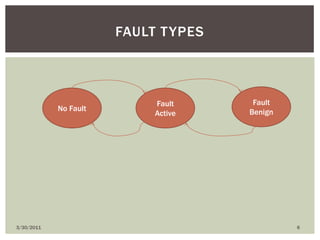
Based on temporal behaviorPermanent FaultsDoes not die away with timeCaused by broken wiresA>0, B=C=D=0Intermittent FaultsThe fault cycles between the fault active and benign statesCaused by loose wiresA>0, B>0, C=0 d>0Transient FaultsDies away after some timeMainly due to environmental effectsA>0,B=0,C>0,D=04/9/20105Fault types
4/9/20106Fault typesFault BenignNo FaultFault Active
Based on Output behaviorMalicious faultsAlso called as byzantine failuresInconsistent output, harder to neutralize these errorsIt behaves arbitrarilyNon malicious faultsConsistent output errorsEasier to neutralize these errorsFail stopResponds to up to a certain maximum number of failures by simply stopping, rather than putting out incorrect outputsFail safeIts failure mode is biased so that the application process does not suffer catastrophe upon failure.4/9/20107Fault types
Fault containment zone (FCZ)Failure in some part of the computer outside an FCZ cannot cause any element inside that FCZ to failSeparate power supply units and separate clock inside and outside the FCZ.Error containment Zone (ECZ)Prevent errors from propagating across zone boundariesHardware redundancyAdditional hardware Software redundancyMany versions of softwareTime redundancyTasks can rerun if necessaryInformation redundancyError detection and correction4/9/20108Fault and error containment
Hardware RedundancyUse of additional hardware to compensate for failuresThis can be done in two waysFault detection, correction and Masking. Multiple hardware units may be assigned to do the same task in parallel and their results compared. If one or more units are faulty, we can express this to show up as a disagreement in the results.The second is to replace the malfunctioning units.Redundancy is expensive, duplicating or triplicating the hardware is justified only in most critical applicationsTwo methods of hardware redundancy is given below are, Static PairingN modular Redundancy (NMR)4/9/20109Hardware redundancy
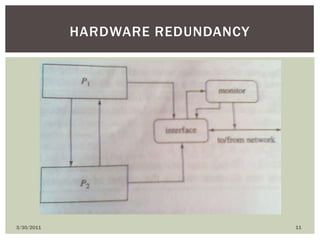
Static PairingHardwire processors in pairs and to discard the entire pair if one of the processors fails, this is very simple schemeThe Pairs runs identical software with identical inputs and should generate identical outputs. If the output is not identical, then the pair is non functional, so the entire pair is discardedThis approach is depicted in the following figure, and it will work only when the interface is working fine and both the processors do not fail identically and around the same timeSo the interface is monitored by means of a monitor which monitors the interface. If the interface fails, the monitor takes care and if the monitor fails, the interface takes care. If both interface and monitor fails, then the system is down. The monitor block is added as a dotted box in the figure4/9/201010Hardware redundancy
4/9/201011Hardware redundancy
N Modular RedundancyIt is a scheme for Forward Error Recovery.It works with N processors instead of one and voting on their output and N is usually odd.NMR can be illustrated by means of the following two waysThere are N voters and the entire cluster produces N outputsThere is just one voterNMR clusters are designed to allow the purging of malfunctioning units. That is, when a failure is detected, the failed unit is checked to see whether or not the failure is transient. If it is not, it must be electrically isolated from the rest of the cluster and a replacement unit is switched on. The faster the unit is replaced, the more reliable the cluster.4/9/201012Hardware redundancy
4/9/201013Hardware redundancy
Purging can be done either by hardware or by the operating system. Self purging consists of a monitor at each unit comparing its output against the voted output. If there is a difference, the monitor disconnects the unit from the system. The monitor can be described as a finite state machine with two states connect and isolate. There are two signals, diff which is set to 1 whenever the module output disagrees with the voter output and reconnect, which is a command from the system to reconnect the module.4/9/201014Hardware redundancy
4/9/201015Hardware redundancy
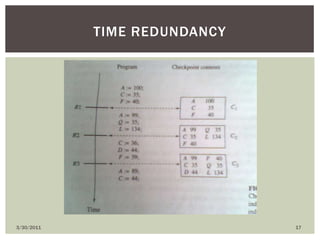
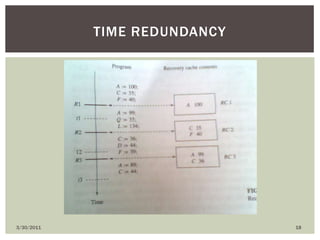
Backward Error Recovery SchemeRetryCheckpointsRecovery cache4/9/201016Time redundancy
4/9/201017Time redundancy
4/9/201018Time redundancy
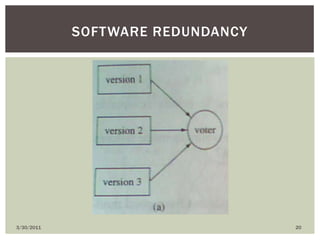
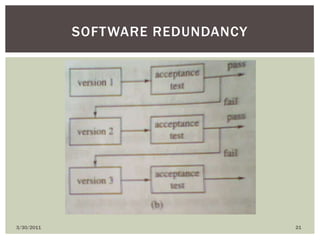
Software faults are occurring mainly in the designReplicating the same software N times will not solve the purpose as the software fails for the same set of inputsBut N versions of software can be running so that the probability of fault is lessThere are two approaches for thatN Version ProgrammingRecovery Block Approach4/9/201019Software redundancy
4/9/201020Software redundancy
4/9/201021Software redundancy
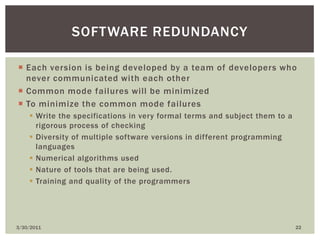
4/9/201022Software redundancyEach version is being developed by a team of developers who never communicated with each otherCommon mode failures will be minimizedTo minimize the common mode failuresWrite the specifications in very formal terms and subject them to a rigorous process of checkingDiversity of multiple software versions in different programming languagesNumerical algorithms usedNature of tools that are being used.Training and quality of the programmers
4/9/201023Information redundancyParity codesOrdinary parity bitInterlaced parity bitChecksum codesSingle precisionDouble precisionHoneywellArithmetic codesAN Code

Fault tolerance techniques tsp

  • 1.
  • 2.
    Hardware faultSome physicaldefect that can cause a component to malfunction. Eg a broken wire or a logic gate output that is togglingSoftware faultIs a bug that can cause the program to fail for a given set of inputsErrorThe manifestation of a fault.Fault latencyDuration between the onset of fault and its manifestation as an errorImpact the reliability of the overall systemError latencyDuration between when an error is produced and when it is either recognised as an error or cause the failure of the system4/9/20102definitions
  • 3.
    Error recoveryProcess bywhich the system attempts to recover from the effects of an error.Forward error recoveryError is masked without any computations having to be redoneBackward error recoveryThe system rolled back to a moment in time before the error is believed to have occurred.Uses time redundancy, since it consumes additional time to mask the effects of failure4/9/20103definitions
  • 4.
    Errors in thespecification or designMistakes in the specification and Design are very difficult to guard.Many hardware failures and all software failures occur due to such mistakes.It is difficult to ensure that the specification is completely right.Defects in the componentsHardware components can develop defects.Wear and tear of componentsEnvironmental effectsDevices can be subjected to whole array of stresses, depending on the application.High ambient temperatures can melt components or otherwise damage them.4/9/20104What causes failure
  • 5.
    Based on temporalbehaviorPermanent FaultsDoes not die away with timeCaused by broken wiresA>0, B=C=D=0Intermittent FaultsThe fault cycles between the fault active and benign statesCaused by loose wiresA>0, B>0, C=0 d>0Transient FaultsDies away after some timeMainly due to environmental effectsA>0,B=0,C>0,D=04/9/20105Fault types
  • 6.
  • 7.
    Based on OutputbehaviorMalicious faultsAlso called as byzantine failuresInconsistent output, harder to neutralize these errorsIt behaves arbitrarilyNon malicious faultsConsistent output errorsEasier to neutralize these errorsFail stopResponds to up to a certain maximum number of failures by simply stopping, rather than putting out incorrect outputsFail safeIts failure mode is biased so that the application process does not suffer catastrophe upon failure.4/9/20107Fault types
  • 8.
    Fault containment zone(FCZ)Failure in some part of the computer outside an FCZ cannot cause any element inside that FCZ to failSeparate power supply units and separate clock inside and outside the FCZ.Error containment Zone (ECZ)Prevent errors from propagating across zone boundariesHardware redundancyAdditional hardware Software redundancyMany versions of softwareTime redundancyTasks can rerun if necessaryInformation redundancyError detection and correction4/9/20108Fault and error containment
  • 9.
    Hardware RedundancyUse ofadditional hardware to compensate for failuresThis can be done in two waysFault detection, correction and Masking. Multiple hardware units may be assigned to do the same task in parallel and their results compared. If one or more units are faulty, we can express this to show up as a disagreement in the results.The second is to replace the malfunctioning units.Redundancy is expensive, duplicating or triplicating the hardware is justified only in most critical applicationsTwo methods of hardware redundancy is given below are, Static PairingN modular Redundancy (NMR)4/9/20109Hardware redundancy
  • 10.
    Static PairingHardwire processorsin pairs and to discard the entire pair if one of the processors fails, this is very simple schemeThe Pairs runs identical software with identical inputs and should generate identical outputs. If the output is not identical, then the pair is non functional, so the entire pair is discardedThis approach is depicted in the following figure, and it will work only when the interface is working fine and both the processors do not fail identically and around the same timeSo the interface is monitored by means of a monitor which monitors the interface. If the interface fails, the monitor takes care and if the monitor fails, the interface takes care. If both interface and monitor fails, then the system is down. The monitor block is added as a dotted box in the figure4/9/201010Hardware redundancy
  • 11.
  • 12.
    N Modular RedundancyItis a scheme for Forward Error Recovery.It works with N processors instead of one and voting on their output and N is usually odd.NMR can be illustrated by means of the following two waysThere are N voters and the entire cluster produces N outputsThere is just one voterNMR clusters are designed to allow the purging of malfunctioning units. That is, when a failure is detected, the failed unit is checked to see whether or not the failure is transient. If it is not, it must be electrically isolated from the rest of the cluster and a replacement unit is switched on. The faster the unit is replaced, the more reliable the cluster.4/9/201012Hardware redundancy
  • 13.
  • 14.
    Purging can bedone either by hardware or by the operating system. Self purging consists of a monitor at each unit comparing its output against the voted output. If there is a difference, the monitor disconnects the unit from the system. The monitor can be described as a finite state machine with two states connect and isolate. There are two signals, diff which is set to 1 whenever the module output disagrees with the voter output and reconnect, which is a command from the system to reconnect the module.4/9/201014Hardware redundancy
  • 15.
  • 16.
    Backward Error RecoverySchemeRetryCheckpointsRecovery cache4/9/201016Time redundancy
  • 17.
  • 18.
  • 19.
    Software faults areoccurring mainly in the designReplicating the same software N times will not solve the purpose as the software fails for the same set of inputsBut N versions of software can be running so that the probability of fault is lessThere are two approaches for thatN Version ProgrammingRecovery Block Approach4/9/201019Software redundancy
  • 20.
  • 21.
  • 22.
    4/9/201022Software redundancyEach versionis being developed by a team of developers who never communicated with each otherCommon mode failures will be minimizedTo minimize the common mode failuresWrite the specifications in very formal terms and subject them to a rigorous process of checkingDiversity of multiple software versions in different programming languagesNumerical algorithms usedNature of tools that are being used.Training and quality of the programmers
  • 23.
    4/9/201023Information redundancyParity codesOrdinaryparity bitInterlaced parity bitChecksum codesSingle precisionDouble precisionHoneywellArithmetic codesAN Code