FATTY CHANGE
PATHOLOGY PRACTICAL
1
Fatty change/steatosis
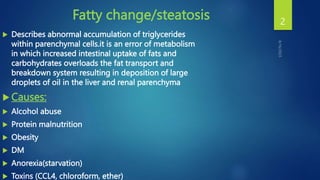
 Describes abnormal accumulation of triglycerides
within parenchymal cells.it is an error of metabolism
in which increased intestinal uptake of fats and
carbohydrates overloads the fat transport and
breakdown system resulting in deposition of large
droplets of oil in the liver and renal parenchyma
 Causes:
 Alcohol abuse
 Protein malnutrition
 Obesity
 DM
 Anorexia(starvation)
 Toxins (CCL4, chloroform, ether)
2
Fatty liver/Hepatic steatosis
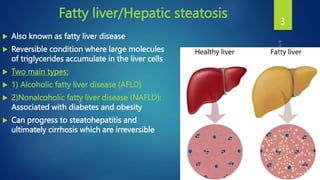
 Also known as fatty liver disease
 Reversible condition where large molecules
of triglycerides accumulate in the liver cells
 Two main types:
 1) Alcoholic fatty liver disease (AFLD)
 2)Nonalcoholic fatty liver disease (NAFLD):
Associated with diabetes and obesity
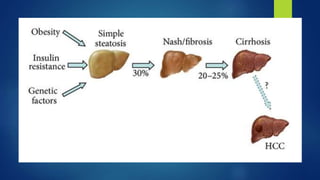
 Can progress to steatohepatitis and
ultimately cirrhosis which are irreversible
3
4
GROSS
5
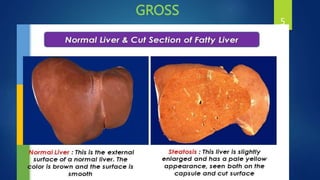
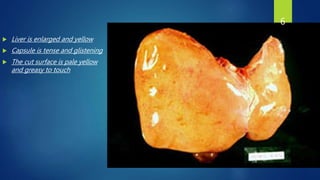
 Liver is enlarged and yellow
 Capsule is tense and glistening
 The cut surface is pale yellow
and greasy to touch
6
MICROSCOPY
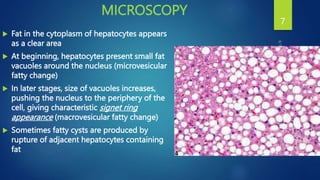
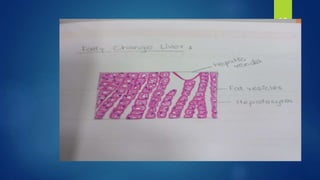
 Fat in the cytoplasm of hepatocytes appears
as a clear area
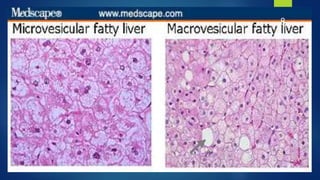
 At beginning, hepatocytes present small fat
vacuoles around the nucleus (microvesicular
fatty change)
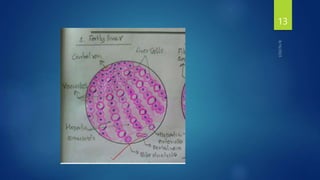
 In later stages, size of vacuoles increases,
pushing the nucleus to the periphery of the
cell, giving characteristic signet ring
appearance (macrovesicular fatty change)
 Sometimes fatty cysts are produced by
rupture of adjacent hepatocytes containing
fat
7
8
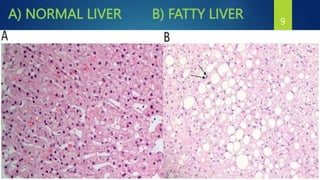
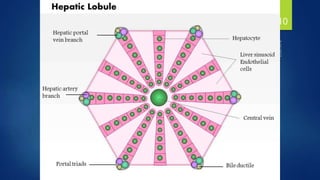
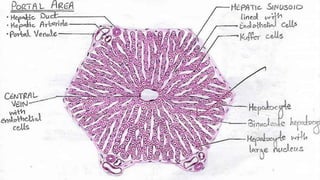
A) NORMAL LIVER B) FATTY LIVER 9
10
11
12
13

fatty change.pptx

  • 1.
  • 2.
    Fatty change/steatosis  Describesabnormal accumulation of triglycerides within parenchymal cells.it is an error of metabolism in which increased intestinal uptake of fats and carbohydrates overloads the fat transport and breakdown system resulting in deposition of large droplets of oil in the liver and renal parenchyma  Causes:  Alcohol abuse  Protein malnutrition  Obesity  DM  Anorexia(starvation)  Toxins (CCL4, chloroform, ether) 2
  • 3.
    Fatty liver/Hepatic steatosis Also known as fatty liver disease  Reversible condition where large molecules of triglycerides accumulate in the liver cells  Two main types:  1) Alcoholic fatty liver disease (AFLD)  2)Nonalcoholic fatty liver disease (NAFLD): Associated with diabetes and obesity  Can progress to steatohepatitis and ultimately cirrhosis which are irreversible 3
  • 4.
  • 5.
  • 6.
     Liver isenlarged and yellow  Capsule is tense and glistening  The cut surface is pale yellow and greasy to touch 6
  • 7.
    MICROSCOPY  Fat inthe cytoplasm of hepatocytes appears as a clear area  At beginning, hepatocytes present small fat vacuoles around the nucleus (microvesicular fatty change)  In later stages, size of vacuoles increases, pushing the nucleus to the periphery of the cell, giving characteristic signet ring appearance (macrovesicular fatty change)  Sometimes fatty cysts are produced by rupture of adjacent hepatocytes containing fat 7
  • 8.
  • 9.
    A) NORMAL LIVERB) FATTY LIVER 9
  • 10.
  • 11.
  • 12.
  • 13.