La fatica muscolare:
come studiarla con l'EMG di superficie
Leonardo Piano
Fisioterapista OMT
Casa di Cura “La Residenza” - Rodello (CN)
Studio di Fisioterapia – Alba (CN)
Arvier, 2 aprile 2016
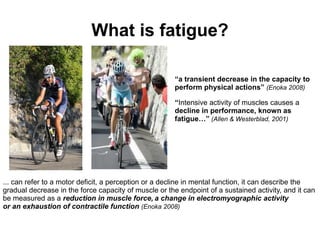
What is fatigue?
“a transient decrease in the capacity to
perform physical actions” (Enoka 2008)
“Intensive activity of muscles causes a
decline in performance, known as
fatigue…” (Allen & Westerblad, 2001)
... can refer to a motor deficit, a perception or a decline in mental function, it can describe the
gradual decrease in the force capacity of muscle or the endpoint of a sustained activity, and it can
be measured as a reduction in muscle force,
or an exhaustion of contractile function (Enoka 2008)
a change in electromyographic activity
How to measure?
 Borg scale
 Rate Perceived Exertion (RPE) scale
 Global Fatigue Index
 Modified Fatigue Impact Scale (MS)
 Fatigue Severity Scale
 ...
Why EMG?
 To objective the evaluation of muscle performance
 To improve the clinical and subjective assessment
 To manage the rehabilitation program after trauma or
surgery (es.: ACL reconstruction)
 To correctly manage the rest period during training
sessions
 For research
Surface EMG
L'elettromiografia (EMG) misura i potenziali elettrici che si
formano in un muscolo durante la sua contrazione
Surface EMG
EMG
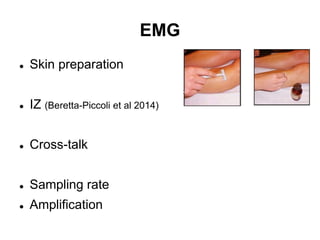
 Skin preparation
 IZ (Beretta-Piccoli et al 2014)
 Cross-talk
 Sampling rate
 Amplification
EMG and muscle fibers
Biological signal frequency:
10 - 450 Hz
Slow twitch motor units (tonic - Type I)
Frequency range = (20) 70 - 125 Hz
Fast twitch motor units (phasic - Type II)
Frequency range = 126 - 250 Hz
Surface EMG and fatigue
quali parametri?
Frequency-domain parameters
Mean Frequency (MNF)
Median Frequency (MDF)
Time-domain parameters
Average Rectified Value (ARV)
Root Mean Square (RMS)
- number of active MUAP
- Firing rate MUAP
- MUAP shape
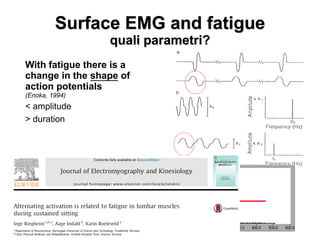
With fatigue there is a
change in the shape of
action potentials
(Enoka, 1994)
< amplitude
> duration
Surface EMG and fatigue
quali parametri?
Result is a EMG spectrum
shift to lower frequencies
(Sadoyama 1981, Winter, 1990)
Surface EMG and fatigue
quali parametri?
Firing rate = frequency
No. of cycles (firings) per unit of time
Mean Power Frequency (MNF)
Median Power Frequency (MDF)
a decrease in the mean/median power frequency serves as an
index of fatigue (Gonzalez-Izal 2012)
Velocità di conduzione delle fibre muscolari?
(Rainoldi et al 2015)

Fatigue and EMG

  • 1.
    La fatica muscolare: comestudiarla con l'EMG di superficie Leonardo Piano Fisioterapista OMT Casa di Cura “La Residenza” - Rodello (CN) Studio di Fisioterapia – Alba (CN) Arvier, 2 aprile 2016
  • 2.
    What is fatigue? “atransient decrease in the capacity to perform physical actions” (Enoka 2008) “Intensive activity of muscles causes a decline in performance, known as fatigue…” (Allen & Westerblad, 2001) ... can refer to a motor deficit, a perception or a decline in mental function, it can describe the gradual decrease in the force capacity of muscle or the endpoint of a sustained activity, and it can be measured as a reduction in muscle force, or an exhaustion of contractile function (Enoka 2008) a change in electromyographic activity
  • 3.
    How to measure? Borg scale  Rate Perceived Exertion (RPE) scale  Global Fatigue Index  Modified Fatigue Impact Scale (MS)  Fatigue Severity Scale  ...
  • 4.
    Why EMG?  Toobjective the evaluation of muscle performance  To improve the clinical and subjective assessment  To manage the rehabilitation program after trauma or surgery (es.: ACL reconstruction)  To correctly manage the rest period during training sessions  For research
  • 5.
    Surface EMG L'elettromiografia (EMG)misura i potenziali elettrici che si formano in un muscolo durante la sua contrazione
  • 6.
  • 7.
    EMG  Skin preparation IZ (Beretta-Piccoli et al 2014)  Cross-talk  Sampling rate  Amplification
  • 9.
    EMG and musclefibers Biological signal frequency: 10 - 450 Hz Slow twitch motor units (tonic - Type I) Frequency range = (20) 70 - 125 Hz Fast twitch motor units (phasic - Type II) Frequency range = 126 - 250 Hz
  • 10.
    Surface EMG andfatigue quali parametri? Frequency-domain parameters Mean Frequency (MNF) Median Frequency (MDF) Time-domain parameters Average Rectified Value (ARV) Root Mean Square (RMS) - number of active MUAP - Firing rate MUAP - MUAP shape
  • 11.
    With fatigue thereis a change in the shape of action potentials (Enoka, 1994) < amplitude > duration Surface EMG and fatigue quali parametri? Result is a EMG spectrum shift to lower frequencies (Sadoyama 1981, Winter, 1990)
  • 12.
    Surface EMG andfatigue quali parametri? Firing rate = frequency No. of cycles (firings) per unit of time Mean Power Frequency (MNF) Median Power Frequency (MDF) a decrease in the mean/median power frequency serves as an index of fatigue (Gonzalez-Izal 2012) Velocità di conduzione delle fibre muscolari? (Rainoldi et al 2015)