Embroidery
What is
Embroidery?
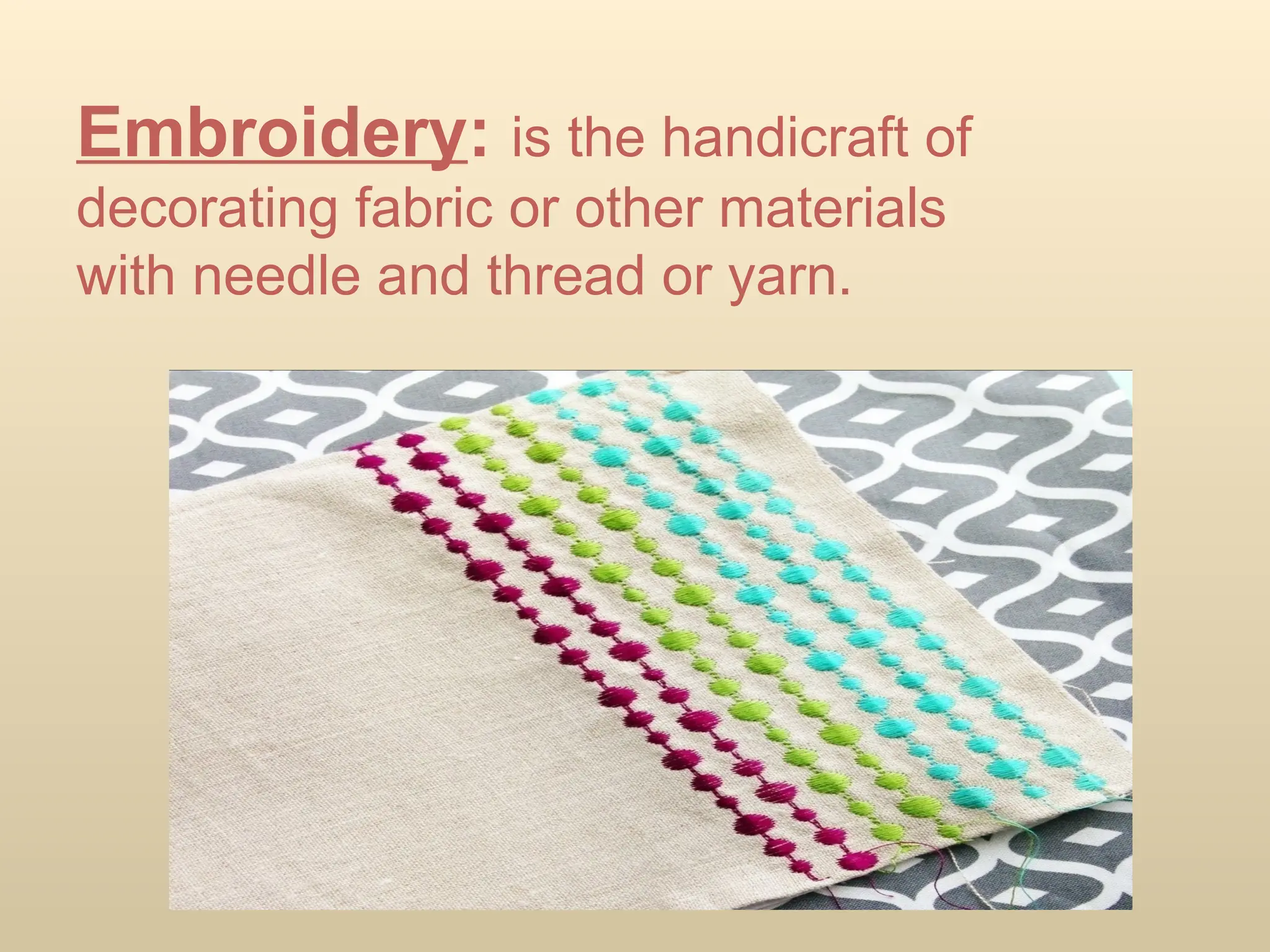
Embroidery: is the handicraft of
decorating fabric or other materials
with needle and thread or yarn.
History:
In 1964, a hunter’s fossil dating back to 30,000 B.C
was found in Cro-Magnon, Russia. The fur clothing
along with his boots and hat were heavily decorated
with handmade stitches of ivory bead
Chinese thread embroidery dates back to 3500 B.C
which is still prevalent today. Chinese bead embroidery
dates back to 6000 B.C that had drilled shells stitched
with decorative designs into animal hides. At around
500 A.D, embroidery with silk thread along with
precious stones and pearls was practiced in China.
Machine embroidery emerged with the industrial
revolution. It also brought in new varieties of yarn
like rayon apart from cotton and wool. Computers
brought in embroidery software with digitized
patterns to finish the texture and designs in the
clothing.
Even though technology has made embroidery work
easy, but there has not been much change in the
materials or techniques in the history of embroidery
that can be actually claimed as an advancement
from the primitive stage to the present.
Tools for Embroidery
Needle
Thread
Embroidery hoops and frames
Your design
What will we be doing?
We will be creating our own
embroidery patches.
Maximum of 4in x 4in. (can be bigger
see me)
Experimentation with color mixing.
So what is experimentation
with color?
It is where you put colors next to another to
create an effect.
This can be fades, color mixing , tone
change, light to darks. Any type of color
mixing. (think about how you make
secondary colors)
Hand Embroidery
Running Stitch
Backstitch
Couching Stitch
Outline Stitch
Chain Stitch
Videos of stitches to try.
Fish bone
https://www.youtube.com/watch?v=cz
ObvihZF2Q
Bullion knot
https://www.youtube.com/watch?v=SSU
V9F4RGNg
French knot
https://www.youtube.com/watch?v=W1
Cq24d5-8s
The running stitch.
https://www.youtube.co
m/watch?v=W4nhj8kMp
AI
Things to try.
Remember to fill the full area.
When you feel ready you can try
and create your own type of
stitch.
You can draw
your own
image on
cloth and then
fill it as you
go. So you
never feel
lost.
Make sure to
fill the full
areas of the
picture (see
the foot and
how it is filled
in)
So what should I make?:
Think about things you like. Such as...
Landscapes
Animals
A quote with an object
A family crest
Any ideas?
What you should do right
now:
1. Take your note books out and start
drawing ideas for your design.
2. Measure out a 4x4 circle or square to
work in. this will be the size of your design.
3.Use colored pencil and sharpie to make
your design. –make sure it is very detailed.
4. Find a piece of fabric you would like to
use. From the box.

lecturer note about Hand-Embroidery-PowerPoint.ppt

  • 1.
  • 2.
  • 3.
    Embroidery: is thehandicraft of decorating fabric or other materials with needle and thread or yarn.
  • 4.
    History: In 1964, ahunter’s fossil dating back to 30,000 B.C was found in Cro-Magnon, Russia. The fur clothing along with his boots and hat were heavily decorated with handmade stitches of ivory bead Chinese thread embroidery dates back to 3500 B.C which is still prevalent today. Chinese bead embroidery dates back to 6000 B.C that had drilled shells stitched with decorative designs into animal hides. At around 500 A.D, embroidery with silk thread along with precious stones and pearls was practiced in China.
  • 5.
    Machine embroidery emergedwith the industrial revolution. It also brought in new varieties of yarn like rayon apart from cotton and wool. Computers brought in embroidery software with digitized patterns to finish the texture and designs in the clothing. Even though technology has made embroidery work easy, but there has not been much change in the materials or techniques in the history of embroidery that can be actually claimed as an advancement from the primitive stage to the present.
  • 6.
  • 7.
    What will webe doing? We will be creating our own embroidery patches. Maximum of 4in x 4in. (can be bigger see me) Experimentation with color mixing.
  • 8.
    So what isexperimentation with color?
  • 9.
    It is whereyou put colors next to another to create an effect. This can be fades, color mixing , tone change, light to darks. Any type of color mixing. (think about how you make secondary colors)
  • 10.
  • 12.
  • 13.
  • 14.
  • 15.
  • 16.
  • 18.
    Videos of stitchesto try. Fish bone https://www.youtube.com/watch?v=cz ObvihZF2Q Bullion knot https://www.youtube.com/watch?v=SSU V9F4RGNg French knot https://www.youtube.com/watch?v=W1 Cq24d5-8s
  • 19.
  • 20.
  • 21.
    Remember to fillthe full area.
  • 22.
    When you feelready you can try and create your own type of stitch.
  • 23.
    You can draw yourown image on cloth and then fill it as you go. So you never feel lost. Make sure to fill the full areas of the picture (see the foot and how it is filled in)
  • 29.
    So what shouldI make?: Think about things you like. Such as... Landscapes Animals A quote with an object A family crest Any ideas?
  • 30.
    What you shoulddo right now: 1. Take your note books out and start drawing ideas for your design. 2. Measure out a 4x4 circle or square to work in. this will be the size of your design. 3.Use colored pencil and sharpie to make your design. –make sure it is very detailed. 4. Find a piece of fabric you would like to use. From the box.