Design, Implementation and Testing of
a Visual Discussion Forum
to Address New Post Bias
Farshid Marbouti
fmarbout@sfu.ca
Spring 2012
Outline
• Introducing New Post Bias
• Designing a new visual interface
• Testing of the visual interface
• Conclusion
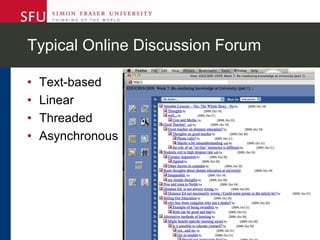
Typical Online Discussion Forum
• Text-based
• Linear
• Threaded
• Asynchronous
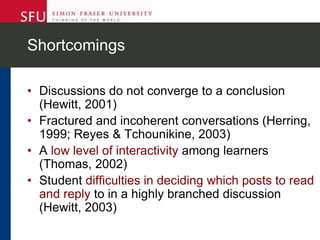
Shortcomings
• Discussions do not converge to a conclusion
(Hewitt, 2001)
• Fractured and incoherent conversations (Herring,
1999; Reyes & Tchounikine, 2003)
• A low level of interactivity among learners
(Thomas, 2002)
• Student difficulties in deciding which posts to read
and reply to in a highly branched discussion
(Hewitt, 2003)
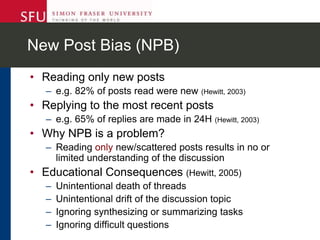
New Post Bias (NPB)
• Reading only new posts
– e.g. 82% of posts read were new (Hewitt, 2003)
• Replying to the most recent posts
– e.g. 65% of replies are made in 24H (Hewitt, 2003)
• Why NPB is a problem?
– Reading only new/scattered posts results in no or
limited understanding of the discussion
• Educational Consequences (Hewitt, 2005)
– Unintentional death of threads
– Unintentional drift of the discussion topic
– Ignoring synthesizing or summarizing tasks
– Ignoring difficult questions
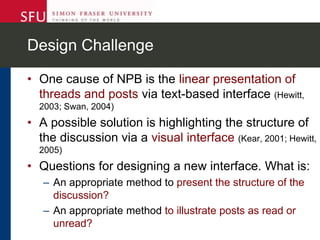
Design Challenge
• One cause of NPB is the linear presentation of
threads and posts via text-based interface (Hewitt,
2003; Swan, 2004)
• A possible solution is highlighting the structure of
the discussion via a visual interface (Kear, 2001; Hewitt,
2005)
• Questions for designing a new interface. What is:
– An appropriate method to present the structure of the
discussion?
– An appropriate method to illustrate posts as read or
unread?
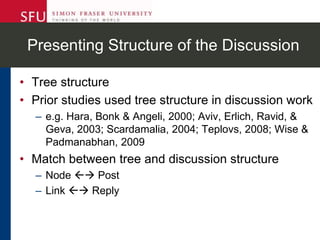
Presenting Structure of the Discussion
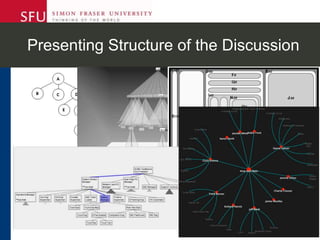
• Tree structure
• Prior studies used tree structure in discussion work
– e.g. Hara, Bonk & Angeli, 2000; Aviv, Erlich, Ravid, &
Geva, 2003; Scardamalia, 2004; Teplovs, 2008; Wise &
Padmanabhan, 2009
• Match between tree and discussion structure
– Node  Post
– Link  Reply
Presenting Structure of the Discussion
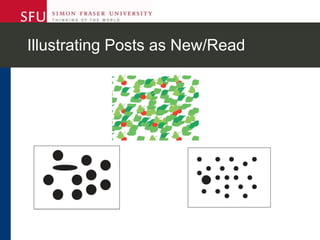
Illustrating Posts as New/Read
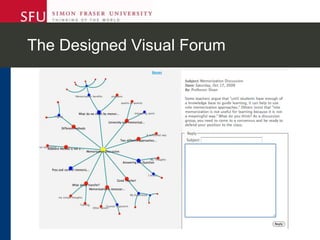
The Designed Visual Forum
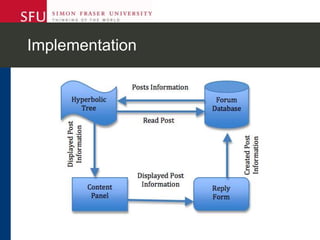
Implementation
Testing of the new interface
Research Questions
• How does the visual forum change students’
reading patterns regarding which threads to
visit and which posts to read?
• How does the visual forum influence
students’ behaviour in reading new posts?
Methodology
• Authentic task
• Record interactions and feedback
• Hybrid Design (Forde, 2008)
– Students participated in an online discussion via a
text-based forum for a course
– Asked students to participate in the same discussion
via the new visual forum
– Comparison case studies
Participants/Setting
• Course/Discussion
– Masters-level course, offering of two years ago
– 10 discussions, each 1 week long
– Discussion worth was 30% of the grade
• Participants
– 7 (4 female, 3 male) out of 15
– 1 student graduated, 6 students at the end of
their masters program
Task / Data Collection
• Total time ~75 min
• Read a summary of the selected week reading
• Participated in two sessions with a 10-min break
– Screen capturing and clickstream data
– Think-aloud data
• 1st Session: midway through the discussion
– 24 posts (out of 39), ~15 minute
• 2nd Session: at the end of the discussion
– All 39 posts, ~25 min
• Fill out a short online survey
• Logged data from the course
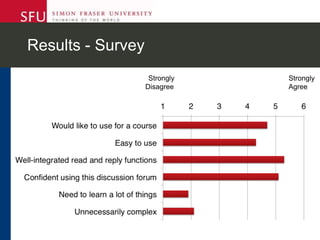
Results - Survey
Strongly
Disagree
Strongly
Agree
Results - Survey
• Useful features
– Visual design and layout
– Integrated read and reply box
– Reset button
• Downsides
– Movements
– Not displaying full posts’ subjects
– Missing authors’ names
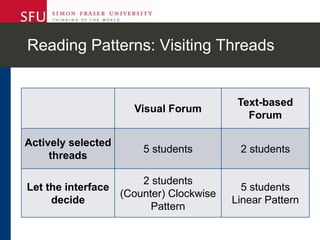
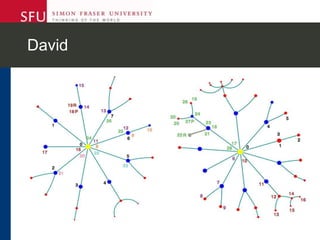
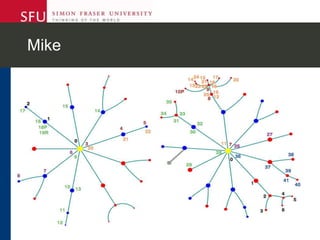
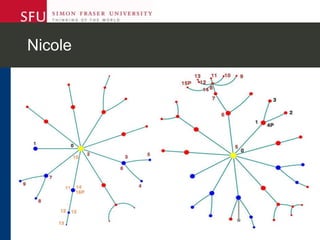
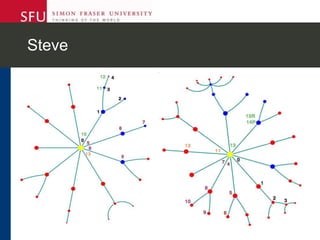
Reading Patterns: Visiting Threads
Visual Forum
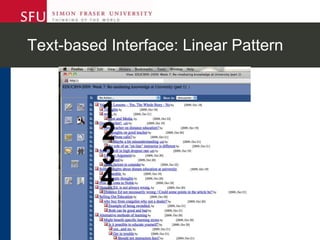
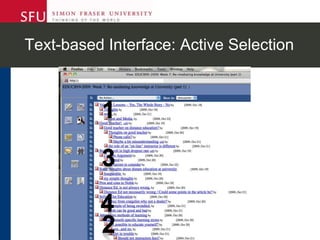
Text-based
Forum
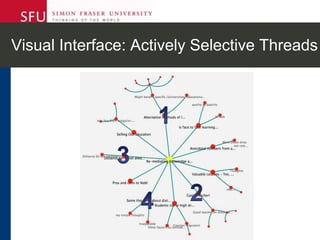
Actively selected
threads
5 students 2 students
Let the interface
decide
2 students
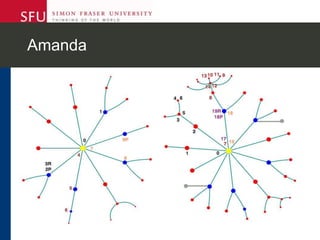
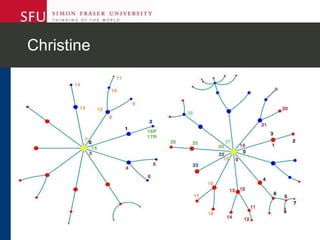
(Counter) Clockwise
Pattern
5 students
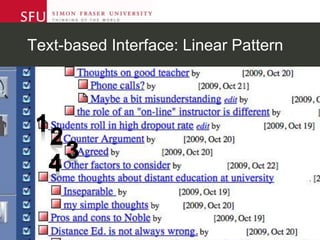
Linear Pattern
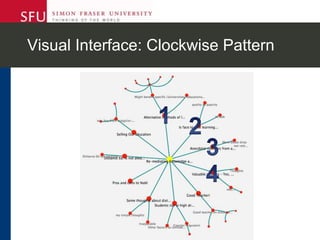
Visual Interface: Clockwise Pattern
Visual Interface: Actively Selective Threads
Text-based Interface: Linear Pattern
Text-based Interface: Active Selection
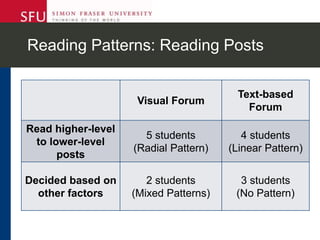
Reading Patterns: Reading Posts
Visual Forum
Text-based
Forum
Read higher-level
to lower-level
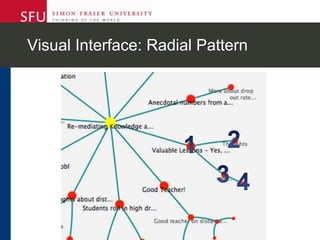
posts
5 students
(Radial Pattern)
4 students
(Linear Pattern)
Decided based on
other factors
2 students
(Mixed Patterns)
3 students
(No Pattern)
Visual Interface: Radial Pattern
Text-based Interface: Linear Pattern
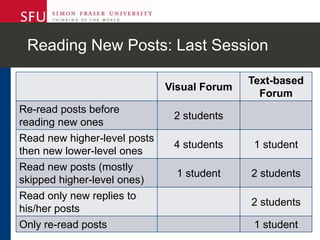
Reading New Posts: Last Session
Visual Forum
Text-based
Forum
Re-read posts before
reading new ones
2 students
Read new higher-level posts
then new lower-level ones
4 students 1 student
Read new posts (mostly
skipped higher-level ones)
1 student 2 students
Read only new replies to
his/her posts
2 students
Only re-read posts 1 student
Conclusion
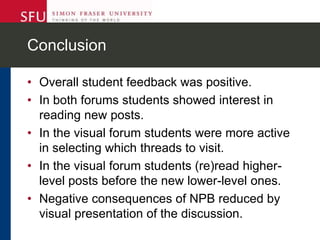
• Overall student feedback was positive.
• In both forums students showed interest in
reading new posts.
• In the visual forum students were more active
in selecting which threads to visit.
• In the visual forum students (re)read higher-
level posts before the new lower-level ones.
• Negative consequences of NPB reduced by
visual presentation of the discussion.
Limitations
• Comparability of sessions
– Number
– Duration
– Time between sessions
• Authenticity of the assigned task
• Lack of observational data for the text-based
forum
Implications for Future Work
• Design
– Displaying authors’ names
– Finding a post
– Illustrating different posts (e.g. self, instructor)
• Research
– Test in a naturalistic setting
– Task specific tests
– Investigating students’ replying patterns
Thank you!
Farshid Marbouti
fmarbout@sfu.ca
Spring 2012
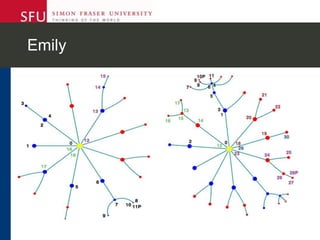
Emily
David
Mike
Nicole
Steve
Amanda
Christine
Knowledge Forum
Implications for Practice
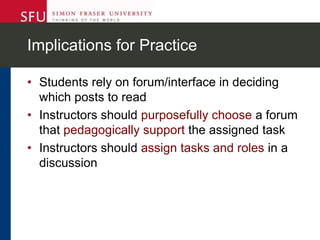
• Students rely on forum/interface in deciding
which posts to read
• Instructors should purposefully choose a forum
that pedagogically support the assigned task
• Instructors should assign tasks and roles in a
discussion

Farshid_Thesis

  • 1.
    Design, Implementation andTesting of a Visual Discussion Forum to Address New Post Bias Farshid Marbouti fmarbout@sfu.ca Spring 2012
  • 2.
    Outline • Introducing NewPost Bias • Designing a new visual interface • Testing of the visual interface • Conclusion
  • 3.
    Typical Online DiscussionForum • Text-based • Linear • Threaded • Asynchronous
  • 4.
    Shortcomings • Discussions donot converge to a conclusion (Hewitt, 2001) • Fractured and incoherent conversations (Herring, 1999; Reyes & Tchounikine, 2003) • A low level of interactivity among learners (Thomas, 2002) • Student difficulties in deciding which posts to read and reply to in a highly branched discussion (Hewitt, 2003)
  • 5.
    New Post Bias(NPB) • Reading only new posts – e.g. 82% of posts read were new (Hewitt, 2003) • Replying to the most recent posts – e.g. 65% of replies are made in 24H (Hewitt, 2003) • Why NPB is a problem? – Reading only new/scattered posts results in no or limited understanding of the discussion • Educational Consequences (Hewitt, 2005) – Unintentional death of threads – Unintentional drift of the discussion topic – Ignoring synthesizing or summarizing tasks – Ignoring difficult questions
  • 6.
    Design Challenge • Onecause of NPB is the linear presentation of threads and posts via text-based interface (Hewitt, 2003; Swan, 2004) • A possible solution is highlighting the structure of the discussion via a visual interface (Kear, 2001; Hewitt, 2005) • Questions for designing a new interface. What is: – An appropriate method to present the structure of the discussion? – An appropriate method to illustrate posts as read or unread?
  • 7.
    Presenting Structure ofthe Discussion • Tree structure • Prior studies used tree structure in discussion work – e.g. Hara, Bonk & Angeli, 2000; Aviv, Erlich, Ravid, & Geva, 2003; Scardamalia, 2004; Teplovs, 2008; Wise & Padmanabhan, 2009 • Match between tree and discussion structure – Node  Post – Link  Reply
  • 8.
  • 9.
  • 10.
  • 11.
  • 12.
    Testing of thenew interface Research Questions • How does the visual forum change students’ reading patterns regarding which threads to visit and which posts to read? • How does the visual forum influence students’ behaviour in reading new posts?
  • 13.
    Methodology • Authentic task •Record interactions and feedback • Hybrid Design (Forde, 2008) – Students participated in an online discussion via a text-based forum for a course – Asked students to participate in the same discussion via the new visual forum – Comparison case studies
  • 14.
    Participants/Setting • Course/Discussion – Masters-levelcourse, offering of two years ago – 10 discussions, each 1 week long – Discussion worth was 30% of the grade • Participants – 7 (4 female, 3 male) out of 15 – 1 student graduated, 6 students at the end of their masters program
  • 15.
    Task / DataCollection • Total time ~75 min • Read a summary of the selected week reading • Participated in two sessions with a 10-min break – Screen capturing and clickstream data – Think-aloud data • 1st Session: midway through the discussion – 24 posts (out of 39), ~15 minute • 2nd Session: at the end of the discussion – All 39 posts, ~25 min • Fill out a short online survey • Logged data from the course
  • 16.
  • 17.
    Results - Survey •Useful features – Visual design and layout – Integrated read and reply box – Reset button • Downsides – Movements – Not displaying full posts’ subjects – Missing authors’ names
  • 18.
    Reading Patterns: VisitingThreads Visual Forum Text-based Forum Actively selected threads 5 students 2 students Let the interface decide 2 students (Counter) Clockwise Pattern 5 students Linear Pattern
  • 19.
  • 20.
    Visual Interface: ActivelySelective Threads
  • 21.
  • 22.
  • 23.
    Reading Patterns: ReadingPosts Visual Forum Text-based Forum Read higher-level to lower-level posts 5 students (Radial Pattern) 4 students (Linear Pattern) Decided based on other factors 2 students (Mixed Patterns) 3 students (No Pattern)
  • 24.
  • 25.
  • 26.
    Reading New Posts:Last Session Visual Forum Text-based Forum Re-read posts before reading new ones 2 students Read new higher-level posts then new lower-level ones 4 students 1 student Read new posts (mostly skipped higher-level ones) 1 student 2 students Read only new replies to his/her posts 2 students Only re-read posts 1 student
  • 27.
    Conclusion • Overall studentfeedback was positive. • In both forums students showed interest in reading new posts. • In the visual forum students were more active in selecting which threads to visit. • In the visual forum students (re)read higher- level posts before the new lower-level ones. • Negative consequences of NPB reduced by visual presentation of the discussion.
  • 28.
    Limitations • Comparability ofsessions – Number – Duration – Time between sessions • Authenticity of the assigned task • Lack of observational data for the text-based forum
  • 29.
    Implications for FutureWork • Design – Displaying authors’ names – Finding a post – Illustrating different posts (e.g. self, instructor) • Research – Test in a naturalistic setting – Task specific tests – Investigating students’ replying patterns
  • 30.
  • 31.
  • 32.
  • 33.
  • 34.
  • 35.
  • 36.
  • 37.
  • 38.
  • 39.
    Implications for Practice •Students rely on forum/interface in deciding which posts to read • Instructors should purposefully choose a forum that pedagogically support the assigned task • Instructors should assign tasks and roles in a discussion

Editor's Notes

  • #4 Most online discussion forums are text-based and linear.
  • #5 This slide is a quick overview of linear text-based online discussions shortcomings.
  • #6 New posts bias: 82% of readings are only new posts.
  • #8 Basic presentation, cone tree, tree map, space tree, hyperbolic tree
  • #9 Basic presentation, cone tree, tree map, space tree, hyperbolic tree
  • #10 Color, shape, size
  • #18 All participants agreed that they would like to use the tool for a course. All participants found the reading and replying functions well-integrated, and everyone felt confident using the forum. No one found the forum unnecessarily complex or felt that they needed to learn a lot of things before working with the forum. In addition, overall students found the visual forum easy to use and easy to learn.