Rethinking Online Discussions:
From Boredom to Engagement


                        Rajesh Singh & Yvonne Ballester
                        School of Library & Information Management,
                        Emporia State University
                        rsingh1@emporia.edu, yballest@emporia.edu

             Copyright © 2012, Rajesh Singh and Yvonne Ballester, All rights reserved.
Agenda
 Background on SLIM Course Format
 Motivation Behind Our Study
 Research Aim and Questions
 Conceptual Foundations
 Methods and Materials
 Discussion on Findings
 Implications of the Research


               Copyright © 2012, Rajesh Singh and Yvonne Ballester, All rights reserved.
Background on
SLIM Course Format

   Core courses: “blended” (hybrid) format
    ◦ Weekend Intensive (Friday evening, all day
      Saturday)
    ◦ Two weekend meetings per semester (lecture,
      group work, presentations)
    ◦ All other work online – discussion often the
      majority.
   Elective courses: typically all-online

                     Copyright © 2012, Rajesh Singh and Yvonne Ballester, All rights reserved.
Motivations behind this Study
 General dissatisfaction with discussion
  boards for both students and faculty.
 Students ask:
    ◦ Why do we have to post postings every
      week?
    ◦ Face-to-face classes don’t require everyone to
      participate in discussion, so why such a
      requirement in online discussion?


                      Copyright © 2012, Rajesh Singh and Yvonne Ballester, All rights reserved.
How Can We Improve Online
Discussion?
 What makes a discussion boring and
  monotonous?
 What makes a discussion engaging?
 As an instructor, how can you tell
  whether a discussion is “successful”?
    ◦ Quality postings
    ◦ How engaged students are in responding to
      postings


                     Copyright © 2012, Rajesh Singh and Yvonne Ballester, All rights reserved.
How can we improve the quality of
online discussions?
Possible strategies:
 Change the interface used for online
  discussion
 Change your instructional
  approaches to online discussion
 Reflection on the results of the
  above changes (what works, what
  doesn’t work)
               Copyright © 2012, Rajesh Singh and Yvonne Ballester, All rights reserved.
Moore’s Theory of Transactional Distance

   Distance as a ‘pedagogical’ phenomenon rather than a
    geographical one.
   Three elements:
    ◦ Dialogue
    ◦ Structure
    ◦ Learner Autonomy
   Four interactions:
    ◦   Learner-instructor
    ◦   Learner-learner
    ◦   Learner-content
    ◦   Learner-interface


                             Copyright © 2012, Rajesh Singh and Yvonne Ballester, All rights reserved.
Research Questions

   Does using a blog interface instead of discussion boards
    promote meaningful and engaging learner-centered
    online discussions?

   Do certain instructional strategies promote meaningful
    and engaging learner-centered online discussions?


                         Copyright © 2012, Rajesh Singh and Yvonne Ballester, All rights reserved.
Method and materials
   Survey was conducted in Spring 2012 across 3 School of
    Library & Information Management (SLIM) courses
   Purposive sample
   39 students participated in the survey (Masters of
    Library Science students)
   An integrated approach of quantitative and qualitative
    methods was used to understand students’ overall
    learning experience.


                        Copyright © 2012, Rajesh Singh and Yvonne Ballester, All rights reserved.
USABILITY OF BLOGS
VERSUS DISCUSSION
BOARDS


      Copyright © 2012, Rajesh Singh and Yvonne Ballester, All rights reserved.
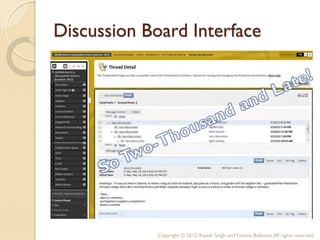
Discussion Board Interface


             Copyright © 2012, Rajesh Singh and Yvonne Ballester, All rights reserved.
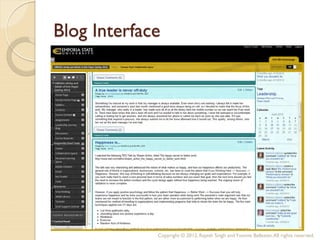
Blog Interface


             Copyright © 2012, Rajesh Singh and Yvonne Ballester, All rights reserved.
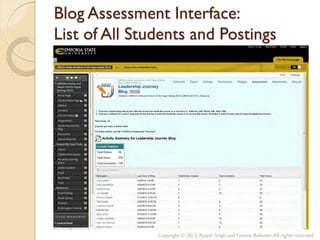
Blog Assessment Interface:
List of All Students and Postings


               Copyright © 2012, Rajesh Singh and Yvonne Ballester, All rights reserved.
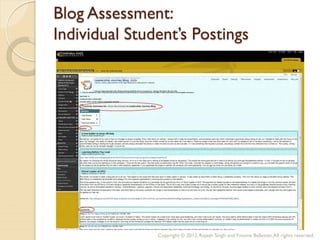
Blog Assessment:
Individual Student’s Postings


               Copyright © 2012, Rajesh Singh and Yvonne Ballester, All rights reserved.
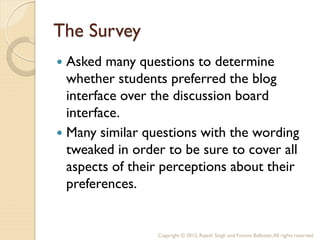
The Survey
 Asked many questions to determine
  whether students preferred the blog
  interface over the discussion board
  interface.
 Many similar questions with the wording
  tweaked in order to be sure to cover all
  aspects of their perceptions about their
  preferences.


                 Copyright © 2012, Rajesh Singh and Yvonne Ballester, All rights reserved.
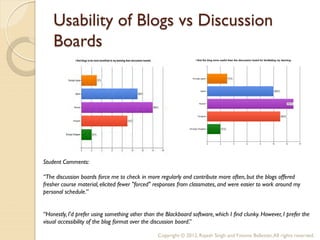
Usability of Blogs vs Discussion
    Boards


Student Comments:

“The discussion boards force me to check in more regularly and contribute more often, but the blogs offered
fresher course material, elicited fewer "forced" responses from classmates, and were easier to work around my
personal schedule.”


“Honestly, I'd prefer using something other than the Blackboard software, which I find clunky. However, I prefer the
visual accessibility of the blog format over the discussion board.”

                                                 Copyright © 2012, Rajesh Singh and Yvonne Ballester, All rights reserved.
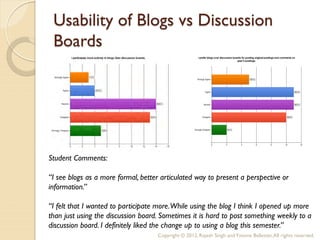
Usability of Blogs vs Discussion
 Boards


Student Comments:

“I see blogs as a more formal, better articulated way to present a perspective or
information.”

“I felt that I wanted to participate more. While using the blog I think I opened up more
than just using the discussion board. Sometimes it is hard to post something weekly to a
discussion board. I definitely liked the change up to using a blog this semester.”
                                    Copyright © 2012, Rajesh Singh and Yvonne Ballester, All rights reserved.
Usability of Blogs vs Discussion
    Boards


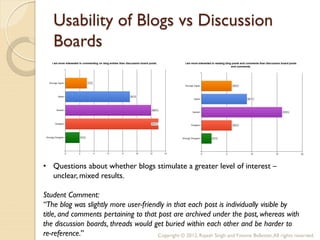
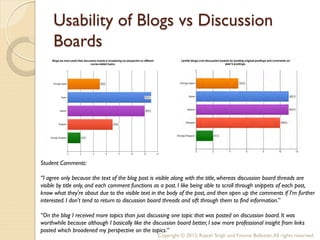
• Questions about whether blogs stimulate a greater level of interest –
  unclear, mixed results.

Student Comment:
“The blog was slightly more user-friendly in that each post is individually visible by
title, and comments pertaining to that post are archived under the post, whereas with
the discussion boards, threads would get buried within each other and be harder to
re-reference.”                         Copyright © 2012, Rajesh Singh and Yvonne Ballester, All rights reserved.
Usability of Blogs vs Discussion
     Boards


Student Comments:

“I agree only because the text of the blog post is visible along with the title, whereas discussion board threads are
visible by title only, and each comment functions as a post. I like being able to scroll through snippets of each post,
know what they're about due to the visible text in the body of the post, and then open up the comments if I'm further
interested. I don't tend to return to discussion board threads and sift through them to find information.”

“On the blog I received more topics than just discussing one topic that was posted on discussion board. It was
worthwhile because although I basically like the discussion board better, I saw more professional insight from links
posted which broadened my perspective on the topics.”
                                                   Copyright © 2012, Rajesh Singh and Yvonne Ballester, All rights reserved.
INSTRUCTIONAL
STRATEGIES


      Copyright © 2012, Rajesh Singh and Yvonne Ballester, All rights reserved.
Instructional Strategies


Student Comments:

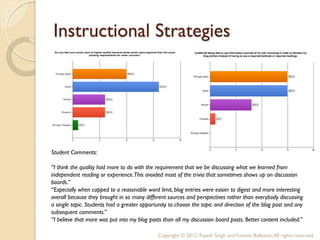
“I think the quality had more to do with the requirement that we be discussing what we learned from
independent reading or experience. This avoided most of the trivia that sometimes shows up on discussion
boards.”
“Especially when capped to a reasonable word limit, blog entries were easier to digest and more interesting
overall because they brought in so many different sources and perspectives rather than everybody discussing
a single topic. Students had a greater opportunity to choose the topic and direction of the blog post and any
subsequent comments.”
“I believe that more was put into my blog posts than all my discussion board posts. Better content included.”

                                              Copyright © 2012, Rajesh Singh and Yvonne Ballester, All rights reserved.
Instructional Strategies


Student Comments:

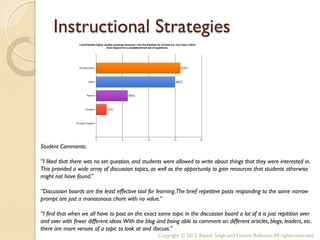
“I liked that there was no set question, and students were allowed to write about things that they were interested in.
This provided a wide array of discussion topics, as well as the opportunity to gain resources that students otherwise
might not have found.”

“Discussion boards are the least effective tool for learning.The brief repetitive posts responding to the same narrow
prompt are just a monotonous chore with no value.”

“I find that when we all have to post on the exact same topic in the discussion board a lot of it is just repitition over
and over with fewer different ideas. With the blog and being able to comment on different articles, blogs, leaders, etc.
there are more venues of a topic to look at and discuss.”
                                                    Copyright © 2012, Rajesh Singh and Yvonne Ballester, All rights reserved.
IMPLICATIONS


     Copyright © 2012, Rajesh Singh and Yvonne Ballester, All rights reserved.
Recommended Instructional
Approaches for Faculty
   Take On the Role of an Observer: Occasionally participate in online discussions, but
    primarily take on an observer role.Your presence should be apparent, but an active role is not
    necessary, and arguably can interfere with students’ learning.
   Avoid Regurgitation: Avoid the types of discussion that simply ask students to parrot back
    information that you already know.
   Give Students Freedom to Choose: Provide a set of broad topics as a roadmap for blog
    participation, but allow students the freedom to choose their specific topic of interest.
   Encourage Self-Discovery: Allow students to make discoveries themselves and lead each
    other to those discoveries. Don't tell students something that they can tell you.
   Encourage Higher-Order Thinking: Encourage high-level discussions by providing students
    with autonomy, ownership and flexibility in their discussions.
   Spark Their Interest: Guide students to connect discussions with their lives and their chosen
    profession.
   Limit Number of Posts Required: Less is more – require fewer higher quality postings.
   Limit Length of Posts: Again, less is more – provide a word limit for postings (e.g., 100-300
    words) so that entries remain manageable to read and digest.
   Provide Regular Feedback: With a lower number of required postings, word limits, and the
    instructor taking on an observer role, providing feedback on online discussion will be more
    doable for the instructor.

                                        Copyright © 2012, Rajesh Singh and Yvonne Ballester, All rights reserved.
Selected Comments from Course
Evaluations
These comments reinforce some of the aforementioned instructional
approaches:

   “The leadership journey blog was a fun assignment. I liked how
    free we were to choose our own topics and I thought the
    conversations going on throughout the blog between students was
    great.”

   “I enjoyed the blog format compared to the typical discussion
    board requirement. It made the subject matter much more
    refreshing, and since the postings were (in theory) supposed to be
    no more than 300 words, it made the content fairly digestible. I do
    feel like this course prompted a great deal of self reflection and
    tendencies and how they influence my interactions with others.”


                             Copyright © 2012, Rajesh Singh and Yvonne Ballester, All rights reserved.
Articulate the Goals for Online
Discussion
   To foster students' engagement with course
    material

   To facilitate their connection with fellow
    students

   To create opportunities for reflective
    thinking

   To enable discussion of challenging topics

                     Copyright © 2012, Rajesh Singh and Yvonne Ballester, All rights reserved.
Provide Clarity in Assignment
Description
   State Broad Parameters
    ◦ Required or optional
    ◦ Credit or no credit
   Provide Frames of Reference
    ◦ Specific roles for students and instructor
    ◦ Relation between online discussion and overall
      course goal and workload
   Delineate Specific Requirements
    ◦ Number of original posts/replies to peer’s postings
    ◦ Genre and length of posts
    ◦ Timeframe for posting and discussion
                         Copyright © 2012, Rajesh Singh and Yvonne Ballester, All rights reserved.
Implications – Future Research
  Can we improve interfaces for online
  discussion?
  What questions would you like to see
  answered in future research studies?


                 Copyright © 2012, Rajesh Singh and Yvonne Ballester, All rights reserved.
Questions?


             Copyright © 2012, Rajesh Singh and Yvonne Ballester, All rights reserved.

Rethinking online discussion singh ballester

  • 1.
    Rethinking Online Discussions: FromBoredom to Engagement Rajesh Singh & Yvonne Ballester School of Library & Information Management, Emporia State University rsingh1@emporia.edu, yballest@emporia.edu Copyright © 2012, Rajesh Singh and Yvonne Ballester, All rights reserved.
  • 2.
    Agenda  Background onSLIM Course Format  Motivation Behind Our Study  Research Aim and Questions  Conceptual Foundations  Methods and Materials  Discussion on Findings  Implications of the Research Copyright © 2012, Rajesh Singh and Yvonne Ballester, All rights reserved.
  • 3.
    Background on SLIM CourseFormat  Core courses: “blended” (hybrid) format ◦ Weekend Intensive (Friday evening, all day Saturday) ◦ Two weekend meetings per semester (lecture, group work, presentations) ◦ All other work online – discussion often the majority.  Elective courses: typically all-online Copyright © 2012, Rajesh Singh and Yvonne Ballester, All rights reserved.
  • 4.
    Motivations behind thisStudy  General dissatisfaction with discussion boards for both students and faculty.  Students ask: ◦ Why do we have to post postings every week? ◦ Face-to-face classes don’t require everyone to participate in discussion, so why such a requirement in online discussion? Copyright © 2012, Rajesh Singh and Yvonne Ballester, All rights reserved.
  • 5.
    How Can WeImprove Online Discussion?  What makes a discussion boring and monotonous?  What makes a discussion engaging?  As an instructor, how can you tell whether a discussion is “successful”? ◦ Quality postings ◦ How engaged students are in responding to postings Copyright © 2012, Rajesh Singh and Yvonne Ballester, All rights reserved.
  • 6.
    How can weimprove the quality of online discussions? Possible strategies:  Change the interface used for online discussion  Change your instructional approaches to online discussion  Reflection on the results of the above changes (what works, what doesn’t work) Copyright © 2012, Rajesh Singh and Yvonne Ballester, All rights reserved.
  • 7.
    Moore’s Theory ofTransactional Distance  Distance as a ‘pedagogical’ phenomenon rather than a geographical one.  Three elements: ◦ Dialogue ◦ Structure ◦ Learner Autonomy  Four interactions: ◦ Learner-instructor ◦ Learner-learner ◦ Learner-content ◦ Learner-interface Copyright © 2012, Rajesh Singh and Yvonne Ballester, All rights reserved.
  • 8.
    Research Questions  Does using a blog interface instead of discussion boards promote meaningful and engaging learner-centered online discussions?  Do certain instructional strategies promote meaningful and engaging learner-centered online discussions? Copyright © 2012, Rajesh Singh and Yvonne Ballester, All rights reserved.
  • 9.
    Method and materials  Survey was conducted in Spring 2012 across 3 School of Library & Information Management (SLIM) courses  Purposive sample  39 students participated in the survey (Masters of Library Science students)  An integrated approach of quantitative and qualitative methods was used to understand students’ overall learning experience. Copyright © 2012, Rajesh Singh and Yvonne Ballester, All rights reserved.
  • 10.
    USABILITY OF BLOGS VERSUSDISCUSSION BOARDS Copyright © 2012, Rajesh Singh and Yvonne Ballester, All rights reserved.
  • 11.
    Discussion Board Interface Copyright © 2012, Rajesh Singh and Yvonne Ballester, All rights reserved.
  • 12.
    Blog Interface Copyright © 2012, Rajesh Singh and Yvonne Ballester, All rights reserved.
  • 13.
    Blog Assessment Interface: Listof All Students and Postings Copyright © 2012, Rajesh Singh and Yvonne Ballester, All rights reserved.
  • 14.
    Blog Assessment: Individual Student’sPostings Copyright © 2012, Rajesh Singh and Yvonne Ballester, All rights reserved.
  • 15.
    The Survey  Askedmany questions to determine whether students preferred the blog interface over the discussion board interface.  Many similar questions with the wording tweaked in order to be sure to cover all aspects of their perceptions about their preferences. Copyright © 2012, Rajesh Singh and Yvonne Ballester, All rights reserved.
  • 16.
    Usability of Blogsvs Discussion Boards Student Comments: “The discussion boards force me to check in more regularly and contribute more often, but the blogs offered fresher course material, elicited fewer "forced" responses from classmates, and were easier to work around my personal schedule.” “Honestly, I'd prefer using something other than the Blackboard software, which I find clunky. However, I prefer the visual accessibility of the blog format over the discussion board.” Copyright © 2012, Rajesh Singh and Yvonne Ballester, All rights reserved.
  • 17.
    Usability of Blogsvs Discussion Boards Student Comments: “I see blogs as a more formal, better articulated way to present a perspective or information.” “I felt that I wanted to participate more. While using the blog I think I opened up more than just using the discussion board. Sometimes it is hard to post something weekly to a discussion board. I definitely liked the change up to using a blog this semester.” Copyright © 2012, Rajesh Singh and Yvonne Ballester, All rights reserved.
  • 18.
    Usability of Blogsvs Discussion Boards • Questions about whether blogs stimulate a greater level of interest – unclear, mixed results. Student Comment: “The blog was slightly more user-friendly in that each post is individually visible by title, and comments pertaining to that post are archived under the post, whereas with the discussion boards, threads would get buried within each other and be harder to re-reference.” Copyright © 2012, Rajesh Singh and Yvonne Ballester, All rights reserved.
  • 19.
    Usability of Blogsvs Discussion Boards Student Comments: “I agree only because the text of the blog post is visible along with the title, whereas discussion board threads are visible by title only, and each comment functions as a post. I like being able to scroll through snippets of each post, know what they're about due to the visible text in the body of the post, and then open up the comments if I'm further interested. I don't tend to return to discussion board threads and sift through them to find information.” “On the blog I received more topics than just discussing one topic that was posted on discussion board. It was worthwhile because although I basically like the discussion board better, I saw more professional insight from links posted which broadened my perspective on the topics.” Copyright © 2012, Rajesh Singh and Yvonne Ballester, All rights reserved.
  • 20.
    INSTRUCTIONAL STRATEGIES Copyright © 2012, Rajesh Singh and Yvonne Ballester, All rights reserved.
  • 21.
    Instructional Strategies Student Comments: “Ithink the quality had more to do with the requirement that we be discussing what we learned from independent reading or experience. This avoided most of the trivia that sometimes shows up on discussion boards.” “Especially when capped to a reasonable word limit, blog entries were easier to digest and more interesting overall because they brought in so many different sources and perspectives rather than everybody discussing a single topic. Students had a greater opportunity to choose the topic and direction of the blog post and any subsequent comments.” “I believe that more was put into my blog posts than all my discussion board posts. Better content included.” Copyright © 2012, Rajesh Singh and Yvonne Ballester, All rights reserved.
  • 22.
    Instructional Strategies Student Comments: “Iliked that there was no set question, and students were allowed to write about things that they were interested in. This provided a wide array of discussion topics, as well as the opportunity to gain resources that students otherwise might not have found.” “Discussion boards are the least effective tool for learning.The brief repetitive posts responding to the same narrow prompt are just a monotonous chore with no value.” “I find that when we all have to post on the exact same topic in the discussion board a lot of it is just repitition over and over with fewer different ideas. With the blog and being able to comment on different articles, blogs, leaders, etc. there are more venues of a topic to look at and discuss.” Copyright © 2012, Rajesh Singh and Yvonne Ballester, All rights reserved.
  • 23.
    IMPLICATIONS Copyright © 2012, Rajesh Singh and Yvonne Ballester, All rights reserved.
  • 24.
    Recommended Instructional Approaches forFaculty  Take On the Role of an Observer: Occasionally participate in online discussions, but primarily take on an observer role.Your presence should be apparent, but an active role is not necessary, and arguably can interfere with students’ learning.  Avoid Regurgitation: Avoid the types of discussion that simply ask students to parrot back information that you already know.  Give Students Freedom to Choose: Provide a set of broad topics as a roadmap for blog participation, but allow students the freedom to choose their specific topic of interest.  Encourage Self-Discovery: Allow students to make discoveries themselves and lead each other to those discoveries. Don't tell students something that they can tell you.  Encourage Higher-Order Thinking: Encourage high-level discussions by providing students with autonomy, ownership and flexibility in their discussions.  Spark Their Interest: Guide students to connect discussions with their lives and their chosen profession.  Limit Number of Posts Required: Less is more – require fewer higher quality postings.  Limit Length of Posts: Again, less is more – provide a word limit for postings (e.g., 100-300 words) so that entries remain manageable to read and digest.  Provide Regular Feedback: With a lower number of required postings, word limits, and the instructor taking on an observer role, providing feedback on online discussion will be more doable for the instructor. Copyright © 2012, Rajesh Singh and Yvonne Ballester, All rights reserved.
  • 25.
    Selected Comments fromCourse Evaluations These comments reinforce some of the aforementioned instructional approaches:  “The leadership journey blog was a fun assignment. I liked how free we were to choose our own topics and I thought the conversations going on throughout the blog between students was great.”  “I enjoyed the blog format compared to the typical discussion board requirement. It made the subject matter much more refreshing, and since the postings were (in theory) supposed to be no more than 300 words, it made the content fairly digestible. I do feel like this course prompted a great deal of self reflection and tendencies and how they influence my interactions with others.” Copyright © 2012, Rajesh Singh and Yvonne Ballester, All rights reserved.
  • 26.
    Articulate the Goalsfor Online Discussion  To foster students' engagement with course material  To facilitate their connection with fellow students  To create opportunities for reflective thinking  To enable discussion of challenging topics Copyright © 2012, Rajesh Singh and Yvonne Ballester, All rights reserved.
  • 27.
    Provide Clarity inAssignment Description  State Broad Parameters ◦ Required or optional ◦ Credit or no credit  Provide Frames of Reference ◦ Specific roles for students and instructor ◦ Relation between online discussion and overall course goal and workload  Delineate Specific Requirements ◦ Number of original posts/replies to peer’s postings ◦ Genre and length of posts ◦ Timeframe for posting and discussion Copyright © 2012, Rajesh Singh and Yvonne Ballester, All rights reserved.
  • 28.
    Implications – FutureResearch  Can we improve interfaces for online discussion?  What questions would you like to see answered in future research studies? Copyright © 2012, Rajesh Singh and Yvonne Ballester, All rights reserved.
  • 29.
    Questions? Copyright © 2012, Rajesh Singh and Yvonne Ballester, All rights reserved.