Farmer’s Distress in India
Submitted by
Sujit Kumar 2013UCE1729
Nitin Kumar 2013UCE1333
Submitted to
Dr. Preeti Bhatt
Department of Humanities and
Social Science
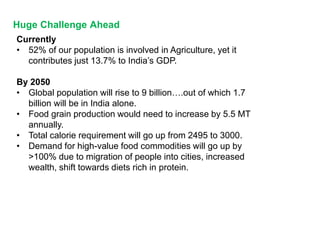
● Contributes 13.7% to GDP
● Provides food to 1.25 Billion people
● Sustains 60% of the population
● Produces 51 major Crops
- Rice, wheat, maize, etc
● Seventh Largest agricultural exporter worldwide
● Huge bio-diversity : 46,000 species of plants &
86,000 species of animals
Indian Agriculture- Some Facts
Huge Challenge Ahead
Currently
• 52% of our population is involved in Agriculture, yet it
contributes just 13.7% to India’s GDP.
By 2050
• Global population will rise to 9 billion….out of which 1.7
billion will be in India alone.
• Food grain production would need to increase by 5.5 MT
annually.
• Total calorie requirement will go up from 2495 to 3000.
• Demand for high-value food commodities will go up by
>100% due to migration of people into cities, increased
wealth, shift towards diets rich in protein.
Status of
The Indian Farmers
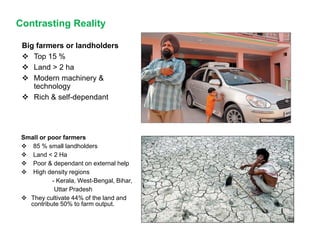
Contrasting Reality
Big farmers or landholders
 Top 15 %
 Land > 2 ha
 Modern machinery &
technology
 Rich & self-dependant
Small or poor farmers
 85 % small landholders
 Land < 2 Ha
 Poor & dependant on external help
 High density regions
- Kerala, West-Bengal, Bihar,
Uttar Pradesh
 They cultivate 44% of the land and
contribute 50% to farm output.
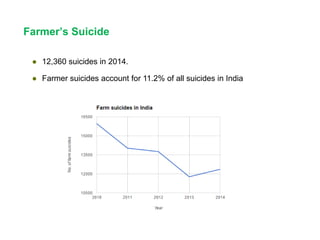
● 12,360 suicides in 2014.
● Farmer suicides account for 11.2% of all suicides in India
Farmer’s Suicide
Immediate reasons of Farmer’s distress
● Issues of weather and climate
- erratic weather
- rainfall does not happens at right time
- difficult to obtain irrigation water
● Decreasing size of landholding
- Division of land
- Less area less income
- Mechanisation and automation
becomes difficult
- Rely on labour
● Lack of farm labour
- Construction and Industries
- Urban migration
- Interested in education
Immediate reasons of Farmer’s distress
● Unsatisfactory realisation of prices
- inability of most farmers to sell their
produce in regulated market
- middle man enjoys profit
- get less price
● Inadequate storage facilities
- lack of cold storages
- 30 to 40 % agriculture is damaged
- Low price selling
● Quality of seeds, pesticides and fertilizers
- poor quality reduces fertility
- high price of good quality seeds
- use cow dung as fertilizer (ineffective)
- inability to buy chemical fertilizers.
● Absence of mechanisation
Factors Causing
Agrarian Distress in Long-run
Consequences of Green Revolution
● Degradation of soil quality due to reckless
chemical use
● Increased weeds & pests resistance
● Water table decreased & quality deteriorated
● Inter-Crop imbalances
● Increase in inequality among farmers
Extreme politicization of Farmers
● Shrinking landholding size clearly indicates the need to
bring farmers into services & manufacturing
● Huge voter bank (about 60 %)
● Every political party sympathies with farmers
● Farmers are made sacred cow
● Rural economic diversification hampered
● Unproductive farmers don’t quit farming
Income Tax Exemption
● Farmers don’t maintain their accounts
● Assessing credit potential is an onerous task for the
bank loan officers
● So bank loan officers in India rely on informal networks
to get info about the borrowers
● Thus big farmers get optimal credit & small landholders
approaches private moneylenders
Electricity bill subsidy for water pumps
● Practice leads to over-exploitation of groundwater.
● Water table drops in the long run.
● Causes excessive salination of soil.
● Local ecosystem gets adversely affected.
● Agricultural productivity decreases
Loan Waiver Trend
● Every election manifesto talks about loan waiver for
farmers.
● Not a solution, but a remedy.
● However, it leads a negative perception among
farmers.
● Unproductive farmers remain adhered to the farming.
● Studys shown that it has a negative impact in long run.
Fertilizer Subsidy Policy
● Fertilizer subsidy (40,000 crores) is the second-biggest
subsidy after food subsidy
● Reckless black marketing increases prices at user level
● Fertilizer use depends on soil type & require proper
knowledge
● Illiterate farmers do more harm to their fields by using
available fertilizers
FDI in Retail sector
● Intense protest over FDI in retail sector until
recently
● 60 years after independence wasted
● Biggest loss was to the farming sector
● Domestic food processing industry could not
develop
● Foreign players will boost agricultural infrastructure
Conclusion
● We need to focus on both the visible & direct
causes as well as the indirect one.
● Integrated policy for agriculture must be adopted.
Thank You

Farmer's distress in India

  • 1.
    Farmer’s Distress inIndia Submitted by Sujit Kumar 2013UCE1729 Nitin Kumar 2013UCE1333 Submitted to Dr. Preeti Bhatt Department of Humanities and Social Science
  • 2.
    ● Contributes 13.7%to GDP ● Provides food to 1.25 Billion people ● Sustains 60% of the population ● Produces 51 major Crops - Rice, wheat, maize, etc ● Seventh Largest agricultural exporter worldwide ● Huge bio-diversity : 46,000 species of plants & 86,000 species of animals Indian Agriculture- Some Facts
  • 3.
    Huge Challenge Ahead Currently •52% of our population is involved in Agriculture, yet it contributes just 13.7% to India’s GDP. By 2050 • Global population will rise to 9 billion….out of which 1.7 billion will be in India alone. • Food grain production would need to increase by 5.5 MT annually. • Total calorie requirement will go up from 2495 to 3000. • Demand for high-value food commodities will go up by >100% due to migration of people into cities, increased wealth, shift towards diets rich in protein.
  • 4.
  • 5.
    Contrasting Reality Big farmersor landholders  Top 15 %  Land > 2 ha  Modern machinery & technology  Rich & self-dependant Small or poor farmers  85 % small landholders  Land < 2 Ha  Poor & dependant on external help  High density regions - Kerala, West-Bengal, Bihar, Uttar Pradesh  They cultivate 44% of the land and contribute 50% to farm output.
  • 6.
    ● 12,360 suicidesin 2014. ● Farmer suicides account for 11.2% of all suicides in India Farmer’s Suicide
  • 7.
    Immediate reasons ofFarmer’s distress ● Issues of weather and climate - erratic weather - rainfall does not happens at right time - difficult to obtain irrigation water ● Decreasing size of landholding - Division of land - Less area less income - Mechanisation and automation becomes difficult - Rely on labour ● Lack of farm labour - Construction and Industries - Urban migration - Interested in education
  • 8.
    Immediate reasons ofFarmer’s distress ● Unsatisfactory realisation of prices - inability of most farmers to sell their produce in regulated market - middle man enjoys profit - get less price ● Inadequate storage facilities - lack of cold storages - 30 to 40 % agriculture is damaged - Low price selling ● Quality of seeds, pesticides and fertilizers - poor quality reduces fertility - high price of good quality seeds - use cow dung as fertilizer (ineffective) - inability to buy chemical fertilizers. ● Absence of mechanisation
  • 9.
  • 10.
    Consequences of GreenRevolution ● Degradation of soil quality due to reckless chemical use ● Increased weeds & pests resistance ● Water table decreased & quality deteriorated ● Inter-Crop imbalances ● Increase in inequality among farmers
  • 11.
    Extreme politicization ofFarmers ● Shrinking landholding size clearly indicates the need to bring farmers into services & manufacturing ● Huge voter bank (about 60 %) ● Every political party sympathies with farmers ● Farmers are made sacred cow ● Rural economic diversification hampered ● Unproductive farmers don’t quit farming
  • 12.
    Income Tax Exemption ●Farmers don’t maintain their accounts ● Assessing credit potential is an onerous task for the bank loan officers ● So bank loan officers in India rely on informal networks to get info about the borrowers ● Thus big farmers get optimal credit & small landholders approaches private moneylenders
  • 13.
    Electricity bill subsidyfor water pumps ● Practice leads to over-exploitation of groundwater. ● Water table drops in the long run. ● Causes excessive salination of soil. ● Local ecosystem gets adversely affected. ● Agricultural productivity decreases
  • 14.
    Loan Waiver Trend ●Every election manifesto talks about loan waiver for farmers. ● Not a solution, but a remedy. ● However, it leads a negative perception among farmers. ● Unproductive farmers remain adhered to the farming. ● Studys shown that it has a negative impact in long run.
  • 15.
    Fertilizer Subsidy Policy ●Fertilizer subsidy (40,000 crores) is the second-biggest subsidy after food subsidy ● Reckless black marketing increases prices at user level ● Fertilizer use depends on soil type & require proper knowledge ● Illiterate farmers do more harm to their fields by using available fertilizers
  • 16.
    FDI in Retailsector ● Intense protest over FDI in retail sector until recently ● 60 years after independence wasted ● Biggest loss was to the farming sector ● Domestic food processing industry could not develop ● Foreign players will boost agricultural infrastructure
  • 17.
    Conclusion ● We needto focus on both the visible & direct causes as well as the indirect one. ● Integrated policy for agriculture must be adopted.
  • 18.