http://biota.ac.id/index.php/jb
Biologi dan Pendidikan Biologi DOI: http://dx.doi.org/10.20414/jb.v12i1.161
Copyright © 2019 THE AUTHOR(S). This article is distributed
under a Creative Commons Attribution-ShareAlike 4.0 International license
Research Article
Inventory of Diversity Butterflies (Lepidoptera: Rhopalocera) in Sumber Clangap
and Waduk Selorejo in East Java
Fariska Nur Ashari*, Nur Rizatul Addiniyah and Hayyin Nurul Aini
Biology Department, Universitas Islam Negeri Sunan Ampel, Surabaya, East Java, Indonesia
*Corresponding author: fariskanurashari4@gmail.com
Abstract
Diversity of butterflies in various habitats very diverse, and it is one of them in the region Sumber Clangap
and Waduk Selorejo. It has seen from the combination of colors and which wing shape varies. In this, both
regions were chosen because it had been affected by Mount Kelud eruption, which causes damage to the
surrounding area. The purpose of this research is to know the diversity of butterflies (Lepidoptera:
Rhopalocera) in the region of Sumber Clangap and Waduk Selorejo, East Java. This research was
conducted on 26-29 January 2019. Sampling has taken by the method of Belt transect along the transect
path randomly with a technique snapshot experiment and a sweeping technique. Based on the
observations obtained 3 of the same family, Nymphalidae, Pieridae, and Papillionidae. The butterfly
diversity in Waduk Selorejo belongs to low, whereas in Sumber Clangap are classified by index Shannon-
Winner = 0.38 H ' and H ' = 2.47. Found eight types of butterflies from 3 families with a total of 13 species
and has a value of H ' =2.47.
Keywords: Diversity; Lepidoptera; Waduk Selorejo; and Sumber Clangap.
1. Introduction
Kelud is one of the most active volcanoes in Indonesia, which is located between
the district of Blitar, Blitar City, Kediri District, Kediri City, and District of Malang. Since
the year 1000 M, Kelud has erupted more than 30 times, with the most massive eruption
of magnitude 5 Volcanic Explosivity Index (VEI). Entering the 21st century, there have
been two eruptions, that is in 2007 and 2014 years. The 2014 eruption of Kelud is
considered more powerful than in 1990. The volcanic ash caused by the eruption of
Mount Kelud spread up to 17 km. The area in East Java affected by volcanic ash such as
Kediri and Malang (Achmad and Hadi, 2015; Rahmadana, 2014).
Waduk Selorejo is one of the reservoirs located in Malang district at an altitude of
625 masl. This reservoir is used as flood control, irrigation, hydroelectric power plant,
fisheries and tourism (Suryanto, 2011). Around the dams can be found several species of
plants, both natural and artificial (planted). Waduk Selorejo is now being developed into
tourist attractions. The region can be found plants and wild plants around the reservoir.
A wild plant that position is not far from the dam has excellent to do observations of
butterflies because there were encountered butterflies passing by. Sumber Clangap is
the main water source located in the village Puncu, sub-District Puncu, Kediri. The
source is utilized for residents to meet water needs. Water from these sources flowed
into several villages in the district of the town including Puncu, Asmorobangun, Satak,
and Kampung Baru. Around this place can be found in the forest to be protected by the
Inventory of Diversity Butterflies …
Volume 12, Issue 1, June 2019 33
government. However, in 2014, the region affected by the eruption of Mount Kelud, so
some habitat is a loss (Abdillah, 2018).
Water draining Sumber Clangap comes from a waterfall under Kelud. The flow of
the river that forms Clangap Source. Water passing through the forest and then
accommodated called Cekdam Jedingmiring. During the dry season, the river is inactive
and active again during the rainy season (Abdillah, 2018). Both of these areas are
affected by the eruption of Mount Kelud. Therefore, the volcano a significant impact on a
wide range of damage, including a variety of vegetation due to soil's condition as a
growing medium a change in chemistry, physics, and biology, thereby inhibiting plant
growth is not optimal. The butterfly is one bioindicator used to determine the condition
of habitats, because if there are diverse species of butterflies then variegated vegetation
these plants in a habitat. In essence, the butterfly is very dependent on the host plant
diversity, to provide a relationship between the diversity of butterfly habitat conditions.
The decline in butterfly species can occur due to changes in forest functions, water
pollution and air (Saputro, 2007).
Butterflies are insects that are included in the order Lepidoptera, meaning
insects that almost the entire body surface covered by sheets of scales that give style and
color of butterfly wings (Scoble, 1995). Butterflies are insects of the most widely known
and frequently encountered because of the shape and color are beautiful and varied, and
are generally active during the day (diurnal) that are classified into suborder
Rhopalocera. Butterflies are very dependent on their hosts. If the host is still prevalent
that butterfly populations are still high. So far, the impact of the eruption of Mount Kelud
occurred in 2014, which affects Waduk Selorejo, and Sumber Clangap has been widely
studied from the field of water (Abdillah, 2018) and soil (Achmad and Hadi, 2015). But
for Rhopalocera, suborder observation has not been done. The purpose of this study was
to determine the species diversity of butterflies (Lepidoptera; Rhopalocera) in Waduk
Selorejo and Sumber Clangap, East Java affected by the eruption of Mount Kelud.
2. Materials and Methods
The research was conducted on January 26-29, 2019. The research sites were
Waduk Selorejo, Sambirejo Hamlet, Pandansari Village, Ngantang Sub-District, Malang
Regency, and Sumber Clangap, Puncu Village, Puncu District, Kediri Regency. The tools
used in this study were sweep net, thermohygrometer and stationery.
This study uses the Belt Transect method, data retrieval is using the snapshot
experiment method. The Belt Transect method, roaming, follow the current path.
Observations in the Waduk Selorejo begin from the motorbike parking lot to the vicinity
of the reservoir. Whereas the observations at Sumber Clangap started from after the
reservoir of water near the community plantations, then followed the current path (the
road that had been made by the residents) until it was blocked by Clangap (Cekdam
Jedingmiring). Snapshot experiment retrieval that is data retrieval is only done once
Fariska Nur Ashari and Nur Rizatul Addiniyah Biota: Bio & Pend Bio 12(1), 2019, 32-37
Biota: Biologi dan Pendidikan Biologi 12 (1), 2019, 32-3734
without repetition. The process of identifies butterflies based on the color of the wings
both forewing and hindwing. Analysis of the data discussed is the use of species
diversity index Shannon-Wiener (Syahputra, 2015) as follows:
H = -∑(ni/N) ln (ni/N)
H : Index diversity
ni : Number of individual types
N : Total number of individuals
3. Results and Discussion
The research has been carried out in the Waduk Selorejo, Malang regency, and
Sumber Clangap, Kediri Regency, using the Belt Transect method. It was found 68
individuals of the 22 species consisting of 5 genera. The results obtained can be seen in
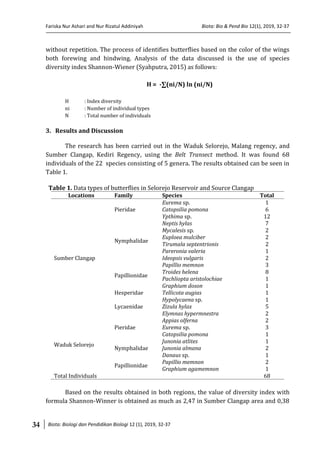
Table 1.
Table 1. Data types of butterflies in Selorejo Reservoir and Source Clangap
Locations Family Species Total
Sumber Clangap
Pieridae
Eurema sp. 1
Catopsilia pomona 6
Ypthima sp. 12
Nymphalidae
Neptis hylas 7
Mycalesis sp. 2
Euploea mulciber 2
Tirumala septentrionis 2
Pareronia valeria 1
Ideopsis vulgaris 2
Papillionidae
Papillio memnon 3
Troides helena 8
Pachliopta aristolochiae 1
Graphium doson 1
Hesperidae Tellicota augias 1
Lycaenidae
Hypolycaena sp. 1
Zizula hylax 5
Elymnas hypermnestra 2
Waduk Selorejo
Pieridae
Appias olferna 2
Eurema sp. 3
Catopsilia pomona 1
Nymphalidae
Junonia atlites 1
Junonia almana 2
Danaus sp. 1
Papillionidae
Papillio memnon 2
Graphium agamemnon 1
Total Individuals 68
Based on the results obtained in both regions, the value of diversity index with
formula Shannon-Winner is obtained as much as 2,47 in Sumber Clangap area and 0,38
Inventory of Diversity Butterflies …
Volume 12, Issue 1, June 2019 35
in the Waduk Selorejo area. Thus, the level of diversity in the Sumber Clangap area is
classified as moderate, or the distribution of individual numbers of each species and the
stability of the community is moderate. While in the Waduk Selorejo area is classified as
low or uneven distribution in each species found, there are only eight species. This is
caused by abiotic factors, including temperature and humidity; also, the biotic factor is
existing the host plants of butterfly (Fauziah et al., 2017).
Observations in the Waduk Selorejo were carried-out during the day around
13.00 – 15.00 WIB with a temperature range of 25,9C and humidity of 82% at an
altitude of 600 meters and also supported by cloudy weather. According to Amir et al.
(2002), butterflies activity on moderate air humidity of around 60% and warm
temperature around 30C and enough sunlight. This causes no heat from the sun to
penetrate the plains so that butterflies prefer to take shelter or hide under the leaves.
While in Waduk Selorejo. Butterflies are easily found in areas that quite open because
trees do not block sunlight. Sunlight is essential for butterflies because butterflies are
cold-blooded animals. Sunlight can provide heat energy to the body of the butterfly so
that body temperature will rise and metabolism will be faster (Natasa, et al., 2016)
The range of humidity and temperature measurement results in these two places
are still within the scale needed for survival, such as used reduced evaporation of body
fluids. The range of humidity is about 64 – 94% and 30 – 359C (Achmad, 2002), and the
entire family found is Papilionidae, Nymphalidae, Peridae, Lycanidae, dan Hesperidae
and the both of the two places dominating is Family Nymphalidae. Nymphalidae have
color characteristics that are dominated by gray, black, brown, with white hues, and
some large species have bright colors, for example, Hipolymnas bolina, but some have
medium body shapes too. Nymphalidae can be found around bushes and trees and has a
high intensity of flying. This family abundance is inseparable from the factor of the
availability host plant of butterflies, either the food plant. Some plants to feed
Nymphalidae larvae are Araceae, Musaceae, dan Peacea (Peggie and Amier, 2006).
The least family was found in Hesperidae because of availability of plants and
changing climate or weather in every place. Hesperidae is usually doing activity in a
dimly lit condition (crepuscular) that’s why these families often misunderstood if he
belongs to the group of moth or Heterocera (Peggie and Amier, 2006). From this
observation, in Sumber Clangap still found Troides helena, this species was rare and
protected. Troides helena is one of a butterfly with large and beautiful wings so that it
can attract the collectors to be traded. Therefore, the government issued Permen LHK
No. 92 2018, stating that all species from Troides in the list Appendix II CITES to protect
the extinction of this type of butterfly (Nurjannah, 2010).
Other than that, due to the availability of host plant forest betel (Aristolocia spp.)
are not supported. These plants also become a hostplant for the different species of
butterflies, especially the family of Papilionidae. One of them is Pachliopta aristolochiae,
this species was found in the same place. If the forest betel plant already has eggs from
these two butterflies, the caterpillar will eat up all the leaves and even cut the stems. It is
Fariska Nur Ashari and Nur Rizatul Addiniyah Biota: Bio & Pend Bio 12(1), 2019, 32-37
Biota: Biologi dan Pendidikan Biologi 12 (1), 2019, 32-3736
thus causing this plant to die before it can bear fruit or regenerate other parts (Aprillia,
et al., 2018). Besides being pollinator, butterflies also function as bioindicators of
environmental quality because butterflies are very susceptible to environmental
changes (Kairupan, et al., 2015).
As volcanic eruption Kelud mounts in 2014, which affected this area, soil
conditions were very influential in the survival of plants and animals that lived in the
vicinity. Soil conditions after being exposed to volcanic ash in a long time will have a
positive and negative impact. The negative effect is caused by the large amount of
volcanic material that hides the soil surface so that it can change soil conditions as a
growing medium. And the positive impact is it can add nutrients needed by the soil as an
addition to mineral spare parts and enrich the chemical composition and improve
physical properties that are poor in nutrients or soil that has further weathering
(Sediyarso and Suping,1987). Volcanic ash has contained a mineral that needed by the
soil, and plants with the highest element composition are Ca, Na, K, Mg, and also
macronutrients like P and S, while the micronutrients are Fe, Mn, Zn, Cu (Anda and
Wahdini, 2010). It can be concluded that the abundance of butterflies obtained is
strongly influenced by the diversity of host plants originating from fertile soil due to
volcanic materials buried.
CONCLUSION
From the results of the research, it can be concluded that the butterfly species at
Sumber Clangap are categorized as moderate according to the results of the diversity
index (H ') is 2.47 while the Waduk Selorejo is classified as low with (H') is 0.38. This is
due to environmental factors, temperature, and host plants. The discovery of Troides
helena at the Sumber Clangap indicates that there are still host plants from the butterfly.
This could be due to volcanic ash from the Kelud eruption containing minerals needed
by soil and plants so that the plants thrive again in a certain period after the explosion.
References
Abdillah, Muhibbuddin, M. (2018). Odonata diversity and its role as an indicator of water
quality at the source and the source Mangli village Clangap Puncu Puncu District
of Kediri. Essay. Surabaya: Faculty of Science and Technology, the State Islamic
University Sunan Ampel.
Achmad, A. (2002). Potential and Distribution of Butterflies in Nature Park Region
Bantimurung. In: Workshop on Management of Community-Based Butterflies.
Batimurung.
Achmad, SR, and Hadi, H. (2015). Identification of Chemical Properties Volcanic Ash and
The Recovery Effort Rubber Plant Affected eruption of Mount Kelud (Case Study:
Gardens Ngrangkah Pawon, East Java). News perkaretan, 34 (1), 19-30.
Inventory of Diversity Butterflies …
Volume 12, Issue 1, June 2019 37
Anda, M., and W. Wahdini. (2010). Nature, mineral composition, and the content of the
various elements in the ash eruption of Merapi, October-November 2010. Bogor:
Center for Research and Development of Land Resources.
Aprilia, I., Yustian, I., Setiawan, A., and Doni, S. (2018). Diversity of Butterflies
(Lepidoptera: Rhopalocera) in the Gunung Raya Wildlife Reserve, Sub District
Warkuk Ranau, South Sumatra. Biological Research Journal, 4 (2), 2477-1392.
Fauziyah, S., Fitrahyanti, FM, Astri, DW, Themas F., Eka KP, Dwi, W., and Thobib, H.,
(2017). Diversity of butterflies in the conservation area Petungsewu Wildlife
Education Center, Malang, East Java. Sem Pros Nas mobi Biodiv Indon, 3 (2), 252-
257.
Kairupan, CF, Koneri, R., and Trina, ET (2015). Genetic variation Troides helena
(Lepidoptera: Papilionidae) Based on COI gene (cytochrome C Oxydase I). Unsrat
Journal of Mathematics and Natural Sciences. 4 (2), 141-147.
Natasa, IW, Zahida, F., and Yuda, P. (2016). Diversity of the Butterflies (Lepidoptera) In
Plawangan Region Mount Merapi National Park, Yogyakarta. BL01065 Journal.
Nurjannah, ST (2010). Biology Troides Helena Troides helena helena and Hephaestus
(Papilionidae) in Captivity. Thesis. Bogor Agricultural University in Bogor.
Peggie, D., and Amier, M. (2006). Practical Guide to Butterflies in the Garden. Bogor:
Center for Biology LIPI.
Saputro, NA (2007). Butterfly Species Diversity on Campus IPB. Essay. Bogor
Agricultural University in Bogor.
Sediyarso, M., and S. Suping. (1987). Abu Galunggung influence on Agricultural Land.
Bogor: Land Research Center.
Suryanto, Maizar, A. (2011). Abundance and composition of phytoplankton in the
reservoir Selorejo Ngantang Malang. Maritime Journal, 4 (2), 34-39.
Syahputra M (2015) Measurement of Diversity butterflies (Lepidoptera by using
Method: Time Search. Media Development Scientific. 9 (4): 68-72.

Fariska butterflies

  • 1.
    http://biota.ac.id/index.php/jb Biologi dan PendidikanBiologi DOI: http://dx.doi.org/10.20414/jb.v12i1.161 Copyright © 2019 THE AUTHOR(S). This article is distributed under a Creative Commons Attribution-ShareAlike 4.0 International license Research Article Inventory of Diversity Butterflies (Lepidoptera: Rhopalocera) in Sumber Clangap and Waduk Selorejo in East Java Fariska Nur Ashari*, Nur Rizatul Addiniyah and Hayyin Nurul Aini Biology Department, Universitas Islam Negeri Sunan Ampel, Surabaya, East Java, Indonesia *Corresponding author: fariskanurashari4@gmail.com Abstract Diversity of butterflies in various habitats very diverse, and it is one of them in the region Sumber Clangap and Waduk Selorejo. It has seen from the combination of colors and which wing shape varies. In this, both regions were chosen because it had been affected by Mount Kelud eruption, which causes damage to the surrounding area. The purpose of this research is to know the diversity of butterflies (Lepidoptera: Rhopalocera) in the region of Sumber Clangap and Waduk Selorejo, East Java. This research was conducted on 26-29 January 2019. Sampling has taken by the method of Belt transect along the transect path randomly with a technique snapshot experiment and a sweeping technique. Based on the observations obtained 3 of the same family, Nymphalidae, Pieridae, and Papillionidae. The butterfly diversity in Waduk Selorejo belongs to low, whereas in Sumber Clangap are classified by index Shannon- Winner = 0.38 H ' and H ' = 2.47. Found eight types of butterflies from 3 families with a total of 13 species and has a value of H ' =2.47. Keywords: Diversity; Lepidoptera; Waduk Selorejo; and Sumber Clangap. 1. Introduction Kelud is one of the most active volcanoes in Indonesia, which is located between the district of Blitar, Blitar City, Kediri District, Kediri City, and District of Malang. Since the year 1000 M, Kelud has erupted more than 30 times, with the most massive eruption of magnitude 5 Volcanic Explosivity Index (VEI). Entering the 21st century, there have been two eruptions, that is in 2007 and 2014 years. The 2014 eruption of Kelud is considered more powerful than in 1990. The volcanic ash caused by the eruption of Mount Kelud spread up to 17 km. The area in East Java affected by volcanic ash such as Kediri and Malang (Achmad and Hadi, 2015; Rahmadana, 2014). Waduk Selorejo is one of the reservoirs located in Malang district at an altitude of 625 masl. This reservoir is used as flood control, irrigation, hydroelectric power plant, fisheries and tourism (Suryanto, 2011). Around the dams can be found several species of plants, both natural and artificial (planted). Waduk Selorejo is now being developed into tourist attractions. The region can be found plants and wild plants around the reservoir. A wild plant that position is not far from the dam has excellent to do observations of butterflies because there were encountered butterflies passing by. Sumber Clangap is the main water source located in the village Puncu, sub-District Puncu, Kediri. The source is utilized for residents to meet water needs. Water from these sources flowed into several villages in the district of the town including Puncu, Asmorobangun, Satak, and Kampung Baru. Around this place can be found in the forest to be protected by the
  • 2.
    Inventory of DiversityButterflies … Volume 12, Issue 1, June 2019 33 government. However, in 2014, the region affected by the eruption of Mount Kelud, so some habitat is a loss (Abdillah, 2018). Water draining Sumber Clangap comes from a waterfall under Kelud. The flow of the river that forms Clangap Source. Water passing through the forest and then accommodated called Cekdam Jedingmiring. During the dry season, the river is inactive and active again during the rainy season (Abdillah, 2018). Both of these areas are affected by the eruption of Mount Kelud. Therefore, the volcano a significant impact on a wide range of damage, including a variety of vegetation due to soil's condition as a growing medium a change in chemistry, physics, and biology, thereby inhibiting plant growth is not optimal. The butterfly is one bioindicator used to determine the condition of habitats, because if there are diverse species of butterflies then variegated vegetation these plants in a habitat. In essence, the butterfly is very dependent on the host plant diversity, to provide a relationship between the diversity of butterfly habitat conditions. The decline in butterfly species can occur due to changes in forest functions, water pollution and air (Saputro, 2007). Butterflies are insects that are included in the order Lepidoptera, meaning insects that almost the entire body surface covered by sheets of scales that give style and color of butterfly wings (Scoble, 1995). Butterflies are insects of the most widely known and frequently encountered because of the shape and color are beautiful and varied, and are generally active during the day (diurnal) that are classified into suborder Rhopalocera. Butterflies are very dependent on their hosts. If the host is still prevalent that butterfly populations are still high. So far, the impact of the eruption of Mount Kelud occurred in 2014, which affects Waduk Selorejo, and Sumber Clangap has been widely studied from the field of water (Abdillah, 2018) and soil (Achmad and Hadi, 2015). But for Rhopalocera, suborder observation has not been done. The purpose of this study was to determine the species diversity of butterflies (Lepidoptera; Rhopalocera) in Waduk Selorejo and Sumber Clangap, East Java affected by the eruption of Mount Kelud. 2. Materials and Methods The research was conducted on January 26-29, 2019. The research sites were Waduk Selorejo, Sambirejo Hamlet, Pandansari Village, Ngantang Sub-District, Malang Regency, and Sumber Clangap, Puncu Village, Puncu District, Kediri Regency. The tools used in this study were sweep net, thermohygrometer and stationery. This study uses the Belt Transect method, data retrieval is using the snapshot experiment method. The Belt Transect method, roaming, follow the current path. Observations in the Waduk Selorejo begin from the motorbike parking lot to the vicinity of the reservoir. Whereas the observations at Sumber Clangap started from after the reservoir of water near the community plantations, then followed the current path (the road that had been made by the residents) until it was blocked by Clangap (Cekdam Jedingmiring). Snapshot experiment retrieval that is data retrieval is only done once
  • 3.
    Fariska Nur Ashariand Nur Rizatul Addiniyah Biota: Bio & Pend Bio 12(1), 2019, 32-37 Biota: Biologi dan Pendidikan Biologi 12 (1), 2019, 32-3734 without repetition. The process of identifies butterflies based on the color of the wings both forewing and hindwing. Analysis of the data discussed is the use of species diversity index Shannon-Wiener (Syahputra, 2015) as follows: H = -∑(ni/N) ln (ni/N) H : Index diversity ni : Number of individual types N : Total number of individuals 3. Results and Discussion The research has been carried out in the Waduk Selorejo, Malang regency, and Sumber Clangap, Kediri Regency, using the Belt Transect method. It was found 68 individuals of the 22 species consisting of 5 genera. The results obtained can be seen in Table 1. Table 1. Data types of butterflies in Selorejo Reservoir and Source Clangap Locations Family Species Total Sumber Clangap Pieridae Eurema sp. 1 Catopsilia pomona 6 Ypthima sp. 12 Nymphalidae Neptis hylas 7 Mycalesis sp. 2 Euploea mulciber 2 Tirumala septentrionis 2 Pareronia valeria 1 Ideopsis vulgaris 2 Papillionidae Papillio memnon 3 Troides helena 8 Pachliopta aristolochiae 1 Graphium doson 1 Hesperidae Tellicota augias 1 Lycaenidae Hypolycaena sp. 1 Zizula hylax 5 Elymnas hypermnestra 2 Waduk Selorejo Pieridae Appias olferna 2 Eurema sp. 3 Catopsilia pomona 1 Nymphalidae Junonia atlites 1 Junonia almana 2 Danaus sp. 1 Papillionidae Papillio memnon 2 Graphium agamemnon 1 Total Individuals 68 Based on the results obtained in both regions, the value of diversity index with formula Shannon-Winner is obtained as much as 2,47 in Sumber Clangap area and 0,38
  • 4.
    Inventory of DiversityButterflies … Volume 12, Issue 1, June 2019 35 in the Waduk Selorejo area. Thus, the level of diversity in the Sumber Clangap area is classified as moderate, or the distribution of individual numbers of each species and the stability of the community is moderate. While in the Waduk Selorejo area is classified as low or uneven distribution in each species found, there are only eight species. This is caused by abiotic factors, including temperature and humidity; also, the biotic factor is existing the host plants of butterfly (Fauziah et al., 2017). Observations in the Waduk Selorejo were carried-out during the day around 13.00 – 15.00 WIB with a temperature range of 25,9C and humidity of 82% at an altitude of 600 meters and also supported by cloudy weather. According to Amir et al. (2002), butterflies activity on moderate air humidity of around 60% and warm temperature around 30C and enough sunlight. This causes no heat from the sun to penetrate the plains so that butterflies prefer to take shelter or hide under the leaves. While in Waduk Selorejo. Butterflies are easily found in areas that quite open because trees do not block sunlight. Sunlight is essential for butterflies because butterflies are cold-blooded animals. Sunlight can provide heat energy to the body of the butterfly so that body temperature will rise and metabolism will be faster (Natasa, et al., 2016) The range of humidity and temperature measurement results in these two places are still within the scale needed for survival, such as used reduced evaporation of body fluids. The range of humidity is about 64 – 94% and 30 – 359C (Achmad, 2002), and the entire family found is Papilionidae, Nymphalidae, Peridae, Lycanidae, dan Hesperidae and the both of the two places dominating is Family Nymphalidae. Nymphalidae have color characteristics that are dominated by gray, black, brown, with white hues, and some large species have bright colors, for example, Hipolymnas bolina, but some have medium body shapes too. Nymphalidae can be found around bushes and trees and has a high intensity of flying. This family abundance is inseparable from the factor of the availability host plant of butterflies, either the food plant. Some plants to feed Nymphalidae larvae are Araceae, Musaceae, dan Peacea (Peggie and Amier, 2006). The least family was found in Hesperidae because of availability of plants and changing climate or weather in every place. Hesperidae is usually doing activity in a dimly lit condition (crepuscular) that’s why these families often misunderstood if he belongs to the group of moth or Heterocera (Peggie and Amier, 2006). From this observation, in Sumber Clangap still found Troides helena, this species was rare and protected. Troides helena is one of a butterfly with large and beautiful wings so that it can attract the collectors to be traded. Therefore, the government issued Permen LHK No. 92 2018, stating that all species from Troides in the list Appendix II CITES to protect the extinction of this type of butterfly (Nurjannah, 2010). Other than that, due to the availability of host plant forest betel (Aristolocia spp.) are not supported. These plants also become a hostplant for the different species of butterflies, especially the family of Papilionidae. One of them is Pachliopta aristolochiae, this species was found in the same place. If the forest betel plant already has eggs from these two butterflies, the caterpillar will eat up all the leaves and even cut the stems. It is
  • 5.
    Fariska Nur Ashariand Nur Rizatul Addiniyah Biota: Bio & Pend Bio 12(1), 2019, 32-37 Biota: Biologi dan Pendidikan Biologi 12 (1), 2019, 32-3736 thus causing this plant to die before it can bear fruit or regenerate other parts (Aprillia, et al., 2018). Besides being pollinator, butterflies also function as bioindicators of environmental quality because butterflies are very susceptible to environmental changes (Kairupan, et al., 2015). As volcanic eruption Kelud mounts in 2014, which affected this area, soil conditions were very influential in the survival of plants and animals that lived in the vicinity. Soil conditions after being exposed to volcanic ash in a long time will have a positive and negative impact. The negative effect is caused by the large amount of volcanic material that hides the soil surface so that it can change soil conditions as a growing medium. And the positive impact is it can add nutrients needed by the soil as an addition to mineral spare parts and enrich the chemical composition and improve physical properties that are poor in nutrients or soil that has further weathering (Sediyarso and Suping,1987). Volcanic ash has contained a mineral that needed by the soil, and plants with the highest element composition are Ca, Na, K, Mg, and also macronutrients like P and S, while the micronutrients are Fe, Mn, Zn, Cu (Anda and Wahdini, 2010). It can be concluded that the abundance of butterflies obtained is strongly influenced by the diversity of host plants originating from fertile soil due to volcanic materials buried. CONCLUSION From the results of the research, it can be concluded that the butterfly species at Sumber Clangap are categorized as moderate according to the results of the diversity index (H ') is 2.47 while the Waduk Selorejo is classified as low with (H') is 0.38. This is due to environmental factors, temperature, and host plants. The discovery of Troides helena at the Sumber Clangap indicates that there are still host plants from the butterfly. This could be due to volcanic ash from the Kelud eruption containing minerals needed by soil and plants so that the plants thrive again in a certain period after the explosion. References Abdillah, Muhibbuddin, M. (2018). Odonata diversity and its role as an indicator of water quality at the source and the source Mangli village Clangap Puncu Puncu District of Kediri. Essay. Surabaya: Faculty of Science and Technology, the State Islamic University Sunan Ampel. Achmad, A. (2002). Potential and Distribution of Butterflies in Nature Park Region Bantimurung. In: Workshop on Management of Community-Based Butterflies. Batimurung. Achmad, SR, and Hadi, H. (2015). Identification of Chemical Properties Volcanic Ash and The Recovery Effort Rubber Plant Affected eruption of Mount Kelud (Case Study: Gardens Ngrangkah Pawon, East Java). News perkaretan, 34 (1), 19-30.
  • 6.
    Inventory of DiversityButterflies … Volume 12, Issue 1, June 2019 37 Anda, M., and W. Wahdini. (2010). Nature, mineral composition, and the content of the various elements in the ash eruption of Merapi, October-November 2010. Bogor: Center for Research and Development of Land Resources. Aprilia, I., Yustian, I., Setiawan, A., and Doni, S. (2018). Diversity of Butterflies (Lepidoptera: Rhopalocera) in the Gunung Raya Wildlife Reserve, Sub District Warkuk Ranau, South Sumatra. Biological Research Journal, 4 (2), 2477-1392. Fauziyah, S., Fitrahyanti, FM, Astri, DW, Themas F., Eka KP, Dwi, W., and Thobib, H., (2017). Diversity of butterflies in the conservation area Petungsewu Wildlife Education Center, Malang, East Java. Sem Pros Nas mobi Biodiv Indon, 3 (2), 252- 257. Kairupan, CF, Koneri, R., and Trina, ET (2015). Genetic variation Troides helena (Lepidoptera: Papilionidae) Based on COI gene (cytochrome C Oxydase I). Unsrat Journal of Mathematics and Natural Sciences. 4 (2), 141-147. Natasa, IW, Zahida, F., and Yuda, P. (2016). Diversity of the Butterflies (Lepidoptera) In Plawangan Region Mount Merapi National Park, Yogyakarta. BL01065 Journal. Nurjannah, ST (2010). Biology Troides Helena Troides helena helena and Hephaestus (Papilionidae) in Captivity. Thesis. Bogor Agricultural University in Bogor. Peggie, D., and Amier, M. (2006). Practical Guide to Butterflies in the Garden. Bogor: Center for Biology LIPI. Saputro, NA (2007). Butterfly Species Diversity on Campus IPB. Essay. Bogor Agricultural University in Bogor. Sediyarso, M., and S. Suping. (1987). Abu Galunggung influence on Agricultural Land. Bogor: Land Research Center. Suryanto, Maizar, A. (2011). Abundance and composition of phytoplankton in the reservoir Selorejo Ngantang Malang. Maritime Journal, 4 (2), 34-39. Syahputra M (2015) Measurement of Diversity butterflies (Lepidoptera by using Method: Time Search. Media Development Scientific. 9 (4): 68-72.