Bacterial Diseases of Pome Fruits in Pakistan
 Group Member’s
Mohammad Adeel Zahid
Mohammad Farhan
Mohammad Nouman
Mohammad Iqbal
Zaib ul hassan
Mohammad Awais
Pome Fruit
 Pome fruits are members of the plant family Rosaceae, sub-family pomoideae.
 They are fruits that have a "core" of several small seeds, surrounded by a tough
membrane. The membrane is encased in an edible layer of flesh.
 Trees are deciduous and have a dormant winter period that requires cold
temperatures for the tree to properly break dormancy in spring.
 Pome fruits are grown from spring blossom and harvested from late summer
through to late autumn.
Examples of Pome Fruits
 1. Apple
 2. Pear
 3. Peach
Apple
 Scientific Classification
 Kingdom: Plantae
 Order : Rosales
 Family : Rosaceae
 Genus : Malus
 Species : M.domestica
Introduction
 Apple is a symbol of health, beauty and love.
 It may be called as king of fruits in temperate Regions
 It ranks third in consumption after citrus and banana fruits in tropical countries.
 Apple is a very nutritious, aromatic and delicious fruit.
 It is very rich in Vitamin C, B and A.
 It contains about 41% sugar besides essential minerals in appreciable amounts.
 Cultivated varieties of apples belong to group Pyrus and sub-group malus.
Bacterial Diseases of Apple
Blister Spot : Pseudomonas syringae pv.papulans
Crown Gall : Agrobacterium tumefaciens
Fire Blight : Erwinia amylovora
Hairy root : Agrobacterium rhizogenes
Blister Spot
 Casual organism
Pseudomonas syringae pv.papulans
 Introduction:-
 Although over 20 cultivars of apple have been reported as susceptible to the
bacterium.
 Disease is usually of economic importance only on Mutsu in New York State.
 If uncontrolled, the disease generally affects 5 to 60 per cent of the fruit in an
orchard.
 The bacterium does not cause extensive decay of the fruit, but makes them
unsuitable for fresh market use.
Symptoms
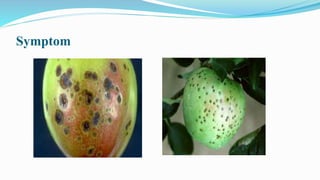
Infections of blister spot are first noticeable 2-3 months after petal fall as small,
green, water-soaked, raised blisters that develop at fruit stomata.
These spots result in purplish black lesions.
As the fruit increase in size, the lesions expand to about 5 mm and become
darkened.
Symptom
Management;-
 Disease could be controlled with three well-timed antibiotic spray.
 The first applied no later than 2 weeks and the others applied weekly again.
Crown Gall
 Casual organism
Agrobacterium tumefaciens
. Introduction:-
 Crown gall can affect a wide range of crops , including woody ornamentals,
tree fruits and small fruits.
 Some vegetable and herbaceous ornamentals are also susceptible but these
crops are less commonly affected.
Symptoms
 Galls are usually restricted to the roots, lower stems and lower branches of
infected plants.
 In some cases, crown gall may occur in the upper branches.
 Galls are spherical, lumpy and rough, varying in size from 1/2 inch to several
inches in diameter.
 Affected plants may be stunted, produce small chlorotic leaves and become
more sensitive to environmental stresses (particularly winter injury).
 Severely infected plants may decline and eventually die.
Symptoms:-
Symptoms:-
Cause and Disease Development
 Crown gall is caused by the soil-borne bacterium , Agrobacterium tumefaciens.
 This organism enters susceptible plants through fresh wounds made during
transplanting, cultivating, grafting and pruning.
 Other wounds inflicted by people, severe weather, insects or other animals may
also serve as avenues of infection.
Disease Management
 AVOID WOUNDING:-
 susceptible plants at or near the soil line.
 PRUNING INFECTED BRANCHES :-
 well back into healthy tissue will serve as an effective means of control when
galls are limited to the above ground portions.
 Cutting tools should be disinfested with 10% household bleach, 70% alcohol or
Lysol between each cut in order to prevent transmitting the bacteria from one
cutting to the next.
 PLANT REMOVAL AND DESTRUCTION
 May be necessary when crown gall infections are extensive, especially on the
lower stem and roots.
 Avoid replanting the site with trees or shrubs known to be susceptible to crown
gall (e.g. apple, pear, brambles, forsythia, grape, honeysuckle, pecan, rose,
Russian-olive and walnut ).
 Plants known to be resistant to crown gall include: hemlock, holly, hornbeam,
linden, pine, spruce.
Pear
 Scientific name: Pyrus
 Family: Rosaceae
 Sub-Family: Pomoideae
 Genus: Carl Linnaeus
Introduction
 Pear are sweet juicy yellow or green fruit with a rounded shape that becomes
narrower towards the stalk.
 Pears are picked when they are almost ripe.
 Pears ripen best at room temperature.
 The cultivation of the pear in cool temprate climate.
 A pear tree can grow up to 20 m. high.
 In Pakistan Pears come in different types and are available usually from
September to December.
 Used in Salads, Pudding, Cake, Tart, Juice
Fire Blight
 Casual organism
Erwinia amylovora
 Genus: Erwinia
 Family: Enterobacteriaceae
Introduction
 Fire blight, unlike most fruit tree diseases, is caused by a bacteria
 It can be spread from tree to tree by bees, aphids, pear psylla, and other insects.
 The bacteria mainly attack twigs and young shoots.
Symptoms and Signs
 Symptoms of fire blight can be observed on all above ground tissues
 It is including blossoms, fruits, shoots, branches and limbs, and in the rootstock
near the graft union on the lower trunk.
 Generally, symptoms of fire blight are easy to recognize and distinguishable
from other diseases.
Disease Symptoms
 The bark at the base of blighted twigs becomes water soaked, then dark,
sunken and dry;
 cracks may develop at the edge of the sunken area.
 Young twigs and branches die from the terminal end and appear burned or deep
rust colored.
 Branches may be bent,
 Dead leaves and fruit remain on the branches
Symptoms
Symptoms
Controls and Management
 Pruning to Control Fireblight :
 Remove all suckers and cut off any infected branches before the bacteria attack
the tree further.
 Cut off the wilting branch at least 8 inches below the point of last visible wilt.
 After each cut, dip the shears in a solution of 1 part household bleach to 9 parts
water to avoid transmitting bacteria from one branch to another
 Remove other plants that may serve as hosts for the disease including wild
apples
Control of fire blight is based on several steps
 Plant resistant or tolerant varieties: Kieffer, Orient, Garber, or Douglas.
 Maintain balanced fertilizer level.
 Do not use excess levels of nitrogen.
 Remove overwintering bacteria cankers by pruning.
 Make pruning cuts 8 to 12 inches below visible sign of disease.
 Apply bactericides on 5 day intervals between early bloom and late blooms.
Crown Gall
 Casual organism
 Agrobacterium tumefaciens
 Introduction:
 This bacterium can infect a wide range of herbaceous and woody plants.
 The bacterium only carries the gall-causing entity ,a plasmid, that contains its
own genetic material.
 After the bacterium enters the host, the plasmid DNA is transferred into the
host plant cell where it stimulates the production of more plant cells.
Symptoms
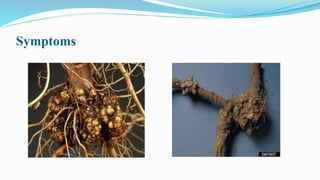
 Roots Galls are initially white, spherical, and soft
 Galls 1/4 inch to several inches in diameter
 Bacteria survives and persists in the soil for many years.
 It invades recent wounds on stems or roots.
 Swelling can be seen 14 days following entry.
 Tissue near the gall is crushed.
Symptoms
Management
 Nursery:-
 Purchase crown gall-free plants.
 Propagate only from crown gall-free plants.
 Avoid wounding plants near soil line.
 Disinfest grafting tools.
 Avoid planting in areas known to be infested with the bacterium.
 Dip or spray seedlings or cuttings in a formulation of strain 84 of
Agrobacterium radiobacter which is a biological control agent.
Home or Commercial Planting
 Plant only crown gall-free plants.
 Remove severely affected plants and do not replace with susceptible cultivars.
 Plants not severely affected can be grown if fertilized, watered, and otherwise
cared for well. The disease will continue but probably not kill the plant.
Peach
 Casual organism : Prunus persica
 Family : Rosaceae
 Genus: Chokecherry
Introduction
 It bears an edible juicy fruit called a peach and it also known as nectarine.
 Both same species but different fruits.
 Peach fruit present the fuzz on the skin,
 Nectarine are characterized by the absence of fruit-skin (fuzz-less fruit);
 Peaches grow in a fairly limited range in dry and temperate climate.
 Most cultivars require 500 hours of chilling around 0 to 10 °C .
 Temperature required for mature the crop is 20 and 30 °C.
 Both are best stored at temperatures of 0 °C (32 °F) and high-humidity.
Bacterial spot or bacteriosis
 Causal organism
 Xanthomonas arboricola pv. pruni or X. campestris pv. Pruni
 Introduction:
 "Bacterial spot" sometimes known as "bacterial shot hole“
 Present especially on older peach trees.
Symptoms and Signs
 Disease can affect foliage, tender twigs, and fruit.
 Presence of water soaked spots on leaves.
 Spots enlarge, darken, purple and necrotic.
 Heavy defoliation early in the summer can reduce the size of the fruit and
weaken the tree.
 Small circular brown spots on the surface of the fruit.
Symptoms
Symptoms
Management
 Good tree vigour should be maintained by proper pruning.
 Judicious application of fertilizer, and watering when necessary.
 Excess nitrogen may aggravate the disease.
 Use resistance varieties.
 Avoid the insecticides during bloom.
Bacterial disease of canker
 Causal organism
 Pseudomonas syringae pv. Syringae
 Introduction:
 This disease is caused by the two related bacterial species, Pseudomonas
syringae and P. morsprunorum.
 The disease can occur on all stone fruit and is known as gummosis, blossom
blast, spur and twig blight, sour sap, and dieback.
 The bacteria have a wide host range, can systemically invade host tissue
without symptoms, and can grow epiphytically on host and nonhost leaf
surfaces.
 As a result, control of this pathogen is complicated.
Symptoms
 The disease occurs on branches, twigs, buds, leaves, and fruit.
 Cool, wet weather after bloom, leaf and fruit infections are common.
 Leaf infections, especially appear as water-soaked spots that become brown
and dry.
 Surrounded by yellow halos.
 Lesions on green fruit are brown and surrounded by water-soaked tissue.
Symptoms
Symptoms
Management
 Practices that minimize wounding and freeze injury.
 Maximize good cultural practices will reduce the incidence of bacterial canker.
 The bacteria can be transmitted by pruning tools so these should be disinfected
between trees if bacterial canker is present.
Control:
 Apply lime before planting to adjust pH to 6.5 .
 Plant trees which have been grown in fumigated soil or certified to be free of
nematodes.
 Early pruning is especially hazardous on old peach land.
 Remove and destroy promptly all dead or dying trees .
 Dip pruning tools between trees in a 9 parts water and 1 part Chlorox solution
in infected orchards.

FARHAN

  • 1.
    Bacterial Diseases ofPome Fruits in Pakistan  Group Member’s Mohammad Adeel Zahid Mohammad Farhan Mohammad Nouman Mohammad Iqbal Zaib ul hassan Mohammad Awais
  • 2.
    Pome Fruit  Pomefruits are members of the plant family Rosaceae, sub-family pomoideae.  They are fruits that have a "core" of several small seeds, surrounded by a tough membrane. The membrane is encased in an edible layer of flesh.  Trees are deciduous and have a dormant winter period that requires cold temperatures for the tree to properly break dormancy in spring.  Pome fruits are grown from spring blossom and harvested from late summer through to late autumn.
  • 3.
    Examples of PomeFruits  1. Apple  2. Pear  3. Peach
  • 4.
    Apple  Scientific Classification Kingdom: Plantae  Order : Rosales  Family : Rosaceae  Genus : Malus  Species : M.domestica
  • 5.
    Introduction  Apple isa symbol of health, beauty and love.  It may be called as king of fruits in temperate Regions  It ranks third in consumption after citrus and banana fruits in tropical countries.  Apple is a very nutritious, aromatic and delicious fruit.  It is very rich in Vitamin C, B and A.  It contains about 41% sugar besides essential minerals in appreciable amounts.  Cultivated varieties of apples belong to group Pyrus and sub-group malus.
  • 6.
    Bacterial Diseases ofApple Blister Spot : Pseudomonas syringae pv.papulans Crown Gall : Agrobacterium tumefaciens Fire Blight : Erwinia amylovora Hairy root : Agrobacterium rhizogenes
  • 7.
    Blister Spot  Casualorganism Pseudomonas syringae pv.papulans  Introduction:-  Although over 20 cultivars of apple have been reported as susceptible to the bacterium.  Disease is usually of economic importance only on Mutsu in New York State.  If uncontrolled, the disease generally affects 5 to 60 per cent of the fruit in an orchard.  The bacterium does not cause extensive decay of the fruit, but makes them unsuitable for fresh market use.
  • 8.
    Symptoms Infections of blisterspot are first noticeable 2-3 months after petal fall as small, green, water-soaked, raised blisters that develop at fruit stomata. These spots result in purplish black lesions. As the fruit increase in size, the lesions expand to about 5 mm and become darkened.
  • 9.
  • 10.
    Management;-  Disease couldbe controlled with three well-timed antibiotic spray.  The first applied no later than 2 weeks and the others applied weekly again.
  • 11.
    Crown Gall  Casualorganism Agrobacterium tumefaciens . Introduction:-  Crown gall can affect a wide range of crops , including woody ornamentals, tree fruits and small fruits.  Some vegetable and herbaceous ornamentals are also susceptible but these crops are less commonly affected.
  • 12.
    Symptoms  Galls areusually restricted to the roots, lower stems and lower branches of infected plants.  In some cases, crown gall may occur in the upper branches.  Galls are spherical, lumpy and rough, varying in size from 1/2 inch to several inches in diameter.  Affected plants may be stunted, produce small chlorotic leaves and become more sensitive to environmental stresses (particularly winter injury).  Severely infected plants may decline and eventually die.
  • 13.
  • 14.
  • 15.
    Cause and DiseaseDevelopment  Crown gall is caused by the soil-borne bacterium , Agrobacterium tumefaciens.  This organism enters susceptible plants through fresh wounds made during transplanting, cultivating, grafting and pruning.  Other wounds inflicted by people, severe weather, insects or other animals may also serve as avenues of infection.
  • 16.
    Disease Management  AVOIDWOUNDING:-  susceptible plants at or near the soil line.  PRUNING INFECTED BRANCHES :-  well back into healthy tissue will serve as an effective means of control when galls are limited to the above ground portions.  Cutting tools should be disinfested with 10% household bleach, 70% alcohol or Lysol between each cut in order to prevent transmitting the bacteria from one cutting to the next.
  • 17.
     PLANT REMOVALAND DESTRUCTION  May be necessary when crown gall infections are extensive, especially on the lower stem and roots.  Avoid replanting the site with trees or shrubs known to be susceptible to crown gall (e.g. apple, pear, brambles, forsythia, grape, honeysuckle, pecan, rose, Russian-olive and walnut ).  Plants known to be resistant to crown gall include: hemlock, holly, hornbeam, linden, pine, spruce.
  • 18.
    Pear  Scientific name:Pyrus  Family: Rosaceae  Sub-Family: Pomoideae  Genus: Carl Linnaeus
  • 19.
    Introduction  Pear aresweet juicy yellow or green fruit with a rounded shape that becomes narrower towards the stalk.  Pears are picked when they are almost ripe.  Pears ripen best at room temperature.  The cultivation of the pear in cool temprate climate.  A pear tree can grow up to 20 m. high.  In Pakistan Pears come in different types and are available usually from September to December.  Used in Salads, Pudding, Cake, Tart, Juice
  • 20.
    Fire Blight  Casualorganism Erwinia amylovora  Genus: Erwinia  Family: Enterobacteriaceae
  • 21.
    Introduction  Fire blight,unlike most fruit tree diseases, is caused by a bacteria  It can be spread from tree to tree by bees, aphids, pear psylla, and other insects.  The bacteria mainly attack twigs and young shoots.
  • 22.
    Symptoms and Signs Symptoms of fire blight can be observed on all above ground tissues  It is including blossoms, fruits, shoots, branches and limbs, and in the rootstock near the graft union on the lower trunk.  Generally, symptoms of fire blight are easy to recognize and distinguishable from other diseases.
  • 23.
    Disease Symptoms  Thebark at the base of blighted twigs becomes water soaked, then dark, sunken and dry;  cracks may develop at the edge of the sunken area.  Young twigs and branches die from the terminal end and appear burned or deep rust colored.  Branches may be bent,  Dead leaves and fruit remain on the branches
  • 24.
  • 25.
  • 26.
    Controls and Management Pruning to Control Fireblight :  Remove all suckers and cut off any infected branches before the bacteria attack the tree further.  Cut off the wilting branch at least 8 inches below the point of last visible wilt.  After each cut, dip the shears in a solution of 1 part household bleach to 9 parts water to avoid transmitting bacteria from one branch to another  Remove other plants that may serve as hosts for the disease including wild apples
  • 27.
    Control of fireblight is based on several steps  Plant resistant or tolerant varieties: Kieffer, Orient, Garber, or Douglas.  Maintain balanced fertilizer level.  Do not use excess levels of nitrogen.  Remove overwintering bacteria cankers by pruning.  Make pruning cuts 8 to 12 inches below visible sign of disease.  Apply bactericides on 5 day intervals between early bloom and late blooms.
  • 28.
    Crown Gall  Casualorganism  Agrobacterium tumefaciens  Introduction:  This bacterium can infect a wide range of herbaceous and woody plants.  The bacterium only carries the gall-causing entity ,a plasmid, that contains its own genetic material.  After the bacterium enters the host, the plasmid DNA is transferred into the host plant cell where it stimulates the production of more plant cells.
  • 29.
    Symptoms  Roots Gallsare initially white, spherical, and soft  Galls 1/4 inch to several inches in diameter  Bacteria survives and persists in the soil for many years.  It invades recent wounds on stems or roots.  Swelling can be seen 14 days following entry.  Tissue near the gall is crushed.
  • 30.
  • 31.
    Management  Nursery:-  Purchasecrown gall-free plants.  Propagate only from crown gall-free plants.  Avoid wounding plants near soil line.  Disinfest grafting tools.  Avoid planting in areas known to be infested with the bacterium.  Dip or spray seedlings or cuttings in a formulation of strain 84 of Agrobacterium radiobacter which is a biological control agent.
  • 32.
    Home or CommercialPlanting  Plant only crown gall-free plants.  Remove severely affected plants and do not replace with susceptible cultivars.  Plants not severely affected can be grown if fertilized, watered, and otherwise cared for well. The disease will continue but probably not kill the plant.
  • 33.
    Peach  Casual organism: Prunus persica  Family : Rosaceae  Genus: Chokecherry
  • 34.
    Introduction  It bearsan edible juicy fruit called a peach and it also known as nectarine.  Both same species but different fruits.  Peach fruit present the fuzz on the skin,  Nectarine are characterized by the absence of fruit-skin (fuzz-less fruit);  Peaches grow in a fairly limited range in dry and temperate climate.  Most cultivars require 500 hours of chilling around 0 to 10 °C .  Temperature required for mature the crop is 20 and 30 °C.  Both are best stored at temperatures of 0 °C (32 °F) and high-humidity.
  • 35.
    Bacterial spot orbacteriosis  Causal organism  Xanthomonas arboricola pv. pruni or X. campestris pv. Pruni  Introduction:  "Bacterial spot" sometimes known as "bacterial shot hole“  Present especially on older peach trees.
  • 36.
    Symptoms and Signs Disease can affect foliage, tender twigs, and fruit.  Presence of water soaked spots on leaves.  Spots enlarge, darken, purple and necrotic.  Heavy defoliation early in the summer can reduce the size of the fruit and weaken the tree.  Small circular brown spots on the surface of the fruit.
  • 37.
  • 38.
  • 39.
    Management  Good treevigour should be maintained by proper pruning.  Judicious application of fertilizer, and watering when necessary.  Excess nitrogen may aggravate the disease.  Use resistance varieties.  Avoid the insecticides during bloom.
  • 40.
    Bacterial disease ofcanker  Causal organism  Pseudomonas syringae pv. Syringae  Introduction:  This disease is caused by the two related bacterial species, Pseudomonas syringae and P. morsprunorum.  The disease can occur on all stone fruit and is known as gummosis, blossom blast, spur and twig blight, sour sap, and dieback.  The bacteria have a wide host range, can systemically invade host tissue without symptoms, and can grow epiphytically on host and nonhost leaf surfaces.  As a result, control of this pathogen is complicated.
  • 41.
    Symptoms  The diseaseoccurs on branches, twigs, buds, leaves, and fruit.  Cool, wet weather after bloom, leaf and fruit infections are common.  Leaf infections, especially appear as water-soaked spots that become brown and dry.  Surrounded by yellow halos.  Lesions on green fruit are brown and surrounded by water-soaked tissue.
  • 42.
  • 43.
  • 44.
    Management  Practices thatminimize wounding and freeze injury.  Maximize good cultural practices will reduce the incidence of bacterial canker.  The bacteria can be transmitted by pruning tools so these should be disinfected between trees if bacterial canker is present.
  • 45.
    Control:  Apply limebefore planting to adjust pH to 6.5 .  Plant trees which have been grown in fumigated soil or certified to be free of nematodes.  Early pruning is especially hazardous on old peach land.  Remove and destroy promptly all dead or dying trees .  Dip pruning tools between trees in a 9 parts water and 1 part Chlorox solution in infected orchards.