TOPIC OUTLINE
 Family traditions come in all shapes and sizes, from
the smallest repeated gestures to the grandest, spare-no-expense celebrations
such
as talking, reading, singing, snuggling up together, and saying a prayer are
things to look forward to on a regular basis.
 Other traditions are set with the intention either because they have been
passed down through the generations or because the parents want to
purposely create a sense of unity. Some traditions reflect family values, such
as donating used toys and/or giving white gifts around the Christmas
season, or volunteering regularly at the
 orphanage.
They tell a story about a family. It can help children
understand where their family came from and what they
are all about. Psychologist
Marshal Duke (2017) has found that children who have an
intimate knowledge of their
family’s history are typically more well-adjusted and self-
confident than children who
don’t.
Provide a source of identity:
Strengthen family bond.
Traditions usually involve unity and face-to-
face
interaction that is becoming rarer in this
technological age. Traditions create trust
and
helps family members feel like they are part
of something special.
Especially important in times of change and
grief.
Should be constant in a fast-paced, ever-
changing world.
Offer comfort and
security.
Teach values.
Daily family prayer teaches the importance
of faith; nightly bedtime
stories teaches the importance of education,
reading and life-long learning; family
dinner and activities instills the value of
family solidarity.
Add to the rhythm and
seasonality of life.
Rituals can give children consistent
events to look forward in anticipation and
something to look back on with satisfaction.
Breaks the monotony of life.
Pass of cultural and religious
heritage.
Religion and family history are a great
place to look if you want to start some
meaningful family traditions.
Connect generations.
Extended family gets involved.
Create lasting memories.
“Family traditions enhance children’s emotional well-
being by helping to create feelings of security, continuity and
identity. Families with established traditions and those who
actively form new actions or events as traditions
are more likely to create strong bonds among members. Family
configurations vary
considerably, but those who live together can create and
celebrate traditions that
reflect their caring for each other.” (Leah Davies, M.Ed., 2017)
Keep Our Families Closer to God
If we will build righteous traditions in our families, the light of
God’s Word can
grow ever brighter in the lives of our children from generation to
generation. We can
look forward to that glorious day when we will all be united
together as eternal family
units to reap the everlasting joy promised by our Eternal Father
for His righteous
children.
A career is defined as the combination and
sequence of roles played by a
person during the course of a lifetime (Super,
1980). Your career dictates a lot of things in
your life – it can determine the kind of
lifestyle that you will be leading, the quality
of relationships that you have with people
around you like your family and friends, the
kind of balance you will be able to keep with
your life and your responsibilities.
factors that influence students’ career choice:
Choosing a career just live up to the parents’
expectation is the most common decision taking by
students from business families
are by default expected to choose commerce
career course. Some who resists submit
to the parental pressure leading to an unsuccessful
career choice.
Parents’ Desire/ Parental Pressure:
Peer Influence
Most of the students want to follow the crowd to get to
their destination.
Follow your friends is the most trending exercise visible
during the selection of
A university or college. The majority choice is the best. This
mindset increased the
count in the mediocre group where students fail to succeed
in their careers and just
keep on it with an average performance.
Skills and Abilities:
Considering your skills and abilities and how they may fit in a
particular occupation comes out of one of the earliest career
development fields. You can identify activities you enjoy and those
in which you have a level of competency through a formal
assessment.
Holland’s Career Typology Theory. This theory
establishes a classification system that matches
personality characteristics and
personal preferences to job characteristics.
Holland codes are six personality/career
types that help describe a wide range of
occupations.
Interest and Personality Test:
Affordability
This is the purchasing power of an individual who dares to
dream.
Past Performance
This practice of determining one’s interest field based on
one-time exam performance has often led to a wrong career
decision. Let us take a concrete example, a senior high
school graduate who wants to take up BSED is
advised to take up other courses because of failing the
screening admission.
Earning Potential
Your chosen profession is likely to be a factor that
influencing your career path. Your personal
financial needs are also likely to influence your
career choices you make.
Location
Geography can have an influence on career path
decisions in a number of ways. You may choose a
job that requires living in a certain region.
Financial Remuneration:
It is identified as the most influential factor in
career choice decisions. Income was considered as an
important component of life,
particularly among youth who had higher levels of
individualism.
They are significant figures in the process of
youth’s career decision-making, are seen as
significant figures are agents of development, and
could have been influence on students’ decision-
making.
Teachers and Educators:
Important Component of
Setting Career and Life Goals
Teachers and Educators:
Benefits of matching your interests
Here are reasons to pick a job that matches your interests:
✓ You will be happier doing a job you like (matches your interests than one
you dislike.
✓ Not everything you enjoy doing will provide you with a good income. It is
important to balance what you enjoy, what you are good at (your skills),
and what jobs are available.
✓ You may not enjoy every part of your job, but you should enjoy most of
it.
R=Realistic people are DOERS. Realistic people like to work with their hands,
either with plants and animals or with tools. They like to fix things. Some
examples of occupations that are primarily realistic in nature are: forester,
industrial arts teacher, radio operator, auto engineer, industrial engineering
technician, aircraft mechanic and other mechanical works, and agricultural
works.
I=Investigative people are THINKER. Investigative people like to analyze data
and solve problems. They usually prefer to work independently. Some specific
investigative jobs are economist, internist, physician, anthropologist,
astronomer, pathologist, physicist, chemist, production planner, medical lab,
math and science teacher, and all sciences.
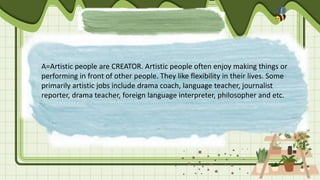
A=Artistic people are CREATOR. Artistic people often enjoy making things or
performing in front of other people. They like flexibility in their lives. Some
primarily artistic jobs include drama coach, language teacher, journalist
reporter, drama teacher, foreign language interpreter, philosopher and etc.
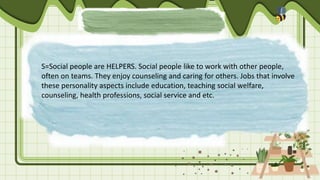
S=Social people are HELPERS. Social people like to work with other people,
often on teams. They enjoy counseling and caring for others. Jobs that involve
these personality aspects include education, teaching social welfare,
counseling, health professions, social service and etc.
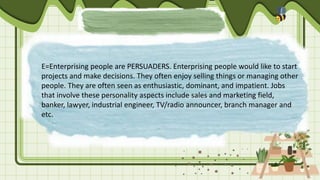
E=Enterprising people are PERSUADERS. Enterprising people would like to start
projects and make decisions. They often enjoy selling things or managing other
people. They are often seen as enthusiastic, dominant, and impatient. Jobs
that involve these personality aspects include sales and marketing field,
banker, lawyer, industrial engineer, TV/radio announcer, branch manager and
etc.
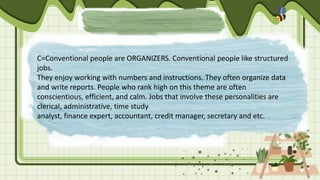
C=Conventional people are ORGANIZERS. Conventional people like structured
jobs.
They enjoy working with numbers and instructions. They often organize data
and write reports. People who rank high on this theme are often
conscientious, efficient, and calm. Jobs that involve these personalities are
clerical, administrative, time study
analyst, finance expert, accountant, credit manager, secretary and etc.
Modernism (early 1900s- 1965)
• There was a greater demand for all sorts of literature
because of the higher literacy rate
•Modernism also challenged the prevailing order during
its time and focused on experimentation while self-
consciously breaking away from traditional forms.
• Imagısm
•Stream of consciousness
•An unreliable narrator
Literary Techniques Used during Modernism
Postmodernism (1965-present)
shows a crisis of identity of the human being in ethnicity and sexuality, as
well as the struggle for social and cultural acceptance in a hypocritical
society.
a. use of paradox or self-contradictory statement,
b. use of fragmentation or incompleteness
whether in form or in content, and
c. the unreliable narrator.
Characteristics of Postmodern Text
Assessment
1-3 Give the 3 dominant cultures in the Medieval period.
4-6 Give the 3 literary techniques used, an unreliable narrator.
7-8 Give 2 types of literary forms from the Medieval period.
9._________ is used of fragmentation or incompleteness whether inform or in content
a. Victorian Period b. Renaissance literature
c. Characteristics of Post Modern Text d. Medieval literature
10.__________it is shows the inconsistencies of Chivalry, problematizing person’s bravery
versus
group needs, and the individual working out his or her destiny.
a. Victorian Period b. Post Modernism
c. Anciant Period d. Medieval literature Characteristics
11. The printing press was invented by Johannes Gutenberg in _____.
a.1440 b. 1160 c. 1443 d. 1460
12._________is writing about nature was done as a way of reclaiming a life that was
threatened by urbanization.
a. Modernism b. Renaissance literature
c. Victorian Period d. Romanticism literature
13-15 Give an example of Romanticism literature.
1-3Christianity, Islam, Germanic
4-6 Imagism, Stream of consciousness, An unreliable
narrator
7-8 Epic, Elegies, Ballad, Narrative poem, Hymns
9. C
10.D
11. A
12. D
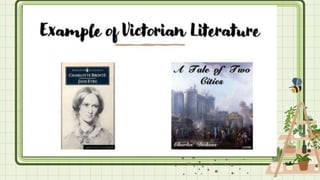
13-15 Songs of Experience, Frankenstein, Jane Austen
Answer key
Thank you!

family traditions-----.pptx

  • 2.
    TOPIC OUTLINE  Familytraditions come in all shapes and sizes, from the smallest repeated gestures to the grandest, spare-no-expense celebrations such as talking, reading, singing, snuggling up together, and saying a prayer are things to look forward to on a regular basis.  Other traditions are set with the intention either because they have been passed down through the generations or because the parents want to purposely create a sense of unity. Some traditions reflect family values, such as donating used toys and/or giving white gifts around the Christmas season, or volunteering regularly at the  orphanage.
  • 3.
    They tell astory about a family. It can help children understand where their family came from and what they are all about. Psychologist Marshal Duke (2017) has found that children who have an intimate knowledge of their family’s history are typically more well-adjusted and self- confident than children who don’t. Provide a source of identity:
  • 4.
    Strengthen family bond. Traditionsusually involve unity and face-to- face interaction that is becoming rarer in this technological age. Traditions create trust and helps family members feel like they are part of something special.
  • 5.
    Especially important intimes of change and grief. Should be constant in a fast-paced, ever- changing world. Offer comfort and security.
  • 6.
    Teach values. Daily familyprayer teaches the importance of faith; nightly bedtime stories teaches the importance of education, reading and life-long learning; family dinner and activities instills the value of family solidarity.
  • 7.
    Add to therhythm and seasonality of life. Rituals can give children consistent events to look forward in anticipation and something to look back on with satisfaction. Breaks the monotony of life.
  • 8.
    Pass of culturaland religious heritage. Religion and family history are a great place to look if you want to start some meaningful family traditions.
  • 9.
  • 10.
    Create lasting memories. “Familytraditions enhance children’s emotional well- being by helping to create feelings of security, continuity and identity. Families with established traditions and those who actively form new actions or events as traditions are more likely to create strong bonds among members. Family configurations vary considerably, but those who live together can create and celebrate traditions that reflect their caring for each other.” (Leah Davies, M.Ed., 2017)
  • 11.
    Keep Our FamiliesCloser to God If we will build righteous traditions in our families, the light of God’s Word can grow ever brighter in the lives of our children from generation to generation. We can look forward to that glorious day when we will all be united together as eternal family units to reap the everlasting joy promised by our Eternal Father for His righteous children.
  • 13.
    A career isdefined as the combination and sequence of roles played by a person during the course of a lifetime (Super, 1980). Your career dictates a lot of things in your life – it can determine the kind of lifestyle that you will be leading, the quality of relationships that you have with people around you like your family and friends, the kind of balance you will be able to keep with your life and your responsibilities.
  • 14.
    factors that influencestudents’ career choice:
  • 15.
    Choosing a careerjust live up to the parents’ expectation is the most common decision taking by students from business families are by default expected to choose commerce career course. Some who resists submit to the parental pressure leading to an unsuccessful career choice. Parents’ Desire/ Parental Pressure:
  • 16.
    Peer Influence Most ofthe students want to follow the crowd to get to their destination. Follow your friends is the most trending exercise visible during the selection of A university or college. The majority choice is the best. This mindset increased the count in the mediocre group where students fail to succeed in their careers and just keep on it with an average performance.
  • 17.
    Skills and Abilities: Consideringyour skills and abilities and how they may fit in a particular occupation comes out of one of the earliest career development fields. You can identify activities you enjoy and those in which you have a level of competency through a formal assessment.
  • 18.
    Holland’s Career TypologyTheory. This theory establishes a classification system that matches personality characteristics and personal preferences to job characteristics. Holland codes are six personality/career types that help describe a wide range of occupations. Interest and Personality Test:
  • 19.
    Affordability This is thepurchasing power of an individual who dares to dream.
  • 20.
    Past Performance This practiceof determining one’s interest field based on one-time exam performance has often led to a wrong career decision. Let us take a concrete example, a senior high school graduate who wants to take up BSED is advised to take up other courses because of failing the screening admission.
  • 21.
    Earning Potential Your chosenprofession is likely to be a factor that influencing your career path. Your personal financial needs are also likely to influence your career choices you make.
  • 22.
    Location Geography can havean influence on career path decisions in a number of ways. You may choose a job that requires living in a certain region.
  • 23.
    Financial Remuneration: It isidentified as the most influential factor in career choice decisions. Income was considered as an important component of life, particularly among youth who had higher levels of individualism.
  • 24.
    They are significantfigures in the process of youth’s career decision-making, are seen as significant figures are agents of development, and could have been influence on students’ decision- making. Teachers and Educators:
  • 25.
    Important Component of SettingCareer and Life Goals Teachers and Educators:
  • 26.
    Benefits of matchingyour interests Here are reasons to pick a job that matches your interests: ✓ You will be happier doing a job you like (matches your interests than one you dislike. ✓ Not everything you enjoy doing will provide you with a good income. It is important to balance what you enjoy, what you are good at (your skills), and what jobs are available. ✓ You may not enjoy every part of your job, but you should enjoy most of it.
  • 27.
    R=Realistic people areDOERS. Realistic people like to work with their hands, either with plants and animals or with tools. They like to fix things. Some examples of occupations that are primarily realistic in nature are: forester, industrial arts teacher, radio operator, auto engineer, industrial engineering technician, aircraft mechanic and other mechanical works, and agricultural works.
  • 28.
    I=Investigative people areTHINKER. Investigative people like to analyze data and solve problems. They usually prefer to work independently. Some specific investigative jobs are economist, internist, physician, anthropologist, astronomer, pathologist, physicist, chemist, production planner, medical lab, math and science teacher, and all sciences.
  • 29.
    A=Artistic people areCREATOR. Artistic people often enjoy making things or performing in front of other people. They like flexibility in their lives. Some primarily artistic jobs include drama coach, language teacher, journalist reporter, drama teacher, foreign language interpreter, philosopher and etc.
  • 30.
    S=Social people areHELPERS. Social people like to work with other people, often on teams. They enjoy counseling and caring for others. Jobs that involve these personality aspects include education, teaching social welfare, counseling, health professions, social service and etc.
  • 31.
    E=Enterprising people arePERSUADERS. Enterprising people would like to start projects and make decisions. They often enjoy selling things or managing other people. They are often seen as enthusiastic, dominant, and impatient. Jobs that involve these personality aspects include sales and marketing field, banker, lawyer, industrial engineer, TV/radio announcer, branch manager and etc.
  • 32.
    C=Conventional people areORGANIZERS. Conventional people like structured jobs. They enjoy working with numbers and instructions. They often organize data and write reports. People who rank high on this theme are often conscientious, efficient, and calm. Jobs that involve these personalities are clerical, administrative, time study analyst, finance expert, accountant, credit manager, secretary and etc.
  • 34.
    Modernism (early 1900s-1965) • There was a greater demand for all sorts of literature because of the higher literacy rate •Modernism also challenged the prevailing order during its time and focused on experimentation while self- consciously breaking away from traditional forms.
  • 35.
    • Imagısm •Stream ofconsciousness •An unreliable narrator Literary Techniques Used during Modernism
  • 36.
    Postmodernism (1965-present) shows acrisis of identity of the human being in ethnicity and sexuality, as well as the struggle for social and cultural acceptance in a hypocritical society.
  • 37.
    a. use ofparadox or self-contradictory statement, b. use of fragmentation or incompleteness whether in form or in content, and c. the unreliable narrator. Characteristics of Postmodern Text
  • 39.
    Assessment 1-3 Give the3 dominant cultures in the Medieval period. 4-6 Give the 3 literary techniques used, an unreliable narrator. 7-8 Give 2 types of literary forms from the Medieval period. 9._________ is used of fragmentation or incompleteness whether inform or in content a. Victorian Period b. Renaissance literature c. Characteristics of Post Modern Text d. Medieval literature 10.__________it is shows the inconsistencies of Chivalry, problematizing person’s bravery versus group needs, and the individual working out his or her destiny. a. Victorian Period b. Post Modernism c. Anciant Period d. Medieval literature Characteristics
  • 40.
    11. The printingpress was invented by Johannes Gutenberg in _____. a.1440 b. 1160 c. 1443 d. 1460 12._________is writing about nature was done as a way of reclaiming a life that was threatened by urbanization. a. Modernism b. Renaissance literature c. Victorian Period d. Romanticism literature 13-15 Give an example of Romanticism literature.
  • 41.
    1-3Christianity, Islam, Germanic 4-6Imagism, Stream of consciousness, An unreliable narrator 7-8 Epic, Elegies, Ballad, Narrative poem, Hymns 9. C 10.D 11. A 12. D 13-15 Songs of Experience, Frankenstein, Jane Austen Answer key
  • 42.