Personal
Development
ABOUT READ A ROAD MAP WEEK
This template contains an assortment of complementary infographic
resources for the Read a Road Map Week presentation.
These infographics are adapted to the style of the aforementioned
presentation, so you can insert them easily and have them completely
integrated at once. You just need to do the following:
● Select the element that you want to copy
● Right-click and choose “Copy”
● Go to the slide where you want the element to appear
● Right-click and choose “Paste”
DAY 1
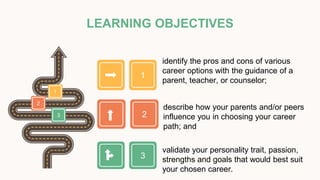
LEARNING OBJECTIVES
1
2
3
identify the pros and cons of various
career options with the guidance of a
parent, teacher, or counselor;
1
describe how your parents and/or peers
influence you in choosing your career
path; and
2
validate your personality trait, passion,
strengths and goals that would best suit
your chosen career.
3
ESSENTIAl QUESTIONS
Do you need to consult your
parents or follow your
peers in choosing your
career path?
ESSENTIAl QUESTIONS
Why is it important to know
the external factors that you
have to consider when
planning your career path?
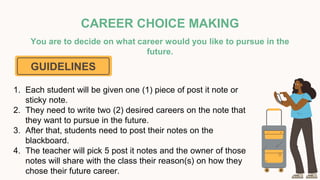
CAREER CHOICE MAKING
You are to decide on what career would you like to pursue in the
future.
GUIDELINES
1. Each student will be given one (1) piece of post it note or
sticky note.
2. They need to write two (2) desired careers on the note that
they want to pursue in the future.
3. After that, students need to post their notes on the
blackboard.
4. The teacher will pick 5 post it notes and the owner of those
notes will share with the class their reason(s) on how they
chose their future career.
READ A ROAD MAP WEEK INFOGRAPHICS
HOW TO IDENTIFY PARKING SPACES
PROHIBITED
Mercury is the smallest
planet of them all
Venus has a beautiful name,
but also high temperatures
Earth is the only planet
known to harbor life
ALLOWED
Despite being red, Mars is
actually a cold place
Jupiter is the biggest planet
in the Solar System
Saturn is the second-largest
planet in the Solar System
PARENTAL INFLUENCE
Your parents have some idea of
what course you should take up in
college. If this coincides with what
you really want, then there will be
no friction between you and your
parents. However, if what they
think do not match with yours,
then there will be conflict.
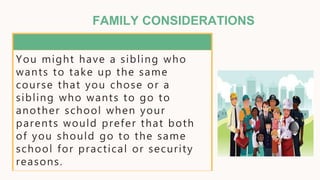
FAMILY CONSIDERATIONS
You might have a sibling who
wants to take up the same
course that you chose or a
sibling who wants to go to
another school when your
parents would prefer that both
of you should go to the same
school for practical or security
reasons.
FAMILY CONSTRAINTS
Your parents have some idea of
what course you should take up in
college. If this coincides with what
you really want, then there will be
no friction between you and your
parents. However, if what they
think do not match with yours,
then there will be conflict.
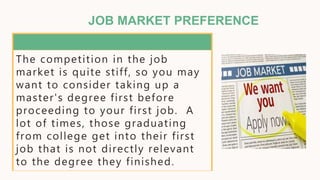
JOB MARKET PREFERENCE
The competition in the job
market is quite stiff, so you may
want to consider taking up a
master's degree first before
proceeding to your first job. A
lot of times, those graduating
from college get into their first
job that is not directly relevant
to the degree they finished.
SCHOOL LOCATION
This is another practical problem
that may arise when you choose
your college course or career
choice. For example, students who
live far from up, especially if they
come from far places outside of
metro manila, stay in boarding
houses near the campus if your
family's financial room or stay in
a boarding house somewhere
nearby your school of choice.
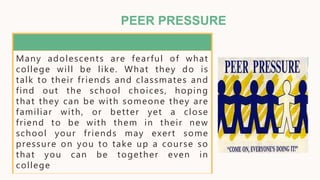
PEER PRESSURE
Many adolescents are fearful of what
college will be like. What they do is
talk to their friends and classmates and
find out the school choices, hoping
that they can be with someone they are
familiar with, or better yet a close
friend to be with them in their new
school your friends may exert some
pressure on you to take up a course so
that you can be together even in
college
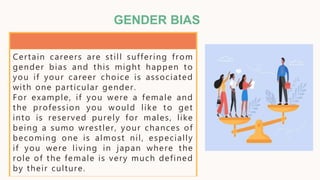
GENDER BIAS
Certain careers are still suffering from
gender bias and this might happen to
you if your career choice is associated
with one particular gender.
For example, if you were a female and
the profession you would like to get
into is reserved purely for males, like
being a sumo wrestler, your chances of
becoming one is almost nil, especially
if you were living in japan where the
role of the female is very much defined
by their culture.
LANGUAGE LIMITATION
Language can be learned, so if you
have this challenge before you, do
not be the faint of heart and just go
ahead and pursue your dream. For
example, you want to take up
european studies to become a
diplomat or an expert in european
matters someday, and you will be
required to be able to speak at least
one european language, then go
ahead and learn.
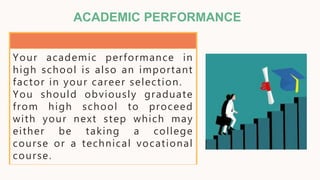
ACADEMIC PERFORMANCE
Your academic performance in
high school is also an important
factor in your career selection.
You should obviously graduate
from high school to proceed
with your next step which may
either be taking a college
course or a technical vocational
course.
DAY 2
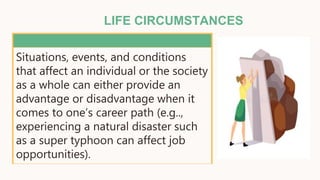
LIFE CIRCUMSTANCES
Situations, events, and conditions
that affect an individual or the society
as a whole can either provide an
advantage or disadvantage when it
comes to one’s career path (e.g..,
experiencing a natural disaster such
as a super typhoon can affect job
opportunities).
SPIRITUAL AND RELIGIOUS FACTORS
Certain spiritual or
religious orientations may
be incorporated in a
person’s career planning.
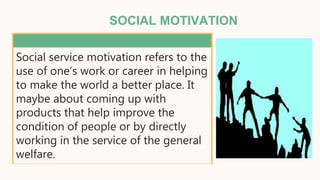
SOCIAL MOTIVATION
Social service motivation refers to the
use of one’s work or career in helping
to make the world a better place. It
maybe about coming up with
products that help improve the
condition of people or by directly
working in the service of the general
welfare.
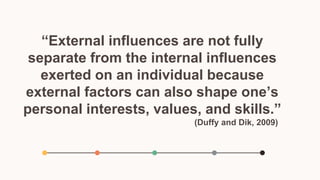
“External influences are not fully
separate from the internal influences
exerted on an individual because
external factors can also shape one’s
personal interests, values, and skills.”
(Duffy and Dik, 2009)
PROS AND CONS OF
VARIOUS CAREER OPTIONS
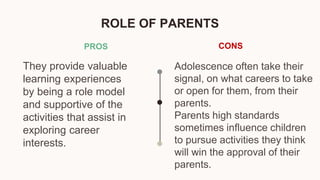
ROLE OF PARENTS
PROS
They provide valuable
learning experiences
by being a role model
and supportive of the
activities that assist in
exploring career
interests.
CONS
Adolescence often take their
signal, on what careers to take
or open for them, from their
parents.
Parents high standards
sometimes influence children
to pursue activities they think
will win the approval of their
parents.
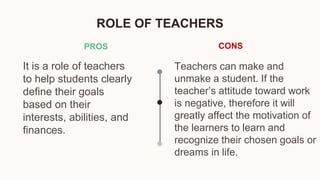
ROLE OF TEACHERS
PROS
It is a role of teachers
to help students clearly
define their goals
based on their
interests, abilities, and
finances.
CONS
Teachers can make and
unmake a student. If the
teacher’s attitude toward work
is negative, therefore it will
greatly affect the motivation of
the learners to learn and
recognize their chosen goals or
dreams in life.
ROLE OF GUIDANCE COUNSELORS
PROS
With the help of career
guidance counselor,
students need clear
direction to be able to
integrate their
education, skills, and
talents with their hopes
and dreams to achieve
success.
CONS
High risk of getting too
personal toward students.
There are cases of untrained
professionals in the field of
psychological perspective who
are in charge of guidance and
counseling in schools which led
the students to avoid being
involved in their services.
DAY 3
PRACTICAL GUIDELINES
IN PLANNING CAREER
Set Personal Goals
Goal setting is important when you think about
your ideal future and in motivating yourself to
turn your vision into reality. The process can
help you choose where and how to proceed in
life. By knowing precisely what you want to
achieve, you will know where you need to
concentrate your efforts.
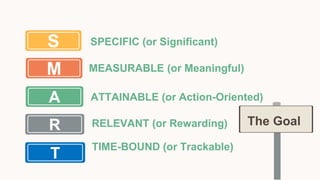
A useful way of setting goals is by
remembering the acronym SMART.
STEP 1
SPECIFIC (or Significant)
S
MEASURABLE (or Meaningful)
M
ATTAINABLE (or Action-Oriented)
A
RELEVANT (or Rewarding)
R The Goal
TIME-BOUND (or Trackable)
T
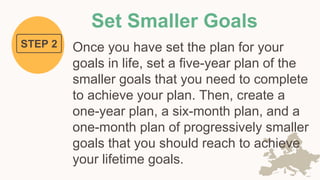
Set Smaller Goals
Once you have set the plan for your
goals in life, set a five-year plan of the
smaller goals that you need to complete
to achieve your plan. Then, create a
one-year plan, a six-month plan, and a
one-month plan of progressively smaller
goals that you should reach to achieve
your lifetime goals.
STEP 2
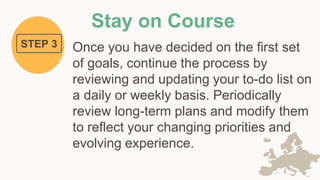
Stay on Course
Once you have decided on the first set
of goals, continue the process by
reviewing and updating your to-do list on
a daily or weekly basis. Periodically
review long-term plans and modify them
to reflect your changing priorities and
evolving experience.
STEP 3
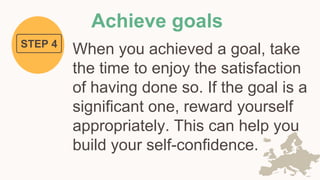
Achieve goals
When you achieved a goal, take
the time to enjoy the satisfaction
of having done so. If the goal is a
significant one, reward yourself
appropriately. This can help you
build your self-confidence.
STEP 4
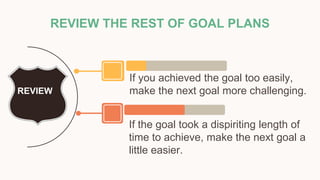
REVIEW THE REST OF GOAL PLANS
If the goal took a dispiriting length of
time to achieve, make the next goal a
little easier.
If you achieved the goal too easily,
make the next goal more challenging.
REVIEW
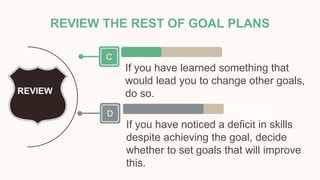
REVIEW THE REST OF GOAL PLANS
If you have learned something that
would lead you to change other goals,
do so.
C
If you have noticed a deficit in skills
despite achieving the goal, decide
whether to set goals that will improve
this.
D 80%
REVIEW
DAY 4
PERFORMANCE
TASK 3
THANK YOU!

PDEV-Final Term-Week 4.pptx

  • 1.
  • 2.
    ABOUT READ AROAD MAP WEEK This template contains an assortment of complementary infographic resources for the Read a Road Map Week presentation. These infographics are adapted to the style of the aforementioned presentation, so you can insert them easily and have them completely integrated at once. You just need to do the following: ● Select the element that you want to copy ● Right-click and choose “Copy” ● Go to the slide where you want the element to appear ● Right-click and choose “Paste”
  • 3.
  • 4.
    LEARNING OBJECTIVES 1 2 3 identify thepros and cons of various career options with the guidance of a parent, teacher, or counselor; 1 describe how your parents and/or peers influence you in choosing your career path; and 2 validate your personality trait, passion, strengths and goals that would best suit your chosen career. 3
  • 5.
    ESSENTIAl QUESTIONS Do youneed to consult your parents or follow your peers in choosing your career path?
  • 6.
    ESSENTIAl QUESTIONS Why isit important to know the external factors that you have to consider when planning your career path?
  • 7.
    CAREER CHOICE MAKING Youare to decide on what career would you like to pursue in the future. GUIDELINES 1. Each student will be given one (1) piece of post it note or sticky note. 2. They need to write two (2) desired careers on the note that they want to pursue in the future. 3. After that, students need to post their notes on the blackboard. 4. The teacher will pick 5 post it notes and the owner of those notes will share with the class their reason(s) on how they chose their future career.
  • 8.
    READ A ROADMAP WEEK INFOGRAPHICS HOW TO IDENTIFY PARKING SPACES PROHIBITED Mercury is the smallest planet of them all Venus has a beautiful name, but also high temperatures Earth is the only planet known to harbor life ALLOWED Despite being red, Mars is actually a cold place Jupiter is the biggest planet in the Solar System Saturn is the second-largest planet in the Solar System
  • 9.
    PARENTAL INFLUENCE Your parentshave some idea of what course you should take up in college. If this coincides with what you really want, then there will be no friction between you and your parents. However, if what they think do not match with yours, then there will be conflict.
  • 10.
    FAMILY CONSIDERATIONS You mighthave a sibling who wants to take up the same course that you chose or a sibling who wants to go to another school when your parents would prefer that both of you should go to the same school for practical or security reasons.
  • 11.
    FAMILY CONSTRAINTS Your parentshave some idea of what course you should take up in college. If this coincides with what you really want, then there will be no friction between you and your parents. However, if what they think do not match with yours, then there will be conflict.
  • 12.
    JOB MARKET PREFERENCE Thecompetition in the job market is quite stiff, so you may want to consider taking up a master's degree first before proceeding to your first job. A lot of times, those graduating from college get into their first job that is not directly relevant to the degree they finished.
  • 13.
    SCHOOL LOCATION This isanother practical problem that may arise when you choose your college course or career choice. For example, students who live far from up, especially if they come from far places outside of metro manila, stay in boarding houses near the campus if your family's financial room or stay in a boarding house somewhere nearby your school of choice.
  • 14.
    PEER PRESSURE Many adolescentsare fearful of what college will be like. What they do is talk to their friends and classmates and find out the school choices, hoping that they can be with someone they are familiar with, or better yet a close friend to be with them in their new school your friends may exert some pressure on you to take up a course so that you can be together even in college
  • 15.
    GENDER BIAS Certain careersare still suffering from gender bias and this might happen to you if your career choice is associated with one particular gender. For example, if you were a female and the profession you would like to get into is reserved purely for males, like being a sumo wrestler, your chances of becoming one is almost nil, especially if you were living in japan where the role of the female is very much defined by their culture.
  • 16.
    LANGUAGE LIMITATION Language canbe learned, so if you have this challenge before you, do not be the faint of heart and just go ahead and pursue your dream. For example, you want to take up european studies to become a diplomat or an expert in european matters someday, and you will be required to be able to speak at least one european language, then go ahead and learn.
  • 17.
    ACADEMIC PERFORMANCE Your academicperformance in high school is also an important factor in your career selection. You should obviously graduate from high school to proceed with your next step which may either be taking a college course or a technical vocational course.
  • 18.
  • 19.
    LIFE CIRCUMSTANCES Situations, events,and conditions that affect an individual or the society as a whole can either provide an advantage or disadvantage when it comes to one’s career path (e.g.., experiencing a natural disaster such as a super typhoon can affect job opportunities).
  • 20.
    SPIRITUAL AND RELIGIOUSFACTORS Certain spiritual or religious orientations may be incorporated in a person’s career planning.
  • 21.
    SOCIAL MOTIVATION Social servicemotivation refers to the use of one’s work or career in helping to make the world a better place. It maybe about coming up with products that help improve the condition of people or by directly working in the service of the general welfare.
  • 22.
    “External influences arenot fully separate from the internal influences exerted on an individual because external factors can also shape one’s personal interests, values, and skills.” (Duffy and Dik, 2009)
  • 23.
    PROS AND CONSOF VARIOUS CAREER OPTIONS
  • 24.
    ROLE OF PARENTS PROS Theyprovide valuable learning experiences by being a role model and supportive of the activities that assist in exploring career interests. CONS Adolescence often take their signal, on what careers to take or open for them, from their parents. Parents high standards sometimes influence children to pursue activities they think will win the approval of their parents.
  • 25.
    ROLE OF TEACHERS PROS Itis a role of teachers to help students clearly define their goals based on their interests, abilities, and finances. CONS Teachers can make and unmake a student. If the teacher’s attitude toward work is negative, therefore it will greatly affect the motivation of the learners to learn and recognize their chosen goals or dreams in life.

  • 26.
    ROLE OF GUIDANCECOUNSELORS PROS With the help of career guidance counselor, students need clear direction to be able to integrate their education, skills, and talents with their hopes and dreams to achieve success. CONS High risk of getting too personal toward students. There are cases of untrained professionals in the field of psychological perspective who are in charge of guidance and counseling in schools which led the students to avoid being involved in their services.
  • 27.
  • 28.
  • 29.
    Set Personal Goals Goalsetting is important when you think about your ideal future and in motivating yourself to turn your vision into reality. The process can help you choose where and how to proceed in life. By knowing precisely what you want to achieve, you will know where you need to concentrate your efforts. A useful way of setting goals is by remembering the acronym SMART. STEP 1
  • 30.
    SPECIFIC (or Significant) S MEASURABLE(or Meaningful) M ATTAINABLE (or Action-Oriented) A RELEVANT (or Rewarding) R The Goal TIME-BOUND (or Trackable) T
  • 31.
    Set Smaller Goals Onceyou have set the plan for your goals in life, set a five-year plan of the smaller goals that you need to complete to achieve your plan. Then, create a one-year plan, a six-month plan, and a one-month plan of progressively smaller goals that you should reach to achieve your lifetime goals. STEP 2
  • 32.
    Stay on Course Onceyou have decided on the first set of goals, continue the process by reviewing and updating your to-do list on a daily or weekly basis. Periodically review long-term plans and modify them to reflect your changing priorities and evolving experience. STEP 3
  • 33.
    Achieve goals When youachieved a goal, take the time to enjoy the satisfaction of having done so. If the goal is a significant one, reward yourself appropriately. This can help you build your self-confidence. STEP 4
  • 34.
    REVIEW THE RESTOF GOAL PLANS If the goal took a dispiriting length of time to achieve, make the next goal a little easier. If you achieved the goal too easily, make the next goal more challenging. REVIEW
  • 35.
    REVIEW THE RESTOF GOAL PLANS If you have learned something that would lead you to change other goals, do so. C If you have noticed a deficit in skills despite achieving the goal, decide whether to set goals that will improve this. D 80% REVIEW
  • 36.
  • 37.
  • 41.

Editor's Notes

  • #30 You will also be able to detect the challenges and obstacles toward achieving your goals ahead of time.
  • #33 A good way to do this is by scheduling regular reviews using a computer-based diary. Learn how to be adaptive and flexible in life.
  • #34 A good way to do this is by scheduling regular reviews using a computer-based diary. Learn how to be adaptive and flexible in life.