Managing Stress and Emotions: identifying Common Stressors faced by Families.pptx
1.
Managing Stress andEmotions:
Identifying Common Stressors Faced
by Familes, Exploring Coping
Mechanisms for Managing Anxiety,
Grief and Frustration
Reporter: DOMILEN R. RABE Submitted to: Nodel Turiano,Phd
2.
Mindfulness and
Relaxation
Time Management
Buildinga Support
System
Family is meant to be a source of love, support, and
stability, but sometimes stress can creep into the picture.
Dealing with stress in the family can be challenging and
often requires open communication and understanding
from all parties involved.
3.
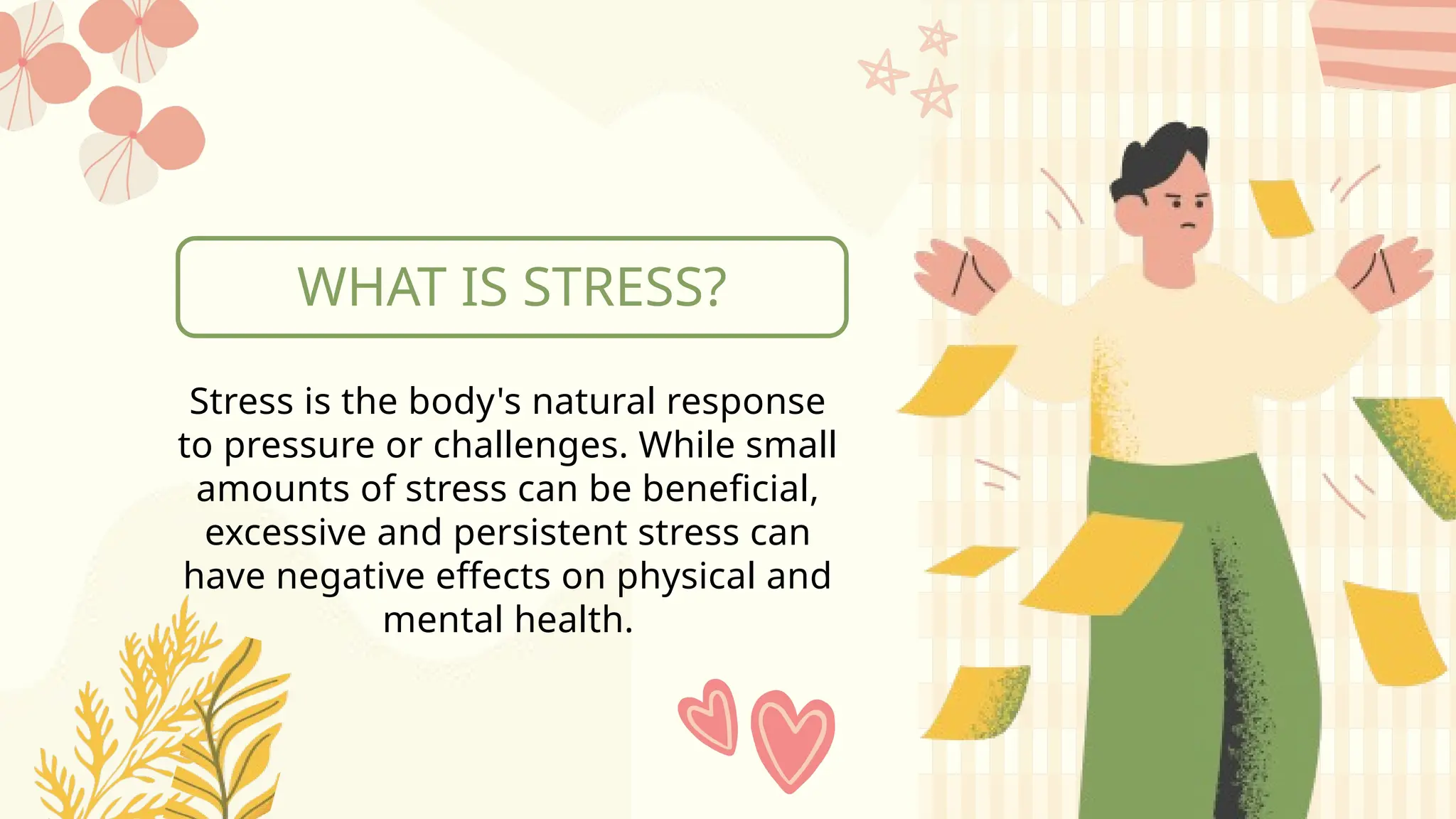
WHAT IS STRESS?
Stressis the body's natural response
to pressure or challenges. While small
amounts of stress can be beneficial,
excessive and persistent stress can
have negative effects on physical and
mental health.
4.
Mindfulness and
Relaxation
Time Management
Buildinga Support
System
Family stress can be defined as the tension or
strain experienced by family members when faced
with changes, challenges, or threats to their well-
being. It’s a complex phenomenon that affects every
member of the family unit, often in different ways.
The prevalence of stress in modern families has
reached alarming levels, with studies showing that a
significant percentage of adults report high levels of
stress related to family responsibilities and
dynamics.
5.
Mindfulness and
Relaxation
Time Management
Buildinga Support
System
Common Sources of Family Stress
1. Financial Pressures: Money matters can be
a significant source of stress for families.
Struggling with debt, living paycheck to
paycheck, or facing unemployment can create
tension and strain on relationships. The
pressure to provide for one’s family and meet
financial obligations can take a toll on both
parents and children.
6.
Mindfulness and
Relaxation
Time Management
Buildinga Support
System
Common Sources of Family Stress
2. Parenting Challenges: Raising children is
undoubtedly rewarding but also comes with its
fair share of stressors. Balancing work demands
with parenting responsibilities, dealing with
behavioral issues, navigating adolescence, or
coping with special needs can all add strain to
family dynamics.
7.
Mindfulness and
Relaxation
Time Management
Buildinga Support
System
Common Sources of Family Stress
3. Communication Breakdowns: Effective
communication is vital for healthy relationships
within a family. When communication breaks
down or becomes strained, misunderstandings
and conflicts often arise, leading to increased
tension and stress.
8.
Mindfulness and
Relaxation
Time Management
Buildinga Support
System
Common Sources of Family Stress
4. Lack of Work-Life Balance: Juggling
multiple roles as a parent, spouse/partner, and
employee can be overwhelming. When
individuals feel overwhelmed by work-related
pressures or find it challenging to maintain a
healthy work-life balance, it can spill over into
their family life and cause added stress.
9.
Mindfulness and
Relaxation
Time Management
Buildinga Support
System
Common Sources of Family Stress
5. Health issues and caregiving
responsibilities: When a family member falls ill
or requires long-term care, it can place
enormous strain on the entire family. The stress
due to family illness can be particularly
challenging, affecting emotional well-being,
finances, and daily routines.
10.
Mindfulness and
Relaxation
Time Management
Buildinga Support
System
Common Sources of Family Stress
6. Major Life Transitions: Significant life
events such as divorce/separation,
relocation/moving homes, the birth of a new
baby, or the loss of a loved one can disrupt the
equilibrium within a family. These transitions
often bring about emotional upheaval and
adjustment challenges that contribute to
heightened levels of stress.
11.
Mindfulness and
Relaxation
Time Management
Buildinga Support
System
Common Sources of Family Stress
7. External factors: Societal pressures, global
events, and cultural expectations can all
contribute to family stress. For example, the
recent COVID-19 pandemic has had a profound
impact on family life worldwide.
12.
Stress can havea profound impact on family dynamics,
affecting relationships, communication patterns, and
overall well-being. When stress infiltrates the home
environment, it can create tension among family
members and disrupt the harmony that is crucial for
healthy functioning. Let’s delve into some examples to
understand how stress manifests in various aspects of
family life.
The Impact of Stress on
Family Dynamics
13.
1. Strained Relationships:High levels of
stress can strain relationships between family
members. Constant worry, financial pressures,
work demands, or other external factors can lead to
increased conflicts and arguments within the
household. For instance, a couple experiencing
job-related stress may find themselves arguing
more frequently or becoming emotionally distant
from one another.
14.
2. Communication Breakdown:Stress has
the power to hinder effective communication within
families. When individuals are overwhelmed by
their own anxieties and worries, they may struggle
to express their thoughts and emotions clearly. This
breakdown in communication can lead to
misunderstandings and misinterpretations and
further escalate tensions within the family unit.
15.
3. Emotional Well-being:The emotional well-
being of each family member is deeply intertwined
with the overall dynamic of the household. Chronic
stress not only affects individuals directly but also
indirectly impacts those around them. For example,
a parent dealing with work-related stress may
unintentionally exhibit irritability or mood swings
that affect the emotional climate of the entire family.
16.
3. Emotional Well-being:The emotional well-
being of each family member is deeply intertwined
with the overall dynamic of the household. Chronic
stress not only affects individuals directly but also
indirectly impacts those around them. For example,
a parent dealing with work-related stress may
unintentionally exhibit irritability or mood swings
that affect the emotional climate of the entire family.
17.
4. Parent-Child Relationships:Stress in parents
can significantly influence their relationship with
their children. Parents who are overwhelmed by
stress might find it challenging to provide emotional
support or engage in quality time with their kids due
to preoccupation with their own concerns. This lack
of parental involvement can potentially strain
parent-child bonds and hinder healthy
development.
18.
5. Role Changes:In times of prolonged stress,
role changes within a family unit may occur as
different members adapt to cope with new
challenges or responsibilities arising from external
pressures such as illness or financial burdens.
These shifts in roles can disrupt familiar family
dynamics and require adjustment from all
individuals involved.
19.
How Stress Impacts
DifferentFamily Members
1. Parents: Often at the epicenter of family
stress, parents face the challenge of balancing
multiple responsibilities while trying to maintain
their own well-being. They may struggle with
feelings of inadequacy, guilt, or burnout as they
attempt to meet everyone’s needs.
20.
2. Children: Youngchildren are particularly
vulnerable to the effects of family stress. They may
experience difficulties in school, exhibit behavioral
problems, or develop anxiety or depression.
Understanding stress for kids is crucial for parents
and caregivers to provide appropriate support.
21.
3. Teenagers: Adolescentsdealing with their
own developmental challenges may find
family stress particularly difficult to navigate.
They may withdraw from family interactions,
experience academic difficulties, or engage in
risky behaviors as a way of coping.
22.
4. Extended family:Grandparents, aunts,
uncles, and other extended family members
can also be affected by and contribute to
family stress. Intergenerational stress
transmission can occur, with older family
members’ experiences and coping
mechanisms influencing younger generations.
23.
4. Extended family:Grandparents, aunts,
uncles, and other extended family members
can also be affected by and contribute to
family stress. Intergenerational stress
transmission can occur, with older family
members’ experiences and coping
mechanisms influencing younger generations.
24.
Coping Mechanisms forManaging
Family Stress
1. Open Communication: Maintaining open lines
of communication is crucial in navigating family
stress. Encouraging family members to express
their thoughts and emotions creates an atmosphere
of understanding and support. Regular family
meetings or check-ins can provide a safe space for
everyone to share their concerns, brainstorm
solutions, and strengthen relationships.
25.
2. Establishing Boundaries:Setting clear
boundaries is essential in managing stress
within the family dynamic. Each member
should have their own personal space and
time to decompress without interruptions or
demands from others. By respecting one
another’s boundaries, conflicts can be
minimized, allowing for greater harmony at
home.
26.
3. Practicing Self-Care:Taking care of
oneself is not selfish but rather vital for
effectively managing family stress. Encourage
each family member to engage in activities
that bring them joy and relaxation, whether it’s
reading a book, practicing yoga, going for a
walk, or pursuing hobbies. Making self-care a
priority helps individuals recharge and
approach challenges with renewed energy.
27.
4. Seeking SupportOutside the Family:
Sometimes external support can make a
significant difference in dealing with familial
stressors. It may be beneficial to seek
assistance from therapists, counselors, or
support groups specializing in family dynamics
or stress management techniques. These
professionals can offer guidance tailored to
your specific situation and provide valuable
insights into effective coping strategies.
28.
5. Embracing Flexibility:Rigidity often
exacerbates stress within the family unit.
Embracing flexibility allows room for
adaptability when facing unexpected
challenges or changes in routine. By
promoting flexibility among all members of the
household, you create an environment where
problem-solving becomes easier, and tensions
are less likely to escalate.
29.
Supporting Children and
Adolescentsin Times of Stress
When it comes to supporting children and adolescents
during times of stress, there are several key strategies
that can make a significant difference in their well-being.
As a parent or caregiver, it’s important to provide the
necessary support and guidance to help them navigate
through challenging situations. Here are some effective
ways to offer support:
30.
1. Open Communication:Encouraging
open communication is crucial for children
and adolescents to express their feelings and
concerns. Create a safe space where they
feel comfortable sharing their thoughts without
judgment or criticism. Be an active listener,
allowing them to vent or ask questions while
offering reassurance and understanding.
31.
2. Validate TheirEmotions: It’s vital to
validate the emotions your child or adolescent
is experiencing during stressful times. Let
them know that it’s normal to feel
overwhelmed, anxious, or upset in certain
situations. Validating their emotions helps
build trust and strengthens your relationship
with them.
32.
3. Establish Routines:Maintaining
consistent routines can provide stability and a
sense of control for children and adolescents
amidst chaotic times. Establish regular meal
times, bedtimes, study schedules, and leisure
activities as part of their daily routine. This
structure helps create a sense of security
during periods of uncertainty.
33.
4. Teach CopingSkills: Empowering young
individuals with effective coping skills equips
them with tools to manage stress more
effectively on their own. Encourage healthy
coping mechanisms such as deep breathing
exercises, journaling, engaging in hobbies
they enjoy, practicing mindfulness techniques,
or seeking support from trusted friends or
family members.
34.
5. Seek ProfessionalHelp if Needed: In
some cases, the stress experienced by
children and adolescents may require
professional intervention. If you notice
persistent signs of distress like prolonged
sadness, changes in behavior patterns,
academic decline, or social withdrawal,
consider reaching out to a mental health
professional who specializes in working with
young individuals.
35.
Balancing Work andFamily Life to
Reduce Stress
Finding a balance between work and family life is crucial
for reducing stress levels. In today’s fast-paced world,
many of us find ourselves juggling multiple
responsibilities, which can lead to feelings of overwhelm
and burnout. However, by implementing effective
strategies, we can create harmony between our
professional and personal lives. Here are some practical
examples:
36.
1. Prioritize TimeManagement: Start by
evaluating your daily schedule and identifying
areas where you can make adjustments.
Consider setting boundaries around work
hours, allocating specific time slots for family
activities, and being mindful of distractions
that hinder productivity.
37.
2. Delegate Responsibilities:Remember
that you don’t have to do it all on your own.
Delegate tasks both at work and home to
lighten your load. Whether it’s assigning
projects to colleagues or involving family
members in household chores, sharing
responsibilities can help free up valuable time.
38.
3. Set RealisticExpectations: Avoid the
temptation to strive for perfection in every
aspect of your life. Understand that there will
be times when certain areas require more
attention than others. By setting realistic
expectations for yourself and acknowledging
that you cannot do everything flawlessly all
the time, you’ll alleviate unnecessary
pressure.
39.
4. Establish Boundaries:It’s essential to
establish clear boundaries between work time
and personal time. Turn off notifications or set
specific periods where you’re unavailable for
work-related matters outside of working hours.
Similarly, during designated family time, try
your best to disconnect from work-related
obligations.
40.
5. Practice Self-Care:Taking care of
yourself is vital in maintaining a healthy
balance between work and family life while
reducing stress levels overall. Make sure to
prioritize self-care activities such as exercise,
hobbies, relaxation techniques like meditation,
or deep breathing exercises – whatever helps
you recharge.
41.
Seeking Professional Helpfor
Overwhelming Family Stress
1. Persistent Conflict Resolution: If your family is
constantly facing conflicts that you find difficult to resolve
on your own, consulting with a family therapist or
counselor can provide valuable guidance. They can help
identify the underlying issues causing tension and teach
effective communication strategies to promote healthier
relationships within the family.
42.
2. Parenting Challenges:Raising children
can be demanding, especially when faced
with behavioral or emotional difficulties.
Seeking assistance from a child psychologist
or parenting coach can offer insights into
effective discipline techniques, strategies for
managing challenging behaviors, and support
in navigating complex parenting issues.
43.
3. Coping withTrauma or Loss: Families
experiencing significant traumatic events or
coping with the loss of a loved one often
struggle to process their emotions and
navigate through grief together. Engaging in
therapy sessions specifically designed for
families dealing with trauma or bereavement
can help facilitate healing and foster
resilience.
44.
4. Mental HealthConcerns: When one or
more family members are grappling with
mental health issues such as depression,
anxiety, substance abuse, or other psychiatric
disorders, seeking professional help becomes
crucial. Mental health professionals possess
the expertise to diagnose conditions
accurately and recommend appropriate
treatment options tailored to each individual’s
needs.
45.
5. Balancing Work-LifeDemands: In
today’s fast-paced world, juggling work
responsibilities while meeting familial
obligations can create immense stress for
both parents and children alike. Consulting an
organizational psychologist or work-life
balance coach can assist families in
establishing healthy boundaries, managing
time effectively, and reducing overall stress
levels.
46.
“By implementing proper
stressmanagement
techniques, we can maintain
emotional and physical
balance to live a healthier,
happier life.”
THANK YOU