Family
Presented By:
welfare
Demography
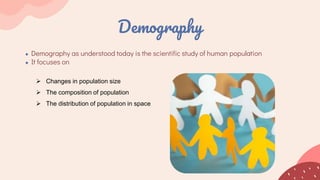
● Demography as understood today is the scientific study of human population
● It focuses on
 Changes in population size
 The composition of population
 The distribution of population in space
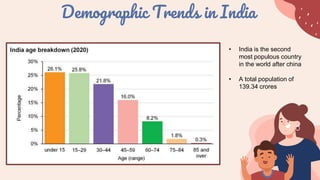
Demographic Trends in India
• India is the second
most populous country
in the world after china
• A total population of
139.34 crores
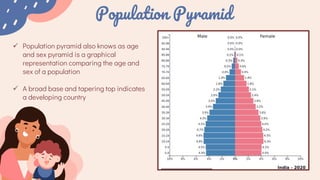
Population Pyramid
 Population pyramid also knows as age
and sex pyramid is a graphical
representation comparing the age and
sex of a population
 A broad base and tapering top indicates
a developing country
Fertility Related Statitics
 Fertility can be measured by a number of
indicators
 Indicators like stillbirths, foetal deaths and
abortions are not included
1. BIRTH RATE
Simplest indicator of fertility and is defined as number of live
birth per 1000 estimated mid year population
2. GENERAL FERTILITY RATE (GFR)
It is the number of live births per 1000 women in reproductive
age group (15-44 or 49 years) in a given year
3. GENERAL MARITAL FERTILITY RATE
It is the number of live births per 1000 married woman in the reproductive age group in a given
year
4. PREGNANCY RATE
It is the ratio of number of pregnancies in a year to married woman in the ages 15-44 years
5. ABORTION RATE
The annual number of all types of abortions, usually per 1000 woman of all child bearing age
6. ABORTION RATO
Abortion ratio is the ratio of number of abortions performed during a particular time period by
number of live births over the same period
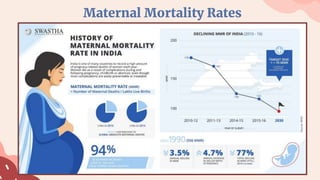
Maternal Mortality Rates
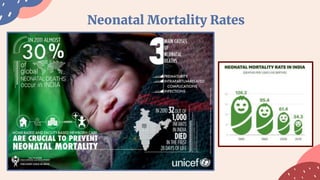
Neonatal Mortality Rates
National
Family Welfare
Programme
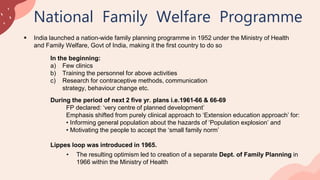
National Family Welfare Programme
 India launched a nation-wide family planning programme in 1952 under the Ministry of Health
and Family Welfare, Govt of India, making it the first country to do so
In the beginning:
a) Few clinics
b) Training the personnel for above activities
c) Research for contraceptive methods, communication
strategy, behaviour change etc.
During the period of next 2 five yr. plans i.e.1961-66 & 66-69
FP declared: ‘very centre of planned development’
Emphasis shifted from purely clinical approach to ‘Extension education approach’ for:
• Informing general population about the hazards of ‘Population explosion’ and
• Motivating the people to accept the ‘small family norm’
Lippes loop was introduced in 1965.
• The resulting optimism led to creation of a separate Dept. of Family Planning in
1966 within the Ministry of Health
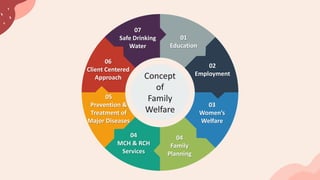
01
Education
Concept
of
Family
Welfare
02
Employment
03
Women’s
Welfare
04
Family
Planning
04
MCH & RCH
Services
05
Prevention &
Treatment of
Major Diseases
06
Client Centered
Approach
07
Safe Drinking
Water
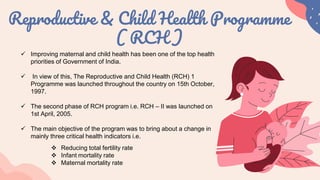
Reproductive & Child Health Programme
( RCH )
 Improving maternal and child health has been one of the top health
priorities of Government of India.
 In view of this, The Reproductive and Child Health (RCH) 1
Programme was launched throughout the country on 15th October,
1997.
 The second phase of RCH program i.e. RCH – II was launched on
1st April, 2005.
 The main objective of the program was to bring about a change in
mainly three critical health indicators i.e.
 Reducing total fertility rate
 Infant mortality rate
 Maternal mortality rate
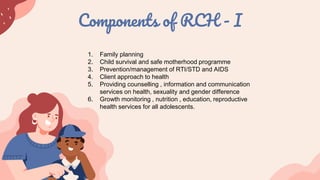
Components of RCH - I
1. Family planning
2. Child survival and safe motherhood programme
3. Prevention/management of RTI/STD and AIDS
4. Client approach to health
5. Providing counselling , information and communication
services on health, sexuality and gender difference
6. Growth monitoring , nutrition , education, reproductive
health services for all adolescents.
Components of RCH - II
1. Population stabilization
2. Maternal health
3. New born care
4. Child health
5. Adolescent health
6. Control of RTI/STD
7. Urban health
8. Tribal health
9. Monitoring and evaluation
10. Other priority areas
Maternal Health / Reproductive Health
 Three or more antenatal check-ups
 Two doses of tetanus toxoid
 Iron folic acid supplementation
 Promoting institutional delivery
Essential Obstetric Care
The strategies to improve and strengthen the quality of maternal
services are
1. Essential Obstetric Care
2. Emergency Obstetric Care
Maternal Health / Reproductive Health
 This consists of operationalizing the first referral unit to be fully
functional round the clock – 24 hours
Emergency Obstetric Care
First Referral Unit (FRU)
 It is an upgraded PHC/CHC into a 30
bedded hospital, having well
furnished and equipped OT with a
new born care centre, labour room,
blood bank and laboratory to provide
necessary obstetric necessary
New Schemes
 Janani Suraksha Yojana (JYS)
 Prasoothi Araike
 Training of traditional birth attendents
 Training of medical officers in obstetric
management
 CEmONC – Comprehensive Emergency Obstetric
and New born Care
 LASA – Life saving anesthesia skills
New Schemes
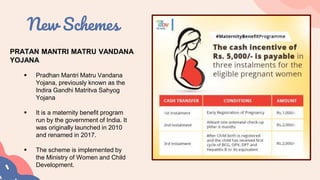
PRATAN MANTRI MATRU VANDANA
YOJANA
 Pradhan Mantri Matru Vandana
Yojana, previously known as the
Indira Gandhi Matritva Sahyog
Yojana
 It is a maternity benefit program
run by the government of India. It
was originally launched in 2010
and renamed in 2017.
 The scheme is implemented by
the Ministry of Women and Child
Development.
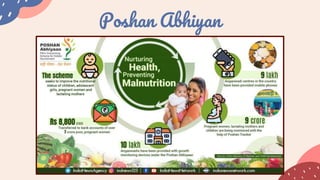
Poshan Abhiyan
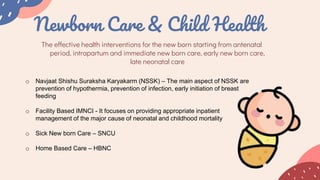
Newborn Care & Child Health
The effective health interventions for the new born starting from antenatal
period, intrapartum and immediate new born care, early new born care,
late neonatal care
o Navjaat Shishu Suraksha Karyakarm (NSSK) – The main aspect of NSSK are
prevention of hypothermia, prevention of infection, early initiation of breast
feeding
o Facility Based IMNCI - It focuses on providing appropriate inpatient
management of the major cause of neonatal and childhood mortality
o Sick New born Care – SNCU
o Home Based Care – HBNC
Family Health Mission
• The National Health Mission (NHM) encompasses its
two Sub-Missions
• the National Rural Health Mission (NRHM) and the newly
launched National Urban Health Mission (NUHM).
• The main programmatic components include Health
System Strengthening in rural and urban areas-
Reproductive-Maternal- Neonatal-Child and Adolescent
Health (RMNCH+A), and Communicable and Non-
Communicable Diseases.
• The NHM envisages achievement of universal access to
equitable, affordable & quality health care services that
are accountable and responsive to people's needs.
Family
Planning
Family Planning
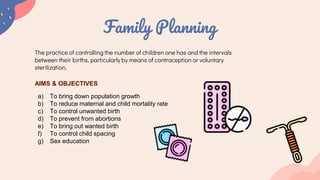
The practice of controlling the number of children one has and the intervals
between their births, particularly by means of contraception or voluntary
sterilization.
AIMS & OBJECTIVES
a) To bring down population growth
b) To reduce maternal and child mortality rate
c) To control unwanted birth
d) To prevent from abortions
e) To bring out wanted birth
f) To control child spacing
g) Sex education
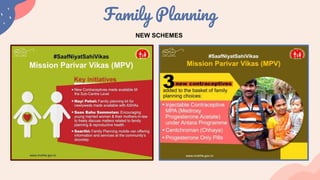
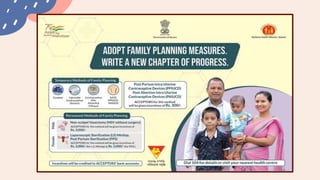
Family Planning
NEW SCHEMES
CREDITS: This presentation template was
created by Slidesgo, including icons by
Flaticon, infographics & images by Freepik
Thanks!

family planning.pptx

  • 1.
  • 2.
    Demography ● Demography asunderstood today is the scientific study of human population ● It focuses on  Changes in population size  The composition of population  The distribution of population in space
  • 3.
    Demographic Trends inIndia • India is the second most populous country in the world after china • A total population of 139.34 crores
  • 4.
    Population Pyramid  Populationpyramid also knows as age and sex pyramid is a graphical representation comparing the age and sex of a population  A broad base and tapering top indicates a developing country
  • 5.
    Fertility Related Statitics Fertility can be measured by a number of indicators  Indicators like stillbirths, foetal deaths and abortions are not included 1. BIRTH RATE Simplest indicator of fertility and is defined as number of live birth per 1000 estimated mid year population 2. GENERAL FERTILITY RATE (GFR) It is the number of live births per 1000 women in reproductive age group (15-44 or 49 years) in a given year
  • 6.
    3. GENERAL MARITALFERTILITY RATE It is the number of live births per 1000 married woman in the reproductive age group in a given year 4. PREGNANCY RATE It is the ratio of number of pregnancies in a year to married woman in the ages 15-44 years 5. ABORTION RATE The annual number of all types of abortions, usually per 1000 woman of all child bearing age 6. ABORTION RATO Abortion ratio is the ratio of number of abortions performed during a particular time period by number of live births over the same period
  • 7.
  • 8.
  • 9.
  • 10.
    National Family WelfareProgramme  India launched a nation-wide family planning programme in 1952 under the Ministry of Health and Family Welfare, Govt of India, making it the first country to do so In the beginning: a) Few clinics b) Training the personnel for above activities c) Research for contraceptive methods, communication strategy, behaviour change etc. During the period of next 2 five yr. plans i.e.1961-66 & 66-69 FP declared: ‘very centre of planned development’ Emphasis shifted from purely clinical approach to ‘Extension education approach’ for: • Informing general population about the hazards of ‘Population explosion’ and • Motivating the people to accept the ‘small family norm’ Lippes loop was introduced in 1965. • The resulting optimism led to creation of a separate Dept. of Family Planning in 1966 within the Ministry of Health
  • 11.
  • 12.
    Reproductive & ChildHealth Programme ( RCH )  Improving maternal and child health has been one of the top health priorities of Government of India.  In view of this, The Reproductive and Child Health (RCH) 1 Programme was launched throughout the country on 15th October, 1997.  The second phase of RCH program i.e. RCH – II was launched on 1st April, 2005.  The main objective of the program was to bring about a change in mainly three critical health indicators i.e.  Reducing total fertility rate  Infant mortality rate  Maternal mortality rate
  • 13.
    Components of RCH- I 1. Family planning 2. Child survival and safe motherhood programme 3. Prevention/management of RTI/STD and AIDS 4. Client approach to health 5. Providing counselling , information and communication services on health, sexuality and gender difference 6. Growth monitoring , nutrition , education, reproductive health services for all adolescents.
  • 14.
    Components of RCH- II 1. Population stabilization 2. Maternal health 3. New born care 4. Child health 5. Adolescent health 6. Control of RTI/STD 7. Urban health 8. Tribal health 9. Monitoring and evaluation 10. Other priority areas
  • 15.
    Maternal Health /Reproductive Health  Three or more antenatal check-ups  Two doses of tetanus toxoid  Iron folic acid supplementation  Promoting institutional delivery Essential Obstetric Care The strategies to improve and strengthen the quality of maternal services are 1. Essential Obstetric Care 2. Emergency Obstetric Care
  • 16.
    Maternal Health /Reproductive Health  This consists of operationalizing the first referral unit to be fully functional round the clock – 24 hours Emergency Obstetric Care First Referral Unit (FRU)  It is an upgraded PHC/CHC into a 30 bedded hospital, having well furnished and equipped OT with a new born care centre, labour room, blood bank and laboratory to provide necessary obstetric necessary
  • 17.
    New Schemes  JananiSuraksha Yojana (JYS)  Prasoothi Araike  Training of traditional birth attendents  Training of medical officers in obstetric management  CEmONC – Comprehensive Emergency Obstetric and New born Care  LASA – Life saving anesthesia skills
  • 18.
    New Schemes PRATAN MANTRIMATRU VANDANA YOJANA  Pradhan Mantri Matru Vandana Yojana, previously known as the Indira Gandhi Matritva Sahyog Yojana  It is a maternity benefit program run by the government of India. It was originally launched in 2010 and renamed in 2017.  The scheme is implemented by the Ministry of Women and Child Development.
  • 19.
  • 20.
    Newborn Care &Child Health The effective health interventions for the new born starting from antenatal period, intrapartum and immediate new born care, early new born care, late neonatal care o Navjaat Shishu Suraksha Karyakarm (NSSK) – The main aspect of NSSK are prevention of hypothermia, prevention of infection, early initiation of breast feeding o Facility Based IMNCI - It focuses on providing appropriate inpatient management of the major cause of neonatal and childhood mortality o Sick New born Care – SNCU o Home Based Care – HBNC
  • 21.
    Family Health Mission •The National Health Mission (NHM) encompasses its two Sub-Missions • the National Rural Health Mission (NRHM) and the newly launched National Urban Health Mission (NUHM). • The main programmatic components include Health System Strengthening in rural and urban areas- Reproductive-Maternal- Neonatal-Child and Adolescent Health (RMNCH+A), and Communicable and Non- Communicable Diseases. • The NHM envisages achievement of universal access to equitable, affordable & quality health care services that are accountable and responsive to people's needs.
  • 22.
  • 23.
    Family Planning The practiceof controlling the number of children one has and the intervals between their births, particularly by means of contraception or voluntary sterilization. AIMS & OBJECTIVES a) To bring down population growth b) To reduce maternal and child mortality rate c) To control unwanted birth d) To prevent from abortions e) To bring out wanted birth f) To control child spacing g) Sex education
  • 24.
  • 26.
    CREDITS: This presentationtemplate was created by Slidesgo, including icons by Flaticon, infographics & images by Freepik Thanks!