Dennis Pruitt
Vice President for Student Affairs
Division Meeting
September 1, 2017
Dr. Dennis A. Pruitt, Sr.
Vice President for Student Affairs,
Vice Provost and Dean of Students
110 Osborne Building
Columbia, SC 29208
Office: 803-777-4172 Fax: 803-777-9354
Email: dpruitt@mailbox.sc.edu
2
3
Worries
and
Wonders
4
Disclaimers and Pre-Apologies
What is Wisdom?
Wisdom:
 Is not simple accumulation of knowledge
 Is not paralyzed by ambiguity, but in fact embraces
uncertainty
 Is expert knowledge about life in general and good
judgment in the face of complex, uncertain
circumstance
 You know it when you see it
5
- Ansberry (2000)
wisdom [wiz-duh m]:
the ability to view more things
with a “blank slate.”
6
wisdom:
can also be the ability to see things
“from the perspective of others”
7
- Aurelius (n.d.)
A little about Student Affairs,
a little about our students,
a little about our worries and wonders.
9
Anyone can do Student Affairs, right?
10
Historical Role of Student Affairs
What happened to the Good Ole Days of
In Loco Parentis?
11
Historical Role of Student Affairs
 Disciplinarian
 Custodian
 Educator
 Integrator
 Combined: contingency (threats and opportunities)
manager
12
- Garland (1985)
New Mission – To provide meaningful services, experiences and support that empower
students to achieve success at Carolina and beyond.
New Vision – An optimum learning environment that inspires students and university
community members to reach their full potential.
13
Current Goals (under revision):
 Manage the comprehensive and collaborative efforts of the university to meet student
enrollment goals, and provide essential programs and services to recruit and enroll new
freshmen and transfer students and facilitate their successful transition to the university.
 Improve student progress and persistence to degree completion by increasing student
engagement in campus life and by providing and supporting essential programs, services,
and educational activities that lead to student success and satisfaction.
 Collaborate with campus and external constituents to provide essential programs and
services that advance learning, at the university and in the higher education community.
 Provide essential programs and services that shape responsible citizens and develop
future leaders, in collaboration with university, community and external partners.
14
Student Affairs is a Profession
 Theories
 Statement of Ethics
 Professional Preparation Programs
 Journals, Books, Monographs, Research Studies
 Listservs, social media, websites
 Professional Associations
 Standards of Good Practice
 Certification Programs
 CAS Standards for Professional Practice
 Foundations
 Has many associated professional organizations
 Practicum and internship
 Graduate assistantships/apprentice programs 15
Student Affairs Functional Areas
 Academic Advising
 Academic Support Services
 Admissions
 Adult Student Services
 Alumni Relations
 Athletics
 Campus Ombudsperson
 Campus Recreation
 Career Services
 Community Service Programs
 Commuter Student Services
 Counseling
 Disabled Student Services
 Development/Fundraising
 Emergency Management
 Enrollment Management
 Family Services
 Financial Aid
 Greek Life
 International Student Services
 Law Enforcement and Safety
 LGBT Program
 Minority Student Affairs
 Multicultural Student Affairs
 Orientation
 Parent Programs
 Registrar
 Residential Life/Housing
 Retention & Assessment
 Sexual Assault Services
 Specific Facilities Management
 Strategic Planning & Innovation
 Student Activities
 Student Conduct
 Student Government
 Student Health Services
 Student Legal Services
 Student Life
 Student Media
 Student Success Programs
 Student Union
 Testing Services
 Visitors Center/Tours
16
 Student Affairs & Academic Support
 Stay-Informed: DSA/AS weekly staff newsletter
 UofSC Student Calendar
 UofSC Weekly Student Email
 National Resource Center for the First Year Experience and
Students in Transition (NRC
17
Resources
 USC Organizational & Professional Development courses
 DSA/SA Professional Development opportunities
 Emerging Leaders Program (ELP)
 Pipeline for Academy Leaders (PAL)
18
Professional Development Resources
Our Students
A peep at our students and
their student experiences.
19
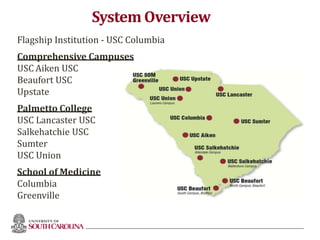
Flagship Institution - USC Columbia
Comprehensive Campuses
USC Aiken USC
Beaufort USC
Upstate
Palmetto College
USC Lancaster USC
Salkehatchie USC
Sumter
USC Union
School of Medicine
Columbia
Greenville
System Overview
20
Total
45,774
46,264
46,672
48,167
49,449
50,099
USC System Headcount Enrollment
Total
30,721
31,288
31,964
32,972
33,724
34,099
- Preliminary Fall 2016
USC Columbia Headcount Enrollment
3690
3826 3881
4423
4569
4580
5002 4975
5190
5104
1183
1191 1192
1185
1199 1199
1208
1210 1210
1216
1100
1120
1140
1160
1180
1200
1220
1240
1500
2000
2500
3000
3500
4000
4500
5000
5500
Fall 2007 Fall 2008 Fall 2009 Fall 2010 Fall 2011 Fall 2012 Fall 2013 Fall 2014 Fall 2015* Fall 2016~
AverageSAT
Enrollment
Enrollment SAT Avg.
*Undergraduate Admissions, 2016 Annual Statistical Report
~Cube Data-Estimated as of Dec 2016.
Ten Year Trend
SAT Averageand FreshmanClass Size
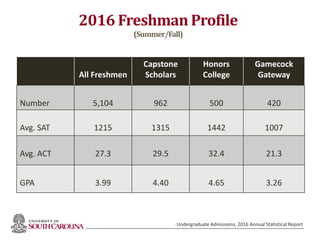
2016 Freshman Profile
(Summer/Fall)
All Freshmen
Capstone
Scholars
Honors
College
Gamecock
Gateway
Number 5,104 962 500 420
Avg. SAT 1215 1315 1442 1007
Avg. ACT 27.3 29.5 32.4 21.3
GPA 3.99 4.40 4.65 3.26
- Undergraduate Admissions, 2016 Annual Statistical Report
2017 Projected Freshman Profile
All Freshmen
Capstone
Scholars
Honors
College
Gamecock
Gateway
Number 5,900 1,180 580 450
THE TRIFECTA ACHIEVED
2017 Projected Freshman Quality
Number SAT ACT WCGPA
Freshmen 5,881 1,254 27.3 4.04
Honors 580 1,478 32.5 4.68
Capstone 1,112 1,357 29.7 4.36
Gateway 443 1,075 21.4 3.14
 17% freshmen are 1st generation
 South Carolina residents – up 20% (+478)
 Non-residents – up 12% (+317)
 African Americans – up 25% (+60)
 Hispanics – up 37% (+85)
 22% are Pell Grant recipients
 45/46 SC counties are represented
27
2017 Projected Demographics
USC Columbia Freshman Student Admissions
Summer/Fall
21,311
23,429
23,035
23,341
25,736
25,441
13,451
14,199
14,844
15,219
16,618
17,302
4,636
4,625
5,046
4,980
5,190
5,104
63.1%
60.6%
64.4% 65.2% 64.6%
68.0%
34.5%
32.6% 34.0% 32.7% 31.2%
29.5%
0.0%
10.0%
20.0%
30.0%
40.0%
50.0%
60.0%
70.0%
80.0%
-
5,000
10,000
15,000
20,000
25,000
30,000
2011 2012 2013 2014 2015 2016
Applied Accepted Enrolled Accept Rate Yield Rate
Score
Averages
2011 2012 2013 2014 2015 2016
SAT 1198 1201 1206 1210 1210 1215
ACT 26.4 26.4 26.9 27.1 27.3 27.3
28
29
Program
Graduation Rate
65%
Gamecock Guarantee
Selection Procedures
1. SC Resident
2. Regular USC
acceptance
3. Parents not 4-yr degree
holders
4. Eligible for federal Pell Grant
Program Benefits
1. Minimum $4,500 award
2. Support of a learning
community
3. Guarantee of full grant
support for tuition &
technology fee
Profile of 2015 Recipients
1. Average family income --
$17,600
2. Gender – 58% Female
3. Race
• White (47%)
• Black (36%)
• Other (17%)
2015 Gamecock Guarantee
Freshmen
Average FAAward
• $21,356
Gift Aid as a Percent of Total Award
• 96% Gamecock Guarantee
• 49% Overall Freshmen
Loans as a Percent of Total Award
• .4% Gamecock Guarantee
• 51% Overall Freshmen
Average Freshman to
Sophomore Retention,
2008 to 2015
• 90%
993
Students Served
2008-2015
30
Top 10 States Fall 2016
College of Arts and Sciences 31%
Darla Moore School of Business 26%
College of Engineering and Computing 13%
College of Hospitality, Retail, Sport Management 7%
College of Nursing 6%
College of Information and Communications 5%
Arnold School of Public Health 5%
College of Education 3%
Pharmacy 3%
School of Music 1%
College of Social Work <1%
Freshman Class Percentage by
College/School
Summer/Fall2016
Freshman Class Top Majors
in First Year
Biological Sciences Public Relations
Exercise Science
Criminology/Criminal
Justice
Experimental Psychology Hospitality Management
Nursing Retailing
Finance Marketing
Management Political Science
Adjusted Gross Family Income
Fall 2015 All Students
Adjusted Gross Family Income All Students SC Resident Out-of-State
$0-49,999 19.8% 27.6% 7.3%
$50,000-99,999 16.9% 21.5% 9.6%
$100,000-249,999 26.1% 23.8% 29.9%
$250,000-499,999 4.1% 1.9% 7.6%
$500,000-749,999 0.5% 0.2% 0.9%
$750,000-999,999 0.1% 0.1% 0.2%
$1,000,000+ 0.1% 0.1% 0.3%
Not Reported 32.3% 24.9% 44.2%
TOTAL 24,862 15,292 9,570
34
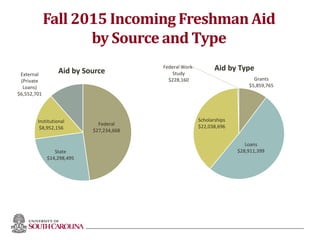
Fall 2015 Incoming Freshman Aid
by Source and Type
Federal
$27,234,668
State
$14,298,495
Institutional
$8,952,156
External
(Private
Loans)
$6,552,701
Aid by Source
Grants
$5,859,765
Loans
$28,911,399
Scholarships
$22,038,696
Federal Work-
Study
$228,160
Aid by Type
35
Cohort return rate for the following fall.
83.10%
85.80%
86.90%
87.20%
86.70%
85.90%
86.80%
87.20%
88.10% 87.90% 88.10%
76.0%
78.0%
80.0%
82.0%
84.0%
86.0%
88.0%
90.0%
2004 2005 2006 2007 2008 2009 2010 2011 2012 2013 2014
First-time, Full-time Freshman
Retention Rates
First Year Retention Rates
(2014 Cohort)
SEC Schools First Year Retention
Vanderbilt University 97%
University of Florida 96%
University of Georgia 94%
Clemson University 92%
Auburn University 91%
University of South Carolina 88%
The University of Alabama 87%
The University of Tennessee 87%
Louisiana State University 85%
University of Mississippi 85%
University of Arkansas 83%
University of Kentucky 82%
Mississippi State University 80% 37
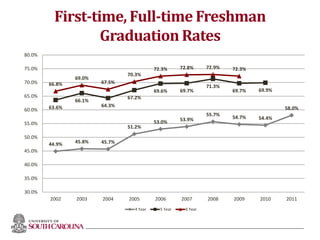
First-time, Full-time Freshman
Graduation Rates
44.9% 45.8% 45.7%
51.2%
53.0% 53.9%
55.7%
54.7% 54.4%
58.0%63.6%
66.1%
64.3%
67.2%
69.6% 69.7%
71.3%
69.7% 69.9%
66.8%
69.0%
67.5%
70.3%
72.3% 72.8% 72.9% 72.3%
30.0%
35.0%
40.0%
45.0%
50.0%
55.0%
60.0%
65.0%
70.0%
75.0%
80.0%
2002 2003 2004 2005 2006 2007 2008 2009 2010 2011
4 Year 5 Year 6 Year
38
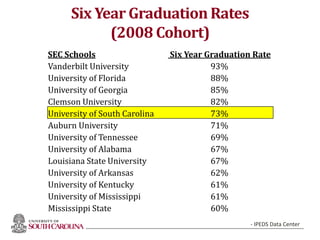
Six Year Graduation Rates
(2008 Cohort)
SEC Schools Six Year Graduation Rate
Vanderbilt University 93%
University of Florida 88%
University of Georgia 85%
Clemson University 82%
University of South Carolina 73%
Auburn University 71%
University of Tennessee 69%
University of Alabama 67%
Louisiana State University 67%
University of Arkansas 62%
University of Kentucky 61%
University of Mississippi 61%
Mississippi State 60%
- IPEDS Data Center
39
2006 2016 Change
Freshman Applications 13,946 25,444 +11,498
Freshman Class 3,697 5,107 +1,410
Freshman Class Yield 42.1% 29.5% -12.6%
Average SAT 1171 1215 +44
Freshman Honors Enrollment 312 500 +188
Capstone Scholars Enrollment 550 962 +412
First to Second Year Retention 86.9% 87.9% +1.0%
4-Year Graduation Rate 53.0% 54.7%* +1.7%
6-Year Graduation Rate 72.3% 72.3%* nc
- OIRA Factbook and Office of Undergraduate Admissions Annual Report
USC Columbia
Enrollment Summary 2006-2016
Summer/FallFreshmen
Freshman and Undergraduate
Totals 1985 to 2015
1985 2000 2015* Growth Since
1985
Freshmen 2,825 2,542 5,190 84%
SAT 951 1116 1210 +259 points
Total UG
Enrollment
15,098 15,266 25,237 67%
41
42
 Women will continue to outpace men in enrollment,
numbers, and persistence
 Women are making gains in educational aspirations
 More women are pursuing traditionally “male” fields
- CIRP data 2014
National Demographics
43
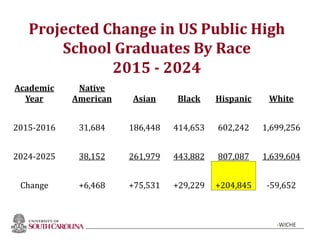
Projected Change in US Public High
School Graduates By Race
2015 - 2024
Academic
Year
Native
American Asian Black Hispanic White
2015-2016 31,684 186,448 414,653 602,242 1,699,256
2024-2025 38,152 261,979 443,882 807,087 1,639,604
Change +6,468 +75,531 +29,229 +204,845 -59,652
-WICHE
45
Non-White FT Enrollment
at South Carolina Institutions
8823
9430
9643
10038
4748
5120 5248 5438
0
2000
4000
6000
8000
10000
12000
Fall 2012 Fall 2013 Fall 2014 Fall 2015
USC System
USC Columbia
Clemson University
Coastal Carolina University
Francis Marion University
Winthrop University
College of Charleston
- Integrated Postsecondary Education Data System
African-American FT Enrollment
at South Carolina Institutions
- Integrated Postsecondary Education Data System
5049
4944 4957 4924
2197 2162 2168 2105
0
1000
2000
3000
4000
5000
6000
Fall 2012 Fall 2013 Fall 2014 Fall 2015
USC System
USC Columbia
Clemson University
Coastal Carolina University
Francis Marion University
Winthrop University
College of Charleston
 5900 freshmen
 1500 transfers
 350 USC system change of campus
 440 Gamecock Gateway
 410 other new undergraduates
47
But – We Really Have 8,600
New Undergraduates
48
Characteristics of this Generation of
College Going Students
49
Meet Generation Z
- Ellis (2017)
Disclaimer
Generational research is often first developed by MARKETERS as
a way to understand how best to reach a population and is often
presented in broad sweeping GENERALITIES.
It is important to know that students will exist along a SPECTRUM
of experiences within these characteristics. The term “in general”
is omitted but implied with this disclaimer in mind.
51
- Ellis (2017)
Characteristics
 1996 – 2011
 60 million strong
 Digital Natives
 Small Windows of Interest
(8 second)
 Aware of their Social Media
Presence
 Pragmatic
 Accepting of Identity
 Most Diverse
 Debt Averse
 Want to Make an Impact
 Ambitious/Career Focus
 Wary of “Establishment”
 Expect Authority Figures to be
Coaches and Collaborators
 Value Applied Education
52
- Ellis (2017)
Additional Characteristics
 1 in 10 incoming freshmen plan to participate in student protest
(HERI)
 15%+ of minority students report feeling “unsafe” on campuses
(NSSE)
 Increased usage of Counseling and Psychology
 Increased reporting of suicidal ideation
 Increased reports of disruptive behavior in the classroom
53
- Ellis (2017)
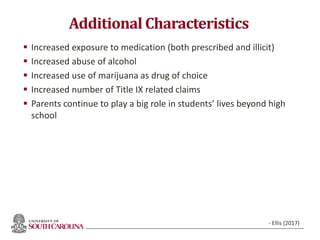
Additional Characteristics
 Increased exposure to medication (both prescribed and illicit)
 Increased abuse of alcohol
 Increased use of marijuana as drug of choice
 Increased number of Title IX related claims
 Parents continue to play a big role in students’ lives beyond high
school
54
- Ellis (2017)
55
Performance Funding Metrics
Input to Output
56
New Performance Criteria
 Freshman to sophomore
retention rates
 Sophomore to senior
persistence rates
 Graduation rates
 Length of time to degree
 Placement
 Gainful employment
 Manageable debt
 Institutional default rates
 Life-long learner
 # of Pell Grant recipients
graduated
 Value added
NEXT:
Transferability
57
58
59
- Randy Bass, 2012
http://www.educause.edu/ero/article/disrupting-ourselves-problem-learning-higher-education
60
Astin’sInput - Environment- OutcomesModel
INPUT
ENVIRONMENT
OUTCOMES
• 6 year graduation rate
• Students’ learning achievements
• College completion
• College completion - value added
• Graduates’ employment status
• Employability
• Life long learner
• Competency and proficiency in chosen field
• Admission to professional /graduate school
WTC – Degree Programs, Courses
BTC Matters - Involvement
• Student Affairs & Academic Support
• Undergraduate Research
• International Programs
• Internships
• Service
• Leadership
Services
• Total undergraduate enrollment
• Quality advising
• Technology resources
• Average freshman SAT scores
• Motivation to attend and graduate
• Scholarship skills / habits
• Financial status
• Life goals
• Class Rank
• High school service, leadership
- Astin (1993)
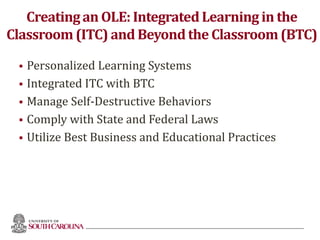
Creatingan OLE: IntegratedLearningin the
Classroom(ITC) and Beyond the Classroom(BTC)
 Personalized Learning Systems
 Integrated ITC with BTC
 Manage Self-Destructive Behaviors
 Comply with State and Federal Laws
 Utilize Best Business and Educational Practices
63
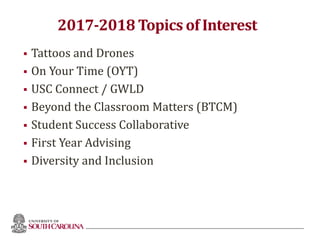
2017-2018 Topics of Interest
 Tattoos and Drones
 On Your Time (OYT)
 USC Connect / GWLD
 Beyond the Classroom Matters (BTCM)
 Student Success Collaborative
 First Year Advising
 Diversity and Inclusion
64
2017-2018 Topics of Interest
 Recruitment and Retention
 Campus Sexual Assault
 Harassment and Discrimination
 Hazing
 Alcohol and Drug Abuse
 Cost of Student (mis) Behavior
 Collegiate Recovery Program
65
2017-2018 Topics of Interest
 Academic Integrity
 Digital Identity/ Privacy
 Suicides
 Free Speech (political correctness; empathetic
correctness; trigger warnings)
 Diversity, Inclusion, & Social Justice
 Next Generation Transcripts
 Mental Health
 Eating Disorders
66
2017-2018 Topics of Interest
 Campus safety
 Crisis/emergency/disaster management
 Career Services: employability and internships
 Social media
 Gallup Work and Life Well-Being
 Elections
 Protest and Demonstrations
 Viewpoint Diversity
 Academic Freedom
67
How do we Keep our Customers (oops!)
Students from Failing?
How to Prevent
Your Customers
from Failing
Stephen S. Tax, Mark Colgate
and David E. Bowen
Spring 2006
How do we Keep our Customers (oops!)
Students from Failing?
 How do we create high expectations that our
students will move from surviving to thriving?
 How do we get students to assume ownership for
their learning, both in the classroom (ITC) and
beyond the classroom (BTC)?
Campus Cultures = Optimum
Learning Environment
Safe
Non-discriminatory
Civil
74
75
Next Big Thing (NBT)
 Viewpoint diversity (Heterodox Academy)
 BTCM and next generation transcripts
 OYT (On Your Time)
 Student Enrollment Services Center
 Center for Health and Well-being
 Diversity and Inclusion = Belonging
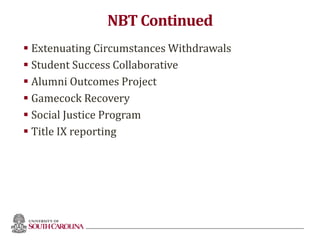
NBT Continued
 Extenuating Circumstances Withdrawals
 Student Success Collaborative
 Alumni Outcomes Project
 Gamecock Recovery
 Social Justice Program
 Title IX reporting
NBT Continued
 Update: Succession Planning
 Dean of Students search
 AVP for Student Life search
 DSA/AS Climate Survey
 Statues and monuments
 Abatements, discounts, and non-resident students
Facilities
 Outdoor Recreational fields
 Greek Village garage
 Greek Village II
 South Campus Village
 Coliseum Conversion
 Campus Visitors Center
NBT Continued
 New leadership: department heads
 New graduate assistants
 New employees
 3% reallocation for excellence
 Student affairs investment in growth
NBT Continued
 Future fundraising: programmatic needs
 Abatements and non-resident student
 Cocky statue installation
 Optimal Learning Environment (OLE); social media;
duty to care
Trend Summary
Student Affairs Professionals Engage in:
 constituent/cultural management
 contingency management (threats and opportunities)
 compliance management
 critics management
 community management
 constraint and accountability management
 commitment and pride management
Thank you for all you do to make
Carolina a better place to be!
Shout - outs
As Professional Educators
Let’s all:
 Inspire our students to engage in high impact
educational activities in the classroom and
beyond the classroom.
 Help our students manage their self-destructive
behaviors (both in and beyond the classroom)
and assume a shared responsibility for others.
 Create high expectations for our students and
hold them accountable.
80
As Professional Educators
 Thrilled to have attracted individuals of your
caliber, with your dedication, and your
commitment to “care”!
 Your role is one of “the most significant” in the
educational lives of our students.
 You have selected a great university…and
remember…
81
….a great
University has
selected you.
Thank you for
becoming a
Carolinian!
82
127
 The most important people on the campus…
…without students there would be no need for the institution
 Not cold enrollment statistics…
…but flesh and blood human beings with feelings and emotions like
our own.
 Not people to be tolerated so we can do our thing…
…they are our thing.
 Not dependent on us…
…rather, we are dependent on them.
 Not an interruption of our work…
…but the purpose of it. We are not doing them a favor by serving them.
They are doing us a favor by giving us the opportunity to do so.
- Noel-Levitz. “Enrollment Strategies That Work in Attracting and Retaining Students”
Students are…
References
Annsberry, Clare. “Older and Wiser.” Wall Street Journal Millennium Edition.
1 Jan 2000.
Astin, A. (1993). Assessment for excellence: The philosophy and practice of
assessment and evaluation in higher education. Phoenix, AZ: Oryx Press.
Aurelius, Marcus. “Everything we hear is an opinion, not a fact. Everything we see
is a perspective, not the truth.” Cartoon. fb/the idealist: Web.
Ellis, Keith. “Generation Z.” Division of Student Affairs and Academic Support
Division Meeting, University of South Carolina. January 27, 2017.
Garland, Peter H. Serving More than Students: A Critical Need for College Student
Personnel Services. ASHE-ERIC Higher Education Report No. 7. Washington,
D.C.: Association for the Study of Higher Education, 1985.
85

September 2017 Division Meeting

  • 1.
    Dennis Pruitt Vice Presidentfor Student Affairs Division Meeting September 1, 2017
  • 2.
    Dr. Dennis A.Pruitt, Sr. Vice President for Student Affairs, Vice Provost and Dean of Students 110 Osborne Building Columbia, SC 29208 Office: 803-777-4172 Fax: 803-777-9354 Email: dpruitt@mailbox.sc.edu 2
  • 3.
  • 4.
  • 5.
    What is Wisdom? Wisdom: Is not simple accumulation of knowledge  Is not paralyzed by ambiguity, but in fact embraces uncertainty  Is expert knowledge about life in general and good judgment in the face of complex, uncertain circumstance  You know it when you see it 5 - Ansberry (2000)
  • 6.
    wisdom [wiz-duh m]: theability to view more things with a “blank slate.” 6
  • 7.
    wisdom: can also bethe ability to see things “from the perspective of others” 7
  • 8.
  • 9.
    A little aboutStudent Affairs, a little about our students, a little about our worries and wonders. 9
  • 10.
    Anyone can doStudent Affairs, right? 10
  • 11.
    Historical Role ofStudent Affairs What happened to the Good Ole Days of In Loco Parentis? 11
  • 12.
    Historical Role ofStudent Affairs  Disciplinarian  Custodian  Educator  Integrator  Combined: contingency (threats and opportunities) manager 12 - Garland (1985)
  • 13.
    New Mission –To provide meaningful services, experiences and support that empower students to achieve success at Carolina and beyond. New Vision – An optimum learning environment that inspires students and university community members to reach their full potential. 13 Current Goals (under revision):  Manage the comprehensive and collaborative efforts of the university to meet student enrollment goals, and provide essential programs and services to recruit and enroll new freshmen and transfer students and facilitate their successful transition to the university.  Improve student progress and persistence to degree completion by increasing student engagement in campus life and by providing and supporting essential programs, services, and educational activities that lead to student success and satisfaction.  Collaborate with campus and external constituents to provide essential programs and services that advance learning, at the university and in the higher education community.  Provide essential programs and services that shape responsible citizens and develop future leaders, in collaboration with university, community and external partners.
  • 14.
  • 15.
    Student Affairs isa Profession  Theories  Statement of Ethics  Professional Preparation Programs  Journals, Books, Monographs, Research Studies  Listservs, social media, websites  Professional Associations  Standards of Good Practice  Certification Programs  CAS Standards for Professional Practice  Foundations  Has many associated professional organizations  Practicum and internship  Graduate assistantships/apprentice programs 15
  • 16.
    Student Affairs FunctionalAreas  Academic Advising  Academic Support Services  Admissions  Adult Student Services  Alumni Relations  Athletics  Campus Ombudsperson  Campus Recreation  Career Services  Community Service Programs  Commuter Student Services  Counseling  Disabled Student Services  Development/Fundraising  Emergency Management  Enrollment Management  Family Services  Financial Aid  Greek Life  International Student Services  Law Enforcement and Safety  LGBT Program  Minority Student Affairs  Multicultural Student Affairs  Orientation  Parent Programs  Registrar  Residential Life/Housing  Retention & Assessment  Sexual Assault Services  Specific Facilities Management  Strategic Planning & Innovation  Student Activities  Student Conduct  Student Government  Student Health Services  Student Legal Services  Student Life  Student Media  Student Success Programs  Student Union  Testing Services  Visitors Center/Tours 16
  • 17.
     Student Affairs& Academic Support  Stay-Informed: DSA/AS weekly staff newsletter  UofSC Student Calendar  UofSC Weekly Student Email  National Resource Center for the First Year Experience and Students in Transition (NRC 17 Resources
  • 18.
     USC Organizational& Professional Development courses  DSA/SA Professional Development opportunities  Emerging Leaders Program (ELP)  Pipeline for Academy Leaders (PAL) 18 Professional Development Resources
  • 19.
    Our Students A peepat our students and their student experiences. 19
  • 20.
    Flagship Institution -USC Columbia Comprehensive Campuses USC Aiken USC Beaufort USC Upstate Palmetto College USC Lancaster USC Salkehatchie USC Sumter USC Union School of Medicine Columbia Greenville System Overview 20
  • 21.
  • 22.
  • 23.
    3690 3826 3881 4423 4569 4580 5002 4975 5190 5104 1183 11911192 1185 1199 1199 1208 1210 1210 1216 1100 1120 1140 1160 1180 1200 1220 1240 1500 2000 2500 3000 3500 4000 4500 5000 5500 Fall 2007 Fall 2008 Fall 2009 Fall 2010 Fall 2011 Fall 2012 Fall 2013 Fall 2014 Fall 2015* Fall 2016~ AverageSAT Enrollment Enrollment SAT Avg. *Undergraduate Admissions, 2016 Annual Statistical Report ~Cube Data-Estimated as of Dec 2016. Ten Year Trend SAT Averageand FreshmanClass Size
  • 24.
    2016 Freshman Profile (Summer/Fall) AllFreshmen Capstone Scholars Honors College Gamecock Gateway Number 5,104 962 500 420 Avg. SAT 1215 1315 1442 1007 Avg. ACT 27.3 29.5 32.4 21.3 GPA 3.99 4.40 4.65 3.26 - Undergraduate Admissions, 2016 Annual Statistical Report
  • 25.
    2017 Projected FreshmanProfile All Freshmen Capstone Scholars Honors College Gamecock Gateway Number 5,900 1,180 580 450 THE TRIFECTA ACHIEVED
  • 26.
    2017 Projected FreshmanQuality Number SAT ACT WCGPA Freshmen 5,881 1,254 27.3 4.04 Honors 580 1,478 32.5 4.68 Capstone 1,112 1,357 29.7 4.36 Gateway 443 1,075 21.4 3.14
  • 27.
     17% freshmenare 1st generation  South Carolina residents – up 20% (+478)  Non-residents – up 12% (+317)  African Americans – up 25% (+60)  Hispanics – up 37% (+85)  22% are Pell Grant recipients  45/46 SC counties are represented 27 2017 Projected Demographics
  • 28.
    USC Columbia FreshmanStudent Admissions Summer/Fall 21,311 23,429 23,035 23,341 25,736 25,441 13,451 14,199 14,844 15,219 16,618 17,302 4,636 4,625 5,046 4,980 5,190 5,104 63.1% 60.6% 64.4% 65.2% 64.6% 68.0% 34.5% 32.6% 34.0% 32.7% 31.2% 29.5% 0.0% 10.0% 20.0% 30.0% 40.0% 50.0% 60.0% 70.0% 80.0% - 5,000 10,000 15,000 20,000 25,000 30,000 2011 2012 2013 2014 2015 2016 Applied Accepted Enrolled Accept Rate Yield Rate Score Averages 2011 2012 2013 2014 2015 2016 SAT 1198 1201 1206 1210 1210 1215 ACT 26.4 26.4 26.9 27.1 27.3 27.3 28
  • 29.
  • 30.
    Program Graduation Rate 65% Gamecock Guarantee SelectionProcedures 1. SC Resident 2. Regular USC acceptance 3. Parents not 4-yr degree holders 4. Eligible for federal Pell Grant Program Benefits 1. Minimum $4,500 award 2. Support of a learning community 3. Guarantee of full grant support for tuition & technology fee Profile of 2015 Recipients 1. Average family income -- $17,600 2. Gender – 58% Female 3. Race • White (47%) • Black (36%) • Other (17%) 2015 Gamecock Guarantee Freshmen Average FAAward • $21,356 Gift Aid as a Percent of Total Award • 96% Gamecock Guarantee • 49% Overall Freshmen Loans as a Percent of Total Award • .4% Gamecock Guarantee • 51% Overall Freshmen Average Freshman to Sophomore Retention, 2008 to 2015 • 90% 993 Students Served 2008-2015 30
  • 31.
    Top 10 StatesFall 2016
  • 32.
    College of Artsand Sciences 31% Darla Moore School of Business 26% College of Engineering and Computing 13% College of Hospitality, Retail, Sport Management 7% College of Nursing 6% College of Information and Communications 5% Arnold School of Public Health 5% College of Education 3% Pharmacy 3% School of Music 1% College of Social Work <1% Freshman Class Percentage by College/School Summer/Fall2016
  • 33.
    Freshman Class TopMajors in First Year Biological Sciences Public Relations Exercise Science Criminology/Criminal Justice Experimental Psychology Hospitality Management Nursing Retailing Finance Marketing Management Political Science
  • 34.
    Adjusted Gross FamilyIncome Fall 2015 All Students Adjusted Gross Family Income All Students SC Resident Out-of-State $0-49,999 19.8% 27.6% 7.3% $50,000-99,999 16.9% 21.5% 9.6% $100,000-249,999 26.1% 23.8% 29.9% $250,000-499,999 4.1% 1.9% 7.6% $500,000-749,999 0.5% 0.2% 0.9% $750,000-999,999 0.1% 0.1% 0.2% $1,000,000+ 0.1% 0.1% 0.3% Not Reported 32.3% 24.9% 44.2% TOTAL 24,862 15,292 9,570 34
  • 35.
    Fall 2015 IncomingFreshman Aid by Source and Type Federal $27,234,668 State $14,298,495 Institutional $8,952,156 External (Private Loans) $6,552,701 Aid by Source Grants $5,859,765 Loans $28,911,399 Scholarships $22,038,696 Federal Work- Study $228,160 Aid by Type 35
  • 36.
    Cohort return ratefor the following fall. 83.10% 85.80% 86.90% 87.20% 86.70% 85.90% 86.80% 87.20% 88.10% 87.90% 88.10% 76.0% 78.0% 80.0% 82.0% 84.0% 86.0% 88.0% 90.0% 2004 2005 2006 2007 2008 2009 2010 2011 2012 2013 2014 First-time, Full-time Freshman Retention Rates
  • 37.
    First Year RetentionRates (2014 Cohort) SEC Schools First Year Retention Vanderbilt University 97% University of Florida 96% University of Georgia 94% Clemson University 92% Auburn University 91% University of South Carolina 88% The University of Alabama 87% The University of Tennessee 87% Louisiana State University 85% University of Mississippi 85% University of Arkansas 83% University of Kentucky 82% Mississippi State University 80% 37
  • 38.
    First-time, Full-time Freshman GraduationRates 44.9% 45.8% 45.7% 51.2% 53.0% 53.9% 55.7% 54.7% 54.4% 58.0%63.6% 66.1% 64.3% 67.2% 69.6% 69.7% 71.3% 69.7% 69.9% 66.8% 69.0% 67.5% 70.3% 72.3% 72.8% 72.9% 72.3% 30.0% 35.0% 40.0% 45.0% 50.0% 55.0% 60.0% 65.0% 70.0% 75.0% 80.0% 2002 2003 2004 2005 2006 2007 2008 2009 2010 2011 4 Year 5 Year 6 Year 38
  • 39.
    Six Year GraduationRates (2008 Cohort) SEC Schools Six Year Graduation Rate Vanderbilt University 93% University of Florida 88% University of Georgia 85% Clemson University 82% University of South Carolina 73% Auburn University 71% University of Tennessee 69% University of Alabama 67% Louisiana State University 67% University of Arkansas 62% University of Kentucky 61% University of Mississippi 61% Mississippi State 60% - IPEDS Data Center 39
  • 40.
    2006 2016 Change FreshmanApplications 13,946 25,444 +11,498 Freshman Class 3,697 5,107 +1,410 Freshman Class Yield 42.1% 29.5% -12.6% Average SAT 1171 1215 +44 Freshman Honors Enrollment 312 500 +188 Capstone Scholars Enrollment 550 962 +412 First to Second Year Retention 86.9% 87.9% +1.0% 4-Year Graduation Rate 53.0% 54.7%* +1.7% 6-Year Graduation Rate 72.3% 72.3%* nc - OIRA Factbook and Office of Undergraduate Admissions Annual Report USC Columbia Enrollment Summary 2006-2016 Summer/FallFreshmen
  • 41.
    Freshman and Undergraduate Totals1985 to 2015 1985 2000 2015* Growth Since 1985 Freshmen 2,825 2,542 5,190 84% SAT 951 1116 1210 +259 points Total UG Enrollment 15,098 15,266 25,237 67% 41
  • 42.
  • 43.
     Women willcontinue to outpace men in enrollment, numbers, and persistence  Women are making gains in educational aspirations  More women are pursuing traditionally “male” fields - CIRP data 2014 National Demographics 43
  • 44.
    Projected Change inUS Public High School Graduates By Race 2015 - 2024 Academic Year Native American Asian Black Hispanic White 2015-2016 31,684 186,448 414,653 602,242 1,699,256 2024-2025 38,152 261,979 443,882 807,087 1,639,604 Change +6,468 +75,531 +29,229 +204,845 -59,652 -WICHE
  • 45.
    45 Non-White FT Enrollment atSouth Carolina Institutions 8823 9430 9643 10038 4748 5120 5248 5438 0 2000 4000 6000 8000 10000 12000 Fall 2012 Fall 2013 Fall 2014 Fall 2015 USC System USC Columbia Clemson University Coastal Carolina University Francis Marion University Winthrop University College of Charleston - Integrated Postsecondary Education Data System
  • 46.
    African-American FT Enrollment atSouth Carolina Institutions - Integrated Postsecondary Education Data System 5049 4944 4957 4924 2197 2162 2168 2105 0 1000 2000 3000 4000 5000 6000 Fall 2012 Fall 2013 Fall 2014 Fall 2015 USC System USC Columbia Clemson University Coastal Carolina University Francis Marion University Winthrop University College of Charleston
  • 47.
     5900 freshmen 1500 transfers  350 USC system change of campus  440 Gamecock Gateway  410 other new undergraduates 47 But – We Really Have 8,600 New Undergraduates
  • 48.
  • 49.
    Characteristics of thisGeneration of College Going Students 49
  • 50.
    Meet Generation Z -Ellis (2017)
  • 51.
    Disclaimer Generational research isoften first developed by MARKETERS as a way to understand how best to reach a population and is often presented in broad sweeping GENERALITIES. It is important to know that students will exist along a SPECTRUM of experiences within these characteristics. The term “in general” is omitted but implied with this disclaimer in mind. 51 - Ellis (2017)
  • 52.
    Characteristics  1996 –2011  60 million strong  Digital Natives  Small Windows of Interest (8 second)  Aware of their Social Media Presence  Pragmatic  Accepting of Identity  Most Diverse  Debt Averse  Want to Make an Impact  Ambitious/Career Focus  Wary of “Establishment”  Expect Authority Figures to be Coaches and Collaborators  Value Applied Education 52 - Ellis (2017)
  • 53.
    Additional Characteristics  1in 10 incoming freshmen plan to participate in student protest (HERI)  15%+ of minority students report feeling “unsafe” on campuses (NSSE)  Increased usage of Counseling and Psychology  Increased reporting of suicidal ideation  Increased reports of disruptive behavior in the classroom 53 - Ellis (2017)
  • 54.
    Additional Characteristics  Increasedexposure to medication (both prescribed and illicit)  Increased abuse of alcohol  Increased use of marijuana as drug of choice  Increased number of Title IX related claims  Parents continue to play a big role in students’ lives beyond high school 54 - Ellis (2017)
  • 55.
  • 56.
  • 57.
    New Performance Criteria Freshman to sophomore retention rates  Sophomore to senior persistence rates  Graduation rates  Length of time to degree  Placement  Gainful employment  Manageable debt  Institutional default rates  Life-long learner  # of Pell Grant recipients graduated  Value added NEXT: Transferability 57
  • 58.
  • 59.
  • 60.
    - Randy Bass,2012 http://www.educause.edu/ero/article/disrupting-ourselves-problem-learning-higher-education 60
  • 61.
    Astin’sInput - Environment-OutcomesModel INPUT ENVIRONMENT OUTCOMES • 6 year graduation rate • Students’ learning achievements • College completion • College completion - value added • Graduates’ employment status • Employability • Life long learner • Competency and proficiency in chosen field • Admission to professional /graduate school WTC – Degree Programs, Courses BTC Matters - Involvement • Student Affairs & Academic Support • Undergraduate Research • International Programs • Internships • Service • Leadership Services • Total undergraduate enrollment • Quality advising • Technology resources • Average freshman SAT scores • Motivation to attend and graduate • Scholarship skills / habits • Financial status • Life goals • Class Rank • High school service, leadership - Astin (1993)
  • 63.
    Creatingan OLE: IntegratedLearninginthe Classroom(ITC) and Beyond the Classroom(BTC)  Personalized Learning Systems  Integrated ITC with BTC  Manage Self-Destructive Behaviors  Comply with State and Federal Laws  Utilize Best Business and Educational Practices 63
  • 64.
    2017-2018 Topics ofInterest  Tattoos and Drones  On Your Time (OYT)  USC Connect / GWLD  Beyond the Classroom Matters (BTCM)  Student Success Collaborative  First Year Advising  Diversity and Inclusion 64
  • 65.
    2017-2018 Topics ofInterest  Recruitment and Retention  Campus Sexual Assault  Harassment and Discrimination  Hazing  Alcohol and Drug Abuse  Cost of Student (mis) Behavior  Collegiate Recovery Program 65
  • 66.
    2017-2018 Topics ofInterest  Academic Integrity  Digital Identity/ Privacy  Suicides  Free Speech (political correctness; empathetic correctness; trigger warnings)  Diversity, Inclusion, & Social Justice  Next Generation Transcripts  Mental Health  Eating Disorders 66
  • 67.
    2017-2018 Topics ofInterest  Campus safety  Crisis/emergency/disaster management  Career Services: employability and internships  Social media  Gallup Work and Life Well-Being  Elections  Protest and Demonstrations  Viewpoint Diversity  Academic Freedom 67
  • 68.
    How do weKeep our Customers (oops!) Students from Failing? How to Prevent Your Customers from Failing Stephen S. Tax, Mark Colgate and David E. Bowen Spring 2006
  • 69.
    How do weKeep our Customers (oops!) Students from Failing?  How do we create high expectations that our students will move from surviving to thriving?  How do we get students to assume ownership for their learning, both in the classroom (ITC) and beyond the classroom (BTC)?
  • 70.
    Campus Cultures =Optimum Learning Environment Safe Non-discriminatory Civil 74
  • 71.
  • 72.
    Next Big Thing(NBT)  Viewpoint diversity (Heterodox Academy)  BTCM and next generation transcripts  OYT (On Your Time)  Student Enrollment Services Center  Center for Health and Well-being  Diversity and Inclusion = Belonging
  • 73.
    NBT Continued  ExtenuatingCircumstances Withdrawals  Student Success Collaborative  Alumni Outcomes Project  Gamecock Recovery  Social Justice Program  Title IX reporting
  • 74.
    NBT Continued  Update:Succession Planning  Dean of Students search  AVP for Student Life search  DSA/AS Climate Survey  Statues and monuments  Abatements, discounts, and non-resident students
  • 75.
    Facilities  Outdoor Recreationalfields  Greek Village garage  Greek Village II  South Campus Village  Coliseum Conversion  Campus Visitors Center
  • 76.
    NBT Continued  Newleadership: department heads  New graduate assistants  New employees  3% reallocation for excellence  Student affairs investment in growth
  • 77.
    NBT Continued  Futurefundraising: programmatic needs  Abatements and non-resident student  Cocky statue installation  Optimal Learning Environment (OLE); social media; duty to care
  • 78.
    Trend Summary Student AffairsProfessionals Engage in:  constituent/cultural management  contingency management (threats and opportunities)  compliance management  critics management  community management  constraint and accountability management  commitment and pride management
  • 79.
    Thank you forall you do to make Carolina a better place to be! Shout - outs
  • 80.
    As Professional Educators Let’sall:  Inspire our students to engage in high impact educational activities in the classroom and beyond the classroom.  Help our students manage their self-destructive behaviors (both in and beyond the classroom) and assume a shared responsibility for others.  Create high expectations for our students and hold them accountable. 80
  • 81.
    As Professional Educators Thrilled to have attracted individuals of your caliber, with your dedication, and your commitment to “care”!  Your role is one of “the most significant” in the educational lives of our students.  You have selected a great university…and remember… 81
  • 82.
    ….a great University has selectedyou. Thank you for becoming a Carolinian! 82
  • 83.
  • 84.
     The mostimportant people on the campus… …without students there would be no need for the institution  Not cold enrollment statistics… …but flesh and blood human beings with feelings and emotions like our own.  Not people to be tolerated so we can do our thing… …they are our thing.  Not dependent on us… …rather, we are dependent on them.  Not an interruption of our work… …but the purpose of it. We are not doing them a favor by serving them. They are doing us a favor by giving us the opportunity to do so. - Noel-Levitz. “Enrollment Strategies That Work in Attracting and Retaining Students” Students are…
  • 85.
    References Annsberry, Clare. “Olderand Wiser.” Wall Street Journal Millennium Edition. 1 Jan 2000. Astin, A. (1993). Assessment for excellence: The philosophy and practice of assessment and evaluation in higher education. Phoenix, AZ: Oryx Press. Aurelius, Marcus. “Everything we hear is an opinion, not a fact. Everything we see is a perspective, not the truth.” Cartoon. fb/the idealist: Web. Ellis, Keith. “Generation Z.” Division of Student Affairs and Academic Support Division Meeting, University of South Carolina. January 27, 2017. Garland, Peter H. Serving More than Students: A Critical Need for College Student Personnel Services. ASHE-ERIC Higher Education Report No. 7. Washington, D.C.: Association for the Study of Higher Education, 1985. 85