Fairness, Transparency, and
Privacy in AI @ LinkedIn
Krishnaram Kenthapadi
AI @ LinkedIn
QConSF Talk, November 2018
InfoQ.com: News & Community Site
• Over 1,000,000 software developers, architects and CTOs read the site world-
wide every month
• 250,000 senior developers subscribe to our weekly newsletter
• Published in 4 languages (English, Chinese, Japanese and Brazilian
Portuguese)
• Post content from our QCon conferences
• 2 dedicated podcast channels: The InfoQ Podcast, with a focus on
Architecture and The Engineering Culture Podcast, with a focus on building
• 96 deep dives on innovative topics packed as downloadable emags and
minibooks
• Over 40 new content items per week
Watch the video with slide
synchronization on InfoQ.com!
https://www.infoq.com/presentations/
linkedin-privacy-ml
Purpose of QCon
- to empower software development by facilitating the spread of
knowledge and innovation
Strategy
- practitioner-driven conference designed for YOU: influencers of
change and innovation in your teams
- speakers and topics driving the evolution and innovation
- connecting and catalyzing the influencers and innovators
Highlights
- attended by more than 12,000 delegates since 2007
- held in 9 cities worldwide
Presented at QCon San Francisco
www.qconsf.com
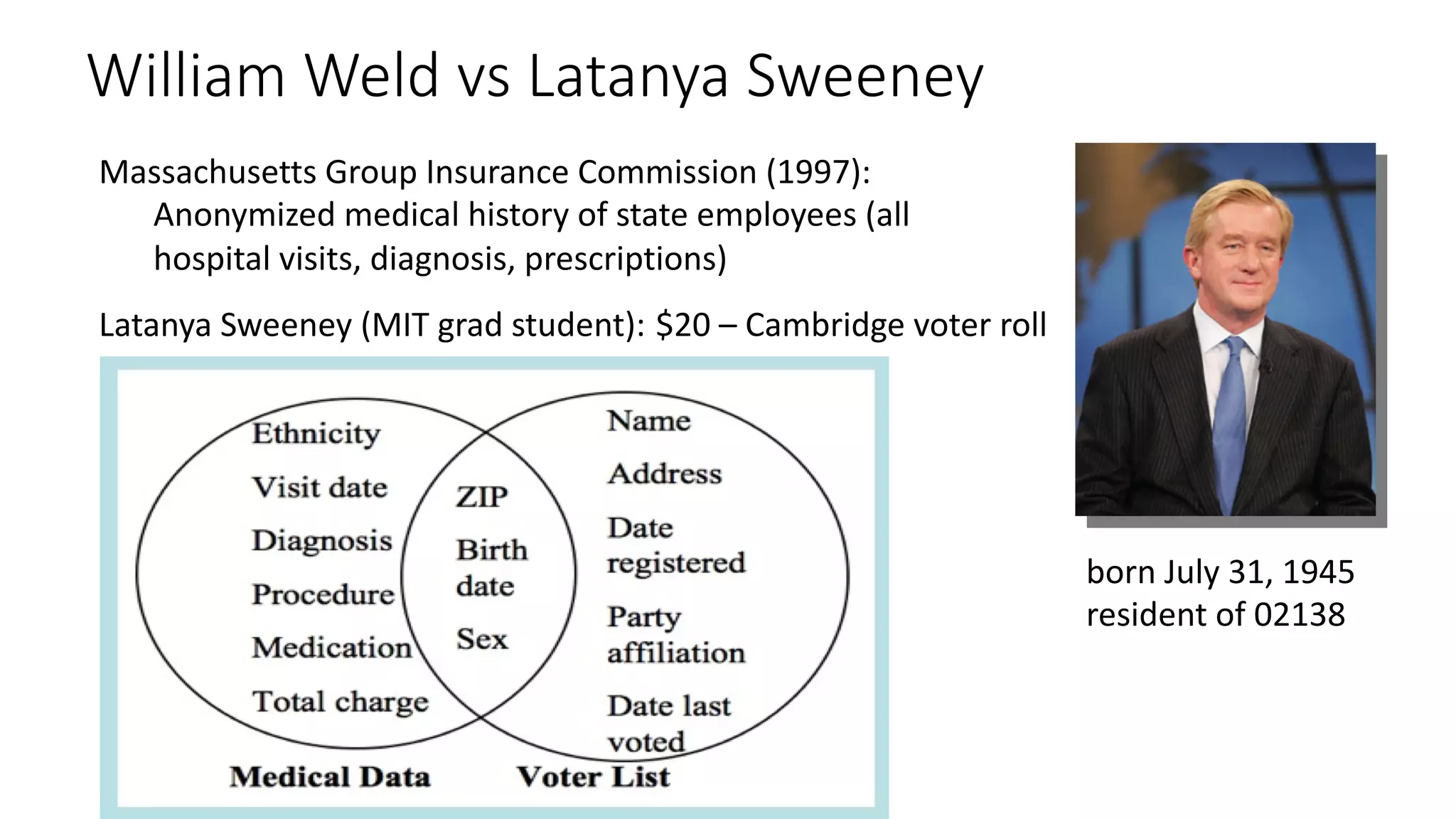
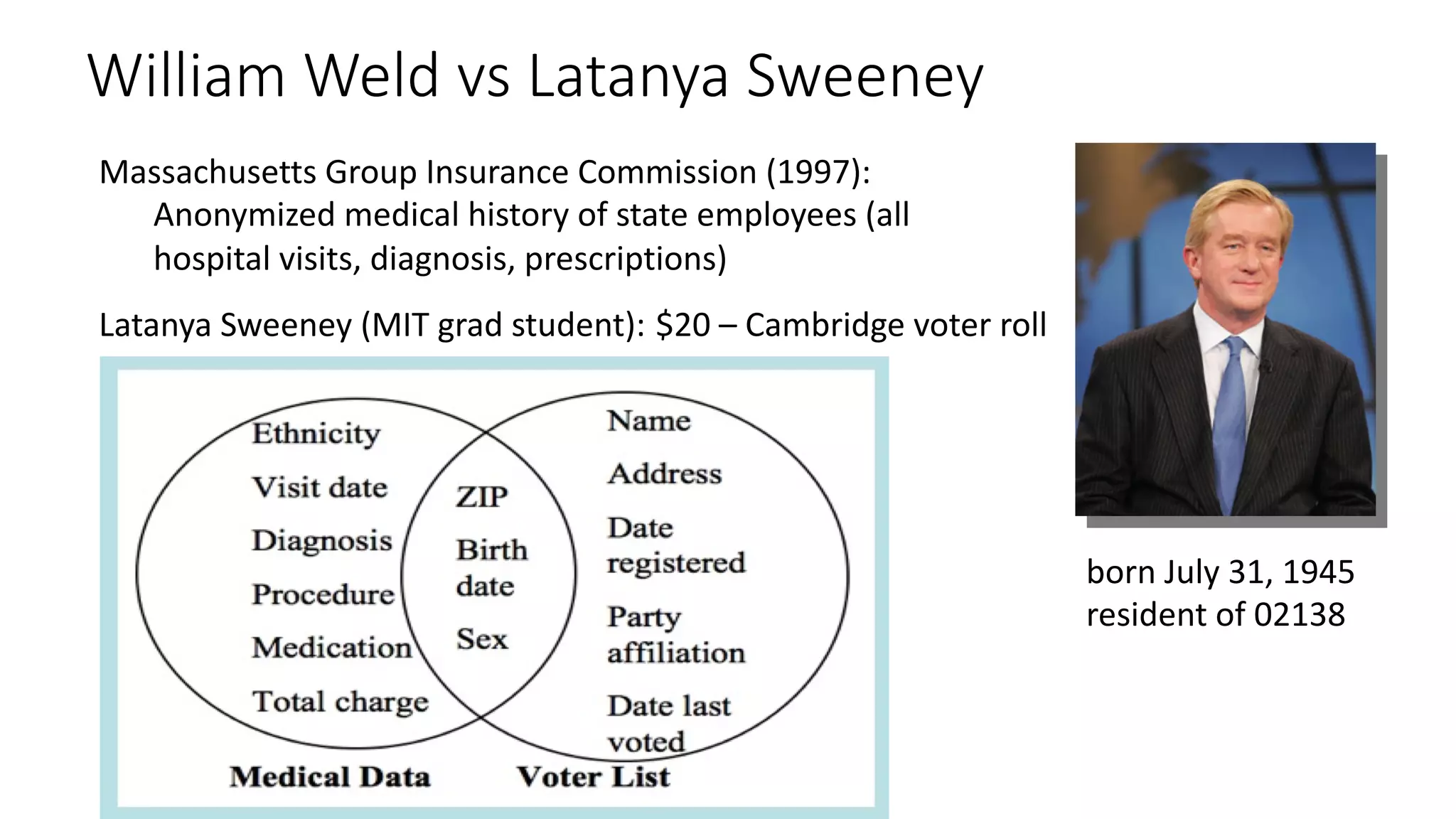
born July 31, 1945
resident of 02138
Massachusetts Group Insurance Commission (1997):
Anonymized medical history of state employees (all
hospital visits, diagnosis, prescriptions)
Latanya Sweeney (MIT grad student): $20 – Cambridge voter roll
William Weld vs Latanya Sweeney
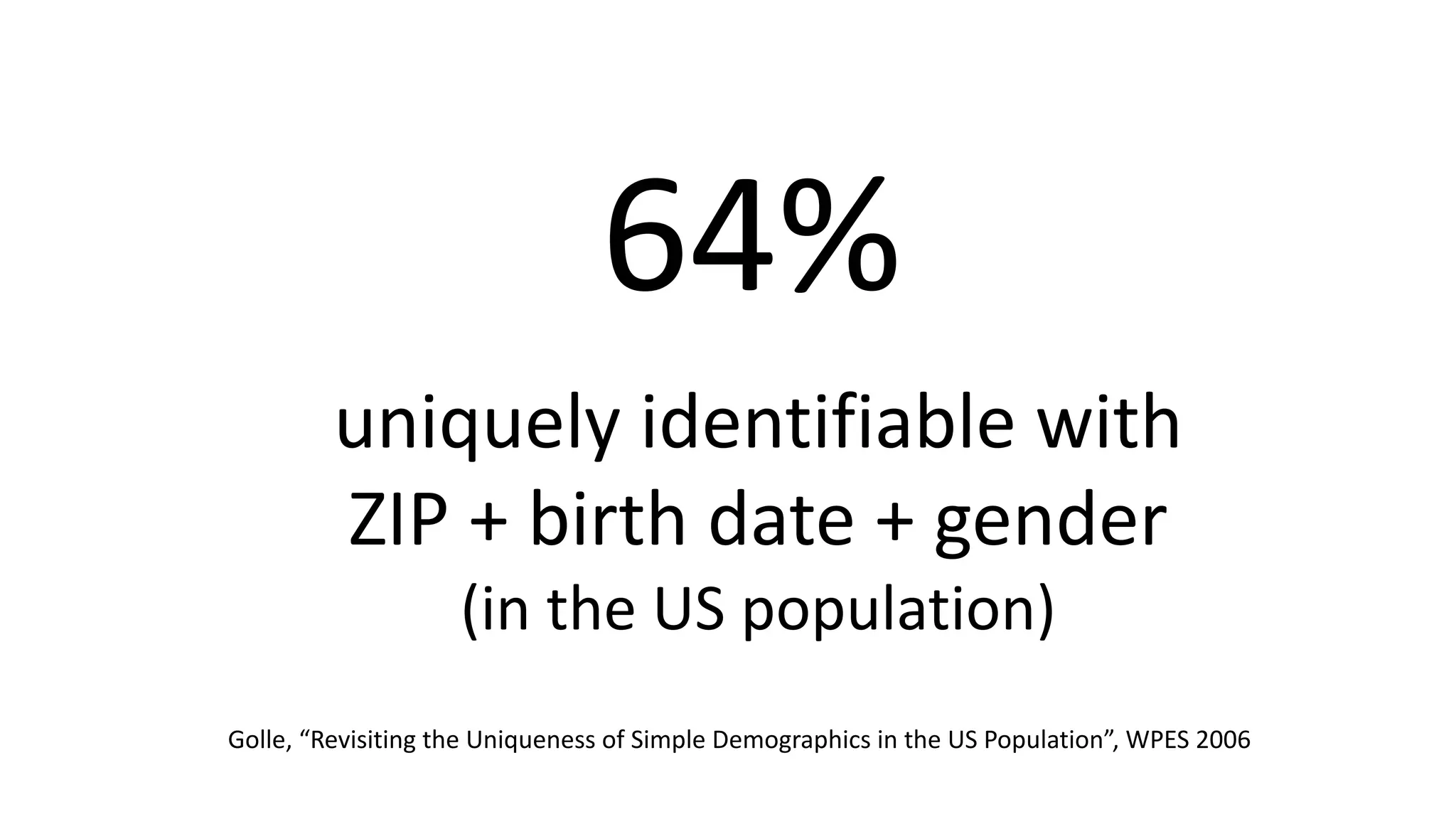
64%
uniquely identifiable with
ZIP + birth date + gender
(in the US population)
Golle, “Revisiting the Uniqueness of Simple Demographics in the US Population”, WPES 2006
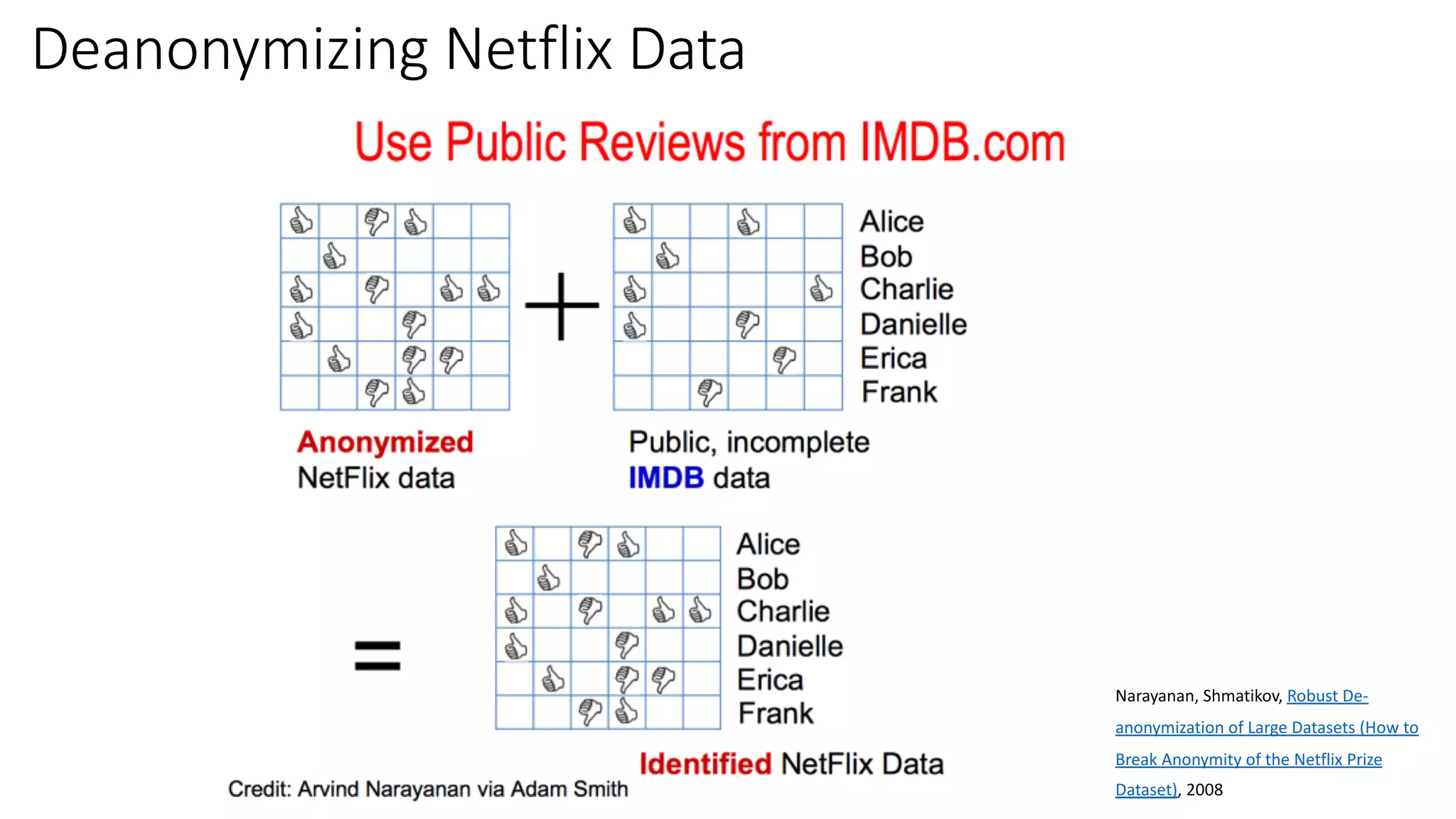
Netflix Prize
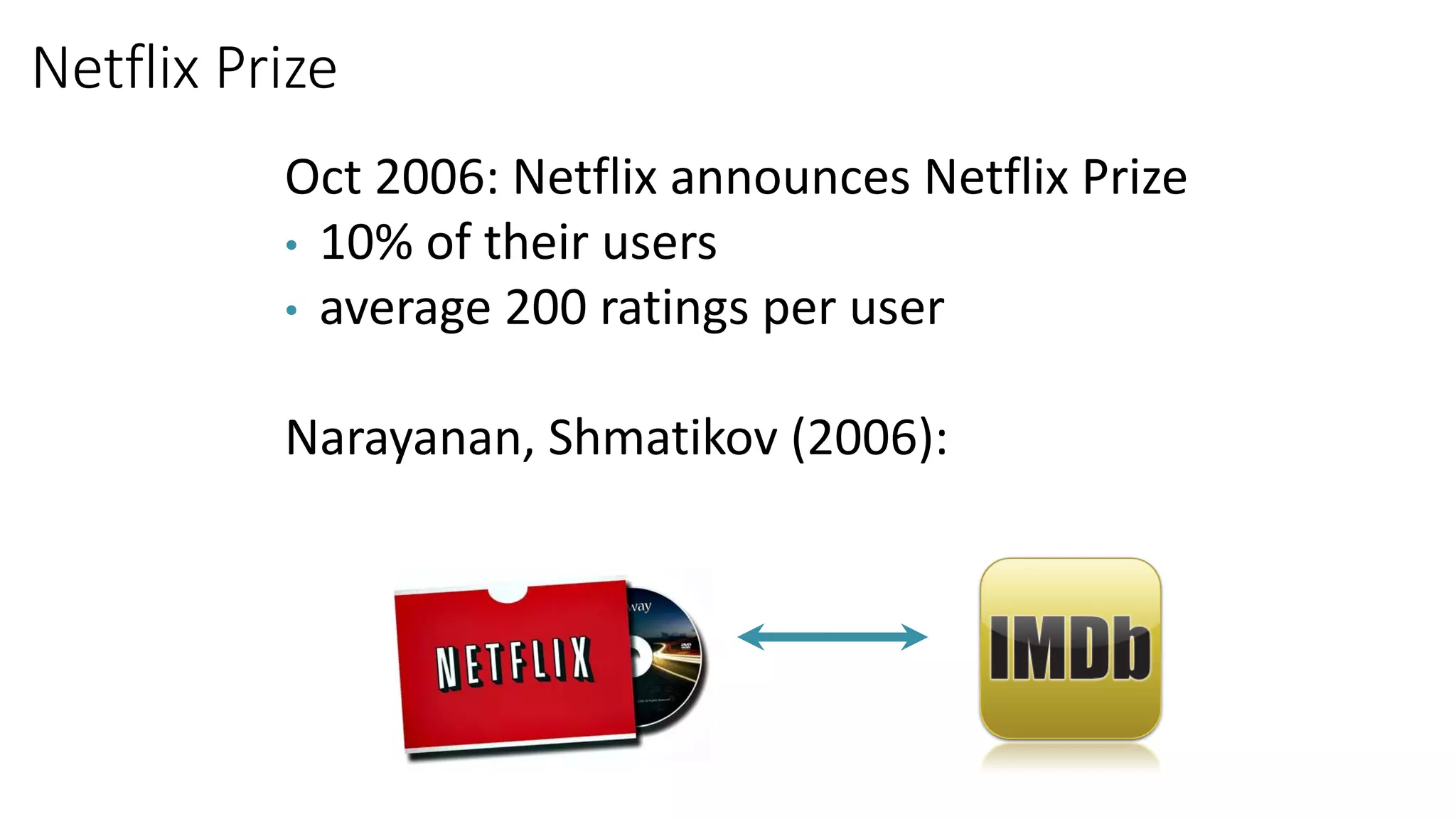
Oct 2006: Netflix announces Netflix Prize
• 10% of their users
• average 200 ratings per user
Narayanan, Shmatikov (2006):
Netflix Prize
Deanonymizing Netflix Data
Narayanan, Shmatikov, Robust De-
anonymization of Large Datasets (How to
Break Anonymity of the Netflix Prize
Dataset), 2008
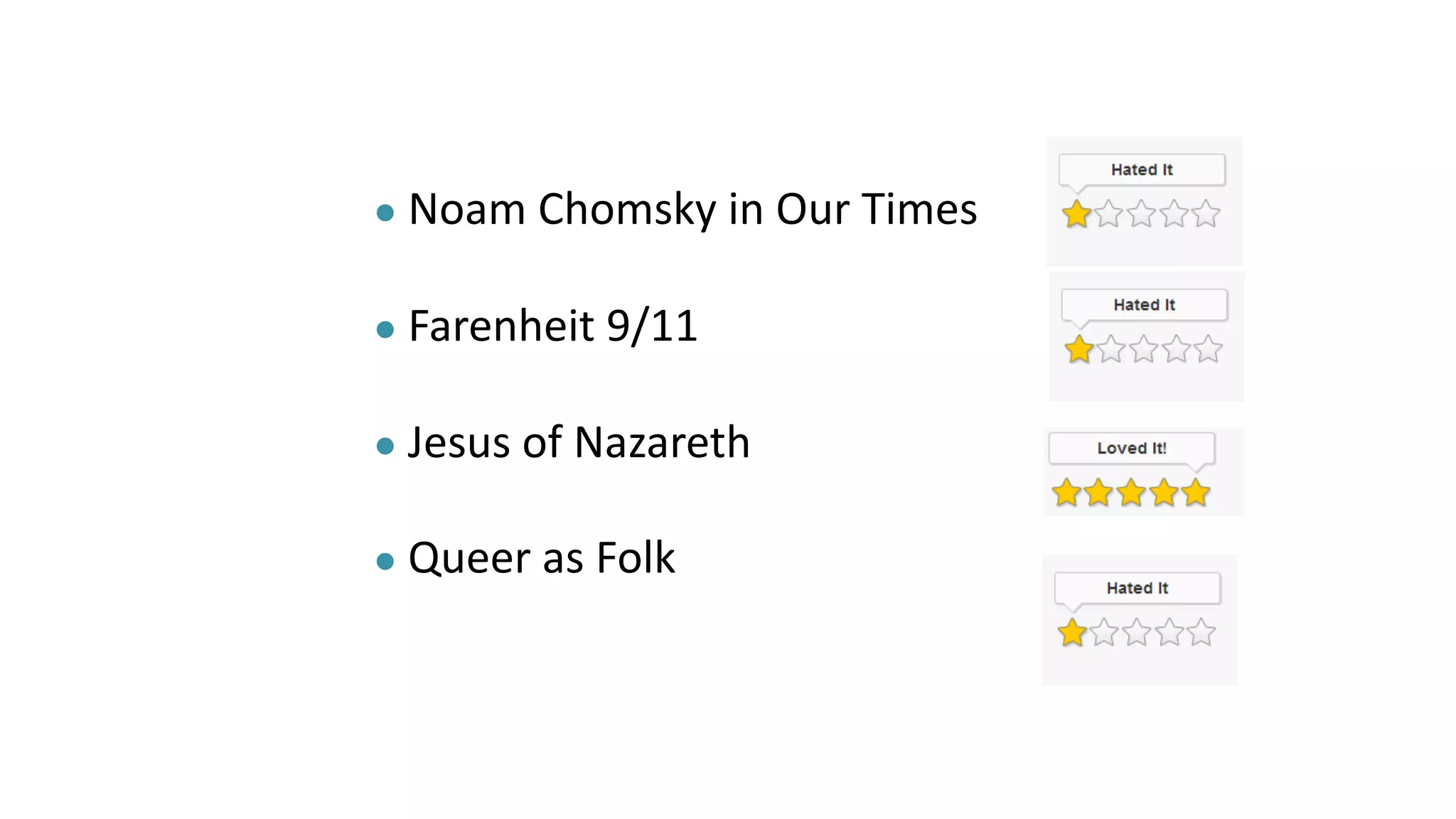
● Noam Chomsky in Our Times
● Farenheit 9/11
● Jesus of Nazareth
● Queer as Folk
Gender Shades [Joy Buolamwini & Timnit Gebru, 2018]
• Facial recognition
software:
Higher accuracy for
light skinned men
• Error rates for dark
skinned women:
20% - 34%
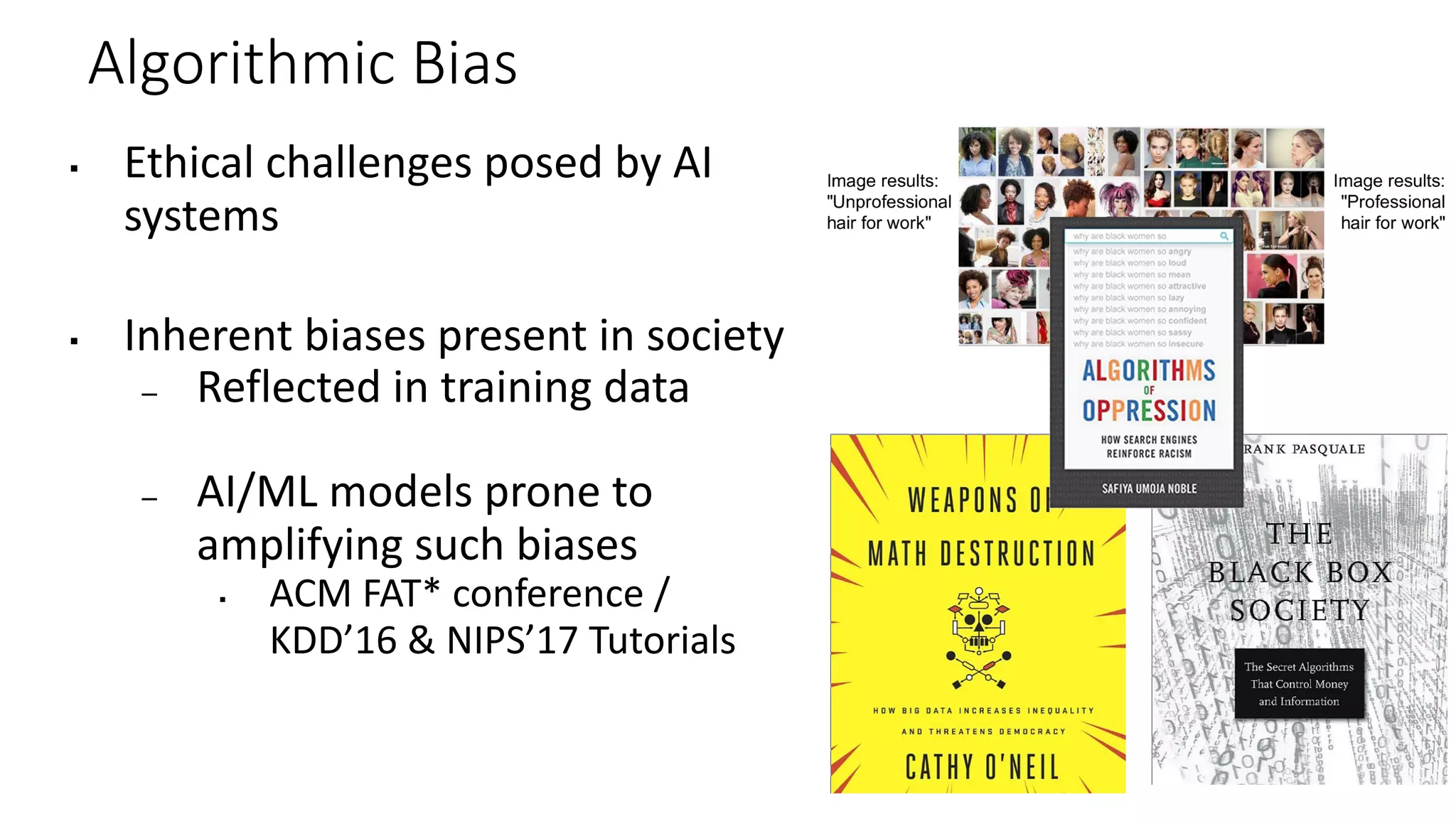
Algorithmic Bias
▪ Ethical challenges posed by AI
systems
▪ Inherent biases present in society
– Reflected in training data
– AI/ML models prone to
amplifying such biases
▪ ACM FAT* conference /
KDD’16 & NIPS’17 Tutorials
“Privacy and Fairness by Design”
for AI products
AI @ LinkedIn
Case Studies @ LinkedIn
Privacy
Fairness
Create economic opportunity for every
member of the global workforce
LinkedIn’s Vision
Connect the world's professionals to make
them more productive and successful
LinkedIn’s Mission
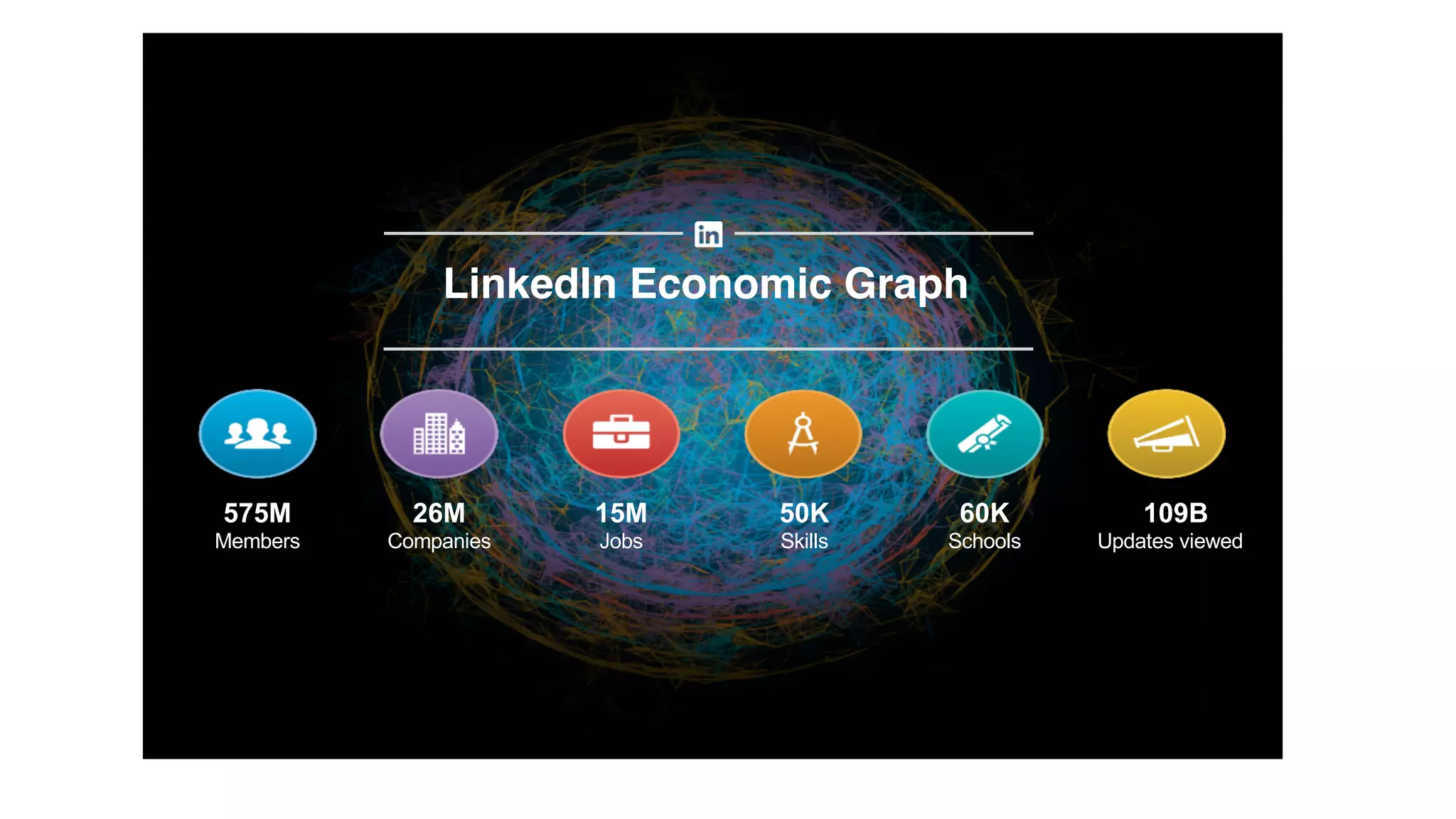
575M
Members
26M
Companies
15M
Jobs
50K
Skills
60K
Schools
109B
Updates viewed
LinkedIn Economic Graph
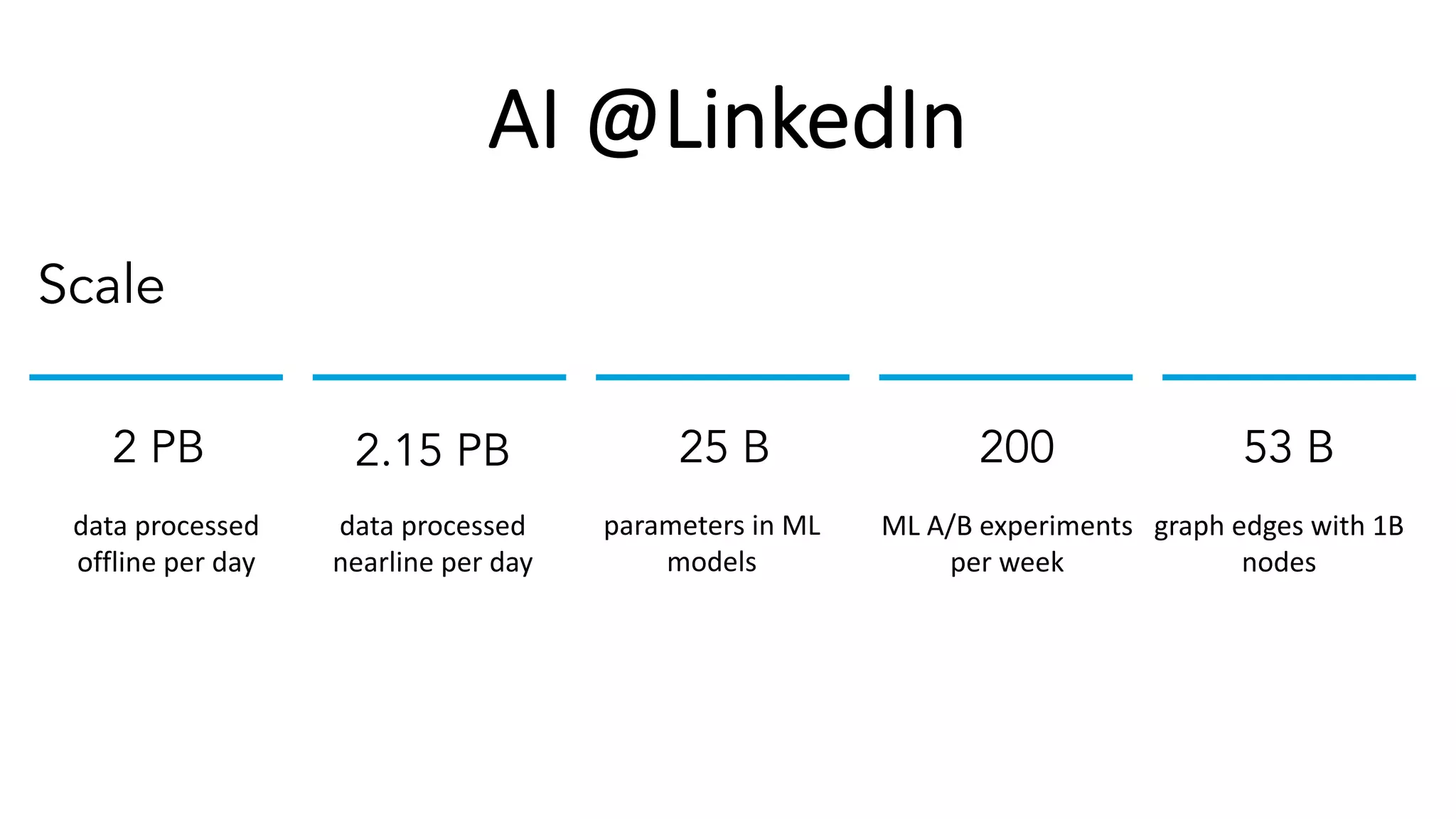
AI @LinkedIn
25 B
ML A/B experiments
per week
data processed
offline per day
2002.15 PB
data processed
nearline per day
2 PB
Scale
graph edges with 1B
nodes
53 B
parameters in ML
models
Privacy in AI @ LinkedIn
• Framework to compute robust, privacy-preserving analytics
• Privacy challenges/design for a large crowdsourced system (LinkedIn Salary)
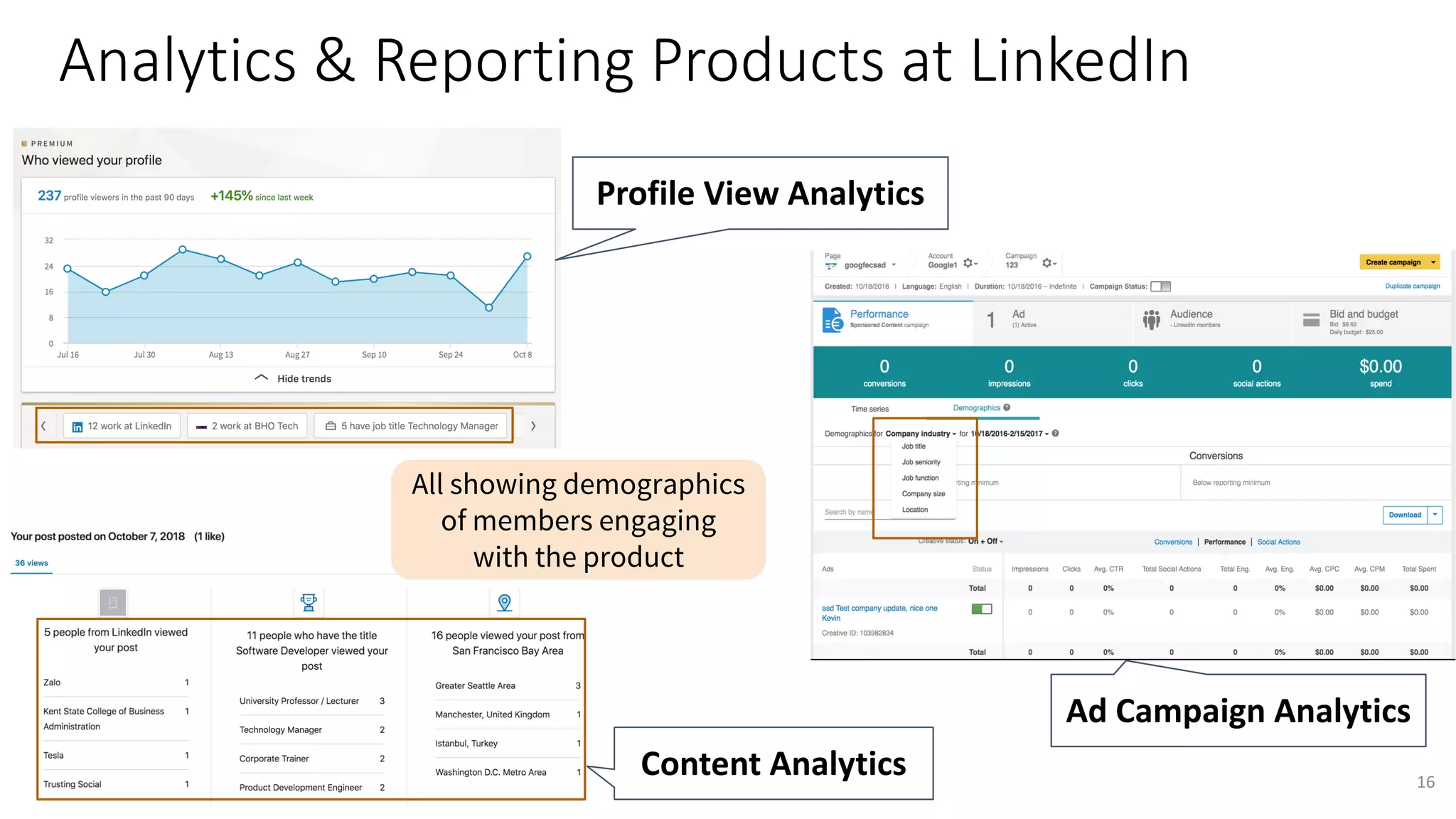
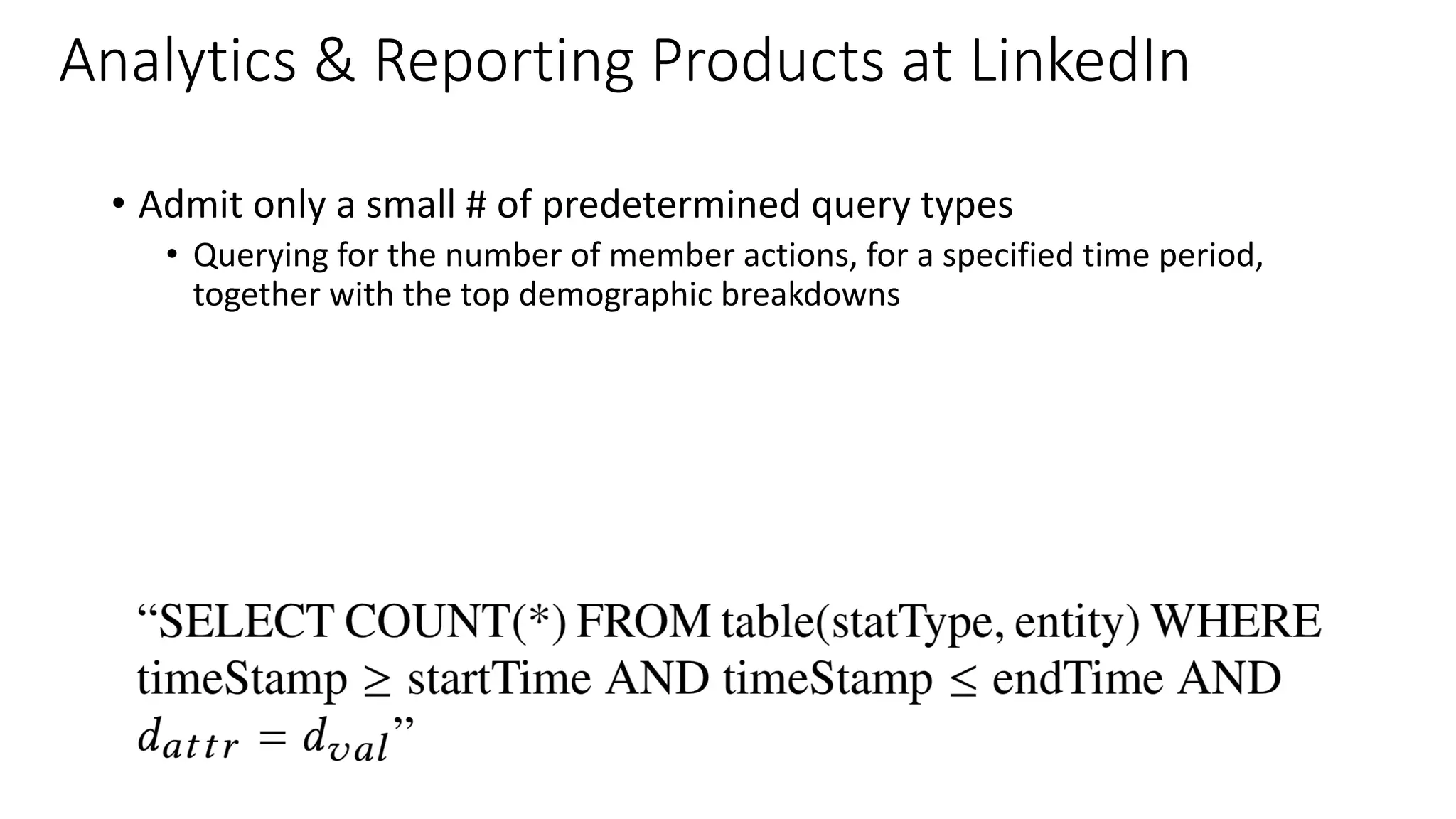
Analytics & Reporting Products at LinkedIn
Profile View Analytics
16
Content Analytics
Ad Campaign Analytics
All showing demographics
of members engaging
with the product
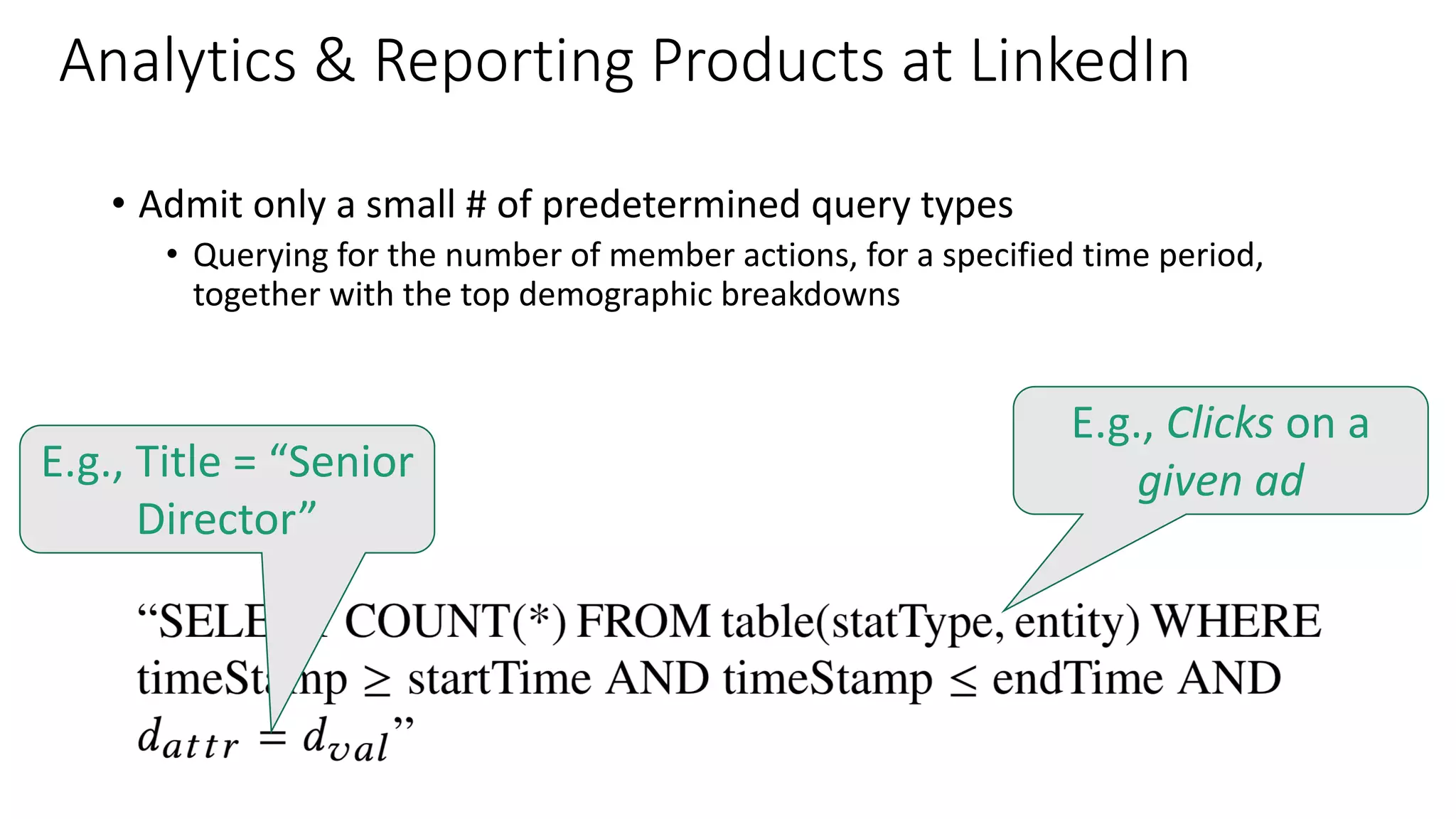
• Admit only a small # of predetermined query types
• Querying for the number of member actions, for a specified time period,
together with the top demographic breakdowns
Analytics & Reporting Products at LinkedIn
• Admit only a small # of predetermined query types
• Querying for the number of member actions, for a specified time period,
together with the top demographic breakdowns
E.g., Clicks on a
given adE.g., Title = “Senior
Director”
Analytics & Reporting Products at LinkedIn
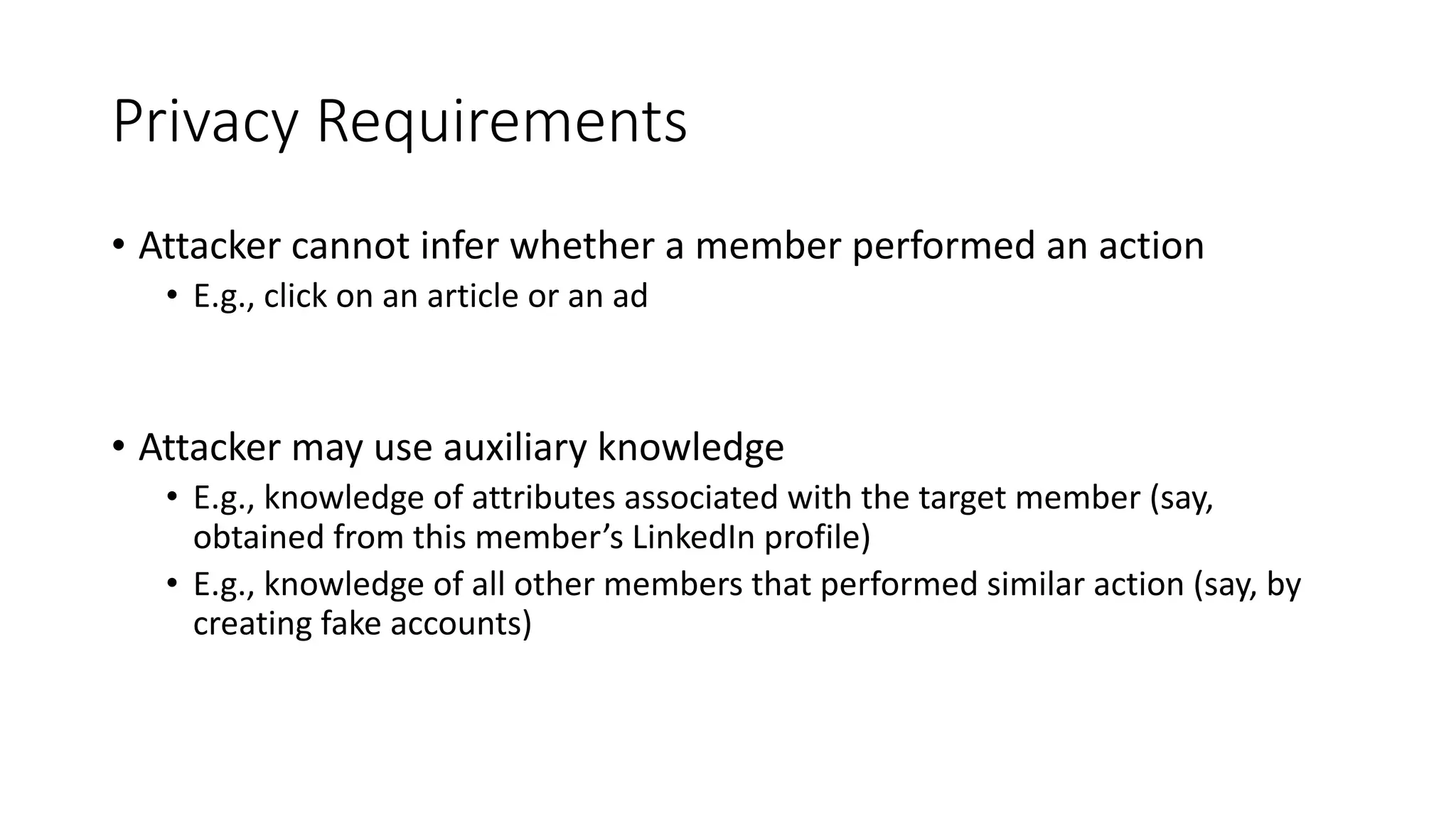
Privacy Requirements
• Attacker cannot infer whether a member performed an action
• E.g., click on an article or an ad
• Attacker may use auxiliary knowledge
• E.g., knowledge of attributes associated with the target member (say,
obtained from this member’s LinkedIn profile)
• E.g., knowledge of all other members that performed similar action (say, by
creating fake accounts)
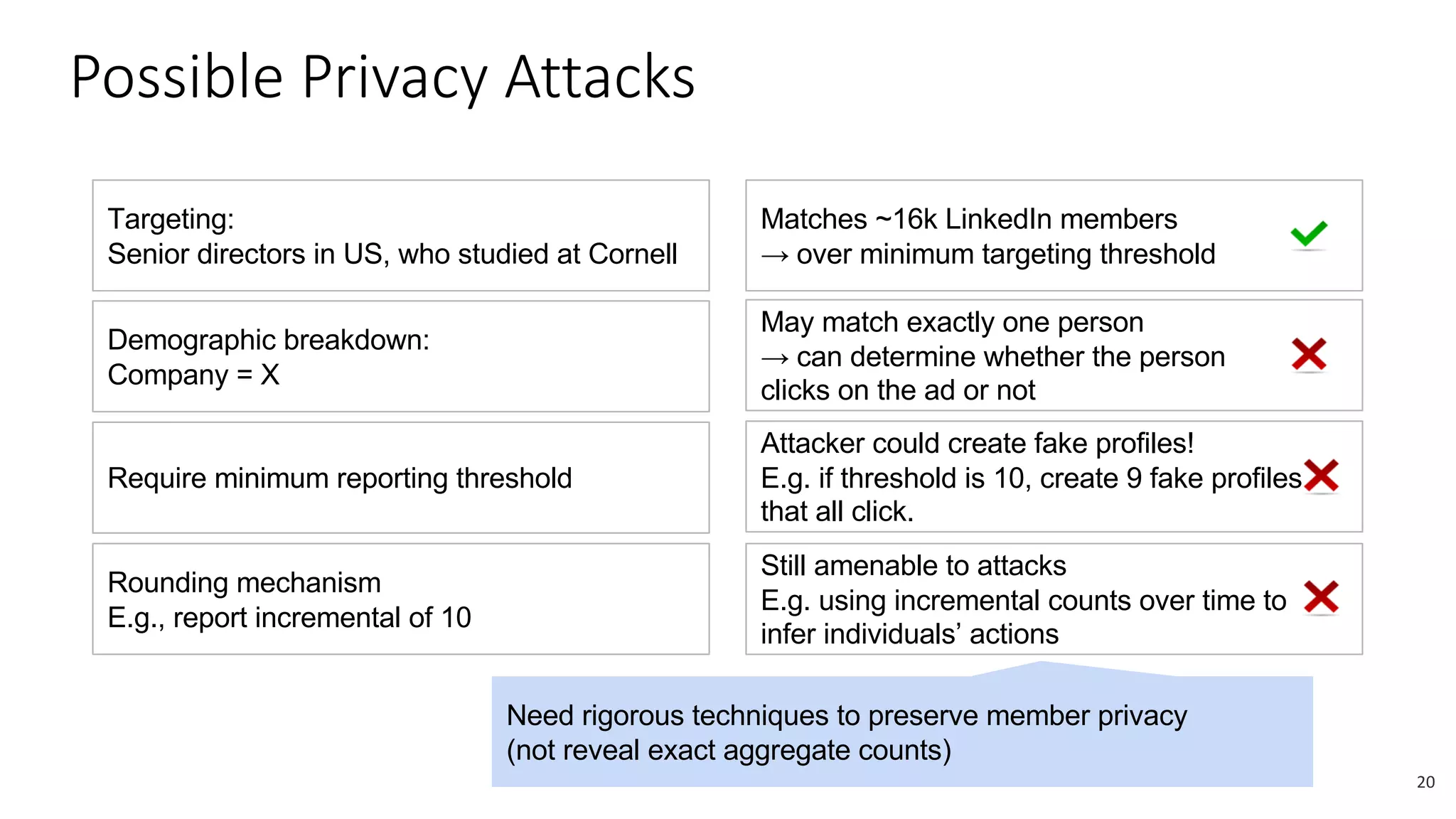
Possible Privacy Attacks
20
Targeting:
Senior directors in US, who studied at Cornell
Matches ~16k LinkedIn members
→ over minimum targeting threshold
Demographic breakdown:
Company = X
May match exactly one person
→ can determine whether the person
clicks on the ad or not
Require minimum reporting threshold
Attacker could create fake profiles!
E.g. if threshold is 10, create 9 fake profiles
that all click.
Rounding mechanism
E.g., report incremental of 10
Still amenable to attacks
E.g. using incremental counts over time to
infer individuals’ actions
Need rigorous techniques to preserve member privacy
(not reveal exact aggregate counts)
Key Product Desiderata
• Coverage & Utility
• Data Consistency
• for repeated queries
• over time
• between total and breakdowns
• across entity/action hierarchy
• for top k queries
Problem Statement
Compute robust, reliable analytics in a privacy-
preserving manner, while addressing the product
desiderata such as coverage, utility, and consistency.
Differential Privacy
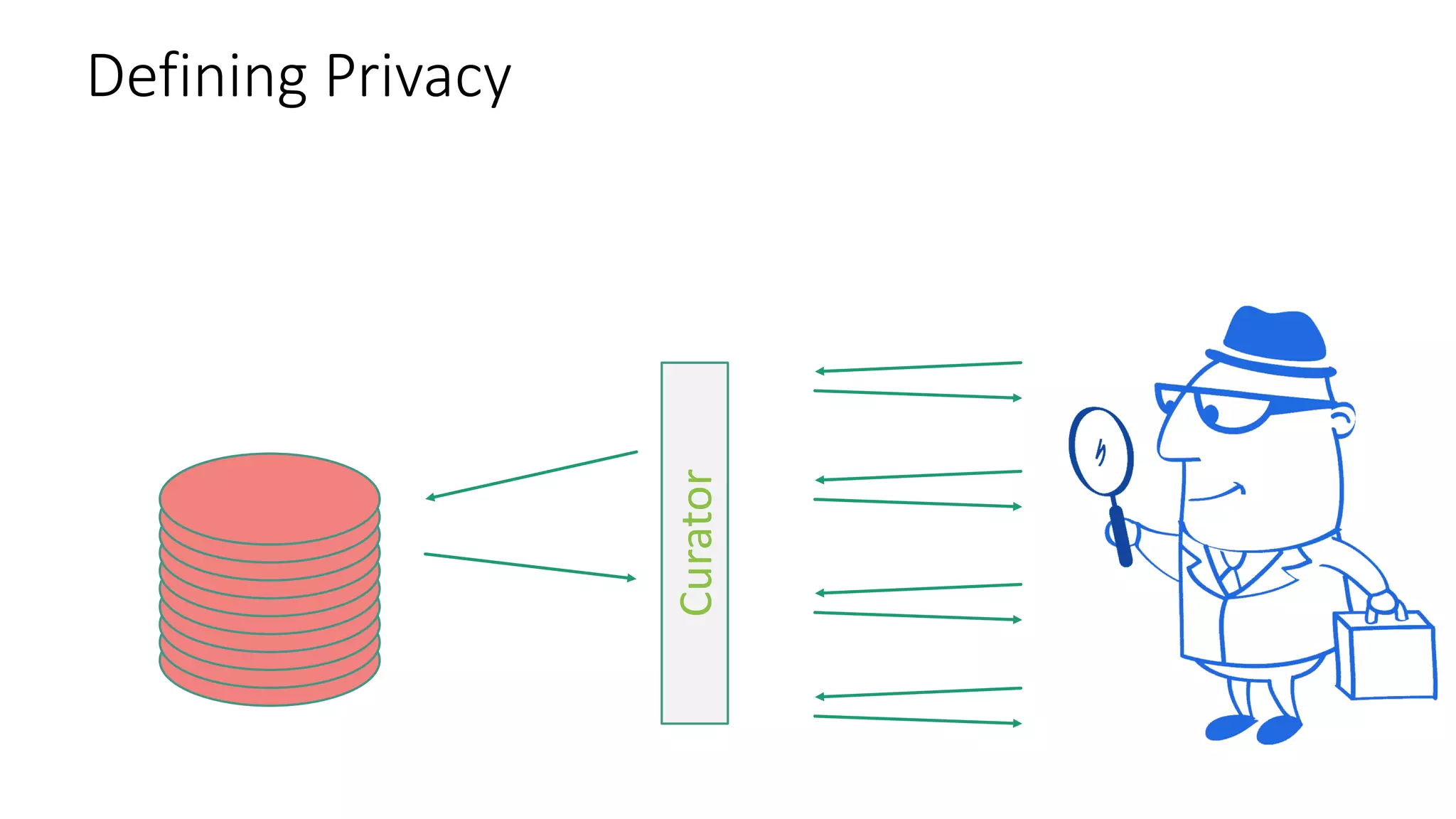
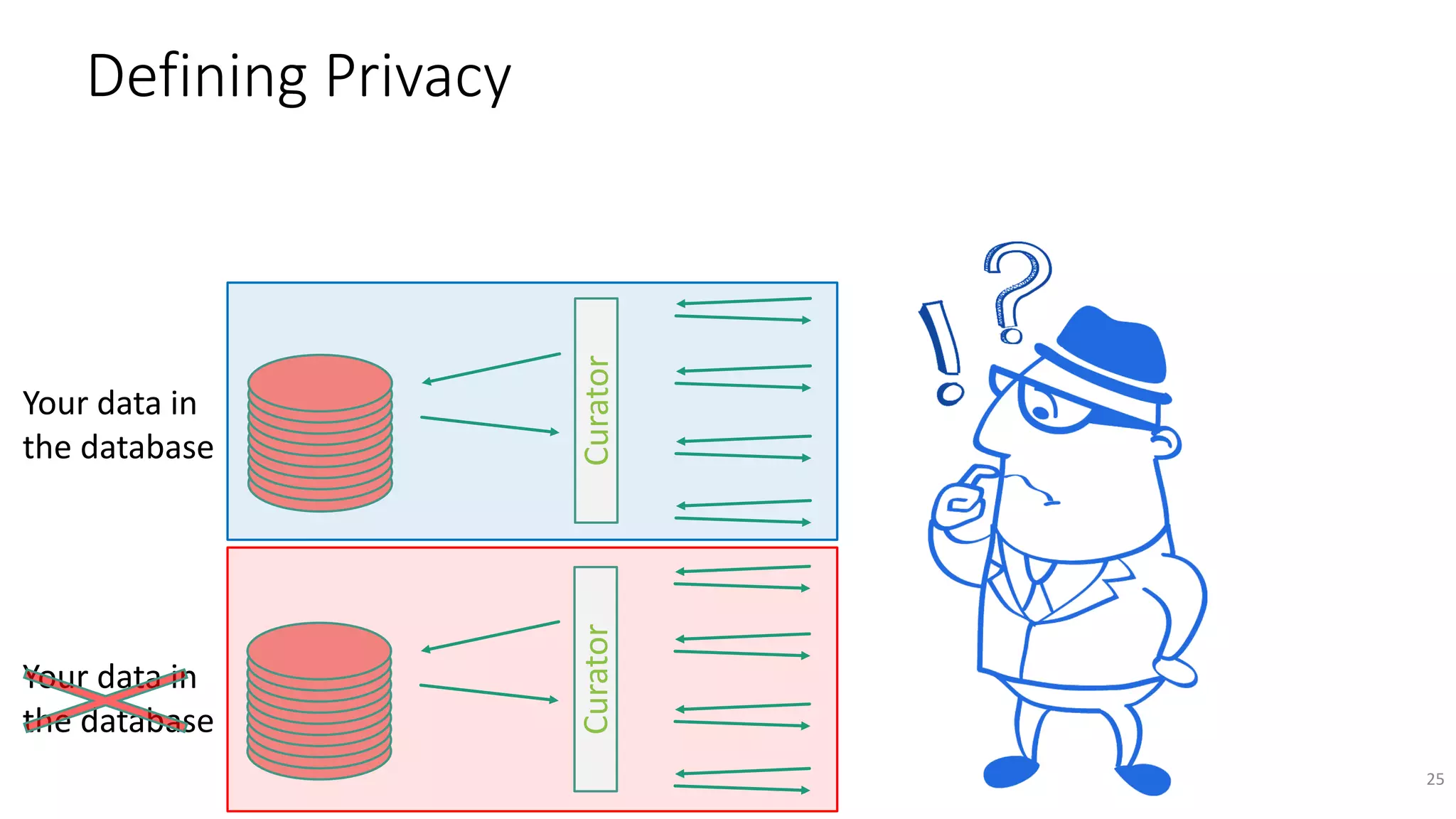
Curator
Defining Privacy
25
CuratorCurator
Your data in
the database
Defining Privacy
Your data in
the database
Defining Privacy
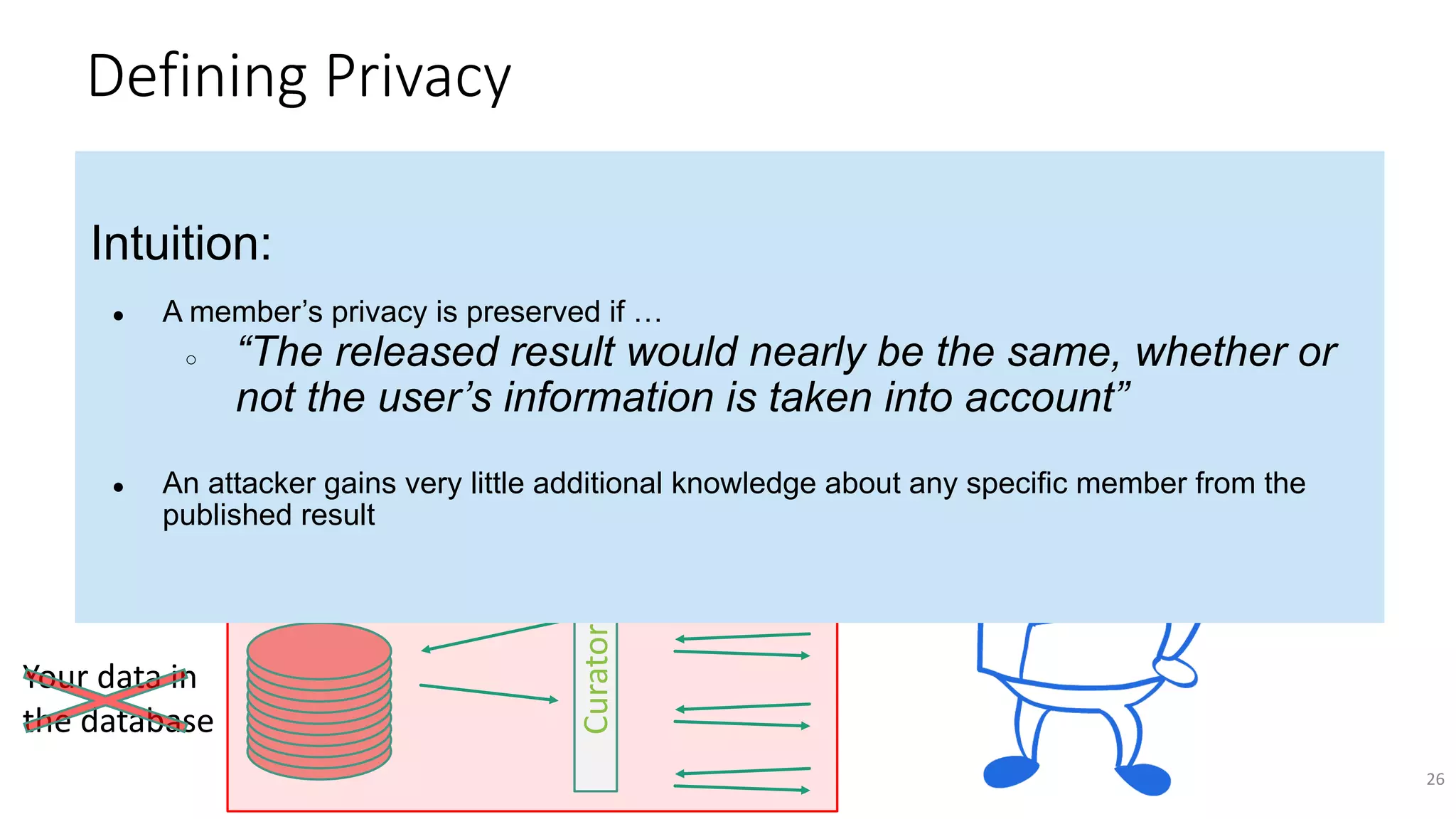
26
CuratorCurator
Intuition:
● A member’s privacy is preserved if …
○ “The released result would nearly be the same, whether or
not the user’s information is taken into account”
● An attacker gains very little additional knowledge about any specific member from the
published result
Defining Privacy
Your data in
the database
ε-Differential Privacy: For neighboring databases D and D′ (differ by one
record), the distribution of the curator’s output f(D) on database D is (nearly)
the same as f(D′).
27
Parameter ε quantifies
information leakage
(smaller ε, more
private)
∀S: Pr[f(D)∊S] ≤ exp(ε) ∙ Pr[f(D′)∊S]
CuratorCurator
Your data in
the database
Your data in
the database
Differential Privacy
Dwork, McSherry, Nissim, Smith, “Calibrating Noise to Sensitivity in Private Data Analysis”, TCC 2006
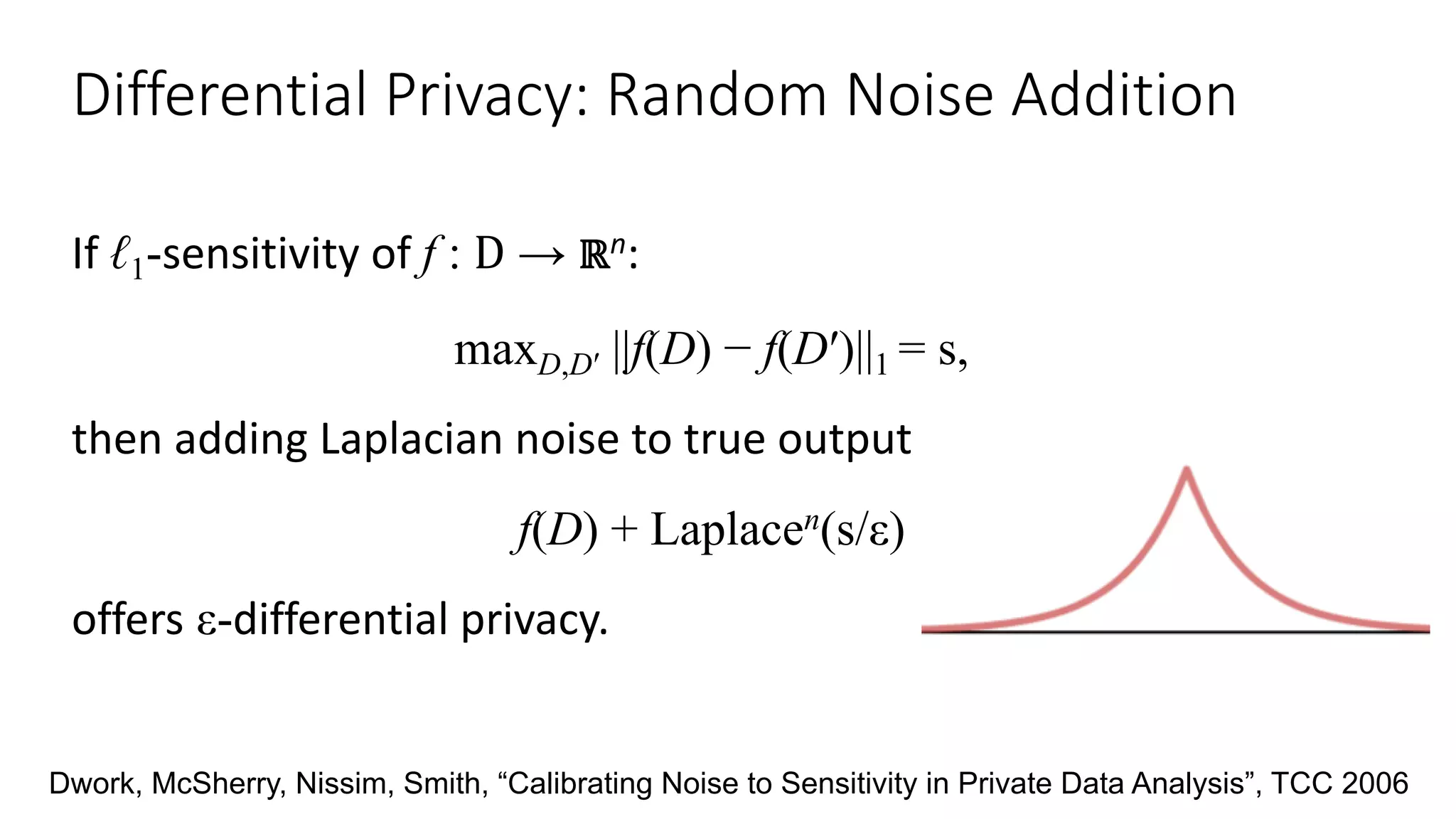
Differential Privacy: Random Noise Addition
If ℓ1-sensitivity of f : D → ℝn:
maxD,D′ ||f(D) − f(D′)||1 = s,
then adding Laplacian noise to true output
f(D) + Laplacen(s/ε)
offers ε-differential privacy.
Dwork, McSherry, Nissim, Smith, “Calibrating Noise to Sensitivity in Private Data Analysis”, TCC 2006
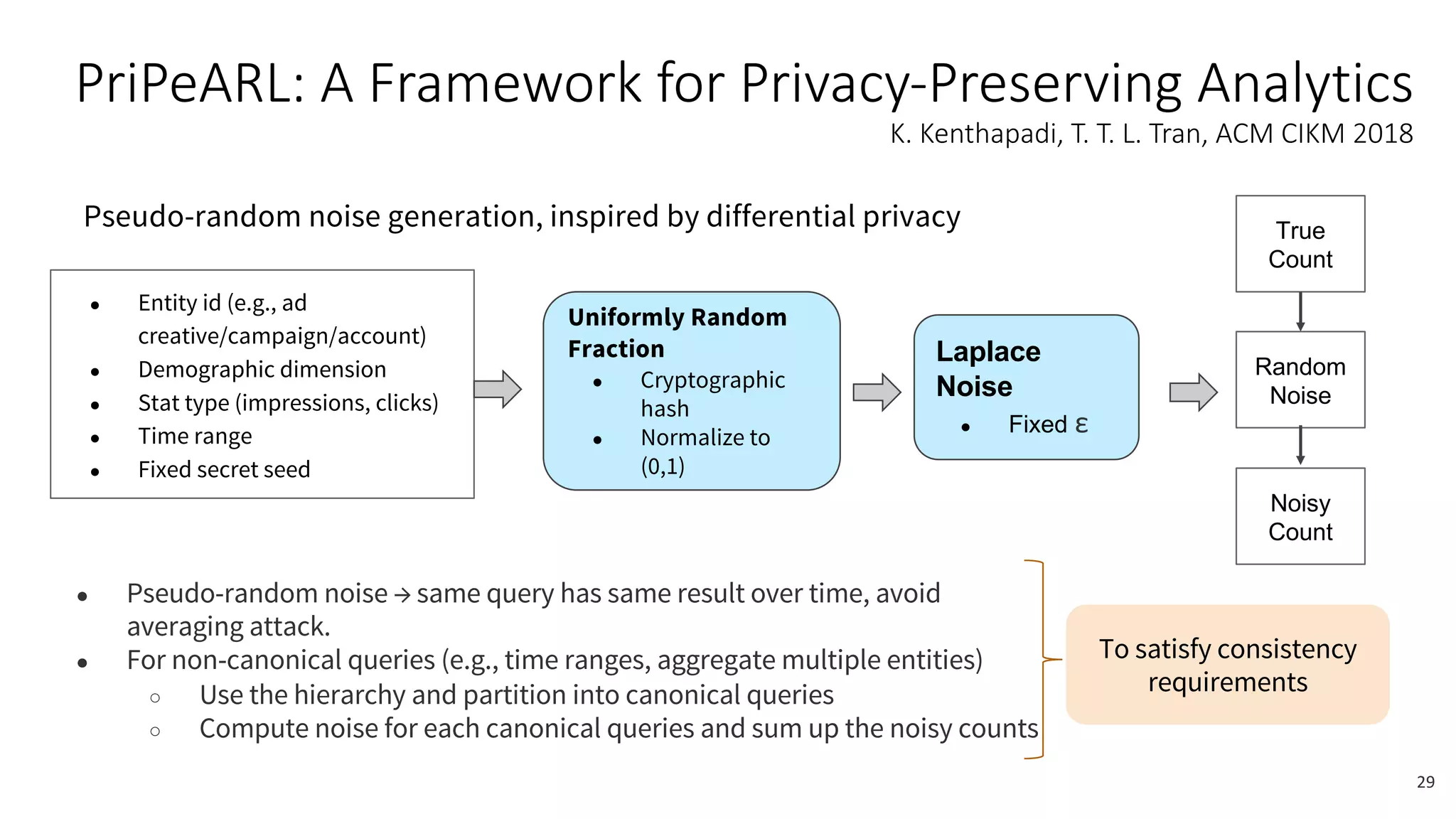
PriPeARL: A Framework for Privacy-Preserving Analytics
K. Kenthapadi, T. T. L. Tran, ACM CIKM 2018
29
Pseudo-random noise generation, inspired by differential privacy
● Entity id (e.g., ad
creative/campaign/account)
● Demographic dimension
● Stat type (impressions, clicks)
● Time range
● Fixed secret seed
Uniformly Random
Fraction
● Cryptographic
hash
● Normalize to
(0,1)
Random
Noise
Laplace
Noise
● Fixed ε
True
Count
Noisy
Count
To satisfy consistency
requirements
● Pseudo-random noise → same query has same result over time, avoid
averaging attack.
● For non-canonical queries (e.g., time ranges, aggregate multiple entities)
○ Use the hierarchy and partition into canonical queries
○ Compute noise for each canonical queries and sum up the noisy counts
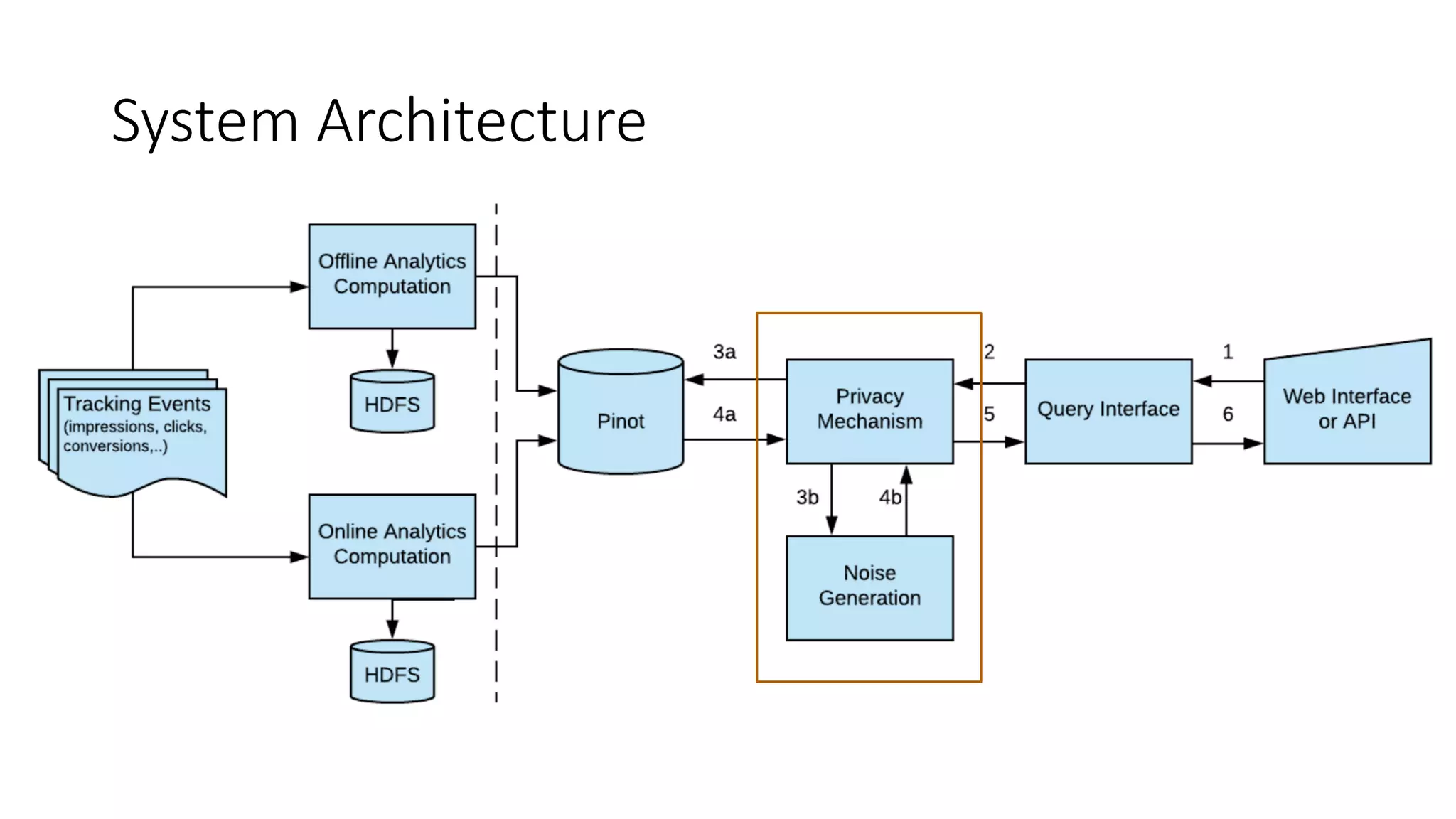
System Architecture
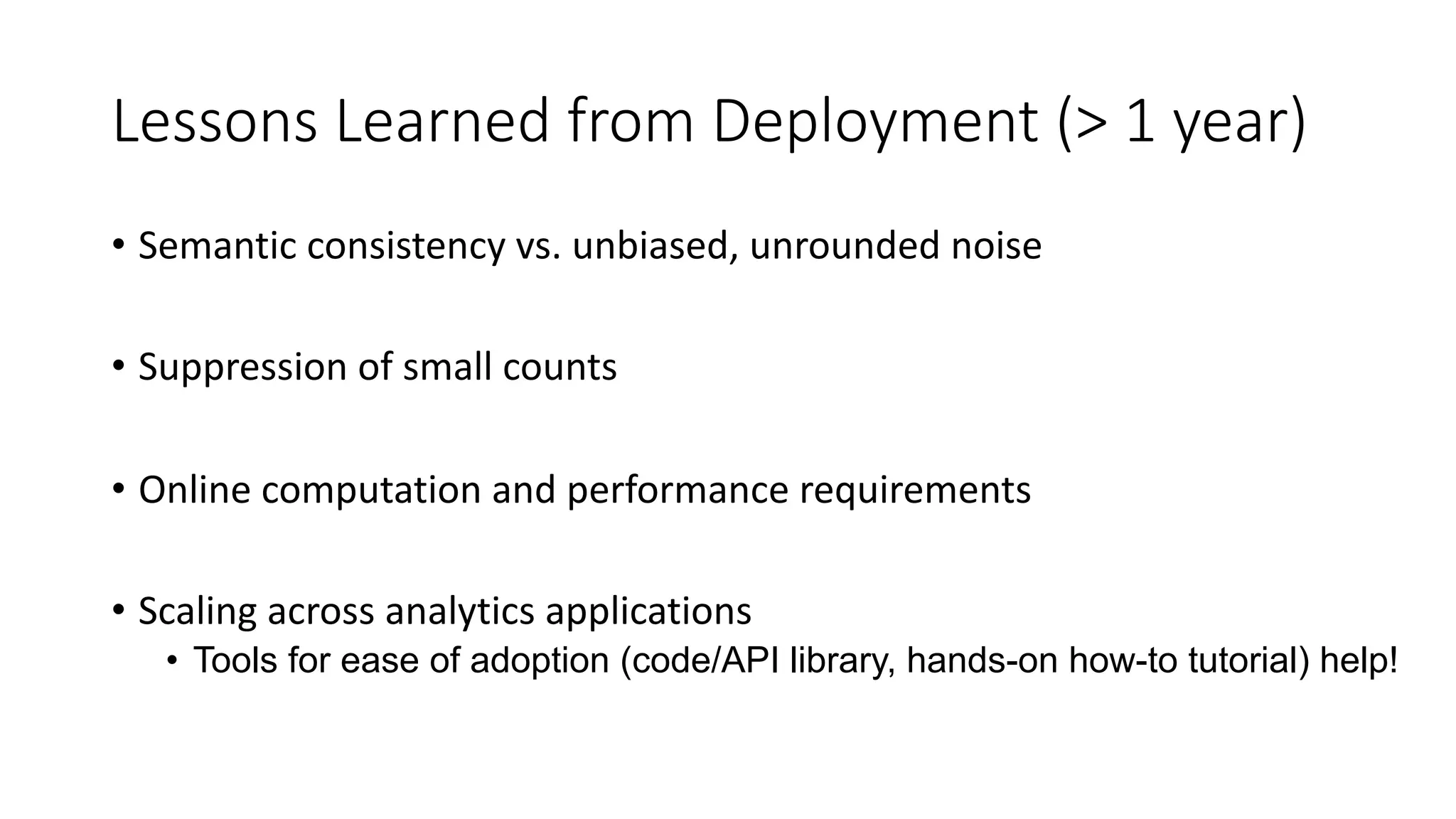
Lessons Learned from Deployment (> 1 year)
• Semantic consistency vs. unbiased, unrounded noise
• Suppression of small counts
• Online computation and performance requirements
• Scaling across analytics applications
• Tools for ease of adoption (code/API library, hands-on how-to tutorial) help!
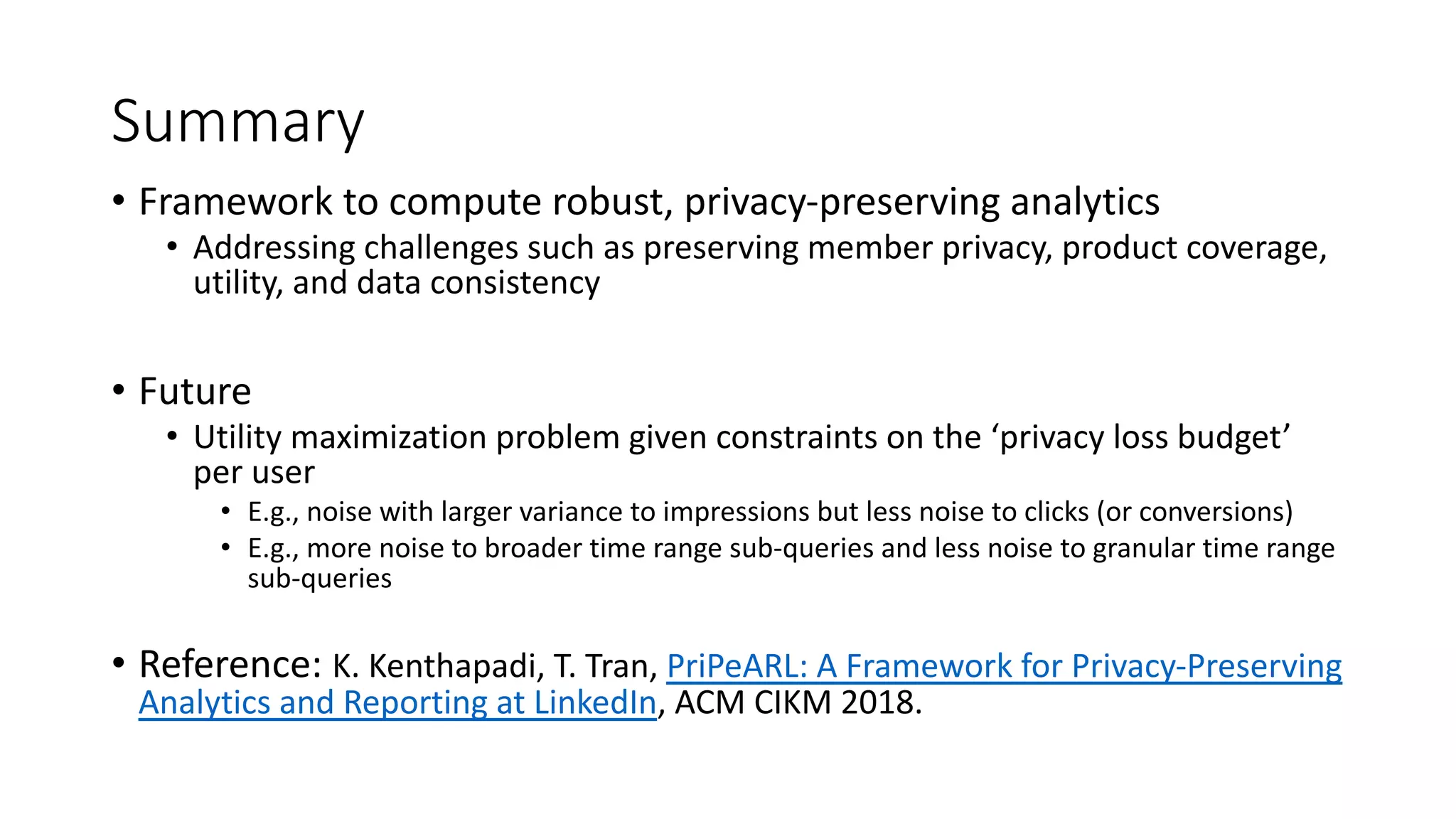
Summary
• Framework to compute robust, privacy-preserving analytics
• Addressing challenges such as preserving member privacy, product coverage,
utility, and data consistency
• Future
• Utility maximization problem given constraints on the ‘privacy loss budget’
per user
• E.g., noise with larger variance to impressions but less noise to clicks (or conversions)
• E.g., more noise to broader time range sub-queries and less noise to granular time range
sub-queries
• Reference: K. Kenthapadi, T. Tran, PriPeARL: A Framework for Privacy-Preserving
Analytics and Reporting at LinkedIn, ACM CIKM 2018.
Acknowledgements
•Team:
• AI/ML: Krishnaram Kenthapadi, Thanh T. L. Tran
• Ad Analytics Product & Engineering: Mark Dietz, Taylor Greason, Ian
Koeppe
• Legal / Security: Sara Harrington, Sharon Lee, Rohit Pitke
•Acknowledgements (in alphabetical order)
• Deepak Agarwal, Igor Perisic, Arun Swami
LinkedIn Salary
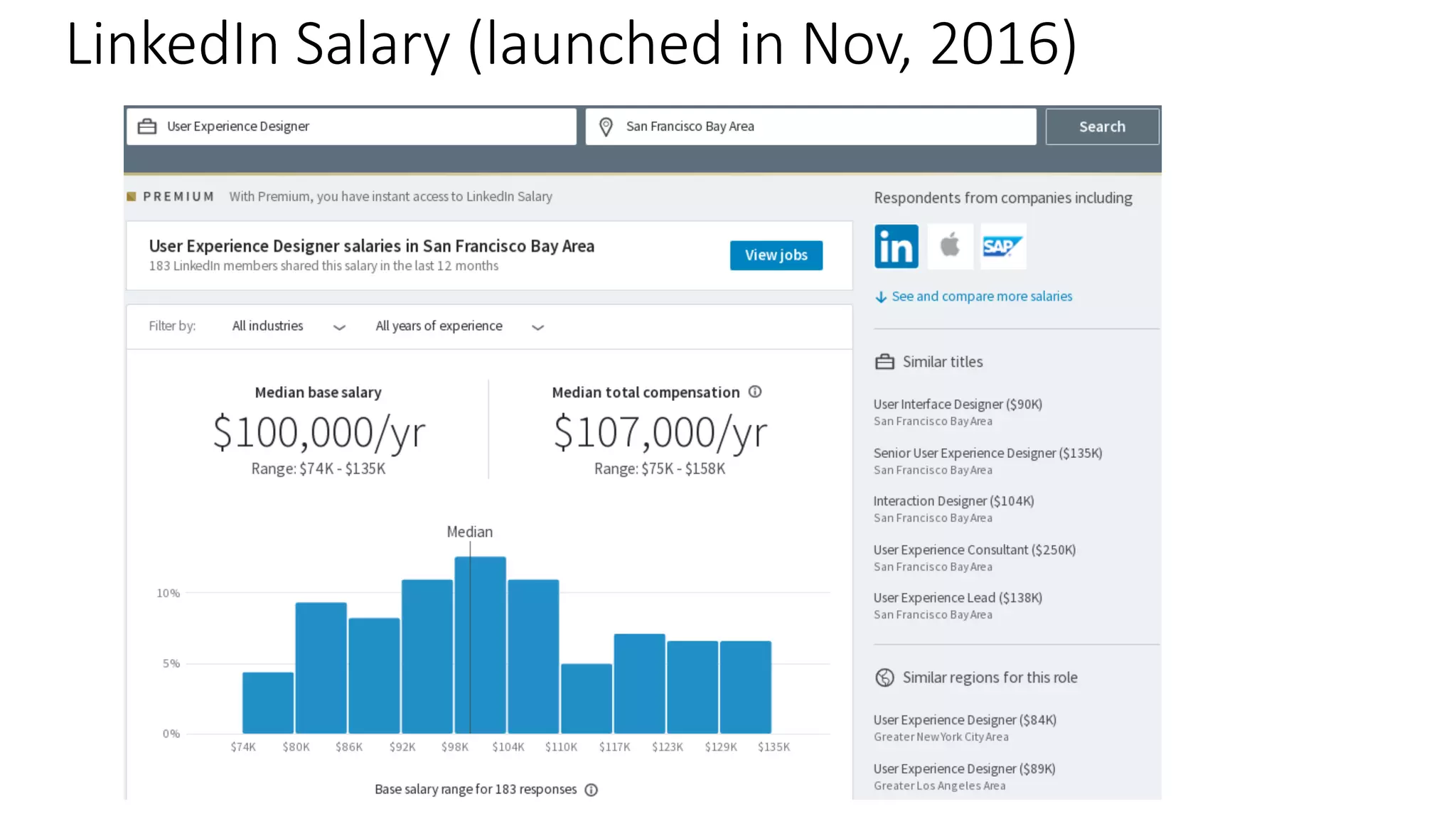
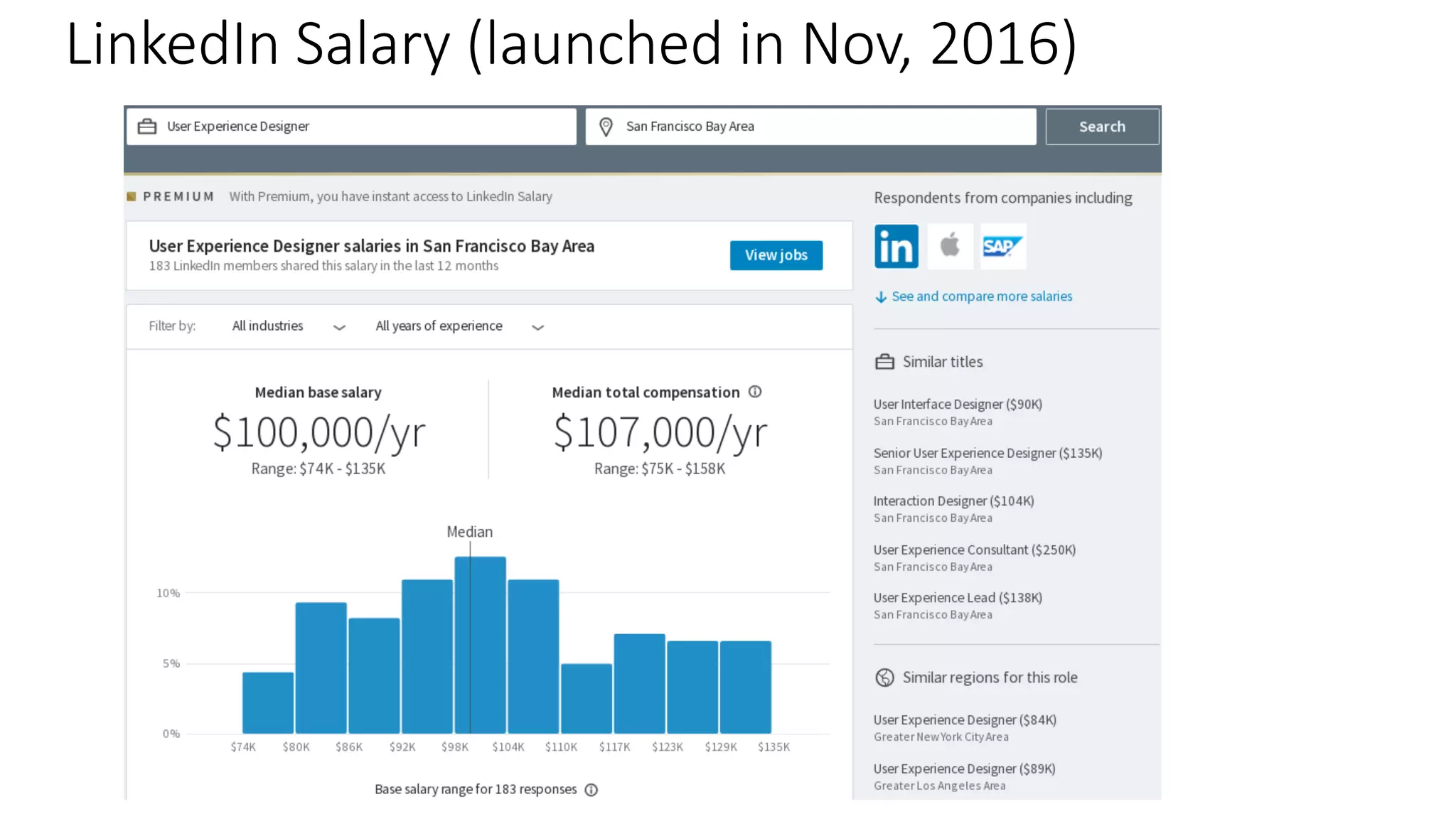
LinkedIn Salary (launched in Nov, 2016)
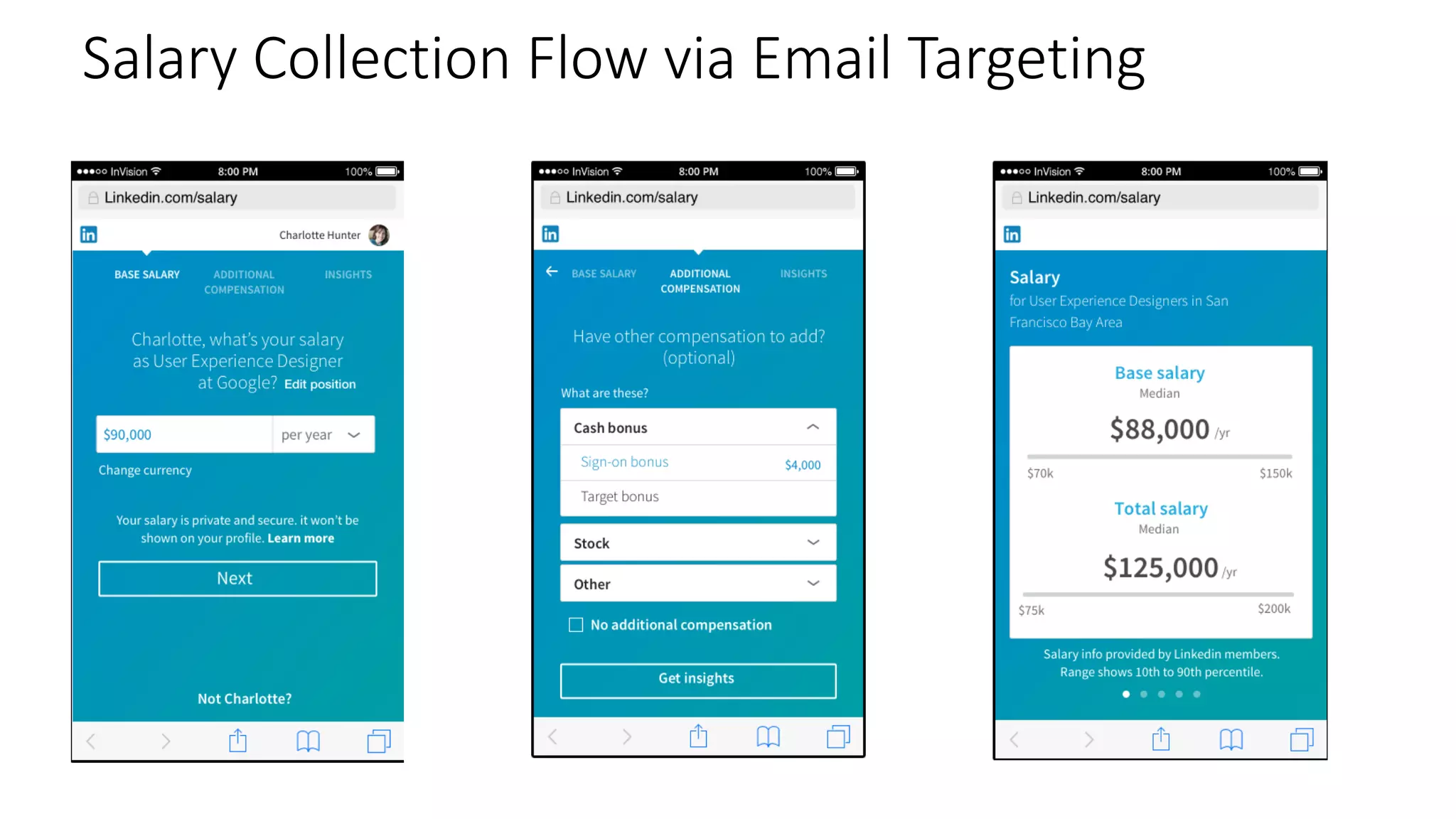
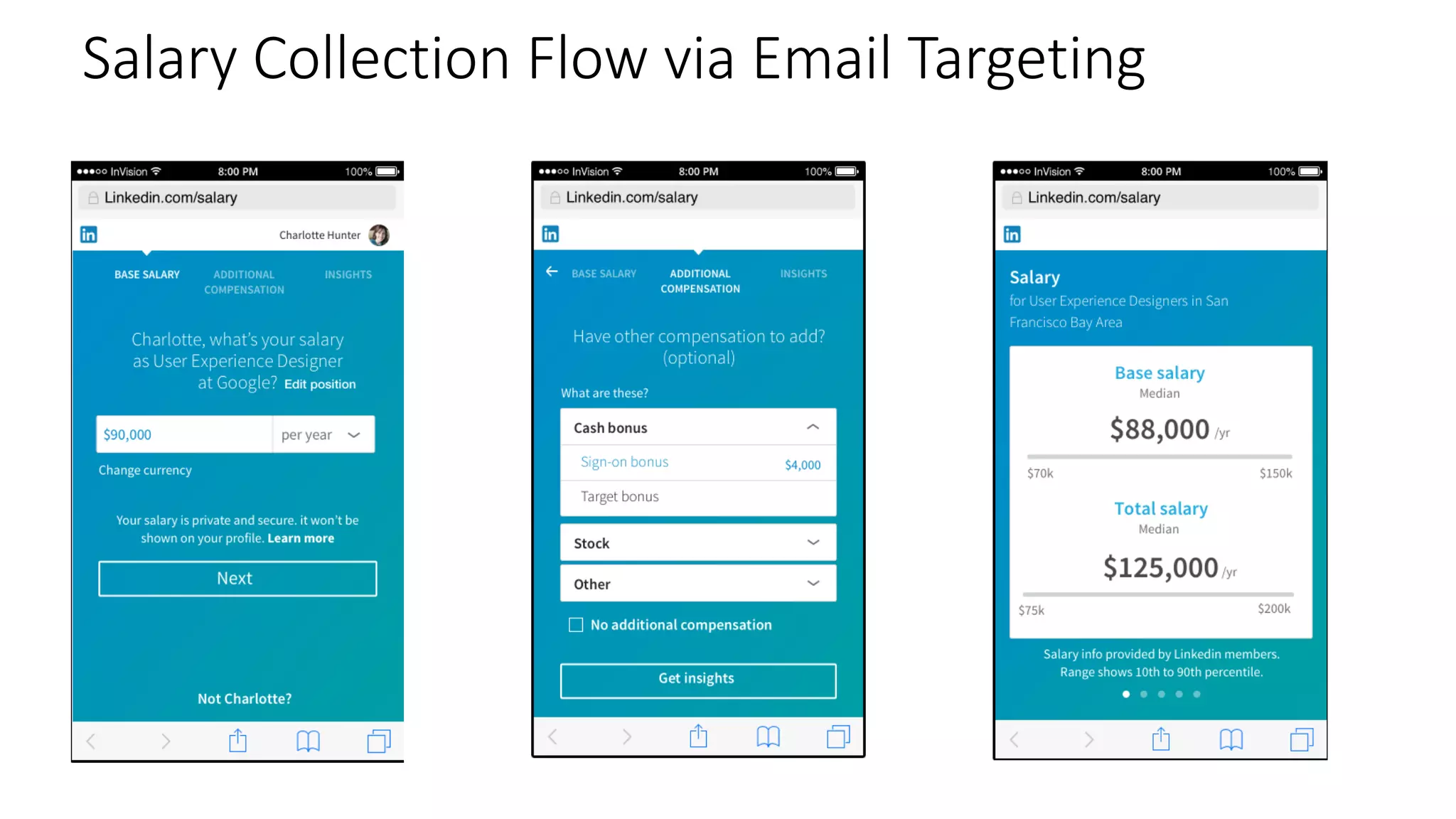
Salary Collection Flow via Email Targeting
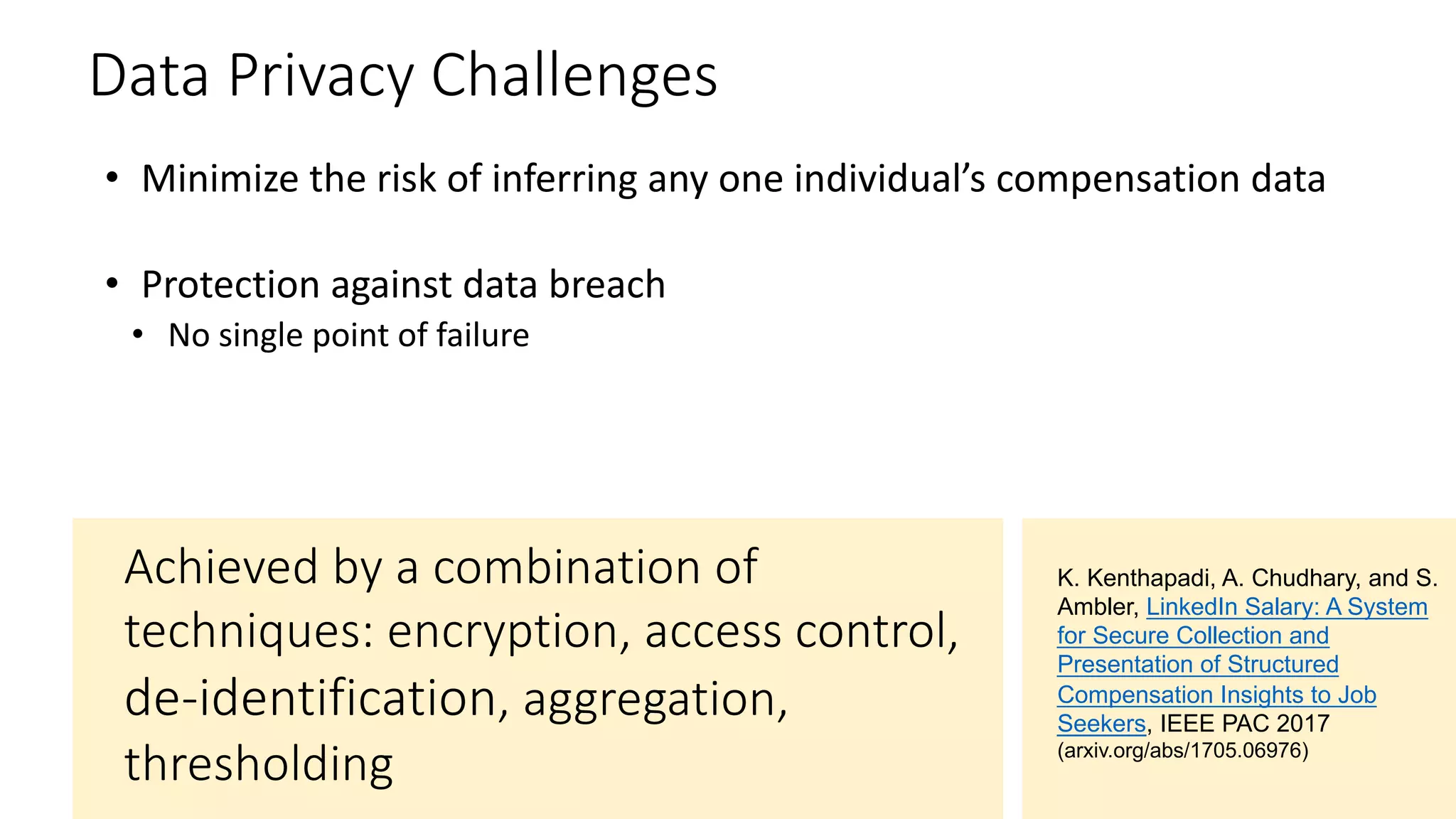
Data Privacy Challenges
• Minimize the risk of inferring any one individual’s compensation data
• Protection against data breach
• No single point of failure
Achieved by a combination of
techniques: encryption, access control,
, aggregation,
thresholding
K. Kenthapadi, A. Chudhary, and S.
Ambler, LinkedIn Salary: A System
for Secure Collection and
Presentation of Structured
Compensation Insights to Job
Seekers, IEEE PAC 2017
(arxiv.org/abs/1705.06976)
Problem Statement
•How do we design LinkedIn Salary system taking into
account the unique privacy and security challenges,
while addressing the product requirements?
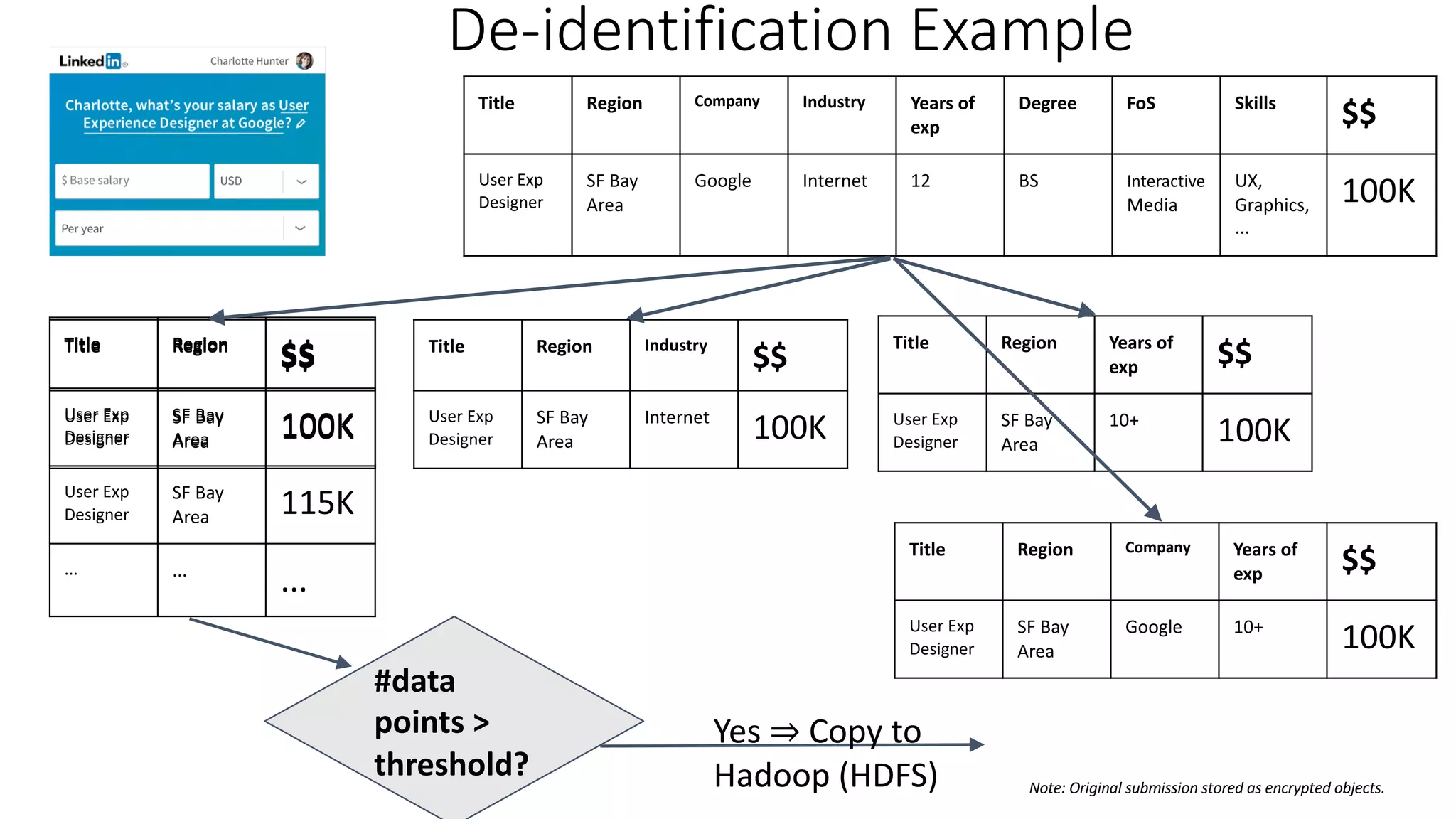
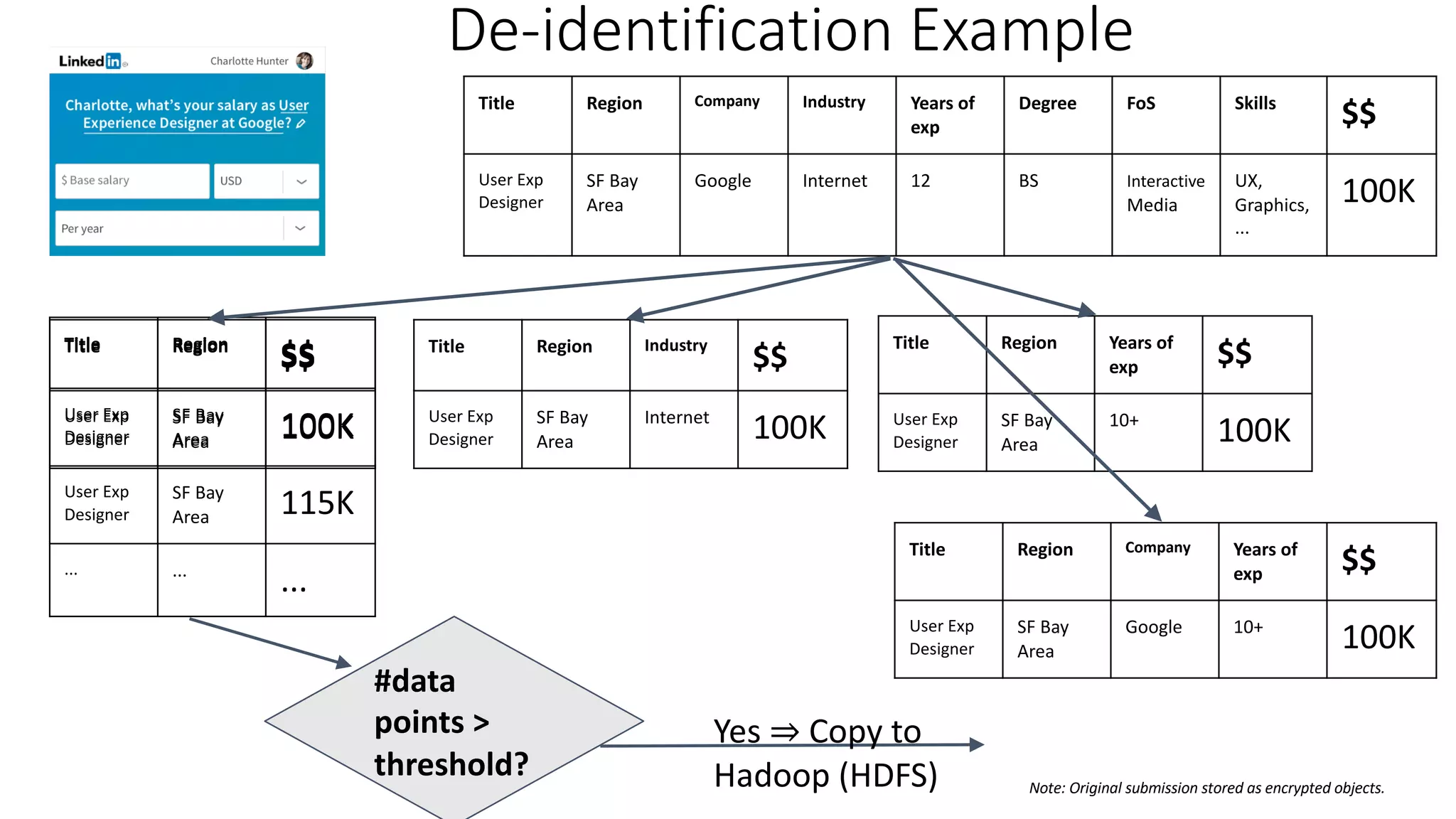
Title Region
$$
User Exp
Designer
SF Bay
Area 100K
User Exp
Designer
SF Bay
Area 115K
... ...
...
Title Region
$$
User Exp
Designer
SF Bay
Area 100K
De-identification Example
Title Region Company Industry Years of
exp
Degree FoS Skills
$$
User Exp
Designer
SF Bay
Area
Google Internet 12 BS Interactive
Media
UX,
Graphics,
...
100K
Title Region Industry
$$
User Exp
Designer
SF Bay
Area
Internet
100K
Title Region Years of
exp $$
User Exp
Designer
SF Bay
Area
10+
100K
Title Region Company Years of
exp $$
User Exp
Designer
SF Bay
Area
Google 10+
100K
#data
points >
threshold?
Yes ⇒ Copy to
Hadoop (HDFS) Note: Original submission stored as encrypted objects.
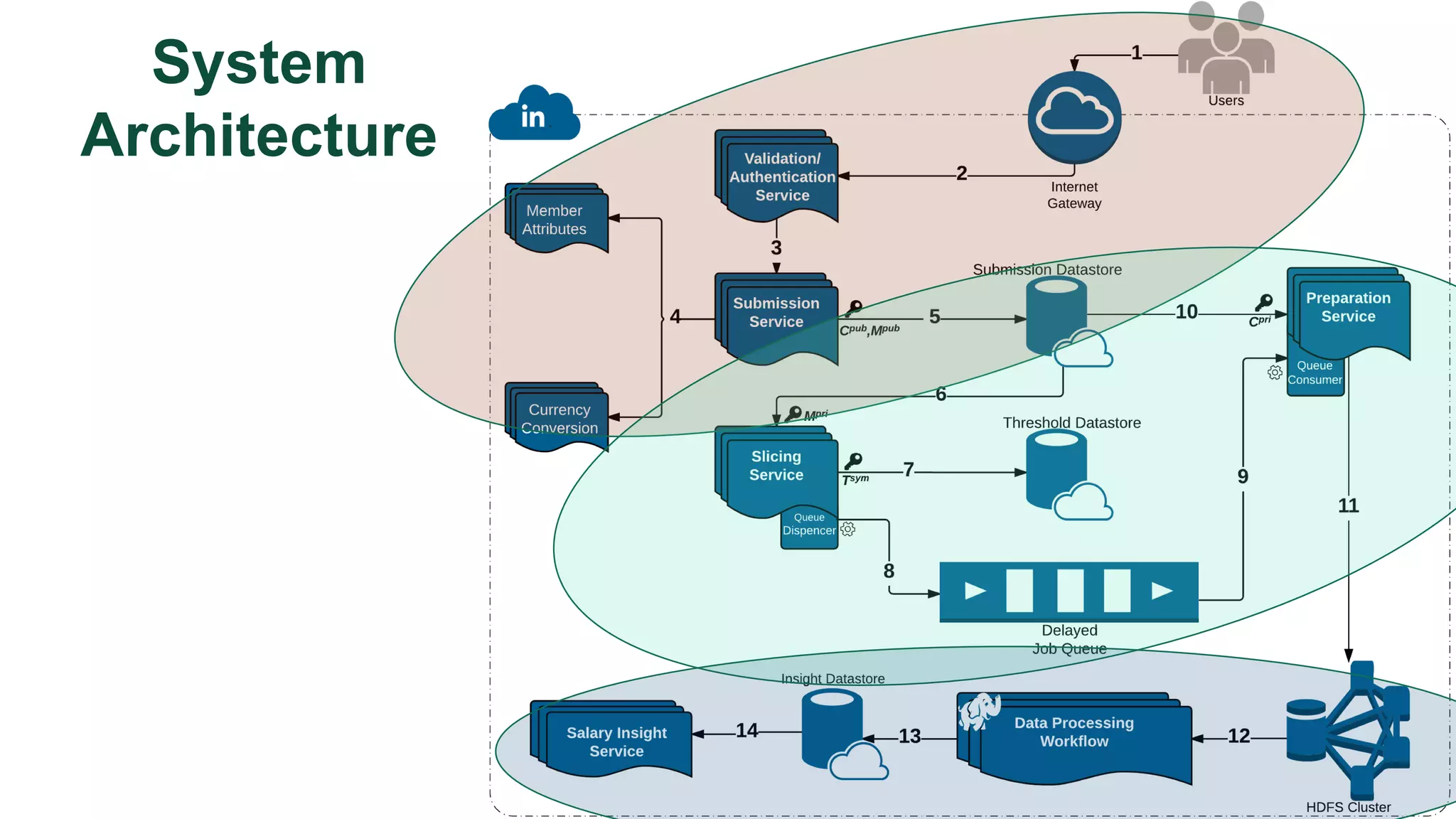
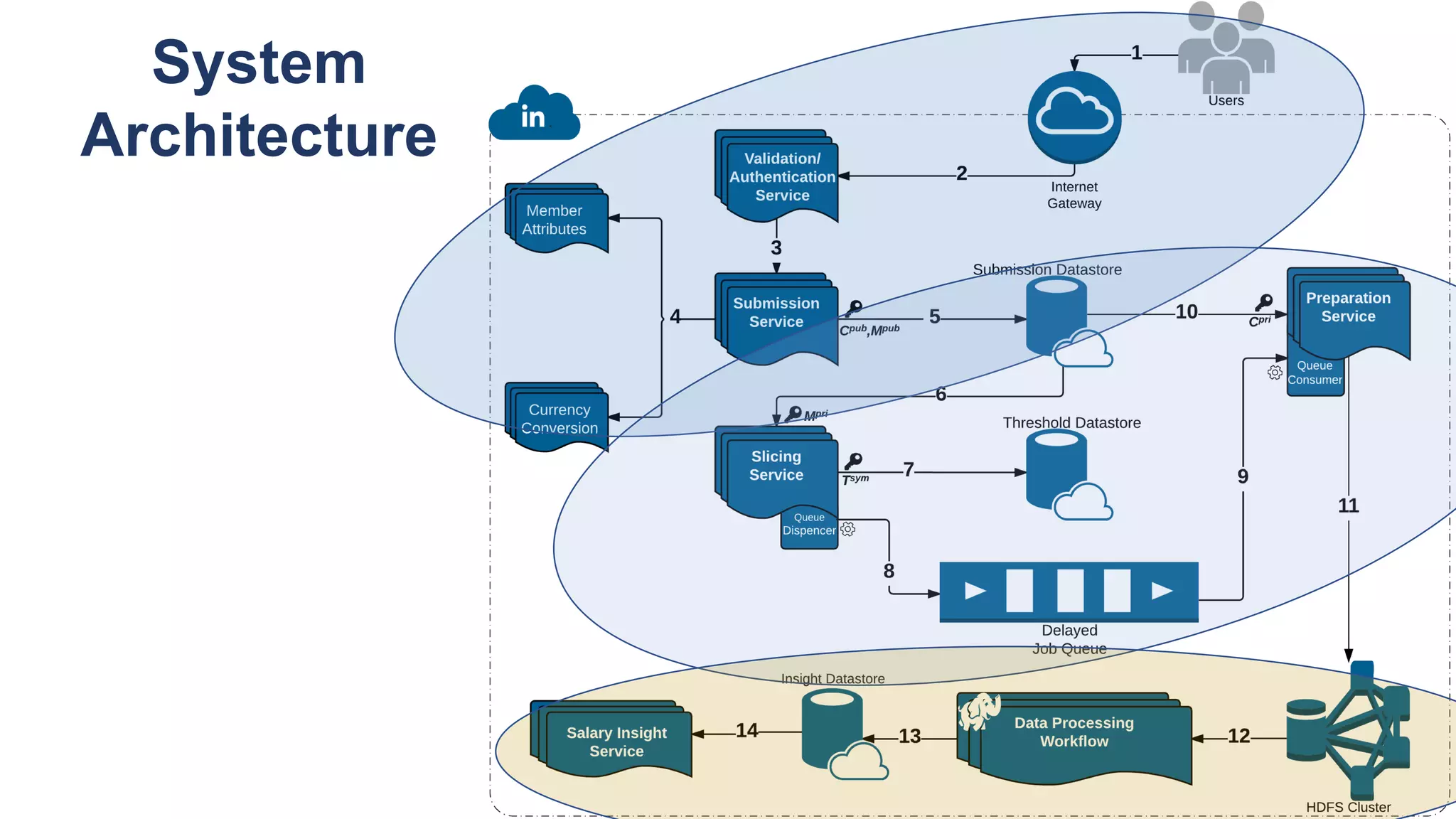
System
Architecture
Summary
• LinkedIn Salary: a new internet application, with
unique privacy/modeling challenges
• Privacy Design & Architecture
• Provably private submission of compensation entries?
Acknowledgements
• Team:
• AI/ML: Krishnaram Kenthapadi, Stuart Ambler, Xi Chen, Yiqun Liu, Parul Jain,
Liang Zhang, Ganesh Venkataraman, Tim Converse, Deepak Agarwal
• Application Engineering: Ahsan Chudhary, Alan Yang, Alex Navasardyan,
Brandyn Bennett, Hrishikesh S, Jim Tao, Juan Pablo Lomeli Diaz, Patrick
Schutz, Ricky Yan, Lu Zheng, Stephanie Chou, Joseph Florencio, Santosh
Kumar Kancha, Anthony Duerr
• Product: Ryan Sandler, Keren Baruch
• Other teams (UED, Marketing, BizOps, Analytics, Testing, Voice of Members,
Security, …): Julie Kuang, Phil Bunge, Prateek Janardhan, Fiona Li, Bharath
Shetty, Sunil Mahadeshwar, Cory Scott, Tushar Dalvi, and team
• Acknowledgements (in alphabetical order)
• David Freeman, Ashish Gupta, David Hardtke, Rong Rong, Ram Swaminathan
What’s Next: Privacy for ML / Data Applications
• Hard open questions
• Can we simultaneously develop highly personalized models and ensure that the
models do not encode private information of members?
• How do we guarantee member privacy over time without exhausting the “privacy
loss budget”?
• How do we enable privacy-preserving mechanisms for data marketplaces?
Fairness in AI @ LinkedIn
Guiding Principle:
“Diversity by Design”
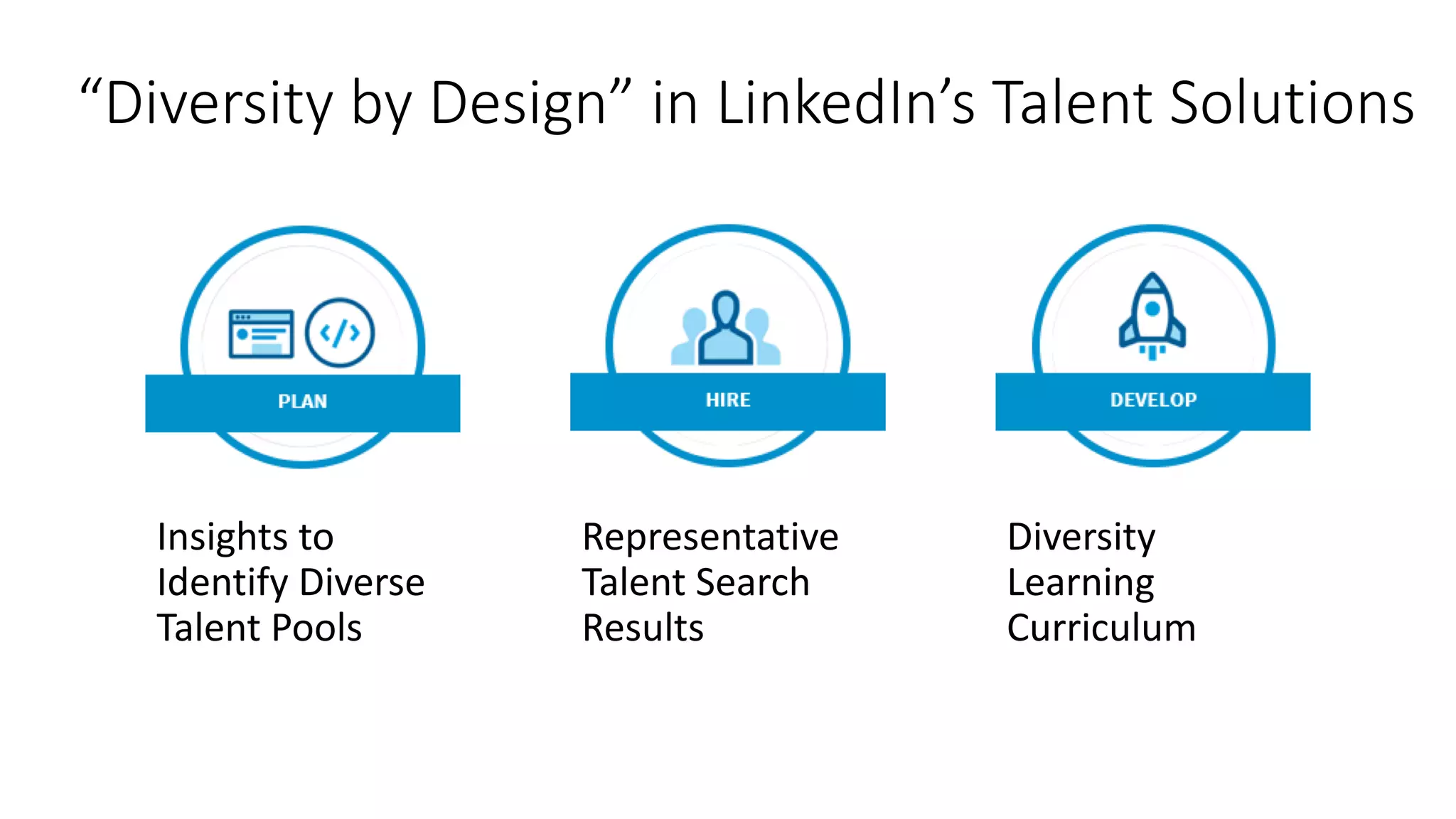
“Diversity by Design” in LinkedIn’s Talent Solutions
Insights to
Identify Diverse
Talent Pools
Representative
Talent Search
Results
Diversity
Learning
Curriculum
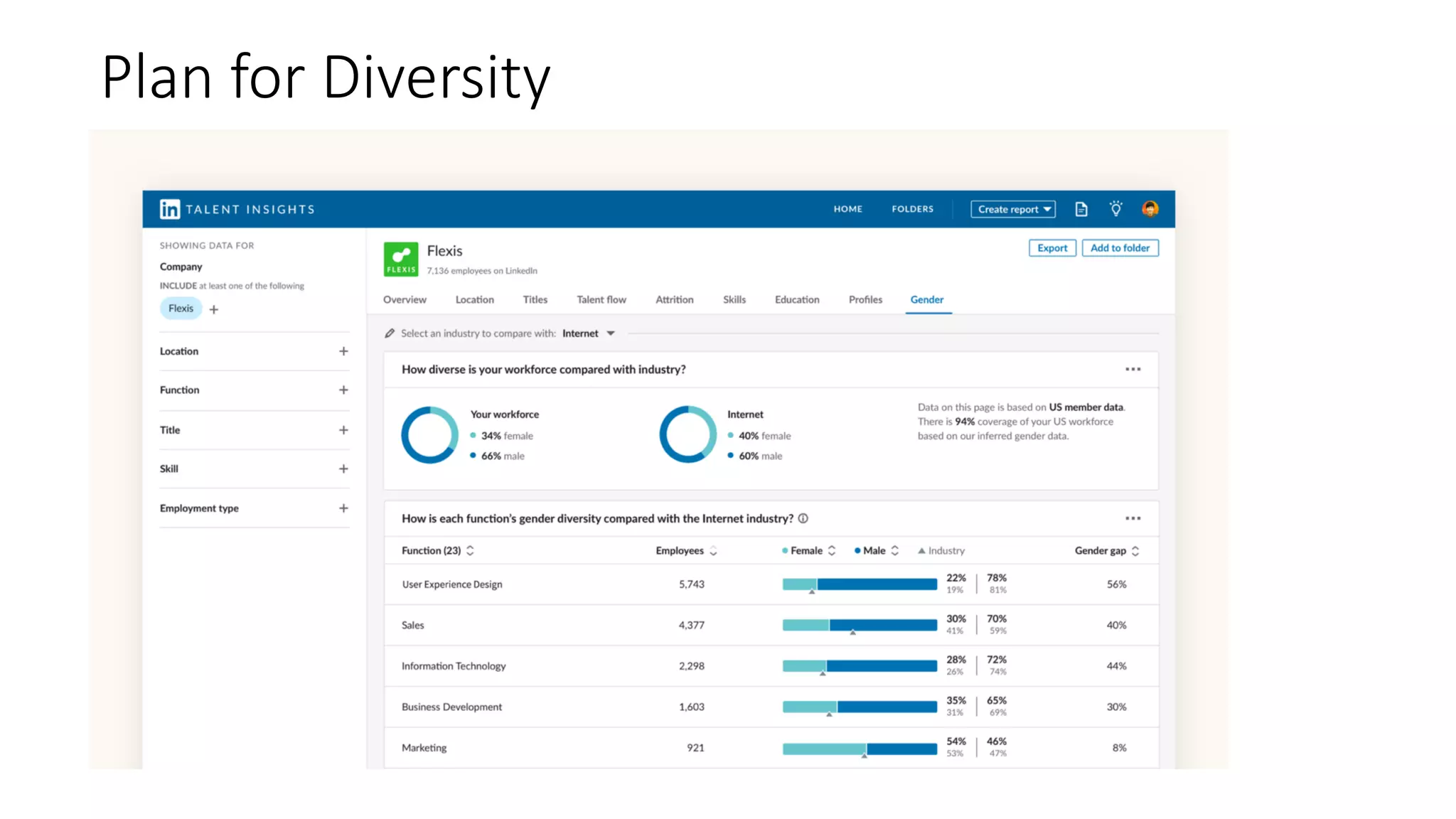
Plan for Diversity
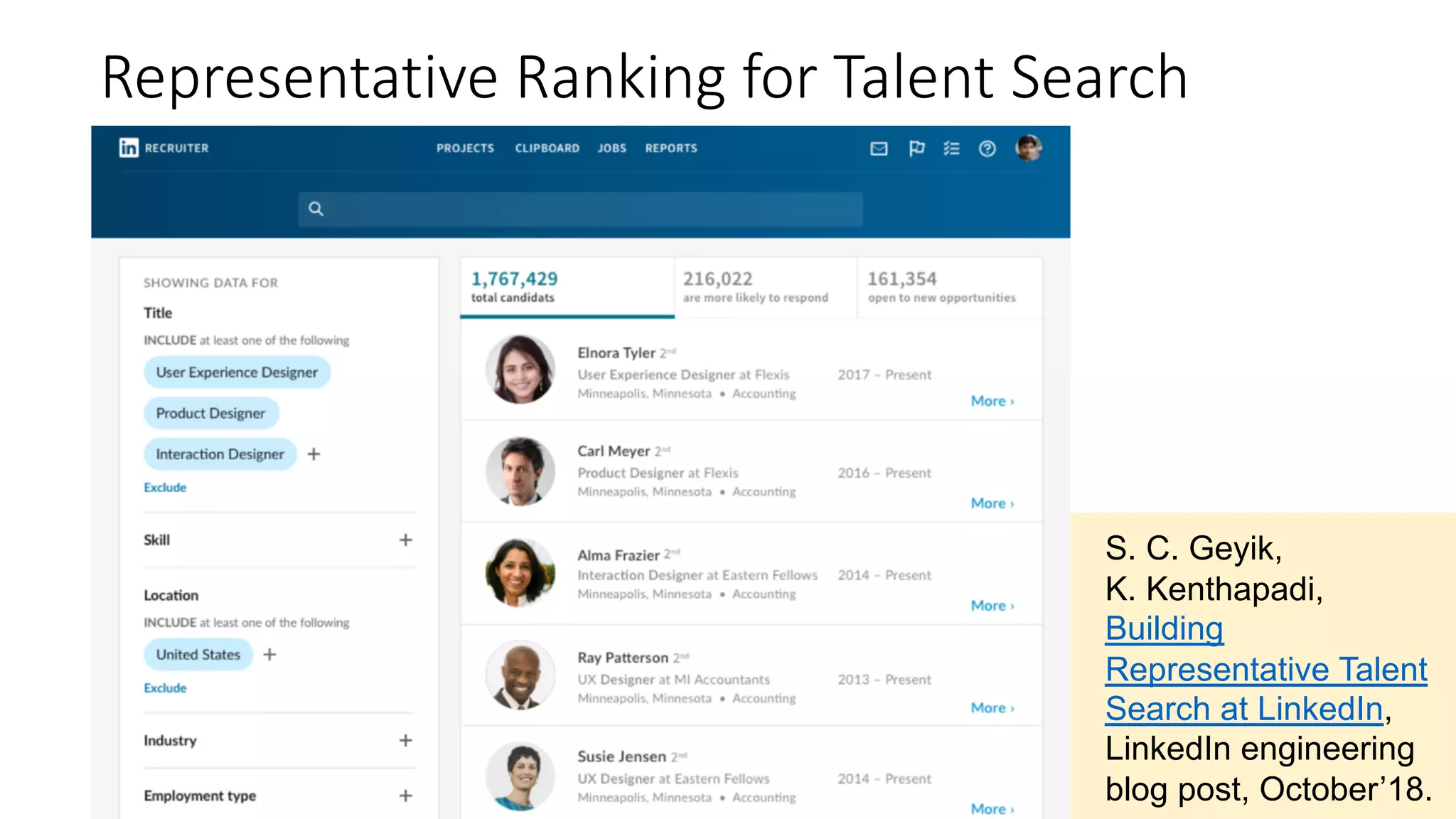
Representative Ranking for Talent Search
S. C. Geyik,
K. Kenthapadi,
Building
Representative Talent
Search at LinkedIn,
LinkedIn engineering
blog post, October’18.
Intuition for Measuring Representativeness
• Ideal: same distribution on gender/age/… for
• Top ranked results and
• Qualified candidates for a search request
• LinkedIn members matching the search criteria
• Same proportion of members with each given attribute value across
both these sets
• “Equal opportunity” definition [Hardt et al, NIPS’16]
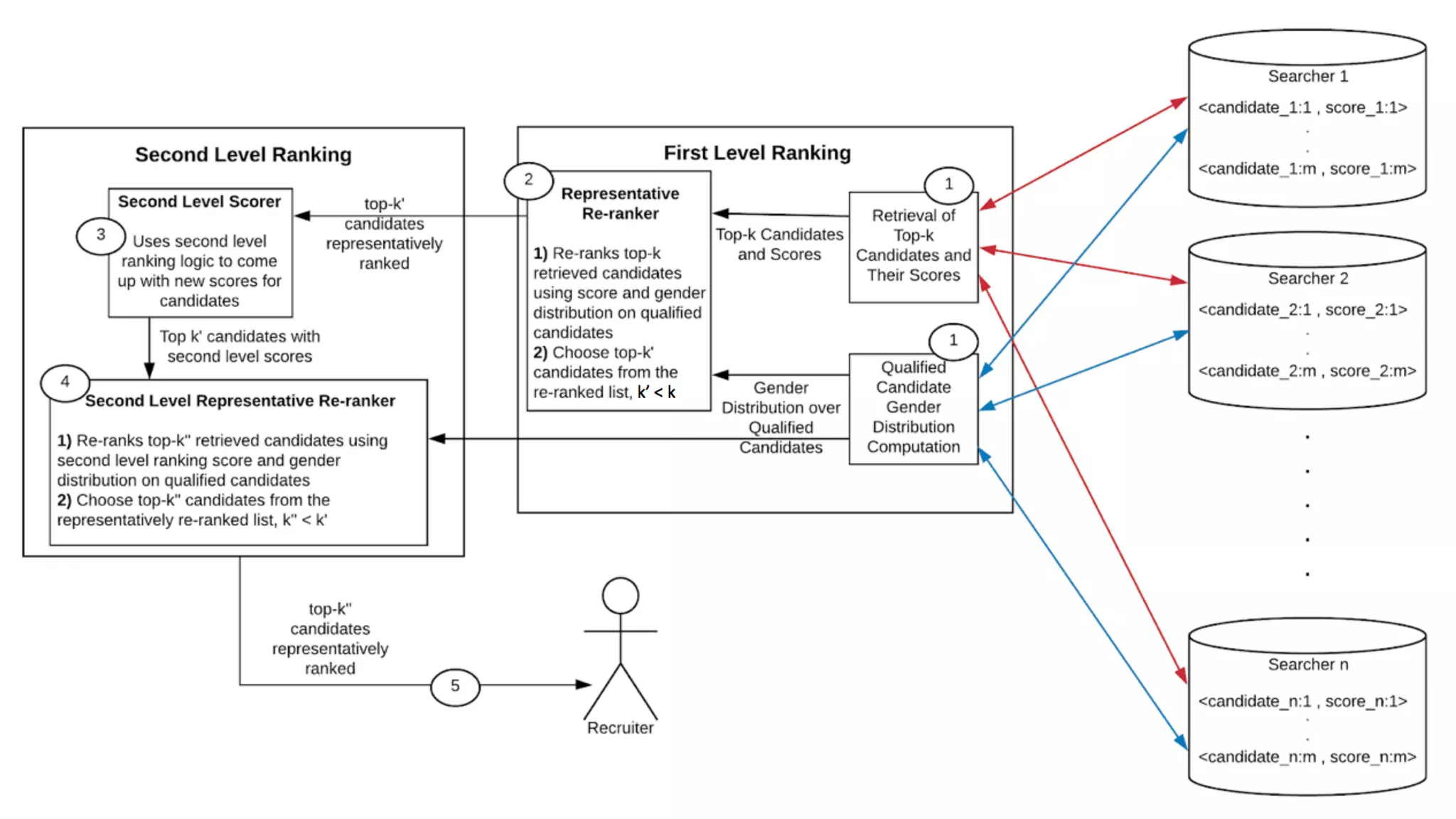
Reranking Algorithm for Representativeness
• Determine the target proportions within the attribute of interest,
corresponding to a search request
• Compute a fairness-aware ranking of size k
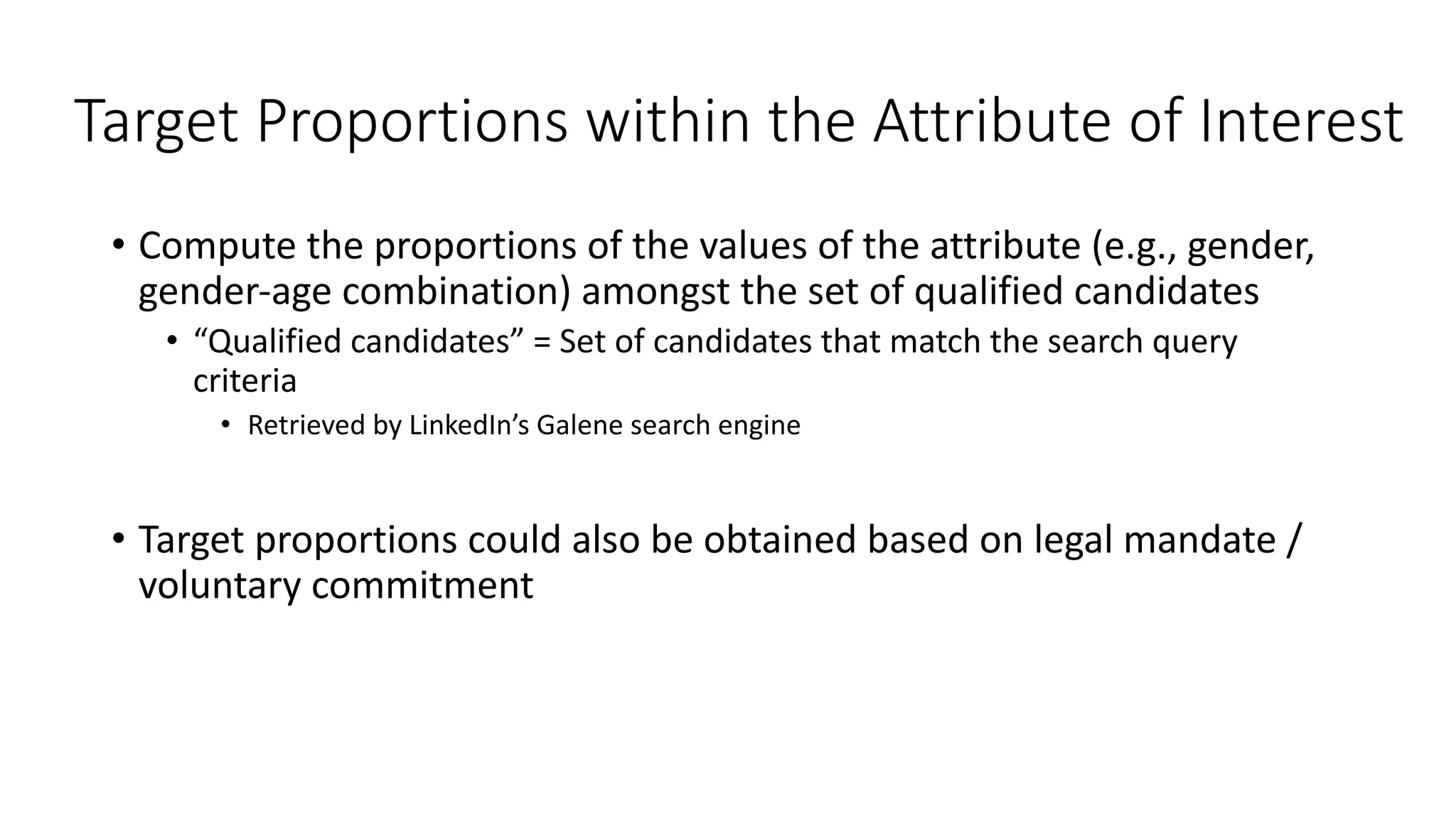
Target Proportions within the Attribute of Interest
• Compute the proportions of the values of the attribute (e.g., gender,
gender-age combination) amongst the set of qualified candidates
• “Qualified candidates” = Set of candidates that match the search query
criteria
• Retrieved by LinkedIn’s Galene search engine
• Target proportions could also be obtained based on legal mandate /
voluntary commitment
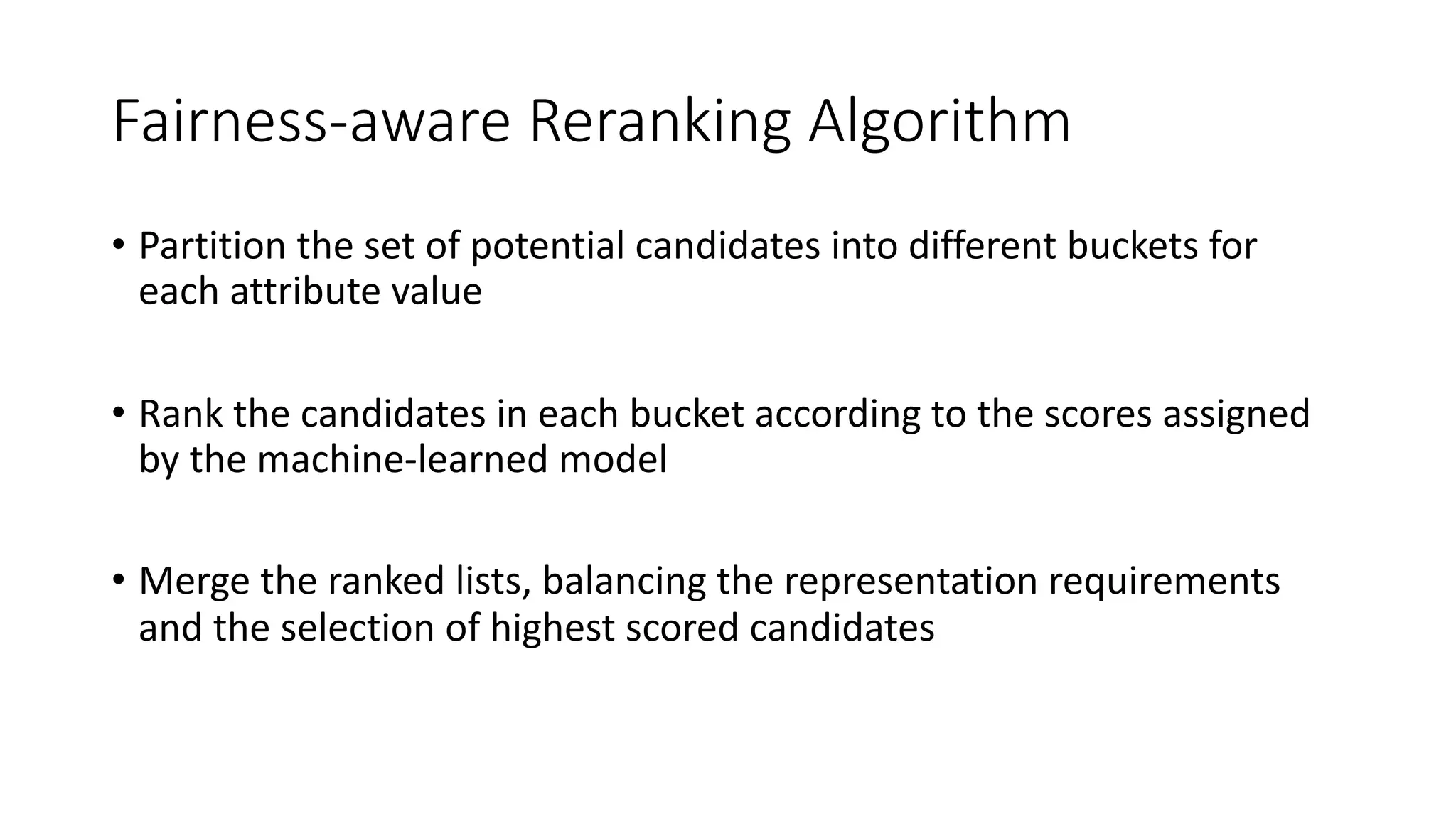
Fairness-aware Reranking Algorithm
• Partition the set of potential candidates into different buckets for
each attribute value
• Rank the candidates in each bucket according to the scores assigned
by the machine-learned model
• Merge the ranked lists, balancing the representation requirements
and the selection of highest scored candidates
Architecture
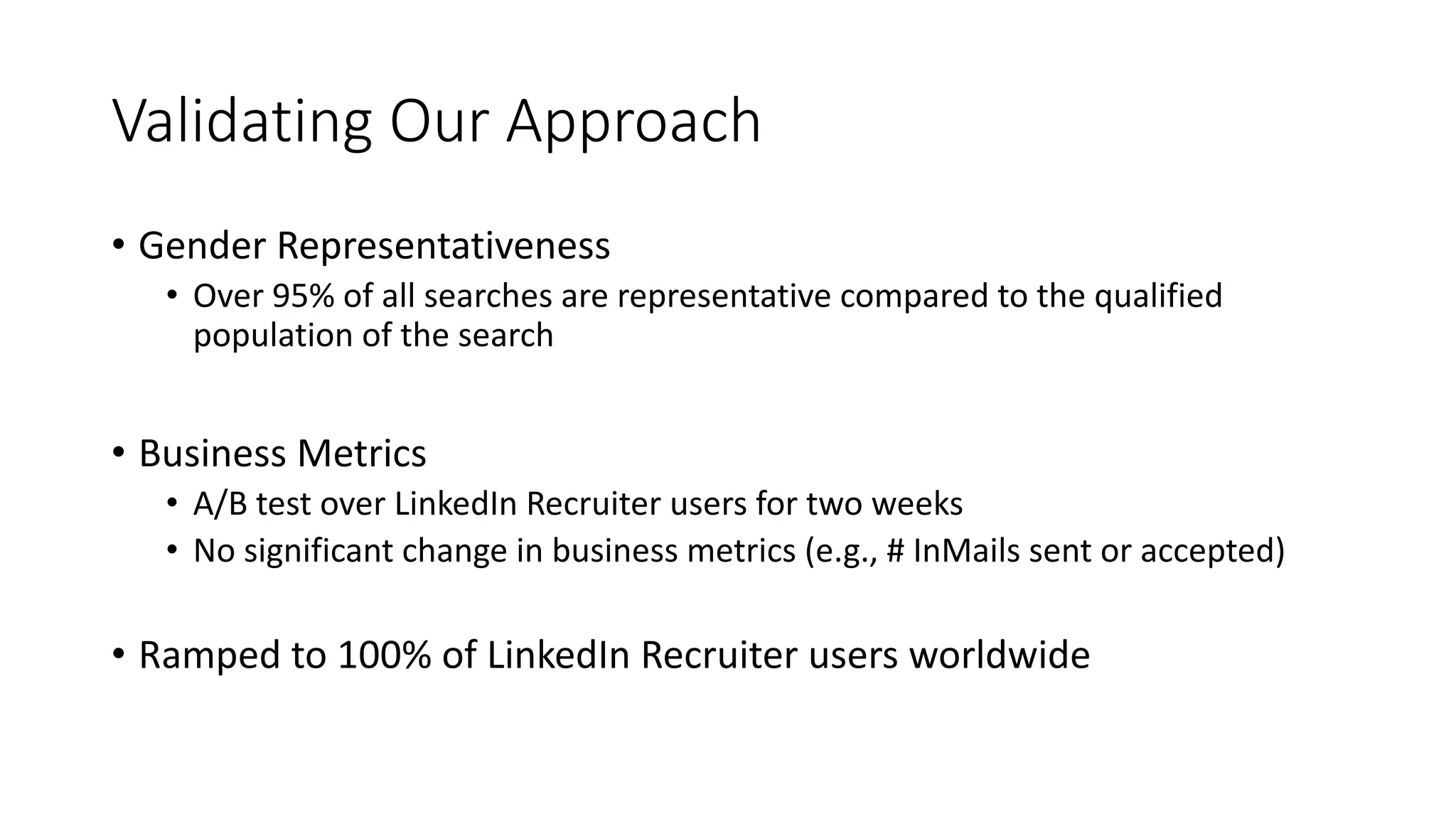
Validating Our Approach
• Gender Representativeness
• Over 95% of all searches are representative compared to the qualified
population of the search
• Business Metrics
• A/B test over LinkedIn Recruiter users for two weeks
• No significant change in business metrics (e.g., # InMails sent or accepted)
• Ramped to 100% of LinkedIn Recruiter users worldwide
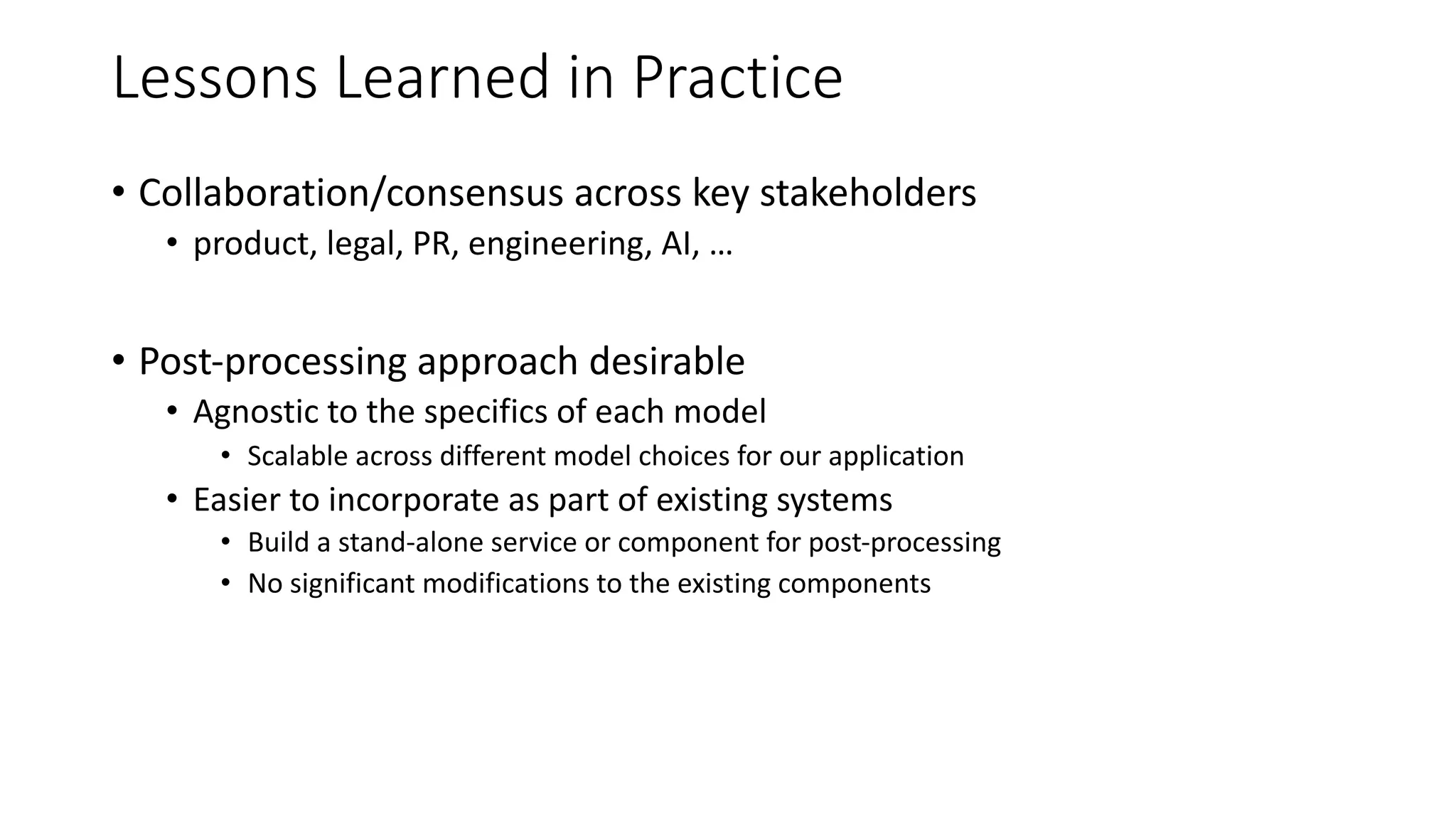
Lessons Learned in Practice
• Collaboration/consensus across key stakeholders
• product, legal, PR, engineering, AI, …
• Post-processing approach desirable
• Agnostic to the specifics of each model
• Scalable across different model choices for our application
• Easier to incorporate as part of existing systems
• Build a stand-alone service or component for post-processing
• No significant modifications to the existing components
Acknowledgements
•Team:
• AI/ML: Sahin Cem Geyik, Stuart Ambler, Krishnaram Kenthapadi
• Application Engineering: Gurwinder Gulati, Chenhui Zhai
• Analytics: Patrick Driscoll, Divyakumar Menghani
• Product: Rachel Kumar
•Acknowledgements (in alphabetical order)
• Deepak Agarwal, Erik Buchanan, Patrick Cheung, Gil Cottle, Nadia
Fawaz, Rob Hallman, Joshua Hartman, Sara Harrington, Heloise Logan,
Stephen Lynch, Lei Ni, Igor Perisic, Ram Swaminathan, Ketan Thakkar,
Janardhanan Vembunarayanan, Hinkmond Wong, Lin Yang, Liang
Zhang, Yani Zhang
Reflections
• Lessons from privacy & fairness challenges è
Need “Privacy and Fairness by Design” approach
when building AI products
• Case studies on privacy & fairness @ LinkedIn
• Collaboration/consensus across key stakeholders
(product, legal, PR, engineering, AI, …)
Thanks! Questions?
• References
• K. Kenthapadi, I. Mironov, A. G. Thakurta, Privacy-preserving Data Mining in Industry:
Practical Challenges and Lessons Learned, ACM KDD 2018 Tutorial (Slide deck)
• K. Kenthapadi, T. T. L. Tran, PriPeARL: A Framework for Privacy-Preserving Analytics and
Reporting at LinkedIn, ACM CIKM 2018
• K. Kenthapadi, A. Chudhary, S. Ambler, LinkedIn Salary: A System for Secure Collection
and Presentation of Structured Compensation Insights to Job Seekers, IEEE Symposium
on Privacy-Aware Computing (PAC), 2017
• S. C. Geyik, S. Ambler, K. Kenthapadi, Fairness Aware Talent Search Ranking at
LinkedIn, Microsoft’s AI/ML conference (MLADS Spring 2018). Distinguished
Contribution Award
• S. C. Geyik, K. Kenthapadi, Building Representative Talent Search at LinkedIn,
LinkedIn engineering blog post, October 2018
kkenthapadi@linkedin.com
Backup
Privacy: A Historical Perspective
Privacy Breaches and Lessons Learned
Attacks on privacy
•Governor of Massachusetts
•AOL
•Netflix
•Web browsing data
•Facebook
•Amazon
•Genomic data
born July 31, 1945
resident of 02138
Massachusetts Group Insurance Commission (1997):
Anonymized medical history of state employees (all
hospital visits, diagnosis, prescriptions)
Latanya Sweeney (MIT grad student): $20 – Cambridge voter roll
William Weld vs Latanya Sweeney
Attacker's Advantage
ØAuxiliary information
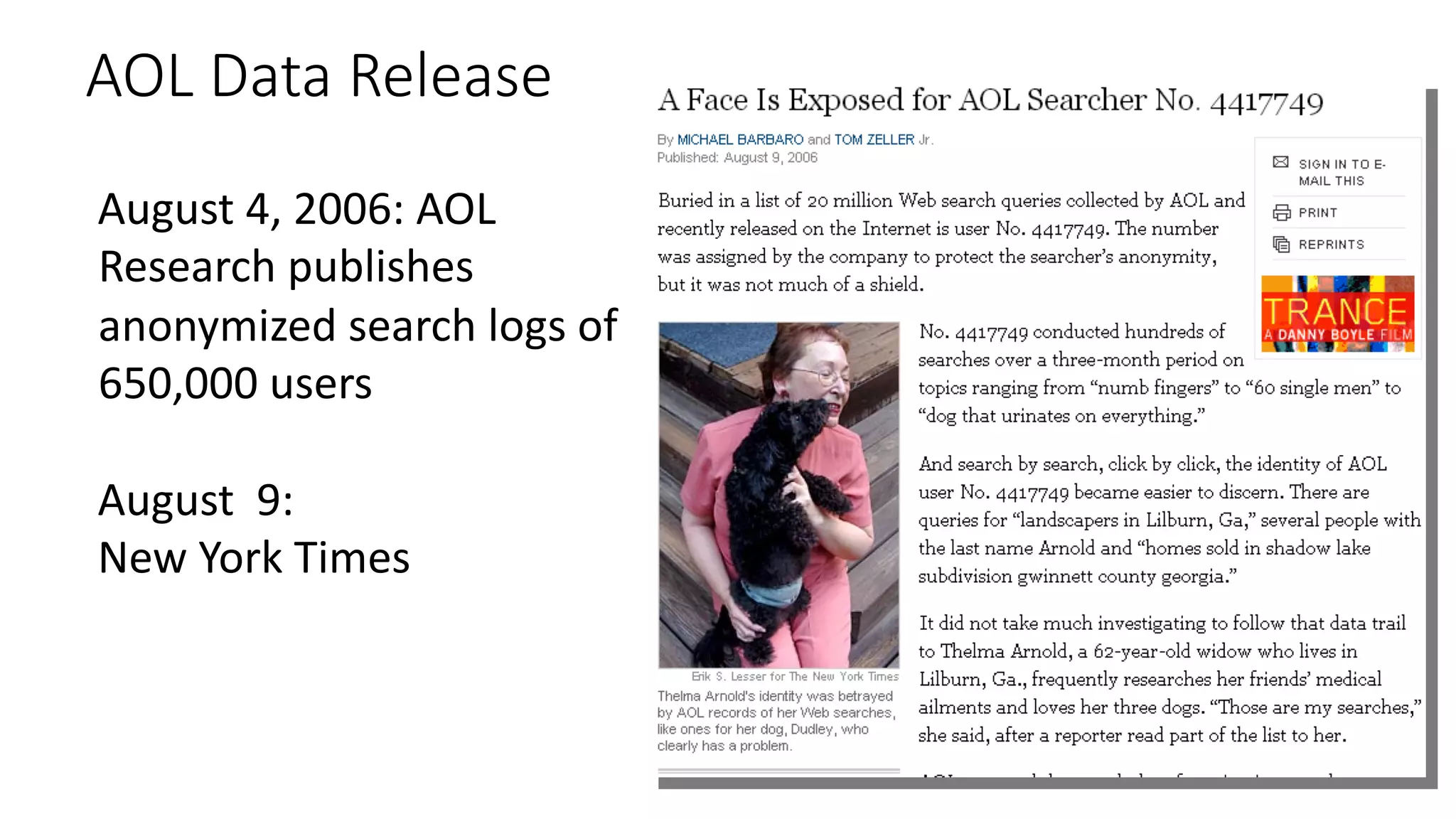
August 4, 2006: AOL
Research publishes
anonymized search logs of
650,000 users
August 9:
New York Times
AOL Data Release
Attacker's Advantage
ØAuxiliary information
ØEnough to succeed on a small fraction of inputs
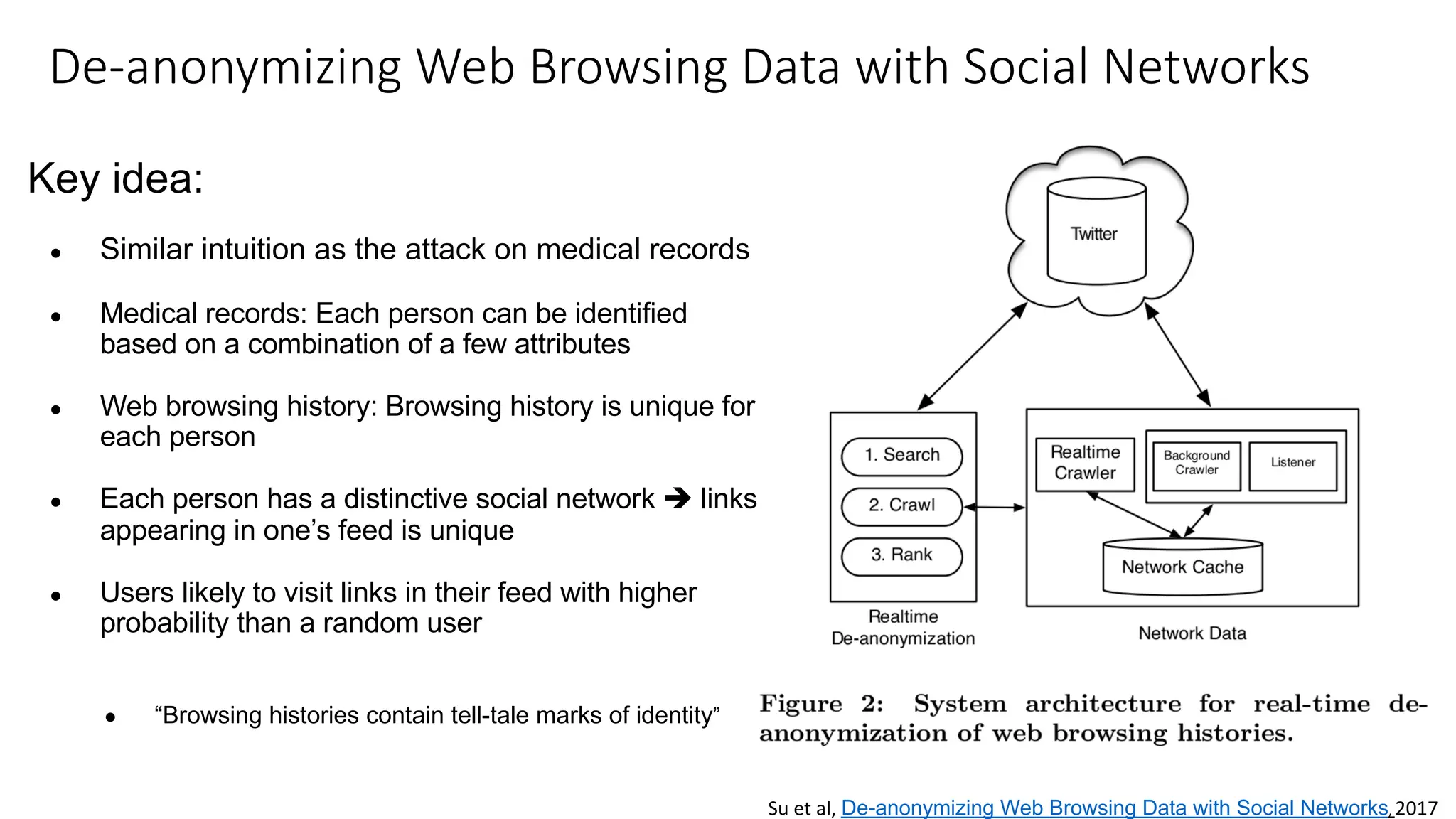
Key idea:
● Similar intuition as the attack on medical records
● Medical records: Each person can be identified
based on a combination of a few attributes
● Web browsing history: Browsing history is unique for
each person
● Each person has a distinctive social network è links
appearing in one’s feed is unique
● Users likely to visit links in their feed with higher
probability than a random user
● “Browsing histories contain tell-tale marks of identity”
Su et al, De-anonymizing Web Browsing Data with Social Networks, 2017
De-anonymizing Web Browsing Data with Social Networks
Attacker's Advantage
ØAuxiliary information
ØEnough to succeed on a small fraction of inputs
ØHigh dimensionality
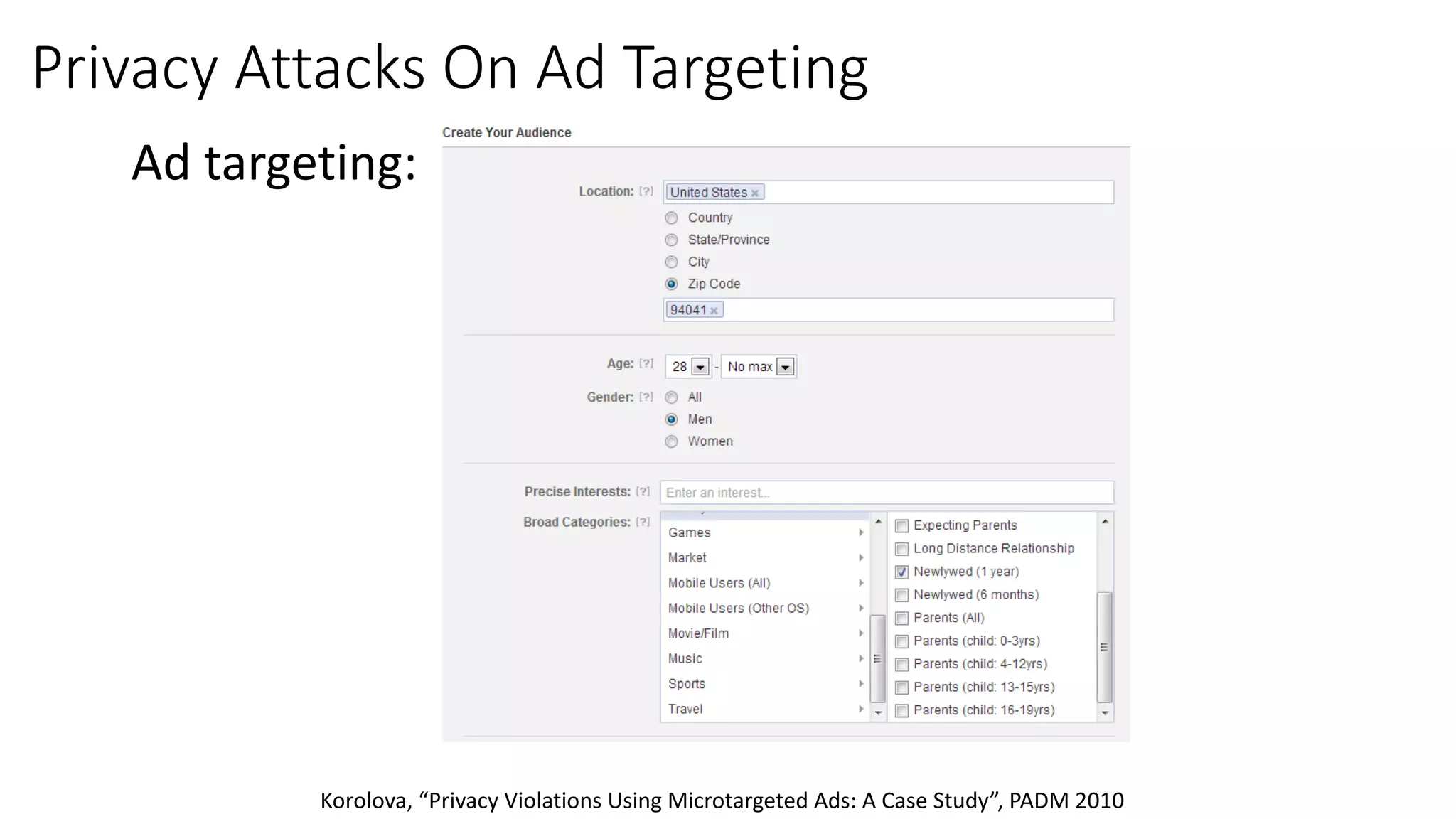
Ad targeting:
Korolova, “Privacy Violations Using Microtargeted Ads: A Case Study”, PADM 2010
Privacy Attacks On Ad Targeting
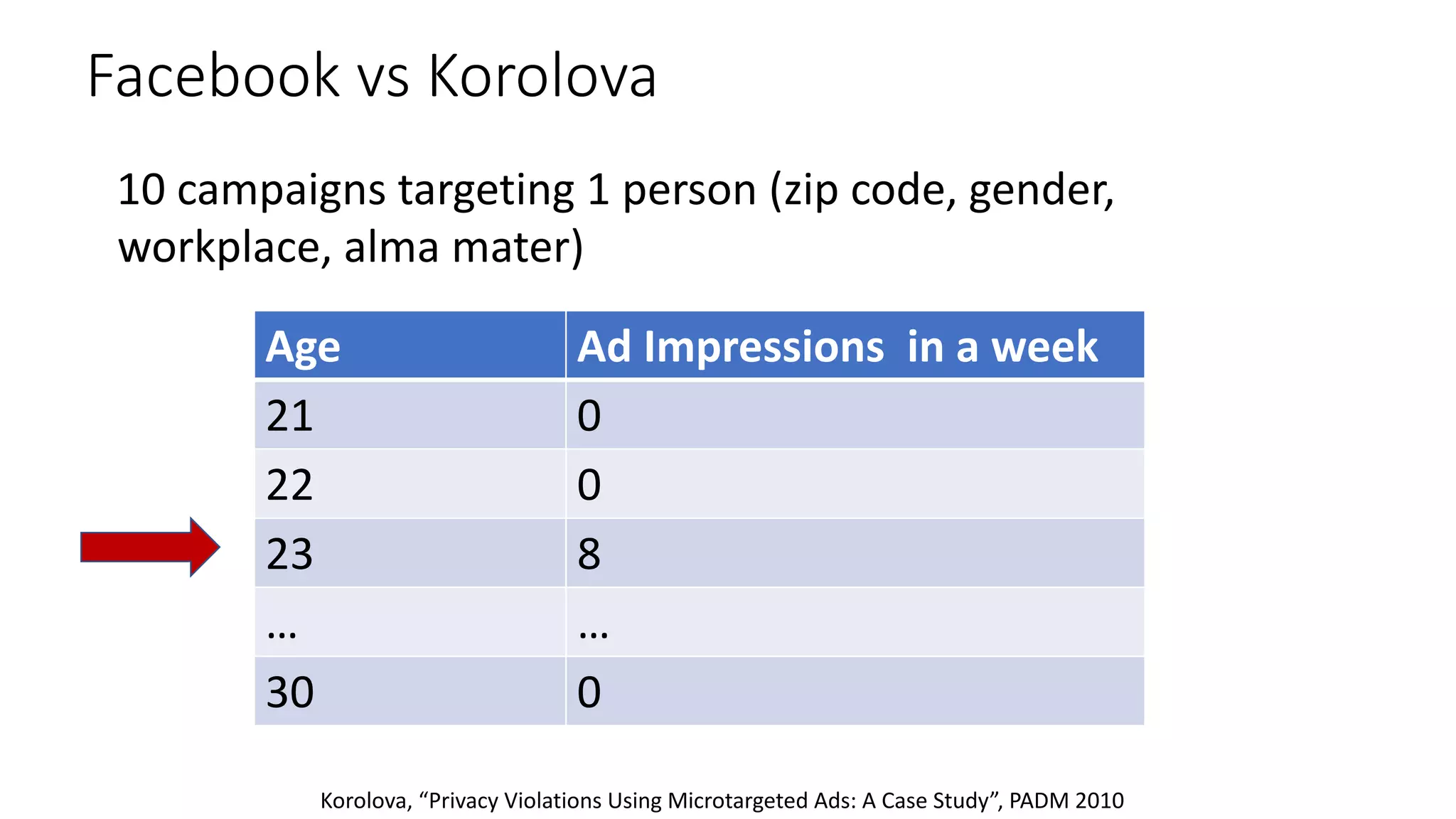
10 campaigns targeting 1 person (zip code, gender,
workplace, alma mater)
Korolova, “Privacy Violations Using Microtargeted Ads: A Case Study”, PADM 2010
Facebook vs Korolova
Age
21
22
23
…
30
Ad Impressions in a week
0
0
8
…
0
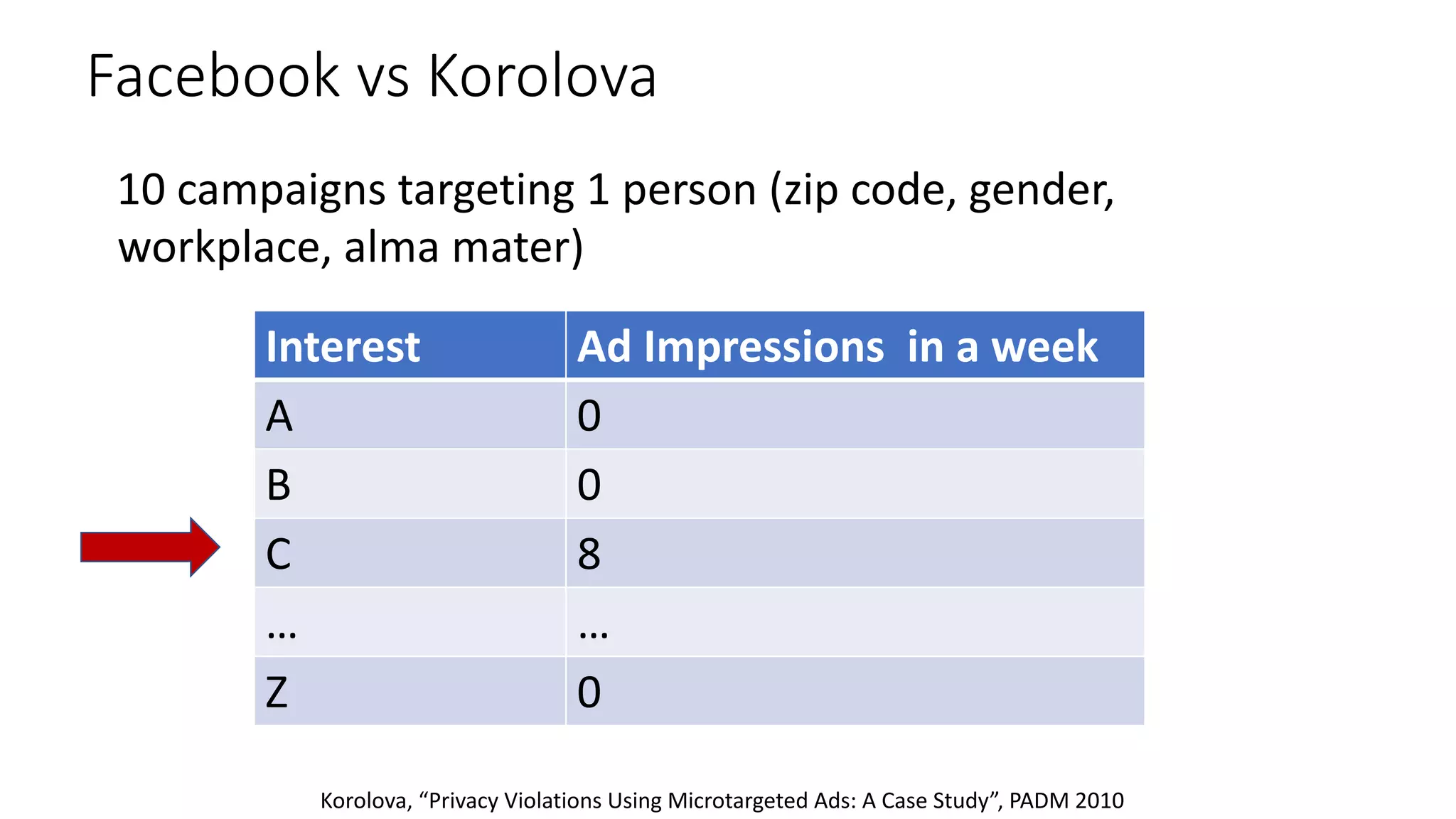
10 campaigns targeting 1 person (zip code, gender,
workplace, alma mater)
Korolova, “Privacy Violations Using Microtargeted Ads: A Case Study”, PADM 2010
Facebook vs Korolova
Interest
A
B
C
…
Z
Ad Impressions in a week
0
0
8
…
0
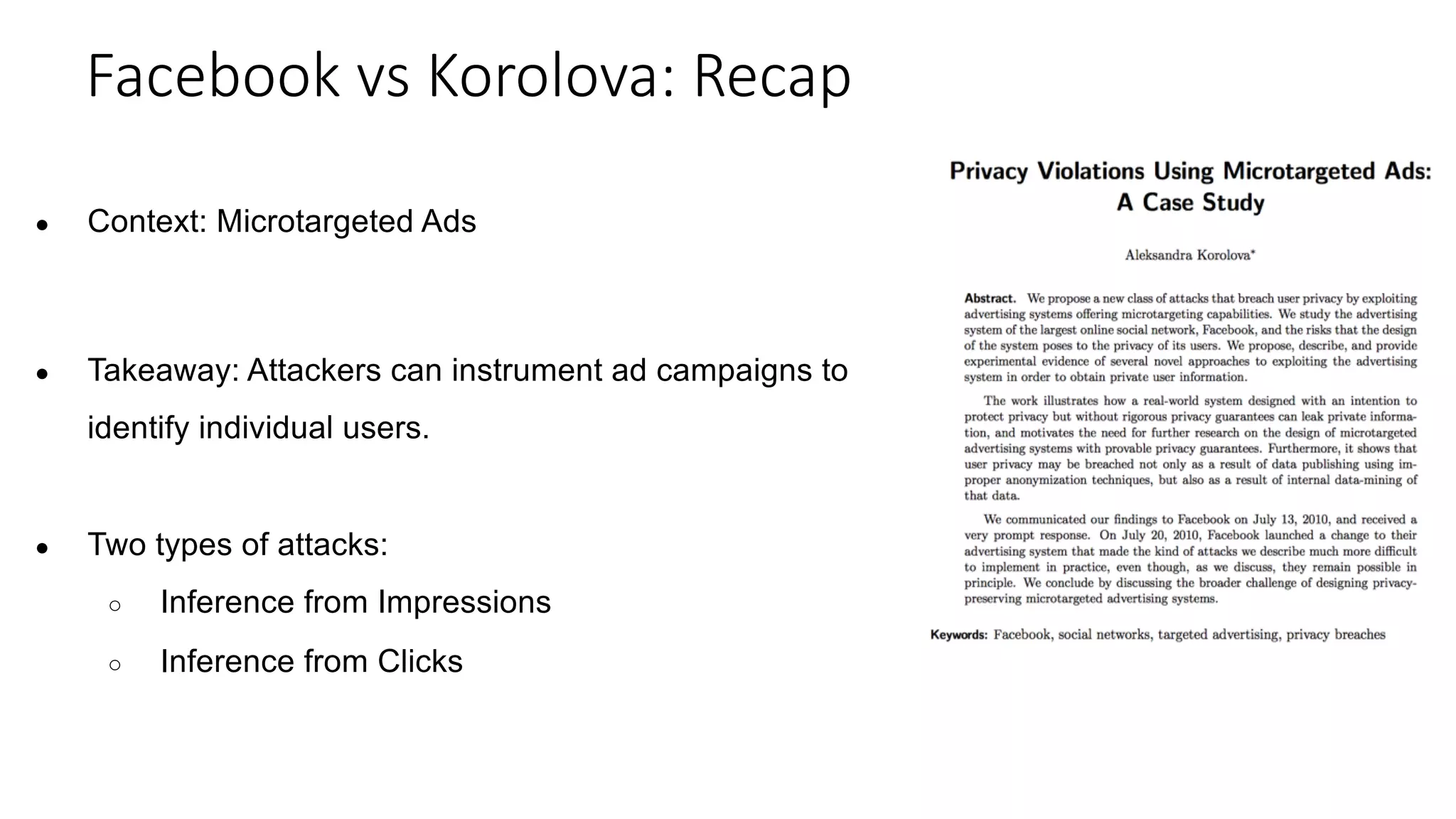
● Context: Microtargeted Ads
● Takeaway: Attackers can instrument ad campaigns to
identify individual users.
● Two types of attacks:
○ Inference from Impressions
○ Inference from Clicks
Facebook vs Korolova: Recap
Attacker's Advantage
ØAuxiliary information
ØEnough to succeed on a small fraction of inputs
ØHigh dimensionality
ØActive
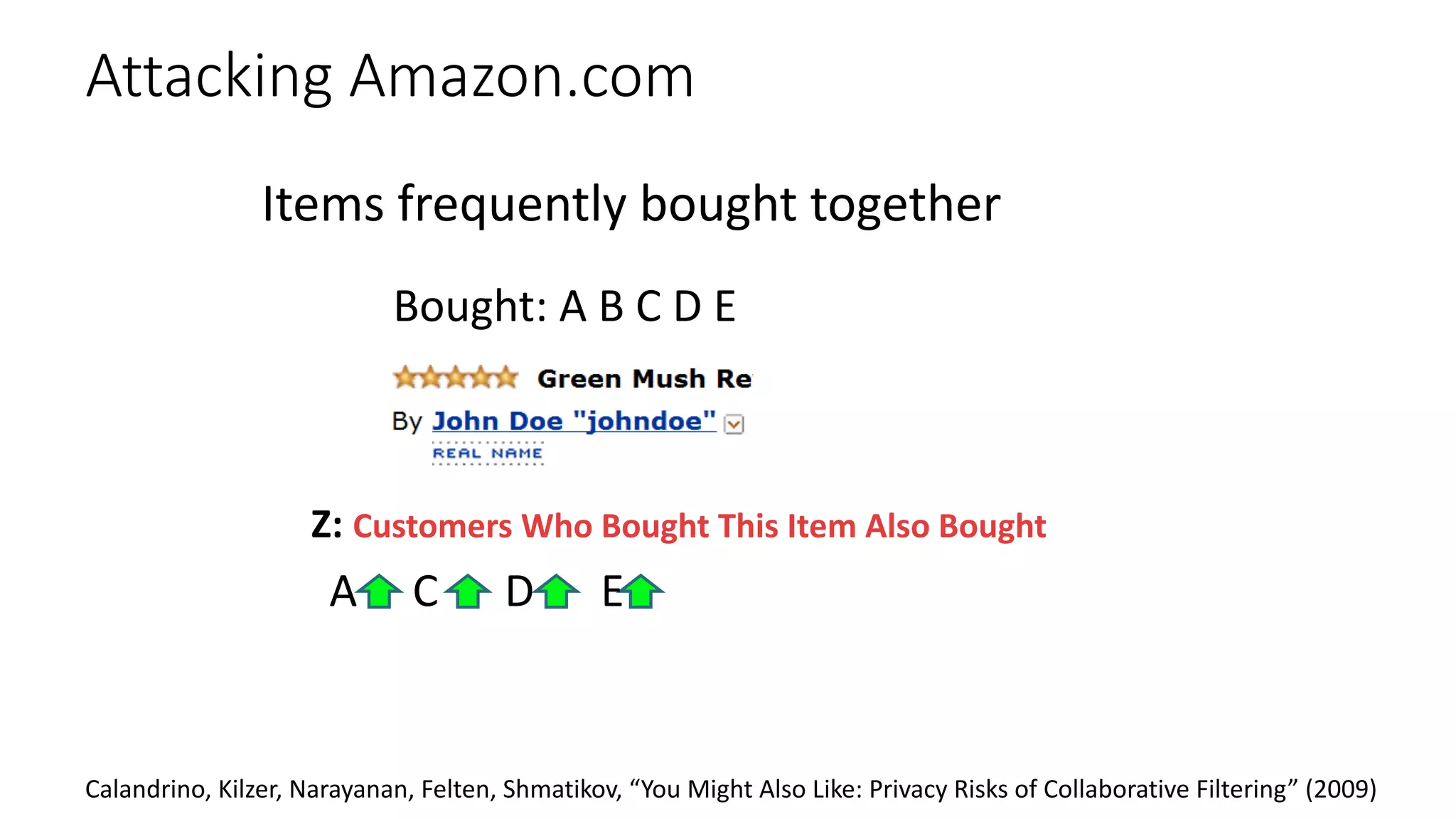
Items frequently bought together
Bought: A B C D E
Z: Customers Who Bought This Item Also Bought
Calandrino, Kilzer, Narayanan, Felten, Shmatikov, “You Might Also Like: Privacy Risks of Collaborative Filtering” (2009)
Attacking Amazon.com
A C D E
Attacker's Advantage
ØAuxiliary information
ØEnough to succeed on a small fraction of inputs
ØHigh dimensionality
ØActive
ØObservant
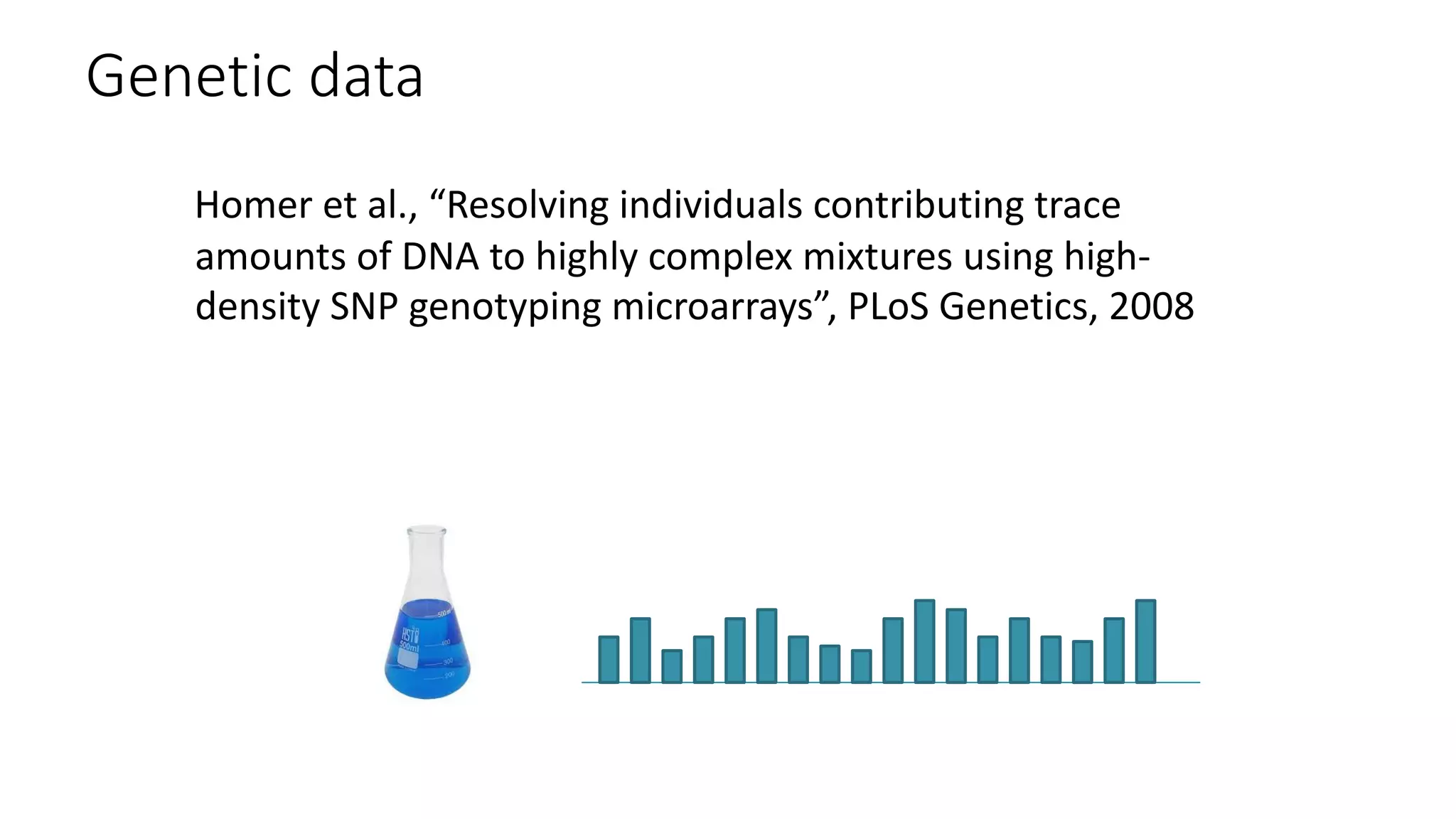
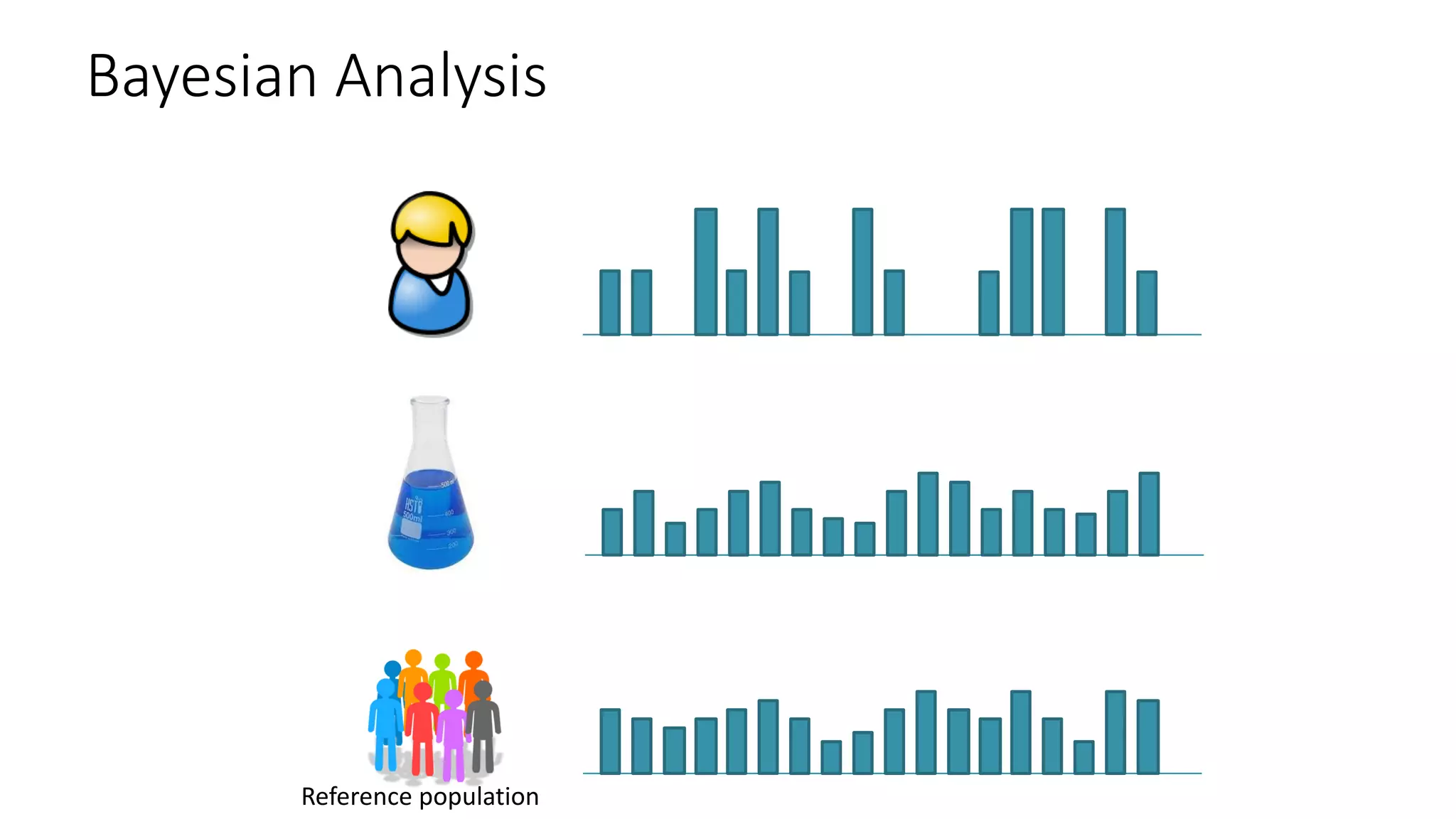
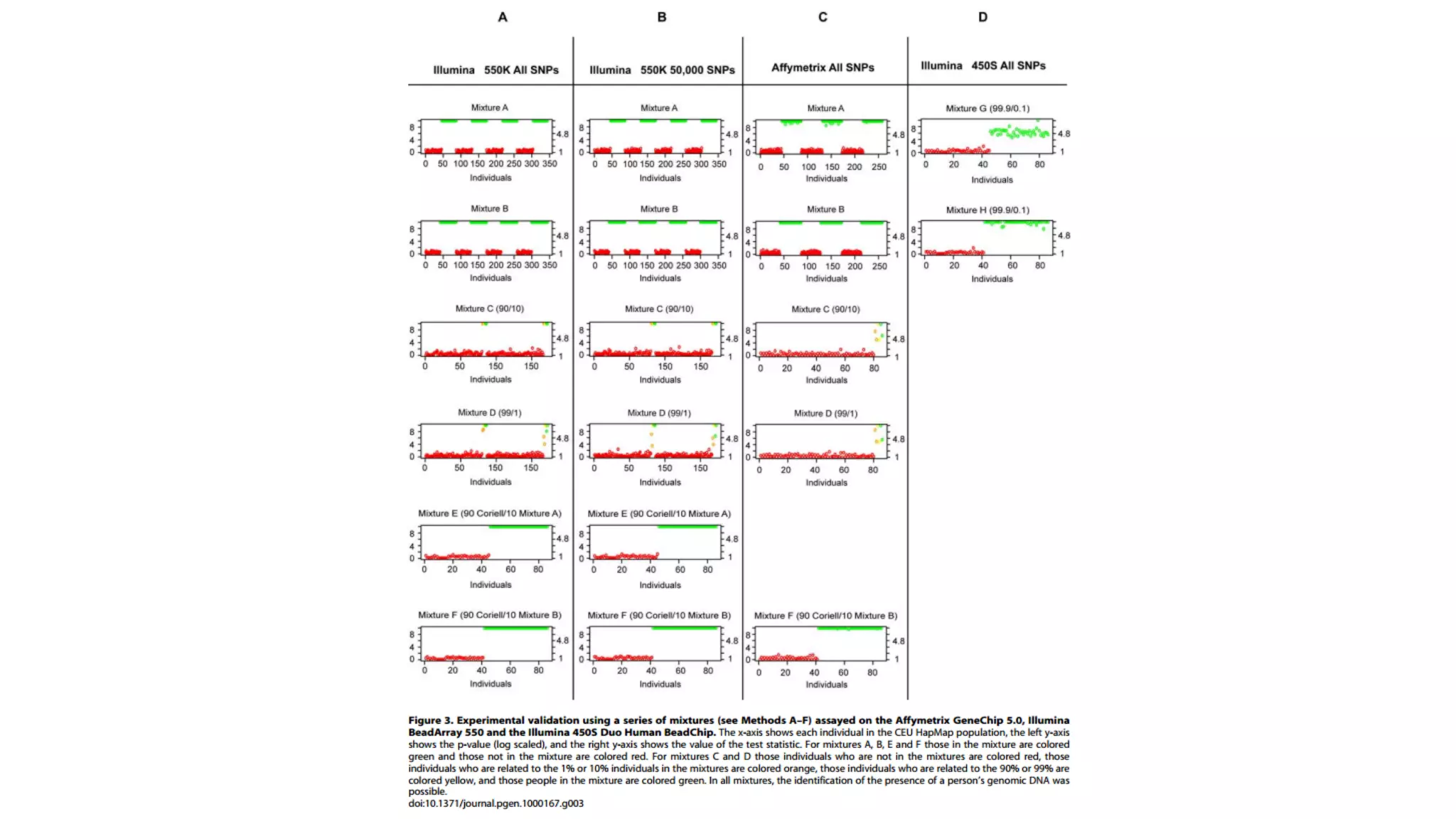
Homer et al., “Resolving individuals contributing trace
amounts of DNA to highly complex mixtures using high-
density SNP genotyping microarrays”, PLoS Genetics, 2008
Genetic data
Reference population
Bayesian Analysis
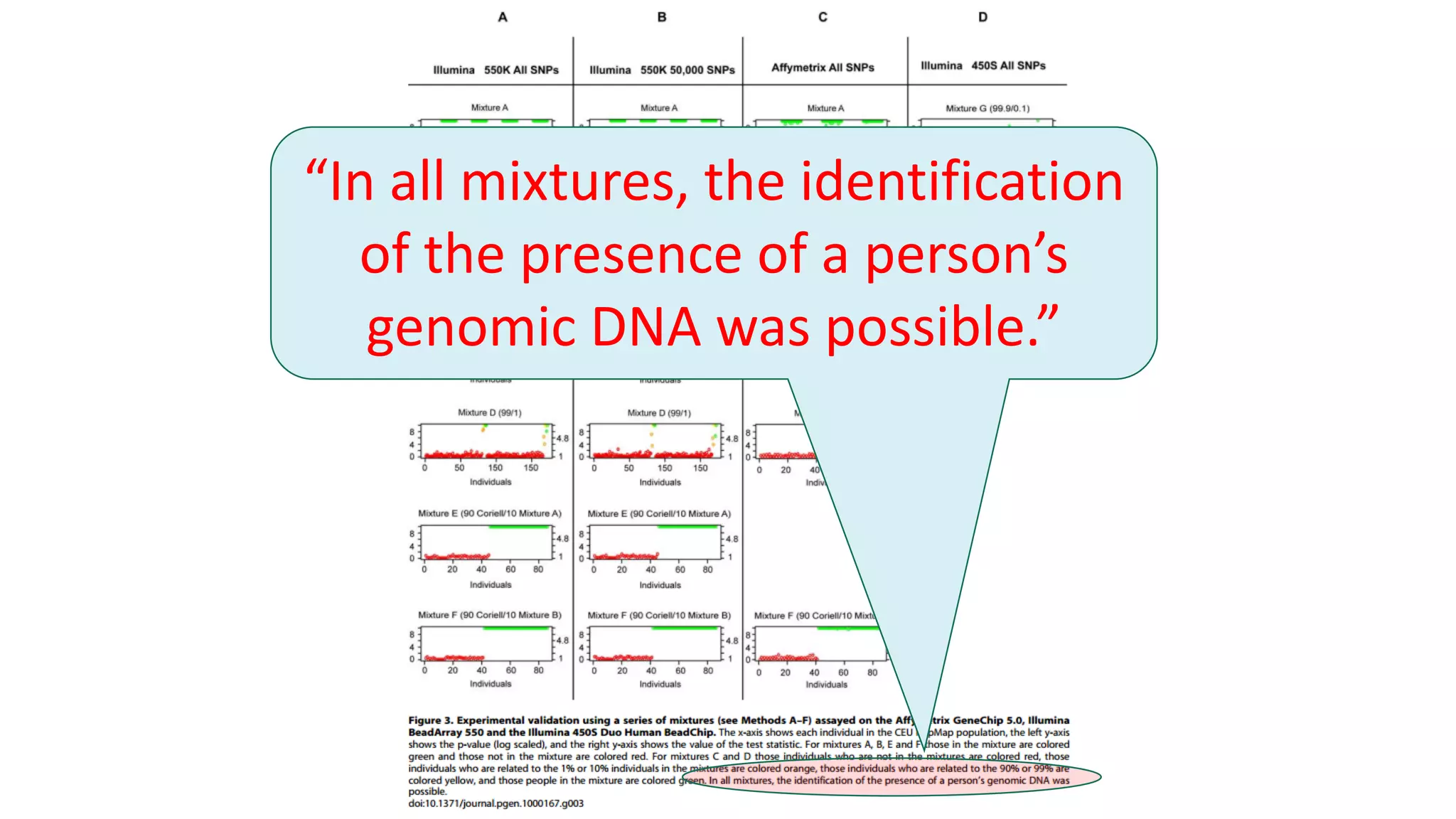
“In all mixtures, the identification
of the presence of a person’s
genomic DNA was possible.”
Zerhouni, NIH Director:
“As a result, the NIH has removed from open-
access databases the aggregate results
(including P values and genotype counts) for all
the GWAS that had been available on NIH sites”
… one week later
Attacker's Advantage
ØAuxiliary information
ØEnough to succeed on a small fraction of inputs
ØHigh dimensionality
ØActive
ØObservant
ØClever
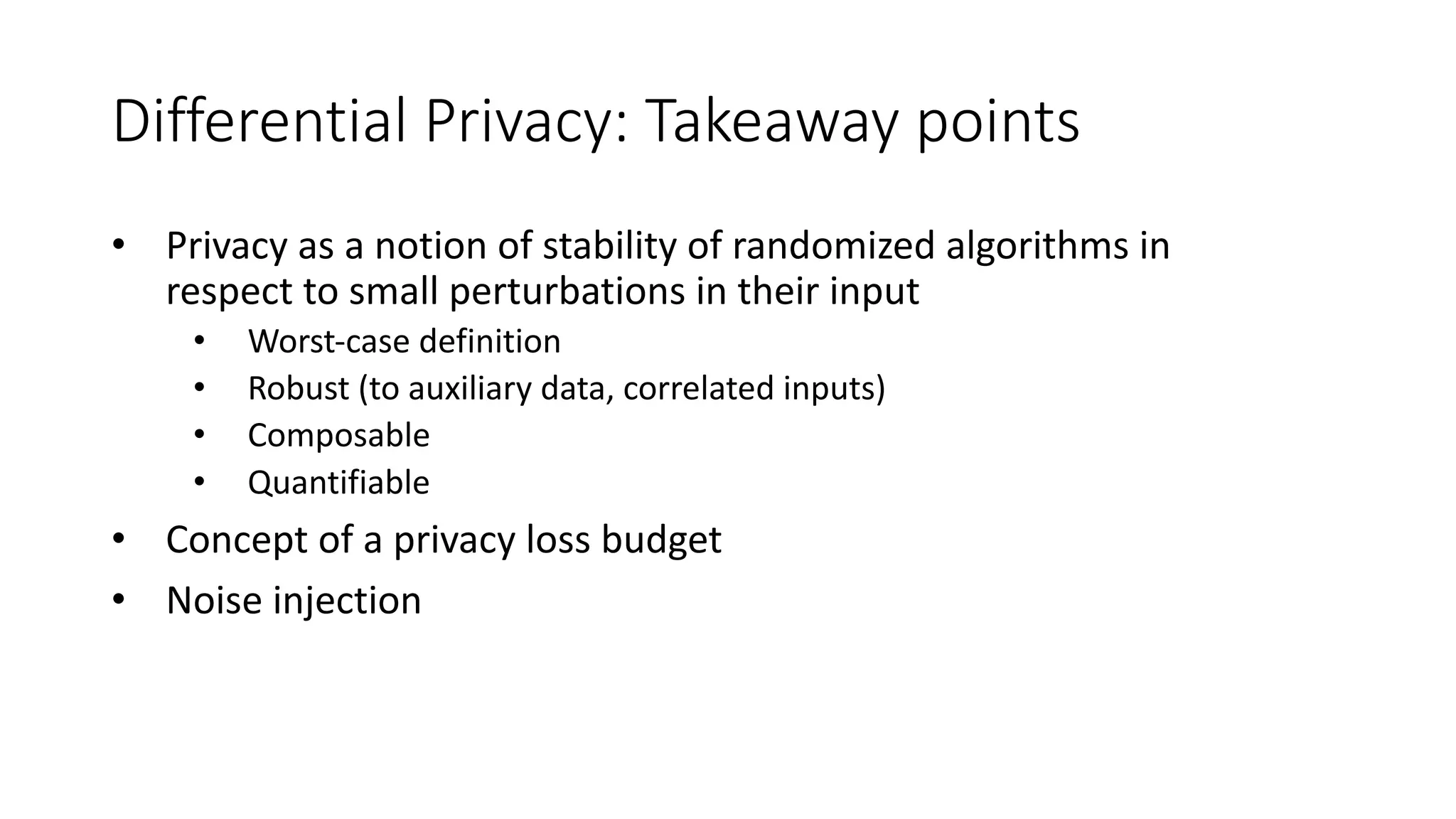
Differential Privacy: Takeaway points
• Privacy as a notion of stability of randomized algorithms in
respect to small perturbations in their input
• Worst-case definition
• Robust (to auxiliary data, correlated inputs)
• Composable
• Quantifiable
• Concept of a privacy loss budget
• Noise injection
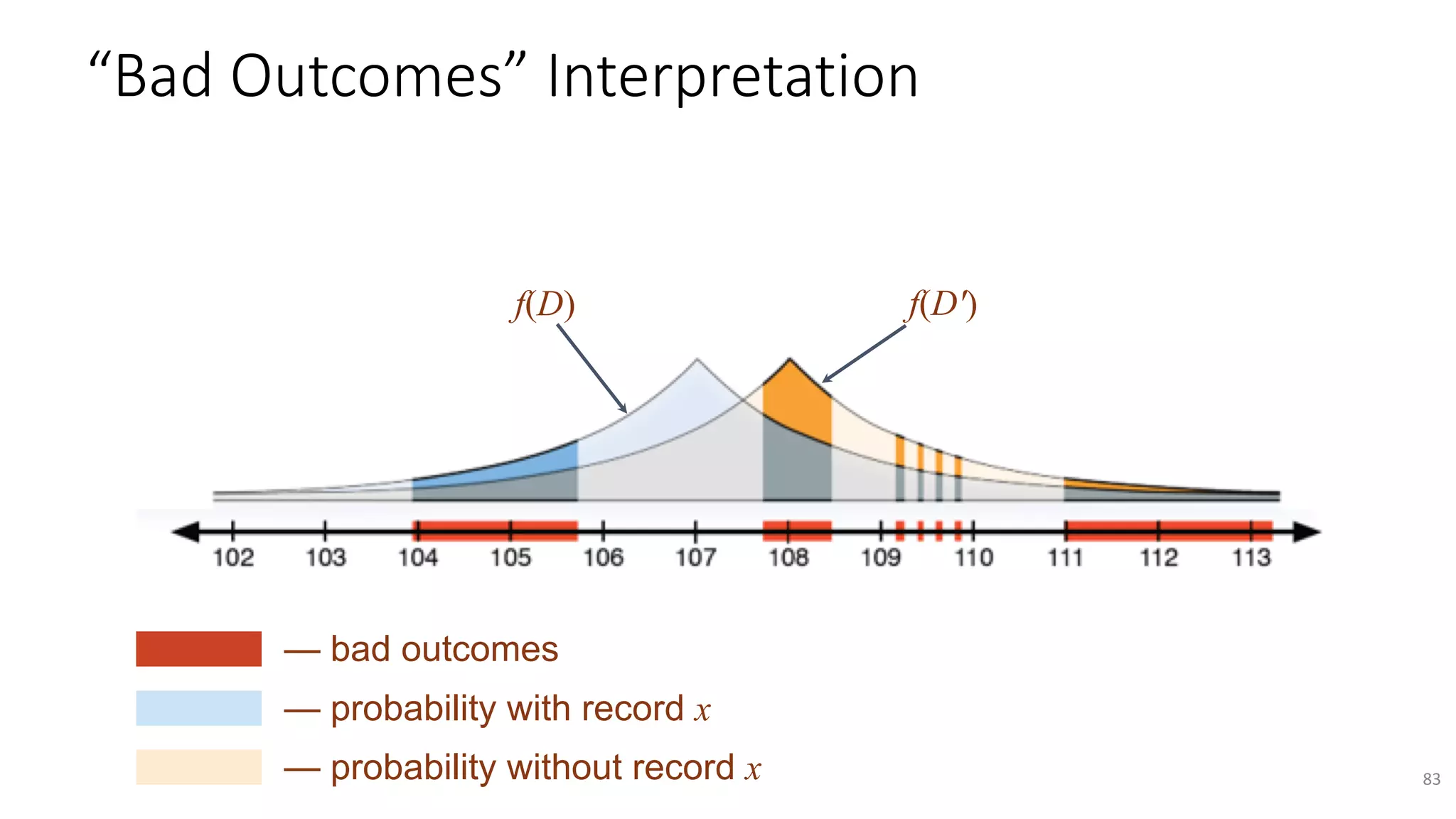
83
f(D) f(D′)
— bad outcomes
— probability with record x
— probability without record x
“Bad Outcomes” Interpretation
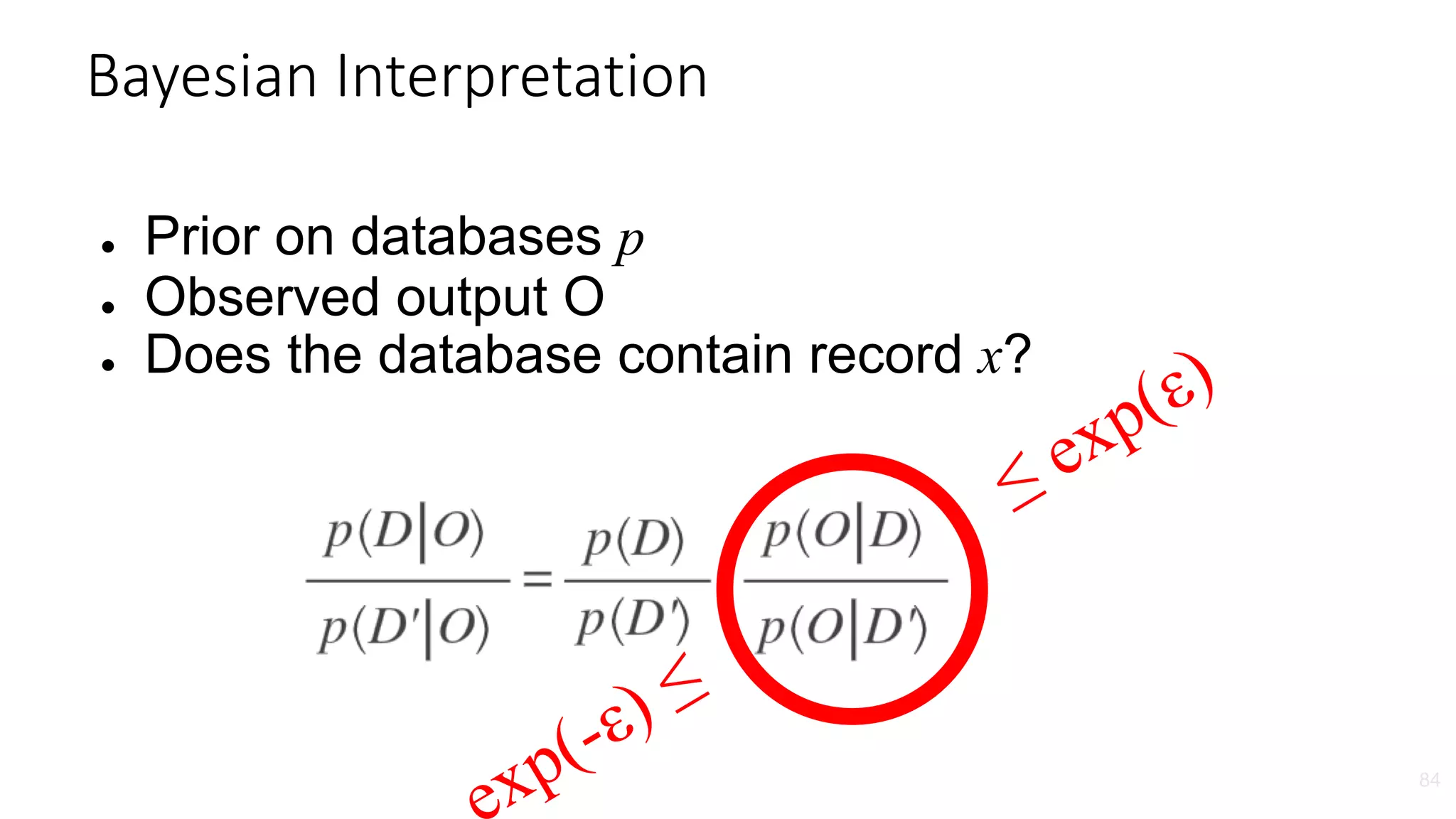
● Prior on databases p
● Observed output O
● Does the database contain record x?
84
xp(-ε) ≤
≤ exp(ε)
Bayesian Interpretation
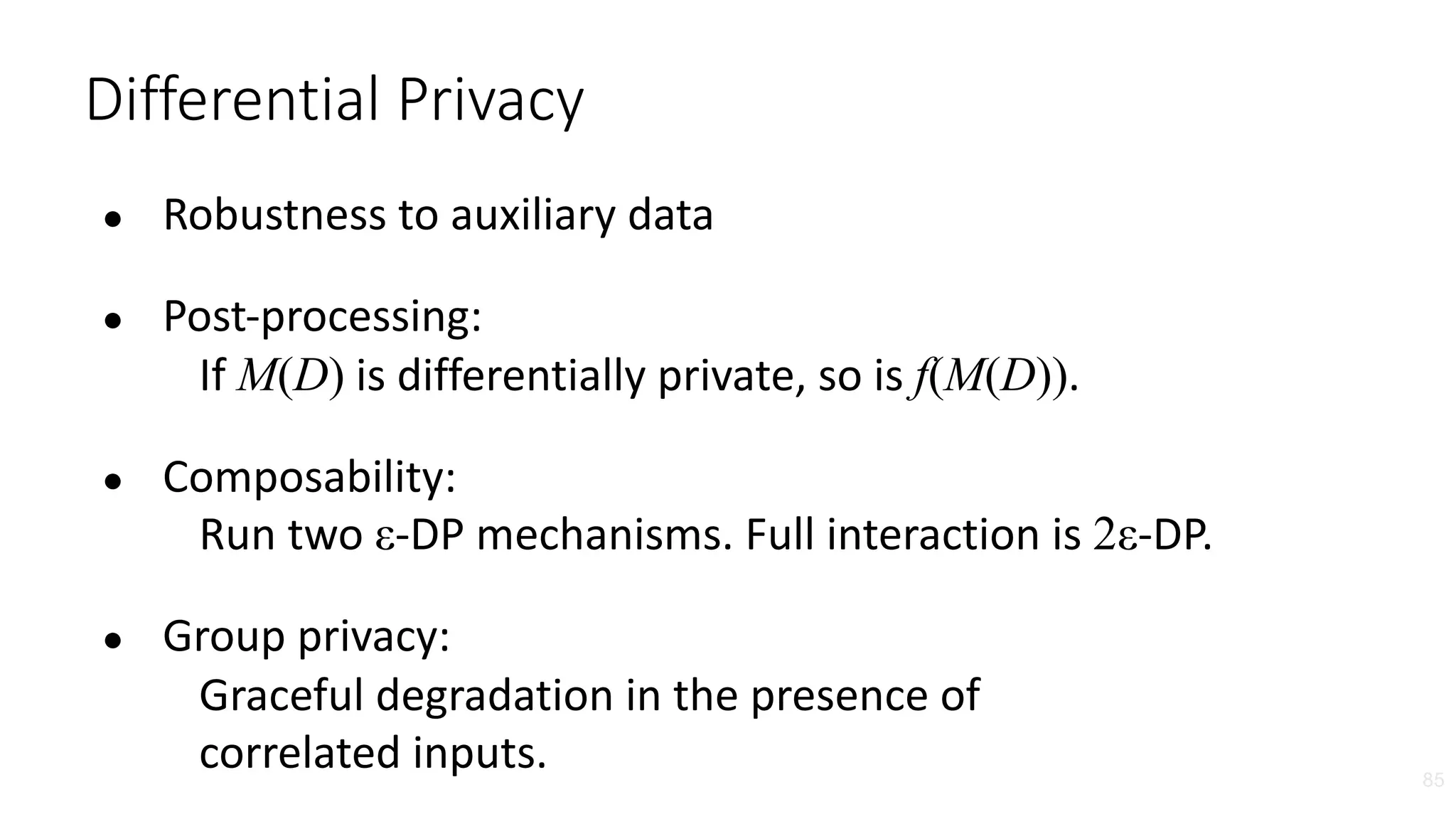
● Robustness to auxiliary data
● Post-processing:
If M(D) is differentially private, so is f(M(D)).
● Composability:
Run two ε-DP mechanisms. Full interaction is 2ε-DP.
● Group privacy:
Graceful degradation in the presence of
correlated inputs. 85
Differential Privacy
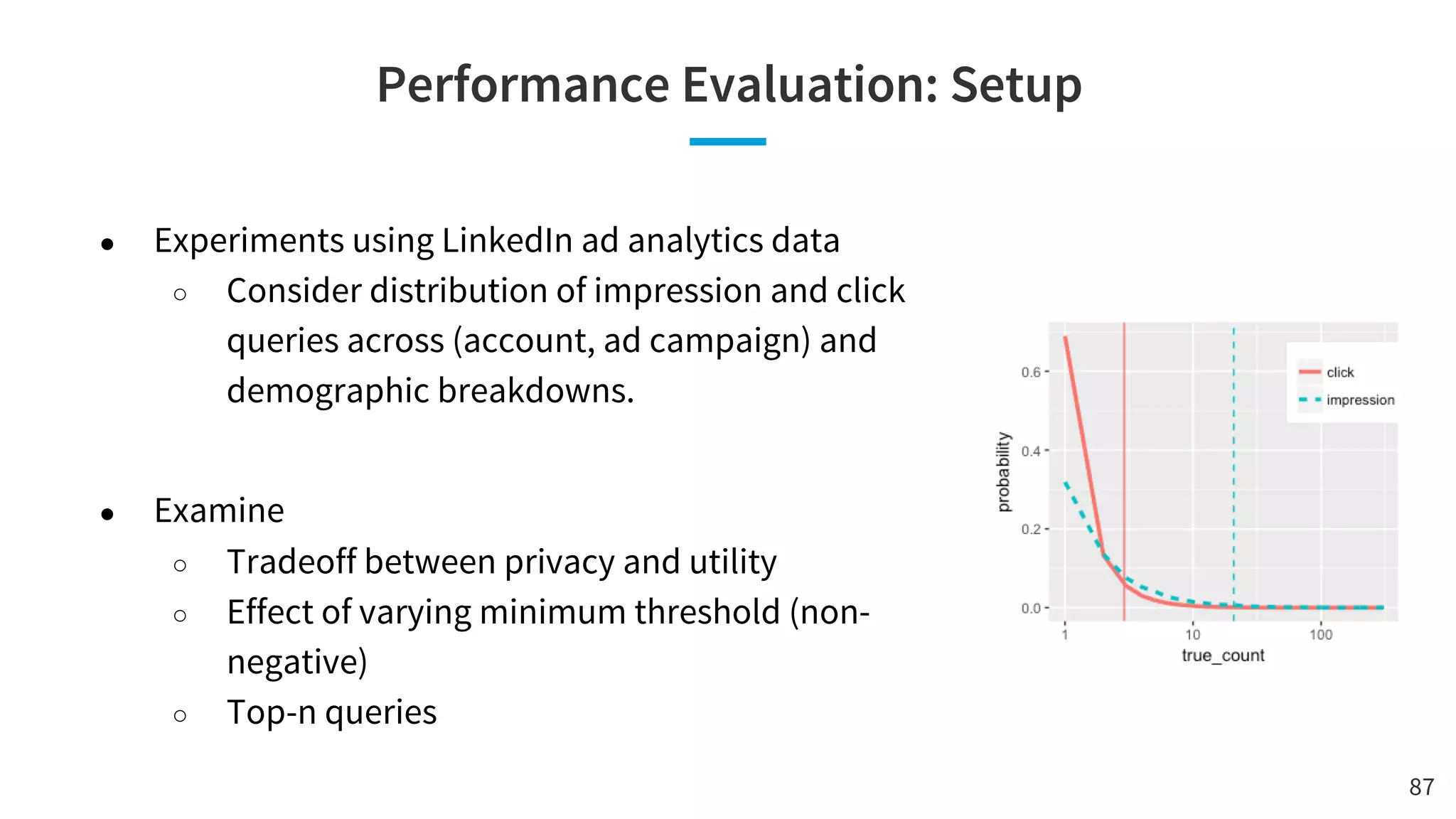
Performance Evaluation: Setup
87
● Experiments using LinkedIn ad analytics data
○ Consider distribution of impression and click
queries across (account, ad campaign) and
demographic breakdowns.
● Examine
○ Tradeoff between privacy and utility
○ Effect of varying minimum threshold (non-
negative)
○ Top-n queries
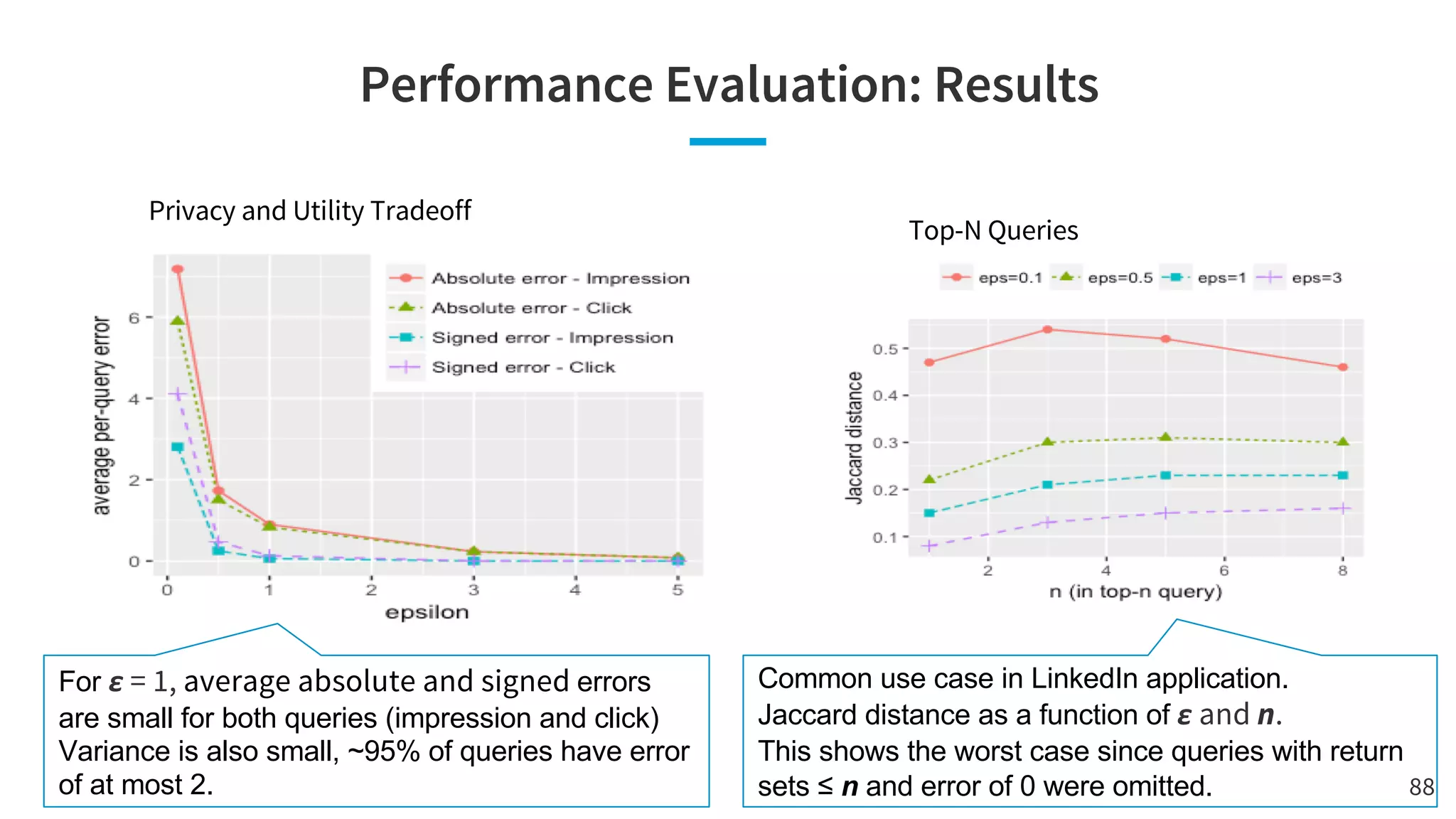
Performance Evaluation: Results
88
Privacy and Utility Tradeoff
For ε = 1, average absolute and signed errors
are small for both queries (impression and click)
Variance is also small, ~95% of queries have error
of at most 2.
Top-N Queries
Common use case in LinkedIn application.
Jaccard distance as a function of ε and n.
This shows the worst case since queries with return
sets ≤ n and error of 0 were omitted.
LinkedIn Salary
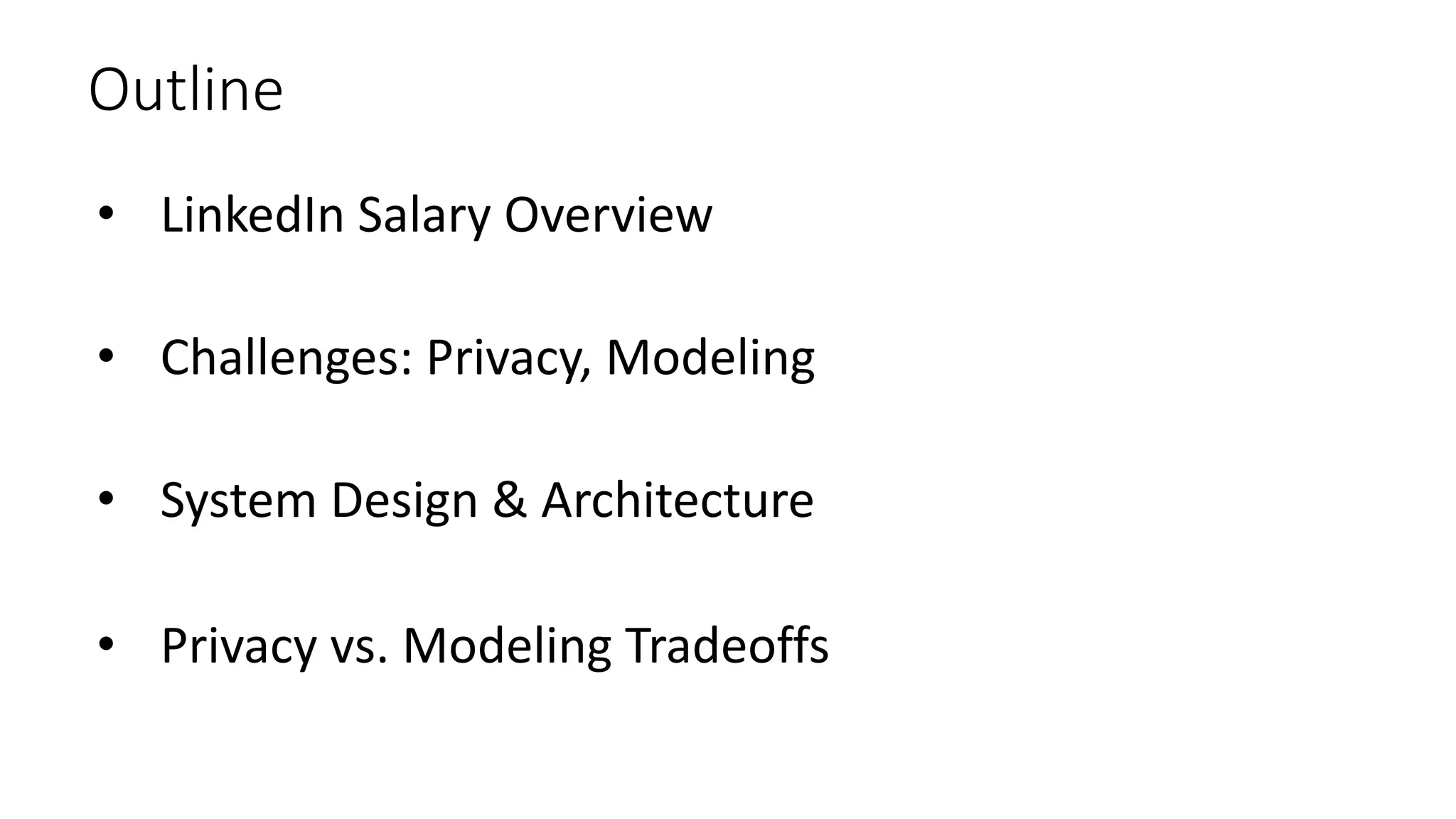
Outline
• LinkedIn Salary Overview
• Challenges: Privacy, Modeling
• System Design & Architecture
• Privacy vs. Modeling Tradeoffs
LinkedIn Salary (launched in Nov, 2016)
Salary Collection Flow via Email Targeting
Current Reach (November 2018)
• A few million responses out of several millions of members targeted
• Targeted via emails since early 2016
• Countries: US, CA, UK, DE, IN, …
• Insights available for a large fraction of US monthly active users
Data Privacy Challenges
• Minimize the risk of inferring any one individual’s compensation data
• Protection against data breach
• No single point of failure
Achieved by a combination of
techniques: encryption, access control,
, aggregation,
thresholding
K. Kenthapadi, A. Chudhary, and S.
Ambler, LinkedIn Salary: A System
for Secure Collection and
Presentation of Structured
Compensation Insights to Job
Seekers, IEEE PAC 2017
(arxiv.org/abs/1705.06976)
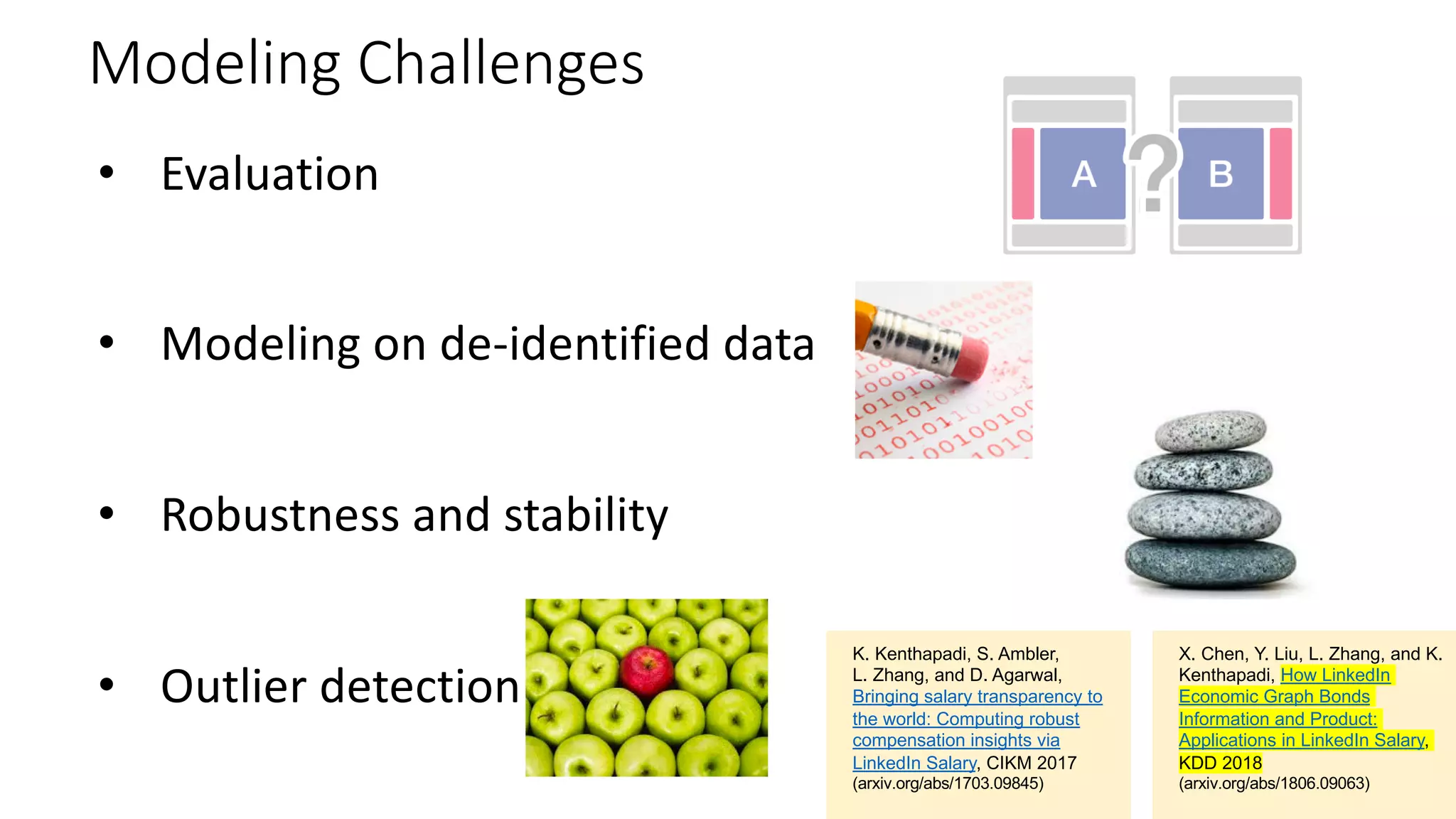
Modeling Challenges
• Evaluation
• Modeling on de-identified data
• Robustness and stability
• Outlier detection
X. Chen, Y. Liu, L. Zhang, and K.
Kenthapadi, How LinkedIn
Economic Graph Bonds
Information and Product:
Applications in LinkedIn Salary,
KDD 2018
(arxiv.org/abs/1806.09063)
K. Kenthapadi, S. Ambler,
L. Zhang, and D. Agarwal,
Bringing salary transparency to
the world: Computing robust
compensation insights via
LinkedIn Salary, CIKM 2017
(arxiv.org/abs/1703.09845)
Problem Statement
•How do we design LinkedIn Salary system taking into
account the unique privacy and security challenges,
while addressing the product requirements?
Open Question
• Can we apply rigorous approaches such as differential privacy in such a
setting?
• While meeting reliability / product coverage needs
• Worst case sensitivity of quantiles to any one user’s compensation data
is large
• è Large noise may need to be added, depriving reliability/usefulness
• Need compensation insights on a continual basis
• Theoretical work on applying differential privacy under continual observations
• No practical implementations / applications
• Local differential privacy / Randomized response based approaches (Google’s RAPPOR;
Apple’s iOS differential privacy; Microsoft’s telemetry collection) don’t seem applicable
Title Region
$$
User Exp
Designer
SF Bay
Area 100K
User Exp
Designer
SF Bay
Area 115K
... ...
...
Title Region
$$
User Exp
Designer
SF Bay
Area 100K
De-identification Example
Title Region Company Industry Years of
exp
Degree FoS Skills
$$
User Exp
Designer
SF Bay
Area
Google Internet 12 BS Interactive
Media
UX,
Graphics,
...
100K
Title Region Industry
$$
User Exp
Designer
SF Bay
Area
Internet
100K
Title Region Years of
exp $$
User Exp
Designer
SF Bay
Area
10+
100K
Title Region Company Years of
exp $$
User Exp
Designer
SF Bay
Area
Google 10+
100K
#data
points >
threshold?
Yes ⇒ Copy to
Hadoop (HDFS) Note: Original submission stored as encrypted objects.
System
Architecture
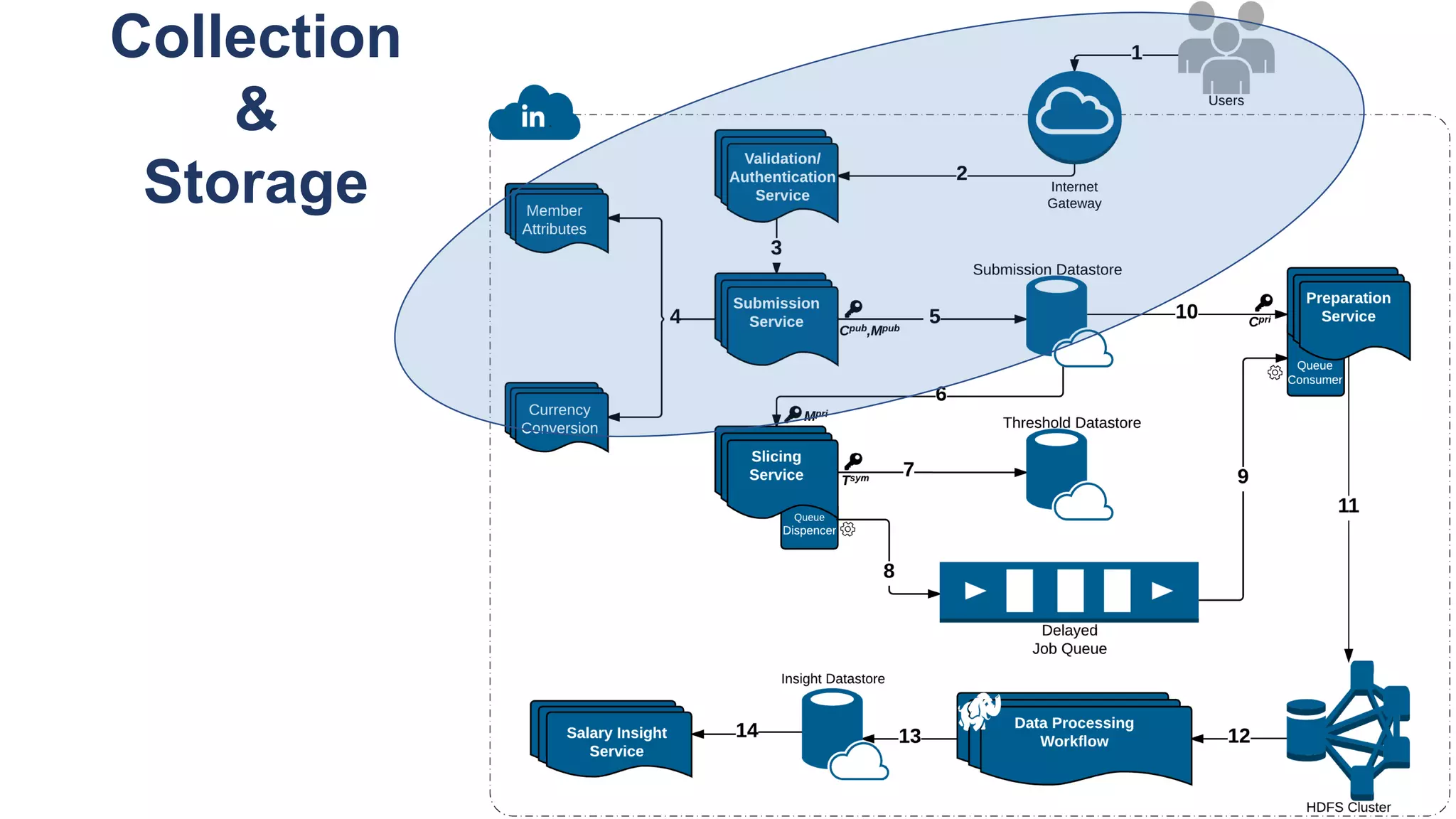
Collection
&
Storage
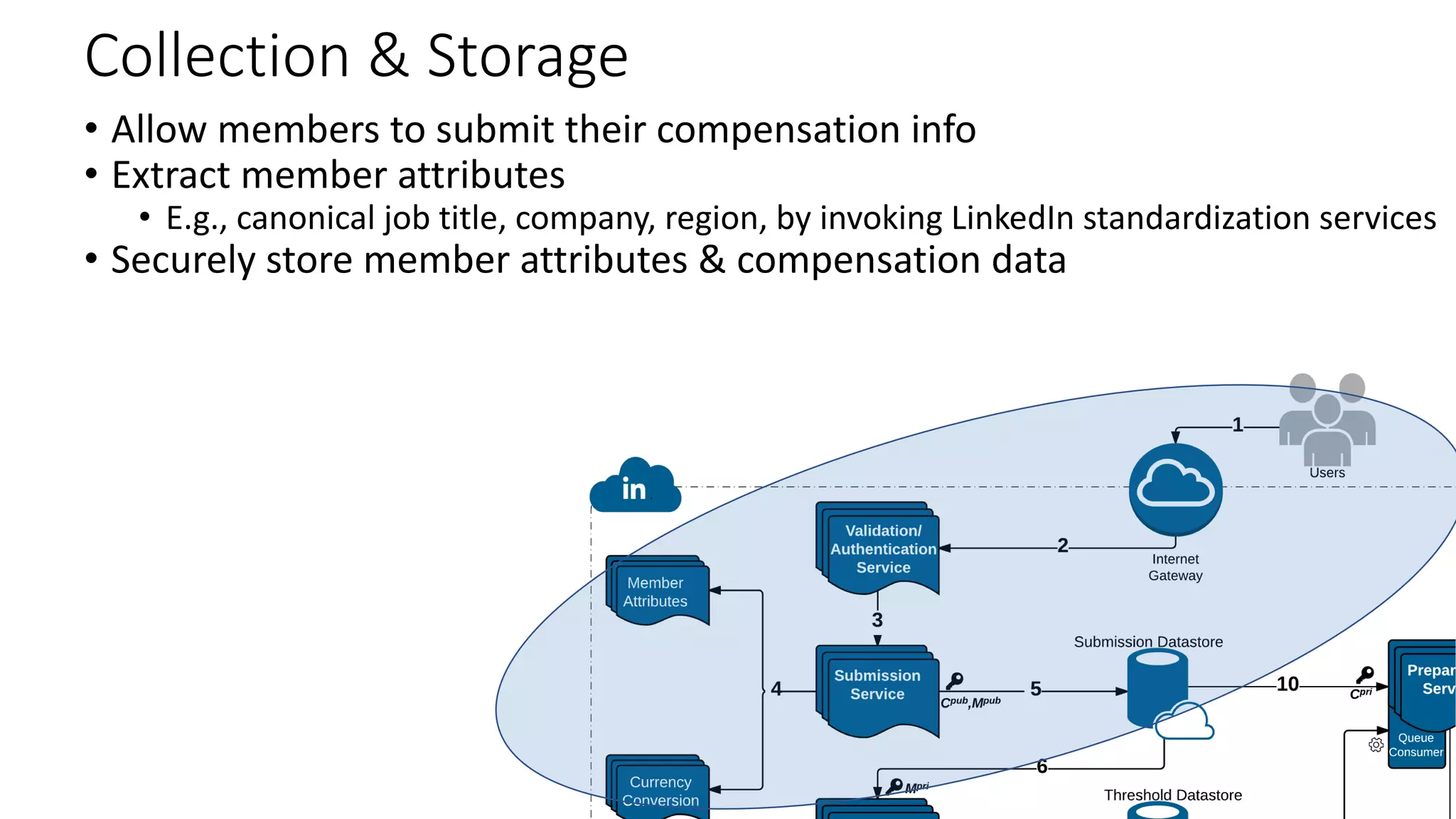
Collection & Storage
• Allow members to submit their compensation info
• Extract member attributes
• E.g., canonical job title, company, region, by invoking LinkedIn standardization services
• Securely store member attributes & compensation data
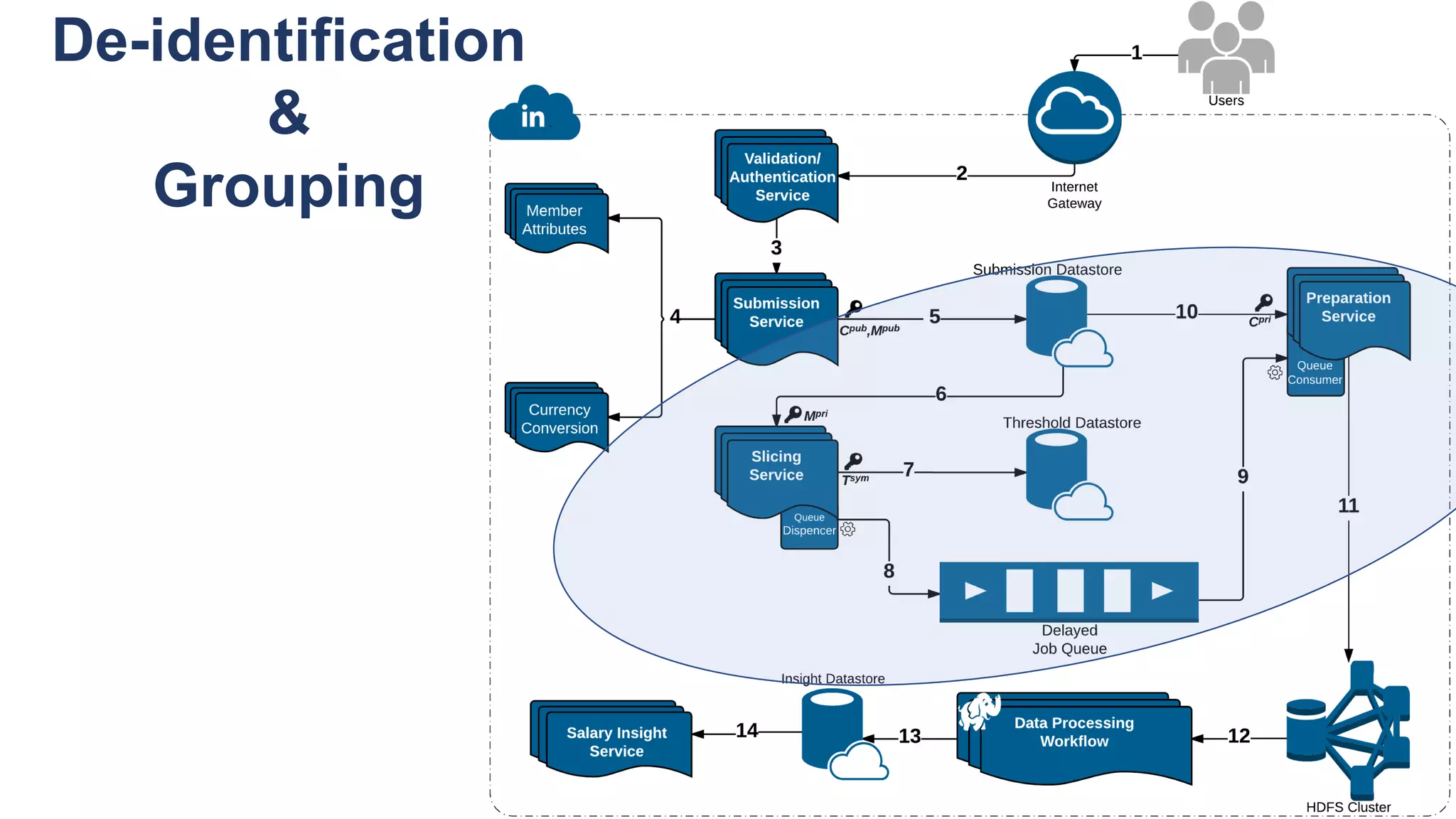
De-identification
&
Grouping
De-identification & Grouping
• Approach inspired by k-Anonymity [Samarati-Sweeney]
• “Cohort” or “Slice”
• Defined by a combination of attributes
• E.g, “User experience designers in SF Bay Area”
• Contains aggregated compensation entries from corresponding individuals
• No user name, id or any attributes other than those that define the cohort
• A cohort available for offline processing only if it has at least k entries
• Apply LinkedIn standardization software (free-form attribute à canonical version)
before grouping
• Analogous to the generalization step in k-Anonymity
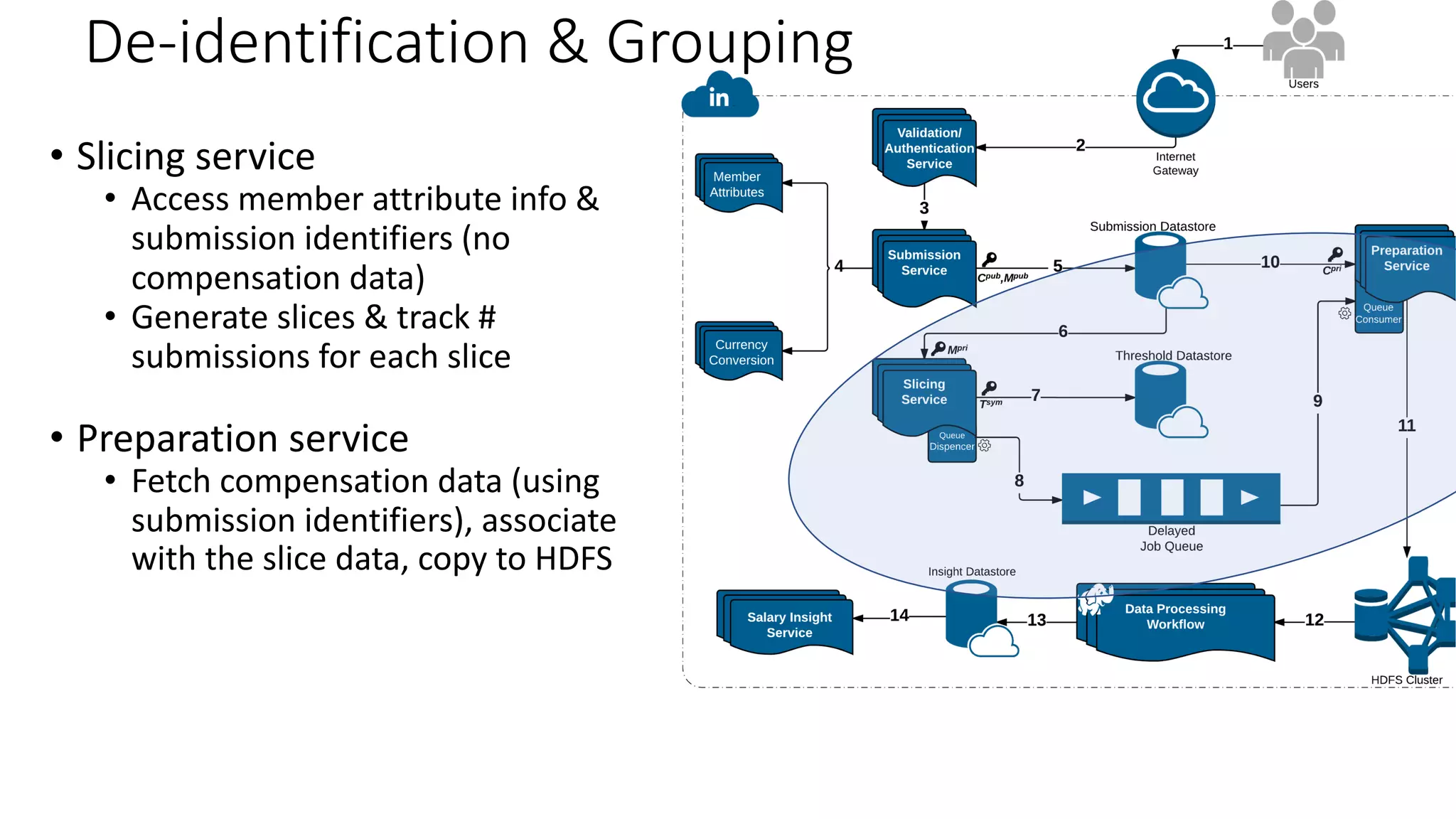
De-identification & Grouping
• Slicing service
• Access member attribute info &
submission identifiers (no
compensation data)
• Generate slices & track #
submissions for each slice
• Preparation service
• Fetch compensation data (using
submission identifiers), associate
with the slice data, copy to HDFS
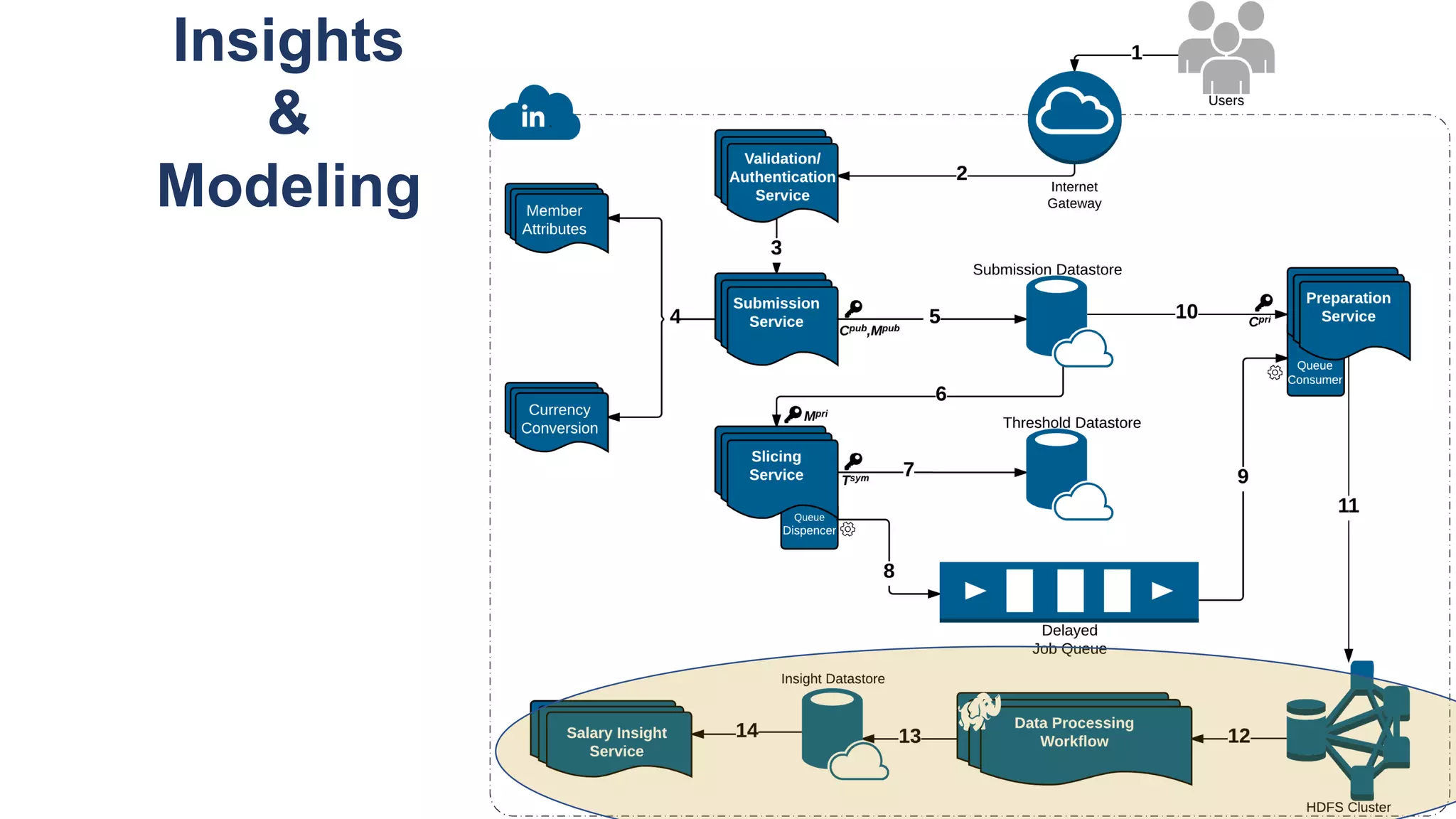
Insights
&
Modeling
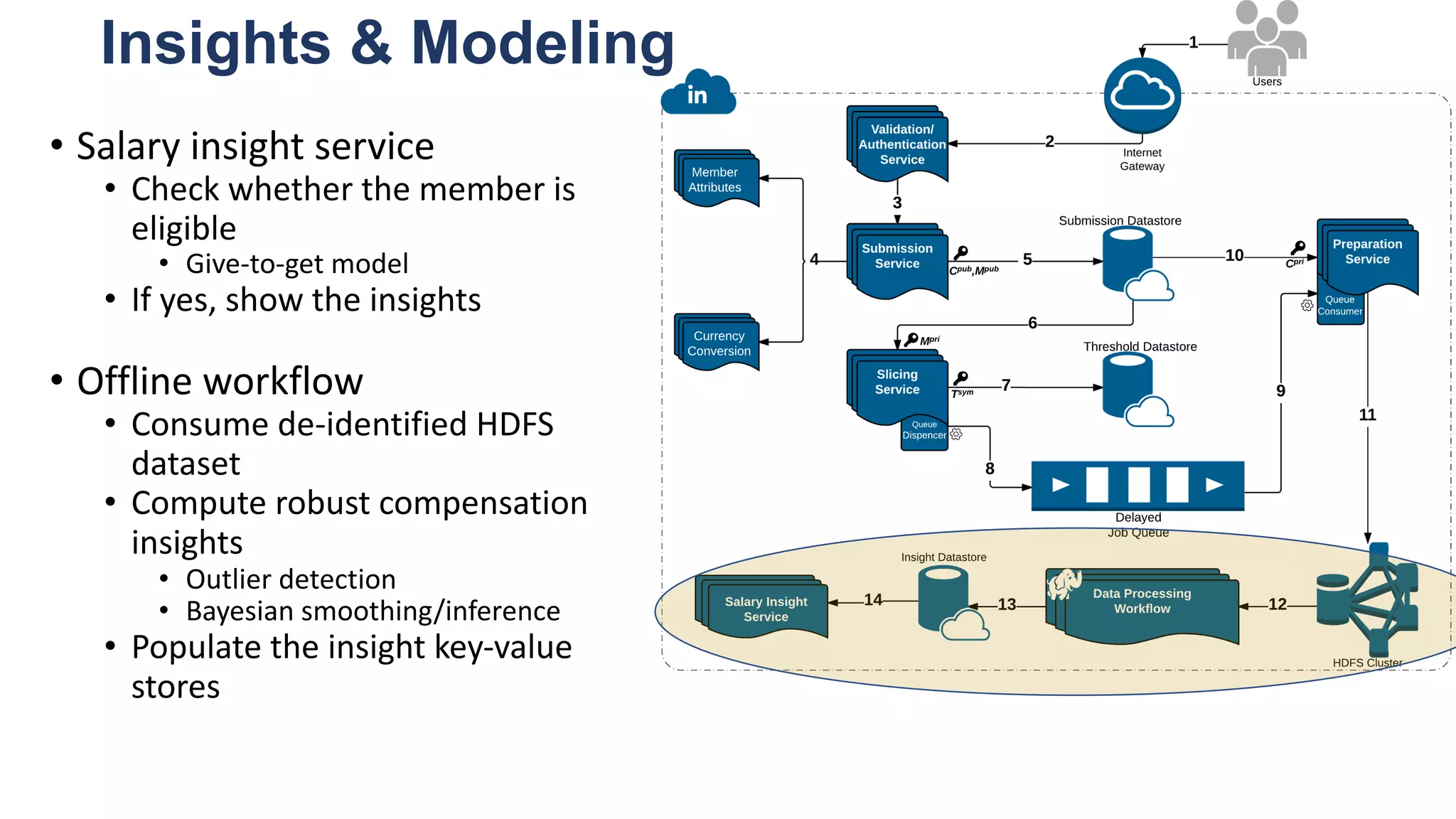
Insights & Modeling
• Salary insight service
• Check whether the member is
eligible
• Give-to-get model
• If yes, show the insights
• Offline workflow
• Consume de-identified HDFS
dataset
• Compute robust compensation
insights
• Outlier detection
• Bayesian smoothing/inference
• Populate the insight key-value
stores
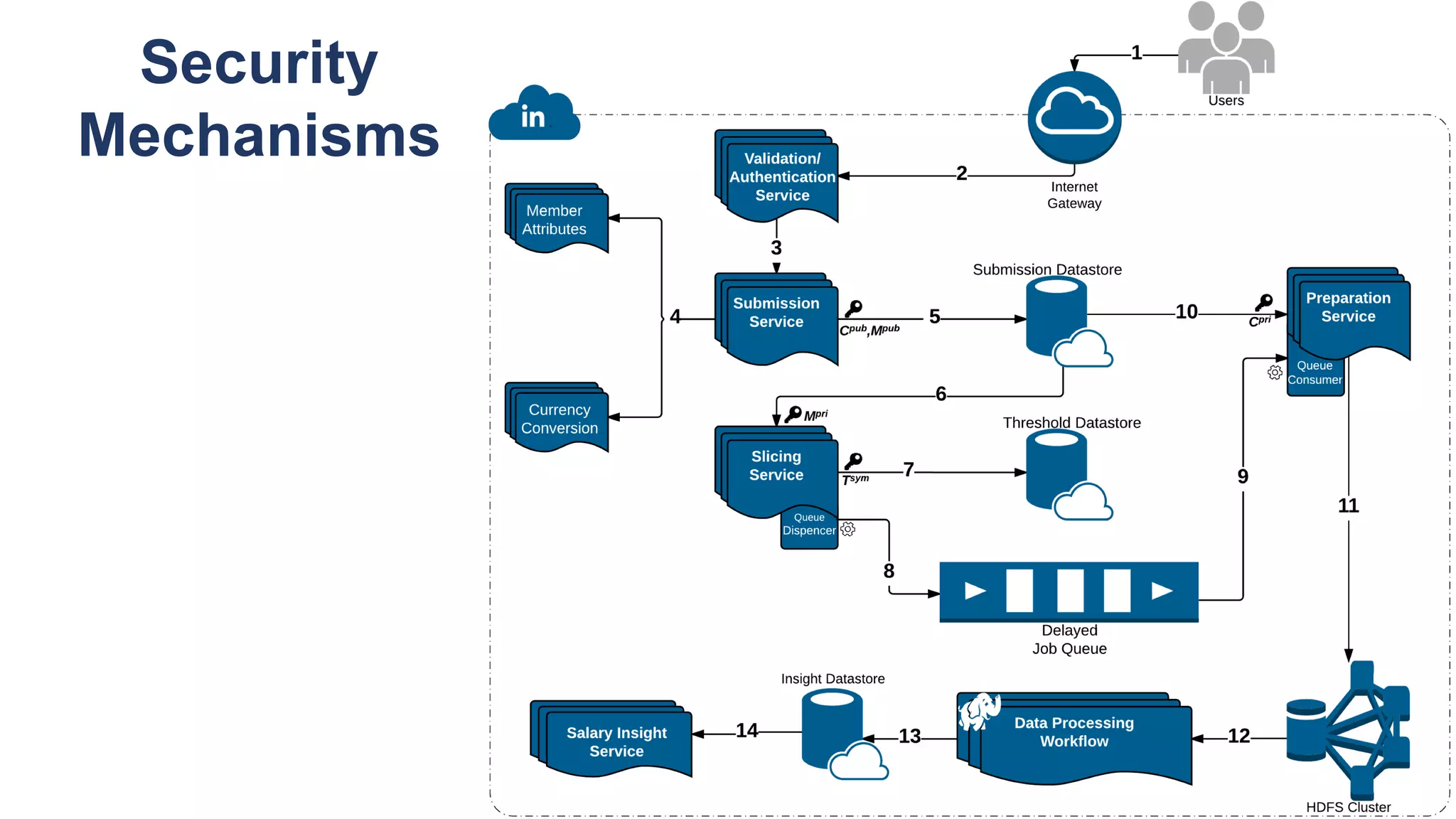
Security
Mechanisms
Security
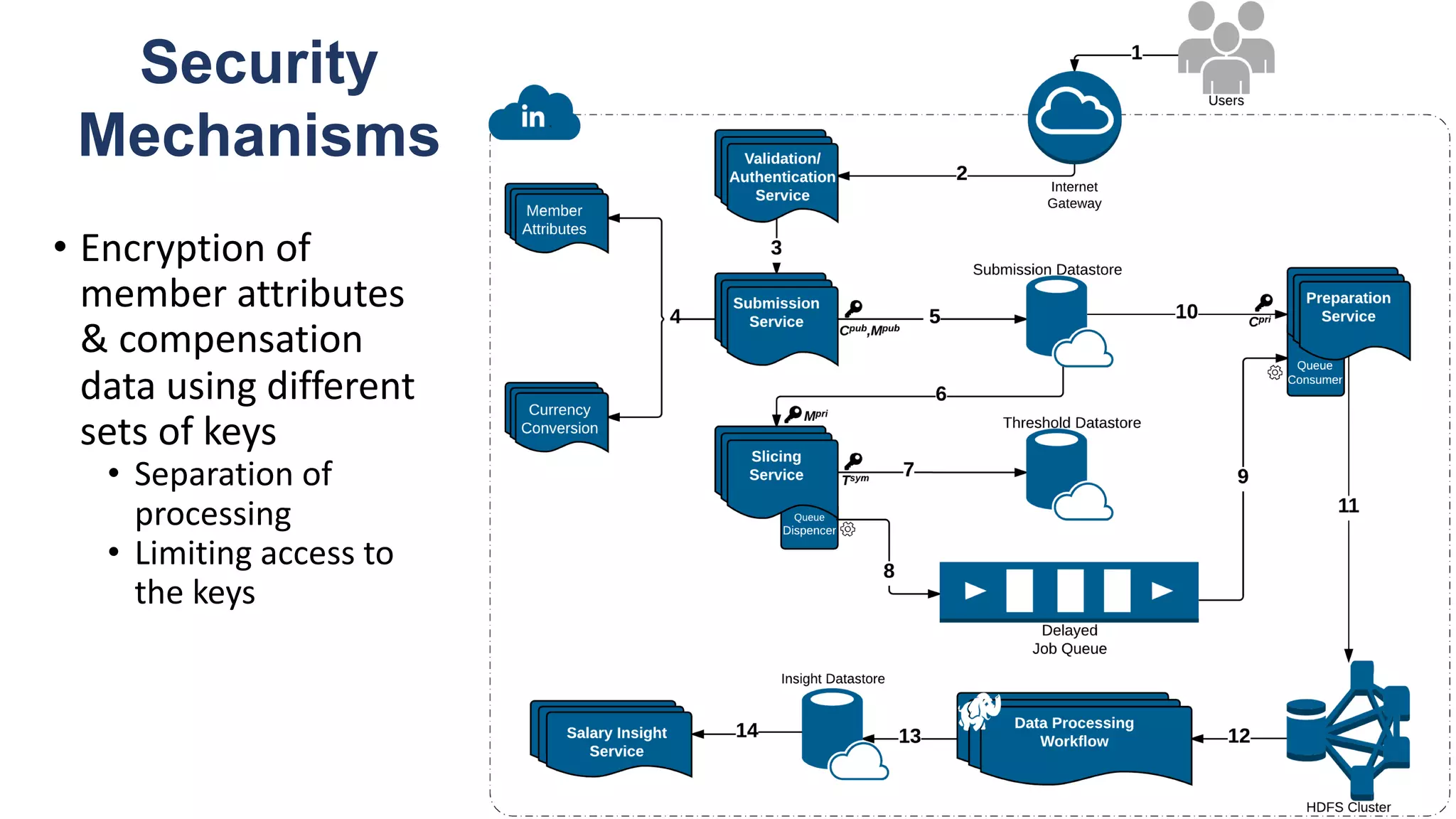
Mechanisms
• Encryption of
member attributes
& compensation
data using different
sets of keys
• Separation of
processing
• Limiting access to
the keys
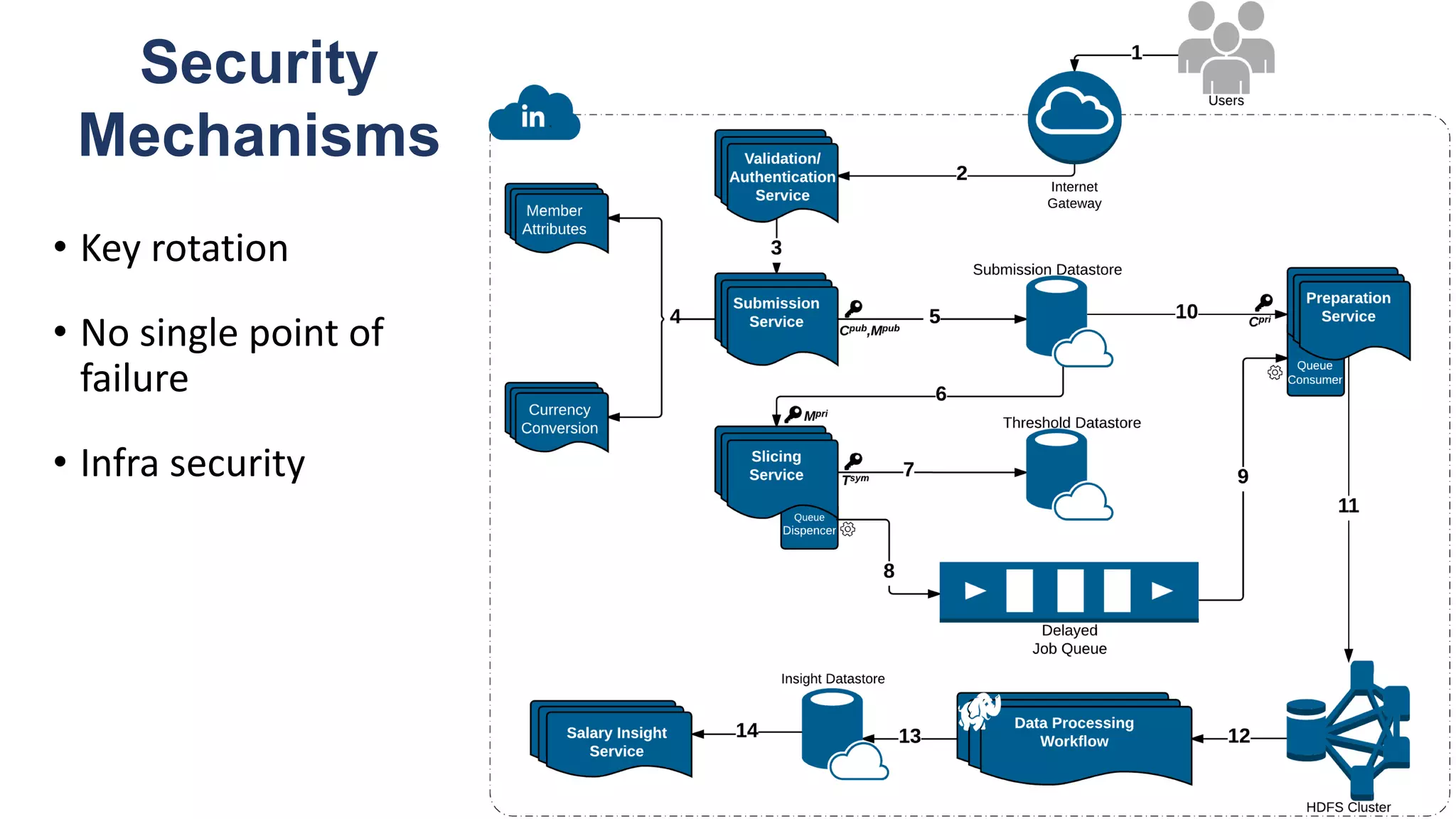
Security
Mechanisms
• Key rotation
• No single point of
failure
• Infra security
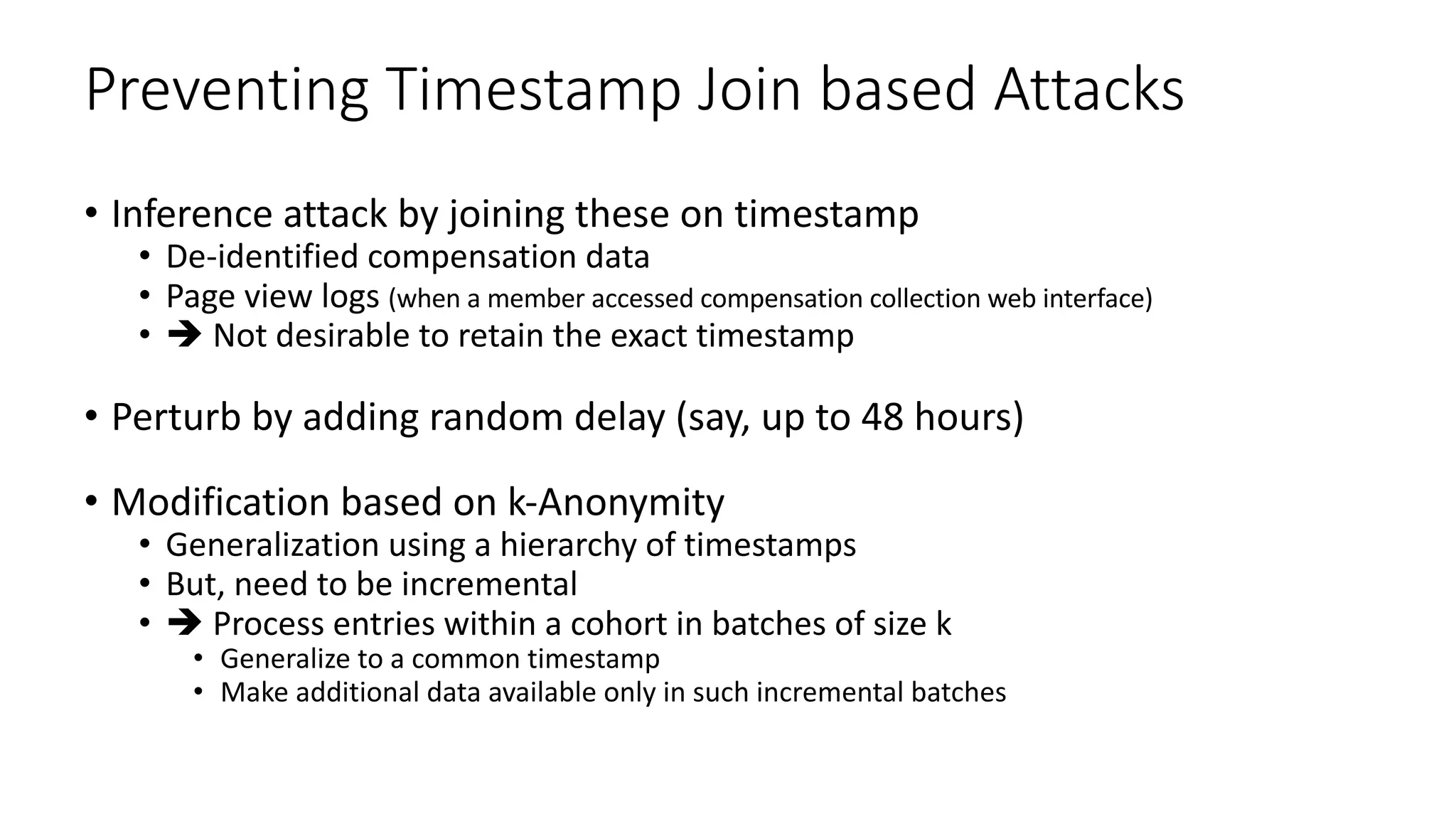
Preventing Timestamp Join based Attacks
• Inference attack by joining these on timestamp
• De-identified compensation data
• Page view logs (when a member accessed compensation collection web interface)
• è Not desirable to retain the exact timestamp
• Perturb by adding random delay (say, up to 48 hours)
• Modification based on k-Anonymity
• Generalization using a hierarchy of timestamps
• But, need to be incremental
• è Process entries within a cohort in batches of size k
• Generalize to a common timestamp
• Make additional data available only in such incremental batches
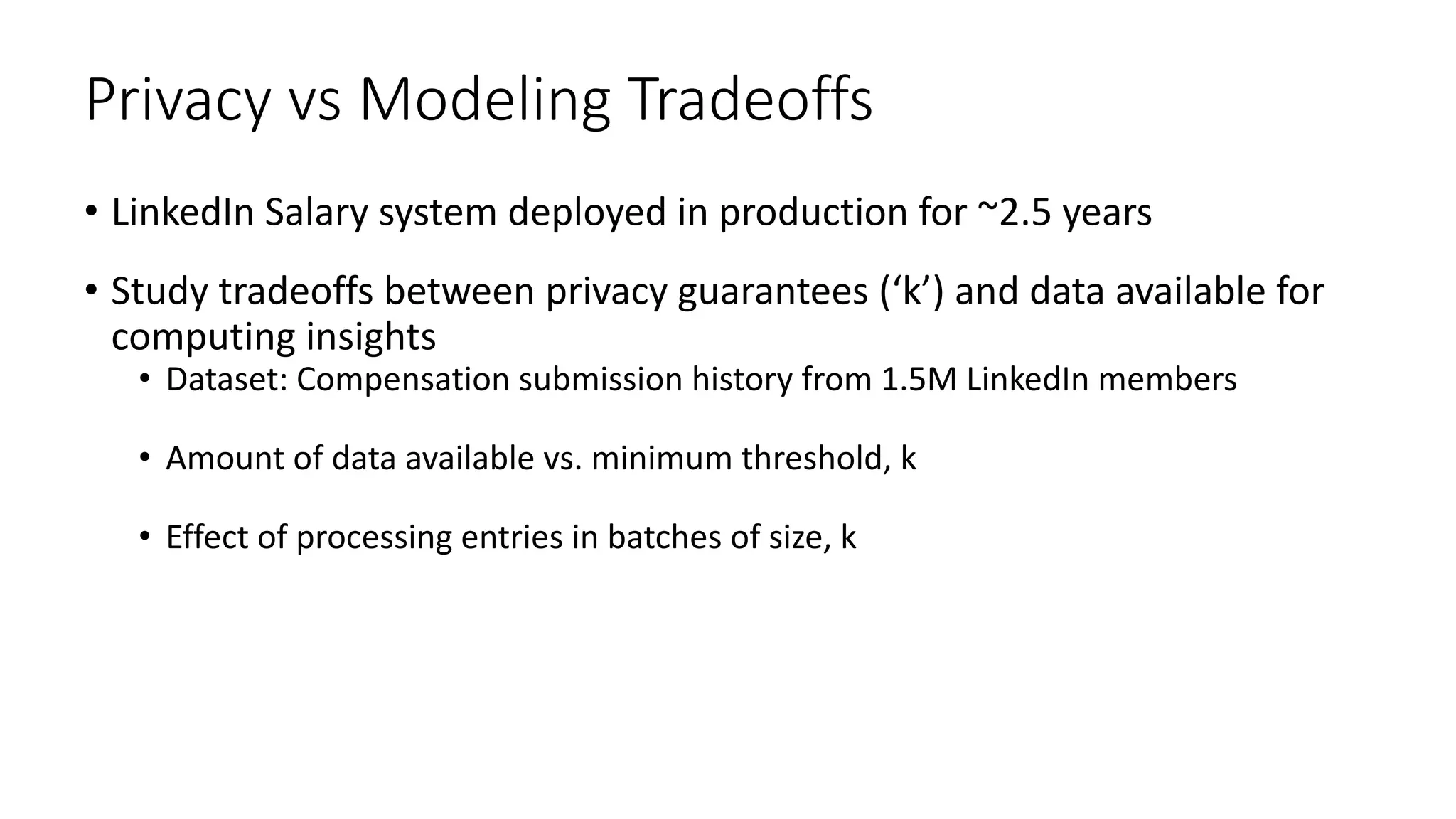
Privacy vs Modeling Tradeoffs
• LinkedIn Salary system deployed in production for ~2.5 years
• Study tradeoffs between privacy guarantees (‘k’) and data available for
computing insights
• Dataset: Compensation submission history from 1.5M LinkedIn members
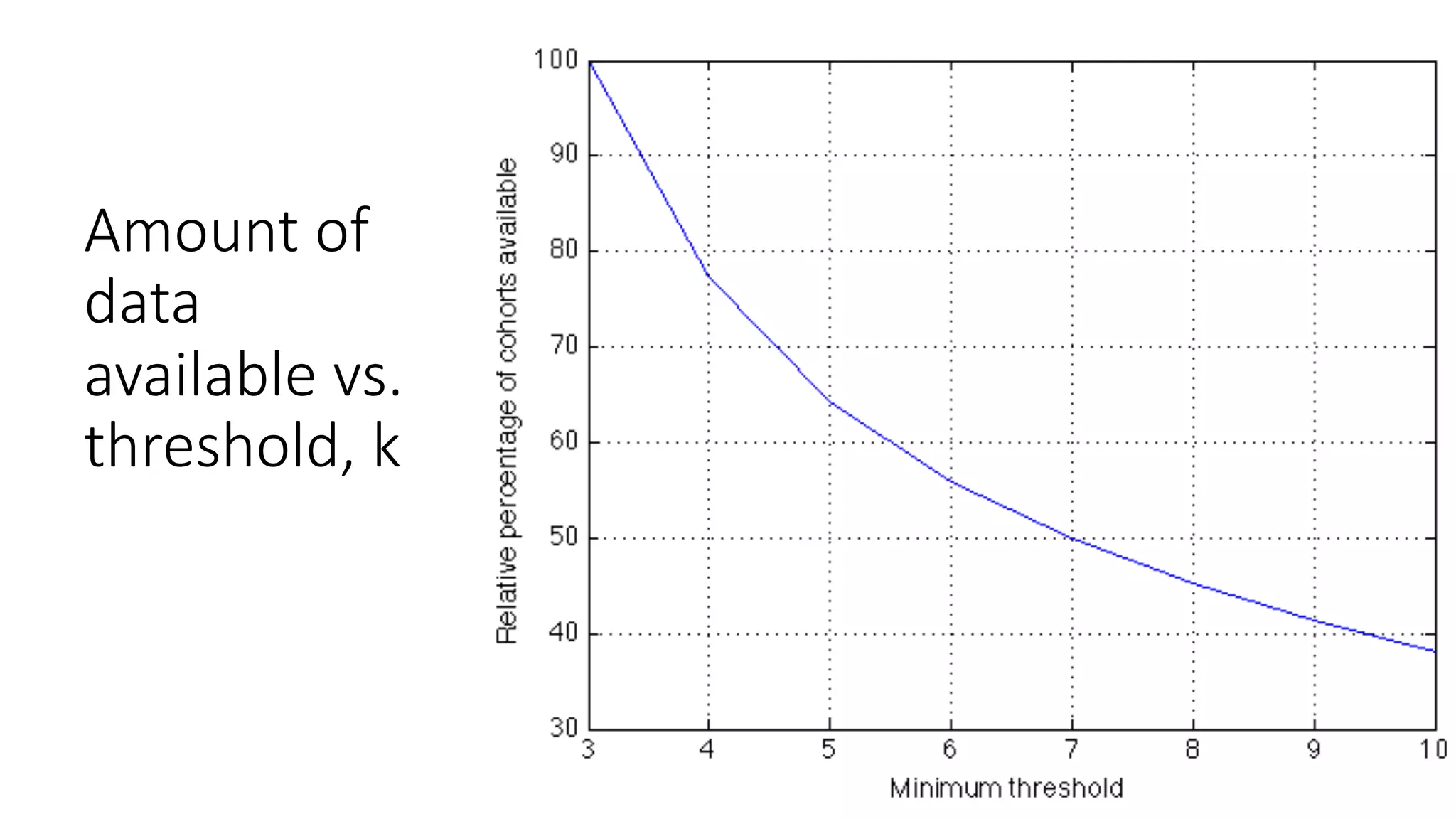
• Amount of data available vs. minimum threshold, k
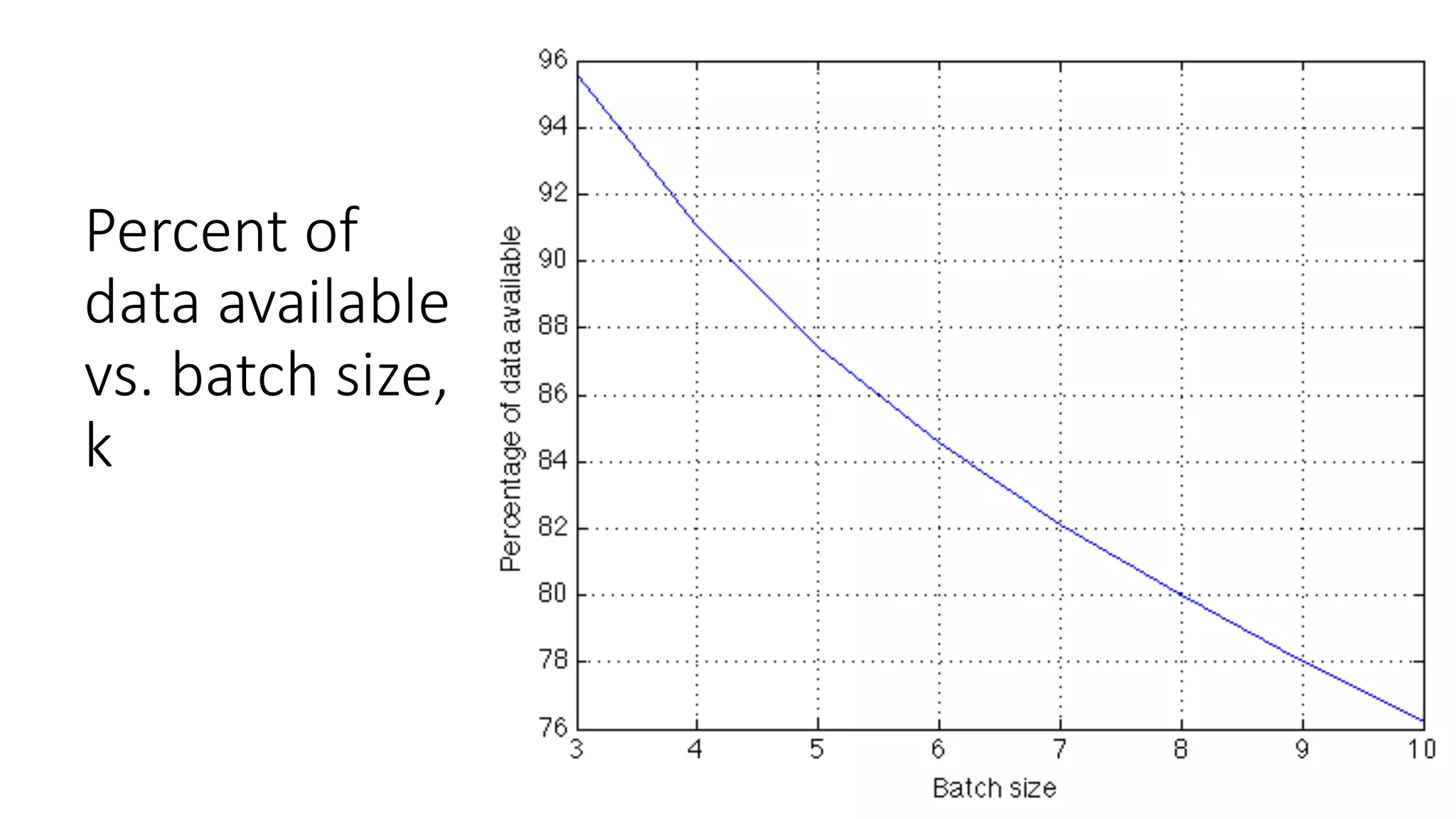
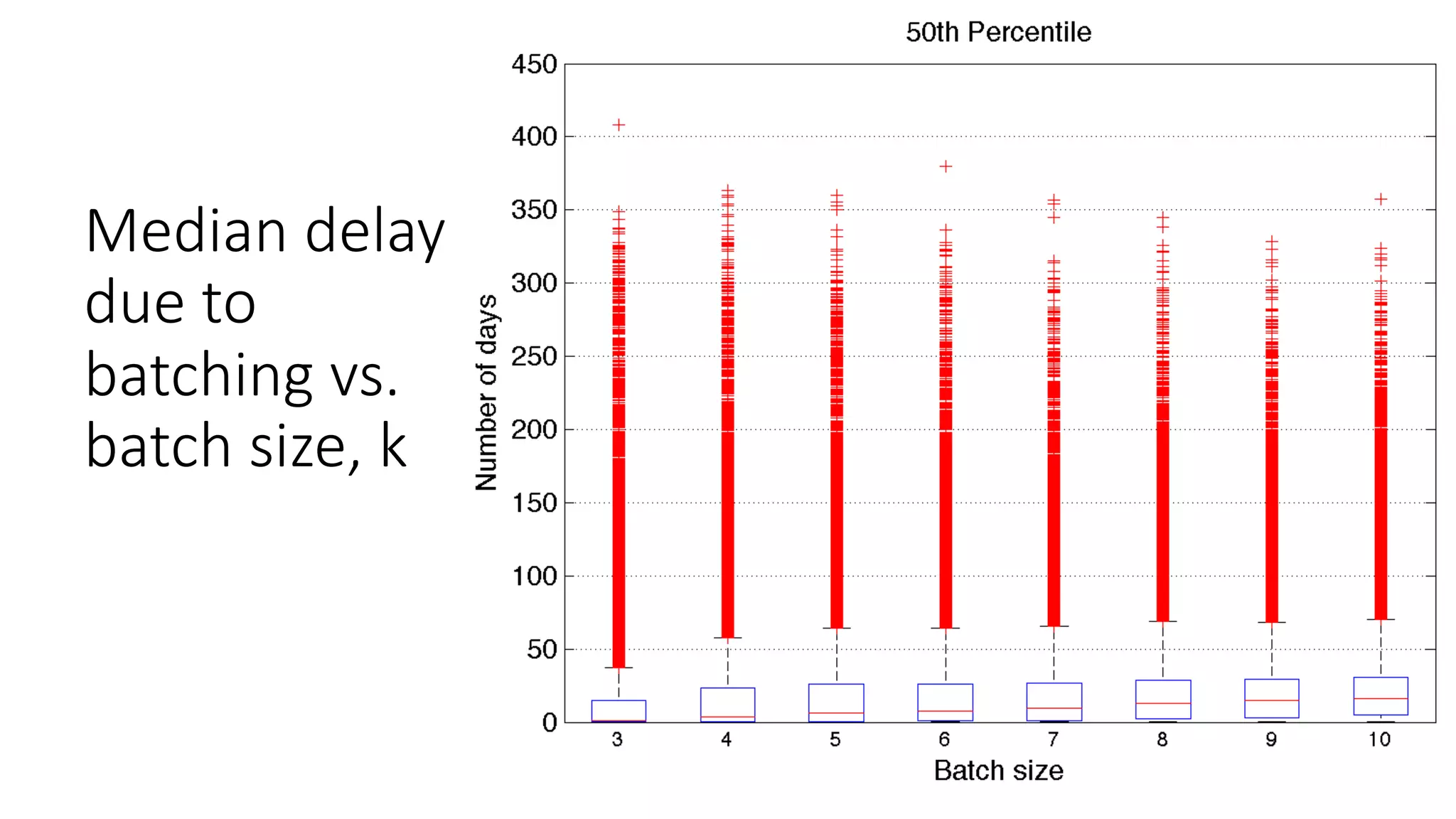
• Effect of processing entries in batches of size, k
Amount of
data
available vs.
threshold, k
Percent of
data available
vs. batch size,
k
Median delay
due to
batching vs.
batch size, k
Key takeaway points
• LinkedIn Salary: a new internet application, with
unique privacy/modeling challenges
• Privacy vs. Modeling Tradeoffs
• Potential directions
• Privacy-preserving machine learning models in a practical setting
[e.g., Chaudhuri et al, JMLR 2011; Papernot et al, ICLR 2017]
• Provably private submission of compensation entries?
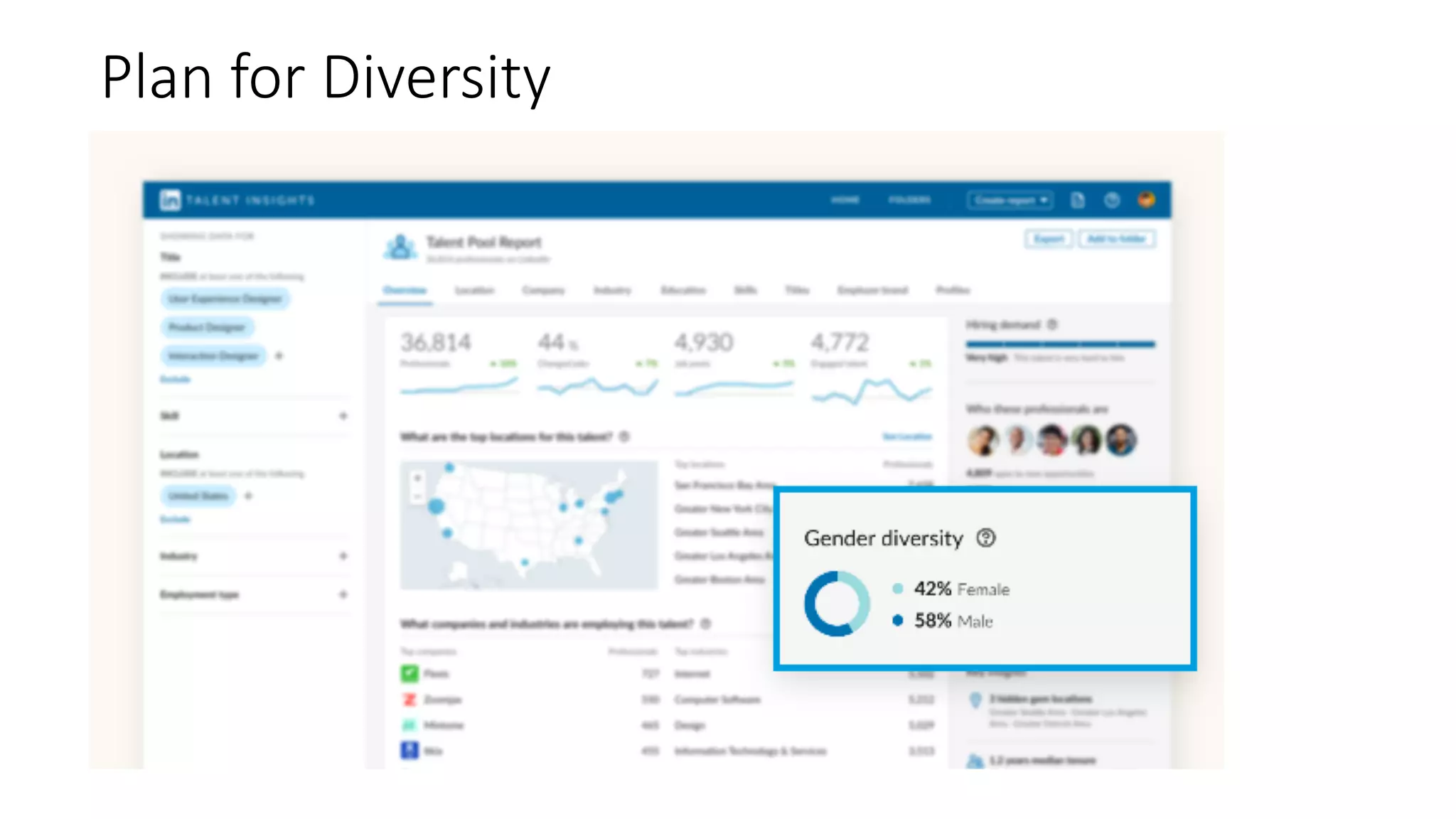
Plan for Diversity
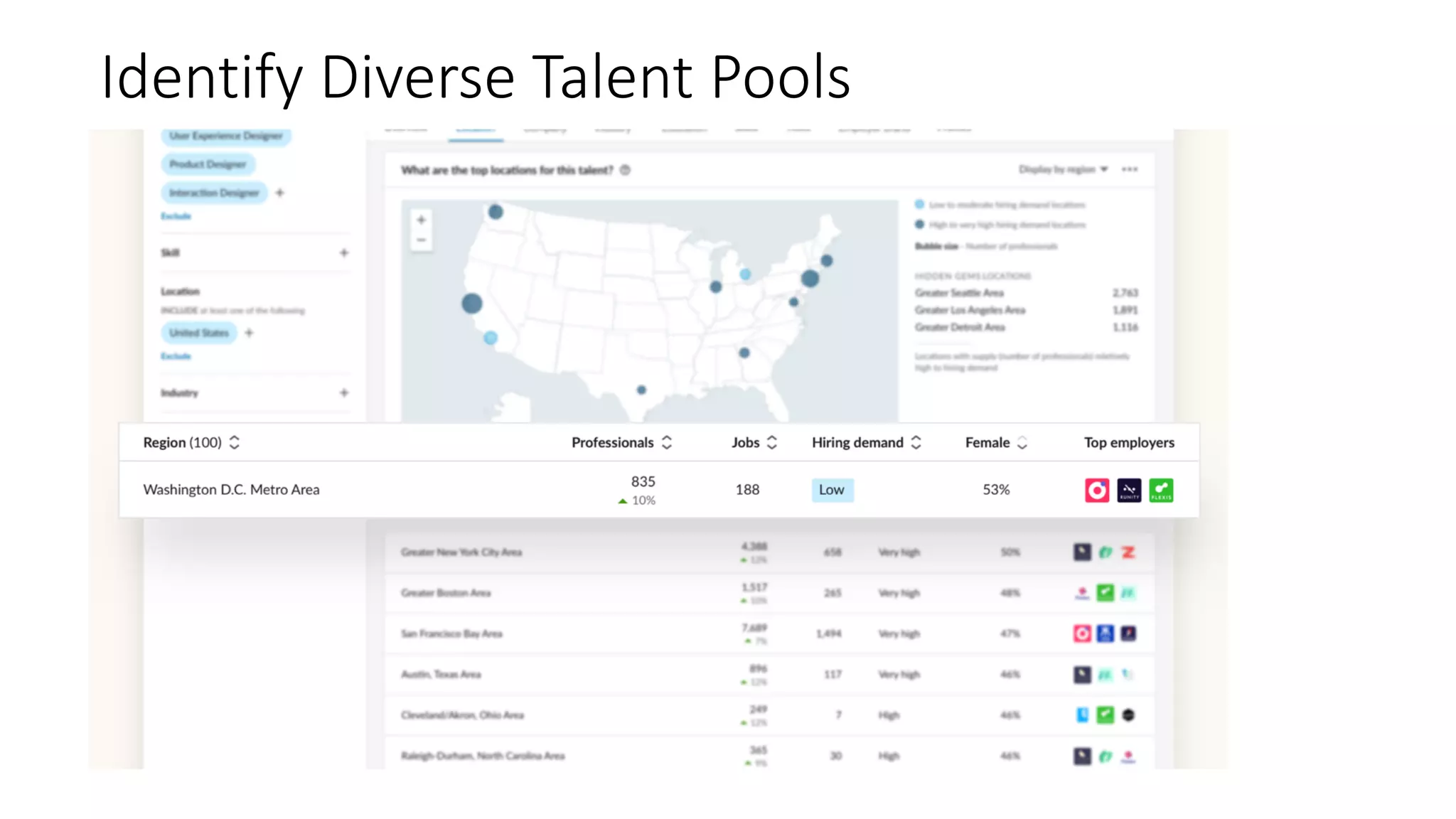
Identify Diverse Talent Pools
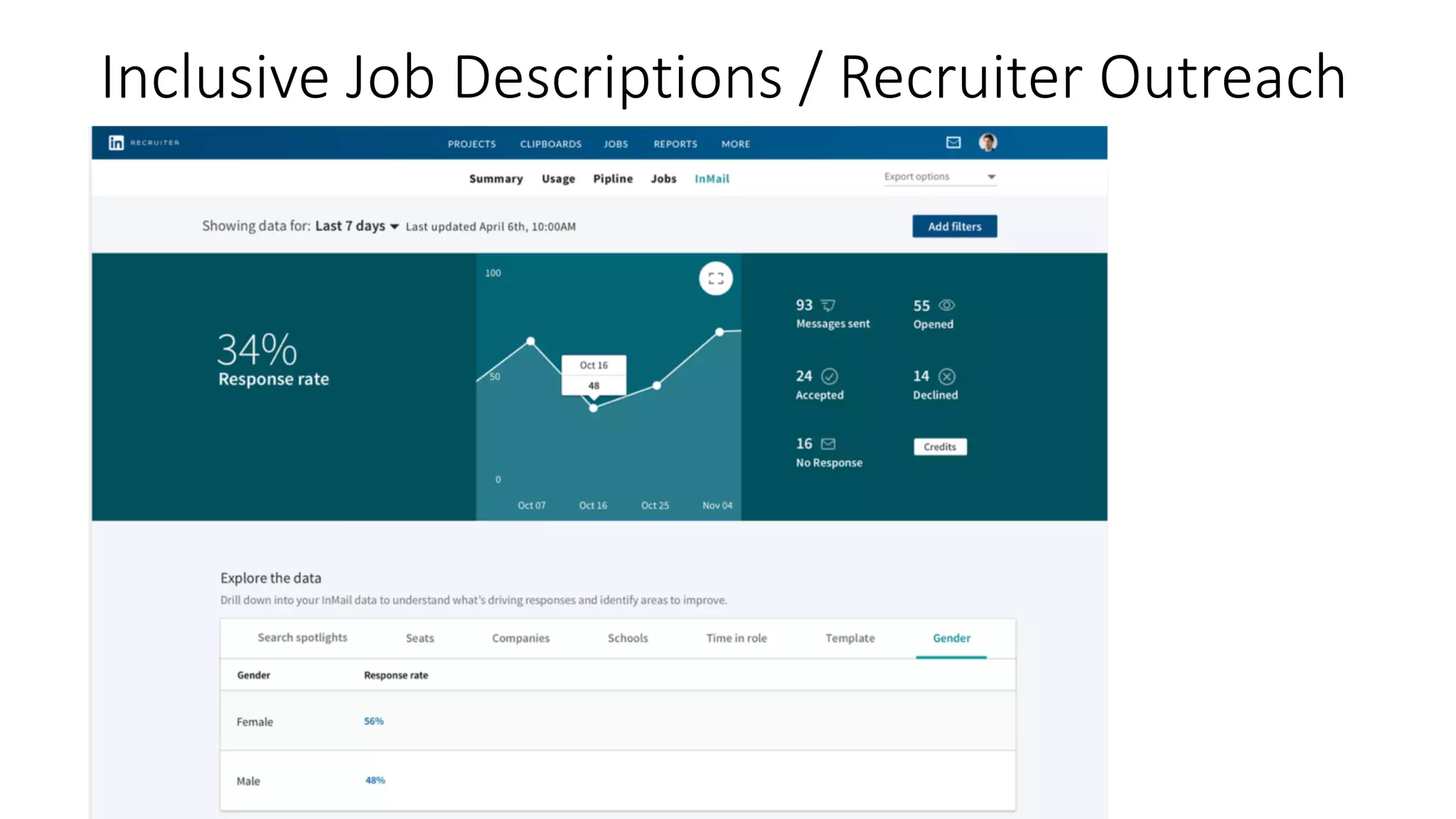
Inclusive Job Descriptions / Recruiter Outreach
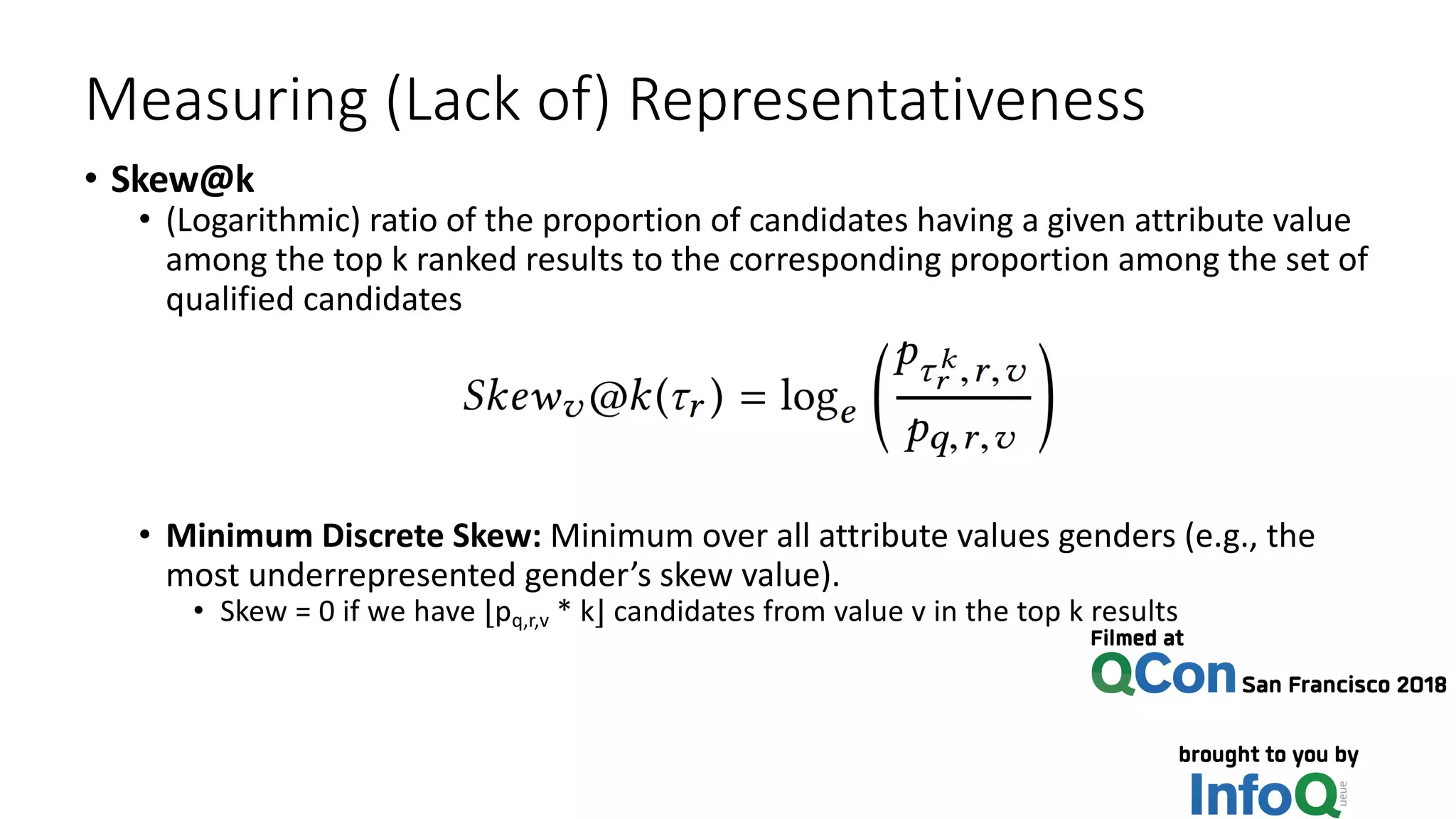
Measuring (Lack of) Representativeness
• Skew@k
• (Logarithmic) ratio of the proportion of candidates having a given attribute value
among the top k ranked results to the corresponding proportion among the set of
qualified candidates
• Minimum Discrete Skew: Minimum over all attribute values genders (e.g., the
most underrepresented gender’s skew value).
• Skew = 0 if we have ⌊pq,r,v * k⌋ candidates from value v in the top k results
Watch the video with slide
synchronization on InfoQ.com!
https://www.infoq.com/presentations/
linkedin-privacy-ml

Fairness, Transparency, and Privacy in AI @LinkedIn

  • 1.
    Fairness, Transparency, and Privacyin AI @ LinkedIn Krishnaram Kenthapadi AI @ LinkedIn QConSF Talk, November 2018
  • 2.
    InfoQ.com: News &Community Site • Over 1,000,000 software developers, architects and CTOs read the site world- wide every month • 250,000 senior developers subscribe to our weekly newsletter • Published in 4 languages (English, Chinese, Japanese and Brazilian Portuguese) • Post content from our QCon conferences • 2 dedicated podcast channels: The InfoQ Podcast, with a focus on Architecture and The Engineering Culture Podcast, with a focus on building • 96 deep dives on innovative topics packed as downloadable emags and minibooks • Over 40 new content items per week Watch the video with slide synchronization on InfoQ.com! https://www.infoq.com/presentations/ linkedin-privacy-ml
  • 3.
    Purpose of QCon -to empower software development by facilitating the spread of knowledge and innovation Strategy - practitioner-driven conference designed for YOU: influencers of change and innovation in your teams - speakers and topics driving the evolution and innovation - connecting and catalyzing the influencers and innovators Highlights - attended by more than 12,000 delegates since 2007 - held in 9 cities worldwide Presented at QCon San Francisco www.qconsf.com
  • 4.
    born July 31,1945 resident of 02138 Massachusetts Group Insurance Commission (1997): Anonymized medical history of state employees (all hospital visits, diagnosis, prescriptions) Latanya Sweeney (MIT grad student): $20 – Cambridge voter roll William Weld vs Latanya Sweeney
  • 5.
    64% uniquely identifiable with ZIP+ birth date + gender (in the US population) Golle, “Revisiting the Uniqueness of Simple Demographics in the US Population”, WPES 2006
  • 6.
  • 7.
    Oct 2006: Netflixannounces Netflix Prize • 10% of their users • average 200 ratings per user Narayanan, Shmatikov (2006): Netflix Prize
  • 8.
    Deanonymizing Netflix Data Narayanan,Shmatikov, Robust De- anonymization of Large Datasets (How to Break Anonymity of the Netflix Prize Dataset), 2008
  • 9.
    ● Noam Chomskyin Our Times ● Farenheit 9/11 ● Jesus of Nazareth ● Queer as Folk
  • 10.
    Gender Shades [JoyBuolamwini & Timnit Gebru, 2018] • Facial recognition software: Higher accuracy for light skinned men • Error rates for dark skinned women: 20% - 34%
  • 11.
    Algorithmic Bias ▪ Ethicalchallenges posed by AI systems ▪ Inherent biases present in society – Reflected in training data – AI/ML models prone to amplifying such biases ▪ ACM FAT* conference / KDD’16 & NIPS’17 Tutorials
  • 12.
    “Privacy and Fairnessby Design” for AI products
  • 13.
    AI @ LinkedIn CaseStudies @ LinkedIn Privacy Fairness
  • 14.
    Create economic opportunityfor every member of the global workforce LinkedIn’s Vision Connect the world's professionals to make them more productive and successful LinkedIn’s Mission
  • 15.
  • 16.
    AI @LinkedIn 25 B MLA/B experiments per week data processed offline per day 2002.15 PB data processed nearline per day 2 PB Scale graph edges with 1B nodes 53 B parameters in ML models
  • 17.
    Privacy in AI@ LinkedIn • Framework to compute robust, privacy-preserving analytics • Privacy challenges/design for a large crowdsourced system (LinkedIn Salary)
  • 18.
    Analytics & ReportingProducts at LinkedIn Profile View Analytics 16 Content Analytics Ad Campaign Analytics All showing demographics of members engaging with the product
  • 19.
    • Admit onlya small # of predetermined query types • Querying for the number of member actions, for a specified time period, together with the top demographic breakdowns Analytics & Reporting Products at LinkedIn
  • 20.
    • Admit onlya small # of predetermined query types • Querying for the number of member actions, for a specified time period, together with the top demographic breakdowns E.g., Clicks on a given adE.g., Title = “Senior Director” Analytics & Reporting Products at LinkedIn
  • 21.
    Privacy Requirements • Attackercannot infer whether a member performed an action • E.g., click on an article or an ad • Attacker may use auxiliary knowledge • E.g., knowledge of attributes associated with the target member (say, obtained from this member’s LinkedIn profile) • E.g., knowledge of all other members that performed similar action (say, by creating fake accounts)
  • 22.
    Possible Privacy Attacks 20 Targeting: Seniordirectors in US, who studied at Cornell Matches ~16k LinkedIn members → over minimum targeting threshold Demographic breakdown: Company = X May match exactly one person → can determine whether the person clicks on the ad or not Require minimum reporting threshold Attacker could create fake profiles! E.g. if threshold is 10, create 9 fake profiles that all click. Rounding mechanism E.g., report incremental of 10 Still amenable to attacks E.g. using incremental counts over time to infer individuals’ actions Need rigorous techniques to preserve member privacy (not reveal exact aggregate counts)
  • 23.
    Key Product Desiderata •Coverage & Utility • Data Consistency • for repeated queries • over time • between total and breakdowns • across entity/action hierarchy • for top k queries
  • 24.
    Problem Statement Compute robust,reliable analytics in a privacy- preserving manner, while addressing the product desiderata such as coverage, utility, and consistency.
  • 25.
  • 26.
  • 27.
    25 CuratorCurator Your data in thedatabase Defining Privacy Your data in the database
  • 28.
    Defining Privacy 26 CuratorCurator Intuition: ● Amember’s privacy is preserved if … ○ “The released result would nearly be the same, whether or not the user’s information is taken into account” ● An attacker gains very little additional knowledge about any specific member from the published result Defining Privacy Your data in the database
  • 29.
    ε-Differential Privacy: Forneighboring databases D and D′ (differ by one record), the distribution of the curator’s output f(D) on database D is (nearly) the same as f(D′). 27 Parameter ε quantifies information leakage (smaller ε, more private) ∀S: Pr[f(D)∊S] ≤ exp(ε) ∙ Pr[f(D′)∊S] CuratorCurator Your data in the database Your data in the database Differential Privacy Dwork, McSherry, Nissim, Smith, “Calibrating Noise to Sensitivity in Private Data Analysis”, TCC 2006
  • 30.
    Differential Privacy: RandomNoise Addition If ℓ1-sensitivity of f : D → ℝn: maxD,D′ ||f(D) − f(D′)||1 = s, then adding Laplacian noise to true output f(D) + Laplacen(s/ε) offers ε-differential privacy. Dwork, McSherry, Nissim, Smith, “Calibrating Noise to Sensitivity in Private Data Analysis”, TCC 2006
  • 31.
    PriPeARL: A Frameworkfor Privacy-Preserving Analytics K. Kenthapadi, T. T. L. Tran, ACM CIKM 2018 29 Pseudo-random noise generation, inspired by differential privacy ● Entity id (e.g., ad creative/campaign/account) ● Demographic dimension ● Stat type (impressions, clicks) ● Time range ● Fixed secret seed Uniformly Random Fraction ● Cryptographic hash ● Normalize to (0,1) Random Noise Laplace Noise ● Fixed ε True Count Noisy Count To satisfy consistency requirements ● Pseudo-random noise → same query has same result over time, avoid averaging attack. ● For non-canonical queries (e.g., time ranges, aggregate multiple entities) ○ Use the hierarchy and partition into canonical queries ○ Compute noise for each canonical queries and sum up the noisy counts
  • 32.
  • 33.
    Lessons Learned fromDeployment (> 1 year) • Semantic consistency vs. unbiased, unrounded noise • Suppression of small counts • Online computation and performance requirements • Scaling across analytics applications • Tools for ease of adoption (code/API library, hands-on how-to tutorial) help!
  • 34.
    Summary • Framework tocompute robust, privacy-preserving analytics • Addressing challenges such as preserving member privacy, product coverage, utility, and data consistency • Future • Utility maximization problem given constraints on the ‘privacy loss budget’ per user • E.g., noise with larger variance to impressions but less noise to clicks (or conversions) • E.g., more noise to broader time range sub-queries and less noise to granular time range sub-queries • Reference: K. Kenthapadi, T. Tran, PriPeARL: A Framework for Privacy-Preserving Analytics and Reporting at LinkedIn, ACM CIKM 2018.
  • 35.
    Acknowledgements •Team: • AI/ML: KrishnaramKenthapadi, Thanh T. L. Tran • Ad Analytics Product & Engineering: Mark Dietz, Taylor Greason, Ian Koeppe • Legal / Security: Sara Harrington, Sharon Lee, Rohit Pitke •Acknowledgements (in alphabetical order) • Deepak Agarwal, Igor Perisic, Arun Swami
  • 36.
  • 37.
  • 38.
    Salary Collection Flowvia Email Targeting
  • 39.
    Data Privacy Challenges •Minimize the risk of inferring any one individual’s compensation data • Protection against data breach • No single point of failure Achieved by a combination of techniques: encryption, access control, , aggregation, thresholding K. Kenthapadi, A. Chudhary, and S. Ambler, LinkedIn Salary: A System for Secure Collection and Presentation of Structured Compensation Insights to Job Seekers, IEEE PAC 2017 (arxiv.org/abs/1705.06976)
  • 40.
    Problem Statement •How dowe design LinkedIn Salary system taking into account the unique privacy and security challenges, while addressing the product requirements?
  • 41.
    Title Region $$ User Exp Designer SFBay Area 100K User Exp Designer SF Bay Area 115K ... ... ... Title Region $$ User Exp Designer SF Bay Area 100K De-identification Example Title Region Company Industry Years of exp Degree FoS Skills $$ User Exp Designer SF Bay Area Google Internet 12 BS Interactive Media UX, Graphics, ... 100K Title Region Industry $$ User Exp Designer SF Bay Area Internet 100K Title Region Years of exp $$ User Exp Designer SF Bay Area 10+ 100K Title Region Company Years of exp $$ User Exp Designer SF Bay Area Google 10+ 100K #data points > threshold? Yes ⇒ Copy to Hadoop (HDFS) Note: Original submission stored as encrypted objects.
  • 42.
  • 43.
    Summary • LinkedIn Salary:a new internet application, with unique privacy/modeling challenges • Privacy Design & Architecture • Provably private submission of compensation entries?
  • 44.
    Acknowledgements • Team: • AI/ML:Krishnaram Kenthapadi, Stuart Ambler, Xi Chen, Yiqun Liu, Parul Jain, Liang Zhang, Ganesh Venkataraman, Tim Converse, Deepak Agarwal • Application Engineering: Ahsan Chudhary, Alan Yang, Alex Navasardyan, Brandyn Bennett, Hrishikesh S, Jim Tao, Juan Pablo Lomeli Diaz, Patrick Schutz, Ricky Yan, Lu Zheng, Stephanie Chou, Joseph Florencio, Santosh Kumar Kancha, Anthony Duerr • Product: Ryan Sandler, Keren Baruch • Other teams (UED, Marketing, BizOps, Analytics, Testing, Voice of Members, Security, …): Julie Kuang, Phil Bunge, Prateek Janardhan, Fiona Li, Bharath Shetty, Sunil Mahadeshwar, Cory Scott, Tushar Dalvi, and team • Acknowledgements (in alphabetical order) • David Freeman, Ashish Gupta, David Hardtke, Rong Rong, Ram Swaminathan
  • 45.
    What’s Next: Privacyfor ML / Data Applications • Hard open questions • Can we simultaneously develop highly personalized models and ensure that the models do not encode private information of members? • How do we guarantee member privacy over time without exhausting the “privacy loss budget”? • How do we enable privacy-preserving mechanisms for data marketplaces?
  • 46.
    Fairness in AI@ LinkedIn
  • 47.
  • 48.
    “Diversity by Design”in LinkedIn’s Talent Solutions Insights to Identify Diverse Talent Pools Representative Talent Search Results Diversity Learning Curriculum
  • 49.
  • 50.
    Representative Ranking forTalent Search S. C. Geyik, K. Kenthapadi, Building Representative Talent Search at LinkedIn, LinkedIn engineering blog post, October’18.
  • 51.
    Intuition for MeasuringRepresentativeness • Ideal: same distribution on gender/age/… for • Top ranked results and • Qualified candidates for a search request • LinkedIn members matching the search criteria • Same proportion of members with each given attribute value across both these sets • “Equal opportunity” definition [Hardt et al, NIPS’16]
  • 52.
    Reranking Algorithm forRepresentativeness • Determine the target proportions within the attribute of interest, corresponding to a search request • Compute a fairness-aware ranking of size k
  • 53.
    Target Proportions withinthe Attribute of Interest • Compute the proportions of the values of the attribute (e.g., gender, gender-age combination) amongst the set of qualified candidates • “Qualified candidates” = Set of candidates that match the search query criteria • Retrieved by LinkedIn’s Galene search engine • Target proportions could also be obtained based on legal mandate / voluntary commitment
  • 54.
    Fairness-aware Reranking Algorithm •Partition the set of potential candidates into different buckets for each attribute value • Rank the candidates in each bucket according to the scores assigned by the machine-learned model • Merge the ranked lists, balancing the representation requirements and the selection of highest scored candidates
  • 55.
  • 56.
    Validating Our Approach •Gender Representativeness • Over 95% of all searches are representative compared to the qualified population of the search • Business Metrics • A/B test over LinkedIn Recruiter users for two weeks • No significant change in business metrics (e.g., # InMails sent or accepted) • Ramped to 100% of LinkedIn Recruiter users worldwide
  • 57.
    Lessons Learned inPractice • Collaboration/consensus across key stakeholders • product, legal, PR, engineering, AI, … • Post-processing approach desirable • Agnostic to the specifics of each model • Scalable across different model choices for our application • Easier to incorporate as part of existing systems • Build a stand-alone service or component for post-processing • No significant modifications to the existing components
  • 58.
    Acknowledgements •Team: • AI/ML: SahinCem Geyik, Stuart Ambler, Krishnaram Kenthapadi • Application Engineering: Gurwinder Gulati, Chenhui Zhai • Analytics: Patrick Driscoll, Divyakumar Menghani • Product: Rachel Kumar •Acknowledgements (in alphabetical order) • Deepak Agarwal, Erik Buchanan, Patrick Cheung, Gil Cottle, Nadia Fawaz, Rob Hallman, Joshua Hartman, Sara Harrington, Heloise Logan, Stephen Lynch, Lei Ni, Igor Perisic, Ram Swaminathan, Ketan Thakkar, Janardhanan Vembunarayanan, Hinkmond Wong, Lin Yang, Liang Zhang, Yani Zhang
  • 59.
    Reflections • Lessons fromprivacy & fairness challenges è Need “Privacy and Fairness by Design” approach when building AI products • Case studies on privacy & fairness @ LinkedIn • Collaboration/consensus across key stakeholders (product, legal, PR, engineering, AI, …)
  • 60.
    Thanks! Questions? • References •K. Kenthapadi, I. Mironov, A. G. Thakurta, Privacy-preserving Data Mining in Industry: Practical Challenges and Lessons Learned, ACM KDD 2018 Tutorial (Slide deck) • K. Kenthapadi, T. T. L. Tran, PriPeARL: A Framework for Privacy-Preserving Analytics and Reporting at LinkedIn, ACM CIKM 2018 • K. Kenthapadi, A. Chudhary, S. Ambler, LinkedIn Salary: A System for Secure Collection and Presentation of Structured Compensation Insights to Job Seekers, IEEE Symposium on Privacy-Aware Computing (PAC), 2017 • S. C. Geyik, S. Ambler, K. Kenthapadi, Fairness Aware Talent Search Ranking at LinkedIn, Microsoft’s AI/ML conference (MLADS Spring 2018). Distinguished Contribution Award • S. C. Geyik, K. Kenthapadi, Building Representative Talent Search at LinkedIn, LinkedIn engineering blog post, October 2018 kkenthapadi@linkedin.com
  • 61.
  • 62.
  • 63.
    Privacy Breaches andLessons Learned Attacks on privacy •Governor of Massachusetts •AOL •Netflix •Web browsing data •Facebook •Amazon •Genomic data
  • 64.
    born July 31,1945 resident of 02138 Massachusetts Group Insurance Commission (1997): Anonymized medical history of state employees (all hospital visits, diagnosis, prescriptions) Latanya Sweeney (MIT grad student): $20 – Cambridge voter roll William Weld vs Latanya Sweeney
  • 65.
  • 66.
    August 4, 2006:AOL Research publishes anonymized search logs of 650,000 users August 9: New York Times AOL Data Release
  • 67.
    Attacker's Advantage ØAuxiliary information ØEnoughto succeed on a small fraction of inputs
  • 68.
    Key idea: ● Similarintuition as the attack on medical records ● Medical records: Each person can be identified based on a combination of a few attributes ● Web browsing history: Browsing history is unique for each person ● Each person has a distinctive social network è links appearing in one’s feed is unique ● Users likely to visit links in their feed with higher probability than a random user ● “Browsing histories contain tell-tale marks of identity” Su et al, De-anonymizing Web Browsing Data with Social Networks, 2017 De-anonymizing Web Browsing Data with Social Networks
  • 69.
    Attacker's Advantage ØAuxiliary information ØEnoughto succeed on a small fraction of inputs ØHigh dimensionality
  • 70.
    Ad targeting: Korolova, “PrivacyViolations Using Microtargeted Ads: A Case Study”, PADM 2010 Privacy Attacks On Ad Targeting
  • 71.
    10 campaigns targeting1 person (zip code, gender, workplace, alma mater) Korolova, “Privacy Violations Using Microtargeted Ads: A Case Study”, PADM 2010 Facebook vs Korolova Age 21 22 23 … 30 Ad Impressions in a week 0 0 8 … 0
  • 72.
    10 campaigns targeting1 person (zip code, gender, workplace, alma mater) Korolova, “Privacy Violations Using Microtargeted Ads: A Case Study”, PADM 2010 Facebook vs Korolova Interest A B C … Z Ad Impressions in a week 0 0 8 … 0
  • 73.
    ● Context: MicrotargetedAds ● Takeaway: Attackers can instrument ad campaigns to identify individual users. ● Two types of attacks: ○ Inference from Impressions ○ Inference from Clicks Facebook vs Korolova: Recap
  • 74.
    Attacker's Advantage ØAuxiliary information ØEnoughto succeed on a small fraction of inputs ØHigh dimensionality ØActive
  • 75.
    Items frequently boughttogether Bought: A B C D E Z: Customers Who Bought This Item Also Bought Calandrino, Kilzer, Narayanan, Felten, Shmatikov, “You Might Also Like: Privacy Risks of Collaborative Filtering” (2009) Attacking Amazon.com A C D E
  • 76.
    Attacker's Advantage ØAuxiliary information ØEnoughto succeed on a small fraction of inputs ØHigh dimensionality ØActive ØObservant
  • 77.
    Homer et al.,“Resolving individuals contributing trace amounts of DNA to highly complex mixtures using high- density SNP genotyping microarrays”, PLoS Genetics, 2008 Genetic data
  • 78.
  • 80.
    “In all mixtures,the identification of the presence of a person’s genomic DNA was possible.”
  • 81.
    Zerhouni, NIH Director: “Asa result, the NIH has removed from open- access databases the aggregate results (including P values and genotype counts) for all the GWAS that had been available on NIH sites” … one week later
  • 82.
    Attacker's Advantage ØAuxiliary information ØEnoughto succeed on a small fraction of inputs ØHigh dimensionality ØActive ØObservant ØClever
  • 83.
    Differential Privacy: Takeawaypoints • Privacy as a notion of stability of randomized algorithms in respect to small perturbations in their input • Worst-case definition • Robust (to auxiliary data, correlated inputs) • Composable • Quantifiable • Concept of a privacy loss budget • Noise injection
  • 84.
    83 f(D) f(D′) — badoutcomes — probability with record x — probability without record x “Bad Outcomes” Interpretation
  • 85.
    ● Prior ondatabases p ● Observed output O ● Does the database contain record x? 84 xp(-ε) ≤ ≤ exp(ε) Bayesian Interpretation
  • 86.
    ● Robustness toauxiliary data ● Post-processing: If M(D) is differentially private, so is f(M(D)). ● Composability: Run two ε-DP mechanisms. Full interaction is 2ε-DP. ● Group privacy: Graceful degradation in the presence of correlated inputs. 85 Differential Privacy
  • 87.
    Performance Evaluation: Setup 87 ●Experiments using LinkedIn ad analytics data ○ Consider distribution of impression and click queries across (account, ad campaign) and demographic breakdowns. ● Examine ○ Tradeoff between privacy and utility ○ Effect of varying minimum threshold (non- negative) ○ Top-n queries
  • 88.
    Performance Evaluation: Results 88 Privacyand Utility Tradeoff For ε = 1, average absolute and signed errors are small for both queries (impression and click) Variance is also small, ~95% of queries have error of at most 2. Top-N Queries Common use case in LinkedIn application. Jaccard distance as a function of ε and n. This shows the worst case since queries with return sets ≤ n and error of 0 were omitted.
  • 89.
  • 90.
    Outline • LinkedIn SalaryOverview • Challenges: Privacy, Modeling • System Design & Architecture • Privacy vs. Modeling Tradeoffs
  • 91.
  • 92.
    Salary Collection Flowvia Email Targeting
  • 93.
    Current Reach (November2018) • A few million responses out of several millions of members targeted • Targeted via emails since early 2016 • Countries: US, CA, UK, DE, IN, … • Insights available for a large fraction of US monthly active users
  • 94.
    Data Privacy Challenges •Minimize the risk of inferring any one individual’s compensation data • Protection against data breach • No single point of failure Achieved by a combination of techniques: encryption, access control, , aggregation, thresholding K. Kenthapadi, A. Chudhary, and S. Ambler, LinkedIn Salary: A System for Secure Collection and Presentation of Structured Compensation Insights to Job Seekers, IEEE PAC 2017 (arxiv.org/abs/1705.06976)
  • 95.
    Modeling Challenges • Evaluation •Modeling on de-identified data • Robustness and stability • Outlier detection X. Chen, Y. Liu, L. Zhang, and K. Kenthapadi, How LinkedIn Economic Graph Bonds Information and Product: Applications in LinkedIn Salary, KDD 2018 (arxiv.org/abs/1806.09063) K. Kenthapadi, S. Ambler, L. Zhang, and D. Agarwal, Bringing salary transparency to the world: Computing robust compensation insights via LinkedIn Salary, CIKM 2017 (arxiv.org/abs/1703.09845)
  • 96.
    Problem Statement •How dowe design LinkedIn Salary system taking into account the unique privacy and security challenges, while addressing the product requirements?
  • 97.
    Open Question • Canwe apply rigorous approaches such as differential privacy in such a setting? • While meeting reliability / product coverage needs • Worst case sensitivity of quantiles to any one user’s compensation data is large • è Large noise may need to be added, depriving reliability/usefulness • Need compensation insights on a continual basis • Theoretical work on applying differential privacy under continual observations • No practical implementations / applications • Local differential privacy / Randomized response based approaches (Google’s RAPPOR; Apple’s iOS differential privacy; Microsoft’s telemetry collection) don’t seem applicable
  • 98.
    Title Region $$ User Exp Designer SFBay Area 100K User Exp Designer SF Bay Area 115K ... ... ... Title Region $$ User Exp Designer SF Bay Area 100K De-identification Example Title Region Company Industry Years of exp Degree FoS Skills $$ User Exp Designer SF Bay Area Google Internet 12 BS Interactive Media UX, Graphics, ... 100K Title Region Industry $$ User Exp Designer SF Bay Area Internet 100K Title Region Years of exp $$ User Exp Designer SF Bay Area 10+ 100K Title Region Company Years of exp $$ User Exp Designer SF Bay Area Google 10+ 100K #data points > threshold? Yes ⇒ Copy to Hadoop (HDFS) Note: Original submission stored as encrypted objects.
  • 99.
  • 100.
  • 101.
    Collection & Storage •Allow members to submit their compensation info • Extract member attributes • E.g., canonical job title, company, region, by invoking LinkedIn standardization services • Securely store member attributes & compensation data
  • 102.
  • 103.
    De-identification & Grouping •Approach inspired by k-Anonymity [Samarati-Sweeney] • “Cohort” or “Slice” • Defined by a combination of attributes • E.g, “User experience designers in SF Bay Area” • Contains aggregated compensation entries from corresponding individuals • No user name, id or any attributes other than those that define the cohort • A cohort available for offline processing only if it has at least k entries • Apply LinkedIn standardization software (free-form attribute à canonical version) before grouping • Analogous to the generalization step in k-Anonymity
  • 104.
    De-identification & Grouping •Slicing service • Access member attribute info & submission identifiers (no compensation data) • Generate slices & track # submissions for each slice • Preparation service • Fetch compensation data (using submission identifiers), associate with the slice data, copy to HDFS
  • 105.
  • 106.
    Insights & Modeling •Salary insight service • Check whether the member is eligible • Give-to-get model • If yes, show the insights • Offline workflow • Consume de-identified HDFS dataset • Compute robust compensation insights • Outlier detection • Bayesian smoothing/inference • Populate the insight key-value stores
  • 107.
  • 108.
    Security Mechanisms • Encryption of memberattributes & compensation data using different sets of keys • Separation of processing • Limiting access to the keys
  • 109.
    Security Mechanisms • Key rotation •No single point of failure • Infra security
  • 110.
    Preventing Timestamp Joinbased Attacks • Inference attack by joining these on timestamp • De-identified compensation data • Page view logs (when a member accessed compensation collection web interface) • è Not desirable to retain the exact timestamp • Perturb by adding random delay (say, up to 48 hours) • Modification based on k-Anonymity • Generalization using a hierarchy of timestamps • But, need to be incremental • è Process entries within a cohort in batches of size k • Generalize to a common timestamp • Make additional data available only in such incremental batches
  • 111.
    Privacy vs ModelingTradeoffs • LinkedIn Salary system deployed in production for ~2.5 years • Study tradeoffs between privacy guarantees (‘k’) and data available for computing insights • Dataset: Compensation submission history from 1.5M LinkedIn members • Amount of data available vs. minimum threshold, k • Effect of processing entries in batches of size, k
  • 112.
  • 113.
  • 114.
  • 115.
    Key takeaway points •LinkedIn Salary: a new internet application, with unique privacy/modeling challenges • Privacy vs. Modeling Tradeoffs • Potential directions • Privacy-preserving machine learning models in a practical setting [e.g., Chaudhuri et al, JMLR 2011; Papernot et al, ICLR 2017] • Provably private submission of compensation entries?
  • 116.
  • 117.
  • 118.
    Inclusive Job Descriptions/ Recruiter Outreach
  • 119.
    Measuring (Lack of)Representativeness • Skew@k • (Logarithmic) ratio of the proportion of candidates having a given attribute value among the top k ranked results to the corresponding proportion among the set of qualified candidates • Minimum Discrete Skew: Minimum over all attribute values genders (e.g., the most underrepresented gender’s skew value). • Skew = 0 if we have ⌊pq,r,v * k⌋ candidates from value v in the top k results
  • 120.
    Watch the videowith slide synchronization on InfoQ.com! https://www.infoq.com/presentations/ linkedin-privacy-ml