The Sanford C. Bernstein & Co. Center for Leadership and Ethics | 1
Innovation and
The Value of Privacy
A joint project of the Data Science Institute
and the Sanford C. Bernstein & Co. Center for
Leadership and Ethics
The Sanford C. Bernstein & Co. Center for Leadership and Ethics | 1
Foreword
In 1999, Scott McNealy, Sun Microsystems’ then-CEO, reportedly said, “You have
zero privacy anyway. Get over it.” Customers may claim that they value their privacy,
but, in practice, they often give or trade it away at low value. Companies are then
able to monetize this information by aggregating and analyzing it for their use or by
selling or trading it with third parties.
Since the uproar over McNealy’s frank words, the privacy-invading capabilities
of businesses, governments, and motivated third parties have greatly expanded
through the continuing progress made in data sciences and in analyzing big data.
The ubiquity of points of access to once-personal data is stunning, moving far
beyond websites visited to surveillance cameras images, voice pattern recognition,
text analysis, and deep learning models. The situation has moved from protecting
what individuals don’t want to share to preventing intelligent systems from learning
personal preferences and behaviors that individuals don’t even know about them-
selves.
On February 5th, 2016, the Data Science Institute and the Sanford C. Bernstein &
Co. Center for Leadership and Ethics at Columbia University brought together busi-
ness leaders and academics to discuss how businesses are incorporating privacy
considerations into their business strategies. Speakers included industry leaders,
government regulators, and entrepreneurs from frontier firms, including Microsoft,
IBM, Deloitte, RedMorph and Dstillery. They shared experiences regarding how they
are accessing or protecting the customer data while setting new industry practices
around privacy. Meanwhile the academics untangled often complex concepts of
privacy and privacy harms or offered new algorithmic tools by which to counter
intrusions on privacy. Above all, this was a conference that looked to solutions to
the challenges of preserving privacy.
By viewing the video of the conference on the Bernstein Center website and by
reading this report, prepared and written by Nancy J. Brandwein, you will find a lot
of robust disagreement. We decided to highlight these disagreements to show-
case the current debates on privacy. This debate is not only between the expected
parties, such as US and European regulators, or hackers and companies, but also
between and among firms. Echoing an earlier generation of software firms that
identified viruses, startups today are being created to improve privacy protection
as a way to differentiate their products.
For example, while firms such as Apple or Blackberry are competing on their reputa-
tions for keeping personal data private, others are actively monetizing data from
consumers who are not vigilant or simply don’t care about protecting their data.
The economic explanation is that markets sort people by their heterogeneous (i.e.,
different) preferences and those outcomes are efficient. The human rights approach
views privacy as inalienable: privacy cannot be sold and bought. This fundamental
divide proved to be a touchstone for debate during the conference.
2 | Innovation and The Value of Privacy
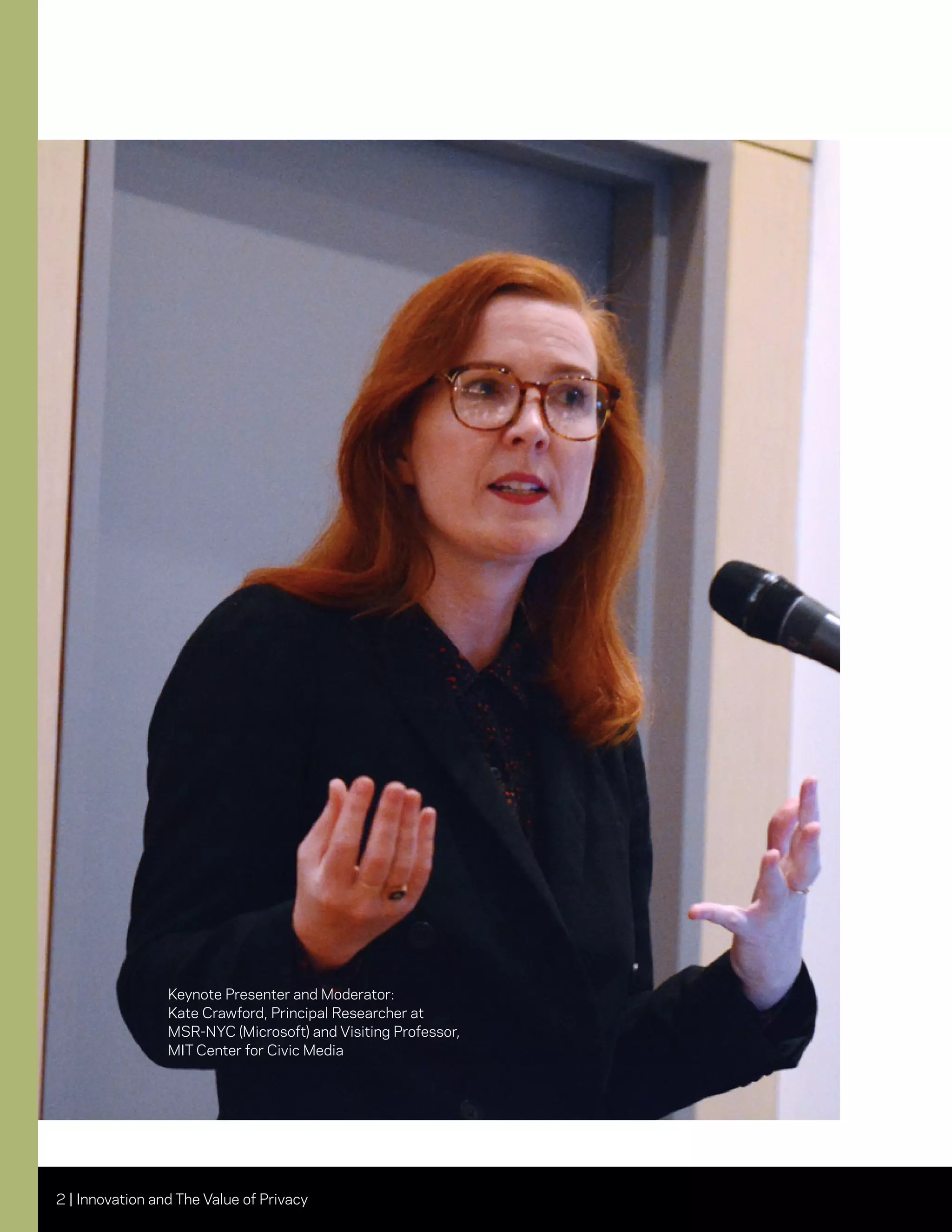
Keynote Presenter and Moderator:
Kate Crawford, Principal Researcher at
MSR-NYC (Microsoft) and Visiting Professor,
MIT Center for Civic Media
The Sanford C. Bernstein & Co. Center for Leadership and Ethics | 3
INNOVATION AND THE VALUE OF PRIVACY¹
We are very thankful to the speakers, many of whom came a long way, and to
our moderators Geoff Heal and Alondra Nelson. Kate Crawford was a superb
keynote speaker, and she also advised us on invitations to other speakers. A
number of speakers have connections to Columbia Engineering and Data Sci-
ences or to the Business School. We thank our staff, Bianca Bellino and Sandra
Navalli at the Bernstein Center, and Leslie Barna, Brianne Cortese and Jonathan
Stark at the Data Science Institute. We also thank our Deans, Glenn Hubbard
and Kathy Phillips from the Business School, Merit Janow from the School of
International and Public Affairs, Alondra Nelson from Social Sciences and Mary
Boyce from the Columbia University’s Fu Foundation School of Engineering and
Applied Science.
It was a lively and fast-paced workshop and both DSI and the Bernstein Center
are pleased to present this account of their joint efforts.
Bruce Kogut
Sanford C. Bernstein & Co. Professor/Director
Columbia Business School
Columbia University
Kathleen McKeown
Henry and Gertrude Rothschild Professor of Computer Science
Director of the Date Science Institute
Columbia University
1	 Prepared and written by Nancy J. Brandwein.
4 | Innovation and The Value of Privacy
Participants
In order of symposium agenda
Kathy McKeown
Director of the Data Science Institute
Kate Crawford
Principal Researcher at
MSR-NYC (Microsoft) and Visiting Professor,
MIT Center for Civic Media
Roxana Geambasu
Assistant Professor of Computer Science at
Columbia University
Deirdre Mulligan
Professor of Information at
UC Berkeley School of Information
Arvind Narayanan
Associate Professor at
Princeton University
Geoff Heal
Donald C. Waite III Professor of
Social Enterprise and Bernstein Faculty Leader
at Columbia Business School (moderator)
Brenda L Dietrich
IBM Fellow, Vice President,
Data Science, IBM
Abhay Edlabadkar ’07
Founder of RedMorph
Claudia Perlich
Chief Data Scientist at Dstillery
Bruce Kogut
Director Sanford C. Bernstein & Co. Center for
Leadership and Ethics (moderator)
Irfan Saif
US Advisory Leader, Technology at Deloitte
Ashkan Soltani
Former Senior Advisor at the White House
Office of Science and Technology Policy and
Independent Researcher
Alondra Nelson
Professor and
Dean of Social Science at
Columbia University (moderator)
The Sanford C. Bernstein & Co. Center for Leadership and Ethics | 5
From the 10,000 recommended steps our Fitbits measure to the e-books we read, the text and
e-mails we send and receive, the photos we share and the news videos we stream online, more and
more of our daily activities are mediated through digital devices. And as we consume digital infor-
mation and complete transactions, we provide personal information, often involuntarily, to industry,
institutions and government. With the advancements of data science, that information becomes
data points, sometimes transformed into inferences about everything from our buying behavior to
our creditworthiness, from our gender to our sexual orientation. For business, government, and sci-
ence, the more information the better—to target marketing, track terrorists, and personalize medi-
cine. But if the innovations of big data have value, what about the value of the privacy lost in the
process—or in the processing? Is privacy a human right or a societal value? In just a half-day long
conference, there was no shortage of debate on what innovations in data science and predictive
modelling imply for privacy and ethics. Kate Crawford, Principal Researcher at Microsoft Research,
New York City, got straight to the heart of the controversy in her keynote address.
What does a Syrian refugee camp have to do
with data science, innovation and privacy?
Everything, as it turns out. Crawford said that
Europe’s burgeoning Syrian refugee camps
are the site of a “fascinating machine-learning
experiment.” While she clicked on a slide of a
mother and child walking between a row of grey
tents, Crawford explained that an IBM initiative
is turning unstructured data on the millions of
Syrian refugees entering Europe into actionable
intelligence.
On hearing concerns that healthy fighting-age
males were among the many emaciated and
sick refugees coming off the boats, IBM’s team
in Europe developed their i2 Enterprise Insight
Analysis program to separate the sheep from
the wolves.² Using real data from the dark web,
such as where the refugees were buying pass-
ports, and combining it with a set of “fake data”
to which a border guard would have access,
IBM claims its computer model can create what
amounts to a jihadist “credit score.” Crawford
said analysts were quick to say that such a
score was not an absolute indicator of guilt or
innocence, yet the model concocted incredibly
detailed portraits of refugees—their names, reli-
gious beliefs, prior addresses and social graphs.
Much of the unstructured data would seem to
be innocuous, including municipal parking tick-
ets and “likes” for certain DJs on Facebook and
Twitter. Of the many reasons to be concerned
about the refugee initiative, Crawford cited the
potential for finding unwarranted correlations
and false positives, the problem of verifying
suspicious scores, and the unreliability of data
drawn from the dark web.
Yet, the privacy harm Crawford finds most wor-
risome, and one raised throughout the confer-
ence, is the potential for discrimination:
Machine learning models are creating a
kind of intensification of surveillance of the
least privileged, being tested out on the
populations who are least able to object. We
have a new and relatively untested system
for predicting terrorists while the mecha-
nism that’s being used is, itself, in a black
box. So if you are, for instance, one of the
accused, it’s very difficult to figure out what
that data is about you or why that conclu-
sion has been drawn, so that highlights for
me the kernel of what we are here to discuss
today: privacy, as it is currently configured,
has no means to deal with a situation like
this.
Crawford went on to outline three themes of the
conference woven throughout two sessions, one
on academic research and one on industry, and
in the final keynote speakers’ presentations as
well:
Privacy’s Threat Models: Privacy has always
been built on mental models of the technolo-
gies of the time and ideas of human behavior.
These threat models, Crawford explained, have
evolved from Peeping Toms at the window and
print newspapers revealing unwelcome tidbits
to the development and use of the camera in
the late 1880s, and then on to business and
government databases of the 1960s through
1980s in which computer systems simply col-
lected what you gave them. It was during this
2	http://www.defenseone.com/technology/2016/01/refugee-or-terrorist-ibm-thinks-its-software-has-answer/125484/
6 | Innovation and The Value of Privacy
time period that privacy principles of notice and
consent for access to your data and security
and enforcement emerged. Yet Crawford, and
almost every conference speaker, acknowl-
edged that this transactional model of privacy,
which still exists today, is inadequate to protect
us from privacy threats of metadata, or data
that provide information about other data, and
machine learning. In the 2010s to 2020s, on-
line trackers, mobile devices, wearable sensors
and more are capturing enormous streams of
behavioral data users never intended to share.
“A predictive system can’t give you notice,” said
Crawford, and, “it doesn’t know how it’s going to
use your data, so it can’t ask you for consent.”
The Rise of Machine Learning: Machine learn-
ing has given society significant benefits, from
Amazon’s sophisticated recommendation sys-
tems to IBM’s Watson, which draws on a corpus
of public information about cancer protocols
and treatments to offer patients personalized
care. But there are enormous risks in how your
data is stored and used, Crawford stressed.
“Because predictions have material outcomes,
some people are going to get benefits and op-
portunities and some are going to face negative
consequences,” she warned. Carnegie Mellon
researchers found Google’s online advertising
system showed ads for high-income jobs to men
more frequently than it showed the same ads to
women. Ads for arrest records have been shown
to pop up more in online searches for distinctly
black names or historic black fraternities, and
the Federal Trade Commission (FTC) has found
advertisers target people in poor neighborhoods
with ads for high-interest loans.³
Pointing to these discriminatory outcomes,
Crawford questioned the autonomy of machine
learning systems.
“The greater autonomy these systems have,”
she said, “the more questions we need to
ask about what kind of values or models
of the world we use to create them. And
what’s interesting here is that these models
get better only if they ingest more and more
training data. That’s how they get more in-
telligent... How can we ever know the value
of data now or in the future? If we can’t
understand the systems we are giving our
data to, how can we have equal power? How
do you protect information from someone
predicting it? What does it mean to have
privacy rights to something personal, e.g.
symptoms of a life-threatening disease or
the desire to leave a relationship, that you
haven’t consciously recognized yet your-
self? What if you’re being judged on some-
thing you haven’t yet done?”
The Turn to Ethics: Crawford said that pri-
vacy alone is insufficient to deal with the kinds
of challenges created by the rise of machine
learning, but “privacy and ethics get us some-
where. And ethics is becoming a core part of
data science curriculum.” She said there was
promising work being done around privacy by
design, an approach to systems engineering
3	http://www.nytimes.com/2015/07/10/upshot/when-algorithms-discriminate.html?_r=0
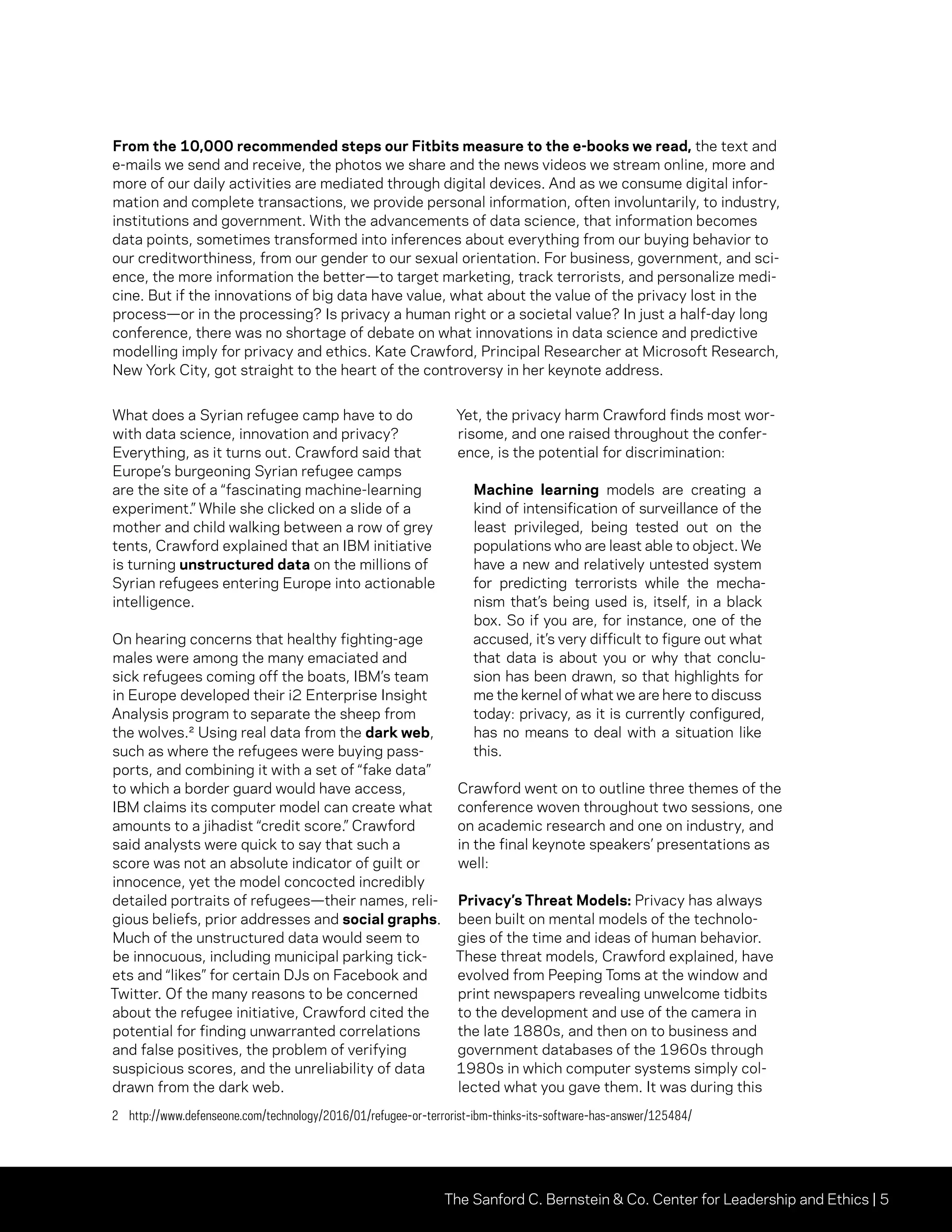
Speakers: Arvind Narayanan, Associate Professor at
Princeton University, Deirdre Mulligan, Professor of
Information at UC Berkeley School of Information, and
Roxana Geambasu, Assistant Professor of Computer
Science at Columbia University
The Sanford C. Bernstein  Co. Center for Leadership and Ethics | 7
Privacy Cheat Sheet
The multi-dimensional concept of privacy was characterized by some of the following touch points
for presenters throughout the conference. Many of these dimensions are overlapping, proving why
jurists, legal scholars, philosophers and now data scientists have yet to reach a satisfying definition
of privacy. Lawyer and philosopher Tom Gerety once observed that privacy has “a protean capacity
to be all things to all lawyers.” And Yale Law School Dean Robert Post lamented that “[p]rivacy is a
value so complex, so engorged with various and distinct meanings that I sometimes despair wheth-
er it can be usefully addressed at all.”⁴ Yet at the conference, Dierdre Mulligan valiantly introduced
these dimensions of privacy in a dizzying ten minutes or less, placing them in two buckets (even
these classifications overlap): those arising from philosophy and law and those developed from
research in computer science. Which ones are salient rely heavily on context.
Philosophy and Law
“The right to be let alone” is considered the
foundation of privacy law in the US. Formulated
by Samuel Warren in an 1890 ruling, it began
as a defense of physical privacy invasion but
has been used against privacy breaches such as
wiretapping without a warrant.
Psychological privacy is the right to keep
secrets, and it can be violated by the public dis-
closure of previously concealed information.
Autonomous decision-making is the right to
independence from the state in making the
kinds of decisions that are central to defining
a person, such as those relating to marriage,
procreation, contraception, and child-rearing.
Personhood, or the protection of the integrity of
one’s personality and of what is irreducible in a
human being, is perhaps the broadest dimension
of privacy and more akin to a human right than a
societal value. Such privacy should protect what
Warren and Brandeis called one’s “inviolate per-
sonality.” It’s a hop, skip, and a jump from there
to anti-totalitarianism in which privacy helps
mitigate against the state imposing a defining
identity upon an individual.
Control over personal information simply
states that one should be able to control the
information that others have about oneself;
however its interpretation depends upon what is
meant by “control,” what is considered “personal”
and what is considered “information.”⁵
Computer Science Research
Anonymity: the ability to interact without
revealing personally identifying information.
Confidentiality: information shared between
two parties that is not made public, an example
of which is the privacy agreement signed be-
tween patient and doctor.
Boundary regulation: control of information
shared between individuals and institutions,
including third party dissemination.
Differential privacy: the cryptographic protec-
tion of data to permit accurate queries from sta-
tistical databases while minimizing the chances
of identifying records and the individual.
4	 Solove, Daniel J., “Conceptualizing Privacy,” California Law Review, Vol.90. Iss.4, July 2002, pp.1087-1054.
5	Ibid.
8 | Innovation and The Value of Privacy
that takes privacy into account throughout the
whole engineering process, and the precise,
mathematical differential privacy, which seeks
to protect against the de-anonymization threats
mentioned earlier. And she pointed to exciting
research coming out of the privacy and ethics
space on transparency and fairness,⁶ human au-
tonomy vs. machine autonomy,⁷ power asymme-
tries, and due process—the ways you can have
legal recourse to intervene on a system that has
made a decision about you.⁸
Tackling any of these themes is daunting, but
Crawford said, “I am thrilled that academic
researchers, industry practitioners and govern-
ment regulators are coming together, because
it’s only by putting all our heads together that
we will resolve some of the very real concerns…
about data privacy today.”
What We Talk About When We Talk
About Privacy
To understand privacy and how to value it in the
big data era, we need to know what it is. In the
research session, Deirdre Mulligan, Associate
Professor of the University of California Berke-
ley’s School of Information, took on this chal-
lenge of untangling what she called an unwieldy
ball of yarn. Building on Crawford’s outline of
threat models, Mulligan said that legislators,
engineers and academics all need to understand
“what it is people are trying to protect against
what kinds of threats.”
“Privacy is like democracy and art,” stated Mul-
ligan, “We are never going to nail it down.” The
best way to think about privacy, she said, is as a
touch point. “Part of the term ‘privacy’s’ work in
the world,” Mulligan told attendees, “is to give us
a vehicle to have conversations about privacy’s
meaning, in practice and in everyday life”—and
in conferences like this one. She recommended
viewing privacy as a living concept, more as an
unfinished “tapestry” that’s fringy at the edges
and that invites us to add to it and, as she said,
“expand how we operationalize privacy to protect
against today’s threats.” We can’t build the right
solutions unless we are sure we are focused on
the “right” privacy. Yet with so many definitions
of privacy (see “Privacy Cheat Sheet”), and in a
world constantly being reinvented by technol-
ogy, we need a heuristic rule to forge this mal-
leable and multi-faceted concept of privacy that
can meet the requirements of actual situations.
As an example of what happens when the
“wrong” privacy is addressed, Mulligan cited
the Transportation Safety Authority’s (TSA’s)
full body scanners or “naked machines.” It turns
out passengers’ concerns on implementing
the scanners were not what the government
thought they would be—that their Personally
6	http://www.stanfordlawreview.org/online/privacy-and-big-data/its-not-privacy-and-its-not-fair
7	http://sth.sagepub.com/content/early/2016/05/31/0162243916650491.full.pdf+html
8	http://lawdigitalcommons.bc.edu/cgi/viewcontent.cgi?article=3351context=bclr
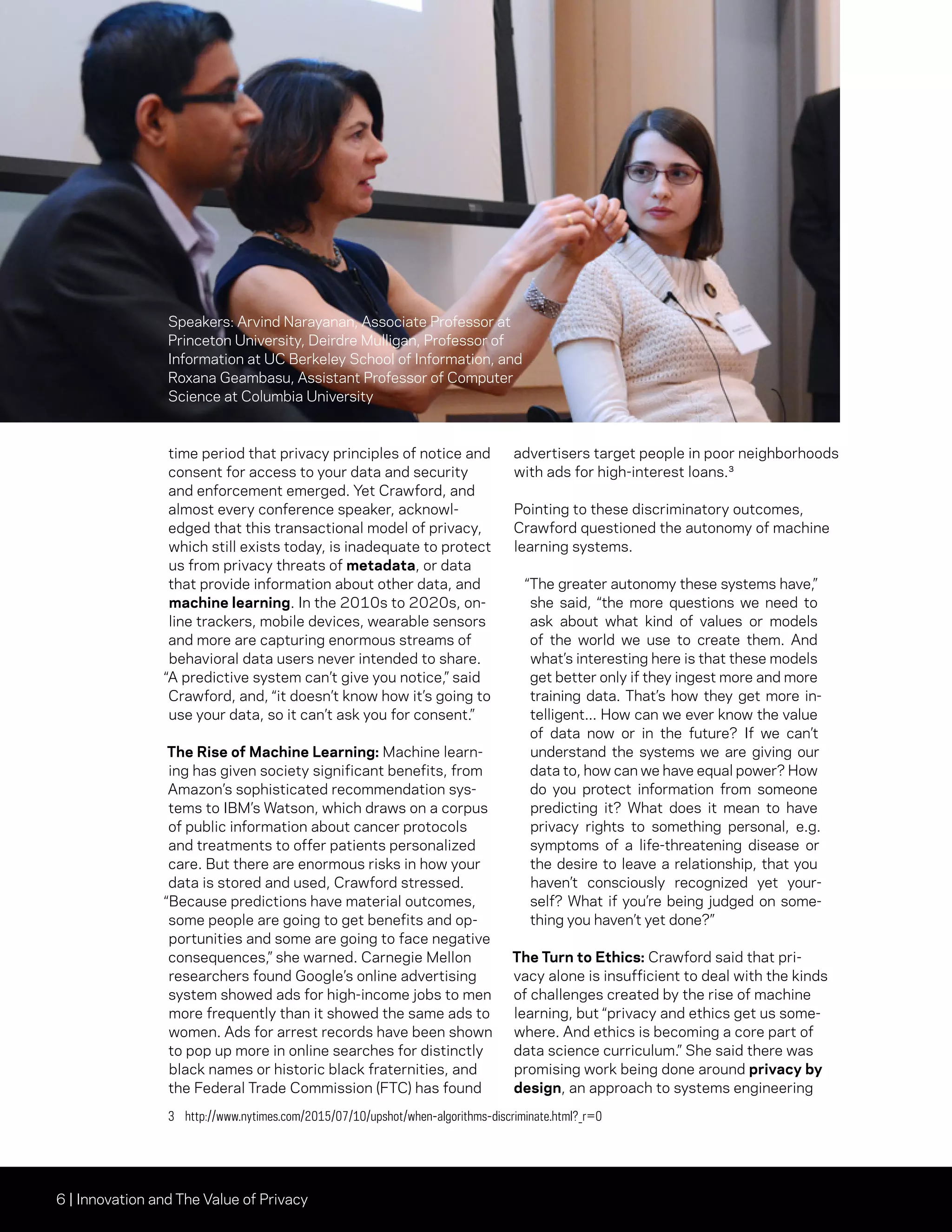
Co-Sponsor of the Event: Kathy McKeown,
Director of the Data Science Institute
The Sanford C. Bernstein  Co. Center for Leadership and Ethics | 9
Identifiable Information (PII) was being stored
in a massive cloud-based park of servers. No,
their concerns are the ones that Mulligan, as
the mother of a teenage girl, felt keenly: guys in
a booth ogling bodies.” The privacy threat here
is access to the physical self, exposure of one’s
naked body, and dignity interests. And design
solutions that protect against privacy solutions
need to be geared toward what is supposed to
protected.
Is It Privacy Or Is It Fairness? Power
Asymmetries Between Users And
Businesses
Though not explicitly discussed, definitions of
privacy also differ by cultures and countries.
European countries are much more eager than
the US to view privacy in the context of an
inviolable human right. This right includes a
derivative “right to be forgotten,” resulting from
a 2014 European Court Ruling, which grants
individuals the right, under certain conditions,
to ask search engines to remove personal
information about them.⁹ The US tendency is
to treat privacy more as property, where users
give consent to provide data to the service-
provider as a condition for the service. This
consent may arguably be voluntary, but there is
also a coercive element to it. If everyone is on
Facebook, the decision not to give consent is ef-
fectively to be socially ostracized. And once an
individual agrees to share data, the data may be
kept in perpetuity. These issues, if not explicit
in the conference panels, came up in QAs and
nevertheless set the stage for one of the more
interesting debates regarding the relative pow-
erlessness of consumers in many situations.
Are we focused on the wrong privacy threats?
In her keynote address, Kate Crawford stated,
“…while these models are ultimately creating
very detailed pictures of us that have privacy
implications, their outcomes have implications
that go far beyond privacy, that touch on things
like discrimination, how we think about fair-
ness… Privacy discourse has failed to account
for growing power asymmetries between data
industries and the rest of us, getting to the
point where I fear those asymmetries.”
Data scientist and consultants working in busi-
ness often have a different view of these asym-
metries. Industry speaker Brenda Dietrich, IBM
Fellow and Vice President in the IBM Research
Divisions, is one of them. “If you think back to
pre-Internet days, consumers had relatively
little information about prices, quality, avail-
ability,” she said. Dietrich contrasted that with
the process of buying a car today, in which the
consumer is armed with vastly more information
and there is much more transparency for the
consumer:
Today you can know what the last 100 or so
models of that car sold for. You have price
9	http://ec.europa.eu/justice/data-protection/files/factsheets/factsheet_data_protection_en.pdf
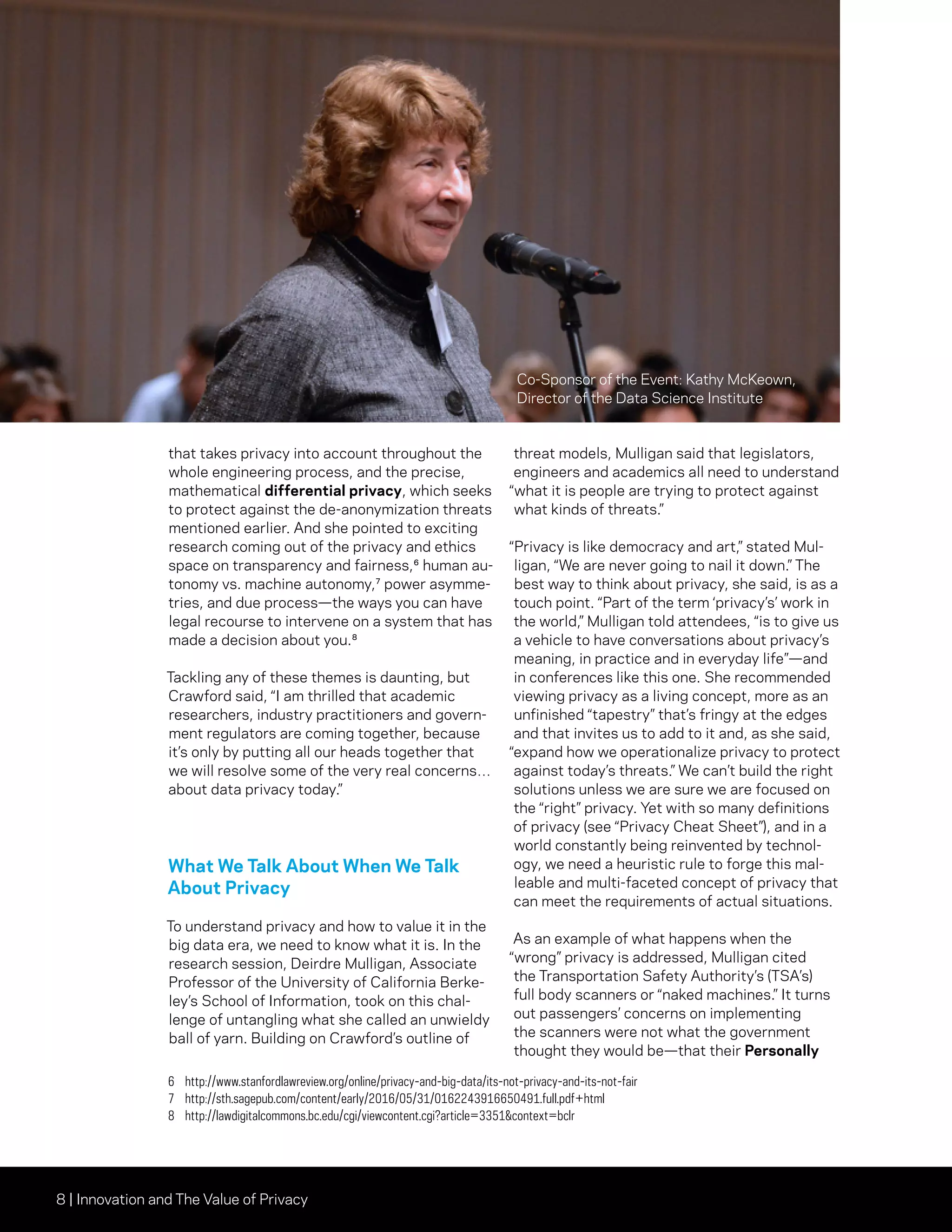
Keynote Speaker:
Irfan Saif, US
Advisory Leader,
Technology at
Deloitte
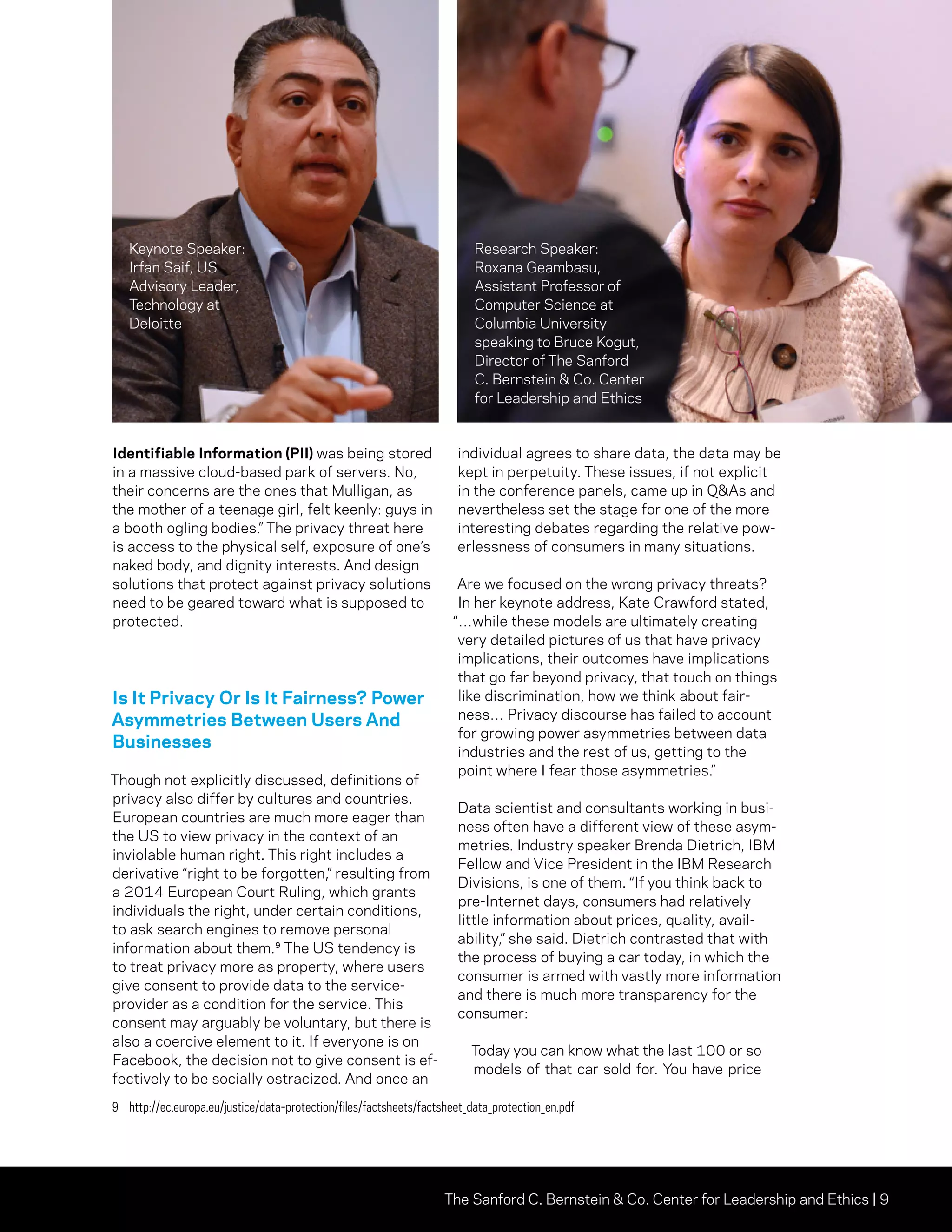
Research Speaker:
Roxana Geambasu,
Assistant Professor of
Computer Science at
Columbia University
speaking to Bruce Kogut,
Director of The Sanford
C. Bernstein  Co. Center
for Leadership and Ethics
10 | Innovation and The Value of Privacy
information at your fingertips. You have the
upper hand. Retailers, consumer packaged
goods companies, etc. were very concerned
about this asymmetry. ‘If my customers
know everything there is about my product
and competitor product, I want to know ev-
erything there is to know about my customer
so I can have an equal amount of informa-
tion that levels the playing field again.’ We
can all argue, ‘Well, the businesses had the
advantages for decades, so it’s our turn as
consumers.’ The reality is that they [busi-
nesses] don’t think that way.
No they don’t. Let’s take Dietrich’s new car
example. While we as customers have more
access to information on dealerships and car
models than ever before, when we go online
to search for the abundance of information on
that new car, websites, browsers, companies,
and third party data brokers are collecting our
information to show us targeted ads for cars,
and, privacy advocates argue, that they then
have the upper hand. Speaking in the research
session, Arvind Narayan, Assistant Professor of
Computer Science at Princeton, said:
In classical economics we say that users
know something about themselves that
the seller or information provider doesn’t
know. So there’s an information asymmetry.
What’s happening here is the exact opposite.
There’s a lot of tracking going on. The people
doing it know what information they’re send-
ing and who they’re sending it to. You don’t
have that information yourself, which hurts
your ability to make an informed decision in
that transaction.
This is a bold observation. Indeed, no less than
a Nobel Prize was given to Berkeley Professor
George Akerlof for his analysis of the failure of
markets to find prices for used cars when the
seller knows whether or not the car is a ‘lemon’.
In the new age of data science, the buyer or ag-
gregator will often know more about the quality
of the good being sold than the seller.
Transparency and Measurement: Antidotes to
Information Asymmetry?
Is transparency the answer to the new econom-
ics of the information asymmetry problem? The
research session moderated by Geoffrey Heal,
Donald Waite III Professor of Social Enterprise
at the Columbia Business School, suggested
yes. Roxana Geambasu, Assistant Professor
of Computer Science at Columbia University,
and Arvind Narayan both presented their own
research solutions that use transparency and
measurement to counter tracking mechanisms.
Geambasu introduced “Sunlight,” the first sys-
tem that can diagnose online ad targeting in fine
detail, at a wide scale, and with solid statistical
justification. This second-generation tool builds
on its predecessor “X-ray.” Geambasu and her
fellow researchers set up a Gmail account and
populated it with simple single-topic e-mails.
The researchers then set up 119 Gmail ac-
counts and sent 300 e-mail messages all with
sensitive keywords both in the subject line and
Question and answer sessions with
members from the greater community
The Sanford C. Bernstein  Co. Center for Leadership and Ethics | 11
bodies of the e-mail. Of the ads shown, about
15 percent appeared to be targeted, and more
worrying, many violated Google’s own policy
against targeting ads based on “race, religion,
sexual orientation, health, or sensitive financial
categories.” For instance, an ad with the key-
word “unemployed” netted an “easy auto financ-
ing” ad. And of course, Geambasu reminded
us, Gmail is not alone in contradicting its own
ad targeting policy. “The web is a complex and
opaque ecosystem,” she said, “driven by massive
collection and monetization of personal data. “
Interestingly, during the last day that the
Sunlight project collected its data, Google shut
down its Gmail ads program and began some-
thing called organic ads.¹⁰ The shutdown of
Gmail ads and its transmutation into something
else are likely not coincidental. In the process of
creating greater transparency, Arvind Narayan’s
research shows that the very act of tracking
the trackers can stop them dead in their tracks.
He and his fellow researchers measured the
presence of three persistent tracking tech-
niques and published the results in their paper,
“The Web Never Forgets: Persistent Tracking
Mechanisms in the Wild.” Of all the techniques
measured, the canvas fingerprinting method
received the most media attention—and elicited
the most public outrage.
The response was immediate. “Canvas finger-
printing was only a known technique for two
years,” said Narayan, “but in just days after our
work was published, the largest users of canvas
fingerprinting [AddThis and Ligatus] stopped
cold. Why?” Narayan’s diagnosis of the sudden
halt in the surreptitious fingerprinting technique
is that “you have some kind of weird Heisenberg
principle analogy for the Web, that measure-
ment automatically changes the behaviour [of
the trackers].” In a blog post on his “Freedom
to Tinker,” one of Narayan’s co-authors, Steve
Engelhart, posited that the visual representa-
tion of canvas fingerprinting in particular was
especially helpful in removing the asymmetry
of information because users could intuitively
grasp that a unique “picture” of their online ID
was being created click by click. In addition, the
paper included measurements of the trackers
responsible for fingerprinting as well as the
sites on which the fingerprinting was taking
place, thus allowing users to voice their frustra-
tions or visit alternate sites.
Inevitably, though, it was only a matter of time
before canvas fingerprinting started up again.
When the research team ran the measure-
ments again in January of 2016, the number of
distinct trackers utilizing canvas fingerprinting
had more than doubled.¹¹ The lesson: in order to
maintain transparency for users, measurements
must be collected on a continuous basis. Naray-
an has initiated what he calls Open Web Privacy
Measurement (WPM), which runs monthly taking
one million site measurements. He hopes using
it will increase transparency, reduce the asym-
metry of information in favor of trackers, and
answer questions ranging from “Are new web
technologies being used and abused for track-
ing?” to “How is the NSA able to piggyback on
ad tracking?” and “How effective are the various
tracking protecting agencies?”
However, the tools that Geambasu and Narayan
and their teams are building are likely of most
use to regulators, privacy advocates and pri-
vacy tool developers. As for the general public,
while a transparency study generates a burst of
interest and outrage, Narayan admits, in “The
Web Never Forgets,” that the level of user effort
and sophistication required for mitigation make
it doubtful that individuals can effectively adopt
and maintain the necessary privacy tools.
Peering Into The Black Box
Rather than looking towards individuals to
mitigate against privacy harms, we can look
towards markets and competition to drive the
innovations needed to protect privacy. In the
industry session, moderated by Professor Bruce
Kogut, IBM’s Brenda Dietrich, Dstillery’s chief
data scientist Claudia Perlich, and privacy advo-
cate and RedMorph founder Abhay Edlabadkar
each spoke about this approach.
Born under Communism in East Germany, Clau-
10	http://datascience.columbia.edu/new-tool-expands-tracking-personal-data-web
11	https://freedom-to-tinker.com/blog/englehardt/retrospective-look-at-canvas-fingerprinting/
12 | Innovation and The Value of Privacy
Privacy as Promotional Plus
Privacy has increasingly been touted as a selling point by major technology
companies. The Fall of 2015 saw the launch of Blackberry PRIV, for instance,
which ditched the company’s own mobile software for Google’s android plat-
form—with a difference—it boasts privacy-enhancing features . Compared to
smartphones powered by Apple’s iOS, android devices have long been known
for their lack of data security. With Blackberry’s “Crackberry” days long gone,
the company’s launch of the PRIV—and its assurance to make its Android
system secure—is a last-ditch effort to regain market share.12 That same
fall, both Microsoft and Apple updated and touted their privacy policies.
Microsoft re-explained the privacy policy for its Windows 10, assuring users,
“We don’t use what you say in e-mail, chat, video calls or voice mail, or your
documents, photos or other personal files to choose which ads to show you.”
Apple couldn’t resist a barely veiled swipe at Google in promoting its privacy
policy, “Some companies mine your cloud data or e-mail for personal informa-
tion to serve you targeted ads. We don’t.”13
Apple has long used its privacy model to market its phones to consum-
ers. Unlike Facebook, Google, and Amazon, which monetize the data users
feed them, Apple does not sell customer data and makes a point of telling
consumers that almost all personal information is kept on the device, not
sent to Apple’s servers. And when it does upload users’ data, that data is
anonymous, untethered to the users’ Apple IDs. For instance, when Apple’s
iPhone location services do send information on your whereabouts to its own
servers, Apple explains in its privacy policy that it uses anonymized rotating
identifiers to keep searches and locations from being traced to you person-
ally.¹⁴
Three weeks after the Innovation and the Value of Privacy Conference, the
world saw just how far Apple would go to protect customer data. Apple was
besieged by lawsuits from the United States Department of Justice (DOJ),
first to create a backdoor key to unlock the iPhone 5C of one of the San Ber-
nardino, California, shooters, Syed Farook, who killed 14 people and injured
22 more on December 22, 2015, and then to unlock the phone of a Brooklyn
drug kingpin. The cases never went to court because third-party hackers
came forward to unlock the phones. But the case pushed data security and
privacy concerns to the forefront for the public. Directly after the DOJ suits,
Facebook-owned messaging app, Whatsapp, gained positive press because
they announced end-to-end encryption of all chat messages. Yet in all the
laudatory press about the encryption, Facebook’s Whatsapp still collects all
the metadata—your e-mail address, cell phone number and, if not what you
say in your chat, with whom you are chatting. Users’ comfort with the level
of privacy touted by a tech business often comes down to their trust in that
particular business.
12	http://www.cnet.com/news/inside-blackberrys-last-ditch-plan-to-win-you-back-with-android/
13	http://www.computerworld.com/article/2987249/data-privacy/apple-microsoft-wield-privacy-as-marketing-tool.html
14	https://www.wired.com/2015/06/apples-latest-selling-point-little-knows/
and [Apple location services] http://www.apple.com/privacy/approach-to-privacy/#personalization
The Sanford C. Bernstein  Co. Center for Leadership and Ethics | 13
dia Perlich could not recall seeing an ad until
she was 16. Now, as chief scientist at market-
ing intelligence company Dstillery, Perlich fine-
tunes consumer marketing by capturing data
from consumers’ digital footprints. “Predictive
modelling has come up because of the down-
side,” Perlich said, referencing Kate Crawford’s
keynote. However, Perlich argued, the very
technology behind the machine learning models
provides “a level of security around sharing data
and limiting data breeches” and also a way to
share data without reaching unintended recipi-
ents.
Perlich explained how her models decide who
are potential consumers of client products and,
hence, who can be shown an ad and when. The
machines crunching the number are “agnostic,”
in that “they don’t need to know or understand
anything about the meaning of the data… In-
stead of using things like income, we’re directly
using the history of URLs to do exactly the
same thing, because what you do online is a hell
of a lot more predictive than what somebody
else thinks you are…. Your actions speak louder
than your demographics.”
And not only does the machine not “know”
anything about your data, but Perlich said she
doesn’t either. “With all due respect to people
arguing for transparency, “ she admitted, “I have
no clue what these things do. I build ten thou-
sand a week. I have no idea what any of these
models predict and why.” In an e-mail discussion
after the conference, Perlich expanded on this
notion:
While our brain is not capable of calculat-
ing the optimal route to the airport (as your
GPS can), we can perfectly understand the
resulting instructions. This is no longer true
when we are talking about algorithms of
the ilk used to predict human behavior. The
short answer is yes, I know exactly how the
prediction was calculated. Think of it as a
very complicated recipe.¹⁵ But our human
mind cannot possibly understand the mean-
ing behind it…The second problem is that I
do not even know what information the mod-
el is using because I am trying to respect the
privacy of users.¹⁶
Both Dietrich and Perlich told attendees privacy
by design was a crucial part of the models built
at IBM and Dstillery respectively. During her
talk, Dietrich spoke of her work with IBM Cloud
Insight Services and its recent acquisition of
The Weather Company’s digital assets. Ac-
cording to a press release announcing the deal,
IBM’s “sophisticated models can now analyze
data from three billion weather forecast refer-
ence points, more than 40 million smartphones
and 50,000 airplane flights per day…[enabling]
IBM to offer a broad range of data-driven prod-
ucts and services to more than 5000 clients
in the media, aviation, energy, insurance and
government industries.”¹⁷ Dietrich remarked, “I
don’t think people have privacy concerns about
15	https://www.linkedin.com/pulse/way-algorithm-claudia-perlich?trk=mp-reader-card
16	E-mail from Claudia Perlich to Nancy J. Brandwein dated April 28, 2016
Moderator: Alondra Nelson,
Professor and Dean of Social
Science at Columbia University
14 | Innovation and The Value of Privacy
knowing what weather conditions are at any
point in time and space, but we also have the
forecasted weather, and so the question is how
do people respond to weather forecasts? How
does their behavior change? This is the question
that gets into privacy issues.”
On the privacy protections in place at IBM, Diet-
rich said, “We adhere to privacy by design as an
objective. Any time we [at IBM] are taking data
in or giving data out we get a reading from the
chief privacy officer on whether what we’re do-
ing is compliant with both the law and the intent
and aspirations of the company.” In correspon-
dence after the conference Dietrich added, “as
Claudia also emphasized, the data is calculated
by a computer and almost never looked at by
human eyes.”
Anonymizing Data and Accounting for Bias
Toward the end of her presentation, Claudia
Perlich started to talk about the ways data is
anonymized so even if human eyes look at it,
the humans looking can’t recognize what they
are seeing. Expanding upon these techniques
after the conference, Perlich elaborated on her
point that her company keeps the users’ digital
footprint from turning into a full body portrait.
She explained:
Our customers are primarily marketers and
their agencies are trying to connect to po-
tential customers. They expect that we NOT
show ads to bots, that ads do NOT appear
on questionable content, that we do NOT
fake the evaluation metric (knowingly or un-
knowingly). On the user side, they expect
us NOT to use device fingerprinting to es-
tablish a unique identity, to NOT reconnect
cookies once they are deleted by the user,
to NOT store PII of any kind, to NOT label
people’s behaviour into segments, to NOT
sell user data, and to NOT keep activity logs
in humanly readable form. ¹⁸
One of the ways data is parsed, for instance, is
through a technique called feature hashing.
When users with a Dstillery cookie visit URLs,
the model does not store the actual string of
URLs visited but translates them into a “hashed”
version, a random string. The URL for www.cnn.
com may look like ‘1he83’, but there are maybe
15 other websites other than CNN that get
recorded as 1he83, so engineers and scientists
like Perlich are unable to trace back the exact
user browsing history. In this way, Perlich and
Dstillery are attempting to satisfy the privacy
dimensions of computer science introduced
by Mulligan earlier (see “Privacy Cheat Sheet”),
such as anonymity, confidentiality and differen-
tial privacy.
Yet because machine learning algorithms learn
and evolve based on what users do online, can
they really be “agnostic,” as Perlich stated? “The
amoral status of an algorithm does not negate
its effects on society,” said Carnegie Mellon
researcher Anupan Datta, one of the authors of
the Google ads study mentioned earlier.¹⁹ One
17	http://www.ibmbigdatahub.com/blog/introducing-insight-cloud-services-ibm-insight-2015
18	Op. Cit.
Keynote Speaker: Ashkan Soltani, Former
Senior Advisor at the White House Office
of Science and Technology Policy and
Independent Researcher
The Sanford C. Bernstein  Co. Center for Leadership and Ethics | 15
can’t look at the inputs that go into that black
box but one can note that the outputs reflect
user bias and can potentially lead to discrimina-
tion in real life (as in the case with the Google
ads study).
Mulligan pressed this point with Perlich, leading
to a lively exchange after Mulligan posed this
conundrum:
If I can’t look at [inside] the black box, we can
at least avoid bad outcomes. We can say ‘If
these people are alike on all these different
parameters we shouldn’t treat them differ-
ently, just because their race or gender is
different.’ But that presumes you actually
have data about race, about gender. All the
[demographic] data you’re doing away with
in your model actually limits your ability to
avoid bad outcomes because you don’t actu-
ally have data.
To which Perlich responded, “If I give my model
race, then I can use it, but that’s what you
specifically don’t want my model to use. Yet, I
take it out, and you tell me I can’t control it.” The
model will still effectively identify race by using
correlates.
“But can’t you set a rule, ‘Don’t use race as a
determining factor’?” asked Mulligan.
“But that’s a totally useless rule!” Perlich ex-
claimed.
“I completely agree,” said Mulligan, and then got
to the heart of her concern over bias and the
black box. “But the thing that you want to be
able to say is ‘Do these things the model seems
to be using correlate with race?’, and if you’ve
done away with capturing race you can never do
that.” Several members of the audience mur-
mured their assent and there was even a chorus
of “Yes” that echoed around the room.
A nonplussed Perlich responded, “I am already
half out of business, because I refuse showing
ads to bots, “ she said, referencing Dstillery’s
privacy policies. “The problem becomes, I’m in
an economic incentive system, where I’m paid
on getting the highest click-through rate, and
if that click-through rate happens to be subject
to racial preference… I can quit doing advertis-
ing or I will be off the plan and someone will be
hired who has much less concerns about going
where the signal leads.” Perlich clearly stood by
Dstillery as a company in which there is a strong
attempt to “do the right thing,” but as she said
earlier, it comes at a cost. “There certainly have
been tradeoffs that have not been beneficial to
us in terms of market valuation. We have com-
petitors getting a lot further in their economic
development by disregarding basic rules around
what we should and should not be doing.”
Do Businesses Value Privacy? Do
Individuals?
“But is privacy something that is always a nega-
tive externality, “bad” for business?” Professor
Kogut asked all three industry practitioners. “Or
can privacy become a benefit for everyone? It
seems that deploying privacy solutions would
diminish ad revenue, or do you think that privacy
can be a positive?” (see “Privacy as Promotional
Plus”)
In response to Kogut’s questions, Abhay Edla-
badkar entered a spirited discussion with his
fellow panelists. With prior experience in Tele-
com  Semiconductors including a stint at Bell
Labs and a Columbia Business School alumni,
Edlabadkar started his company, RedMorph, in
2013 when he became concerned about the
amount of data his teens were sharing online.
His firm markets a privacy tool that promises to
visualize and block trackers, cookies, and third
party content, to encrypt your data, and to filter
or block inappropriate content. “Advertising is
not ‘wrong,’ affirmed Edlabadkar, but “the way
it is happening is wrong with the indiscriminate
way data is collected, the asymmetry that has
been created.”
“My very short answer, “ replied Perlich bluntly,
“is this: ‘You’re living in a capitalist society where
there is always misalignment of incentives.’ ”
19	http://www.nytimes.com/2015/07/10/upshot/when-algorithms-discriminate.html?_r=0;
see also https://www.propublica.org/article/machine-bias-risk-assessments-in-criminal-sentencing.
16 | Innovation and The Value of Privacy
But IBM’s Dietrich pushed back against the
notion of asymmetry, “I don’t think there is a
disequilibrium here. Some of us don’t mind giv-
ing information to the businesses that we do
business with because it enables them to serve
us better. On the other hand, we have some
extremely paranoid people who don’t want to
let any information leak, so they don’t reap the
necessary benefits.”
Edlabadkar leapt from his seat to disagree.
“That’s not right. I believe one should be able
to control what’s public and what you want to
keep private. That control does not exist right
now,” he exclaimed, to which Dietrich confirmed
calmly, “You’re right. However, I’m not convinced
that if it did exist that most people would be
able to control it to their benefit.”
The Tradeoff Between Privacy and Utility:
Does it Exist?
Dietrich and Perlich assume there is a tradeoff
between privacy and utility.
Irfan Saif, the penultimate conference speaker,
agreed with this assumption. As a principal in
Deloitte  Touche LLP’s Cyber Risk Services
practice, Saif helps technology companies
design and build platforms for the marketplace,
with a primary focus on combatting cyber risks.
“I don’t believe that users are necessarily victims,
“ he said, “There’s lots of people who intention-
ally give up certain privacy [rights] and certain
information to get something in return…and it’s
driving a massive economy.”
Citing Facebook as one of the forces driving this
economy and offering utility to its users, Saif
said that in January 2016, “Facebook’s user
rate was up to 1.6 billion individual users and
growing at 100 million users a month…People
want to share. They want to share a lot. But
what they have, though, is an expectation that
the people they are sharing with are going to
have a limited and constrained set of use cases
for that data. There is a tradeoff that is the
whole heart of data as currency…If I can get a
game or service or some functionality or some-
thing that benefits me from a user experience
standpoint, I might be willing to give up some of
my privacy.”
But what about the question Dietrich raised:
if some way to control data actually existed,
would people avail themselves of it? The answer
is paradoxical. Citing a Pew Research poll on
Americans’ attitudes on privacy, Edlabadkar
reeled off these stats:
•	 Over 90% of people have a strong desire
to have control of their online content and
privacy
•	 85% of online consumers now oppose track-
ing and are unwilling to trade their personal
data, even anonymously, for the sake of being
served relevant ads.
Yet—and this is the paradox—Edlabadkar also
pointed out that Americans are not doing much
to protect themselves by utilizing tools like
RedMorph’s or ad blocker Disconnect, despite
the fact that such tools create speedier Internet
surfing, which is the positive externality Pro-
fessor Kogut was looking for. Citing his experi-
ence trying Disconnect, Irfan Saif said that the
tool found twenty trackers on a Superbowl 50
website page—for one two-paragraph article.
Saif acknowledged, “The user experience for
me is far greater with Disconnect. Not because
I’m worried that I won’t get targeted ads… I’m a
security guy, so I don’t click on ads or links, but
it speeds up the performance of the web page
by more than double.”
So if we can protect our privacy and improve
our Internet experience to boot, why aren’t we
doing so? Crawford had mentioned the work of
Professor Joseph Turow, at NYU’s Annenberg
School for Communication. Turow reported the
results of his study on the tradeoff between
privacy and utility in The Tradeoff Fallacy: How
Marketers are Misrepresenting American Con-
sumers and Opening them Up to Exploitation. In
a study on Americans’ attitudes to exchanging
online data for supermarket discounts, Turow
and his fellow researchers found:
A majority of Americans are resigned to
giving up their data—and that is why many
appear to be engaging in tradeoffs. Resig-
The Sanford C. Bernstein  Co. Center for Leadership and Ethics | 17
nation occurs when a person believes an
undesirable outcome is inevitable and feels
powerless to stop it. Rather than feeling
able to make choices, Americans believe
it is futile to manage what companies can
learn about them. Our study reveals that
more than half do not want to lose control
over their information but also believe this
loss has already happened.20
For those users who are not resigned, can they
opt out? One audience member, an info-tech
employee who works on highly secure systems,
posed this dilemma to Kate Crawford. “I’m
writing a novel set in the war on terrorism. I’m
learning Arabic, I’m researching GITMO online.
I’m sure I’m in an NSA database. While I don’t fit
their [terrorism] profile in some ways, I’m sure if I
bought a large load of different types of fertil-
izer, someone would show up at my door very
quickly! Are there valid ways of opting out that
don’t raise a different red flag?” Crawford told
the techie/novelist:
Each piece of information is a signal that can
be read a certain way, and the system reads
cumulatively… I worry that the 1990s and
2000s model of opting out is gone. We’ve
lost out. There are data infrastructures built
into the cities we live in, the airports we fly
through. Without the ability to opt out, what
can we do to strengthen people’s agency,
capacity and privacy? We have less than
five years to come up with a really strong
framework.
How do other countries view the same privacy
dilemmas?
Inevitably, questions came up about how the
United States compares with other countries
when it comes to expectations around privacy
and whether there was any convergence in the
international space on privacy that would allow
business to proceed smoothly.
In the industry session QA session, the con-
sensus was that European countries are much
more privacy conscious than Americans—Ed-
labadkar said a higher percentage of Germans
used ad blockers. (In the summer of 2016, the
European Union adopted a due process require-
ment for data-driven decisions based “solely on
automated processing” that are shown to “sig-
nificantly affect” citizens.21 (Writer’s note, NJB)
Yet while it’s tempting to think that privacy rules
and regulations necessarily make a populace
more secure, Dierdre Mulligan added an inter-
esting perspective from research conducted for
her book with Kenneth A. Bamberger, Privacy on
the Ground: Driving Corporate Behavior in the
United States and Europe.22 The authors found
that there is a divergence between how privacy
is treated on the ground—in daily and business
20	https://www.asc.upenn.edu/sites/default/files/TradeoffFallacy_1.pdf
21	http://www.nytimes.com/2016/08/01/opinion/make-algorithms-accountable.html?_r=1
22	Bamberger, Kenneth A. and Mulligan, Dierdre K., Privacy on the Ground: Driving Corporate Behavior in the United States and Europe, Boston, MA
(MIT Press: 2015).
Industry Insights Presenters: (from
left) Brenda Dietrich, IBM Fellow,
Vice President, Data Science, IBM,
Abhay Edlabadkar ’07, Founder of
RedMorph and Claudia Perlich, Chief
Data Scientist at Dstillery
18 | Innovation and The Value of Privacy
life—and on the books, i.e., the law. Mulligan
summarized her findings:
The countries that have the most robust in-
terpretations of privacy… are the US and
Germany. If you just focused on the laws
on the books, you would think them the fur-
thest apart. Privacy is a strategic issue, not
just a compliance issue; privacy influences
business and tech decision-making, market
entry, lines of business, not just what does
the legal agreement look like at the end of
the day. Privacy in both countries is rela-
tively ambiguous from a legal perspective,
and the company itself is vested with figur-
ing out what is required. We think of Ger-
many as top down with lots of rules, but the
simple fact is they vested responsibility for
understanding and protecting privacy with
a data protection officer who is in the firm,
and as there has been more transparency
around privacy failures, those people have
become more influential.
These findings are at odds with Crawford’s
urgency in demanding a framework for privacy
within five years and the statement she made,
at the outset, in her keynote: If you were to ask
me ‘How do we end privacy?’ The answer: Just
keep doing what we’re doing.”
Pushing Back on Paranoia
On the whole, this conference and the intense
debates it spawned on the nexus between data
science and privacy—as well as other forums
for the debate that have sprouted up—run
counter to a pessimistic outlook. What “we’re
doing”—the academics, industry practitioners
and government regulators—is what Crawford
lauded as so important at the outset: “putting all
our heads together.”
From his own experience with enterprises, albe-
it on the cybersecurity end, Irfan Saif noted just
how important this dialogue will be. Regarding
the information that is aggregated behind the
scenes and correlated in a way that generates
information you didn’t consciously give up, Saif
said there is no consistent approach from com-
pany to company. “It’s not necessarily a prob-
lem…that you want the engineers in the field to
solve as they build a product,” he said, implying
that privacy by design cannot be left solely to
data science engineers but “requires a lot of
debate and dialogue [across disciplines], and I
think that’s a lot of what has gone on today.”
In introducing the conference’s closing speaker
Alondra Nelson, Columbia’s Dean of Social
Science, echoed the need for interdisciplin-
ary dialogue. Nelson said this conference was
particularly important to the social science
schools “because issues of data and computa-
tional social science, privacy, surveillance and
discrimination are one of the strategic priorities
for the division.”
The conference’s final keynote speaker, Ashkan
Soltani, is an independent technologist and
Keynote Presenter
and Moderator: Kate
Crawford, Principal
Researcher at MSR-
NYC (Microsoft) and
Visiting Professor,
MIT Center for Civic
Media
The Sanford C. Bernstein  Co. Center for Leadership and Ethics | 19
researcher; he was on the team of Pulitzer Prize
winning Washington Post reporters who broke
the story of Edward Snowden and NSA surveil-
lance, a researcher on the Wall Street Journal’s
award-winning “What They Know” series, and
chief technologist for the Federal Trade Com-
mission, where he helped create its new of-
fice of technology research and investigation.
Wouldn’t he sound the most alarms for the po-
tential for privacy breeches in the big data era?
Surprisingly, Soltani began his talk by push-
ing back on paranoia and attempting to ease
privacy fears. “Much of this [discussion] has
generated a feeling of being frightened or…of
helplessness. That’s one response,” Soltani said,
and he went on to remind attendees, “This field
is emerging. We’ve had databases only less than
a century, data brokerages for a few decades,
ad targeting for maybe ten or twenty years…Pri-
or to 2006 the big ad companies were not doing
behavioral ad targeting. There are a lot of differ-
ent business models we might end up at. It’s not
predetermined that all our privacy is gone, and
we’re walking around naked all day.”
At the same time that he pushed back on
paranoia, Soltani pushed back on the notion
of hiding behind an outdated legal framework
of notice and consent, or on the idea Claudia
Perlich brought up that “we don’t understand
how these things [computer models] work.” To
that, Soltani said, “That’s not good enough,” and
here he echoed Mulligan’s concerns about bias:
There are certain things the system should not
do. Using the example of flight control systems
safety improvements, he said even seasoned pi-
lots might ask, “What is the system doing now?”
in the same way that seasoned data scientists
will ask, “What is the model doing now?” The
Federal Aviation Administration says, “That may
be the case but there are certain things the sys-
tem should not do and these should be known.”
In the case of predictive modeling, Soltani
said, “Computers or systems don’t necessarily
understand what data it’s processing, but…we
as practitioners, developers and designers must
make sure that there are certain things baked
in.” He gave an example of casinos marketing to
people who have disclosed gambling addictions
online, and concluded, “People’s self-disclosed
vulnerabilities should not be an area we allow
targeting to.”
Adding to Deirdre Mulligan’s take on privacy as
a “morass” and an “unwieldy ball of yarn,” Soltani
agreed that one of the key difficulties of tack-
ling privacy and the ethics surrounding it in the
age of innovation in big data is its very amor-
phousness. Yet no matter what definition you
use, Soltani said they all share three elements
(see Figure 1):
1. The data: what are the different levels of
sensitivity, from browsing history to high
sensitivity data like credit card or healthcare
information?
2. The target: who are the individuals or class
of people from whom data are collected?
3. The audience: who sees/uses the
information?
It is only by measuring each of these elements
that you can get a sense of privacy tradeoffs or
privacy threats, Soltani summarized. He also
cautioned that this “privacy triangle” might not
work as well with inferential privacy issues that
arise when data analytics can take a piece of
information—e.g., favorite ice cream flavor—
and infer sexual orientation. Still, one might be
able to use the triangle as a rubric to analyze a
new technology and its effect on privacy.
Soltani urged the attendees to do just this, to
approach innovation and solutions from an opti-
mistic, inclusive viewpoint:
Privacy is information regret management.
PRIVACY
TRADEOFFS
or
THREATS
DATA AUDIENCE
TARGET
P.17 Ashkan Soltani’s
“triangle” of elements contributing to
perceived/real privacy tradeoffs or threats.
Figure 1. Soltan’s Privacy Triangel
20 | Innovation and The Value of Privacy
We all want to make sure individuals or
classes of society don’t regret the disclo-
sures and the changes in information struc-
ture to which we trust them. As a result, if
we feel like a new change or new develop-
ment or new policy is going to push us down
the spectrum in terms of being more privacy
sensitive, we have to make sure we have de-
cided that that’s the outcome we want, that
we’re comfortable with those nuances.
As an example of reducing that link to individu-
als or reducing the impact of sensitive data
floating about in the information ecosystem,
Soltani suggested reducing the storage of
individualized behaviors once the aggregate in-
ferences are made, thus reducing the potential
privacy harm. There are “levers” to play with as a
group, he explained, but it’s not something that
can be left to any one group—to individuals,
researchers, businesses or policymakers.
Where Can We Find A Sense of Agency?
As the only person from the regulatory sphere in
the conference, Soltani was cautious around the
idea of implementing privacy laws. “What I want
to emphasize as a policymaker,” he warned, “is
that we probably don’t want technology-specific
laws to deal with this [big data and discrimina-
tion] too quickly, because oftentimes the people
who are least informed about these nuances are
policymakers themselves—and that will have
downsides for everyone.”
What, then, is the “upside”?
At the closing of the conference, Kate Crawford
asked Ashkan Soltani, “Where can people find a
sense of agency?” If we can’t trust policymakers
or trust that businesses will behave as ethically
as Dstillery or follow the word of their chief
policy officers to the letter, what then? If we
as consumers find it too complicated to use ad
blockers or find that they don’t work perfectly
yet, how can we protect our information online?
And even then, there are always the fumes of
what is called “digital exhaust” emanating from
our devices, from the applications, and from
day-to-day online interactions we make without
realizing that traces of our behaviour, or per-
haps our very identity, will be left behind like
contrails.
One way to find agency is in banding together
as concerned citizens and companies. Red-
Morpheus’s Edlabadkar wrote that his firm is
launching a non-profit consortium called the
“Ethical Internet Initiative” (EII). “As part of this,”
he wrote, “websites and advertisers become
members and agree not to identify and track
users…They submit the URLs through which…
context based ads would be pushed. These
would then be allowed with user permission
in our product or any other…tracker blockers,
browsers, etc.…This is an ethical solution as
the control is in users’ hands.” But Edlabadkar
says the plan benefits websites as well, since
they can regain their ad revenues while branding
themselves as ethical and pro-user privacy.23
For his part, Soltani said, “The key is articulat-
ing the balance we want to maintain, in terms
of agency, autonomy, rights, and ethics” that
shares the space with a market that provides
the commercial benefits and ads supporting the
products and services that consumers want.
One should think of where we are with privacy,
he said, as analogous to where we were de-
cades ago in terms of environmental policy.
It’s likely that everyone at the conference was
aware of the need to couple concerns for priva-
cy with all the promising innovations in data sci-
ence. However, the general public is still largely
unaware of the issues raised at the conference,
in the same way that they were once unaware
of the dangers of fossil fuel consumption. Most
consumers are now keenly aware of environmen-
tal harms and, hopefully, they will become aware
of privacy harms in the future. This conversa-
tion between academic researchers, business
practitioners, and regulators was a fruitful one
and part of a larger, national conversation that
is far from settled.
23	E-mail correspondence between Nancy J. Brandwein and Abhay Edlabadkar on April 22, 2016.
The Sanford C. Bernstein  Co. Center for Leadership and Ethics | 21
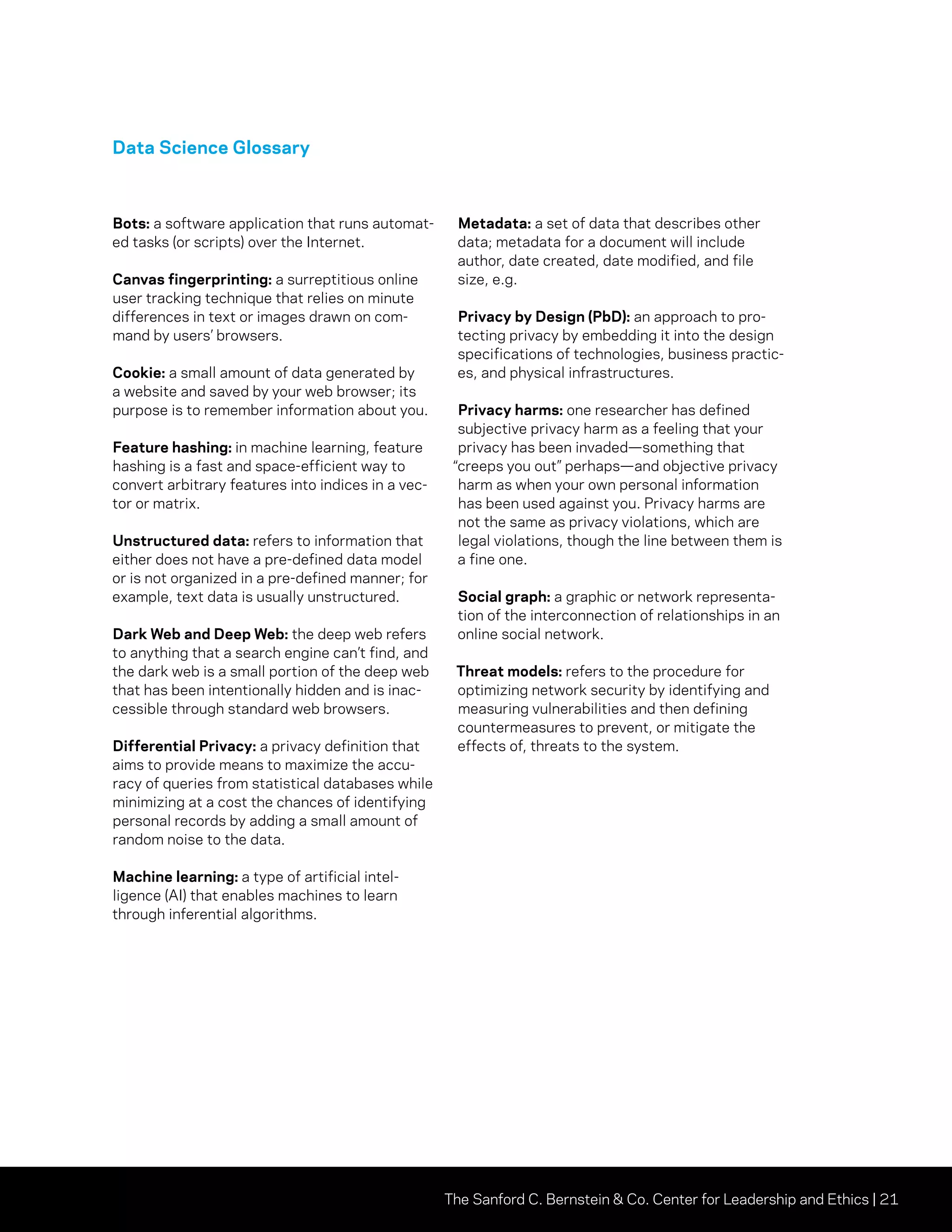
Data Science Glossary
Bots: a software application that runs automat-
ed tasks (or scripts) over the Internet.
Canvas fingerprinting: a surreptitious online
user tracking technique that relies on minute
differences in text or images drawn on com-
mand by users’ browsers.
Cookie: a small amount of data generated by
a website and saved by your web browser; its
purpose is to remember information about you.
Feature hashing: in machine learning, feature
hashing is a fast and space-efficient way to
convert arbitrary features into indices in a vec-
tor or matrix.
Unstructured data: refers to information that
either does not have a pre-defined data model
or is not organized in a pre-defined manner; for
example, text data is usually unstructured.
Dark Web and Deep Web: the deep web refers
to anything that a search engine can’t find, and
the dark web is a small portion of the deep web
that has been intentionally hidden and is inac-
cessible through standard web browsers.
Differential Privacy: a privacy definition that
aims to provide means to maximize the accu-
racy of queries from statistical databases while
minimizing at a cost the chances of identifying
personal records by adding a small amount of
random noise to the data.
Machine learning: a type of artificial intel-
ligence (AI) that enables machines to learn
through inferential algorithms.
Metadata: a set of data that describes other
data; metadata for a document will include
author, date created, date modified, and file
size, e.g.
Privacy by Design (PbD): an approach to pro-
tecting privacy by embedding it into the design
specifications of technologies, business practic-
es, and physical infrastructures.
Privacy harms: one researcher has defined
subjective privacy harm as a feeling that your
privacy has been invaded—something that
“creeps you out” perhaps—and objective privacy
harm as when your own personal information
has been used against you. Privacy harms are
not the same as privacy violations, which are
legal violations, though the line between them is
a fine one.
Social graph: a graphic or network representa-
tion of the interconnection of relationships in an
online social network.
Threat models: refers to the procedure for
optimizing network security by identifying and
measuring vulnerabilities and then defining
countermeasures to prevent, or mitigate the
effects of, threats to the system.
22 | Innovation and The Value of Privacy
The Sanford C. Bernstein  Co. Center
for Leadership and Ethics
Uris Hall
3022 Broadway
New York, NY 10027
P. 212-854-1060
F. 212-854-0016
www.gsb.columbia.edu/leadership
leadershipethics@gsb.columbia.edu

Conference Report Final 11.18

  • 1.
    The Sanford C.Bernstein & Co. Center for Leadership and Ethics | 1 Innovation and The Value of Privacy A joint project of the Data Science Institute and the Sanford C. Bernstein & Co. Center for Leadership and Ethics
  • 3.
    The Sanford C.Bernstein & Co. Center for Leadership and Ethics | 1 Foreword In 1999, Scott McNealy, Sun Microsystems’ then-CEO, reportedly said, “You have zero privacy anyway. Get over it.” Customers may claim that they value their privacy, but, in practice, they often give or trade it away at low value. Companies are then able to monetize this information by aggregating and analyzing it for their use or by selling or trading it with third parties. Since the uproar over McNealy’s frank words, the privacy-invading capabilities of businesses, governments, and motivated third parties have greatly expanded through the continuing progress made in data sciences and in analyzing big data. The ubiquity of points of access to once-personal data is stunning, moving far beyond websites visited to surveillance cameras images, voice pattern recognition, text analysis, and deep learning models. The situation has moved from protecting what individuals don’t want to share to preventing intelligent systems from learning personal preferences and behaviors that individuals don’t even know about them- selves. On February 5th, 2016, the Data Science Institute and the Sanford C. Bernstein & Co. Center for Leadership and Ethics at Columbia University brought together busi- ness leaders and academics to discuss how businesses are incorporating privacy considerations into their business strategies. Speakers included industry leaders, government regulators, and entrepreneurs from frontier firms, including Microsoft, IBM, Deloitte, RedMorph and Dstillery. They shared experiences regarding how they are accessing or protecting the customer data while setting new industry practices around privacy. Meanwhile the academics untangled often complex concepts of privacy and privacy harms or offered new algorithmic tools by which to counter intrusions on privacy. Above all, this was a conference that looked to solutions to the challenges of preserving privacy. By viewing the video of the conference on the Bernstein Center website and by reading this report, prepared and written by Nancy J. Brandwein, you will find a lot of robust disagreement. We decided to highlight these disagreements to show- case the current debates on privacy. This debate is not only between the expected parties, such as US and European regulators, or hackers and companies, but also between and among firms. Echoing an earlier generation of software firms that identified viruses, startups today are being created to improve privacy protection as a way to differentiate their products. For example, while firms such as Apple or Blackberry are competing on their reputa- tions for keeping personal data private, others are actively monetizing data from consumers who are not vigilant or simply don’t care about protecting their data. The economic explanation is that markets sort people by their heterogeneous (i.e., different) preferences and those outcomes are efficient. The human rights approach views privacy as inalienable: privacy cannot be sold and bought. This fundamental divide proved to be a touchstone for debate during the conference.
  • 4.
    2 | Innovationand The Value of Privacy Keynote Presenter and Moderator: Kate Crawford, Principal Researcher at MSR-NYC (Microsoft) and Visiting Professor, MIT Center for Civic Media
  • 5.
    The Sanford C.Bernstein & Co. Center for Leadership and Ethics | 3 INNOVATION AND THE VALUE OF PRIVACY¹ We are very thankful to the speakers, many of whom came a long way, and to our moderators Geoff Heal and Alondra Nelson. Kate Crawford was a superb keynote speaker, and she also advised us on invitations to other speakers. A number of speakers have connections to Columbia Engineering and Data Sci- ences or to the Business School. We thank our staff, Bianca Bellino and Sandra Navalli at the Bernstein Center, and Leslie Barna, Brianne Cortese and Jonathan Stark at the Data Science Institute. We also thank our Deans, Glenn Hubbard and Kathy Phillips from the Business School, Merit Janow from the School of International and Public Affairs, Alondra Nelson from Social Sciences and Mary Boyce from the Columbia University’s Fu Foundation School of Engineering and Applied Science. It was a lively and fast-paced workshop and both DSI and the Bernstein Center are pleased to present this account of their joint efforts. Bruce Kogut Sanford C. Bernstein & Co. Professor/Director Columbia Business School Columbia University Kathleen McKeown Henry and Gertrude Rothschild Professor of Computer Science Director of the Date Science Institute Columbia University 1 Prepared and written by Nancy J. Brandwein.
  • 6.
    4 | Innovationand The Value of Privacy Participants In order of symposium agenda Kathy McKeown Director of the Data Science Institute Kate Crawford Principal Researcher at MSR-NYC (Microsoft) and Visiting Professor, MIT Center for Civic Media Roxana Geambasu Assistant Professor of Computer Science at Columbia University Deirdre Mulligan Professor of Information at UC Berkeley School of Information Arvind Narayanan Associate Professor at Princeton University Geoff Heal Donald C. Waite III Professor of Social Enterprise and Bernstein Faculty Leader at Columbia Business School (moderator) Brenda L Dietrich IBM Fellow, Vice President, Data Science, IBM Abhay Edlabadkar ’07 Founder of RedMorph Claudia Perlich Chief Data Scientist at Dstillery Bruce Kogut Director Sanford C. Bernstein & Co. Center for Leadership and Ethics (moderator) Irfan Saif US Advisory Leader, Technology at Deloitte Ashkan Soltani Former Senior Advisor at the White House Office of Science and Technology Policy and Independent Researcher Alondra Nelson Professor and Dean of Social Science at Columbia University (moderator)
  • 7.
    The Sanford C.Bernstein & Co. Center for Leadership and Ethics | 5 From the 10,000 recommended steps our Fitbits measure to the e-books we read, the text and e-mails we send and receive, the photos we share and the news videos we stream online, more and more of our daily activities are mediated through digital devices. And as we consume digital infor- mation and complete transactions, we provide personal information, often involuntarily, to industry, institutions and government. With the advancements of data science, that information becomes data points, sometimes transformed into inferences about everything from our buying behavior to our creditworthiness, from our gender to our sexual orientation. For business, government, and sci- ence, the more information the better—to target marketing, track terrorists, and personalize medi- cine. But if the innovations of big data have value, what about the value of the privacy lost in the process—or in the processing? Is privacy a human right or a societal value? In just a half-day long conference, there was no shortage of debate on what innovations in data science and predictive modelling imply for privacy and ethics. Kate Crawford, Principal Researcher at Microsoft Research, New York City, got straight to the heart of the controversy in her keynote address. What does a Syrian refugee camp have to do with data science, innovation and privacy? Everything, as it turns out. Crawford said that Europe’s burgeoning Syrian refugee camps are the site of a “fascinating machine-learning experiment.” While she clicked on a slide of a mother and child walking between a row of grey tents, Crawford explained that an IBM initiative is turning unstructured data on the millions of Syrian refugees entering Europe into actionable intelligence. On hearing concerns that healthy fighting-age males were among the many emaciated and sick refugees coming off the boats, IBM’s team in Europe developed their i2 Enterprise Insight Analysis program to separate the sheep from the wolves.² Using real data from the dark web, such as where the refugees were buying pass- ports, and combining it with a set of “fake data” to which a border guard would have access, IBM claims its computer model can create what amounts to a jihadist “credit score.” Crawford said analysts were quick to say that such a score was not an absolute indicator of guilt or innocence, yet the model concocted incredibly detailed portraits of refugees—their names, reli- gious beliefs, prior addresses and social graphs. Much of the unstructured data would seem to be innocuous, including municipal parking tick- ets and “likes” for certain DJs on Facebook and Twitter. Of the many reasons to be concerned about the refugee initiative, Crawford cited the potential for finding unwarranted correlations and false positives, the problem of verifying suspicious scores, and the unreliability of data drawn from the dark web. Yet, the privacy harm Crawford finds most wor- risome, and one raised throughout the confer- ence, is the potential for discrimination: Machine learning models are creating a kind of intensification of surveillance of the least privileged, being tested out on the populations who are least able to object. We have a new and relatively untested system for predicting terrorists while the mecha- nism that’s being used is, itself, in a black box. So if you are, for instance, one of the accused, it’s very difficult to figure out what that data is about you or why that conclu- sion has been drawn, so that highlights for me the kernel of what we are here to discuss today: privacy, as it is currently configured, has no means to deal with a situation like this. Crawford went on to outline three themes of the conference woven throughout two sessions, one on academic research and one on industry, and in the final keynote speakers’ presentations as well: Privacy’s Threat Models: Privacy has always been built on mental models of the technolo- gies of the time and ideas of human behavior. These threat models, Crawford explained, have evolved from Peeping Toms at the window and print newspapers revealing unwelcome tidbits to the development and use of the camera in the late 1880s, and then on to business and government databases of the 1960s through 1980s in which computer systems simply col- lected what you gave them. It was during this 2 http://www.defenseone.com/technology/2016/01/refugee-or-terrorist-ibm-thinks-its-software-has-answer/125484/
  • 8.
    6 | Innovationand The Value of Privacy time period that privacy principles of notice and consent for access to your data and security and enforcement emerged. Yet Crawford, and almost every conference speaker, acknowl- edged that this transactional model of privacy, which still exists today, is inadequate to protect us from privacy threats of metadata, or data that provide information about other data, and machine learning. In the 2010s to 2020s, on- line trackers, mobile devices, wearable sensors and more are capturing enormous streams of behavioral data users never intended to share. “A predictive system can’t give you notice,” said Crawford, and, “it doesn’t know how it’s going to use your data, so it can’t ask you for consent.” The Rise of Machine Learning: Machine learn- ing has given society significant benefits, from Amazon’s sophisticated recommendation sys- tems to IBM’s Watson, which draws on a corpus of public information about cancer protocols and treatments to offer patients personalized care. But there are enormous risks in how your data is stored and used, Crawford stressed. “Because predictions have material outcomes, some people are going to get benefits and op- portunities and some are going to face negative consequences,” she warned. Carnegie Mellon researchers found Google’s online advertising system showed ads for high-income jobs to men more frequently than it showed the same ads to women. Ads for arrest records have been shown to pop up more in online searches for distinctly black names or historic black fraternities, and the Federal Trade Commission (FTC) has found advertisers target people in poor neighborhoods with ads for high-interest loans.³ Pointing to these discriminatory outcomes, Crawford questioned the autonomy of machine learning systems. “The greater autonomy these systems have,” she said, “the more questions we need to ask about what kind of values or models of the world we use to create them. And what’s interesting here is that these models get better only if they ingest more and more training data. That’s how they get more in- telligent... How can we ever know the value of data now or in the future? If we can’t understand the systems we are giving our data to, how can we have equal power? How do you protect information from someone predicting it? What does it mean to have privacy rights to something personal, e.g. symptoms of a life-threatening disease or the desire to leave a relationship, that you haven’t consciously recognized yet your- self? What if you’re being judged on some- thing you haven’t yet done?” The Turn to Ethics: Crawford said that pri- vacy alone is insufficient to deal with the kinds of challenges created by the rise of machine learning, but “privacy and ethics get us some- where. And ethics is becoming a core part of data science curriculum.” She said there was promising work being done around privacy by design, an approach to systems engineering 3 http://www.nytimes.com/2015/07/10/upshot/when-algorithms-discriminate.html?_r=0 Speakers: Arvind Narayanan, Associate Professor at Princeton University, Deirdre Mulligan, Professor of Information at UC Berkeley School of Information, and Roxana Geambasu, Assistant Professor of Computer Science at Columbia University
  • 9.
    The Sanford C.Bernstein Co. Center for Leadership and Ethics | 7 Privacy Cheat Sheet The multi-dimensional concept of privacy was characterized by some of the following touch points for presenters throughout the conference. Many of these dimensions are overlapping, proving why jurists, legal scholars, philosophers and now data scientists have yet to reach a satisfying definition of privacy. Lawyer and philosopher Tom Gerety once observed that privacy has “a protean capacity to be all things to all lawyers.” And Yale Law School Dean Robert Post lamented that “[p]rivacy is a value so complex, so engorged with various and distinct meanings that I sometimes despair wheth- er it can be usefully addressed at all.”⁴ Yet at the conference, Dierdre Mulligan valiantly introduced these dimensions of privacy in a dizzying ten minutes or less, placing them in two buckets (even these classifications overlap): those arising from philosophy and law and those developed from research in computer science. Which ones are salient rely heavily on context. Philosophy and Law “The right to be let alone” is considered the foundation of privacy law in the US. Formulated by Samuel Warren in an 1890 ruling, it began as a defense of physical privacy invasion but has been used against privacy breaches such as wiretapping without a warrant. Psychological privacy is the right to keep secrets, and it can be violated by the public dis- closure of previously concealed information. Autonomous decision-making is the right to independence from the state in making the kinds of decisions that are central to defining a person, such as those relating to marriage, procreation, contraception, and child-rearing. Personhood, or the protection of the integrity of one’s personality and of what is irreducible in a human being, is perhaps the broadest dimension of privacy and more akin to a human right than a societal value. Such privacy should protect what Warren and Brandeis called one’s “inviolate per- sonality.” It’s a hop, skip, and a jump from there to anti-totalitarianism in which privacy helps mitigate against the state imposing a defining identity upon an individual. Control over personal information simply states that one should be able to control the information that others have about oneself; however its interpretation depends upon what is meant by “control,” what is considered “personal” and what is considered “information.”⁵ Computer Science Research Anonymity: the ability to interact without revealing personally identifying information. Confidentiality: information shared between two parties that is not made public, an example of which is the privacy agreement signed be- tween patient and doctor. Boundary regulation: control of information shared between individuals and institutions, including third party dissemination. Differential privacy: the cryptographic protec- tion of data to permit accurate queries from sta- tistical databases while minimizing the chances of identifying records and the individual. 4 Solove, Daniel J., “Conceptualizing Privacy,” California Law Review, Vol.90. Iss.4, July 2002, pp.1087-1054. 5 Ibid.
  • 10.
    8 | Innovationand The Value of Privacy that takes privacy into account throughout the whole engineering process, and the precise, mathematical differential privacy, which seeks to protect against the de-anonymization threats mentioned earlier. And she pointed to exciting research coming out of the privacy and ethics space on transparency and fairness,⁶ human au- tonomy vs. machine autonomy,⁷ power asymme- tries, and due process—the ways you can have legal recourse to intervene on a system that has made a decision about you.⁸ Tackling any of these themes is daunting, but Crawford said, “I am thrilled that academic researchers, industry practitioners and govern- ment regulators are coming together, because it’s only by putting all our heads together that we will resolve some of the very real concerns… about data privacy today.” What We Talk About When We Talk About Privacy To understand privacy and how to value it in the big data era, we need to know what it is. In the research session, Deirdre Mulligan, Associate Professor of the University of California Berke- ley’s School of Information, took on this chal- lenge of untangling what she called an unwieldy ball of yarn. Building on Crawford’s outline of threat models, Mulligan said that legislators, engineers and academics all need to understand “what it is people are trying to protect against what kinds of threats.” “Privacy is like democracy and art,” stated Mul- ligan, “We are never going to nail it down.” The best way to think about privacy, she said, is as a touch point. “Part of the term ‘privacy’s’ work in the world,” Mulligan told attendees, “is to give us a vehicle to have conversations about privacy’s meaning, in practice and in everyday life”—and in conferences like this one. She recommended viewing privacy as a living concept, more as an unfinished “tapestry” that’s fringy at the edges and that invites us to add to it and, as she said, “expand how we operationalize privacy to protect against today’s threats.” We can’t build the right solutions unless we are sure we are focused on the “right” privacy. Yet with so many definitions of privacy (see “Privacy Cheat Sheet”), and in a world constantly being reinvented by technol- ogy, we need a heuristic rule to forge this mal- leable and multi-faceted concept of privacy that can meet the requirements of actual situations. As an example of what happens when the “wrong” privacy is addressed, Mulligan cited the Transportation Safety Authority’s (TSA’s) full body scanners or “naked machines.” It turns out passengers’ concerns on implementing the scanners were not what the government thought they would be—that their Personally 6 http://www.stanfordlawreview.org/online/privacy-and-big-data/its-not-privacy-and-its-not-fair 7 http://sth.sagepub.com/content/early/2016/05/31/0162243916650491.full.pdf+html 8 http://lawdigitalcommons.bc.edu/cgi/viewcontent.cgi?article=3351context=bclr Co-Sponsor of the Event: Kathy McKeown, Director of the Data Science Institute
  • 11.
    The Sanford C.Bernstein Co. Center for Leadership and Ethics | 9 Identifiable Information (PII) was being stored in a massive cloud-based park of servers. No, their concerns are the ones that Mulligan, as the mother of a teenage girl, felt keenly: guys in a booth ogling bodies.” The privacy threat here is access to the physical self, exposure of one’s naked body, and dignity interests. And design solutions that protect against privacy solutions need to be geared toward what is supposed to protected. Is It Privacy Or Is It Fairness? Power Asymmetries Between Users And Businesses Though not explicitly discussed, definitions of privacy also differ by cultures and countries. European countries are much more eager than the US to view privacy in the context of an inviolable human right. This right includes a derivative “right to be forgotten,” resulting from a 2014 European Court Ruling, which grants individuals the right, under certain conditions, to ask search engines to remove personal information about them.⁹ The US tendency is to treat privacy more as property, where users give consent to provide data to the service- provider as a condition for the service. This consent may arguably be voluntary, but there is also a coercive element to it. If everyone is on Facebook, the decision not to give consent is ef- fectively to be socially ostracized. And once an individual agrees to share data, the data may be kept in perpetuity. These issues, if not explicit in the conference panels, came up in QAs and nevertheless set the stage for one of the more interesting debates regarding the relative pow- erlessness of consumers in many situations. Are we focused on the wrong privacy threats? In her keynote address, Kate Crawford stated, “…while these models are ultimately creating very detailed pictures of us that have privacy implications, their outcomes have implications that go far beyond privacy, that touch on things like discrimination, how we think about fair- ness… Privacy discourse has failed to account for growing power asymmetries between data industries and the rest of us, getting to the point where I fear those asymmetries.” Data scientist and consultants working in busi- ness often have a different view of these asym- metries. Industry speaker Brenda Dietrich, IBM Fellow and Vice President in the IBM Research Divisions, is one of them. “If you think back to pre-Internet days, consumers had relatively little information about prices, quality, avail- ability,” she said. Dietrich contrasted that with the process of buying a car today, in which the consumer is armed with vastly more information and there is much more transparency for the consumer: Today you can know what the last 100 or so models of that car sold for. You have price 9 http://ec.europa.eu/justice/data-protection/files/factsheets/factsheet_data_protection_en.pdf Keynote Speaker: Irfan Saif, US Advisory Leader, Technology at Deloitte Research Speaker: Roxana Geambasu, Assistant Professor of Computer Science at Columbia University speaking to Bruce Kogut, Director of The Sanford C. Bernstein Co. Center for Leadership and Ethics
  • 12.
    10 | Innovationand The Value of Privacy information at your fingertips. You have the upper hand. Retailers, consumer packaged goods companies, etc. were very concerned about this asymmetry. ‘If my customers know everything there is about my product and competitor product, I want to know ev- erything there is to know about my customer so I can have an equal amount of informa- tion that levels the playing field again.’ We can all argue, ‘Well, the businesses had the advantages for decades, so it’s our turn as consumers.’ The reality is that they [busi- nesses] don’t think that way. No they don’t. Let’s take Dietrich’s new car example. While we as customers have more access to information on dealerships and car models than ever before, when we go online to search for the abundance of information on that new car, websites, browsers, companies, and third party data brokers are collecting our information to show us targeted ads for cars, and, privacy advocates argue, that they then have the upper hand. Speaking in the research session, Arvind Narayan, Assistant Professor of Computer Science at Princeton, said: In classical economics we say that users know something about themselves that the seller or information provider doesn’t know. So there’s an information asymmetry. What’s happening here is the exact opposite. There’s a lot of tracking going on. The people doing it know what information they’re send- ing and who they’re sending it to. You don’t have that information yourself, which hurts your ability to make an informed decision in that transaction. This is a bold observation. Indeed, no less than a Nobel Prize was given to Berkeley Professor George Akerlof for his analysis of the failure of markets to find prices for used cars when the seller knows whether or not the car is a ‘lemon’. In the new age of data science, the buyer or ag- gregator will often know more about the quality of the good being sold than the seller. Transparency and Measurement: Antidotes to Information Asymmetry? Is transparency the answer to the new econom- ics of the information asymmetry problem? The research session moderated by Geoffrey Heal, Donald Waite III Professor of Social Enterprise at the Columbia Business School, suggested yes. Roxana Geambasu, Assistant Professor of Computer Science at Columbia University, and Arvind Narayan both presented their own research solutions that use transparency and measurement to counter tracking mechanisms. Geambasu introduced “Sunlight,” the first sys- tem that can diagnose online ad targeting in fine detail, at a wide scale, and with solid statistical justification. This second-generation tool builds on its predecessor “X-ray.” Geambasu and her fellow researchers set up a Gmail account and populated it with simple single-topic e-mails. The researchers then set up 119 Gmail ac- counts and sent 300 e-mail messages all with sensitive keywords both in the subject line and Question and answer sessions with members from the greater community
  • 13.
    The Sanford C.Bernstein Co. Center for Leadership and Ethics | 11 bodies of the e-mail. Of the ads shown, about 15 percent appeared to be targeted, and more worrying, many violated Google’s own policy against targeting ads based on “race, religion, sexual orientation, health, or sensitive financial categories.” For instance, an ad with the key- word “unemployed” netted an “easy auto financ- ing” ad. And of course, Geambasu reminded us, Gmail is not alone in contradicting its own ad targeting policy. “The web is a complex and opaque ecosystem,” she said, “driven by massive collection and monetization of personal data. “ Interestingly, during the last day that the Sunlight project collected its data, Google shut down its Gmail ads program and began some- thing called organic ads.¹⁰ The shutdown of Gmail ads and its transmutation into something else are likely not coincidental. In the process of creating greater transparency, Arvind Narayan’s research shows that the very act of tracking the trackers can stop them dead in their tracks. He and his fellow researchers measured the presence of three persistent tracking tech- niques and published the results in their paper, “The Web Never Forgets: Persistent Tracking Mechanisms in the Wild.” Of all the techniques measured, the canvas fingerprinting method received the most media attention—and elicited the most public outrage. The response was immediate. “Canvas finger- printing was only a known technique for two years,” said Narayan, “but in just days after our work was published, the largest users of canvas fingerprinting [AddThis and Ligatus] stopped cold. Why?” Narayan’s diagnosis of the sudden halt in the surreptitious fingerprinting technique is that “you have some kind of weird Heisenberg principle analogy for the Web, that measure- ment automatically changes the behaviour [of the trackers].” In a blog post on his “Freedom to Tinker,” one of Narayan’s co-authors, Steve Engelhart, posited that the visual representa- tion of canvas fingerprinting in particular was especially helpful in removing the asymmetry of information because users could intuitively grasp that a unique “picture” of their online ID was being created click by click. In addition, the paper included measurements of the trackers responsible for fingerprinting as well as the sites on which the fingerprinting was taking place, thus allowing users to voice their frustra- tions or visit alternate sites. Inevitably, though, it was only a matter of time before canvas fingerprinting started up again. When the research team ran the measure- ments again in January of 2016, the number of distinct trackers utilizing canvas fingerprinting had more than doubled.¹¹ The lesson: in order to maintain transparency for users, measurements must be collected on a continuous basis. Naray- an has initiated what he calls Open Web Privacy Measurement (WPM), which runs monthly taking one million site measurements. He hopes using it will increase transparency, reduce the asym- metry of information in favor of trackers, and answer questions ranging from “Are new web technologies being used and abused for track- ing?” to “How is the NSA able to piggyback on ad tracking?” and “How effective are the various tracking protecting agencies?” However, the tools that Geambasu and Narayan and their teams are building are likely of most use to regulators, privacy advocates and pri- vacy tool developers. As for the general public, while a transparency study generates a burst of interest and outrage, Narayan admits, in “The Web Never Forgets,” that the level of user effort and sophistication required for mitigation make it doubtful that individuals can effectively adopt and maintain the necessary privacy tools. Peering Into The Black Box Rather than looking towards individuals to mitigate against privacy harms, we can look towards markets and competition to drive the innovations needed to protect privacy. In the industry session, moderated by Professor Bruce Kogut, IBM’s Brenda Dietrich, Dstillery’s chief data scientist Claudia Perlich, and privacy advo- cate and RedMorph founder Abhay Edlabadkar each spoke about this approach. Born under Communism in East Germany, Clau- 10 http://datascience.columbia.edu/new-tool-expands-tracking-personal-data-web 11 https://freedom-to-tinker.com/blog/englehardt/retrospective-look-at-canvas-fingerprinting/
  • 14.
    12 | Innovationand The Value of Privacy Privacy as Promotional Plus Privacy has increasingly been touted as a selling point by major technology companies. The Fall of 2015 saw the launch of Blackberry PRIV, for instance, which ditched the company’s own mobile software for Google’s android plat- form—with a difference—it boasts privacy-enhancing features . Compared to smartphones powered by Apple’s iOS, android devices have long been known for their lack of data security. With Blackberry’s “Crackberry” days long gone, the company’s launch of the PRIV—and its assurance to make its Android system secure—is a last-ditch effort to regain market share.12 That same fall, both Microsoft and Apple updated and touted their privacy policies. Microsoft re-explained the privacy policy for its Windows 10, assuring users, “We don’t use what you say in e-mail, chat, video calls or voice mail, or your documents, photos or other personal files to choose which ads to show you.” Apple couldn’t resist a barely veiled swipe at Google in promoting its privacy policy, “Some companies mine your cloud data or e-mail for personal informa- tion to serve you targeted ads. We don’t.”13 Apple has long used its privacy model to market its phones to consum- ers. Unlike Facebook, Google, and Amazon, which monetize the data users feed them, Apple does not sell customer data and makes a point of telling consumers that almost all personal information is kept on the device, not sent to Apple’s servers. And when it does upload users’ data, that data is anonymous, untethered to the users’ Apple IDs. For instance, when Apple’s iPhone location services do send information on your whereabouts to its own servers, Apple explains in its privacy policy that it uses anonymized rotating identifiers to keep searches and locations from being traced to you person- ally.¹⁴ Three weeks after the Innovation and the Value of Privacy Conference, the world saw just how far Apple would go to protect customer data. Apple was besieged by lawsuits from the United States Department of Justice (DOJ), first to create a backdoor key to unlock the iPhone 5C of one of the San Ber- nardino, California, shooters, Syed Farook, who killed 14 people and injured 22 more on December 22, 2015, and then to unlock the phone of a Brooklyn drug kingpin. The cases never went to court because third-party hackers came forward to unlock the phones. But the case pushed data security and privacy concerns to the forefront for the public. Directly after the DOJ suits, Facebook-owned messaging app, Whatsapp, gained positive press because they announced end-to-end encryption of all chat messages. Yet in all the laudatory press about the encryption, Facebook’s Whatsapp still collects all the metadata—your e-mail address, cell phone number and, if not what you say in your chat, with whom you are chatting. Users’ comfort with the level of privacy touted by a tech business often comes down to their trust in that particular business. 12 http://www.cnet.com/news/inside-blackberrys-last-ditch-plan-to-win-you-back-with-android/ 13 http://www.computerworld.com/article/2987249/data-privacy/apple-microsoft-wield-privacy-as-marketing-tool.html 14 https://www.wired.com/2015/06/apples-latest-selling-point-little-knows/ and [Apple location services] http://www.apple.com/privacy/approach-to-privacy/#personalization
  • 15.
    The Sanford C.Bernstein Co. Center for Leadership and Ethics | 13 dia Perlich could not recall seeing an ad until she was 16. Now, as chief scientist at market- ing intelligence company Dstillery, Perlich fine- tunes consumer marketing by capturing data from consumers’ digital footprints. “Predictive modelling has come up because of the down- side,” Perlich said, referencing Kate Crawford’s keynote. However, Perlich argued, the very technology behind the machine learning models provides “a level of security around sharing data and limiting data breeches” and also a way to share data without reaching unintended recipi- ents. Perlich explained how her models decide who are potential consumers of client products and, hence, who can be shown an ad and when. The machines crunching the number are “agnostic,” in that “they don’t need to know or understand anything about the meaning of the data… In- stead of using things like income, we’re directly using the history of URLs to do exactly the same thing, because what you do online is a hell of a lot more predictive than what somebody else thinks you are…. Your actions speak louder than your demographics.” And not only does the machine not “know” anything about your data, but Perlich said she doesn’t either. “With all due respect to people arguing for transparency, “ she admitted, “I have no clue what these things do. I build ten thou- sand a week. I have no idea what any of these models predict and why.” In an e-mail discussion after the conference, Perlich expanded on this notion: While our brain is not capable of calculat- ing the optimal route to the airport (as your GPS can), we can perfectly understand the resulting instructions. This is no longer true when we are talking about algorithms of the ilk used to predict human behavior. The short answer is yes, I know exactly how the prediction was calculated. Think of it as a very complicated recipe.¹⁵ But our human mind cannot possibly understand the mean- ing behind it…The second problem is that I do not even know what information the mod- el is using because I am trying to respect the privacy of users.¹⁶ Both Dietrich and Perlich told attendees privacy by design was a crucial part of the models built at IBM and Dstillery respectively. During her talk, Dietrich spoke of her work with IBM Cloud Insight Services and its recent acquisition of The Weather Company’s digital assets. Ac- cording to a press release announcing the deal, IBM’s “sophisticated models can now analyze data from three billion weather forecast refer- ence points, more than 40 million smartphones and 50,000 airplane flights per day…[enabling] IBM to offer a broad range of data-driven prod- ucts and services to more than 5000 clients in the media, aviation, energy, insurance and government industries.”¹⁷ Dietrich remarked, “I don’t think people have privacy concerns about 15 https://www.linkedin.com/pulse/way-algorithm-claudia-perlich?trk=mp-reader-card 16 E-mail from Claudia Perlich to Nancy J. Brandwein dated April 28, 2016 Moderator: Alondra Nelson, Professor and Dean of Social Science at Columbia University
  • 16.
    14 | Innovationand The Value of Privacy knowing what weather conditions are at any point in time and space, but we also have the forecasted weather, and so the question is how do people respond to weather forecasts? How does their behavior change? This is the question that gets into privacy issues.” On the privacy protections in place at IBM, Diet- rich said, “We adhere to privacy by design as an objective. Any time we [at IBM] are taking data in or giving data out we get a reading from the chief privacy officer on whether what we’re do- ing is compliant with both the law and the intent and aspirations of the company.” In correspon- dence after the conference Dietrich added, “as Claudia also emphasized, the data is calculated by a computer and almost never looked at by human eyes.” Anonymizing Data and Accounting for Bias Toward the end of her presentation, Claudia Perlich started to talk about the ways data is anonymized so even if human eyes look at it, the humans looking can’t recognize what they are seeing. Expanding upon these techniques after the conference, Perlich elaborated on her point that her company keeps the users’ digital footprint from turning into a full body portrait. She explained: Our customers are primarily marketers and their agencies are trying to connect to po- tential customers. They expect that we NOT show ads to bots, that ads do NOT appear on questionable content, that we do NOT fake the evaluation metric (knowingly or un- knowingly). On the user side, they expect us NOT to use device fingerprinting to es- tablish a unique identity, to NOT reconnect cookies once they are deleted by the user, to NOT store PII of any kind, to NOT label people’s behaviour into segments, to NOT sell user data, and to NOT keep activity logs in humanly readable form. ¹⁸ One of the ways data is parsed, for instance, is through a technique called feature hashing. When users with a Dstillery cookie visit URLs, the model does not store the actual string of URLs visited but translates them into a “hashed” version, a random string. The URL for www.cnn. com may look like ‘1he83’, but there are maybe 15 other websites other than CNN that get recorded as 1he83, so engineers and scientists like Perlich are unable to trace back the exact user browsing history. In this way, Perlich and Dstillery are attempting to satisfy the privacy dimensions of computer science introduced by Mulligan earlier (see “Privacy Cheat Sheet”), such as anonymity, confidentiality and differen- tial privacy. Yet because machine learning algorithms learn and evolve based on what users do online, can they really be “agnostic,” as Perlich stated? “The amoral status of an algorithm does not negate its effects on society,” said Carnegie Mellon researcher Anupan Datta, one of the authors of the Google ads study mentioned earlier.¹⁹ One 17 http://www.ibmbigdatahub.com/blog/introducing-insight-cloud-services-ibm-insight-2015 18 Op. Cit. Keynote Speaker: Ashkan Soltani, Former Senior Advisor at the White House Office of Science and Technology Policy and Independent Researcher
  • 17.
    The Sanford C.Bernstein Co. Center for Leadership and Ethics | 15 can’t look at the inputs that go into that black box but one can note that the outputs reflect user bias and can potentially lead to discrimina- tion in real life (as in the case with the Google ads study). Mulligan pressed this point with Perlich, leading to a lively exchange after Mulligan posed this conundrum: If I can’t look at [inside] the black box, we can at least avoid bad outcomes. We can say ‘If these people are alike on all these different parameters we shouldn’t treat them differ- ently, just because their race or gender is different.’ But that presumes you actually have data about race, about gender. All the [demographic] data you’re doing away with in your model actually limits your ability to avoid bad outcomes because you don’t actu- ally have data. To which Perlich responded, “If I give my model race, then I can use it, but that’s what you specifically don’t want my model to use. Yet, I take it out, and you tell me I can’t control it.” The model will still effectively identify race by using correlates. “But can’t you set a rule, ‘Don’t use race as a determining factor’?” asked Mulligan. “But that’s a totally useless rule!” Perlich ex- claimed. “I completely agree,” said Mulligan, and then got to the heart of her concern over bias and the black box. “But the thing that you want to be able to say is ‘Do these things the model seems to be using correlate with race?’, and if you’ve done away with capturing race you can never do that.” Several members of the audience mur- mured their assent and there was even a chorus of “Yes” that echoed around the room. A nonplussed Perlich responded, “I am already half out of business, because I refuse showing ads to bots, “ she said, referencing Dstillery’s privacy policies. “The problem becomes, I’m in an economic incentive system, where I’m paid on getting the highest click-through rate, and if that click-through rate happens to be subject to racial preference… I can quit doing advertis- ing or I will be off the plan and someone will be hired who has much less concerns about going where the signal leads.” Perlich clearly stood by Dstillery as a company in which there is a strong attempt to “do the right thing,” but as she said earlier, it comes at a cost. “There certainly have been tradeoffs that have not been beneficial to us in terms of market valuation. We have com- petitors getting a lot further in their economic development by disregarding basic rules around what we should and should not be doing.” Do Businesses Value Privacy? Do Individuals? “But is privacy something that is always a nega- tive externality, “bad” for business?” Professor Kogut asked all three industry practitioners. “Or can privacy become a benefit for everyone? It seems that deploying privacy solutions would diminish ad revenue, or do you think that privacy can be a positive?” (see “Privacy as Promotional Plus”) In response to Kogut’s questions, Abhay Edla- badkar entered a spirited discussion with his fellow panelists. With prior experience in Tele- com Semiconductors including a stint at Bell Labs and a Columbia Business School alumni, Edlabadkar started his company, RedMorph, in 2013 when he became concerned about the amount of data his teens were sharing online. His firm markets a privacy tool that promises to visualize and block trackers, cookies, and third party content, to encrypt your data, and to filter or block inappropriate content. “Advertising is not ‘wrong,’ affirmed Edlabadkar, but “the way it is happening is wrong with the indiscriminate way data is collected, the asymmetry that has been created.” “My very short answer, “ replied Perlich bluntly, “is this: ‘You’re living in a capitalist society where there is always misalignment of incentives.’ ” 19 http://www.nytimes.com/2015/07/10/upshot/when-algorithms-discriminate.html?_r=0; see also https://www.propublica.org/article/machine-bias-risk-assessments-in-criminal-sentencing.
  • 18.
    16 | Innovationand The Value of Privacy But IBM’s Dietrich pushed back against the notion of asymmetry, “I don’t think there is a disequilibrium here. Some of us don’t mind giv- ing information to the businesses that we do business with because it enables them to serve us better. On the other hand, we have some extremely paranoid people who don’t want to let any information leak, so they don’t reap the necessary benefits.” Edlabadkar leapt from his seat to disagree. “That’s not right. I believe one should be able to control what’s public and what you want to keep private. That control does not exist right now,” he exclaimed, to which Dietrich confirmed calmly, “You’re right. However, I’m not convinced that if it did exist that most people would be able to control it to their benefit.” The Tradeoff Between Privacy and Utility: Does it Exist? Dietrich and Perlich assume there is a tradeoff between privacy and utility. Irfan Saif, the penultimate conference speaker, agreed with this assumption. As a principal in Deloitte Touche LLP’s Cyber Risk Services practice, Saif helps technology companies design and build platforms for the marketplace, with a primary focus on combatting cyber risks. “I don’t believe that users are necessarily victims, “ he said, “There’s lots of people who intention- ally give up certain privacy [rights] and certain information to get something in return…and it’s driving a massive economy.” Citing Facebook as one of the forces driving this economy and offering utility to its users, Saif said that in January 2016, “Facebook’s user rate was up to 1.6 billion individual users and growing at 100 million users a month…People want to share. They want to share a lot. But what they have, though, is an expectation that the people they are sharing with are going to have a limited and constrained set of use cases for that data. There is a tradeoff that is the whole heart of data as currency…If I can get a game or service or some functionality or some- thing that benefits me from a user experience standpoint, I might be willing to give up some of my privacy.” But what about the question Dietrich raised: if some way to control data actually existed, would people avail themselves of it? The answer is paradoxical. Citing a Pew Research poll on Americans’ attitudes on privacy, Edlabadkar reeled off these stats: • Over 90% of people have a strong desire to have control of their online content and privacy • 85% of online consumers now oppose track- ing and are unwilling to trade their personal data, even anonymously, for the sake of being served relevant ads. Yet—and this is the paradox—Edlabadkar also pointed out that Americans are not doing much to protect themselves by utilizing tools like RedMorph’s or ad blocker Disconnect, despite the fact that such tools create speedier Internet surfing, which is the positive externality Pro- fessor Kogut was looking for. Citing his experi- ence trying Disconnect, Irfan Saif said that the tool found twenty trackers on a Superbowl 50 website page—for one two-paragraph article. Saif acknowledged, “The user experience for me is far greater with Disconnect. Not because I’m worried that I won’t get targeted ads… I’m a security guy, so I don’t click on ads or links, but it speeds up the performance of the web page by more than double.” So if we can protect our privacy and improve our Internet experience to boot, why aren’t we doing so? Crawford had mentioned the work of Professor Joseph Turow, at NYU’s Annenberg School for Communication. Turow reported the results of his study on the tradeoff between privacy and utility in The Tradeoff Fallacy: How Marketers are Misrepresenting American Con- sumers and Opening them Up to Exploitation. In a study on Americans’ attitudes to exchanging online data for supermarket discounts, Turow and his fellow researchers found: A majority of Americans are resigned to giving up their data—and that is why many appear to be engaging in tradeoffs. Resig-
  • 19.
    The Sanford C.Bernstein Co. Center for Leadership and Ethics | 17 nation occurs when a person believes an undesirable outcome is inevitable and feels powerless to stop it. Rather than feeling able to make choices, Americans believe it is futile to manage what companies can learn about them. Our study reveals that more than half do not want to lose control over their information but also believe this loss has already happened.20 For those users who are not resigned, can they opt out? One audience member, an info-tech employee who works on highly secure systems, posed this dilemma to Kate Crawford. “I’m writing a novel set in the war on terrorism. I’m learning Arabic, I’m researching GITMO online. I’m sure I’m in an NSA database. While I don’t fit their [terrorism] profile in some ways, I’m sure if I bought a large load of different types of fertil- izer, someone would show up at my door very quickly! Are there valid ways of opting out that don’t raise a different red flag?” Crawford told the techie/novelist: Each piece of information is a signal that can be read a certain way, and the system reads cumulatively… I worry that the 1990s and 2000s model of opting out is gone. We’ve lost out. There are data infrastructures built into the cities we live in, the airports we fly through. Without the ability to opt out, what can we do to strengthen people’s agency, capacity and privacy? We have less than five years to come up with a really strong framework. How do other countries view the same privacy dilemmas? Inevitably, questions came up about how the United States compares with other countries when it comes to expectations around privacy and whether there was any convergence in the international space on privacy that would allow business to proceed smoothly. In the industry session QA session, the con- sensus was that European countries are much more privacy conscious than Americans—Ed- labadkar said a higher percentage of Germans used ad blockers. (In the summer of 2016, the European Union adopted a due process require- ment for data-driven decisions based “solely on automated processing” that are shown to “sig- nificantly affect” citizens.21 (Writer’s note, NJB) Yet while it’s tempting to think that privacy rules and regulations necessarily make a populace more secure, Dierdre Mulligan added an inter- esting perspective from research conducted for her book with Kenneth A. Bamberger, Privacy on the Ground: Driving Corporate Behavior in the United States and Europe.22 The authors found that there is a divergence between how privacy is treated on the ground—in daily and business 20 https://www.asc.upenn.edu/sites/default/files/TradeoffFallacy_1.pdf 21 http://www.nytimes.com/2016/08/01/opinion/make-algorithms-accountable.html?_r=1 22 Bamberger, Kenneth A. and Mulligan, Dierdre K., Privacy on the Ground: Driving Corporate Behavior in the United States and Europe, Boston, MA (MIT Press: 2015). Industry Insights Presenters: (from left) Brenda Dietrich, IBM Fellow, Vice President, Data Science, IBM, Abhay Edlabadkar ’07, Founder of RedMorph and Claudia Perlich, Chief Data Scientist at Dstillery
  • 20.
    18 | Innovationand The Value of Privacy life—and on the books, i.e., the law. Mulligan summarized her findings: The countries that have the most robust in- terpretations of privacy… are the US and Germany. If you just focused on the laws on the books, you would think them the fur- thest apart. Privacy is a strategic issue, not just a compliance issue; privacy influences business and tech decision-making, market entry, lines of business, not just what does the legal agreement look like at the end of the day. Privacy in both countries is rela- tively ambiguous from a legal perspective, and the company itself is vested with figur- ing out what is required. We think of Ger- many as top down with lots of rules, but the simple fact is they vested responsibility for understanding and protecting privacy with a data protection officer who is in the firm, and as there has been more transparency around privacy failures, those people have become more influential. These findings are at odds with Crawford’s urgency in demanding a framework for privacy within five years and the statement she made, at the outset, in her keynote: If you were to ask me ‘How do we end privacy?’ The answer: Just keep doing what we’re doing.” Pushing Back on Paranoia On the whole, this conference and the intense debates it spawned on the nexus between data science and privacy—as well as other forums for the debate that have sprouted up—run counter to a pessimistic outlook. What “we’re doing”—the academics, industry practitioners and government regulators—is what Crawford lauded as so important at the outset: “putting all our heads together.” From his own experience with enterprises, albe- it on the cybersecurity end, Irfan Saif noted just how important this dialogue will be. Regarding the information that is aggregated behind the scenes and correlated in a way that generates information you didn’t consciously give up, Saif said there is no consistent approach from com- pany to company. “It’s not necessarily a prob- lem…that you want the engineers in the field to solve as they build a product,” he said, implying that privacy by design cannot be left solely to data science engineers but “requires a lot of debate and dialogue [across disciplines], and I think that’s a lot of what has gone on today.” In introducing the conference’s closing speaker Alondra Nelson, Columbia’s Dean of Social Science, echoed the need for interdisciplin- ary dialogue. Nelson said this conference was particularly important to the social science schools “because issues of data and computa- tional social science, privacy, surveillance and discrimination are one of the strategic priorities for the division.” The conference’s final keynote speaker, Ashkan Soltani, is an independent technologist and Keynote Presenter and Moderator: Kate Crawford, Principal Researcher at MSR- NYC (Microsoft) and Visiting Professor, MIT Center for Civic Media
  • 21.
    The Sanford C.Bernstein Co. Center for Leadership and Ethics | 19 researcher; he was on the team of Pulitzer Prize winning Washington Post reporters who broke the story of Edward Snowden and NSA surveil- lance, a researcher on the Wall Street Journal’s award-winning “What They Know” series, and chief technologist for the Federal Trade Com- mission, where he helped create its new of- fice of technology research and investigation. Wouldn’t he sound the most alarms for the po- tential for privacy breeches in the big data era? Surprisingly, Soltani began his talk by push- ing back on paranoia and attempting to ease privacy fears. “Much of this [discussion] has generated a feeling of being frightened or…of helplessness. That’s one response,” Soltani said, and he went on to remind attendees, “This field is emerging. We’ve had databases only less than a century, data brokerages for a few decades, ad targeting for maybe ten or twenty years…Pri- or to 2006 the big ad companies were not doing behavioral ad targeting. There are a lot of differ- ent business models we might end up at. It’s not predetermined that all our privacy is gone, and we’re walking around naked all day.” At the same time that he pushed back on paranoia, Soltani pushed back on the notion of hiding behind an outdated legal framework of notice and consent, or on the idea Claudia Perlich brought up that “we don’t understand how these things [computer models] work.” To that, Soltani said, “That’s not good enough,” and here he echoed Mulligan’s concerns about bias: There are certain things the system should not do. Using the example of flight control systems safety improvements, he said even seasoned pi- lots might ask, “What is the system doing now?” in the same way that seasoned data scientists will ask, “What is the model doing now?” The Federal Aviation Administration says, “That may be the case but there are certain things the sys- tem should not do and these should be known.” In the case of predictive modeling, Soltani said, “Computers or systems don’t necessarily understand what data it’s processing, but…we as practitioners, developers and designers must make sure that there are certain things baked in.” He gave an example of casinos marketing to people who have disclosed gambling addictions online, and concluded, “People’s self-disclosed vulnerabilities should not be an area we allow targeting to.” Adding to Deirdre Mulligan’s take on privacy as a “morass” and an “unwieldy ball of yarn,” Soltani agreed that one of the key difficulties of tack- ling privacy and the ethics surrounding it in the age of innovation in big data is its very amor- phousness. Yet no matter what definition you use, Soltani said they all share three elements (see Figure 1): 1. The data: what are the different levels of sensitivity, from browsing history to high sensitivity data like credit card or healthcare information? 2. The target: who are the individuals or class of people from whom data are collected? 3. The audience: who sees/uses the information? It is only by measuring each of these elements that you can get a sense of privacy tradeoffs or privacy threats, Soltani summarized. He also cautioned that this “privacy triangle” might not work as well with inferential privacy issues that arise when data analytics can take a piece of information—e.g., favorite ice cream flavor— and infer sexual orientation. Still, one might be able to use the triangle as a rubric to analyze a new technology and its effect on privacy. Soltani urged the attendees to do just this, to approach innovation and solutions from an opti- mistic, inclusive viewpoint: Privacy is information regret management. PRIVACY TRADEOFFS or THREATS DATA AUDIENCE TARGET P.17 Ashkan Soltani’s “triangle” of elements contributing to perceived/real privacy tradeoffs or threats. Figure 1. Soltan’s Privacy Triangel
  • 22.
    20 | Innovationand The Value of Privacy We all want to make sure individuals or classes of society don’t regret the disclo- sures and the changes in information struc- ture to which we trust them. As a result, if we feel like a new change or new develop- ment or new policy is going to push us down the spectrum in terms of being more privacy sensitive, we have to make sure we have de- cided that that’s the outcome we want, that we’re comfortable with those nuances. As an example of reducing that link to individu- als or reducing the impact of sensitive data floating about in the information ecosystem, Soltani suggested reducing the storage of individualized behaviors once the aggregate in- ferences are made, thus reducing the potential privacy harm. There are “levers” to play with as a group, he explained, but it’s not something that can be left to any one group—to individuals, researchers, businesses or policymakers. Where Can We Find A Sense of Agency? As the only person from the regulatory sphere in the conference, Soltani was cautious around the idea of implementing privacy laws. “What I want to emphasize as a policymaker,” he warned, “is that we probably don’t want technology-specific laws to deal with this [big data and discrimina- tion] too quickly, because oftentimes the people who are least informed about these nuances are policymakers themselves—and that will have downsides for everyone.” What, then, is the “upside”? At the closing of the conference, Kate Crawford asked Ashkan Soltani, “Where can people find a sense of agency?” If we can’t trust policymakers or trust that businesses will behave as ethically as Dstillery or follow the word of their chief policy officers to the letter, what then? If we as consumers find it too complicated to use ad blockers or find that they don’t work perfectly yet, how can we protect our information online? And even then, there are always the fumes of what is called “digital exhaust” emanating from our devices, from the applications, and from day-to-day online interactions we make without realizing that traces of our behaviour, or per- haps our very identity, will be left behind like contrails. One way to find agency is in banding together as concerned citizens and companies. Red- Morpheus’s Edlabadkar wrote that his firm is launching a non-profit consortium called the “Ethical Internet Initiative” (EII). “As part of this,” he wrote, “websites and advertisers become members and agree not to identify and track users…They submit the URLs through which… context based ads would be pushed. These would then be allowed with user permission in our product or any other…tracker blockers, browsers, etc.…This is an ethical solution as the control is in users’ hands.” But Edlabadkar says the plan benefits websites as well, since they can regain their ad revenues while branding themselves as ethical and pro-user privacy.23 For his part, Soltani said, “The key is articulat- ing the balance we want to maintain, in terms of agency, autonomy, rights, and ethics” that shares the space with a market that provides the commercial benefits and ads supporting the products and services that consumers want. One should think of where we are with privacy, he said, as analogous to where we were de- cades ago in terms of environmental policy. It’s likely that everyone at the conference was aware of the need to couple concerns for priva- cy with all the promising innovations in data sci- ence. However, the general public is still largely unaware of the issues raised at the conference, in the same way that they were once unaware of the dangers of fossil fuel consumption. Most consumers are now keenly aware of environmen- tal harms and, hopefully, they will become aware of privacy harms in the future. This conversa- tion between academic researchers, business practitioners, and regulators was a fruitful one and part of a larger, national conversation that is far from settled. 23 E-mail correspondence between Nancy J. Brandwein and Abhay Edlabadkar on April 22, 2016.
  • 23.
    The Sanford C.Bernstein Co. Center for Leadership and Ethics | 21 Data Science Glossary Bots: a software application that runs automat- ed tasks (or scripts) over the Internet. Canvas fingerprinting: a surreptitious online user tracking technique that relies on minute differences in text or images drawn on com- mand by users’ browsers. Cookie: a small amount of data generated by a website and saved by your web browser; its purpose is to remember information about you. Feature hashing: in machine learning, feature hashing is a fast and space-efficient way to convert arbitrary features into indices in a vec- tor or matrix. Unstructured data: refers to information that either does not have a pre-defined data model or is not organized in a pre-defined manner; for example, text data is usually unstructured. Dark Web and Deep Web: the deep web refers to anything that a search engine can’t find, and the dark web is a small portion of the deep web that has been intentionally hidden and is inac- cessible through standard web browsers. Differential Privacy: a privacy definition that aims to provide means to maximize the accu- racy of queries from statistical databases while minimizing at a cost the chances of identifying personal records by adding a small amount of random noise to the data. Machine learning: a type of artificial intel- ligence (AI) that enables machines to learn through inferential algorithms. Metadata: a set of data that describes other data; metadata for a document will include author, date created, date modified, and file size, e.g. Privacy by Design (PbD): an approach to pro- tecting privacy by embedding it into the design specifications of technologies, business practic- es, and physical infrastructures. Privacy harms: one researcher has defined subjective privacy harm as a feeling that your privacy has been invaded—something that “creeps you out” perhaps—and objective privacy harm as when your own personal information has been used against you. Privacy harms are not the same as privacy violations, which are legal violations, though the line between them is a fine one. Social graph: a graphic or network representa- tion of the interconnection of relationships in an online social network. Threat models: refers to the procedure for optimizing network security by identifying and measuring vulnerabilities and then defining countermeasures to prevent, or mitigate the effects of, threats to the system.
  • 24.
    22 | Innovationand The Value of Privacy The Sanford C. Bernstein Co. Center for Leadership and Ethics Uris Hall 3022 Broadway New York, NY 10027 P. 212-854-1060 F. 212-854-0016 www.gsb.columbia.edu/leadership leadershipethics@gsb.columbia.edu