OUTLINE
Study Session 1.1:Define Enzymes, explain the nature of enzymes
and classify enzymes according to the reactions they catalyse.
Study Session 1.2: Explain the physical and chemical properties
of enzymes
Study Session 1.3: Explain the factors affecting enzyme activity
3.
Study Session 1.1
DefineEnzymes, explain the
nature of enzymes and classify
enzymes according to the
reactions they catalyse.
4.
Introduction
• Enzymes areproteins that
speed up chemical reactions in
living organisms.
• They are biological catalysts
that act on molecules called
substrates, converting them
into different molecules called
products.
• Enzymes are essential for many
processes in the body, including
digestion, blood clotting, and
5.
Define Enzymes
• “Enzymescan be defined as biological polymers that catalyze
biochemical reactions.” They are biological catalysts that speed
up reactions inside the body.
• The initial stage of the metabolic process depends upon the
enzymes, which react with a molecule and are called the
substrate. Enzymes convert the substrates into other distinct
molecules, which are known as products.
Types Biochemical Property
OxidoreductasesThe enzyme Oxidoreductase catalyzes the oxidation reaction where the
electrons tend to travel from one form of a molecule to the other.
Transferases The transferase enzymes help in the transportation of the functional group
among acceptors and donor molecules.
Hydrolases Hydrolases are hydrolytic enzymes, which catalyze the hydrolysis reaction by
adding water to cleave the bond and hydrolyze it.
Lyases Adds water, carbon dioxide or ammonia across double bonds or eliminates
these to create double bonds.
Isomerases The isomerase enzymes catalyze the structural shifts present in a molecule,
thus causing the change in the shape of the molecule.
Ligases The Ligases enzymes are known to charge the catalysis of a ligation process.
Resources
• Changeux J.-P.50 years of allosteric interactions: the twists and turns
of the models. Nat. Rev. Mol. Cell Biol. 2013;14:819–829.
• Kamata K., Mitsuya M., Nishimura T., Eiki J., Nagata Y. Structural
basis for allosteric regulation of the monomeric allosteric enzyme
human glucokinase. Structure. 2004;12:429–438.
Introduction
• Most enzymesare proteins, their
activity is affected by factors that
disrupt protein structure, as well
as by factors that affect catalysts in
general.
14.
Physical Properties ofEnzymes
Physically, enzymes act as colloids or as high-molecular-weight compounds.
At a temperature below the boiling point of the water, enzymes are killed or inactivated.
Most enzymes in the liquid medium are inactivated at 60 degrees Celsius.
Extracting dried enzymes can withstand temperatures of 100 degrees Celsius to 120
degrees Celsius or even higher. Enzymes are, therefore, thermos-labile.
The optimum activity of each enzyme is always at a particular temperature, which typically
varies from 25 degrees Celsius to 45 degrees Celsius. At 37 degrees Celsius, enzyme action
is strongest and as temperatures rise above 60 degrees Celsius, enzymes become inactive.
15.
Chemical Properties ofEnzymes
Catalytic Properties: Biological catalysts are enzymes. The greater
amounts of compounds are catalyzed by a small number of enzymes. This
means that enzymes are highly capable of turning giant amounts of the
substrate into a substance. Enzymes improve the reaction rate and remain
unaffected by the reaction they catalyze.
Enzyme Specificity: Enzymes are extremely variable, which means that a
specific enzyme can catalyze a specific reaction. For example, only sucrose
hydrolysis can be catalyzed by Enzyme sucrase.
16.
General Properties ofEnzymes
Enzymes initiate the biochemical reaction rate and accelerate it.
The activity of enzymes depends on the medium acidity (pH specific). At a particular pH, each catalyst is most
active. PH 2 for pepsin, pH 8.5 for trypsin, for example. At near-neutral pH, most intracellular enzymes act.
The reaction in either direction can be accelerated by enzymes.
Both enzymes have active sites involved in biochemical reactions.
Enzymes, often soluble in water, dilute glycerol, NaCl, and dilute alcohol, are very unstable compounds.
At the optimum temperature, enzymes work aggressively.
In nature, all enzymes are proteins, but not all proteins are enzymes.
Enzymes lower the molecule's activation energy so that the biochemical reaction can take place at the normal
temperature of the body, which is 37 degrees Celsius.
17.
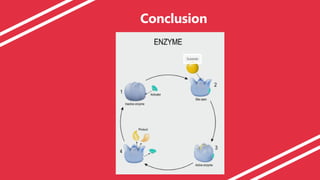
Conclusion
The rate ofbiochemical reaction often
influences enzymes like catalysts, so that they
can take place at a relatively low temperature.
The enzymes are thus known to lower the
energy of activation. In certain cases, the
biological response is initiated by enzymes.
Resources
1. Bisswanger H.Enzyme Kinetics: Principles and Methods. 2nd ed.
Weinheim, Germany: Wiley-VCH; 2008. Available online and as
hard copy. A user-friendly and comprehensive treatise on enzyme
kinetics.
2. McGrath M.J., Scanaill C.N. Sensor Technologies: Healthcare,
Wellness and Environmental Applications. New York: Apress Media,
LLC; 2014. Available online. Covers sensor technologies and their
clinical applications, together with broader applications that are
relevant to wellness, fitness, lifestyle and the environment.
Factors Affecting EnzymeActivity
Active site
Enzymatic catalysis depends upon the
activity of amino acid side chains assembled
in the active centre. Enzymes bind the
substrate into a region of the active site in an
intermediate conformation.
22.
Temperature and pH
Enzymesrequire an optimum temperature and pH for their action. The temperature or pH
at which a compound shows its maximum activity is called optimum temperature or
optimum pH, respectively. Enzymes are protein compounds. A temperature or pH more
than optimum may alter the molecular structure of the enzymes.
At low temperatures, the number of successful collisions between
the enzyme and substrate is reduced because their molecular movement decreases. The
reaction is slow. The human body is maintained at 37°C as this is the temperature at which
the enzymes in our body work best. This is not true of the enzymes in all organisms.
Concentration and Typeof Substrate
Concentration and Type of Substrate
Enzymes have a saturation point, i.e., once all the enzymes added are occupied by
the substrate molecules, their activity will cease. When the reaction begins, the
velocity of enzyme action keeps increasing with further addition of substrate.
However, at a saturation point where substrate molecules are more in number than
the free enzyme, the velocity remains the same.
The type of substrate is another factor that affects the enzyme action. The chemicals
that bind to the active site of the enzyme can inhibit the activity of the enzyme, and
such a substrate is called an inhibitor.
25.
Conclusion
Enzyme activity isaffected by several factors
including the concentration of the enzyme,
the concentration of the substrate, the
temperature, the pH, and the salt
concentration.
Resources
Trevan M.D. ImmobilizedEnzymes: An Introduction and Applications in
Biotechnology. Chichester: John Wiley & Sons; 1980. An older text, and
difficult to find except in libraries, but it provides an introductory text
for non-experts, and as yet there is no other book that fulfils this role.