FACTORING IN SINGAPORE
Sonam Jambhulkar
874
National Law University
Factoring
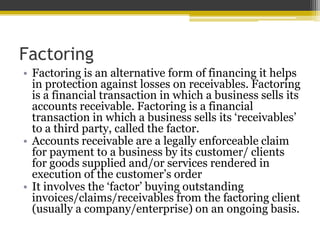
• Factoring is an alternative form of financing it helps
in protection against losses on receivables. Factoring
is a financial transaction in which a business sells its
accounts receivable. Factoring is a financial
transaction in which a business sells its ‘receivables’
to a third party, called the factor.
• Accounts receivable are a legally enforceable claim
for payment to a business by its customer/ clients
for goods supplied and/or services rendered in
execution of the customer’s order
• It involves the ‘factor’ buying outstanding
invoices/claims/receivables from the factoring client
(usually a company/enterprise) on an ongoing basis.
• A pre-defined percentage is kept with the
‘factor’, as security deposit. i.e. invoices to a
third party, called a factor, at a discount.
• The sale of the receivables essentially transfers
ownership of the receivables to the
factor, indicating the factor obtains all of the
rights associated with the receivables.
• The Factor checks the ongoing creditworthiness
of the customer and takes under an agreed
limit, the full risk of default, before signing the
contract.
• In factoring a company sells its receivables from
deliveries of goods and services to its customers
continuously to a factoring institution
• And hence the company maintains immediate
liquidity directly from his debts. And with this
liquidity obtained by factoring company may also
procure-use income in purchasing because of different
discounts and special rates.
• By way of factoring the company outsources its claims
and management provides administrative relief. The
sale of receivables reduces the balance and leads to
better balance sheet ratios.
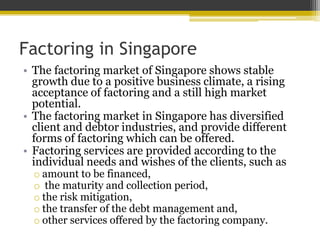
Factoring in Singapore
• The factoring market of Singapore shows stable
growth due to a positive business climate, a rising
acceptance of factoring and a still high market
potential.
• The factoring market in Singapore has diversified
client and debtor industries, and provide different
forms of factoring which can be offered.
• Factoring services are provided according to the
individual needs and wishes of the clients, such as
o amount to be financed,
o the maturity and collection period,
o the risk mitigation,
o the transfer of the debt management and,
o other services offered by the factoring company.
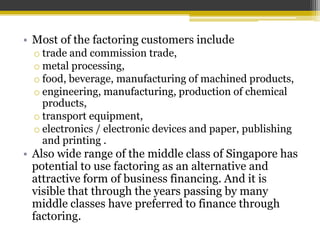
• Most of the factoring customers include
o trade and commission trade,
o metal processing,
o food, beverage, manufacturing of machined products,
o engineering, manufacturing, production of chemical
products,
o transport equipment,
o electronics / electronic devices and paper, publishing
and printing .
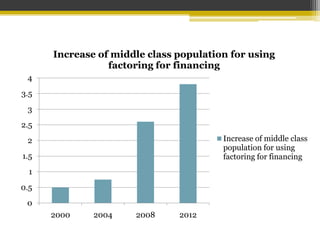
• Also wide range of the middle class of Singapore has
potential to use factoring as an alternative and
attractive form of business financing. And it is
visible that through the years passing by many
middle classes have preferred to finance through
factoring.
0
0.5
1
1.5
2
2.5
3
3.5
4
2000 2004 2008 2012
Increase of middle class population for using
factoring for financing
Increase of middle class
population for using
factoring for financing
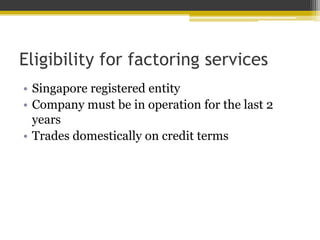
Eligibility for factoring services
• Singapore registered entity
• Company must be in operation for the last 2
years
• Trades domestically on credit terms
Factoring Institutions
• DBS BANK LTD-EB-FACTORING
• GE Commercial Financing (Singapore) Ltd
• Global Merchant Funding Pvt Ltd
• Hong Leong Finance Limited
• HSBC RECEIVABLE FINANCE
• IFS Capital Limited
• Malayan Banking Berhad
• OCBC Ltd
• STANDARD CHARTERED BANK: Standard chartered
banks in Singapore has acquired all the SMEs in 2010
• UNITED OVERSEAS BANK LIMITED
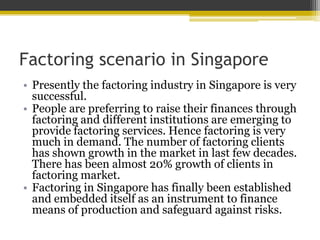
Factoring scenario in Singapore
• Presently the factoring industry in Singapore is very
successful.
• People are preferring to raise their finances through
factoring and different institutions are emerging to
provide factoring services. Hence factoring is very
much in demand. The number of factoring clients
has shown growth in the market in last few decades.
There has been almost 20% growth of clients in
factoring market.
• Factoring in Singapore has finally been established
and embedded itself as an instrument to finance
means of production and safeguard against risks.
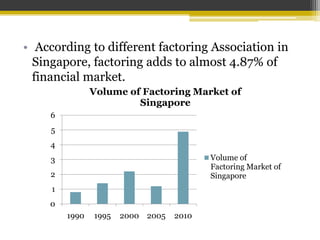
• According to different factoring Association in
Singapore, factoring adds to almost 4.87% of
financial market.
0
1
2
3
4
5
6
1990 1995 2000 2005 2010
Volume of Factoring Market of
Singapore
Volume of
Factoring Market of
Singapore
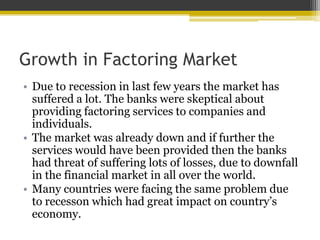
Growth in Factoring Market
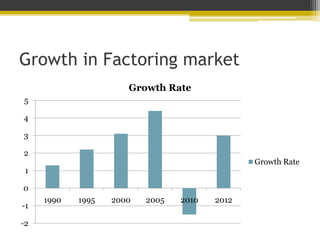
• Due to recession in last few years the market has
suffered a lot. The banks were skeptical about
providing factoring services to companies and
individuals.
• The market was already down and if further the
services would have been provided then the banks
had threat of suffering lots of losses, due to downfall
in the financial market in all over the world.
• Many countries were facing the same problem due
to recesson which had great impact on country’s
economy.
Growth in Factoring market
-2
-1
0
1
2
3
4
5
1990 1995 2000 2005 2010 2012
Growth Rate
Growth Rate
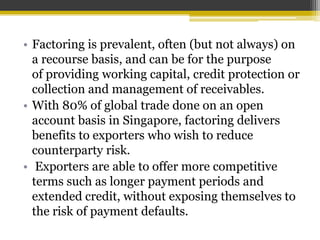
• Factoring is prevalent, often (but not always) on
a recourse basis, and can be for the purpose
of providing working capital, credit protection or
collection and management of receivables.
• With 80% of global trade done on an open
account basis in Singapore, factoring delivers
benefits to exporters who wish to reduce
counterparty risk.
• Exporters are able to offer more competitive
terms such as longer payment periods and
extended credit, without exposing themselves to
the risk of payment defaults.
• With factoring, the payment risk is transferred to
the factor (or the bank) when exporters sell their
invoices to them. The factor then collects the
invoices on the exporters’ behalf.
• Corporations ranging from MNCs to SMEs use
factoring as a core part of their working capital
strategy and to manage more efficient supply chains.
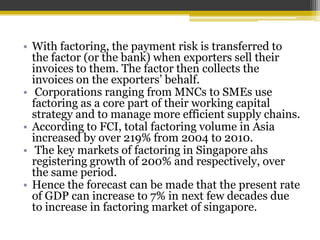
• According to FCI, total factoring volume in Asia
increased by over 219% from 2004 to 2010.
• The key markets of factoring in Singapore ahs
registering growth of 200% and respectively, over
the same period.
• Hence the forecast can be made that the present rate
of GDP can increase to 7% in next few decades due
to increase in factoring market of singapore.
Problems in Factoring Market in
Singapore
• Companies do not prefer using factoring services when they
do not run any debt collection operations of their own.
• Companies do not prefer using factoring services when they
wish to finance their expansion and growth on their own.
• Companies do not prefer using factoring services when they
want to protect themselves against losses on receivables.
• Companies do not prefer using factoring services when they
think that there is no need of such financial source and they
can rain money from other resources.
• Many people are still apprehensive about the loss or ay other
suffering that can be caused to them.
• Some factoring companies create a strong financial base but
do not get the potential customers.

Factoring in singapore

  • 1.
    FACTORING IN SINGAPORE SonamJambhulkar 874 National Law University
  • 2.
    Factoring • Factoring isan alternative form of financing it helps in protection against losses on receivables. Factoring is a financial transaction in which a business sells its accounts receivable. Factoring is a financial transaction in which a business sells its ‘receivables’ to a third party, called the factor. • Accounts receivable are a legally enforceable claim for payment to a business by its customer/ clients for goods supplied and/or services rendered in execution of the customer’s order • It involves the ‘factor’ buying outstanding invoices/claims/receivables from the factoring client (usually a company/enterprise) on an ongoing basis.
  • 3.
    • A pre-definedpercentage is kept with the ‘factor’, as security deposit. i.e. invoices to a third party, called a factor, at a discount. • The sale of the receivables essentially transfers ownership of the receivables to the factor, indicating the factor obtains all of the rights associated with the receivables. • The Factor checks the ongoing creditworthiness of the customer and takes under an agreed limit, the full risk of default, before signing the contract.
  • 4.
    • In factoringa company sells its receivables from deliveries of goods and services to its customers continuously to a factoring institution • And hence the company maintains immediate liquidity directly from his debts. And with this liquidity obtained by factoring company may also procure-use income in purchasing because of different discounts and special rates. • By way of factoring the company outsources its claims and management provides administrative relief. The sale of receivables reduces the balance and leads to better balance sheet ratios.
  • 5.
    Factoring in Singapore •The factoring market of Singapore shows stable growth due to a positive business climate, a rising acceptance of factoring and a still high market potential. • The factoring market in Singapore has diversified client and debtor industries, and provide different forms of factoring which can be offered. • Factoring services are provided according to the individual needs and wishes of the clients, such as o amount to be financed, o the maturity and collection period, o the risk mitigation, o the transfer of the debt management and, o other services offered by the factoring company.
  • 6.
    • Most ofthe factoring customers include o trade and commission trade, o metal processing, o food, beverage, manufacturing of machined products, o engineering, manufacturing, production of chemical products, o transport equipment, o electronics / electronic devices and paper, publishing and printing . • Also wide range of the middle class of Singapore has potential to use factoring as an alternative and attractive form of business financing. And it is visible that through the years passing by many middle classes have preferred to finance through factoring.
  • 7.
    0 0.5 1 1.5 2 2.5 3 3.5 4 2000 2004 20082012 Increase of middle class population for using factoring for financing Increase of middle class population for using factoring for financing
  • 8.
    Eligibility for factoringservices • Singapore registered entity • Company must be in operation for the last 2 years • Trades domestically on credit terms
  • 9.
    Factoring Institutions • DBSBANK LTD-EB-FACTORING • GE Commercial Financing (Singapore) Ltd • Global Merchant Funding Pvt Ltd • Hong Leong Finance Limited • HSBC RECEIVABLE FINANCE • IFS Capital Limited • Malayan Banking Berhad • OCBC Ltd • STANDARD CHARTERED BANK: Standard chartered banks in Singapore has acquired all the SMEs in 2010 • UNITED OVERSEAS BANK LIMITED
  • 10.
    Factoring scenario inSingapore • Presently the factoring industry in Singapore is very successful. • People are preferring to raise their finances through factoring and different institutions are emerging to provide factoring services. Hence factoring is very much in demand. The number of factoring clients has shown growth in the market in last few decades. There has been almost 20% growth of clients in factoring market. • Factoring in Singapore has finally been established and embedded itself as an instrument to finance means of production and safeguard against risks.
  • 11.
    • According todifferent factoring Association in Singapore, factoring adds to almost 4.87% of financial market. 0 1 2 3 4 5 6 1990 1995 2000 2005 2010 Volume of Factoring Market of Singapore Volume of Factoring Market of Singapore
  • 12.
    Growth in FactoringMarket • Due to recession in last few years the market has suffered a lot. The banks were skeptical about providing factoring services to companies and individuals. • The market was already down and if further the services would have been provided then the banks had threat of suffering lots of losses, due to downfall in the financial market in all over the world. • Many countries were facing the same problem due to recesson which had great impact on country’s economy.
  • 13.
    Growth in Factoringmarket -2 -1 0 1 2 3 4 5 1990 1995 2000 2005 2010 2012 Growth Rate Growth Rate
  • 14.
    • Factoring isprevalent, often (but not always) on a recourse basis, and can be for the purpose of providing working capital, credit protection or collection and management of receivables. • With 80% of global trade done on an open account basis in Singapore, factoring delivers benefits to exporters who wish to reduce counterparty risk. • Exporters are able to offer more competitive terms such as longer payment periods and extended credit, without exposing themselves to the risk of payment defaults.
  • 15.
    • With factoring,the payment risk is transferred to the factor (or the bank) when exporters sell their invoices to them. The factor then collects the invoices on the exporters’ behalf. • Corporations ranging from MNCs to SMEs use factoring as a core part of their working capital strategy and to manage more efficient supply chains. • According to FCI, total factoring volume in Asia increased by over 219% from 2004 to 2010. • The key markets of factoring in Singapore ahs registering growth of 200% and respectively, over the same period. • Hence the forecast can be made that the present rate of GDP can increase to 7% in next few decades due to increase in factoring market of singapore.
  • 16.
    Problems in FactoringMarket in Singapore • Companies do not prefer using factoring services when they do not run any debt collection operations of their own. • Companies do not prefer using factoring services when they wish to finance their expansion and growth on their own. • Companies do not prefer using factoring services when they want to protect themselves against losses on receivables. • Companies do not prefer using factoring services when they think that there is no need of such financial source and they can rain money from other resources. • Many people are still apprehensive about the loss or ay other suffering that can be caused to them. • Some factoring companies create a strong financial base but do not get the potential customers.