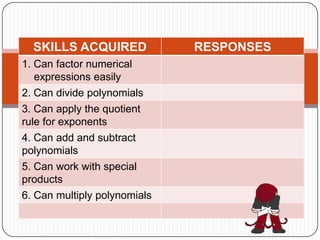
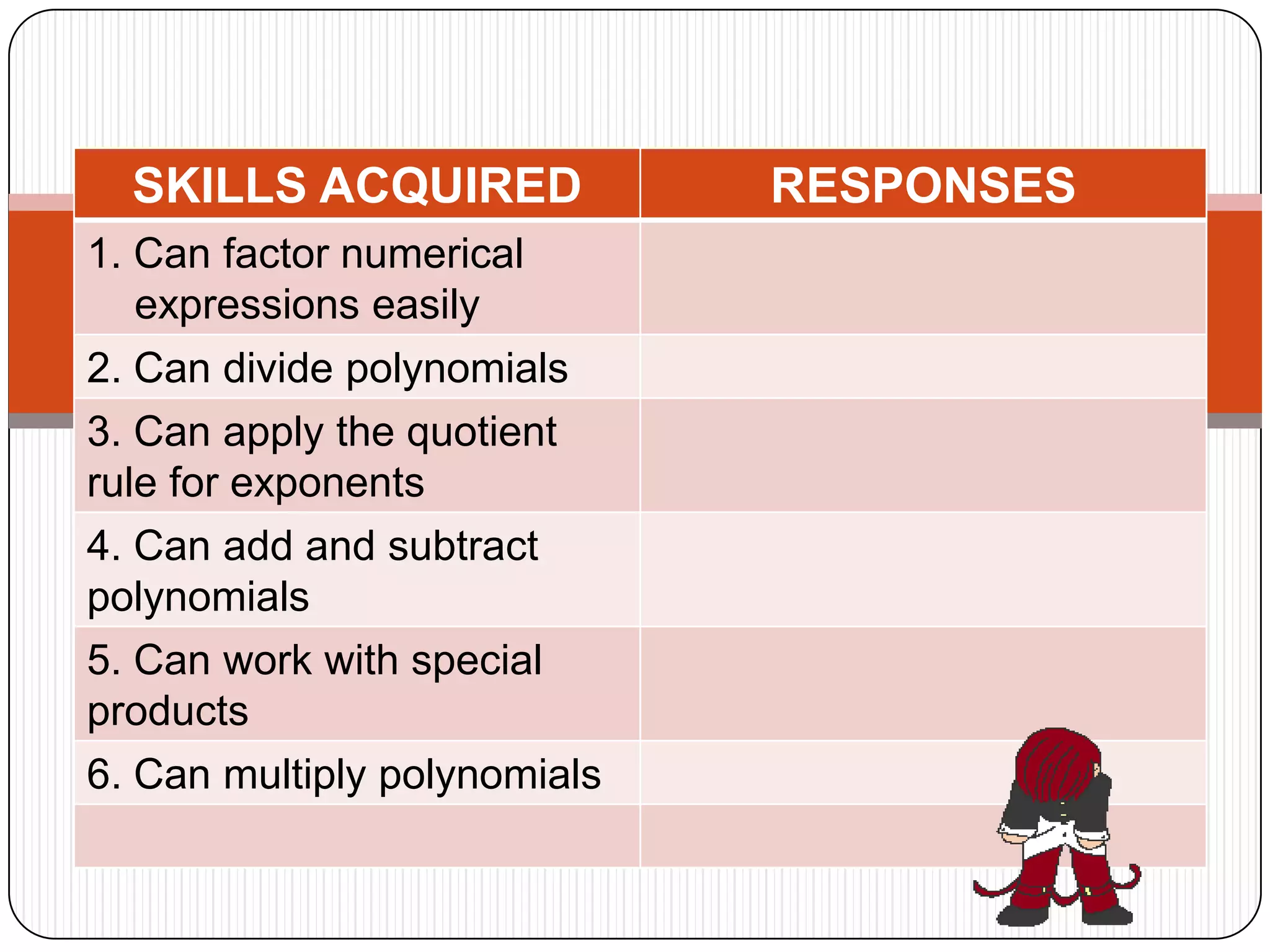
SKILLS ACQUIRED RESPONSES
1. Can factor numerical
expressions easily
2. Can divide polynomials
3. Can apply the quotient
rule for exponents
4. Can add and subtract
polynomials
5. Can work with special
products
6. Can multiply polynomials
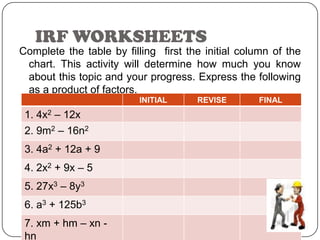
IRF WORKSHEETS
Complete the table by filling first the initial column of the
chart. This activity will determine how much you know
about this topic and your progress. Express the following
as a product of factors.
INITIAL REVISE FINAL
1. 4x2 – 12x
2. 9m2 – 16n2
3. 4a2 + 12a + 9
4. 2x2 + 9x – 5
5. 27x3 – 8y3
6. a3 + 125b3
7. xm + hm – xn -
hn
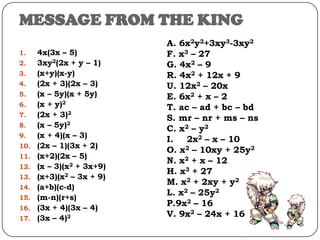
MESSAGE FROM THE KING
1. 4x(3x – 5)
2. 3xy2(2x + y – 1)
3. (x+y)(x-y)
4. (2x + 3)(2x – 3)
5. (x – 5y)(x + 5y)
6. (x + y)2
7. (2x + 3)2
8. (x – 5y)2
9. (x + 4)(x – 3)
10. (2x – 1)(3x + 2)
11. (x+2)(2x – 5)
12. (x – 3)(x2 + 3x+9)
13. (x+3)(x2 – 3x + 9)
14. (a+b)(c-d)
15. (m-n)(r+s)
16. (3x + 4)(3x – 4)
17. (3x – 4)2
A. 6x2y2+3xy3-3xy2
F. x3 – 27
G. 4x2 – 9
R. 4x2 + 12x + 9
U. 12x2 – 20x
E. 6x2 + x – 2
T. ac – ad + bc – bd
S. mr – nr + ms – ns
C. x2 – y2
I. 2x2 – x – 10
O. x2 – 10xy + 25y2
N. x2 + x – 12
H. x3 + 27
M. x2 + 2xy + y2
L. x2 – 25y2
P.9x2 – 16
V. 9x2 – 24x + 16
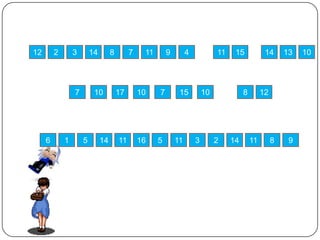
12 2 3 14 491178 1511 101314
101571017107 128
96 811142311516111451
QUESTIONS
1. What are your observations on the
expressions in column A? Compare them
with those in column B.
2. Do you see any pattern?
3. Are the two groups of expressions related?
4. Why is it important to know the reverse
process of multiplication?

Factoring (2)

  • 1.
    SKILLS ACQUIRED RESPONSES 1.Can factor numerical expressions easily 2. Can divide polynomials 3. Can apply the quotient rule for exponents 4. Can add and subtract polynomials 5. Can work with special products 6. Can multiply polynomials
  • 2.
    IRF WORKSHEETS Complete thetable by filling first the initial column of the chart. This activity will determine how much you know about this topic and your progress. Express the following as a product of factors. INITIAL REVISE FINAL 1. 4x2 – 12x 2. 9m2 – 16n2 3. 4a2 + 12a + 9 4. 2x2 + 9x – 5 5. 27x3 – 8y3 6. a3 + 125b3 7. xm + hm – xn - hn
  • 3.
    MESSAGE FROM THEKING 1. 4x(3x – 5) 2. 3xy2(2x + y – 1) 3. (x+y)(x-y) 4. (2x + 3)(2x – 3) 5. (x – 5y)(x + 5y) 6. (x + y)2 7. (2x + 3)2 8. (x – 5y)2 9. (x + 4)(x – 3) 10. (2x – 1)(3x + 2) 11. (x+2)(2x – 5) 12. (x – 3)(x2 + 3x+9) 13. (x+3)(x2 – 3x + 9) 14. (a+b)(c-d) 15. (m-n)(r+s) 16. (3x + 4)(3x – 4) 17. (3x – 4)2 A. 6x2y2+3xy3-3xy2 F. x3 – 27 G. 4x2 – 9 R. 4x2 + 12x + 9 U. 12x2 – 20x E. 6x2 + x – 2 T. ac – ad + bc – bd S. mr – nr + ms – ns C. x2 – y2 I. 2x2 – x – 10 O. x2 – 10xy + 25y2 N. x2 + x – 12 H. x3 + 27 M. x2 + 2xy + y2 L. x2 – 25y2 P.9x2 – 16 V. 9x2 – 24x + 16
  • 4.
    12 2 314 491178 1511 101314 101571017107 128 96 811142311516111451
  • 5.
    QUESTIONS 1. What areyour observations on the expressions in column A? Compare them with those in column B. 2. Do you see any pattern? 3. Are the two groups of expressions related? 4. Why is it important to know the reverse process of multiplication?