Sneha Biswas
Manish Prasad
Mahesh Makhijani
Presented to :
Prof. bibhas
INTRODUCTION
Founded by Mark Zuckerburg in 2004
It focused on helping users connect
and share information
Facebook developed Facebook
platform
Continue
Revenue was estimated to be $4.27
billion in 2011
90% of revenue expected to come
from advertising
Facebook faced many challenges
History of social networking sites
Social networking sites allowed users to
construct personal profiles , view
profiles of others and communicate with
each other
Online social networks had become
leading internet destinations
First Modern online social network , six
degrees , was founded in 1997
continue
Two years later new company
Friendster rolled out a new social
networking site
Attracted as many as seven million
users
Continue
2003 , Chris Dewolfe and Tom Anderson launched Myspace
Emerged as the market leader
Minimum membership age at 13
February 2004, Mark Zuckerberg
and two of his roommates built the
earliest version of Facebook
It was similar to other social network
sites
People already have their friends ,
acquaintances and business
connections
Created trust amongst everyone
continue
Within a month three quarters students had
registered
Facebook spread rapidly across college
campus
It was serving about 30 college networks
and 1,50,000 users
Site was expanded to more than 800
college networks in U.S.
continue
In 2005 Facebook added
photo sharing features which
allowed the company to sign
up 5.5 million users by the
end of 2005
September 2006 , Facebook introduced news
feed a timeline on the Facebook homepage
that displayed the recent activities
Changed to include a feature called the
mini-feed , displayed the recent activities
News and mini-feed as Violations of some
users privacy
Four months , the launch of feed features
the average minutes on Facebook
increased by nearly 30%
competitors
TWITTER
Google
Why do people use Facebook?
 Facebook offers us that virtual sense of belonging.
 Facebook meets two basic social needs:
(1) the need to belong and (2) the need for self-presentation.
 Females and ethnic minorities tended to use Facebook more than males.
 Facebook can serve as a support system for those people in collectivist
cultures, who have frequent interactions and a close circle of Facebook
friends.
continue
 Chatting
 Sharing feelings and emotions because they get connected to those friends
to whom they cant meet in their day to day life or their close friends
 upload pictures and sharing of old memories
 Update status
 Deliver their message to their friends, relatives etc.
Success of advertising on Facebook
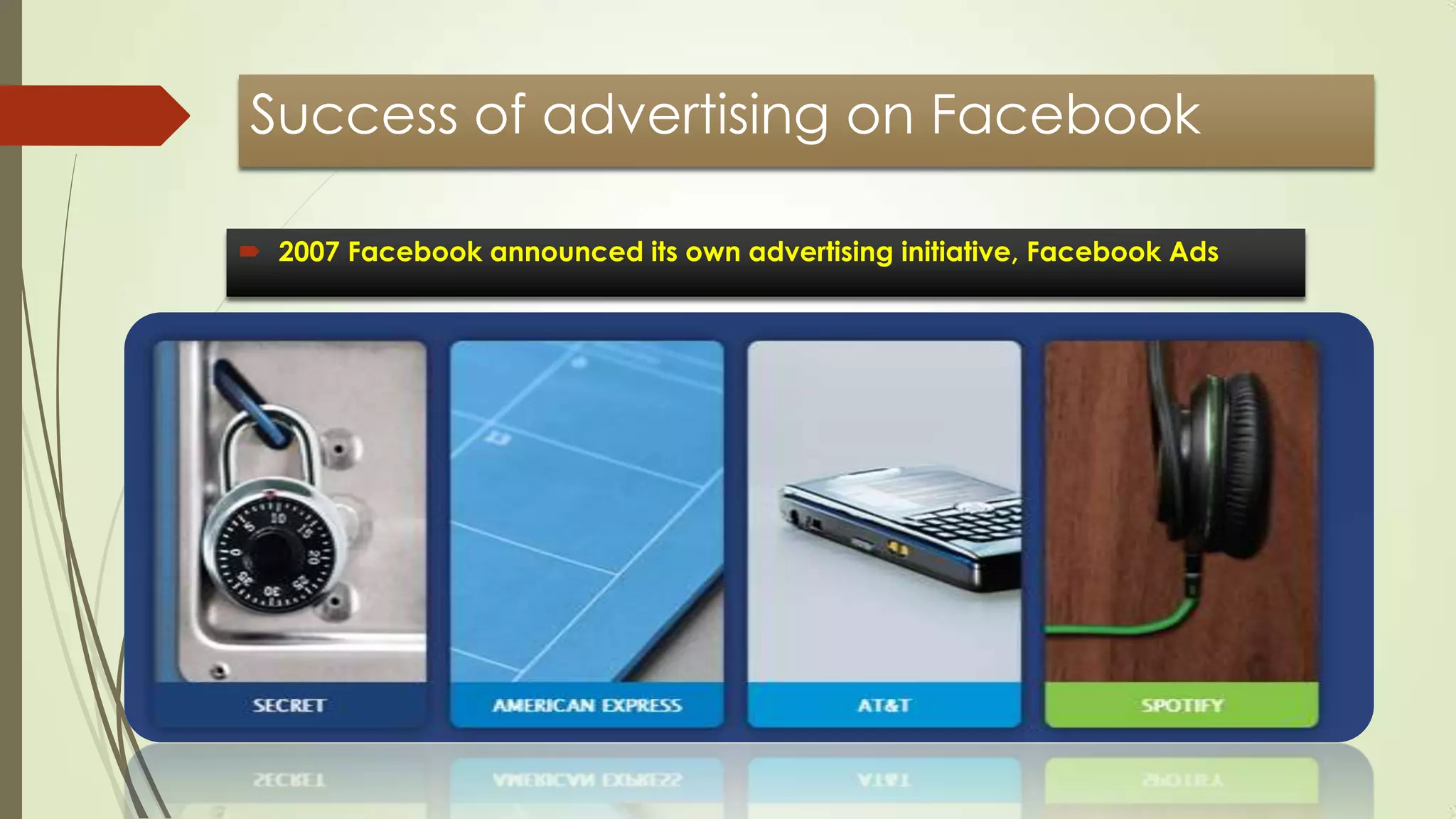
 2007 Facebook announced its own advertising initiative, Facebook Ads
continue
 Advertisers could target their campaigns on the basis of gender , age ,
geographical location etc.
 On basis of that Facebook recommend prices
 Ads then to Facebook for approval
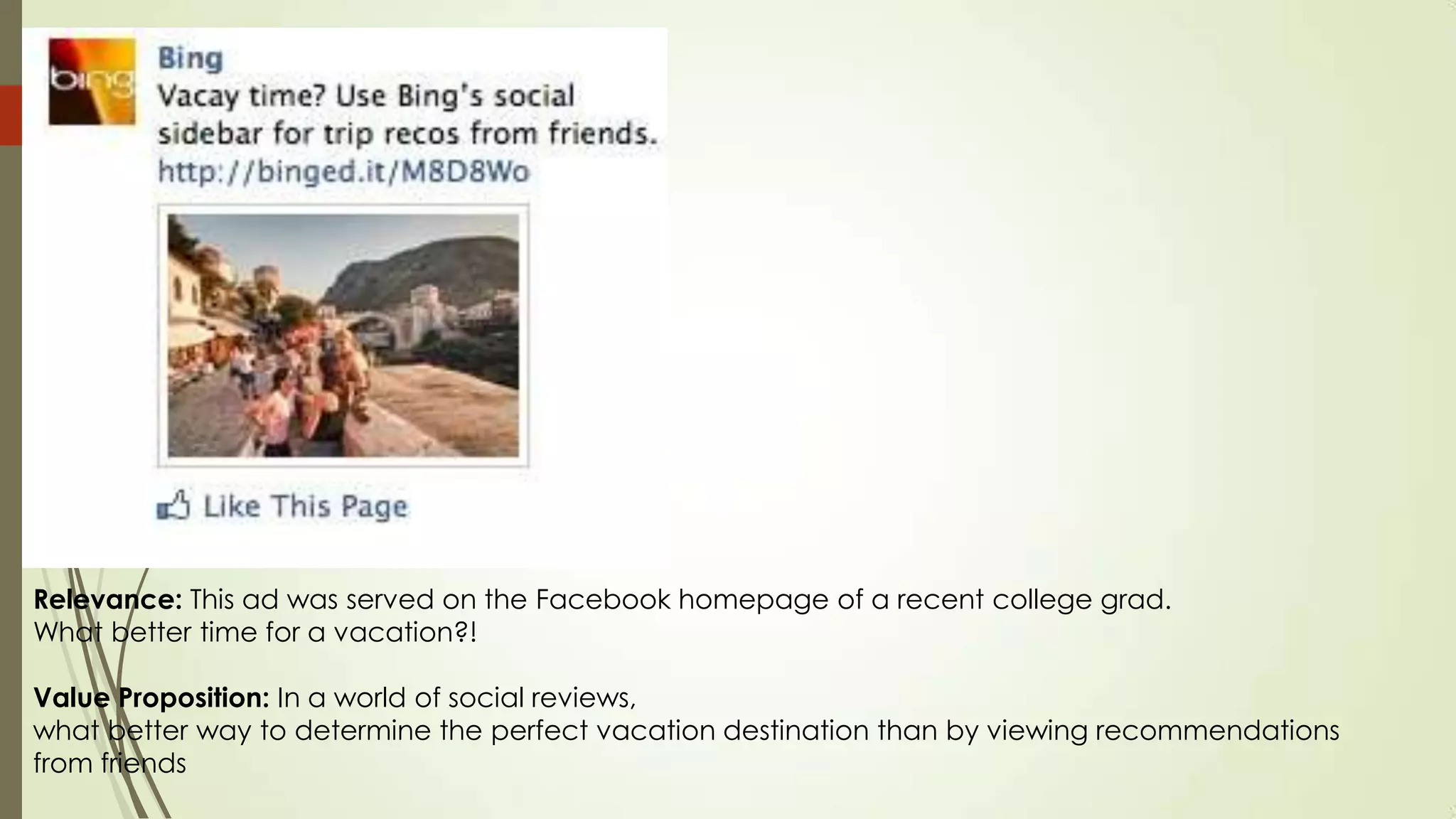
Relevance: This ad was served on the Facebook homepage of a recent college grad.
What better time for a vacation?!
Value Proposition: In a world of social reviews,
what better way to determine the perfect vacation destination than by viewing recommendations
from friends
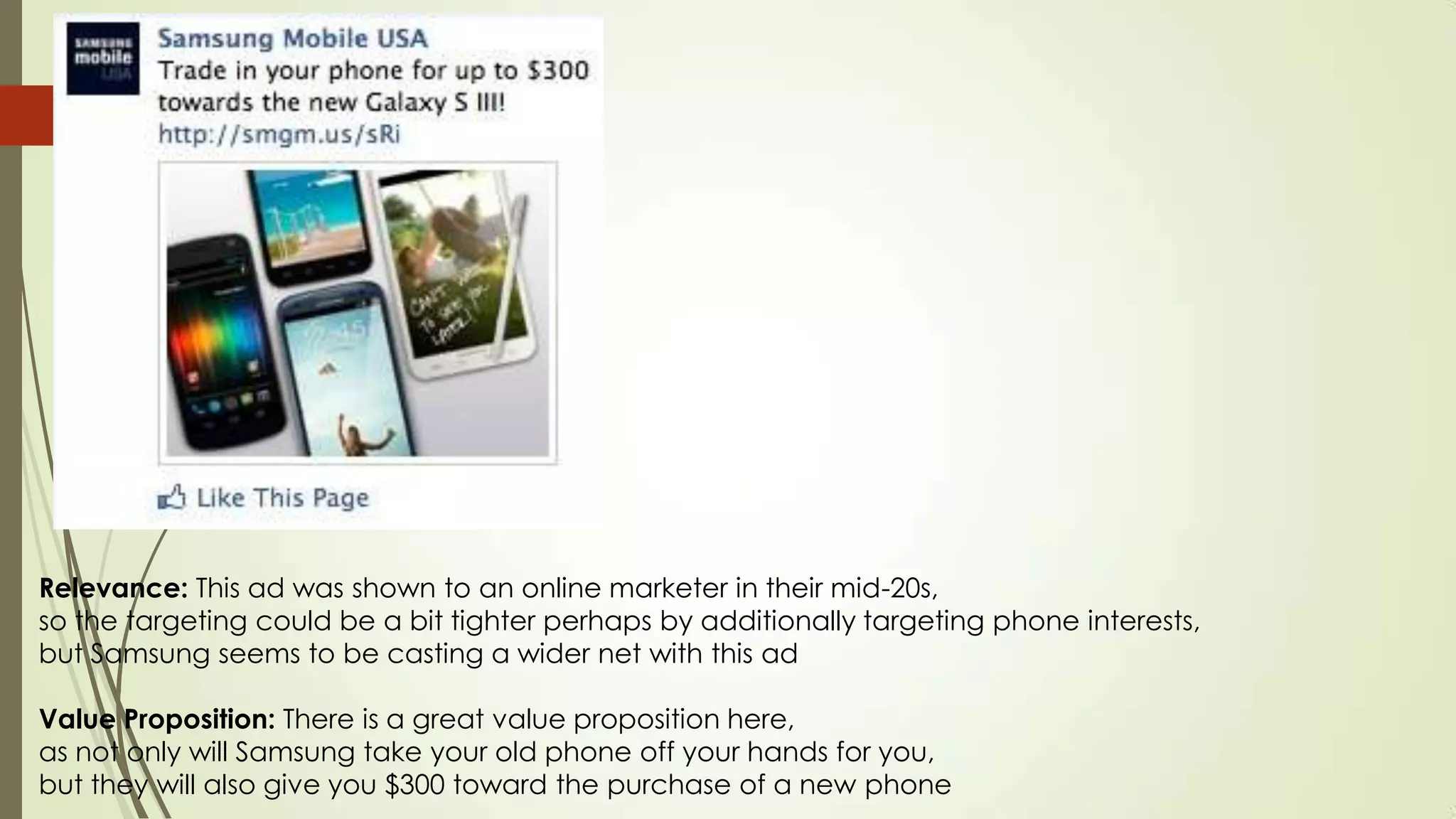
Relevance: This ad was shown to an online marketer in their mid-20s,
so the targeting could be a bit tighter perhaps by additionally targeting phone interests,
but Samsung seems to be casting a wider net with this ad
Value Proposition: There is a great value proposition here,
as not only will Samsung take your old phone off your hands for you,
but they will also give you $300 toward the purchase of a new phone
Success of Facebook fan pages
 Networking with other platforms
 Creating a resource
 Creating contests that include participation
 Empowering pre-existing pages
 Targeting the proper demographic
Facebook platforms
 Facebook announced Facebook platform which enabled third party to
develop applications inside the Facebook environment
 Three months after the launch of Facebook platform over 3000 applications
had been released
 Reached 11 million people by end of 2007
 Application boom , help Facebook build greater user engagement
 Zynga followed up farm Ville and several other hits in December 2010
Facebook for websites
 Second generation platform called Facebook for websites
 Sites used at least three different types of functionalities in Facebook for
websites
 Third party sites obtain significant amount of data on users who logged on
using their Facebook credentials
 The development of Facebook for websites did not go unnoticed by
facebook's biggest competitor which announced its competing program
Myspace ID
Facebook rms

Facebook rms

  • 1.
    Sneha Biswas Manish Prasad MaheshMakhijani Presented to : Prof. bibhas
  • 2.
    INTRODUCTION Founded by MarkZuckerburg in 2004 It focused on helping users connect and share information Facebook developed Facebook platform
  • 3.
    Continue Revenue was estimatedto be $4.27 billion in 2011 90% of revenue expected to come from advertising Facebook faced many challenges
  • 4.
    History of socialnetworking sites Social networking sites allowed users to construct personal profiles , view profiles of others and communicate with each other Online social networks had become leading internet destinations First Modern online social network , six degrees , was founded in 1997
  • 5.
    continue Two years laternew company Friendster rolled out a new social networking site Attracted as many as seven million users
  • 6.
    Continue 2003 , ChrisDewolfe and Tom Anderson launched Myspace Emerged as the market leader Minimum membership age at 13
  • 7.
    February 2004, MarkZuckerberg and two of his roommates built the earliest version of Facebook It was similar to other social network sites People already have their friends , acquaintances and business connections Created trust amongst everyone
  • 8.
    continue Within a monththree quarters students had registered Facebook spread rapidly across college campus It was serving about 30 college networks and 1,50,000 users Site was expanded to more than 800 college networks in U.S.
  • 9.
    continue In 2005 Facebookadded photo sharing features which allowed the company to sign up 5.5 million users by the end of 2005
  • 10.
    September 2006 ,Facebook introduced news feed a timeline on the Facebook homepage that displayed the recent activities Changed to include a feature called the mini-feed , displayed the recent activities News and mini-feed as Violations of some users privacy Four months , the launch of feed features the average minutes on Facebook increased by nearly 30%
  • 12.
  • 13.
    Why do peopleuse Facebook?  Facebook offers us that virtual sense of belonging.  Facebook meets two basic social needs: (1) the need to belong and (2) the need for self-presentation.  Females and ethnic minorities tended to use Facebook more than males.  Facebook can serve as a support system for those people in collectivist cultures, who have frequent interactions and a close circle of Facebook friends.
  • 14.
    continue  Chatting  Sharingfeelings and emotions because they get connected to those friends to whom they cant meet in their day to day life or their close friends  upload pictures and sharing of old memories  Update status  Deliver their message to their friends, relatives etc.
  • 15.
    Success of advertisingon Facebook  2007 Facebook announced its own advertising initiative, Facebook Ads
  • 16.
    continue  Advertisers couldtarget their campaigns on the basis of gender , age , geographical location etc.  On basis of that Facebook recommend prices  Ads then to Facebook for approval
  • 17.
    Relevance: This adwas served on the Facebook homepage of a recent college grad. What better time for a vacation?! Value Proposition: In a world of social reviews, what better way to determine the perfect vacation destination than by viewing recommendations from friends
  • 18.
    Relevance: This adwas shown to an online marketer in their mid-20s, so the targeting could be a bit tighter perhaps by additionally targeting phone interests, but Samsung seems to be casting a wider net with this ad Value Proposition: There is a great value proposition here, as not only will Samsung take your old phone off your hands for you, but they will also give you $300 toward the purchase of a new phone
  • 19.
    Success of Facebookfan pages  Networking with other platforms  Creating a resource  Creating contests that include participation  Empowering pre-existing pages  Targeting the proper demographic
  • 21.
    Facebook platforms  Facebookannounced Facebook platform which enabled third party to develop applications inside the Facebook environment  Three months after the launch of Facebook platform over 3000 applications had been released  Reached 11 million people by end of 2007  Application boom , help Facebook build greater user engagement  Zynga followed up farm Ville and several other hits in December 2010
  • 22.
    Facebook for websites Second generation platform called Facebook for websites  Sites used at least three different types of functionalities in Facebook for websites  Third party sites obtain significant amount of data on users who logged on using their Facebook credentials  The development of Facebook for websites did not go unnoticed by facebook's biggest competitor which announced its competing program Myspace ID