Fabry disease: results of the enzyme
replacement therapy with agalsidase
                     beta


C. SPÂNU, C. DRUGAN, C.NIŢĂ, S.SPÂNU, C. CRĂCIUN,
   M. RADU,V.TODEA, M. GHERMAN- CĂPRIOARĂ


                Cluj, Romania
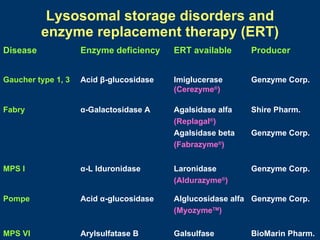
Lysosomal storage disorders and
          enzyme replacement therapy (ERT)
Disease             Enzyme deficiency    ERT available     Producer


Gaucher type 1, 3   Acid β-glucosidase   Imiglucerase      Genzyme Corp.
                                         (Cerezyme®)

Fabry               α-Galactosidase A    Agalsidase alfa   Shire Pharm.
                                         (Replagal®)
                                         Agalsidase beta   Genzyme Corp.
                                         (Fabrazyme®)


MPS I               α-L Iduronidase      Laronidase        Genzyme Corp.
                                         (Aldurazyme®)

Pompe               Acid α-glucosidase   Alglucosidase alfa Genzyme Corp.
                                         (MyozymeTM)

MPS VI              Arylsulfatase B      Galsulfase        BioMarin Pharm.
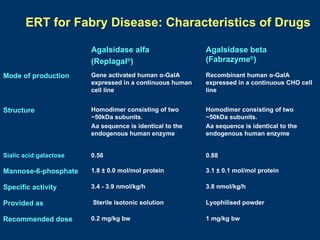
ERT for Fabry Disease: Characteristics of Drugs

                        Agalsidase alfa                   Agalsidase beta
                        (Replagal®)                       (Fabrazyme®)

Mode of production      Gene activated human α-GalA       Recombinant human α-GalA
                        expressed in a continuous human   expressed in a continuous CHO cell
                        cell line                         line


Structure               Homodimer consisting of two       Homodimer consisting of two
                        ~50kDa subunits.                  ~50kDa subunits.
                        Aa sequence is identical to the   Aa sequence is identical to the
                        endogenous human enzyme           endogenous human enzyme


Sialic acid:galactose   0.56                              0.88

Mannose-6-phosphate     1.8 ± 0.0 mol/mol protein         3.1 ± 0.1 mol/mol protein

Specific activity       3.4 - 3.9 nmol/kg/h               3.8 nmol/kg/h

Provided as             Sterile isotonic solution         Lyophilised powder

Recommended dose        0.2 mg/kg bw                      1 mg/kg bw
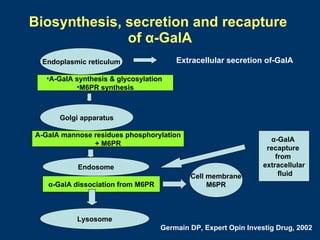
Biosynthesis, secretion and recapture
              of α-GalA
 Endoplasmic reticulum                 Extracellular secretion of-GalA

   •Α-GalA synthesis & glycosylation
           •M6PR synthesis


      Golgi apparatus

Α-GalA mannose residues phosphorylation
                                                                  α-GalA
               + M6PR
                                                                 recapture
                                                                    from
           Endosome                                             extracellular
                                           Cell membrane             fluid
   α-GalA dissociation from M6PR                M6PR


           Lysosome
                                   Germain DP, Expert Opin Investig Drug, 2002
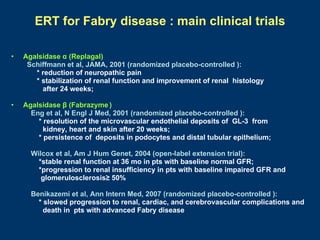
ERT for Fabry disease : main clinical trials

•   Agalsidase α (Replagal)
     Schiffmann et al, JAMA, 2001 (randomized placebo-controlled ):
       * reduction of neuropathic pain
       * stabilization of renal function and improvement of renal histology
         after 24 weeks;

•   Agalsidase β (Fabrazyme )
      Eng et al, N Engl J Med, 2001 (randomized placebo-controlled ):
        * resolution of the microvascular endothelial deposits of GL-3 from
          kidney, heart and skin after 20 weeks;
        * persistence of deposits in podocytes and distal tubular epithelium;

      Wilcox et al, Am J Hum Genet, 2004 (open-label extension trial):
        *stable renal function at 36 mo in pts with baseline normal GFR;
        *progression to renal insufficiency in pts with baseline impaired GFR and
         glomerulosclerosis≥ 50%

      Benikazemi et al, Ann Intern Med, 2007 (randomized placebo-controlled ):
        * slowed progression to renal, cardiac, and cerebrovascular complications and
          death in pts with advanced Fabry disease
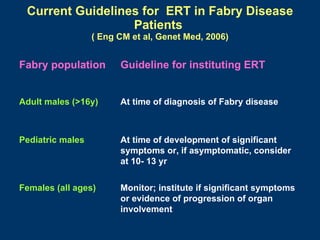
Current Guidelines for ERT in Fabry Disease
                  Patients
                  ( Eng CM et al, Genet Med, 2006)


Fabry population        Guideline for instituting ERT


Adult males (>16y)      At time of diagnosis of Fabry disease


Pediatric males         At time of development of significant
                        symptoms or, if asymptomatic, consider
                        at 10- 13 yr

Females (all ages)      Monitor; institute if significant symptoms
                        or evidence of progression of organ
                        involvement
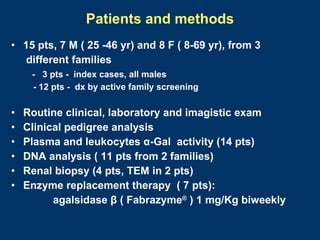
Patients and methods
• 15 pts, 7 M ( 25 -46 yr) and 8 F ( 8-69 yr), from 3
  different families
     - 3 pts - index cases, all males
     - 12 pts - dx by active family screening

•   Routine clinical, laboratory and imagistic exam
•   Clinical pedigree analysis
•   Plasma and leukocytes α-Gal activity (14 pts)
•   DNA analysis ( 11 pts from 2 families)
•   Renal biopsy (4 pts, TEM in 2 pts)
•   Enzyme replacement therapy ( 7 pts):
          agalsidase β ( Fabrazyme® ) 1 mg/Kg biweekly
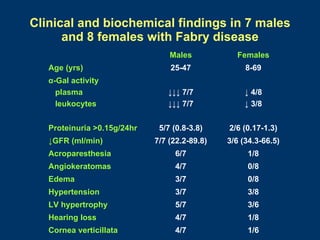
Clinical and biochemical findings in 7 males
      and 8 females with Fabry disease
                                 Males           Females
   Age (yrs)                     25-47              8-69
   α-Gal activity
     plasma                     ↓↓↓ 7/7             ↓ 4/8
     leukocytes                 ↓↓↓ 7/7             ↓ 3/8


   Proteinuria >0.15g/24hr    5/7 (0.8-3.8)    2/6 (0.17-1.3)
   ↓GFR (ml/min)             7/7 (22.2-89.8)   3/6 (34.3-66.5)
   Acroparesthesia                6/7               1/8
   Angiokeratomas                 4/7               0/8
   Edema                          3/7               0/8
   Hypertension                   3/7               3/8
   LV hypertrophy                 5/7               3/6
   Hearing loss                   4/7               1/8
   Cornea verticillata            4/7               1/6
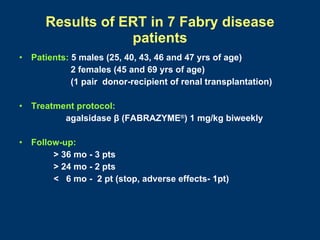
Results of ERT in 7 Fabry disease
                   patients
•   Patients: 5 males (25, 40, 43, 46 and 47 yrs of age)
              2 females (45 and 69 yrs of age)
              (1 pair donor-recipient of renal transplantation)

•   Treatment protocol:
           agalsidase β (FABRAZYME®) 1 mg/kg biweekly

•   Follow-up:
         > 36 mo - 3 pts
         > 24 mo - 2 pts
         < 6 mo - 2 pt (stop, adverse effects- 1pt)
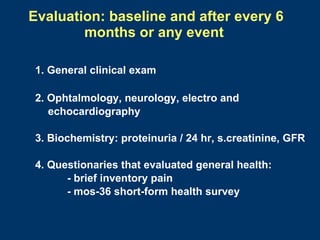
Evaluation: baseline and after every 6
        months or any event

1. General clinical exam

2. Ophtalmology, neurology, electro and
   echocardiography

3. Biochemistry: proteinuria / 24 hr, s.creatinine, GFR

4. Questionaries that evaluated general health:
      - brief inventory pain
      - mos-36 short-form health survey
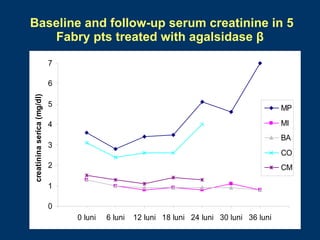
Baseline and follow-up serum creatinine in 5
   Fabry pts treated with agalsidase β

                            7

                            6
creatinina serica (mg/dl)


                            5                                                               MP

                            4                                                               MI
                                                                                            BA
                            3
                                                                                            CO
                            2                                                               CM

                            1

                            0
                                0 luni   6 luni   12 luni 18 luni 24 luni 30 luni 36 luni
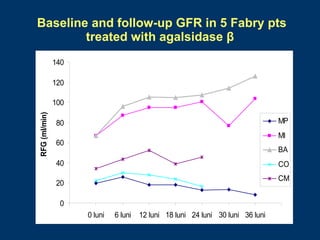
Baseline and follow-up GFR in 5 Fabry pts
        treated with agalsidase β
               140

               120

               100
RFG (ml/min)


               80                                                                MP
                                                                                 MI
               60
                                                                                 BA
               40                                                                CO
                                                                                 CM
               20

                0
                     0 luni   6 luni   12 luni 18 luni 24 luni 30 luni 36 luni
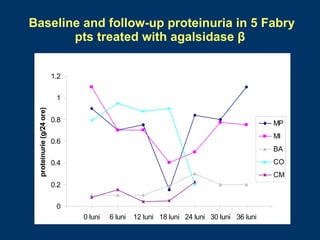
Baseline and follow-up proteinuria in 5 Fabry
       pts treated with agalsidase β


                          1.2


                           1
 proteinurie (g/24 ore)


                          0.8                                                               MP
                                                                                            MI
                          0.6
                                                                                            BA
                          0.4                                                               CO
                                                                                            CM
                          0.2


                           0
                                0 luni   6 luni   12 luni 18 luni 24 luni 30 luni 36 luni
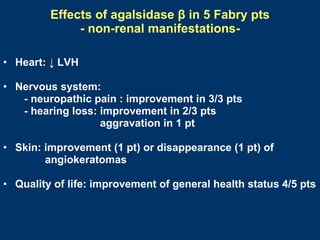
Effects of agalsidase β in 5 Fabry pts
              - non-renal manifestations-

• Heart: ↓ LVH

• Nervous system:
   - neuropathic pain : improvement in 3/3 pts
   - hearing loss: improvement in 2/3 pts
                   aggravation in 1 pt

• Skin: improvement (1 pt) or disappearance (1 pt) of
        angiokeratomas

• Quality of life: improvement of general health status 4/5 pts
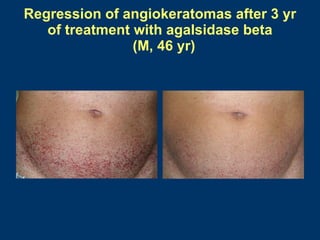
Regression of angiokeratomas after 3 yr
   of treatment with agalsidase beta
                (M, 46 yr)
Conclusions

• Most of the studied patients have had advanced
  disease at the time of ERT initiation

• No major events related to disease or therapy
  were noted during treatment period in the
  majority of patients

• Renal and extrarenal manifestations in our Fabry
  patients were favorably influenced by ERT with
  agalsidase beta

• ERT with agalsidase β is more efficient in early
  stages of Fabry disease
Acknowledgments


Genzyme Corporation :
   providing logistical support and
   Fabrazyme for treatment of our patients

Fabry.Cong.Balcanic.2009

  • 1.
    Fabry disease: resultsof the enzyme replacement therapy with agalsidase beta C. SPÂNU, C. DRUGAN, C.NIŢĂ, S.SPÂNU, C. CRĂCIUN, M. RADU,V.TODEA, M. GHERMAN- CĂPRIOARĂ Cluj, Romania
  • 2.
    Lysosomal storage disordersand enzyme replacement therapy (ERT) Disease Enzyme deficiency ERT available Producer Gaucher type 1, 3 Acid β-glucosidase Imiglucerase Genzyme Corp. (Cerezyme®) Fabry α-Galactosidase A Agalsidase alfa Shire Pharm. (Replagal®) Agalsidase beta Genzyme Corp. (Fabrazyme®) MPS I α-L Iduronidase Laronidase Genzyme Corp. (Aldurazyme®) Pompe Acid α-glucosidase Alglucosidase alfa Genzyme Corp. (MyozymeTM) MPS VI Arylsulfatase B Galsulfase BioMarin Pharm.
  • 3.
    ERT for FabryDisease: Characteristics of Drugs Agalsidase alfa Agalsidase beta (Replagal®) (Fabrazyme®) Mode of production Gene activated human α-GalA Recombinant human α-GalA expressed in a continuous human expressed in a continuous CHO cell cell line line Structure Homodimer consisting of two Homodimer consisting of two ~50kDa subunits. ~50kDa subunits. Aa sequence is identical to the Aa sequence is identical to the endogenous human enzyme endogenous human enzyme Sialic acid:galactose 0.56 0.88 Mannose-6-phosphate 1.8 ± 0.0 mol/mol protein 3.1 ± 0.1 mol/mol protein Specific activity 3.4 - 3.9 nmol/kg/h 3.8 nmol/kg/h Provided as Sterile isotonic solution Lyophilised powder Recommended dose 0.2 mg/kg bw 1 mg/kg bw
  • 4.
    Biosynthesis, secretion andrecapture of α-GalA Endoplasmic reticulum Extracellular secretion of-GalA •Α-GalA synthesis & glycosylation •M6PR synthesis Golgi apparatus Α-GalA mannose residues phosphorylation α-GalA + M6PR recapture from Endosome extracellular Cell membrane fluid α-GalA dissociation from M6PR M6PR Lysosome Germain DP, Expert Opin Investig Drug, 2002
  • 5.
    ERT for Fabrydisease : main clinical trials • Agalsidase α (Replagal) Schiffmann et al, JAMA, 2001 (randomized placebo-controlled ): * reduction of neuropathic pain * stabilization of renal function and improvement of renal histology after 24 weeks; • Agalsidase β (Fabrazyme ) Eng et al, N Engl J Med, 2001 (randomized placebo-controlled ): * resolution of the microvascular endothelial deposits of GL-3 from kidney, heart and skin after 20 weeks; * persistence of deposits in podocytes and distal tubular epithelium; Wilcox et al, Am J Hum Genet, 2004 (open-label extension trial): *stable renal function at 36 mo in pts with baseline normal GFR; *progression to renal insufficiency in pts with baseline impaired GFR and glomerulosclerosis≥ 50% Benikazemi et al, Ann Intern Med, 2007 (randomized placebo-controlled ): * slowed progression to renal, cardiac, and cerebrovascular complications and death in pts with advanced Fabry disease
  • 6.
    Current Guidelines forERT in Fabry Disease Patients ( Eng CM et al, Genet Med, 2006) Fabry population Guideline for instituting ERT Adult males (>16y) At time of diagnosis of Fabry disease Pediatric males At time of development of significant symptoms or, if asymptomatic, consider at 10- 13 yr Females (all ages) Monitor; institute if significant symptoms or evidence of progression of organ involvement
  • 7.
    Patients and methods •15 pts, 7 M ( 25 -46 yr) and 8 F ( 8-69 yr), from 3 different families - 3 pts - index cases, all males - 12 pts - dx by active family screening • Routine clinical, laboratory and imagistic exam • Clinical pedigree analysis • Plasma and leukocytes α-Gal activity (14 pts) • DNA analysis ( 11 pts from 2 families) • Renal biopsy (4 pts, TEM in 2 pts) • Enzyme replacement therapy ( 7 pts): agalsidase β ( Fabrazyme® ) 1 mg/Kg biweekly
  • 8.
    Clinical and biochemicalfindings in 7 males and 8 females with Fabry disease Males Females Age (yrs) 25-47 8-69 α-Gal activity plasma ↓↓↓ 7/7 ↓ 4/8 leukocytes ↓↓↓ 7/7 ↓ 3/8 Proteinuria >0.15g/24hr 5/7 (0.8-3.8) 2/6 (0.17-1.3) ↓GFR (ml/min) 7/7 (22.2-89.8) 3/6 (34.3-66.5) Acroparesthesia 6/7 1/8 Angiokeratomas 4/7 0/8 Edema 3/7 0/8 Hypertension 3/7 3/8 LV hypertrophy 5/7 3/6 Hearing loss 4/7 1/8 Cornea verticillata 4/7 1/6
  • 9.
    Results of ERTin 7 Fabry disease patients • Patients: 5 males (25, 40, 43, 46 and 47 yrs of age) 2 females (45 and 69 yrs of age) (1 pair donor-recipient of renal transplantation) • Treatment protocol: agalsidase β (FABRAZYME®) 1 mg/kg biweekly • Follow-up: > 36 mo - 3 pts > 24 mo - 2 pts < 6 mo - 2 pt (stop, adverse effects- 1pt)
  • 10.
    Evaluation: baseline andafter every 6 months or any event 1. General clinical exam 2. Ophtalmology, neurology, electro and echocardiography 3. Biochemistry: proteinuria / 24 hr, s.creatinine, GFR 4. Questionaries that evaluated general health: - brief inventory pain - mos-36 short-form health survey
  • 11.
    Baseline and follow-upserum creatinine in 5 Fabry pts treated with agalsidase β 7 6 creatinina serica (mg/dl) 5 MP 4 MI BA 3 CO 2 CM 1 0 0 luni 6 luni 12 luni 18 luni 24 luni 30 luni 36 luni
  • 12.
    Baseline and follow-upGFR in 5 Fabry pts treated with agalsidase β 140 120 100 RFG (ml/min) 80 MP MI 60 BA 40 CO CM 20 0 0 luni 6 luni 12 luni 18 luni 24 luni 30 luni 36 luni
  • 13.
    Baseline and follow-upproteinuria in 5 Fabry pts treated with agalsidase β 1.2 1 proteinurie (g/24 ore) 0.8 MP MI 0.6 BA 0.4 CO CM 0.2 0 0 luni 6 luni 12 luni 18 luni 24 luni 30 luni 36 luni
  • 14.
    Effects of agalsidaseβ in 5 Fabry pts - non-renal manifestations- • Heart: ↓ LVH • Nervous system: - neuropathic pain : improvement in 3/3 pts - hearing loss: improvement in 2/3 pts aggravation in 1 pt • Skin: improvement (1 pt) or disappearance (1 pt) of angiokeratomas • Quality of life: improvement of general health status 4/5 pts
  • 15.
    Regression of angiokeratomasafter 3 yr of treatment with agalsidase beta (M, 46 yr)
  • 16.
    Conclusions • Most ofthe studied patients have had advanced disease at the time of ERT initiation • No major events related to disease or therapy were noted during treatment period in the majority of patients • Renal and extrarenal manifestations in our Fabry patients were favorably influenced by ERT with agalsidase beta • ERT with agalsidase β is more efficient in early stages of Fabry disease
  • 17.
    Acknowledgments Genzyme Corporation : providing logistical support and Fabrazyme for treatment of our patients