Mr. Shaha Rohit D Int. Journal of Engineering Research and Applications www.ijera.com
ISSN : 2248-9622, Vol. 5, Issue 5, ( Part -2) May 2015, pp.44-50
www.ijera.com 44 | P a g e
Vibration Analysis of deep groove ball bearing using Finite
Element Analysis
Mr. Shaha Rohit D*, Prof. S. S. Kulkarni**
*(Dept. of Mechanical Engg.SKN SCOE, Korti-Pandharpur, Maharashtra India)
** (2
Dept. of Mechanical Engg.SKN SCOE, Korti-Pandharpur, Maharashtra India)
ABSTRACT
Rolling element bearing is essential part of machinery. The rolling bearing, with outer ring fixed, is a multi body
mechanical system with rolling elements that transmit motion and load from the inner raceway to the outer
raceway. The rolling bearings dynamical behaviour analysis is an important condition to determine the machine
vibration response. Modern trend of Dynamic analysis is useful in early prediction. Dynamic analysis has
become a very powerful tool for the betterment of the actual performance of the system. The methodology for
prediction and validation of dynamic characteristics of bearing rotor system vibration is studied. ANSYS
software is the promising tools for the modelling. The result obtained from FEA are validated with experimental
results.
Keywords - deep groove ball Bearing, Outer race defects, Inner race defect, FFT analysis.
I. INTRODUCTION
The bearing type used in this study is a single row
deep groove ball bearing. They are the most popular
of all rolling bearing because it is non-separable,
capable of operating at high even very high speeds,
and require little maintenance in service. In addition
they have a price advantages. The bearing model 6204
from SKF is used in study. This bearing has a bore
diameter of 20 mm and widely used for many
applications.
Experimental modal analysis, structural dynamics
modification and finite element analysis is used to
analyze the dynamic properties of a test structure.
Most noise, vibration or failure problems in
mechanical structures and systems are caused by
excessive dynamic behavior. In recent years, however,
the implementation of the Fast Fourier Transform
(FFT) in low cost computer-based signal analyzers
has provided the environmental testing laboratory
with a fast and more powerful tool for acquisition and
analysis of vibration data.
The FFT spectrum analyzer samples the input
signal, computes the magnitude of its sine and cosine
components, and displays the spectrum of these
measured frequency components. The big advantage
of this technique is its speed. Because FFT spectrum
analyzers measure all frequency components at the
same time, the technique offers the possibility of
being hundreds of times faster than traditional
analogue spectrum analyzers.
Many research works had been done in the field
of signal analysis in rolling element bearing. Amit R
Patel [1] in this paper Test rig for vibration
monitoring of bearing have been designed. The design
of test rig includes design of Shaft, Bearing selection,
pedestal selection, motor selection, and base
preparation. A 3-D model have been developed using
Pro-engineer modeling software. The vibration signals
generated by the healthy/faulty bearing can be
captured by the accelerometer mounted on the test
bearing. The analysis of the vibration signal is useful
for the condition monitoring of rolling element
bearings. Abhay Utpat [2] in this paper, the study of
failure analysis of ball bearing is discussed by creation
of artificial cracks of different sizes on various
elements and noting down its signatures. The work
has been extended with Finite Element Analysis of
bearing with artificial defects to study the peaks at its
outer ring as well as inner ring defect frequencies. It is
concluded that at constant defect size and constant
load with different speeds of rotation, amplitudes of
vibration varies with increase in speed. In this case
also amplitudes of vibration are observed higher for
outer ring defected bearings than inner ring defected
bearings for same defect size. U. A. Patel, Shukla
Rajkamal [3] in this paper modern trend of dynamic
analysis is used for prediction. PRO-E and ANSYS
software are used for the modeling and model analysis
of the bearing rotor system.Experiment result has
been taken for the analysis of the signal that has been
obtained through the use of FFT analyser. Defect size
was 0.02 mm3 was studied and the different plots in
terms of acceleration and displacement amplitude
were generated both in the experiment and FEA
software ANSYS 12. The result was almost same in
both. M.S. Patil, Jose Mathew, [4] in this paper work
is focused towards the development of a theoretical
model to study the effect of defect size on bearing
vibration. The model makes it possible to detect the
frequency spectrum having peaks at the bearing defect
RESEARCH ARTICLE OPEN ACCESS
Mr. Shaha Rohit D Int. Journal of Engineering Research and Applications www.ijera.com
ISSN : 2248-9622, Vol. 5, Issue 5, ( Part -2) May 2015, pp.44-50
www.ijera.com 45 | P a g e
frequencies. The amplitudes at these frequencies are
also predicted. He developed a mathematical model
for the ball bearing vibrations due to defect on the
bearing race. N. Tandon , A. Choudhury, [7] a review
of vibration and acoustic measurement methods for
the detection of defects in rolling element bearings is
presented in this paper. This paper include detection
of both localized and distributed categories of defect,
explanation for the vibration and noise generation,
Vibration measurement in both time and frequency
domains along with signal processing techniques such
as the high-frequency resonance technique, acoustic
measurement techniques such as sound pressure,
sound intensity and acoustic emission. Dennis H.
Shreve [8] this paper is considers the various data
collection setup parameters and tradeoffs in acquiring
fast, meaningful vibration data to perform accurate
analysis in the field of predictive maintenance. The
intent of this paper is to focus on the internal signal
processing path, and how it relates to the ultimate
root-cause analysis of the original vibration problem.
An understanding of these basic concepts in signal
processing and data manipulation will enable one to
select instrumentation and to understand its use.
This paper consists of finite element modeling and
analysis of healthy bearing and defective bearing.
Modeling is a complex task for designing a bearing
because in the modeling of bearing various types of
joints should be applied at the design stage which is
very complex. In defective bearing, defect is created
on inner race and outer race. Amplitudes of
acceleration are obtained for different defect size by
varying rotational speed. At the last, amplitude vs.
frequency graphs are obtained to know the results.
Also results of experimentation are benchmarked
through finite element analysis.
II. FINITE ELEMENT ANALYSIS
2.1Finite element modeling
FEA has been carried out by using ANSYS 14
package. Initially 6204 bearing model are drawn in
CATIA software and these have been imported to
ANSYS software. Defect at inner race and outer race
are created in ANSYS itself.
In pre-processor menu, there are five cases taken
into consideration for analysis in order to validate
results of each case. Following are the cases of
simulation,
1) Healthy bearing
2) (1×0.25) mm inner race defect
3) (1×0.5) mm inner race defect
4) (1×0.25) mm outer race defect
5) (1×0.5) mm outer race defect
While modeling each case, shell 163 element has
been used with element edge length 2mm. Because
shell element is suitable for curved shape component
as well as rotating component. In order to get good
results, shell element is used in rotating component.
In order to define bearing model assembly of
three components is made those are, inner race, balls,
outer race. These components are made of nodes. It
means that each component is defined as a group of
nodes.
Analysis has been carried in ANSYS EXPLICIT
LS-DYNA. 3D dynamic analysis is done so as to get
better response of the bearing. Results are obtained in
frequency domain. Following figures shows meshed
model of each case individually.
Fig.1Meshed models of healthy bearings
Fig. 2 Meshed model of 0.25mm inner race defect
Fig. 3 Meshed model of 0.5mm inner race defect
Fig. 4 Meshed model of 0.25mm outer race defect
Mr. Shaha Rohit D Int. Journal of Engineering Research and Applications www.ijera.com
ISSN : 2248-9622, Vol. 5, Issue 5, ( Part -2) May 2015, pp.44-50
www.ijera.com 46 | P a g e
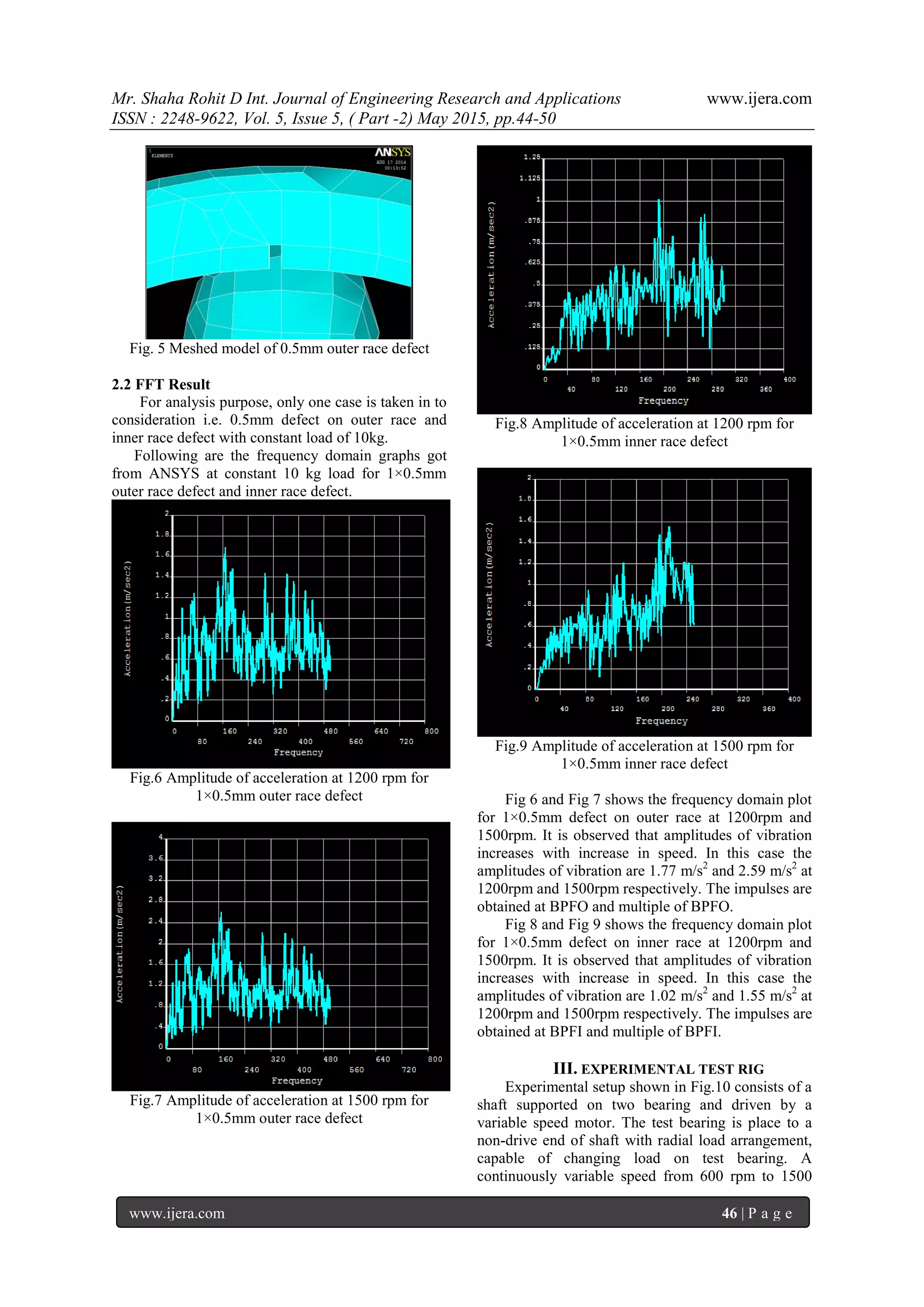
Fig. 5 Meshed model of 0.5mm outer race defect
2.2 FFT Result
For analysis purpose, only one case is taken in to
consideration i.e. 0.5mm defect on outer race and
inner race defect with constant load of 10kg.
Following are the frequency domain graphs got
from ANSYS at constant 10 kg load for 1×0.5mm
outer race defect and inner race defect.
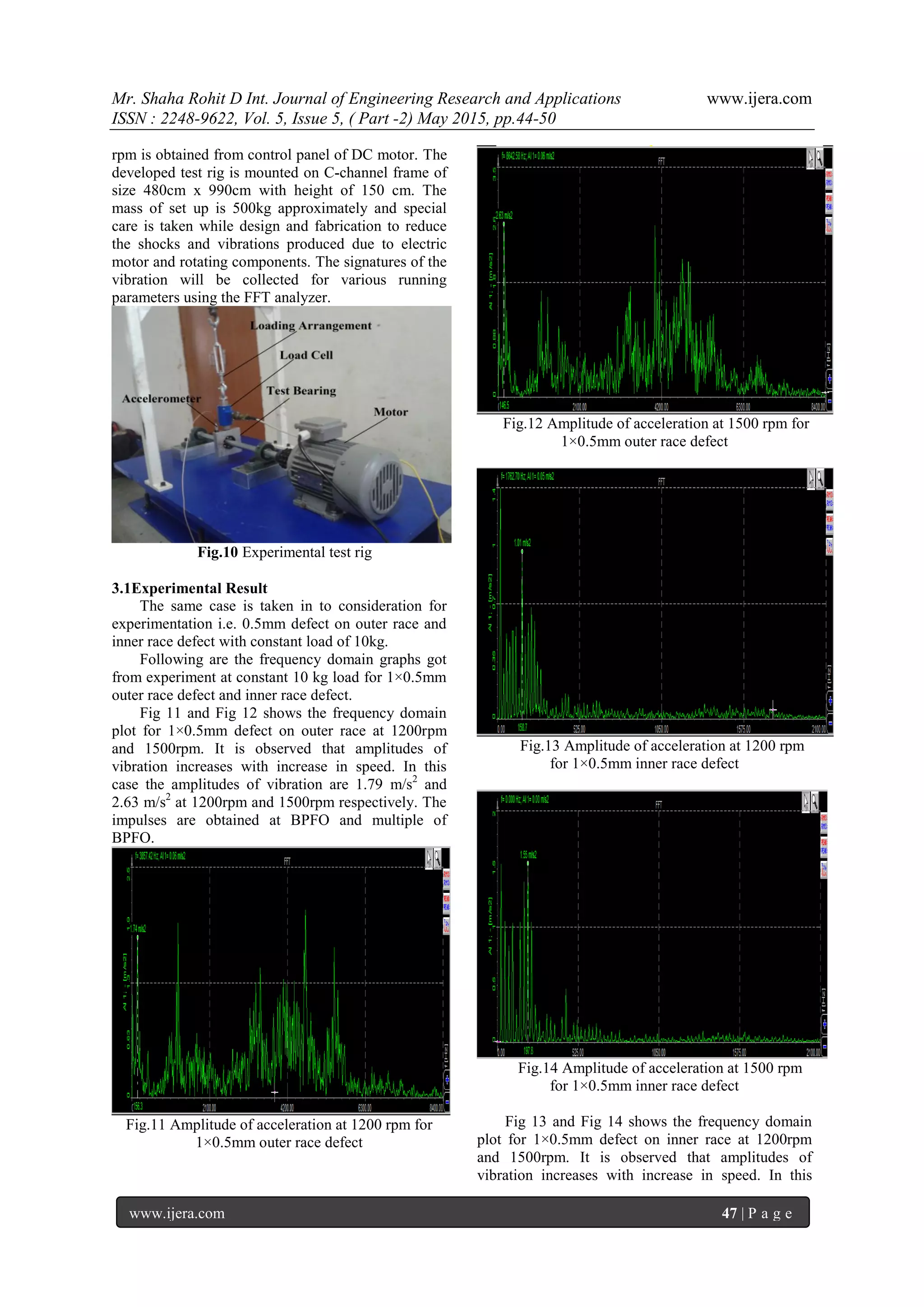
Fig.6 Amplitude of acceleration at 1200 rpm for
1×0.5mm outer race defect
Fig.7 Amplitude of acceleration at 1500 rpm for
1×0.5mm outer race defect
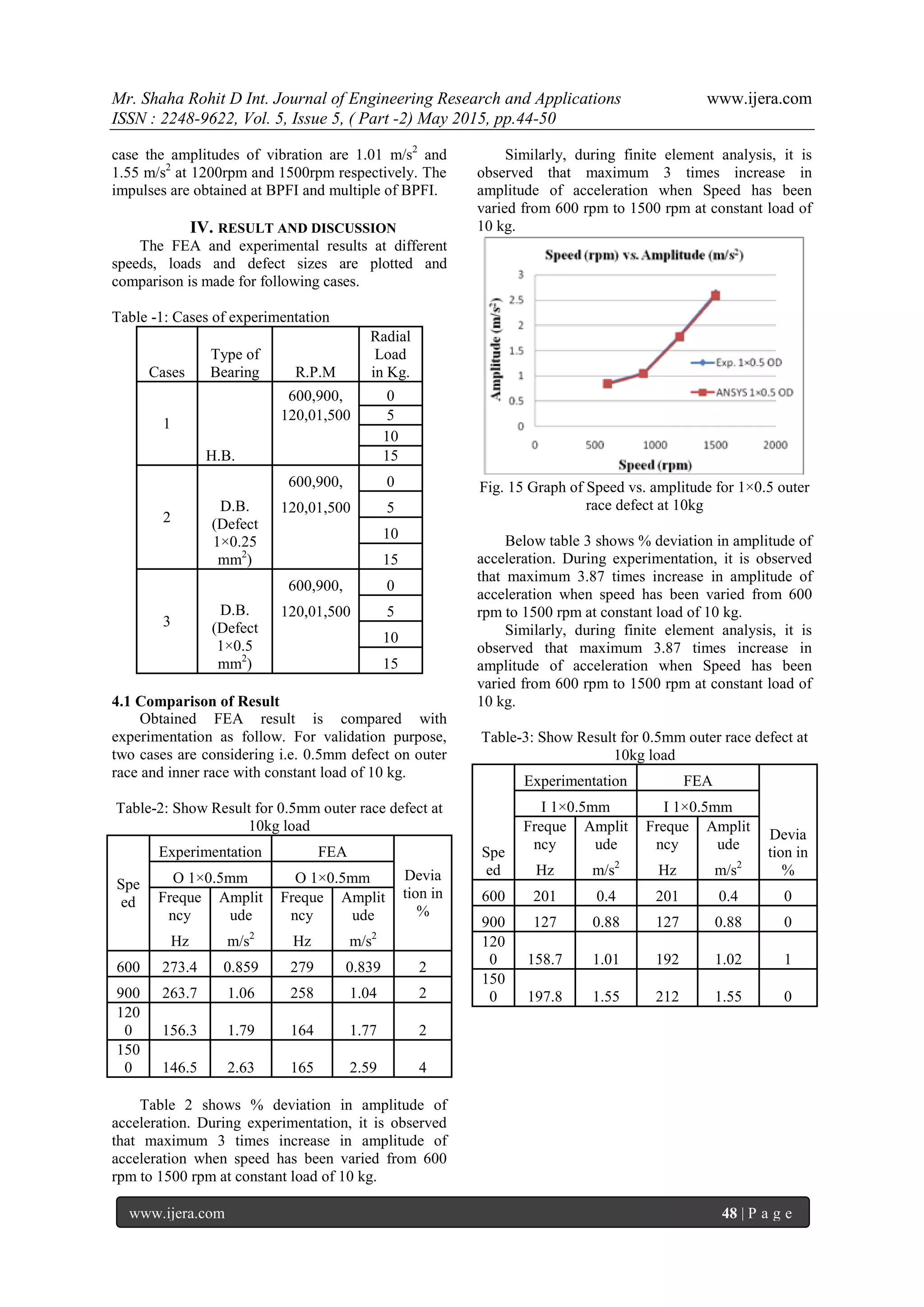
Fig.8 Amplitude of acceleration at 1200 rpm for
1×0.5mm inner race defect
Fig.9 Amplitude of acceleration at 1500 rpm for
1×0.5mm inner race defect
Fig 6 and Fig 7 shows the frequency domain plot
for 1×0.5mm defect on outer race at 1200rpm and
1500rpm. It is observed that amplitudes of vibration
increases with increase in speed. In this case the
amplitudes of vibration are 1.77 m/s2
and 2.59 m/s2
at
1200rpm and 1500rpm respectively. The impulses are
obtained at BPFO and multiple of BPFO.
Fig 8 and Fig 9 shows the frequency domain plot
for 1×0.5mm defect on inner race at 1200rpm and
1500rpm. It is observed that amplitudes of vibration
increases with increase in speed. In this case the
amplitudes of vibration are 1.02 m/s2
and 1.55 m/s2
at
1200rpm and 1500rpm respectively. The impulses are
obtained at BPFI and multiple of BPFI.
III. EXPERIMENTAL TEST RIG
Experimental setup shown in Fig.10 consists of a
shaft supported on two bearing and driven by a
variable speed motor. The test bearing is place to a
non-drive end of shaft with radial load arrangement,
capable of changing load on test bearing. A
continuously variable speed from 600 rpm to 1500
Mr. Shaha Rohit D Int. Journal of Engineering Research and Applications www.ijera.com
ISSN : 2248-9622, Vol. 5, Issue 5, ( Part -2) May 2015, pp.44-50
www.ijera.com 47 | P a g e
rpm is obtained from control panel of DC motor. The
developed test rig is mounted on C-channel frame of
size 480cm x 990cm with height of 150 cm. The
mass of set up is 500kg approximately and special
care is taken while design and fabrication to reduce
the shocks and vibrations produced due to electric
motor and rotating components. The signatures of the
vibration will be collected for various running
parameters using the FFT analyzer.
Fig.10 Experimental test rig
3.1Experimental Result
The same case is taken in to consideration for
experimentation i.e. 0.5mm defect on outer race and
inner race defect with constant load of 10kg.
Following are the frequency domain graphs got
from experiment at constant 10 kg load for 1×0.5mm
outer race defect and inner race defect.
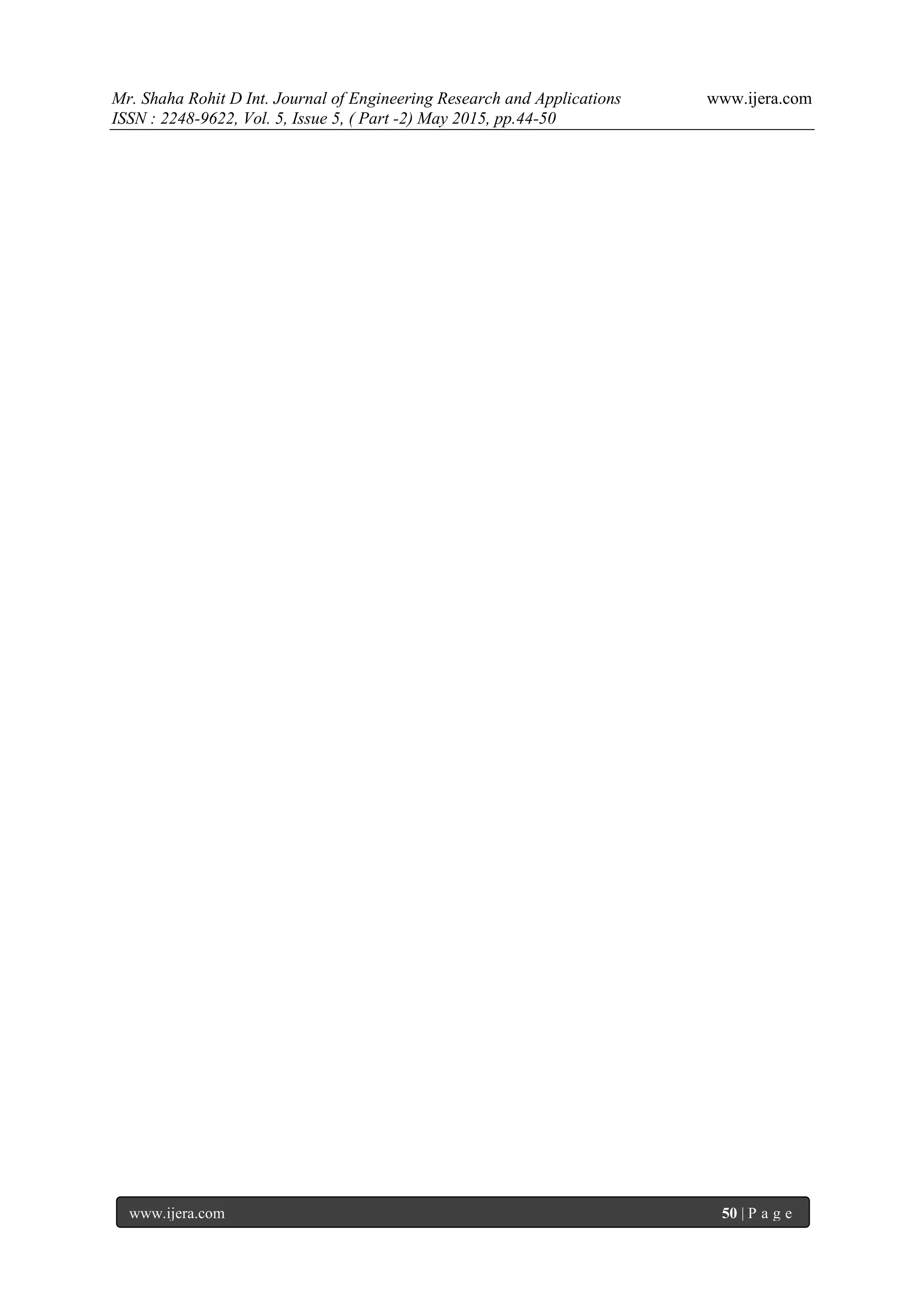
Fig 11 and Fig 12 shows the frequency domain
plot for 1×0.5mm defect on outer race at 1200rpm
and 1500rpm. It is observed that amplitudes of
vibration increases with increase in speed. In this
case the amplitudes of vibration are 1.79 m/s2
and
2.63 m/s2
at 1200rpm and 1500rpm respectively. The
impulses are obtained at BPFO and multiple of
BPFO.
Fig.11 Amplitude of acceleration at 1200 rpm for
1×0.5mm outer race defect
Fig.12 Amplitude of acceleration at 1500 rpm for
1×0.5mm outer race defect
Fig.13 Amplitude of acceleration at 1200 rpm
for 1×0.5mm inner race defect
Fig.14 Amplitude of acceleration at 1500 rpm
for 1×0.5mm inner race defect
Fig 13 and Fig 14 shows the frequency domain
plot for 1×0.5mm defect on inner race at 1200rpm
and 1500rpm. It is observed that amplitudes of
vibration increases with increase in speed. In this
Mr. Shaha Rohit D Int. Journal of Engineering Research and Applications www.ijera.com
ISSN : 2248-9622, Vol. 5, Issue 5, ( Part -2) May 2015, pp.44-50
www.ijera.com 48 | P a g e
case the amplitudes of vibration are 1.01 m/s2
and
1.55 m/s2
at 1200rpm and 1500rpm respectively. The
impulses are obtained at BPFI and multiple of BPFI.
IV. RESULT AND DISCUSSION
The FEA and experimental results at different
speeds, loads and defect sizes are plotted and
comparison is made for following cases.
Table -1: Cases of experimentation
Type of
Bearing R.P.M
Radial
Load
in Kg.Cases
1
H.B.
600,900, 0
120,01,500 5
10
15
2
D.B.
(Defect
1×0.25
mm2
)
600,900, 0
120,01,500 5
10
15
3
D.B.
(Defect
1×0.5
mm2
)
600,900, 0
120,01,500 5
10
15
4.1 Comparison of Result
Obtained FEA result is compared with
experimentation as follow. For validation purpose,
two cases are considering i.e. 0.5mm defect on outer
race and inner race with constant load of 10 kg.
Table-2: Show Result for 0.5mm outer race defect at
10kg load
Spe
ed
Experimentation FEA
Devia
tion in
%
O 1×0.5mm O 1×0.5mm
Freque
ncy
Amplit
ude
Freque
ncy
Amplit
ude
Hz m/s2
Hz m/s2
600 273.4 0.859 279 0.839 2
900 263.7 1.06 258 1.04 2
120
0 156.3 1.79 164 1.77 2
150
0 146.5 2.63 165 2.59 4
Table 2 shows % deviation in amplitude of
acceleration. During experimentation, it is observed
that maximum 3 times increase in amplitude of
acceleration when speed has been varied from 600
rpm to 1500 rpm at constant load of 10 kg.
Similarly, during finite element analysis, it is
observed that maximum 3 times increase in
amplitude of acceleration when Speed has been
varied from 600 rpm to 1500 rpm at constant load of
10 kg.
Fig. 15 Graph of Speed vs. amplitude for 1×0.5 outer
race defect at 10kg
Below table 3 shows % deviation in amplitude of
acceleration. During experimentation, it is observed
that maximum 3.87 times increase in amplitude of
acceleration when speed has been varied from 600
rpm to 1500 rpm at constant load of 10 kg.
Similarly, during finite element analysis, it is
observed that maximum 3.87 times increase in
amplitude of acceleration when Speed has been
varied from 600 rpm to 1500 rpm at constant load of
10 kg.
Table-3: Show Result for 0.5mm outer race defect at
10kg load
Spe
ed
Experimentation FEA
Devia
tion in
%
I 1×0.5mm I 1×0.5mm
Freque
ncy
Amplit
ude
Freque
ncy
Amplit
ude
Hz m/s2
Hz m/s2
600 201 0.4 201 0.4 0
900 127 0.88 127 0.88 0
120
0 158.7 1.01 192 1.02 1
150
0 197.8 1.55 212 1.55 0
Mr. Shaha Rohit D Int. Journal of Engineering Research and Applications www.ijera.com
ISSN : 2248-9622, Vol. 5, Issue 5, ( Part -2) May 2015, pp.44-50
www.ijera.com 49 | P a g e
Fig. 16 Graph of Speed vs. amplitude for 1×0.5 inner
race defect at 10kg
From table 2 and 3 it is observed that amplitude
of outer race defect is more than that of inner race
defect. Also deviation in frequency occurs due to
uncontrolled parameters during experimentation. As
amplitude changes with respect to frequency also it
changes from node to node. Here, nodes on the
surface of bearing are picked up to get the result.
Also due to birth death of element, large deviation
occurs in frequency.
V. CONCLUSION
The proposed simulation method is used to
determine the vibration signal response for various
shaft speeds and loading condition, which is
compared with experimental result. It is found
simulated vibration pattern has similar characteristic
compare to experimental results. The deviation in
amplitude of acceleration is may be due to variation
of mesh density in the region near to defect and also
deviation in frequency occurs due to uncontrolled
parameters during experimentation.
It is observed that as the speed increases the peak
amplitude values (m/s2
) gradually increases for
constant load. Also the peak amplitude values (m/s2
)
for healthy bearing are smaller than defective
bearing.
It is found that the amplitude values for the case
of outer race defect are more than that for the inner
race defect. It is because of defect present on the
outer race is remained in the load zone at maximum
position as in second case, inner race moves in and
out of the load zone during each revolution of the
shaft. The strong fault vibration spectrum produced
while the defect is in the load zone and weaker fault
vibration spectrum produced while the defect is
outside the load zone.
Acknowledgements
I owe a great many thanks to a many people who
helped and supported me during mine dissertation
work, from bottom of my heart.
REFERENCES
[1] R Patel, “Development of Test Rig for
Vibration Monitoring of Bearing” GIT-
Journal of Engineering and Technology,
vol-6, 2013, ISSN 2249 - 6157.
[2] Abhay utpat “Vibration signature analysis
of defective deep groove ball bearing by
numerical and experimental approach”
International Journal of scientific &
Engineering Research, volume 4, issue 6,
June 2013
[3] U. A. Patel, Shukla Rajkamal “Vibrational
analysis of self align ball bearing having a
local defect through FEA and its validation
through experiment” International Journal
of modern engineering research, vol 2, issue
3, May-June 2012 pp. 1073-1080.
[4] M.S. Patil, P.K. Rajendrakumar, Sandeep
Desai,” A theoretical model to predict the
effect of localized defect on vibration
associated with ball bearing”, Int journal 17
May 2010.
[5] ZekiKıral_, HiraKaragulle“Vibration
analysis of rolling element bearings with
various defects under the action of an
unbalanced force” Mechanical Systems and
Signal Processing 20 (2006) pp.1967–1991.
[6] Orhan S. “Vibration monitoring for defect
diagnosis of rolling element bearing as a
predictive maintenance tool: Comprehensive
case studies” International, Vol 39, 2006,
pp. 293-298.
[7] N. Tandon , A. Choudhury “A review of
vibration and acoustic measurement
methods for the detection of defects in
rolling element bearings” Tribology
International 32 (1999)pp. 469–480.
[8] Dennis H. Shreve “Signal processing for
effective vibration analysis” IRD
Mechanalysis, Inc Columbus, Ohio
November 1995.
[9] McFadden PD, Smith JD. Model for the
vibration produced by a single point defect
in a rolling element bearing. Journal of
Sound and Vibration 1984;96(1):69–82.
[10] Gupta PK. Dynamics of rolling element
bearings Part II: ball bearing analysis.
Journal of Lubrication Technology
Transactions of the ASME 1979;101:305–
11.
[11] Rolling Element Analysis Book of Tedric A.
Yong-Han Harris
[12] V.B.Bhandari, “Design of Machine
Elements” TATA Mc-Graw-Hill
Publications, second edition, (2007) pp.124-
127.
[13] R S Khurmi, J K Gupta “Theory of Machine
Elements” S Chand Publications.
Mr. Shaha Rohit D Int. Journal of Engineering Research and Applications www.ijera.com
ISSN : 2248-9622, Vol. 5, Issue 5, ( Part -2) May 2015, pp.44-50
www.ijera.com 50 | P a g e

Vibration Analysis of deep groove ball bearing using Finite Element Analysis

  • 1.
    Mr. Shaha RohitD Int. Journal of Engineering Research and Applications www.ijera.com ISSN : 2248-9622, Vol. 5, Issue 5, ( Part -2) May 2015, pp.44-50 www.ijera.com 44 | P a g e Vibration Analysis of deep groove ball bearing using Finite Element Analysis Mr. Shaha Rohit D*, Prof. S. S. Kulkarni** *(Dept. of Mechanical Engg.SKN SCOE, Korti-Pandharpur, Maharashtra India) ** (2 Dept. of Mechanical Engg.SKN SCOE, Korti-Pandharpur, Maharashtra India) ABSTRACT Rolling element bearing is essential part of machinery. The rolling bearing, with outer ring fixed, is a multi body mechanical system with rolling elements that transmit motion and load from the inner raceway to the outer raceway. The rolling bearings dynamical behaviour analysis is an important condition to determine the machine vibration response. Modern trend of Dynamic analysis is useful in early prediction. Dynamic analysis has become a very powerful tool for the betterment of the actual performance of the system. The methodology for prediction and validation of dynamic characteristics of bearing rotor system vibration is studied. ANSYS software is the promising tools for the modelling. The result obtained from FEA are validated with experimental results. Keywords - deep groove ball Bearing, Outer race defects, Inner race defect, FFT analysis. I. INTRODUCTION The bearing type used in this study is a single row deep groove ball bearing. They are the most popular of all rolling bearing because it is non-separable, capable of operating at high even very high speeds, and require little maintenance in service. In addition they have a price advantages. The bearing model 6204 from SKF is used in study. This bearing has a bore diameter of 20 mm and widely used for many applications. Experimental modal analysis, structural dynamics modification and finite element analysis is used to analyze the dynamic properties of a test structure. Most noise, vibration or failure problems in mechanical structures and systems are caused by excessive dynamic behavior. In recent years, however, the implementation of the Fast Fourier Transform (FFT) in low cost computer-based signal analyzers has provided the environmental testing laboratory with a fast and more powerful tool for acquisition and analysis of vibration data. The FFT spectrum analyzer samples the input signal, computes the magnitude of its sine and cosine components, and displays the spectrum of these measured frequency components. The big advantage of this technique is its speed. Because FFT spectrum analyzers measure all frequency components at the same time, the technique offers the possibility of being hundreds of times faster than traditional analogue spectrum analyzers. Many research works had been done in the field of signal analysis in rolling element bearing. Amit R Patel [1] in this paper Test rig for vibration monitoring of bearing have been designed. The design of test rig includes design of Shaft, Bearing selection, pedestal selection, motor selection, and base preparation. A 3-D model have been developed using Pro-engineer modeling software. The vibration signals generated by the healthy/faulty bearing can be captured by the accelerometer mounted on the test bearing. The analysis of the vibration signal is useful for the condition monitoring of rolling element bearings. Abhay Utpat [2] in this paper, the study of failure analysis of ball bearing is discussed by creation of artificial cracks of different sizes on various elements and noting down its signatures. The work has been extended with Finite Element Analysis of bearing with artificial defects to study the peaks at its outer ring as well as inner ring defect frequencies. It is concluded that at constant defect size and constant load with different speeds of rotation, amplitudes of vibration varies with increase in speed. In this case also amplitudes of vibration are observed higher for outer ring defected bearings than inner ring defected bearings for same defect size. U. A. Patel, Shukla Rajkamal [3] in this paper modern trend of dynamic analysis is used for prediction. PRO-E and ANSYS software are used for the modeling and model analysis of the bearing rotor system.Experiment result has been taken for the analysis of the signal that has been obtained through the use of FFT analyser. Defect size was 0.02 mm3 was studied and the different plots in terms of acceleration and displacement amplitude were generated both in the experiment and FEA software ANSYS 12. The result was almost same in both. M.S. Patil, Jose Mathew, [4] in this paper work is focused towards the development of a theoretical model to study the effect of defect size on bearing vibration. The model makes it possible to detect the frequency spectrum having peaks at the bearing defect RESEARCH ARTICLE OPEN ACCESS
  • 2.
    Mr. Shaha RohitD Int. Journal of Engineering Research and Applications www.ijera.com ISSN : 2248-9622, Vol. 5, Issue 5, ( Part -2) May 2015, pp.44-50 www.ijera.com 45 | P a g e frequencies. The amplitudes at these frequencies are also predicted. He developed a mathematical model for the ball bearing vibrations due to defect on the bearing race. N. Tandon , A. Choudhury, [7] a review of vibration and acoustic measurement methods for the detection of defects in rolling element bearings is presented in this paper. This paper include detection of both localized and distributed categories of defect, explanation for the vibration and noise generation, Vibration measurement in both time and frequency domains along with signal processing techniques such as the high-frequency resonance technique, acoustic measurement techniques such as sound pressure, sound intensity and acoustic emission. Dennis H. Shreve [8] this paper is considers the various data collection setup parameters and tradeoffs in acquiring fast, meaningful vibration data to perform accurate analysis in the field of predictive maintenance. The intent of this paper is to focus on the internal signal processing path, and how it relates to the ultimate root-cause analysis of the original vibration problem. An understanding of these basic concepts in signal processing and data manipulation will enable one to select instrumentation and to understand its use. This paper consists of finite element modeling and analysis of healthy bearing and defective bearing. Modeling is a complex task for designing a bearing because in the modeling of bearing various types of joints should be applied at the design stage which is very complex. In defective bearing, defect is created on inner race and outer race. Amplitudes of acceleration are obtained for different defect size by varying rotational speed. At the last, amplitude vs. frequency graphs are obtained to know the results. Also results of experimentation are benchmarked through finite element analysis. II. FINITE ELEMENT ANALYSIS 2.1Finite element modeling FEA has been carried out by using ANSYS 14 package. Initially 6204 bearing model are drawn in CATIA software and these have been imported to ANSYS software. Defect at inner race and outer race are created in ANSYS itself. In pre-processor menu, there are five cases taken into consideration for analysis in order to validate results of each case. Following are the cases of simulation, 1) Healthy bearing 2) (1×0.25) mm inner race defect 3) (1×0.5) mm inner race defect 4) (1×0.25) mm outer race defect 5) (1×0.5) mm outer race defect While modeling each case, shell 163 element has been used with element edge length 2mm. Because shell element is suitable for curved shape component as well as rotating component. In order to get good results, shell element is used in rotating component. In order to define bearing model assembly of three components is made those are, inner race, balls, outer race. These components are made of nodes. It means that each component is defined as a group of nodes. Analysis has been carried in ANSYS EXPLICIT LS-DYNA. 3D dynamic analysis is done so as to get better response of the bearing. Results are obtained in frequency domain. Following figures shows meshed model of each case individually. Fig.1Meshed models of healthy bearings Fig. 2 Meshed model of 0.25mm inner race defect Fig. 3 Meshed model of 0.5mm inner race defect Fig. 4 Meshed model of 0.25mm outer race defect
  • 3.
    Mr. Shaha RohitD Int. Journal of Engineering Research and Applications www.ijera.com ISSN : 2248-9622, Vol. 5, Issue 5, ( Part -2) May 2015, pp.44-50 www.ijera.com 46 | P a g e Fig. 5 Meshed model of 0.5mm outer race defect 2.2 FFT Result For analysis purpose, only one case is taken in to consideration i.e. 0.5mm defect on outer race and inner race defect with constant load of 10kg. Following are the frequency domain graphs got from ANSYS at constant 10 kg load for 1×0.5mm outer race defect and inner race defect. Fig.6 Amplitude of acceleration at 1200 rpm for 1×0.5mm outer race defect Fig.7 Amplitude of acceleration at 1500 rpm for 1×0.5mm outer race defect Fig.8 Amplitude of acceleration at 1200 rpm for 1×0.5mm inner race defect Fig.9 Amplitude of acceleration at 1500 rpm for 1×0.5mm inner race defect Fig 6 and Fig 7 shows the frequency domain plot for 1×0.5mm defect on outer race at 1200rpm and 1500rpm. It is observed that amplitudes of vibration increases with increase in speed. In this case the amplitudes of vibration are 1.77 m/s2 and 2.59 m/s2 at 1200rpm and 1500rpm respectively. The impulses are obtained at BPFO and multiple of BPFO. Fig 8 and Fig 9 shows the frequency domain plot for 1×0.5mm defect on inner race at 1200rpm and 1500rpm. It is observed that amplitudes of vibration increases with increase in speed. In this case the amplitudes of vibration are 1.02 m/s2 and 1.55 m/s2 at 1200rpm and 1500rpm respectively. The impulses are obtained at BPFI and multiple of BPFI. III. EXPERIMENTAL TEST RIG Experimental setup shown in Fig.10 consists of a shaft supported on two bearing and driven by a variable speed motor. The test bearing is place to a non-drive end of shaft with radial load arrangement, capable of changing load on test bearing. A continuously variable speed from 600 rpm to 1500
  • 4.
    Mr. Shaha RohitD Int. Journal of Engineering Research and Applications www.ijera.com ISSN : 2248-9622, Vol. 5, Issue 5, ( Part -2) May 2015, pp.44-50 www.ijera.com 47 | P a g e rpm is obtained from control panel of DC motor. The developed test rig is mounted on C-channel frame of size 480cm x 990cm with height of 150 cm. The mass of set up is 500kg approximately and special care is taken while design and fabrication to reduce the shocks and vibrations produced due to electric motor and rotating components. The signatures of the vibration will be collected for various running parameters using the FFT analyzer. Fig.10 Experimental test rig 3.1Experimental Result The same case is taken in to consideration for experimentation i.e. 0.5mm defect on outer race and inner race defect with constant load of 10kg. Following are the frequency domain graphs got from experiment at constant 10 kg load for 1×0.5mm outer race defect and inner race defect. Fig 11 and Fig 12 shows the frequency domain plot for 1×0.5mm defect on outer race at 1200rpm and 1500rpm. It is observed that amplitudes of vibration increases with increase in speed. In this case the amplitudes of vibration are 1.79 m/s2 and 2.63 m/s2 at 1200rpm and 1500rpm respectively. The impulses are obtained at BPFO and multiple of BPFO. Fig.11 Amplitude of acceleration at 1200 rpm for 1×0.5mm outer race defect Fig.12 Amplitude of acceleration at 1500 rpm for 1×0.5mm outer race defect Fig.13 Amplitude of acceleration at 1200 rpm for 1×0.5mm inner race defect Fig.14 Amplitude of acceleration at 1500 rpm for 1×0.5mm inner race defect Fig 13 and Fig 14 shows the frequency domain plot for 1×0.5mm defect on inner race at 1200rpm and 1500rpm. It is observed that amplitudes of vibration increases with increase in speed. In this
  • 5.
    Mr. Shaha RohitD Int. Journal of Engineering Research and Applications www.ijera.com ISSN : 2248-9622, Vol. 5, Issue 5, ( Part -2) May 2015, pp.44-50 www.ijera.com 48 | P a g e case the amplitudes of vibration are 1.01 m/s2 and 1.55 m/s2 at 1200rpm and 1500rpm respectively. The impulses are obtained at BPFI and multiple of BPFI. IV. RESULT AND DISCUSSION The FEA and experimental results at different speeds, loads and defect sizes are plotted and comparison is made for following cases. Table -1: Cases of experimentation Type of Bearing R.P.M Radial Load in Kg.Cases 1 H.B. 600,900, 0 120,01,500 5 10 15 2 D.B. (Defect 1×0.25 mm2 ) 600,900, 0 120,01,500 5 10 15 3 D.B. (Defect 1×0.5 mm2 ) 600,900, 0 120,01,500 5 10 15 4.1 Comparison of Result Obtained FEA result is compared with experimentation as follow. For validation purpose, two cases are considering i.e. 0.5mm defect on outer race and inner race with constant load of 10 kg. Table-2: Show Result for 0.5mm outer race defect at 10kg load Spe ed Experimentation FEA Devia tion in % O 1×0.5mm O 1×0.5mm Freque ncy Amplit ude Freque ncy Amplit ude Hz m/s2 Hz m/s2 600 273.4 0.859 279 0.839 2 900 263.7 1.06 258 1.04 2 120 0 156.3 1.79 164 1.77 2 150 0 146.5 2.63 165 2.59 4 Table 2 shows % deviation in amplitude of acceleration. During experimentation, it is observed that maximum 3 times increase in amplitude of acceleration when speed has been varied from 600 rpm to 1500 rpm at constant load of 10 kg. Similarly, during finite element analysis, it is observed that maximum 3 times increase in amplitude of acceleration when Speed has been varied from 600 rpm to 1500 rpm at constant load of 10 kg. Fig. 15 Graph of Speed vs. amplitude for 1×0.5 outer race defect at 10kg Below table 3 shows % deviation in amplitude of acceleration. During experimentation, it is observed that maximum 3.87 times increase in amplitude of acceleration when speed has been varied from 600 rpm to 1500 rpm at constant load of 10 kg. Similarly, during finite element analysis, it is observed that maximum 3.87 times increase in amplitude of acceleration when Speed has been varied from 600 rpm to 1500 rpm at constant load of 10 kg. Table-3: Show Result for 0.5mm outer race defect at 10kg load Spe ed Experimentation FEA Devia tion in % I 1×0.5mm I 1×0.5mm Freque ncy Amplit ude Freque ncy Amplit ude Hz m/s2 Hz m/s2 600 201 0.4 201 0.4 0 900 127 0.88 127 0.88 0 120 0 158.7 1.01 192 1.02 1 150 0 197.8 1.55 212 1.55 0
  • 6.
    Mr. Shaha RohitD Int. Journal of Engineering Research and Applications www.ijera.com ISSN : 2248-9622, Vol. 5, Issue 5, ( Part -2) May 2015, pp.44-50 www.ijera.com 49 | P a g e Fig. 16 Graph of Speed vs. amplitude for 1×0.5 inner race defect at 10kg From table 2 and 3 it is observed that amplitude of outer race defect is more than that of inner race defect. Also deviation in frequency occurs due to uncontrolled parameters during experimentation. As amplitude changes with respect to frequency also it changes from node to node. Here, nodes on the surface of bearing are picked up to get the result. Also due to birth death of element, large deviation occurs in frequency. V. CONCLUSION The proposed simulation method is used to determine the vibration signal response for various shaft speeds and loading condition, which is compared with experimental result. It is found simulated vibration pattern has similar characteristic compare to experimental results. The deviation in amplitude of acceleration is may be due to variation of mesh density in the region near to defect and also deviation in frequency occurs due to uncontrolled parameters during experimentation. It is observed that as the speed increases the peak amplitude values (m/s2 ) gradually increases for constant load. Also the peak amplitude values (m/s2 ) for healthy bearing are smaller than defective bearing. It is found that the amplitude values for the case of outer race defect are more than that for the inner race defect. It is because of defect present on the outer race is remained in the load zone at maximum position as in second case, inner race moves in and out of the load zone during each revolution of the shaft. The strong fault vibration spectrum produced while the defect is in the load zone and weaker fault vibration spectrum produced while the defect is outside the load zone. Acknowledgements I owe a great many thanks to a many people who helped and supported me during mine dissertation work, from bottom of my heart. REFERENCES [1] R Patel, “Development of Test Rig for Vibration Monitoring of Bearing” GIT- Journal of Engineering and Technology, vol-6, 2013, ISSN 2249 - 6157. [2] Abhay utpat “Vibration signature analysis of defective deep groove ball bearing by numerical and experimental approach” International Journal of scientific & Engineering Research, volume 4, issue 6, June 2013 [3] U. A. Patel, Shukla Rajkamal “Vibrational analysis of self align ball bearing having a local defect through FEA and its validation through experiment” International Journal of modern engineering research, vol 2, issue 3, May-June 2012 pp. 1073-1080. [4] M.S. Patil, P.K. Rajendrakumar, Sandeep Desai,” A theoretical model to predict the effect of localized defect on vibration associated with ball bearing”, Int journal 17 May 2010. [5] ZekiKıral_, HiraKaragulle“Vibration analysis of rolling element bearings with various defects under the action of an unbalanced force” Mechanical Systems and Signal Processing 20 (2006) pp.1967–1991. [6] Orhan S. “Vibration monitoring for defect diagnosis of rolling element bearing as a predictive maintenance tool: Comprehensive case studies” International, Vol 39, 2006, pp. 293-298. [7] N. Tandon , A. Choudhury “A review of vibration and acoustic measurement methods for the detection of defects in rolling element bearings” Tribology International 32 (1999)pp. 469–480. [8] Dennis H. Shreve “Signal processing for effective vibration analysis” IRD Mechanalysis, Inc Columbus, Ohio November 1995. [9] McFadden PD, Smith JD. Model for the vibration produced by a single point defect in a rolling element bearing. Journal of Sound and Vibration 1984;96(1):69–82. [10] Gupta PK. Dynamics of rolling element bearings Part II: ball bearing analysis. Journal of Lubrication Technology Transactions of the ASME 1979;101:305– 11. [11] Rolling Element Analysis Book of Tedric A. Yong-Han Harris [12] V.B.Bhandari, “Design of Machine Elements” TATA Mc-Graw-Hill Publications, second edition, (2007) pp.124- 127. [13] R S Khurmi, J K Gupta “Theory of Machine Elements” S Chand Publications.
  • 7.
    Mr. Shaha RohitD Int. Journal of Engineering Research and Applications www.ijera.com ISSN : 2248-9622, Vol. 5, Issue 5, ( Part -2) May 2015, pp.44-50 www.ijera.com 50 | P a g e