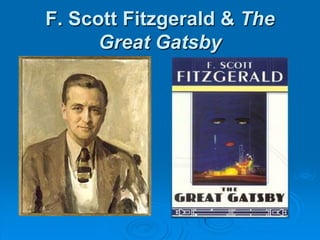
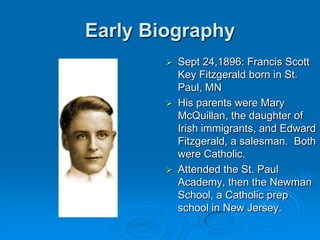
F. Scott Fitzgerald & The
Great Gatsby
Early Biography
 Sept 24,1896: Francis Scott
Key Fitzgerald born in St.
Paul, MN
 His parents were Mary
McQuillan, the daughter of
Irish immigrants, and Edward
Fitzgerald, a salesman. Both
were Catholic.
 Attended the St. Paul
Academy, then the Newman
School, a Catholic prep
school in New Jersey.
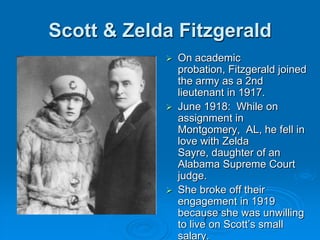
Scott & Zelda Fitzgerald
 On academic
probation, Fitzgerald joined
the army as a 2nd
lieutenant in 1917.
 June 1918: While on
assignment in
Montgomery, AL, he fell in
love with Zelda
Sayre, daughter of an
Alabama Supreme Court
judge.
 She broke off their
engagement in 1919
because she was unwilling
to live on Scott’s small
salary.
Literary Career Beginnings
 June 1919: Fitzgerald
returns to St. Paul, MN to
rewrite his novel, This
Side of Paradise.
 In the fall of that year, he
begins writing stories in
mass-circulation
magazines.
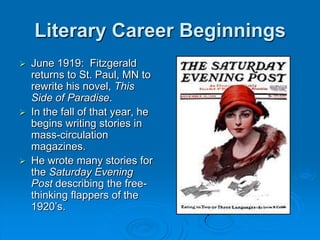
 He wrote many stories for
the Saturday Evening
Post describing the free-
thinking flappers of the
1920’s.
Overnight Fame
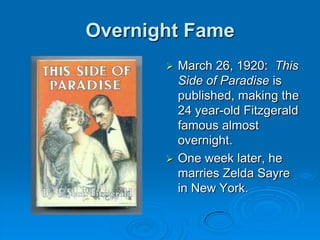
 March 26, 1920: This
Side of Paradise is
published, making the
24 year-old Fitzgerald
famous almost
overnight.
 One week later, he
marries Zelda Sayre
in New York.
Extravagant Living
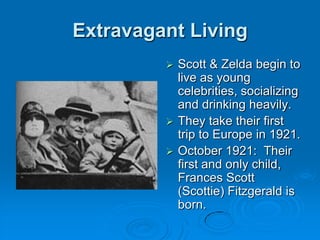
 Scott & Zelda begin to
live as young
celebrities, socializing
and drinking heavily.
 They take their first
trip to Europe in 1921.
 October 1921: Their
first and only child,
Frances Scott
(Scottie) Fitzgerald is
born.
Early Stumblings
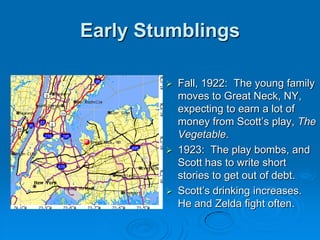
 Fall, 1922: The young family
moves to Great Neck, NY,
expecting to earn a lot of
money from Scott’s play, The
Vegetable.
 1923: The play bombs, and
Scott has to write short
stories to get out of debt.
 Scott’s drinking increases.
He and Zelda fight often.
Gatsby is Born
 Spring 1924: The
Fitzgeralds go to France.
 Summer 1924: Scott starts
writing The Great Gatsby.
Zelda has a relationship
with a French pilot.
 Winter 1924-25: The
Fitzgeralds go to Rome
where Scott revises Gatsby.
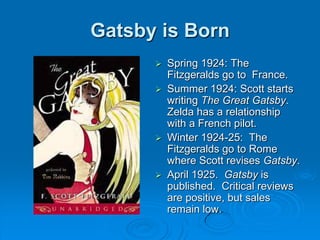
 April 1925. Gatsby is
published. Critical reviews
are positive, but sales
remain low.
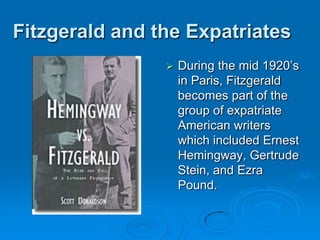
Fitzgerald and the Expatriates
 During the mid 1920’s
in Paris, Fitzgerald
becomes part of the
group of expatriate
American writers
which included Ernest
Hemingway, Gertrude
Stein, and Ezra
Pound.
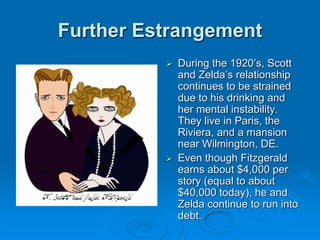
Further Estrangement
 During the 1920’s, Scott
and Zelda’s relationship
continues to be strained
due to his drinking and
her mental instability.
They live in Paris, the
Riviera, and a mansion
near Wilmington, DE.
 Even though Fitzgerald
earns about $4,000 per
story (equal to about
$40,000 today), he and
Zelda continue to run into
debt.
1930’s
 The Fitzgeralds rent a
house in Montgomery, AL
in 1931. Scott makes an
unsuccessful trip to
Hollywood; Zelda suffers
a mental breakdown in
1932 and is hospitalized.
 1936-37: Scott
drinks, gets into more
debt, and lives in hotels
near Asheville, NC. Zelda
enters a nearby hospital.
The Last Years
 Summer 1937: Fitzgerald
goes to Hollywood with a
screenwriting contract
earning $1,000/ week.
 Despite earning $91,000
from MGM, he is unable
to save any money.
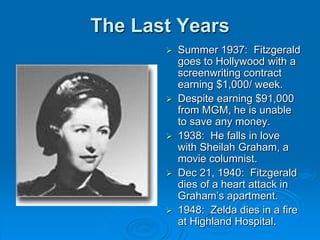
 1938: He falls in love
with Sheilah Graham, a
movie columnist.
 Dec 21, 1940: Fitzgerald
dies of a heart attack in
Graham’s apartment.
 1948: Zelda dies in a fire
at Highland Hospital.
Fitzgerald’s Death
“On December 21, 1940 -- the Winter Solstice -- the author F.
Scott Fitzgerald jolted to his feet from a green armchair, grasped hold
of a marble mantlepiece, and fell down dead of a massive heart attack.
He was forty-four years old. His woman companion of three-and-a
half years ran out into the hallway and began knocking frantically on
doors of their small Hollywood apartment building on Laurel Avenue,
just south of Sunset Boulevard, crying desperately for help. She
refused to accept that Scott was dead, even later when the ambulance
came, and a fire engine also, and a fireman stood over the body and
shook his head.
The name of the woman was Sheilah Graham, Fitzgerald's last
heroine -- a young, pretty Hollywood newspaper columnist.”
--Robert Westbrook, son of Sheilah Graham
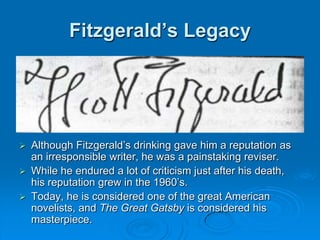
Fitzgerald’s Legacy
 Although Fitzgerald’s drinking gave him a reputation as
an irresponsible writer, he was a painstaking reviser.
 While he endured a lot of criticism just after his death,
his reputation grew in the 1960’s.
 Today, he is considered one of the great American
novelists, and The Great Gatsby is considered his
masterpiece.
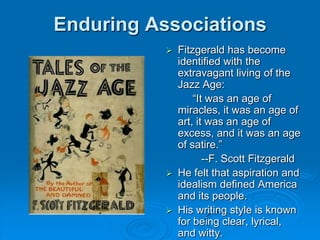
Enduring Associations
 Fitzgerald has become
identified with the
extravagant living of the
Jazz Age:
“It was an age of
miracles, it was an age of
art, it was an age of
excess, and it was an age
of satire.”
--F. Scott Fitzgerald
 He felt that aspiration and
idealism defined America
and its people.
 His writing style is known
for being clear, lyrical,
and witty.
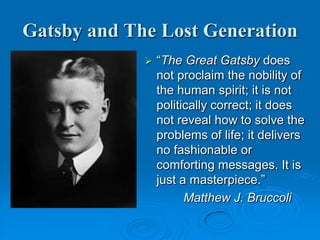
Gatsby and The Lost Generation
 “The Great Gatsby does
not proclaim the nobility of
the human spirit; it is not
politically correct; it does
not reveal how to solve the
problems of life; it delivers
no fashionable or
comforting messages. It is
just a masterpiece.”
Matthew J. Bruccoli
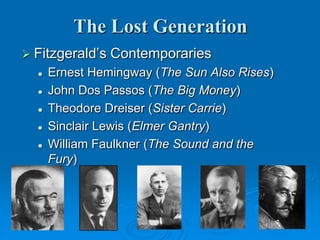
The Lost Generation
 Fitzgerald’s Contemporaries
 Ernest Hemingway (The Sun Also Rises)
 John Dos Passos (The Big Money)
 Theodore Dreiser (Sister Carrie)
 Sinclair Lewis (Elmer Gantry)
 William Faulkner (The Sound and the
Fury)
The Lost Generation
 Lived through horror of the “War to End All
Wars”
 Characterized by a deep rift with their elder
generation
 Fitzgerald’s generation felt an absolute break with
the standards and ideals with their elders
 Why?
The Lost Generation
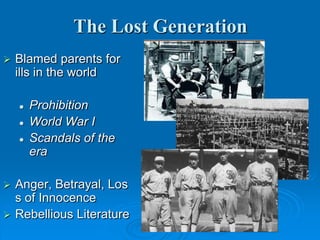
 Blamed parents for
ills in the world
 Prohibition
 World War I
 Scandals of the
era
 Anger, Betrayal, Los
s of Innocence
 Rebellious Literature
Conflicts
The Great Gatsby is built upon the
language of rebellion, of societal
challenge.
 East vs. West
 Reality vs. Illusion
 Haves vs. Have-nots
 Urban vs. Rural
 Knowledge vs. Ignorance
 Apathy vs. Action

F. Scott Fitzgerald Background Information

  • 1.
    F. Scott Fitzgerald& The Great Gatsby
  • 2.
    Early Biography  Sept24,1896: Francis Scott Key Fitzgerald born in St. Paul, MN  His parents were Mary McQuillan, the daughter of Irish immigrants, and Edward Fitzgerald, a salesman. Both were Catholic.  Attended the St. Paul Academy, then the Newman School, a Catholic prep school in New Jersey.
  • 3.
    Scott & ZeldaFitzgerald  On academic probation, Fitzgerald joined the army as a 2nd lieutenant in 1917.  June 1918: While on assignment in Montgomery, AL, he fell in love with Zelda Sayre, daughter of an Alabama Supreme Court judge.  She broke off their engagement in 1919 because she was unwilling to live on Scott’s small salary.
  • 4.
    Literary Career Beginnings June 1919: Fitzgerald returns to St. Paul, MN to rewrite his novel, This Side of Paradise.  In the fall of that year, he begins writing stories in mass-circulation magazines.  He wrote many stories for the Saturday Evening Post describing the free- thinking flappers of the 1920’s.
  • 5.
    Overnight Fame  March26, 1920: This Side of Paradise is published, making the 24 year-old Fitzgerald famous almost overnight.  One week later, he marries Zelda Sayre in New York.
  • 6.
    Extravagant Living  Scott& Zelda begin to live as young celebrities, socializing and drinking heavily.  They take their first trip to Europe in 1921.  October 1921: Their first and only child, Frances Scott (Scottie) Fitzgerald is born.
  • 7.
    Early Stumblings  Fall,1922: The young family moves to Great Neck, NY, expecting to earn a lot of money from Scott’s play, The Vegetable.  1923: The play bombs, and Scott has to write short stories to get out of debt.  Scott’s drinking increases. He and Zelda fight often.
  • 8.
    Gatsby is Born Spring 1924: The Fitzgeralds go to France.  Summer 1924: Scott starts writing The Great Gatsby. Zelda has a relationship with a French pilot.  Winter 1924-25: The Fitzgeralds go to Rome where Scott revises Gatsby.  April 1925. Gatsby is published. Critical reviews are positive, but sales remain low.
  • 9.
    Fitzgerald and theExpatriates  During the mid 1920’s in Paris, Fitzgerald becomes part of the group of expatriate American writers which included Ernest Hemingway, Gertrude Stein, and Ezra Pound.
  • 10.
    Further Estrangement  Duringthe 1920’s, Scott and Zelda’s relationship continues to be strained due to his drinking and her mental instability. They live in Paris, the Riviera, and a mansion near Wilmington, DE.  Even though Fitzgerald earns about $4,000 per story (equal to about $40,000 today), he and Zelda continue to run into debt.
  • 11.
    1930’s  The Fitzgeraldsrent a house in Montgomery, AL in 1931. Scott makes an unsuccessful trip to Hollywood; Zelda suffers a mental breakdown in 1932 and is hospitalized.  1936-37: Scott drinks, gets into more debt, and lives in hotels near Asheville, NC. Zelda enters a nearby hospital.
  • 12.
    The Last Years Summer 1937: Fitzgerald goes to Hollywood with a screenwriting contract earning $1,000/ week.  Despite earning $91,000 from MGM, he is unable to save any money.  1938: He falls in love with Sheilah Graham, a movie columnist.  Dec 21, 1940: Fitzgerald dies of a heart attack in Graham’s apartment.  1948: Zelda dies in a fire at Highland Hospital.
  • 13.
    Fitzgerald’s Death “On December21, 1940 -- the Winter Solstice -- the author F. Scott Fitzgerald jolted to his feet from a green armchair, grasped hold of a marble mantlepiece, and fell down dead of a massive heart attack. He was forty-four years old. His woman companion of three-and-a half years ran out into the hallway and began knocking frantically on doors of their small Hollywood apartment building on Laurel Avenue, just south of Sunset Boulevard, crying desperately for help. She refused to accept that Scott was dead, even later when the ambulance came, and a fire engine also, and a fireman stood over the body and shook his head. The name of the woman was Sheilah Graham, Fitzgerald's last heroine -- a young, pretty Hollywood newspaper columnist.” --Robert Westbrook, son of Sheilah Graham
  • 14.
    Fitzgerald’s Legacy  AlthoughFitzgerald’s drinking gave him a reputation as an irresponsible writer, he was a painstaking reviser.  While he endured a lot of criticism just after his death, his reputation grew in the 1960’s.  Today, he is considered one of the great American novelists, and The Great Gatsby is considered his masterpiece.
  • 15.
    Enduring Associations  Fitzgeraldhas become identified with the extravagant living of the Jazz Age: “It was an age of miracles, it was an age of art, it was an age of excess, and it was an age of satire.” --F. Scott Fitzgerald  He felt that aspiration and idealism defined America and its people.  His writing style is known for being clear, lyrical, and witty.
  • 16.
    Gatsby and TheLost Generation  “The Great Gatsby does not proclaim the nobility of the human spirit; it is not politically correct; it does not reveal how to solve the problems of life; it delivers no fashionable or comforting messages. It is just a masterpiece.” Matthew J. Bruccoli
  • 17.
    The Lost Generation Fitzgerald’s Contemporaries  Ernest Hemingway (The Sun Also Rises)  John Dos Passos (The Big Money)  Theodore Dreiser (Sister Carrie)  Sinclair Lewis (Elmer Gantry)  William Faulkner (The Sound and the Fury)
  • 18.
    The Lost Generation Lived through horror of the “War to End All Wars”  Characterized by a deep rift with their elder generation  Fitzgerald’s generation felt an absolute break with the standards and ideals with their elders  Why?
  • 19.
    The Lost Generation Blamed parents for ills in the world  Prohibition  World War I  Scandals of the era  Anger, Betrayal, Los s of Innocence  Rebellious Literature
  • 20.
    Conflicts The Great Gatsbyis built upon the language of rebellion, of societal challenge.  East vs. West  Reality vs. Illusion  Haves vs. Have-nots  Urban vs. Rural  Knowledge vs. Ignorance  Apathy vs. Action