The Life andTimes of
F. Scott Fitzgerald:
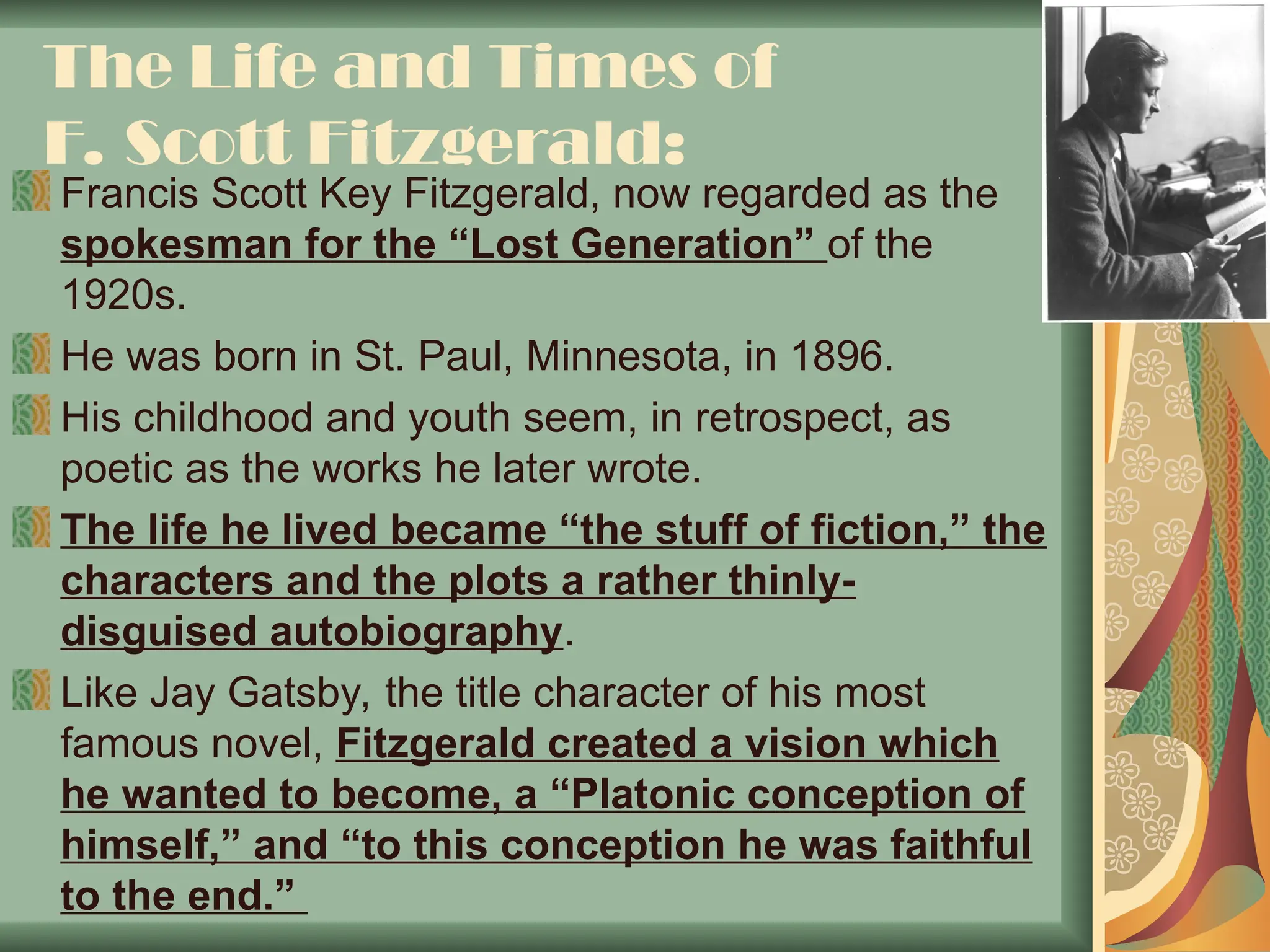
Francis Scott Key Fitzgerald, now regarded as the
spokesman for the “Lost Generation” of the
1920s.
He was born in St. Paul, Minnesota, in 1896.
His childhood and youth seem, in retrospect, as
poetic as the works he later wrote.
The life he lived became “the stuff of fiction,” the
characters and the plots a rather thinly-
disguised autobiography.
Like Jay Gatsby, the title character of his most
famous novel, Fitzgerald created a vision which
he wanted to become, a “Platonic conception of
himself,” and “to this conception he was faithful
to the end.”
3.
The Life andTimes of
F. Scott Fitzgerald:
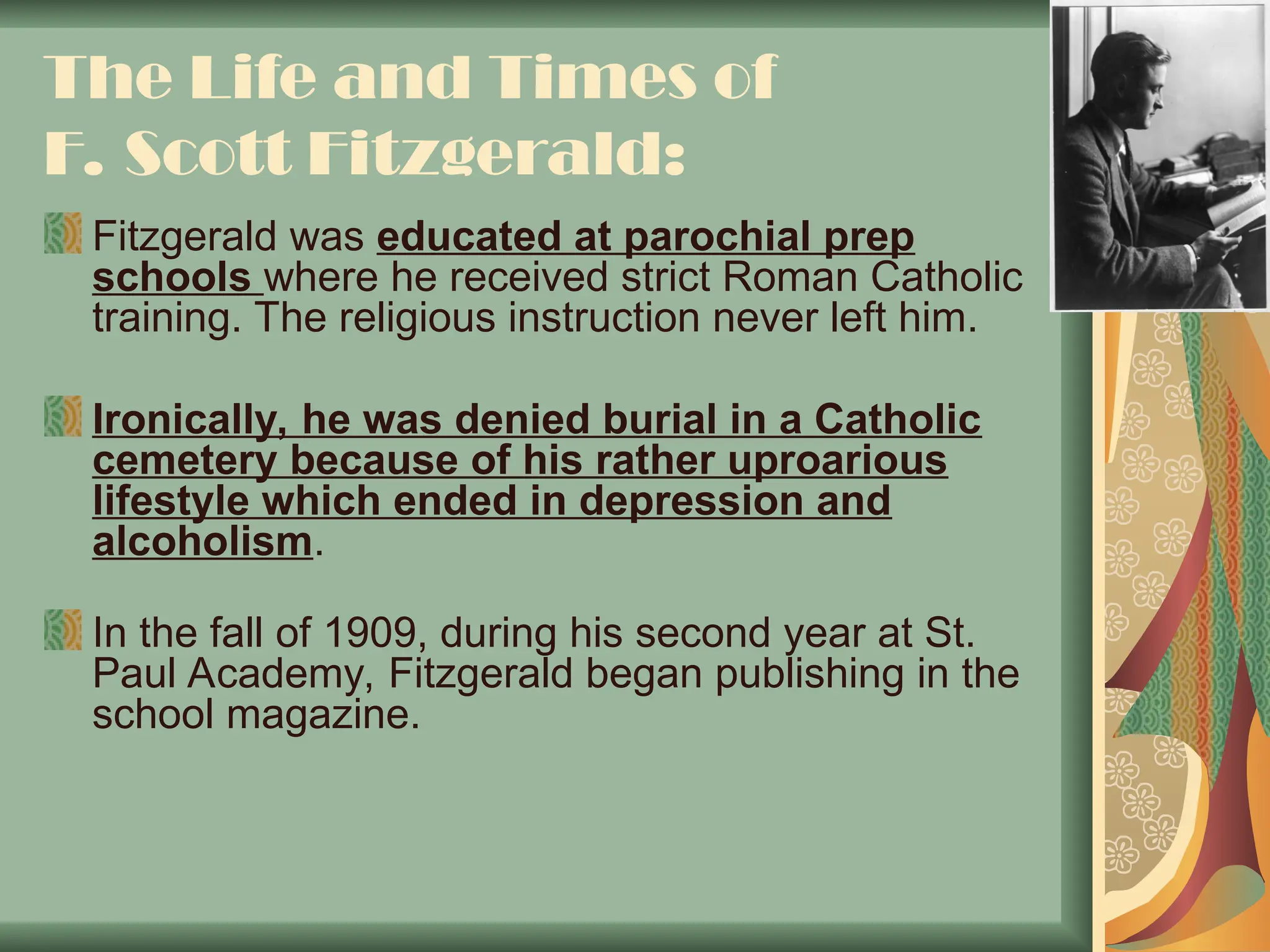
Fitzgerald was educated at parochial prep
schools where he received strict Roman Catholic
training. The religious instruction never left him.
Ironically, he was denied burial in a Catholic
cemetery because of his rather uproarious
lifestyle which ended in depression and
alcoholism.
In the fall of 1909, during his second year at St.
Paul Academy, Fitzgerald began publishing in the
school magazine.
4.
The Life andTimes of
F. Scott Fitzgerald:
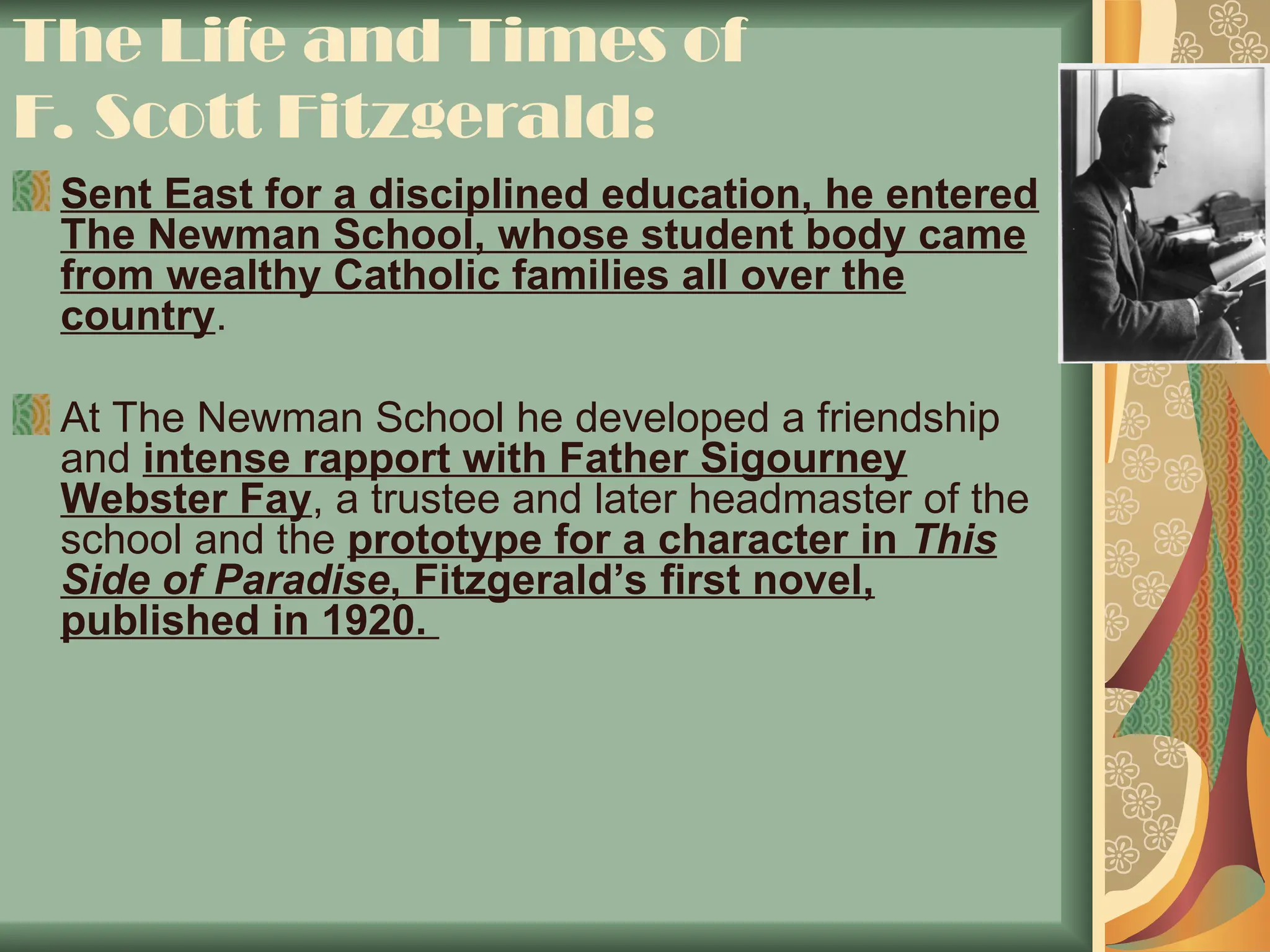
Sent East for a disciplined education, he entered
The Newman School, whose student body came
from wealthy Catholic families all over the
country.
At The Newman School he developed a friendship
and intense rapport with Father Sigourney
Webster Fay, a trustee and later headmaster of the
school and the prototype for a character in This
Side of Paradise, Fitzgerald’s first novel,
published in 1920.
5.
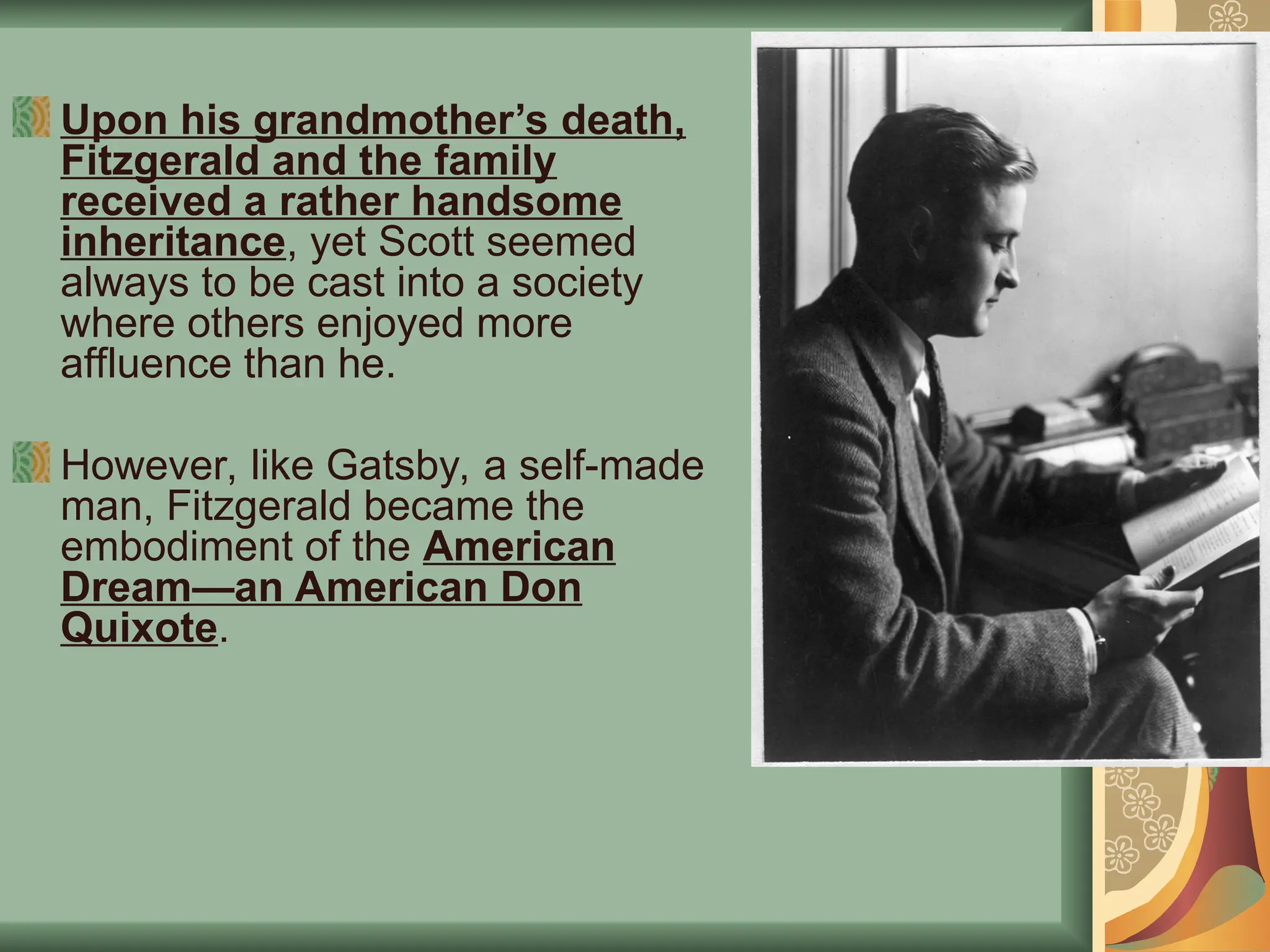
Upon his grandmother’sdeath,
Fitzgerald and the family
received a rather handsome
inheritance, yet Scott seemed
always to be cast into a society
where others enjoyed more
affluence than he.
However, like Gatsby, a self-made
man, Fitzgerald became the
embodiment of the American
Dream—an American Don
Quixote.
6.
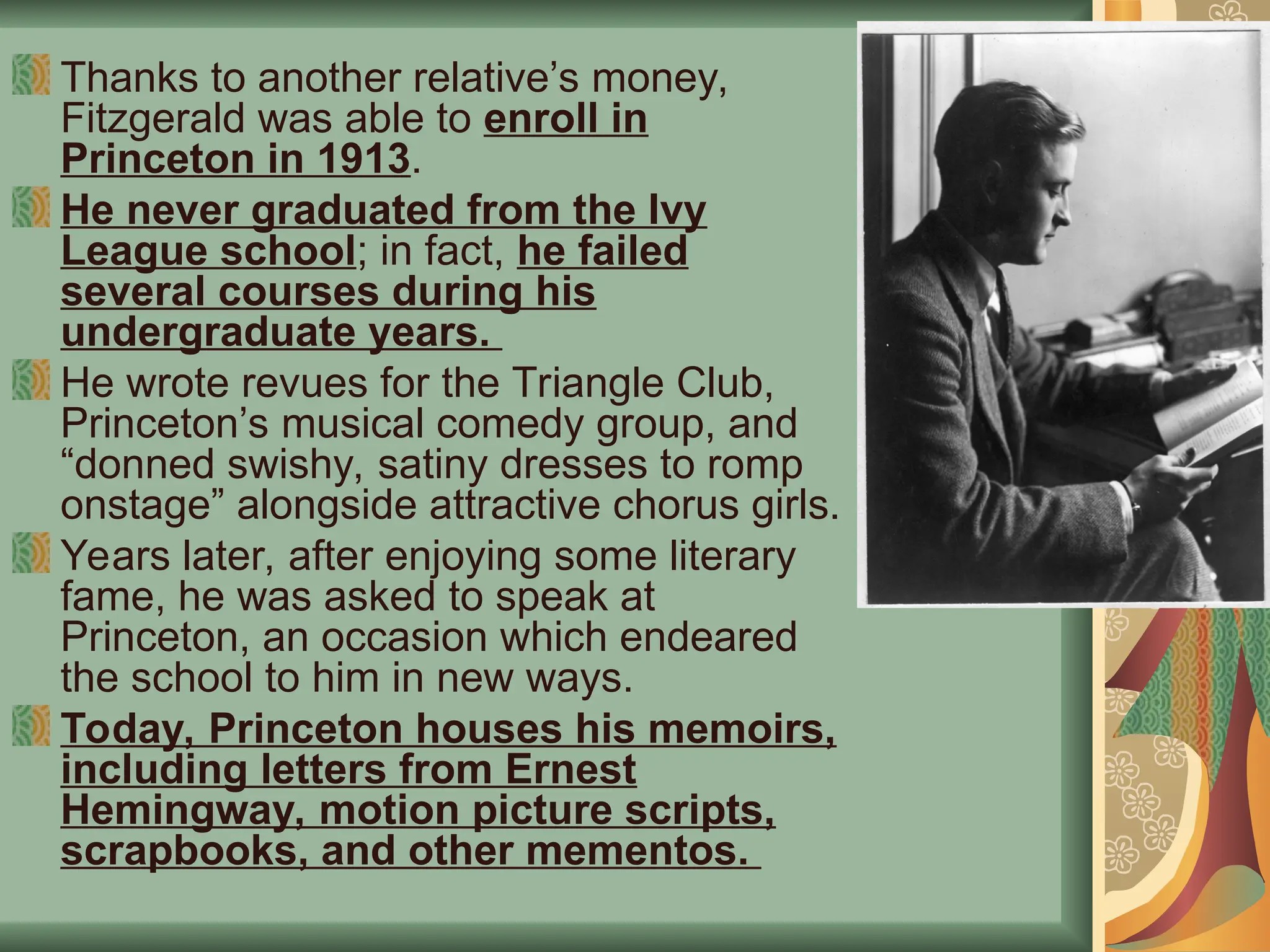
Thanks to anotherrelative’s money,
Fitzgerald was able to enroll in
Princeton in 1913.
He never graduated from the Ivy
League school; in fact, he failed
several courses during his
undergraduate years.
He wrote revues for the Triangle Club,
Princeton’s musical comedy group, and
“donned swishy, satiny dresses to romp
onstage” alongside attractive chorus girls.
Years later, after enjoying some literary
fame, he was asked to speak at
Princeton, an occasion which endeared
the school to him in new ways.
Today, Princeton houses his memoirs,
including letters from Ernest
Hemingway, motion picture scripts,
scrapbooks, and other mementos.
7.
He withdrew from
Princetonand
entered the war in
1917, commissioned
a second lieutenant
in the army.
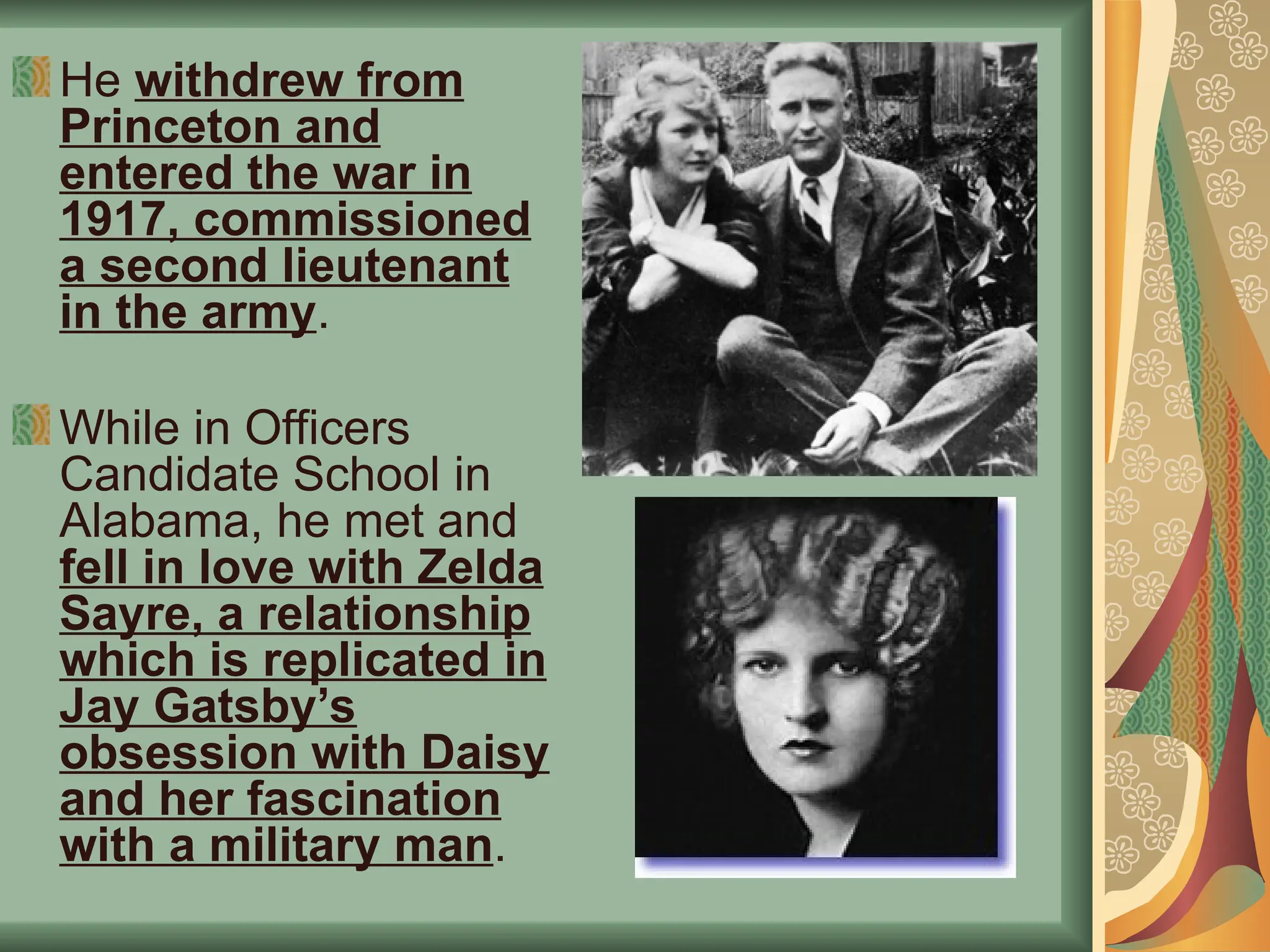
While in Officers
Candidate School in
Alabama, he met and
fell in love with Zelda
Sayre, a relationship
which is replicated in
Jay Gatsby’s
obsession with Daisy
and her fascination
with a military man.
8.
He never madeit to the European front,
but he did come to the attention of New
York publishers by the end of the war.
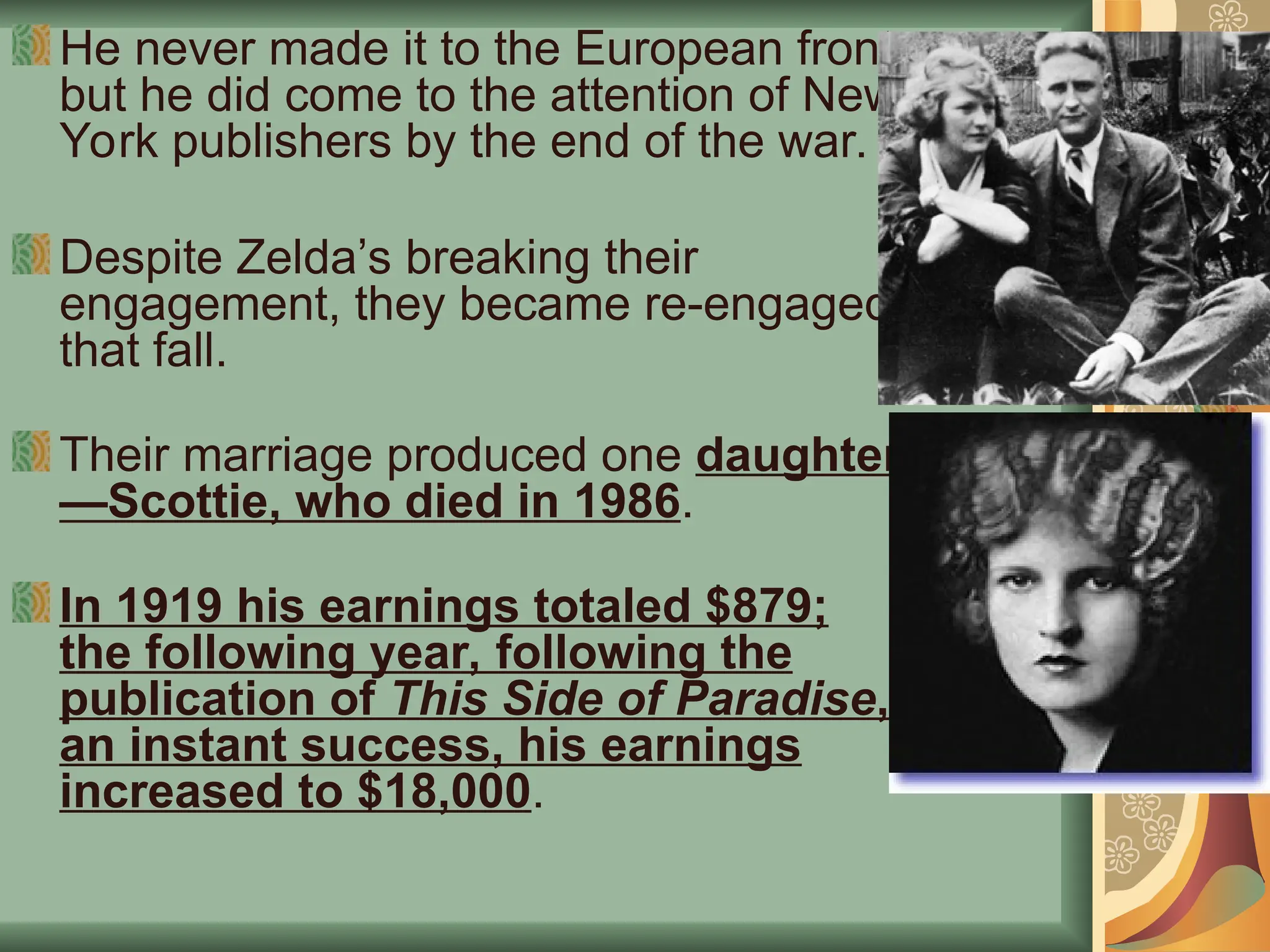
Despite Zelda’s breaking their
engagement, they became re-engaged
that fall.
Their marriage produced one daughter
—Scottie, who died in 1986.
In 1919 his earnings totaled $879;
the following year, following the
publication of This Side of Paradise,
an instant success, his earnings
increased to $18,000.
9.
By 1924 itwas clear that Fitzgerald needed a
change.
He, Zelda, and Scottie moved to Europe, near
the French Riviera, where he first met Ernest
Hemingway, Gertrude Stein, and Edith Wharton.
Before long, Zelda met and had an affair with
Edouard Josanne, a relationship which
Fitzgerald at first ignored but ultimately forced
to a showdown.
**His writing may have profited because of her
affair—according to biographer Andrew
Turnbull, Fitzgerald’s jealousy “sharpened the
edge of Gatsby’s and gave weight to Tom
Buchanan’s bullish determination to regain his
wife.”
10.
To increase earningshe wrote some 160
short stories for magazines, works
which, by his own admission, lacked
luster.
After Zelda’s alcoholism had several
times forced her commitment to an
institution, Scott went to Hollywood to
write screenplays, and struggled
unsuccessfully to complete a final novel,
The Last Tycoon.
He died in December of 1940 after a
lifelong battle with alcohol and a series
of heart attacks.
11.
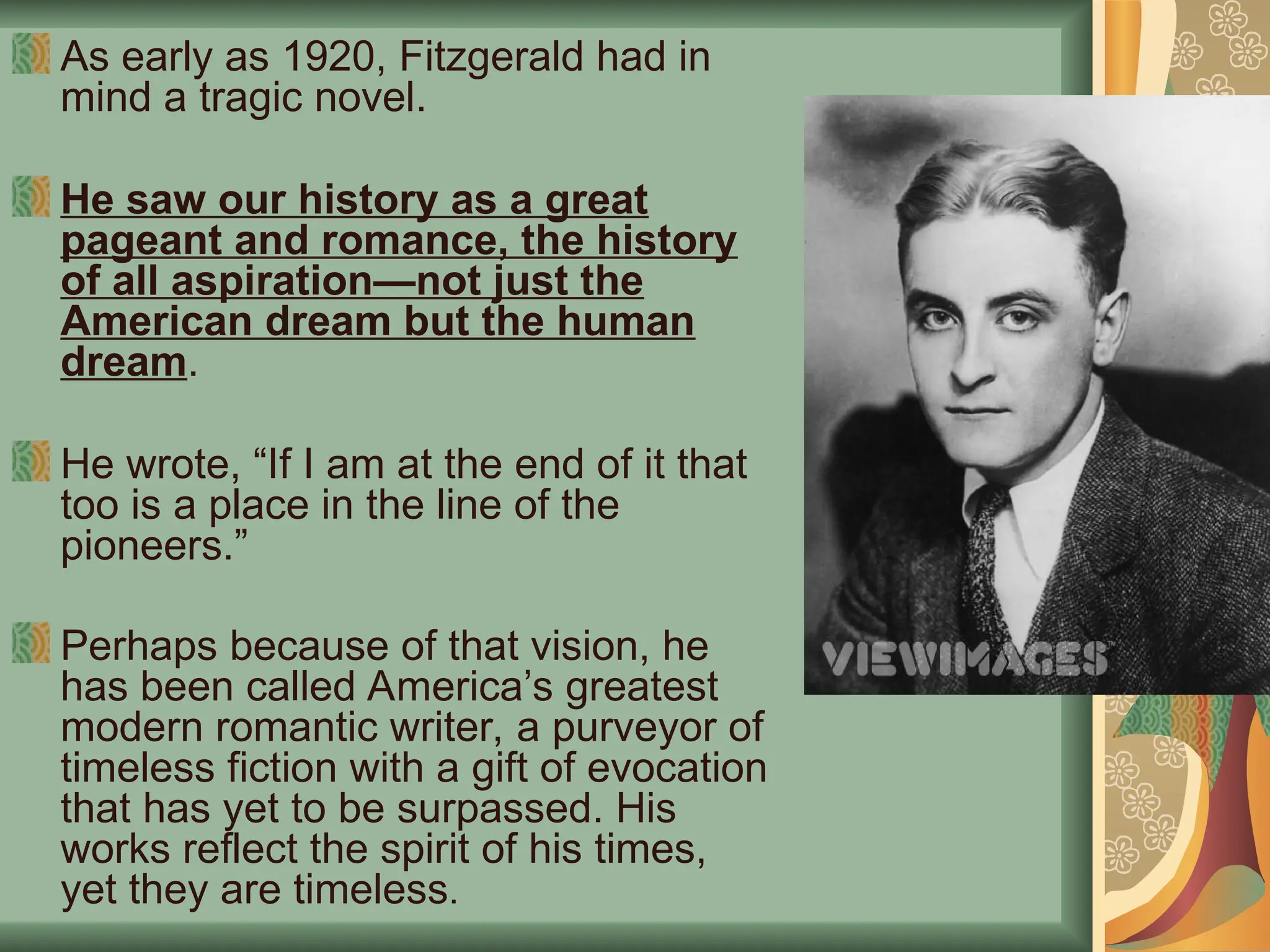
As early as1920, Fitzgerald had in
mind a tragic novel.
He saw our history as a great
pageant and romance, the history
of all aspiration—not just the
American dream but the human
dream.
He wrote, “If I am at the end of it that
too is a place in the line of the
pioneers.”
Perhaps because of that vision, he
has been called America’s greatest
modern romantic writer, a purveyor of
timeless fiction with a gift of evocation
that has yet to be surpassed. His
works reflect the spirit of his times,
yet they are timeless.
12.
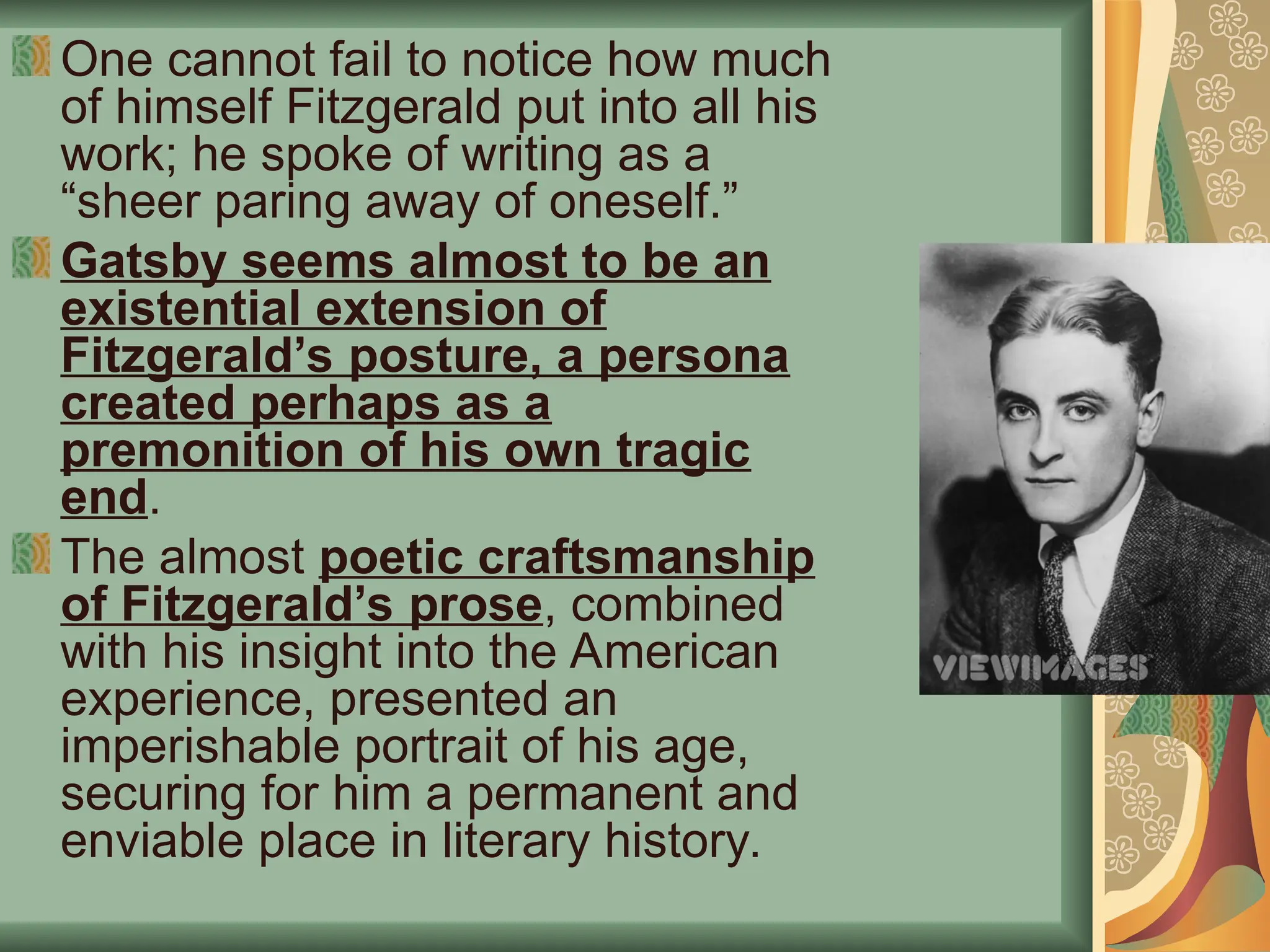
One cannot failto notice how much
of himself Fitzgerald put into all his
work; he spoke of writing as a
“sheer paring away of oneself.”
Gatsby seems almost to be an
existential extension of
Fitzgerald’s posture, a persona
created perhaps as a
premonition of his own tragic
end.
The almost poetic craftsmanship
of Fitzgerald’s prose, combined
with his insight into the American
experience, presented an
imperishable portrait of his age,
securing for him a permanent and
enviable place in literary history.
13.
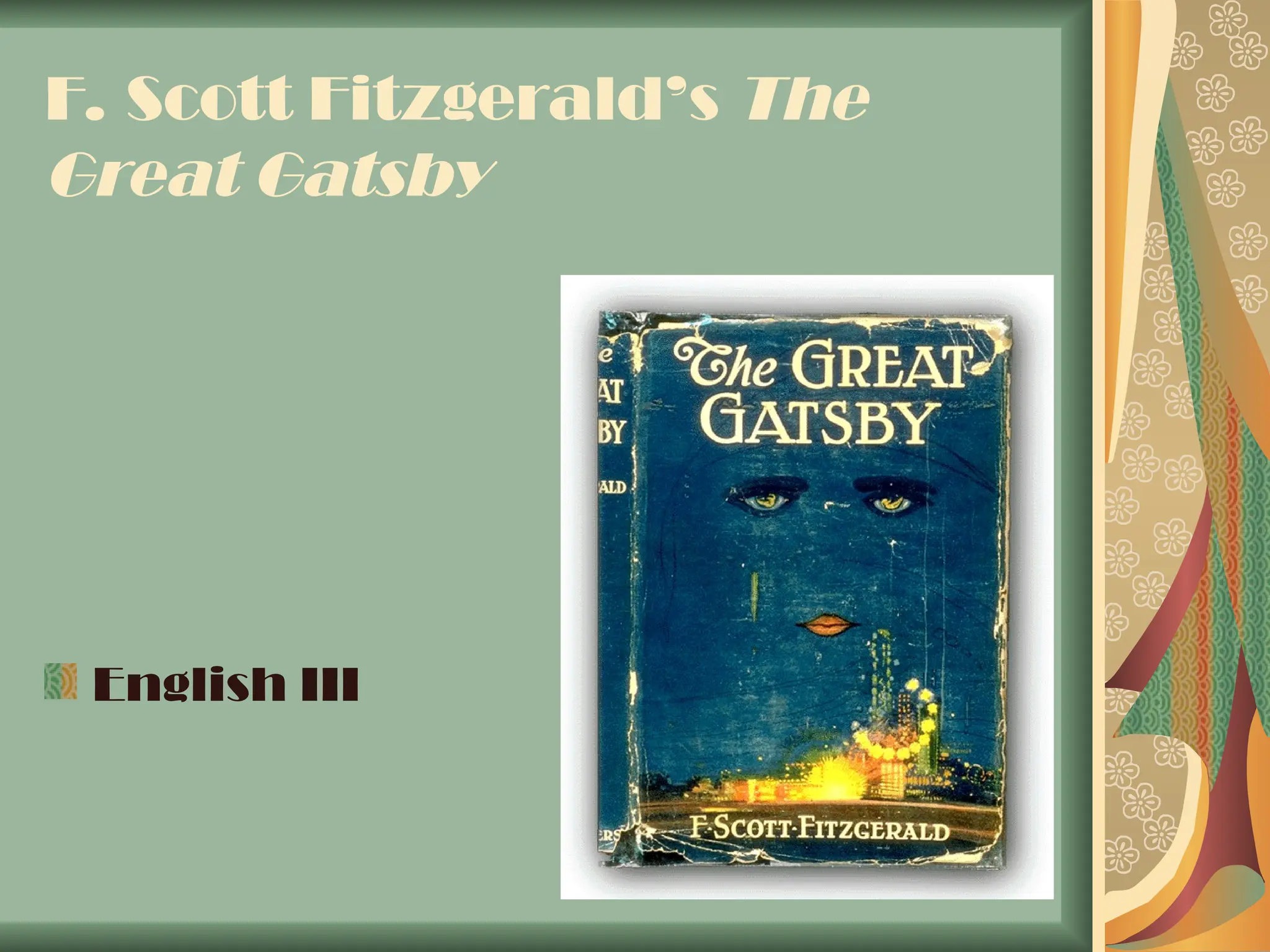
5. Introduction toThe Great
Gatsby:
In 1925, The Great Gatsby was published and hailed as an
artistic and material success for its young author, F. Scott
Fitzgerald. It is considered a vastly more mature and
artistically masterful treatment of Fitzgerald's themes than
his earlier fiction. These works examine the results of the
Jazz Age generation's adherence to false material values.
In nine chapters, Fitzgerald presents the rise and fall of Jay
Gatsby, as related in a first-person narrative by Nick
Carraway. Carraway reveals the story of a farmer's son-
turned racketeer, named Jay Gatz. His ill-gotten wealth is
acquired solely to gain acceptance into the sophisticated,
moneyed world of the woman he loves, Daisy Fay
Buchanan. His romantic illusions about the power of money
to buy respectability and the love of Daisy—the "golden girl"
of his dreams—are skillfully and ironically interwoven with
episodes that depict what Fitzgerald viewed as the
callousness and moral irresponsibility of the affluent
American society of the 1920s.
14.
America at thistime experienced a cultural and lifestyle
revolution. In the economic arena, the stock market
boomed, the rich spent money on fabulous parties and
expensive acquisitions, the automobile became a
symbol of glamour and wealth, and profits were made,
both legally and illegally. The whirlwind pace of this
post-World War I era is captured in Fitzgerald's
Gatsby, whose tragic quest and violent death foretell
the collapse of that era and the onset of disillusionment
with the American dream.
By the end of the novel, the reader slowly realizes that
Carraway is transformed as he recognizes Gatsby's
moral superiority to the Buchanans. In fact, the triumph
of Gatsby's legacy is reached by Nick Carraway's
ruminations at the end of the book about Gatsby's
valiant, however futile, attempts to regain his past love.
15.
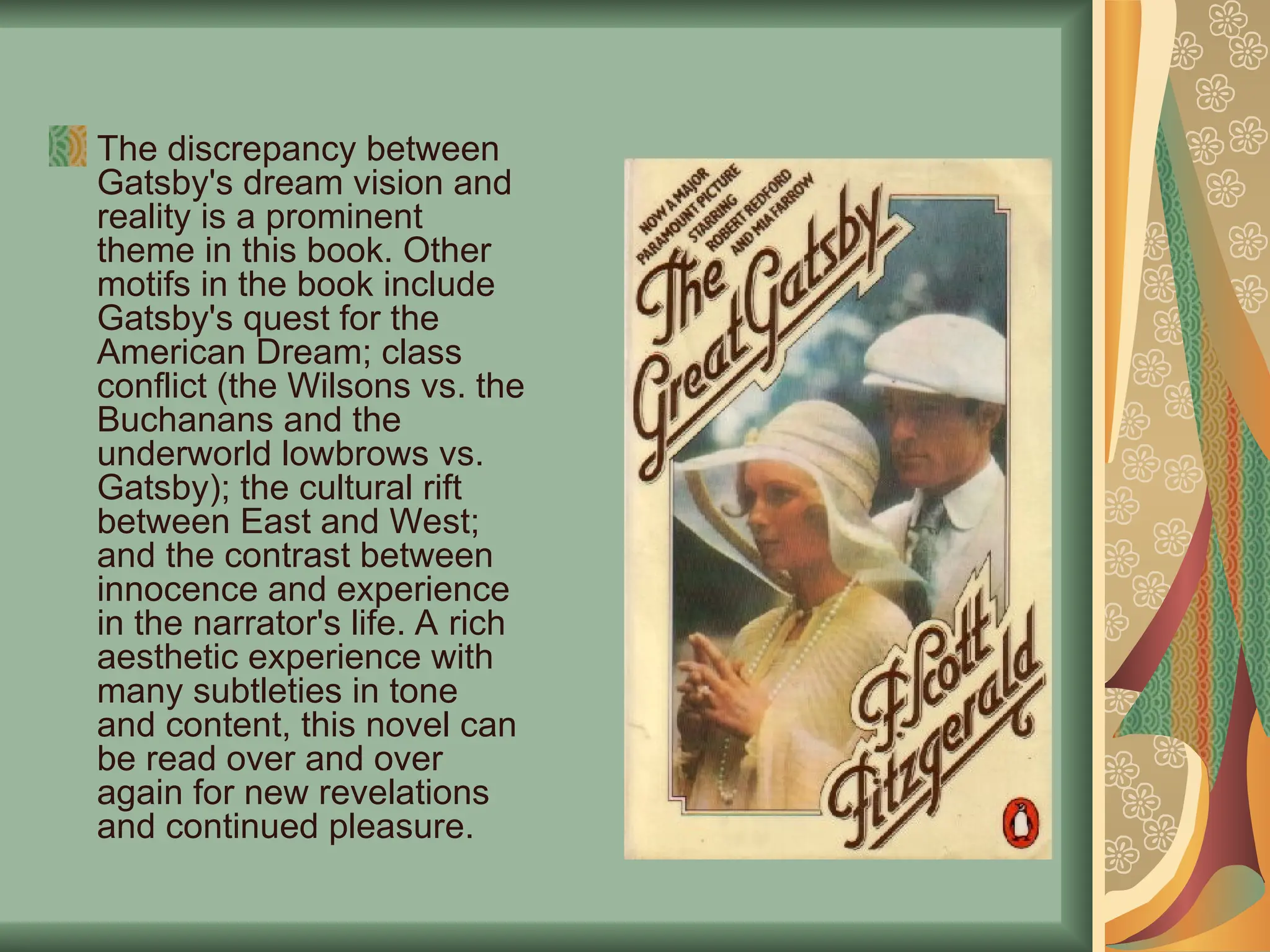
The discrepancy between
Gatsby'sdream vision and
reality is a prominent
theme in this book. Other
motifs in the book include
Gatsby's quest for the
American Dream; class
conflict (the Wilsons vs. the
Buchanans and the
underworld lowbrows vs.
Gatsby); the cultural rift
between East and West;
and the contrast between
innocence and experience
in the narrator's life. A rich
aesthetic experience with
many subtleties in tone
and content, this novel can
be read over and over
again for new revelations
and continued pleasure.
16.
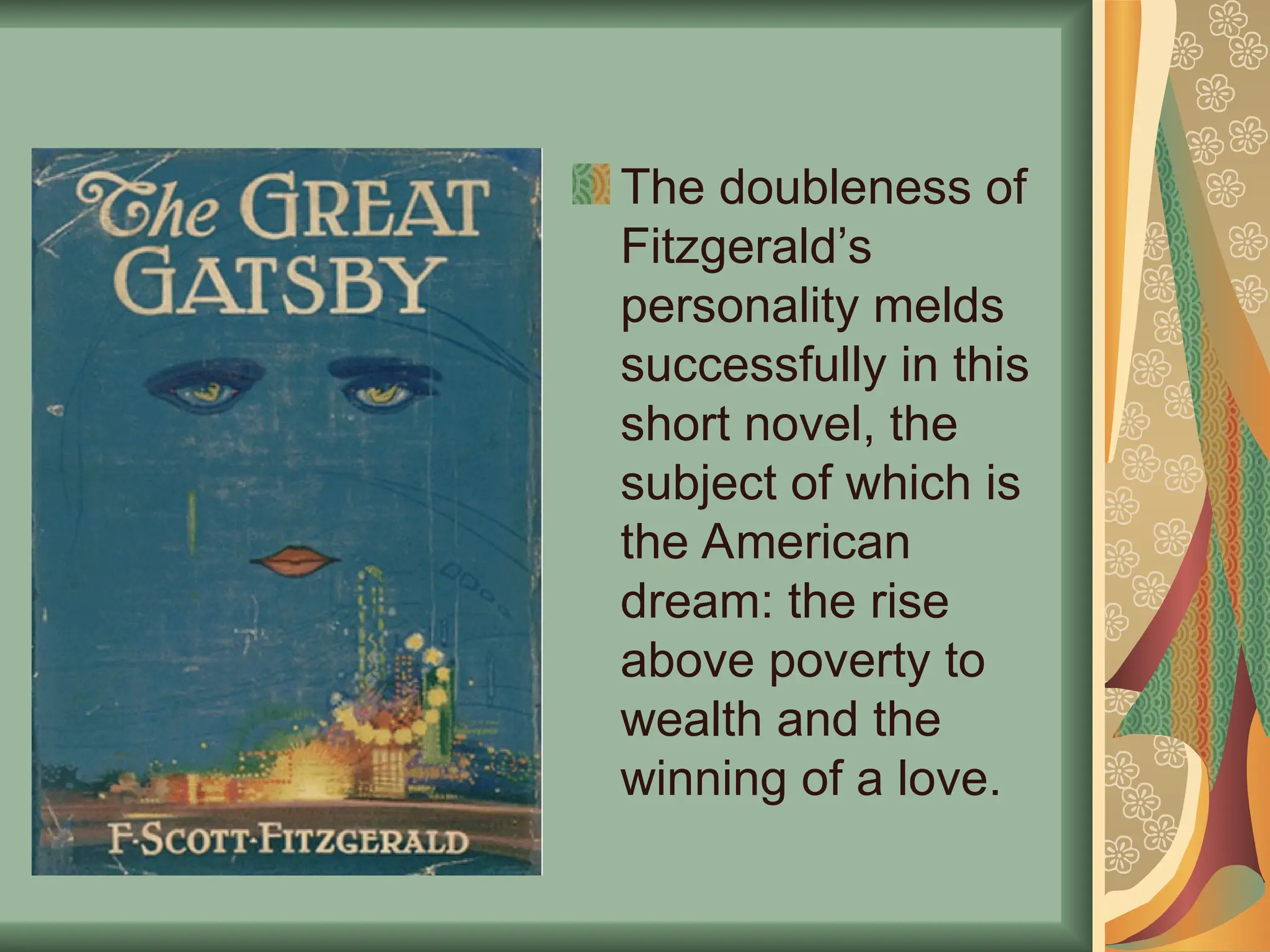
The doubleness of
Fitzgerald’s
personalitymelds
successfully in this
short novel, the
subject of which is
the American
dream: the rise
above poverty to
wealth and the
winning of a love.
17.
Nick Carraway, fromthe Midwest,
tells of coming east and meeting the
fabulously high-living and
mysteriously wealthy Jay Gatsby,
who is in love with Nick’s cousin,
Daisy Buchanan.
Ultimately, Nick leaves the East to
return to the Midwest. The book
closes with Nick’s mournful, ecstatic
meditation on America and its
promises.
18.
6. The AmericanDream and
The Great Gatsby:
The American Dream is the idea held by many in the United
States of America that through hard work, courage, and
determination one can achieve financial and personal
success. These were values held by many early European
settlers, and have been passed down to subsequent
generations.
What the American dream has become is a question under
constant discussion, and some believe that it has led to an
emphasis on material wealth as a measure of success
and/or happiness.
The American dream is a concept that permeates our culture
and unifies us all as Americans despite our racial, religious,
and socio-economic diversity. This dream also serves to
connect us to our nation’s historical past as well as to the
generations of the future.
19.
Origins of theAmerican
Dream:
European explorers and the Puritans—
Doctrine of Election and Predestination
The Declaration of Independence—life,
liberty, and the pursuit of happiness
American Revolutionary War—promise of
land ownership and investment
Industrial Revolution—possibility of anyone
achieving wealth & the nouveau riche
Individualism and self-reliance
Westward expansion and the Gold Rush
Immigration
20.
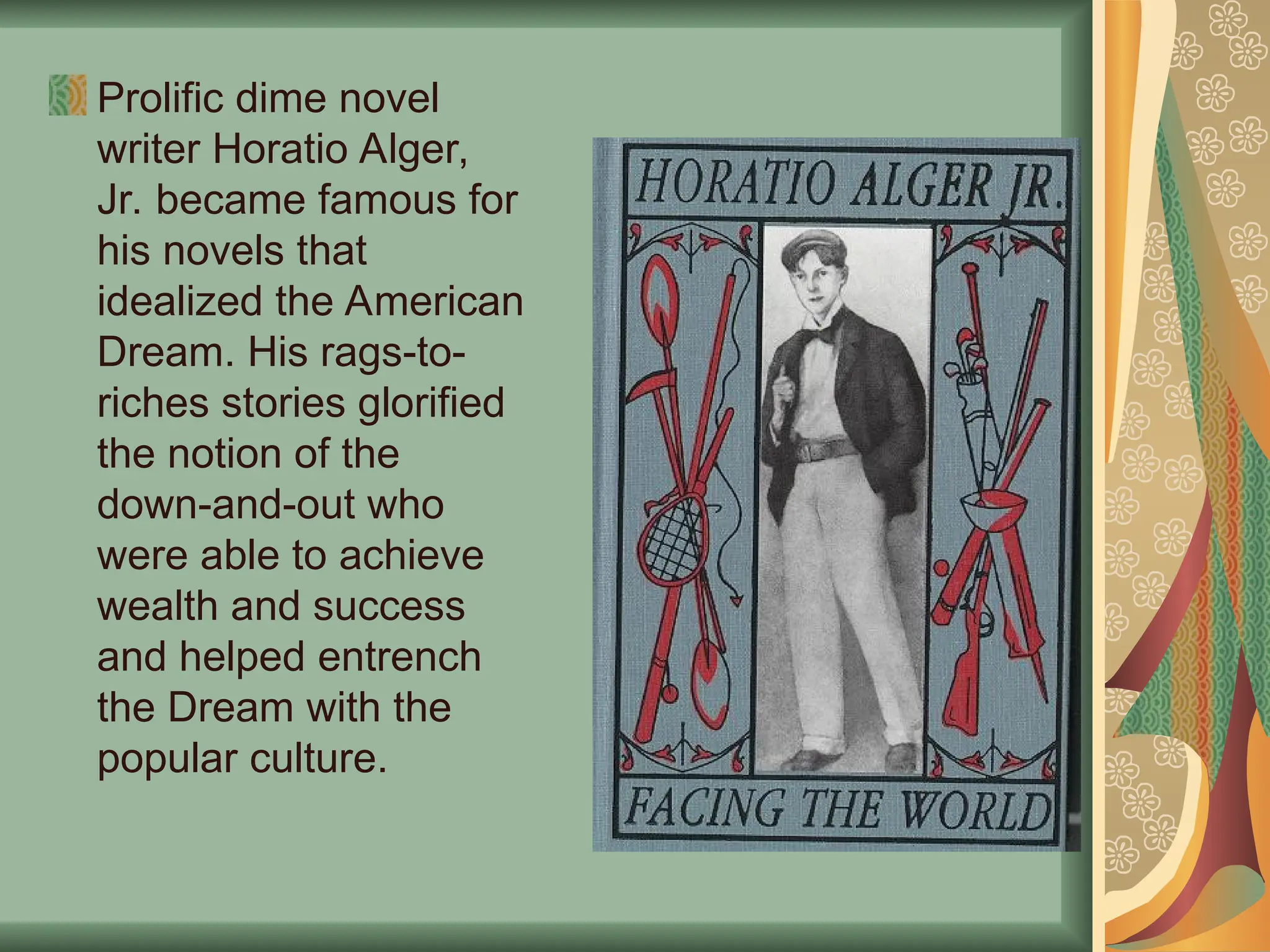
Prolific dime novel
writerHoratio Alger,
Jr. became famous for
his novels that
idealized the American
Dream. His rags-to-
riches stories glorified
the notion of the
down-and-out who
were able to achieve
wealth and success
and helped entrench
the Dream with the
popular culture.
21.
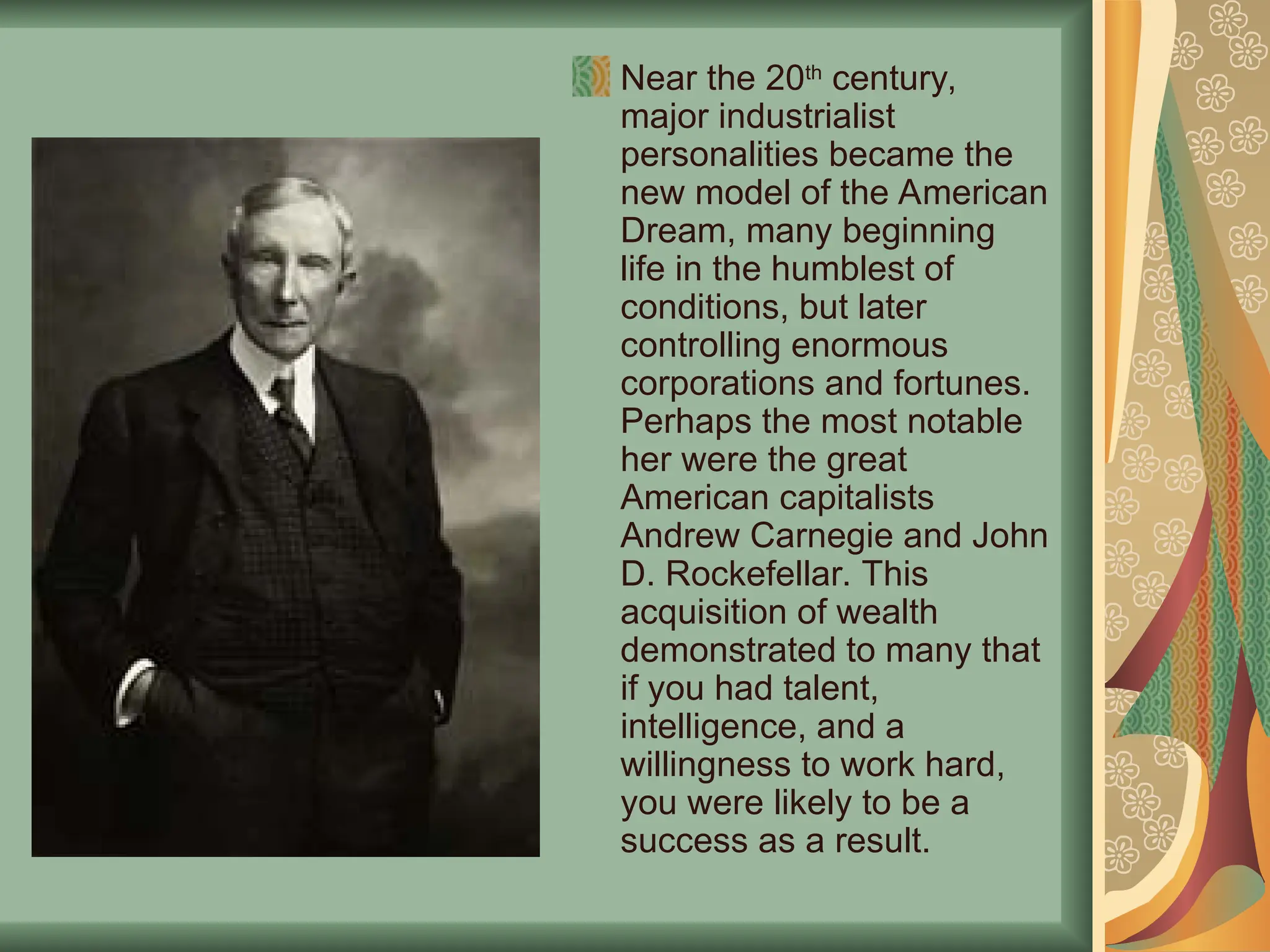
Near the 20th
century,
majorindustrialist
personalities became the
new model of the American
Dream, many beginning
life in the humblest of
conditions, but later
controlling enormous
corporations and fortunes.
Perhaps the most notable
her were the great
American capitalists
Andrew Carnegie and John
D. Rockefellar. This
acquisition of wealth
demonstrated to many that
if you had talent,
intelligence, and a
willingness to work hard,
you were likely to be a
success as a result.
22.
Whilst The GreatGatsby explores a number of themes, none is
more prevalent than that of the corruption of the American dream.
Gatsby appears to be the embodiment of this dream – he has risen
from being a poor farm boy with no prospects, to being rich, having
a big house, servants, and a large social circle attending his
numerous functions. He has achieved all this in only a few short
years, having returned from the war penniless.
However, Gatsby is never truly one of the elite – his dream is just a
façade.
However, Fitzgerald explores much more than the failure of the
American dream – he is more deeply concerned with its total
corruption. Gatsby has not achieved his wealth through honest hard
work, but through bootlegging and crime. His money is not simply
‘new’ money – it is dirty money, earned through dishonesty and
crime. His wealthy lifestyle is little more than a façade, as is the
whole person Jay Gatsby.
The society in which the novel takes place is one of moral
decadence. Whether their money is inherited or earned, its
inhabitant are morally decadent, living life in quest of cheap thrills
and with no seeming moral purpose to their lives. Any person who
attempts to move up through the social classes becomes corrupt in
the process.
23.
Like one ofHoratio Alger’s novels Gatsby is a self-
made man, springing from “his Platonic conception
of himself,” beholden to no one.
In the final pages of the novel, the sweep of
American history is alluded to in the landscape
itself, as Nick is about to leave Long Island. The
fresh, virginal country that “Dutch sailors” first saw
is evoked, reinforcing the magic of the American
promise. This promise has been tragically
betrayed. The ideals that give meaning to
American life are illusions, but Americans strive for
them anyway and doing so gives them tragic
grandeur.
Its form, its satisfying complexity, its deft selection
of detail, its great natural appeal, and its concision
make The Great Gatsby one of the definitive
statements of the American myth.
24.
7. Sources:
www.bookteacher.org (Thanks,Platt!)
Lathbury, Roger. American
Modernism (1910-1945). New York:
Facts on File, 2006.
Gay, Peter. Modernism: The Lure of
Heresy: From Baudelaire to Beckett
and Beyond. New York: W.W. Norton
& Co., Inc., 2008.



![Geografia y Geopolitica de Ã_frica (1-2-3) [Modo de compatibilidad].pdf](https://cdn.slidesharecdn.com/ss_thumbnails/geografiaygeopoliticadeafrica1-2-3mododecompatibilidad-251210123544-0ff2cdec-thumbnail.jpg?width=640&height=640&fit=bounds)


