F-Commerce


Selling on or through Facebook now has a
name: F-commerce.


The average Facebook user is connected to 130
Friends and 80 interest groups and makes his or her
preferences known through rich profiles and by
posting 90 pieces of content per month.

 Facebook users spend 700 billion minutes per

month in an active, relaxed environment where
word-of-mouth is built into every turn.
 The traffic, of course, also matters.
1. Facebook-Facilitated On-Site Selling


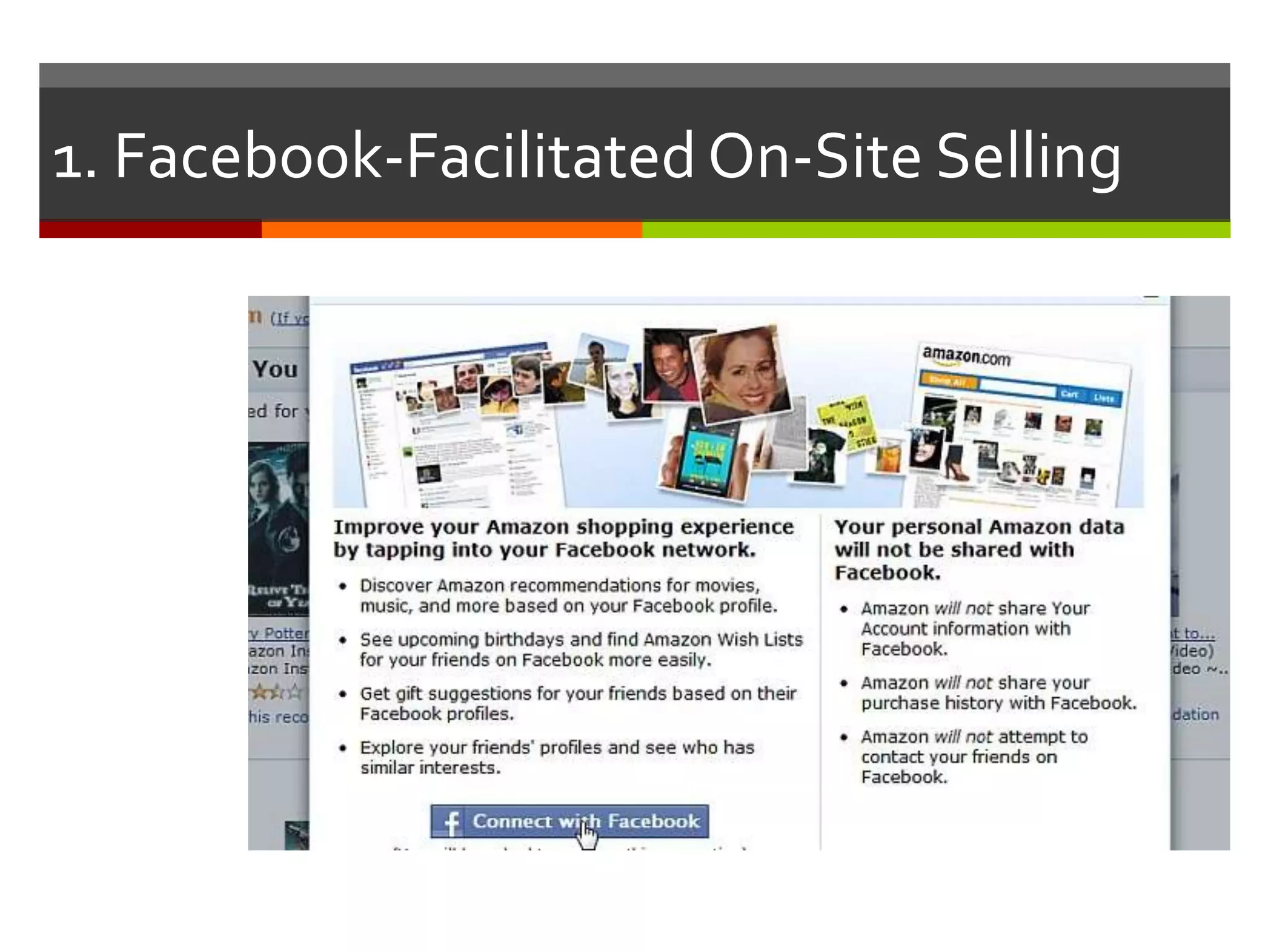
Brands can bring the Facebook experience to their websites,
tapping users' connections and interests to support the
purchasing process.



The simplest examples involve using social plugins — short
code snippets that ping Facebook’s network for information
about the user visiting the brand's site.



The Like Button is the most common plugin and is usually
regarded as a content sharing device, but when it is used in
conjunction with a product page it can provide peer support
by displaying the names and profile images of people who
have Liked the product — most appealing for brands is the
fact that it also highlights any of the user's Facebook friends
who have Liked the product.
2. Facebook-Initiated Selling
 Business accounts can set up a storefront for free

on their Facebook Pages, and many thousands have
already done so.
 The vast majority start the shopping process at

Facebook.com but then jump to their own
ecommerce pages at some point.
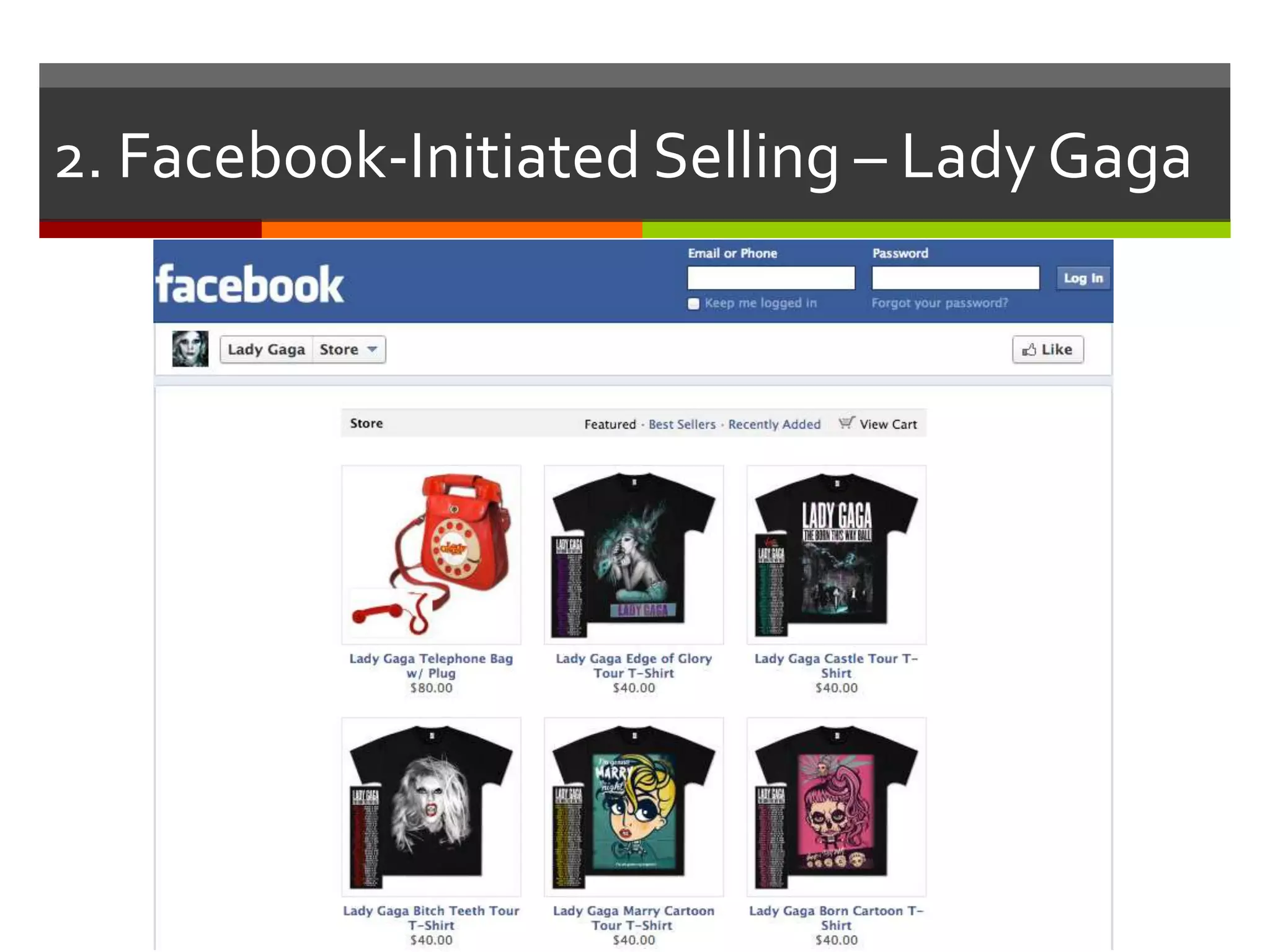
2. Facebook-Initiated Selling – Lady Gaga


Lady Gaga’s Facebook store is an example of a store that
takes users on a rather abrupt transition. Users can
browse products on her Facebook Page, but any click
takes them to the product page at bravadousa.com, a
licensed merchandise marketer and fulfillment service.
The Facebook branding is gone, and the look and feel
changes completely. A new window opens which would
make any Facebook multitasking (e.g., chat)
cumbersome. Apparently, a Page with over 30 million
Likes can get away with this — Justin Bieber has the
exact same arrangement.
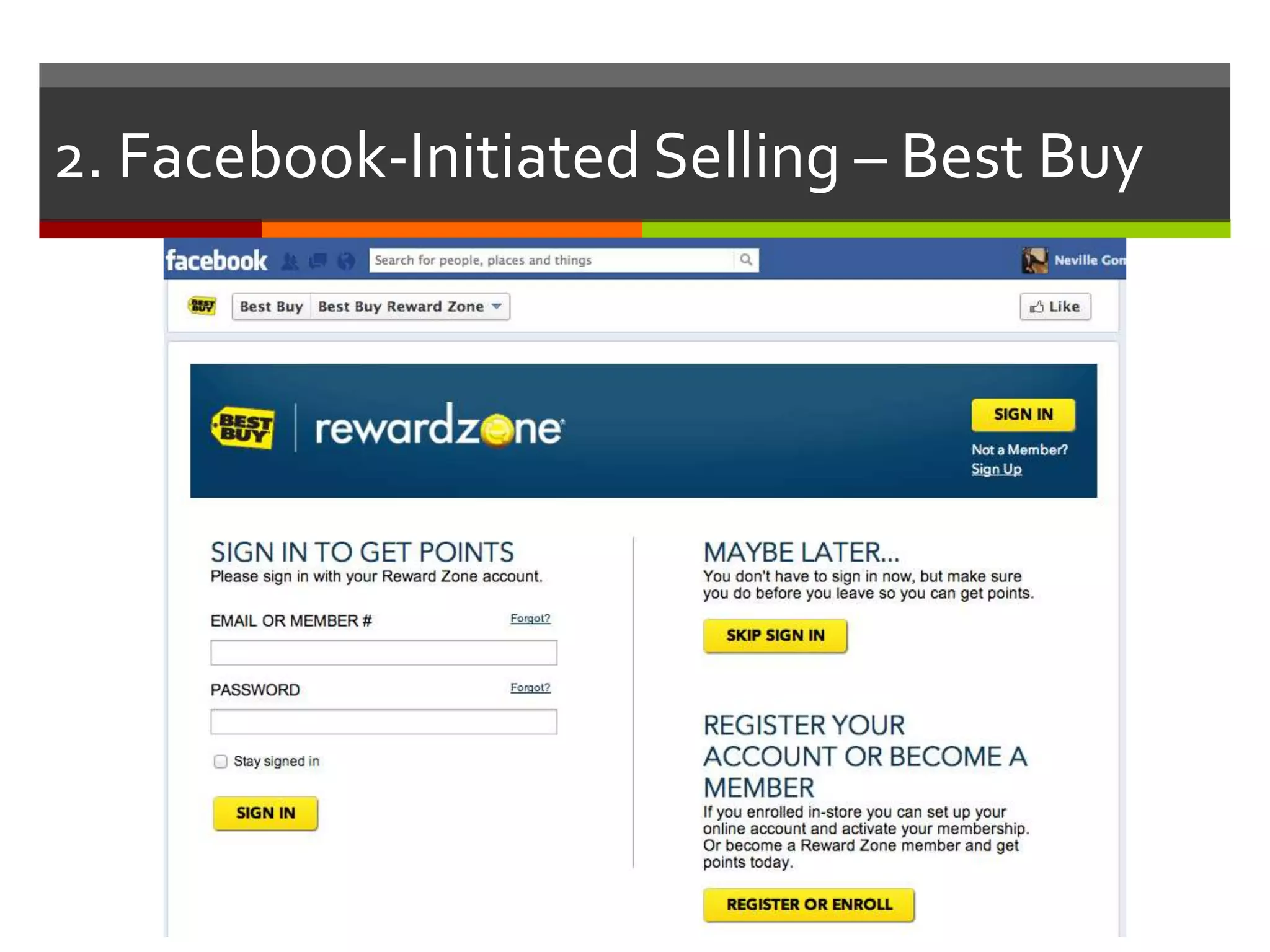
2. Facebook-Initiated Selling – Best Buy
iFrames vs. Facebook Apps
 There are two ways of displaying F-commerce Pages

on Facebook.com, each with its pluses and minuses.
 In February 2011, Facebook adopted iFrames as the

method that businesses use to supply custom
content to their Pages.
 In the simplest terms, iFrames allow a business to

create and host its own content and to display it in
the 520-pixel middle column of a Facebook Page.
iFrames vs. Facebook Apps


The advantage is simplicity, since businesses can create and
maintain the content on their own terms — iFrames tend to
offer the most seamless experiences for consumers.



1-800-Flowers and Delta do their selling via Facebook apps.
The primary advantage of going to an app is real estate.



iFrame content is restricted to the 520 pixel-wide middle Page
column, while an app can control the left most 760 pixels — a
46% increase in visible selling space.



The disadvantage of apps is that they are more difficult to
maintain and they may stress smaller budgets within
businesses lacking Facebook development expertise.

F commerce

  • 1.
  • 2.
    Selling on orthrough Facebook now has a name: F-commerce.  The average Facebook user is connected to 130 Friends and 80 interest groups and makes his or her preferences known through rich profiles and by posting 90 pieces of content per month.  Facebook users spend 700 billion minutes per month in an active, relaxed environment where word-of-mouth is built into every turn.  The traffic, of course, also matters.
  • 3.
  • 4.
    1. Facebook-Facilitated On-SiteSelling  Brands can bring the Facebook experience to their websites, tapping users' connections and interests to support the purchasing process.  The simplest examples involve using social plugins — short code snippets that ping Facebook’s network for information about the user visiting the brand's site.  The Like Button is the most common plugin and is usually regarded as a content sharing device, but when it is used in conjunction with a product page it can provide peer support by displaying the names and profile images of people who have Liked the product — most appealing for brands is the fact that it also highlights any of the user's Facebook friends who have Liked the product.
  • 5.
    2. Facebook-Initiated Selling Business accounts can set up a storefront for free on their Facebook Pages, and many thousands have already done so.  The vast majority start the shopping process at Facebook.com but then jump to their own ecommerce pages at some point.
  • 6.
  • 7.
    2. Facebook-Initiated Selling– Lady Gaga  Lady Gaga’s Facebook store is an example of a store that takes users on a rather abrupt transition. Users can browse products on her Facebook Page, but any click takes them to the product page at bravadousa.com, a licensed merchandise marketer and fulfillment service. The Facebook branding is gone, and the look and feel changes completely. A new window opens which would make any Facebook multitasking (e.g., chat) cumbersome. Apparently, a Page with over 30 million Likes can get away with this — Justin Bieber has the exact same arrangement.
  • 8.
  • 9.
    iFrames vs. FacebookApps  There are two ways of displaying F-commerce Pages on Facebook.com, each with its pluses and minuses.  In February 2011, Facebook adopted iFrames as the method that businesses use to supply custom content to their Pages.  In the simplest terms, iFrames allow a business to create and host its own content and to display it in the 520-pixel middle column of a Facebook Page.
  • 10.
    iFrames vs. FacebookApps  The advantage is simplicity, since businesses can create and maintain the content on their own terms — iFrames tend to offer the most seamless experiences for consumers.  1-800-Flowers and Delta do their selling via Facebook apps. The primary advantage of going to an app is real estate.  iFrame content is restricted to the 520 pixel-wide middle Page column, while an app can control the left most 760 pixels — a 46% increase in visible selling space.  The disadvantage of apps is that they are more difficult to maintain and they may stress smaller budgets within businesses lacking Facebook development expertise.