COLDFORGINGEXTRUSION
SOFTWARE
Supervised By
Prof. Dr. Abdallah Wifi
T.A. Mohamed Al-Mo’ayed
Prepared By Group One
Anton Tamer Shafique
Ayman Hisham Mahmoud
Sarah Hossam Marzouk
Mohamed Ahmed Morsy
Mohamed Ashraf Mohamed
Mahmoud Ahmed El-Sayed
Hager Ali Mahmoud Ali
B.N: 12
B.N: 13
B.N: 15
B.N: 23
B.N: 24
B.N: 28
B.N: 35
CAMF2
Contents
◉ Introduction
◉ Problem statement
◉ Overview
◉ Graphical User Interface
◉ Program Base Calculations
◉ Program Work Principal
◉ Hand Calculations(Idealized & Semi-Empirical), EXTRUCAD 4
and CAMF 2 Comparison
◉ Program Additional Feature
◉ Conclusion 2
Introduction
◉ Cold extrusion
○ Used in: Cans , collapsible tubes &
fire extinguishers
○ The first extrusion process for pipe
making was patented by Joseph
Bramah in 1797..
3
Introduction
◉ Importance of Computer Aided Metal Forming
■ Increasing level of automation.
■ Maintaining competitiveness.
■ Available for smaller factories, at a reasonable
price.
4
Problem Statement
A program that calculates the tonnage & force of a press
rapidly depending on product type & dimensions.
5
Based on the idealized calculations
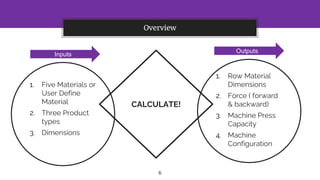
Overview
6
1. Row Material
Dimensions
2. Force ( forward
& backward)
3. Machine Press
Capacity
4. Machine
Configuration
CALCULATE!
Inputs
Outputs
1. Five Materials or
User Define
Material
2. Three Product
types
3. Dimensions
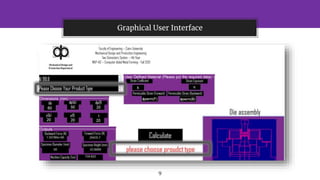
Graphical User Interface
Inputs
7
Product Dimension
Sketch
Graphical User Interface
Error massages
8
Calculated outputs
Suggested Die
Assembly Sketch
Graphical User Interface
9
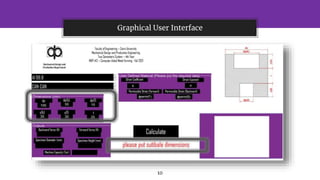
Graphical User Interface
10
Program Base Calculations
11
Forward Extrusion
• 𝑣 = 𝐶𝑎𝑙𝑐𝑢𝑙𝑎𝑡𝑒𝑑 𝑑𝑒𝑝𝑒𝑛𝑑𝑠 𝑜𝑛 𝑝𝑟𝑜𝑑𝑢𝑐𝑡 𝑠ℎ𝑎𝑝𝑒
• 𝜑𝑝 = 𝑙𝑛
𝐴𝑜
𝐴1
• 𝐾𝑠𝑡𝑟𝑚
=
𝐾𝜑𝑝
𝑛
𝑛+1
• 𝐹 =
𝐴𝑝𝐾𝑠𝑡𝑟𝑚𝜑𝑝
𝜂𝐹
Backward Extrusion (Thick)
•
𝐷𝑜
𝑆
≤ 10, 𝑆 =
𝐷𝑜−𝐷𝑝
2
• 𝑣 = 𝐶𝑎𝑙𝑐𝑢𝑙𝑎𝑡𝑒𝑑 𝑑𝑒𝑝𝑒𝑛𝑑𝑠 𝑜𝑛 𝑝𝑟𝑜𝑑𝑢𝑐𝑡 𝑠ℎ𝑎𝑝𝑒
• 𝜑𝑝 = 𝑙𝑛
𝐴𝑜
𝐴1
• 𝐾𝑠𝑡𝑟𝑚
=
𝐾𝜑𝑝
𝑛
𝑛+1
• 𝐹 =
𝐴𝑝𝐾𝑠𝑡𝑟𝑚𝜑𝑝
𝜂𝐹
𝜂𝐹 = 0.6 𝑤ℎ𝑒𝑛 𝜑𝑝 < 0.8
𝜂𝐹 = 0.7 𝑤ℎ𝑒𝑛 𝜑𝑝 > 0.8
𝜂𝐹 = 0.6 𝑤ℎ𝑒𝑛 𝜑𝑝 < 0.1
𝜂𝐹 = 0.7 𝑤ℎ𝑒𝑛 𝜑𝑝 > 0.1
𝑉𝐵𝑒𝑓𝑜𝑟𝑒 = 𝑉𝐴𝑓𝑡𝑒𝑟
Program Base Calculations
12
Backward Extrusion (Thin)
•
𝐷𝑜
𝑆
> 10, S =
𝐷𝑜−𝐷𝑝
2
• 𝑣 = 𝐶𝑎𝑙𝑐𝑢𝑙𝑎𝑡𝑒𝑑 𝑑𝑒𝑝𝑒𝑛𝑑𝑠 𝑜𝑛 𝑝𝑟𝑜𝑑𝑢𝑐𝑡 𝑠ℎ𝑎𝑝𝑒
• 𝜑𝑝 = 𝑙𝑛
𝐷𝑜
𝐷𝑜−𝑑
∗ 0.16
• 𝐹 =
𝐴𝑝𝐾𝑠𝑡𝑟𝑚
𝜂𝐹
(2 + 0.25
ℎ𝑜
𝑠
) 𝜂𝐹 = 0.6 𝑤ℎ𝑒𝑛 𝜑𝑝 < 0.1
𝜂𝐹 = 0.7 𝑤ℎ𝑒𝑛 𝜑𝑝 > 0.1
Program Work Principal
13
Strain Exponent
Strain Coefficient
Maximum Allowable Strains
CAN-CAN
ROD-ROD
CAN-ROD
Select or Define Material Select Product Type Set Suitable Dimensions
Thin or Thick
Backward
Extrusion
Calculate Strain
Select Efficiency
Calculate Row Material Dimensions
Program Work Principal
14
Part Drawing
Schematic Die Set
Proceed to Calculations
Depends on Extrusion Type
Calculate Mean Flow Stress
Calculate the Forces
Select the Maximum
Calculate Machine Capacity
Output Graphs
Hand Calculations(Idealized & Semi-Empirical),
EXTRUCAD 4 and CAMF 2 Comparison
15
For CAN-CAN Product
𝑑𝑜
60 𝑚𝑚
𝑑𝑝1
45 𝑚𝑚
𝑑𝑝2
45 𝑚𝑚
𝑦𝑏
35 𝑚𝑚
𝑡
10 𝑚𝑚
𝑦𝑓
35 𝑚𝑚
Hand Calculations
(Idealized)
𝑆𝑡𝑜𝑐𝑘 𝐷𝑖𝑎𝑚𝑒𝑡𝑒𝑟 = 60 𝑚𝑚
𝑆𝑡𝑜𝑐𝑘 𝐻𝑖𝑔ℎ𝑡 = 40.62 𝑚𝑚
𝐹(𝐹𝑜𝑟𝑤𝑎𝑟𝑑) = 1097334.4 𝑁
𝐹(𝐵𝑎𝑐𝑘𝑤𝑎𝑟𝑑) = 257915.6 𝑁
𝑀𝑎𝑐ℎ𝑖𝑛𝑒 𝐶𝑎𝑝𝑎𝑐𝑖𝑡𝑦 = 111.85 𝑇𝑜𝑛𝑠
16
CAMF 2
𝑆𝑡𝑜𝑐𝑘 𝐷𝑖𝑎𝑚𝑒𝑡𝑒𝑟 = 60 𝑚𝑚
𝑆𝑡𝑜𝑐𝑘 𝐻𝑖𝑔ℎ𝑡 = 40.62 𝑚𝑚
𝐹(𝐹𝑜𝑟𝑤𝑎𝑟𝑑) = 1097300 𝑁
𝐹(𝐹𝑜𝑟𝑤𝑎𝑟𝑑) = 257934 𝑁
𝑀𝑎𝑐ℎ𝑖𝑛𝑒 𝐶𝑎𝑝𝑎𝑐𝑖𝑡𝑦 = 111.85 𝑇𝑜𝑛𝑠
Hand Calculations(Idealized & Semi-Empirical),
EXTRUCAD 4 and CAMF 2 Comparison
17
For CAN-CAN Product
𝑑𝑜
60 𝑚𝑚
𝑑𝑝1
45 𝑚𝑚
𝑑𝑝2
45 𝑚𝑚
𝑦𝑏
35 𝑚𝑚
𝑡
10 𝑚𝑚
𝑦𝑓
35 𝑚𝑚
Hand Calculations
(Semi-Empirical)
𝑆𝑡𝑜𝑐𝑘 𝐷𝑖𝑎𝑚𝑒𝑡𝑒𝑟 = 60 𝑚𝑚
𝑆𝑡𝑜𝑐𝑘 𝐻𝑖𝑔ℎ𝑡 = 40.62 𝑚𝑚
P 𝐵𝑎𝑐𝑘𝑤𝑎𝑟𝑑 = 2040.5 𝑀𝑃𝑎
P 𝐹𝑜𝑟𝑤𝑎𝑟𝑑 = 936.334 𝑀𝑃𝑎
𝑀𝑎𝑐ℎ𝑖𝑛𝑒 𝐶𝑎𝑝𝑎𝑐𝑖𝑡𝑦 = 330.6 𝑇𝑜𝑛𝑠
Hand Calculations(Idealized & Semi-Empirical),
EXTRUCAD 4 and CAMF 2 Comparison
18
EXTRUCAD 4
𝑀𝑎𝑐ℎ𝑖𝑛𝑒 𝐶𝑎𝑝𝑎𝑐𝑖𝑡𝑦 = 330.6 𝑇𝑜𝑛𝑠
P 𝑚𝑎𝑥 = 2040.5 𝑀𝑃𝑎
Hand Calculations(Idealized & Semi-Empirical),
EXTRUCAD 4 and CAMF 2 Comparison
19
For ROD-ROD Product
𝑑𝑜
40 𝑚𝑚
𝑑𝑝1
28 𝑚𝑚
𝑑𝑝2
28 𝑚𝑚
𝑦𝑏
30 𝑚𝑚
𝑡
40 𝑚𝑚
𝑦𝑓
30 𝑚𝑚
𝑆𝑡𝑜𝑐𝑘 𝐷𝑖𝑎𝑚𝑒𝑡𝑒𝑟 = 40 𝑚𝑚
𝑆𝑡𝑜𝑐𝑘 𝐻𝑖𝑔ℎ𝑡 = 69.4 𝑚𝑚
𝐹 𝐹𝑜𝑟𝑤𝑎𝑟𝑑 = 431156.1 𝑁
𝐹(𝐵𝑎𝑐𝑘𝑤𝑎𝑟𝑑) = 12976.6 𝑁
𝑀𝑎𝑐ℎ𝑖𝑛𝑒 𝐶𝑎𝑝𝑎𝑐𝑖𝑡𝑦 = 43.95 𝑇𝑜𝑛𝑠
Hand Calculations
(Idealized)
Hand Calculations(Idealized & Semi-Empirical),
EXTRUCAD 4 and CAMF 2 Comparison
20
CAMF 2
𝑆𝑡𝑜𝑐𝑘 𝐷𝑖𝑎𝑚𝑒𝑡𝑒𝑟 = 40 𝑚𝑚
𝑆𝑡𝑜𝑐𝑘 𝐻𝑖𝑔ℎ𝑡 = 69.4 𝑚𝑚
𝐹(𝐹𝑜𝑟𝑤𝑎𝑟𝑑) = 431193 𝑁
𝐹(𝐹𝑜𝑟𝑤𝑎𝑟𝑑) = 12978.7 𝑁
𝑀𝑎𝑐ℎ𝑖𝑛𝑒 𝐶𝑎𝑝𝑎𝑐𝑖𝑡𝑦 = 43.95 𝑇𝑜𝑛𝑠
Hand Calculations(Idealized & Semi-Empirical),
EXTRUCAD 4 and CAMF 2 Comparison
21
For ROD-ROD Product
𝑑𝑜
40 𝑚𝑚
𝑑𝑝1
28 𝑚𝑚
𝑑𝑝2
28 𝑚𝑚
𝑦𝑏
30 𝑚𝑚
𝑡
40 𝑚𝑚
𝑦𝑓
30 𝑚𝑚
𝑆𝑡𝑜𝑐𝑘 𝐷𝑖𝑎𝑚𝑒𝑡𝑒𝑟 = 40 𝑚𝑚
𝑆𝑡𝑜𝑐𝑘 𝐻𝑖𝑔ℎ𝑡 = 69.4 𝑚𝑚
P 𝐵𝑎𝑐𝑘𝑤𝑎𝑟𝑑 = 1991.3 𝑀𝑃𝑎
P(𝐹𝑜𝑟𝑤𝑎𝑟𝑑) = 1211 𝑀𝑃𝑎
𝑀𝑎𝑐ℎ𝑖𝑛𝑒 𝐶𝑎𝑝𝑎𝑐𝑖𝑡𝑦 = 130 𝑇𝑜𝑛𝑠
Hand Calculations
(Semi-Empirical)
Hand Calculations(Idealized & Semi-Empirical),
EXTRUCAD 4 and CAMF 2 Comparison
22
EXTRUCAD 4
𝑀𝑎𝑐ℎ𝑖𝑛𝑒 𝐶𝑎𝑝𝑎𝑐𝑖𝑡𝑦 = 130 𝑇𝑜𝑛𝑠
P 𝑚𝑎𝑥 = 1991.3 𝑀𝑃𝑎
Hand Calculations(Idealized & Semi-Empirical),
EXTRUCAD 4 and CAMF 2 Comparison
23
For CAN-ROD Product
𝑑𝑜
60 𝑚𝑚
𝑑𝑝1
45 𝑚𝑚
𝑑𝑝2
45 𝑚𝑚
𝑦𝑏
35 𝑚𝑚
𝑡
10 𝑚𝑚
𝑦𝑓
35 𝑚𝑚
𝑆𝑡𝑜𝑐𝑘 𝐷𝑖𝑎𝑚𝑒𝑡𝑒𝑟 = 60 𝑚𝑚
𝑆𝑡𝑜𝑐𝑘 𝐻𝑖𝑔ℎ𝑡 = 45 𝑚𝑚
𝐹 𝐹𝑜𝑟𝑤𝑎𝑟𝑑 = 823905.1 𝑁
𝐹(𝐵𝑎𝑐𝑘𝑤𝑎𝑟𝑑) = 257915.6 𝑁
𝑀𝑎𝑐ℎ𝑖𝑛𝑒 𝐶𝑎𝑝𝑎𝑐𝑖𝑡𝑦 = 83.98 𝑇𝑜𝑛𝑠
Hand Calculations
(Idealized)
Hand Calculations(Idealized & Semi-Empirical),
EXTRUCAD 4 and CAMF 2 Comparison
24
CAMF 2
𝑆𝑡𝑜𝑐𝑘 𝐷𝑖𝑎𝑚𝑒𝑡𝑒𝑟 = 60 𝑚𝑚
𝑆𝑡𝑜𝑐𝑘 𝐻𝑖𝑔ℎ𝑡 = 45 𝑚𝑚
𝐹(𝐹𝑜𝑟𝑤𝑎𝑟𝑑) = 823913 𝑁
𝐹(𝐹𝑜𝑟𝑤𝑎𝑟𝑑) = 257934 𝑁
𝑀𝑎𝑐ℎ𝑖𝑛𝑒 𝐶𝑎𝑝𝑎𝑐𝑖𝑡𝑦 = 83.98 𝑇𝑜𝑛𝑠
Hand Calculations(Idealized & Semi-Empirical),
EXTRUCAD 4 and CAMF 2 Comparison
25
For CAN-ROD Product
𝑑𝑜
60 𝑚𝑚
𝑑𝑝1
45 𝑚𝑚
𝑑𝑝2
45 𝑚𝑚
𝑦𝑏
35 𝑚𝑚
𝑡
10 𝑚𝑚
𝑦𝑓
35 𝑚𝑚
𝑆𝑡𝑜𝑐𝑘 𝐷𝑖𝑎𝑚𝑒𝑡𝑒𝑟 = 60 𝑚𝑚
𝑆𝑡𝑜𝑐𝑘 𝐻𝑖𝑔ℎ𝑡 = 45 𝑚𝑚
P 𝐵𝑎𝑐𝑘𝑤𝑎𝑟𝑑 = 2040.5 𝑀𝑃𝑎
P(𝐹𝑜𝑟𝑤𝑎𝑟𝑑) = 954.91 𝑀𝑃𝑎
𝑀𝑎𝑐ℎ𝑖𝑛𝑒 𝐶𝑎𝑝𝑎𝑐𝑖𝑡𝑦 = 330.6 𝑇𝑜𝑛𝑠
Hand Calculations
(Semi-Empirical)
Hand Calculations(Idealized & Semi-Empirical),
EXTRUCAD 4 and CAMF 2 Comparison
26
EXTRUCAD 4
𝑀𝑎𝑐ℎ𝑖𝑛𝑒 𝐶𝑎𝑝𝑎𝑐𝑖𝑡𝑦 = 330.6 𝑇𝑜𝑛𝑠
P 𝑚𝑎𝑥 = 2040.5 𝑀𝑃𝑎
Hand Calculations(Idealized & Semi-Empirical),
EXTRUCAD 4 and CAMF 2 Comparison
27
Comparison Results
Hand Calculations(Idealized & Semi-Empirical),
EXTRUCAD 4 and CAMF 2 Comparison
Result Hand
calculation
(Idealized)
MATLAB
Software
Hand Calculation
(Semi-Empirical)
EXTRUCAD4
Can-Can 111.85 Tons 111.85 Tons 330.6 Tons 330.6 Tons
Rod-Rod 43.95 Tons 43.95Tons 130 Tons 130 Tons
Can-Rod 83.98 Tons 83.98 Tons 330.6 Tons 330.6 Tons
Program Additional Feature
28
Defining Material
(Equivalent to CK10)
With the Same
Dimensions
Coclusion
29
◉ Cold Forging Software Can Make Multiple Iterations for Multiple
Products in No Time.
◉ The Software is not limited with Chosen Materials.
◉ For CAMF2, there is NO DIFFRERNCE with Idealized Hand
Calculations.
◉ For EXTRUCAD4, there is a BIG DIFFERENCE with Idealized
Hand Calculation, Because it uses Semi-Empirical Equations.
Coclusion
30
Thanks

Extrusion software

  • 1.
    COLDFORGINGEXTRUSION SOFTWARE Supervised By Prof. Dr.Abdallah Wifi T.A. Mohamed Al-Mo’ayed Prepared By Group One Anton Tamer Shafique Ayman Hisham Mahmoud Sarah Hossam Marzouk Mohamed Ahmed Morsy Mohamed Ashraf Mohamed Mahmoud Ahmed El-Sayed Hager Ali Mahmoud Ali B.N: 12 B.N: 13 B.N: 15 B.N: 23 B.N: 24 B.N: 28 B.N: 35 CAMF2
  • 2.
    Contents ◉ Introduction ◉ Problemstatement ◉ Overview ◉ Graphical User Interface ◉ Program Base Calculations ◉ Program Work Principal ◉ Hand Calculations(Idealized & Semi-Empirical), EXTRUCAD 4 and CAMF 2 Comparison ◉ Program Additional Feature ◉ Conclusion 2
  • 3.
    Introduction ◉ Cold extrusion ○Used in: Cans , collapsible tubes & fire extinguishers ○ The first extrusion process for pipe making was patented by Joseph Bramah in 1797.. 3
  • 4.
    Introduction ◉ Importance ofComputer Aided Metal Forming ■ Increasing level of automation. ■ Maintaining competitiveness. ■ Available for smaller factories, at a reasonable price. 4
  • 5.
    Problem Statement A programthat calculates the tonnage & force of a press rapidly depending on product type & dimensions. 5 Based on the idealized calculations
  • 6.
    Overview 6 1. Row Material Dimensions 2.Force ( forward & backward) 3. Machine Press Capacity 4. Machine Configuration CALCULATE! Inputs Outputs 1. Five Materials or User Define Material 2. Three Product types 3. Dimensions
  • 7.
  • 8.
    Graphical User Interface Errormassages 8 Calculated outputs Suggested Die Assembly Sketch
  • 9.
  • 10.
  • 11.
    Program Base Calculations 11 ForwardExtrusion • 𝑣 = 𝐶𝑎𝑙𝑐𝑢𝑙𝑎𝑡𝑒𝑑 𝑑𝑒𝑝𝑒𝑛𝑑𝑠 𝑜𝑛 𝑝𝑟𝑜𝑑𝑢𝑐𝑡 𝑠ℎ𝑎𝑝𝑒 • 𝜑𝑝 = 𝑙𝑛 𝐴𝑜 𝐴1 • 𝐾𝑠𝑡𝑟𝑚 = 𝐾𝜑𝑝 𝑛 𝑛+1 • 𝐹 = 𝐴𝑝𝐾𝑠𝑡𝑟𝑚𝜑𝑝 𝜂𝐹 Backward Extrusion (Thick) • 𝐷𝑜 𝑆 ≤ 10, 𝑆 = 𝐷𝑜−𝐷𝑝 2 • 𝑣 = 𝐶𝑎𝑙𝑐𝑢𝑙𝑎𝑡𝑒𝑑 𝑑𝑒𝑝𝑒𝑛𝑑𝑠 𝑜𝑛 𝑝𝑟𝑜𝑑𝑢𝑐𝑡 𝑠ℎ𝑎𝑝𝑒 • 𝜑𝑝 = 𝑙𝑛 𝐴𝑜 𝐴1 • 𝐾𝑠𝑡𝑟𝑚 = 𝐾𝜑𝑝 𝑛 𝑛+1 • 𝐹 = 𝐴𝑝𝐾𝑠𝑡𝑟𝑚𝜑𝑝 𝜂𝐹 𝜂𝐹 = 0.6 𝑤ℎ𝑒𝑛 𝜑𝑝 < 0.8 𝜂𝐹 = 0.7 𝑤ℎ𝑒𝑛 𝜑𝑝 > 0.8 𝜂𝐹 = 0.6 𝑤ℎ𝑒𝑛 𝜑𝑝 < 0.1 𝜂𝐹 = 0.7 𝑤ℎ𝑒𝑛 𝜑𝑝 > 0.1 𝑉𝐵𝑒𝑓𝑜𝑟𝑒 = 𝑉𝐴𝑓𝑡𝑒𝑟
  • 12.
    Program Base Calculations 12 BackwardExtrusion (Thin) • 𝐷𝑜 𝑆 > 10, S = 𝐷𝑜−𝐷𝑝 2 • 𝑣 = 𝐶𝑎𝑙𝑐𝑢𝑙𝑎𝑡𝑒𝑑 𝑑𝑒𝑝𝑒𝑛𝑑𝑠 𝑜𝑛 𝑝𝑟𝑜𝑑𝑢𝑐𝑡 𝑠ℎ𝑎𝑝𝑒 • 𝜑𝑝 = 𝑙𝑛 𝐷𝑜 𝐷𝑜−𝑑 ∗ 0.16 • 𝐹 = 𝐴𝑝𝐾𝑠𝑡𝑟𝑚 𝜂𝐹 (2 + 0.25 ℎ𝑜 𝑠 ) 𝜂𝐹 = 0.6 𝑤ℎ𝑒𝑛 𝜑𝑝 < 0.1 𝜂𝐹 = 0.7 𝑤ℎ𝑒𝑛 𝜑𝑝 > 0.1
  • 13.
    Program Work Principal 13 StrainExponent Strain Coefficient Maximum Allowable Strains CAN-CAN ROD-ROD CAN-ROD Select or Define Material Select Product Type Set Suitable Dimensions Thin or Thick Backward Extrusion Calculate Strain Select Efficiency Calculate Row Material Dimensions
  • 14.
    Program Work Principal 14 PartDrawing Schematic Die Set Proceed to Calculations Depends on Extrusion Type Calculate Mean Flow Stress Calculate the Forces Select the Maximum Calculate Machine Capacity Output Graphs
  • 15.
    Hand Calculations(Idealized &Semi-Empirical), EXTRUCAD 4 and CAMF 2 Comparison 15 For CAN-CAN Product 𝑑𝑜 60 𝑚𝑚 𝑑𝑝1 45 𝑚𝑚 𝑑𝑝2 45 𝑚𝑚 𝑦𝑏 35 𝑚𝑚 𝑡 10 𝑚𝑚 𝑦𝑓 35 𝑚𝑚 Hand Calculations (Idealized) 𝑆𝑡𝑜𝑐𝑘 𝐷𝑖𝑎𝑚𝑒𝑡𝑒𝑟 = 60 𝑚𝑚 𝑆𝑡𝑜𝑐𝑘 𝐻𝑖𝑔ℎ𝑡 = 40.62 𝑚𝑚 𝐹(𝐹𝑜𝑟𝑤𝑎𝑟𝑑) = 1097334.4 𝑁 𝐹(𝐵𝑎𝑐𝑘𝑤𝑎𝑟𝑑) = 257915.6 𝑁 𝑀𝑎𝑐ℎ𝑖𝑛𝑒 𝐶𝑎𝑝𝑎𝑐𝑖𝑡𝑦 = 111.85 𝑇𝑜𝑛𝑠
  • 16.
    16 CAMF 2 𝑆𝑡𝑜𝑐𝑘 𝐷𝑖𝑎𝑚𝑒𝑡𝑒𝑟= 60 𝑚𝑚 𝑆𝑡𝑜𝑐𝑘 𝐻𝑖𝑔ℎ𝑡 = 40.62 𝑚𝑚 𝐹(𝐹𝑜𝑟𝑤𝑎𝑟𝑑) = 1097300 𝑁 𝐹(𝐹𝑜𝑟𝑤𝑎𝑟𝑑) = 257934 𝑁 𝑀𝑎𝑐ℎ𝑖𝑛𝑒 𝐶𝑎𝑝𝑎𝑐𝑖𝑡𝑦 = 111.85 𝑇𝑜𝑛𝑠 Hand Calculations(Idealized & Semi-Empirical), EXTRUCAD 4 and CAMF 2 Comparison
  • 17.
    17 For CAN-CAN Product 𝑑𝑜 60𝑚𝑚 𝑑𝑝1 45 𝑚𝑚 𝑑𝑝2 45 𝑚𝑚 𝑦𝑏 35 𝑚𝑚 𝑡 10 𝑚𝑚 𝑦𝑓 35 𝑚𝑚 Hand Calculations (Semi-Empirical) 𝑆𝑡𝑜𝑐𝑘 𝐷𝑖𝑎𝑚𝑒𝑡𝑒𝑟 = 60 𝑚𝑚 𝑆𝑡𝑜𝑐𝑘 𝐻𝑖𝑔ℎ𝑡 = 40.62 𝑚𝑚 P 𝐵𝑎𝑐𝑘𝑤𝑎𝑟𝑑 = 2040.5 𝑀𝑃𝑎 P 𝐹𝑜𝑟𝑤𝑎𝑟𝑑 = 936.334 𝑀𝑃𝑎 𝑀𝑎𝑐ℎ𝑖𝑛𝑒 𝐶𝑎𝑝𝑎𝑐𝑖𝑡𝑦 = 330.6 𝑇𝑜𝑛𝑠 Hand Calculations(Idealized & Semi-Empirical), EXTRUCAD 4 and CAMF 2 Comparison
  • 18.
    18 EXTRUCAD 4 𝑀𝑎𝑐ℎ𝑖𝑛𝑒 𝐶𝑎𝑝𝑎𝑐𝑖𝑡𝑦= 330.6 𝑇𝑜𝑛𝑠 P 𝑚𝑎𝑥 = 2040.5 𝑀𝑃𝑎 Hand Calculations(Idealized & Semi-Empirical), EXTRUCAD 4 and CAMF 2 Comparison
  • 19.
    19 For ROD-ROD Product 𝑑𝑜 40𝑚𝑚 𝑑𝑝1 28 𝑚𝑚 𝑑𝑝2 28 𝑚𝑚 𝑦𝑏 30 𝑚𝑚 𝑡 40 𝑚𝑚 𝑦𝑓 30 𝑚𝑚 𝑆𝑡𝑜𝑐𝑘 𝐷𝑖𝑎𝑚𝑒𝑡𝑒𝑟 = 40 𝑚𝑚 𝑆𝑡𝑜𝑐𝑘 𝐻𝑖𝑔ℎ𝑡 = 69.4 𝑚𝑚 𝐹 𝐹𝑜𝑟𝑤𝑎𝑟𝑑 = 431156.1 𝑁 𝐹(𝐵𝑎𝑐𝑘𝑤𝑎𝑟𝑑) = 12976.6 𝑁 𝑀𝑎𝑐ℎ𝑖𝑛𝑒 𝐶𝑎𝑝𝑎𝑐𝑖𝑡𝑦 = 43.95 𝑇𝑜𝑛𝑠 Hand Calculations (Idealized) Hand Calculations(Idealized & Semi-Empirical), EXTRUCAD 4 and CAMF 2 Comparison
  • 20.
    20 CAMF 2 𝑆𝑡𝑜𝑐𝑘 𝐷𝑖𝑎𝑚𝑒𝑡𝑒𝑟= 40 𝑚𝑚 𝑆𝑡𝑜𝑐𝑘 𝐻𝑖𝑔ℎ𝑡 = 69.4 𝑚𝑚 𝐹(𝐹𝑜𝑟𝑤𝑎𝑟𝑑) = 431193 𝑁 𝐹(𝐹𝑜𝑟𝑤𝑎𝑟𝑑) = 12978.7 𝑁 𝑀𝑎𝑐ℎ𝑖𝑛𝑒 𝐶𝑎𝑝𝑎𝑐𝑖𝑡𝑦 = 43.95 𝑇𝑜𝑛𝑠 Hand Calculations(Idealized & Semi-Empirical), EXTRUCAD 4 and CAMF 2 Comparison
  • 21.
    21 For ROD-ROD Product 𝑑𝑜 40𝑚𝑚 𝑑𝑝1 28 𝑚𝑚 𝑑𝑝2 28 𝑚𝑚 𝑦𝑏 30 𝑚𝑚 𝑡 40 𝑚𝑚 𝑦𝑓 30 𝑚𝑚 𝑆𝑡𝑜𝑐𝑘 𝐷𝑖𝑎𝑚𝑒𝑡𝑒𝑟 = 40 𝑚𝑚 𝑆𝑡𝑜𝑐𝑘 𝐻𝑖𝑔ℎ𝑡 = 69.4 𝑚𝑚 P 𝐵𝑎𝑐𝑘𝑤𝑎𝑟𝑑 = 1991.3 𝑀𝑃𝑎 P(𝐹𝑜𝑟𝑤𝑎𝑟𝑑) = 1211 𝑀𝑃𝑎 𝑀𝑎𝑐ℎ𝑖𝑛𝑒 𝐶𝑎𝑝𝑎𝑐𝑖𝑡𝑦 = 130 𝑇𝑜𝑛𝑠 Hand Calculations (Semi-Empirical) Hand Calculations(Idealized & Semi-Empirical), EXTRUCAD 4 and CAMF 2 Comparison
  • 22.
    22 EXTRUCAD 4 𝑀𝑎𝑐ℎ𝑖𝑛𝑒 𝐶𝑎𝑝𝑎𝑐𝑖𝑡𝑦= 130 𝑇𝑜𝑛𝑠 P 𝑚𝑎𝑥 = 1991.3 𝑀𝑃𝑎 Hand Calculations(Idealized & Semi-Empirical), EXTRUCAD 4 and CAMF 2 Comparison
  • 23.
    23 For CAN-ROD Product 𝑑𝑜 60𝑚𝑚 𝑑𝑝1 45 𝑚𝑚 𝑑𝑝2 45 𝑚𝑚 𝑦𝑏 35 𝑚𝑚 𝑡 10 𝑚𝑚 𝑦𝑓 35 𝑚𝑚 𝑆𝑡𝑜𝑐𝑘 𝐷𝑖𝑎𝑚𝑒𝑡𝑒𝑟 = 60 𝑚𝑚 𝑆𝑡𝑜𝑐𝑘 𝐻𝑖𝑔ℎ𝑡 = 45 𝑚𝑚 𝐹 𝐹𝑜𝑟𝑤𝑎𝑟𝑑 = 823905.1 𝑁 𝐹(𝐵𝑎𝑐𝑘𝑤𝑎𝑟𝑑) = 257915.6 𝑁 𝑀𝑎𝑐ℎ𝑖𝑛𝑒 𝐶𝑎𝑝𝑎𝑐𝑖𝑡𝑦 = 83.98 𝑇𝑜𝑛𝑠 Hand Calculations (Idealized) Hand Calculations(Idealized & Semi-Empirical), EXTRUCAD 4 and CAMF 2 Comparison
  • 24.
    24 CAMF 2 𝑆𝑡𝑜𝑐𝑘 𝐷𝑖𝑎𝑚𝑒𝑡𝑒𝑟= 60 𝑚𝑚 𝑆𝑡𝑜𝑐𝑘 𝐻𝑖𝑔ℎ𝑡 = 45 𝑚𝑚 𝐹(𝐹𝑜𝑟𝑤𝑎𝑟𝑑) = 823913 𝑁 𝐹(𝐹𝑜𝑟𝑤𝑎𝑟𝑑) = 257934 𝑁 𝑀𝑎𝑐ℎ𝑖𝑛𝑒 𝐶𝑎𝑝𝑎𝑐𝑖𝑡𝑦 = 83.98 𝑇𝑜𝑛𝑠 Hand Calculations(Idealized & Semi-Empirical), EXTRUCAD 4 and CAMF 2 Comparison
  • 25.
    25 For CAN-ROD Product 𝑑𝑜 60𝑚𝑚 𝑑𝑝1 45 𝑚𝑚 𝑑𝑝2 45 𝑚𝑚 𝑦𝑏 35 𝑚𝑚 𝑡 10 𝑚𝑚 𝑦𝑓 35 𝑚𝑚 𝑆𝑡𝑜𝑐𝑘 𝐷𝑖𝑎𝑚𝑒𝑡𝑒𝑟 = 60 𝑚𝑚 𝑆𝑡𝑜𝑐𝑘 𝐻𝑖𝑔ℎ𝑡 = 45 𝑚𝑚 P 𝐵𝑎𝑐𝑘𝑤𝑎𝑟𝑑 = 2040.5 𝑀𝑃𝑎 P(𝐹𝑜𝑟𝑤𝑎𝑟𝑑) = 954.91 𝑀𝑃𝑎 𝑀𝑎𝑐ℎ𝑖𝑛𝑒 𝐶𝑎𝑝𝑎𝑐𝑖𝑡𝑦 = 330.6 𝑇𝑜𝑛𝑠 Hand Calculations (Semi-Empirical) Hand Calculations(Idealized & Semi-Empirical), EXTRUCAD 4 and CAMF 2 Comparison
  • 26.
    26 EXTRUCAD 4 𝑀𝑎𝑐ℎ𝑖𝑛𝑒 𝐶𝑎𝑝𝑎𝑐𝑖𝑡𝑦= 330.6 𝑇𝑜𝑛𝑠 P 𝑚𝑎𝑥 = 2040.5 𝑀𝑃𝑎 Hand Calculations(Idealized & Semi-Empirical), EXTRUCAD 4 and CAMF 2 Comparison
  • 27.
    27 Comparison Results Hand Calculations(Idealized& Semi-Empirical), EXTRUCAD 4 and CAMF 2 Comparison Result Hand calculation (Idealized) MATLAB Software Hand Calculation (Semi-Empirical) EXTRUCAD4 Can-Can 111.85 Tons 111.85 Tons 330.6 Tons 330.6 Tons Rod-Rod 43.95 Tons 43.95Tons 130 Tons 130 Tons Can-Rod 83.98 Tons 83.98 Tons 330.6 Tons 330.6 Tons
  • 28.
    Program Additional Feature 28 DefiningMaterial (Equivalent to CK10) With the Same Dimensions
  • 29.
    Coclusion 29 ◉ Cold ForgingSoftware Can Make Multiple Iterations for Multiple Products in No Time. ◉ The Software is not limited with Chosen Materials. ◉ For CAMF2, there is NO DIFFRERNCE with Idealized Hand Calculations. ◉ For EXTRUCAD4, there is a BIG DIFFERENCE with Idealized Hand Calculation, Because it uses Semi-Empirical Equations.
  • 30.

Editor's Notes

  • #4 He made pipe out of soft metals forced through a die with the use of a hand-driven plunger
  • #5 Another characteristic of this industry is a rapid development and widespread application of CAD/CAM systems. This can be explained by several reasons: - The increasing level of automation of main production processes requires the automation of auxiliary processes as well. This is especially valid for the design phase. - To maintain competitiveness, it is necessary to increase the flexibility both in design and manufacturing: the only way to meet these requirements is the implementation of complexCAD/CAM systems to reduce time and labour required for design and manufacturing. - Recent developments in computer hardware and pheripherials make these systems available even for smaller factories, at a reasonable price.
  • #6 Another characteristic of this industry is a rapid development and widespread application of CAD/CAM systems. This can be explained by several reasons: - The increasing level of automation of main production processes requires the automation of auxiliary processes as well. This is especially valid for the design phase. - To maintain competitiveness, it is necessary to increase the flexibility both in design and manufacturing: the only way to meet these requirements is the implementation of complexCAD/CAM systems to reduce time and labour required for design and manufacturing. - Recent developments in computer hardware and pheripherials make these systems available even for smaller factories, at a reasonable price.