KILLING ANIMALS FOR FUN

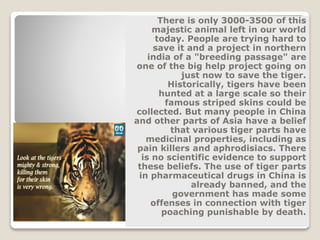
There is only 3000-3500 of this
majestic animal left in our world
today. People are trying hard to
save it and a project in northern
india of a "breeding passage" are
one of the big help project going on
just now to save the tiger.
Historically, tigers have been
hunted at a large scale so their
famous striped skins could be
collected. But many people in China
and other parts of Asia have a belief
that various tiger parts have
medicinal properties, including as
pain killers and aphrodisiacs. There
is no scientific evidence to support
these beliefs. The use of tiger parts
in pharmaceutical drugs in China is
already banned, and the
government has made some
offenses in connection with tiger
poaching punishable by death.
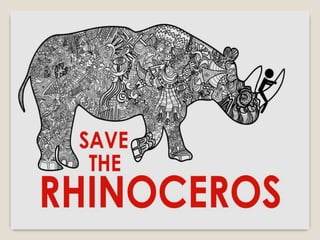
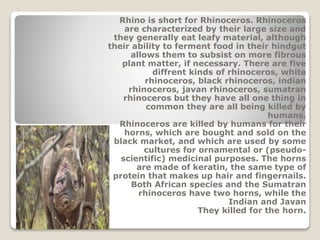
Rhino is short for Rhinoceros. Rhinoceros
are characterized by their large size and
they generally eat leafy material, although
their ability to ferment food in their hindgut
allows them to subsist on more fibrous
plant matter, if necessary. There are five
diffrent kinds of rhinoceros, white
rhinoceros, black rhinoceros, indian
rhinoceros, javan rhinoceros, sumatran
rhinoceros but they have all one thing in
common they are all being killed by
humans.
Rhinoceros are killed by humans for their
horns, which are bought and sold on the
black market, and which are used by some
cultures for ornamental or (pseudo-
scientific) medicinal purposes. The horns
are made of keratin, the same type of
protein that makes up hair and fingernails.
Both African species and the Sumatran
rhinoceros have two horns, while the
Indian and Javan
They killed for the horn.
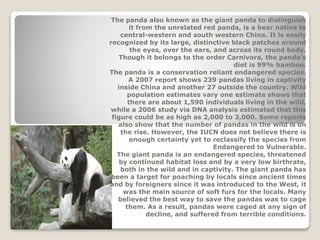
The panda also known as the giant panda to distinguish
it from the unrelated red panda, is a bear native to
central-western and south western China. It is easily
recognized by its large, distinctive black patches around
the eyes, over the ears, and across its round body.
Though it belongs to the order Carnivora, the panda's
diet is 99% bamboo.
The panda is a conservation reliant endangered species.
A 2007 report shows 239 pandas living in captivity
inside China and another 27 outside the country. Wild
population estimates vary one estimate shows that
there are about 1,590 individuals living in the wild,
while a 2006 study via DNA analysis estimated that this
figure could be as high as 2,000 to 3,000. Some reports
also show that the number of pandas in the wild is on
the rise. However, the IUCN does not believe there is
enough certainty yet to reclassify the species from
Endangered to Vulnerable.
The giant panda is an endangered species, threatened
by continued habitat loss and by a very low birthrate,
both in the wild and in captivity. The giant panda has
been a target for poaching by locals since ancient times
and by foreigners since it was introduced to the West, it
was the main source of soft furs for the locals. Many
believed the best way to save the pandas was to cage
them. As a result, pandas were caged at any sign of
decline, and suffered from terrible conditions.
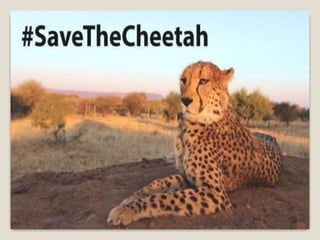
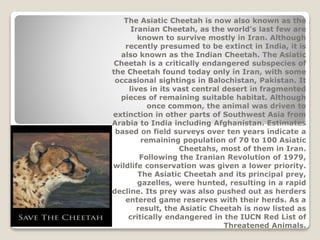
The Asiatic Cheetah is now also known as the
Iranian Cheetah, as the world's last few are
known to survive mostly in Iran. Although
recently presumed to be extinct in India, it is
also known as the Indian Cheetah. The Asiatic
Cheetah is a critically endangered subspecies of
the Cheetah found today only in Iran, with some
occasional sightings in Balochistan, Pakistan. It
lives in its vast central desert in fragmented
pieces of remaining suitable habitat. Although
once common, the animal was driven to
extinction in other parts of Southwest Asia from
Arabia to India including Afghanistan. Estimates
based on field surveys over ten years indicate a
remaining population of 70 to 100 Asiatic
Cheetahs, most of them in Iran.
Following the Iranian Revolution of 1979,
wildlife conservation was given a lower priority.
The Asiatic Cheetah and its principal prey,
gazelles, were hunted, resulting in a rapid
decline. Its prey was also pushed out as herders
entered game reserves with their herds. As a
result, the Asiatic Cheetah is now listed as
critically endangered in the IUCN Red List of
Threatened Animals.
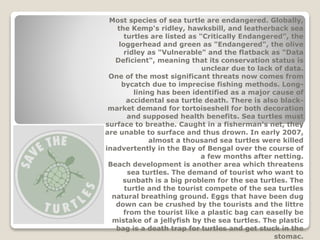
Most species of sea turtle are endangered. Globally,
the Kemp's ridley, hawksbill, and leatherback sea
turtles are listed as "Critically Endangered", the
loggerhead and green as "Endangered", the olive
ridley as "Vulnerable" and the flatback as "Data
Deficient", meaning that its conservation status is
unclear due to lack of data.
One of the most significant threats now comes from
bycatch due to imprecise fishing methods. Long-
lining has been identified as a major cause of
accidental sea turtle death. There is also black-
market demand for tortoiseshell for both decoration
and supposed health benefits. Sea turtles must
surface to breathe. Caught in a fisherman's net, they
are unable to surface and thus drown. In early 2007,
almost a thousand sea turtles were killed
inadvertently in the Bay of Bengal over the course of
a few months after netting.
Beach development is another area which threatens
sea turtles. The demand of tourist who want to
sunbath is a big problem for the sea turtles. The
turtle and the tourist compete of the sea turtles
natural breathing ground. Eggs that have been dug
down can be crushed by the tourists and the littre
from the tourist like a plastic bag can easelly be
mistake of a jellyfish by the sea turtles. The plastic
bag is a death trap for turtles and get stuck in the
stomac.
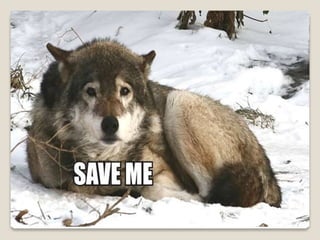
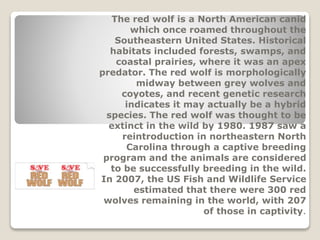
The red wolf is a North American canid
which once roamed throughout the
Southeastern United States. Historical
habitats included forests, swamps, and
coastal prairies, where it was an apex
predator. The red wolf is morphologically
midway between grey wolves and
coyotes, and recent genetic research
indicates it may actually be a hybrid
species. The red wolf was thought to be
extinct in the wild by 1980. 1987 saw a
reintroduction in northeastern North
Carolina through a captive breeding
program and the animals are considered
to be successfully breeding in the wild.
In 2007, the US Fish and Wildlife Service
estimated that there were 300 red
wolves remaining in the world, with 207
of those in captivity.
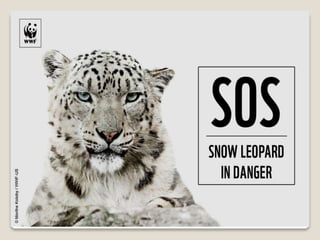
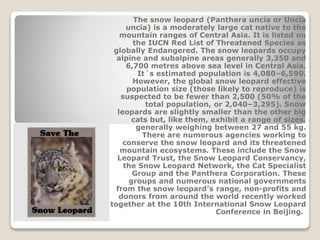
The snow leopard (Panthera uncia or Uncia
uncia) is a moderately large cat native to the
mountain ranges of Central Asia. It is listed on
the IUCN Red List of Threatened Species as
globally Endangered. The snow leopards occupy
alpine and subalpine areas generally 3,350 and
6,700 metres above sea level in Central Asia.
It´s estimated population is 4,080–6,590.
However, the global snow leopard effective
population size (those likely to reproduce) is
suspected to be fewer than 2,500 (50% of the
total population, or 2,040–3,295). Snow
leopards are slightly smaller than the other big
cats but, like them, exhibit a range of sizes,
generally weighing between 27 and 55 kg.
There are numerous agencies working to
conserve the snow leopard and its threatened
mountain ecosystems. These include the Snow
Leopard Trust, the Snow Leopard Conservancy,
the Snow Leopard Network, the Cat Specialist
Group and the Panthera Corporation. These
groups and numerous national governments
from the snow leopard’s range, non-profits and
donors from around the world recently worked
together at the 10th International Snow Leopard
Conference in Beijing.
PRESENTATION
BY
YASH THITE
ROLL NO.37
STD. 8TH A

Save Animals Presentation by Yash Thite

  • 2.
  • 5.
  • 6.
    There is only3000-3500 of this majestic animal left in our world today. People are trying hard to save it and a project in northern india of a "breeding passage" are one of the big help project going on just now to save the tiger. Historically, tigers have been hunted at a large scale so their famous striped skins could be collected. But many people in China and other parts of Asia have a belief that various tiger parts have medicinal properties, including as pain killers and aphrodisiacs. There is no scientific evidence to support these beliefs. The use of tiger parts in pharmaceutical drugs in China is already banned, and the government has made some offenses in connection with tiger poaching punishable by death.
  • 8.
    Rhino is shortfor Rhinoceros. Rhinoceros are characterized by their large size and they generally eat leafy material, although their ability to ferment food in their hindgut allows them to subsist on more fibrous plant matter, if necessary. There are five diffrent kinds of rhinoceros, white rhinoceros, black rhinoceros, indian rhinoceros, javan rhinoceros, sumatran rhinoceros but they have all one thing in common they are all being killed by humans. Rhinoceros are killed by humans for their horns, which are bought and sold on the black market, and which are used by some cultures for ornamental or (pseudo- scientific) medicinal purposes. The horns are made of keratin, the same type of protein that makes up hair and fingernails. Both African species and the Sumatran rhinoceros have two horns, while the Indian and Javan They killed for the horn.
  • 10.
    The panda alsoknown as the giant panda to distinguish it from the unrelated red panda, is a bear native to central-western and south western China. It is easily recognized by its large, distinctive black patches around the eyes, over the ears, and across its round body. Though it belongs to the order Carnivora, the panda's diet is 99% bamboo. The panda is a conservation reliant endangered species. A 2007 report shows 239 pandas living in captivity inside China and another 27 outside the country. Wild population estimates vary one estimate shows that there are about 1,590 individuals living in the wild, while a 2006 study via DNA analysis estimated that this figure could be as high as 2,000 to 3,000. Some reports also show that the number of pandas in the wild is on the rise. However, the IUCN does not believe there is enough certainty yet to reclassify the species from Endangered to Vulnerable. The giant panda is an endangered species, threatened by continued habitat loss and by a very low birthrate, both in the wild and in captivity. The giant panda has been a target for poaching by locals since ancient times and by foreigners since it was introduced to the West, it was the main source of soft furs for the locals. Many believed the best way to save the pandas was to cage them. As a result, pandas were caged at any sign of decline, and suffered from terrible conditions.
  • 12.
    The Asiatic Cheetahis now also known as the Iranian Cheetah, as the world's last few are known to survive mostly in Iran. Although recently presumed to be extinct in India, it is also known as the Indian Cheetah. The Asiatic Cheetah is a critically endangered subspecies of the Cheetah found today only in Iran, with some occasional sightings in Balochistan, Pakistan. It lives in its vast central desert in fragmented pieces of remaining suitable habitat. Although once common, the animal was driven to extinction in other parts of Southwest Asia from Arabia to India including Afghanistan. Estimates based on field surveys over ten years indicate a remaining population of 70 to 100 Asiatic Cheetahs, most of them in Iran. Following the Iranian Revolution of 1979, wildlife conservation was given a lower priority. The Asiatic Cheetah and its principal prey, gazelles, were hunted, resulting in a rapid decline. Its prey was also pushed out as herders entered game reserves with their herds. As a result, the Asiatic Cheetah is now listed as critically endangered in the IUCN Red List of Threatened Animals.
  • 14.
    Most species ofsea turtle are endangered. Globally, the Kemp's ridley, hawksbill, and leatherback sea turtles are listed as "Critically Endangered", the loggerhead and green as "Endangered", the olive ridley as "Vulnerable" and the flatback as "Data Deficient", meaning that its conservation status is unclear due to lack of data. One of the most significant threats now comes from bycatch due to imprecise fishing methods. Long- lining has been identified as a major cause of accidental sea turtle death. There is also black- market demand for tortoiseshell for both decoration and supposed health benefits. Sea turtles must surface to breathe. Caught in a fisherman's net, they are unable to surface and thus drown. In early 2007, almost a thousand sea turtles were killed inadvertently in the Bay of Bengal over the course of a few months after netting. Beach development is another area which threatens sea turtles. The demand of tourist who want to sunbath is a big problem for the sea turtles. The turtle and the tourist compete of the sea turtles natural breathing ground. Eggs that have been dug down can be crushed by the tourists and the littre from the tourist like a plastic bag can easelly be mistake of a jellyfish by the sea turtles. The plastic bag is a death trap for turtles and get stuck in the stomac.
  • 16.
    The red wolfis a North American canid which once roamed throughout the Southeastern United States. Historical habitats included forests, swamps, and coastal prairies, where it was an apex predator. The red wolf is morphologically midway between grey wolves and coyotes, and recent genetic research indicates it may actually be a hybrid species. The red wolf was thought to be extinct in the wild by 1980. 1987 saw a reintroduction in northeastern North Carolina through a captive breeding program and the animals are considered to be successfully breeding in the wild. In 2007, the US Fish and Wildlife Service estimated that there were 300 red wolves remaining in the world, with 207 of those in captivity.
  • 18.
    The snow leopard(Panthera uncia or Uncia uncia) is a moderately large cat native to the mountain ranges of Central Asia. It is listed on the IUCN Red List of Threatened Species as globally Endangered. The snow leopards occupy alpine and subalpine areas generally 3,350 and 6,700 metres above sea level in Central Asia. It´s estimated population is 4,080–6,590. However, the global snow leopard effective population size (those likely to reproduce) is suspected to be fewer than 2,500 (50% of the total population, or 2,040–3,295). Snow leopards are slightly smaller than the other big cats but, like them, exhibit a range of sizes, generally weighing between 27 and 55 kg. There are numerous agencies working to conserve the snow leopard and its threatened mountain ecosystems. These include the Snow Leopard Trust, the Snow Leopard Conservancy, the Snow Leopard Network, the Cat Specialist Group and the Panthera Corporation. These groups and numerous national governments from the snow leopard’s range, non-profits and donors from around the world recently worked together at the 10th International Snow Leopard Conference in Beijing.
  • 19.

Editor's Notes

  • #4 10 ANIMALS THAT KILL FOR FUN