QUANTUM INFORMATION
1
Y. AADEL
2
Outline
 Introduction
 Qubit
 Quantum gate
 No-cloning Theorem
 Entanglement
 Quantum Algorithm
 Deutsch-Jozsa algorithm
 Grover Algorithm
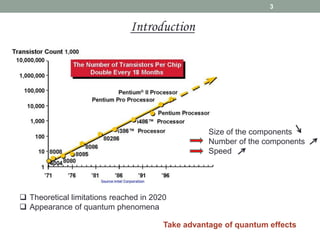
Size of the components
Number of the components
Speed
 Theoretical limitations reached in 2020
 Appearance of quantum phenomena
Take advantage of quantum effects
Introduction
3
4
Introduction
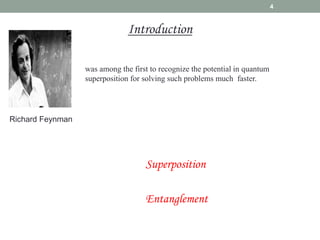
Richard Feynman
was among the first to recognize the potential in quantum
superposition for solving such problems much faster.
Entanglement
Superposition
5
1
0 

 

1
2
2

 

Measure
|0 >
||2
||2 |1 >
Qubit
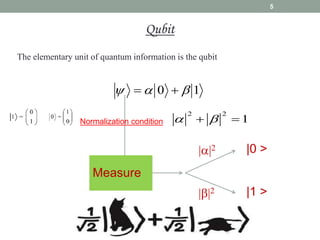
The elementary unit of quantum information is the qubit
Normalization condition
6
Qubit
Bloch sphere
cos 0 sin 1
2 2
i
e 
 
  
1
0 

 

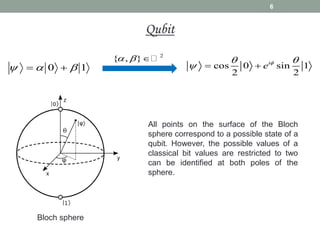
All points on the surface of the Bloch
sphere correspond to a possible state of a
qubit. However, the possible values of a
classical bit values are restricted to two
can be identified at both poles of the
sphere.
2
{ , }
  
7
Quantum gates
1 0 0 0
0 1 0 0
0 0 0 1
0 0 1 0
CNOT
 
 
 

 
 
 
† †
UU U U I
 
a b
U
c d
 
  
 
† a c
U
b d
 
 
 
  
 
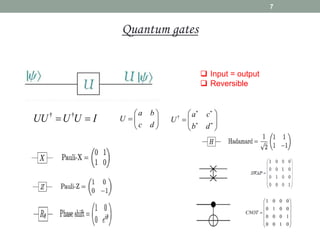
 Input = output
 Reversible
8
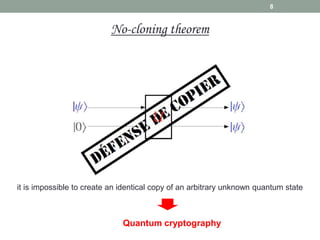
No-cloning theorem
it is impossible to create an identical copy of an arbitrary unknown quantum state
Quantum cryptography
9
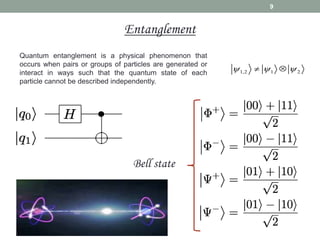
Bell state
Entanglement
1,2 1 2
  
 
Quantum entanglement is a physical phenomenon that
occurs when pairs or groups of particles are generated or
interact in ways such that the quantum state of each
particle cannot be described independently.
10
Entanglement & Teleportation
   
0
1 1
00 11
2 2
1
0 00 11 1 00 11
2
 
 
 
 
 
 
 
   
 
       
2
1
0 1 1 0
00 01 0 1 1
2
11 0
10
        
 
       
 
0 1
  
 
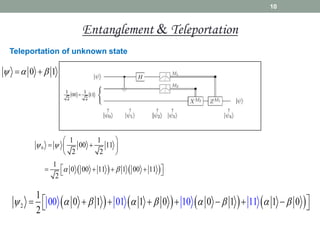
Teleportation of unknown state
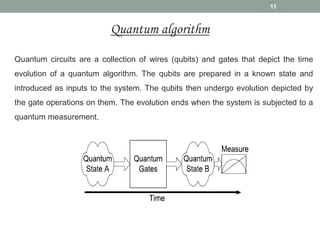
Quantum circuits are a collection of wires (qubits) and gates that depict the time
evolution of a quantum algorithm. The qubits are prepared in a known state and
introduced as inputs to the system. The qubits then undergo evolution depicted by
the gate operations on them. The evolution ends when the system is subjected to a
quantum measurement.
11
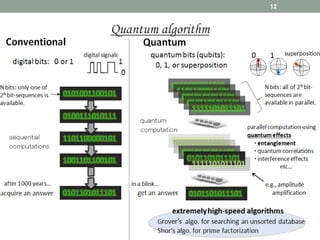
Quantum algorithm
12
Quantum algorithm
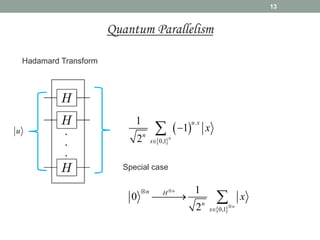
13
Hadamard Transform
.
.
.
u  
 
.
0,1
1
1
2 n
u x
n
x
x



Special case
 
0,1
1
0
2
n
n
n H
n
x
x





 
Quantum Parallelism
14
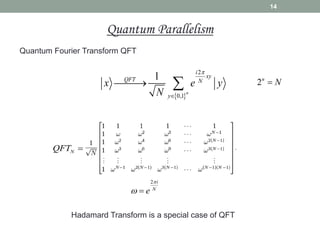
Quantum Parallelism
Quantum Fourier Transform QFT
N
QFT 
2 i
N
e

 
 
2
0,1
1
n
i
xy
QFT N
y
x e y
N



  2n
N

Hadamard Transform is a special case of QFT
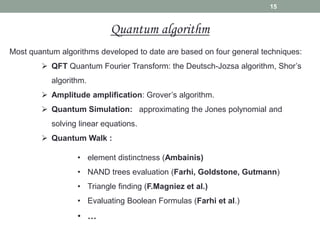
Most quantum algorithms developed to date are based on four general techniques:
 QFT Quantum Fourier Transform: the Deutsch-Jozsa algorithm, Shor’s
algorithm.
 Amplitude amplification: Grover’s algorithm.
 Quantum Simulation: approximating the Jones polynomial and
solving linear equations.
 Quantum Walk :
• element distinctness (Ambainis)
• NAND trees evaluation (Farhi, Goldstone, Gutmann)
• Triangle finding (F.Magniez et al.)
• Evaluating Boolean Formulas (Farhi et al.)
• …
15
Quantum algorithm
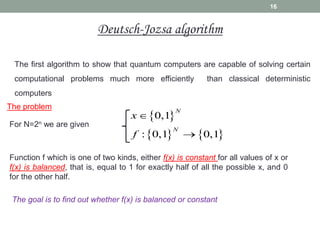
The first algorithm to show that quantum computers are capable of solving certain
computational problems much more efficiently than classical deterministic
computers
16
The problem
For N=2n we are given
Function f which is one of two kinds, either f(x) is constant for all values of x or
f(x) is balanced, that is, equal to 1 for exactly half of all the possible x, and 0
for the other half.
 
   
0,1
: 0,1 0,1
N
N
x
f


The goal is to find out whether f(x) is balanced or constant
Deutsch-Jozsa algorithm
17
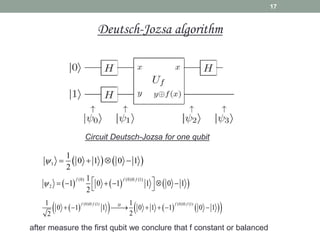
Circuit Deutsch-Jozsa for one qubit
   
1
1
0 1 0 1
2
    
     
(0) (0) (1)
2
1
1 0 1 1 0 1
2
f f f


 
     
 
 
     
 
(0) (1) (0) (1)
1 1
0 1 1 0 1 1 0 1
2
2
f f f f
H
 
  
    
after measure the first qubit we conclure that f constant or balanced
Deutsch-Jozsa algorithm
18
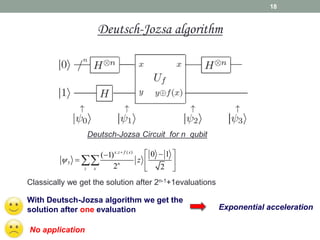
Deutsch-Jozsa Circuit for n qubit
. ( )
3
0 1
( 1)
2 2
x z f x
n
z x
z


  

  
 

With Deutsch-Jozsa algorithm we get the
solution after one evaluation
No application
Exponential acceleration
Classically we get the solution after 2n-1+1evaluations
Deutsch-Jozsa algorithm
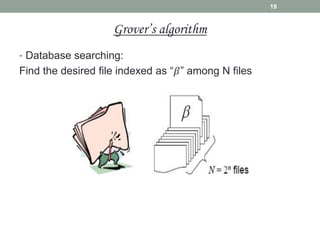
• Database searching:
Find the desired file indexed as “𝛽” among N files
19
Grover’s algorithm
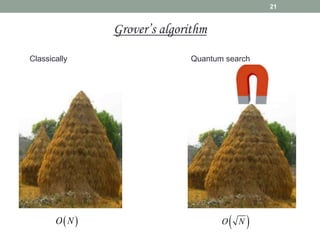
• The problem addressed by Grover’s algorithm can be
viewed as trying to find a marked element in an
unstructured database of size N. To solve this problem a
classical algorithm need, on average O(N/2) evaluations
and O(N) in the worst case.
• But with using Grover’s algorithm, a quantum computer
can realize the same task using only O( 𝑵) evaluations.
20
Grover’s algorithm
21
Grover’s algorithm
Classically Quantum search
 
O N  
O N
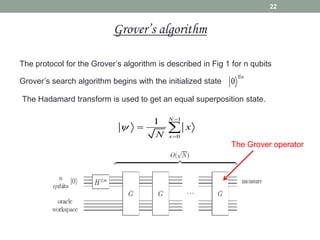
The protocol for the Grover’s algorithm is described in Fig 1 for n qubits
Grover’s search algorithm begins with the initialized state 0
n

The Hadamard transform is used to get an equal superposition state.
1
0
1 N
x
x
N



 
The Grover operator
22
Grover’s algorithm
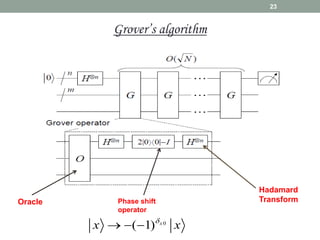
Oracle
Hadamard
Transform
Phase shift
operator
0
( 1) x
x x

  
23
Grover’s algorithm
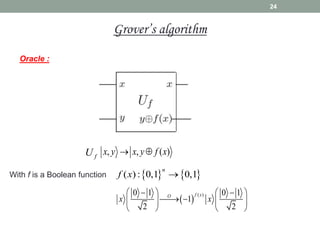
Oracle :
   
( ) : 0,1 0,1
n
f x 
, , ( )
x y x y f x
 
With f is a Boolean function
 
( )
0 1 0 1
1
2 2
f x
O
x x
     

 
   
   
f
U
24
Grover’s algorithm
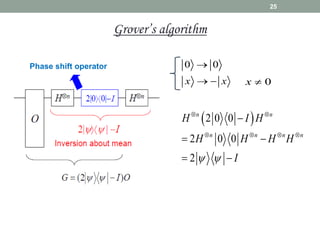
Phase shift operator 0 0
x x

  0
x 
 
2 0 0
2 0 0
2
n n
n n n n
H I H
H H H H
I
 
 
   

 
 
25
Grover’s algorithm
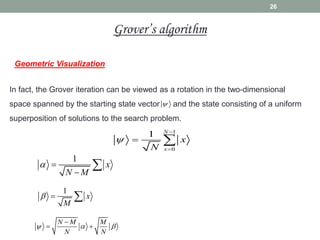
Geometric Visualization
In fact, the Grover iteration can be viewed as a rotation in the two-dimensional
space spanned by the starting state vector and the state consisting of a uniform
superposition of solutions to the search problem.

1
0
1 N
x
x
N



 
1
x
N M
 


1
x
M
  
N M M
N N
  

 
26
Grover’s algorithm
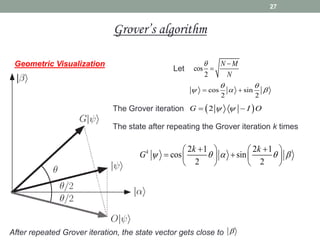
Geometric Visualization
After repeated Grover iteration, the state vector gets close to 
cos
2
N M
N
 

Let
cos sin
2 2
 
  
 
 
2
G I O
 
 
The Grover iteration
The state after repeating the Grover iteration k times
2 1 2 1
cos sin
2 2
k k k
G     
 
   
 
   
   
27
Grover’s algorithm
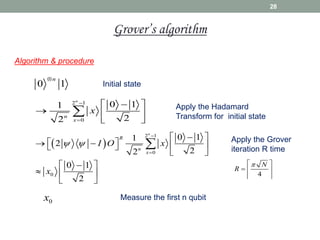
Algorithm & procedure
0 1
n

Initial state
2 1
0
0 1
1
2
2
n
n
x
x


  
  
 
 Apply the Hadamard
Transform for initial state
 
2 1
0
0
0 1
1
2
2
2
0 1
2
n
R
n
x
I O x
x
 


  
 
   
 
 
  
  
 
 Apply the Grover
iteration R time
4
N
R

 
  
 
0
x Measure the first n qubit
28
Grover’s algorithm
29
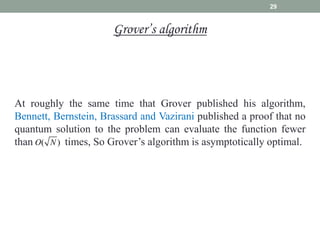
At roughly the same time that Grover published his algorithm,
Bennett, Bernstein, Brassard and Vazirani published a proof that no
quantum solution to the problem can evaluate the function fewer
than times, So Grover’s algorithm is asymptotically optimal.
( )
O N
Grover’s algorithm
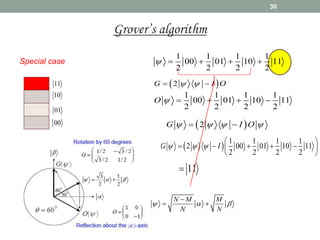
Special case
30
00
01
10
11
1 1 1 1
00 01 10 11
2 2 2 2
    
 
2
G I O
 
 
1 1 1 1
00 01 10 11
2 2 2 2
O     
 
2
G I O
   
 
  1 1 1 1
2 00 01 10 11
2 2 2 2
G I
  
 
    
 
 
11

N M M
N N
  

 
Grover’s algorithm
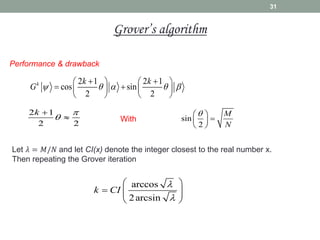
Performance & drawback
2 1 2 1
cos sin
2 2
k k k
G     
 
   
 
   
   
2 1
2 2
k 


 sin
2
M
N

 

 
 
With
Let 𝜆 = 𝑀/𝑁 and let CI(x) denote the integer closest to the real number x.
Then repeating the Grover iteration
arccos
2arcsin
k CI


 
  
 
 
31
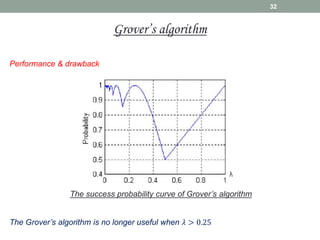
Grover’s algorithm
Performance & drawback
The success probability curve of Grover’s algorithm
The Grover’s algorithm is no longer useful when 𝜆 > 0.25
32
Grover’s algorithm
33
When the Grover’s algorithm is applied to search an unordered
database, the probability of getting correct results usually decreases
with the increase of marked items.
Grover’s algorithm
34
Thank You

exposé quantum information and quantum algorithm.pptx

  • 1.
  • 2.
    2 Outline  Introduction  Qubit Quantum gate  No-cloning Theorem  Entanglement  Quantum Algorithm  Deutsch-Jozsa algorithm  Grover Algorithm
  • 3.
    Size of thecomponents Number of the components Speed  Theoretical limitations reached in 2020  Appearance of quantum phenomena Take advantage of quantum effects Introduction 3
  • 4.
    4 Introduction Richard Feynman was amongthe first to recognize the potential in quantum superposition for solving such problems much faster. Entanglement Superposition
  • 5.
    5 1 0      1 2 2    Measure |0 > ||2 ||2 |1 > Qubit The elementary unit of quantum information is the qubit Normalization condition
  • 6.
    6 Qubit Bloch sphere cos 0sin 1 2 2 i e       1 0      All points on the surface of the Bloch sphere correspond to a possible state of a qubit. However, the possible values of a classical bit values are restricted to two can be identified at both poles of the sphere. 2 { , }   
  • 7.
    7 Quantum gates 1 00 0 0 1 0 0 0 0 0 1 0 0 1 0 CNOT              † † UU U U I   a b U c d        † a c U b d             Input = output  Reversible
  • 8.
    8 No-cloning theorem it isimpossible to create an identical copy of an arbitrary unknown quantum state Quantum cryptography
  • 9.
    9 Bell state Entanglement 1,2 12      Quantum entanglement is a physical phenomenon that occurs when pairs or groups of particles are generated or interact in ways such that the quantum state of each particle cannot be described independently.
  • 10.
    10 Entanglement & Teleportation    0 1 1 00 11 2 2 1 0 00 11 1 00 11 2                             2 1 0 1 1 0 00 01 0 1 1 2 11 0 10                      0 1      Teleportation of unknown state
  • 11.
    Quantum circuits area collection of wires (qubits) and gates that depict the time evolution of a quantum algorithm. The qubits are prepared in a known state and introduced as inputs to the system. The qubits then undergo evolution depicted by the gate operations on them. The evolution ends when the system is subjected to a quantum measurement. 11 Quantum algorithm
  • 12.
  • 13.
    13 Hadamard Transform . . . u    . 0,1 1 1 2 n u x n x x    Special case   0,1 1 0 2 n n n H n x x        Quantum Parallelism
  • 14.
    14 Quantum Parallelism Quantum FourierTransform QFT N QFT  2 i N e      2 0,1 1 n i xy QFT N y x e y N      2n N  Hadamard Transform is a special case of QFT
  • 15.
    Most quantum algorithmsdeveloped to date are based on four general techniques:  QFT Quantum Fourier Transform: the Deutsch-Jozsa algorithm, Shor’s algorithm.  Amplitude amplification: Grover’s algorithm.  Quantum Simulation: approximating the Jones polynomial and solving linear equations.  Quantum Walk : • element distinctness (Ambainis) • NAND trees evaluation (Farhi, Goldstone, Gutmann) • Triangle finding (F.Magniez et al.) • Evaluating Boolean Formulas (Farhi et al.) • … 15 Quantum algorithm
  • 16.
    The first algorithmto show that quantum computers are capable of solving certain computational problems much more efficiently than classical deterministic computers 16 The problem For N=2n we are given Function f which is one of two kinds, either f(x) is constant for all values of x or f(x) is balanced, that is, equal to 1 for exactly half of all the possible x, and 0 for the other half.       0,1 : 0,1 0,1 N N x f   The goal is to find out whether f(x) is balanced or constant Deutsch-Jozsa algorithm
  • 17.
    17 Circuit Deutsch-Jozsa forone qubit     1 1 0 1 0 1 2            (0) (0) (1) 2 1 1 0 1 1 0 1 2 f f f                       (0) (1) (0) (1) 1 1 0 1 1 0 1 1 0 1 2 2 f f f f H           after measure the first qubit we conclure that f constant or balanced Deutsch-Jozsa algorithm
  • 18.
    18 Deutsch-Jozsa Circuit forn qubit . ( ) 3 0 1 ( 1) 2 2 x z f x n z x z             With Deutsch-Jozsa algorithm we get the solution after one evaluation No application Exponential acceleration Classically we get the solution after 2n-1+1evaluations Deutsch-Jozsa algorithm
  • 19.
    • Database searching: Findthe desired file indexed as “𝛽” among N files 19 Grover’s algorithm
  • 20.
    • The problemaddressed by Grover’s algorithm can be viewed as trying to find a marked element in an unstructured database of size N. To solve this problem a classical algorithm need, on average O(N/2) evaluations and O(N) in the worst case. • But with using Grover’s algorithm, a quantum computer can realize the same task using only O( 𝑵) evaluations. 20 Grover’s algorithm
  • 21.
    21 Grover’s algorithm Classically Quantumsearch   O N   O N
  • 22.
    The protocol forthe Grover’s algorithm is described in Fig 1 for n qubits Grover’s search algorithm begins with the initialized state 0 n  The Hadamard transform is used to get an equal superposition state. 1 0 1 N x x N      The Grover operator 22 Grover’s algorithm
  • 23.
    Oracle Hadamard Transform Phase shift operator 0 ( 1)x x x     23 Grover’s algorithm
  • 24.
    Oracle :    ( ) : 0,1 0,1 n f x  , , ( ) x y x y f x   With f is a Boolean function   ( ) 0 1 0 1 1 2 2 f x O x x                  f U 24 Grover’s algorithm
  • 25.
    Phase shift operator0 0 x x    0 x    2 0 0 2 0 0 2 n n n n n n H I H H H H H I              25 Grover’s algorithm
  • 26.
    Geometric Visualization In fact,the Grover iteration can be viewed as a rotation in the two-dimensional space spanned by the starting state vector and the state consisting of a uniform superposition of solutions to the search problem.  1 0 1 N x x N      1 x N M     1 x M    N M M N N       26 Grover’s algorithm
  • 27.
    Geometric Visualization After repeatedGrover iteration, the state vector gets close to  cos 2 N M N    Let cos sin 2 2          2 G I O     The Grover iteration The state after repeating the Grover iteration k times 2 1 2 1 cos sin 2 2 k k k G                      27 Grover’s algorithm
  • 28.
    Algorithm & procedure 01 n  Initial state 2 1 0 0 1 1 2 2 n n x x            Apply the Hadamard Transform for initial state   2 1 0 0 0 1 1 2 2 2 0 1 2 n R n x I O x x                           Apply the Grover iteration R time 4 N R         0 x Measure the first n qubit 28 Grover’s algorithm
  • 29.
    29 At roughly thesame time that Grover published his algorithm, Bennett, Bernstein, Brassard and Vazirani published a proof that no quantum solution to the problem can evaluate the function fewer than times, So Grover’s algorithm is asymptotically optimal. ( ) O N Grover’s algorithm
  • 30.
    Special case 30 00 01 10 11 1 11 1 00 01 10 11 2 2 2 2        2 G I O     1 1 1 1 00 01 10 11 2 2 2 2 O        2 G I O         1 1 1 1 2 00 01 10 11 2 2 2 2 G I               11  N M M N N       Grover’s algorithm
  • 31.
    Performance & drawback 21 2 1 cos sin 2 2 k k k G                      2 1 2 2 k     sin 2 M N         With Let 𝜆 = 𝑀/𝑁 and let CI(x) denote the integer closest to the real number x. Then repeating the Grover iteration arccos 2arcsin k CI            31 Grover’s algorithm
  • 32.
    Performance & drawback Thesuccess probability curve of Grover’s algorithm The Grover’s algorithm is no longer useful when 𝜆 > 0.25 32 Grover’s algorithm
  • 33.
    33 When the Grover’salgorithm is applied to search an unordered database, the probability of getting correct results usually decreases with the increase of marked items. Grover’s algorithm
  • 34.