© Copyright IBM Corp. 2024, 2025
Understanding
quantum information
and computation
Lesson 5
Quantum query algorithms
By John Watrous
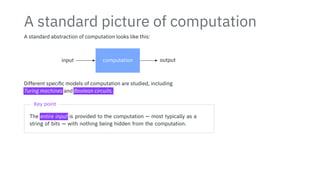
A standard picture of computation
A standard abstraction of computation looks like this:
input computation output
Different specific models of computation are studied, including
Turing machines and Boolean circuits.
Key point
The entire input is provided to the computation — most typically as a
string of bits — with nothing being hidden from the computation.
The query model of computation
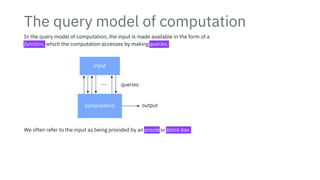
In the query model of computation, the input is made available in the form of a
function, which the computation accesses by making queries.
input
computation output
⋯ queries
We often refer to the input as being provided by an oracle or black box.
The query model of computation
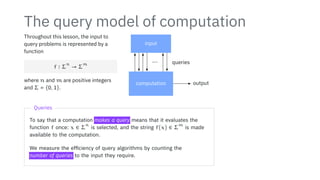
Throughout this lesson, the input to
query problems is represented by a
function
f ∶ Σ
n
→ Σ
m
where n and m are positive integers
and Σ = {0, 1}.
input
computation output
⋯ queries
Queries
To say that a computation makes a query means that it evaluates the
function f once: x ∈ Σ
n
is selected, and the string f(x) ∈ Σ
m
is made
available to the computation.
We measure the efficiency of query algorithms by counting the
number of queries to the input they require.
Examples of query problems
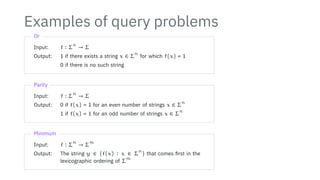
Or
Input: f ∶ Σ
n
→ Σ
Output: 1 if there exists a string x ∈ Σ
n
for which f(x) = 1
0 if there is no such string
Parity
Input: f ∶ Σ
n
→ Σ
Output: 0 if f(x) = 1 for an even number of strings x ∈ Σ
n
1 if f(x) = 1 for an odd number of strings x ∈ Σ
n
Minimum
Input: f ∶ Σ
n
→ Σ
m
Output: The string y ∈ {f(x) ∶ x ∈ Σ
n
} that comes first in the
lexicographic ordering of Σ
m
Examples of query problems
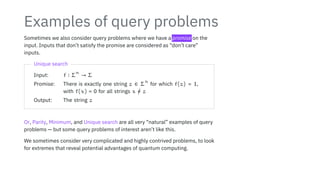
Sometimes we also consider query problems where we have a promise on the
input. Inputs that don’t satisfy the promise are considered as “don’t care”
inputs.
Unique search
Input: f ∶ Σ
n
→ Σ
Promise: There is exactly one string z ∈ Σ
n
for which f(z) = 1,
with f(x) = 0 for all strings x /
= z
Output: The string z
Or, Parity, Minimum, and Unique search are all very “natural” examples of query
problems — but some query problems of interest aren’t like this.
We sometimes consider very complicated and highly contrived problems, to look
for extremes that reveal potential advantages of quantum computing.
Query gates
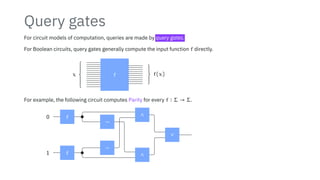
For circuit models of computation, queries are made by query gates.
For Boolean circuits, query gates generally compute the input function f directly.
f
x
⎧
⎪
⎪
⎪
⎪
⎪
⎨
⎪
⎪
⎪
⎪
⎪
⎩
⎫
⎪
⎪
⎪
⎬
⎪
⎪
⎪
⎭
f(x)
For example, the following circuit computes Parity for every f ∶ Σ → Σ.
f
f
0
1
¬
¬
∧
∧
∨
Query gates
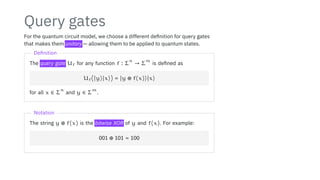
For the quantum circuit model, we choose a different definition for query gates
that makes them unitary — allowing them to be applied to quantum states.
Definition
The query gate Uf for any function f ∶ Σ
n
→ Σ
m
is defined as
Uf(∣y⟩∣x⟩) = ∣y ⊕ f(x)⟩∣x⟩
for all x ∈ Σ
n
and y ∈ Σ
m
.
Notation
The string y ⊕ f(x) is the bitwise XOR of y and f(x). For example:
001 ⊕ 101 = 100
Query gates
For the quantum circuit model, we choose a different definition for query gates
that makes them unitary — allowing them to be applied to quantum states.
Definition
The query gate Uf for any function f ∶ Σ
n
→ Σ
m
is defined as
Uf(∣y⟩∣x⟩) = ∣y ⊕ f(x)⟩∣x⟩
for all x ∈ Σ
n
and y ∈ Σ
m
.
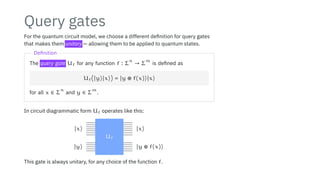
In circuit diagrammatic form Uf operates like this:
∣x⟩
∣y⟩
∣x⟩
∣y ⊕ f(x)⟩
Uf
This gate is always unitary, for any choice of the function f.
Deutsch’s problem
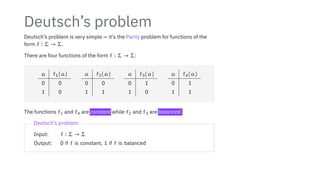
Deutsch’s problem is very simple — it’s the Parity problem for functions of the
form f ∶ Σ → Σ.
There are four functions of the form f ∶ Σ → Σ:
a f1(a)
0 0
1 0
a f2(a)
0 0
1 1
a f3(a)
0 1
1 0
a f4(a)
0 1
1 1
The functions f1 and f4 are constant while f2 and f3 are balanced.
Deutsch’s problem
Input: f ∶ Σ → Σ
Output: 0 if f is constant, 1 if f is balanced
Deutsch’s problem
Deutsch’s problem
Input: f ∶ Σ → Σ
Output: 0 if f is constant, 1 if f is balanced
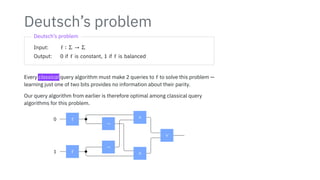
Every classical query algorithm must make 2 queries to f to solve this problem —
learning just one of two bits provides no information about their parity.
Our query algorithm from earlier is therefore optimal among classical query
algorithms for this problem.
f
f
0
1
¬
¬
∧
∧
∨
Deutsch’s algorithm
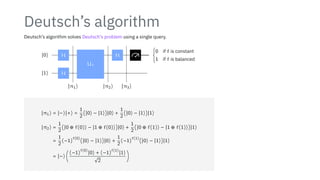
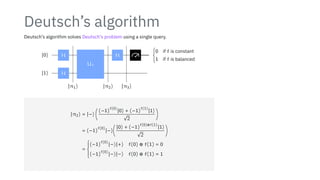
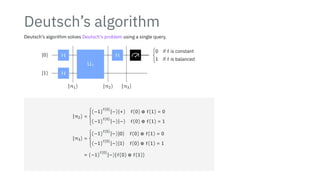
Deutsch’s algorithm solves Deutsch’s problem using a single query.
∣0⟩
∣1⟩
H
H
Uf
H {
0 if f is constant
1 if f is balanced
∣π1⟩ ∣π2⟩ ∣π3⟩
∣π1⟩ = ∣−⟩∣+⟩ =
1
2
(∣0⟩ − ∣1⟩)∣0⟩ +
1
2
(∣0⟩ − ∣1⟩)∣1⟩
∣π2⟩ =
1
2
(∣0 ⊕ f(0)⟩ − ∣1 ⊕ f(0)⟩)∣0⟩ +
1
2
(∣0 ⊕ f(1)⟩ − ∣1 ⊕ f(1)⟩)∣1⟩
=
1
2
(−1)
f(0)
(∣0⟩ − ∣1⟩)∣0⟩ +
1
2
(−1)
f(1)
(∣0⟩ − ∣1⟩)∣1⟩
= ∣−⟩ (
(−1)
f(0)
∣0⟩ + (−1)
f(1)
∣1⟩
√
2
)
Deutsch’s algorithm
Deutsch’s algorithm solves Deutsch’s problem using a single query.
∣0⟩
∣1⟩
H
H
Uf
H {
0 if f is constant
1 if f is balanced
∣π1⟩ ∣π2⟩ ∣π3⟩
∣π2⟩ = ∣−⟩ (
(−1)
f(0)
∣0⟩ + (−1)
f(1)
∣1⟩
√
2
)
= (−1)
f(0)
∣−⟩(
∣0⟩ + (−1)
f(0)⊕f(1)
∣1⟩
√
2
)
=
⎧
⎪
⎪
⎪
⎨
⎪
⎪
⎪
⎩
(−1)
f(0)
∣−⟩∣+⟩ f(0) ⊕ f(1) = 0
(−1)
f(0)
∣−⟩∣−⟩ f(0) ⊕ f(1) = 1
Deutsch’s algorithm
Deutsch’s algorithm solves Deutsch’s problem using a single query.
∣0⟩
∣1⟩
H
H
Uf
H {
0 if f is constant
1 if f is balanced
∣π1⟩ ∣π2⟩ ∣π3⟩
∣π2⟩ =
⎧
⎪
⎪
⎪
⎨
⎪
⎪
⎪
⎩
(−1)
f(0)
∣−⟩∣+⟩ f(0) ⊕ f(1) = 0
(−1)
f(0)
∣−⟩∣−⟩ f(0) ⊕ f(1) = 1
∣π3⟩ =
⎧
⎪
⎪
⎪
⎨
⎪
⎪
⎪
⎩
(−1)
f(0)
∣−⟩∣0⟩ f(0) ⊕ f(1) = 0
(−1)
f(0)
∣−⟩∣1⟩ f(0) ⊕ f(1) = 1
= (−1)
f(0)
∣−⟩∣f(0) ⊕ f(1)⟩
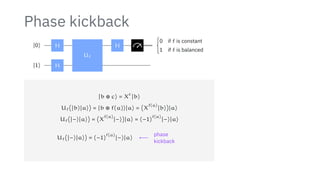
Phase kickback
∣0⟩
∣1⟩
H
H
Uf
H {
0 if f is constant
1 if f is balanced
∣b ⊕ c⟩ = X
c
∣b⟩
Uf(∣b⟩∣a⟩) = ∣b ⊕ f(a)⟩∣a⟩ = (X
f(a)
∣b⟩)∣a⟩
Uf(∣−⟩∣a⟩) = (X
f(a)
∣−⟩)∣a⟩ = (−1)
f(a)
∣−⟩∣a⟩
Uf(∣−⟩∣a⟩) = (−1)
f(a)
∣−⟩∣a⟩ ⟵
phase
kickback
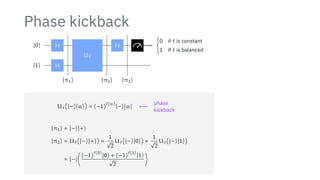
Phase kickback
∣0⟩
∣1⟩
H
H
Uf
H {
0 if f is constant
1 if f is balanced
∣π1⟩ ∣π2⟩ ∣π3⟩
Uf(∣−⟩∣a⟩) = (−1)
f(a)
∣−⟩∣a⟩ ⟵
phase
kickback
∣π1⟩ = ∣−⟩∣+⟩
∣π2⟩ = Uf(∣−⟩∣+⟩) =
1
√
2
Uf(∣−⟩∣0⟩) +
1
√
2
Uf(∣−⟩∣1⟩)
= ∣−⟩(
(−1)
f(0)
∣0⟩ + (−1)
f(1)
∣1⟩
√
2
)
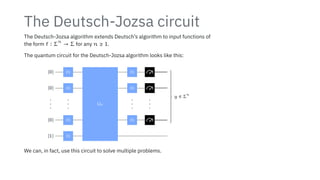
The Deutsch-Jozsa circuit
The Deutsch-Jozsa algorithm extends Deutsch’s algorithm to input functions of
the form f ∶ Σ
n
→ Σ for any n ≥ 1.
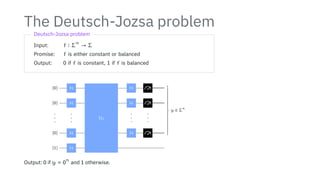
The quantum circuit for the Deutsch-Jozsa algorithm looks like this:
H
H
H
H
H
H
H
Uf
∣0⟩
∣0⟩
∣0⟩
∣1⟩
⎫
⎪
⎪
⎪
⎪
⎪
⎪
⎪
⎪
⎪
⎪
⎪
⎪
⎪
⎪
⎪
⎪
⎪
⎬
⎪
⎪
⎪
⎪
⎪
⎪
⎪
⎪
⎪
⎪
⎪
⎪
⎪
⎪
⎪
⎪
⎪
⎭
y ∈ Σ
n
We can, in fact, use this circuit to solve multiple problems.
The Deutsch-Jozsa problem
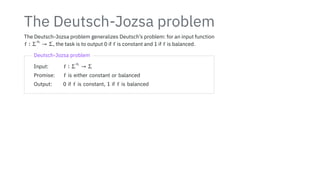
The Deutsch-Jozsa problem generalizes Deutsch’s problem: for an input function
f ∶ Σ
n
→ Σ, the task is to output 0 if f is constant and 1 if f is balanced.
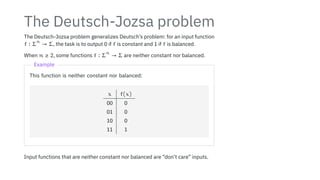
When n ≥ 2, some functions f ∶ Σ
n
→ Σ are neither constant nor balanced.
Example
This function is neither constant nor balanced:
x f(x)
00 0
01 0
10 0
11 1
Input functions that are neither constant nor balanced are “don’t care” inputs.
The Deutsch-Jozsa problem
The Deutsch-Jozsa problem generalizes Deutsch’s problem: for an input function
f ∶ Σ
n
→ Σ, the task is to output 0 if f is constant and 1 if f is balanced.
Deutsch-Jozsa problem
Input: f ∶ Σ
n
→ Σ
Promise: f is either constant or balanced
Output: 0 if f is constant, 1 if f is balanced
The Deutsch-Jozsa problem
Deutsch-Jozsa problem
Input: f ∶ Σ
n
→ Σ
Promise: f is either constant or balanced
Output: 0 if f is constant, 1 if f is balanced
H
H
H
H
H
H
H
Uf
∣0⟩
∣0⟩
∣0⟩
∣1⟩
⎫
⎪
⎪
⎪
⎪
⎪
⎪
⎪
⎪
⎪
⎪
⎪
⎪
⎪
⎪
⎪
⎪
⎪
⎬
⎪
⎪
⎪
⎪
⎪
⎪
⎪
⎪
⎪
⎪
⎪
⎪
⎪
⎪
⎪
⎪
⎪
⎭
y ∈ Σ
n
Output: 0 if y = 0
n
and 1 otherwise.
Deutsch-Jozsa analysis
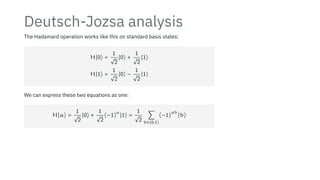
The Hadamard operation works like this on standard basis states:
H∣0⟩ =
1
√
2
∣0⟩ +
1
√
2
∣1⟩
H∣1⟩ =
1
√
2
∣0⟩ −
1
√
2
∣1⟩
We can express these two equations as one:
H∣a⟩ =
1
√
2
∣0⟩ +
1
√
2
(−1)
a
∣1⟩ =
1
√
2
∑
b∈{0,1}
(−1)
ab
∣b⟩
Deutsch-Jozsa analysis
The Hadamard operation works like this on standard basis states:
H∣a⟩ =
1
√
2
∑
b∈{0,1}
(−1)
ab
∣b⟩
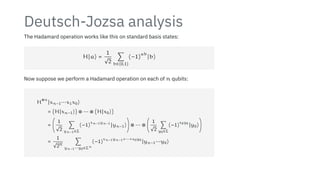
Now suppose we perform a Hadamard operation on each of n qubits:
H
⊗n
∣xn−1⋯x1x0⟩
= (H∣xn−1⟩) ⊗ ⋯ ⊗ (H∣x0⟩)
= (
1
√
2
∑
yn−1∈Σ
(−1)
xn−1yn−1
∣yn−1⟩) ⊗ ⋯ ⊗ (
1
√
2
∑
y0∈Σ
(−1)
x0y0
∣y0⟩)
=
1
√
2n
∑
yn−1⋯y0∈Σn
(−1)
xn−1yn−1+⋯+x0y0
∣yn−1⋯y0⟩
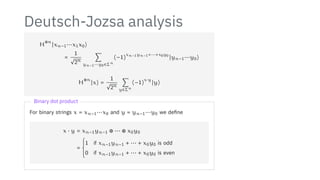
Deutsch-Jozsa analysis
H
⊗n
∣xn−1⋯x1x0⟩
=
1
√
2n
∑
yn−1⋯y0∈Σn
(−1)
xn−1yn−1+⋯+x0y0
∣yn−1⋯y0⟩
H
⊗n
∣x⟩ =
1
√
2n
∑
y∈Σn
(−1)
x⋅y
∣y⟩
Binary dot product
For binary strings x = xn−1⋯x0 and y = yn−1⋯y0 we define
x ⋅ y = xn−1yn−1 ⊕ ⋯ ⊕ x0y0
=
⎧
⎪
⎪
⎪
⎨
⎪
⎪
⎪
⎩
1 if xn−1yn−1 + ⋯ + x0y0 is odd
0 if xn−1yn−1 + ⋯ + x0y0 is even
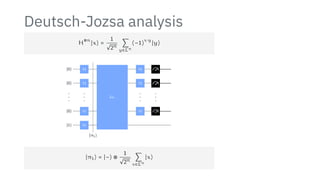
Deutsch-Jozsa analysis
H
⊗n
∣x⟩ =
1
√
2n
∑
y∈Σn
(−1)
x⋅y
∣y⟩
H
H
H
H
H
H
H
Uf
∣0⟩
∣0⟩
∣0⟩
∣1⟩
∣π1⟩
∣π1⟩ = ∣−⟩ ⊗
1
√
2n
∑
x∈Σn
∣x⟩
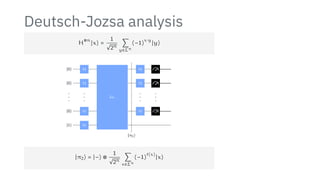
Deutsch-Jozsa analysis
H
⊗n
∣x⟩ =
1
√
2n
∑
y∈Σn
(−1)
x⋅y
∣y⟩
H
H
H
H
H
H
H
Uf
∣0⟩
∣0⟩
∣0⟩
∣1⟩
∣π2⟩
∣π2⟩ = ∣−⟩ ⊗
1
√
2n
∑
x∈Σn
(−1)
f(x)
∣x⟩
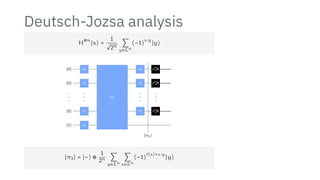
Deutsch-Jozsa analysis
H
⊗n
∣x⟩ =
1
√
2n
∑
y∈Σn
(−1)
x⋅y
∣y⟩
H
H
H
H
H
H
H
Uf
∣0⟩
∣0⟩
∣0⟩
∣1⟩
∣π3⟩
∣π3⟩ = ∣−⟩ ⊗
1
2n ∑
y∈Σn
∑
x∈Σn
(−1)
f(x)+x⋅y
∣y⟩
Deutsch-Jozsa analysis
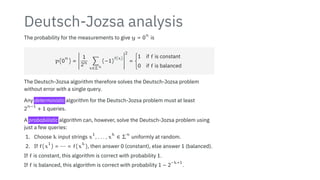
The probability for the measurements to give y = 0
n
is
p(0
n
) =
2
2
2
2
2
2
2
2
2
2
1
2n ∑
x∈Σn
(−1)
f(x)
2
2
2
2
2
2
2
2
2
2
2
= {
1 if f is constant
0 if f is balanced
The Deutsch-Jozsa algorithm therefore solves the Deutsch-Jozsa problem
without error with a single query.
Any deterministic algorithm for the Deutsch-Jozsa problem must at least
2
n−1
+ 1 queries.
A probabilistic algorithm can, however, solve the Deutsch-Jozsa problem using
just a few queries:
1. Choose k input strings x
1
, . . . , x
k
∈ Σ
n
uniformly at random.
2. If f(x
1
) = ⋯ = f(x
k
), then answer 0 (constant), else answer 1 (balanced).
If f is constant, this algorithm is correct with probability 1.
If f is balanced, this algorithm is correct with probability 1 − 2
−k+1
.
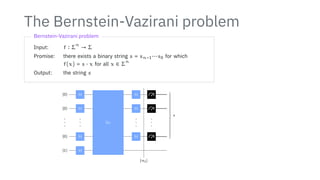
The Bernstein-Vazirani problem
Bernstein-Vazirani problem
Input: f ∶ Σ
n
→ Σ
Promise: there exists a binary string s = sn−1⋯s0 for which
f(x) = s ⋅ x for all x ∈ Σ
n
Output: the string s
H
H
H
H
H
H
H
Uf
∣0⟩
∣0⟩
∣0⟩
∣1⟩
⎫
⎪
⎪
⎪
⎪
⎪
⎪
⎪
⎪
⎪
⎪
⎪
⎪
⎪
⎪
⎪
⎪
⎪
⎬
⎪
⎪
⎪
⎪
⎪
⎪
⎪
⎪
⎪
⎪
⎪
⎪
⎪
⎪
⎪
⎪
⎪
⎭
s
∣π3⟩
The Bernstein-Vazirani problem
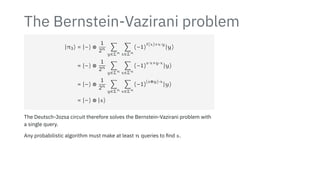
∣π3⟩ = ∣−⟩ ⊗
1
2n ∑
y∈Σn
∑
x∈Σn
(−1)
f(x)+x⋅y
∣y⟩
= ∣−⟩ ⊗
1
2n ∑
y∈Σn
∑
x∈Σn
(−1)
s⋅x+y⋅x
∣y⟩
= ∣−⟩ ⊗
1
2n ∑
y∈Σn
∑
x∈Σn
(−1)
(s⊕y)⋅x
∣y⟩
= ∣−⟩ ⊗ ∣s⟩
The Deutsch-Jozsa circuit therefore solves the Bernstein-Vazirani problem with
a single query.
Any probabilistic algorithm must make at least n queries to find s.
Simon’s problem
Simon’s problem
Input: A function f ∶ Σ
n
→ Σ
m
Promise: There exists a string s ∈ Σ
n
such that
[f(x) = f(y)] ⇔ [(x = y) or (x ⊕ s = y)]
for all x, y ∈ Σ
n
Output: The string s
Case 1: s = 0
n
The condition in the promise simplifies to
[f(x) = f(y)] ⇔ [x = y]
This is equivalent to f being one-to-one.
Simon’s problem
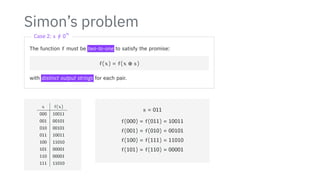
Case 2: s /
= 0
n
The function f must be two-to-one to satisfy the promise:
f(x) = f(x ⊕ s)
with distinct output strings for each pair.
x f(x)
000 10011
001 00101
010 00101
011 10011
100 11010
101 00001
110 00001
111 11010
s = 011
f(000) = f(011) = 10011
f(001) = f(010) = 00101
f(100) = f(111) = 11010
f(101) = f(110) = 00001
Simon’s algorithm
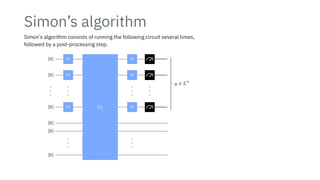
Simon’s algorithm consists of running the following circuit several times,
followed by a post-processing step.
H
H
H
H
H
H
Uf
∣0⟩
∣0⟩
∣0⟩
∣0⟩
∣0⟩
∣0⟩
⎫
⎪
⎪
⎪
⎪
⎪
⎪
⎪
⎪
⎪
⎪
⎪
⎪
⎪
⎪
⎪
⎪
⎪
⎬
⎪
⎪
⎪
⎪
⎪
⎪
⎪
⎪
⎪
⎪
⎪
⎪
⎪
⎪
⎪
⎪
⎪
⎭
y ∈ Σ
n
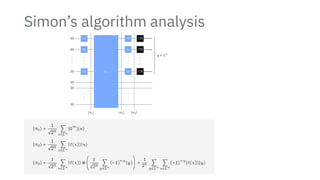
Simon’s algorithm analysis
H
H
H
H
H
H
Uf
∣0⟩
∣0⟩
∣0⟩
∣0⟩
∣0⟩
∣0⟩
⎫
⎪
⎪
⎪
⎪
⎪
⎪
⎪
⎪
⎪
⎪
⎪
⎪
⎪
⎪
⎪
⎪
⎪
⎬
⎪
⎪
⎪
⎪
⎪
⎪
⎪
⎪
⎪
⎪
⎪
⎪
⎪
⎪
⎪
⎪
⎪
⎭
y ∈ Σ
n
∣π1⟩ ∣π2⟩ ∣π3⟩
∣π1⟩ =
1
√
2n
∑
x∈Σn
∣0
m
⟩∣x⟩
∣π2⟩ =
1
√
2n
∑
x∈Σn
∣f(x)⟩∣x⟩
∣π3⟩ =
1
√
2n
∑
x∈Σn
∣f(x)⟩ ⊗
⎛
⎜
⎝
1
√
2n
∑
y∈Σn
(−1)
x⋅y
∣y⟩
⎞
⎟
⎠
=
1
2n ∑
y∈Σn
∑
x∈Σn
(−1)
x⋅y
∣f(x)⟩∣y⟩
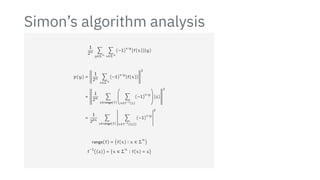
Simon’s algorithm analysis
1
2n ∑
y∈Σn
∑
x∈Σn
(−1)
x⋅y
∣f(x)⟩∣y⟩
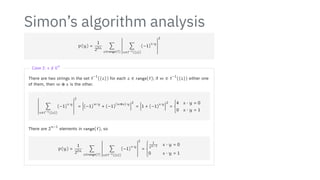
p(y) =
;
;
;
;
;
;
;
;
;
;
1
2n ∑
x∈Σn
(−1)
x⋅y
∣f(x)⟩
;
;
;
;
;
;
;
;
;
;
2
=
;
;
;
;
;
;
;
;
;
;
;
;
1
2n ∑
z∈range(f)
⎛
⎜
⎜
⎝
∑
x∈f−1(z)
(−1)
x⋅y
⎞
⎟
⎟
⎠
∣z⟩
;
;
;
;
;
;
;
;
;
;
;
;
2
=
1
22n
∑
z∈range(f)
2
2
2
2
2
2
2
2
2
2
2
2
∑
x∈f−1({z})
(−1)
x⋅y
2
2
2
2
2
2
2
2
2
2
2
2
2
range(f) = {f(x) ∶ x ∈ Σ
n
}
f
−1
({z}) = {x ∈ Σ
n
∶ f(x) = z}
Simon’s algorithm analysis
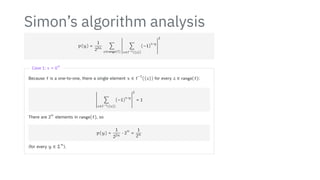
p(y) =
1
22n
∑
z∈range(f)
2
2
2
2
2
2
2
2
2
2
2
2
∑
x∈f−1({z})
(−1)
x⋅y
2
2
2
2
2
2
2
2
2
2
2
2
2
Case 1: s = 0
n
Because f is a one-to-one, there a single element x ∈ f
−1
({z}) for every z ∈ range(f):
2
2
2
2
2
2
2
2
2
2
2
2
∑
x∈f−1({z})
(−1)
x⋅y
2
2
2
2
2
2
2
2
2
2
2
2
2
= 1
There are 2
n
elements in range(f), so
p(y) =
1
22n
⋅ 2
n
=
1
2n
(for every y ∈ Σ
n
).
Simon’s algorithm analysis
p(y) =
1
22n
∑
z∈range(f)
2
2
2
2
2
2
2
2
2
2
2
2
∑
x∈f−1({z})
(−1)
x⋅y
2
2
2
2
2
2
2
2
2
2
2
2
2
Case 2: s /
= 0
n
There are two strings in the set f
−1
({z}) for each z ∈ range(f); if w ∈ f
−1
({z}) either one
of them, then w ⊕ s is the other.
2
2
2
2
2
2
2
2
2
2
2
2
∑
x∈f−1({z})
(−1)
x⋅y
2
2
2
2
2
2
2
2
2
2
2
2
2
=
2
2
2
2
2
2
(−1)
w⋅y
+ (−1)
(w⊕s)⋅y2
2
2
2
2
2
2
=
2
2
2
2
2
2
1 + (−1)
s⋅y2
2
2
2
2
2
2
= {
4 s ⋅ y = 0
0 s ⋅ y = 1
There are 2
n−1
elements in range(f), so
p(y) =
1
22n
∑
z∈range(f)
2
2
2
2
2
2
2
2
2
2
2
2
∑
x∈f−1({z})
(−1)
x⋅y
2
2
2
2
2
2
2
2
2
2
2
2
2
=
⎧
⎪
⎪
⎪
⎨
⎪
⎪
⎪
⎩
1
2n−1 s ⋅ y = 0
0 s ⋅ y = 1
Classical post-processing
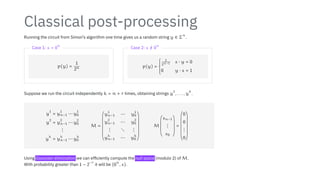
Running the circuit from Simon’s algorithm one time gives us a random string y ∈ Σ
n
.
Case 1: s = 0
n
p(y) =
1
2n
Case 2: s /
= 0
n
p(y) =
⎧
⎪
⎪
⎪
⎨
⎪
⎪
⎪
⎩
1
2n−1 s ⋅ y = 0
0 y ⋅ s = 1
Suppose we run the circuit independently k = n + r times, obtaining strings y
1
, . . . , y
k
.
y
1
= y
1
n−1 ⋯ y
1
0
y
2
= y
2
n−1 ⋯ y
2
0
⋮
y
k
= y
k
n−1 ⋯ y
k
0
M =
⎛
⎜
⎜
⎜
⎜
⎜
⎜
⎜
⎜
⎜
⎜
⎜
⎜
⎝
y
1
n−1 ⋯ y
1
0
y
2
n−1 ⋯ y
2
0
⋮ ⋱ ⋮
y
k
n−1 ⋯ y
k
0
⎞
⎟
⎟
⎟
⎟
⎟
⎟
⎟
⎟
⎟
⎟
⎟
⎟
⎠
M
⎛
⎜
⎜
⎜
⎜
⎜
⎜
⎝
sn−1
⋮
s0
⎞
⎟
⎟
⎟
⎟
⎟
⎟
⎠
=
⎛
⎜
⎜
⎜
⎜
⎜
⎜
⎜
⎜
⎜
⎜
⎜
⎜
⎝
0
0
⋮
0
⎞
⎟
⎟
⎟
⎟
⎟
⎟
⎟
⎟
⎟
⎟
⎟
⎟
⎠
Using Gaussian elimination we can efficiently compute the null space (modulo 2) of M.
With probability greater than 1 − 2
−r
it will be {0
n
, s}.
Classical difficulty
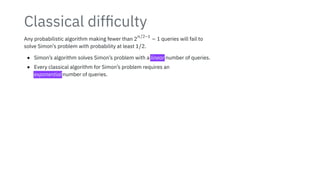
Any probabilistic algorithm making fewer than 2
n/2−1
− 1 queries will fail to
solve Simon’s problem with probability at least 1/2.
• Simon’s algorithm solves Simon’s problem with a linear number of queries.
• Every classical algorithm for Simon’s problem requires an
exponential number of queries.

05-Quantum-query-algorithms-slides.pdfnxjxjxjx

  • 1.
    © Copyright IBMCorp. 2024, 2025 Understanding quantum information and computation Lesson 5 Quantum query algorithms By John Watrous
  • 2.
    A standard pictureof computation A standard abstraction of computation looks like this: input computation output Different specific models of computation are studied, including Turing machines and Boolean circuits. Key point The entire input is provided to the computation — most typically as a string of bits — with nothing being hidden from the computation.
  • 3.
    The query modelof computation In the query model of computation, the input is made available in the form of a function, which the computation accesses by making queries. input computation output ⋯ queries We often refer to the input as being provided by an oracle or black box.
  • 4.
    The query modelof computation Throughout this lesson, the input to query problems is represented by a function f ∶ Σ n → Σ m where n and m are positive integers and Σ = {0, 1}. input computation output ⋯ queries Queries To say that a computation makes a query means that it evaluates the function f once: x ∈ Σ n is selected, and the string f(x) ∈ Σ m is made available to the computation. We measure the efficiency of query algorithms by counting the number of queries to the input they require.
  • 5.
    Examples of queryproblems Or Input: f ∶ Σ n → Σ Output: 1 if there exists a string x ∈ Σ n for which f(x) = 1 0 if there is no such string Parity Input: f ∶ Σ n → Σ Output: 0 if f(x) = 1 for an even number of strings x ∈ Σ n 1 if f(x) = 1 for an odd number of strings x ∈ Σ n Minimum Input: f ∶ Σ n → Σ m Output: The string y ∈ {f(x) ∶ x ∈ Σ n } that comes first in the lexicographic ordering of Σ m
  • 6.
    Examples of queryproblems Sometimes we also consider query problems where we have a promise on the input. Inputs that don’t satisfy the promise are considered as “don’t care” inputs. Unique search Input: f ∶ Σ n → Σ Promise: There is exactly one string z ∈ Σ n for which f(z) = 1, with f(x) = 0 for all strings x / = z Output: The string z Or, Parity, Minimum, and Unique search are all very “natural” examples of query problems — but some query problems of interest aren’t like this. We sometimes consider very complicated and highly contrived problems, to look for extremes that reveal potential advantages of quantum computing.
  • 7.
    Query gates For circuitmodels of computation, queries are made by query gates. For Boolean circuits, query gates generally compute the input function f directly. f x ⎧ ⎪ ⎪ ⎪ ⎪ ⎪ ⎨ ⎪ ⎪ ⎪ ⎪ ⎪ ⎩ ⎫ ⎪ ⎪ ⎪ ⎬ ⎪ ⎪ ⎪ ⎭ f(x) For example, the following circuit computes Parity for every f ∶ Σ → Σ. f f 0 1 ¬ ¬ ∧ ∧ ∨
  • 8.
    Query gates For thequantum circuit model, we choose a different definition for query gates that makes them unitary — allowing them to be applied to quantum states. Definition The query gate Uf for any function f ∶ Σ n → Σ m is defined as Uf(∣y⟩∣x⟩) = ∣y ⊕ f(x)⟩∣x⟩ for all x ∈ Σ n and y ∈ Σ m . Notation The string y ⊕ f(x) is the bitwise XOR of y and f(x). For example: 001 ⊕ 101 = 100
  • 9.
    Query gates For thequantum circuit model, we choose a different definition for query gates that makes them unitary — allowing them to be applied to quantum states. Definition The query gate Uf for any function f ∶ Σ n → Σ m is defined as Uf(∣y⟩∣x⟩) = ∣y ⊕ f(x)⟩∣x⟩ for all x ∈ Σ n and y ∈ Σ m . In circuit diagrammatic form Uf operates like this: ∣x⟩ ∣y⟩ ∣x⟩ ∣y ⊕ f(x)⟩ Uf This gate is always unitary, for any choice of the function f.
  • 10.
    Deutsch’s problem Deutsch’s problemis very simple — it’s the Parity problem for functions of the form f ∶ Σ → Σ. There are four functions of the form f ∶ Σ → Σ: a f1(a) 0 0 1 0 a f2(a) 0 0 1 1 a f3(a) 0 1 1 0 a f4(a) 0 1 1 1 The functions f1 and f4 are constant while f2 and f3 are balanced. Deutsch’s problem Input: f ∶ Σ → Σ Output: 0 if f is constant, 1 if f is balanced
  • 11.
    Deutsch’s problem Deutsch’s problem Input:f ∶ Σ → Σ Output: 0 if f is constant, 1 if f is balanced Every classical query algorithm must make 2 queries to f to solve this problem — learning just one of two bits provides no information about their parity. Our query algorithm from earlier is therefore optimal among classical query algorithms for this problem. f f 0 1 ¬ ¬ ∧ ∧ ∨
  • 12.
    Deutsch’s algorithm Deutsch’s algorithmsolves Deutsch’s problem using a single query. ∣0⟩ ∣1⟩ H H Uf H { 0 if f is constant 1 if f is balanced ∣π1⟩ ∣π2⟩ ∣π3⟩ ∣π1⟩ = ∣−⟩∣+⟩ = 1 2 (∣0⟩ − ∣1⟩)∣0⟩ + 1 2 (∣0⟩ − ∣1⟩)∣1⟩ ∣π2⟩ = 1 2 (∣0 ⊕ f(0)⟩ − ∣1 ⊕ f(0)⟩)∣0⟩ + 1 2 (∣0 ⊕ f(1)⟩ − ∣1 ⊕ f(1)⟩)∣1⟩ = 1 2 (−1) f(0) (∣0⟩ − ∣1⟩)∣0⟩ + 1 2 (−1) f(1) (∣0⟩ − ∣1⟩)∣1⟩ = ∣−⟩ ( (−1) f(0) ∣0⟩ + (−1) f(1) ∣1⟩ √ 2 )
  • 13.
    Deutsch’s algorithm Deutsch’s algorithmsolves Deutsch’s problem using a single query. ∣0⟩ ∣1⟩ H H Uf H { 0 if f is constant 1 if f is balanced ∣π1⟩ ∣π2⟩ ∣π3⟩ ∣π2⟩ = ∣−⟩ ( (−1) f(0) ∣0⟩ + (−1) f(1) ∣1⟩ √ 2 ) = (−1) f(0) ∣−⟩( ∣0⟩ + (−1) f(0)⊕f(1) ∣1⟩ √ 2 ) = ⎧ ⎪ ⎪ ⎪ ⎨ ⎪ ⎪ ⎪ ⎩ (−1) f(0) ∣−⟩∣+⟩ f(0) ⊕ f(1) = 0 (−1) f(0) ∣−⟩∣−⟩ f(0) ⊕ f(1) = 1
  • 14.
    Deutsch’s algorithm Deutsch’s algorithmsolves Deutsch’s problem using a single query. ∣0⟩ ∣1⟩ H H Uf H { 0 if f is constant 1 if f is balanced ∣π1⟩ ∣π2⟩ ∣π3⟩ ∣π2⟩ = ⎧ ⎪ ⎪ ⎪ ⎨ ⎪ ⎪ ⎪ ⎩ (−1) f(0) ∣−⟩∣+⟩ f(0) ⊕ f(1) = 0 (−1) f(0) ∣−⟩∣−⟩ f(0) ⊕ f(1) = 1 ∣π3⟩ = ⎧ ⎪ ⎪ ⎪ ⎨ ⎪ ⎪ ⎪ ⎩ (−1) f(0) ∣−⟩∣0⟩ f(0) ⊕ f(1) = 0 (−1) f(0) ∣−⟩∣1⟩ f(0) ⊕ f(1) = 1 = (−1) f(0) ∣−⟩∣f(0) ⊕ f(1)⟩
  • 15.
    Phase kickback ∣0⟩ ∣1⟩ H H Uf H { 0if f is constant 1 if f is balanced ∣b ⊕ c⟩ = X c ∣b⟩ Uf(∣b⟩∣a⟩) = ∣b ⊕ f(a)⟩∣a⟩ = (X f(a) ∣b⟩)∣a⟩ Uf(∣−⟩∣a⟩) = (X f(a) ∣−⟩)∣a⟩ = (−1) f(a) ∣−⟩∣a⟩ Uf(∣−⟩∣a⟩) = (−1) f(a) ∣−⟩∣a⟩ ⟵ phase kickback
  • 16.
    Phase kickback ∣0⟩ ∣1⟩ H H Uf H { 0if f is constant 1 if f is balanced ∣π1⟩ ∣π2⟩ ∣π3⟩ Uf(∣−⟩∣a⟩) = (−1) f(a) ∣−⟩∣a⟩ ⟵ phase kickback ∣π1⟩ = ∣−⟩∣+⟩ ∣π2⟩ = Uf(∣−⟩∣+⟩) = 1 √ 2 Uf(∣−⟩∣0⟩) + 1 √ 2 Uf(∣−⟩∣1⟩) = ∣−⟩( (−1) f(0) ∣0⟩ + (−1) f(1) ∣1⟩ √ 2 )
  • 17.
    The Deutsch-Jozsa circuit TheDeutsch-Jozsa algorithm extends Deutsch’s algorithm to input functions of the form f ∶ Σ n → Σ for any n ≥ 1. The quantum circuit for the Deutsch-Jozsa algorithm looks like this: H H H H H H H Uf ∣0⟩ ∣0⟩ ∣0⟩ ∣1⟩ ⎫ ⎪ ⎪ ⎪ ⎪ ⎪ ⎪ ⎪ ⎪ ⎪ ⎪ ⎪ ⎪ ⎪ ⎪ ⎪ ⎪ ⎪ ⎬ ⎪ ⎪ ⎪ ⎪ ⎪ ⎪ ⎪ ⎪ ⎪ ⎪ ⎪ ⎪ ⎪ ⎪ ⎪ ⎪ ⎪ ⎭ y ∈ Σ n We can, in fact, use this circuit to solve multiple problems.
  • 18.
    The Deutsch-Jozsa problem TheDeutsch-Jozsa problem generalizes Deutsch’s problem: for an input function f ∶ Σ n → Σ, the task is to output 0 if f is constant and 1 if f is balanced. When n ≥ 2, some functions f ∶ Σ n → Σ are neither constant nor balanced. Example This function is neither constant nor balanced: x f(x) 00 0 01 0 10 0 11 1 Input functions that are neither constant nor balanced are “don’t care” inputs.
  • 19.
    The Deutsch-Jozsa problem TheDeutsch-Jozsa problem generalizes Deutsch’s problem: for an input function f ∶ Σ n → Σ, the task is to output 0 if f is constant and 1 if f is balanced. Deutsch-Jozsa problem Input: f ∶ Σ n → Σ Promise: f is either constant or balanced Output: 0 if f is constant, 1 if f is balanced
  • 20.
    The Deutsch-Jozsa problem Deutsch-Jozsaproblem Input: f ∶ Σ n → Σ Promise: f is either constant or balanced Output: 0 if f is constant, 1 if f is balanced H H H H H H H Uf ∣0⟩ ∣0⟩ ∣0⟩ ∣1⟩ ⎫ ⎪ ⎪ ⎪ ⎪ ⎪ ⎪ ⎪ ⎪ ⎪ ⎪ ⎪ ⎪ ⎪ ⎪ ⎪ ⎪ ⎪ ⎬ ⎪ ⎪ ⎪ ⎪ ⎪ ⎪ ⎪ ⎪ ⎪ ⎪ ⎪ ⎪ ⎪ ⎪ ⎪ ⎪ ⎪ ⎭ y ∈ Σ n Output: 0 if y = 0 n and 1 otherwise.
  • 21.
    Deutsch-Jozsa analysis The Hadamardoperation works like this on standard basis states: H∣0⟩ = 1 √ 2 ∣0⟩ + 1 √ 2 ∣1⟩ H∣1⟩ = 1 √ 2 ∣0⟩ − 1 √ 2 ∣1⟩ We can express these two equations as one: H∣a⟩ = 1 √ 2 ∣0⟩ + 1 √ 2 (−1) a ∣1⟩ = 1 √ 2 ∑ b∈{0,1} (−1) ab ∣b⟩
  • 22.
    Deutsch-Jozsa analysis The Hadamardoperation works like this on standard basis states: H∣a⟩ = 1 √ 2 ∑ b∈{0,1} (−1) ab ∣b⟩ Now suppose we perform a Hadamard operation on each of n qubits: H ⊗n ∣xn−1⋯x1x0⟩ = (H∣xn−1⟩) ⊗ ⋯ ⊗ (H∣x0⟩) = ( 1 √ 2 ∑ yn−1∈Σ (−1) xn−1yn−1 ∣yn−1⟩) ⊗ ⋯ ⊗ ( 1 √ 2 ∑ y0∈Σ (−1) x0y0 ∣y0⟩) = 1 √ 2n ∑ yn−1⋯y0∈Σn (−1) xn−1yn−1+⋯+x0y0 ∣yn−1⋯y0⟩
  • 23.
    Deutsch-Jozsa analysis H ⊗n ∣xn−1⋯x1x0⟩ = 1 √ 2n ∑ yn−1⋯y0∈Σn (−1) xn−1yn−1+⋯+x0y0 ∣yn−1⋯y0⟩ H ⊗n ∣x⟩ = 1 √ 2n ∑ y∈Σn (−1) x⋅y ∣y⟩ Binarydot product For binary strings x = xn−1⋯x0 and y = yn−1⋯y0 we define x ⋅ y = xn−1yn−1 ⊕ ⋯ ⊕ x0y0 = ⎧ ⎪ ⎪ ⎪ ⎨ ⎪ ⎪ ⎪ ⎩ 1 if xn−1yn−1 + ⋯ + x0y0 is odd 0 if xn−1yn−1 + ⋯ + x0y0 is even
  • 24.
  • 25.
  • 26.
  • 27.
    Deutsch-Jozsa analysis The probabilityfor the measurements to give y = 0 n is p(0 n ) = 2 2 2 2 2 2 2 2 2 2 1 2n ∑ x∈Σn (−1) f(x) 2 2 2 2 2 2 2 2 2 2 2 = { 1 if f is constant 0 if f is balanced The Deutsch-Jozsa algorithm therefore solves the Deutsch-Jozsa problem without error with a single query. Any deterministic algorithm for the Deutsch-Jozsa problem must at least 2 n−1 + 1 queries. A probabilistic algorithm can, however, solve the Deutsch-Jozsa problem using just a few queries: 1. Choose k input strings x 1 , . . . , x k ∈ Σ n uniformly at random. 2. If f(x 1 ) = ⋯ = f(x k ), then answer 0 (constant), else answer 1 (balanced). If f is constant, this algorithm is correct with probability 1. If f is balanced, this algorithm is correct with probability 1 − 2 −k+1 .
  • 28.
    The Bernstein-Vazirani problem Bernstein-Vaziraniproblem Input: f ∶ Σ n → Σ Promise: there exists a binary string s = sn−1⋯s0 for which f(x) = s ⋅ x for all x ∈ Σ n Output: the string s H H H H H H H Uf ∣0⟩ ∣0⟩ ∣0⟩ ∣1⟩ ⎫ ⎪ ⎪ ⎪ ⎪ ⎪ ⎪ ⎪ ⎪ ⎪ ⎪ ⎪ ⎪ ⎪ ⎪ ⎪ ⎪ ⎪ ⎬ ⎪ ⎪ ⎪ ⎪ ⎪ ⎪ ⎪ ⎪ ⎪ ⎪ ⎪ ⎪ ⎪ ⎪ ⎪ ⎪ ⎪ ⎭ s ∣π3⟩
  • 29.
    The Bernstein-Vazirani problem ∣π3⟩= ∣−⟩ ⊗ 1 2n ∑ y∈Σn ∑ x∈Σn (−1) f(x)+x⋅y ∣y⟩ = ∣−⟩ ⊗ 1 2n ∑ y∈Σn ∑ x∈Σn (−1) s⋅x+y⋅x ∣y⟩ = ∣−⟩ ⊗ 1 2n ∑ y∈Σn ∑ x∈Σn (−1) (s⊕y)⋅x ∣y⟩ = ∣−⟩ ⊗ ∣s⟩ The Deutsch-Jozsa circuit therefore solves the Bernstein-Vazirani problem with a single query. Any probabilistic algorithm must make at least n queries to find s.
  • 30.
    Simon’s problem Simon’s problem Input:A function f ∶ Σ n → Σ m Promise: There exists a string s ∈ Σ n such that [f(x) = f(y)] ⇔ [(x = y) or (x ⊕ s = y)] for all x, y ∈ Σ n Output: The string s Case 1: s = 0 n The condition in the promise simplifies to [f(x) = f(y)] ⇔ [x = y] This is equivalent to f being one-to-one.
  • 31.
    Simon’s problem Case 2:s / = 0 n The function f must be two-to-one to satisfy the promise: f(x) = f(x ⊕ s) with distinct output strings for each pair. x f(x) 000 10011 001 00101 010 00101 011 10011 100 11010 101 00001 110 00001 111 11010 s = 011 f(000) = f(011) = 10011 f(001) = f(010) = 00101 f(100) = f(111) = 11010 f(101) = f(110) = 00001
  • 32.
    Simon’s algorithm Simon’s algorithmconsists of running the following circuit several times, followed by a post-processing step. H H H H H H Uf ∣0⟩ ∣0⟩ ∣0⟩ ∣0⟩ ∣0⟩ ∣0⟩ ⎫ ⎪ ⎪ ⎪ ⎪ ⎪ ⎪ ⎪ ⎪ ⎪ ⎪ ⎪ ⎪ ⎪ ⎪ ⎪ ⎪ ⎪ ⎬ ⎪ ⎪ ⎪ ⎪ ⎪ ⎪ ⎪ ⎪ ⎪ ⎪ ⎪ ⎪ ⎪ ⎪ ⎪ ⎪ ⎪ ⎭ y ∈ Σ n
  • 33.
    Simon’s algorithm analysis H H H H H H Uf ∣0⟩ ∣0⟩ ∣0⟩ ∣0⟩ ∣0⟩ ∣0⟩ ⎫ ⎪ ⎪ ⎪ ⎪ ⎪ ⎪ ⎪ ⎪ ⎪ ⎪ ⎪ ⎪ ⎪ ⎪ ⎪ ⎪ ⎪ ⎬ ⎪ ⎪ ⎪ ⎪ ⎪ ⎪ ⎪ ⎪ ⎪ ⎪ ⎪ ⎪ ⎪ ⎪ ⎪ ⎪ ⎪ ⎭ y∈ Σ n ∣π1⟩ ∣π2⟩ ∣π3⟩ ∣π1⟩ = 1 √ 2n ∑ x∈Σn ∣0 m ⟩∣x⟩ ∣π2⟩ = 1 √ 2n ∑ x∈Σn ∣f(x)⟩∣x⟩ ∣π3⟩ = 1 √ 2n ∑ x∈Σn ∣f(x)⟩ ⊗ ⎛ ⎜ ⎝ 1 √ 2n ∑ y∈Σn (−1) x⋅y ∣y⟩ ⎞ ⎟ ⎠ = 1 2n ∑ y∈Σn ∑ x∈Σn (−1) x⋅y ∣f(x)⟩∣y⟩
  • 34.
    Simon’s algorithm analysis 1 2n∑ y∈Σn ∑ x∈Σn (−1) x⋅y ∣f(x)⟩∣y⟩ p(y) = ; ; ; ; ; ; ; ; ; ; 1 2n ∑ x∈Σn (−1) x⋅y ∣f(x)⟩ ; ; ; ; ; ; ; ; ; ; 2 = ; ; ; ; ; ; ; ; ; ; ; ; 1 2n ∑ z∈range(f) ⎛ ⎜ ⎜ ⎝ ∑ x∈f−1(z) (−1) x⋅y ⎞ ⎟ ⎟ ⎠ ∣z⟩ ; ; ; ; ; ; ; ; ; ; ; ; 2 = 1 22n ∑ z∈range(f) 2 2 2 2 2 2 2 2 2 2 2 2 ∑ x∈f−1({z}) (−1) x⋅y 2 2 2 2 2 2 2 2 2 2 2 2 2 range(f) = {f(x) ∶ x ∈ Σ n } f −1 ({z}) = {x ∈ Σ n ∶ f(x) = z}
  • 35.
    Simon’s algorithm analysis p(y)= 1 22n ∑ z∈range(f) 2 2 2 2 2 2 2 2 2 2 2 2 ∑ x∈f−1({z}) (−1) x⋅y 2 2 2 2 2 2 2 2 2 2 2 2 2 Case 1: s = 0 n Because f is a one-to-one, there a single element x ∈ f −1 ({z}) for every z ∈ range(f): 2 2 2 2 2 2 2 2 2 2 2 2 ∑ x∈f−1({z}) (−1) x⋅y 2 2 2 2 2 2 2 2 2 2 2 2 2 = 1 There are 2 n elements in range(f), so p(y) = 1 22n ⋅ 2 n = 1 2n (for every y ∈ Σ n ).
  • 36.
    Simon’s algorithm analysis p(y)= 1 22n ∑ z∈range(f) 2 2 2 2 2 2 2 2 2 2 2 2 ∑ x∈f−1({z}) (−1) x⋅y 2 2 2 2 2 2 2 2 2 2 2 2 2 Case 2: s / = 0 n There are two strings in the set f −1 ({z}) for each z ∈ range(f); if w ∈ f −1 ({z}) either one of them, then w ⊕ s is the other. 2 2 2 2 2 2 2 2 2 2 2 2 ∑ x∈f−1({z}) (−1) x⋅y 2 2 2 2 2 2 2 2 2 2 2 2 2 = 2 2 2 2 2 2 (−1) w⋅y + (−1) (w⊕s)⋅y2 2 2 2 2 2 2 = 2 2 2 2 2 2 1 + (−1) s⋅y2 2 2 2 2 2 2 = { 4 s ⋅ y = 0 0 s ⋅ y = 1 There are 2 n−1 elements in range(f), so p(y) = 1 22n ∑ z∈range(f) 2 2 2 2 2 2 2 2 2 2 2 2 ∑ x∈f−1({z}) (−1) x⋅y 2 2 2 2 2 2 2 2 2 2 2 2 2 = ⎧ ⎪ ⎪ ⎪ ⎨ ⎪ ⎪ ⎪ ⎩ 1 2n−1 s ⋅ y = 0 0 s ⋅ y = 1
  • 37.
    Classical post-processing Running thecircuit from Simon’s algorithm one time gives us a random string y ∈ Σ n . Case 1: s = 0 n p(y) = 1 2n Case 2: s / = 0 n p(y) = ⎧ ⎪ ⎪ ⎪ ⎨ ⎪ ⎪ ⎪ ⎩ 1 2n−1 s ⋅ y = 0 0 y ⋅ s = 1 Suppose we run the circuit independently k = n + r times, obtaining strings y 1 , . . . , y k . y 1 = y 1 n−1 ⋯ y 1 0 y 2 = y 2 n−1 ⋯ y 2 0 ⋮ y k = y k n−1 ⋯ y k 0 M = ⎛ ⎜ ⎜ ⎜ ⎜ ⎜ ⎜ ⎜ ⎜ ⎜ ⎜ ⎜ ⎜ ⎝ y 1 n−1 ⋯ y 1 0 y 2 n−1 ⋯ y 2 0 ⋮ ⋱ ⋮ y k n−1 ⋯ y k 0 ⎞ ⎟ ⎟ ⎟ ⎟ ⎟ ⎟ ⎟ ⎟ ⎟ ⎟ ⎟ ⎟ ⎠ M ⎛ ⎜ ⎜ ⎜ ⎜ ⎜ ⎜ ⎝ sn−1 ⋮ s0 ⎞ ⎟ ⎟ ⎟ ⎟ ⎟ ⎟ ⎠ = ⎛ ⎜ ⎜ ⎜ ⎜ ⎜ ⎜ ⎜ ⎜ ⎜ ⎜ ⎜ ⎜ ⎝ 0 0 ⋮ 0 ⎞ ⎟ ⎟ ⎟ ⎟ ⎟ ⎟ ⎟ ⎟ ⎟ ⎟ ⎟ ⎟ ⎠ Using Gaussian elimination we can efficiently compute the null space (modulo 2) of M. With probability greater than 1 − 2 −r it will be {0 n , s}.
  • 38.
    Classical difficulty Any probabilisticalgorithm making fewer than 2 n/2−1 − 1 queries will fail to solve Simon’s problem with probability at least 1/2. • Simon’s algorithm solves Simon’s problem with a linear number of queries. • Every classical algorithm for Simon’s problem requires an exponential number of queries.