This is an activity/exercise that incorporate passages from the novel, Nausea ----
a certain vaguefeeling the main character,Roquentin,calls“nausea”.This feeling is basically a result of
suspecting thatthereis a reality behind whatweperceive as reality,an objectiveand subjectiverealityor
Self. Realizing that upon piercing the veil of existence, there’s a subjective reality that we alone are
responsible for creating – this creates a freedom, but also a burden and anxiety or nausea. That
subjectivity(ortheword “contingency”isused in Nausea)isthe1stprincipleof Existentialism. Roquentin’s
revelationsaboutrealityand humanconsciousnesslead himto hisunderstanding that“existenceprecedes
essence”.Weexistfirst,and then do stuff and definewhoweareafterthefactof existing.Theimplications
of this are thatweare all free to defineourown essence.We exist,thereforewe haveanxiety aboutwhat
to do with ourselves now that we exist ---
This overwhelming freedom is highly relatable to you who are coping with your first wave of
existential angst,aswell astryingtoconstruct your virtual Self/Selvesinthisworldorotherworlds.This
activityisdesignedtoencourage youto lookat your individual choicesthroughthe lensof the concepts
of consciousness, reason, emotion and practicality. You will be asked to record your thoughts and
experiencesasyou go throughthe material andgroup discussionslater. There will be series of exercises
that will follow after this first exercise.
Title: Exploring the Self and Existence via the concepts of consciousness, reason, emotion and
practicality in one’s world
Learning Objectives:
1. Studentswill noticeanddescribe the differencebetweentheirinternal andexternal states.They
will experience their consciousness by noticing and recording their thoughts.
2. Students will gain an understandingof the feeling of nausea as describedby Nausea’s narrator,
connecting it with their own feelings. They will be able to explain what is meant by “existence
precedes essence”.
3. Studentswill explore the conceptof “Adventure”asdescribedinSartre’sNauseaand applythis
concept to their own world.
4. Students will examine how Sartre’s views about living in Nausea are expressed, and how their
own ideas about living their lives as individuals are impacted by other’s world.
Tool Kits to be used;
1. Existentialism of Jean-Paul Sartre in Nausea. (Attached is a summary excerpts of the novel,
Nausea, please read).
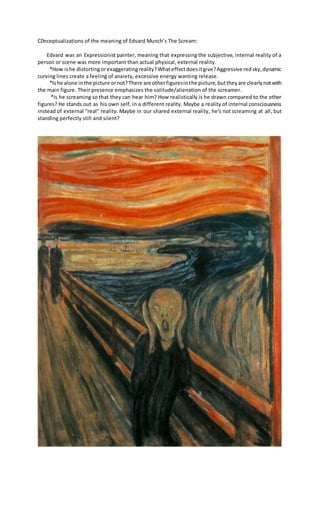
2. Image of Edvard Munch’s The Scream
3. Yellow papers stapled, or copy paper folded and stapled.
Exercise 1:
Objective: Students will notice and describe the difference between their internal and external states.
They will experience their consciousness by noticing and recording their thoughts.
1. Students stare at their own faces in a mirror for a full minute.
After the minute is up:
a. Write about what you noticed while looking at yourself.
b. What did you notice about your face?
c. What were you thinking about?
Or, alternatively, you could ask somebody as a partner, then stare at each
other and then record what that was like, how was it different than looking at
yourself, what were you thinking, were you trying to notice the appearance of your
partner, were you wondering how you look to your partner
2. Readexcerptwhere Roquentinislookingathisface inamirror,starting“Igetup.There isawhite
hole in the wall, a mirror…” through “light halo gliding in the light.”
3. Answer the following questions:
a. In what way can you relate your mirror experience to Roquintin’s?
b. What does Roquentinmean withhis comment about the monkey? Do you see the same
image with yourself? Do you question what your image reflects to you?
c. He seessomethinglowerthanthe monkey.Whatdoesthatmean? Do youhave the same
consciousness with Roquintin upon seeing your image in the mirror vis-à-vis your real
world?
d. Why is he so fascinated/bothered by his reflection? Are you? If not, why?
Exercise 2:
Objective:Studentswill gainanunderstandingof the feelingof nauseaasdescribedbyNausea’s narrator,
connectingit withtheirown feelings.Theywill be able toexplainwhatis meantby “existence precedes
essence”.
1. Project image of Edvard Munch’s The Scream.
2. Answer the following questions:
a. How does this picture make you feel/
b. Why is the person screaming? Or, why, on the outside, are you screaming?
c. Describe a time when, on the inside, you felt like the person in this picture.
3. Draw your own expression of The Scream.
Summary of Jean-Paul Sartre’s novel,Nausea [(SparkNotesEditors.“SparkNoteonNausea.”
SparkNotesLLC.n.d..http://www.sparknotes.com/lit/nausea/(accessedNovember17,2016).]
Characters:
Antoine Roquentin - The protagonist of the novel, he is also the narrator, writing down his
observations in diary format. After traveling around most of Africa and the Far East, he returned to
Bouville tocomplete hishistorical researchonthe Marquisde Rollebon.Yet,notonlyhashe lostinterest
inhisresearch,butsomethingaboutthe wayhe seesbothhimself andthe outsideworldbeginstoworry
him.Whetheritisholdingastone or lookingata glassof beer,he feelsconfrontedbythe bare existence
of things. The result is what he calls the Nausea. He soon realizes that the Nausea comes from the fact
that "existenceprecedesessence."He thinksthe physical characteristicsof objectsandpeople are justa
comfortingfacade tomaskthe "nothingness"of existence.Bythe endof the novel he hasdisavowedthe
past,embracedhisexistence,anddiscoveredthatthere isnopurposetoexistence.Ratherthansurrender
to despair, he decides to assert his freedom and moves to Paris to write a novel.
Marquisde Rollebon - Althoughnotacharacter inthe novel perse,he isthe subjectof Roquentin's
research. He was a mysterious French aristocrat who meddled in politics during and after the French
Revolution.AtfirstRoquentinthinkshe canlearneverythingabouthim, butsoonrealizesthatnotonlyis
he guessingaboutwhothe marquisreallywas,buthe isalsousinghimtojustifyhisexistence.Roquentin's
rejection of Rollebon is thus a rejection of living in the past.
Anny - She is Roquentin'soldloverandlivesinParis.Eventhough she begsRoquentinto come see
her,she ismore interestedinthe manhe usedtobe.She admittedlylivesinthe past,rereadingthe same
historybooksandrecallingthe "perfectmoments"of herlife.She refusestoresumeherrelationshipwith
Roquentin since she is already the mistress of a number of men who pay for her apartment.
Self-TaughtMan- A lonelymanwhomRoquentinmeetsatthe Bouville Library.Roquentinmockshim
forthinkinghe canlearnall there istoknow byreadingeverything inthe Libraryinalphabeticalorder.He
is a defender of humanism, believingthat all men and womenare unitedby the common bond of love.
He is later chased out of town for fondling a small boy in public.
Francoise - The barmaidof a local cafe, she isRoquentin'ssometime lover.Ashisnauseaprogresses
he is more and more disgusted at the prospect of having sex with her.
Summary:
The novel opens with an "Editors' Note," claiming that the following pages were found among the
papers of Antoine Roquentin. The pages are presented in a diary format. The Editors suggest that
Roquentin began his diary in January 1932, following his return from the Far East, Central Europe, and
North Africa. He moved to the seaside town of Bouville in order to write a book about the Marquis de
Rollebon.
Roquentin's introductory notes establish his intent to keep a diary. He feels that something has
changedin the wayhe seesobjects,buthe cannot quite place hisfingeron exactlywhat.He hopesthat
a diarywill helphimbetterunderstandwhatis goingon, specifically,tosee,classify,anddeterminethe
extentandnature of the change.He recallsanoddsensationwhileholdingastone afew daysearlier,but
is not sure whether the odd feeling came from the stone or himself. Despite hisfeelings of disgust and
being afraid of the stone,he is wary of exaggerating the eventshe records in his diary. Indeed, he soon
writesthat his odd feelingswere nothingbuta passingmomentof madnessand that there is no longer
any need to continue with his diary.
Nevertheless, the next entry, dated January 29, 1932, opens with Roquentin's realization that
something strange has happened to him. He first thought that it was nothing but a "passing moment"
gives way to a permanent feeling of uneasiness around objects and people. He hopes that it is nothing
but an "abstract change," but soon begins to worry that he is the one who has changed little by little,
overwhelmedbyasuddentransformation.He recallshiswhimsical decisiontoleave Vietnamandreturn
to France, terrified that it was actually a precursor to his current state of mind.
The nextday,however,hebecomesresignedtohisfate,realizingthathissolitarylifestylehaschanged
him.He notices thatlivingalone haspreventedhimfrombothhavingfriendsandsimplycommunicating
withotherpeople.Whenhe looksinsidehimself foranswers,he findsnothing.Evenwhenhe hassexwith
Francoise,a local barmaid,verylittle issaidbetweenthem:Roquentinfeelsthathe ispurginghimself of
a "certain nostalgia" rather than feeling pleasure. Yet he does acknowledge that he would be lying to
himself if he begantothinkthatnothingnew hashappenedtohim.Whenhe looksataglassof beerora
soggy piece of paper lying in the street he is unable to touch them despite his desire to do so. He does
not feel free.Thinkingbackonthe strange feelinghe hadwhile holdingthe stone he recallsa"nauseaof
the hands."
Roquentin attempts to divert his angst with historical research on the Marquis de Rollebon, a
mysterious aristocrat who lived around the time of the French Revolution. Yet Roquentin's research
beginstobore him.Tenyearsearlierhe hadbeenfascinatedwiththe storyof the Marquis,butnowfeels
that he is writinga workof pure conjecture thathas nothingto do withthe real Marquis at all.Hiswork
inevitably returns Roquentin to himself and his emerging disgust at the outside world. Specifically,the
changingappearance of objectsin the lightof the sunmakeshim feel uneasy.Whenhe triestofocuson
the mysteryof Rollebonhe can'thelpbutlookathimself inthe mirror,alarmedthathe doesn'trecognize
his own face:
“ I getup. Imove throughthispale light;Isee itchange beneathmyhandsandon
the sleevesof mycoat:I cannotdescribe how muchitdisgustsme.Iyawn.I lightthe
lamp on the table: perhaps its light will be able to combat the light of day. But no:
the lampmakesnothingmore than a pitiful pondarounditsbase.I turn it out; I get
up. There is a white hole in the wall, a mirror. It is a trap. I know I am going to let
myself be caughtinit.Ihave.The greythingappearsinthe mirror.Igooverand look
at it, I can no longergetaway.It isthe reflectionof myface.Ofteninthese lostdays
I studyit.Ican understandnothingof thisface.The facesof othershave some sense,
some direction. Not mine. I cannot even decide whether it is handsome or ugly. I
think it is ugly because I have been told so. But it doesn't strike me. At heart, I am
even shocked that anyone can attribute qualities of this kind to it, as if you called a
clod of earth or a block of stone beautiful or ugly. Still, there is one thing which is
pleasing to see, above the flabbycheeks, above the forehead; it is he beautiful red
flame which crowns my head, it is my hair. That is pleasant to see. Anyhow, it is a
definitecolour:IamgladIhave redhair.There itisinthe mirror, itmakesitselfseen,
it shines. I am still lucky: if my forehead was surmounted by one of those neutral
heads of hair which are neither chestnut nor blond, my face would be lost in
vagueness, it would make me dizzy. My glance slowly and wearily travels over my
forehead,mycheeks:itfindsnothingfirm, itisstranded.Obviouslythereare anose,
two eyes and a mouth, but none of it makes sense, there is not even a human
expression.YetAnnyandVelinesthoughtIlookedsoalive:perhapsIamtoo usedto
my face.”
WhenI was little,myAuntUigeoistoldme "If youlookatyourself toolonginthe
mirror, you'll see a monkey." I must have looked at myself even longer than that:
whatIsee iswell belowthe monkey,onthe fringeof the vegetableworld,atthe level
of jellyfish. It is alive, I can't say it isn't; but this was not the life that Anny
contemplated:Isee aslighttremor,Isee the insipidfleshblossomingandpalpitating
with abandon. The eyes especially are horrible seen so close. They are glassy, soft,
blind, red-rimmed, they look like fish scales. I lean all my weight on the porcelain
ledge, I draw my face closer until it touches the mirror. The eyes, nose and mouth
disappear:nothinghumanis left.Brownwrinklesshow on each side of the feverish
swelledlips,crevices,mole holes.A silkywhite downcoversthe great slopesof the
cheeks, two hairs protrude from the nostrils: it is a geological embossedmap. And,
in spite of everything,thislunarworldisfamiliarto me.I cannot say I recognize the
details.Butthe whole thinggivesme animpressionof somethingseenbefore which
stupefiesme:Islipquietlyoff tosleep.Iwouldlike totake holdof myself:anacute,
vividsensationwoulddeliverme.I plastermy lefthand againstmy cheek,I pull the
skin; I grimace at myself. An entire half of my face yields, the left half of the mouth
twists and swells, uncovering a tooth, the eye opens on a white globe, on pink,
bleedingflesh.Thatis not whatI was lookingfor: nothingstrong,nothingnew;soft,
flaccid, stale! I go to sleep with my eyes open, already the face is growing larger,
growing in the mirror, an immense, light halo gliding in the light. . . . “
Roquentin begins the next section in the grips of what he calls the "Nausea." He previously thought
thathisoddfeelingsaroundobjectsandpeopleonlyoccurredwhenhe wasaloneorwalkinginthe street,
but nowtheyalso occur in hisfavorite cafe.Overcome withanxiety,he exclaimsinhisdiary:"Thingsare
bad!Thingsare verybad."He findsthathe nolongerrecognizespeoplebutonlyseeshands,eyelids,hair,
cheeks,dirtyskin,and"enormousnostrils."Hisheadbeginstospinandhe triesto steadyhisfeeton the
ground to keep from vomiting. Roquentin is especially disgusted at a bartender's purple suspenders,
which he thinks keep changing color.
Inan attempttocalm hisnerves,Roquentinasksabarmaidtoplayone of hisfavorite songs,aragtime
record called"Some of these days."Before the musicbegins,he worriesthatthe musicwill nothelphim
pass the time.He thinksthat time is "too large" and can't be filledupwithoutit disintegratingbetween
one's fingers. Indeed, each note of the music is born at the same time that it dies. He decides that he
mustnotonlyaccepttheirdeaths,butthathemust"willit."Everythingseemsinevitabletohim.He knows
the songby heart and anticipatesthe lyrics:nothingisa surprise.Butwhenthe lyricsactuallybegin,the
Nauseavanishes.Roquentin writesthatthe melody"crushes"the timeof the real world,makinghimfeel
in in the music.
Whenthe musicends,Roquentindoesn'tknow what to do with himself.He wants to go see a movie
but ends up wandering the streets. He shiesaway from the light, following dark avenues towardswhat
he callsa "blackhole."Somethingaboutthe blacknothingnessof the Bouvillestreetsatnightcatcheshis
attentionbuthe isnotsure exactlywhyorhow.He justknowsthathe feelsmore comfortableinthe dark-
-the Nausea only occurs in the light.
The nextday,he triestodiverthisattentionfromthe NauseabyintermittentlyreadingBalzac'sEugenie
Grandet and researching Rollebon. At the library, he runs into the Self-Taught Man, who thinks that he
can learnall there is to knowby readingthe entire contentsof the Bouville libraryinalphabetical order.
The sheerpredictabilityof the Self-TaughtMan'sbehaviorremindsRoquentinthattraditional definitions
of time have become meaninglesstohimunderthe influence of the Nausea:"Ican no longerdistinguish
the presentfromthe future."He findsthe Self-Taughtmanveryboringbuttheyendupspendingalotof
time togetheroutof sheerloneliness.The Self-TaughtManadmiresRoquentin'ssenseof adventure,but
Roquentinrealizesthatman's obsessionwithadventure isnothingbutan attemptto "catch time by the
tail." Roquentin cannot recapture his past adventures in the Far East and as a result, feels "forsakenin
the present."
Roquentinfindshimselfunabletocomplete hisresearchonthe Marquisde Rollebon.He usedtoenjoy
Rollebon'sovertliesinletterstocontemporaryaristocrats,butRoquentinnow feelsthatRollebonislying
tohimpersonally.He hadhopedthatbyresearchingRollebon,he woulddiscoverthe truthabouthimjust
aseasilyashe couldlearnaboutsomeonewhowasstillalive.Yet,notonlyisRollebondeadbutRoquentin
thinksany understandingof the past to be a futile pursuitatbest.The Rollebonhe thoughhe knewwas
nothing but a man of his own creation, who ended up disgusting him as much as he disgusts himself.
Roquentin's attention turns to womeninstead. He tries to fondle Francoise under a cafe table,but is
thoroughlydisgustedbythe ideaof sex.He imaginesantsand othervermincrawlingup her leg,while a
suddenattackof the Nauseamakeshimwanttovomit.He thenreceivesaletterfromhisoldlover,Anny.
They have not seen or spoken to each other since they parted ways in Vietnam five years earlier. She
writesthatshe isin Parisanddesperatelyneedstosee him.Roquentinisfirstexcitedtosee herbutthen
recalls all the trouble they had communicating with each other. He realizes that it is completely his
decisionwhathappensnext:he can eithergo see her or do nothing.He says that he staggersunder the
weight of his responsibility.
Whenhe triesto remembermore aboutAnny,he realizesthathe can neverhave anyreal memoryof
her:he feelsthatitisimpossible tothinkof someoneinthe past.Roquentinconcludesthatthe pastdoes
not exist;inits place there isonly an enormousvacuum.He then comprehendsthatif one cannot learn
fromthe past theycannotlearnfromthe present.Historianstrytodescribe currenteventsandpeoplein
terms of a convenient but meaningless past: Leninwas a Russian Robespierre, while Robespierre was a
FrenchCromwell.Inthe end,one is leftwithrelative comparisonsthatsignifynothing.Roquentinwants
to free himself from the meaningless past by perceiving objects and people on their own terms.
Roquentin soon realizes that one of things that has been bothering himis the meaning of existence.
While roaming through the halls of the Bouville portrait museum, he is confronted with hundreds of
paintedeyes bothlookingathimandrecallingthe experiencesthatmade themworthyportraitsubjects.
Roquentinthinksthatthesemenweresoafraidof deaththattheyreliedontheirpastexperiencestogive
meaning to their lives. But Roquentin decides that the past is useless since death can come at any
moment--why try and hide from it?
Roquentin's final refusal to research Rollebon gives him a greater understanding of the meaning of
existence.He thinksthe pastdoesnot existat all,while the presentisthe onlythingthatdoes.His foray
intoRollebon'spastwas nothingbut a "vacation"fromexistence.Roquentin'smemoriesof hisresearch
have become anemptyvacuumjustasRollebonhasreturnedtothe "nothingness"fromwherehe came.
He realizesthatanythinghe wrote about Rollebonandthe past was pure fictionand bettersuitedfora
novel.
Roquentin'snewfoundappreciationandawarenessof hisexistence putshimatodds withthe people
he meets and sees. While sitting at a café, he is disgusted with the robot-like behavior of the people
around him. He thinks that they are trying to hide the enormous absurdity of their existence from
themselves:theyare eitherlyingtothemselvesaboutwhomtheyare goingtosleepwithorstuffingtheir
mouths with food. Roquentin however, righteously declares that, unlike everyone else at the cafe, he
doesnothide hisexistence fromhimself:knowsthathe exists.Hisdisgustcauseshimtogetintoaheated
debate with the Self-Taught Man about humanism. The Self-Taught Man believes that all rational
behaviorcanbe explainedbyman'slove forhisfellow man.He proudlydeclaresthathe isa socialistand
naturally loves every man and woman in the world. But Roquentin ridicules himfor lovingsymbols and
labels that are just essences and thus do not really exist.
The two men part on poor terms as Roquentin is overcome by the Nausea. He is afraid to touch
anything for fear that it will make him sick. Holding a knife, he is shocked by the raw sensation of its
handle. Suddenly, he understandswhat the Nausea is about: his fear of existence. Anything he touches
no longerhasany essence;itjustexists.Hisrevelationclimaxeswhenhe seesthe rootof a chestnuttree
under a park bench. Roquentin can find no words to describe the root--it is simply there. He discovers
that existence usuallyhidesitself fromview orthoughtwith the facade of itsessence,or attributes.For
Roquentin,the word"existence"nolongerevokesanabstractcategorybutanunexplainablenothingness
that has no reason to be there.
The second he tries to explain its size, color, or function, Roquentin discoversthat he is no longer
talking about the root, but about things that don't exist. He thinks back on the bartender's purple
suspenders and realizes that they were never purple, but something that looked like a "color." He
concludes that an object's essence is a simplifiedidea to hide its existence. The uneasy feeling of his
Nausea is a result of colors, tastes, and smells that are not real. His feelings of Nausea also come from
what he calls "contingency." He thinks that people attribute essences to objects to supply a reason for
their existence.But he claims that there is no necessary reason for something to exist--it is there by
accident.Since humanexistenceiscontingent,meaninganythingcanhappenatanymoment,Roquentin
finds no reason for existence: it is just a free gift.
Roquentin had moved to Bouville in order to study the Rollebon archives, so after abandoning his
research he sees no reason to remain there. He plans to first visit his ex-lover Anny in Paris, return to
Bouville to pack up his belongings, and then return to Paris indefinitely. He secretly hopes that he can
both explain his Nausea to Anny and that they can get back together. As he waits for his train he feels
ready for an adventure.
He and Anny meet as planned, but they are very awkward around each other. Roquentin is
disappointedtofindthatAnnyhasgrownoldand isno longerasattractive as he remembered.He isalso
surprisedthat she is the mistressof a numberof men who pay for her apartment.Roquentincannever
completelyunderstandwhatAnnyistalkingabout,asshe intermittentlylaughsathisawkwardness.She
says that she is very happy to see him because he never changes. She calls him her milestone, claiming
that she needs him to remain the same so she can tell how much she has changed over the years.
Their conversation turns to their past relationship. Roquentin can remember very little of the things
theydid together,feelingoverwhelmedbyAnny'sprecise memory.Annyis obsessedwiththe past: she
remembersentirepassagesfromplaysandconstantlystudiesFrenchhistory.She alsospeaksof "perfect
moments," which she describes as past events whose importance she embraced while they were
happening. But she thinks that they no longer exist; she can't recreate emotions that are in the past.
Roquentin suspects that she has come to similar conclusions as him about the nature of time and
existence.He describeshisNauseaanddiscoverythatexistenceprecedesessence,butAnnydoesn'tagree
with him at all. She asks him to leave and he reluctantly obeys.
Back inBouville,RoquentinpreparestoreturntoParisfor good.He issad that he and Annycannotbe
togetherbutapart of himhadexpectednothingtocome of theirmeeting.He feelsverylonely,especially
while walkingaroundthe citystreets,buttakescomfortfromhisawarenessof existence.He wantstosay
goodbye tothe Self-TaughtMan,butseeshimfondlingasmall boyinpublic.Otherpeopleseethe offence
and chase the Self-Taught Man away. Left to himself, Roquentin goes back to his old cafe one last time
and asksto hear hisfavorite record,"Some of these days."Ashe listenstothe song overand overagain,
he resolvestowrite a novel thatwill have nothingtodo withthe questionof existence.He thinksthatit
might clarify who he was in the past and prevent him from remembering his life with disgust.
C0nceptualizations of the meaning of Edvard Munch’s The Scream:
Edvard was an Expressionist painter, meaning that expressing the subjective, internal reality of a
person or scene was more important than actual physical, external reality.
*How ishe distortingorexaggeratingreality?Whateffectdoesitgive?Aggressive redsky,dynamic
curving lines create a feeling of anxiety, excessive energy wanting release.
*Ishe alone inthe picture ornot?There are otherfiguresinthe picture,buttheyare clearlynotwith
the main figure. Their presence emphasizes the solitude/alienation of the screamer.
*Is he screaming so that they can hear him? How realistically is he drawn compared to the other
figures? He stands out as his own self, in a different reality. Maybe a reality of internal consciousness
instead of external “real” reality. Maybe in our shared external reality, he’s not screaming at all, but
standing perfectly still and silent?

Exploring the-self-and-existence

  • 1.
    This is anactivity/exercise that incorporate passages from the novel, Nausea ---- a certain vaguefeeling the main character,Roquentin,calls“nausea”.This feeling is basically a result of suspecting thatthereis a reality behind whatweperceive as reality,an objectiveand subjectiverealityor Self. Realizing that upon piercing the veil of existence, there’s a subjective reality that we alone are responsible for creating – this creates a freedom, but also a burden and anxiety or nausea. That subjectivity(ortheword “contingency”isused in Nausea)isthe1stprincipleof Existentialism. Roquentin’s revelationsaboutrealityand humanconsciousnesslead himto hisunderstanding that“existenceprecedes essence”.Weexistfirst,and then do stuff and definewhoweareafterthefactof existing.Theimplications of this are thatweare all free to defineourown essence.We exist,thereforewe haveanxiety aboutwhat to do with ourselves now that we exist --- This overwhelming freedom is highly relatable to you who are coping with your first wave of existential angst,aswell astryingtoconstruct your virtual Self/Selvesinthisworldorotherworlds.This activityisdesignedtoencourage youto lookat your individual choicesthroughthe lensof the concepts of consciousness, reason, emotion and practicality. You will be asked to record your thoughts and experiencesasyou go throughthe material andgroup discussionslater. There will be series of exercises that will follow after this first exercise. Title: Exploring the Self and Existence via the concepts of consciousness, reason, emotion and practicality in one’s world Learning Objectives: 1. Studentswill noticeanddescribe the differencebetweentheirinternal andexternal states.They will experience their consciousness by noticing and recording their thoughts. 2. Students will gain an understandingof the feeling of nausea as describedby Nausea’s narrator, connecting it with their own feelings. They will be able to explain what is meant by “existence precedes essence”. 3. Studentswill explore the conceptof “Adventure”asdescribedinSartre’sNauseaand applythis concept to their own world. 4. Students will examine how Sartre’s views about living in Nausea are expressed, and how their own ideas about living their lives as individuals are impacted by other’s world. Tool Kits to be used; 1. Existentialism of Jean-Paul Sartre in Nausea. (Attached is a summary excerpts of the novel, Nausea, please read). 2. Image of Edvard Munch’s The Scream 3. Yellow papers stapled, or copy paper folded and stapled. Exercise 1: Objective: Students will notice and describe the difference between their internal and external states. They will experience their consciousness by noticing and recording their thoughts. 1. Students stare at their own faces in a mirror for a full minute. After the minute is up: a. Write about what you noticed while looking at yourself. b. What did you notice about your face? c. What were you thinking about? Or, alternatively, you could ask somebody as a partner, then stare at each other and then record what that was like, how was it different than looking at yourself, what were you thinking, were you trying to notice the appearance of your partner, were you wondering how you look to your partner 2. Readexcerptwhere Roquentinislookingathisface inamirror,starting“Igetup.There isawhite hole in the wall, a mirror…” through “light halo gliding in the light.”
  • 2.
    3. Answer thefollowing questions: a. In what way can you relate your mirror experience to Roquintin’s? b. What does Roquentinmean withhis comment about the monkey? Do you see the same image with yourself? Do you question what your image reflects to you? c. He seessomethinglowerthanthe monkey.Whatdoesthatmean? Do youhave the same consciousness with Roquintin upon seeing your image in the mirror vis-à-vis your real world? d. Why is he so fascinated/bothered by his reflection? Are you? If not, why? Exercise 2: Objective:Studentswill gainanunderstandingof the feelingof nauseaasdescribedbyNausea’s narrator, connectingit withtheirown feelings.Theywill be able toexplainwhatis meantby “existence precedes essence”. 1. Project image of Edvard Munch’s The Scream. 2. Answer the following questions: a. How does this picture make you feel/ b. Why is the person screaming? Or, why, on the outside, are you screaming? c. Describe a time when, on the inside, you felt like the person in this picture. 3. Draw your own expression of The Scream.
  • 3.
    Summary of Jean-PaulSartre’s novel,Nausea [(SparkNotesEditors.“SparkNoteonNausea.” SparkNotesLLC.n.d..http://www.sparknotes.com/lit/nausea/(accessedNovember17,2016).] Characters: Antoine Roquentin - The protagonist of the novel, he is also the narrator, writing down his observations in diary format. After traveling around most of Africa and the Far East, he returned to Bouville tocomplete hishistorical researchonthe Marquisde Rollebon.Yet,notonlyhashe lostinterest inhisresearch,butsomethingaboutthe wayhe seesbothhimself andthe outsideworldbeginstoworry him.Whetheritisholdingastone or lookingata glassof beer,he feelsconfrontedbythe bare existence of things. The result is what he calls the Nausea. He soon realizes that the Nausea comes from the fact that "existenceprecedesessence."He thinksthe physical characteristicsof objectsandpeople are justa comfortingfacade tomaskthe "nothingness"of existence.Bythe endof the novel he hasdisavowedthe past,embracedhisexistence,anddiscoveredthatthere isnopurposetoexistence.Ratherthansurrender to despair, he decides to assert his freedom and moves to Paris to write a novel. Marquisde Rollebon - Althoughnotacharacter inthe novel perse,he isthe subjectof Roquentin's research. He was a mysterious French aristocrat who meddled in politics during and after the French Revolution.AtfirstRoquentinthinkshe canlearneverythingabouthim, butsoonrealizesthatnotonlyis he guessingaboutwhothe marquisreallywas,buthe isalsousinghimtojustifyhisexistence.Roquentin's rejection of Rollebon is thus a rejection of living in the past. Anny - She is Roquentin'soldloverandlivesinParis.Eventhough she begsRoquentinto come see her,she ismore interestedinthe manhe usedtobe.She admittedlylivesinthe past,rereadingthe same historybooksandrecallingthe "perfectmoments"of herlife.She refusestoresumeherrelationshipwith Roquentin since she is already the mistress of a number of men who pay for her apartment. Self-TaughtMan- A lonelymanwhomRoquentinmeetsatthe Bouville Library.Roquentinmockshim forthinkinghe canlearnall there istoknow byreadingeverything inthe Libraryinalphabeticalorder.He is a defender of humanism, believingthat all men and womenare unitedby the common bond of love. He is later chased out of town for fondling a small boy in public. Francoise - The barmaidof a local cafe, she isRoquentin'ssometime lover.Ashisnauseaprogresses he is more and more disgusted at the prospect of having sex with her. Summary: The novel opens with an "Editors' Note," claiming that the following pages were found among the papers of Antoine Roquentin. The pages are presented in a diary format. The Editors suggest that Roquentin began his diary in January 1932, following his return from the Far East, Central Europe, and North Africa. He moved to the seaside town of Bouville in order to write a book about the Marquis de Rollebon. Roquentin's introductory notes establish his intent to keep a diary. He feels that something has changedin the wayhe seesobjects,buthe cannot quite place hisfingeron exactlywhat.He hopesthat a diarywill helphimbetterunderstandwhatis goingon, specifically,tosee,classify,anddeterminethe extentandnature of the change.He recallsanoddsensationwhileholdingastone afew daysearlier,but is not sure whether the odd feeling came from the stone or himself. Despite hisfeelings of disgust and being afraid of the stone,he is wary of exaggerating the eventshe records in his diary. Indeed, he soon writesthat his odd feelingswere nothingbuta passingmomentof madnessand that there is no longer any need to continue with his diary. Nevertheless, the next entry, dated January 29, 1932, opens with Roquentin's realization that something strange has happened to him. He first thought that it was nothing but a "passing moment" gives way to a permanent feeling of uneasiness around objects and people. He hopes that it is nothing but an "abstract change," but soon begins to worry that he is the one who has changed little by little, overwhelmedbyasuddentransformation.He recallshiswhimsical decisiontoleave Vietnamandreturn to France, terrified that it was actually a precursor to his current state of mind. The nextday,however,hebecomesresignedtohisfate,realizingthathissolitarylifestylehaschanged him.He notices thatlivingalone haspreventedhimfrombothhavingfriendsandsimplycommunicating withotherpeople.Whenhe looksinsidehimself foranswers,he findsnothing.Evenwhenhe hassexwith Francoise,a local barmaid,verylittle issaidbetweenthem:Roquentinfeelsthathe ispurginghimself of a "certain nostalgia" rather than feeling pleasure. Yet he does acknowledge that he would be lying to himself if he begantothinkthatnothingnew hashappenedtohim.Whenhe looksataglassof beerora
  • 4.
    soggy piece ofpaper lying in the street he is unable to touch them despite his desire to do so. He does not feel free.Thinkingbackonthe strange feelinghe hadwhile holdingthe stone he recallsa"nauseaof the hands." Roquentin attempts to divert his angst with historical research on the Marquis de Rollebon, a mysterious aristocrat who lived around the time of the French Revolution. Yet Roquentin's research beginstobore him.Tenyearsearlierhe hadbeenfascinatedwiththe storyof the Marquis,butnowfeels that he is writinga workof pure conjecture thathas nothingto do withthe real Marquis at all.Hiswork inevitably returns Roquentin to himself and his emerging disgust at the outside world. Specifically,the changingappearance of objectsin the lightof the sunmakeshim feel uneasy.Whenhe triestofocuson the mysteryof Rollebonhe can'thelpbutlookathimself inthe mirror,alarmedthathe doesn'trecognize his own face: “ I getup. Imove throughthispale light;Isee itchange beneathmyhandsandon the sleevesof mycoat:I cannotdescribe how muchitdisgustsme.Iyawn.I lightthe lamp on the table: perhaps its light will be able to combat the light of day. But no: the lampmakesnothingmore than a pitiful pondarounditsbase.I turn it out; I get up. There is a white hole in the wall, a mirror. It is a trap. I know I am going to let myself be caughtinit.Ihave.The greythingappearsinthe mirror.Igooverand look at it, I can no longergetaway.It isthe reflectionof myface.Ofteninthese lostdays I studyit.Ican understandnothingof thisface.The facesof othershave some sense, some direction. Not mine. I cannot even decide whether it is handsome or ugly. I think it is ugly because I have been told so. But it doesn't strike me. At heart, I am even shocked that anyone can attribute qualities of this kind to it, as if you called a clod of earth or a block of stone beautiful or ugly. Still, there is one thing which is pleasing to see, above the flabbycheeks, above the forehead; it is he beautiful red flame which crowns my head, it is my hair. That is pleasant to see. Anyhow, it is a definitecolour:IamgladIhave redhair.There itisinthe mirror, itmakesitselfseen, it shines. I am still lucky: if my forehead was surmounted by one of those neutral heads of hair which are neither chestnut nor blond, my face would be lost in vagueness, it would make me dizzy. My glance slowly and wearily travels over my forehead,mycheeks:itfindsnothingfirm, itisstranded.Obviouslythereare anose, two eyes and a mouth, but none of it makes sense, there is not even a human expression.YetAnnyandVelinesthoughtIlookedsoalive:perhapsIamtoo usedto my face.” WhenI was little,myAuntUigeoistoldme "If youlookatyourself toolonginthe mirror, you'll see a monkey." I must have looked at myself even longer than that: whatIsee iswell belowthe monkey,onthe fringeof the vegetableworld,atthe level of jellyfish. It is alive, I can't say it isn't; but this was not the life that Anny contemplated:Isee aslighttremor,Isee the insipidfleshblossomingandpalpitating with abandon. The eyes especially are horrible seen so close. They are glassy, soft, blind, red-rimmed, they look like fish scales. I lean all my weight on the porcelain ledge, I draw my face closer until it touches the mirror. The eyes, nose and mouth disappear:nothinghumanis left.Brownwrinklesshow on each side of the feverish swelledlips,crevices,mole holes.A silkywhite downcoversthe great slopesof the cheeks, two hairs protrude from the nostrils: it is a geological embossedmap. And, in spite of everything,thislunarworldisfamiliarto me.I cannot say I recognize the details.Butthe whole thinggivesme animpressionof somethingseenbefore which stupefiesme:Islipquietlyoff tosleep.Iwouldlike totake holdof myself:anacute, vividsensationwoulddeliverme.I plastermy lefthand againstmy cheek,I pull the skin; I grimace at myself. An entire half of my face yields, the left half of the mouth twists and swells, uncovering a tooth, the eye opens on a white globe, on pink, bleedingflesh.Thatis not whatI was lookingfor: nothingstrong,nothingnew;soft, flaccid, stale! I go to sleep with my eyes open, already the face is growing larger, growing in the mirror, an immense, light halo gliding in the light. . . . “ Roquentin begins the next section in the grips of what he calls the "Nausea." He previously thought thathisoddfeelingsaroundobjectsandpeopleonlyoccurredwhenhe wasaloneorwalkinginthe street, but nowtheyalso occur in hisfavorite cafe.Overcome withanxiety,he exclaimsinhisdiary:"Thingsare bad!Thingsare verybad."He findsthathe nolongerrecognizespeoplebutonlyseeshands,eyelids,hair, cheeks,dirtyskin,and"enormousnostrils."Hisheadbeginstospinandhe triesto steadyhisfeeton the ground to keep from vomiting. Roquentin is especially disgusted at a bartender's purple suspenders, which he thinks keep changing color. Inan attempttocalm hisnerves,Roquentinasksabarmaidtoplayone of hisfavorite songs,aragtime record called"Some of these days."Before the musicbegins,he worriesthatthe musicwill nothelphim
  • 5.
    pass the time.Hethinksthat time is "too large" and can't be filledupwithoutit disintegratingbetween one's fingers. Indeed, each note of the music is born at the same time that it dies. He decides that he mustnotonlyaccepttheirdeaths,butthathemust"willit."Everythingseemsinevitabletohim.He knows the songby heart and anticipatesthe lyrics:nothingisa surprise.Butwhenthe lyricsactuallybegin,the Nauseavanishes.Roquentin writesthatthe melody"crushes"the timeof the real world,makinghimfeel in in the music. Whenthe musicends,Roquentindoesn'tknow what to do with himself.He wants to go see a movie but ends up wandering the streets. He shiesaway from the light, following dark avenues towardswhat he callsa "blackhole."Somethingaboutthe blacknothingnessof the Bouvillestreetsatnightcatcheshis attentionbuthe isnotsure exactlywhyorhow.He justknowsthathe feelsmore comfortableinthe dark- -the Nausea only occurs in the light. The nextday,he triestodiverthisattentionfromthe NauseabyintermittentlyreadingBalzac'sEugenie Grandet and researching Rollebon. At the library, he runs into the Self-Taught Man, who thinks that he can learnall there is to knowby readingthe entire contentsof the Bouville libraryinalphabetical order. The sheerpredictabilityof the Self-TaughtMan'sbehaviorremindsRoquentinthattraditional definitions of time have become meaninglesstohimunderthe influence of the Nausea:"Ican no longerdistinguish the presentfromthe future."He findsthe Self-Taughtmanveryboringbuttheyendupspendingalotof time togetheroutof sheerloneliness.The Self-TaughtManadmiresRoquentin'ssenseof adventure,but Roquentinrealizesthatman's obsessionwithadventure isnothingbutan attemptto "catch time by the tail." Roquentin cannot recapture his past adventures in the Far East and as a result, feels "forsakenin the present." Roquentinfindshimselfunabletocomplete hisresearchonthe Marquisde Rollebon.He usedtoenjoy Rollebon'sovertliesinletterstocontemporaryaristocrats,butRoquentinnow feelsthatRollebonislying tohimpersonally.He hadhopedthatbyresearchingRollebon,he woulddiscoverthe truthabouthimjust aseasilyashe couldlearnaboutsomeonewhowasstillalive.Yet,notonlyisRollebondeadbutRoquentin thinksany understandingof the past to be a futile pursuitatbest.The Rollebonhe thoughhe knewwas nothing but a man of his own creation, who ended up disgusting him as much as he disgusts himself. Roquentin's attention turns to womeninstead. He tries to fondle Francoise under a cafe table,but is thoroughlydisgustedbythe ideaof sex.He imaginesantsand othervermincrawlingup her leg,while a suddenattackof the Nauseamakeshimwanttovomit.He thenreceivesaletterfromhisoldlover,Anny. They have not seen or spoken to each other since they parted ways in Vietnam five years earlier. She writesthatshe isin Parisanddesperatelyneedstosee him.Roquentinisfirstexcitedtosee herbutthen recalls all the trouble they had communicating with each other. He realizes that it is completely his decisionwhathappensnext:he can eithergo see her or do nothing.He says that he staggersunder the weight of his responsibility. Whenhe triesto remembermore aboutAnny,he realizesthathe can neverhave anyreal memoryof her:he feelsthatitisimpossible tothinkof someoneinthe past.Roquentinconcludesthatthe pastdoes not exist;inits place there isonly an enormousvacuum.He then comprehendsthatif one cannot learn fromthe past theycannotlearnfromthe present.Historianstrytodescribe currenteventsandpeoplein terms of a convenient but meaningless past: Leninwas a Russian Robespierre, while Robespierre was a FrenchCromwell.Inthe end,one is leftwithrelative comparisonsthatsignifynothing.Roquentinwants to free himself from the meaningless past by perceiving objects and people on their own terms. Roquentin soon realizes that one of things that has been bothering himis the meaning of existence. While roaming through the halls of the Bouville portrait museum, he is confronted with hundreds of paintedeyes bothlookingathimandrecallingthe experiencesthatmade themworthyportraitsubjects. Roquentinthinksthatthesemenweresoafraidof deaththattheyreliedontheirpastexperiencestogive meaning to their lives. But Roquentin decides that the past is useless since death can come at any moment--why try and hide from it? Roquentin's final refusal to research Rollebon gives him a greater understanding of the meaning of existence.He thinksthe pastdoesnot existat all,while the presentisthe onlythingthatdoes.His foray intoRollebon'spastwas nothingbut a "vacation"fromexistence.Roquentin'smemoriesof hisresearch have become anemptyvacuumjustasRollebonhasreturnedtothe "nothingness"fromwherehe came. He realizesthatanythinghe wrote about Rollebonandthe past was pure fictionand bettersuitedfora novel. Roquentin'snewfoundappreciationandawarenessof hisexistence putshimatodds withthe people he meets and sees. While sitting at a café, he is disgusted with the robot-like behavior of the people around him. He thinks that they are trying to hide the enormous absurdity of their existence from themselves:theyare eitherlyingtothemselvesaboutwhomtheyare goingtosleepwithorstuffingtheir mouths with food. Roquentin however, righteously declares that, unlike everyone else at the cafe, he doesnothide hisexistence fromhimself:knowsthathe exists.Hisdisgustcauseshimtogetintoaheated debate with the Self-Taught Man about humanism. The Self-Taught Man believes that all rational behaviorcanbe explainedbyman'slove forhisfellow man.He proudlydeclaresthathe isa socialistand naturally loves every man and woman in the world. But Roquentin ridicules himfor lovingsymbols and labels that are just essences and thus do not really exist.
  • 6.
    The two menpart on poor terms as Roquentin is overcome by the Nausea. He is afraid to touch anything for fear that it will make him sick. Holding a knife, he is shocked by the raw sensation of its handle. Suddenly, he understandswhat the Nausea is about: his fear of existence. Anything he touches no longerhasany essence;itjustexists.Hisrevelationclimaxeswhenhe seesthe rootof a chestnuttree under a park bench. Roquentin can find no words to describe the root--it is simply there. He discovers that existence usuallyhidesitself fromview orthoughtwith the facade of itsessence,or attributes.For Roquentin,the word"existence"nolongerevokesanabstractcategorybutanunexplainablenothingness that has no reason to be there. The second he tries to explain its size, color, or function, Roquentin discoversthat he is no longer talking about the root, but about things that don't exist. He thinks back on the bartender's purple suspenders and realizes that they were never purple, but something that looked like a "color." He concludes that an object's essence is a simplifiedidea to hide its existence. The uneasy feeling of his Nausea is a result of colors, tastes, and smells that are not real. His feelings of Nausea also come from what he calls "contingency." He thinks that people attribute essences to objects to supply a reason for their existence.But he claims that there is no necessary reason for something to exist--it is there by accident.Since humanexistenceiscontingent,meaninganythingcanhappenatanymoment,Roquentin finds no reason for existence: it is just a free gift. Roquentin had moved to Bouville in order to study the Rollebon archives, so after abandoning his research he sees no reason to remain there. He plans to first visit his ex-lover Anny in Paris, return to Bouville to pack up his belongings, and then return to Paris indefinitely. He secretly hopes that he can both explain his Nausea to Anny and that they can get back together. As he waits for his train he feels ready for an adventure. He and Anny meet as planned, but they are very awkward around each other. Roquentin is disappointedtofindthatAnnyhasgrownoldand isno longerasattractive as he remembered.He isalso surprisedthat she is the mistressof a numberof men who pay for her apartment.Roquentincannever completelyunderstandwhatAnnyistalkingabout,asshe intermittentlylaughsathisawkwardness.She says that she is very happy to see him because he never changes. She calls him her milestone, claiming that she needs him to remain the same so she can tell how much she has changed over the years. Their conversation turns to their past relationship. Roquentin can remember very little of the things theydid together,feelingoverwhelmedbyAnny'sprecise memory.Annyis obsessedwiththe past: she remembersentirepassagesfromplaysandconstantlystudiesFrenchhistory.She alsospeaksof "perfect moments," which she describes as past events whose importance she embraced while they were happening. But she thinks that they no longer exist; she can't recreate emotions that are in the past. Roquentin suspects that she has come to similar conclusions as him about the nature of time and existence.He describeshisNauseaanddiscoverythatexistenceprecedesessence,butAnnydoesn'tagree with him at all. She asks him to leave and he reluctantly obeys. Back inBouville,RoquentinpreparestoreturntoParisfor good.He issad that he and Annycannotbe togetherbutapart of himhadexpectednothingtocome of theirmeeting.He feelsverylonely,especially while walkingaroundthe citystreets,buttakescomfortfromhisawarenessof existence.He wantstosay goodbye tothe Self-TaughtMan,butseeshimfondlingasmall boyinpublic.Otherpeopleseethe offence and chase the Self-Taught Man away. Left to himself, Roquentin goes back to his old cafe one last time and asksto hear hisfavorite record,"Some of these days."Ashe listenstothe song overand overagain, he resolvestowrite a novel thatwill have nothingtodo withthe questionof existence.He thinksthatit might clarify who he was in the past and prevent him from remembering his life with disgust.
  • 7.
    C0nceptualizations of themeaning of Edvard Munch’s The Scream: Edvard was an Expressionist painter, meaning that expressing the subjective, internal reality of a person or scene was more important than actual physical, external reality. *How ishe distortingorexaggeratingreality?Whateffectdoesitgive?Aggressive redsky,dynamic curving lines create a feeling of anxiety, excessive energy wanting release. *Ishe alone inthe picture ornot?There are otherfiguresinthe picture,buttheyare clearlynotwith the main figure. Their presence emphasizes the solitude/alienation of the screamer. *Is he screaming so that they can hear him? How realistically is he drawn compared to the other figures? He stands out as his own self, in a different reality. Maybe a reality of internal consciousness instead of external “real” reality. Maybe in our shared external reality, he’s not screaming at all, but standing perfectly still and silent?