EXPLORING RURAL TELECOM OPPORTUNITY
PRESENTED BY ALPANA RAJ SHARMA VANI KAPOOR
INTRODUCTION The Indian Telecommunications network with 110.01 million connections is the fifth largest in the world and the second largest among the emerging economies of Asia. Presently, the Indian telecom industry is currently slated to an estimated contribution of nearly 1% to India’s GDP. In the last 3 years, two out of every three new telephone subscribers were wireless subscribers. Consequently, wireless now accounts for 54.6% of the total telephone subscriber base. The wireless technologies currently in use are Global System for Mobile Communications (GSM) and Code Division Multiple Access (CDMA). There are primarily 9 GSM and 5 CDMA operators providing mobile services in 19 telecom circles and 4 metro cities, covering 2000 towns across the country.
Evolution of the industry-Important Milestones History of Indian Telecommunications Year 1851  First operational land lines were laid by the government near Calcutta  1881  Telephone service introduced in India 1883   Merger with the postal system 1923   Formation of Indian Radio Telegraph Company (IRT) 1932  Merger of ETC and IRT into the Indian Radio and Cable      Communication  Company Telephone and Telegraph (PTT) 1985  Department of Telecommunications (DOT) established, an exclusive    provider of domestic and long-distance service that would be its own    regulator (separate from the postal system) 1986  Conversion of DOT into two wholly government-owned companies:    the Videsh Sanchar Nigam  Limited (VSNL) for international      telecommunications and Mahanagar Telephone Nigam Limited    (MTNL) for service in metropolitan areas. 1997  Telecom Regulatory Authority of India created. 1999  Cellular Services are launched in India.  2000   DoT becomes a corporation, BSNL
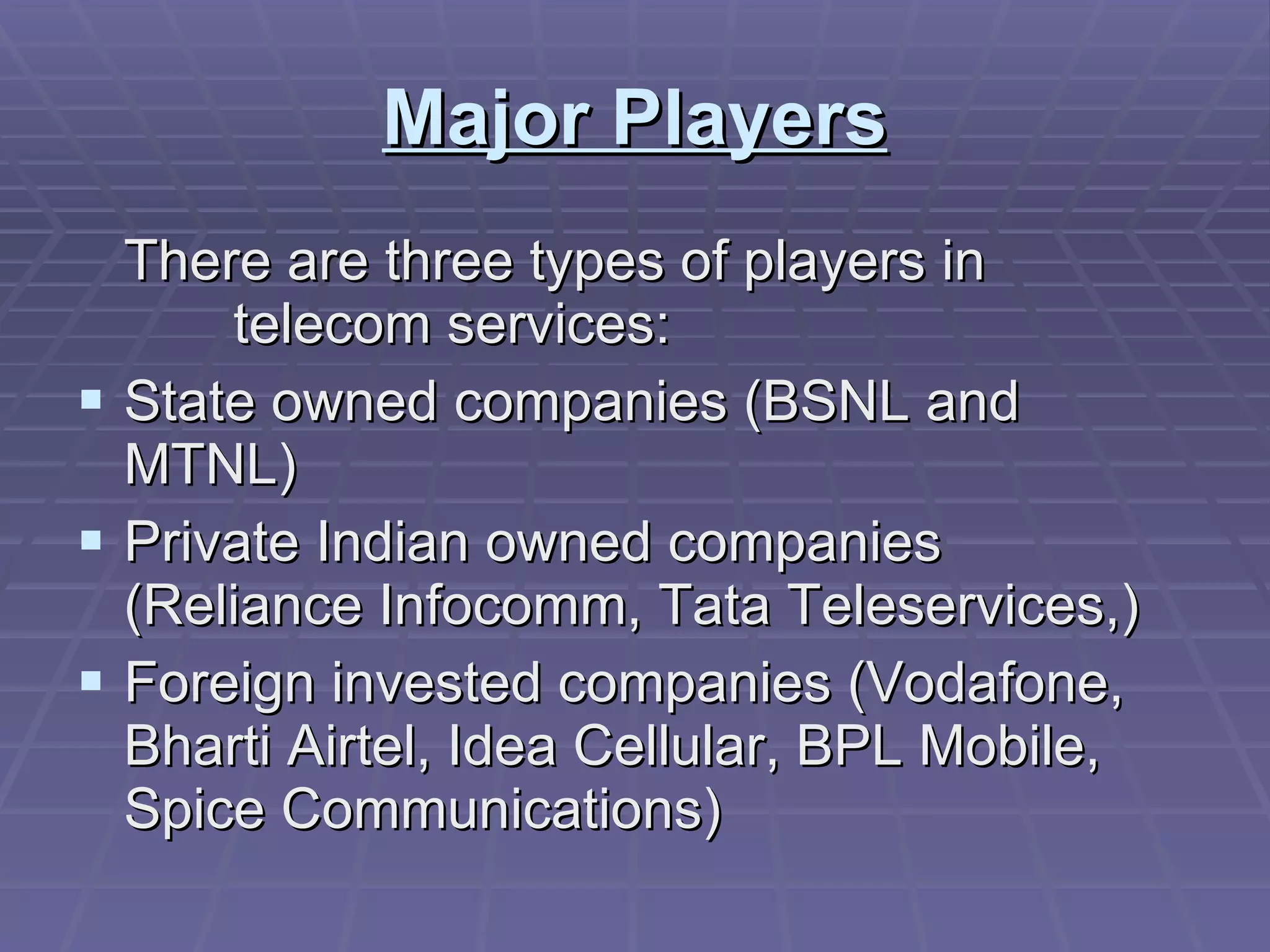
Major Players There are three types of players in  telecom services: State owned companies (BSNL and MTNL) Private Indian owned companies (Reliance Infocomm, Tata Teleservices,) Foreign invested companies (Vodafone, Bharti Airtel, Idea Cellular, BPL Mobile, Spice Communications)
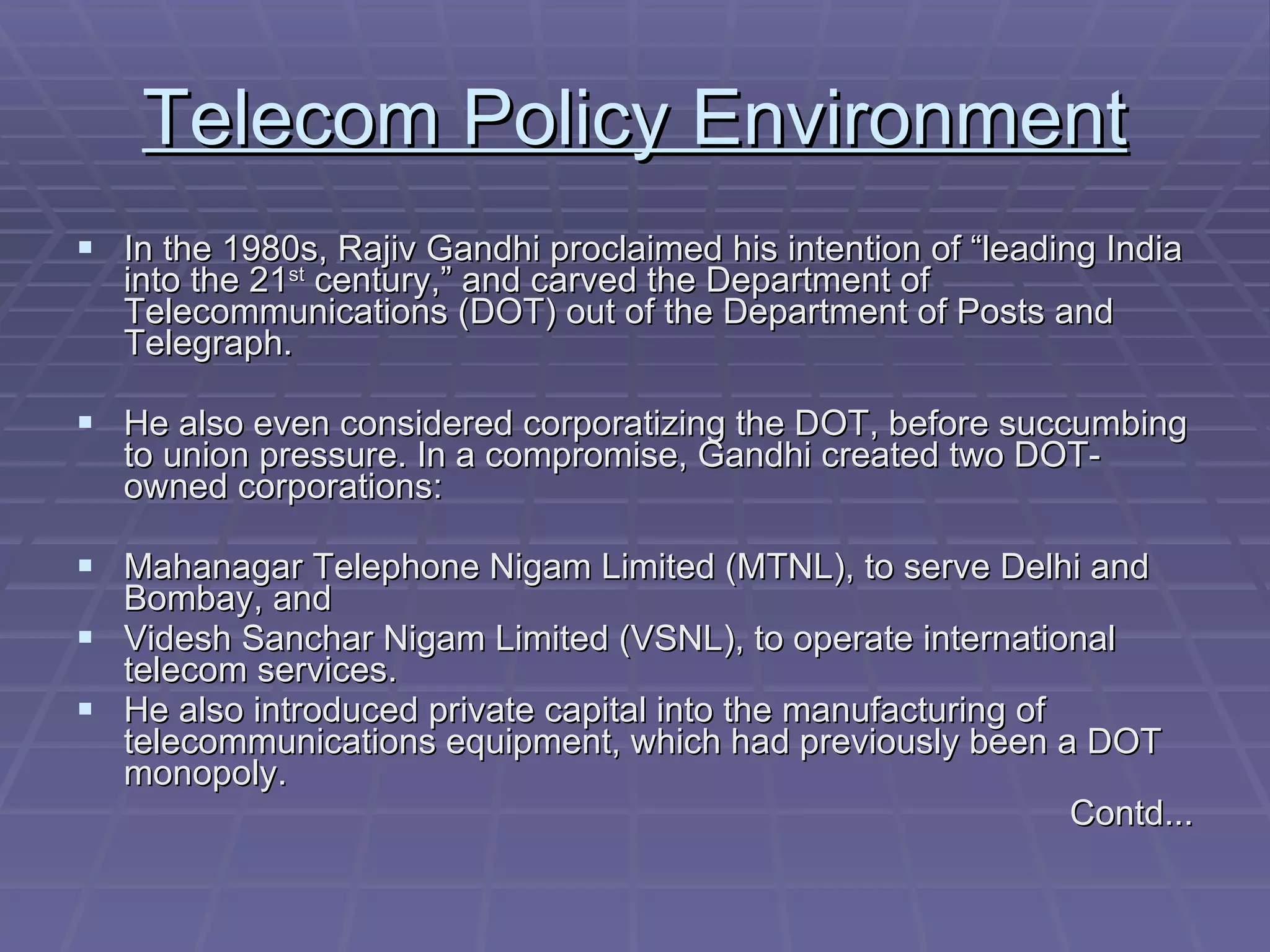
Telecom Policy Environment In the 1980s, Rajiv Gandhi proclaimed his intention of “leading India into the 21 st  century,” and carved the Department of Telecommunications (DOT) out of the Department of Posts and Telegraph. He also even considered corporatizing the DOT, before succumbing to union pressure. In a compromise, Gandhi created two DOT-owned corporations: Mahanagar Telephone Nigam Limited (MTNL), to serve Delhi and Bombay, and Videsh Sanchar Nigam Limited (VSNL), to operate international telecom services. He also introduced private capital into the manufacturing of telecommunications equipment, which had previously been a DOT monopoly. Contd...
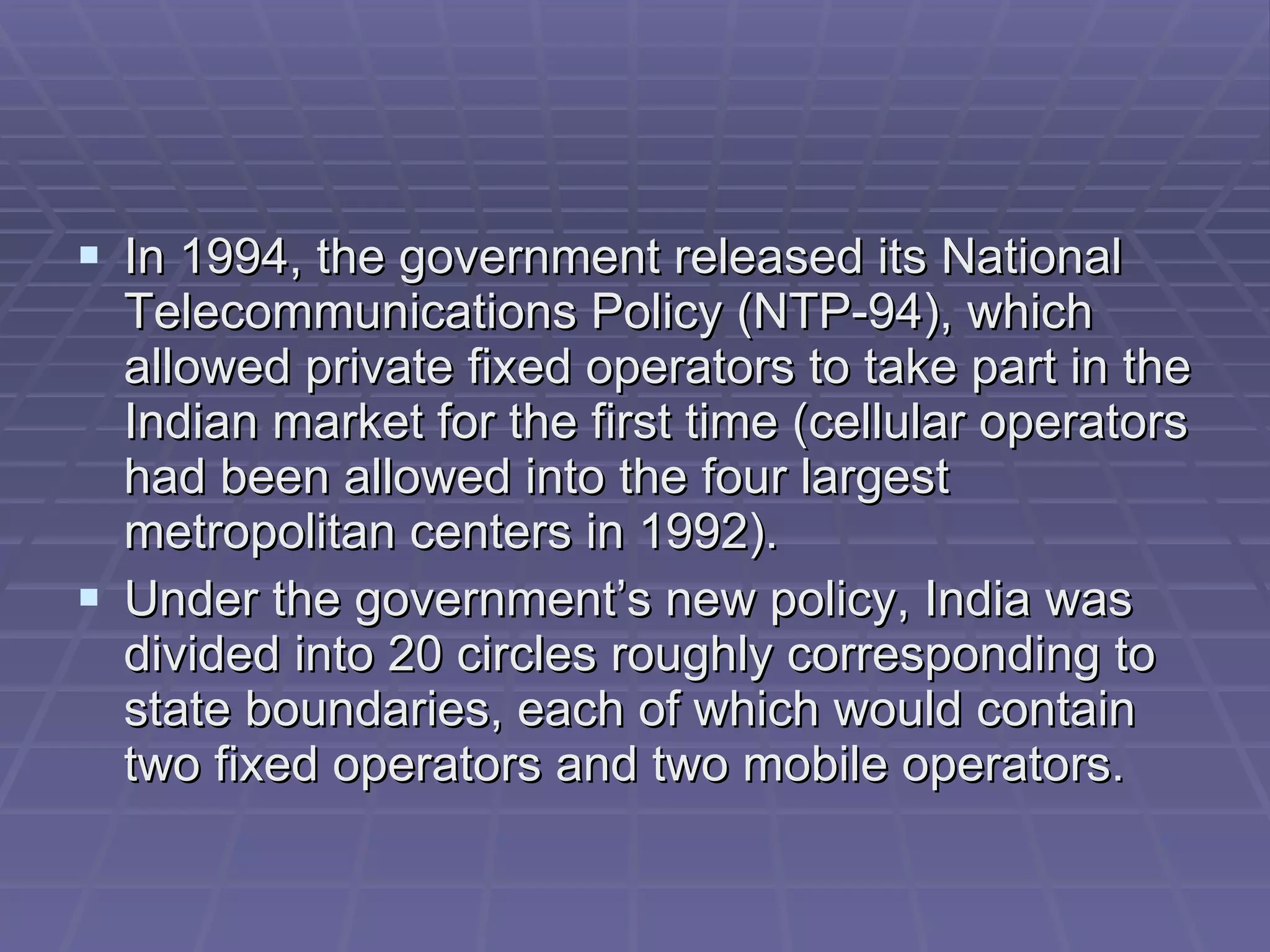
In 1994, the government released its National Telecommunications Policy (NTP-94), which allowed private fixed operators to take part in the Indian market for the first time (cellular operators had been allowed into the four largest metropolitan centers in 1992).  Under the government’s new policy, India was divided into 20 circles roughly corresponding to state boundaries, each of which would contain two fixed operators and two mobile operators.
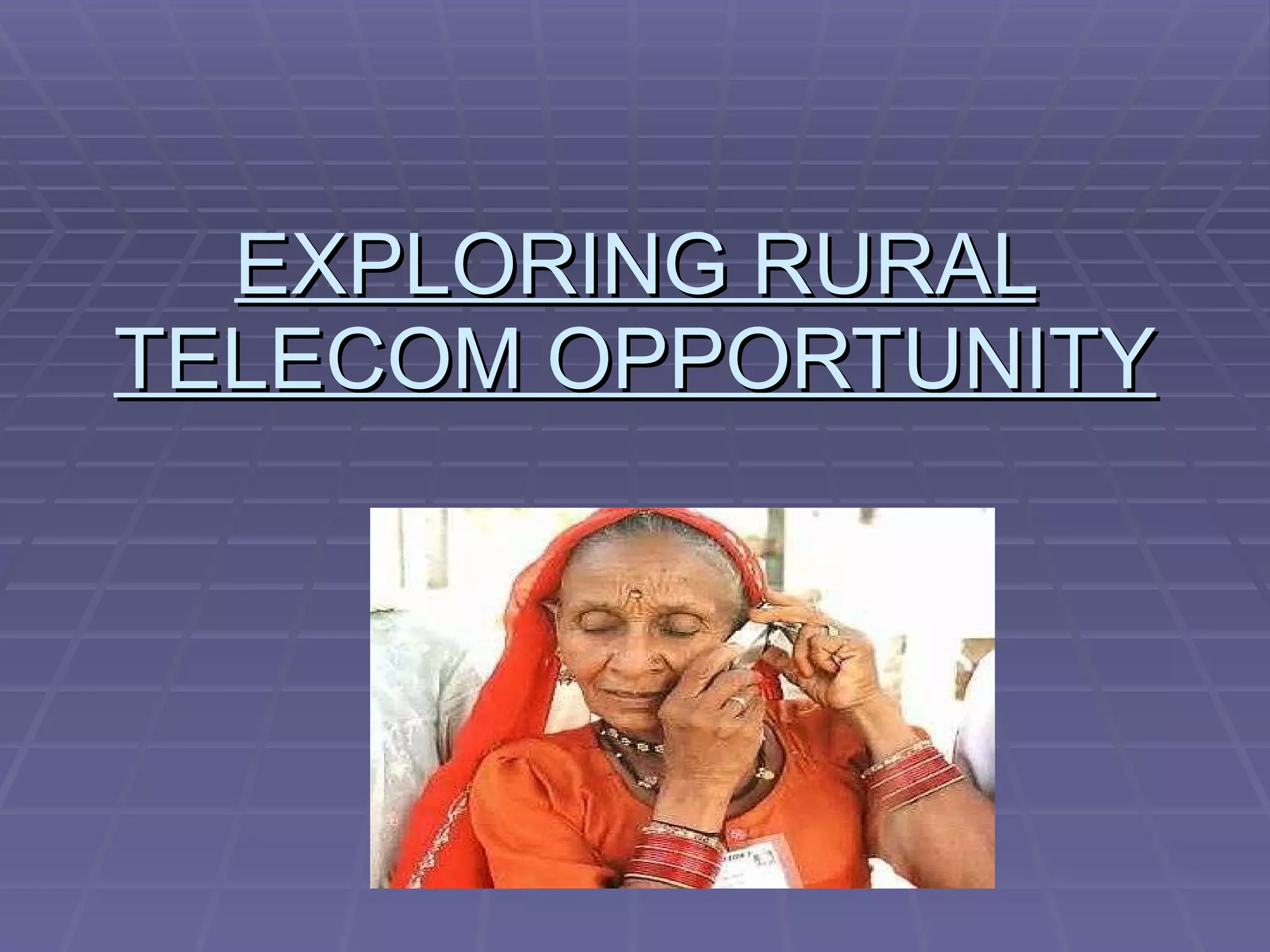
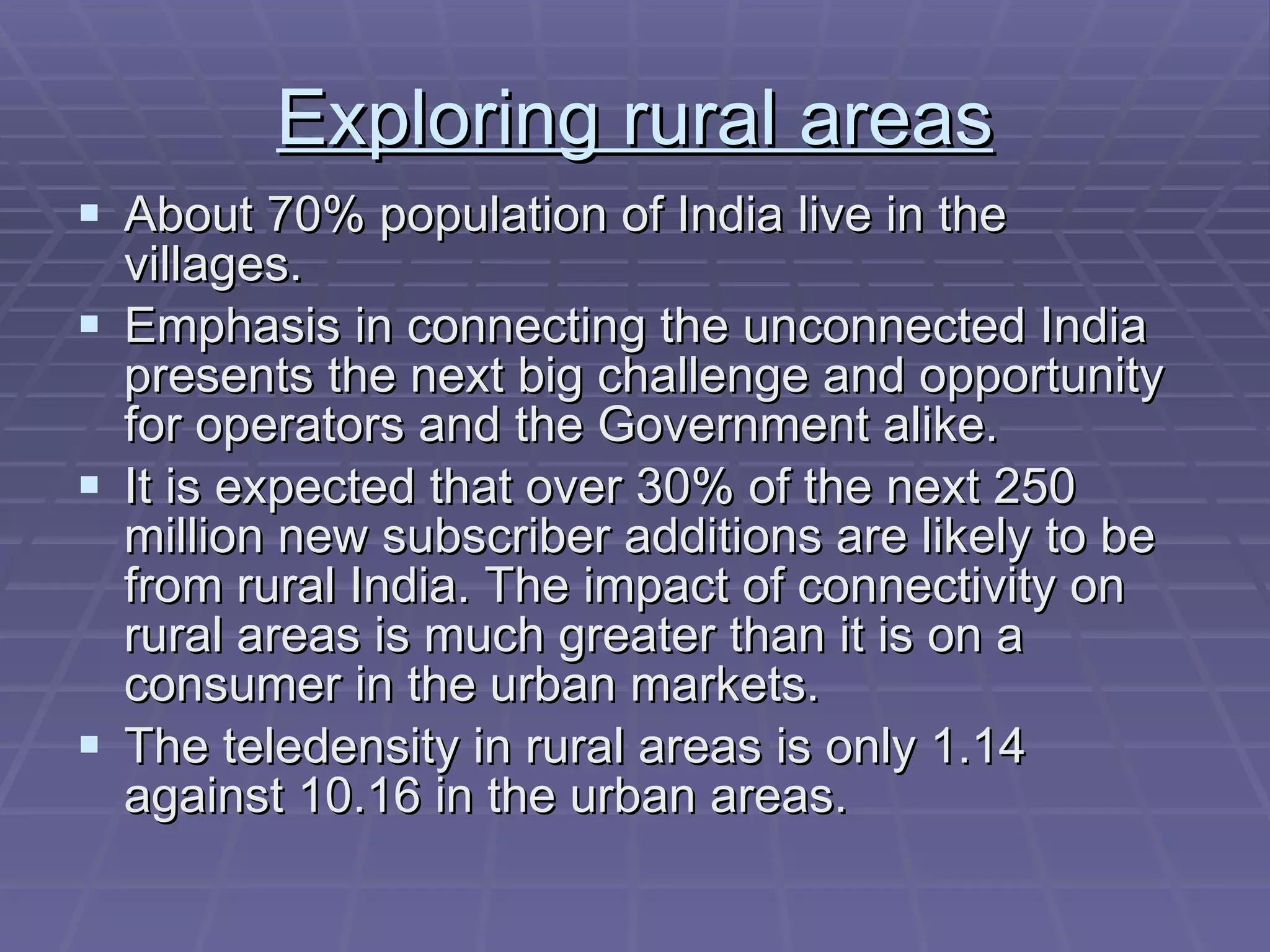
Exploring rural areas About 70% population of India live in the villages. Emphasis in connecting the unconnected India presents the next big challenge and opportunity for operators and the Government alike. It is expected that over 30% of the next 250 million new subscriber additions are likely to be from rural India. The impact of connectivity on rural areas is much greater than it is on a consumer in the urban markets.  The teledensity in rural areas is only 1.14 against 10.16 in the urban areas.
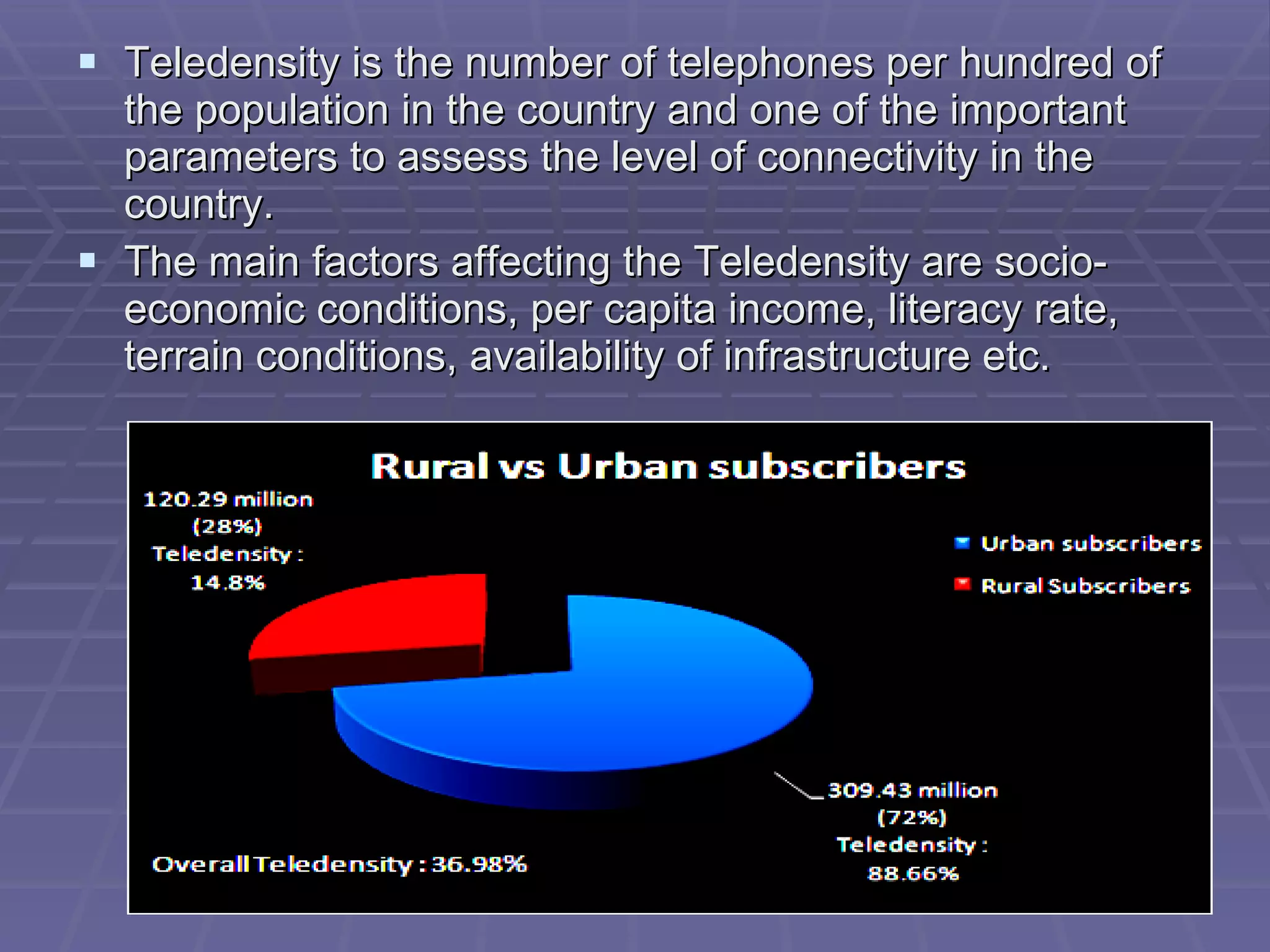
Teledensity is the number of telephones per hundred of the population in the country and one of the important parameters to assess the level of connectivity in the country. The main factors affecting the Teledensity are socio-economic conditions, per capita income, literacy rate, terrain conditions, availability of infrastructure etc.
Most companies are targeting their sale of product and services in the rural areas. Due to hype in the geographical coverage of mobile telephony there is increase of about 39% from 13%in mobile users in rural areas.
 
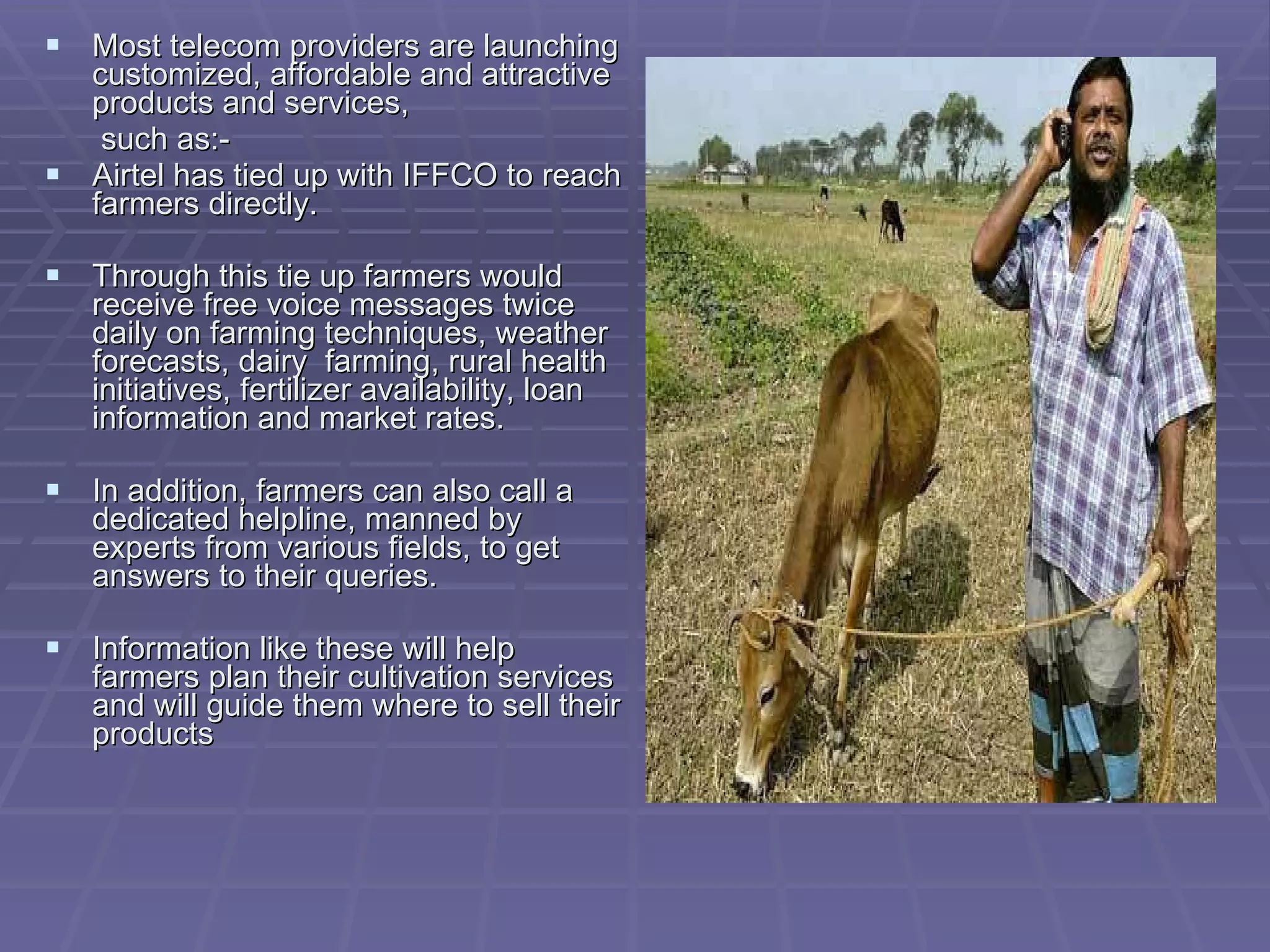
Most telecom providers are launching customized, affordable and attractive products and services,   such as:- Airtel has tied up with IFFCO to reach farmers directly. Through this tie up farmers would receive free voice messages twice daily on farming techniques, weather forecasts, dairy  farming, rural health initiatives, fertilizer availability, loan information and market rates. In addition, farmers can also call a  dedicated helpline, manned by experts from various fields, to get answers to their queries. Information like these will help farmers plan their cultivation services and will guide them where to sell their products
Reasons for not developing of Telecommunications  in rural areas:  Telecom is considered a key sector with a significant impact on promoting economic development, but still there are reasons of not developing telecommunications in rural areas: Inadequate Business Models due to various reasons.  Low Population Density  Low Income Levels  Lower Literacy Levels  Preference of operators for high earning areas initially.  Technology Limitations and High Costs of Delivery and  Some other factors related to policies and priorities
Rural India Set to Ring in 3G mobile Technology 3G networks enable network operators to offer users a wider range of more advanced services while achieving greater network capacity through improved spectral efficiency. 3G mobile or third generation mobile is the networks  where high speed data, voice and video can be exchanged , it allow high- speed mobile broadband access at a speed of more than 386 kbps.
A specialized group drawn from several departments of the prestigious Indian Institute of Technology-Madras, the TeNeT has been tasked with research and product development for the Indian telecom and networking industry as well as driving information technology policy.  Current TeNeT missions include building 50 million broadband connections over the next five years, helping to double the rural GDP of India, making high-quality distance education possible and driving the next generation of wireless standards.
TRAI policies are structured in such a way as to ensure that private mobile operators are compelled to take their services to millions of rural consumers because that is the only way they can recover the high costs of buying 3G spectrum at government auctions, which are due to be completed by November. One such policy requires the conduct of auctions.
Mobile 3G services can make Internet services more easily accessible compared to using a PC, which needs steady electricity supplies, maintenance, broadband services and other infrastructure which are missing in large swathes of rural India . With the advent of 3G, fishermen can negotiate prices for their catch before heading for shore by sending in pictures of the type of fish they have on board. Similarly, farmers and horticulturalists who have perishable produce can take advantage of 3G services to bargain for the best prices before harvesting, bypassing middlemen.
SWOT ANALYSIS OF TELECOM IN RURAL AREAS
STRENGTH Access to health care and other allied services. Timely information on business, price, market, and demands. Better coordination for delivery of administration and public services. Information about employment. Interacts with neighboring market regarding business expansion. Creates atmosphere of national and regional integration.
WEAKNESS Lack of better connectivity  Slow pace of the reform process . It would be difficult to make in-roads into the semi-rural and rural areas because of the lack of infrastructure.  The sector requires players with huge financial resources due to the above mentioned constraint. Problem of limited spectrum availability and the issue of interconnection charges between the private and state operators.
OPPORTUNITIES There is more opportunities for telecomm industry to cover up the remaining rural areas and spread their network.
THREAT Profit earned by intermediaries . Misuse of telecom facilities.
THANK YOU

Exploring Rural Telecom Opportunity

  • 1.
  • 2.
    PRESENTED BY ALPANARAJ SHARMA VANI KAPOOR
  • 3.
    INTRODUCTION The IndianTelecommunications network with 110.01 million connections is the fifth largest in the world and the second largest among the emerging economies of Asia. Presently, the Indian telecom industry is currently slated to an estimated contribution of nearly 1% to India’s GDP. In the last 3 years, two out of every three new telephone subscribers were wireless subscribers. Consequently, wireless now accounts for 54.6% of the total telephone subscriber base. The wireless technologies currently in use are Global System for Mobile Communications (GSM) and Code Division Multiple Access (CDMA). There are primarily 9 GSM and 5 CDMA operators providing mobile services in 19 telecom circles and 4 metro cities, covering 2000 towns across the country.
  • 4.
    Evolution of theindustry-Important Milestones History of Indian Telecommunications Year 1851 First operational land lines were laid by the government near Calcutta 1881 Telephone service introduced in India 1883 Merger with the postal system 1923 Formation of Indian Radio Telegraph Company (IRT) 1932 Merger of ETC and IRT into the Indian Radio and Cable Communication Company Telephone and Telegraph (PTT) 1985 Department of Telecommunications (DOT) established, an exclusive provider of domestic and long-distance service that would be its own regulator (separate from the postal system) 1986 Conversion of DOT into two wholly government-owned companies: the Videsh Sanchar Nigam Limited (VSNL) for international telecommunications and Mahanagar Telephone Nigam Limited (MTNL) for service in metropolitan areas. 1997 Telecom Regulatory Authority of India created. 1999 Cellular Services are launched in India. 2000 DoT becomes a corporation, BSNL
  • 5.
    Major Players Thereare three types of players in telecom services: State owned companies (BSNL and MTNL) Private Indian owned companies (Reliance Infocomm, Tata Teleservices,) Foreign invested companies (Vodafone, Bharti Airtel, Idea Cellular, BPL Mobile, Spice Communications)
  • 6.
    Telecom Policy EnvironmentIn the 1980s, Rajiv Gandhi proclaimed his intention of “leading India into the 21 st century,” and carved the Department of Telecommunications (DOT) out of the Department of Posts and Telegraph. He also even considered corporatizing the DOT, before succumbing to union pressure. In a compromise, Gandhi created two DOT-owned corporations: Mahanagar Telephone Nigam Limited (MTNL), to serve Delhi and Bombay, and Videsh Sanchar Nigam Limited (VSNL), to operate international telecom services. He also introduced private capital into the manufacturing of telecommunications equipment, which had previously been a DOT monopoly. Contd...
  • 7.
    In 1994, thegovernment released its National Telecommunications Policy (NTP-94), which allowed private fixed operators to take part in the Indian market for the first time (cellular operators had been allowed into the four largest metropolitan centers in 1992). Under the government’s new policy, India was divided into 20 circles roughly corresponding to state boundaries, each of which would contain two fixed operators and two mobile operators.
  • 8.
    Exploring rural areasAbout 70% population of India live in the villages. Emphasis in connecting the unconnected India presents the next big challenge and opportunity for operators and the Government alike. It is expected that over 30% of the next 250 million new subscriber additions are likely to be from rural India. The impact of connectivity on rural areas is much greater than it is on a consumer in the urban markets. The teledensity in rural areas is only 1.14 against 10.16 in the urban areas.
  • 9.
    Teledensity is thenumber of telephones per hundred of the population in the country and one of the important parameters to assess the level of connectivity in the country. The main factors affecting the Teledensity are socio-economic conditions, per capita income, literacy rate, terrain conditions, availability of infrastructure etc.
  • 10.
    Most companies aretargeting their sale of product and services in the rural areas. Due to hype in the geographical coverage of mobile telephony there is increase of about 39% from 13%in mobile users in rural areas.
  • 11.
  • 12.
    Most telecom providersare launching customized, affordable and attractive products and services, such as:- Airtel has tied up with IFFCO to reach farmers directly. Through this tie up farmers would receive free voice messages twice daily on farming techniques, weather forecasts, dairy farming, rural health initiatives, fertilizer availability, loan information and market rates. In addition, farmers can also call a dedicated helpline, manned by experts from various fields, to get answers to their queries. Information like these will help farmers plan their cultivation services and will guide them where to sell their products
  • 13.
    Reasons for notdeveloping of Telecommunications in rural areas: Telecom is considered a key sector with a significant impact on promoting economic development, but still there are reasons of not developing telecommunications in rural areas: Inadequate Business Models due to various reasons. Low Population Density Low Income Levels Lower Literacy Levels Preference of operators for high earning areas initially. Technology Limitations and High Costs of Delivery and Some other factors related to policies and priorities
  • 14.
    Rural India Setto Ring in 3G mobile Technology 3G networks enable network operators to offer users a wider range of more advanced services while achieving greater network capacity through improved spectral efficiency. 3G mobile or third generation mobile is the networks where high speed data, voice and video can be exchanged , it allow high- speed mobile broadband access at a speed of more than 386 kbps.
  • 15.
    A specialized groupdrawn from several departments of the prestigious Indian Institute of Technology-Madras, the TeNeT has been tasked with research and product development for the Indian telecom and networking industry as well as driving information technology policy. Current TeNeT missions include building 50 million broadband connections over the next five years, helping to double the rural GDP of India, making high-quality distance education possible and driving the next generation of wireless standards.
  • 16.
    TRAI policies arestructured in such a way as to ensure that private mobile operators are compelled to take their services to millions of rural consumers because that is the only way they can recover the high costs of buying 3G spectrum at government auctions, which are due to be completed by November. One such policy requires the conduct of auctions.
  • 17.
    Mobile 3G servicescan make Internet services more easily accessible compared to using a PC, which needs steady electricity supplies, maintenance, broadband services and other infrastructure which are missing in large swathes of rural India . With the advent of 3G, fishermen can negotiate prices for their catch before heading for shore by sending in pictures of the type of fish they have on board. Similarly, farmers and horticulturalists who have perishable produce can take advantage of 3G services to bargain for the best prices before harvesting, bypassing middlemen.
  • 18.
    SWOT ANALYSIS OFTELECOM IN RURAL AREAS
  • 19.
    STRENGTH Access tohealth care and other allied services. Timely information on business, price, market, and demands. Better coordination for delivery of administration and public services. Information about employment. Interacts with neighboring market regarding business expansion. Creates atmosphere of national and regional integration.
  • 20.
    WEAKNESS Lack ofbetter connectivity Slow pace of the reform process . It would be difficult to make in-roads into the semi-rural and rural areas because of the lack of infrastructure. The sector requires players with huge financial resources due to the above mentioned constraint. Problem of limited spectrum availability and the issue of interconnection charges between the private and state operators.
  • 21.
    OPPORTUNITIES There ismore opportunities for telecomm industry to cover up the remaining rural areas and spread their network.
  • 22.
    THREAT Profit earnedby intermediaries . Misuse of telecom facilities.
  • 23.