Date: 10 April 2024
Exploring Existential
Themes in
Popular Culture
Sem 2 | Batch 2023-25
Department of English
Maharaja Krishnakumarsinhji Bhavnagar University
Aakash Chavda
Exploring Existential
Themes in
Popular Culture
Prepared by: Aakash Chavda
● Presented by - Aakash Chavda
● Roll No. - 1
● Paper: 110A - History of English Literature - 1900 to 2000
● Topic - Exploring Existential Themes in Popular Culture
● Submitted To - S. B. Gardi, Department of English, M.K.B.U.
● E-mail Id - aakashchavda637@gmail.com
Academic Details
What is Existentialism ?
● A philosophical movement that arose as a corrective against overly abstract and detached
philosophies that lost sight of concrete human existence and freedom.
● Existentialist philosophers, predominantly from Europe during the 19th and 20th centuries,
are widely recognized as key figures in existentialism. Existentialism is arguably the most
famous philosophical movement. (Fell)
● Existentialists examine various aspects of human existence such as anxiety, isolation, and
our connection with God. They concentrate on understanding the significance of real-life
human experiences.(Coates)
● The philosophy suggests that humans, being aware of their mortality, ascribe meaning to
their lives by making choices and engaging in actions.
● It argues that Individual should make choices in their life and should be responsible for
that.
● This philosophy made emphasis on human beings as self-determining subjects or agents
capable of free choice, rather than just objective determination by their nature or essence.
“Existence precedes essence”
- Sartre
Continue…
● Existentialism proposes ways for individuals to become aware of their existential
freedom and responsibility for choosing their essence, they have to confront finitude.
(Killinger)
● We are not born with fixed human nature but create our own essence through the
choices we made.
● "To exist authentically in the highest degree", that is the aim that existentialism sets
before everyman.
● Individuals should learn the spirit of authentically relating oneself to one's unique existential
situation from existentialists. (Coates)
● Existentialism calls for confronting one’s finitude, aloneness, and freedom through
experience that return one to authentic selfhood.
● Key existentialist thinkers like Kierkegaard, Nietzsche, Heidegger, Sartre, Jaspers, and
Marcel shared the belief that mainstream philosophical ideas didn't adequately deal
with real human life.
“There is no determinism, man is free, man is freedom”
- Sartre
Existentialists Philosophers
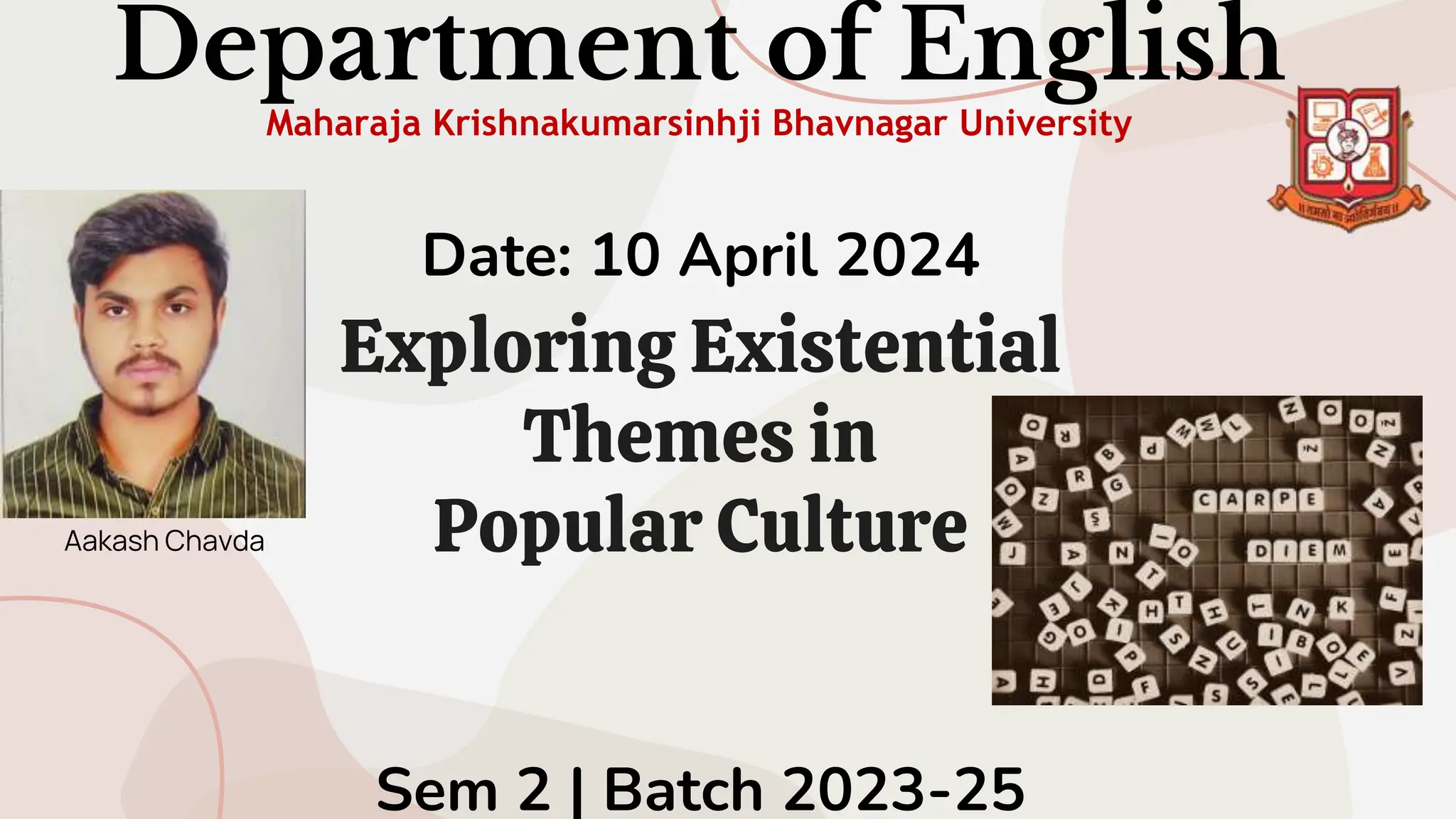
Soren Kierkegaard
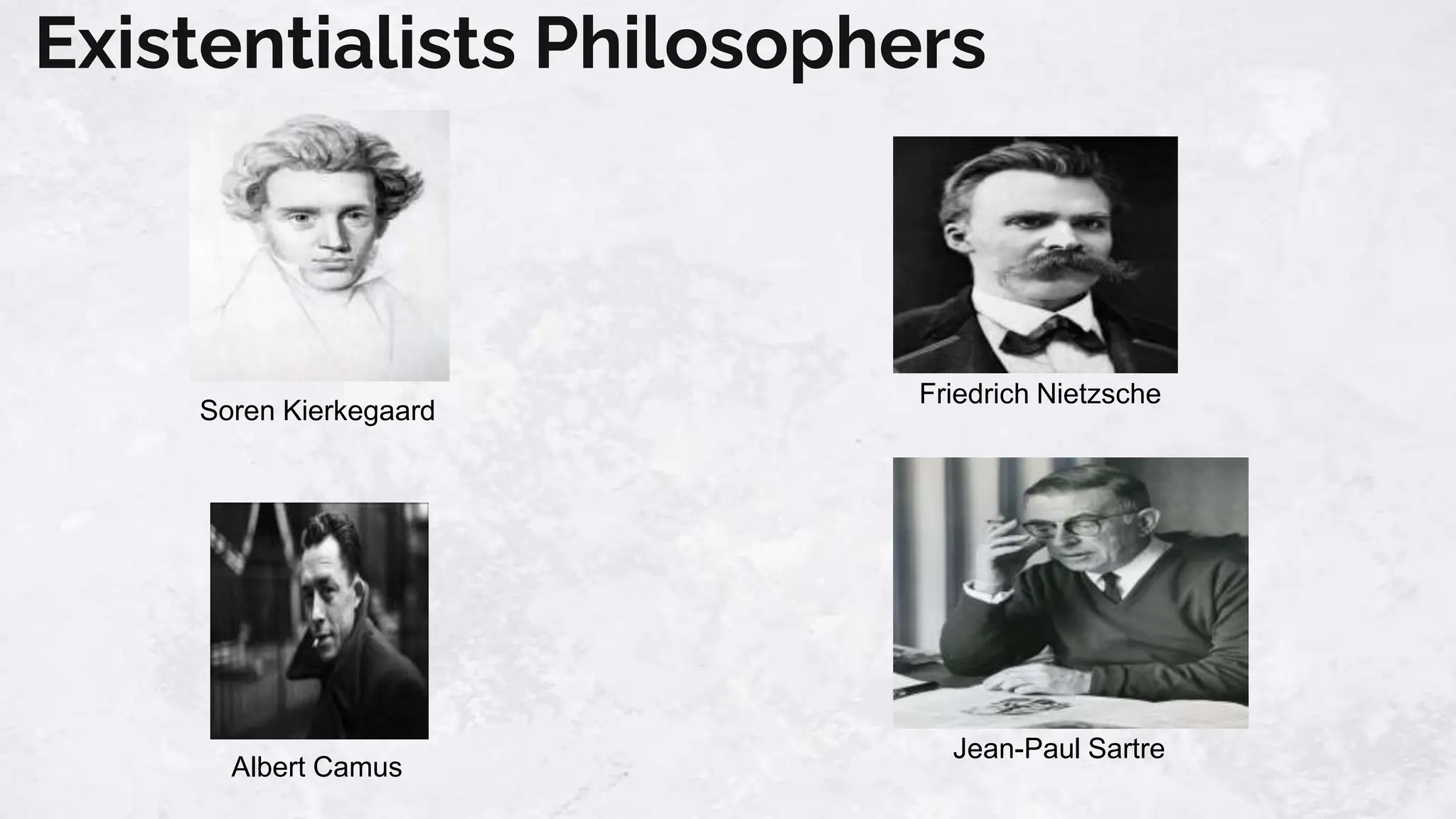
Jean-Paul Sartre
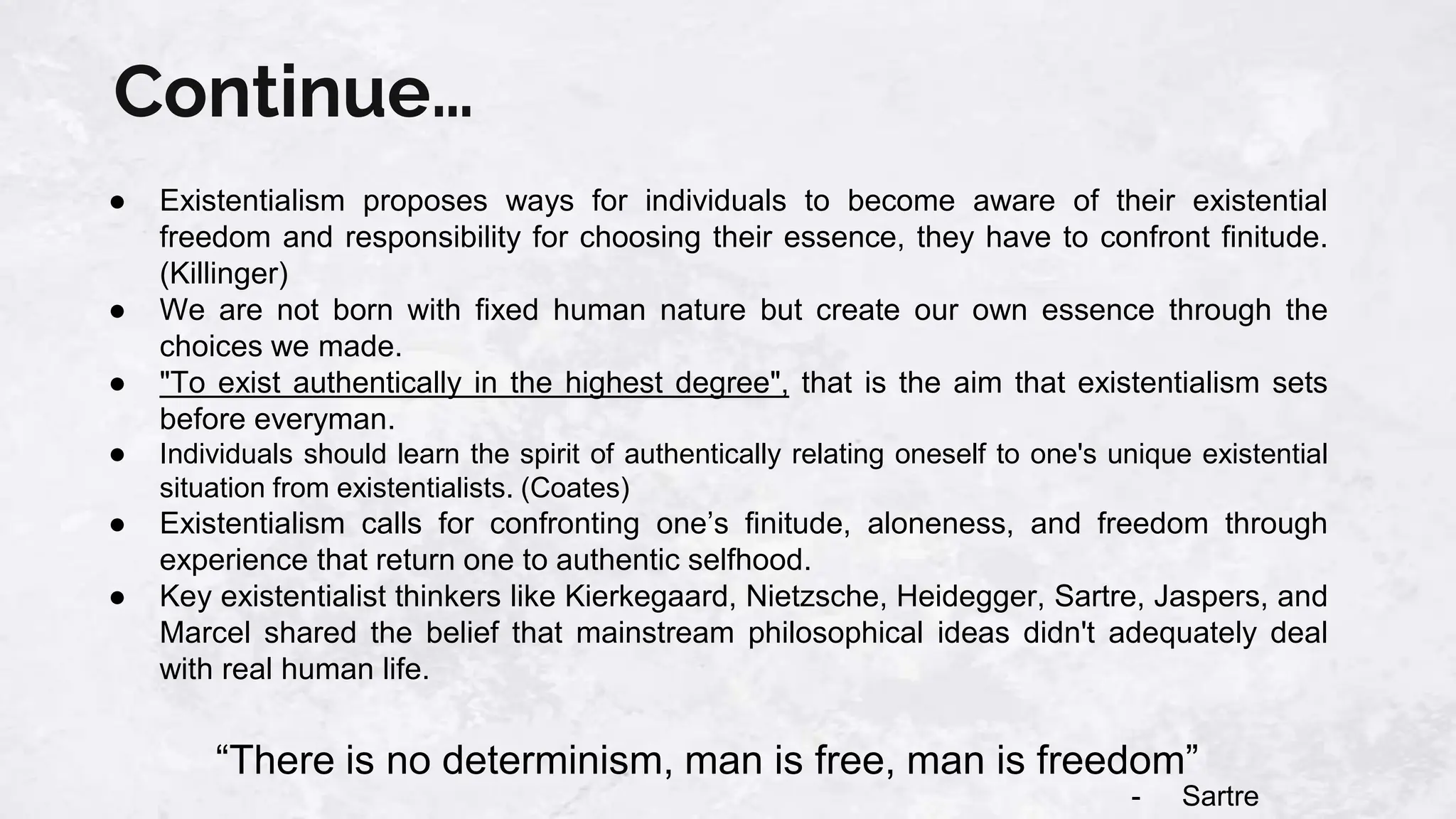
Albert Camus
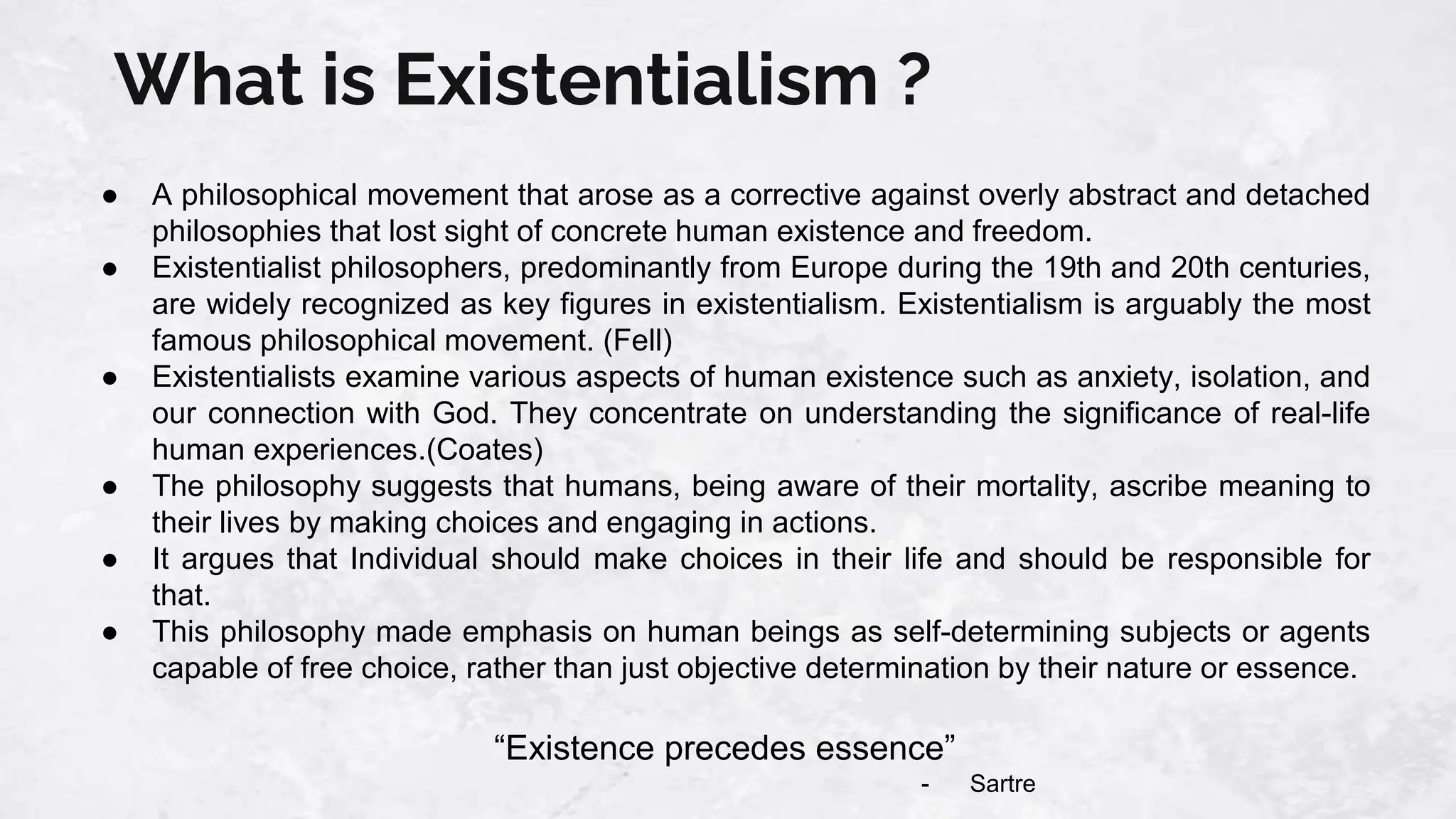
Friedrich Nietzsche
Existential Views
● Kierkegaard, had a Christian injunction to make a personal commitment through ‘Leap
of Faith’, for others like Camus and Sartre had a secular embrace of radical freedom
and responsibility despite life’s absurdity. (Killinger)
● The ‘Leap of Faith’ involves deciding to believe in something despite the inability to
completely justify or demonstrate its truth by means of rationality.
● Kierkegaard believed that the problem of meaning could be solved by an individual's
connection to the Divine, while Nietzsche took a strongly anti-Christian stance.
● Nietzsche believed that with the demise of divine belief, there's a chance for
individuals to find meaning in their existence from within themselves rather than
relying on external authorities.
● Bad Faith: According to Sartre, bad faith is when individuals deceive themselves by
denying or misrepresenting something they are inherently aware of about themselves
or their situation without consciously acknowledging it. (Stevenson)
● Most fundamental aspect of ‘bad faith’ is humanity’s constant denial of crushing
burden of freedom that it posses.
Question to Address
● How existential themes in popular films and TV reflect modern
society's existential worries? Characters mirror viewers' struggles
with identity crisis, meaning, and mortality against a backdrop of
technological development, and social discord. Does this
interconnection between narratives depicted on screens and real-life
help us to better understand such theories. How these popular
narrative providing an opportunity for individuals to critically examine
existential themes and contemplate profound questions within their
own lives and the wider cultural context?
What is Pop Culture ?
● The term "popular culture" gained prominence in the 19th century as the urban
working class gained more leisure time and expendable income.
● Since the 1960s, popular culture rise as academic field of study, driven by the
growing influence of television and advertising in American society.
● Popular culture refers to cultural expressions, traditions, ideologies, and artifacts
that enjoy widespread acceptance and consumption among the masses, contrasting
with elite or highbrow culture.
● It is closely tied with mass media, commercialism, and industries such as television,
advertising, mainstream music, and genre films.
● Pop culture Includes genres like popular music, movies, TV shows, comic books,
genre fiction, sports, advertising etc.
● Popular culture acts as a mirror reflecting the dominant values, beliefs, myths and
ideologies prevalent in society at a particular time.
● Shapes the cultural trends. (Haselstein)
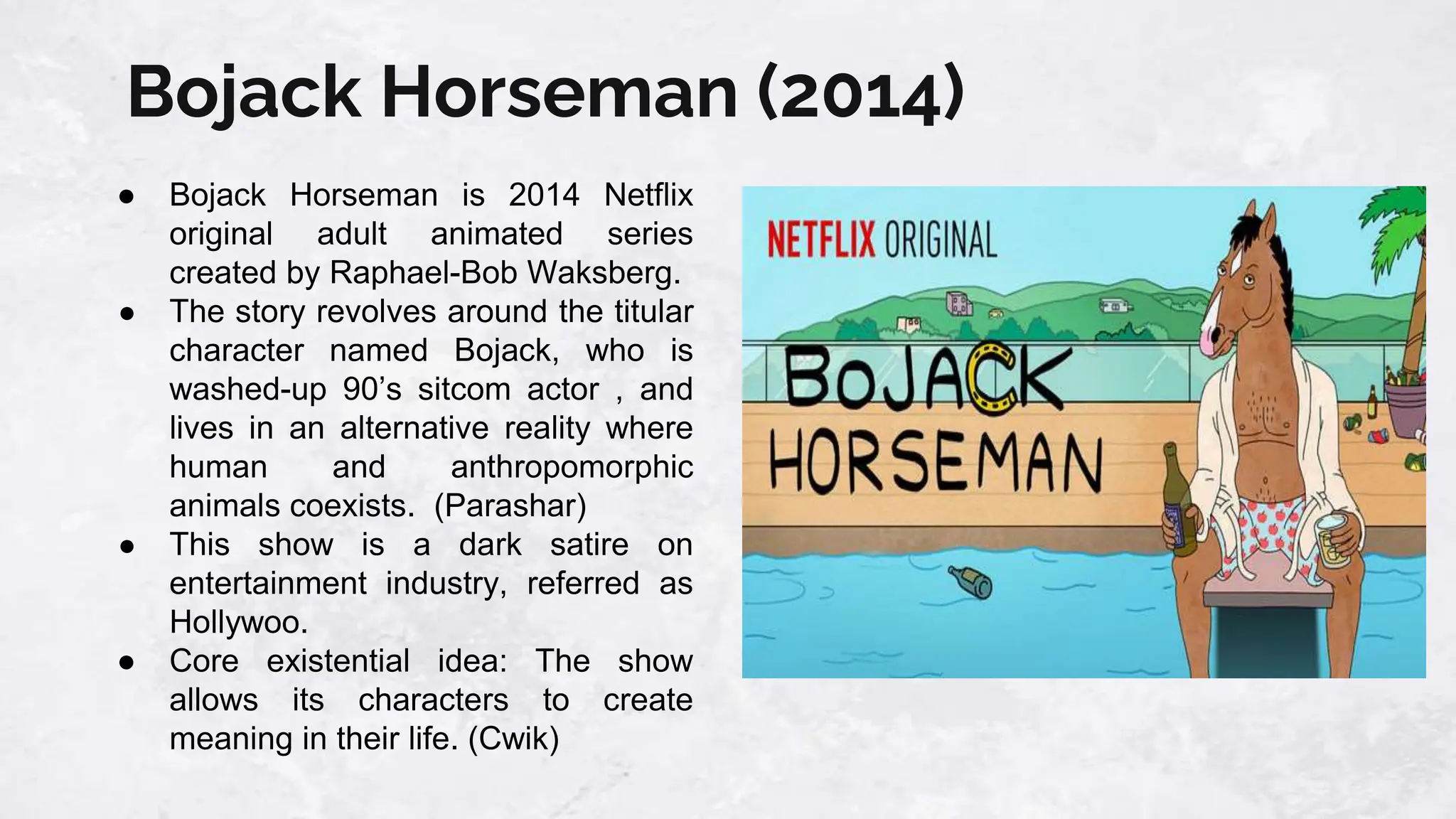
Bojack Horseman (2014)
● Bojack Horseman is 2014 Netflix
original adult animated series
created by Raphael-Bob Waksberg.
● The story revolves around the titular
character named Bojack, who is
washed-up 90’s sitcom actor , and
lives in an alternative reality where
human and anthropomorphic
animals coexists. (Parashar)
● This show is a dark satire on
entertainment industry, referred as
Hollywoo.
● Core existential idea: The show
allows its characters to create
meaning in their life. (Cwik)
Existentialism and Bojack Horseman
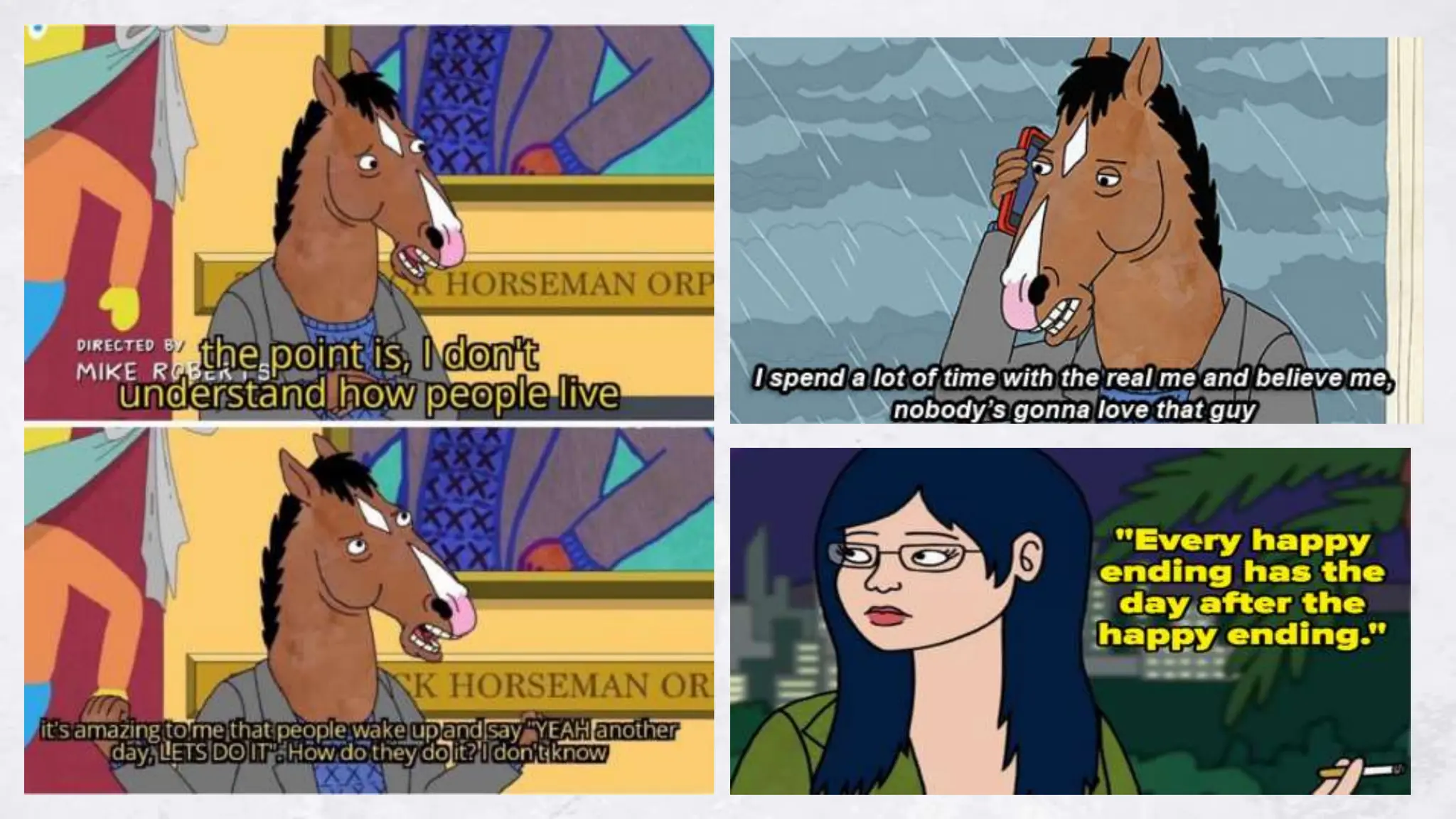
● Bojack portrays existential ideas like the subjective nature of identity, authenticity vs
living in "bad faith", and the human condition of feeling alone and disconnected from a
meaningless world.
● Bojack wanted to regain his fame, and for that he asked for a role of racehorse in the
movie Secretariat, for which he was nominated for Oscar.
● Bojack's attempts to secure an Oscar underscore the idea that his existence lacks
inherent significance. (Parashar)
● Just like Bojack, every other character in the story awaits for happy ending, which does
not actually exists.
● "We must imagine BoJack happy. We must imagine he wants to be. BoJack is Sisyphus
rolling a beer bottle up the Hollywood hills." (Cwik)
● Sartre’s idea of radical freedom complicates Bojack’s situation.
“I’m responsible for my own happiness?
I can’t even be responsible for my own breakfast!” (S1, EP1)
Existential Crisis in Minor Characters
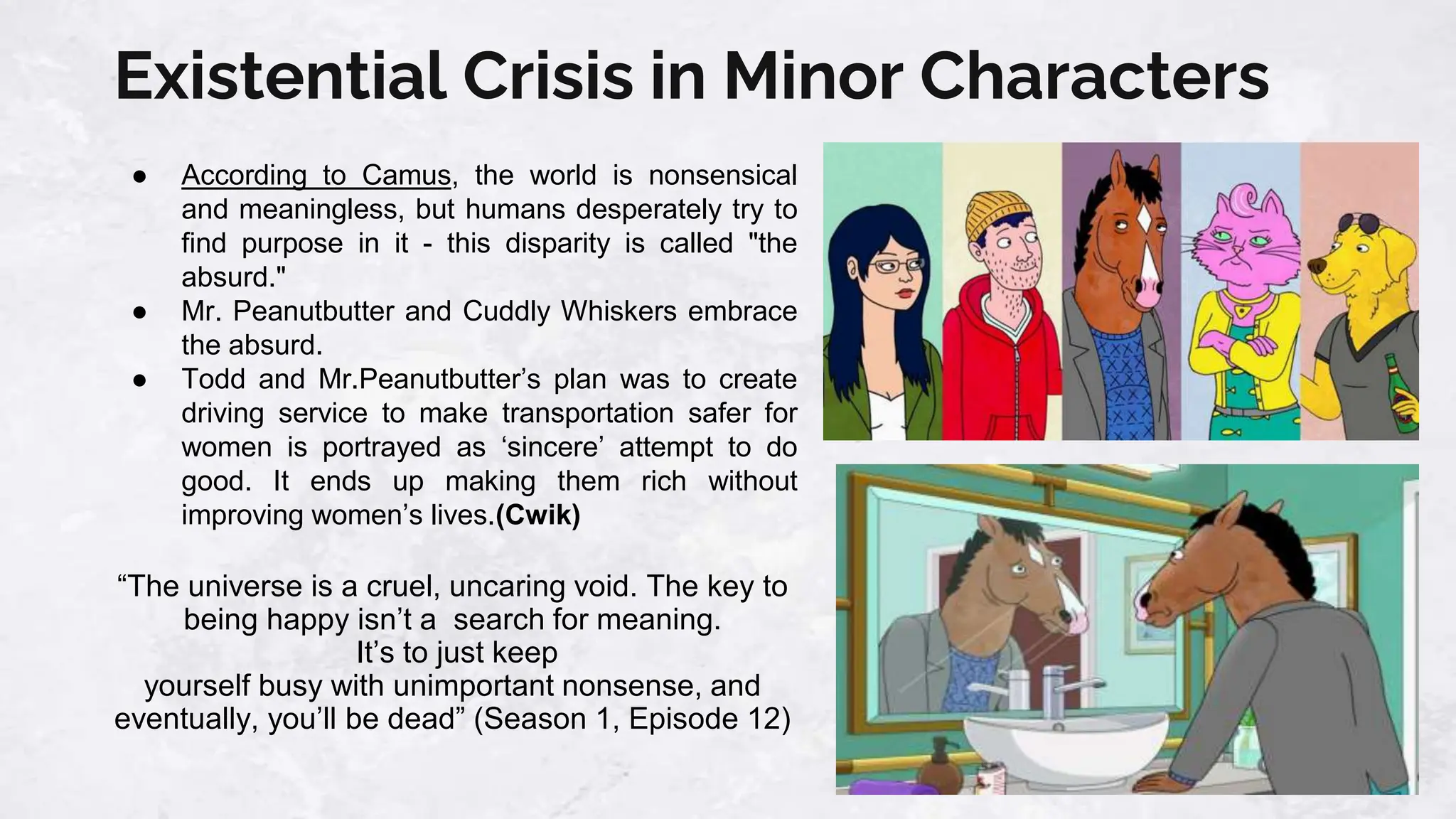
● According to Camus, the world is nonsensical
and meaningless, but humans desperately try to
find purpose in it - this disparity is called "the
absurd."
● Mr. Peanutbutter and Cuddly Whiskers embrace
the absurd.
● Todd and Mr.Peanutbutter’s plan was to create
driving service to make transportation safer for
women is portrayed as ‘sincere’ attempt to do
good. It ends up making them rich without
improving women’s lives.(Cwik)
“The universe is a cruel, uncaring void. The key to
being happy isn’t a search for meaning.
It’s to just keep
yourself busy with unimportant nonsense, and
eventually, you’ll be dead” (Season 1, Episode 12)
Continue…
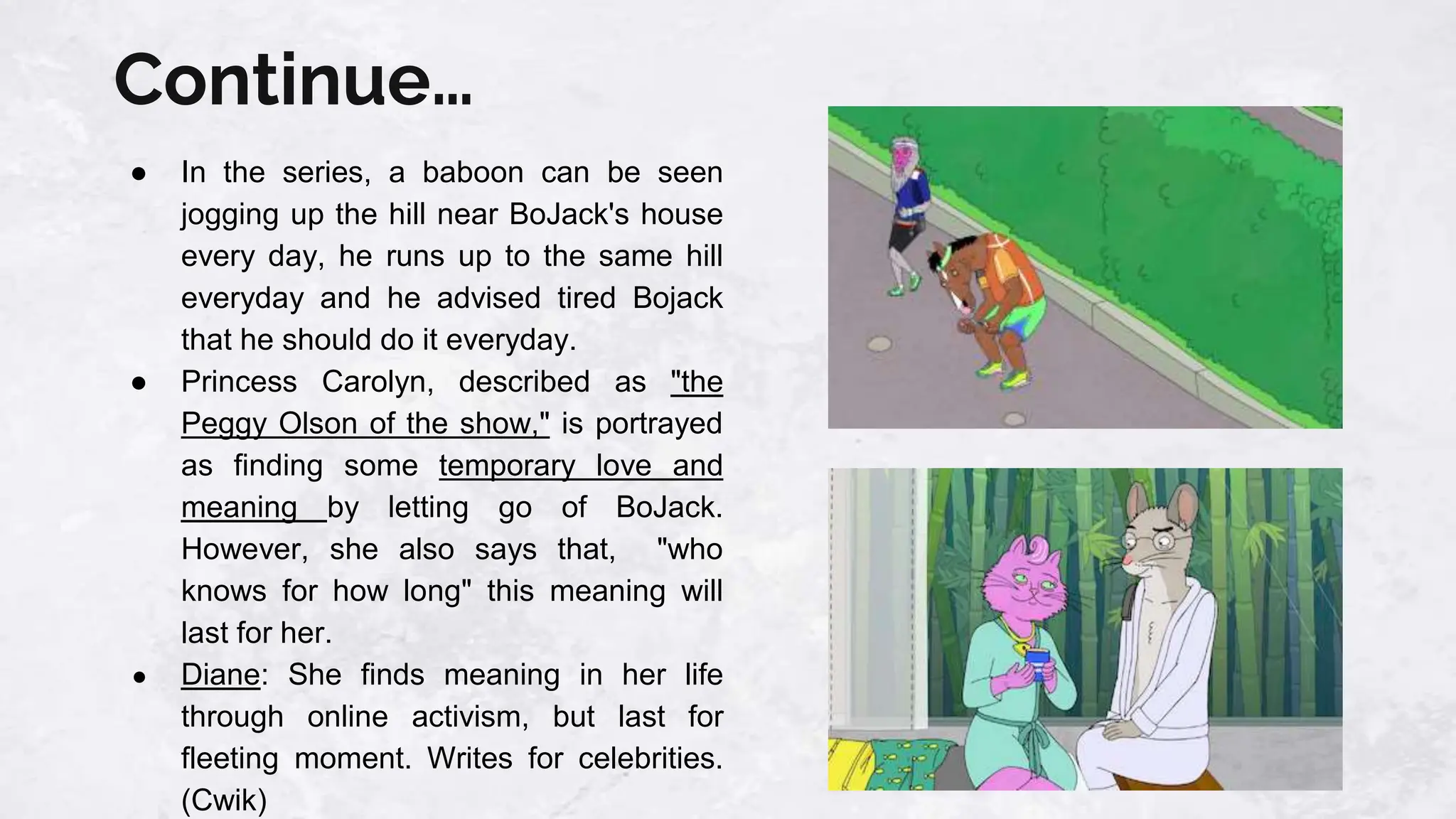
● In the series, a baboon can be seen
jogging up the hill near BoJack's house
every day, he runs up to the same hill
everyday and he advised tired Bojack
that he should do it everyday.
● Princess Carolyn, described as "the
Peggy Olson of the show," is portrayed
as finding some temporary love and
meaning by letting go of BoJack.
However, she also says that, "who
knows for how long" this meaning will
last for her.
● Diane: She finds meaning in her life
through online activism, but last for
fleeting moment. Writes for celebrities.
(Cwik)
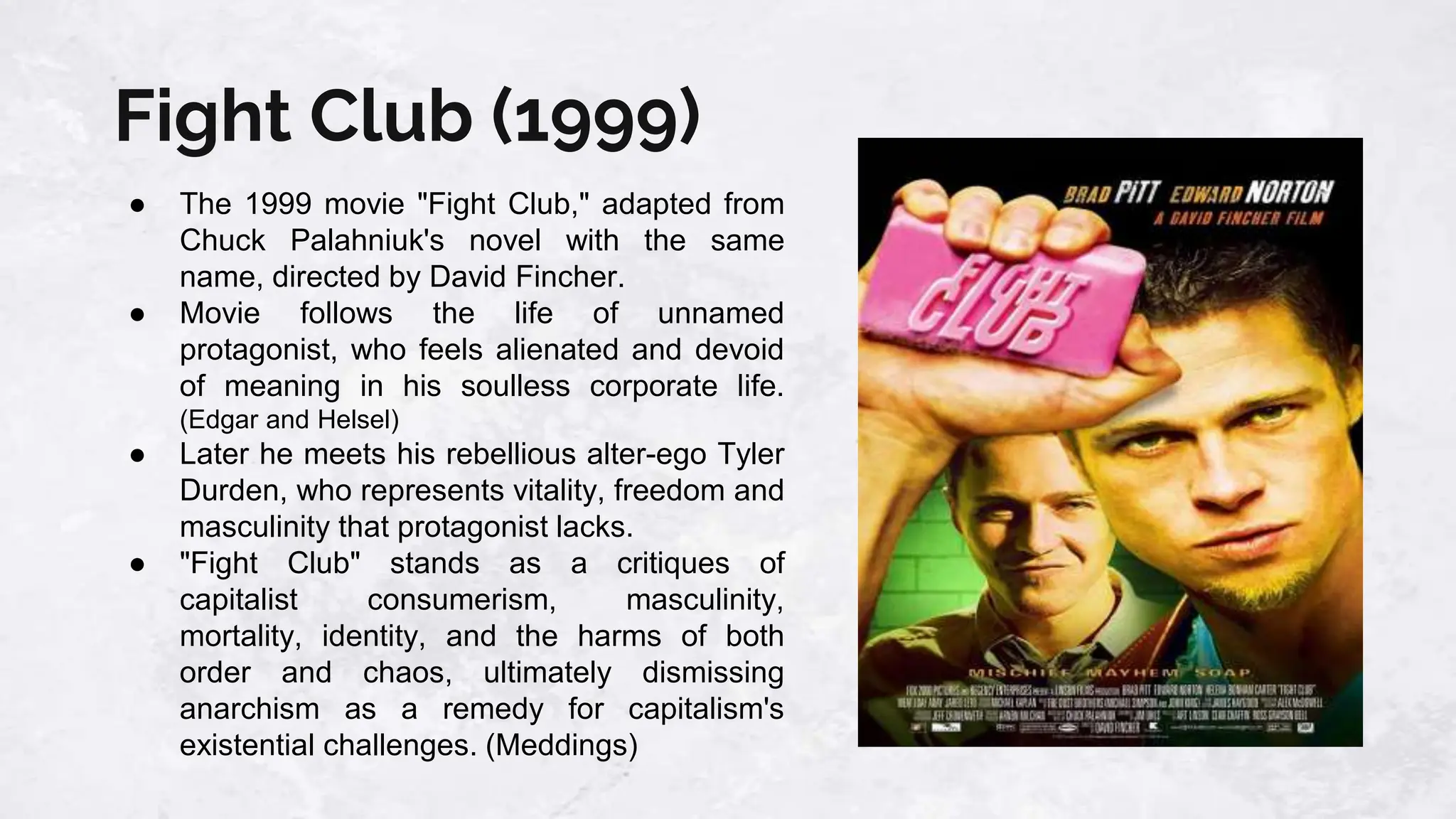
Fight Club (1999)
● The 1999 movie "Fight Club," adapted from
Chuck Palahniuk's novel with the same
name, directed by David Fincher.
● Movie follows the life of unnamed
protagonist, who feels alienated and devoid
of meaning in his soulless corporate life.
(Edgar and Helsel)
● Later he meets his rebellious alter-ego Tyler
Durden, who represents vitality, freedom and
masculinity that protagonist lacks.
● "Fight Club" stands as a critiques of
capitalist consumerism, masculinity,
mortality, identity, and the harms of both
order and chaos, ultimately dismissing
anarchism as a remedy for capitalism's
existential challenges. (Meddings)
Insomnia as Existential Angst
● The narrator's insomnia represents an existential
restlessness and lack of meaning in his life,
driving him to seek more authentic experiences.
(Irwin)
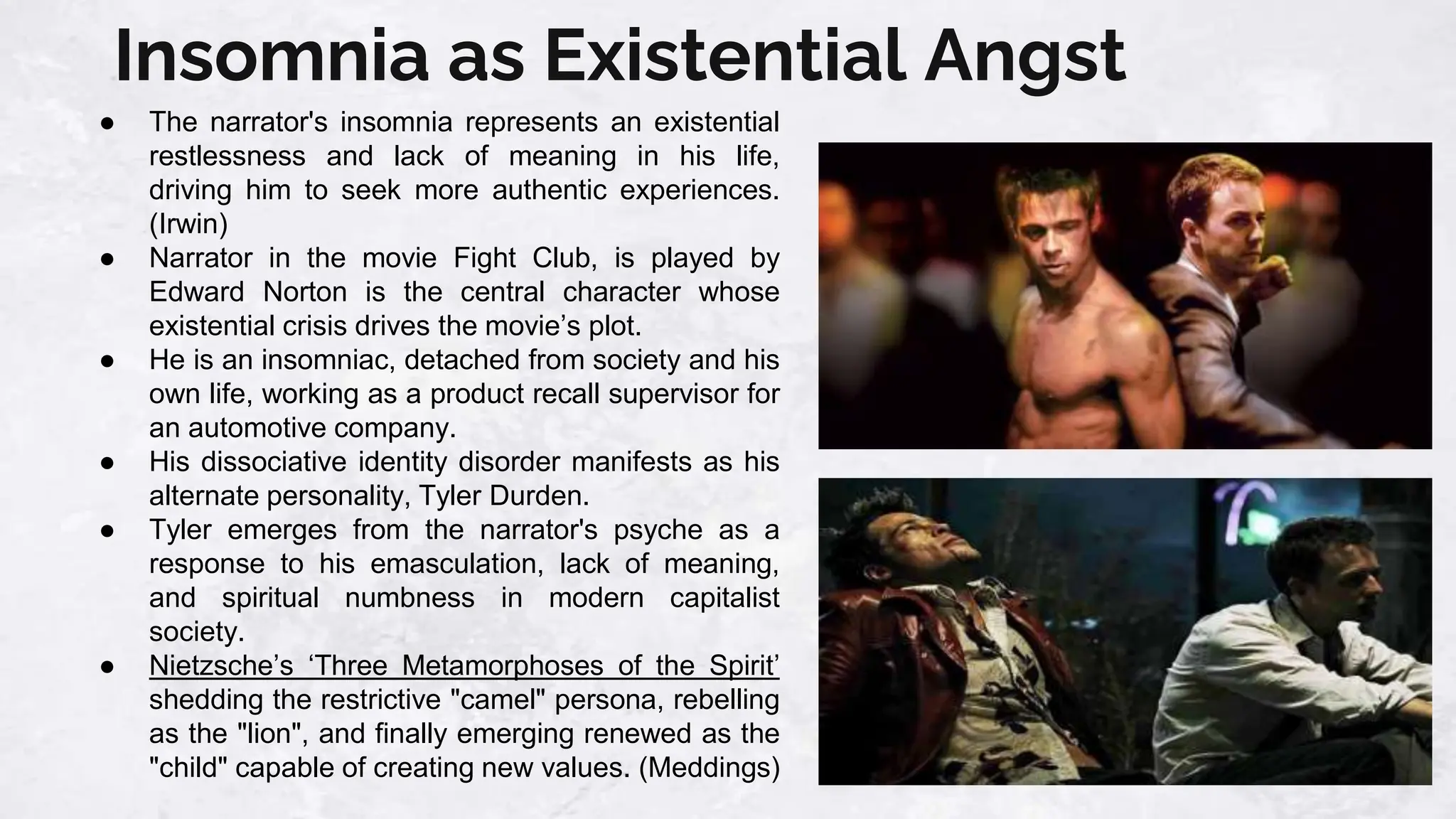
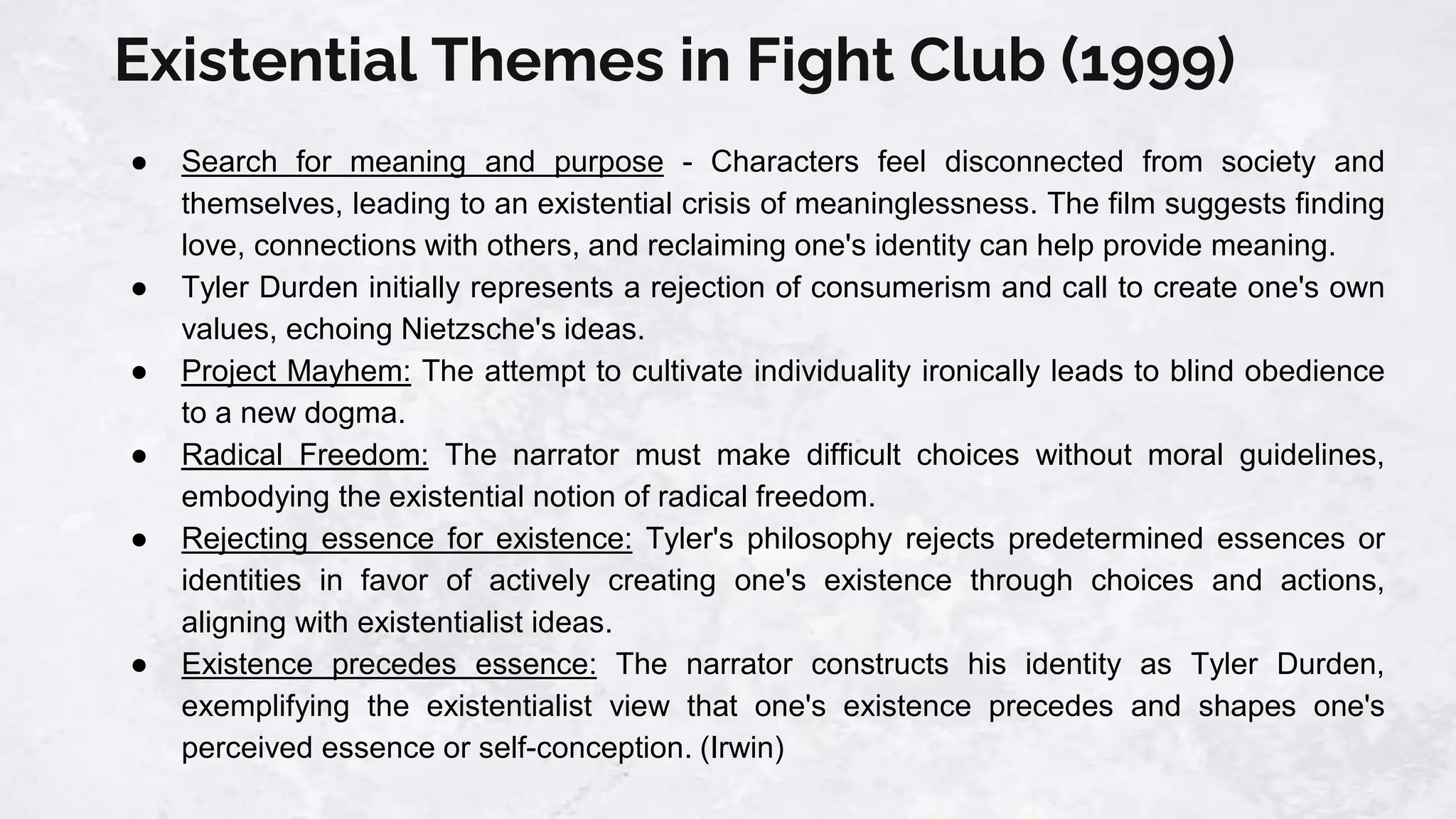
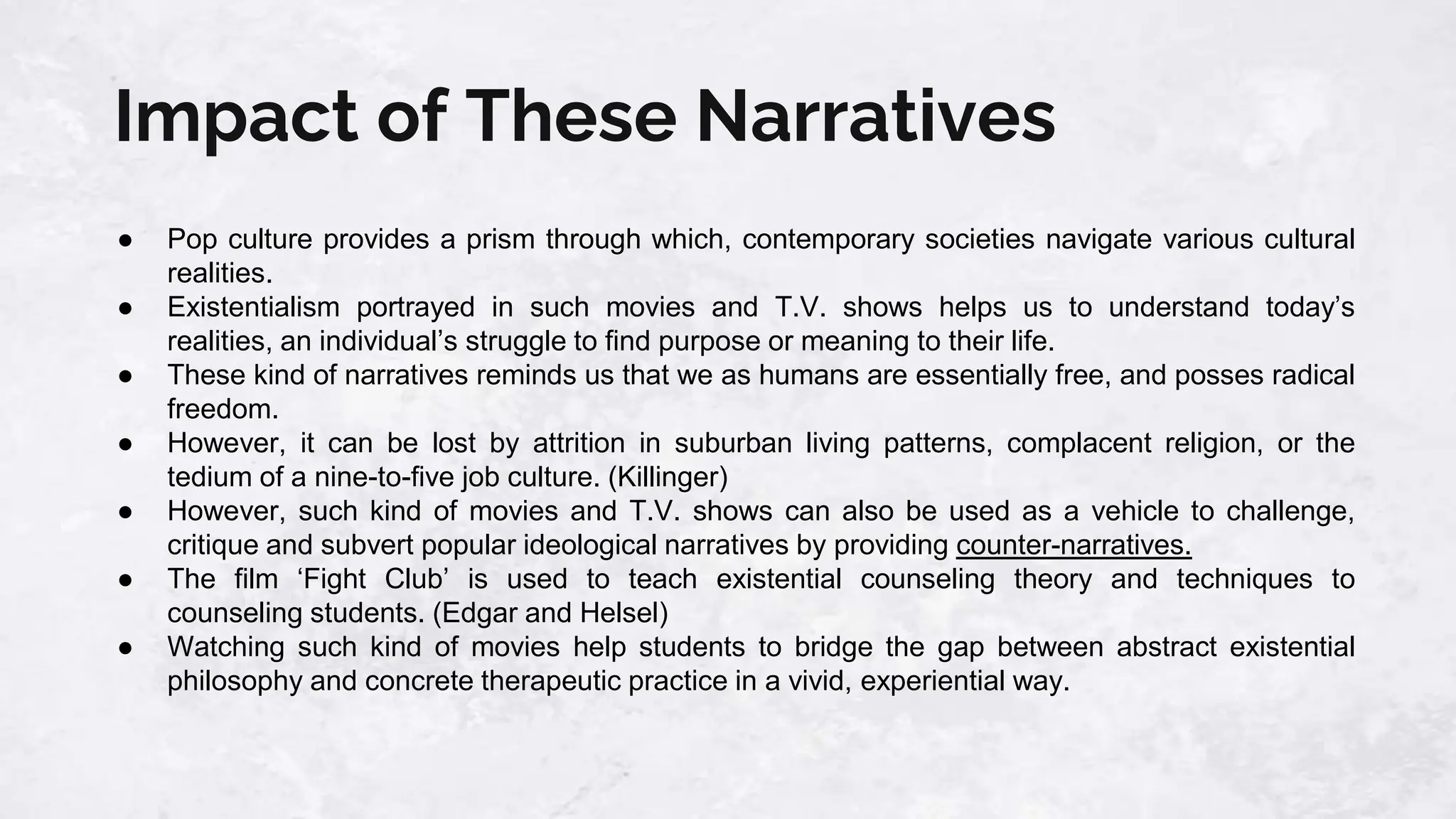
● Narrator in the movie Fight Club, is played by
Edward Norton is the central character whose
existential crisis drives the movie’s plot.
● He is an insomniac, detached from society and his
own life, working as a product recall supervisor for
an automotive company.
● His dissociative identity disorder manifests as his
alternate personality, Tyler Durden.
● Tyler emerges from the narrator's psyche as a
response to his emasculation, lack of meaning,
and spiritual numbness in modern capitalist
society.
● Nietzsche’s ‘Three Metamorphoses of the Spirit’
shedding the restrictive "camel" persona, rebelling
as the "lion", and finally emerging renewed as the
"child" capable of creating new values. (Meddings)
Existential Themes in Fight Club (1999)
● Search for meaning and purpose - Characters feel disconnected from society and
themselves, leading to an existential crisis of meaninglessness. The film suggests finding
love, connections with others, and reclaiming one's identity can help provide meaning.
● Tyler Durden initially represents a rejection of consumerism and call to create one's own
values, echoing Nietzsche's ideas.
● Project Mayhem: The attempt to cultivate individuality ironically leads to blind obedience
to a new dogma.
● Radical Freedom: The narrator must make difficult choices without moral guidelines,
embodying the existential notion of radical freedom.
● Rejecting essence for existence: Tyler's philosophy rejects predetermined essences or
identities in favor of actively creating one's existence through choices and actions,
aligning with existentialist ideas.
● Existence precedes essence: The narrator constructs his identity as Tyler Durden,
exemplifying the existentialist view that one's existence precedes and shapes one's
perceived essence or self-conception. (Irwin)
Impact of These Narratives
● Pop culture provides a prism through which, contemporary societies navigate various cultural
realities.
● Existentialism portrayed in such movies and T.V. shows helps us to understand today’s
realities, an individual’s struggle to find purpose or meaning to their life.
● These kind of narratives reminds us that we as humans are essentially free, and posses radical
freedom.
● However, it can be lost by attrition in suburban living patterns, complacent religion, or the
tedium of a nine-to-five job culture. (Killinger)
● However, such kind of movies and T.V. shows can also be used as a vehicle to challenge,
critique and subvert popular ideological narratives by providing counter-narratives.
● The film ‘Fight Club’ is used to teach existential counseling theory and techniques to
counseling students. (Edgar and Helsel)
● Watching such kind of movies help students to bridge the gap between abstract existential
philosophy and concrete therapeutic practice in a vivid, experiential way.
Conclusion
● The prevalence of existential themes in popular cinema reflects the enduring
human search for meaning, identity, and purpose amidst the complexities of
modern and fast life.
● Individuals can address their existential question through more relatable
movies and narratives.
● Such a abstract and complex philosophies can be better understood with the
help of visuals and frames.
● Interrelation of existentialism and popular culture highlights how humans
strive to understand their limited time on Earth and to discover meaning,
even when life appears absure..
References
● Bob-Waksberg, R. (Creator). (2014). Bojack Horseman [Television series]. Netflix.
● Cwik, Greg. “The most existential show on television is a cartoon about an alcoholic horse.”
The Week, 25 July 2016, https://theweek.com/articles/637676/most-existential-show-
television-cartoon-about-alcoholic-horse. Accessed 25 March 2024.
● Coates, J. B. “Existentialism.” Philosophy, vol. 28, no. 106, 1953, pp. 229–38. JSTOR,
http://www.jstor.org/stable/3748098. Accessed 20 Mar. 2024.
● Edger, Kailla, and Stephanie Helsel. “Constructivist education with Media: Using FIGHT CLUB to
teach existential counseling theory.” heraldjournals.org , Vol. 1 (2) , pp. 048-053 , 2012 .
https://heraldjournals.org/hjegs/pdf/2012/sept/Edger%20%20and%20Helsel.pdf. Accessed 9 April
2024.
● Fell, Joseph P. “Existentialism | Internet Encyclopedia.” Internet Encyclopedia of Philosophy,
https://iep.utm.edu/existent/. Accessed 20 March 2024.
● Haselstein, Ulla, et al. “Popular Culture: Introduction.” Amerikastudien / American Studies,
vol. 46, no. 3, 2001, pp. 331–38. JSTOR, http://www.jstor.org/stable/41157662. Accessed 21
Mar. 2024.
● IRWIN, WILLIAM. “‘Fight Club’, Self-Definition, and the Fragility of Authenticity.” Revista
Portuguesa de Filosofia, vol. 69, no. 3/4, 2013, pp. 673–84. JSTOR,
http://www.jstor.org/stable/23785885. Accessed 9 Apr. 2024.
● Killinger, John. “Existentialism and Human Freedom.” The English Journal, vol. 50, no. 5, 1961, pp.
303–13. JSTOR, https://doi.org/10.2307/810349. Accessed 20 Mar. 2024.
● Kidd, Dustin. “Popular Culture - Sociology.” Oxford Bibliographies, 28 February 2017,
https://www.oxfordbibliographies.com/display/document/obo-9780199756384/obo-9780199756384-0193.xml.
Accessed 21 March 2024.
● Meddings, Jonathan. “The philosophy of Fight Club. Photo by JGA licenced through… | by Jonathan
Meddings | Medium.” Jonathan Meddings, 29 June 2023, https://jonathanmeddings.medium.com/the-
philosophy-of-fight-club-5589eabc9e93. Accessed 26 March 2024.
● Parashar, Poorva. “(PDF) Bojack Horseman and Mental Health : An Academic Exploration of Existentialist
Themes.” ResearchGate, 19 May 2020,
https://www.researchgate.net/publication/341489156_Bojack_Horseman_and_Mental_Health_An_Academic
_Exploration_of_Existentialist_Themes. Accessed 25 March 2024.
● Stevenson, Leslie. “Sartre on Bad Faith.” Philosophy, vol. 58, no. 224, 1983, pp. 253–58. JSTOR,
http://www.jstor.org/stable/3750658. Accessed 20 Mar. 2024.
Thank you

Exploring Existential Themes in Popular Culture

  • 1.
    Date: 10 April2024 Exploring Existential Themes in Popular Culture Sem 2 | Batch 2023-25 Department of English Maharaja Krishnakumarsinhji Bhavnagar University Aakash Chavda
  • 2.
    Exploring Existential Themes in PopularCulture Prepared by: Aakash Chavda
  • 3.
    ● Presented by- Aakash Chavda ● Roll No. - 1 ● Paper: 110A - History of English Literature - 1900 to 2000 ● Topic - Exploring Existential Themes in Popular Culture ● Submitted To - S. B. Gardi, Department of English, M.K.B.U. ● E-mail Id - aakashchavda637@gmail.com Academic Details
  • 4.
    What is Existentialism? ● A philosophical movement that arose as a corrective against overly abstract and detached philosophies that lost sight of concrete human existence and freedom. ● Existentialist philosophers, predominantly from Europe during the 19th and 20th centuries, are widely recognized as key figures in existentialism. Existentialism is arguably the most famous philosophical movement. (Fell) ● Existentialists examine various aspects of human existence such as anxiety, isolation, and our connection with God. They concentrate on understanding the significance of real-life human experiences.(Coates) ● The philosophy suggests that humans, being aware of their mortality, ascribe meaning to their lives by making choices and engaging in actions. ● It argues that Individual should make choices in their life and should be responsible for that. ● This philosophy made emphasis on human beings as self-determining subjects or agents capable of free choice, rather than just objective determination by their nature or essence. “Existence precedes essence” - Sartre
  • 5.
    Continue… ● Existentialism proposesways for individuals to become aware of their existential freedom and responsibility for choosing their essence, they have to confront finitude. (Killinger) ● We are not born with fixed human nature but create our own essence through the choices we made. ● "To exist authentically in the highest degree", that is the aim that existentialism sets before everyman. ● Individuals should learn the spirit of authentically relating oneself to one's unique existential situation from existentialists. (Coates) ● Existentialism calls for confronting one’s finitude, aloneness, and freedom through experience that return one to authentic selfhood. ● Key existentialist thinkers like Kierkegaard, Nietzsche, Heidegger, Sartre, Jaspers, and Marcel shared the belief that mainstream philosophical ideas didn't adequately deal with real human life. “There is no determinism, man is free, man is freedom” - Sartre
  • 6.
    Existentialists Philosophers Soren Kierkegaard Jean-PaulSartre Albert Camus Friedrich Nietzsche
  • 7.
    Existential Views ● Kierkegaard,had a Christian injunction to make a personal commitment through ‘Leap of Faith’, for others like Camus and Sartre had a secular embrace of radical freedom and responsibility despite life’s absurdity. (Killinger) ● The ‘Leap of Faith’ involves deciding to believe in something despite the inability to completely justify or demonstrate its truth by means of rationality. ● Kierkegaard believed that the problem of meaning could be solved by an individual's connection to the Divine, while Nietzsche took a strongly anti-Christian stance. ● Nietzsche believed that with the demise of divine belief, there's a chance for individuals to find meaning in their existence from within themselves rather than relying on external authorities. ● Bad Faith: According to Sartre, bad faith is when individuals deceive themselves by denying or misrepresenting something they are inherently aware of about themselves or their situation without consciously acknowledging it. (Stevenson) ● Most fundamental aspect of ‘bad faith’ is humanity’s constant denial of crushing burden of freedom that it posses.
  • 8.
    Question to Address ●How existential themes in popular films and TV reflect modern society's existential worries? Characters mirror viewers' struggles with identity crisis, meaning, and mortality against a backdrop of technological development, and social discord. Does this interconnection between narratives depicted on screens and real-life help us to better understand such theories. How these popular narrative providing an opportunity for individuals to critically examine existential themes and contemplate profound questions within their own lives and the wider cultural context?
  • 9.
    What is PopCulture ? ● The term "popular culture" gained prominence in the 19th century as the urban working class gained more leisure time and expendable income. ● Since the 1960s, popular culture rise as academic field of study, driven by the growing influence of television and advertising in American society. ● Popular culture refers to cultural expressions, traditions, ideologies, and artifacts that enjoy widespread acceptance and consumption among the masses, contrasting with elite or highbrow culture. ● It is closely tied with mass media, commercialism, and industries such as television, advertising, mainstream music, and genre films. ● Pop culture Includes genres like popular music, movies, TV shows, comic books, genre fiction, sports, advertising etc. ● Popular culture acts as a mirror reflecting the dominant values, beliefs, myths and ideologies prevalent in society at a particular time. ● Shapes the cultural trends. (Haselstein)
  • 11.
    Bojack Horseman (2014) ●Bojack Horseman is 2014 Netflix original adult animated series created by Raphael-Bob Waksberg. ● The story revolves around the titular character named Bojack, who is washed-up 90’s sitcom actor , and lives in an alternative reality where human and anthropomorphic animals coexists. (Parashar) ● This show is a dark satire on entertainment industry, referred as Hollywoo. ● Core existential idea: The show allows its characters to create meaning in their life. (Cwik)
  • 12.
    Existentialism and BojackHorseman ● Bojack portrays existential ideas like the subjective nature of identity, authenticity vs living in "bad faith", and the human condition of feeling alone and disconnected from a meaningless world. ● Bojack wanted to regain his fame, and for that he asked for a role of racehorse in the movie Secretariat, for which he was nominated for Oscar. ● Bojack's attempts to secure an Oscar underscore the idea that his existence lacks inherent significance. (Parashar) ● Just like Bojack, every other character in the story awaits for happy ending, which does not actually exists. ● "We must imagine BoJack happy. We must imagine he wants to be. BoJack is Sisyphus rolling a beer bottle up the Hollywood hills." (Cwik) ● Sartre’s idea of radical freedom complicates Bojack’s situation. “I’m responsible for my own happiness? I can’t even be responsible for my own breakfast!” (S1, EP1)
  • 14.
    Existential Crisis inMinor Characters ● According to Camus, the world is nonsensical and meaningless, but humans desperately try to find purpose in it - this disparity is called "the absurd." ● Mr. Peanutbutter and Cuddly Whiskers embrace the absurd. ● Todd and Mr.Peanutbutter’s plan was to create driving service to make transportation safer for women is portrayed as ‘sincere’ attempt to do good. It ends up making them rich without improving women’s lives.(Cwik) “The universe is a cruel, uncaring void. The key to being happy isn’t a search for meaning. It’s to just keep yourself busy with unimportant nonsense, and eventually, you’ll be dead” (Season 1, Episode 12)
  • 15.
    Continue… ● In theseries, a baboon can be seen jogging up the hill near BoJack's house every day, he runs up to the same hill everyday and he advised tired Bojack that he should do it everyday. ● Princess Carolyn, described as "the Peggy Olson of the show," is portrayed as finding some temporary love and meaning by letting go of BoJack. However, she also says that, "who knows for how long" this meaning will last for her. ● Diane: She finds meaning in her life through online activism, but last for fleeting moment. Writes for celebrities. (Cwik)
  • 16.
    Fight Club (1999) ●The 1999 movie "Fight Club," adapted from Chuck Palahniuk's novel with the same name, directed by David Fincher. ● Movie follows the life of unnamed protagonist, who feels alienated and devoid of meaning in his soulless corporate life. (Edgar and Helsel) ● Later he meets his rebellious alter-ego Tyler Durden, who represents vitality, freedom and masculinity that protagonist lacks. ● "Fight Club" stands as a critiques of capitalist consumerism, masculinity, mortality, identity, and the harms of both order and chaos, ultimately dismissing anarchism as a remedy for capitalism's existential challenges. (Meddings)
  • 17.
    Insomnia as ExistentialAngst ● The narrator's insomnia represents an existential restlessness and lack of meaning in his life, driving him to seek more authentic experiences. (Irwin) ● Narrator in the movie Fight Club, is played by Edward Norton is the central character whose existential crisis drives the movie’s plot. ● He is an insomniac, detached from society and his own life, working as a product recall supervisor for an automotive company. ● His dissociative identity disorder manifests as his alternate personality, Tyler Durden. ● Tyler emerges from the narrator's psyche as a response to his emasculation, lack of meaning, and spiritual numbness in modern capitalist society. ● Nietzsche’s ‘Three Metamorphoses of the Spirit’ shedding the restrictive "camel" persona, rebelling as the "lion", and finally emerging renewed as the "child" capable of creating new values. (Meddings)
  • 18.
    Existential Themes inFight Club (1999) ● Search for meaning and purpose - Characters feel disconnected from society and themselves, leading to an existential crisis of meaninglessness. The film suggests finding love, connections with others, and reclaiming one's identity can help provide meaning. ● Tyler Durden initially represents a rejection of consumerism and call to create one's own values, echoing Nietzsche's ideas. ● Project Mayhem: The attempt to cultivate individuality ironically leads to blind obedience to a new dogma. ● Radical Freedom: The narrator must make difficult choices without moral guidelines, embodying the existential notion of radical freedom. ● Rejecting essence for existence: Tyler's philosophy rejects predetermined essences or identities in favor of actively creating one's existence through choices and actions, aligning with existentialist ideas. ● Existence precedes essence: The narrator constructs his identity as Tyler Durden, exemplifying the existentialist view that one's existence precedes and shapes one's perceived essence or self-conception. (Irwin)
  • 19.
    Impact of TheseNarratives ● Pop culture provides a prism through which, contemporary societies navigate various cultural realities. ● Existentialism portrayed in such movies and T.V. shows helps us to understand today’s realities, an individual’s struggle to find purpose or meaning to their life. ● These kind of narratives reminds us that we as humans are essentially free, and posses radical freedom. ● However, it can be lost by attrition in suburban living patterns, complacent religion, or the tedium of a nine-to-five job culture. (Killinger) ● However, such kind of movies and T.V. shows can also be used as a vehicle to challenge, critique and subvert popular ideological narratives by providing counter-narratives. ● The film ‘Fight Club’ is used to teach existential counseling theory and techniques to counseling students. (Edgar and Helsel) ● Watching such kind of movies help students to bridge the gap between abstract existential philosophy and concrete therapeutic practice in a vivid, experiential way.
  • 20.
    Conclusion ● The prevalenceof existential themes in popular cinema reflects the enduring human search for meaning, identity, and purpose amidst the complexities of modern and fast life. ● Individuals can address their existential question through more relatable movies and narratives. ● Such a abstract and complex philosophies can be better understood with the help of visuals and frames. ● Interrelation of existentialism and popular culture highlights how humans strive to understand their limited time on Earth and to discover meaning, even when life appears absure..
  • 21.
    References ● Bob-Waksberg, R.(Creator). (2014). Bojack Horseman [Television series]. Netflix. ● Cwik, Greg. “The most existential show on television is a cartoon about an alcoholic horse.” The Week, 25 July 2016, https://theweek.com/articles/637676/most-existential-show- television-cartoon-about-alcoholic-horse. Accessed 25 March 2024. ● Coates, J. B. “Existentialism.” Philosophy, vol. 28, no. 106, 1953, pp. 229–38. JSTOR, http://www.jstor.org/stable/3748098. Accessed 20 Mar. 2024. ● Edger, Kailla, and Stephanie Helsel. “Constructivist education with Media: Using FIGHT CLUB to teach existential counseling theory.” heraldjournals.org , Vol. 1 (2) , pp. 048-053 , 2012 . https://heraldjournals.org/hjegs/pdf/2012/sept/Edger%20%20and%20Helsel.pdf. Accessed 9 April 2024. ● Fell, Joseph P. “Existentialism | Internet Encyclopedia.” Internet Encyclopedia of Philosophy, https://iep.utm.edu/existent/. Accessed 20 March 2024. ● Haselstein, Ulla, et al. “Popular Culture: Introduction.” Amerikastudien / American Studies, vol. 46, no. 3, 2001, pp. 331–38. JSTOR, http://www.jstor.org/stable/41157662. Accessed 21 Mar. 2024. ● IRWIN, WILLIAM. “‘Fight Club’, Self-Definition, and the Fragility of Authenticity.” Revista Portuguesa de Filosofia, vol. 69, no. 3/4, 2013, pp. 673–84. JSTOR, http://www.jstor.org/stable/23785885. Accessed 9 Apr. 2024.
  • 22.
    ● Killinger, John.“Existentialism and Human Freedom.” The English Journal, vol. 50, no. 5, 1961, pp. 303–13. JSTOR, https://doi.org/10.2307/810349. Accessed 20 Mar. 2024. ● Kidd, Dustin. “Popular Culture - Sociology.” Oxford Bibliographies, 28 February 2017, https://www.oxfordbibliographies.com/display/document/obo-9780199756384/obo-9780199756384-0193.xml. Accessed 21 March 2024. ● Meddings, Jonathan. “The philosophy of Fight Club. Photo by JGA licenced through… | by Jonathan Meddings | Medium.” Jonathan Meddings, 29 June 2023, https://jonathanmeddings.medium.com/the- philosophy-of-fight-club-5589eabc9e93. Accessed 26 March 2024. ● Parashar, Poorva. “(PDF) Bojack Horseman and Mental Health : An Academic Exploration of Existentialist Themes.” ResearchGate, 19 May 2020, https://www.researchgate.net/publication/341489156_Bojack_Horseman_and_Mental_Health_An_Academic _Exploration_of_Existentialist_Themes. Accessed 25 March 2024. ● Stevenson, Leslie. “Sartre on Bad Faith.” Philosophy, vol. 58, no. 224, 1983, pp. 253–58. JSTOR, http://www.jstor.org/stable/3750658. Accessed 20 Mar. 2024.
  • 23.