acadecraft.com
Visit Our Website
Revolutionizing Education
in the Digital Age
Exploring
Elearning Services
Acadecraft Pvt. Ltd.
Elearning services encompass a wide range of digital tools, platforms, and resources designed to facilitate
online learning and training. These services leverage technology to deliver educational content, facilitate
communication and collaboration, track progress, and assess learning outcomes. Here are some common
components and examples of eLearning services:
Learning Management Systems (LMS): LMS platforms provide a centralized hub for organizing, delivering,
and managing online courses and training programs. They typically include features such as content
creation and management, student enrollment, progress tracking, assessment tools, and communication
functionalities.
1.
Massive Open Online Courses (MOOCs): MOOC platforms offer open-access courses that are available to
anyone with an internet connection. They often feature video lectures, interactive quizzes, discussion
forums, and peer assessment. Examples include Coursera, edX, and Udacity.
2.
Virtual Classroom Platforms: These platforms enable live, interactive online classes and webinars, allowing
instructors to deliver lectures, conduct discussions, share presentations, and engage with students in real-
time. Examples include Zoom, Microsoft Teams, and Adobe Connect.
3.
Content Creation Tools: Elearning services also include tools for creating and publishing digital learning
materials such as interactive presentations, e-books, videos, quizzes, and simulations. Examples include
Articulate Storyline, Adobe Captivate, and Camtasia.
4.
Gamification Platforms: Gamification services incorporate game elements and mechanics into eLearning
experiences to increase engagement, motivation, and knowledge retention. They often include features
such as badges, leaderboards, challenges, and rewards. Examples include Kahoot!, Quizizz, and Classcraft.
5.
What are Elearning
Services?
Benefits of Elearning Services
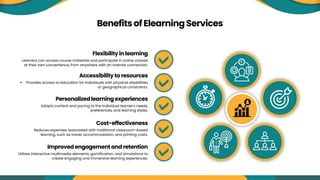
Learners can access course materials and participate in online classes
at their own convenience, from anywhere with an internet connection.
Provides access to education for individuals with physical disabilities
or geographical constraints.
Adapts content and pacing to the individual learner's needs,
preferences, and learning styles.
Reduces expenses associated with traditional classroom-based
learning, such as travel, accommodation, and printing costs.
Utilizes interactive multimedia elements, gamification, and simulations to
create engaging and immersive learning experiences.
Flexibility in learning
Accessibility to resources
Personalized learning experiences
Cost-effectiveness
Improved engagement and retention
Types of eLearning
Services
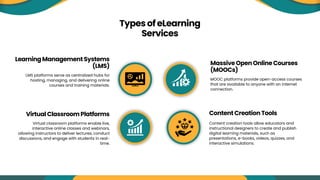
MOOC platforms provide open-access courses
that are available to anyone with an internet
connection.
LMS platforms serve as centralized hubs for
hosting, managing, and delivering online
courses and training materials.
Content creation tools allow educators and
instructional designers to create and publish
digital learning materials, such as
presentations, e-books, videos, quizzes, and
interactive simulations.
Virtual classroom platforms enable live,
interactive online classes and webinars,
allowing instructors to deliver lectures, conduct
discussions, and engage with students in real-
time.
Massive Open Online Courses
(MOOCs)
Learning Management Systems
(LMS)
Content Creation Tools
Virtual Classroom Platforms
info@acadecraft.com
+1 778 951 8354
www.acadecraft.com
30 N Gould St Ste R, Sheridan, WY
Contact Us
acadecraft.com
Visit Our Website
F o r Y o u r A t t e n t i o n
Thank You
Acadecraft Pvt. Ltd.

Exploring Elearning Services: Revolutionizing Education in the Digital Age

  • 1.
    acadecraft.com Visit Our Website RevolutionizingEducation in the Digital Age Exploring Elearning Services Acadecraft Pvt. Ltd.
  • 2.
    Elearning services encompassa wide range of digital tools, platforms, and resources designed to facilitate online learning and training. These services leverage technology to deliver educational content, facilitate communication and collaboration, track progress, and assess learning outcomes. Here are some common components and examples of eLearning services: Learning Management Systems (LMS): LMS platforms provide a centralized hub for organizing, delivering, and managing online courses and training programs. They typically include features such as content creation and management, student enrollment, progress tracking, assessment tools, and communication functionalities. 1. Massive Open Online Courses (MOOCs): MOOC platforms offer open-access courses that are available to anyone with an internet connection. They often feature video lectures, interactive quizzes, discussion forums, and peer assessment. Examples include Coursera, edX, and Udacity. 2. Virtual Classroom Platforms: These platforms enable live, interactive online classes and webinars, allowing instructors to deliver lectures, conduct discussions, share presentations, and engage with students in real- time. Examples include Zoom, Microsoft Teams, and Adobe Connect. 3. Content Creation Tools: Elearning services also include tools for creating and publishing digital learning materials such as interactive presentations, e-books, videos, quizzes, and simulations. Examples include Articulate Storyline, Adobe Captivate, and Camtasia. 4. Gamification Platforms: Gamification services incorporate game elements and mechanics into eLearning experiences to increase engagement, motivation, and knowledge retention. They often include features such as badges, leaderboards, challenges, and rewards. Examples include Kahoot!, Quizizz, and Classcraft. 5. What are Elearning Services?
  • 3.
    Benefits of ElearningServices Learners can access course materials and participate in online classes at their own convenience, from anywhere with an internet connection. Provides access to education for individuals with physical disabilities or geographical constraints. Adapts content and pacing to the individual learner's needs, preferences, and learning styles. Reduces expenses associated with traditional classroom-based learning, such as travel, accommodation, and printing costs. Utilizes interactive multimedia elements, gamification, and simulations to create engaging and immersive learning experiences. Flexibility in learning Accessibility to resources Personalized learning experiences Cost-effectiveness Improved engagement and retention
  • 4.
    Types of eLearning Services MOOCplatforms provide open-access courses that are available to anyone with an internet connection. LMS platforms serve as centralized hubs for hosting, managing, and delivering online courses and training materials. Content creation tools allow educators and instructional designers to create and publish digital learning materials, such as presentations, e-books, videos, quizzes, and interactive simulations. Virtual classroom platforms enable live, interactive online classes and webinars, allowing instructors to deliver lectures, conduct discussions, and engage with students in real- time. Massive Open Online Courses (MOOCs) Learning Management Systems (LMS) Content Creation Tools Virtual Classroom Platforms
  • 5.
    info@acadecraft.com +1 778 9518354 www.acadecraft.com 30 N Gould St Ste R, Sheridan, WY Contact Us
  • 6.
    acadecraft.com Visit Our Website Fo r Y o u r A t t e n t i o n Thank You Acadecraft Pvt. Ltd.