Understanding WCAG
Understanding WCAG
Compliance
Compliance
Requirements:
Requirements:
Ensuring Accessibility for All
Users
Acadecraft Pvt. Ltd.
What is WCAG?
What is WCAG?
The Web Content Accessibility Guidelines (WCAG) are a set of guidelines designed to make web content more accessible to
people with disabilities. These guidelines are developed and maintained by the World Wide Web Consortium (W3C) through the
Web Accessibility Initiative (WAI).
Key Points about WCAG:
Purpose:
1.
To provide a single shared standard for web content accessibility that meets the needs of individuals, organizations, and
governments internationally.
Target Audience:
2.
Web content developers (page authors, site designers, etc.)
Web authoring tool developers
Web accessibility evaluation tool developers
Others who want or need a standard for web accessibility, including for mobile accessibility
Versions:
3.
WCAG 1.0: Published in May 1999
WCAG 2.0: Published in December 2008
WCAG 2.1: Published in June 2018, includes additional success criteria to address accessibility barriers for people with
disabilities, including those with low vision and cognitive or learning disabilities
WCAG 2.2: Currently in draft, expected to include further enhancements to address a wider range of accessibility issues
Principles:
4.
Perceivable: Information and user interface components must be presented to users in ways they can perceive.
Operable: User interface components and navigation must be operable.
Understandable: Information and the operation of user interface must be understandable.
Robust: Content must be robust enough to be interpreted by a wide variety of user agents, including assistive technologies.
Importance of WCAG Compliance
Ensuring that your website complies with the Web Content Accessibility Guidelines (WCAG) is crucial for several reasons. Here’s a
detailed overview of why WCAG compliance is important:
1. Inclusivity and Accessibility
Universal Access: WCAG compliance ensures that web content is accessible to people with a wide range of disabilities,
including visual, auditory, motor, and cognitive impairments. This inclusivity helps everyone access information, services, and
products online.
Equal Opportunity: By making web content accessible, organizations provide equal opportunities for all users, regardless of
their abilities, to participate fully in the digital world.
2. Legal and Regulatory Compliance
Avoiding Legal Risks: Many countries have laws and regulations requiring web accessibility. In the United States, the Americans
with Disabilities Act (ADA) and Section 508 of the Rehabilitation Act are examples of such regulations. Non-compliance can
lead to legal action and significant fines.
Global Standards: WCAG serves as a global benchmark for web accessibility, making it easier for organizations to comply with
international laws and standards.
3. Improved User Experience
Enhanced Usability: Accessible websites tend to be more user-friendly for everyone. Features like clear navigation, sufficient
color contrast, and alternative text for images benefit all users, not just those with disabilities.
Better Design: Focusing on accessibility often leads to cleaner, more efficient website designs that enhance the overall user
experience.
4. Expanded Audience Reach
Broader Audience: By ensuring that web content is accessible to people with disabilities, organizations can reach a larger
audience, including an estimated 1 billion people worldwide who have some form of disability.
Customer Loyalty: Accessible websites demonstrate a commitment to inclusivity and social responsibility, which can enhance
brand reputation and foster customer loyalty.
Levels of WCAG
Levels of WCAG
Compliance
Compliance
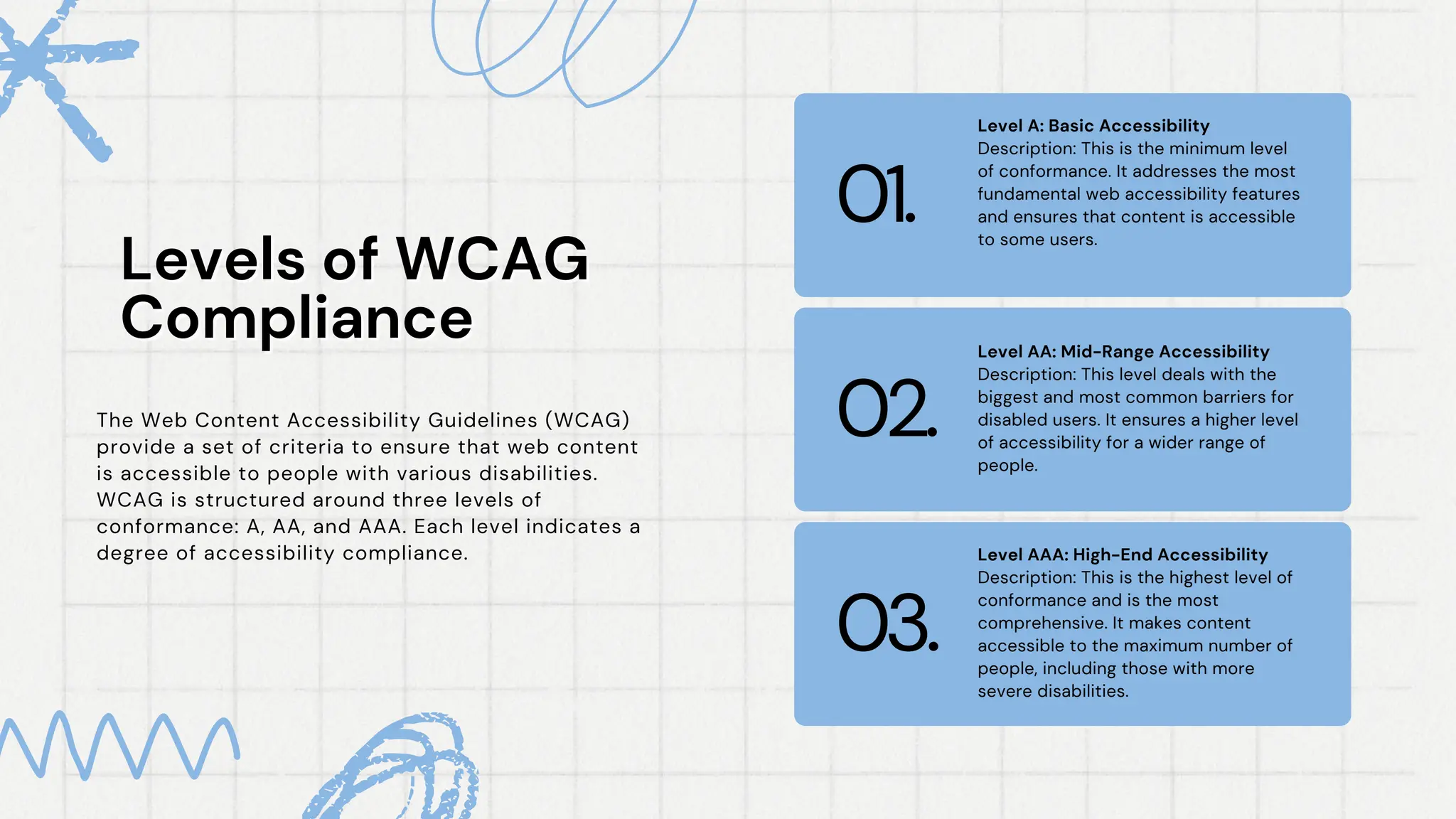
The Web Content Accessibility Guidelines (WCAG)
provide a set of criteria to ensure that web content
is accessible to people with various disabilities.
WCAG is structured around three levels of
conformance: A, AA, and AAA. Each level indicates a
degree of accessibility compliance.
01.
02.
03.
Level A: Basic Accessibility
Description: This is the minimum level
of conformance. It addresses the most
fundamental web accessibility features
and ensures that content is accessible
to some users.
Level AA: Mid-Range Accessibility
Description: This level deals with the
biggest and most common barriers for
disabled users. It ensures a higher level
of accessibility for a wider range of
people.
Level AAA: High-End Accessibility
Description: This is the highest level of
conformance and is the most
comprehensive. It makes content
accessible to the maximum number of
people, including those with more
severe disabilities.
Thank you
Thank you
very much!
very much!
www.acadecraft.com
info@acadecraft.com
Acadecraft Pvt. Ltd.

Understanding WCAG Compliance Requirements: Ensuring Accessibility for All Users

  • 1.
  • 2.
    What is WCAG? Whatis WCAG? The Web Content Accessibility Guidelines (WCAG) are a set of guidelines designed to make web content more accessible to people with disabilities. These guidelines are developed and maintained by the World Wide Web Consortium (W3C) through the Web Accessibility Initiative (WAI). Key Points about WCAG: Purpose: 1. To provide a single shared standard for web content accessibility that meets the needs of individuals, organizations, and governments internationally. Target Audience: 2. Web content developers (page authors, site designers, etc.) Web authoring tool developers Web accessibility evaluation tool developers Others who want or need a standard for web accessibility, including for mobile accessibility Versions: 3. WCAG 1.0: Published in May 1999 WCAG 2.0: Published in December 2008 WCAG 2.1: Published in June 2018, includes additional success criteria to address accessibility barriers for people with disabilities, including those with low vision and cognitive or learning disabilities WCAG 2.2: Currently in draft, expected to include further enhancements to address a wider range of accessibility issues Principles: 4. Perceivable: Information and user interface components must be presented to users in ways they can perceive. Operable: User interface components and navigation must be operable. Understandable: Information and the operation of user interface must be understandable. Robust: Content must be robust enough to be interpreted by a wide variety of user agents, including assistive technologies.
  • 3.
    Importance of WCAGCompliance Importance of WCAG Compliance Ensuring that your website complies with the Web Content Accessibility Guidelines (WCAG) is crucial for several reasons. Here’s a detailed overview of why WCAG compliance is important: 1. Inclusivity and Accessibility Universal Access: WCAG compliance ensures that web content is accessible to people with a wide range of disabilities, including visual, auditory, motor, and cognitive impairments. This inclusivity helps everyone access information, services, and products online. Equal Opportunity: By making web content accessible, organizations provide equal opportunities for all users, regardless of their abilities, to participate fully in the digital world. 2. Legal and Regulatory Compliance Avoiding Legal Risks: Many countries have laws and regulations requiring web accessibility. In the United States, the Americans with Disabilities Act (ADA) and Section 508 of the Rehabilitation Act are examples of such regulations. Non-compliance can lead to legal action and significant fines. Global Standards: WCAG serves as a global benchmark for web accessibility, making it easier for organizations to comply with international laws and standards. 3. Improved User Experience Enhanced Usability: Accessible websites tend to be more user-friendly for everyone. Features like clear navigation, sufficient color contrast, and alternative text for images benefit all users, not just those with disabilities. Better Design: Focusing on accessibility often leads to cleaner, more efficient website designs that enhance the overall user experience. 4. Expanded Audience Reach Broader Audience: By ensuring that web content is accessible to people with disabilities, organizations can reach a larger audience, including an estimated 1 billion people worldwide who have some form of disability. Customer Loyalty: Accessible websites demonstrate a commitment to inclusivity and social responsibility, which can enhance brand reputation and foster customer loyalty.
  • 4.
    Levels of WCAG Levelsof WCAG Compliance Compliance The Web Content Accessibility Guidelines (WCAG) provide a set of criteria to ensure that web content is accessible to people with various disabilities. WCAG is structured around three levels of conformance: A, AA, and AAA. Each level indicates a degree of accessibility compliance. 01. 02. 03. Level A: Basic Accessibility Description: This is the minimum level of conformance. It addresses the most fundamental web accessibility features and ensures that content is accessible to some users. Level AA: Mid-Range Accessibility Description: This level deals with the biggest and most common barriers for disabled users. It ensures a higher level of accessibility for a wider range of people. Level AAA: High-End Accessibility Description: This is the highest level of conformance and is the most comprehensive. It makes content accessible to the maximum number of people, including those with more severe disabilities.
  • 5.
    Thank you Thank you verymuch! very much! www.acadecraft.com info@acadecraft.com Acadecraft Pvt. Ltd.