Opening Educational Practices in
Scotland
Exploring barriers to participation
in open, online learning
Rosemarie McIlwhan
2
Opening Educational Practices in Scotland
About us
Opening Educational Practices in Scotland is a cross-sector
project that facilitates best practice in Scottish open education.
We aim to enhance Scotland’s reputation and capacity for
developing publicly available and licenced online materials,
supported by high quality pedagogy and learning technology.
3
Opening Educational Practices in Scotland
OEPS
• Final two months of 3-year
project (finish 31/7/17)
• Working with >60 partners
to identify and share good
practice.
• Working with some of
these partners to co-
design and co-produce
exemplar free openly
licensed courses
www.oepscotland.org
4
Opening Educational Practices in Scotland
Defining OER and OEP
• Open Educational Resources (OER) - focus on
freedoms afforded by openly licensing content “The 5
Rs”: retain, reuse, revise, remix, redistribute (Wiley,
2014)) and the degree to which design, development
and distribution accounts for equity and openness.
• Open Educational Practices (OEP) are usually
understood as approaches to teaching and facilitation
using technology to support learning in the context of
high quality OER.
5
Opening Educational Practices in Scotland
The promise of open education
• Free access to high quality education on a mass scale
• Widening access and participation
‘Promote and use OER to widen access to education at all
levels both formal and non-formal in a perspective of lifelong
learning …’ (UNESCO, 2012)
• However:
‘… there is little evidence of educational transformation
resulting from OER practices: [..]. The lack of sufficient
evidence hinders understanding of the role of OER in
widening access to education, social inclusion, and long-term
sustainability.’ (Butcher, 2011)
6
Opening Educational Practices in Scotland
Understanding Barriers
• Barriers can be situational, institutional and dispositional
(Fuller & Paton, 2008)
• Those most disadvantaged are least like to be
connected (Royal Society of Edinburgh, 2010)
• Disconnect between everyday digital skills and online
learning/study skills (Beetham et al, 2010)
7
Opening Educational Practices in Scotland
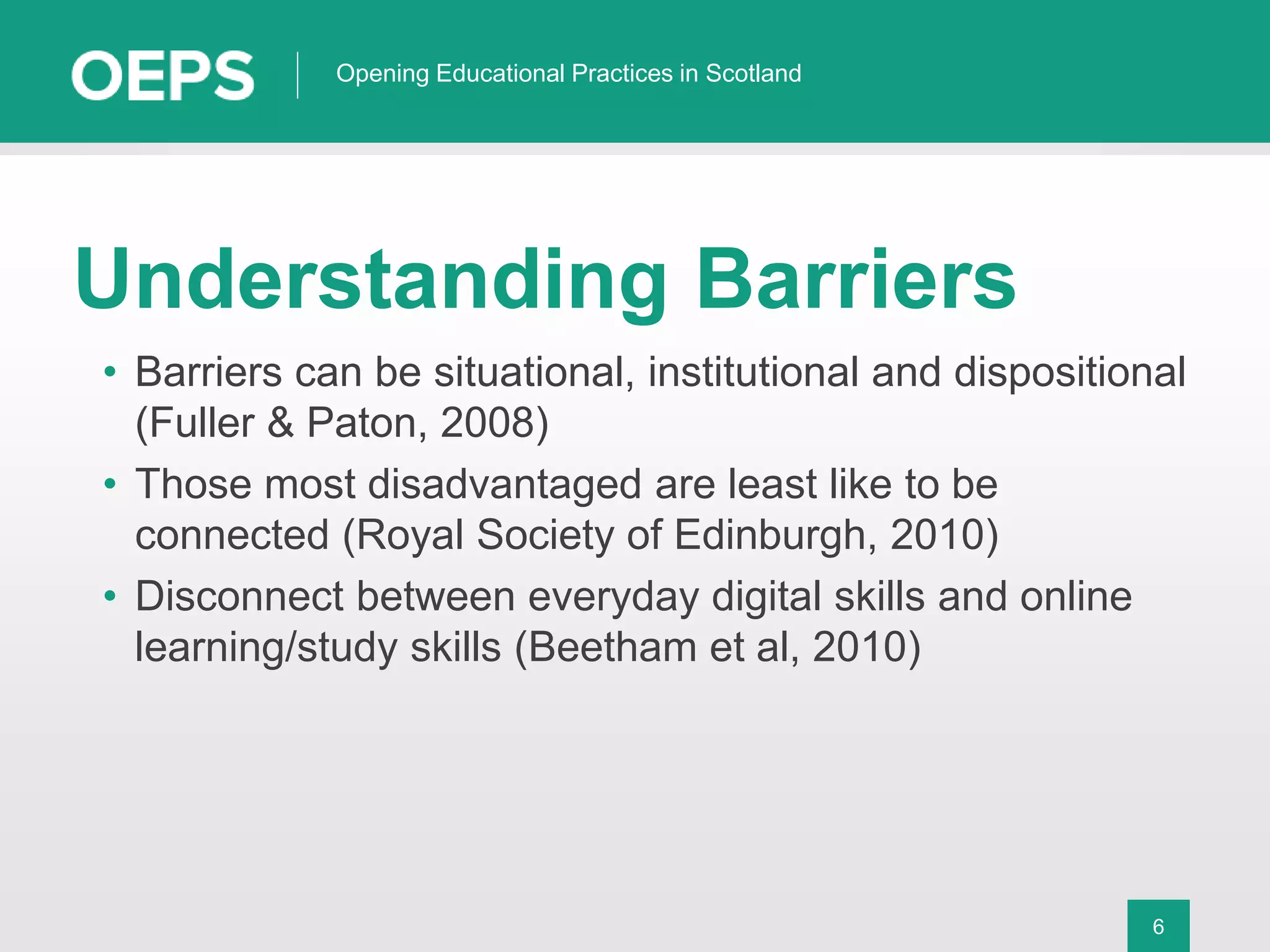
Barrier: Looks/ feels like university
Credit:‘Courserahomepage’,screenshotbyOEPS,CCBYNCSA4.0
8
Opening Educational Practices in Scotland
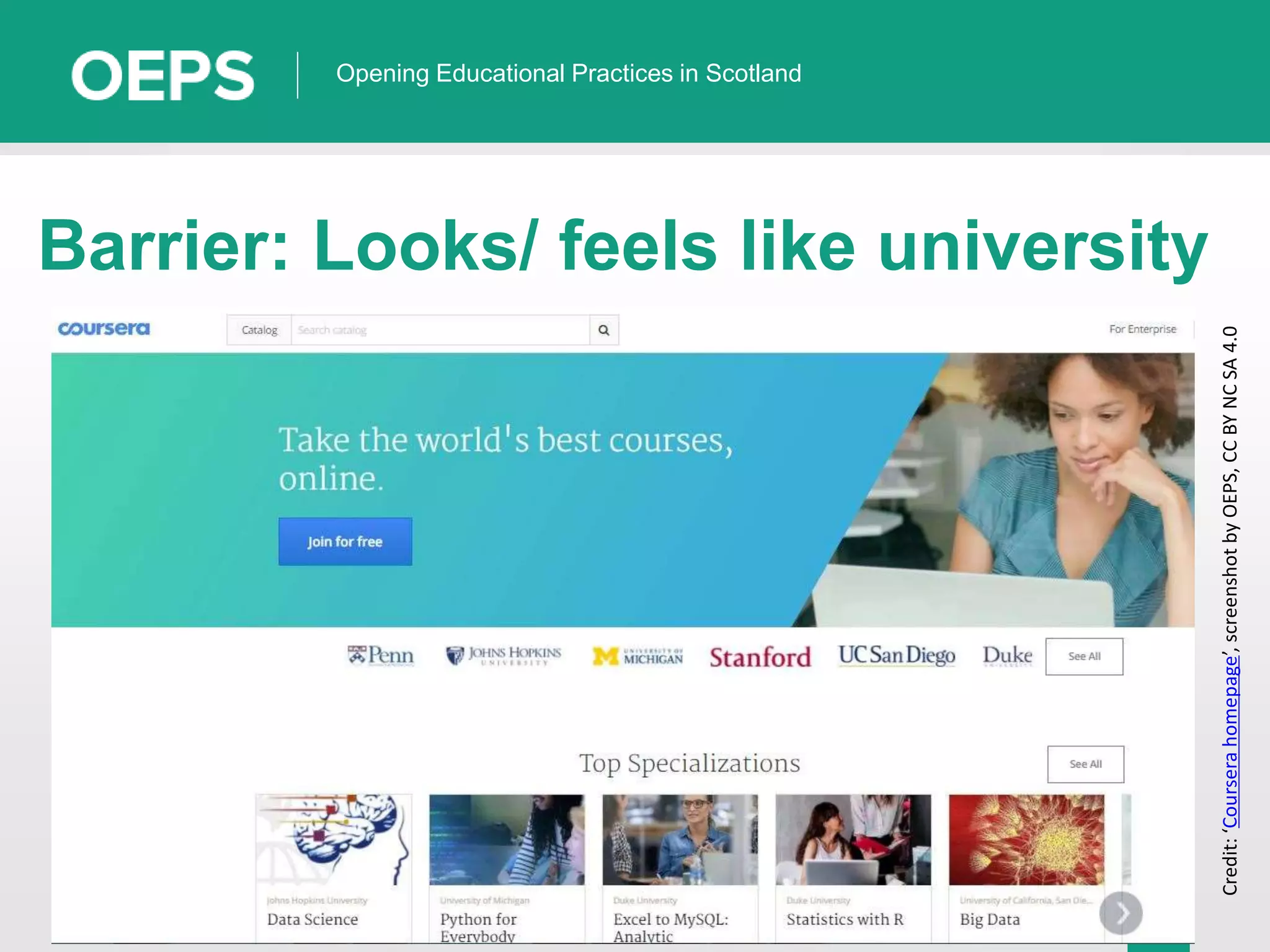
Barrier: Looks/ feels like university
Credit:‘FuturelearnStudySkills’,screenshotbyOEPS,CCBYNCSA4.0
9
Opening Educational Practices in Scotland
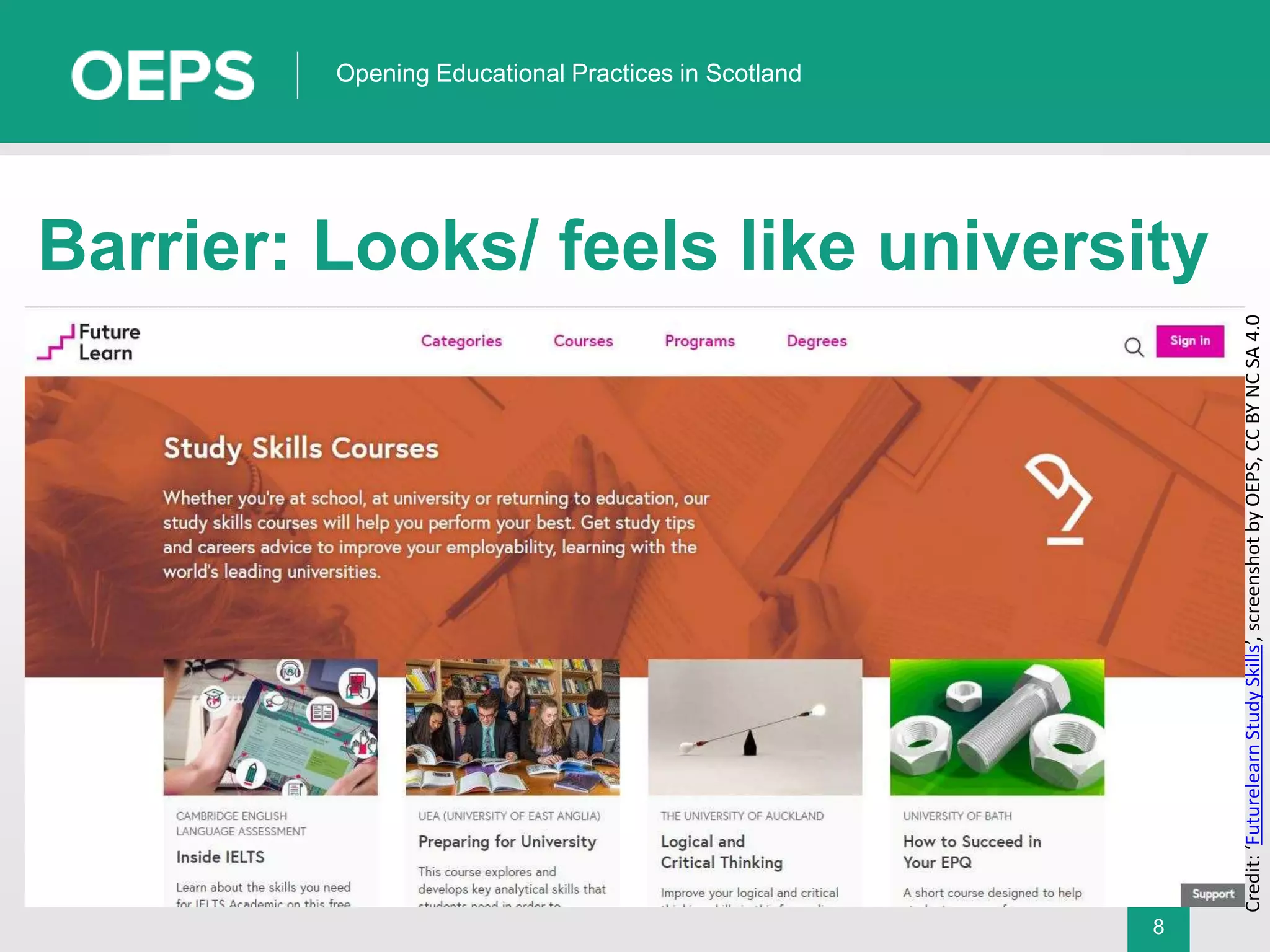
Barrier: Looks/ feels like university
Credit:‘OpenLearn’,screenshotbyOEPS,CCBYNCSA4.0
10
Opening Educational Practices in Scotland
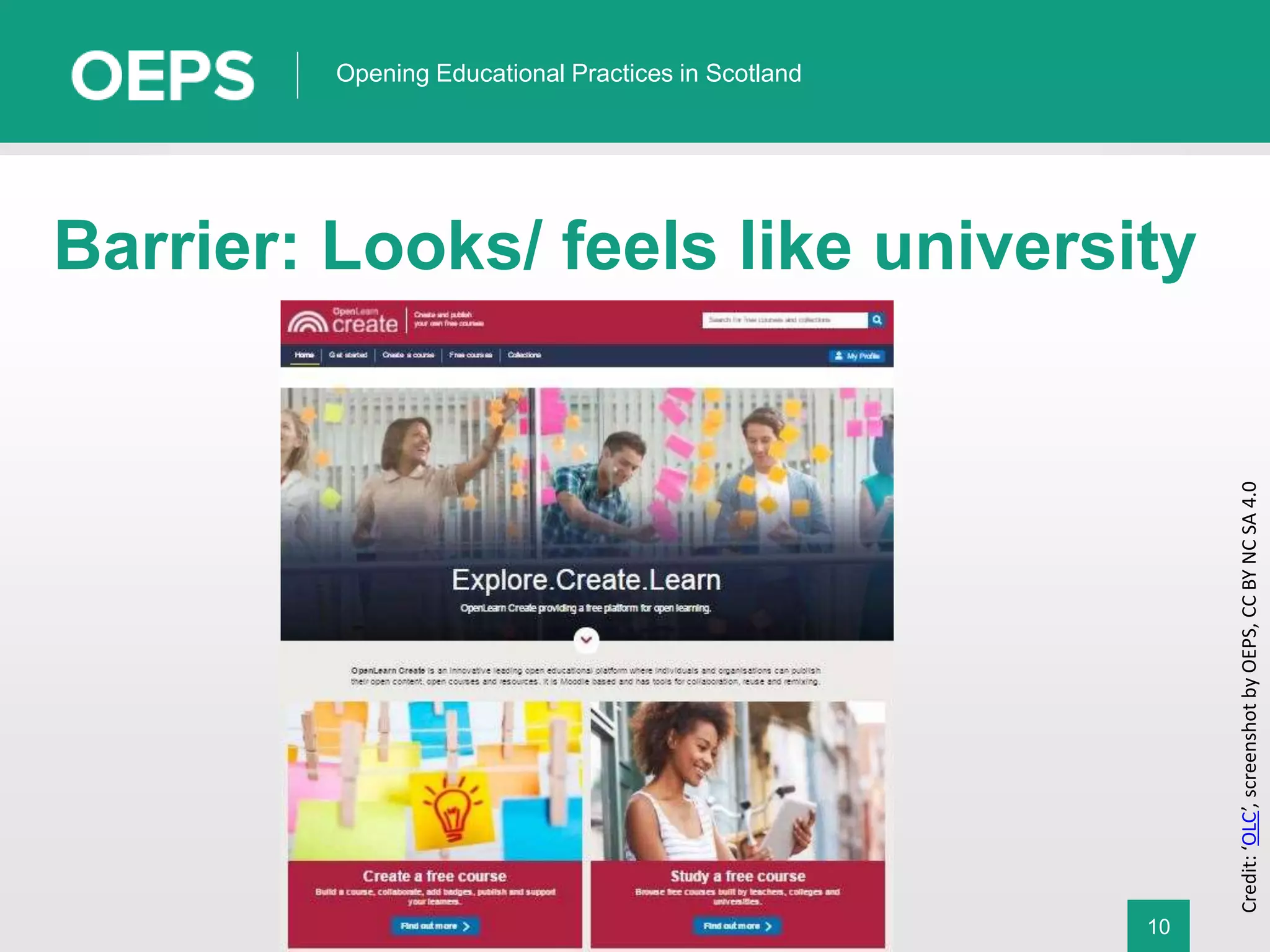
Barrier: Looks/ feels like university
Credit:‘OLC’,screenshotbyOEPS,CCBYNCSA4.0
11
Opening Educational Practices in Scotland
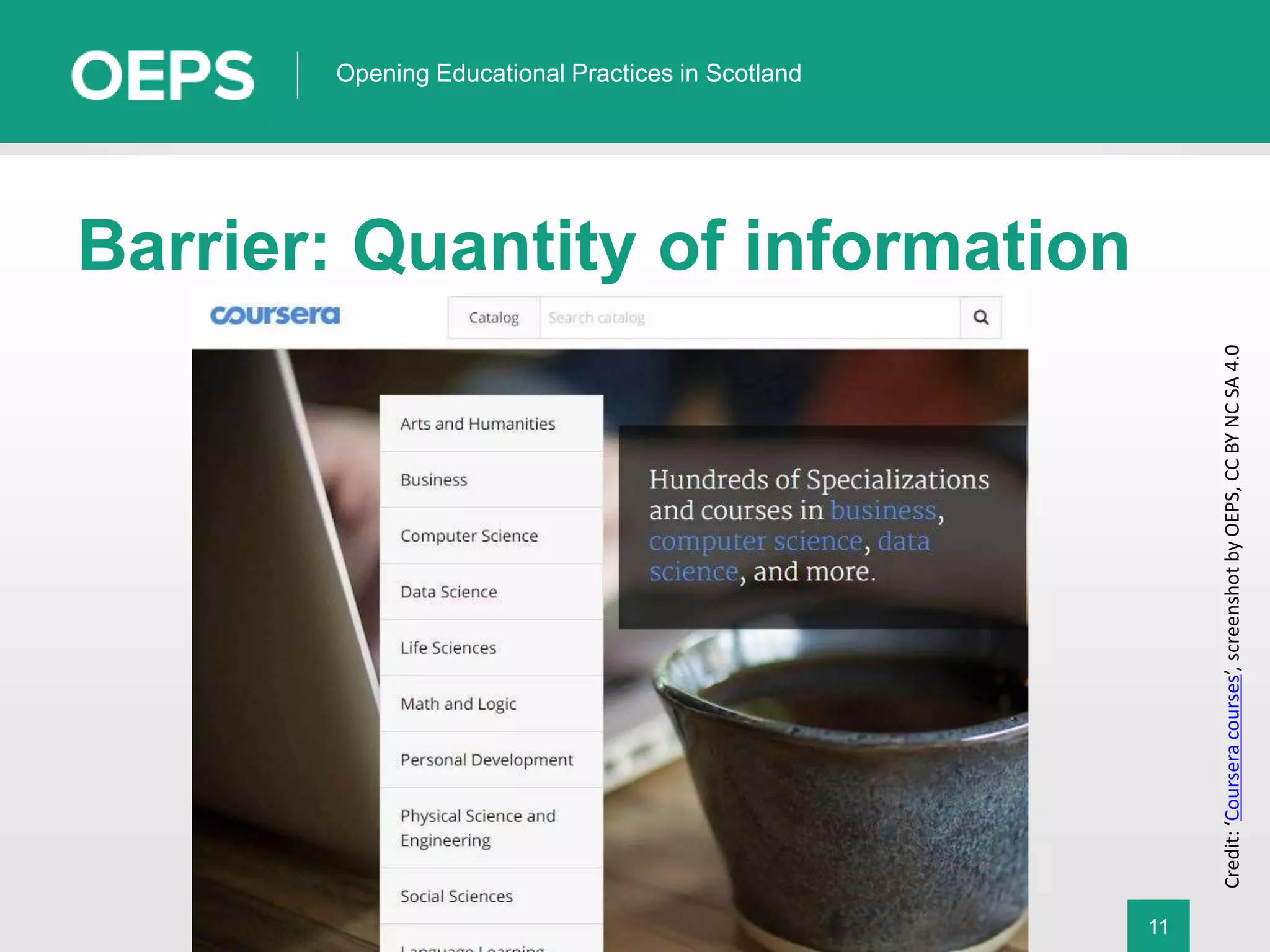
Barrier: Quantity of information
Credit:‘Courseracourses’,screenshotbyOEPS,CCBYNCSA4.0
12
Opening Educational Practices in Scotland
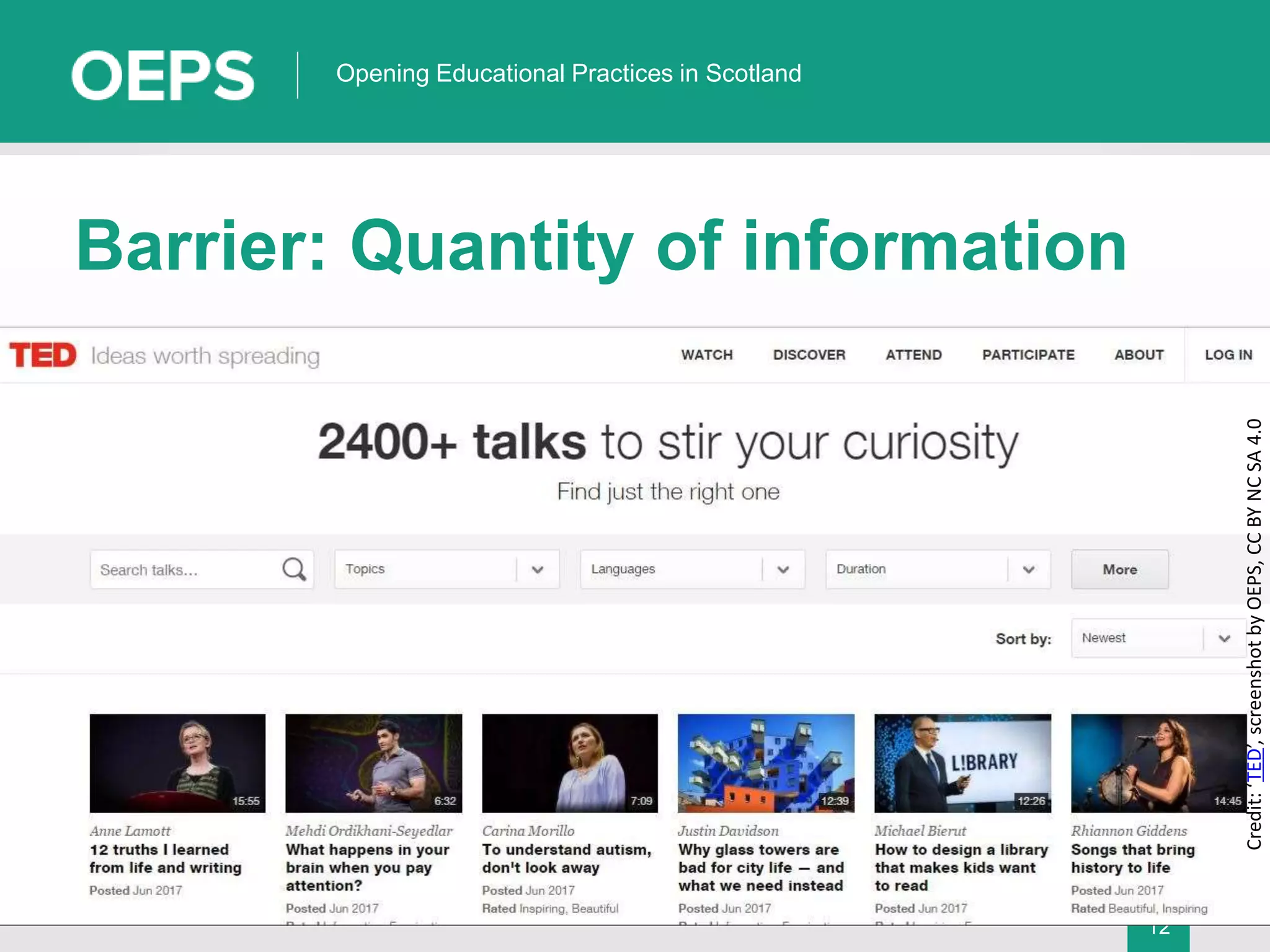
Barrier: Quantity of information
Credit:‘TED’,screenshotbyOEPS,CCBYNCSA4.0
13
Opening Educational Practices in Scotland
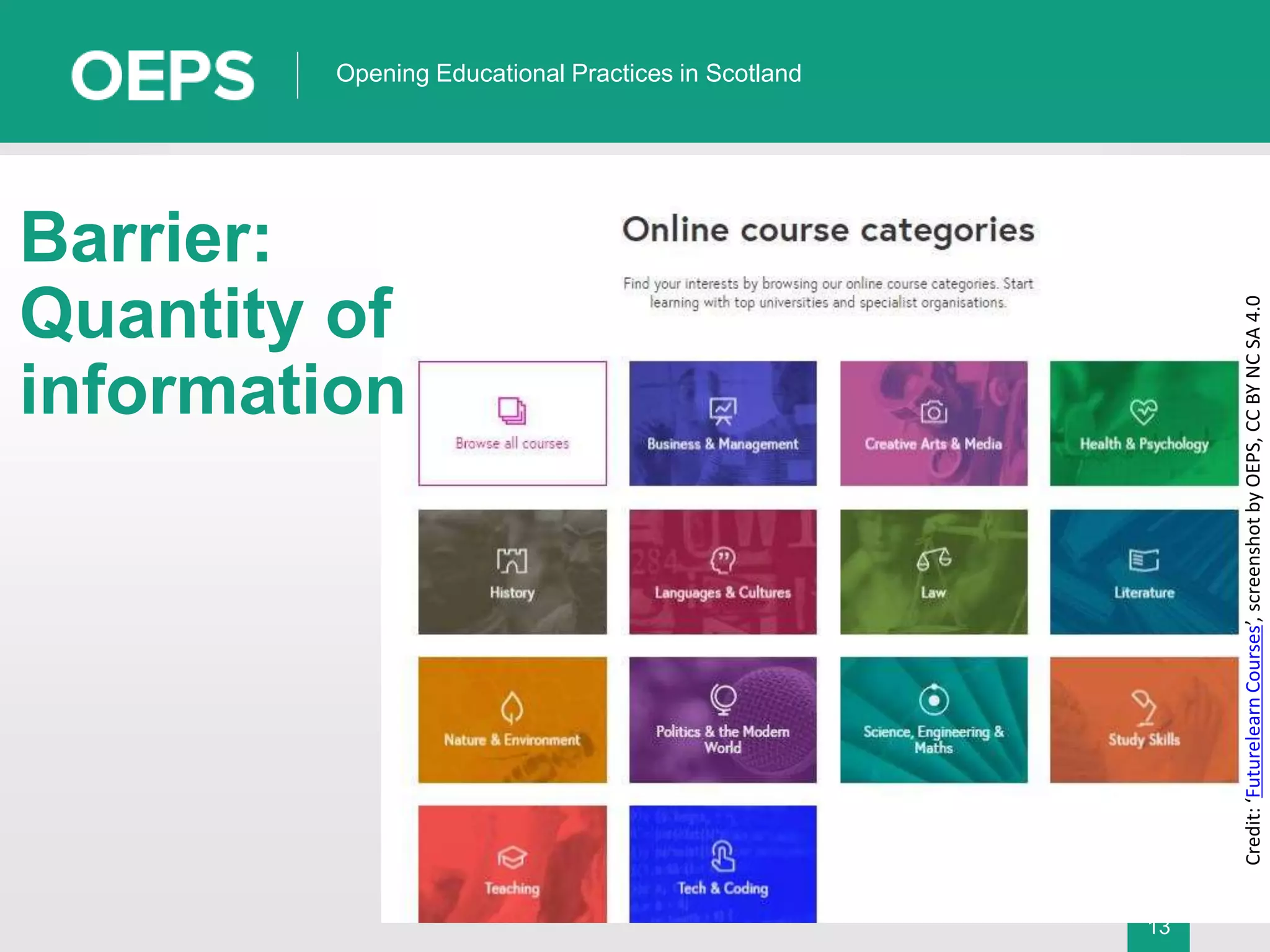
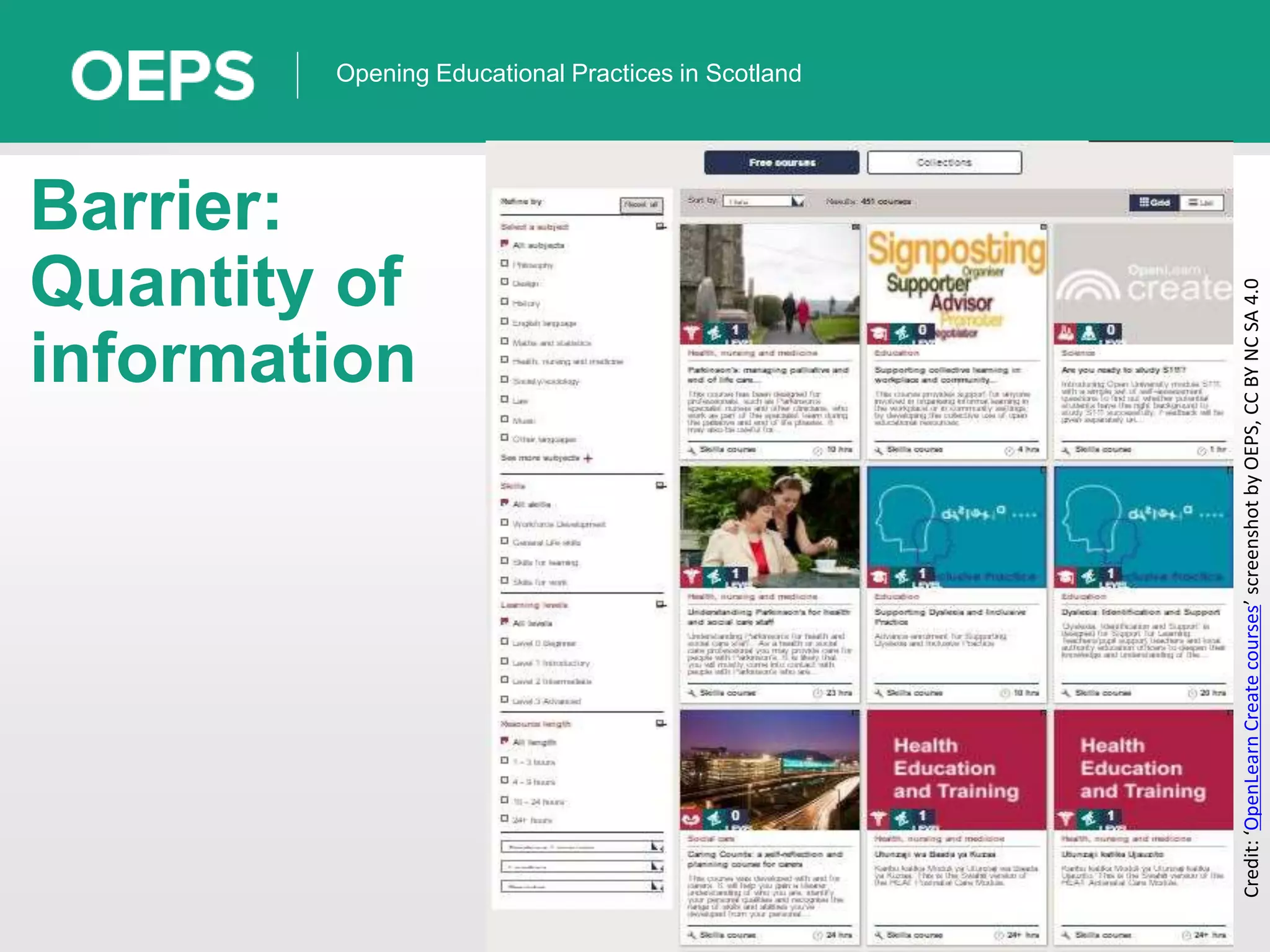
Barrier:
Quantity of
information
Credit:‘FuturelearnCourses’,screenshotbyOEPS,CCBYNCSA4.0
14
Opening Educational Practices in Scotland
Barrier:
Quantity of
information
Credit:‘OpenLearnCreatecourses’screenshotbyOEPS,CCBYNCSA4.0
15
Opening Educational Practices in Scotland
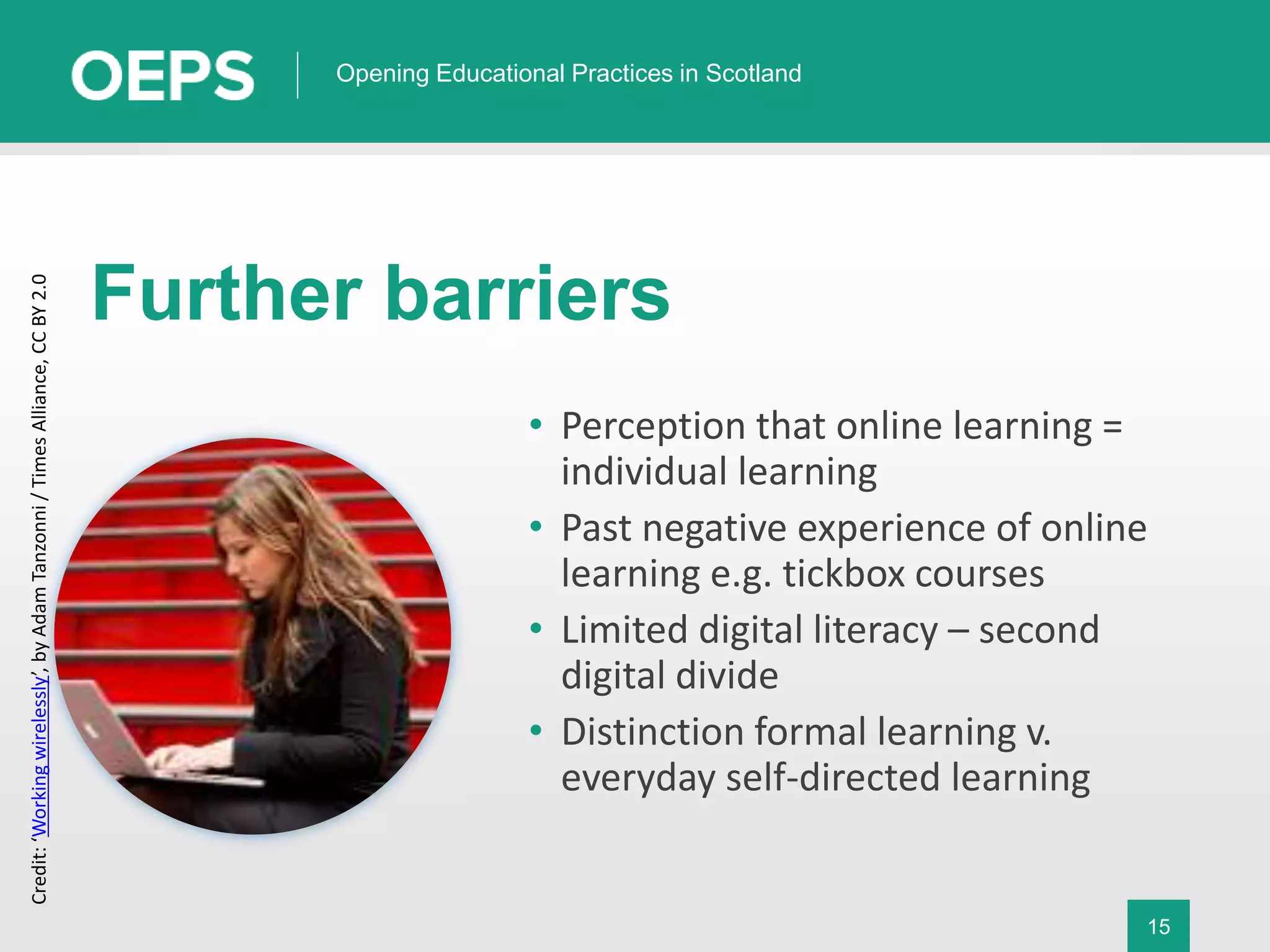
Further barriers
• Perception that online learning =
individual learning
• Past negative experience of online
learning e.g. tickbox courses
• Limited digital literacy – second
digital divide
• Distinction formal learning v.
everyday self-directed learning
Credit:‘Workingwirelessly’,byAdamTanzonni/TimesAlliance,CCBY2.0
16
Opening Educational Practices in Scotland
Tackling barriers
• Focus on students and contextualise pedagogy
• Use technology as a tool rather than the subject
• Ensure opportunities to share social learning and
engage with idea
• Make connections between existing skills /digital
literacy and online learning
• Use trusted gate keepers/facilitators
17
Opening Educational Practices in Scotland
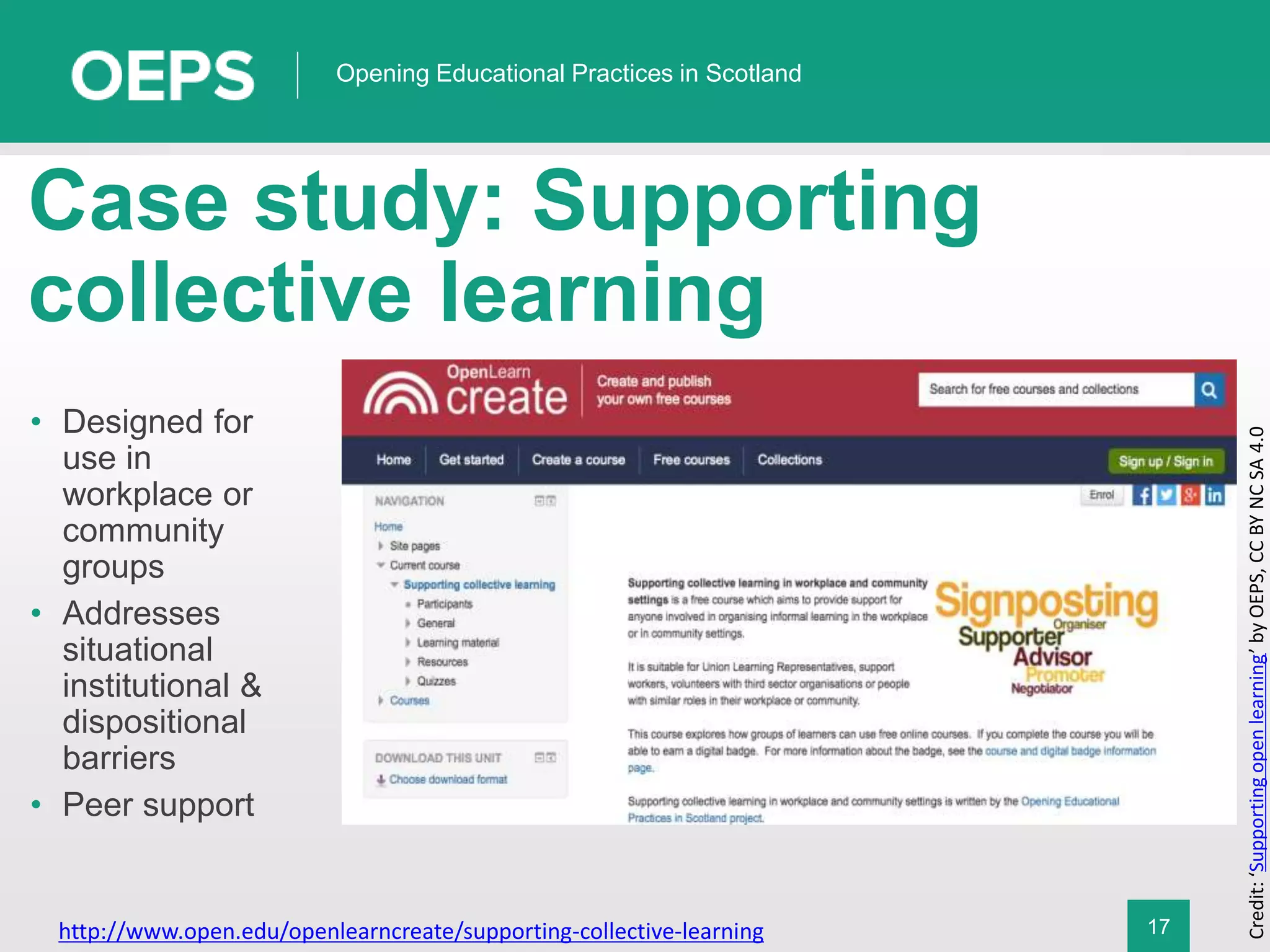
Case study: Supporting
collective learning
http://www.open.edu/openlearncreate/supporting-collective-learning
Credit:‘Supportingopenlearning’byOEPS,CCBYNCSA4.0
• Designed for
use in
workplace or
community
groups
• Addresses
situational
institutional &
dispositional
barriers
• Peer support
18
Opening Educational Practices in Scotland
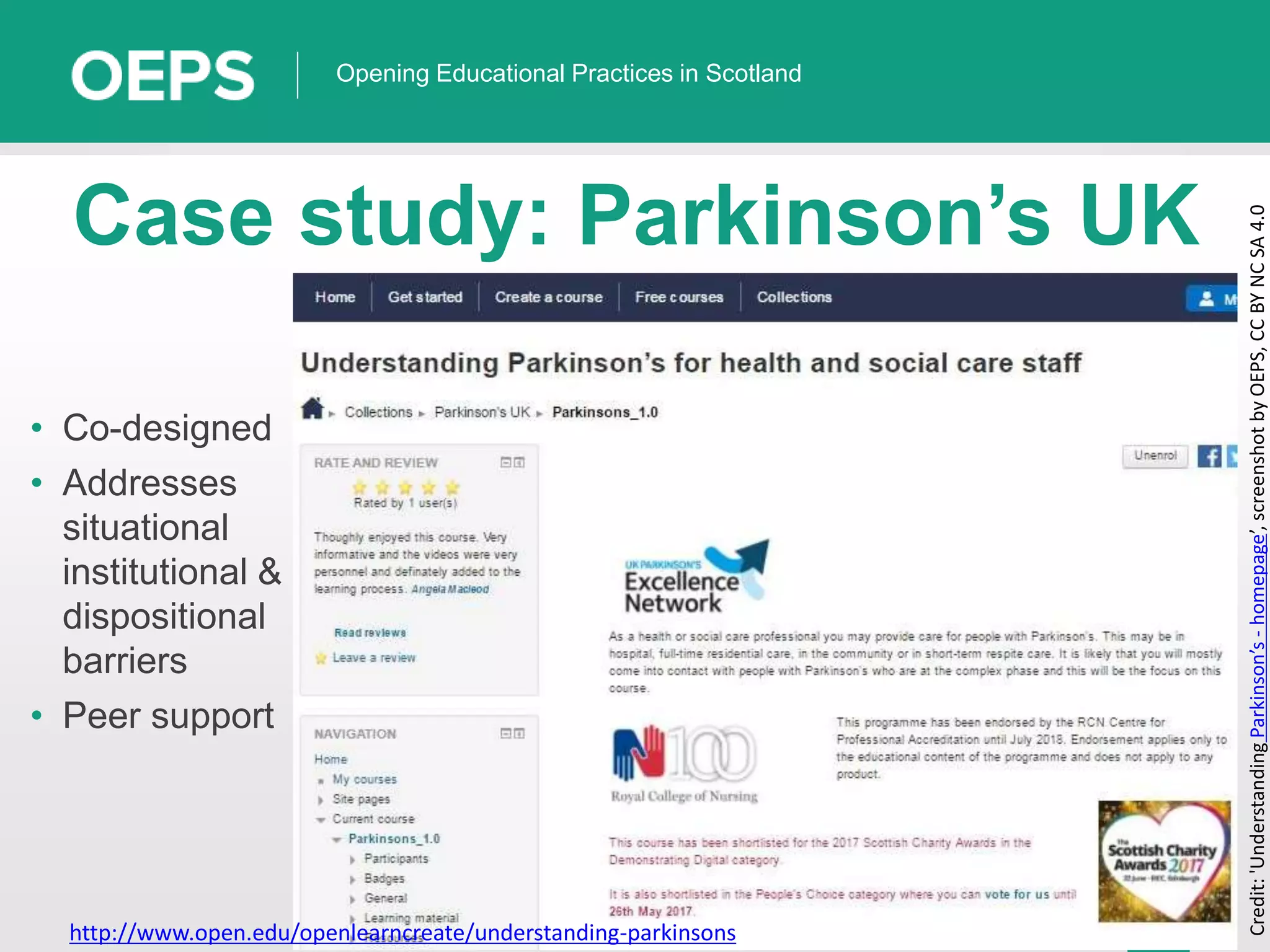
Case study: Parkinson’s UK
• Co-designed
• Addresses
situational
institutional &
dispositional
barriers
• Peer support
Credit:'UnderstandingParkinson’s-homepage’,screenshotbyOEPS,CCBYNCSA4.0
http://www.open.edu/openlearncreate/understanding-parkinsons
Opening Educational Practices in Scotland
Contact Us:
Email: OEPScotland@open.ac.uk
Twitter: @OEPScotland
Web: www.oepscotland.org
Community hub: www.oeps.ac.uk
20
Opening Educational Practices in Scotland
References
• Beetham, H., McGill, L. and Littlejohn, A. (2010) Learning Literacies in the Digital Age
report, Joint Information System Committee [Online]. Available at
www.jisc.ac.uk/whatwedo/projects/elearningllida
• Butcher, N. (2011). Mainstreaming the use of open educational practices (OEP) will
transform education [Online debate]. Retrieved from http://www.wsis-
community.org/pg/debates/group:14358/viewstatement/400536/400537/401532
• The Royal Society of Edinburgh (2010) Digital Scotland, Edinburgh, The Royal Society of
Edinburgh.
• UNESCO (2012) Paris OER Declaration [Online]. Available at
http://www.unesco.org/fileadmin/MULTIMEDIA/HQ/CI/WPFD2009/English_Declaration.ht
ml
• Wiley, D. (2014) ‘The Access Compromise and the 5th R’, Iterating towards progresss, 5
March 2014 [Blog]. Available at https://opencontent.org/blog/archives/3221
Further reading:
• Cannell, P. (2016) ‘Lifelong learning and partnerships: rethinking the boundaries of the
university in the digital age’, Widening Participation and Lifelong Learning, 18(1), 61–73.
• Cannell, P. and Macintyre, R. (2017) ‘Free open online resources in workplace and
community settings – a case study in overcoming barriers’, Widening Participation and
Lifelong Learning, 19(1), 111-122.

Exploring barriers to participation CALRG (June 2017)

  • 1.
    Opening Educational Practicesin Scotland Exploring barriers to participation in open, online learning Rosemarie McIlwhan
  • 2.
    2 Opening Educational Practicesin Scotland About us Opening Educational Practices in Scotland is a cross-sector project that facilitates best practice in Scottish open education. We aim to enhance Scotland’s reputation and capacity for developing publicly available and licenced online materials, supported by high quality pedagogy and learning technology.
  • 3.
    3 Opening Educational Practicesin Scotland OEPS • Final two months of 3-year project (finish 31/7/17) • Working with >60 partners to identify and share good practice. • Working with some of these partners to co- design and co-produce exemplar free openly licensed courses www.oepscotland.org
  • 4.
    4 Opening Educational Practicesin Scotland Defining OER and OEP • Open Educational Resources (OER) - focus on freedoms afforded by openly licensing content “The 5 Rs”: retain, reuse, revise, remix, redistribute (Wiley, 2014)) and the degree to which design, development and distribution accounts for equity and openness. • Open Educational Practices (OEP) are usually understood as approaches to teaching and facilitation using technology to support learning in the context of high quality OER.
  • 5.
    5 Opening Educational Practicesin Scotland The promise of open education • Free access to high quality education on a mass scale • Widening access and participation ‘Promote and use OER to widen access to education at all levels both formal and non-formal in a perspective of lifelong learning …’ (UNESCO, 2012) • However: ‘… there is little evidence of educational transformation resulting from OER practices: [..]. The lack of sufficient evidence hinders understanding of the role of OER in widening access to education, social inclusion, and long-term sustainability.’ (Butcher, 2011)
  • 6.
    6 Opening Educational Practicesin Scotland Understanding Barriers • Barriers can be situational, institutional and dispositional (Fuller & Paton, 2008) • Those most disadvantaged are least like to be connected (Royal Society of Edinburgh, 2010) • Disconnect between everyday digital skills and online learning/study skills (Beetham et al, 2010)
  • 7.
    7 Opening Educational Practicesin Scotland Barrier: Looks/ feels like university Credit:‘Courserahomepage’,screenshotbyOEPS,CCBYNCSA4.0
  • 8.
    8 Opening Educational Practicesin Scotland Barrier: Looks/ feels like university Credit:‘FuturelearnStudySkills’,screenshotbyOEPS,CCBYNCSA4.0
  • 9.
    9 Opening Educational Practicesin Scotland Barrier: Looks/ feels like university Credit:‘OpenLearn’,screenshotbyOEPS,CCBYNCSA4.0
  • 10.
    10 Opening Educational Practicesin Scotland Barrier: Looks/ feels like university Credit:‘OLC’,screenshotbyOEPS,CCBYNCSA4.0
  • 11.
    11 Opening Educational Practicesin Scotland Barrier: Quantity of information Credit:‘Courseracourses’,screenshotbyOEPS,CCBYNCSA4.0
  • 12.
    12 Opening Educational Practicesin Scotland Barrier: Quantity of information Credit:‘TED’,screenshotbyOEPS,CCBYNCSA4.0
  • 13.
    13 Opening Educational Practicesin Scotland Barrier: Quantity of information Credit:‘FuturelearnCourses’,screenshotbyOEPS,CCBYNCSA4.0
  • 14.
    14 Opening Educational Practicesin Scotland Barrier: Quantity of information Credit:‘OpenLearnCreatecourses’screenshotbyOEPS,CCBYNCSA4.0
  • 15.
    15 Opening Educational Practicesin Scotland Further barriers • Perception that online learning = individual learning • Past negative experience of online learning e.g. tickbox courses • Limited digital literacy – second digital divide • Distinction formal learning v. everyday self-directed learning Credit:‘Workingwirelessly’,byAdamTanzonni/TimesAlliance,CCBY2.0
  • 16.
    16 Opening Educational Practicesin Scotland Tackling barriers • Focus on students and contextualise pedagogy • Use technology as a tool rather than the subject • Ensure opportunities to share social learning and engage with idea • Make connections between existing skills /digital literacy and online learning • Use trusted gate keepers/facilitators
  • 17.
    17 Opening Educational Practicesin Scotland Case study: Supporting collective learning http://www.open.edu/openlearncreate/supporting-collective-learning Credit:‘Supportingopenlearning’byOEPS,CCBYNCSA4.0 • Designed for use in workplace or community groups • Addresses situational institutional & dispositional barriers • Peer support
  • 18.
    18 Opening Educational Practicesin Scotland Case study: Parkinson’s UK • Co-designed • Addresses situational institutional & dispositional barriers • Peer support Credit:'UnderstandingParkinson’s-homepage’,screenshotbyOEPS,CCBYNCSA4.0 http://www.open.edu/openlearncreate/understanding-parkinsons
  • 19.
    Opening Educational Practicesin Scotland Contact Us: Email: OEPScotland@open.ac.uk Twitter: @OEPScotland Web: www.oepscotland.org Community hub: www.oeps.ac.uk
  • 20.
    20 Opening Educational Practicesin Scotland References • Beetham, H., McGill, L. and Littlejohn, A. (2010) Learning Literacies in the Digital Age report, Joint Information System Committee [Online]. Available at www.jisc.ac.uk/whatwedo/projects/elearningllida • Butcher, N. (2011). Mainstreaming the use of open educational practices (OEP) will transform education [Online debate]. Retrieved from http://www.wsis- community.org/pg/debates/group:14358/viewstatement/400536/400537/401532 • The Royal Society of Edinburgh (2010) Digital Scotland, Edinburgh, The Royal Society of Edinburgh. • UNESCO (2012) Paris OER Declaration [Online]. Available at http://www.unesco.org/fileadmin/MULTIMEDIA/HQ/CI/WPFD2009/English_Declaration.ht ml • Wiley, D. (2014) ‘The Access Compromise and the 5th R’, Iterating towards progresss, 5 March 2014 [Blog]. Available at https://opencontent.org/blog/archives/3221 Further reading: • Cannell, P. (2016) ‘Lifelong learning and partnerships: rethinking the boundaries of the university in the digital age’, Widening Participation and Lifelong Learning, 18(1), 61–73. • Cannell, P. and Macintyre, R. (2017) ‘Free open online resources in workplace and community settings – a case study in overcoming barriers’, Widening Participation and Lifelong Learning, 19(1), 111-122.

Editor's Notes

  • #8 Look and feel of sites (like a university) deters non traditional learners (self-deselect ‘not for me’) Compare Coursea https://www.coursera.org/ with those universities shown on that page i.e. http://www.upenn.edu/ https://www.jhu.edu/ https://www.umich.edu/ https://www.stanford.edu/ https://www.duke.edu/ https://ucsd.edu/ Picture credit: ‘Coursera homepage’, screenshot by OEPS, https://www.coursera.org/, CC BY NC SA 4.0
  • #9 Look and feel of sites (like a university) deters non traditional learners (self-deselect ‘not for me’) Compare Futurelearn https://www.futurelearn.com/courses/categories/study-skills-courses with those universities shown on that page i.e. University of Cambridge http://www.cam.ac.uk/ University of East Anglia http://www.uea.ac.uk/ University of Auckland https://www.auckland.ac.nz/en.html University of Bath http://www.bath.ac.uk/ Picture credit: ‘Futurelearn Study Skills’, screenshot by OEPS, https://www.futurelearn.com/courses/categories/study-skills-courses, CC BY NC SA 4.0
  • #10 Look and feel of sites (like a university) deters non traditional learners Compare OpenLearn http://www.open.edu/openlearn/ with OU www.open.ac.uk Picture credit: ‘OpenLearn’, screenshot by OEPS, http://www.open.edu/openlearn/, CC BY NC SA 4.0
  • #11 Look and feel of sites (like a university) deters non traditional learners Compare OpenLearn Create open.edu/openlearncreate/ with OU www.open.ac.uk Picture credit: ‘BAOE’, screenshot by OEPS, http://www.open.edu/openlearncreate/course/view.php?id=2274, CC BY NC SA 4.0 Picture credit: ‘OpenLearn’, screenshot by OEPS, http://www.open.edu/openlearn/, CC BY NC SA 4.0
  • #12 Sheer mass of material is problematic for organisations, facilitators and learners Picture credit: ‘Coursera courses’, screenshot by OEPS, https://www.coursera.org/browse?languages=en&source=deprecated_spark_cdp, CC BY NC SA 4.0
  • #13 Sheer mass of material is problematic for organisations, facilitators and learners Picture credit: ‘TED’, screenshot by OEPS, https://www.ted.com/talks, CC BY NC SA 4.0
  • #14 Sheer mass of material is problematic for organisations, facilitators and learners Picture credit: ‘Futurelearn Courses’, screenshot by OEPS, https://www.futurelearn.com/courses/categories, CC BY NC SA 4.0
  • #15 Sheer mass of material is problematic for organisations, facilitators and learners Picture credit: ‘OpenLearn Create courses’ screenshot by OEPS, http://www.open.edu/openlearncreate/local/ocwfreecourses/freecourse.php?sort=title&dir=ASC&perpage=12, CC BY NC SA 4.0
  • #16  Picture credit: ‘Working wirelessly’, by Adam Tanzonni / Times Alliance, https://www.flickr.com/photos/yodelanecdotal/4092671749, CC BY 2.0
  • #19  Picture credit: ‘Understanding Parkinson’s - homepage’, screenshot by OEPS, http://www.open.edu/openlearncreate/course/view.php?id=2161, CC BY NC SA 4.0
  • #20 19