Opening Educational Practices in Scotland
Learning Design workshop template
Cite as: Macintyre R. Cannell P. (2016) “Designing for Openness: Learning Design Workshop Template”,
CC BY 4.0
2
Opening Educational Practices in Scotland
Session(s) Structure
• Introduction to OEPS and OER and OEP
• Our Approach – Designing for Openness & inbetween spaces
• Exercise 1: Define “The Problem”
• Exercise 2: The “Ideal Learner”
• Exercise 3: Mapping the Learning Journey
• Exercise 4: Planning and Production
• Conclusions and Questions
Opening Educational Practices in Scotland
About OEPS
The Opening Educational Practices in Scotland ran from
the summer of 2014 until July 31st
2017. It aimed to
enhance Scotland’s reputation and capacity for
developing publicly available and licenced online
materials, supported by high quality pedagogy and
learning technology.
“”
Opening Educational Practices in Scotland
What do we mean by
OER?
The OEPS understanding of Open Educational Resources
was grounded in established notions of openly licensed
content. It had a specific focus on the freedoms afforded by
openly licensing content (allowing “The 5 Rs”: retain, reuse,
revise, remix, redistribute) and the degree to which design
development and distribution accounts for equity and
openness.
“”
Opening Educational Practices in Scotland
What do we mean by
OEP?
OEPS found it useful to think about Open Educational
Practices as those educational practices that are concerned
with and promote equity and openness. The project’s
understanding of ‘open’ builds on the freedoms associated
with “the 5 Rs” of OER, promoting a broader sense of open,
emphasising social justice, and developing practices that
open up opportunities for those distanced from education.
“”
Opening Educational Practices in Scotland
Hands Up!
“”
Hands Up, CC0 Public Domain, Free for commercial use, no attribution required
https://pixabay.com/en/hands-hand-raised-hands-raised-220163/
Opening Educational Practices in Scotland
Todays Purpose
TiTLE
Background
Agreed with Partner.
“”
Opening Educational Practices in Scotland
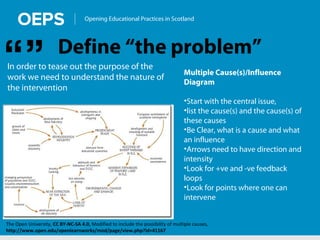
Define “the problem”
In order to tease out the purpose of the
work we need to understand the nature of
the intervention
“” Multiple Cause(s)/Influence
Diagram
•Start with the central issue,
•list the cause(s) and the cause(s) of
these causes
•Be Clear, what is a cause and what
an influence
•Arrows need to have direction and
intensity
•Look for +ve and -ve feedback
loops
•Look for points where one can
intervene
The Open University, CC BY-NC-SA 4.0, Modified to include the possibility of multiple causes,
http://www.open.edu/openlearnworks/mod/page/view.php?id=41167
9
Opening Educational Practices in Scotland
Partnership, Co-Production: Designing in, for
through Partnership
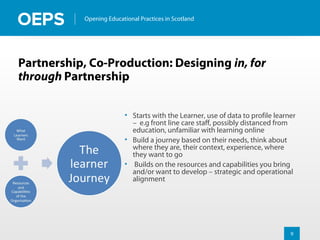
• Starts with the Learner, use of data to profile learner
– e.g front line care staff, possibly distanced from
education, unfamiliar with learning online
• Build a journey based on their needs, think about
where they are, their context, experience, where
they want to go
• Builds on the resources and capabilities you bring
and/or want to develop – strategic and operational
alignment
10
Opening Educational Practices in Scotland
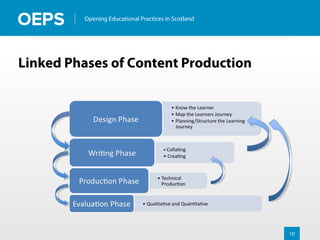
Linked Phases of Content Production
11
Opening Educational Practices in Scotland
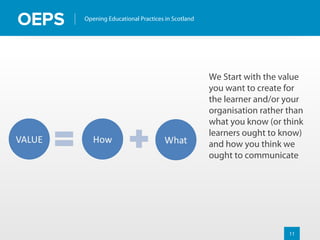
We Start with the value
you want to create for
the learner and/or your
organisation rather than
what you know (or think
learners ought to know)
and how you think we
ought to communicate
12
Opening Educational Practices in Scotland
Exploring Learner Journeys: Exercise 1
Tables may want to split and take different learners groups. [insert target audience
as appropriate]
Think about the learner and think about the value you
want to create, the nature of the transformation
•Draw out an “rich picture” of your “ideal”
[transitional/workplace] learner
•Draw out a “rich picture” of your “actual” learner
13
Opening Educational Practices in Scotland
Exploring Learner Journeys: Exercise 2
• The ideal learner tells us a great deal about the
resources and capabilities of the organisation –
it is often what they are good at delivering
• The actual learner also tells us a great deal
about the resources and capabilities
• [often] both highlight the limits of our
knowledge about learners needs and wants
14
Opening Educational Practices in Scotland
Exercise 3: Storyboarding [Option 1]
Walk through with your “Learner”
Capture the Scene
The Sequence
Tell the Story
Do it quickly
Do it together, build consensus
Serge Lacinov, Public Domain, C0, Tapisserie de Bayeux,
https://en.wikipedia.org/wiki/Bayeux_Tapestry#/media/File:Tapisserie_de_Bayeux_31109.jpg
15
Opening Educational Practices in Scotland
Exercise 3: Learner Journeys &
Transformation [Option 2]
A Journey is about moving through, process and destinations,
stops along the way
Sketch our a learning journey(s) for your ideal or actual learners
(or perhaps a mix)
Detail the landmarks they encounter, the critical incidences, the
support, the shift between non formal, informal and formal, the
barriers and enablers.
16
Opening Educational Practices in Scotland
Exercise 3: Learning Journeys &
Transformation [Option 2]
START WITH THE LEARNER
Do you "know " your student”
Think about their learning journey
•What are key things to learn – troublesome ideas
•Critical Points in Learning Journey – what keeps them going, what gets in
the way?
•How will they learn, how/will they be taught- Do I need to know what they
learn?
•Track and Assess – evaluation
•What happens at the end
17
Opening Educational Practices in Scotland
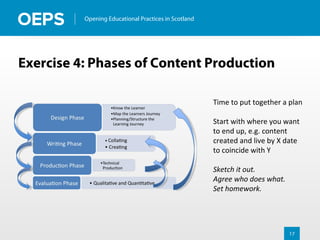
Exercise 4: Phases of Content Production
Time to put together a plan
Start with where you want
to end up, e.g. content
created and live by X date
to coincide with Y
Sketch it out.
Agree who does what.
Set homework.
18
Opening Educational Practices in Scotland
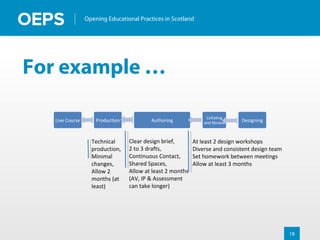
For example …
At least 2 design workshops
Diverse and consistent design team
Set homework between meetings
Allow at least 3 months
Clear design brief,
2 to 3 drafts,
Continuous Contact,
Shared Spaces,
Allow at least 2 months
(AV, IP & Assessment
can take longer)
Technical
production,
Minimal
changes,
Allow 2
months (at
least)
19
Opening Educational Practices in Scotland
Concluding Remarks + Next Steps
Opening Educational Practices in Scotland
Questions

Learning design workshop template

  • 1.
    Opening Educational Practicesin Scotland Learning Design workshop template Cite as: Macintyre R. Cannell P. (2016) “Designing for Openness: Learning Design Workshop Template”, CC BY 4.0
  • 2.
    2 Opening Educational Practicesin Scotland Session(s) Structure • Introduction to OEPS and OER and OEP • Our Approach – Designing for Openness & inbetween spaces • Exercise 1: Define “The Problem” • Exercise 2: The “Ideal Learner” • Exercise 3: Mapping the Learning Journey • Exercise 4: Planning and Production • Conclusions and Questions
  • 3.
    Opening Educational Practicesin Scotland About OEPS The Opening Educational Practices in Scotland ran from the summer of 2014 until July 31st 2017. It aimed to enhance Scotland’s reputation and capacity for developing publicly available and licenced online materials, supported by high quality pedagogy and learning technology. “”
  • 4.
    Opening Educational Practicesin Scotland What do we mean by OER? The OEPS understanding of Open Educational Resources was grounded in established notions of openly licensed content. It had a specific focus on the freedoms afforded by openly licensing content (allowing “The 5 Rs”: retain, reuse, revise, remix, redistribute) and the degree to which design development and distribution accounts for equity and openness. “”
  • 5.
    Opening Educational Practicesin Scotland What do we mean by OEP? OEPS found it useful to think about Open Educational Practices as those educational practices that are concerned with and promote equity and openness. The project’s understanding of ‘open’ builds on the freedoms associated with “the 5 Rs” of OER, promoting a broader sense of open, emphasising social justice, and developing practices that open up opportunities for those distanced from education. “”
  • 6.
    Opening Educational Practicesin Scotland Hands Up! “” Hands Up, CC0 Public Domain, Free for commercial use, no attribution required https://pixabay.com/en/hands-hand-raised-hands-raised-220163/
  • 7.
    Opening Educational Practicesin Scotland Todays Purpose TiTLE Background Agreed with Partner. “”
  • 8.
    Opening Educational Practicesin Scotland Define “the problem” In order to tease out the purpose of the work we need to understand the nature of the intervention “” Multiple Cause(s)/Influence Diagram •Start with the central issue, •list the cause(s) and the cause(s) of these causes •Be Clear, what is a cause and what an influence •Arrows need to have direction and intensity •Look for +ve and -ve feedback loops •Look for points where one can intervene The Open University, CC BY-NC-SA 4.0, Modified to include the possibility of multiple causes, http://www.open.edu/openlearnworks/mod/page/view.php?id=41167
  • 9.
    9 Opening Educational Practicesin Scotland Partnership, Co-Production: Designing in, for through Partnership • Starts with the Learner, use of data to profile learner – e.g front line care staff, possibly distanced from education, unfamiliar with learning online • Build a journey based on their needs, think about where they are, their context, experience, where they want to go • Builds on the resources and capabilities you bring and/or want to develop – strategic and operational alignment
  • 10.
    10 Opening Educational Practicesin Scotland Linked Phases of Content Production
  • 11.
    11 Opening Educational Practicesin Scotland We Start with the value you want to create for the learner and/or your organisation rather than what you know (or think learners ought to know) and how you think we ought to communicate
  • 12.
    12 Opening Educational Practicesin Scotland Exploring Learner Journeys: Exercise 1 Tables may want to split and take different learners groups. [insert target audience as appropriate] Think about the learner and think about the value you want to create, the nature of the transformation •Draw out an “rich picture” of your “ideal” [transitional/workplace] learner •Draw out a “rich picture” of your “actual” learner
  • 13.
    13 Opening Educational Practicesin Scotland Exploring Learner Journeys: Exercise 2 • The ideal learner tells us a great deal about the resources and capabilities of the organisation – it is often what they are good at delivering • The actual learner also tells us a great deal about the resources and capabilities • [often] both highlight the limits of our knowledge about learners needs and wants
  • 14.
    14 Opening Educational Practicesin Scotland Exercise 3: Storyboarding [Option 1] Walk through with your “Learner” Capture the Scene The Sequence Tell the Story Do it quickly Do it together, build consensus Serge Lacinov, Public Domain, C0, Tapisserie de Bayeux, https://en.wikipedia.org/wiki/Bayeux_Tapestry#/media/File:Tapisserie_de_Bayeux_31109.jpg
  • 15.
    15 Opening Educational Practicesin Scotland Exercise 3: Learner Journeys & Transformation [Option 2] A Journey is about moving through, process and destinations, stops along the way Sketch our a learning journey(s) for your ideal or actual learners (or perhaps a mix) Detail the landmarks they encounter, the critical incidences, the support, the shift between non formal, informal and formal, the barriers and enablers.
  • 16.
    16 Opening Educational Practicesin Scotland Exercise 3: Learning Journeys & Transformation [Option 2] START WITH THE LEARNER Do you "know " your student” Think about their learning journey •What are key things to learn – troublesome ideas •Critical Points in Learning Journey – what keeps them going, what gets in the way? •How will they learn, how/will they be taught- Do I need to know what they learn? •Track and Assess – evaluation •What happens at the end
  • 17.
    17 Opening Educational Practicesin Scotland Exercise 4: Phases of Content Production Time to put together a plan Start with where you want to end up, e.g. content created and live by X date to coincide with Y Sketch it out. Agree who does what. Set homework.
  • 18.
    18 Opening Educational Practicesin Scotland For example … At least 2 design workshops Diverse and consistent design team Set homework between meetings Allow at least 3 months Clear design brief, 2 to 3 drafts, Continuous Contact, Shared Spaces, Allow at least 2 months (AV, IP & Assessment can take longer) Technical production, Minimal changes, Allow 2 months (at least)
  • 19.
    19 Opening Educational Practicesin Scotland Concluding Remarks + Next Steps
  • 20.
    Opening Educational Practicesin Scotland Questions