Opening Educational Practices in
Scotland
Developing an open educational
resource
Pete Cannell, Open Learning Champions Workshop
21 Feb 2017
2
Opening Educational Practices in Scotland
About us
Opening Educational Practices in Scotland is a
cross-sector project that facilitates best practice
in Scottish open education. We aim to enhance
Scotland’s reputation and capacity for developing
publicly available and licenced online materials,
supported by high quality pedagogy and learning
technology.
3
Opening Educational Practices in Scotland
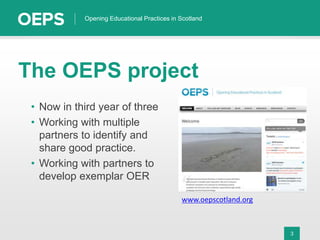
The OEPS project
• Now in third year of three
• Working with multiple
partners to identify and
share good practice.
• Working with partners to
develop exemplar OER
www.oepscotland.org
4
Opening Educational Practices in Scotland
What do we mean by OER?
Educational resources produced under a
Creative Commons License that allows
retention, reuse, revision, remixing and
redistribution).
OEPS has focused on the degree to which
design, development and distribution
accounts for equity and openness.
5
Opening Educational Practices in Scotland
What do we mean by OEP?
Open Educational Practices are usually
understood as approaches to teaching and
facilitation using technology in the context of
high quality OER.
We have found it helpful to extend notions of
Open Educational Practice beyond Learning
Design into the nature of the interface between
the provider and the world and the social
practices that mediate between providers,
partners and learners.
6
Opening Educational Practices in Scotland
Why use online resources?
Scale and reach
• Whatever the license attached to them, online courses can be
studied by anyone with access to the Internet. Modern software
enables course materials to be readable on a wide range of digital
devices. Access no longer restricted to those with a desktop or
laptop computer.
Interactivity
• Well-designed courses provide opportunities for active learning
through interactive exercises.
Feedback
• It’s possible to design courses so that learners share some
personal information and provide insights into their experience
through the completion of exercises or survey questions.
Analytics
• It’s possible to collect and aggregate data on how many people
engage with the course, what they study and their study outcomes.
7
Opening Educational Practices in Scotland
Why use openly licensed materials?
Cost
• There is no charge for using openly licensed courses. Some
course providers do charge for a certificated that documents
successful completion.
Unfettered use
• The open license allows unrestricted use of course material,
whether viewed online or downloaded to an e-reader, or in hard
copy.
Reputation
• Openly licensed materials are often derived from earlier
versions that have been developed by well-recognised and
trusted organisations
8
Opening Educational Practices in Scotland
Why use openly licensed materials?
Editable
• The open license allows individuals and organisations to edit
material to be more relevant to their particular context (subject
to giving appropriate acknowledgement to the originator).
New versions
• Open, online courses can be revised and/or remixed with other
openly licensed material to produce new courses that are
improved in the light of experience, more up to date or targeted
at a different set of students.
Economies of scale and contextualisation
• Open online courses allow the possibility of combining large-
scale reach and economies of scale with low cost, bespoke
versioning for specific audiences.
9
Opening Educational Practices in Scotland
Using and creating open courses
Using open courses
• Students and pedagogy first – technology
second
• Start with learning design – who are the
students – how and where will they study …
what opportunities are their for peer support …
• Curate the resources and embed in a clear and
supportive structure
10
Opening Educational Practices in Scotland
Using and creating open courses
Creating open courses
• Students and pedagogy
first – technology second
• Partners and platforms
• Start with learning
design – who are the
students – how and
where will they study …
what opportunities are
their for peer support …
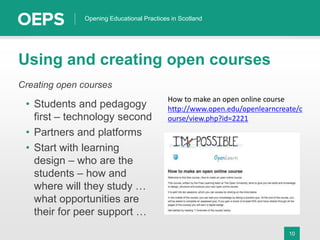
How to make an open online course
http://www.open.edu/openlearncreate/c
ourse/view.php?id=2221
11
Opening Educational Practices in Scotland
Exemplar courses
• Four live, nine in
production
• Produced in
partnership
• Responding to partner
needs and
motivations
Short, free, openly licensed
Strong demand for:
•Transitions – filling gaps
•Professional development
•Knowledge exchange
superfactice https://pixabay.com/en/laptop-
knowledge-information-1749345/ CC0
12
Opening Educational Practices in Scotland
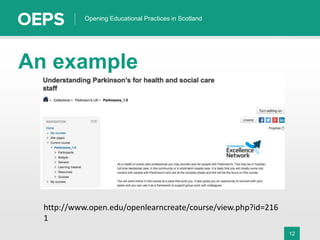
http://www.open.edu/openlearncreate/course/view.php?id=216
1
An example
13
Opening Educational Practices in Scotland
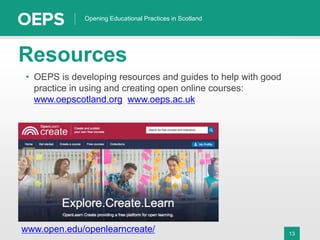
• OEPS is developing resources and guides to help with good
practice in using and creating open online courses:
www.oepscotland.org www.oeps.ac.uk
Resources
www.open.edu/openlearncreate/
Contact Us: Email:
OEPScotland@gmail.com
Twitter: @OEPScotland
These slides available at

Developing an OER

  • 1.
    Opening Educational Practicesin Scotland Developing an open educational resource Pete Cannell, Open Learning Champions Workshop 21 Feb 2017
  • 2.
    2 Opening Educational Practicesin Scotland About us Opening Educational Practices in Scotland is a cross-sector project that facilitates best practice in Scottish open education. We aim to enhance Scotland’s reputation and capacity for developing publicly available and licenced online materials, supported by high quality pedagogy and learning technology.
  • 3.
    3 Opening Educational Practicesin Scotland The OEPS project • Now in third year of three • Working with multiple partners to identify and share good practice. • Working with partners to develop exemplar OER www.oepscotland.org
  • 4.
    4 Opening Educational Practicesin Scotland What do we mean by OER? Educational resources produced under a Creative Commons License that allows retention, reuse, revision, remixing and redistribution). OEPS has focused on the degree to which design, development and distribution accounts for equity and openness.
  • 5.
    5 Opening Educational Practicesin Scotland What do we mean by OEP? Open Educational Practices are usually understood as approaches to teaching and facilitation using technology in the context of high quality OER. We have found it helpful to extend notions of Open Educational Practice beyond Learning Design into the nature of the interface between the provider and the world and the social practices that mediate between providers, partners and learners.
  • 6.
    6 Opening Educational Practicesin Scotland Why use online resources? Scale and reach • Whatever the license attached to them, online courses can be studied by anyone with access to the Internet. Modern software enables course materials to be readable on a wide range of digital devices. Access no longer restricted to those with a desktop or laptop computer. Interactivity • Well-designed courses provide opportunities for active learning through interactive exercises. Feedback • It’s possible to design courses so that learners share some personal information and provide insights into their experience through the completion of exercises or survey questions. Analytics • It’s possible to collect and aggregate data on how many people engage with the course, what they study and their study outcomes.
  • 7.
    7 Opening Educational Practicesin Scotland Why use openly licensed materials? Cost • There is no charge for using openly licensed courses. Some course providers do charge for a certificated that documents successful completion. Unfettered use • The open license allows unrestricted use of course material, whether viewed online or downloaded to an e-reader, or in hard copy. Reputation • Openly licensed materials are often derived from earlier versions that have been developed by well-recognised and trusted organisations
  • 8.
    8 Opening Educational Practicesin Scotland Why use openly licensed materials? Editable • The open license allows individuals and organisations to edit material to be more relevant to their particular context (subject to giving appropriate acknowledgement to the originator). New versions • Open, online courses can be revised and/or remixed with other openly licensed material to produce new courses that are improved in the light of experience, more up to date or targeted at a different set of students. Economies of scale and contextualisation • Open online courses allow the possibility of combining large- scale reach and economies of scale with low cost, bespoke versioning for specific audiences.
  • 9.
    9 Opening Educational Practicesin Scotland Using and creating open courses Using open courses • Students and pedagogy first – technology second • Start with learning design – who are the students – how and where will they study … what opportunities are their for peer support … • Curate the resources and embed in a clear and supportive structure
  • 10.
    10 Opening Educational Practicesin Scotland Using and creating open courses Creating open courses • Students and pedagogy first – technology second • Partners and platforms • Start with learning design – who are the students – how and where will they study … what opportunities are their for peer support … How to make an open online course http://www.open.edu/openlearncreate/c ourse/view.php?id=2221
  • 11.
    11 Opening Educational Practicesin Scotland Exemplar courses • Four live, nine in production • Produced in partnership • Responding to partner needs and motivations Short, free, openly licensed Strong demand for: •Transitions – filling gaps •Professional development •Knowledge exchange superfactice https://pixabay.com/en/laptop- knowledge-information-1749345/ CC0
  • 12.
    12 Opening Educational Practicesin Scotland http://www.open.edu/openlearncreate/course/view.php?id=216 1 An example
  • 13.
    13 Opening Educational Practicesin Scotland • OEPS is developing resources and guides to help with good practice in using and creating open online courses: www.oepscotland.org www.oeps.ac.uk Resources www.open.edu/openlearncreate/
  • 14.
    Contact Us: Email: OEPScotland@gmail.com Twitter:@OEPScotland These slides available at

Editor's Notes