Exploration Of Eucalyptus
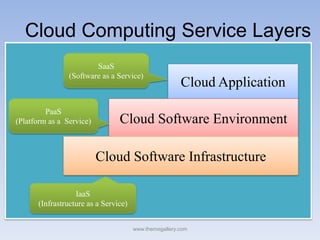
Cloud Computing Service Layers
                        SaaS
                (Software as a Service)
                                                       Cloud Application
         PaaS
(Platform as a Service)         Cloud Software Environment

                          Cloud Software Infrastructure

                  IaaS
      (Infrastructure as a Service)


                                      www.themegallery.com
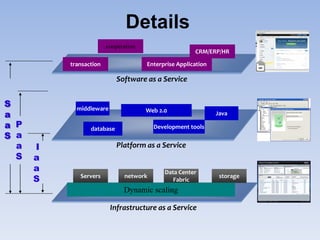
Details
                        cooperation
                                                       CRM/ERP/HR

          transaction                 Enterprise Application

                            Software as a Service


S           middleware                Web 2.0
a                High Volume                                   Java
                 Transactions
a P              database                 Development tools
S a
  a   I                     Platform as a Service
  S   a
      a                                      Data Center
             Servers            network                         storage
      S                                         Fabric
                                Dynamic scaling

                         Infrastructure as a Service
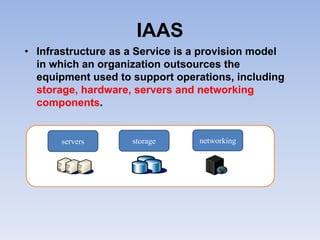
IAAS
• Infrastructure as a Service is a provision model
  in which an organization outsources the
  equipment used to support operations, including
  storage, hardware, servers and networking
  components.


       servers      storage      networking
Characteristics and components of IAAS

  •   Automation of administrative tasks
  •   Virtualization
  •   Dynamic scaling
  •   Desktop virtualization
  •   Policy-based services
  •   Internet connectivity
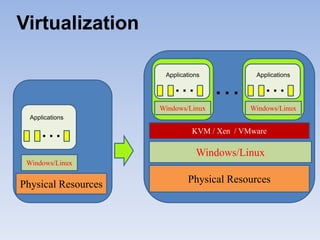
Virtualization

                      Applications            Applications

                         …           … …
                     Windows/Linux           Windows/Linux
  Applications

     …                         KVM / Xen / VMware

                                Windows/Linux
 Windows/Linux


Physical Resources           Physical Resources
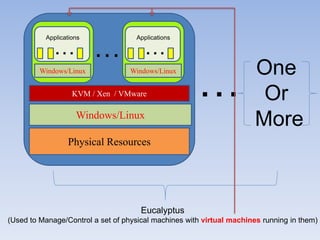
Applications              Applications

             …           … …
                                                                       One
                                                      …
         Windows/Linux             Windows/Linux


                   KVM / Xen / VMware                                   Or
                    Windows/Linux
                                                                       More
                 Physical Resources


                                      Eucalyptus
(Used to Manage/Control a set of physical machines with virtual machines running in them)
Eucalyptus Introduction
• A software platform for the implementation of
  private cloud computing on computer clusters.
• There is an open-core enterprise edition and an
  open-source edition.
• Began as a research project in the field of high
  performance computing (HPC) under the
  direction of Professor Rich Wolski in the
  Computer Science Department at the University
  of California, Santa Barbara.
Eucalyptus Architecture

• Distributed System
  – Components implemented as webservice


• Components run on top of existing resources
  – Linux distribution agnostic
     • Ubuntu, RHEL, CentOS, Debian, opens USE
  – Hypervisor agnostic
     • Xen, KVM, VMware
Eucalyptus Architecture
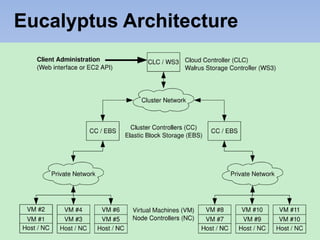
• CLC(Cloud Controller)

  – User interface to interact with the cloud
     • Standard SOAP API matching the Amazon EC2 API
     • Query Interface
        – Euca2ools and ElasticFox
  – Talks with the Cluster Controllers(CC)
     • Holds all information linking users to running instances
     • Collection of available machines to be run
     • View of the load of the entire system
Eucalyptus Architecture

• WS3(Walrus Storage Controller)
  – Storing the machine images (MI) that can be
    instantiated on the cloud
  – Accessing and storing data (either from a running
    instance or from anywhere on the web)

  Note: Currently the machine on which the Cloud
  Controller runs also hosts the Walrus Storage Controller
  (WS3), this limitation will be removed in a forthcoming
  version
Eucalyptus Architecture
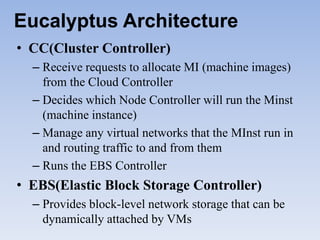
• CC(Cluster Controller)
  – Receive requests to allocate MI (machine images)
    from the Cloud Controller
  – Decides which Node Controller will run the Minst
    (machine instance)
  – Manage any virtual networks that the MInst run in
    and routing traffic to and from them
  – Runs the EBS Controller
• EBS(Elastic Block Storage Controller)
  – Provides block-level network storage that can be
    dynamically attached by VMs
Eucalyptus Architecture
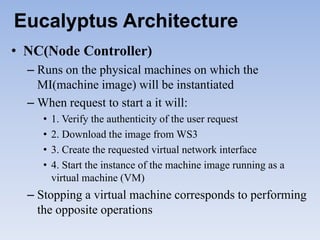
• NC(Node Controller)
  – Runs on the physical machines on which the
    MI(machine image) will be instantiated
  – When request to start a it will:
     •   1. Verify the authenticity of the user request
     •   2. Download the image from WS3
     •   3. Create the requested virtual network interface
     •   4. Start the instance of the machine image running as a
         virtual machine (VM)
  – Stopping a virtual machine corresponds to performing
    the opposite operations
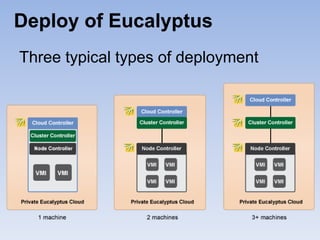
Deploy of Eucalyptus
Three typical types of deployment
Deploy of Eucalyptus
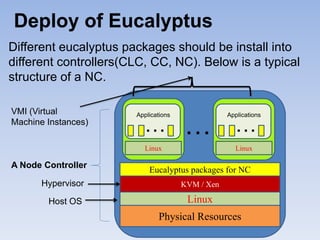
Different eucalyptus packages should be install into
different controllers(CLC, CC, NC). Below is a typical
structure of a NC.

VMI (Virtual           Applications               Applications
Machine Instances)
                         …            … …
                         Linux                      Linux

A Node Controller
                           Eucalyptus packages for NC
       Hypervisor                     KVM / Xen

        Host OS                        Linux
                              Physical Resources
Our Eucalyptus Cloud
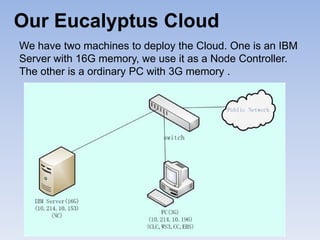
We have two machines to deploy the Cloud. One is an IBM
Server with 16G memory, we use it as a Node Controller.
The other is a ordinary PC with 3G memory .
Our Eucalyptus Cloud
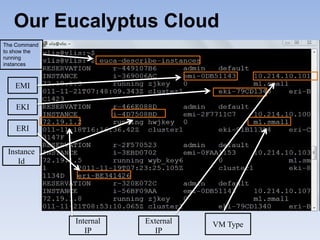
The Command
to show the
running
instances


   EMI

   EKI

    ERI

 Instance
    Id


              Internal   External   VM Type
                 IP        IP
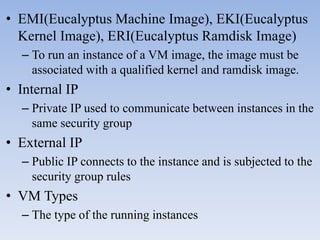
• EMI(Eucalyptus Machine Image), EKI(Eucalyptus
  Kernel Image), ERI(Eucalyptus Ramdisk Image)
  – To run an instance of a VM image, the image must be
    associated with a qualified kernel and ramdisk image.
• Internal IP
  – Private IP used to communicate between instances in the
    same security group
• External IP
  – Public IP connects to the instance and is subjected to the
    security group rules
• VM Types
  – The type of the running instances
Our Eucalyptus Cloud

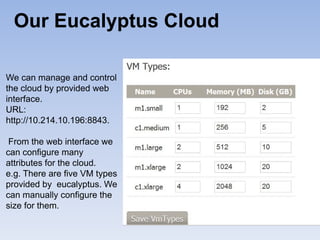
We can manage and control
the cloud by provided web
interface.
URL:
http://10.214.10.196:8843.

 From the web interface we
can configure many
attributes for the cloud.
e.g. There are five VM types
provided by eucalyptus. We
can manually configure the
size for them.
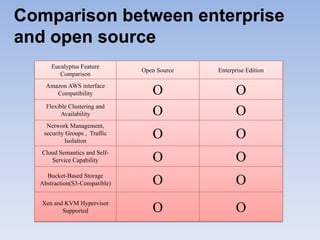
Comparison between enterprise
and open source
      Eucalyptus Feature
                               Open Source   Enterprise Edition
         Comparison
    Amazon AWS interface
       Compatibility              O                O
    Flexible Clustering and
          Availability            O                O
    Network Management,
   security Groups , Traffic
           Isolation
                                  O                O
   Cloud Semantics and Self-
      Service Capability          O                O
    Bucket-Based Storage
  Abstraction(S3-Compatible)      O                O
   Xen and KVM Hypervisor
          Supported               O                O
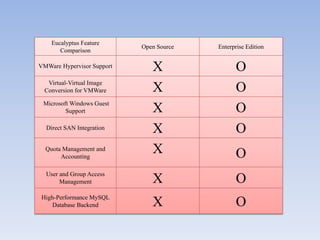
Eucalyptus Feature
                            Open Source   Enterprise Edition
       Comparison

VMWare Hypervisor Support      X                O
   Virtual-Virtual Image
  Conversion for VMWare        X                O
 Microsoft Windows Guest
         Support               X                O
  Direct SAN Integration       X                O
  Quota Management and
       Accounting
                               X                O
  User and Group Access
       Management              X                O
 High-Performance MySQL
     Database Backend          X                O
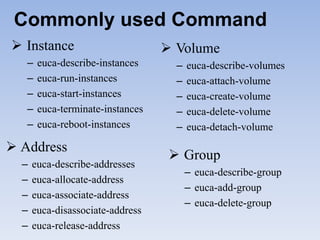
Commonly used Command
 Instance                         Volume
   –   euca-describe-instances      –   euca-describe-volumes
   –   euca-run-instances           –   euca-attach-volume
   –   euca-start-instances         –   euca-create-volume
   –   euca-terminate-instances     –   euca-delete-volume
   –   euca-reboot-instances        –   euca-detach-volume
 Address
                                    Group
  –   euca-describe-addresses
                                        – euca-describe-group
  –   euca-allocate-address
                                        – euca-add-group
  –   euca-associate-address
                                        – euca-delete-group
  –   euca-disassociate-address
  –   euca-release-address
Exploration of eucalyptus_v2.0

Exploration of eucalyptus_v2.0

  • 1.
  • 2.
    Cloud Computing ServiceLayers SaaS (Software as a Service) Cloud Application PaaS (Platform as a Service) Cloud Software Environment Cloud Software Infrastructure IaaS (Infrastructure as a Service) www.themegallery.com
  • 3.
    Details cooperation CRM/ERP/HR transaction Enterprise Application Software as a Service S middleware Web 2.0 a High Volume Java Transactions a P database Development tools S a a I Platform as a Service S a a Data Center Servers network storage S Fabric Dynamic scaling Infrastructure as a Service
  • 4.
    IAAS • Infrastructure asa Service is a provision model in which an organization outsources the equipment used to support operations, including storage, hardware, servers and networking components. servers storage networking
  • 5.
    Characteristics and componentsof IAAS • Automation of administrative tasks • Virtualization • Dynamic scaling • Desktop virtualization • Policy-based services • Internet connectivity
  • 6.
    Virtualization Applications Applications … … … Windows/Linux Windows/Linux Applications … KVM / Xen / VMware Windows/Linux Windows/Linux Physical Resources Physical Resources
  • 7.
    Applications Applications … … … One … Windows/Linux Windows/Linux KVM / Xen / VMware Or Windows/Linux More Physical Resources Eucalyptus (Used to Manage/Control a set of physical machines with virtual machines running in them)
  • 8.
    Eucalyptus Introduction • Asoftware platform for the implementation of private cloud computing on computer clusters. • There is an open-core enterprise edition and an open-source edition. • Began as a research project in the field of high performance computing (HPC) under the direction of Professor Rich Wolski in the Computer Science Department at the University of California, Santa Barbara.
  • 9.
    Eucalyptus Architecture • DistributedSystem – Components implemented as webservice • Components run on top of existing resources – Linux distribution agnostic • Ubuntu, RHEL, CentOS, Debian, opens USE – Hypervisor agnostic • Xen, KVM, VMware
  • 10.
  • 11.
    Eucalyptus Architecture • CLC(CloudController) – User interface to interact with the cloud • Standard SOAP API matching the Amazon EC2 API • Query Interface – Euca2ools and ElasticFox – Talks with the Cluster Controllers(CC) • Holds all information linking users to running instances • Collection of available machines to be run • View of the load of the entire system
  • 12.
    Eucalyptus Architecture • WS3(WalrusStorage Controller) – Storing the machine images (MI) that can be instantiated on the cloud – Accessing and storing data (either from a running instance or from anywhere on the web) Note: Currently the machine on which the Cloud Controller runs also hosts the Walrus Storage Controller (WS3), this limitation will be removed in a forthcoming version
  • 13.
    Eucalyptus Architecture • CC(ClusterController) – Receive requests to allocate MI (machine images) from the Cloud Controller – Decides which Node Controller will run the Minst (machine instance) – Manage any virtual networks that the MInst run in and routing traffic to and from them – Runs the EBS Controller • EBS(Elastic Block Storage Controller) – Provides block-level network storage that can be dynamically attached by VMs
  • 14.
    Eucalyptus Architecture • NC(NodeController) – Runs on the physical machines on which the MI(machine image) will be instantiated – When request to start a it will: • 1. Verify the authenticity of the user request • 2. Download the image from WS3 • 3. Create the requested virtual network interface • 4. Start the instance of the machine image running as a virtual machine (VM) – Stopping a virtual machine corresponds to performing the opposite operations
  • 15.
    Deploy of Eucalyptus Threetypical types of deployment
  • 16.
    Deploy of Eucalyptus Differenteucalyptus packages should be install into different controllers(CLC, CC, NC). Below is a typical structure of a NC. VMI (Virtual Applications Applications Machine Instances) … … … Linux Linux A Node Controller Eucalyptus packages for NC Hypervisor KVM / Xen Host OS Linux Physical Resources
  • 17.
    Our Eucalyptus Cloud Wehave two machines to deploy the Cloud. One is an IBM Server with 16G memory, we use it as a Node Controller. The other is a ordinary PC with 3G memory .
  • 18.
    Our Eucalyptus Cloud TheCommand to show the running instances EMI EKI ERI Instance Id Internal External VM Type IP IP
  • 19.
    • EMI(Eucalyptus MachineImage), EKI(Eucalyptus Kernel Image), ERI(Eucalyptus Ramdisk Image) – To run an instance of a VM image, the image must be associated with a qualified kernel and ramdisk image. • Internal IP – Private IP used to communicate between instances in the same security group • External IP – Public IP connects to the instance and is subjected to the security group rules • VM Types – The type of the running instances
  • 20.
    Our Eucalyptus Cloud Wecan manage and control the cloud by provided web interface. URL: http://10.214.10.196:8843. From the web interface we can configure many attributes for the cloud. e.g. There are five VM types provided by eucalyptus. We can manually configure the size for them.
  • 21.
    Comparison between enterprise andopen source Eucalyptus Feature Open Source Enterprise Edition Comparison Amazon AWS interface Compatibility O O Flexible Clustering and Availability O O Network Management, security Groups , Traffic Isolation O O Cloud Semantics and Self- Service Capability O O Bucket-Based Storage Abstraction(S3-Compatible) O O Xen and KVM Hypervisor Supported O O
  • 22.
    Eucalyptus Feature Open Source Enterprise Edition Comparison VMWare Hypervisor Support X O Virtual-Virtual Image Conversion for VMWare X O Microsoft Windows Guest Support X O Direct SAN Integration X O Quota Management and Accounting X O User and Group Access Management X O High-Performance MySQL Database Backend X O
  • 23.
    Commonly used Command Instance  Volume – euca-describe-instances – euca-describe-volumes – euca-run-instances – euca-attach-volume – euca-start-instances – euca-create-volume – euca-terminate-instances – euca-delete-volume – euca-reboot-instances – euca-detach-volume  Address  Group – euca-describe-addresses – euca-describe-group – euca-allocate-address – euca-add-group – euca-associate-address – euca-delete-group – euca-disassociate-address – euca-release-address