Minute Lectures

Analogies to explain reactive power (part 2)

Following the Minute Lecture ‘Four analogies to explain
  reactive power’, we received many reactions.
  Several writers suggested further analogies

This inspired us for making a sequel to this minute
  lecture, with four more analogies worked out

When explaining reactive power to lay persons, you
 can pick any analogy of your choice, according to
 your target audience
Minute Lectures

Analogies to explain reactive power (part 2)
What does the analogy needs to explain?
 Remember: these analogies are didactic tools; none of
   them are 100% correct

 They elucidate the difference between active power (W),
   reactive power (VAR), and apparent power (VA)

 Some of them also explain why reactive power limits the
   capacity of the lines in the grid, why reactive power
   increases energy losses in the grid, or other related
   phenomena
Minute Lectures

Analogies to explain reactive power (part 2)
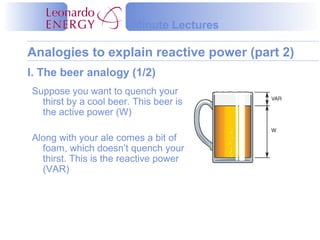
I. The beer analogy (1/2)
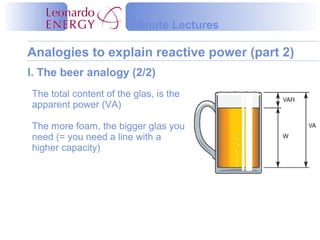
Suppose you want to quench your
  thirst by a cool beer. This beer is
  the active power (W)

Along with your ale comes a bit of
  foam, which doesn’t quench your
  thirst. This is the reactive power
  (VAR)
Minute Lectures

Analogies to explain reactive power (part 2)
I. The beer analogy (2/2)
The total content of the glas, is the
apparent power (VA)

The more foam, the bigger glas you
need (= you need a line with a
higher capacity)
Minute Lectures

Analogies to explain reactive power (part 2)
II. The marble-in-a-tube analogy (1/3)


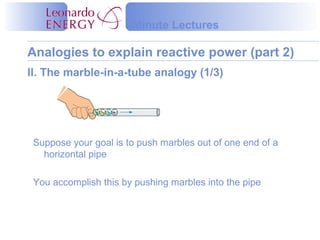
 Suppose your goal is to push marbles out of one end of a
   horizontal pipe

 You accomplish this by pushing marbles into the pipe
Minute Lectures

Analogies to explain reactive power (part 2)
II. The marble-in-a-tube analogy (2/3)


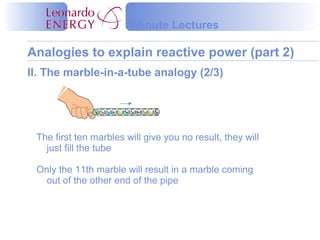
 The first ten marbles will give you no result, they will
   just fill the tube

 Only the 11th marble will result in a marble coming
   out of the other end of the pipe
Minute Lectures

Analogies to explain reactive power (part 2)
II. The marble-in-a-tube analogy (3/3)


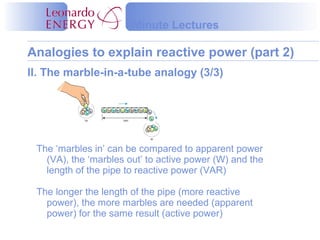
 The ‘marbles in’ can be compared to apparent power
   (VA), the ‘marbles out’ to active power (W) and the
   length of the pipe to reactive power (VAR)

 The longer the length of the pipe (more reactive
   power), the more marbles are needed (apparent
   power) for the same result (active power)
Minute Lectures

Analogies to explain reactive power (part 2)
III. The cash flow analogy (1/2)
 Suppose you are running a business. You have to
   spend an amount of money C (cost) on one day,
   for earning a larger amount of money E (earnings)
   one month later. Your profit will be P = E - C

 C is not lost money. However, without spending C,
   you will not be able to make the profit P

 The profit P can be compared to the active power.
   The earnings E are the equivalent of the apparent
   power. The cost C is the reactive power
Minute Lectures

Analogies to explain reactive power (part 2)
III. The cash flow analogy (2/2)
 To bridge the time between the spending of C and the
   earning of E, you will need some money. You could
   borrow this money (take reactive power from the
   power grid). That will however cost interest
   (reactive power penalty)

 A better solution would be to have some cash money
   available at your business (= a capacitor bank at
   your site).
Minute Lectures

Analogies to explain reactive power (part 2)
IV. The water tower (1/7)
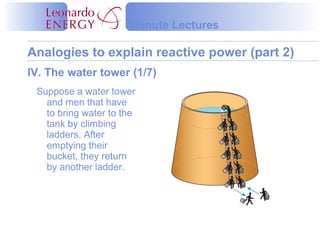
 Suppose a water tower
   and men that have
   to bring water to the
   tank by climbing
   ladders. After
   emptying their
   bucket, they return
   by another ladder.
Minute Lectures

Analogies to explain reactive power (part 2)
IV. The water tower (2/7)
 The climbing ladder = the electricity line

 The number of men on the ladder = the voltage

 The amount of water each man carries = the current

 The amount of water added to the tank per time
   interval = the frequency
Minute Lectures

Analogies to explain reactive power (part 2)
IV. The water tower (3/7)
 Energy = voltage x current

 The active power = the height of the tower.

 If the tower is high (high power), there are two
     solutions to keep the frequency: using more men
     (higher voltage) or increasing the amount of water
     each man carries (higher current)
Minute Lectures

Analogies to explain reactive power (part 2)
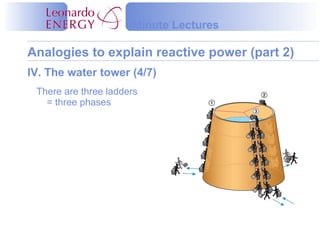
IV. The water tower (4/7)
 There are three ladders
   = three phases
Minute Lectures

Analogies to explain reactive power (part 2)
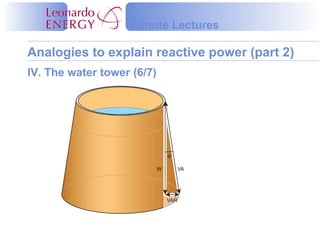
IV. The water tower (5/7)
 Width of the tower = reactive power

 Consequence: the length of the ladder (apparent
   power/voltage) depends on the height of the tower
   (active power) and the width of the tower (reactive
   power).

 The higher the reactive power, the longer the ladder.
   So if the same voltage is kept (same amount of
   men on the ladder), each man has to carry more
   water to keep up the same frequency.
Minute Lectures

Analogies to explain reactive power (part 2)
IV. The water tower (6/7)
Minute Lectures

Analogies to explain reactive power (part 2)
IV. The water tower (7/7)
 If a man is carrying more water (higher current), he
    will lose some along the way. So more reactive
    power means more losses.

 If the reactive power is so high that the men have to
     carry really a lot of water, one of the men could
     collapse  the other men have to carry even more
     water  if no support from new men is given, the
     system risks to experience a complete breakdown
Minute Lectures

Analogies to explain reactive power (part 2)
Round-up
 Another four analogies represent the idea of active and
   reactive power in an electric system:
    •   The beer analogy
    •   The marble-in-a-tube analogy
    •   The cash flow analogy
    •   The water tower analogy

 Some people prefer one or another analogy

 We hope they will increase the reader’s insight in the
  phenomenon, or help explaining the phenomenon to
  others
Minute Lectures

Analogies to explain reactive power (part 2)
Links and references
 • P Sauer, What is Reactive Power?,
   PSERC, Sep 2003

 • Minute Lecture: 4 analogies to explain
   reactive power

Explaining reactive power - 4 further analogies

  • 1.
    Minute Lectures Analogies toexplain reactive power (part 2) Following the Minute Lecture ‘Four analogies to explain reactive power’, we received many reactions. Several writers suggested further analogies This inspired us for making a sequel to this minute lecture, with four more analogies worked out When explaining reactive power to lay persons, you can pick any analogy of your choice, according to your target audience
  • 2.
    Minute Lectures Analogies toexplain reactive power (part 2) What does the analogy needs to explain? Remember: these analogies are didactic tools; none of them are 100% correct They elucidate the difference between active power (W), reactive power (VAR), and apparent power (VA) Some of them also explain why reactive power limits the capacity of the lines in the grid, why reactive power increases energy losses in the grid, or other related phenomena
  • 3.
    Minute Lectures Analogies toexplain reactive power (part 2) I. The beer analogy (1/2) Suppose you want to quench your thirst by a cool beer. This beer is the active power (W) Along with your ale comes a bit of foam, which doesn’t quench your thirst. This is the reactive power (VAR)
  • 4.
    Minute Lectures Analogies toexplain reactive power (part 2) I. The beer analogy (2/2) The total content of the glas, is the apparent power (VA) The more foam, the bigger glas you need (= you need a line with a higher capacity)
  • 5.
    Minute Lectures Analogies toexplain reactive power (part 2) II. The marble-in-a-tube analogy (1/3) Suppose your goal is to push marbles out of one end of a horizontal pipe You accomplish this by pushing marbles into the pipe
  • 6.
    Minute Lectures Analogies toexplain reactive power (part 2) II. The marble-in-a-tube analogy (2/3) The first ten marbles will give you no result, they will just fill the tube Only the 11th marble will result in a marble coming out of the other end of the pipe
  • 7.
    Minute Lectures Analogies toexplain reactive power (part 2) II. The marble-in-a-tube analogy (3/3) The ‘marbles in’ can be compared to apparent power (VA), the ‘marbles out’ to active power (W) and the length of the pipe to reactive power (VAR) The longer the length of the pipe (more reactive power), the more marbles are needed (apparent power) for the same result (active power)
  • 8.
    Minute Lectures Analogies toexplain reactive power (part 2) III. The cash flow analogy (1/2) Suppose you are running a business. You have to spend an amount of money C (cost) on one day, for earning a larger amount of money E (earnings) one month later. Your profit will be P = E - C C is not lost money. However, without spending C, you will not be able to make the profit P The profit P can be compared to the active power. The earnings E are the equivalent of the apparent power. The cost C is the reactive power
  • 9.
    Minute Lectures Analogies toexplain reactive power (part 2) III. The cash flow analogy (2/2) To bridge the time between the spending of C and the earning of E, you will need some money. You could borrow this money (take reactive power from the power grid). That will however cost interest (reactive power penalty) A better solution would be to have some cash money available at your business (= a capacitor bank at your site).
  • 10.
    Minute Lectures Analogies toexplain reactive power (part 2) IV. The water tower (1/7) Suppose a water tower and men that have to bring water to the tank by climbing ladders. After emptying their bucket, they return by another ladder.
  • 11.
    Minute Lectures Analogies toexplain reactive power (part 2) IV. The water tower (2/7) The climbing ladder = the electricity line The number of men on the ladder = the voltage The amount of water each man carries = the current The amount of water added to the tank per time interval = the frequency
  • 12.
    Minute Lectures Analogies toexplain reactive power (part 2) IV. The water tower (3/7) Energy = voltage x current The active power = the height of the tower. If the tower is high (high power), there are two solutions to keep the frequency: using more men (higher voltage) or increasing the amount of water each man carries (higher current)
  • 13.
    Minute Lectures Analogies toexplain reactive power (part 2) IV. The water tower (4/7) There are three ladders = three phases
  • 14.
    Minute Lectures Analogies toexplain reactive power (part 2) IV. The water tower (5/7) Width of the tower = reactive power Consequence: the length of the ladder (apparent power/voltage) depends on the height of the tower (active power) and the width of the tower (reactive power). The higher the reactive power, the longer the ladder. So if the same voltage is kept (same amount of men on the ladder), each man has to carry more water to keep up the same frequency.
  • 15.
    Minute Lectures Analogies toexplain reactive power (part 2) IV. The water tower (6/7)
  • 16.
    Minute Lectures Analogies toexplain reactive power (part 2) IV. The water tower (7/7) If a man is carrying more water (higher current), he will lose some along the way. So more reactive power means more losses. If the reactive power is so high that the men have to carry really a lot of water, one of the men could collapse  the other men have to carry even more water  if no support from new men is given, the system risks to experience a complete breakdown
  • 17.
    Minute Lectures Analogies toexplain reactive power (part 2) Round-up Another four analogies represent the idea of active and reactive power in an electric system: • The beer analogy • The marble-in-a-tube analogy • The cash flow analogy • The water tower analogy Some people prefer one or another analogy We hope they will increase the reader’s insight in the phenomenon, or help explaining the phenomenon to others
  • 18.
    Minute Lectures Analogies toexplain reactive power (part 2) Links and references • P Sauer, What is Reactive Power?, PSERC, Sep 2003 • Minute Lecture: 4 analogies to explain reactive power