EXPERIENTIAL
LEARNING
BY:
AFIFAH NABILAH
FARAH SHAMIMI
LAILA SYAHIRAH
SHARIFAH SHAHIRAH
EXPERIENTIAL
LEARNING
#1
Identify and briefly describe a
company in Malaysia that has
successfully adopted each of the
following strategies:
a) Cost minimisation
b) Product - differentiation
c) Response (Time-based)
strategies
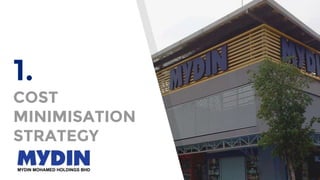
1.
COST
MINIMISATION
STRATEGY
COST-MINIMISATION
STRATEGY
 Widely known by Malaysians as a long
standing retailer and wholesaler
 Sells products in lower than average price
 Sells products in small quantity and big
packages to their customers
 Provide a counter for customers who buys in
bulk
 Customers can buy in bulk with cheaper price
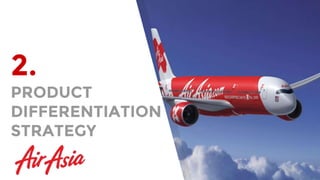
2.
PRODUCT
DIFFERENTIATION
STRATEGY
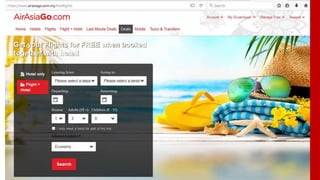
▸ Flight + hotel combo booking with the
cheapest price in town (customer can save up
to 70% when booking the combo). Sometimes
they even give the flight ticket for free when
the customers bought the combo package.
PRODUCT DIFFERENTIATION
STRATEGY
PRODUCT DIFFERENTIATION
STRATEGY
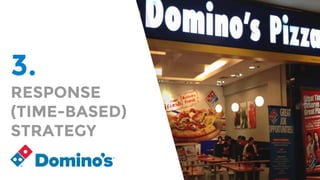
3.
RESPONSE
(TIME-BASED)
STRATEGY
RESPONSE (TIME-BASED)
STRATEGY
i) Flexibility- Customer can order online and choose
their own pizza. Customer can view complete
information about varieties of pizza through online.
ii) Reliability- People make an order by selecting their
favourite choices depending on the complete
description on the website. The orders will then be
fulfilled by the nearest dominos branch.
iii) Timeliness- They do delivery services. A coupon will
be given for free pizza if late than 30 minutes.
Experiential Learning
#2
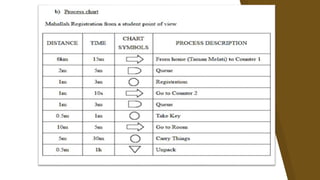
▸Choose a process at any organization. Conduct the
following analysis:
A)Job expansion analysis for a staff in charge of 1 of
the procedures in the process.
B) Draw process chart for the whole process
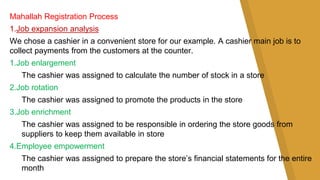
Mahallah Registration Process
1.Job expansion analysis
We chose a cashier in a convenient store for our example. A cashier main job is to
collect payments from the customers at the counter.
1.Job enlargement
The cashier was assigned to calculate the number of stock in a store
2.Job rotation
The cashier was assigned to promote the products in the store
3.Job enrichment
The cashier was assigned to be responsible in ordering the store goods from
suppliers to keep them available in store
4.Employee empowerment
The cashier was assigned to prepare the store’s financial statements for the entire
month
Experiential Learning
#3
Choose 1 manufacturing company
and 1 service company.
 Manufacturing company: Proton Holdings Berhad
Proton Holdings Berhad, commonly known as Proton and stylised
PROTON is a Malaysia-based corporation active in automobile
design, manufacturing, distribution and sales and established
in 1983.
 Service Company: Foodpanda
Foodpanda group is a global mobile food delivery marketplace.
The service allows users to select from local restaurants and
place orders via its mobile applications as well as its websites.
a) Discuss the key differences in capacity planning
between manufacturing and services industries.
 Capacity planning for manufacturing industries are based on the
productions by machineries, while for services industries are based on
manpower capabilities
 When demand exceeds capacity:
 In a manufacturing organization, they need to extend or add more
equipment.
 In a service industry, they need to add more labor.
 Capacity planning for manufacturing industries involves tangible
goods, while capacity planning for services industries involves
intangible goods
b) What are the associated challenges in managing
capacity for each.
Proton Holdings Berhad
The capacity may exceed demand
▹ The demand of the new car cannot be determined. May lead to profit
or loss in return.
Capacity constraint
▹ Modifying capacity in the short run is difficult if Proton want to make
the major changes in production line. For instances like allocate new
machinery
Foodpanda
Skillfull programmer
▹They must be skillful enough to ensure the current web system they
used match with the current technology updates in order to become
user friendly
Experiential Learning
#4
a)Explain key business issues affecting the decision to
open more outlets
Answer:
▸Measure the strength of current existing fast food franchise- capacity
and size of business- profitable or not?
▸Perform market research focused on any proposed new locations-
Identify potential new target markets, and measure the strength of
existing demand- high demand or low demand?
▸Believe that the business can be duplicated even the business was not
run by the owner
b) Analyse the situation and highlight the key factors and
trade-offs involved in opening more outlets. The pros and
cons of various options are to be examined
Answer:
▸Labor productivity
‒ Pros: Area with low wage rates
‒ Cons: Employees with poor training, education and work habits
▸Exchange Rates and Currency Risk
‒ Pros: Favourable exchange rate in foreign country
‒ Cons: Continuous rise and fall of foreign currencies
▸Costs
‒ Pros: Tangible costs are readily identifiable and precisely measured
‒ Cons: Intangible costs are less easily quantified
▸Proximity to Markets
‒ Pros: The fast food restaurant already has regular customers which
come from the first outlet in the same area.
‒ Cons: Even though the new outlet will be near customers, but since it
will be in the same area as the first outlet, there will be an internal
competition between the same fast food restaurant with different
outlets.
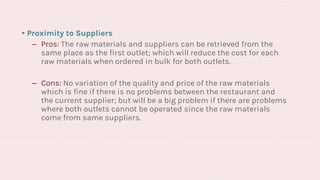
▸Proximity to Suppliers
‒ Pros: The raw materials and suppliers can be retrieved from the
same place as the first outlet; which will reduce the cost for each
raw materials when ordered in bulk for both outlets.
‒ Cons: No variation of the quality and price of the raw materials
which is fine if there is no problems between the restaurant and
the current supplier; but will be a big problem if there are problems
where both outlets cannot be operated since the raw materials
come from same suppliers.
Experiential Learning
#5
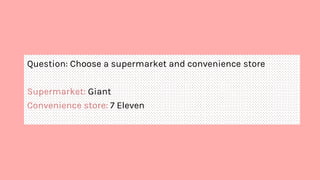
Question: Choose a supermarket and convenience store
Supermarket: Giant
Convenience store: 7 Eleven
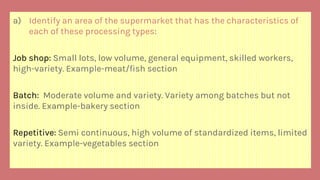
a) Identify an area of the supermarket that has the characteristics of
each of these processing types:
Job shop: Small lots, low volume, general equipment, skilled workers,
high-variety. Example-meat/fish section
Batch: Moderate volume and variety. Variety among batches but not
inside. Example-bakery section
Repetitive: Semi continuous, high volume of standardized items, limited
variety. Example-vegetables section
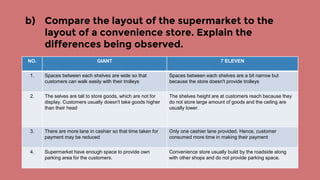
b) Compare the layout of the supermarket to the
layout of a convenience store. Explain the
differences being observed.
NO. GIANT 7 ELEVEN
1. Spaces between each shelves are wide so that
customers can walk easily with their trolleys
Spaces between each shelves are a bit narrow but
because the store doesn't provide trolleys
2. The selves are tall to store goods, which are not for
display. Customers usually doesn't take goods higher
than their head
The shelves height are at customers reach because they
do not store large amount of goods and the ceiling are
usually lower.
3. There are more lane in cashier so that time taken for
payment may be reduced
Only one cashier lane provided. Hence, customer
consumed more time in making their payment
4. Supermarket have enough space to provide own
parking area for the customers.
Convenience store usually build by the roadside along
with other shops and do not provide parking space.
Experiential Learning
#6
Pick a position for your
company:
Henna Sales
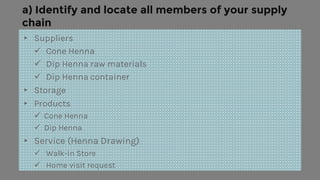
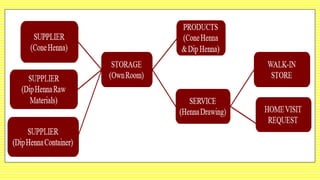
a) Identify and locate all members of your supply
chain
▸ Suppliers
 Cone Henna
 Dip Henna raw materials
 Dip Henna container
▸ Storage
▸ Products
 Cone Henna
 Dip Henna
▸ Service (Henna Drawing)
 Walk-in Store
 Home visit request
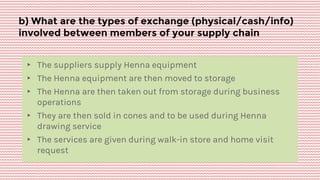
b) What are the types of exchange (physical/cash/info)
involved between members of your supply chain
▸ The suppliers supply Henna equipment
▸ The Henna equipment are then moved to storage
▸ The Henna are then taken out from storage during business
operations
▸ They are then sold in cones and to be used during Henna
drawing service
▸ The services are given during walk-in store and home visit
request
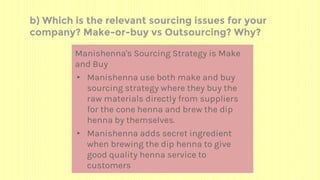
b) Which is the relevant sourcing issues for your
company? Make-or-buy vs Outsourcing? Why?
Manishenna's Sourcing Strategy is Make
and Buy
▸ Manishenna use both make and buy
sourcing strategy where they buy the
raw materials directly from suppliers
for the cone henna and brew the dip
henna by themselves.
▸ Manishenna adds secret ingredient
when brewing the dip henna to give
good quality henna service to
customers
Experiential Learning
#7
The function of MRP:
Describe examples of planning “backwards in time” in your
own lives.
Refer to example given.
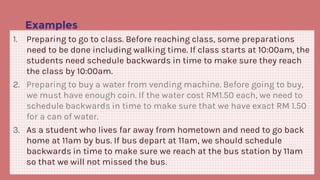
Examples
1. Preparing to go to class. Before reaching class, some preparations
need to be done including walking time. If class starts at 10:00am, the
students need schedule backwards in time to make sure they reach
the class by 10:00am.
2. Preparing to buy a water from vending machine. Before going to buy,
we must have enough coin. If the water cost RM1.50 each, we need to
schedule backwards in time to make sure that we have exact RM 1.50
for a can of water.
3. As a student who lives far away from hometown and need to go back
home at 11am by bus. If bus depart at 11am, we should schedule
backwards in time to make sure we reach at the bus station by 11am
so that we will not missed the bus.

Experiential Learning (Complete)

  • 1.
  • 2.
  • 3.
    Identify and brieflydescribe a company in Malaysia that has successfully adopted each of the following strategies: a) Cost minimisation b) Product - differentiation c) Response (Time-based) strategies
  • 4.
  • 5.
    COST-MINIMISATION STRATEGY  Widely knownby Malaysians as a long standing retailer and wholesaler  Sells products in lower than average price  Sells products in small quantity and big packages to their customers  Provide a counter for customers who buys in bulk  Customers can buy in bulk with cheaper price
  • 6.
  • 7.
    ▸ Flight +hotel combo booking with the cheapest price in town (customer can save up to 70% when booking the combo). Sometimes they even give the flight ticket for free when the customers bought the combo package. PRODUCT DIFFERENTIATION STRATEGY
  • 8.
  • 9.
  • 10.
    RESPONSE (TIME-BASED) STRATEGY i) Flexibility-Customer can order online and choose their own pizza. Customer can view complete information about varieties of pizza through online. ii) Reliability- People make an order by selecting their favourite choices depending on the complete description on the website. The orders will then be fulfilled by the nearest dominos branch. iii) Timeliness- They do delivery services. A coupon will be given for free pizza if late than 30 minutes.
  • 11.
  • 12.
    ▸Choose a processat any organization. Conduct the following analysis: A)Job expansion analysis for a staff in charge of 1 of the procedures in the process. B) Draw process chart for the whole process
  • 13.
    Mahallah Registration Process 1.Jobexpansion analysis We chose a cashier in a convenient store for our example. A cashier main job is to collect payments from the customers at the counter. 1.Job enlargement The cashier was assigned to calculate the number of stock in a store 2.Job rotation The cashier was assigned to promote the products in the store 3.Job enrichment The cashier was assigned to be responsible in ordering the store goods from suppliers to keep them available in store 4.Employee empowerment The cashier was assigned to prepare the store’s financial statements for the entire month
  • 15.
  • 16.
    Choose 1 manufacturingcompany and 1 service company.  Manufacturing company: Proton Holdings Berhad Proton Holdings Berhad, commonly known as Proton and stylised PROTON is a Malaysia-based corporation active in automobile design, manufacturing, distribution and sales and established in 1983.  Service Company: Foodpanda Foodpanda group is a global mobile food delivery marketplace. The service allows users to select from local restaurants and place orders via its mobile applications as well as its websites.
  • 17.
    a) Discuss thekey differences in capacity planning between manufacturing and services industries.  Capacity planning for manufacturing industries are based on the productions by machineries, while for services industries are based on manpower capabilities  When demand exceeds capacity:  In a manufacturing organization, they need to extend or add more equipment.  In a service industry, they need to add more labor.  Capacity planning for manufacturing industries involves tangible goods, while capacity planning for services industries involves intangible goods
  • 18.
    b) What arethe associated challenges in managing capacity for each. Proton Holdings Berhad The capacity may exceed demand ▹ The demand of the new car cannot be determined. May lead to profit or loss in return. Capacity constraint ▹ Modifying capacity in the short run is difficult if Proton want to make the major changes in production line. For instances like allocate new machinery Foodpanda Skillfull programmer ▹They must be skillful enough to ensure the current web system they used match with the current technology updates in order to become user friendly
  • 19.
  • 20.
    a)Explain key businessissues affecting the decision to open more outlets Answer: ▸Measure the strength of current existing fast food franchise- capacity and size of business- profitable or not? ▸Perform market research focused on any proposed new locations- Identify potential new target markets, and measure the strength of existing demand- high demand or low demand? ▸Believe that the business can be duplicated even the business was not run by the owner
  • 21.
    b) Analyse thesituation and highlight the key factors and trade-offs involved in opening more outlets. The pros and cons of various options are to be examined Answer: ▸Labor productivity ‒ Pros: Area with low wage rates ‒ Cons: Employees with poor training, education and work habits ▸Exchange Rates and Currency Risk ‒ Pros: Favourable exchange rate in foreign country ‒ Cons: Continuous rise and fall of foreign currencies
  • 22.
    ▸Costs ‒ Pros: Tangiblecosts are readily identifiable and precisely measured ‒ Cons: Intangible costs are less easily quantified ▸Proximity to Markets ‒ Pros: The fast food restaurant already has regular customers which come from the first outlet in the same area. ‒ Cons: Even though the new outlet will be near customers, but since it will be in the same area as the first outlet, there will be an internal competition between the same fast food restaurant with different outlets.
  • 23.
    ▸Proximity to Suppliers ‒Pros: The raw materials and suppliers can be retrieved from the same place as the first outlet; which will reduce the cost for each raw materials when ordered in bulk for both outlets. ‒ Cons: No variation of the quality and price of the raw materials which is fine if there is no problems between the restaurant and the current supplier; but will be a big problem if there are problems where both outlets cannot be operated since the raw materials come from same suppliers.
  • 24.
  • 25.
    Question: Choose asupermarket and convenience store Supermarket: Giant Convenience store: 7 Eleven
  • 26.
    a) Identify anarea of the supermarket that has the characteristics of each of these processing types: Job shop: Small lots, low volume, general equipment, skilled workers, high-variety. Example-meat/fish section Batch: Moderate volume and variety. Variety among batches but not inside. Example-bakery section Repetitive: Semi continuous, high volume of standardized items, limited variety. Example-vegetables section
  • 27.
    b) Compare thelayout of the supermarket to the layout of a convenience store. Explain the differences being observed. NO. GIANT 7 ELEVEN 1. Spaces between each shelves are wide so that customers can walk easily with their trolleys Spaces between each shelves are a bit narrow but because the store doesn't provide trolleys 2. The selves are tall to store goods, which are not for display. Customers usually doesn't take goods higher than their head The shelves height are at customers reach because they do not store large amount of goods and the ceiling are usually lower. 3. There are more lane in cashier so that time taken for payment may be reduced Only one cashier lane provided. Hence, customer consumed more time in making their payment 4. Supermarket have enough space to provide own parking area for the customers. Convenience store usually build by the roadside along with other shops and do not provide parking space.
  • 28.
  • 29.
    Pick a positionfor your company: Henna Sales
  • 30.
    a) Identify andlocate all members of your supply chain ▸ Suppliers  Cone Henna  Dip Henna raw materials  Dip Henna container ▸ Storage ▸ Products  Cone Henna  Dip Henna ▸ Service (Henna Drawing)  Walk-in Store  Home visit request
  • 31.
    b) What arethe types of exchange (physical/cash/info) involved between members of your supply chain ▸ The suppliers supply Henna equipment ▸ The Henna equipment are then moved to storage ▸ The Henna are then taken out from storage during business operations ▸ They are then sold in cones and to be used during Henna drawing service ▸ The services are given during walk-in store and home visit request
  • 32.
    b) Which isthe relevant sourcing issues for your company? Make-or-buy vs Outsourcing? Why? Manishenna's Sourcing Strategy is Make and Buy ▸ Manishenna use both make and buy sourcing strategy where they buy the raw materials directly from suppliers for the cone henna and brew the dip henna by themselves. ▸ Manishenna adds secret ingredient when brewing the dip henna to give good quality henna service to customers
  • 34.
  • 35.
    The function ofMRP: Describe examples of planning “backwards in time” in your own lives. Refer to example given.
  • 36.
    Examples 1. Preparing togo to class. Before reaching class, some preparations need to be done including walking time. If class starts at 10:00am, the students need schedule backwards in time to make sure they reach the class by 10:00am. 2. Preparing to buy a water from vending machine. Before going to buy, we must have enough coin. If the water cost RM1.50 each, we need to schedule backwards in time to make sure that we have exact RM 1.50 for a can of water. 3. As a student who lives far away from hometown and need to go back home at 11am by bus. If bus depart at 11am, we should schedule backwards in time to make sure we reach at the bus station by 11am so that we will not missed the bus.