EXPERIENCE BASED LEARNING
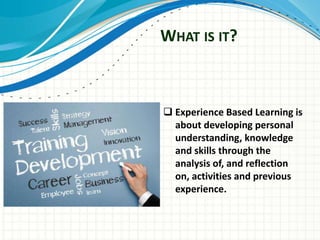
 Experience Based Learning is
about developing personal
understanding, knowledge
and skills through the
analysis of, and reflection
on, activities and previous
experience.
WHAT IS IT?
WHAT MAKES
EXPERIENCE BASED
LEARNING SPECIAL
 Experiential Learning is an active process
which engages the learner.
 Experience provides the platform for
learning
 Individuals are encouraged to work
things out for themselves, they are
guided by coaches to And through their
learning. Thus they retain the
knowledge better
 The learning is appropriate to the
learner and their needs and the learner
is encouraged to explore different ways
of thinking,
WHAT ARE THE BENEFITS
OF EXPERIENCE BASED
LEARNING
 It is learner centred – it focusses on
the learning needs of the student.
 It is easier for the student to
absorb and relate to the learning
 Each learner is encouraged to
develop a personal understanding
of their role and how they could
make improvements through
subsequent activity
AN EXAMPLE OF HOW IT
WORKS WITH LLA
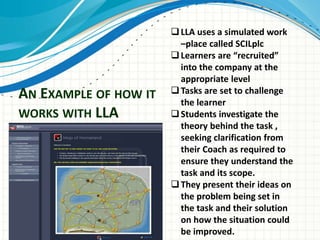
LLA uses a simulated work
–place called SCILplc
Learners are “recruited”
into the company at the
appropriate level
Tasks are set to challenge
the learner
Students investigate the
theory behind the task ,
seeking clarification from
their Coach as required to
ensure they understand the
task and its scope.
They present their ideas on
the problem being set in
the task and their solution
on how the situation could
be improved.
WHO IS LLA?
LLA is a global provider of
logistics and supply chain
development programmes.
All programmes are built
around the model of
experience based learning
Learning can be developed to
meet specific learner or
organisational needs
CONTACT US TODAY
You can contact us on:
Tel: 0800 158 8231 or +44 1530 276590
Text or Call: 07717 758352 Skype: admin_lla
Email: enquiry@logisticslearningalliance.com
www.logisticslearningalliance.com

Experience based learning with LLA

  • 1.
  • 2.
     Experience BasedLearning is about developing personal understanding, knowledge and skills through the analysis of, and reflection on, activities and previous experience. WHAT IS IT?
  • 3.
    WHAT MAKES EXPERIENCE BASED LEARNINGSPECIAL  Experiential Learning is an active process which engages the learner.  Experience provides the platform for learning  Individuals are encouraged to work things out for themselves, they are guided by coaches to And through their learning. Thus they retain the knowledge better  The learning is appropriate to the learner and their needs and the learner is encouraged to explore different ways of thinking,
  • 4.
    WHAT ARE THEBENEFITS OF EXPERIENCE BASED LEARNING  It is learner centred – it focusses on the learning needs of the student.  It is easier for the student to absorb and relate to the learning  Each learner is encouraged to develop a personal understanding of their role and how they could make improvements through subsequent activity
  • 5.
    AN EXAMPLE OFHOW IT WORKS WITH LLA LLA uses a simulated work –place called SCILplc Learners are “recruited” into the company at the appropriate level Tasks are set to challenge the learner Students investigate the theory behind the task , seeking clarification from their Coach as required to ensure they understand the task and its scope. They present their ideas on the problem being set in the task and their solution on how the situation could be improved.
  • 6.
    WHO IS LLA? LLAis a global provider of logistics and supply chain development programmes. All programmes are built around the model of experience based learning Learning can be developed to meet specific learner or organisational needs
  • 7.
    CONTACT US TODAY Youcan contact us on: Tel: 0800 158 8231 or +44 1530 276590 Text or Call: 07717 758352 Skype: admin_lla Email: enquiry@logisticslearningalliance.com www.logisticslearningalliance.com

Editor's Notes

  • #2 This template can be used as a starter file for presenting training materials in a group setting. Sections Right-click on a slide to add sections. Sections can help to organize your slides or facilitate collaboration between multiple authors. Notes Use the Notes section for delivery notes or to provide additional details for the audience. View these notes in Presentation View during your presentation. Keep in mind the font size (important for accessibility, visibility, videotaping, and online production) Coordinated colors Pay particular attention to the graphs, charts, and text boxes. Consider that attendees will print in black and white or grayscale. Run a test print to make sure your colors work when printed in pure black and white and grayscale. Graphics, tables, and graphs Keep it simple: If possible, use consistent, non-distracting styles and colors. Label all graphs and tables.
  • #3 Use a section header for each of the topics, so there is a clear transition to the audience.