Expected U.S. GDP Growth Rate
         Victoria Rock

          AIU Online

       BUSN300-1202A-15
Abstract


Being a newly appointed President for the local Chamber of Commerce, a presentation on the

Expected U.S. GDP growth will be examined and explained.
Introduction


In this paper the GDP growth rate of the U.S. will be examined through trends, forcasts, and

statistics. Also how the GDP is determined and interpreted.
Expected U.S. GDP Growth Rate


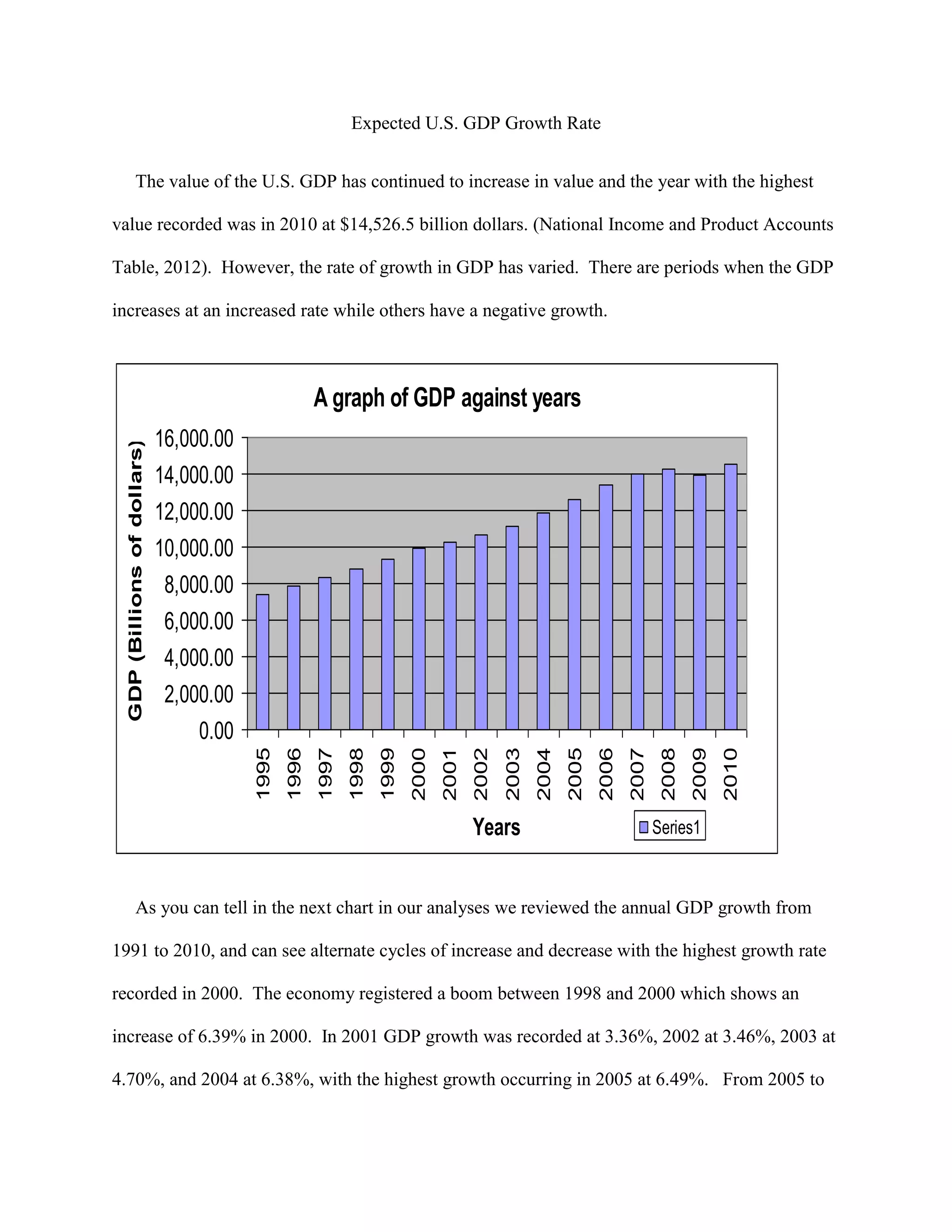
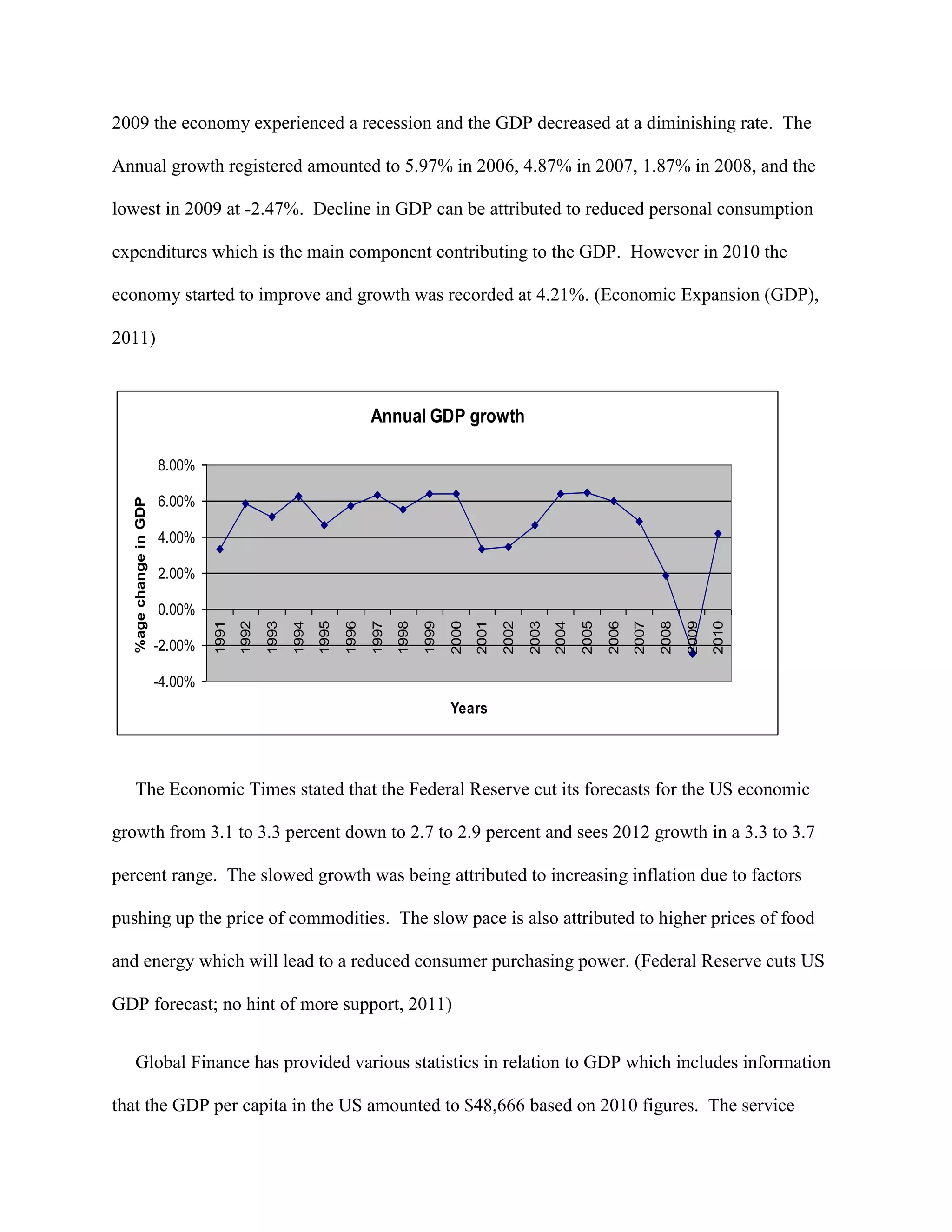
            The value of the U.S. GDP has continued to increase in value and the year with the highest

value recorded was in 2010 at $14,526.5 billion dollars. (National Income and Product Accounts

Table, 2012). However, the rate of growth in GDP has varied. There are periods when the GDP

increases at an increased rate while others have a negative growth.


                                                        A graph of GDP against years
                              16,000.00
  GDP (Billions of dollars)


                              14,000.00
                              12,000.00
                              10,000.00
                               8,000.00
                               6,000.00
                               4,000.00
                               2,000.00
                                   0.00
                                          1995
                                                 1996
                                                        1997
                                                               1998
                                                                      1999
                                                                             2000
                                                                                    2001
                                                                                           2002
                                                                                                  2003
                                                                                                         2004
                                                                                                                2005
                                                                                                                       2006
                                                                                                                              2007
                                                                                                                                      2008
                                                                                                                                             2009
                                                                                                                                                    2010


                                                                                           Years                                     Series1


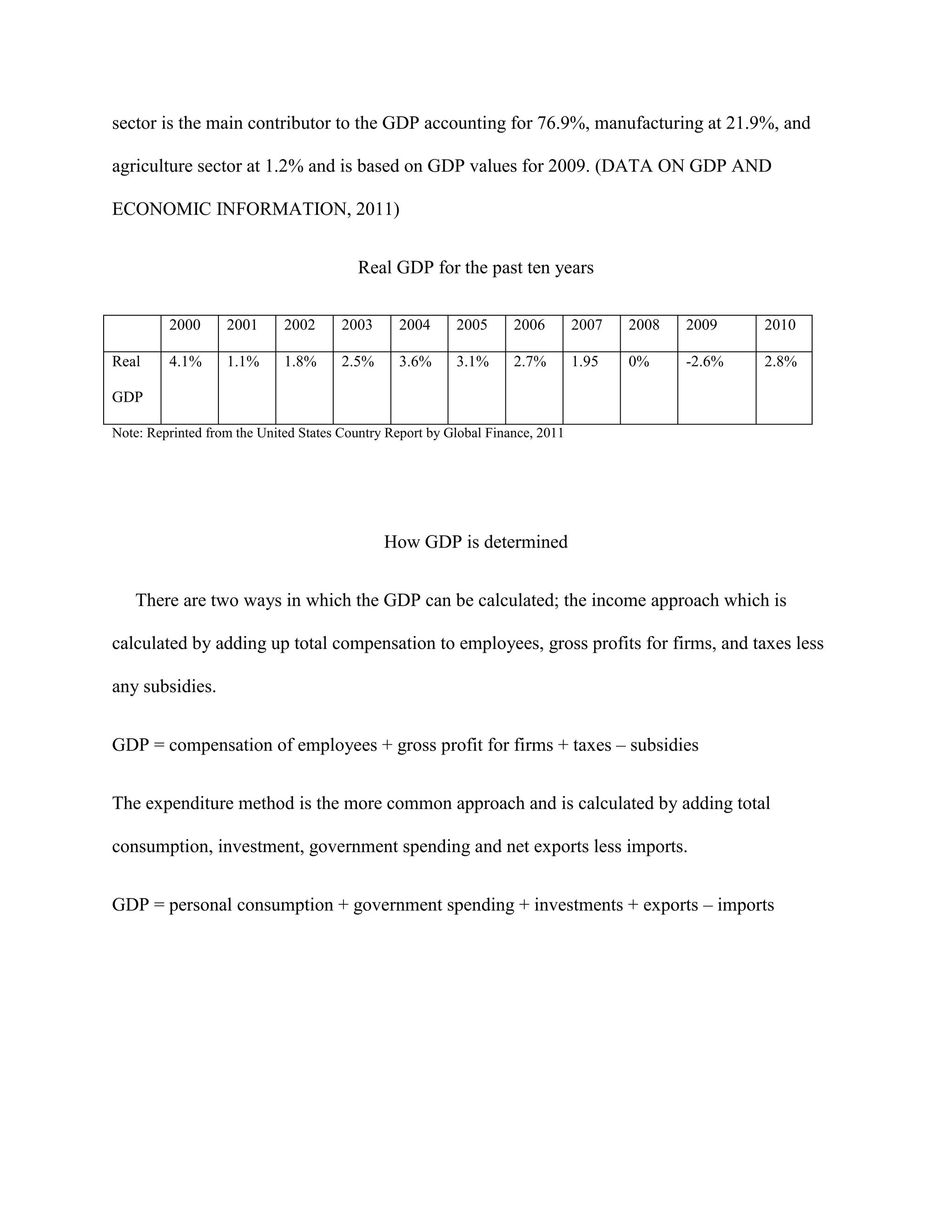
            As you can tell in the next chart in our analyses we reviewed the annual GDP growth from

1991 to 2010, and can see alternate cycles of increase and decrease with the highest growth rate

recorded in 2000. The economy registered a boom between 1998 and 2000 which shows an

increase of 6.39% in 2000. In 2001 GDP growth was recorded at 3.36%, 2002 at 3.46%, 2003 at

4.70%, and 2004 at 6.38%, with the highest growth occurring in 2005 at 6.49%. From 2005 to
2009 the economy experienced a recession and the GDP decreased at a diminishing rate. The

Annual growth registered amounted to 5.97% in 2006, 4.87% in 2007, 1.87% in 2008, and the

lowest in 2009 at -2.47%. Decline in GDP can be attributed to reduced personal consumption

expenditures which is the main component contributing to the GDP. However in 2010 the

economy started to improve and growth was recorded at 4.21%. (Economic Expansion (GDP),

2011)


                                                                           Annual GDP growth

                        8.00%

                        6.00%
   %age change in GDP


                        4.00%

                        2.00%

                        0.00%
                                 1991
                                        1992
                                               1993

                                                      1994
                                                             1995
                                                                    1996
                                                                           1997
                                                                                  1998
                                                                                         1999

                                                                                                2000
                                                                                                       2001
                                                                                                              2002
                                                                                                                     2003
                                                                                                                            2004

                                                                                                                                   2005
                                                                                                                                          2006
                                                                                                                                                 2007
                                                                                                                                                        2008
                                                                                                                                                               2009
                                                                                                                                                                      2010
                        -2.00%

                        -4.00%
                                                                                                Years


   The Economic Times stated that the Federal Reserve cut its forecasts for the US economic

growth from 3.1 to 3.3 percent down to 2.7 to 2.9 percent and sees 2012 growth in a 3.3 to 3.7

percent range. The slowed growth was being attributed to increasing inflation due to factors

pushing up the price of commodities. The slow pace is also attributed to higher prices of food

and energy which will lead to a reduced consumer purchasing power. (Federal Reserve cuts US

GDP forecast; no hint of more support, 2011)


   Global Finance has provided various statistics in relation to GDP which includes information

that the GDP per capita in the US amounted to $48,666 based on 2010 figures. The service
sector is the main contributor to the GDP accounting for 76.9%, manufacturing at 21.9%, and

agriculture sector at 1.2% and is based on GDP values for 2009. (DATA ON GDP AND

ECONOMIC INFORMATION, 2011)


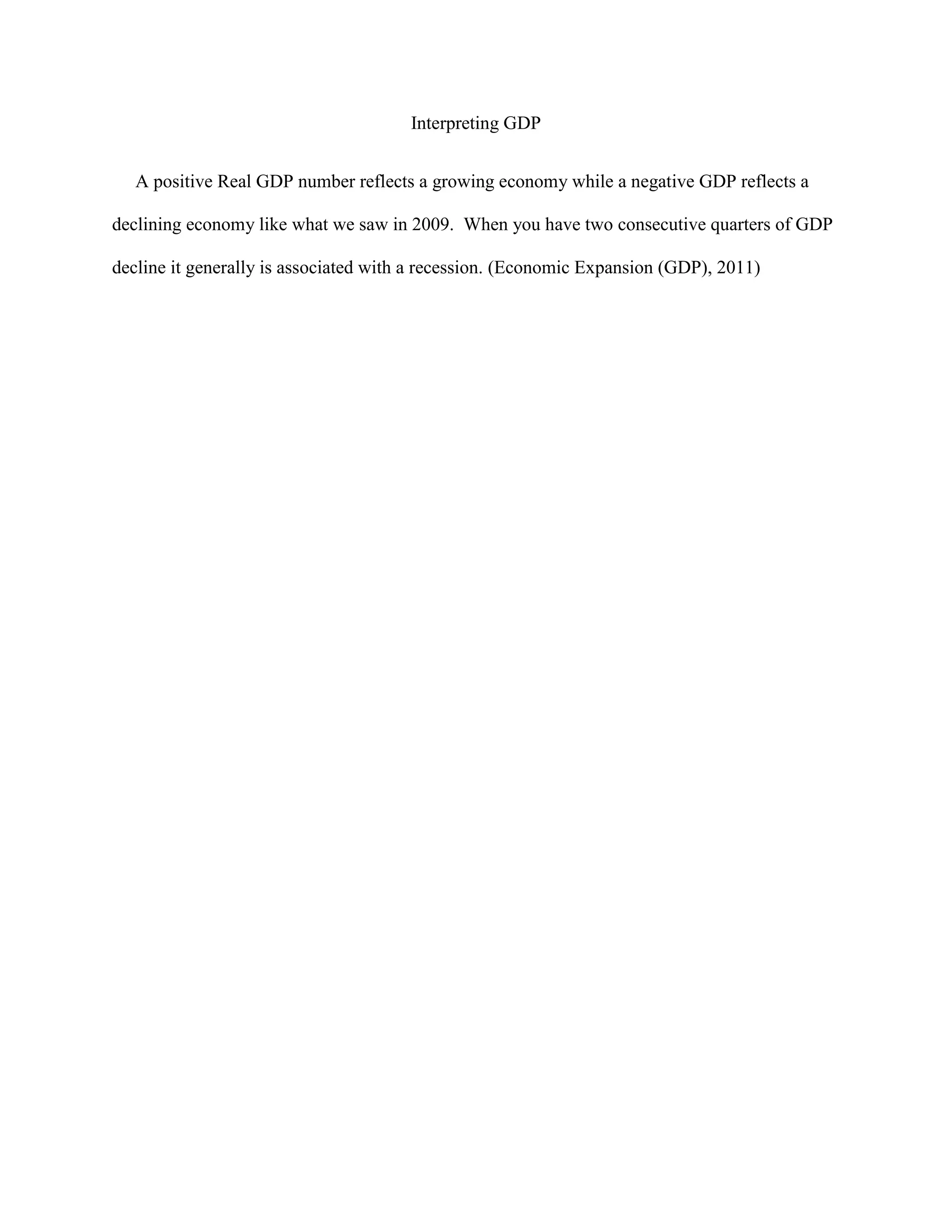
                                         Real GDP for the past ten years


         2000      2001      2002      2003     2004      2005      2006        2007   2008   2009    2010

Real     4.1%      1.1%      1.8%      2.5%     3.6%      3.1%      2.7%        1.95   0%     -2.6%   2.8%

GDP

Note: Reprinted from the United States Country Report by Global Finance, 2011


                                              How GDP is determined


   There are two ways in which the GDP can be calculated; the income approach which is

calculated by adding up total compensation to employees, gross profits for firms, and taxes less

any subsidies.


GDP = compensation of employees + gross profit for firms + taxes – subsidies


The expenditure method is the more common approach and is calculated by adding total

consumption, investment, government spending and net exports less imports.


GDP = personal consumption + government spending + investments + exports – imports
Interpreting GDP


   A positive Real GDP number reflects a growing economy while a negative GDP reflects a

declining economy like what we saw in 2009. When you have two consecutive quarters of GDP

decline it generally is associated with a recession. (Economic Expansion (GDP), 2011)
Reference


DATA ON GDP AND ECONOMIC INFORMATION. (2011). Retrieved from Global Finance:
      http://www.gfmag.com/gdp-data-country-reports/151-the-united-states-gdp-country-
      report.html#axzz1s9ytNMsh

Economic Expansion (GDP). (2011, December). Retrieved from Russell Investments:
      http://www.russell.com/helping-
      advisors/Markets/EconomicIndicatorsDashboard/EconomicExpansion-GDP.aspx

Federal Reserve cuts US GDP forecast; no hint of more support. (2011, June 23). Retrieved from The
        Economic Times: http://economictimes.indiatimes.com/news/international-business/federal-
        reserve-cuts-us-gdp-forecast-no-hint-of-more-support/articleshow/8956240.cms

National Income and Product Accounts Table. (2012, March 29). Retrieved from Bureau of Economic
       Analysis:
       http://www.bea.gov/National/Nipaweb/Tableview.Asp?Selectedtable=5&Viewseries=NO&Java=
       No&Request3Place=N&3Place=N&Fromview=YES&Freq=Year&Firstyear=1990&Lastyear=2010

What is GDP and why is it so important? (2007, September 19). Retrieved from Investopedia:
        http://www.investopedia.com/Ask/Answers/199.Asp#Axzz1aeuepbgk

Expected u

  • 1.
    Expected U.S. GDPGrowth Rate Victoria Rock AIU Online BUSN300-1202A-15
  • 2.
    Abstract Being a newlyappointed President for the local Chamber of Commerce, a presentation on the Expected U.S. GDP growth will be examined and explained.
  • 3.
    Introduction In this paperthe GDP growth rate of the U.S. will be examined through trends, forcasts, and statistics. Also how the GDP is determined and interpreted.
  • 4.
    Expected U.S. GDPGrowth Rate The value of the U.S. GDP has continued to increase in value and the year with the highest value recorded was in 2010 at $14,526.5 billion dollars. (National Income and Product Accounts Table, 2012). However, the rate of growth in GDP has varied. There are periods when the GDP increases at an increased rate while others have a negative growth. A graph of GDP against years 16,000.00 GDP (Billions of dollars) 14,000.00 12,000.00 10,000.00 8,000.00 6,000.00 4,000.00 2,000.00 0.00 1995 1996 1997 1998 1999 2000 2001 2002 2003 2004 2005 2006 2007 2008 2009 2010 Years Series1 As you can tell in the next chart in our analyses we reviewed the annual GDP growth from 1991 to 2010, and can see alternate cycles of increase and decrease with the highest growth rate recorded in 2000. The economy registered a boom between 1998 and 2000 which shows an increase of 6.39% in 2000. In 2001 GDP growth was recorded at 3.36%, 2002 at 3.46%, 2003 at 4.70%, and 2004 at 6.38%, with the highest growth occurring in 2005 at 6.49%. From 2005 to
  • 5.
    2009 the economyexperienced a recession and the GDP decreased at a diminishing rate. The Annual growth registered amounted to 5.97% in 2006, 4.87% in 2007, 1.87% in 2008, and the lowest in 2009 at -2.47%. Decline in GDP can be attributed to reduced personal consumption expenditures which is the main component contributing to the GDP. However in 2010 the economy started to improve and growth was recorded at 4.21%. (Economic Expansion (GDP), 2011) Annual GDP growth 8.00% 6.00% %age change in GDP 4.00% 2.00% 0.00% 1991 1992 1993 1994 1995 1996 1997 1998 1999 2000 2001 2002 2003 2004 2005 2006 2007 2008 2009 2010 -2.00% -4.00% Years The Economic Times stated that the Federal Reserve cut its forecasts for the US economic growth from 3.1 to 3.3 percent down to 2.7 to 2.9 percent and sees 2012 growth in a 3.3 to 3.7 percent range. The slowed growth was being attributed to increasing inflation due to factors pushing up the price of commodities. The slow pace is also attributed to higher prices of food and energy which will lead to a reduced consumer purchasing power. (Federal Reserve cuts US GDP forecast; no hint of more support, 2011) Global Finance has provided various statistics in relation to GDP which includes information that the GDP per capita in the US amounted to $48,666 based on 2010 figures. The service
  • 6.
    sector is themain contributor to the GDP accounting for 76.9%, manufacturing at 21.9%, and agriculture sector at 1.2% and is based on GDP values for 2009. (DATA ON GDP AND ECONOMIC INFORMATION, 2011) Real GDP for the past ten years 2000 2001 2002 2003 2004 2005 2006 2007 2008 2009 2010 Real 4.1% 1.1% 1.8% 2.5% 3.6% 3.1% 2.7% 1.95 0% -2.6% 2.8% GDP Note: Reprinted from the United States Country Report by Global Finance, 2011 How GDP is determined There are two ways in which the GDP can be calculated; the income approach which is calculated by adding up total compensation to employees, gross profits for firms, and taxes less any subsidies. GDP = compensation of employees + gross profit for firms + taxes – subsidies The expenditure method is the more common approach and is calculated by adding total consumption, investment, government spending and net exports less imports. GDP = personal consumption + government spending + investments + exports – imports
  • 7.
    Interpreting GDP A positive Real GDP number reflects a growing economy while a negative GDP reflects a declining economy like what we saw in 2009. When you have two consecutive quarters of GDP decline it generally is associated with a recession. (Economic Expansion (GDP), 2011)
  • 8.
    Reference DATA ON GDPAND ECONOMIC INFORMATION. (2011). Retrieved from Global Finance: http://www.gfmag.com/gdp-data-country-reports/151-the-united-states-gdp-country- report.html#axzz1s9ytNMsh Economic Expansion (GDP). (2011, December). Retrieved from Russell Investments: http://www.russell.com/helping- advisors/Markets/EconomicIndicatorsDashboard/EconomicExpansion-GDP.aspx Federal Reserve cuts US GDP forecast; no hint of more support. (2011, June 23). Retrieved from The Economic Times: http://economictimes.indiatimes.com/news/international-business/federal- reserve-cuts-us-gdp-forecast-no-hint-of-more-support/articleshow/8956240.cms National Income and Product Accounts Table. (2012, March 29). Retrieved from Bureau of Economic Analysis: http://www.bea.gov/National/Nipaweb/Tableview.Asp?Selectedtable=5&Viewseries=NO&Java= No&Request3Place=N&3Place=N&Fromview=YES&Freq=Year&Firstyear=1990&Lastyear=2010 What is GDP and why is it so important? (2007, September 19). Retrieved from Investopedia: http://www.investopedia.com/Ask/Answers/199.Asp#Axzz1aeuepbgk