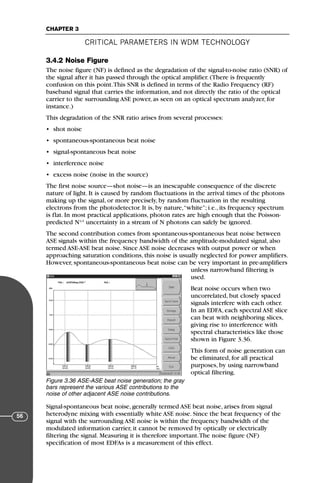
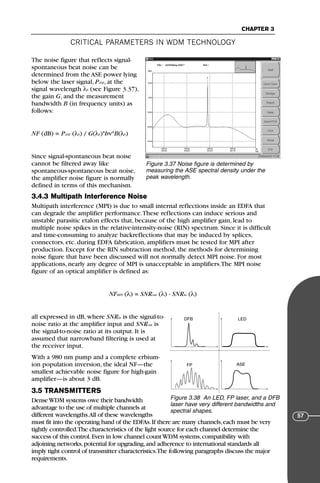
74988 Cover_cb 11/17/09 10:18 AM C
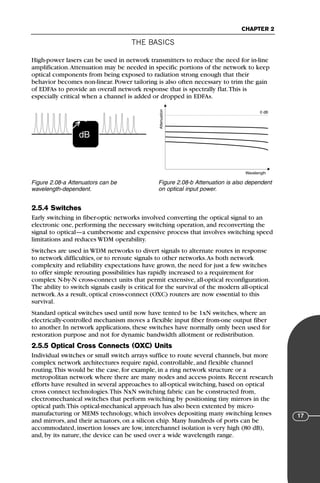
M
Y
K 1
71136 lim1-14_cb 10/30/08 9:29 AM K 1
IV
71136 lim1-14_cb 10/30/08 9:29 AM K 2
V
André Girard
Ghislain Lévesque Peter Clark
Gregory W. Schinn Olivier Plomteux
Don Galbraith Juan Pablo Perez
Michael Carlson Stéphane Chabot
Normand Cyr Stéphane Duquet
Daniel Gariepy Nicholas Gagnon
Stéphane Vigot André Fougères
Étienne Gagnon Alain Chandonnet
EXFO Electro-Optical Engineering Inc.
Quebec City, Canada
71136 lim1-14_cb 10/30/08 9:29 AM K 3
VI
Managing Editors: Ghislain Lévesque,Vance Oliver
Production Editors: Sovita Chander,André Hamel
Copy Editors: Karine Beaulé-Prince, Simon Evans, Daniel Gault,
Helen Kinsella
Design and Graphics: Caroline Brunet, Nathalie Coulombe,Annie Fournier,
Alain Roberge
Page Layout: Annie Fournier
© 2008, 2000, 1998 EXFO Electro-Optical Engineering Inc., Quebec City, Canada
3rd edition
2nd edition
1st edition entitled Introduction to WDM Testing
ALL RIGHTS RESERVED
No part of this book may be reproduced in any form or by any means without
permission in writing from EXFO.
Printed and bound in Canada
ISBN 1-55342-000-4
Legal Deposit- National Library of Canada 2000
Legal Deposit- National Library of Quebec 2000
71136 lim1-14_cb 10/30/08 9:29 AM K 4
VII
Acknowledgements
This book would not have been possible without the enthusiasm and teamwork of
the people who make up EXFO. In particular, the authors would like to thank
Sonia Bélanger, Guylaine Bureau, Nathalie Duquette, Guy Fournier, Maryse Imbeault,
Dominique Landry, Claudia Lavoie, Guillaume Légaré, Érick Pelletier, Élie Pérusse,
Jean-Pierre Simard, Pierre Talbot, and Elizabeth Tessier for putting their skills to
work for the Guide.
71136 lim1-14_cb 10/30/08 9:29 AM K 5
VIII
71136 lim1-14_cb 10/30/08 9:29 AM K 6
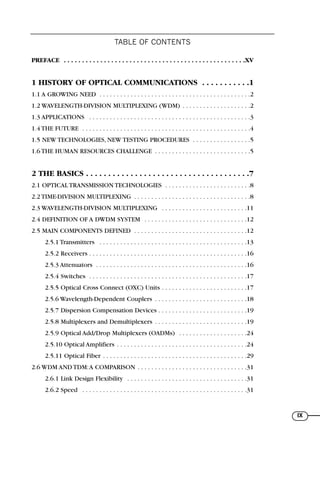
TABLE OF CONTENTS
IX
PREFACE . . . . . . . . . . . . . . . . . . . . . . . . . . . . . . . . . . . . . . . . . . . . . . . . . .XV
1 HISTORY OF OPTICAL COMMUNICATIONS . . . . . . . . . . .1
1.1 A GROWING NEED . . . . . . . . . . . . . . . . . . . . . . . . . . . . . . . . . . . . . . . . . . . .2
1.2 WAVELENGTH-DIVISION MULTIPLEXING (WDM) . . . . . . . . . . . . . . . . . . . .2
1.3 APPLICATIONS . . . . . . . . . . . . . . . . . . . . . . . . . . . . . . . . . . . . . . . . . . . . . . .3
1.4 THE FUTURE . . . . . . . . . . . . . . . . . . . . . . . . . . . . . . . . . . . . . . . . . . . . . . . . .4
1.5 NEW TECHNOLOGIES, NEW TESTING PROCEDURES . . . . . . . . . . . . . . . . .5
1.6 THE HUMAN RESOURCES CHALLENGE . . . . . . . . . . . . . . . . . . . . . . . . . . . .5
2 THE BASICS . . . . . . . . . . . . . . . . . . . . . . . . . . . . . . . . . . . . .7
2.1 OPTICAL TRANSMISSION TECHNOLOGIES . . . . . . . . . . . . . . . . . . . . . . . . .8
2.2 TIME-DIVISION MULTIPLEXING . . . . . . . . . . . . . . . . . . . . . . . . . . . . . . . . . .8
2.3 WAVELENGTH-DIVISION MULTIPLEXING . . . . . . . . . . . . . . . . . . . . . . . . .11
2.4 DEFINITION OF A DWDM SYSTEM . . . . . . . . . . . . . . . . . . . . . . . . . . . . . .12
2.5 MAIN COMPONENTS DEFINED . . . . . . . . . . . . . . . . . . . . . . . . . . . . . . . . .12
2.5.1 Transmitters . . . . . . . . . . . . . . . . . . . . . . . . . . . . . . . . . . . . . . . . . . .13
2.5.2 Receivers . . . . . . . . . . . . . . . . . . . . . . . . . . . . . . . . . . . . . . . . . . . . . .16
2.5.3 Attenuators . . . . . . . . . . . . . . . . . . . . . . . . . . . . . . . . . . . . . . . . . . . .16
2.5.4 Switches . . . . . . . . . . . . . . . . . . . . . . . . . . . . . . . . . . . . . . . . . . . . . .17
2.5.5 Optical Cross Connect (OXC) Units . . . . . . . . . . . . . . . . . . . . . . . . .17
2.5.6 Wavelength-Dependent Couplers . . . . . . . . . . . . . . . . . . . . . . . . . . .18
2.5.7 Dispersion Compensation Devices . . . . . . . . . . . . . . . . . . . . . . . . . .19
2.5.8 Multiplexers and Demultiplexers . . . . . . . . . . . . . . . . . . . . . . . . . . .19
2.5.9 Optical Add/Drop Multiplexers (OADMs) . . . . . . . . . . . . . . . . . . . .24
2.5.10 Optical Amplifiers . . . . . . . . . . . . . . . . . . . . . . . . . . . . . . . . . . . . . .24
2.5.11 Optical Fiber . . . . . . . . . . . . . . . . . . . . . . . . . . . . . . . . . . . . . . . . . .29
2.6 WDM AND TDM:A COMPARISON . . . . . . . . . . . . . . . . . . . . . . . . . . . . . . . .31
2.6.1 Link Design Flexibility . . . . . . . . . . . . . . . . . . . . . . . . . . . . . . . . . . .31
2.6.2 Speed . . . . . . . . . . . . . . . . . . . . . . . . . . . . . . . . . . . . . . . . . . . . . . . .31
71136 lim1-14_cb 10/30/08 9:29 AM K 7
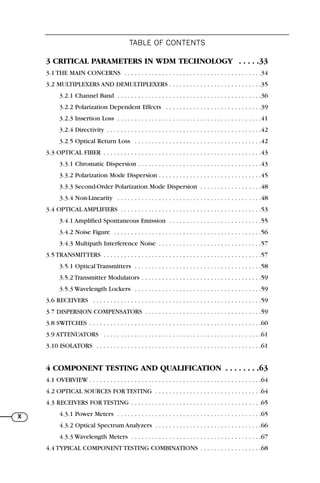
TABLE OF CONTENTS
X
3 CRITICAL PARAMETERS IN WDM TECHNOLOGY . . . . .33
3.1 THE MAIN CONCERNS . . . . . . . . . . . . . . . . . . . . . . . . . . . . . . . . . . . . . . . .34
3.2 MULTIPLEXERS AND DEMULTIPLEXERS . . . . . . . . . . . . . . . . . . . . . . . . . . .35
3.2.1 Channel Band . . . . . . . . . . . . . . . . . . . . . . . . . . . . . . . . . . . . . . . . . .36
3.2.2 Polarization Dependent Effects . . . . . . . . . . . . . . . . . . . . . . . . . . . .39
3.2.3 Insertion Loss . . . . . . . . . . . . . . . . . . . . . . . . . . . . . . . . . . . . . . . . . .41
3.2.4 Directivity . . . . . . . . . . . . . . . . . . . . . . . . . . . . . . . . . . . . . . . . . . . . .42
3.2.5 Optical Return Loss . . . . . . . . . . . . . . . . . . . . . . . . . . . . . . . . . . . . .42
3.3 OPTICAL FIBER . . . . . . . . . . . . . . . . . . . . . . . . . . . . . . . . . . . . . . . . . . . . . .43
3.3.1 Chromatic Dispersion . . . . . . . . . . . . . . . . . . . . . . . . . . . . . . . . . . . .43
3.3.2 Polarization Mode Dispersion . . . . . . . . . . . . . . . . . . . . . . . . . . . . . .45
3.3.3 Second-Order Polarization Mode Dispersion . . . . . . . . . . . . . . . . . .48
3.3.4 Non-Linearity . . . . . . . . . . . . . . . . . . . . . . . . . . . . . . . . . . . . . . . . . .48
3.4 OPTICAL AMPLIFIERS . . . . . . . . . . . . . . . . . . . . . . . . . . . . . . . . . . . . . . . . .53
3.4.1 Amplified Spontaneous Emission . . . . . . . . . . . . . . . . . . . . . . . . . . .55
3.4.2 Noise Figure . . . . . . . . . . . . . . . . . . . . . . . . . . . . . . . . . . . . . . . . . . .56
3.4.3 Multipath Interference Noise . . . . . . . . . . . . . . . . . . . . . . . . . . . . . .57
3.5 TRANSMITTERS . . . . . . . . . . . . . . . . . . . . . . . . . . . . . . . . . . . . . . . . . . . . . .57
3.5.1 Optical Transmitters . . . . . . . . . . . . . . . . . . . . . . . . . . . . . . . . . . . . .58
3.5.2 Transmitter Modulators . . . . . . . . . . . . . . . . . . . . . . . . . . . . . . . . . . .59
3.5.3 Wavelength Lockers . . . . . . . . . . . . . . . . . . . . . . . . . . . . . . . . . . . . .59
3.6 RECEIVERS . . . . . . . . . . . . . . . . . . . . . . . . . . . . . . . . . . . . . . . . . . . . . . . . .59
3.7 DISPERSION COMPENSATORS . . . . . . . . . . . . . . . . . . . . . . . . . . . . . . . . . .59
3.8 SWITCHES . . . . . . . . . . . . . . . . . . . . . . . . . . . . . . . . . . . . . . . . . . . . . . . . . .60
3.9 ATTENUATORS . . . . . . . . . . . . . . . . . . . . . . . . . . . . . . . . . . . . . . . . . . . . . .61
3.10 ISOLATORS . . . . . . . . . . . . . . . . . . . . . . . . . . . . . . . . . . . . . . . . . . . . . . . .61
4 COMPONENT TESTING AND QUALIFICATION . . . . . . . .63
4.1 OVERVIEW . . . . . . . . . . . . . . . . . . . . . . . . . . . . . . . . . . . . . . . . . . . . . . . . . .64
4.2 OPTICAL SOURCES FOR TESTING . . . . . . . . . . . . . . . . . . . . . . . . . . . . . . .64
4.3 RECEIVERS FOR TESTING . . . . . . . . . . . . . . . . . . . . . . . . . . . . . . . . . . . . . .65
4.3.1 Power Meters . . . . . . . . . . . . . . . . . . . . . . . . . . . . . . . . . . . . . . . . . .65
4.3.2 Optical Spectrum Analyzers . . . . . . . . . . . . . . . . . . . . . . . . . . . . . . .66
4.3.3 Wavelength Meters . . . . . . . . . . . . . . . . . . . . . . . . . . . . . . . . . . . . . .67
4.4 TYPICAL COMPONENT TESTING COMBINATIONS . . . . . . . . . . . . . . . . . .68
71136 lim1-14_cb 10/30/08 9:29 AM K 8
TABLE OF CONTENTS
XI
4.4.1 Multiplexers/Demultiplexers . . . . . . . . . . . . . . . . . . . . . . . . . . . . . .68
4.4.2 Switches . . . . . . . . . . . . . . . . . . . . . . . . . . . . . . . . . . . . . . . . . . . . . .74
4.4.3 Optical Sources . . . . . . . . . . . . . . . . . . . . . . . . . . . . . . . . . . . . . . . . .74
4.4.4 Receivers . . . . . . . . . . . . . . . . . . . . . . . . . . . . . . . . . . . . . . . . . . . . . .75
4.4.5 Optical Amplifiers . . . . . . . . . . . . . . . . . . . . . . . . . . . . . . . . . . . . . . .75
4.4.6 Bragg Gratings . . . . . . . . . . . . . . . . . . . . . . . . . . . . . . . . . . . . . . . . .83
4.4.7 Isolators . . . . . . . . . . . . . . . . . . . . . . . . . . . . . . . . . . . . . . . . . . . . . .83
4.4.8 Fiber . . . . . . . . . . . . . . . . . . . . . . . . . . . . . . . . . . . . . . . . . . . . . . . . .84
4.5 AUTOMATED TEST SYSTEM FOR COMPONENT TESTING . . . . . . . . . . . . .90
4.6 ENVIRONMENTAL QUALIFICATION . . . . . . . . . . . . . . . . . . . . . . . . . . . . . .91
4.7 FIELD TESTING . . . . . . . . . . . . . . . . . . . . . . . . . . . . . . . . . . . . . . . . . . . . . .92
4.7.1 Optical Loss Test Set . . . . . . . . . . . . . . . . . . . . . . . . . . . . . . . . . . . . .92
4.7.2 Optical Time Domain Reflectometer . . . . . . . . . . . . . . . . . . . . . . . .92
4.7.3 Backreflection Meter . . . . . . . . . . . . . . . . . . . . . . . . . . . . . . . . . . . .93
4.7.4 PMD Test Set . . . . . . . . . . . . . . . . . . . . . . . . . . . . . . . . . . . . . . . . . . .93
5 SYSTEM INSTALLATION AND MAINTENANCE . . . . . . . .95
5.1 CRITICAL SYSTEM PARAMETERS . . . . . . . . . . . . . . . . . . . . . . . . . . . . . . . .96
5.1.1 Bit Error Rate . . . . . . . . . . . . . . . . . . . . . . . . . . . . . . . . . . . . . . . . . .97
5.1.2 Loss Tests . . . . . . . . . . . . . . . . . . . . . . . . . . . . . . . . . . . . . . . . . . . . .98
5.1.3 Optical Return Loss . . . . . . . . . . . . . . . . . . . . . . . . . . . . . . . . . . . . .98
5.1.4 Optical Signal-to-Noise Ratio . . . . . . . . . . . . . . . . . . . . . . . . . . . . . .99
5.1.5 Gain . . . . . . . . . . . . . . . . . . . . . . . . . . . . . . . . . . . . . . . . . . . . . . . . .101
5.1.6 Central Wavelength . . . . . . . . . . . . . . . . . . . . . . . . . . . . . . . . . . . . .101
5.1.7 Drift . . . . . . . . . . . . . . . . . . . . . . . . . . . . . . . . . . . . . . . . . . . . . . . . .102
5.1.8 Crosstalk . . . . . . . . . . . . . . . . . . . . . . . . . . . . . . . . . . . . . . . . . . . . .102
5.1.9 Non-Linear Effects . . . . . . . . . . . . . . . . . . . . . . . . . . . . . . . . . . . . . .103
5.1.10 Polarization Mode Dispersion . . . . . . . . . . . . . . . . . . . . . . . . . . . .103
5.1.11 Chromatic Dispersion . . . . . . . . . . . . . . . . . . . . . . . . . . . . . . . . . .104
5.1.12 Other Phenomena . . . . . . . . . . . . . . . . . . . . . . . . . . . . . . . . . . . .105
5.2 INSTALLATION AND PRECOMMISSIONING . . . . . . . . . . . . . . . . . . . . . . .105
5.2.1 Network Compatibility . . . . . . . . . . . . . . . . . . . . . . . . . . . . . . . . . .106
5.2.2 Commissioning . . . . . . . . . . . . . . . . . . . . . . . . . . . . . . . . . . . . . . . .106
5.2.3 Maintenance and Monitoring . . . . . . . . . . . . . . . . . . . . . . . . . . . . .106
5.2.4 Inter-Vendor Operability . . . . . . . . . . . . . . . . . . . . . . . . . . . . . . . . .107
71136 lim1-14_cb 10/30/08 9:29 AM K 9
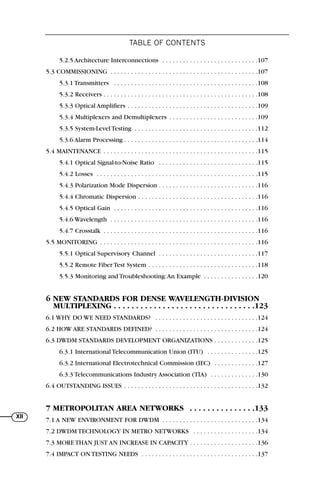
TABLE OF CONTENTS
XII
5.2.5 Architecture Interconnections . . . . . . . . . . . . . . . . . . . . . . . . . . . .107
5.3 COMMISSIONING . . . . . . . . . . . . . . . . . . . . . . . . . . . . . . . . . . . . . . . . . . .107
5.3.1 Transmitters . . . . . . . . . . . . . . . . . . . . . . . . . . . . . . . . . . . . . . . . . .108
5.3.2 Receivers . . . . . . . . . . . . . . . . . . . . . . . . . . . . . . . . . . . . . . . . . . . . .108
5.3.3 Optical Amplifiers . . . . . . . . . . . . . . . . . . . . . . . . . . . . . . . . . . . . . .109
5.3.4 Multiplexers and Demultiplexers . . . . . . . . . . . . . . . . . . . . . . . . . .109
5.3.5 System-Level Testing . . . . . . . . . . . . . . . . . . . . . . . . . . . . . . . . . . . .112
5.3.6 Alarm Processing . . . . . . . . . . . . . . . . . . . . . . . . . . . . . . . . . . . . . . .114
5.4 MAINTENANCE . . . . . . . . . . . . . . . . . . . . . . . . . . . . . . . . . . . . . . . . . . . . .115
5.4.1 Optical Signal-to-Noise Ratio . . . . . . . . . . . . . . . . . . . . . . . . . . . . .115
5.4.2 Losses . . . . . . . . . . . . . . . . . . . . . . . . . . . . . . . . . . . . . . . . . . . . . . .115
5.4.3 Polarization Mode Dispersion . . . . . . . . . . . . . . . . . . . . . . . . . . . . .116
5.4.4 Chromatic Dispersion . . . . . . . . . . . . . . . . . . . . . . . . . . . . . . . . . . .116
5.4.5 Optical Gain . . . . . . . . . . . . . . . . . . . . . . . . . . . . . . . . . . . . . . . . . .116
5.4.6 Wavelength . . . . . . . . . . . . . . . . . . . . . . . . . . . . . . . . . . . . . . . . . . .116
5.4.7 Crosstalk . . . . . . . . . . . . . . . . . . . . . . . . . . . . . . . . . . . . . . . . . . . . .116
5.5 MONITORING . . . . . . . . . . . . . . . . . . . . . . . . . . . . . . . . . . . . . . . . . . . . . .116
5.5.1 Optical Supervisory Channel . . . . . . . . . . . . . . . . . . . . . . . . . . . . .117
5.5.2 Remote Fiber Test System . . . . . . . . . . . . . . . . . . . . . . . . . . . . . . . .118
5.5.3 Monitoring and Troubleshooting:An Example . . . . . . . . . . . . . . . .120
6 NEW STANDARDS FOR DENSE WAVELENGTH-DIVISION
MULTIPLEXING . . . . . . . . . . . . . . . . . . . . . . . . . . . . . . . .123
6.1 WHY DO WE NEED STANDARDS? . . . . . . . . . . . . . . . . . . . . . . . . . . . . . .124
6.2 HOW ARE STANDARDS DEFINED? . . . . . . . . . . . . . . . . . . . . . . . . . . . . . .124
6.3 DWDM STANDARDS DEVELOPMENT ORGANIZATIONS . . . . . . . . . . . . .125
6.3.1 International Telecommunication Union (ITU) . . . . . . . . . . . . . . .125
6.3.2 International Electrotechnical Commission (IEC) . . . . . . . . . . . . .127
6.3.3 Telecommunications Industry Association (TIA) . . . . . . . . . . . . . .130
6.4 OUTSTANDING ISSUES . . . . . . . . . . . . . . . . . . . . . . . . . . . . . . . . . . . . . . .132
7 METROPOLITAN AREA NETWORKS . . . . . . . . . . . . . . .133
7.1 A NEW ENVIRONMENT FOR DWDM . . . . . . . . . . . . . . . . . . . . . . . . . . . .134
7.2 DWDM TECHNOLOGY IN METRO NETWORKS . . . . . . . . . . . . . . . . . . .134
7.3 MORE THAN JUST AN INCREASE IN CAPACITY . . . . . . . . . . . . . . . . . . . .136
7.4 IMPACT ON TESTING NEEDS . . . . . . . . . . . . . . . . . . . . . . . . . . . . . . . . . .137
71136 lim1-14_cb 10/30/08 9:29 AM K 10
TABLE OF CONTENTS
XIII
8 THE FUTURE . . . . . . . . . . . . . . . . . . . . . . . . . . . . . . . . . .139
8.1 WHAT IS NEXT? . . . . . . . . . . . . . . . . . . . . . . . . . . . . . . . . . . . . . . . . . . . . .140
8.2 FIBER . . . . . . . . . . . . . . . . . . . . . . . . . . . . . . . . . . . . . . . . . . . . . . . . . . . . .141
8.3 COMPONENTS . . . . . . . . . . . . . . . . . . . . . . . . . . . . . . . . . . . . . . . . . . . . .141
8.4 TRENDS . . . . . . . . . . . . . . . . . . . . . . . . . . . . . . . . . . . . . . . . . . . . . . . . . . .142
9 CASE STUDY: AN EXFO TEST SOLUTION . . . . . . . . . . .145
9.1 LINK QUALIFICATION . . . . . . . . . . . . . . . . . . . . . . . . . . . . . . . . . . . . . . .146
9.2 COMPONENT TESTING: MULTIPLEXER . . . . . . . . . . . . . . . . . . . . . . . . . .152
9.3 COMMISSIONING . . . . . . . . . . . . . . . . . . . . . . . . . . . . . . . . . . . . . . . . . . .158
9.4 MONITORING . . . . . . . . . . . . . . . . . . . . . . . . . . . . . . . . . . . . . . . . . . . . . .163
9.5 MAINTENANCE AND TROUBLESHOOTING . . . . . . . . . . . . . . . . . . . . . . .168
GLOSSARY . . . . . . . . . . . . . . . . . . . . . . . . . . . . . . . . . . . . .170
ACRONYM INDEX . . . . . . . . . . . . . . . . . . . . . . . . . . . . . . .185
FURTHER READING . . . . . . . . . . . . . . . . . . . . . . . . . . . . . .189
71136 lim1-14_cb 10/30/08 9:29 AM K 11
TABLE OF CONTENTS
XIV
71136 lim1-14_cb 10/30/08 9:29 AM K 12
PREFACE
XV
When a new technology comes along, the process of moving from theory and lab
experience to real-world deployment and practice takes time and hard work.The
people and companies that use new technology often need to go through a period of
learning and assessment to overcome both anticipated and unforeseen challenges.
WDM technology is no exception. Right now, the fiber-optic and telecommunications
industries are in the middle of that period of changing processes and reassessing
needs.And as WDM grows and becomes more widely implemented, more people and
companies than ever need access to practical, yet thorough, information about testing
WDM technology.
This is where EXFO's Guide to WDM Technology and Testing comes in.This book is
aimed at the engineers, technicians, and scientists throughout the telecommunications
industry who want to learn more about the practical aspects of WDM and DWDM
technology. In addition, system and component manufacturers, installers, service
providers, and private network operators will find useful information to inform
corporate decision-makers.Also, newcomers to the field, and people who know about
one aspect of WDM testing and would like to broaden their knowledge, are likely to
find what they need in this guide.
Chapter 1 begins with a basic overview of WDM technology: what it is, what it does,
and the challenges for the present and future. Chapters 2 through 5 cover the
requirements and the fundamentals of WDM testing, as follows:
• Chapter 2 introduces definitions and concepts to people who are new to the
field.
• Chapter 3 outlines critical WDM parameters according to component.
• Chapter 4 addresses the specific testing and qualification needs of component
and fiber manufacturers.
• Chapter 5 covers the installation, maintenance, and monitoring of WDM systems.
Chapter 6 talks about standards. It should be noted that standards for WDM
technology are still under development and, thus, subject to change. However,
advanced readers will be interested in the details about standards that this chapter
provides.
With WDM technology moving beyond long-haul links, it is important to outline the
next stage: metropolitan area networks (Chapter 7).The testing needs for this arena
can sometimes differ significantly from those of long-haul networks, so it was felt that
this topic deserved a chapter of its own.
With WDM technology continuing to evolve, Chapter 8 will interest readers who need
to keep an eye on the future: not just advances in technology, but also how testing
needs will change.And finally, Chapter 9 solidifies previous concepts for readers. Using
a case study of a telecommunications service provider deploying WDM on an existing
link, readers can see a real-life example of how testing works.
André Girard, Ph.D
Senior Member of Technical Staff
71136 lim1-14_cb 10/30/08 9:29 AM K 13
71136 lim1-14_cb 10/30/08 9:29 AM K 14
71136 001-194_cb 11/10/08 8:58 AM K 1
HISTORY OF OPTICAL COMMUNICATIONS
CHAPTER 1
2
1.1 A GROWING NEED
The past decade has witnessed a tremendous growth in the need for communications
capacity, both in terms of data rates and in geographic coverage. Rapid and reliable
video, voice, and data transmission is critical to the continued growth of many aspects
of modern life, in government, industry, and society at large.This need is widespread in
North America, Europe, and Asia, and to an ever-increasing extent in other parts of the
world.
In the late 1990s, a new phenomenon, the Internet, began to add significant traffic to
international networks.Although the Internet had been sitting in the wings for some
time, providing a then-novel communications service to the military and research
communities, its potential to absorb almost any available communications bandwidth
became evident when the World Wide Web offered a bottomless pit of information to
the general public. Even the most enthusiastic forecasters of bandwidth expansion
were caught off guard.
To an increasing extent, optical fiber has been the medium of choice to handle this
vast volume of traffic, and time-division multiplexing (TDM) has been the most
common way to divide the impressive capacity of a single optical fiber into useable
communications channels. Even this technology, however, has been limited by the
increasing complexity of modulation and multiplexing equipment as data rates soar.A
new complementary approach has demonstrated its capabilities: wavelength-division
multiplexing (WDM).
1.2 WAVELENGTH-DIVISION MULTIPLEXING (WDM)
WDM systems are based on the ability of an optical fiber to carry many different
wavelengths of light—colors, essentially—simultaneously without mutual interference.
Each wavelength represents an optical channel within the fiber. Several optical
methods are available to combine individual channels within a fiber and to extract
them at appropriate points along a network.WDM technology has evolved to the
point that channel wavelength separations can be very small—a fraction of a
nanometer or 10-9
m—giving rise to dense wavelength-division multiplexing (DWDM)
systems. Networks in which individual fibers carry more than 100 independent optical
channels are commercially available, as well as those in which bidirectional use is
made of the fiber.And this is just the beginning.
The success of DWDM is largely due to the development of the erbium-doped fiber
amplifier (EDFA), an optical device that uses energy from a laser pump to amplify all
the signal wavelengths presented to its input (within its narrow bandpass centered at
1550 nm). By amplifying optical signals directly—that is, without requiring that they
be converted into electrical signals and back again into optical signals—this device
allows the construction of long-haul transmission networks, with few if any electronic
components needed.
The TDM approach to increasing network capacity adds channels by subdividing those
that already exist, but at some cost in equipment and signal-protocol complexity.The
time slots of each channel must be carefully protected and identified, so that
individual channels can be recovered.The WDM approach, on the other hand, simply
transmits more signals along the fiber, with no timing or protocol implications.
Of course,TDM techniques are applied to individual WDM channels to provide greater
flexibility in the assignment of network bandwidth to particular users.
71136 001-194_cb 11/10/08 8:58 AM K 2
HISTORY OF OPTICAL COMMUNICATIONS
CHAPTER 1
3
From early components able to
handle from 4 to 16 channels, each
accommodating a 2.5 Gb/s
synchronous data
hierarchy/synchronous optical
network (SHD/SONET) signal,
DWDM suppliers soon developed
units to support dozens of
channels. Systems with hundreds of
channels are available now,
providing a combined data rate of
multi-Gb/s and approaching rates
of Tb/s all on a single fiber! Even in
applications not requiring such
rates today, the installation of a
system that can easily be expanded to
reach such a performance level
is extremely attractive.
The increases in network
transport capacity that have been
supported by advances in WDM
technology are summarized in
Figure 1.02.
1.3 APPLICATIONS
DWDM systems have been used
since 1996, primarily in long-haul
sectors where the need for
increased bandwidth is usually
first experienced.Adding channel
capacity this way, without any
need to replace existing fiber, is a
natural upgrade in the lifespan of a
network.As service providers are
called upon to supply more
bandwidth to individual
subscribers and to respond quickly to traffic patterns that are constantly changing, the
DWDM approach will see greater use at other network levels. Competitive local-
exchange carriers (CLECs) and several local carriers have already started deploying
DWDM systems to relieve congestion along high-traffic portions of their networks, in
particular to provide extra bandwidth in links joining central offices.
DWDM has not yet made a great impact on the incumbent local-exchange carrier
(ILEC) market, where laying new fiber is often the most economical way of increasing
bandwidth, although some use in point-to-point applications has been reported.
Products are now entering the market that specifically address the problems of
metropolitan area networks (MANs), products that provide ring and mesh architecture
protection at the optical layer. Products intended to serve the pure-data market—
primarily Internet traffic—are especially interesting because the reduced level of
protection that is needed for this form of data, compared to voice traffic, could
eliminate much of the equipment performing SONET functions. Direct optical
connections to end-users are also feasible, along with lease-a-wavelength marketing
strategies.
1E-3
1E-2
1E-1
1E+0
1E+1
1E+2
1E+3
1E+4
1E+6
1E+5
1982
1984
1986
1988
1990
1992
1994
1996
1998
2000
2002
2004
Network
Capacity
(Gb/s)
Developed Transport Capacity
Installed Transport Capacity
LAN
Internet
Years
Figure 1.01 The evolution of transport capacity
shows that the gap between development and
installation is smaller every year.
1
10
100
1000
10000
4 16 32 64 128
10
160
40 40
160
80
160
640 640
2560
320 320
1280
1280
5120
OC-48 (2.5 Gb/s)
OC-192 (10 Gb/s)
OC-768 (40 Gb/s)
BANDWIDTH
(Gb/S)
(CHANNELS)
Figure 1.02 Bandwidth capacity increases rapidly with
the multiplication of channels.
71136 001-194_cb 11/10/08 8:58 AM K 3
HISTORY OF OPTICAL COMMUNICATIONS
CHAPTER 1
4
The use of DWDM for data transmission over fiber links, using Internet Protocol (IP), is
another proven application of this technology. Potential reductions of data
transmission costs are estimated at 100% for end users (Internet gratuity).
DWDM technology developments give credence to the feasibility and practicality of
all-optical networks with no electronic signal regeneration at any point.Although
much work remains to be done to ensure that such networks can provide SONET-like
reliability, components are already available to split, combine, and multiplex optical
signals carried by optical fiber. Fixed-wavelength, optical add/drop multiplexers
(OADMs) have reached the market, and dynamically reconfigurable units are expected
in the near future. Optical cross connect (OXC) units that serve as network hubs are
also in development.A similar technology should eventually yield units to switch and
convert individual wavelength channels in a fiber.
1.4 THE FUTURE
There is little doubt that demand for network bandwidth, which is now growing
roughly 100% per year, will continue to be strong for at least the next decade.This
demand will also spread over increasingly wide geographic areas. Price-cutting by
suppliers, government deregulation, and—perhaps, above all—the unabated popularity
of Internet use and of other high bandwidth-intensive applications in the
entertainment area will bolster this growth. DWDM now provides the quickest proven
way of increasing bandwidth in a cost-effective manner. In many cases, it allows
increases in existing fiber capacity by a factor approaching 100.
Although at some point DWDM techniques will reach their limit, such a day still seems
very distant.The transmission of several hundred channels along a single fiber has
been demonstrated. Further increases can be expected by reducing channel spacing,
by using wider spectral-range EDFAs such as in the L-band (up to 1610 nm), or by
using the full available spectrum of the improved fibers down to 1200 nm without
amplification.
Even more dramatic increases are on the horizon through the use of data rates greater
than the 2.5 Gb/s and 10 Gb/s per channel that are found in today’s advanced
systems. Prototype systems at 40 Gb/s have already been demonstrated, and the
combination of 160 channels, each at 40 Gb/s—which corresponds to an aggregate
rate of over five terabits per second or nearly 1000 full CD-ROMs per second along a
single fiber—is a foreseen reality.The demand for the transmission of motion pictures
in real-time on the Internet could certainly stimulate such an increase in bandwidth.
DWDM, once considered merely a way to squeeze a little more capacity from existing
point-to-point cable, now promises to offer the flexibility in routing and the overall bit-
rate capacity to answer the challenge of future networks.Technology is even providing
the means to generate, combine, route, convert, and separate individual information
channels easily through purely optical means without conversion.As a result, high-
speed, low-cost optical communication services will soon be widely available.
1983 1993 1995 1997
OADM
OXC
TDM
1999 2005?
2000 2002
Figure 1.03 Communication evolution will allow fiber-to-the-desk in a near future.
71136 001-194_cb 11/10/08 8:58 AM K 4
HISTORY OF OPTICAL COMMUNICATIONS
CHAPTER 1
5
1.5 NEW TECHNOLOGY, NEW TESTING PROCEDURES
Network service providers and their clients can be comforted by the apparent ability
of equipment suppliers to meet any increase in communications needs. However,
there is a significant cost in adopting the new technology.Verifying system
performance and maintaining it will necessarily be far more complex than the
corresponding operations were on first-generation fiber-optic networks or, indeed,
than they are with present-day networks. In the past, a fiber carrying a single channel
could be verified by observing signals with an oscilloscope at the protocol level and
the parameter with an optical test instrument such as an optical time domain
reflectometer (OTDR) at the physical level. Checking TDM networks requires an
enhanced level of test equipment and expertise. DWDM systems, however, present a
whole new dimension: all the parameters relevant to transmission efficiency and
accuracy must be measured at each channel wavelength.This is not a trivial task,
especially when wavelengths are very closely spaced.
Verification and multi-level testing is needed at all levels in a DWDM network:
components, sub-systems, optical media, and for the entire system.Test
instrumentation must match the complexity of the equipment to be verified, the
nature of the communications system, the specific task undertaken and—most
important—the experience, skill, and expectations of its operator.
1.6 THE HUMAN RESOURCES CHALLENGE
Above and beyond the outbreak of bandwidth capacity, technological progress, new
applications, and new avenues for optical data transmission, remains a more complex
problem: lack of human resources.The telecommunication industry is growing so fast
that universities and technical institutions cannot deliver sufficient specialized
personnel. Furthermore, experience is rare and an advanced technical education is
watered down to enable the flow of more students.You just have to visit various
company Web sites to discover that there is abundance of job openings in the field of
fiber optics.
Optical systems are growing in size, not only physically but also geographically.This
expansion has created a major demand for specialized personnel to deploy these
systems along cities, countries, and oceans.All the components required to build
optical systems have to be developed and manufactured by a team of engineers and
technicians. Research departments are also looking for high-level scientists, while
distributors and vendors are searching for qualified sales people.We have witnessed
numerous startups begin operations in the last few years and it is most likely to
continue in subsequent years.Wherever you are positioned in the telecommunications
industry, human resources are definitely a major concern for years to come and should
be seriously taken into account.
71136 001-194_cb 11/10/08 8:58 AM K 5
HISTORY OF OPTICAL COMMUNICATIONS
CHAPTER 1
6
71136 001-194_cb 11/10/08 8:58 AM K 6
71136 001-194_cb 11/10/08 8:58 AM K 7
THE BASICS
CHAPTER 2
8
2.1 OPTICAL TRANSMISSION TECHNOLOGIES
WDM is not a game that you learn to play over night. Fiber-optic data transmission in
general, and WDM techniques in particular, involve a complex mix of many diverse
and sometimes rather esoteric phenomena, practical limitations, and economic
constraints. Throughout this section, which covers optical transmission technologies,
you will discover or rediscover the basis of traditional TDM systems and their
evolution. New WDM systems and their components will be discussed in greater detail
to clearly demonstrate their utility within a system.The differences between TDM and
WDM will complete the section and lead to more complex definitions of the critical
parameters in WDM technology.
2.2 TIME-DIVISION MULTIPLEXING
The need to narrow the gap between the inherent information-carrying capacity of an
optical channel and the use that can be made of that capacity in everyday applications
has spawned extensive research. Solutions are needed for both existing fiber lines and
for the provision of new services.The first approach taken is analogous to the one
used in conventional electronic communications systems. It combines a number of
channels onto a single carrier with time-division multiplexing (TDM).
In TDM, the optical signal in a fiber is shared among a number of information channels
by time slicing. For a brief period, or time slot, the signal is modulated with the first
information channel; for the next time slot, the signal is modulated with the second
information channel, and so on.
See Figure 2.01.
The duration of a time slot depends upon a number of different engineering design
factors and, in particular, upon the transmission speed needed for each link. Each
communication path is assigned a specific time slot, a TDM channel, during which it is
allowed to send data from the source to the user. No other source is permitted to
transmit at the same time.The multiplexer at the source end takes in data from the
sources connected to it, and inserts packets of data from each into the fiber during the
appropriate TDM time slot.The demultiplexer at the other end must recognize the
time slots, unload the data from each, and send it as a continuous stream to the
corresponding user.
The use of TDM techniques has increased the useful capacity of a single optical fiber
channel to more than 10 Gb/s, using technology and design methods that are familiar
to telecommunications system designers; systems at this rate are gradually replacing
early 2.5 Gb/s TDM implementations.The 10 Gb/s rate represents a turning point of
sorts. Below this speed, the governing characteristics of optical fiber have a reasonably
small impact on transmission quality; above it, their effects must be carefully taken
into account.Although TDM systems operating at up to 40 Gb/s may soon be widely
available, and research is underway into 100 Gb/s transmitters, further increases will
Figure 2.01 In TDM systems, channels are divided into time-slots propagating at the same
wavelength on the same fiber.
1 2 3 4 1 2 3 4
1
3
2
4
Time-division
demultiplexer
4X1
Time-division
demultiplexer
1X4
Time frame
1
3
2
4
71136 001-194_cb 11/10/08 8:58 AM K 8
THE BASICS
CHAPTER 2
9
not be easy; existing electronic
techniques become prohibitively
complex and expensive at high
rates. New laser-modulation
methodswill be needed and effects
that can be neglected at low bit
rates will begin to degrade signal
transmission at high rates.
Physical phenomena that can
safely be ignored at lower data
rates in short-distance systems
become limiting factors as data rates and transmission distances increase. Chromatic
dispersion—arising from the variation of the effective index of refraction of the
optical fiber with wavelength—is one such parameter. Its effect on signal quality—it
spreads optical pulses—is 16 times greater at the current 10 Gb/s (OC-192) data rate
than it is at the 2.5 Gb/s OC-48 rate. Even though measures are available to control
chromatic dispersion, these measures lead to increased system loss, cost, and
complexity. For standard, step-index singlemode fiber (i.e., non-dispersion-shifted fiber
often referred to as G.652 fiber), 10 Gb/s transmission is limited to distances of 50 to
75 km without any compensation or correction.
An early compensation measure consisted of using narrowband, source-laser pulses
centered near the wavelength at which the fiber dispersion is zero. Operation at
exactly the zero-dispersion wavelength should be avoided due to four-wave mixing,
which will be discussed in Chapter 3. Unfortunately, directly modulated lasers exhibit
a slewing of their carrier wavelength as they are modulated, a phenomenon known as
“chirp” that leads to an effective spectral spreading of the generated pulses. Chirp can
be subtantially reduced by using externally modulated transmitting lasers, an approach
that is used in almost all high-speed systems.
As TDM transmission rates are pushed higher and higher, the design and
implementation of their electronic elements becomes dramatically more difficult and
expensive, especially since the rates needed exceed those used in other areas such as
the computer industry. As a result, the full cost of developing new components must
be borne by the optical telecommunications industry.Timing requirements are
extremely tight and highly advanced electronic components are needed to modulate
lasers and to multiplex and demultiplex electronic signals at these very high
frequencies.
A powerful technology known as forward error correction (FEC) can add up to
several dBs of system margin. Long used in satellite and wireless communications, FEC
adds extra check bits to the data payload, enabling occasional errors in the digital
signal (1s and 0s) to be corrected without retransmission. FEC is a process of
detection and correction of bit error carried out at the software or hardware level,
hardware correction being necessary in the case of very high-speed data transmission.
Obviously, this error correction technique cannot resolve every major error, and other
optical phenomena can cause transmission problems that it will not be able to rectify.
Another optical phenomenon, polarization mode dispersion (PMD), also affects signal
quality at these rates by spreading the signal over time. PMD, which describes how
various polarization states of the signal propagate at different velocities along the
fiber, is especially difficult to handle because it is a stochastic phenomenon: there are
no known practical ways of eliminating its effects entirely. PMD compensation has
been demonstrated in the laboratory for small PMD values, but scientists still have a
sizeable challenge on their hands before they can transfer this design to the field.
Table 2.01 Transmission data rates standardized
Optical Synchronous transport Line rate
carrier (OC-x) module (STM-x) (Gb/s)
OC-3 STM-1 0.15552 (0.156)
OC-12 STM-4 0.62208 (0.625)
OC-48 STM-16 2.48832 (2.5)
OC-192 STM-64 9.9533 (10)
OC-768 STM-256 39.813 (40)
71136 001-194_cb 11/10/08 8:58 AM K 9
THE BASICS
CHAPTER 2
10
Despite these difficulties, higher data rates are coming on the scene.The new 40 Gb/s
(OC-768/STM-256) rate was recently achieved and, even though commercial
implementations are unlikely before late 2001, major players in the industry have
announced successful transmission along links of more than 100 km, with hopes to
raise the limit to much farther distances. So far, trials have not included full SONET
support and these trials lack some of the features that will be needed for reliable
network operation. Results, however, are encouraging, and suggest that upgrading
10 Gb/s links will be possible much sooner than was originally thought possible.
Making appropriate and economic use of the full bandwidth that OC-768/STM-256
offers will be a challenge to network designers and operators, but help is on the way
in the form of an array of products to inject lower-rate tributaries (OC-48/STM-16 and
OC-192/STM-64) into high-capacity networks.The distance limitations expected of
early implementations will probably restrict their use to metropolitan areas, but wider
applications can be expected as distance limitations are eliminated and other limiting
optical phenomena are handled.
Regeneration can also be an
issue where the financial budget
allows it.
Recent papers describe
transmission at high bit rates
(10 Gb/s and higher) along
very long distances.This
technology takes advantage of
dispersion-managed solitons,
which use counter-balancing,
non-linear, and dispersion effects,
and return-to-zero (RZ)
transmission code to avoid
degradation of the pulses at the
receiver.
A soliton is a special kind of light pulse that maintains its shape (typically Gaussian) as
it travels over arbitrarily long distances, provided that the pulse is amplified at regular
spacing.The shape or waveform of a soliton allows for compensation of the dispersion
affecting traditional pulse waveforms; this compensation is based on the fact that the
fiber index of refraction has a non-linear term that is dependent upon the pulse peak
power.The soliton uses non-linear and chromatic dispersion effects to conserve its
shape.Another important property of solitons is that they have stable propagation
characteristics and are very robust to perturbations in the transmission path. Even if
this new propagation technique is limited by fiber attenuation, it may be of great help
for amplified, long-haul applications.
Whether TDM technology turns to a universal and independent protocol like IP or
adopts a largely used protocol like SONET or STM, it will remain exploited and
deployed by a significant number of operators for years to come.Advances in soliton
research have provided a second wind to a technology that we considered at its limits.
Therefore, whatever problems occur and whatever the solutions employed in TDM, no
other technology will ever replace it. In a best-case scenario, another technology will
be used side-by-side to increase efficiency:WDM.
Non-Return to zero coding
Return to zero (50% cycle) coding
1—
0—
1—
0—
Figure 2.02 Return-to-zero transmission code
71136 001-194_cb 11/10/08 8:58 AM K 10
THE BASICS
CHAPTER 2
11
2.3 WAVELENGTH-DIVISION MULTIPLEXING
WDM avoids many of the constraints and implementation difficulties that limit the
performance of TDM systems. Rather than increasing the data rate to handle more
information like a TDM system, a WDM system simply carries several optical signals,
each at its own wavelength and each respecting the data-rate limitations applicable to
the transmission system.
This technique can increase the capacity of existing networks without the need for
expensive re-cabling and, thus, can significantly reduce the cost of upgrading a
network. It also opens up a new era of marketing flexibility: the transport
infrastructure can provide not only cable and fiber for rent, but also individual
wavelengths. One wavelength could be used for cable TV, another for telephony,
another for Internet traffic, another for video-on-demand, four others reserved to a
specific customer, eight others rented to five different customer, and so on.
WDM technology will not directly affect fiber and cable installation. In fact, more fiber
than ever is being deployed in North America, Europe,Asia, and the rest of the world.
Even though fiber is being deployed throughout the world, we still have to remember
that material costs for non-zero dispersion-shifted fiber (NZDSF) at about $150 per
kilometer, a 100-fiber cable—with installation costs that often exceed the material
costs—can easily run to $100,000 per km. Even if new materials and manufacturing
techniques reduce this figure in the future, significant sums will remain tied in fixed
transmission facilities.The key to their profitable use is, and will always be, flexibility,
that is, the ability to increase bandwidth and reconfigure network services over a long
life cycle without recabling or redesigning the existing plant.This is where WDM will
come to the rescue of bandwidth needs by allowing a better management of installed
and soon-to-be-installed fiber.
WDM technologies are particularly valuable in long-haul applications where greater
bandwidth is needed, but wide area networks (WANs), such as cable television
systems, potentially represent a large market by offering an economical way of making
better use of the expensive base of installed cable.These and other applications have
led to dramatic increases in the number of wavelengths carried on a single cable and
the resulting narrow channel spacing that characterizes a new class within the WDM
domain: DWDM.Although the term wavelength division may imply transmission using
any one of a limitless set of possible wavelengths, very practical limitations on
available communications equipment presently limit DWDM use to a relatively narrow
spectral band centered around 1550 nm. Even within these limitations, the possibilities
are enormous.
The many advantages of DWDM systems come at a price. First, optical component
properties and cable characteristics, which could safely be neglected in systems using
simpler transmission techniques, must be addressed. Furthermore, the new spectral
dimension that is inherent to these systems implies new criteria for network design
and for the selection of components, thus leading to different, often much tighter,
specifications than those applicable to current OC–48/STM-16 TDM systems.
TDM practices and specifications cannot be forgotten.A proper mix of TDM and WDM
technologies is still appropriate for new and improved services through cost-effective,
non-intrusive additions and upgrades to installed equipment.
WDM offers many advantages at all network levels—from network planning through
operation to eventual upgrading—and expanded business opportunities. Its
technology is leading-edge, since it places new demands on the understanding needed
to plan networks and services and on the skills and equipment needed to monitor and
maintain them.
71136 001-194_cb 11/10/08 8:58 AM K 11
THE BASICS
CHAPTER 2
12
2.4 DEFINITION OF A DWDM SYSTEM
A DWDM system is much like a
traditional TDM system. It has
transmitters at one end, receivers
at the other end, and fiber and
repeaters in between, as shown in
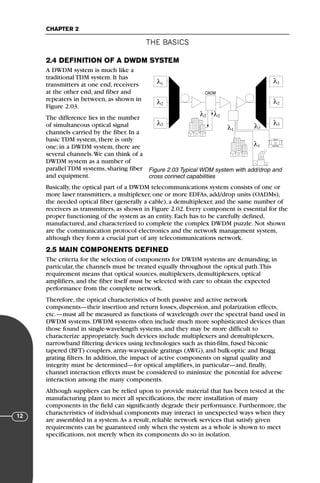
Figure 2.03.
The difference lies in the number
of simultaneous optical signal
channels carried by the fiber. In a
basic TDM system, there is only
one; in a DWDM system, there are
several channels.We can think of a
DWDM system as a number of
parallel TDM systems, sharing fiber
and equipment.
Basically, the optical part of a DWDM telecommunications system consists of one or
more laser transmitters, a multiplexer, one or more EDFAs, add/drop units (OADMs),
the needed optical fiber (generally a cable), a demultiplexer, and the same number of
receivers as transmitters, as shown in Figure 2.02. Every component is essential for the
proper functioning of the system as an entity. Each has to be carefully defined,
manufactured, and characterized to complete the complex DWDM puzzle. Not shown
are the communication protocol electronics and the network management system,
although they form a crucial part of any telecommunications network.
2.5 MAIN COMPONENTS DEFINED
The criteria for the selection of components for DWDM systems are demanding; in
particular, the channels must be treated equally throughout the optical path.This
requirement means that optical sources, multiplexers, demultiplexers, optical
amplifiers, and the fiber itself must be selected with care to obtain the expected
performance from the complete network.
Therefore, the optical characteristics of both passive and active network
components—their insertion and return losses, dispersion, and polarization effects,
etc.—must all be measured as functions of wavelength over the spectral band used in
DWDM systems. DWDM systems often include much more sophisticated devices than
those found in single-wavelength systems, and they may be more difficult to
characterize appropriately. Such devices include multiplexers and demultiplexers,
narrowband filtering devices using technologies such as thin-film, fused biconic
tapered (BFT) couplers, array-waveguide gratings (AWG), and bulk-optic and Bragg
grating filters. In addition, the impact of active components on signal quality and
integrity must be determined—for optical amplifiers, in particular—and, finally,
channel interaction effects must be considered to minimize the potential for adverse
interaction among the many components.
Although suppliers can be relied upon to provide material that has been tested at the
manufacturing plant to meet all specifications, the mere installation of many
components in the field can significantly degrade their performance. Furthermore, the
characteristics of individual components may interact in unexpected ways when they
are assembled in a system.As a result, reliable network services that satisfy given
requirements can be guaranteed only when the system as a whole is shown to meet
specifications, not merely when its components do so in isolation.
OADM
λ
λ
λ
1
2
λ2 λ2
3
λ
λ
λ
1
λ1
λ1
2
3
λ3
BANK
Figure 2.03 Typical WDM system with add/drop and
cross connect capabilities
71136 001-194_cb 11/10/08 8:58 AM K 12
THE BASICS
CHAPTER 2
13
Testing components in isolation, however, can present many challenges.Wavelength
spacing in WDM and, especially, in DWDM systems is very small, so tolerances in many
components (multiplexers, for example) must be correspondingly tight.Yet, the whole
point of DWDM systems is to support many optical channels, that is, many
wavelengths, so the characteristics of several devices are critical over broad spectral
bands as well.
2.5.1 Transmitters
Hybrid modules containing integrated circuits and laser diodes, modulated by separate
integrated circuitry, have now largely replaced early fiber-optic transmitters made up
of discrete electrical and electro-optical devices.Very large scale integrated (VLSI)
circuit implementations have come along to meet the need for ever-higher modulation
rates and to improve reliability. Present-day transmitters, although usually hybrid in
construction, can safely be treated as “black box” modules at the system design level.
They are electro-optical transducers: sources of signal light whose intensity can be
modulated by digital electrical input signals, either internally (laser current) for low
bit-rate transmissions or externally (laser optical beam) for fast rates.
A transmitter for a single channel (wavelength) is typically made up of a distributed
feedback (DFB) laser (at least 0 dBm or 1mW) followed by a modulator, which is
usually external to the laser especially when modulation rates are high. Recent
developments in integrated optics have led to attractive and cost-effective transmitter
designs in which the laser chip, modulator, and a subsequent solid-state optical
amplifier, are combined in a package.Transmitter packages are now available that
incorporate multi-lasers, multiplexers, and a booster amplifier, which is usually a
semiconductor optical amplifier.
A variable attenuator covering the band of the modulator is sometimes mounted next
to a laser to tailor its power to a specific value.This value is chosen to suit the
characteristics of the first repeater down the transmission line, or when used with
other wavelength transmitters to make sure that all transmitters combine to produce
an equally flat spectral power distribution.
The aforementioned DFB laser is presently the source of choice for DWDM systems. In
this device, the usual two-mirror Fabry-Perot laser cavity is reduced and controlled,
and selecting the exact lasing wavelength through optical feedback is accomplished
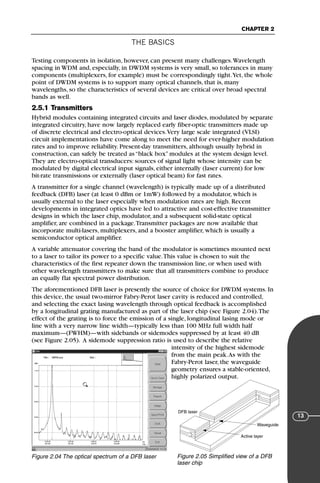
by a longitudinal grating manufactured as part of the laser chip (see Figure 2.04).The
effect of the grating is to force the emission of a single, longitudinal lasing mode or
line with a very narrow line width—typically less than 100 MHz full width half
maximum—(FWHM)—with sidebands or sidemodes suppressed by at least 40 dB
(see Figure 2.05). A sidemode suppression ratio is used to describe the relative
intensity of the highest sidemode
from the main peak.As with the
Fabry-Perot laser, the waveguide
geometry ensures a stable-oriented,
highly polarized output.
Figure 2.04 The optical spectrum of a DFB laser Figure 2.05 Simplified view of a DFB
laser chip
Waveguide
Active layer
DFB laser
71136 001-194_cb 11/10/08 8:58 AM K 13
THE BASICS
CHAPTER 2
14
In addition to the high-speedelectrical connections, a DFB package can include a
thermoelectric cooler, temperature sensor, optical isolator, and monitoring photo
diode. Output efficiency is quite acceptable: an output power of 0 dBm is produced
with a drive current of about 40 mA.
Laser modulation is a matter of some concern because the method used in low bit-rate
systems—modulating the laser drive current—introduces too much chirp for long-haul
transmission at the high rates typical of advanced WDM systems.The option is to
modulate the laser light externally (within or outside the source module), but this
adds cost, circuit complexity, and optical loss, and can lead to state of polarization
(SOP) management issues.
External modulators are generally based on switching technologies such as Mach-
Zehnder interferometers or electro-absorption devices. Modulators based on
integrated optics often use lithium niobate (LiNbO3) or indium phosphide (InP) to
achieve fast switching due to their high refractive index.Although the high cost of
integrated optics has limited their initial market penetration, improvements in
manufacturing processes and economies of scale now appear to have changed this
situation. Modulation up to 10 Gb/s (OC-192 or STM-64 rates) has been the highest
commercially-available rate to date, but 40 Gb/s transmission is now also available and
research is being performed on 80 Gb/s and >100 Gb/s.
With the use of an EDFA or a semiconductor optical amplifier (SOA) after the
modulator,WDM laser transmitters have demonstrated transmit powers of more than
+16 dBm, just under the +17 dBm limit to meet the IEC 60825 Class IIIb laser safety
designation. Laser safety requirements, appropriate for even higher power
transmitters, have been proposed, in particular a new Class 1M for +20 dBm and
higher.
As mentioned DFB lasers have recently become available.These lasers incorporate
external modulators on the chip, offering an integrated package for low-chirp, high bit
rate modulation, with all the other parameters—excluding, perhaps, cost—well under
control.
DFB lasers exhibit several shortcomings. For example, their very narrow spectral line
width (or high coherence length) makes them susceptible to coherent interference
from backreflection in the link they feed.Any accidental etalon-like section of the
link—any pair of parallel, partially reflecting surfaces—whose spacing falls within this
coherence length can produce strong reflections that can affect the stability of the
output signal. Since the exact length of such parasitic etalons will vary with
temperature, and because the critical length range to be avoided will vary with
specific laser operating conditions within its stability range, the potential for this
undesirable feedback in a particular configuration may be difficult to determine.
Transmitter Wavelengths
The provision of interchangeable components for WDM use and the need for
interconnections among networks both lead to a requirement for the definition of a
set of standard frequencies to be used in such systems. Study Group 15 on Transport
Networks, Systems and Equipment in the ITU Telecommunication Standardization
Sector is the international standards body responsible for defining this set (the set is
defined in the G.692 Recommendation on Optical Interfaces for Multichannel Systems
with Optical Amplifiers).
71136 001-194_cb 11/10/08 8:58 AM K 14
THE BASICS
CHAPTER 2
15
The ITU grid is a set of standardized frequencies based on a reference frequency at
193100 GHz.Available standard frequencies are defined both up and down from this
reference, evenly spaced by 100 GHz and, more recently, at 50 GHz.A frequency list
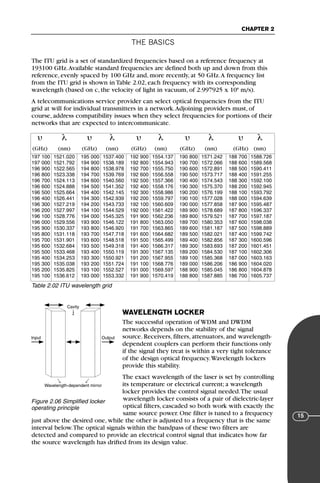
from the ITU grid is shown in Table 2.02, each frequency with its corresponding
wavelength (based on c, the velocity of light in vacuum, of 2.997925 x 10⁸
m/s).
A telecommunications service provider can select optical frequencies from the ITU
grid at will for individual transmitters in a network.Adjoining providers must, of
course, address compatibility issues when they select frequencies for portions of their
networks that are expected to intercommunicate.
WAVELENGTH LOCKER
The successful operation of WDM and DWDM
networks depends on the stability of the signal
source. Receivers, filters, attenuators, and wavelength-
dependent couplers can perform their functions only
if the signal they treat is within a very tight tolerance
of the design optical frequency.Wavelength lockers
provide this stability.
The exact wavelength of the laser is set by controlling
its temperature or electrical current; a wavelength
locker provides the control signal needed.The usual
wavelength locker consists of a pair of dielectric-layer
optical filters, cascaded so both work with exactly the
same source power. One filter is tuned to a frequency
just above the desired one, while the other is adjusted to a frequency that is the same
interval below.The optical signals within the bandpass of these two filters are
detected and compared to provide an electrical control signal that indicates how far
the source wavelength has drifted from its design value.
Input
Cavity
Output
→ν
Wavelength-dependent mirror
Figure 2.06 Simplified locker
operating principle
197 100 1521.020
197 000 1521.792
196 900 1522.565
196 800 1523.338
196 700 1524.113
196 600 1524.888
196 500 1525.664
196 400 1526.441
196 300 1527.219
196 200 1527.997
196 100 1528.776
196 000 1529.556
195 900 1530.337
195 800 1531.118
195 700 1531.901
195 600 1532.684
195 500 1533.468
195 400 1534.253
195 300 1535.038
195 200 1535.825
195 100 1536.612
195 000 1537.400
194 900 1538.189
194 800 1538.978
194 700 1539.769
194 600 1540.560
194 500 1541.352
194 400 1542.145
194 300 1542.939
194 200 1543.733
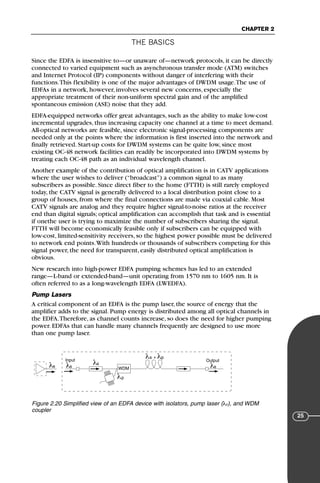
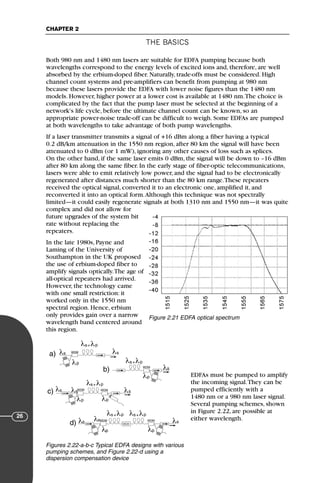
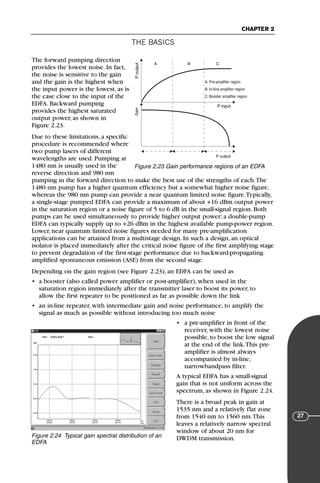
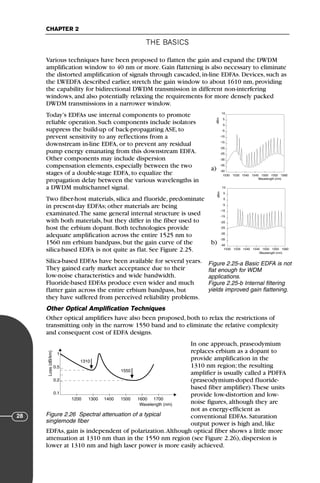
194 100 1544.529
194 000 1545.325
193 900 1546.122
193 800 1546.920
193 700 1547.718
193 600 1548.518
193 500 1549.318
193 400 1550.119
193 300 1550.921
193 200 1551.724
193 100 1552.527
193 000 1553.332
192 900 1554.137
192 800 1554.943
192 700 1555.750
192 600 1556.558
192 500 1557.366
192 400 1558.176
192 300 1558.986
192 200 1559.797
192 100 1560.609
192 000 1561.422
191 900 1562.236
191 800 1563.050
191 700 1563.865
191 600 1564.682
191 500 1565.499
191 400 1566.317
191 300 1567.135
191 200 1567.955
191 100 1568.776
191 000 1569.597
191 900 1570.419
190 800 1571.242
190 700 1572.066
190 600 1572.891
190 500 1573.717
190 400 1574.543
190 300 1575.370
190 200 1576.199
190 100 1577.028
190 000 1577.858
189 900 1578.689
189 800 1579.521
189 700 1580.353
189 600 1581.187
189 500 1582.021
189 400 1582.856
189 300 1583.693
189 200 1584.530
189 100 1585.368
189 000 1586.206
188 900 1585.045
188 800 1587.885
188 700 1588.726
188 600 1589.568
188 500 1590.411
188 400 1591.255
188 300 1592.100
188 200 1592.945
188 100 1593.792
188 000 1594.639
187 900 1595.487
187 800 1596.337
187 700 1597.187
187 600 1598.038
187 500 1598.889
187 400 1599.742
187 300 1600.596
187 200 1601.451
187 100 1602.306
187 000 1603.163
186 900 1604.020
186 800 1604.878
186 700 1605.737
υ λ υ λ υ λ υ λ υ λ
(GHz) (nm) (GHz) (nm) (GHz) (nm) (GHz) (nm) (GHz) (nm)
Table 2.02 ITU wavelength grid
71136 001-194_cb 11/10/08 8:58 AM K 15
THE BASICS
CHAPTER 2
16
Dielectric-layer filters can be made to pass very narrow, accurately positioned
bandwidths and they are inherently extremely stable.As a result, wavelength lockers
using these filters can provide the long-term wavelength stability required of WDM
sources.
2.5.2 Receivers
The receiver converts optical signals to an electronic form by detecting whatever
modulation has been applied to the light signal and demodulating it. Of course, the
receiver must be completely compatible with the transmitter—both its primary
wavelength and its modulation characteristics—and it must be designed to cope with
whatever signal degradations other network components may have introduced.
Traditional optical techniques are used to couple light energy from a fiber to a
detector, generally a photodiode.The resulting signal must be amplified
electronically—adding as little noise as possible—within an electrical bandpass
appropriate to the expected signal. Electronic filtering may also be needed to flatten
the effective frequency response of the unit.All these operations are usually carried
out within a single hybrid module, including a receiver module whose input is light
from a fiber and whose output is a clean electrical signal that must be demodulated
appropriately.The complexity of the demodulation process depends on the
modulation used. For example, timing information must be extracted if the channel
uses TDM, and various error detection and recovery schemes may be required at this
level.
Two types of photodiodes are commonly used: positive-intrinsic-negative (PIN) diodes
and avalanche photodiodes (APD).The PIN device operates with standard low-voltage,
logic power supplies (5 V), but it is less sensitive and covers a narrower bandwidth
than the avalanche model. High-speed PINs were used in 10 Gb/s and 40 Gb/s
applications before the arrival of APDs.The latter is found mainly in long-haul
applications, where its higher cost and greater circuit complexity is justified. In many
cases, the use of an APD alone allows the user to forego the need for an optical
preamplifier with a PIN photodetector. It is, therefore, economically very justifiable.
Critical selection parameters for receivers include spectral response (A/W as a
function of wavelength, especially in relation to the detector used), sensitivity
(a measure of the level at which intrinsic detector noise masks the incoming signal),
both spectral and electronic bandwidth, dynamic range, and noise.Appropriate criteria
for each depend on the individual application. For example, noise characteristics are
more important than high output power in an optical preamplifier used just before a
channel receiver. Furthermore, the
need for optical filtering—such as
within a demultiplexer—to reduce
amplified spontaneous emission
should receive attention.
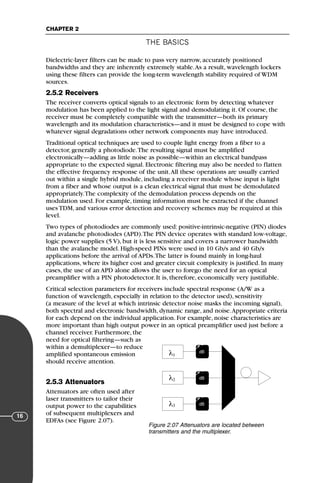
2.5.3 Attenuators
Attenuators are often used after
laser transmitters to tailor their
output power to the capabilities
of subsequent multiplexers and
EDFAs (see Figure 2.07).
λ
λ
λ
1
2
3
dB
→
ν
dB
→
ν
dB
→
ν
Figure 2.07 Attenuators are located between
transmitters and the multiplexer.
71136 001-194_cb 11/10/08 8:58 AM K 16
THE BASICS
CHAPTER 2
17
High-power lasers can be used in network transmitters to reduce the need for in-line
amplification.Attenuation may be needed in specific portions of the network to keep
optical components from being exposed to radiation strong enough that their
behavior becomes non-linear. Power tailoring is also often necessary to trim the gain
of EDFAs to provide an overall network response that is spectrally flat.This is
especially critical when a channel is added or dropped in EDFAs.
2.5.4 Switches
Early switching in fiber-optic networks involved converting the optical signal to an
electronic one, performing the necessary switching operation, and reconverting the
signal to optical—a cumbersome and expensive process that involves switching speed
limitations and reduces WDM operability.
Switches are used in WDM networks to divert signals to alternate routes in response
to network difficulties, or to reroute signals to other networks.As both network
complexity and reliability expectations have grown, the need for just a few switches
to offer simple rerouting possibilities has rapidly increased to a requirement for
complex N-by-N cross-connect units that permit extensive, all-optical reconfiguration.
The ability to switch signals easily is critical for the survival of the modern all-optical
network.As a result, optical cross-connect (OXC) routers are now essential to this
survival.
Standard optical switches used until now have tented to be 1xN switches, where an
electrically-controlled mechanism moves a flexible input fiber from-one output fiber
to another. In network applications, these switches have normally omly been used for
restoration purpose and not for dynamic bandwidth allotment or redistribution.
2.5.5 Optical Cross Connects (OXC) Units
Individual switches or small switch arrays suffice to route several channels, but more
complex network architectures require rapid, controllable, and flexible channel
routing.This would be the case, for example, in a ring network structure or a
metropolitan network where there are many nodes and access points. Recent research
efforts have resulted in several approaches to all-optical switching, based on optical
cross connect technologies.This NxN switching fabric can be constructed from,
electromechanical switches that perform switching by positioning tiny mirrors in the
optical path.This optical-mechanical approach has also been extented by micro-
manufacturing or MEMS technology, which involves depositing many switching lenses
and mirrors, and their actuators, on a silicon chip. Many hundreds of ports can be
accommodated, insertion losses are low, interchannel isolation is very high (80 dB),
and, by its nature, the device can be used over a wide wavelength range.
dB
→
ν
Figure 2.08-a Attenuators can be
wavelength-dependent.
0 dB
Wavelength
Attenuation
Figure 2.08-b Attenuation is also dependent
on optical input power.
71136 001-194_cb 11/10/08 8:58 AM K 17
THE BASICS
CHAPTER 2
18
Pure optical solutions under study include waveguides, liquid crystals, or even bubble
technology, whose characteristics can be quickly modified by heat, an electrical signal,
or optical gates (individual optical amplifiers that can be turned on and off rapidly).
The ever-increasing need for fast, reliable, and inexpensive optical switching
equipment will drive research and development efforts for the foreseeable future.
Addressable Add/Drop Units
The addressable add/drop device provides selective routing of DWDM channels,
using optical switches combined with other components that can be based on
fiber-switching or wavelength-switching technologies.The purpose of using an
addressable add/drop unit is to keep all routing within the optical transmission layer
and, thus, to avoid having to opto-electronically convert transmission signals and then
regenerate them.
Arrayed waveguide grating (AWG)
represents a good example of this
technology.A generic exampleof
an OXC is shown in Figure 2.09.
In such a device, the wavelengths at each output depend on the wavelengths at the
input.A control port can be added to allow selective wavelength routing.
2.5.6 Wavelength-Dependent Couplers
In WDM applications, it is often necessary to extract wavelengths individually
representing information channels. Purely passive optical devices are now available to
handle this task.
Frequency-dependent parameters of optical devices that must be overcome to
produce components, such as broadband couplers, can also be used to produce
components whose outputs are strongly wavelength-dependent. For instance, take a
wavelength-dependent coupler. Units are available to separate the 1310 nm and
1550 nm wavelengths commonly used in early WDM systems, or to combine the
980 nm or 1480 nm pump with the 1550 nm input signal into the erbium-doped fiber
in an EDFA.
Control signal
Output
Output
λ
λ
1
n
OXC
Figure 2.09 Signal λi coming to the input port of the OXC is rerouted to other ports.
71136 001-194_cb 11/10/08 8:58 AM K 18
THE BASICS
CHAPTER 2
19
2.5.7 Dispersion Compensation Devices
Various components of fiber-optic networks—and particularly the fiber itself—exhibit
chromatic dispersion.Their index of refraction varies with wavelength, as does the
propagation speed through them.The most easily noticeable result is the broadening
of transmitted optical pulses, which makes their error-free recovery more difficult as
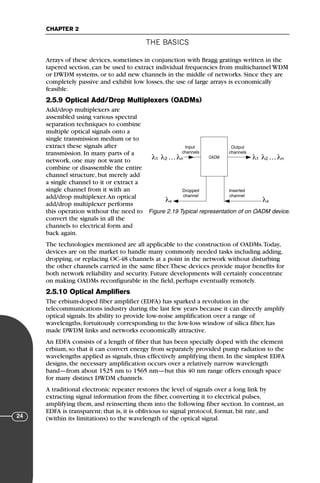
neighboring bits overlap.A dispersion compensation device (DCD) is used to apply an
equal but opposite dispersion to correct this pulse broadening.The two most
commonly used DCD types are dispersion compensating fibers (DCFS) and dispersion
compensating gratings (DCGS).
2.5.8 Multiplexers and Demultiplexers
The output of each laser transmitter in a WDM system is set to one of the allowed
channel frequencies.These beams must then be multiplexed—superimposed or
combined—and inserted into the first fiber cable span.The device used is called a
multiplexer (also called a mux, optical mux, or OM).A similar device is used to extract
the multiplexed channels at the receiver end of each link. It is called a demultiplexer
(or demux, optical demux, or OD). Unlike the situation in TDM systems, where both
these operations occur in the time domain and much attention must be paid to
maintaining accurate clocks and to retrieving timing clues from incoming signals,
multiplexing and demultiplexing in WDM systems are strictly a matter of dealing
individually with a signal’s spectral components.The characteristics of these spectral
components are always known beforehand.
Multiplexing and demultiplexing functions both employ narrowband filters, cascaded
and combined in other ways to achieve the desired result. Particular techniques that
have been used to perform such filtering include thin-film filters, fiber Bragg or bulk
optic gratings, tapered fibers, liquid crystal filters, and integrated optics (phased array
waveguides,AWG, or phasar).
Many mux/demux devices are available today to handle the 100 GHz (0.78 nm)
channel spacing that is common in WDM networks, and to accommodate the more
demanding 50 GHz spacing—or even higher channel densities—that are appearing.
Most recent models have been based on thin-film filters, with arrayed waveguides and
fiber Bragg grating models close behind, but this technology distribution will shift as
more stringent requirements of narrowly spaced DWDM systems come to bear.
DCD
0 Time
Output pulse
Input pulse
Power
(dB)
Figure 2.10 The broadening effect due to dispersion and its compensation
71136 001-194_cb 11/10/08 8:58 AM K 19
THE BASICS
CHAPTER 2
20
Multiplexing Technologies
Although a thorough discussion of
the mechanisms underlying
mux/demux operations is beyond
our scope, we will outline the
wavelength-dividing mechanisms
used in the more common types.
Thin-Film Filters
Thin-film filters consist of a
number of layers of transparent
dielectric materials of differing
refractive indices deposited
sequentially on an optical
substrate. Since the index of
refraction changes at each
interface in the stack of layers, a
portion of the incident light is
reflected at each interface.This
reflected light interferes
constructively or destructively
with incoming light, depending
on wavelength.Through judicious
selection of the indices
of refraction and the thickness of
each layer, one can use this internal interference to produce a filter that will pass any
desired range of wavelengths and reflect the others (Figure 2.12).
The techniques for choosing design parameters and applying the coating have been
known in the optical industry for decades.The selection of coating materials is
limited. Many substances, whose optical properties are desirable, have physical
properties that are less than ideal. Generally, the more stringent the requirements, the
greater the number of optical layers needed. Despite these difficulties, filters with
many highly specialized spectral response functions can be produced inexpensively
without much variation during production.
λ1
λn λn
λ1
Figure 2.11 Typical representation of a multiplexer
and demultiplexer
I1
I2
I3
1
2
3
θ
θ
2
θ
θ
1
θ
=
Figure 2.12 Incident wavelength Ι1 is reflected Ι2 at the
same angle, and Ι3 is transmitted at a lower angle.
71136 001-194_cb 11/10/08 8:58 AM K 20
THE BASICS
CHAPTER 2
21
Single-stage filters used in
mux/demux applications must
generally be mounted slightly
askew to the optical axis, so that
the light they reject by reflection
is not reinserted backwards into
the network.This angular
displacement changes the
effective thickness of the layers
used and, thus, alters, the bandpass
of the filter, so the tilt must be
factored into the design of the
unit. In multi-stage units for
multichannel use, the beam
reflected from each filter is the
input for the next stage; thus, alignment is extremely critical.
Thin-film filters provide bandpasses narrow enough for use in mux/demux
applications in WDM systems of 16 or 32 channels. More densely spaced networks are
now turning to other technologies.
Fiber Bragg Gratings
A fiber Bragg grating is essentially
an optical interferometer built
right inside a fiber. If a glass fiber
is doped with a suitable
substance—germanium is
commonly used—its refractive
index can later be modified by
exposure to ultraviolet light. If this
exposure occurs in an appropriate
periodic pattern, the fiber
becomes a grating. In other words, it will reflect light wavelengths almost completely
within a predetermined band and transmit other wavelengths. If the pattern is not
periodic and varies monotonically (i.e., is “chirped”), the fiber grating can be used to
compensate for chromatic dispersion in a fiber link, or to correct the frequency-
broadening chirp of laser sources used under certain conditions.
The central wavelength of a regularly
spaced Bragg grating filter is
determined by its periodicity; its
bandwidth is inversely proportional to
its length. Both of these parameters
are temperature-sensitive, so such
filters require constant-temperature
enclosures or some other mechanism
for temperature control.
A Bragg grating can be used as an
optical filter in a mux/demux, as a
compensator for chromatic
dispersion, or in combination with
circulators to manufacture add/drop
multiplexers or demultiplexers.
λ λ λ λ …
1 2 3 4
λ4
λ2
λ3
λ1
TT TT
GRI
Figure 2.13 Example of a cascaded thin-film filter for
multiwavelength demultiplexing
λ λ λ λ
1 λ1
2
λ2
3 λ3
4 λ4
Incident light Transmitted light
Reflected light Grating response
Fiber Bragg grating
Figure 2.14 The fiber Bragg grating drop on a specific
channel from the transmitted signal
Fiber Bragg grating
Fiber Bragg grating
λ ,λ …λ
1 2 n
λ ,λ …λ
1 2 n
DROP λ1
ADD λ1
Circulator Circulator
Figure 2.15 Two examples of fiber Bragg gratings
used in an OADM device
71136 001-194_cb 11/10/08 8:58 AM K 21
THE BASICS
CHAPTER 2
22
Bragg gratings are seldom used alone as passive DWDM components. One common
application involves an add/drop multiplexer with one or two optical circulators, as
shown in Figure 2.14. On the drop side, the circulator recovers the reflected
wavelength and sends it to the drop port. On the add side, the circulator recombines a
new transmission signal at the same wavelength as that at which it was dropped.
Therefore, a specific wavelength channel is either added to or dropped from the
original transmitted signal.This technique is often used at the interface between a
long-haul and a metropolitan network, where the former typically uses as many
wavelengths as possible and the latter uses far fewer wavelengths.
Fiber Bragg grating devices are also beginning to appear in mux and demux devices in
Mach-Zehnder configurations and in hybrid combinations with other types of filters.
Aside from mux/demux applications, this narrowband filtering technology is also used
to perform EDFA gain flattening, wavelength stabilization, and wavelength locking.
Diffraction Gratings
A bulk-optic diffraction grating reflects light at an angle proportional to wavelength
and, once again, the underlying physical principle is the same: constructive and
destructive interference.
For each wavelength of incident
light, there is an angle for which
light waves reflecting from
individual grating lines will differ
in phase by exactly one
wavelength.At this angle, the
contribution from each line will
add constructively, so this will be
the angle of maximum
transmission for that specific
incident wavelength.
Designing a mux or a demux
using a diffraction grating, is a
matter of positioning the input
and output optics to select the
desired wavelengths.Although
they are difficult to manufacture
and expensive, devices based on diffraction gratings have an insertion loss that is
essentially independent of the number of channels, rendering this technology one of
the more promising for high channel count systems. However, polarization control
requires critical attention.
Integrated Optical Devices
Integrated optical wavelength multiplexing/demultiplexing devices are the optical
equivalent of integrated electronic circuits.Typically, they consist of optical
waveguides—core material surrounded by cladding material—layered onto silicon or
lithium niobate-substrates using many of the techniques adopted by the large-scale
integration manufacturers.The end result is a small package containing many optical
components—usually interacting—that can be manufactured in significant quantities
using totally automatic techniques. Integrated optics is a relatively new technology and
significant research and development is still required before its full potential can be
exploited. Some of the devices that are currently being produced include couplers,
switches, modulators, erbium—and other rare-earth-doped waveguide amplifiers, Bragg
gratings, and other DWDM components.
λ1
λ2
Incident light
Long wavelengths
Reflected light
Short wavelengths
Figure 2.16 The incident light is divided into all
primary wavelengths λ1, λ2,…λn
71136 001-194_cb 11/10/08 8:58 AM K 22
THE BASICS
CHAPTER 2
23
Integrated optics lends itself
particularly well to arrayed
waveguide gratings (AWG),
whose principle of operation is
outlined in Figure 2.16.
Input light, comprised of many
different wavelengths is coupled
into the input slab coupler
where it is split among N optical
paths making up the waveguide
array. Since each of the N legs of
the array is a different length,
each introduces a different
wavelength-dependent phase
shift.The resulting interference in the converging beam in the output coupler directs
different wavelengths into separate output waveguides.
An AWG can be used either to reassign wavelengths on one set of fibers to a different
distribution on another set, or to demultiplex individual frequencies on a single fiber
(Figure 2.16).This is becoming a key technology for manufacturers of wavelength
multiplexers/demultiplexers. Since its architecture is easily scalable, it holds the
potential for applications in systems with hundreds of channels.
An AWG is also called a Dragone router, a phase array, or a phasar.
Fused Biconic Tapered (FBT) Devices
In its simplest form, the biconic tapered coupler consists of a pair of singlemode
optical fibers that have been fused together lengthwise. Signal light transmitted in a
fiber-core mode that arrives at the fused region from one of the fibers on the left-hand
side is redistributed into a variety of cladding modes as it crosses the joint.As the
fibers once again separate, cladding modes reconvert to core modes in each of the
output (right-hand side) fibers.The result is an almost loss-less coupler or splitter.The
redistribution of energy does not need to be homogeneous; interference along the
length of the fused region—a dimension that is fixed during manufacturing—
determines how the input energy at a given wavelength will be redistributed at the
output.
If two such devices are connected
in series (Figure 2.18), the optical
path difference between the two
central connecting sections causes
the combination to act like a
Mach-Zehnder interferometer.The
input energy is split between the
two outputs, depending on
wavelength, with a periodicity that
is set when the device is manufactured.Thus, two frequencies that are present
together on an input fiber can leave the device on separate fibers (the second input
fiber is not used). In multi-frequency applications, evenly spaced frequencies on the
input fiber will appear as two sets of frequencies on the output, each spaced at twice
the original channel spacing. Further stages may be used to reduce the channel count
to one per output fiber.
λ11 λ12 λ13
λ21 λ22 λ23
λ31 λ32 λ33
λ11 λ21 λ31
λ12 λ22 λ32
λ13 λ23 λ33
N x M Slab coupler
M x N Slab coupler
Input waveguides Output waveguides
Figure 2.17 AWG : illustration and principle of operation
Couplers
Input
Output 1
Output 2
Mach-Zehnder configuration
Figure 2.18 The fused fiber redistributes the input
signal to the output of the device.
71136 001-194_cb 11/10/08 8:58 AM K 23
THE BASICS
CHAPTER 2
24
Arrays of these devices, sometimes in conjunction with Bragg gratings written in the
tapered section, can be used to extract individual frequencies from multichannel WDM
or DWDM systems, or to add new channels in the middle of networks. Since they are
completely passive and exhibit low losses, the use of large arrays is economically
feasible.
2.5.9 Optical Add/Drop Multiplexers (OADMs)
Add/drop multiplexers are
assembled using various spectral
separation techniques to combine
multiple optical signals onto a
single transmission medium or to
extract these signals after
transmission. In many parts of a
network, one may not want to
combine or disassemble the entire
channel structure, but merely add
a single channel to it or extract a
single channel from it with an
add/drop multiplexer.An optical
add/drop multiplexer performs
this operation without the need to
convert the signals in all the
channels to electrical form and
back again.
The technologies mentioned are all applicable to the construction of OADMs.Today,
devices are on the market to handle many commonly needed tasks including adding,
dropping, or replacing OC-48 channels at a point in the network without disturbing
the other channels carried in the same fiber.These devices provide major benefits for
both network reliability and security. Future developments will certainly concentrate
on making OADMs reconfigurable in the field, perhaps eventually remotely.
2.5.10 Optical Amplifiers
The erbium-doped fiber amplifier (EDFA) has sparked a revolution in the
telecommunications industry during the last few years because it can directly amplify
optical signals. Its ability to provide low-noise amplification over a range of
wavelengths, fortuitously corresponding to the low-loss window of silica fiber, has
made DWDM links and networks economically attractive.
An EDFA consists of a length of fiber that has been specially doped with the element
erbium, so that it can convert energy from separately provided pump radiation to the
wavelengths applied as signals, thus effectively amplifying them. In the simplest EDFA
designs, the necessary amplification occurs over a relatively narrow wavelength
band—from about 1525 nm to 1565 nm—but this 40 nm range offers enough space
for many distinct DWDM channels.
A traditional electronic repeater restores the level of signals over a long link by
extracting signal information from the fiber, converting it to electrical pulses,
amplifying them, and reinserting them into the following fiber section. In contrast, an
EDFA is transparent; that is, it is oblivious to signal protocol, format, bit rate, and
(within its limitations) to the wavelength of the optical signal.
OADM
Input
channels
Output
channels
Inserted
channel
Dropped
channel
λ λ …
1 2 λn λ λ …
1 2 λn
λx λx
Figure 2.19 Typical representation of on OADM device.
71136 001-194_cb 11/10/08 8:58 AM K 24
THE BASICS
CHAPTER 2
25
Since the EDFA is insensitive to—or unaware of—network protocols, it can be directly
connected to varied equipment such as asynchronous transfer mode (ATM) switches
and Internet Protocol (IP) components without danger of interfering with their
functions.This flexibility is one of the major advantages of DWDM usage.The use of
EDFAs in a network, however, involves several new concerns, especially the
appropriate treatment of their non-uniform spectral gain and of the amplified
spontaneous emission (ASE) noise that they add.
EDFA-equipped networks offer great advantages, such as the ability to make low-cost
incremental upgrades, thus increasing capacity one channel at a time to meet demand.
All-optical networks are feasible, since electronic signal-processing components are
needed only at the points where the information is first inserted into the network and
finally retrieved. Start-up costs for DWDM systems can be quite low, since most
existing OC-48 network facilities can readily be incorporated into DWDM systems by
treating each OC-48 path as an individual wavelength channel.
Another example of the contribution of optical amplification is in CATV applications
where the user wishes to deliver (“broadcast”) a common signal to as many
subscribers as possible. Since direct fiber to the home (FTTH) is still rarely employed
today, the CATV signal is generally delivered to a local distribution point close to a
group of houses, from where the final connections are made via coaxial cable. Most
CATV signals are analog and they require higher signal-to-noise ratios at the receiver
end than digital signals; optical amplification can accomplish that task and is essential
if onethe user is trying to maximize the number of subscribers sharing the signal.
FTTH will become economically feasible only if subscribers can be equipped with
low-cost, limited-sensitivity receivers, so the highest power possible must be delivered
to network end points.With hundreds or thousands of subscribers competing for this
signal power, the need for transparent, easily distributed optical amplification is
obvious.
New research into high-power EDFA pumping schemes has led to an extended
range—L-band or extended-band—unit operating from 1570 nm to 1605 nm. It is
often referred to as a long-wavelength EDFA (LWEDFA).
Pump Lasers
A critical component of an EDFA is the pump laser, the source of energy that the
amplifier adds to the signal. Pump energy is distributed among all optical channels in
the EDFA.Therefore, as channel counts increase, so does the need for higher pumping
power. EDFAs that can handle many channels frequently are designed to use more
than one pump laser.
λs λp
λs λs λs
λs
Input Output
λp
WDM
+
Figure 2.20 Simplified view of an EDFA device with isolators, pump laser (λp), and WDM
coupler
71136 001-194_cb 11/10/08 8:58 AM K 25
THE BASICS
CHAPTER 2
26
Both 980 nm and 1480 nm lasers are suitable for EDFA pumping because both
wavelengths correspond to the energy levels of excited ions and, therefore, are well
absorbed by the erbium-doped fiber. Naturally, trade-offs must be considered. High
channel count systems and pre-amplifiers can benefit from pumping at 980 nm
because these lasers provide the EDFA with lower noise figures than the 1480 nm
models. However, higher power at a lower cost is available at 1480 nm.The choice is
complicated by the fact that the pump laser must be selected at the beginning of a
network's life cycle, before the ultimate channel count can be known, so an
appropriate power-noise trade-off can be difficult to weigh. Some EDFAs are pumped
at both wavelengths to take advantage of both pump wavelengths.
If a laser transmitter transmits a signal of +16 dBm along a fiber having a typical
0.2 dB/km attenuation in the 1550 nm region, after 80 km the signal will have been
attenuated to 0 dBm (or 1 mW), ignoring any other causes of loss such as splices.
On the other hand, if the same laser emits 0 dBm, the signal will be down to –16 dBm
after 80 km along the same fiber. In the early stage of fiber-optic telecommunications,
lasers were able to emit relatively low power, and the signal had to be electronically
regenerated after distances much shorter than the 80 km range.These repeaters
received the optical signal, converted it to an electronic one, amplified it, and
reconverted it into an optical form.Although this technique was not spectrally
limited—it could easily regenerate signals at both 1310 nm and 1550 nm—it was quite
complex and did not allow for
future upgrades of the system bit
rate without replacing the
repeaters.
In the late 1980s, Payne and
Laming of the University of
Southampton in the UK proposed
the use of erbium-doped fiber to
amplify signals optically.The age of
all-optical repeaters had arrived.
However, the technology came
with one small restriction: it
worked only in the 1550 nm
spectral region. Hence, erbium
only provides gain over a narrow
wavelength band centered around
this region.
EDFAs must be pumped to amplify
the incoming signal.They can be
pumped efficiently with a
1480 nm or a 980 nm laser signal.
Several pumping schemes, shown
in Figure 2.22, are possible at
either wavelength.
Figure 2.21 EDFA optical spectrum
λs λs
λs
λp λp
λs
λs
λp
λs λp
+
λs λp
+
λs λp
+
λs λp
+ λs λp
+
a)
c)
d)
λs
λp
b)
λs λs
λs
λp λp
WDM
WDM WDM
WDM
WDM WDM
DCD
Figures 2.22-a-b-c Typical EDFA designs with various
pumping schemes, and Figure 2.22-d using a
dispersion compensation device
71136 001-194_cb 11/10/08 8:58 AM K 26
THE BASICS
CHAPTER 2
27
The forward pumping direction
provides the lowest noise. In fact,
the noise is sensitive to the gain
and the gain is the highest when
the input power is the lowest, as is
the case close to the input of the
EDFA. Backward pumping
provides the highest saturated
output power, as shown in
Figure 2.23.
Due to these limitations, a specific
procedure is recommended where
two pump lasers of different
wavelengths are used. Pumping at
1480 nm is usually used in the
reverse direction and 980 nm
pumping in the forward direction to make the best use of the strengths of each.The
1480 nm pump has a higher quantum efficiency but a somewhat higher noise figure,
whereas the 980 nm pump can provide a near quantum limited noise figure.Typically,
a single-stage pumped EDFA can provide a maximum of about +16 dBm output power
in the saturation region or a noise figure of 5 to 6 dB in the small-signal region. Both
pumps can be used simultaneously to provide higher output power; a double-pump
EDFA can typically supply up to +26 dBm in the highest available pump-power region.
Lower, near quantum limited noise figures needed for many pre-amplification
applications can be attained from a multistage design. In such a design, an optical
isolator is placed immediately after the critical noise figure of the first amplifying stage
to prevent degradation of the first-stage performance due to backward-propagating
amplified spontaneous emission (ASE) from the second stage.
Depending on the gain region (see Figure 2.23), an EDFA can be used as
• a booster (also called power amplifier or post-amplifier), when used in the
saturation region immediately after the transmitter laser to boost its power, to
allow the first repeater to be positioned as far as possible down the link
• an in-line repeater, with intermediate gain and noise performance, to amplify the
signal as much as possible without introducing too much noise
• a pre-amplifier in front of the
receiver, with the lowest noise
possible, to boost the low signal
at the end of the link.This pre-
amplifier is almost always
accompanied by in-line,
narrowbandpass filter.
A typical EDFA has a small-signal
gain that is not uniform across the
spectrum, as shown in Figure 2.24.
There is a broad peak in gain at
1535 nm and a relatively flat zone
from 1540 nm to 1560 nm.This
leaves a relatively narrow spectral
window of about 20 nm for
DWDM transmission.
A B C
P output
Gain
P
output
P input
A: Pre-amplifier region
B: In-line amplifier region
C: Booster amplifier region
Figure 2.23 Gain performance regions of an EDFA
Figure 2.24 Typical gain spectral distribution of an
EDFA
71136 001-194_cb 11/10/08 8:58 AM K 27
THE BASICS
CHAPTER 2
28
Various techniques have been proposed to flatten the gain and expand the DWDM
amplification window to 40 nm or more. Gain flattening is also necessary to eliminate
the distorted amplification of signals through cascaded, in-line EDFAs. Devices, such as
the LWEDFA described earlier, stretch the gain window to about 1610 nm, providing
the capability for bidirectional DWDM transmission in different non-interfering
windows, and also potentially relaxing the requirements for more densely packed
DWDM transmissions in a narrower window.
Today’s EDFAs use internal components to promote
reliable operation. Such components include isolators
suppress the build-up of back-propagating ASE, to
prevent sensitivity to any reflections from a
downstream in-line EDFA, or to prevent any residual
pump energy emanating from this downstream EDFA.
Other components may include dispersion
compensation elements, especially between the two
stages of a double-stage EDFA, to equalize the
propagation delay between the various wavelengths in
a DWDM multichannel signal.
Two fiber-host materials, silica and fluoride, predominate
in present-day EDFAs; other materials are being
examinated.The same general internal structure is used
with both materials, but they differ in the fiber used to
host the erbium dopant. Both technologies provide
adequate amplification across the entire 1525 nm to
1560 nm erbium bandpass, but the gain curve of the
silica-based EDFA is not quite as flat. See Figure 2.25.
Silica-based EDFAs have been available for several years.
They gained early market acceptance due to their
low-noise characteristics and wide bandwidth.
Fluoride-based EDFAs produce even wider and much
flatter gain across the entire erbium bandpass, but
they have suffered from perceived reliability problems.
Other Optical Amplification Techniques
Other optical amplifiers have also been proposed, both to relax the restrictions of
transmitting only in the narrow 1550 band and to eliminate the relative complexity
and consequent cost of EDFA designs.
In one approach, praseodymium
replaces erbium as a dopant to
provide amplification in the
1310 nm region; the resulting
amplifier is usually called a PDFFA
(praseodymium-doped fluoride-
based fiber amplifier).These units
provide low-distortion and low-
noise figures, although they are
not as energy-efficient as
conventional EDFAs. Saturation
output power is high and, like
EDFAs, gain is independent of polarization.Although optical fiber shows a little more
attenuation at 1310 nm than in the 1550 nm region (see Figure 2.26), dispersion is
lower at 1310 nm and high laser power is more easily achieved.
1530 1535 1540 1545 1550 1555 1560
-40
-35
-30
-25
-20
-15
-10
-5
0
5
10
dBm
Wavelength (nm)
Figure 2.25-a Basic EDFA is not
flat enough for WDM
applications.
Figure 2.25-b Internal filtering
yields improved gain flattening.
1200 1300 1400 1500 1600 1700
0.1
0.2
0.5
1
Wavelength (nm)
Loss
(dB/km)
1310
1550
Figure 2.26 Spectral attenuation of a typical
singlemode fiber
1530 1535 1540 1545 1550 1555 1560
-40
-35
-30
-25
-20
-15
-10
-5
0
5
10
dBm
Wavelength (nm)
a)
b)
71136 001-194_cb 11/10/08 8:58 AM K 28
THE BASICS
CHAPTER 2
29
Unfortunately, reasonable pumping efficiencies can be obtained only by using
praseodymium-doped fiber that is much smaller than standard optical fiber.The losses
resulting from the mismatches at the two needed splices, and the difficulty to achieve
reliable mechanical splices are costly enough to rule out widespread commercial use
for now.
Other host-dopant combinations under study include the fluoride-based
thulium-doped fiber amplifier (TDFFA) with two spectral operating regions:
1460 nm and 1650 nm. Its advantages include high saturation output power,
polarization-independent gain, and a low-noise figure.Ytterbium is also used in
EDFAs with very high output power.
A rather different approach achieves gain through the stimulated Raman scattering
effect. In principle, this method, which uses the silica fiber itself as the gain medium,
offers great flexibility in choosing the wavelength of the amplification region, and the
mechanism is inherently low-noise.This Raman amplifier is especially useful for
upgrading existing links to higher channel counts without having to replace
already-installed EDFAs. It is also very useful for medium-haul undersea links that do
not use repeaters (e.g., 300 km long), where the installation of an in-line EDFA can be
very expensive. However, Raman amplifiers exhibit significant cross gain modulation,
limiting their use to either a single-signal channel or to high channel count DWDM
signals, where the effects of such modulation can be averaged out.Additionally, Raman
amplifiers have some linearity and polarization-dependence problems, which, when
combined with the extreme weakness of the effect in silica fiber, has limited the use
of Raman amplifier technology to specialized applications, at least for now.
Semiconductor (solid-state) optical amplifiers (SOAs), in which photon emission is
stimulated by electron-hole recombination in a semiconductor through direct
injection of current, rather than by pumping an erbium-doped fiber, are also being
developed.They have attracted considerable interest due to their promise of high
performance and flexibility in operating wavelength, albeit with a high noise figure
(typically more than 5 to 6 dB above that of EDFAs, largely due to inevitable losses as a
result of pigtailing). Like Raman amplifiers, SOAs exhibit a significant cross gain
modulation, precluding their use in low channel count DWDM applications, but this
can be used to advantage in switching and wavelength-conversion applications.
Like the praseodymium-doped, fluoride-based fiber amplifier, SOAs also present
fiber-coupling problems because waveguide dimensions best suited to semiconductor
optical amplification differ from those of optical fibers.
Integrated optical modulators for high bit rates are also becoming available, as are
modulators integrated into packages with laser chips. Modules that integrate laser
chips, modulators, SOAs, and a multiplexer have also been demonstrated.
2.5.11 Optical Fiber
Fiber—especially cabled fiber—is one of the most critical components of an optical
network.After all, it is the physical transport medium.The first fibers to see
widespread use were for long-haul communications: step-index, singlemode fibers
exhibiting zero dispersion at 1310 nm, which were designated G.652 fibers by the
ITU. More than 80 million kilometers of cable made up of these fibers was installed in
the 1980s. Despite the tendency towards higher data rates and the ability of DWDM
techniques to multiply the capacity of installed optical fiber, cable installation will
continue unabated throughout the world for the foreseeable future.
71136 001-194_cb 11/10/08 8:58 AM K 29
THE BASICS
CHAPTER 2
30
Although this standard fiber (G.652) exhibits zero chromatic dispersion at 1310 nm, it
shows high dispersion at 1550 nm (18 ps/nm.km). Despite this apparent
incompatibility with the EDFA window at 1550 nm, recent tests indicate that this fiber
can carry moderate-rate DWDM transmissions without loss of signal quality over
significant distances.This is largely due to the fact that, although dispersion is high at
1550 nm, it can be compensated with dispersion compensating fiber or other
compensation devices.
Fiber manufacturers have
developed dispersion-shifted fiber
(G.653) that has zero dispersion at
approximately 1550 nm. Fiber
attenuation is lower at 1550 nm
than at 1310 nm, so operation in
the former region is preferred,
especially for long-haul
transmission. However, dispersion-
shifted fiber is not necessarily the
preferred fiber for DWDM
transmission; its spectral
dispersion profile slopes steeply
around the dispersion zero
wavelength, and dispersion
compensation must be individually
applied to channels.
Non-linear effects were witnessed as soon as EDFAs were introduced for DWDM
transmission over dispersion-shifted fiber.Although dispersion-shifted fiber exhibits
zero chromatic dispersion at 1550 nm, the effects of four-wave mixing limit the
wavelengths at or very near the dispersion zero.To reduce the influence of non-linear
effects, such as four-wave mixing in DWDM systems, the effective area of the fiber
core must be increased, but not to the extent that singlemode propagation is lost.
Non-linear effects—primarily changes in the refractive index with power—depend on
the intensity of the propagating energy,that is, the power per effective cross-sectional
area of the fiber, not the total power. Using uneven or wider channel spacing between
the DWDM channels can also minimize four-wave mixing.
New fibers have been developed
to address this issue such as
the non-zero dispersion-shifted
fiber (ITU G.655). Some of these
fibers have refractive index
profiles in the shape of rings
(see Figure 2.28).A small,
controlled amount of chromatic
dispersion can be introduced over
the 1530 nm to 1565 nm band
(from more than 3 ps/nm.km
at 1530 nm to less than
0.7 ps/nm.km at 1560 nm).This is
just enough to suppress four-wave
mixing and, yet, still allow
individual channel rates of at least
2.5 Gb/s over 1000 km. Such fibers
are preferred for DWDM systems.
1100 1200 1300 1400 1500 1600
-20
-10
10
20
0
Wavelength λ (nm)
Dispersion
(ps/nm.km)
Dispersion-unshifted
Non-zero dispersion
Dispersion-shifted
Figure 2.27 Typical dispersion figure for different types
of fiber
n1
n1 n1
n2
n2 n2
2a=10 µm
n1
n3
2a=10µm
45 µm
6 µm 8 µm
0.1%
0.3%
0.3%
0.8%
Pedestal Ring
Matched cladding fiber Depressed cladding fiber
Dispersion-shifted fiber
Figure 2.28 Typical refractive index profiles for
singlemode fibers
71136 001-194_cb 11/10/08 8:58 AM K 30
THE BASICS
CHAPTER 2
31
2.6 WDM AND TDM: A COMPARISON
Both WDM and TDM techniques can be used to increase the information-carrying
capacity of a network.Although the two are more complementary than competitive,
their features can be compared one-on-one on the basis of link design flexibility, speed,
and impact on the bit error rate.
2.6.1 Link Design Flexibility
TDM can be engineered to handle different types of links to accommodate different
user applications.A TDM scheme can divide a given fiber-optic cable into a multitude of
links carrying different types of traffic at different transmission rates.A variety of
strategies can be applied to time-slot assignment.They can be assigned permanently or
on-demand, which is also known as demand assignment multiple access (DAMA).Their
duration can also vary and slots can even be eliminated altogether. If slots are
eliminated, data can be encapsulated into packets, each carrying a source and a
recipient address (statistical multiplexing). Generally speaking, however,TDM works
best when it is applied to a number of logical links, all carrying the same type of traffic,
with equal and permanently assigned time slots.This simple version of TDM is easy to
design and to manage. It also has less maintenance costs.
Since WDM provides totally independent channels, it is inherently more flexible than
TDM. For example, a link can easily be carved into a multitude of channels. However,
the characteristics of the traffic and of the data rates on each channel can be quite
different, without posing any design or implementation difficulties.A mix of 10Base-T
Ethernet LAN traffic, 100Base-T Ethernet LAN traffic, digital video, and out-of-band test
signals is easily managed. It is easy to add new channels to an existing WDM
architecture, without facing the need that would exist in a TDM system to reallocate all
the existing channel time slots.
2.6.2 Speed
The capacity increase that TDM offers results from pumping more information bits
along a link. How fast this can be done depends—within some fundamental fiber-cable
limits—on the electronic components used. Digital circuitry is required to accept data
from each source, to store it, to load it into appropriate time slots, to unload it, and to
deliver it to the correct user.All these digital components must operate at, or close to,
the speed of the composite link of the multiplexer; that is, each channel, regardless of
its net bandwidth, must be equipped with at least electronic equipment capable of
handling the overall bandwidth of the link.A fiber-optic cable transmission medium can
handle rates of several Gb/s, while the logic speeds of commercially available digital
electronics are of the order of 1 billion operations per second.Although electronic
speeds are bound to rise,TDM will forever be limited by the economics of needing
leading-edge electronics in each signal path, so the technique will unlikely provide a
composite link speed commensurate with the tremendous bandwidth presented by
fiber-optic cable.This limitation applies to the WAN as well as the premise
environment.
Although individual WDM channels are subject to the same end-of-link requirements for
supporting electronics as TDM channels, other equipment in the channel only need to
deal with its own low data rate, not the rate of the composite signal.The overall
channel capacity is not constrained by the speed of the supporting electronics.
Capacity can be increased at any time simply by adding more channels on demand.The
fastest TDM link design, using the most advanced electronics, can always be transmitted
over a single WDM link as one of many channels.WDM can provide composite link
speeds that are in line with the enormous bandwidth offered by fiber-optic cable.
71136 001-194_cb 11/10/08 8:58 AM K 31
In this chapter, we have presented the main building blocks of a DWDM system and we
have pointed out how TDM and DWDM technologies are being combined to provide
dramatic bandwidth upgrades.All these technological advances in a DWDM system
generate new testing methods to ensure that each component and set of components
work together to deliver expected performance. In the next chapter, we will describe
these critical testing parameters, which will be followed by a detailed discussion of
testing methods in Chapter 4.
THE BASICS
CHAPTER 2
32
71136 001-194_cb 11/10/08 8:58 AM K 32
71136 001-194_cb 11/10/08 8:58 AM K 33
CRITICAL PARAMETERS IN WDM TECHNOLOGY
CHAPTER 3
34
3.1 THE MAIN CONCERNS
The arrival of DWDM, as that of any other technology, introduces new difficulties as
well as powerful advantages.The main concern for users of the new DWDM system is
its reliability and stability over time.Testing optical quality parameters and system
behavior from component manufacturing up to the system integrator is an important
means of ensuring that a DWDM system will be commissioned with the right
specifications and will deliver robust performance for many years.
We can examine the critical
factors limiting the performance
of a time-domain multiplexing
(TDM) system by placing them on
a two-dimensional power-versus-
time representation, as shown in
Figure 5.01-a.
On the power axis, the critical
issues are laser power, fiber
attenuation, and component loss.
On the time axis, the critical
factors are fiber PMD, chromatic
and (for multimode fibers) modal
dispersion, as well as signal jitter
and transmission rate.At the
junction of the power and time
axes, new factors come into play:
laser modulation depth, fiber non-
linearity, relative intensity noise
(RIN), and bit error rate (BER).
WDM adds wavelength as a new
dimension and complicates
considerably the representation of
the critical factors (Figure 5.01-b).
Power
Time
• Laser power
• Fiber attenuation
• Component losses
• Laser modulation
• Fiber non-linearity
• RIN
• BER
• Fiber PMD
• Modal dispersion
• Jitter
• Transmission rate
Figure 5.01-a Critical factors limiting TDM
performance
Power
Time
• Laser power
• Fiber attenuation
• Component losses
• Laser modulation
• Fiber non-linearity
• RIN
• BER
• PDL
• Laser chirp
• Chromatic dispersion
• Stability of opt. freq.
• Phase noise
• λ-dependent PMD
• EDFA ASE
• EDFA gain
• Crosstalk
• Four-wave mixing
• Raman
• Fiber chirp
• Jitter
• Transmission rate
• PMD
• λ stability
• EDFA range
• λ & BW
• Brillouin
effect
Wavelength
Figure 5.01-b Addition of the wavelength dimension in
WDM systems
71136 001-194_cb 11/10/08 8:58 AM K 34
CRITICAL PARAMETERS IN WDM TECHNOLOGY
CHAPTER 3
35
On the wavelength axis, we are now faced with such critical elements as spectral
stability, EDFA spectral range, central wavelength, and bandwidth.At the corner of
wavelength and time, we encounter laser chirp, chromatic dispersion, stability of the
optical frequency, and phase noise (self-phase modulation and cross-phase
modulation).At the corner of wavelength and power, we find EDFA amplified
spontaneous emission (ASE), EDFA gain, crosstalk, four-wave mixing, and stimulated
Raman forward scattering.Where all three axes meet, we encounter stimulated
Brillouin backscattering.Although WDM technology makes networks more efficient by
adding bandwidth and channels, its effective application requires care. In the planning,
designing, manufacturing, and implementation stages, these factors must be considered
and appropriately countered.
We will describe, here, the most important parameters and phenomena to be tested.
These parameters are related to the fiber, optical components, effects of non-
linearities, effects of fiber dispersion and active components on the system.
3.2 MULTIPLEXERS AND DEMULTIPLEXERS
A multiplexer (mux) is used to combine signals of different wavelengths onto a single
optical fiber (Figure 3.03).A standard broadband coupler might be considered for use
as a mux. However, the insertion loss would be too high, about 4 dB for two-channel
systems, 7 dB for four-channel systems, 13 dB for 16-channel systems, and so on.
Therefore, other techniques such as filtering technology are generally used to
multiplex input signals.A practical DWDM narrowband mux is a device that combines
multiple wavelengths onto a single fiber with as little signal loss as possible.
A demultiplexer (demux) separates a multiwavelength signal into its individual
components. Conceptually, it functions as a multiplexer used backwards.Thus, the
technologies applicable to multiplexing are also relevant to demultiplexing. However,
ademux requires more complex technology.While it is desirable that the insertion loss
of a demux be as low as possible, strong rejection of wavelengths outside each of the
signal channels is much more important.This is to supply the final receiver with
channels having a high signal-to-noise ratio.As channel spacing becomes increasingly
small, wavelength selectivity becomes more important.
λ1
λn λn
λ1
a) b)
Figure 3.03 Multiplexed wavelengths together have to be precise and linear.
71136 001-194_cb 11/10/08 8:58 AM K 35
CRITICAL PARAMETERS IN WDM TECHNOLOGY
CHAPTER 3
36
3.2.1 Channel Band
The performance of a mux/demux
depends on its ability to isolate
incoming or outgoing channels.
Each channel band is characterized
by the following parameters,
illustrated in Figure 3.04:
1. Channel central wavelength
The measured central wavelength is
often used to characterize a filter or
multiplexer/demultiplexer channel.
Central wavelength is the mean
wavelength, halfway between the
upper and lower cutoff wavelengths
[(λupper + λlower)/2]. It is not
necessarily the wavelength of
maximum transmission.
The central wavelength parameter is
most meaningful for filters whose
spectral shapes are symmetric or
nearly so. Generally, the central
wavelength is defined as the
midpoint between the
3 dB downward-sloping
wavelengths on either side of the
wavelength of peak transmission.
For a perfectly symmetrical
distribution, the central wavelength
would be the same as the peak
transmission wavelength, but this is
seldom the case. In fact, relatively
minor differences in the shape of
the transmission curve can lead to
marked changes in central
wavelength—compare the two
traces in Figure 3.05
Figure 3.04 Performance criteria for a typical
mux/demux
λ
P
-3 dB
Centre
Wavelength
Channel
λ
P
-3 dB
Centre
Wavelength
Channel
Figure 3.05 A comparison between two
traces shows how an apparently minor
change can affect the central
wavelength.
71136 001-194_cb 11/10/08 8:58 AM K 36
CRITICAL PARAMETERS IN WDM TECHNOLOGY
CHAPTER 3
37
The channel transmitter will be operating near nominal wavelength, the wavelength at
which the device is designed to operate, usually one of the standard ITU wavelengths.
So the central wavelength will have to be as close as possible to this frequency such
as that of the channel ITU wavelength.Cutoff wavelengths, upper or lower, are the
wavelengths at which the insertion loss reaches a specified value, usually 3 dB.
2. Channel spacing (which is intended to match the network standard channel grid)
In existing network systems, both evenly spaced and unevenly spaced channels are
used. Evenly spaced channels are most commonly in accordance with the ITU grid,
spaced at 100 GHz intervals.
Uneven channel spacing is used to minimize and predict non-linear effects such as
four-wave mixing. Four-wave mixing arises when two or more wavelengths interact to
generate new wavelengths.With even channel spacing, these new wavelengths fall on
top of existing channels and create crosstalk.With uneven spacing, four-wave mixing
causes noise between channels.
3. Bandwidth at -3 dB and at some
other appropriate value
(typically -0.5 dB, –20 dB or lower)
Bandwidth is the spectral width
over which the transmission (or, in
the case of reflective devices such
as Bragg gratings, the reflectance)
exceeds some stated value (-3 dB
from maximum or full width half
maximum—FWHM—for example).
It is meaningless to cite bandwidth
without specifying a threshold level.
Bandwidth defines the spectral
range over which the device can be
used effectively.
Knowing the bandwidth at two or
more levels indicates the shape of
the band edges (which is generally
related to the order of the filter
design); see Figure 3.06.The values
at very high attenuations (-20 dB or
-30 dB) are useful to predict
possible crosstalk in adjacent
DWDM channels.The particular
threshold value to be used
depends on the adjacent channel
isolation required by a particular
network application.
The bandwidth of all components (and sub-components, in the case of multiplexers)
is critical in determining the allowable channel spacing and laser source
characteristics.
Figure 3.06 Bandwidth measurement of a wide signal
Figure 3.07 Bandwidth measurement of a narrow
signal
71136 001-194_cb 11/10/08 8:58 AM K 37
CRITICAL PARAMETERS IN WDM TECHNOLOGY
CHAPTER 3
38
Some manufacturers use a figure –of merit (FOM) to describe the shape of a filter. It is
defined as the ratio of the bandpass bandwidth to the rejection-band bandwidth. For
an ideal square-spectral-response filter, the ratio would be one. In general, a high-order
filter will have sharper transitions and thus a higher FOM.
4. Isolation and crosstalk (the amount of energy from one channel that appears in an
adjacent channel)
Broadly speaking, channel isolation and crosstalk describe the rejection of signals from
an adjacent or other channel in a multichannel device.The measurement takes the
bandpass characteristics of each channel into account and is normally specified under
worst-case conditions. Isolation and crosstalk have slightly different interpretations.
Whereas channel isolation describes the rejection of signal power from or to another
channel, crosstalk describes the power leaking through a channel band from other
channels. Isolation is the minimum value in dBm at which the DUT eliminates an
outside signal, while crosstalk is the difference in dB between the maximum input
power value and the minimum leaking power (isolation).
Figure 3.08 shows the loss spectra
for three channels: A, B, and C.The
operating wavelength limits for
channel B are also shown; the
channel-B transmitter may operate at
any wavelength in the range
indicated. Measuring isolation
determines how much channel-B
power will leak into channel A.
Placing the loss spectra of the two
channels over each other, we can
identify this value and express it in
dB. Normally, we will do so for the
worst possible case, in this case at
the band edge (a typical situation for
thin-film devices).With the type of
device shown above, the isolation
between any two non-adjacent
channels is very high, and non-adjacent-channel crosstalk can be neglected.This may
not be so for some technologies such as arrayed waveguide gratings (AWGs).
Figure 3.09 presents the loss
spectrum for a four-channel AWG
device. Both the bandpass and
stopband shapes are quite different
from those of the thin-film devices
treated so far.Worst-case isolation
does not necessarily occur at the
band edges, and non-adjacent
channels may display lower isolation
than adjacent ones. In such systems,
isolation measurements must be
considered in a matrix form—
comparing performance in each
channel with that in all other
channels—and an estimate must be
made of the total crosstalk.
Figure 3.08 Loss spectra of a 3-λ device
Figure 3.09 8-λ AWG device characterization for
isolation and crosstalk
71136 001-194_cb 11/10/08 8:58 AM K 38
CRITICAL PARAMETERS IN WDM TECHNOLOGY
CHAPTER 3
39
Besides measuring or estimating the worst-case crosstalk between, or among, channels
in a WDM system, the user must also determine the levels of crosstalk that can be
tolerated.Traditionally, adjacent-channel isolation of 25 dB or greater were sufficient.
However, as network complexity grows, and receivers are required to reliably deal
with lower signal levels, higher isolation becomes necessary. For the same reason, non-
adjacent channel isolation, once a negligible parameter, must now be taken into
careful consideration in network designs.
5. Ripple on the peak of the channel power versus wavelength (the power variation at
the top of the band in Figure 3.10)
Examined closely, the spectral
response of a DWDM device is
never perfectly flat. Single-
valued insertion loss
specifications reveal the loss at
a single wavelength, but do not
describe the variation in loss
over the bandpass or ITU
channel.The variation—the
difference between the
minimum and maximum losses
over the defined or measured
bandpass—is called ripple (an
inverse quantity, flatness, is also
often used to describe the same
property).
The ripple in a channel gives
the system designer information about the possible variations in transmitted power as
transmission wavelength varies within the nominal bandpass (Figure 3.10). Excessive
ripple is unacceptable in many practical applications.
Another important parameter is the maximum ripple slope, which is the change in
loss over change in wavelength (δloss/δλ). Using this parameter, the designer
determines how much the channel power may change for a very small change in
transmitter wavelength. In some instances, both the overall insertion loss and the
overall variation in insertion loss for a device may be acceptable, but a small short-
period ripple may disqualify it for a particular DWDM application.
6. Channel uniformity
Channel uniformity refers to the amount of variation in the transmittance or the
insertion loss from channel to channel in a mux/demux.
3.2.2 Polarization Dependent Effects
At any point in a fiber-optic network, the state of polarization of the optical energy is
essentially unknown. It depends on the geometric path of the fiber, on birefringence
due to asymmetries in the transmission medium—either intrinsic or brought about by
thermal, tensile, and compressive stresses—as well as a variety of optical effects in the
network components .
Since the characteristics of many of the components commonly used in fiber-optic
networks vary as a function of the state of polarization, overall channel characteristics
such as insertion loss, central wavelength, and bandwidth will also vary with
polarization.Therefore, to guarantee reliable performance, a network designer must
accommodate the worst-case polarization dependence of all the passive components
used in the system.
Figure 3.10 Close-up of a mux channel spectrum
that shows the ripple on the peak wavelength
71136 001-194_cb 11/10/08 8:58 AM K 39
CRITICAL PARAMETERS IN WDM TECHNOLOGY
CHAPTER 3
40
Loss, bandwidth, and central frequency are particularly sensitive to the state of
polarization. Each must be measured at different states of polarization, using a
polarization controller.The variation in results is the polarization dependence of the
parameter in question. Ideally, measurements should be performed for all polarization
states, but a random selection usually suffices.The following sections describe the
three principal measurements.
Polarization Dependent Loss (PDL)
Polarization dependent loss (PDL) is
the variation in loss over the range
of possible polarization states. It is
obtained from the ratio between the
transmittances in the best and worst
polarization states (Figure 3.11) and
is normally expressed in dB.When
half of its value is added to the
insertion loss, where the insertion
loss is measured with unpolarized
light, it gives the worst-case loss for
the component at the specified
wavelength (usually the nominal
operating wavelength).
In general, PDL is lowest in the
bandpass, higher in the transition
region, and highest in the filter
stopband. Most component
manufacturers and users find that it is
sufficient to perform the PDL
measurement at the channel center
and at the bandpass edges. For most
applications, a PDL less than 0.1 dB
in these regions is required.
Other mux parameters that vary with
polarization include the central
wavelength (Figure 3.12) and
bandwidth.They are estimated in the
same way as PDL.
Figure 3.11 Polarization dependence of the insertion
loss of a typical mux/demux
Figure 3.12 Polarization dependence of the central
wavelength of a typical mux/demux
Fast axis Pulse dispersion
Propagation axis
PMD = Temporal delay
PMD
Slow axis
Signal response
Detector
power
Figure 3.13 The effect of PMD on the pulse
71136 001-194_cb 11/10/08 8:58 AM K 40
CRITICAL PARAMETERS IN WDM TECHNOLOGY
CHAPTER 3
41
Polarization Mode Dispersion
Another important effect, polarization mode dispersion (PMD), results when the two
polarization components of a signal travel at different velocities and, therefore, fall out
of phase along a fiber link.This effect, which is aggravated in the presence of PDL and
transmitter chirp, distorts signal pulses, broadens and affects error rates in digital
systems, and can introduce serious harmonic distortion in analog systems such as
CATV networks. Under the conditions that usually prevail in fiber networks, PMD
accumulates statistically as the square root of distance, rather than linearly along the
length of a fiber link.Thus, although total PMD is generally quoted in time units (e.g.,
ps), its coefficient, that is, its value per unit length of fiber, must be expressed as a
delay per square root of the unit distance (e.g., ps/km). However, for components such
as mux/demux, the PMD process is deterministic and we are normally only interested
in the total PMD of the device (or per channel of the device).Thus, component PMD
is normally simply specified in time units (e.g., ps).
3.2.3 Insertion Loss
The insertion loss (IL) of a component is the difference between the power entering
and leaving it, i.e., IL (dB) = 10log10((Pin – Pout)/Pin). It quantifies the power loss in the
device at a particular wavelength or over a given spectral region. For a DWDM
component, IL is normally quoted for the transmission band of the device. Obviously,
insertion loss should be as low as possible.
To quantify the IL of a DWDM device
completely, a curve of loss versus
wavelength is required (Figure 3.14).
This figure shows a loss curve for a
typical DWDM channel at and near
the ITU channel it is intended to
serve.The exact ITU wavelength is
marked, as are the ITU channel
tolerances (crosses on the curve), that
is, points marking the extreme
wavelength values permitted from the
transmitter.
The most useful single measure of IL is the value at the wavelength where the loss is
greatest. Using this value, the designer can safely calculate a loss budget that will apply
at any transmission wavelength. In fact, this is the way most component manufacturers
specify channel insertion loss. Note once again, however, that the ITU center is not
necessarily the center of the bandpass.
This method is applicable when the channel width is known, but some components
are intended for general applications where the exact operating conditions cannot be
determined in advance. In such situations, the best way to describe the IL of the
device is to calculate the central wavelength of the bandpass and to determine the IL
at that wavelength.This method is often used to characterize single-channel devices or
those with symmetrical bandpass.
There is not yet an accepted standard as to how insertion loss should be defined in
the presence of PDL. One very reasonable definition has been proposed by standards
committees. First, it is necessary to measure insertion loss with a depolarized source
according to the formula above; the PDL will be the (max-to-min) variation about this
value.Alternatively, the insertion loss may be defined as the best-case loss as the input
state of polarization into the device under test (DUT) of a fully polarized source
(e.g., laser) is adjusted.The worst-case loss would then be the sum of the IL and PDL.
Figure 3.14 Insertion loss of a typical
mux/demux
71136 001-194_cb 11/10/08 8:58 AM K 41
CRITICAL PARAMETERS IN WDM TECHNOLOGY
CHAPTER 3
42
Important factors to consider when comparing the IL values for different devices
include the effect of connectors and the uniformity of the IL across channels in a
multichannel unit.
3.2.4 Directivity
Directivity, which is sometimes
referred to as near-end crosstalk, is
a measure of the isolation between
the inputs ports of a multi-input
device (Figure 3.15). It is
particularly important in a
multiplexer, where power returned
to the system transmitters must be
kept to a minimum.
The users must provide a non-
reflective termination on the
output side of the device when
measuring directivity. If not,
reflections at the fiber end-face
may degrade the measurement.
Often, it is sufficient to perform directivity measurements only at nominal channel
wavelengths. In Figure 3.15, for example, we could insert a signal into channel 1 at its
design wavelength and measure the power that is returned to the other inputs.The
difference between the power inserted and that returned to other inputs is the
directivity for that particular channel combination. Measurements should be taken for
all channel combinations.This makes it difficult to automate directivity measurements,
especially for high channel count devices.
3.2.5 Optical Return Loss
When light is injected into a fiber-optic component, such as a connector, a multiplexer
or fiber itself, some of the energy is transmitted, some is absorbed, and some is
reflected. In fiber-optic systems, light is reflected because of Rayleigh scattering and
Fresnel reflections. Rayleigh scattering occurs within the fiber itself as an inevitable
result of interaction between the light energy transmitted and the molecules that
make up the fiber.Therefore, Rayleigh scattering depends on the composition of the
glass.It is also wavelength-dependent.The amplitude of Rayleigh scattering is about
–75 dB per meter of typical fiber at 1550 nm, and its effects can be considerable over
long fiber links. Fresnel reflections occur at discrete interfaces (connectors, adapters,
etc.) as a result of air gaps, misalignment, and mismatched refractive indices.
Reflected optical power is undesirable for a number of reasons:
• It contributes to overall power loss.
• High-performance laser transmitters like those used in dense WDM systems are very
sensitive to reflected light, which can significantly degrade the stability of the laser
and the signal-to-noise ratio of the system. In the extreme situation, strong reflected
power can damage the laser transmitter.
• Reflected light can be re-reflected in the forward direction. Such forward-
propagating reflections lag the original signal, causing problems at the demodulation
stage.This phenomenon is termed multipath interference (MPI).
• Reflections occurring inside an EDFA optical amplifier—especially if the gain
medium lies between them—can lead to additional multipath interference and can
contribute significantly to amplifier noise .
All things being equal, a component with a –55 dB reflectance would be preferable to
one with a reflectance of –50 dB.
1
2
3
4
Non-reflective
termination
Figure 3.15 Illustration of undesired signal leakage
from input 1 to other inputs
71136 001-194_cb 11/10/08 8:58 AM K 42
CRITICAL PARAMETERS IN WDM TECHNOLOGY
CHAPTER 3
43
3.3 OPTICAL FIBER
Four key parameters of optical fiber limit the performance of WDM systems: non-
linearity, chromatic dispersion, and first- and second-order polarization mode
dispersion.
3.3.1 Chromatic Dispersion
All glass, including that used to make fiber, exhibits a material dispersion because its
index of refraction varies with wavelength. In addition, when a singlemode optical
fiber is drawn from this glass, the geometric form and refractive index profile can
contribute significantly to the wavelength-dependence of the speed of propagation of
information-carrying pulses in the fiber, that is, the waveguide dispersion.Together, the
material and waveguide dispersions yield what is termed the chromatic dispersion of
the fiber.
Chromatic dispersion would not present a problem if an optical channel was
represented by a single wavelength, but even the narrowest of channels has some
finite bandwidth. Even an ideal
monochromatic source has a non-
zero linewidth when it is
modulated, by virtue of the fact
that it is carrying information.
Moreover, additional real-life
phenomena, such as chirp, can
lead to even broader, effective
source linewidths.
Thus, a given channel is
represented by a range of closely
spaced wavelengths rather than a
single wavelength. Because
different wavelengths travel at
different speeds (or rather, at
different group velocities), a pulse that
is a sharp square at the input end of a
communications link will become increasingly wide as it passes through a fiber link.
In many cases, this pulse will eventually blend into adjacent pulses, making accurate
signal-recovery difficult.As bit rates and link lengths increase, the effects of chromatic
dispersion become greater.
Singlemode silica glass fiber with a step-index profile has dispersion zero, mainly
determined by the material dispersion (i.e., the refractive index) of the silica glass.This
fiber is often called dispersion-unshifted fiber. However, with an appropriate design of
a more complex index profile of the fiber core and inner cladding, the waveguide
dispersion can be made to play an increasingly important role. In this way, the
dispersion zero can be shifted substantially, and the shape of the dispersion-versus-
wavelength curve tailored for specific applications. In particular, dispersion-shifted
fiber—in which the dispersion zero wavelength λ0 has been shifted to 1550 nm— has
been widely produced and deployed.Together with λ0, designers use the S0 parameter
to describe the slope of the dispersion at λ0.This instantaneous slope is constant and
locally defines a linear dispersion at about λ0.This slope is, in general, different at any
wavelength other than at λ0.The form of the dispersion curve as a function of
wavelength is crucial for WDM transmission, especially in G.653 dispersion-shifted
fibers.
Figure 3.16 Chromatic dispersion as a function of
wavelength
71136 001-194_cb 11/10/08 8:58 AM K 43
CRITICAL PARAMETERS IN WDM TECHNOLOGY
CHAPTER 3
44
The chromatic dispersion of a fiber link is cumulative with distance, and is stated as
the change in group delay per unit wavelength, in ps/nm.The delay coefficient is the
dispersion for a particular fiber type and is generally quoted in units of ps/(nm.km).
Chromatic dispersion in a system is
sensitive to
• an increase in the number and
length of spans
• an increase in the bit rate (since
the effective source linewidth is
increased)
It is not significantly influenced by
• a decrease in channel spacing
• an increase in the number of
channels
The effects of chromatic dispersion
decrease with
• a decrease in the absolute value
of the fiber’s chromatic dispersion
• dispersion compensation
Chromatic dispersion requires more attention in WDM systems using G.652 fibers,
since the dispersion is large in the 1550 nm region.
Dispersion
(ps/nm.km)
Wavelength λ (nm)
dispersion zero wavelength
λ0
0
-
+ S0
slope at zero dispersion
Figure 3.17 Key chromatic dispersion parameters
are the dispersion zero, λ0, and the slope at zero
dispersion, S0.
Dispersion
(ps/nm.km)
Wavelength λ (nm)
0
2
1
-1
-2
1100 1200 1300 1400 1500 1600
material
dispersion given
dispersion-unshifted
waveguide
dispersion-shifted
waveguide Controllable
waveguide
dispersion
Figure 3.18 Dispersion varies as a function of
wavelength for a given material.
71136 001-194_cb 11/10/08 8:58 AM K 44
CRITICAL PARAMETERS IN WDM TECHNOLOGY
CHAPTER 3
45
3.3.2 Polarization Mode Dispersion
Describing the characteristics of an ideal optical fiber is relatively straightforward. It
involves how energy propagates along the fiber, what polarization modes it supports
at given wavelengths, and so on. However, when real fibers are combined in cable and
the cable is installed in the field, it is more difficult to achieve an ideal fiber. During
the fiber-manufacturing process, stresses in the fiber core and cladding are frozen into
place, inducing an intrinsic, essentially unpredictable birefringence to the fiber. In
addition, the mechanical action of winding fiber into a twined cable introduces
asymmetrical strains, which are increased when the cable is wound onto a mandrel.
And once out in the field, the cable is continuously subjected to further stress when it
is being installed and when mounting brackets, pass-throughs, connector mounts, and
so on.All of these mechanical actions result in quasi-random local deformations of the
fiber, deformations that disturb its circular geometry or the concentricity of the core
within the cladding, or that elongate it or bend it sharply.
Polarization mode dispersion is the primary mechanism through which these flaws
affect performance.
At any point along a fiber, a polarized light pulse can be decomposed into
components aligned with two local, orthogonal axes of the fiber: a fast axis and a slow
axis. It should be noted that these axes do not necessarily correspond to a linear state
of polarization.In the real world of cabled fiber, the orientation of these axes, and the
relative difference in propagation speed corresponding to each axis (directly related
to the magnitude of the local birefringence) changes along the optical path. In a
somewhat idealized scenario, different sections of the fiber will have different
orientations of these local birefringence axes. (The change in orientation of the local
principal axes is known as a mode-coupling event.) In each segment, a time delay will
be introduced between that portion of the light aligned with the local fast versus the
local slow birefringence axes. Since the relative orientation of these axes in adjoining
segments is different, the pulse will experience a statistical spreading over time.
For a particular wavelength, the input state of polarization of a light pulse launched
into the fiber can be adjusted so that the pulse undergoes no spreading (at least for a
measurement time sufficiently short that environmental perturbations can be
neglected). In fact, two such mutually orthogonal input states of polarization exist.
These are known as the input principal states of polarization, one of which
corresponds to the fastest and the other to the slowest pulse propagation time
through the fiber.The difference in these two propagation times is known as the
differential group delay (DGD) corresponding to that wavelength, and the PMD is
defined as the wavelength-averaged value of the DGD.
Figure 3.19 PMD is affected by physical stress, temperature, and fiber imperfections.
71136 001-194_cb 11/10/08 8:58 AM K 45
CRITICAL PARAMETERS IN WDM TECHNOLOGY
CHAPTER 3
46
Because the individual factors that cause PMD cannot be measured or even observed
in isolation, the phenomenon must be viewed as a constantly changing, unstable
stochastic process.This process results in a broadening of the pulses carrying
information, which can impair the ability of a receiver to decode them correctly. PMD
is thus a critical phenomenon that limits the transmission rate.
PMD is measured in ps for a
particular span of installed fiber.
Because each new flaw along the
fiber may partially counteract the
effect of an earlier flaw, but the
overall result is a gradual increase in
PMD, the appropriate units for the
coefficient that characterizes the
fiber itself are ps/km1/2
.
An averaging procedure must be
used to determine the PMD of a
particular link made of a number of
sections.The total PMD of a number
of spans in a network is given by a
root mean square summation:
PMDTOT = (ΣN (PMDN)2
)1/2
If, for example, nine out of ten
spans in a network each have a
PMD of 0.2 ps, but the tenth one
has a PMD of 2 ps, the total PMD
would be 2.088 ps. In other
words, the single bad section
dominates the overall figure.Thus,
all spans in a network must be
tested; it cannot be assumed that if
a few spans show low PMD that,
overall, they will be acceptable.
BIT
1
BIT
0
∆τ1
∆τ1
fast axis
slow axis
∆τ2
∆τ2>∆τ1
∆τ3
∆τ3>∆τ2
τ
Figure 3.20 Transmission bits (0,1) get wider along the fiber so that 0 and 1 are undetectable.
Figure 3.21 Example of PMD measured with the
interferometric method
Figure 3.22 The average DGD value over the
wavelength range gives the mean fiber PMD.
71136 001-194_cb 11/10/08 8:58 AM K 46
CRITICAL PARAMETERS IN WDM TECHNOLOGY
CHAPTER 3
47
The impact of PMD in a system is particularly sensitive to
• an increase in the channel bit rate (one of the most important criteria)
• an increase in the number of spans (equivalent to an increase in the length of the
fiber link)
• an increase in the number of channels (since the more channels there are, the
higher the probability of one of them being affected by a larger instantaneous value
of the differential group delay than its mean value)
PMD is not significantly influenced by a decrease in channel spacing (except if it is to
provide more channels in a fixed bandwidth such as the 40 nm bandwidth of the
EDFA). However, it will decrease with better control over fiber geometry, or by
increasing mode coupling (the level of energy exchange between the principal states).
The impact of the use of
chromatic dispersion
compensation techniques on PMD
is unclear, but research into this
issue is underway. Soliton-based
transmission systems using return-
to-zero (RZ) bit coding have been
shown to be less susceptible to
PMD impairment than non-return-
to-zero (NRZ) coding
(see Figure 3.23).
PMD is a more important issue for
WDM installations using older
G.652 fibers (80 million
kilometers of which were installed
in the late 1980s) than for those
using newer G.652, G.653, and G.655 fibers.
ITU has proposed the criteria for PMD outlined in Figure 3.24 as guidelines to
maintain acceptable receiver error rates.
Non-Return to zero coding
Return to zero (50% cycle) coding
1—
0—
1—
0—
Figure 3.23 Return to zero reduces the 1 time slot to
avoid overlapping distortion.
Proposed PMD coefficient for a 99.994%
probability that the power penalty will be less
than 1 dB for 0.1 of the bit period
Bit rate Maximum PMD PMD coefficient
(Gb/s) (ps) 400 km fiber (ps/km1/2
)
2.5 40 2.0
10 10 0.5
20 5 0.25
40 2.5 0.125
Figure 3.24 Maximum PMD value for a given bit rate
71136 001-194_cb 11/10/08 8:58 AM K 47
CRITICAL PARAMETERS IN WDM TECHNOLOGY
CHAPTER 3
48
Figure 3.25 presents PMD criteria
in a different way. For each of
three common bit rates, it shows
the sensitivity penalty at the
receiver that will be introduced by
a given differential group delay
(i.e., the difference between the
group velocities of the two
propagating principal states of
polarization).
As noted earlier, PMD affects
individual components, not just
fiber. However, in the case of
component, PMD is generally
constant, not quasi-random, and
can be reduced through quality
control during the manufacturing stage.
3.3.3 Second-Order Polarization Mode Dispersion
Until recently, second-order PMD, related to the variation of polarization mode
dispersion with wavelength, has had a negligible effect on network performance.
However, as transmission rates reach 10 Gbps and beyond, it can become an important
factor in system degradation. Second-order PMD is always present in long singlemode
fibers if first-order PMD is present. (In fact, there is a simple mathematical relationship
between the two for the usual case of strongly coupled fibers.) However, second-order
PMD will normally only lead to system degradation if the link has chromatic
dispersion or if there is transmitter chirp.The magnitude of this degradation can be of
the same order as that of chromatic dispersion, and is proportional to the link length,
unlike that of first-order PMD. It is therefore of particular consideration for long-
distance links. In contrast to chromatic dispersion, however, second-order PMD
behaves stochastically.
Second-order PMD affects the statistics of the DGD probability distribution, increasing
when very low bit error rates (BERs) are required. Second-order PMD depends to
some extent on the rate of change of the DGD as a function of wavelength. However,
it depends to a much greater extent on the change of direction of the output principal
states of polarization (the polarization dispersion vector) as a function of optical
frequency.
3.3.4 Non-Linearity
Non-linearity in fiber optics has similar effects
as non-linearity in other physical systems, be
they mechanical or electronic. It causes the
generation of spurious harmonic and sum and
difference frequencies.These added signals
cause unexpected loss effects in optical
communications networks.
Sensitivity
penalty
(dB)
Differential group delay (ps)
0
0 10 20 30 40 50 60 70 80
1
2
3
4
5
10
5
2.5 Gb/s
Figure 3.25 PMD-induced sensitivity penalty
Figure 3.26 Second-order PMD is the
variation of the polarization dispersion
vector orientation and its magnitude
(i.e., DGD) as a function of wavelength.
71136 001-194_cb 11/10/08 8:58 AM K 48
CRITICAL PARAMETERS IN WDM TECHNOLOGY
CHAPTER 3
49
Fiber non-linearity is not a manufacturing or design defect; it is an inherent
characteristic of any electromagnetic energy passing through a physical medium. It is
of particular concern to designers and users of fiber-optic communications systems,
due to the very high coherence of laser energy these systems use.The strength of the
electric field needed for a given level of transmitted power increases with the level of
coherence in the wave.Thus, even moderate power levels in highly coherent WDM
systems lead to electric field levels sufficient to produce non-linear effects.
Fiber non-linearity becomes noticeable when the laser signal intensity (the power per
unit area) reaches a threshold value.Also, non-linear effects generally become evident
after signals have passed through a length of fiber, depending on the characteristics of
its construction and the operating conditions under which it is placed.
In fact, the electric field (E) of the
propagating signal is proportional to the
signal power P times the fiber non-linear
index n2 divided by the fiber core
effective area Aeff as expressed in:
E(z + dz) = E(z) exp [(-α/2 +iβ +
γP(z,t)/2) dz]
where α is the fiber attenuation, β is the
phase of the propagating wave, and γ is
the non-linear coefficient equal to
(2π/λ)(n2/Aeff). If we assume that the light
beam propagates in a Gaussian form,
then:
Aeff = π(MFD)2
where MFD is the mode field diameter. For G.653 dispersion-shifted fibers and G.655
non-zero dispersion-shifted fibers,Aeff is approximately equal to 50 to 60 µm2
, while
G.652 dispersion-unshifted fibers have Aeff approximately equal to 80 µm2
.The
effective fiber length Leff has the same effect as Aeff. For typical singlemode fibers, Leff is
typically equal to 20 km.
Non-linear effects fall into two categories, depending on the behavior of the non-linear
coefficient γ.These are scattering phenomena (when g is a real number and gives rise
to gain or loss) and refractive index phenomena (when g is an imaginary number and
gives rise to phase modulation).
1. With scattering phenomena, the laser signal is scattered by sound waves
(acoustic phonons) or fiber molecular vibrations (optical phonons) and is shifted
to longer wavelengths.The following are two different types of scattering
phenomena:
a) stimulated Brillouin backscattering (acoustic phonon phenomenon)
b) stimulated Raman scattering (optical phonon phenomenon)
Power
at
the
output
Power at the input
Non-linear region
Linear region
Figure 3.27 Non-linearity appears at high
power level.
71136 001-194_cb 11/10/08 8:58 AM K 49
CRITICAL PARAMETERS IN WDM TECHNOLOGY
CHAPTER 3
50
2. With refractive index phenomena, the signal power is high enough that the
refractive index may no longer be assumed to be a constant, but instead is
approximated by:
n = n0 + n2I
where n0 is the fiber linear refractive index, I is the signal intensity, and n2 the non-
linear index (about 2 to 3 x 10-16
cm2
/W for silica fiber).The following are the different
refractive index phenomena:
a) self-phase modulation, or the effect a signal has on its own phase
b) cross-phase modulation, or the effect a signal in one channel has on the
phase of that in another channel
c) four-wave mixing, or the mix of a number of wavelengths to produce
entirely new wavelengths
Stimulated Brillouin Backscattering
In stimulated Brillouin backscattering,
the laser signal creates periodic regions
of altered refractive index, that is, a
periodic grating that travels as an
acoustic wave away from the signal.The
reflections caused by this virtual grating
appear as backscattered light, which is
amplified and Doppler-shifted to lower
frequencies (longer wavelengths).The
SBS effect can result in a very noisy and
unstable forward- propagating signal,
since much of the optical energy is
backscattered.
For G.653 fibers at 1525 nm, for instance, the backscattered signal is downshifted by
about 10.7 GHz (+0.085 nm) with a bandwidth of about 60 MHz. For G.652 fibers in
the same window, the backscattered signal is downshifted by about 11 GHz (+0.088
nm) with a bandwidth of about 30 MHz.As a rule of thumb, SBS should be considered
as a potential problem if
monochromatic light of more than
about 6 dBm is launched into the fiber.
A number of techniques have been
developed to suppress SBS in real
systems.The most popular involves a
rapid (~50 kHz) dithering of the carrier
wavelength over a range of about 1
GHz, much greater than the 30 to 60
MHz SBS bandwidth.
Stimulated Raman Forward
Scattering
The coefficient for Raman scattering,
10-12
cm/W, is much smaller than that for
Brillouin backscattering. But the signal frequency is shifted to much lower frequencies
(between 10 to 15 THz in the 1550 nm window, or about +100 nm longer
wavelength) with a much wider bandwidth (about 7 THz or 55 nm). In WDM systems,
the effect is a transfer of power from shorter wavelength channels to longer ones.
Power
Wavelength
Figure 3.28 The Brillouin backscattering effect
creates a side mode downshifted by about
116 Hz.
Power
Wavelength
Figure 3.29 Raman scattering creates a wide
peak wavelength.
71136 001-194_cb 11/10/08 8:58 AM K 50
CRITICAL PARAMETERS IN WDM TECHNOLOGY
CHAPTER 3
51
Self-Phase Modulation
When the intensity of the laser signal becomes too high, the signal can modulate its
own phase.This modulation broadens the signal spectrum and temporally broadens or
compresses the signal, depending on the sign (positive or negative) of the chromatic
dispersion it sees.A shift to short wavelengths occurs at the trailing edge of the signal
and a shift to long wavelengths at the leading edge.
In WDM systems, the spectral broadening created by self-phase modulation in a signal
channel can interfere with adjacent signals.
Self-phase modulation increases with
• an increase in injected channel power in a fixed fiber with fixed effective area
• an increase in the channel bit rate (higher bit rates have faster rise-and-fall bit
slopes)
• negative chromatic dispersion
In WDM systems, self-phase modulation is more of an issue for G.652 fibers (zero
dispersion at 1310 nm) than for G.653 dispersion-shifted fibers at 1550 nm and G.655
non-zero dispersion-shifted fibers. It is not significantly influenced by a decrease in
channel spacing or by an increase in the number of channels.
Self-phase modulation decreases with
• a zero or small positive value of chromatic dispersion
• an increase in fiber effective area
• dispersion compensation
Cross-Phase Modulation
In this case, the signal in one channel modulates the phase of an adjacent channel.
Cross-phase modulation is sensitive to the same factors as is self-phase modulation, as
well as to an increase in the number of channels. It is not significantly influenced by a
decrease in channel spacing, as is the case for self-phase modulation, but will decrease
with
• an increase of the fiber effective area
• dispersion compensation
Cross-phase modulation is less important in WDM systems using fibers with large
effective areas.
71136 001-194_cb 11/10/08 8:58 AM K 51
CRITICAL PARAMETERS IN WDM TECHNOLOGY
CHAPTER 3
52
Four-Wave Mixing
Four-wave mixing is one of the most disruptive non-linear effects in WDM systems.
When the intensity of the laser signal reaches a critical level, ghost signals appear,
some of which may fall within the true channels.The number of these ghost channels
is given by:
N2
(N – 1) / 2
where N is the number of signal channels.Thus, 24 ghost channels appear in a
four-channel system, 224 in an eight-channel system, and 1920 in a 16-channel system
(see figure 3.30). Interference of this magnitude can be catastrophic at the receiver
end.
Four-wave mixing is sensitive to
• an increase in the channel power
• a decrease in the channel spacing
• an increase in the number of channels (although a saturation value may be
reached)
Four-wave mixing is a particularly serious issue in systems using G.653 dispersion-
shifted fibers. It is less important with G.655 non-zero dispersion-shifted fibers,
especially those with large effective areas. It is not significantly influenced by an
increase in the channel bit rate.
Four-wave mixing decreases with
• an increase in the fiber effective area
• an increase in the absolute value of chromatic dispersion
Four-wave mixing is less serious for dispersion-unshifted (G.652) fibers in DWDM
systems at 1550 nm because the dispersion is relatively flat compared to dispersion-
shifted (G.653) fiber, where the dispersion slope is much steeper.
Power
Wavelength
w2
w1
2w1-w2 2w2-w1
Power
Wavelength
w2 w3
w1
Figure 3.30 Four-wave mixing creates unwanted signals within the transmission spectral
range.
71136 001-194_cb 11/10/08 8:58 AM K 52
CRITICAL PARAMETERS IN WDM TECHNOLOGY
CHAPTER 3
53
3.4 OPTICAL AMPLIFIERS
Optical amplifiers, generally erbium-doped fiber amplifiers or EDFAs, are crucial to the
economic operation of dense WDM networks.This is because they provide transparent
amplification of all channels, without regard for the modulation schemes or protocols
used in each.Their use means that a modulated optical signal can be transmitted over
very long distances without the need for the recovery and regeneration of the
information carried. However, the wavelength-dependence of the gain of EDFAs must
be determined and addressed during network design, especially when individual
channels will traverse several amplifiers. Furthermore, as the noise figures of the
individual EDFAs used will critically affect the integrity of the optical signal, these
figures will determine the number of amplifiers that can be cascaded, and thus the
maximum link distance.
Since gain is the essential function
of an amplifier, optical
amplification is one of the most
important parameters to measure.
Gain depends on many parameters
that, separately or together, can
modify device performance.
Gain varies with signal
wavelength, input polarization
state, and power.The gain curve
(Figure 3.31), which characterizes
the gain across the channel
spectrum, will change depending
on the relative input power of
each channel.Thus, the effect of a
temporary redistribution of the input
power, such as when a channel is being added or dropped, must be characterized and
controlled in multi-signal applications.
Gain is measured as the ratio between the average output and input powers, omitting
the contribution of the amplified spontaneous emission (ASE) of the amplifier itself.
G (dB) = 10 log ((Pout(λc) - PASE(λc))/Pin(λc))
where G is the gain in dB; Pout(lc) is
the average output power at the
channel wavelength (in mW); Pase
(lc) is the ASE power in mW; and
Pin(lc) is the average input power in
mW.
The gain exhibited by an optical
amplifier is very dependent on the
input-signal level, as shown in
Figure 3.32.The amplifier exhibits a
typically large small-signal gain for
weak input signals (e.g., >30 dB for
an EDFA pre-amplifier with an input
signal of <-20 dBm). For intermediate
power input signals, the gain begins
to deviate from its small-signal value,
and this gain compression is an
important parameter. For high-power
Figure 3.31 Gain can vary from one peak to another.
Gain
(dB)
Output (dBm)
0
-4 -2 0 2 4 6 8 10 12 14 16
5
10
15
20
25
30
35
40
P saturation
P compression
P small-signal gain
Figure 3.32 EDFA gain is linear and flat in its
operating window.
71136 001-194_cb 11/10/08 8:58 AM K 53
CRITICAL PARAMETERS IN WDM TECHNOLOGY
CHAPTER 3
54
input signals (typically >3 dBm in the case of an EDFA), the amplifier is in deep gain
saturation, and the output power corresponding to an input power level where the
gain ≅ 1 is termed the saturated output power.
In general, the values of these three key amplifier gain parameters, that is, the small-
signal gain, 3 dB gain compression, and saturated output power, vary with input signal
wavelength. Consequently, users wishing to fully characterize amplifier performance
will require a test system that performs measurements at different optical input
powers for a number of wavelengths of interest.
To measure saturated gain for DWDM applications, the amplifier is saturated at one
particular channel wavelength and the gain measurements are taken at other channel
wavelengths, using an input signal. Probing at all wavelengths over the operating
spectrum reveals the spectral sensitivity of this parameter.The measurement can also
be bidirectional, to provide so-called reverse saturated small-signal gain.
Gain Cross Saturation
Gain cross saturation is the change in the gain of one specific channel when the input
power in another channel (or several channels) is changed by a specific amount.
Gain Flatness
Gain flatness is the maximum difference among individual channel gains when their
input powers are equal.
Polarization Dependent Gain
Polarization dependent gain (PDG) characterizes the difference in gain for different
input polarization states. It is usually determined by scanning or sampling all possible
input polarizations and noting the lowest and highest gain values.
Signal Gain
The signal gain of an EDFA is the gain that applies to a large signal such as the traffic
signal, which, for a power amplifier application, normally drives the amplifier into
saturation.This is the main factor determining the operating point of the amplifier. In
contrast, noise gain is the gain that applies to a small signal that has one with little or
no impact on the amplifier’s operating point, while another large signal is driving the
amplifier into saturation (Figure 3.32).
Profile
The term profile is often used to refer to the wavelength-dependence of a particular
property. For instance, the noise gain can be a simple value (expressed in dB) for one
wavelength, while the noise gain profile describes how the parameter varies with
wavelength.
Channel Gain
Channel gain is the gain of one particular signal in a DWDM system. In general, it is
different for different wavelengths or channels. Spectral flatness (or gain flatness)
describes the change in gain with wavelength, i.e., the slope of the gain profile, usually
in dB/nm. Gain tilt describes how this property changes as individual channel
wavelengths are added or removed.
71136 001-194_cb 11/10/08 8:58 AM K 54
CRITICAL PARAMETERS IN WDM TECHNOLOGY
CHAPTER 3
55
3.4.1 Amplified Spontaneous Emission
The main source of noise in an optical amplifier is amplified spontaneous emission
(ASE), which is not unlike the background hiss that can be heard from an audio
amplifier.This ASE appears as a background level across the optical spectrum, as seen
with an optical spectrum analyzer. It introduces noise in the rf baseband (i.e., in the
electrical signal coming out of the receiver) via mechanisms that will be discussed in
more detail below.
As an optically-pumped amplifying
medium, erbium-doped silica has
what is known as a three-level
structure (Figure 3.33), where the
upper level in the 1550 nm band
transition is metastable and can give
rise to spontaneous and stimulated
emission.
A metastable level has a long decay
time. Consequently, an erbium ion
can remain in this state for a long
time, resulting in a population
inversion. In the presence of such an
inversion, isolated atoms, or ions,
produce spontaneous emission of
radiation. In a gain-producing
medium, such as that in an EDFA
(Figure 3.34), this spontaneous
emission has a given probability of
being captured in each elemental
slice of doped fiber and, thus, being
amplified by successive elements,
producing amplified spontaneous
emission (ASE).ASE is generated in
both forward and backward
directions.
The ASE power in the signal can
be deduced by measuring the
noise level of the input signal (Nin
(λ)) and the total noise level of the
output signal (Nout (λ)) using the
following equation:
Nout (λ) = (Nin (λ) x G) + ASE
In saturation or gain compression ,
the ASE contribution is small. Gain
is simply the output/input power
ratio, without taking amplified
spontaneous emission into
account (see Figure 3.35).
0
-10
-20
-30
-40
-50
-60
-70
1526 1530 1532 1534 1536 1538
1528
Power
Wavelength
Interpolated
output
noise Nout (λ)
Measured
noise values
Out
In
Nin < gain
ASE
λo
Figure 3.35 Different levels used to calculate ASE
and gain for the linear region.
Z Z+∆Z
Optical
pump
Backward ASE Forward
ASE
Spontaneous emission
Figure 3.34 Every small piece (z, z+∆z) of fiber
creates forward and backward ASE.
N3
Pump
(980 nm or
1480 nm)
R21
R12
N2
N1
stimulated emission
and absorption
Stimulated
emission
(1550 nm)
Figure 3.33 3-Level population level system of a
typical EDFA
71136 001-194_cb 11/10/08 8:58 AM K 55
CRITICAL PARAMETERS IN WDM TECHNOLOGY
CHAPTER 3
56
3.4.2 Noise Figure
The noise figure (NF) is defined as the degradation of the signal-to-noise ratio (SNR) of
the signal after it has passed through the optical amplifier. (There is frequently
confusion on this point.This SNR is defined in terms of the Radio Frequency (RF)
baseband signal that carries the information, and not directly the ratio of the optical
carrier to the surrounding ASE power, as seen on an optical spectrum analyzer, for
instance.)
This degradation of the SNR ratio arises from several processes:
• shot noise
• spontaneous-spontaneous beat noise
• signal-spontaneous beat noise
• interference noise
• excess noise (noise in the source)
The first noise source—shot noise—is an inescapable consequence of the discrete
nature of light. It is caused by random fluctuations in the arrival times of the photons
making up the signal, or more precisely, by random fluctuation in the resulting
electrons from the photodetector. It is, by nature,“white”; i.e., its frequency spectrum
is flat. In most practical applications, photon rates are high enough that the Poisson-
predicted N1/2
uncertainty in a stream of N photons can safely be ignored.
The second contribution comes from spontaneous-spontaneous beat noise between
ASE signals within the frequency bandwidth of the amplitude-modulated signal, also
termed ASE-ASE beat noise. Since ASE noise decreases with output power or when
approaching saturation conditions, this noise is usually neglected for power amplifiers.
However, spontaneous-spontaneous beat noise can be very important in pre-amplifiers
unless narrowband filtering is
used.
Beat noise occurs when two
uncorrelated, but closely spaced
signals interfere with each other.
In an EDFA, each spectral ASE slice
can beat with neighboring slices,
giving rise to interference with
spectral characteristics like those
shown in Figure 3.36.
This form of noise generation can
be eliminated, for all practical
purposes, by using narrowband
optical filtering.
Signal-spontaneous beat noise, generally termed ASE beat noise, arises from signal
heterodyne mixing with essentially white ASE noise. Since the beat frequency of the
signal with the surrounding ASE noise is within the frequency bandwidth of the
modulated information carrier, it cannot be removed by optically or electrically
filtering the signal. Measuring it is therefore important.The noise figure (NF)
specification of most EDFAs is a measurement of this effect.
Figure 3.36 ASE-ASE beat noise generation; the gray
bars represent the various ASE contributions to the
noise of other adjacent ASE noise contributions.
71136 001-194_cb 11/10/08 8:58 AM K 56
The noise figure that reflects signal-
spontaneous beat noise can be
determined from the ASE power lying
below the laser signal, PASE, at the
signal wavelength λS (see Figure 3.37),
the gain G, and the measurement
bandwidth B (in frequency units) as
follows:
NF (dB) = PASE (λS) / G(λS)*hν*B(λS)
Since signal-spontaneous beat noise
cannot be filtered away like
spontaneous-spontaneous beat noise,
the amplifier noise figure is normally
defined in terms of this mechanism.
3.4.3 Multipath Interference Noise
Multipath interference (MPI) is due to small internal reflections inside an EDFA that
can degrade the amplifier performance.These reflections can induce serious and
unstable parasitic etalon effects that, because of the high amplifier gain, lead to
multiple noise spikes in the relative-intensity-noise (RIN) spectrum. Since it is difficult
and time-consuming to analyze backreflections that may be induced by splices,
connectors, etc. during EDFA fabrication, amplifiers must be tested for MPI after
production. Except for the RIN subtraction method, the methods for determining
noise figure that have been discussed will not normally detect MPI noise. For most
applications, nearly any degree of MPI is unacceptable in amplifiers.The MPI noise
figure of an optical amplifier is defined as:
NFMPI (λ) = SNRout (λ) - SNRin (λ)
all expressed in dB, where SNRin is the signal-to-
noise ratio at the amplifier input and SNRout is
the signal-to-noise ratio at its output. It is
assumed that narrowband filtering is used at
the receiver input.
With a 980 nm pump and a complete erbium-
ion population inversion, the ideal NF—the
smallest achievable noise figure for high-gain
amplifier—is about 3 dB.
3.5 TRANSMITTERS
DenseWDM systems owe their bandwidth
advantage to the use of multiple channels at
different wavelengths.All of these wavelengths
must fit into the operating band of the EDFAs.If there are many channels,each must be very
tightly controlled.The characteristics of the light source for each channel determine the
success of this control.Even in low channel countWDM systems,compatibility with
adjoining networks,potential for upgrading,and adherence to international standards all
imply tight control of transmitter characteristics.The following paragraphs discuss the major
requirements.
CRITICAL PARAMETERS IN WDM TECHNOLOGY
CHAPTER 3
57
FP
DFB
ASE
LED
Figure 3.38 An LED, FP laser, and a DFB
laser have very different bandwidths and
spectral shapes.
Figure 3.37 Noise figure is determined by
measuring the ASE spectral density under the
peak wavelength.
71136 001-194_cb 11/10/08 8:58 AM K 57
CRITICAL PARAMETERS IN WDM TECHNOLOGY
CHAPTER 3
58
The linewidth of the laser should be narrow to allow close DWDM channel spacing.
Narrow linewidth minimizes pulse distortion caused by fiber dispersion and allows
narrowband filters to be used in front of the receiver to improve the signal-to-noise
ratio.Also, very low residual sidebands are required to ensure that no source output
interferes with any other channel.
Operation in a single longitudinal mode is necessary to minimize the generation of
beat noise.The line broadening (chirp) tendency of lasers directly modulated by the
drive current makes them unsuitable for dense WDM systems. External modulators
that are physically integrated with the source are preferred.
Peak power, peak wavelength, spectral width, and susceptibility to chirp must stay
within acceptable bounds both in the short- and long-term, as the device ages. Short-
term drifts due to temperature and other ambient influences must also be sufficiently
low. If not, means must be provided to detect and counteract them. Laser sources must
be suitably protected if they are subject to backreflection, which can cause them to
become unstable.
Laser modules themselves are expensive, and their replacement can involve very
costly and complex mechanical disassembly and re-alignment of components that are
critical to the effective operation of a link.A long, stable life is evidently a prime
requirement.
Energy not converted to light results in heat that affects the characteristics
(wavelength and power) of the laser and creates instability.Thermoelectric coolers are
generally used to maintain the laser sources at the desired temperature.
The transmitter must remain within the system channel bandwidth and should not
drift in wavelength over time.The typical spectral drift in DFB lasers is less than
0.1 nm/o
C and 0.01 nm/mA; the sensitivity to case temperature is typically
0.002 nm/o
C and the aging drift should typically be no greater than 0.001 nm/year.
The output power should be stable over time and side modes should be suppressed to
better than 40 dB below the peak output.The laser is optically isolated and should not
be affected by spurious reflections from the transmission medium, especially those
coming from the first in-line EDFA.
The modulator should provide minimal laser chirp, ideally less than its modulation
bandwidth (in other words, the line broadening should only be due to the modulation
of the signal itself). Its insertion loss should be as low as possible.
We will take an individual look at the main transmitter components: the optical source
used and the modulator.
3.5.1 Optical Transmitters
The optical source must meet a number of requirements. Mechanically, of course, its
physical dimensions must be compatible with the size of the fiber-optic cable being
used, and appropriate means must be available to couple this power into the fiber-
optic cable with high efficiency.To avoid assembly problems in DWDM systems, where
a number of transmitter modules will necessarily be used in close proximity, the
source should be physically small, lightweight, and extremely reliable.
The source must be able to generate enough optical power to meet the bit error rate
(BER) requirement in the particular application, and its output must be easily
modulated at the required rate. Linearity can be important if output power is to be
varied or when analog modulation is performed.
Although both the light emitting diode (LED) and the laser diode (LD) meet these
requirements to a useful extent, the power and bandwidth advantages of the LD make
it the source of choice in demanding WDM systems.
71136 001-194_cb 11/10/08 8:58 AM K 58
CRITICAL PARAMETERS IN WDM TECHNOLOGY
CHAPTER 3
59
Sources to be used in a 2.5 Gb/s system can, in general, be directly modulated by their
current. Sources to be used at higher transmission rates require separate modulators to
minimize chirp. In either case, appropriate means must be provided to efficiently
couple the output energy to the next component, the modulator, and to the
transmission line. Heat-dissipating measures, i.e., thermometers, are usually required.
3.5.2 Transmitter Modulators
Light from the optical source must be modulated with the bit content of the
information the channel carries.This modulation should be sufficiently linear to avoid
generation of excessive harmonics and intermodulation distortion.These could lead to
deleterious effects elsewhere in the network, or interfere with the extraction of
information (demodulation) at the receiver end of the link.
Although a number of modulation techniques are available, intensity modulation is
most common. For rates of up to about 2.5 Gb/s, direct pulse modulation of the
operating current is used. For higher rates, a rapidly opened and closed optical gate
provides an on/off light signal.
3.5.3 Wavelength Lockers
Lockers are devices that provide an error signal proportional to the wavelength shift
of a laser source from a desired ITU grid value. Most locking techniques are based on
comparing the optical power transmitted by narrowband optical filters whose central
wavelengths straddle the reference value.
3.6 RECEIVERS
The function of the receiver is to provide the demodulator with the cleanest electrical
signal it can extract from the
optical signal it receives.
Receiver performance is
measured by the bit error rate
(BER) it delivers.The result, for a
given received signal, depends, in
turn, on the receiver’s sensitivity,
its bandwidth, and any noise it
adds to the signal before
demodulation.
The overall performance of a
receiver is described by its
sensitivity curve, which plots the
BER as a function of optical
power received for a given data
rate.
Such a curve applies to a particular set of operating conditions and, thus, incorporates
the effects of bandwidth, detector noise, and demodulation techniques.
Mechanical and environmental factors must also be considered, including size, weight,
power needs, and possible temperature sensitivity (especially for avalanche
photodiodes), as well as ease of servicing and replacement.
3.7 DISPERSION COMPENSATORS
We have already discussed how chromatic dispersion broadens signal pulses over a
fiber link and have mentioned dispersion compensation as a possible remedy.
BER
Attenuation (dB)
1e-09 10
-9
14.00 16.00
Figure 3.39 Typical BER screen result with the
important 10-9
mark.
71136 001-194_cb 11/10/08 8:58 AM K 59
CRITICAL PARAMETERS IN WDM TECHNOLOGY
CHAPTER 3
60
A dispersion compensator is often a length of optical fiber made of a material that
displays anomalous chromatic dispersion at the wavelength of operation.Therefore, its
dispersion is negative, while that of the principal fiber medium is positive.The
magnitude of the dispersion per unit length in the compensator is usually much
greater than that in the fiber to be compensated, so a short length of dispersion-
compensating fiber can compensate for the chromatic dispersion of a considerable
span of ordinary fiber. Dispersion compensation can also be achieved using discrete
components such as Bragg gratings.
For dispersion compensation techniques to be effective, it is necessary to be able to
measure the total dispersion in the fiber to be corrected as well as the dispersion
coefficient of the correcting fiber. It must also be possible to check that inserting the
calculated length of compensating fiber does indeed eliminate the dispersion.
3.8 SWITCHES
Switches are used in the network to rearrange the links.They allow signal re-routing
and are used for configuring a path or restoring a link.They are also used in
conjunction with optical add/drop muxs.The key parameters that determine the
performance of switches and, thus, their suitability for particular network applications,
are
• insertion and coupling loss
• return loss
• PDL
• crosstalk and isolation
• reliability
• switching time
• stability
Dispersion
Fiber length (km)
0
-
+
Fiber Compensator
Figure 3.40 Compensation diagram
71136 001-194_cb 11/10/08 8:58 AM K 60
CRITICAL PARAMETERS IN WDM TECHNOLOGY
CHAPTER 3
61
3.9 ATTENUATORS
The main application of attenuators in WDM systems is to tailor the power in each
channel so that the power delivered to the first in-line EDFA is spectrally flat.
Consequently, flatness over a channel width is a key performance parameter. Other
parameters, whose relative importance depends upon the specific system
applications, include
• stability
• reliability
• ORL
• PDL
• PMD
• accuracy
• repeatability
• insertion loss
3.10 ISOLATORS
Isolators are used in situations where backscattered light or the light reflected from an
interface can degrade the performance of a sensitive component such as a DFB laser.
The following are the critical parameters that determine the performance of isolators:
• Wavelength-dependence, especially for so-called narrowband isolators that are
designed to operate in a spectral range narrower than 20 nm. Isolators are
described both by a peak reverse-direction attenuation figure and by the bandwidth
for which the isolation is within 3 dB of the peak value.
• Small insertion loss <1 dB in the forward direction, but typically in excess of 35 dB
(single stage) or 60 dB (double stage) in the reverse direction, and low polarization
dependence
• Polarization mode dispersion (PMD). Isolators are constructed using highly-
birefringent elements, and are very prone to PMD (typically 50 to 100 fs), especially
for single-stage designs. Double-stage isolators can be designed so that the PMD
induced by the first stage is largely canceled by the second stage.
• Polarization dependent loss (PDL), which also degrades the performance of optical
isolators
• N/=on-PMD multipath interference dispersion (an additional dispersion effect
caused by spurious reflections in the device or unbalanced optical paths)
People involved with DWDM technology have very direct questions regarding DWDM
testing.They need to know what to test, how to test, and where to test. In this chapter,
we have answered the first question.The second one will be addressed in the next
chapter, where test methods for component characterization are described.The last
question is dealt with later on as part of installation and commissioning.
71136 001-194_cb 11/10/08 8:58 AM K 61
CRITICAL PARAMETERS IN WDM TECHNOLOGY
CHAPTER 3
62
71136 001-194_cb 11/10/08 8:58 AM K 62
71136 001-194_cb 11/10/08 8:58 AM K 63
4.1 OVERVIEW
A whole new family of sub-systems and components is needed to permit and facilitate
the development, manufacture, and deployment of systems using dense WDM
technology.As is the case for any evolving technology, new terminology, specifications,
and measurement techniques have been developed to describe each of these
elements.This section describes the key measurement and testing techniques used to
characterize the major network elements of a dense WDM system.
The components of a DWDM network include transmitters (including lasers and
modulators), receivers (including filters and detectors), transponders, optical
amplifiers (including boosters, in-lines, and pre-amplifiers), multiplexers,
demultiplexers, optical add/drop multiplexers, routers and switches, fibers, cables, and
compensators.As dense WDM technology moves to closer and closer wavelength
spacing, the requirements and performance specifications for wavelength-selective
components become
increasingly demanding and
test procedures become
correspondingly complex.
A device under test (DUT)
must be fed with an optical
signal that has known
characteristics, and its output
must be analyzed to determine
in detail, how it differs from
the input. Both the
measurement source and the
analyzing instrument should be
selected to test and analyze the
intrinsic value of the
parameter being measured
without introducing
extraneous effects.
(See Figure 4.01)
In real life, such ideal sources—infinitely variable in wavelength, able to produce
spectrally pure multiple wavelengths, perfectly stable—and measuring instruments—
high resolution and accuracy, stable calibration, infinitely tunable—do not exist.The
test engineer must select equipment carefully, to ensure that the desired parameter is
actually being measured and that the measurement technique itself does not introduce
undesirable side effects.
4.2 OPTICAL SOURCES FOR TESTING
Several characteristics are important in the choice of an optical source to be used to
test passive components.Adequate power must be available so that reliable
measurements can be made on high-loss components, or at the extreme transmission
limits of wavelength-sensitive devices where two or more signals may have to be
compared, each attenuated by at least 40 dB.
Broadband sources are required in a measurement, and these should be reasonably flat
over their spectral range to minimize corrections. Non-coherent broadband sources,
including near-black-body sources such as high-intensity incandescent lamps, LEDs,
and amplified spontaneous emission (ASE) sources, are available covering all the
spectral ranges of interest both for WDM and more traditional components. Because
their output is non-polarized, or nearly so, measurements made will minimize any
polarization dependencies.
Sources
P
λ
P
λ
P
λ
Broadband source
White source
Tunable laser
DUT Detector
Figure 4.01 Test setup using perfect sources
COMPONENT TESTING AND QUALIFICATION
CHAPTER 4
64
71136 001-194_cb 11/10/08 8:58 AM K 64
COMPONENT TESTING AND QUALIFICATION
CHAPTER 4
65
ASE sources provide high-intensity light over wide wavelength bands, but they must
be selected to display a spectral power distribution as flat and as uniform as possible
over the wavelength range of interest.
Requirements for narrowband sources are usually met by external cavity lasers (ECLs),
whose precise lasing wavelength can be adjusted by mechanical means with
accuracies of a few picometers over a spectral range exceeding 120 nm. Such sources
are strongly polarized and very nearly monochromatic, making them suitable for
demanding wavelength-sensitive measurement situations. Spontaneous emission can
be controlled with appropriate filtering, and their noise performance can be adequate
for low insertion loss measurements. New tunable laser designs are now available,
including the fiber laser, which combines the advantages of the EDFA and narrow
tunable filtering technologies. It offers very low baseline noise compared to the ECL
(lower than 65 dB).
Figure 4.02 indicates the spectral regions in which each of the source types discussed
is particularly applicable.
4.3 RECEIVERS FOR TESTING
Testing WDM components almost invariably involves addressing the wavelength and
loss sensitivity of the device, so measurement techniques usually include either a
wavelength-selecting detection system with a broadband source or a broadband
detection system with a tunable light source.
The desirable characteristics of receivers in test applications are analogous to those
for sources. Broadband receivers (or power meters) should be spectrally flat.They
should respond linearly over as wide a dynamic range as possible, and they should
contribute as little noise as possible to the measurement.Their polarization sensitivity
should be as low as possible.
4.3.1 Power Meters
Broadband optical power meters generally use photodiode detectors that are sensitive
ove r spectral ranges appropriate to the wavelength bands in common use (they may
use plug-in modules to switch bands).Their wavelength response is smooth and
usually reasonably flat (especially so for InGaAs detectors), and they can be calibrated
to ensure measurement accuracy at any wavelength. Power meters—especially
thermoelectrically cooled models—are stable and they generally offer sufficient
dynamic range for the most demanding attenuation measurements.They have small
sensitivity to polarization.
Measurement
range
(dB)
20
40
60
80
(nm)
0
900
700 800 1000 1100 1200 1300 1400 1500 1600 1700 1800
White source
Broadband (LED) source
ASE source
Tunable laser
Figure 4.02 Spectral emitting region and dynamic range of different type of sources
71136 001-194_cb 11/10/08 8:58 AM K 65
4.3.2 Optical Spectrum Analyzers
Several of the techniques that may be used in an optical spectrum analyzer (OSA) to
discriminate wavelengths are shown in Figures 4.03-a-b-c. In one technique, mutual
interference in the two arms of a Michelson interferometer results in an output signal
that varies as the length of one of the two optical paths is changed by moving a
mirror.The resulting electrical output signal can be analyzed (digitally, using fast
Fourier transform techniques) to obtain the spectrum of the input energy.Another
approach (Figure 4.03-b) uses a moving dispersive grating to sweep all the
wavelengths present across an output slit (in the arrangement shown, additional
resolution is gained by passing the beam through the system twice).A third approach
(Figure 4.03-c) is similar, but the grating is fixed: it spreads the spectral content of the
input beam over a number of discrete detectors or a movable single detector.
COMPONENT TESTING AND QUALIFICATION
CHAPTER 4
66
Input
Detector
Movable
mirror
Fixed mirror
Figure 4.03-a The interferometric method uses
a movable mirror to create interference
between the two divided signal paths.
Input
Detector
Rotating
grating
Fixed mirror
Figure 4.03-b The rotating grating sends the
mirror different wavelengths during the
rotation.
Input Fixed
grating
Fixed
grating
Fixed detectors
Movable
detectors
Figure 4.03-c The fixed grating divides the input into primary
elements before reaching the detectors.
71136 001-194_cb 11/10/08 8:58 AM K 66
COMPONENT TESTING AND QUALIFICATION
CHAPTER 4
67
Important criteria for OSA’s include
• Dynamic range: the ability to measure a wide range of signal strengths, needed, for
example, in characterizing the band shape of an optical channel, in which sideband
anomalies that are 50 dB down may be important.
• Sensitivity: the ability to measure optical signals of very low intensity.
• Resolution bandwidth (RBW): the ability to resolve closely spaced wavelengths,
needed to investigate the detailed properties of DWDM channels—a parameter of
increasing importance as higher channel densities come into service.
• Accuracy: the ability to indicate exactly and correctly the measurement wavelength
and power.
The first two criteria depend mostly on the detector used, and, therefore, they can be
tailored to a certain extent to meet particular measurement needs. Resolution is the
strong point of a grating-style OSA: gratings can be produced to meet the demanding
resolution needs of DWDM testing.Accuracy is the grating OSA’s Achilles heel:
absolute wavelength calibration depends upon the positioning of many mechanical
components—the rotational position of the grating, in particular—so it is difficult to
ensure its constancy. Some form of outboard calibration—the sharp absorption lines of
an acetylene cell, for example—is usually used to provide the reference needed to
convert the OSA’s intrinsically high relative accuracy to an acceptable absolute value.
Alternatively, the wavelength of a tunable laser (in particular a narrow linewidth ECL)
can first be accurately determined with a wavelength meter and then the laser used to
calibrate the OSA.
Although the design parameters governing the performance of an OSA can, to a
degree, be tailored to specific measurement needs, the criteria we have discussed
interact strongly. Increasing spectral resolution, for example, means using a grating of
higher dispersion, or collecting the diffracted light through a narrower slit. Both steps
decrease the amount of light collected in the case of a signal of equivalent or larger
bandwidth. Modulated signals can also reduce sensitivity and, in many instances, the
dynamic range.
4.3.3 Wavelength Meters
The second wavelength-selective receiver, the wavelength meter, is essentially a
Michelson interferometer (Figure 4.03-a).As the moveable mirror in the reference arm
of the interferometer is displaced, interference between the light in the two arms will
cause the signal captured by the detector to vary: sinusoidally for monochromatic
input light, in a more complex pattern for a mixture of input wavelengths.The output
electrical signal is “deconvoluted”—usually using fast Fourier transform (FFT)
algorithms—to reveal the input spectrum.
The wavelength meter may be judged by the same criteria as used for the OSA, but its
strengths and weaknesses are quite different. First, because all the source energy is used
all of the time, measurements across a spectral region or at several different
wavelengths are carried out truly in parallel, unlike the OSA, whose detector only looks
at a very small spectral region at any one time. It is thus well suited to broad, fast
channel measurements. Highly accurate relative wavelength information is extracted
from the signal by computational means—the FFT—and an absolute wavelength
reference—a HeNe laser—is usually built into the instrument.Therefore, overall
absolute accuracy is high, better than 0.005 nm; certainly adequate for detailed
verification of channel positioning in 80-channel WDM systems, for example.
The wavelength meter is weakest in its ability to deal with large dynamic ranges
(limited to slightly over 30 dB; inadequate to characterize dense WDM channels
properly) and with low-level signals. Nevertheless, its intrinsic wavelength accuracy
71136 001-194_cb 11/10/08 8:58 AM K 67
and its ability to scan entire wavelength bands simultaneously make it a very useful
complement to the OSA.The wavelength meter, designed with its own internal
reference, is more likely to maintain calibration with heavy use.
4.4 TYPICAL COMPONENT TESTING COMBINATIONS
There are many ways broadband and tunable sources and receivers can be combined
in real-life measurement situations to achieve the wavelength-dependent
measurements needed to characterize DWDM components.A discussion of some of
the common situations follows, using
the very demanding task of
multiplexer (or demultiplexer)
testing as an example.
First, a few general principles need
introduction. If only one of the
source/receiver pair is narrowband,
then obviously that element will
determine the resulting spectral
resolution. If both are narrowband,
however, then either can be the
dominant, depending on the
technique used.
4.4.1 Multiplexers/Demultiplexers
Multiplexers and demultiplexers are important components of DWDM systems, and
their bandwidth, crosstalk, insertion loss, return loss, isolation, and polarization
properties are critical to network performance.The desirable spectral attributes of
several other DWDM components are very similar to those needed in multiplexers and
demultiplexers (or, more particularly, in individual mux/demux channels), and test
procedures for these devices are included in this section.
Insertion Loss
Figure 4.05 shows a typical setup
to determine the insertion loss of
a DWDM mux/demux.A flat,
broadband ASE source is used,
whose output covers the DWDM
band.The OSA output will,
therefore, directly indicate the
shape of the insertion loss.A
suitable reference measurement,
made by connecting the source
directly to the OSA, can be used to
convert this relative loss curve to
an absolute one. In this case, the
spectral resolution of the
measurement is limited by the
OSA RBW and its shape.
The 1xN switch is included to ease or even automate the testing of multichannel
devices.All measurement components must have low polarization state sensitivity.
COMPONENT TESTING AND QUALIFICATION
CHAPTER 4
68
Source
OSA
Figure 4.04 The OSA located after the mux
characterizes the device.
Source OSA
N x 1
Switch
Figure 4.05 The ASE source shoots through the mux
while the OSA gets the signal for each output port.
71136 001-194_cb 11/10/08 8:58 AM K 68
COMPONENT TESTING AND QUALIFICATION
CHAPTER 4
69
Polarization Dependent Loss
Spectral polarization dependent loss (PDL) can be measured using a similar setup: a
broadband source and an OSA.A number of OSA scans must be made at different,
randomly chosen polarization states.The difference between the minimum and
maximum loss measured is the PDL. Software is usually available for the calculation.
The accuracy of the final measurement increases with the number of scans made.
PDL is also often measured using a
single-wavelength source, a
polarization controller, and an OSA
or power meter, as shown in
Figure 4.06.The polarization
controller varies the signal state of
polarization rapidly and quasi-
randomly, while the OSA or power
meter compares the optical signal
level sent to the device under test
to that transmitted through it.
Both PDL and IL can be
determined at a single wavelength
in 2 to 5 seconds depending on
the acceptable level of uncertainty.
For many dense WDM
components—filters and Bragg
gratings, in addition to
multiplexers and demultiplexers—
PDL must be measured as a
function of wavelength.To
accomplish this, a tunable laser
source can be substituted for the
fixed source in the configuration
shown.
Values of PDL common to many
dense WDM components are very
low, so great care must be taken to
compensate for any PDL
introduced by the measurement
technique itself.Available PDL-
measurement modules usually
include a reference channel to
eliminate the need for any manual compensation.
Mueller-Stokes PDL Measurement Method
It is possible to represent an optical wave as mathematical vectors called Stokes
vectors (S).The elements constituting the vectors are power measurements easily
obtained with a source, polarizer, and detector.The input signal (input vector) will be
changed by the DUT and will give a new Stokes vector.The complete DUT effect on
the polarization of light will then be represented in the Mueller matrix.This 4x4
matrix represents the transmission characteristic of the DUT.
Polarized
LED
source
OSA
Polarization
controller
Figure 4.06 In this setup, a polarization controller is
added to measure PDL.
Figure 4.07 PDL can be measured across the
bandpass of a multiplexer channel.
71136 001-194_cb 11/10/08 8:58 AM K 69
Four different input polarization states are needed to determine the four parameters
of the Mueller matrix.The polarization controller (Figure 4.08) generates those four
polarization states.After a reference measurement between the polarizer and the
detector, the DUT is inserted after the polarizer.The power is measured by the
detector with respect to every polarization state, and then the Mueller element is
calculated with the transmission coefficient (T). Since the Mueller element is related
to the DUT maximum and minimum transmission coefficient, the PDL is obtained
with:
PDL (dB) = -10 log Tmin
Tmax
This method is fast and requires
low-cost equipment. PDL could
also be measured as a function of
wavelength by using a tunable
laser in sweep mode. However, the
Mueller-Stoker method is sensitive
to patchcord manipulation.This
method is ideal for automated test
systems such as described in
section 4.5.
A related parameter, polarization
dependent bandwidth (PDBW),
can be similarly measured.
This spectral characteristic of
an optical filtering device is the
difference between the minimum
and maximum bandwidth when
the channel is measured
under all states of polarization:
PDBW = BWmax – BWmin
(see Figure 4.10). Measurement
accuracy increases with the number
of polarization states examined, but
there is obviously a practical limit to
this number; several minutes of continuous measurement normally suffice.
COMPONENT TESTING AND QUALIFICATION
CHAPTER 4
70
Polarized
LED
source
Polarizer
Power
meter
Input light
Polarizer
λ/4
Waveplate
λ/2
Waveplate
Output light
Horizontally polarized
(0°)
Diagonally polarized
(45°)
Circularly polarized
θ = 0° θ = 0° θ = 0°
θ = 0° θ = 0° θ = 225°
θ = 0° θ = 45° θ = 0°
θ
θ
Figure 4.08 Three different waveplates are used to create different polarization states.
Polarized
LED
source
OSA
1 x N
switch
4
Polarization
controller
Figure 4.09 Polarization dependent bandwidth
measurement
Figure 4.10 Bandwidth measurement dependent
on polarization
71136 001-194_cb 11/10/08 8:58 AM K 70
COMPONENT TESTING AND QUALIFICATION
CHAPTER 4
71
polarization dependent central wavelength (PDCW)—the change in the central
wavelength of a filter passband under different states of polarization (Figure 4.11)—
can be measured similarly. Certain components exhibit high values of PDCW (1 nm or
more), which can seriously impact the performance of a network.
Crosstalk
Crosstalk between DWDM
channels is measured by replacing
the ASE source used in the
previous setups with a narrow-
linewidth, tunable laser source.
Repeated OSA scans are
performed on all of the
multiplexer or demultiplexer
channels while stepping the
tunable source through the
wavelength region of interest at
the desired resolution.The
measurement resolution is
determined by the tunable-laser
steps, not by the OSA, but loss
curves with a resolution as high as
0.001 nm can be obtained with
excellent dynamic range.The
procedure is time-consuming,
however, especially for
multichannel DUTs, unless a multichannel power meter is also available.A wavelength
meter should be used for calibration.
Optical Return Loss
Optical return loss (ORL) is measured using the combination of a source, coupler, and
photodetector, often referred to as an optical continuous wave reflectometer (OCWR).
After a calibration step in which a component with a known reflectance is substituted
for the DUT, the DUT is inserted.The detector then measures the power it reflects, a
correction factor based on the calibrating step is applied, and the ORL is displayed.
With a high-power, non-coherent optical source and a high-sensitivity, high-resolution
detection system, return losses of 70 dB or lower can be detected and measured with
this configuration.
Figure 4.11 Result of polarization dependent central
wavelength
Tunable
source
1 x N OSA
Tunable
source
N
Power
meter
a)
b)
Figure 4.12 Crosstalk can be measured using a) a
tunable laser with on OSA or b) a tunable laser with
power meters.
71136 001-194_cb 11/10/08 8:58 AM K 71
ORL can be wavelength-
dependent. If this dependence
must be characterized, either a
high-power, moderate-coherence
tunable laser or a wide-band
source (an ASE laser) can be used
as the source in the configuration
just described, with an OSA used
as a detector (Figure 4.13).
Because of the limited dynamic
range of an OSA, however, it will
be difficult to track ORLs lower
than about –40 dB.
Bandwidth
Optical bandwidth is measured
using a procedure very similar to
that used to measure insertion
loss.The spectral characteristics of
the measurement system can be
removed with a reference
measurement.A typical setup is
illustrated in Figure 4.14.
If the band edges must be
characterized precisely—to a
spectral resolution less than
0.1 nm, for instance—an
alternative configuration should be
used, with a tunable source and a
power meter or OSA (Figure 4.15).
Here, the spectral resolution is
limited by the tuning resolution of
the source (probably about
0.01 nm), and the dynamic range
by the sideband rejection of the
tunable source.The sensitivity is
determined by that of the power
meter (perhaps –100 dBm).
COMPONENT TESTING AND QUALIFICATION
CHAPTER 4
72
ASE
source
Broadband
coupler
OSA
Figure 4.13 Wavelength-dependent ORL
measurement
ASE OSA
Figure 4.14 This very simple setup using an ASE
source and an OSA provides bandwidth characteristics.
Tunable
source
Power
meter
Figure 4.15 Alternative bandwidth measurement with
a tunable source and a power meter
71136 001-194_cb 11/10/08 8:58 AM K 72
COMPONENT TESTING AND QUALIFICATION
CHAPTER 4
73
Many of the measurements already discussed share test equipment in similar
configurations, so they can readily be combined.This approach is particularly
attractive when test methods are being automated.
The configuration shown in Figure
4.16, for example, uses a low-noise
tunable laser source (TLS) that
scans across the wavelengths of
interest, while at the same time
multichannel power meters
acquire transmission data for each
channel of the DUT.With this type
of instrument setup, the
measurement time is independent
of the number of device channels.
This particularly suits automated
testing of multichannel
components.The upper portion of
the figure indicates how
incorporating an optical switch in
the measurement setup can allow
other devices to be prepared for
testing while a particular test is
going on, using much of the same
equipment.
The resolution of the measurement is determined by the TLS, and the measurement
dynamic range is determined by the spontaneous emission (or noise) of the source,
and the dynamic range and the sensitivity of the power meter. By using a TLS, such as
a fiber laser, a dynamic range of more than 65 dB is easily attained.The diagram also
shows how ORL and PDL measurements are integrated into the process.With this
arrangement, it is easy to add additional power meters to deal with devices having
many channels.
Polarization Mode Dispersion (PMD)
A PMD test set is used to measure PMD, and four methods—the Jones Matrix
Eigenanalysis (JME), the Poincaré Sphere Analysis (PSA) method, the Wavelength-
Scanning/Fixed-Analyzer (WSFA) technique, and the Interferometric Method (IM)—can
be used. JME and PSA are polarimetric methods that obtain the differential group delay
(DGD) as a function of the optical frequency or wavelength, while IM and WSFA
measure PMD in the time domain and are particularly suitable for characterizing
broadband devices. Other methods have also been proposed: modulation phase shift,
for example.The methods are discussed in more detail in a later section that covers
PMD in optical fiber.
Tunable
source
Return
loss
meter
N
Power
meter
PDL
meter
Figure 4.16 Automated test setup that measures PDL
insertion loss and ORL
71136 001-194_cb 11/10/08 8:58 AM K 73
4.4.2 Switches
Optical switches are tested using a source and a
multichannel power meter, along with a suitable
switch controller (see the configuration shown in
Figure 4.17).
Switching speed is often a characteristic of
considerable interest, so a high sampling rate and
rapid stabilization are essential qualities in the
power meter. If tests are to be automated to any
extent, the power meter must be able to
recognize, and be triggered by, the electrical
signals that drive the switch.Appropriate
read-out facilities are also needed for both
switching rates and interchannel crosstalk.
The loss, crosstalk, and transient behaviors of switching elements can be critical in
network applications, so the instrumentation used to characterize them must offer
very high dynamic ranges at very high measurement rates.
4.4.3 Optical Sources
The output power and central wavelength of laser diodes are parameters that are
critical in WDM applications, and manufacturers need automated or at least semi-
automated methods to measure them.Wavelength meters and fast-sampling, fast-
responding power meters, coupled with appropriate optical switches, expedite these
measurements.
The test configuration in
Figure 4.18 performs a fast scan of
output power versus laser input
current for four devices at a time
using a four-channel power meter.
A second wavelength
measurement at one or more
specific power levels can then be
performed using a 1x4 optical
switch.
The measurement sequence is
1. A controller trigger signals the start of a current ramp applied to all the lasers,
starting just below the expected lasing threshold.
2. The same trigger starts sampling with the power meter at the input channels. If the
rate of change of the drive current is constant, output power can be accurately
correlated with input current throughout the scan.With high-speed power meters,
many thousands of data points can be acquired in a second, enough to provide
adequate resolution in the threshold region, even in a short overall acquisition
period.
3. After the output-versus-drive-current characteristics (also called L-I curve) have
been obtained, the controller can fix the current of each device at a specific value,
slightly above the threshold, that represents a typical operating power level.The
wavelength meter can then be used to accurately measure the wavelength.
COMPONENT TESTING AND QUALIFICATION
CHAPTER 4
74
Source
N
Power
meter
TTL
controller
Figure 4.17 The high-speed power
meter makes it possible to test
today’s switches.
Four-channel laser
controller equipped
with trigger
High-speed
four-channel
power meter
1x4
optical switch
Wavelength meter
Test jigs
To SYNC input
Figure 4.18 Laser source characterization
71136 001-194_cb 11/10/08 8:58 AM K 74
COMPONENT TESTING AND QUALIFICATION
CHAPTER 4
75
Determining the PDL of a wavelength locker is particularly demanding.The
configuration generally used combines a tunable laser source, whose wavelength can
be tuned anywhere in the ITU-T wavelength grid, and a polarization controller to vary
the source polarization over all possible states.
Because of the very high wavelength accuracy demanded of wavelength lockers,
which are the primary wavelength standard in an operating WDM network, a
wavelength meter is generally included in the measurement setup to ensure that tests
are performed at exact ITU-T grid wavelengths.The maximum change in the error-
voltage signal for all states of polarization yields the polarization dependency of the
locker (in percent or dB).
4.4.4 Receivers
Linearity testing is needed for semiconductor photodetectors, which saturate as the
input power increases. Biasing the p-i-n junction improves this behavior, but increases
dark noise, which thus limits the measurement of very low power levels.Various
measures taken to increase dynamic range (trans-impedance pre-amplifiers, automatic
gain control circuits, or automatically selected fixed amplification steps), all tend to
increase non-linear behavior, especially at very low signal levels or if discretely
stepped amplification schemes are used and are inadequately calibrated.
The configuration beside shows
the typical setup of a linearity test
using the superposition method.
This method is easily automated.
4.4.5 Optical Fiber Amplifiers
Many characteristics of an erbium-
doped fiber amplifier (EDFA) must
be determined before the device
can be integrated into an effective
network design. Gain is the most
evident, and it must be measured
using the channel configuration
for which the device will be used.
Gain flatness must be determined,
and appropriate equalization steps
taken to ensure equal treatment of
all channels throughout the
network. Gain must also be
suitably flat within individual
channels. Small-signal gain must
also be determined over the entire
wavelength band.
Source dB
→
ρ
dB
→
ρ
dB
→
ρ
Receiver
F
Shutter
Figure 4.19 Automated setup used to characterize
receiver sensitivity and detection time
Figure 4.20 Example of an optical amplifier signal
71136 001-194_cb 11/10/08 8:58 AM K 75
Noise in an EDFA originates from amplified self-emission, which must be measured
across the operating spectrum to determine signal-to-noise ratios for each operating
channel.The sensitivity of the device to backreflections must be determined, and
appropriate measures made of the common polarization phenomena (PMD, PDL, and
polarization dependent gain, or PDG).
To determine the spectral dependence of an EDFA, a tunable laser source is connected
to its input through a variable attenuator.A power meter is connected to the EDFA.An
InGaAs or Ge detector able to measure power levels up to +25 dBm is generally used,
but care must be exercised when a Ge detector is used in the 1550 nm window
because its spectral response varies sharply in this region. Small-signal gain is
measured, at each wavelength, by reducing the input power to less than –30 dBm,
using the variable attenuator. Input power is then increased and the gain continually
calculated, watching for the point at which the gain drops by 3 dB, i.e., the 3-dB
compression point, which usually marks the ultimate operating point.
The measurement described offers only an approximation to the complete spectral-
gain characteristics of the device: it does not take into account “gain sharing” when all
the signal channels are present. It does, however, provide performance figures
adequate for estimating of network loss budgets.
To obtain a more complete description of spectral gain, a number of sources must be
provided, enough to duplicate the channel population expected in the ultimate
application.The resulting EDFA output signal can be examined using a multichannel
power meter, OSA, or wavelength meter.The procedure outlined for a single source is
followed, but for each channel in turn. Channels other than the one being measured
should be carrying power typical of eventual operating conditions.
For some applications, it is
important to know the insertion
loss produced by a passive EDFA,
one not being pumped optically.
This parameter can be measured,
as a function of wavelength, using
a broadband source such as an
LED or an ASE laser, together with
an OSA detector.The physical
arrangement and the test
procedure are analogous to those
just described for spectral gain
measurements and the result
indicates the loss to be expected
should the amplifier fail.A typical
result is shown in Figure 4.21.
COMPONENT TESTING AND QUALIFICATION
CHAPTER 4
76
Figure 4.21 Insertion loss figure with input and output
results
71136 001-194_cb 11/10/08 8:58 AM K 76
COMPONENT TESTING AND QUALIFICATION
CHAPTER 4
77
The return loss of EDFAs is often wavelength-dependent, because of the filters,
circulators, or other components that are included within the amplifier module.A
tunable laser source can be used, along with a return loss meter, to characterize this
spectral dependence. Both are connected to the EDFA input and the device is not
pumped (Figure 4.22-a).
Alternatively, a broadband source can be used—an ASE source, for example—and an
OSA in a similar configuration, using a 1x2 coupler (Figure 4.22-b).
A complete description of the behavior of an EDFA that is amplifying a number of
channels must take into account its gain-sharing property and, particularly, the
differences in this property across the WDM spectral region.An active EDFA will
divide its gain among the number of channels presented to its input.The EDFA output
power is constant, so if one of these input channels is removed, the gain applied to
the remaining signals must change in order to maintain the output power.This
redistribution of gain will be slightly different, depending on the change of the input
spectral content, i.e., on which input channel was removed.
Figure 4.23 shows a test setup to
measure this effect—suitable
sources representing each input
channel multiplexed to the EDFA
input, probably through a
spectrally flat variable attenuator
used to adjust the total power to a
value typical of a network
application.An OSA analyzes the
EDFA output.The spectral gain
redistribution characteristics of
the EDFA and the stability of the
spectral flatness it delivers are
measured by extinguishing the
source lasers in turn, one by one,
and observing the distribution of
output power to the remaining
channels.
Source
ASE
source
OSA
ORL
meter
1x2
coupler
a) b)
Figure 4.22 Two different setups used to measure ORL
Source
1
2
N
WDM
attenuator
OSA
λ
λ
λ
Figure 4.23 The OSA measures the spectral gain
redistribution of the EDFA as a function of attenuated
input signals.
71136 001-194_cb 11/10/08 8:58 AM K 77
This type of measurement lends itself well to automation, and test-set modules are
available to perform the appropriate measurements and analyze their results.
Backreflections are yet another potential disturbing influence on EDFAs.
Every active device in a network is subject to backreflections: power reflected
unintentionally from components farther along the link.This reflected energy may
affect such parameters as continuous power stability, wavelength stability, spectral
broadening, and multi-path interference.Although backreflection affects EDFAs in
particular, tests similar to the following may occasionally be called for to characterize
other devices.
The setup in Figure 4.24 tests the sensitivity of the power and wavelength
characteristics of devices to backreflection.
By setting the variable back reflector to the maximum level likely in real life (the
reflectance of a glass-air interface: 4% or –13.9 dB), one can check for fluctuations in
the power and wavelength characteristics of the DUT, and thus set confidence limits
on its isolation behavior in actual use.The optical signal-to-noise ratio of a typical
wavelength meter is adequate to detect the presence of secondary peaks or
wavelength shifts of 1 pm.
The noise figure of an EDFA determines such cost-critical network characteristics as
the input power requirements and allowable repeater spacing.The accurate
measurement of noise figure is complicated by the fact that the major contributor to
noise, amplified spontaneous emission (ASE), varies with the signal level, so simple
methods of measuring noise figure that are adequate in most electronic applications—
measuring the output in the absence of an input signal—cannot be used.There are
four common ways to overcome this difficulty: three optical and one electrical.
The optical methods are interpolation, polarization nulling, and time-domain
extinction.
Interpolation involves measuring the amplifier output over a broad spectral range,
with a signal present.The ASE within the signal bandwidth is estimated by
interpolating output levels just outside it (Figure 4.25).
COMPONENT TESTING AND QUALIFICATION
CHAPTER 4
78
Variable
back
reflector
High-speed
power
meter
MWM
Figure 4.24 The high-speed power meter detects light reflected back to the EDFA.
71136 001-194_cb 11/10/08 8:58 AM K 78
COMPONENT TESTING AND QUALIFICATION
CHAPTER 4
79
But if the source used in the
measurement has appreciable ASE
noise at the signal wavelength, it will
be amplified and will be
indistinguishable from the amplifier
ASE, increasing the apparent noise
figure.This effect is particularly
troublesome for the relatively high
input powers found in booster
amplifier applications, especially if
the amplifier is not operated in a
deep gain-saturation region.
The source ASE, determined by other
measurements, may be removed by
computation:
Pamp ΑΣΕ (λs) = Ptot ΑΣΕ – G x PΣΣΕ
where Pamp ΑΣΕ is the true amplifier ASE at the signal wavelength λs, Ptot ΑΣΕ is the total
(measured) ASE, G is the amplifier gain, and PΣΣΕ is the source ASE.
This simple and inexpensive method is fast and cost-effective, but it is sensitive to
spontaneous emission in the source used.
A slightly more complex optical measurement method—polarization nulling—can be
used to eliminate the effects of source spontaneous emission (SSE). It is based on the
fact that the laser signal is polarized but the EDFA ASE is not; it is noise. It also
presumes that the SSE is polarized in the same state as the source signal.A polarizer is
used to remove the source signal; the signal remaining in the wavelength band
measured is half the ASE (see Figure 4.26).
Optical
power
BW
λ
Psignal + PASE (λs)
^ ^
λs
Figure 4.25 Interpolation method for EDFA noise
figure determination
Source dB
→
ρ
Polarizer Polarizer
Attenuator
Polarization
controller
Optical
power
λ
λs
ASE + G•SSE
2
Optical
power
λ
λs
ASE
2
Signal
OSA
Figure 4.26 Polarization nulling method for EDFA noise figure determination
71136 001-194_cb 11/10/08 8:58 AM K 79
The polarization nulling method is generally not sensitive to SSE and is particularly
useful in detailed ASE studies. However, it is difficult to automate and it may be
affected by PMD.
The third optical method, time-
domain extinction, is based on the
fact that the mechanisms
governing changes in carrier
population in an EDFA are
relatively slow, and there is a
period of a millisecond or so after
a signal disappears before the
corresponding ASE generation
ceases.Thus, the ASE in a channel
bandwidth can be observed by
looking at the power output in
that channel immediately after the
channel input signal is cut off
(see Figure 4.27).
The measurement must be made quickly—within about 10 ms—so the requirements
for accurate synchronization are high. Despite its complications and cost, the method
is very useful in detailed studies of other characteristics such as amplifier gain slope.
The time-domain extinction method of noise measurement is limited to EDFA
amplifiers; the gain dynamics of semiconductor optical amplifiers are too rapid for the
method to be useful.
The electrical noise-measurement
method is known as relative
intensity noise (RIN) subtraction,
which is based on measurement of
the intensity variation of the
optical carrier as a function of
frequency
(see Figure 4.28).
COMPONENT TESTING AND QUALIFICATION
CHAPTER 4
80
ASE with signal ( )
ASE w/o signal ( )
Figure 4.27 Time-domain extinction method for
EDFA noise figure determination
Figure 4.28 Relative intensity noise (RIN)
measurement
71136 001-194_cb 11/10/08 8:58 AM K 80
COMPONENT TESTING AND QUALIFICATION
CHAPTER 4
81
An RIN measurement looks at
high-frequency variations in the
intensity of a nominally constant
optical carrier, evidenced as
electrical signal variations.A shot-
noise-limited source feeds the
DUT, and a calibrated, fast, low-
noise detector and RF amplifier
feed its output, as a signal to an
electrical spectrum analyzer (ESA),
as shown in Figure 4.29.
The noise figure of the DUT,
which may be an optical amplifier
or a complete end-to-end system,
can be determined from the
“floor” of the RIN signal plotted
against frequency (Figure 4.30).
The RIN method is particularly suited to detect multipath interference (MPI) effects
produced by reflections due to discontinuities or misalignment in the device; effects
that are not detected by the optical methods discussed. But RIN subtraction is
expensive to perform, as it requires very low noise instrumentation and extensive
calibration.
Shot-
noise
limited
source
ESA
Calibrated
high-speed
detector
RF
Low-noise RF
amplifier
Power reference Power reference
Figure 4.29 RIN subtraction method for EDFA noise
figure determination
RIN
(dB/Hz)
f
NF (f)
100 kHz 1 MHz 10 MHz 100 MHz 1 GHz
Figure 4.30 Typical RIN measurement of an EDFA
71136 001-194_cb 11/10/08 8:58 AM K 81
Polarization Effects
A PMD analyzer based on an
interferometric technique can
measure the inherent PDM of a
non-active EDFA module, as long
as the device does not contain
narrowband filters.A polarized
LED source is used, at a
wavelength well above the strong
1531 nm absorption band of the
erbium (Figure 4.31). Such interferometric methods will also reveal multipath noise
interference effects, including those caused by spurious Fabry-Perot etalons resulting
from faulty components or fiber splices.
Strong MPI noise effects can be detected with a simple combination of a high-speed
photodiode detector and an oscilloscope. MPI will appear as a sinusoidal signal (with
harmonics) superimposed on the background noise.
Results can be improved by replacing the oscilloscope with an electrical spectrum
analyzer, but even so, valid quantitative measurements require careful calibration of the
entire measurement system across a wide RF frequency range.
Although an EDFA does not exhibit appreciable MPI noise in normal use, it may do so
if it is exposed to high levels of reflected signal power at its output.A variable
backreflector is used to test for this effect, and a well-isolated EDFA should remain
stable at backreflection levels approaching 100% (0 dB).
Wavelength-dependent
polarization dependent gain
(PDG) is measured with a PDL test
set, an appropriate source—a
selection of fixed models or a
tunable laser—and a polarization
controller (Figure 4.32).An
attenuator is often needed to
maintain power levels typical of
operational networks.
Bidirectional Testing
EDFAs are increasingly used bidirectionally: amplifying signals simultaneously in both
directions on a link.All of the tests described can be performed in both directions,
often in quick succession using a switching arrangement like that shown in
Figure 4.33.
COMPONENT TESTING AND QUALIFICATION
CHAPTER 4
82
Polarized
LED
source
PMD
analyzer
Figure 4.31 Setup used when measuring PMD with
an interferometry-based PMD analyzer
Tunable
source
PMD
Analyzer
PMD
Analyzer
WDM
attenuator
Polarization
controller
PDL
meter
Figure 4.32 Measurement of the wavelength-
dependent polarization dependent gain of the EDFA
Source
OSA
2x2
switch
Figure 4.33 The 2x2 switch allows bidirectional testing.
71136 001-194_cb 11/10/08 8:58 AM K 82
COMPONENT TESTING AND QUALIFICATION
CHAPTER 4
83
4.4.6 Bragg Gratings
Devices that incorporate Bragg
gratings (multiplexers, add/drop
filters, etc.) employ selective
spectral reflection to accomplish
the necessary task, so their
spectral behavior must be well
characterized.A test setup similar
to that shown in Figure 4.34 is
usually used for multiplexers.The
setup uses an ASE broadband
source and a wavelength meter.
Typical setup loss per channel would be around 7-8 dB.The insertion loss measured
would be twice the one-pass value.
4.4.7 Isolators
Optical isolators are needed throughout fiber networks to block backreflections or
back-generated ASE, either of which can disrupt signal integrity. Both insertion loss
and, especially, return loss must be determined throughout the wavelength band.
These measurements may be carried out using either a tunable laser and a power
meter, or an ASE broadband source and an OSA.
PDL can be a significant factor in
isolator performance, but since it
generally does not vary with
wavelength across the 1550 nm
DWDM window, a single
measurement suffices
(Figure 4.35).
Isolators are subject to other effects that are generally wavelength-dependent,
however. Because common isolators split and subsequently recombine the optical
path internally, they are subject to PMD.Their mechanical construction also leaves
them susceptible to small defects that lead to internal etalon effects, causing multipath
interference in the link. PMD analyzers are available to characterize both phenomena
and to provide Pass/Fail ratings (Figure 4.36).
Laser
source
OSA
Coupler
Figure 4.34 Typical setup used for Bragg grating
reflectivity measurement
Source Polarization
controller
PDL
meter
Figure 4.35 Setup for PDL measurement of an
isolator
Polarized
LED
source
PMD
analyzer
Figure 4.36 PMD measurement of an isolator
71136 001-194_cb 11/10/08 8:58 AM K 83
Many of the wavelength-
dependent characteristics of
isolators can be measured in a
single test setup using a
bidirectional switch (Figure 4.37).
4.4.8 Fiber
Chromatic Dispersion
Chromatic dispersion is one of the
most fundamental properties
affecting the performance of fiber
in a communications link.
Although it can be measured in a
variety of ways, a method
particularly suited to the
investigation of behavior in the
1550 nm band is illustrated in
Figure 4.38.
A signal from a tunable laser is
modulated externally at as high a
frequency as is practical.The
source wavelength is monitored by
diverting a small fraction of the
signal to a wavelength meter.The
signal transmitted by the fiber under test is received and the RF modulation is
detected.The group delay at that signal wavelength may then be derived by
comparing the phase of the demodulated signal with that applied to the source.
Stepping the source through the wavelength range of interest completes the
chromatic dispersion picture.
Polarization Mode Dispersion
It is not practical to try to measure PMD in real time because of the very high
frequencies involved.There are four main indirect methods.Two are wavelength-
scanning procedures: extrema counting and Fourier transform.The others are the
interferometric method and two closely related polarimetric techniques: Jones Matrix
Eigenanalysis (JME) and Poincaré Sphere Analysis (PSA).
There are two common ways to express the results of a PMD measurement: the mean
square deviation of time of flight and the mean DGD.The first applies to the Fourier
transform wavelength-scanning method and the interferometric method, the second to
extrema counting and JME.
COMPONENT TESTING AND QUALIFICATION
CHAPTER 4
84
Tunable
source
PMD
Analyzer
PMD
Analyzer
POL
controller
PDL
meter
1x2
switch
Figure 4.37 PDL is measured as a function of
wavelength with this setup.
Tunable
source
PMD
Analyzer
PMD
Analyzer
Modulator
Receiver
MWM
RF
analyzer
Fiber
Figure 4.38 Typical chromatic dispersion
measurement setup
71136 001-194_cb 11/10/08 8:58 AM K 84
COMPONENT TESTING AND QUALIFICATION
CHAPTER 4
85
Wavelength-Scanning Methods
Both of the wavelength-scanning
techniques— extrema counting
and Fourier transform—are
performed using either of the two
setups shown in Figure 4.39.
Transmission versus wavelength is
plotted with both source output
and analyzer polarizers fixed at
the same orientation. In the
absence of birefringence in the
fiber, polarized light from the
source would always reach the
analyzer polarization at the same
angle, and the output power
measured would be constant. But
if the fiber is birefringent, the
output polarization will vary
cyclically with wavelength and
this variation will show up in the
output (Figure 4.40).
The two measurements differ in the treatment of the output information. In the first,
the extrema over a given wavelength range are counted and related to PMD
mathematically. In the second, a Fourier transform (the square of the second moment
of the Gaussian fit) is applied to the wavelength scan to extract the PMD parameter.
Tunable
source Detector
Fiber
P P
Broadband
source OSA
Fiber
P P
Figure 4.39 Wavelength-scanning setup
Figure 4.40 Source amplitude as a function of
wavelength
71136 001-194_cb 11/10/08 8:58 AM K 85
Limitations of these techniques include:
• Measurements of large PMD values require small wavelength steps and high resolution.
• Increasing the wavelength resolution reduces the dynamic range.
• For accurate results, the wavelength range must be wide enough to give at least one
complete oscillation in the output.
• The determination of the number of oscillations can be susceptible to noise and is
often a matter of interpretation.
• The coherence of the source must be much greater than the polarization mode
group delay.
• The measurement is both time-consuming and sensitive to vibration in the fiber.
• The methods are sensitive to launch polarization.
Interferometric Methods
PMD can be measured using a broadband, polarized source and analyzing the
transmitted radiation with a Michelson interferometer, as shown in Figure 4.41.
The source is chosen to have a central wavelength appropriate to the measurement
(1550 nm for modern DWDM systems) and a coherence time much smaller than the
PMD of the fiber under test.The interferometric method determines the
autocorrelation of the time broadening of this source, giving the PMD directly on the
graph.The analysis assumes that the spectral shape of the source is approximately
Gaussian, without significant ripple, and this condition should be verified using an OSA.
The necessary condition that the source coherence time be sufficiently smaller than
the PMD of the fiber can be verified by observing the output interferogram: there
should be at least two output peaks on each side of the autocorrelation peak, and
both should be used in deriving the Gaussian fit.
Source polarization is assured over the full spectral range by a separate polarizer,
which may be included in the source module.The detector must have adequate signal-
to-noise ratio and dynamic range to cover the measurement conditions, possibly with
some manual intervention.The fiber under measurement should be treated
appropriately: supported in a strain-free manner and held steady.Temperature control
is not usually needed, as the measurement can be made quite quickly.
A test-sample measurement is usually preceded by a source measurement—directly
coupling the polarized source to the interferometer to check that it provides a single,
smooth, nearly symmetric autocorrelation peak.A “real” measurement can then be
made on a PMD emulator—either fixed or variable.This device is deliberately
configured to prove a fixed amount or range of PMD.
COMPONENT TESTING AND QUALIFICATION
CHAPTER 4
86
Source
Polarized
LED
source
Fiber
Input
Detector
Movable
mirror
Fixed mirror
or
Figure 4.41 PMD measured using a polarized signal and the interferometer
71136 001-194_cb 11/10/08 8:58 AM K 86
COMPONENT TESTING AND QUALIFICATION
CHAPTER 4
87
The fiber itself can then be measured, generally for a number of different input
polarization states (some of which will couple better to the principal axes of the test
fiber). If results are needed over a range of temperatures, steps of at least 5ºC are
recommended to produce significant variation.
PMD can be calculated from the resulting interferogram in two ways.The one to use
will depend on the level of mode coupling in the test fiber. If this coupling is
negligible, as will usually be the
case for a short fiber or one
designed to maintain polarization,
the interferogram will show a
strong central peak that represents
the autocorrelation of the source,
and two satellite peaks
symmetrically displaced from it by
the group delay of the fiber
(Figure 4.42).Thus, the PMD value is
this displacement (or half the total
displacement between the two
satellites) converted to time.The
figure quoted is usually normalized
to a unit length of fiber by dividing
by the sample length, giving units of
ps/m or ps/km.
Appreciable random mode coupling
in the test fiber will wipe out the
satellite peaks, and the PMD must be
determined by analysis.The second
moment (the rms half-width) of the
autocorrelation function is observed
(Figure 4.43):
<∆τ2
> = (3/4)*σ
where <Dt> is the PMD delay and
rms half-width of the
autocorrelation function, and σ is
the Gaussian standard deviation.
Because of the random contribution of mode coupling, the “normalized” value is
referenced to the square root of the length unit,resulting in units of
ps/ m or ps/ km.
The accuracy of both analysis measurements depends on the number of points used
and, thus, on the size and accuracy of the possible displacements of the movable arm
of the interferometer.Accuracy of the second analysis method also depends on the
ability to extract an appropriate approximation from the noisy signal. Experience
based on many repeated measurements indicates that accuracies of 5 to 10% are
possible as long as the output signal-to-noise ratio is reasonable and the PMD
measured is 1 ps or more, but that accuracy can easily slip to 20 to 25% for PMDs of
0.1 ps or less.
The total displacement range of the movable interferometer arm determines the
largest measurable PMD delay. In practice, sufficient displacement should be provided
to cover a PMD value three times that expected.
Figure 4.42 Weak mode coupling PMD trace
Figure 4.43 Strong mode coupling PMD trace with
the Gaussian fit curve
71136 001-194_cb 11/10/08 8:58 AM K 87
The minimum measurable PMD is determined by the source coherence time
(its spectral width) and on the number of peaks observable in the interferogram.
Second-order PMD, which is the change of PMD with wavelength, is closely related to
the first-order phenomenon and can be estimated from:
PMD2 = 2πc (PMD1)2
/ λ2
√3
where PMD1 is the first-order PMD coefficient.
Thus, for example, a first-order PMD coefficient of 0.5 ps/√km will be accompanied by
a second-order effect of about 0.15 ps/nm.km.
Requirements of the interferometric techniques
• Handling large PMD values requires extensive movement of the interferometer
mirror.
• Source coherence must be much less than the delay to be measured.
Characteristics of the interferometric techniques
• Very rapid measurement that is insensitive to fiber vibration
• Suitable for field use, because the method does not require simultaneous, co-sited
access to both fiber input and output
• Wide dynamic range
• Sensitive to launch polarization condition
Polarimetric Methods
The PMD measurement techniques outlined so far are sufficient for many practical
applications, in particular to characterize fibers exhibiting strong, random mode
coupling with at least moderate levels of PMD.The coverage of all ranges of PMD in
fibers exhibiting arbitrary levels of coupling requires a much more detailed look at the
underlying polarimetric parameters that describe the medium.Two methods are
currently known: the Jones Matrix Eigen analysis (JME) and the Poincaré Sphere
Analysis (PSA). Both methods involve injecting a specified set of polarized signals into
the fiber or other DUT and fully characterizing the polarization state of the output
signals to obtain the corresponding (normalized) Stokes vectors as a function of the
optical frequency.
In the JME method, all the input signals are linearly polarized, whereas in the original
PSA technique, one of them must be circularly polarized. However, the PSA method,
recently revised by EXFO has been shown to require only the same three linearly
polarized input signals as the JME. In fact, it is now recognized that the two methods
are fundamentally equivalent and they are in the process of being consolidated as a
recommended test method at the international level. Indeed, both methods determine
the DGD as a function of wavelength from the same set of raw data (output Stokes
vectors).
The JME method is commonly implemented using the tunable laser source configuration,
whereas the PSA method (as implemented by EXFO) is based on a combination of a
broadband source and an interferometer.A linear polarization state adjuster,the fiber or
component under test,and a four-port polarimeter complete the setup.
This setup record the Stokes parameters as a function of wavelength. From the Stokes
parameters, the output state of polarization (i.e., the output Stokes vectors) as well as
the degree of polarization can be calculated as a function of wavelength.
COMPONENT TESTING AND QUALIFICATION
CHAPTER 4
88
71136 001-194_cb 11/10/08 8:58 AM K 88
COMPONENT TESTING AND QUALIFICATION
CHAPTER 4
89
In the JME method, the measured Stokes vectors
are first transformed into Jones vectors.The
Jones matrix (i.e., the transmission matrix that
represents the conversion by the device of the
input polarization state into the output
polarization state) is then calculated as a
function of optical frequency.The DGDs are
finally obtained from the properties (Eigen
values) of a composite matrix made up of two
Jones matrices at neighboring wavelengths. In
the PSA method, DGDs are directly obtained
through a combination of the finite differences
between two sets of output Stokes vectors acquired at
neighboring wavelengths.The formal equivalence of
the two methods of analysis is established through an
expression of the polarization dispersion matrix (in the Jones vector representation)
as a function of the polarization dispersion vector (in the Stokes representation). Both
methods yield identical results in the absence of measurement noise. In the presence
of noise, results are no longer identical, but the same accuracy can be reached with
either methods.
Finally, the PMD from a single measurement is the average of the DGDs over the
wavelength range of interest.
Main limitations of the polarimetric techniques
• Small wavelength steps (~0.01 nm), or a large interferometer course, are required
when measuring large PMD values and/or measuring through narrowband devices
and/or when DGDs show strong variations with respect to wavelength.
• Increasing the wavelength resolution reduces the dynamic range.
• A wide wavelength range and small wavelength steps are required in the case of
long, strongly-coupled fibers to obtain good output statistics.
Additional limitations when based on a tunable laser source
• Source coherence has to be much greater than the delay to be measured to avoid
depolarization.
• The measurement can be very time-consuming (several minutes) depending on
wavelength range and step size.
• The measurement is very sensitive to movement (vibrations and thermal effects)
when testing devices with small PMD or when using small wavelength steps.
Additional limitations when based on a broadband source and interferometer
• The residual PMD and PDL of the interferometer
• The coherence of the source has to be much smaller than the delay to be measured
to avoid unwanted coherence effects within the interferometer.
Traditionally, the JME method has been more commonly used, because it avoided the
complication of inserting circularly polarized input signals and it was less demanding
as regards the step size needed for the input wavelengths.This is no longer the case
with the new PSA formalism. In fact, the new PSA formalism, together with an
implementation using a broadband light source and an interferometer in the receiver,
considerably reduces the main limitation of the tunable laser source approach.
Because of its very fast measurement capability, the DGD distributions obtained with
the PSA method are much less susceptible to change in launching and environmental
conditions.This opens the door for high-accuracy PMD measurement for production-
testing as well as field-testing applications.
PSA
Frequency Offset (THz)
-10 0
0
1.06
2.12
10
DGD
(ps)
Figure 4.44 JME and PSA give
the same DGD vs. f trace
71136 001-194_cb 11/10/08 8:58 AM K 89
4.5 AUTOMATED TEST SYSTEM FOR COMPONENT TESTING
In order to accelerate component testing and receive all the advantages of current
automation possibilities, optical testing companies have to exploit the full potential of
testing systems.The passive component test system is an innovative approach to
DWDM component characterization.The system sweeps a very low-noise, tunable laser
source across the spectral band of the DUT and, at the same time, measures power on
multiple channels, thus providing a quick testing time that is practically independent
of the number of device ports. Because of the low SSEs of the tunable laser source, a
dynamic range of 60 dB is easily attained.The wavelength reference module ensures
accuracy by providing a fast and continuous wavelength reference across the sweep
range.
The system design offers the possibility of testing almost every specification: insertion
loss, flatness, ripple, crosstalk, isolation, central wavelength, channel spacing, peak
power, bandwidth, and PDL. PDL measurements in accordance with the Mueller
Matrix method are optional on different systems and provide PDL vs. wavelength
across the complete range.The attenuation and PDL sweeps are completed without
any fiber manipulations.
The modularity of the system and the flexibility of the software enable the user to
easily expand to a higher number of channels.The user can start with a single channel
system for measuring filters or gratings and expand to 32, 64, or more channels simply
by adding the necessary plug-in modules.
Throughout most of the system, a high-level software will control all instrument
functions from start to finish.A step-by-step approach will also offer a systematic test
procedure that ensures accurate and repeatable results. Numerous features—including
automatic Pass/Fail detection, filter masks, and part number database—make the job of
DWDM component characterization a simple task.
The following components may be part of the test system:
• Platform:This is the system controller and is used to control the measurement
process as well as the data interpretation and data storage.The controller will be
supplied so that the system can be connected to a local area network (LAN).
• Source:A tunable laser source may be used as the high-resolution light source for
performing the spectral attenuation measurement.The ASE source is another option
for broadband applications depending on the DUT and the characteristics under
investigation.
• Wavelength reference module (WRM):This module is used to perform numerous
functions. Its main purpose is to ensure excellent wavelength accuracy. Its
secondary functions are to provide a continuous dynamic power reference,
provide synchronization of all power measurements, and take the ORL
measurement.
• Detector:The power meter is the first choice and is synchronized with the WRM. It
is used to perform the transmitted power measurement, which is compared to the
WRM reference power to calculate the DUT spectral attenuation.The OSA can be
used for wavelength monitoring and large spectrum analysis.
• Polarization state adjuster (PSA):The PSA is used to produce four known states-of-
polarization (SOPs).A measurement scan is performed at each state and based on
the attenuation values for each SOP, and the PDL vs. wavelength is calculated in
accordance with the Mueller Matrix algorithms.The time required for a PDL
measurement is the time necessary to perform four sweeps.
• Depolarizer unit:This component is used to condition the tunable laser signal when
PDL measurements are being performed. It could also be used for attenuation
measurements where unpolarized light conditions are required.
COMPONENT TESTING AND QUALIFICATION
CHAPTER 4
90
71136 001-194_cb 11/10/08 8:58 AM K 90
COMPONENT TESTING AND QUALIFICATION
CHAPTER 4
91
The system software stores data in a separate database for each device type using a
database with commercially available software.These databases can be stored on each
local machine or can be connected to a LAN for storage on any network drive.Test
data can also be exported in a delimited .TXT format, which is then compatible with
many different storage and analysis programs.This automated testing system uses a
must-have software that offers component and system manufacturers the chance to
add reliability, repeatability, and speed to their testing procedure whether the tests are
performed in a laboratory, a central office, or an environmental room.
4.6 ENVIRONMENTAL QUALIFICATION
All the components previously discussed will eventually be used in the field, where
they may be subject to a wide range of environmental conditions: temperature,
humidity, electric and magnetic fields, and more. Procedures to establish the
environmental characteristics of the electronic components and modules used are
well established, and appropriate care must be taken to qualify each item in the
expected conditions.
Fortunately, the very nature of optical communications gives fiber-optic components
considerable immunity to many disturbing environmental conditions, in particular
electric and magnetic fields. Hermetic packaging protects against humidity.
Temperature is the principal disturbing environmental factor. Many of the important
optical characteristics of fiber-optic components depend on physical dimensions—the
spacing of grating lines or Bragg etalons, the lengths of the individual fibers in an
AWG, the thickness of the layers in a thin-film filter—and these dimensions change in
accordance with the thermal expansion coefficients of the materials used.Although in
some cases temperature compensation can be built into the device (temperature-
insensitive biconic couplers are available, for example), in general the variation of
device performance with temperature must be measured and appropriate measures
taken either to compensate for temperature effects or to provide temperature-
stabilized equipment enclosures.
Many EDFA characteristics are sensitive to temperature, including time-varying ones.
The temperature dependence of time variations in the gain spectrum must be
investigated over the expected temperature range and for all—or at least a
representative sample—of the wavelengths to be used.These measurements are
usually made for small signals and for those either at the point of 3 dB compression or
at saturation, depending on the ultimate use to be made of the amplifier (booster, in-
line, or pre-amplifier).
A set of individual fixed sources, one for each channel wavelength, or a broadband ASE
source covering the entire band may be used to allow all channels to be measured
simultaneously.A tunable laser can be used for sequential measurement.The choice
will determine the appropriate receiver for the measurement: a multiwavelength
meter, a singlewavelength meter, or an OSA.
Such EDFA testing is usually carried out in an environmental chamber, with
appropriately controlled temperature and humidity.
The critical parameters of all of the many passive components used in WDM systems
may vary with temperature or humidity, and the task of ensuring that these variations
will not affect system performance is daunting.To maintain testing at a manageable
level, methods must be sought that test as many parameters of as many individual
devices as possible at the same time or using the same test setup.Where appropriate
and available, full use must be made of automated test procedures and computerized
data collection, processing, display, and interpretation facilities.
71136 001-194_cb 11/10/08 8:58 AM K 91
Fortunately, modular approaches to test-equipment design now simplify the task.
Modules that share a command language and structure can be interconnected in many
ways to meet most measurement needs, and knowledgeable control software allows
test procedures to be programmed in high-level languages. Go/no-go test criteria can
be handled completely automatically and detailed spectral characteristics can be
extracted without operator intervention.
4.7 FIELD TESTING
Some of the complications that differentiate production-line or laboratory test
procedures from those appropriate to field use have been hinted at in the previous
sections. Some measurements simply cannot be performed reliably anywhere but in a
stable, controlled environment.Also, many measurements require capabilities that, until
recently, have simply not been available in instruments intended for use in the field.
Although conventional field installation and test equipment is still needed to deal with
many of the basic attributes of links that are independent of the transmission mode
used, new requirements now exist for fiber-optic test instruments to deal with dense
WDM components and the complex optical phenomena that affect them.
4.7.1 Optical Loss Test Set
The optical loss test set (OLTS) used in dense WDM systems must be calibrated at
precisely defined channel wavelengths in the 1525 to 1565 nm band.This means that
accurate power measurements of individual channels can be taken at the output of
demultiplexers.
These test sets will also be used at the wavelengths used for optical supervisory
channels (OSCs): 1480 nm, 1510 nm, and 1625 nm, depending on the system design.
Dedicated DFB light sources will be needed to check the loss budget when the fiber
is installed.The longest OSC wavelength, 1625 nm, requires particular attention since
it lies outside the range in which the fiber or cable manufacturer guarantees the
performance of his product. Optical loss test sets that include capabilities at this
wavelength are now on the market.
4.7.2 Optical Time Domain Reflectometer
Modern optical time domain reflectometers (OTDRs) often offer capabilities in the
fourth window region, at 1625 nm. In addition to the ability to test and troubleshoot
the important 1625 nm optical supervisory channel, using this wavelength presents
other important advantages. In
particular, in many circumstances,
live fibers may be tested at the
1625 nm wavelength while
normal dense WDM transmission
continues uninterrupted in the
EDFA spectral region. In addition,
because optical losses due to fiber
bending are more pronounced at
1625 nm than at the shorter
DWDM operational wavelengths,
OTDR testing at the long
wavelength can reveal critical
points in the installed fiber, that is,
points where the performance of
the fiber is acceptable at the time
of installation but could degrade
over time (Figure 4.45).
COMPONENT TESTING AND QUALIFICATION
CHAPTER 4
92
12
14
10
8
6
4
2
0
-2
1300 1400 1450 1500 1550 1600 1650 1700
1350
Loss
(dB)
on
100
turns
Wavelength (nm)
Figure 4.45 Comparison of bending loss for different
fiber types as a function of wavelength
71136 001-194_cb 11/10/08 8:58 AM K 92
COMPONENT TESTING AND QUALIFICATION
CHAPTER 4
93
4.7.3 Backreflection Meter
In a conventional non-dense WDM network, optical return loss (ORL) can be
determined with a single measurement using a backreflection meter at the operating
wavelength.This solitary measurement may not suffice for dense WDM systems in the
field.There are two possibilities: an aggregate measure covering the entire wavelength
band in use or a detailed one giving results for each channel wavelength.Although the
first is obviously quicker to perform and may provide enough information to satisfy a
go/no-go acceptance test, ORL can vary considerably from channel to channel.This
variation with wavelength may be caused by defective Bragg gratings or, more often,
by bad connectors at the output port of a multiplexer or demultiplexer. Excessive
back reflection can cause instability in DFB source lasers, which affect the overall
system performance.Therefore, the ability to perform the more complex wavelength-
dependent measurement will often be needed.
An aggregate measurement is made with a broadband source and an independent
power meter, in the same way the measurement is carried out in a single-wavelength
optical link.The measurement result is a single value: the total ORL power at the test
point over the entire transmission spectrum.
The value of the ORL as a function
of wavelength is often a more
useful parameter intrinsically, and
it may be essential to determine it
if the simpler, aggregate test
should fail on a particular link.The
value is determined using a high-
power broadband source, usually
an ASE source. High power is
needed to provide enough power
in each measurement band (which
may be as narrow as 0.1 nm) to
give an adequate signal-to-noise
ratio at the detector for the lowest
ORL of interest.The receiver is an
OSA of adequate spectral
resolution and sensitivity.The
result is an individual ORL reading
for each dense WDM channel:
often just the information needed
to guide a troubleshooting session
(Figure 4.46).
4.7.4 PMD Test Set
Field measurements indicate that it is not uncommon for the PMD in installed cabled
fibers to be much higher than that of uncabled fibers. Having the manufacturer test,
the fiber may provide some degree of confidence, but there is no guarantee that the
network will provide the required specifications.
The instantaneous PMD for a specific wavelength can vary over time. However, tests
performed with the interferometric technique in the field show that the average PMD
is relatively stable.This suggests that the second moment calculated by the
interferometric technique, which gives the average PMD value, is the best parameter
to characterize PMD in fibers. Having such a stable parameter allows comparison
among fibers in the same cable and it permits the use of a Pass/Fail criterion, which
depends on the network speed and the bit error rate (BER) that can be tolerated.
Power
Wavelength
0 dB
Figure 4.46 Schematic representation of ORL spectral
measurement
71136 001-194_cb 11/10/08 8:58 AM K 93
It is particularly important to measure PMD in conditions that are in accordance with
the real operation of the network. For example, some PMD measurement methods
require that the source and analyzer be at the same location, not at opposite ends of a
link.To meet this requirement for a single link, one might be tempted to provide a
return path through a parallel link that returns to the test site.This practice presents
two difficulties. First, one of the tests is necessarily made in a direction that does not
correspond with its real-life use. Second, because the results from the two separate
links are combined into a single measurement, deduced Pass/Fail results for either may
be incorrect.A simple numerical example explains this phenomenon:
With strong mode coupling, the total PMD for two cascaded links is:
PMD1+2 = ((PMD1)2
+ (PMD2)2
)1/2
where PMD1+2 is the total PMD of the optical link, which is composed of links 1 and 2.
If the maximum allowable PMD for a link length of say, 40 km, is 2.5 ps (0.4 ps/km1/2
);
and if two 40 km links are tested together, one with 1.5 ps (0.24 ps/km1/2
) PMD
and the other with 3 ps (0.47 ps/km1/2
), the result for 80 km will be 3.35 ps
(0.37 ps/km1/2
). Both links will be declared “good,” although one of them clearly is not.
Similarly, if one link has a PMD of 2 ps (0.32 ps/km1/2
) and the other, 4 ps
(0.63ps/km1/2
), an 80-km result of 4.47 ps (0.50 ps/km1/2
) will be obtained, indicating
that both links are bad; another incorrect conclusion. Care must be taken to test the
links in the configuration in which they are used.
There is no doubt that PMD will become critical in high-speed communication
networks like SONET.Although manufactured cable may be measured for PMD in the
plant, cabling and installation will often introduce mechanical bends and pressure
points that will alter its value.With the increasing use of EDFAs to increase fiber span,
all sources of dispersion must be controlled and minimized, otherwise the gains these
devices offer will be compromised by PMD effects.
The interferometric technique is best suited to measurements of PMD in the field. It is
fast, it requires no hardware communication or loopback, its wide dynamic range
allows large PMD values to be measured over long distances, and it is insensitive to
fiber vibration.
Manufacturing and qualifying DWDM components require new test instruments and
techniques.The most important ones have just been described. Nevertheless, rapid
developments in technology will certainly increase the number of new measurements
and methods.Also, some of these measurements will become more relevant as
technology evolves (i.e., PDL).These specialized techniques and equipment are rapidly
evolving from the quality-control laboratories and manufacturing verification
environment to the field-testing arena.The next chapter will deal with key testing
issues for system verification before final exploitation of the system begins.
COMPONENT TESTING AND QUALIFICATION
CHAPTER 4
94
71136 001-194_cb 11/10/08 8:58 AM K 94
71136 001-194_cb 11/10/08 8:58 AM K 95
The rapid evolution of WDM technology and the need to quickly apply it in the field
have led to a requirement for new and advanced test procedures.WDM technology
has the potential to dramatically increase the capacity of existing networks, reduce the
cost of network upgrades by increasing the bandwidth of existing links, and offer new
options for all-optical network design.These goals can be met, but only by confirming
the correct operation of all the network components through extensive testing during
installation, and by checking ongoing performance through appropriate maintenance
procedures.
In the previous chapter, we discussed different WDM technology components. In this
chapter, we will focus on what links all these components, i.e., the WDM system.
Measuring the optical and electronic parameters of the link is vital to ensure that each
channel is operating at the specified wavelength and that all network elements are
spectrally aligned according to the design specifications. Obviously, once all critical
components are installed, they must be tested again to ensure that they still conform
to the system provider’s requirements.They will have to be tested before the system is
put into operation (commissioning) and on a regular basis after that (maintenance).
After the network is in service, operation, administration, and maintenance tests are
still necessary to confirm the proper working of network operations and all
management functions. Critical parameters must be monitored to ensure that they do
not stray from design limits.These system parameters are particular to the system used
and depend on several factors, including the length of the optical link, transmission
rates used, number of wavelengths, and channel spacing.
This chapter, thus, is relevant for system operators, installers, maintenance teams, and
all other personnel who want to know more about test systems.
5.1 CRITICAL SYSTEM PARAMETERS
Critical system parameters are different from individual components, since, when
everything is assembled and installed on one fiber, the parameters must be
characterized at each end of the network.The effects induced by the different
components are hard to foresee because, in certain cases, they are added, in other
instances, increased, and sometimes, they are removed. Furthermore, external
environmental conditions, physical and optical distance, as well as connectors and
patchcords can create unforeseen problems on one single component.The overall
performance of a WDM network system is based on the following major factors:
1. Laser transmitter output power level, which should be as high and as stable as
possible to increase the transmission span length, but not to the detriment of non-
linear effects
2. Number of channels (The number of channels times the modulation rate defines
the total system bandwidth; for example: 40 wavelengths at 2.5 Gbps
(STM-16 or OC-48) gives a total system bandwidth of 100 Gbps.)

3. The channel spacing capability in GHz (ITU-T has defined a standard channel
spacing of 100 GHz—about 0.8 nm—in the ITU grid; 50 GHz is also proposed in
the grid—about 0.4 nm—and eventually lower values will be added.)
4. Laser transmitter modulation rate in Gbps (Long-haul communications are presently
at STM-16 or OC-48 2.5 Gbps and STM-64 or OC-192 10 Gbps rates; metropolitan
communications are usually at much lower rates.)
SYSTEM INSTALLATION AND MAINTENANCE
CHAPTER 5
96
71136 001-194_cb 11/10/08 8:58 AM K 96
5. EDFA gain (Both amplitude and spectral width; small signal gains of 30 to 40 dB are
typical, while spectral widths of 40 nm are typical in non-extended-range EDFA.)
6. Receiver gain (as high and as stable as possible)
7. Fiber type and specifications (critical for data rate, dispersion, and maximum
channel possibility)
Even though it is possible to characterize system performance with the previous
parameters, many more considerations have to be taken into account to carry out a
complete study of the system performance.
5.1.1 Bit Error Rate (BER)
Suppose the installer has a
tentative design for a fiber-optic
data link of the type dealt with in
this chapter, that is, the type
illustrated in Figure 5.01. How
does the installer analyze it to see
if it will meet requirements?
Performance requirements are usually characterized in terms of an acceptable bit
error rate (BER), whose value generally depends on a specific source-to-user
application. It might be as high as 10–3
for applications such as digitized voice or as
low as 10–12
for scientific data.The tendency is towards lower and lower BER
requirements.
Will the tentative link design
provide the required BER? To
answer this question, we must
look at the receiver sensitivity.This
specification indicates how much
optical power the link must
receive if it is to deliver the
required BER.
To determine whether the tentative link design can deliver this power, the installer
must analyze it, i.e., step through the components of the link to determine just how
much power will reach the receiver.This is done with a fiber-optic data-link power
budget.
SYSTEM INSTALLATION AND MAINTENANCE
CHAPTER 5
97
Receiver User
Transmitter
Source
Fiber-optic cable
Figure 5.01 Typical point-to-point link from the source
to the user
Receiver
Stimulus
Detector
Pattern
generator
Fiber-optic link under test
Pattern, clock
Figure 5.02 BER setup using a traditional pattern
generator
71136 001-194_cb 11/10/08 8:58 AM K 97
A power budget for a particular example is presented in Table 5.01.The fiber-optic
link in question has the following attributes:
The entries in Table 5.01 are self-explanatory. Clearly, the optical power at the receiver
is greater than that required to achieve the necessary BER.The loss margin entry is
significant since it specifies the amount by which the received optical power exceeds
that required. In this example, it is 15.75 dB. Good design practice requires that it be
at least 10 dB.Why? Because no matter how carefully the power budget is estimated,
some entries are always forgotten and some are too optimistic. In other cases, vendor
specifications turn out to be inaccurate and an allowance must always be made for
future maintenance.
5.1.2 Loss Tests
Losses depend on components and are a function of optical signal distance.They are
to be expected in each component or subsystem, even with top-quality products.
Losses are inevitable in connectors, multiplexers, demultiplexers, and in the fiber itself.
The loss test is the principal evaluator of the performance of a system or link.
Individual losses can be measured or interpreted according to a variety of procedures
and criteria, but the primary result of loss testing is to provide an overall performance
figure for the link in question.
5.1.3 Optical Return Loss
When light is injected into a fiber-optic component, some of the energy is reflected.
The optical return loss is directly associated with bad connectors or splices and
defective components.We can also attribute the loss to the reflections that occur at
discrete interfaces as a result of air gaps, misalignment, and mismatched refractive
indices.
SYSTEM INSTALLATION AND MAINTENANCE
CHAPTER 5
98
LINK ELEMENT VALUE COMMENT
Transmitter LED output power 3 dBm Value specified by vendor
Source coupling loss -5 dB Accounts for reflections,
area mismatch, etc.
Tranmiter-to-cable connector loss -1 dB Transmitter to fiber-optic
cable with ST connector.
Value accounts for
misalignment.
Splice loss -0.25 dB Mechanical splice
Fiber-optic cable attenuation -20 dB From other specifications
or measurements
Cable-to-receiver connector loss -1 dB Assumes an ST connector
and includes misalignment
Total loss -27.25 dB Sum of the five loss figures
Optical power delivered to the -24.25 dBm Source power reduced by
receiver the total loss
Receiver sensitivity -40 dBm Specified in link design
Loss margin 15.75 dB
Table 5.01 Sample power budget for a fiber-optic data link
71136 001-194_cb 11/10/08 8:58 AM K 98
The signal will lose power, the integrity of the data will be damaged by multipath
interference, and the stability of the source will tend to become lower.
The loss is a function of the component quality and accuracy. It fluctuates from one
channel to another and this is the main reason why tests must be performed over the
entire spectral range.The high-performance lasers used in DWDM systems are very
sensitive to reflected light, which can degrade the stability of the laser and the signal-
to-noise ratio, or even damage the source. Reflections can appear in the EDFAs and
cause major increases in the noise figure.All these problems must be measured before
and after the decisive signal is put to the network.
Optical Return Loss versus Reflectance
The terms optical return loss—often abbreviated to return loss—and reflectance are
both commonly used to quantify reflected power.The two are often confused.
Optical return loss or ORL is generally used to describe the total reflection in a fiber-
optic network system or subsystem, measured at a specific location.
ORL (dB) = 10 log10 (incident power/reflected power)
ORL, measured in dB, is always positive (the incident power is always greater than the
reflected power). For example, if, at a system interface, there is 1 mW of incident
power and 1 µW of reflected power, the return loss is 30 dB.A higher value means
less reflected power and, thus, better performance.
Reflectance is usually used to describe a reflection at a single interface or other site at
the component level, for example at a connector.
Although ORL and reflectance are defined differently, each represents a ratio between
the incident and reflected power.As both are commonly quoted in decibels,
conversion from one to the other is simply a matter of changing the sign.
Reflectance (dB) = 10 log10 (reflected power from specific interface/incident power).
Reflectance, measured in dB, is always negative (reflected power is always smaller
than incident power). For example, if, at a connector, there is 1 mW of incident power
and 1 µW of reflected power, the reflectance is –30 dB.A greater negative value means
less reflected power and, thus, better performance.
5.1.4 Optical Signal-to-Noise Ratio
Although the BER is the best single parameter to characterize the performance of a
link, it is determined principally by the optical signal-to-noise ratio (OSNR).Therefore,
the OSNR is invariably determined whenever a dense WDM system is installed. It
characterizes the “head room” between the peak power and the noise floor at the
receiver for each channel. It is an indication of the readability of the received signal; a
parameter of increasing interest as the limits for long distance applications are pushed
farther and farther.
SYSTEM INSTALLATION AND MAINTENANCE
CHAPTER 5
99
71136 001-194_cb 11/10/08 8:58 AM K 99
OSNR is graphically represented
(Figure 5.03) as the ratio between
signal and noise power as a
function of wavelength.The value,
measured at the output of the first
multiplexer, should be greater than
40 dB for all channels. It will be
greatly affected by any optical
amplifiers in the link and will drop
to about 20 dB at the end of the
link depending on the link length,
the number of cascaded EDFAs,
and the bit rate.An individual
EDFA should not degrade the
OSNR by more than
3 to 7 dB.
Optical noise, which has taken on new importance since the introduction of optical
amplifiers in transmission systems, is due mainly to amplified spontaneous emission
(ASE) in the EDFAs.Although the manufacturer has almost certainly tested the EDFAs
individually, it is important to check their performance on-site, with all optical
channels in operation and all cascaded amplifiers present, to confirm that overall
performance expectations are being met. Gain variation merits special attention in
multi-amplifier systems, as it will directly affect system power flatness.ASE noise
figures can be particularly significant in some configurations, since this phenomenon
degrades the signal-to-noise ratio in all optical channels.
System gain will vary over time because of temperature changes, local stress,
component degradation, and network modifications.
The OSNR must be determined for each populated channel in a WDM system.
Referring to Figure 5.05, it is defined as:
OSNR = worst-case value of 10 Log Pι + 10 Log Bµ
Nι Bρ
where Pι is the optical signal power in the ith channel. Bρ is the reference optical
bandwidth. (Bµ and Bρ may be either frequency or wavelength); Bρ is typically 0.1 nm.
Nι is the interpolated value of noise power measured in the noise equivalent
bandwidth, Bµ, for the ith channel:
Nι = N(λι - ∆λ) + N(λι + ∆λ)
2
where ∆λ is the interpolation offset equal to or less than one-half the channel spacing.
Deficiencies in ONSR must be dealt with by configuration changes, generally by
adding optical amplification at appropriate points in the link. ONSR is obviously a
particularly significant parameter to be determined at links between connected
operators as a measure of the quality of the signal supplied.
SYSTEM INSTALLATION AND MAINTENANCE
CHAPTER 5
100
Figure 5.03 SNR is measured half-way from the
adjacent peak.
dB
71136 001-194_cb 11/10/08 8:58 AM K 100
5.1.5 Gain
Optical signals are modified many
times in passing from a source to
an ultimate receiver in a network.
In an optical network using
EDFAs, the gain for individual
channels depends on the channel
population at that particular
point, so means must be available
to check that the signal-to-noise
ratio of every channel remains
adequate at the receiver;
aggregate measurements are not
sufficient.And, of course, means
must be available to determine
the cause of any discrepancies.
Although the overall go/no-go
criterion may be based on total power and the power in each channel, tracing the
cause of weak channels may well require an ability to chek gain flatness at individual
amplifiers, as well as to investigate a variety of polarization and non-linear effects.All
require accurate spectral information about the signal.
5.1.6 Central Wavelength
The central wavelength of each channel in the signal is probably the most important
single characteristic, given that its accuracy ultimately determines the ability of the
source to communicate with the receiver.
The precise value of the central
wavelength of each channel must
be measured when the network is
first installed to ensure that design
specifications are met.These
values must also be monitored
during maintenance programs to
detect unacceptable drift.The
accuracy of central-wavelength
measurement increases in
importance as channel
bandwidths and spacings are
reduced.
In a switched dense WDM optical network, a comprehensive, carefully planned policy
is needed to govern wavelength usage, eliminate conflicts in wavelength assignment,
and minimize possible interaction between wavelengths.The international standard for
channel spacing now defines integer multiples of 100 GHz (about 0.8 nm).This
spacing was chosen because it offers a good compromise between high capacity and
tight component specifications, but it still represents a demanding tolerance for all the
equipment in the transmission path. Spacing of 50 GHz is commonly used for new
installations.
SYSTEM INSTALLATION AND MAINTENANCE
CHAPTER 5
101
Figure 5.04 Gain is not flat over the EDFA
bandwidth.
Figure 5.05 Central wavelength measured on a
50 GHz system.
71136 001-194_cb 11/10/08 8:58 AM K 101
Since a 100 GHz channel separation implies very narrow channel bandwidths, spectral
drifts in the distributed feedback lasers used as transmission sources can have
devastating effects on signal levels at the receiver end.Therefore, source stability and
spectral purity are of paramount importance. Sidelobes are also of particular concern,
since they can add noise to adjacent dense WDM channels.Although older,
unstabilized lasers used in SONET networks cannot meet these requirements, existing
transmission equipment can be upgraded for dense WDM use by replacing these
sources with spectrally stabilized DFB models. In some cases, installed equipment can
be converted to dense WDM by directly inserting OC-48 laser signals into the
stabilized, modulated DFB.
5.1.7 Drift
Real optical sources are not
absolutely stable because both
their output power and central
wavelengths can be expected to
drift. Figure 5.06 shows a typical
result of monitoring a source over
a 12-hour period. Drift is caused
by such factors as temperature
changes, backreflection, and laser
chirp phenomena.
The primary concern with drift is
that the signal must remain within
the acceptable channel limits at all
times, under all operating
conditions. Excessive drift may
cause the loss of the signal in the
affected channel.The drifting source may even spill over into an adjacent channel and
interfere disastrously with the information transfer there. Drift must be measured and
controlled to avoid loss of data.
5.1.8 Crosstalk
Crosstalk—the unwanted contribution of energy in one channel to others—is another
effect whose magnitude is difficult to accurately predict from pre-installation data; it
must be observed in real life, with real (or at least simulated) signals present.
Crosstalk calculations were
discussed in section 4.4.1.They
involve a detailed examination of
the shape of the passbands of two
adjacent channels to check that the
amount of signal leaking from one
to the other is negligible. Normally, a
minimum of 25 dB is required
between channels (Figure 5.07), but
13 dB might suffice for a submarine
link, and 17 dB values have been
tolerated in very long haul
applications.
SYSTEM INSTALLATION AND MAINTENANCE
CHAPTER 5
102
Figure 5.06 The wavelength and power vary over time.
Figure 5.07 The bold portion of peak 2 represents
crosstalk in adjacent channels.
71136 001-194_cb 11/10/08 8:58 AM K 102
Calculations based on pre-installation measurements cannot give accurate values;
crosstalk must be checked when all the components of a network are assembled.
Crosstalk must also be checked periodically during maintenance to assure the quality
of signal transmission.
5.1.9 Non-linear Effects
Non-linear effects that are not apparent when fibers are tested can become important
only once a network is put into operation.The changes brought on by interconnecting
equipment and installing it in the field can bring any of the effects outlined in section
3.3.4 to the fore, and care should be taken—especially during installation, but also at
appropriate maintenance intervals—to check for non-linear perturbations.
Four-Wave Mixing
Although four-wave mixing is also
a non-linear effect, it requires
special attention because of the
seriousness of its consequences on
a network.When two optical
signals interact in this way, energy
extracted from them can turn up
at wavelengths in use by other
channels, thus seriously disturbing
network operation.Although the
effect is similar to crosstalk, its
effects are not limited to the two
conflicting channels. Its magnitude
depends on the relative
polarizations of the two
interacting signals as well as their
magnitude and channel spacing.
Four-wave mixing can be reduced by increasing channel spacing or by using unequal
channel spacing; either is difficult to achieve after a network design is finalized. For
networks not already in place, using a fiber with an appropriate amount of chromatic
dispersion can reduce four-wave mixing. Since four-wave mixing can at least
potentially be counterbalanced, it is important to know its exact magnitude.
5.1.10 Polarization Mode Dispersion
In the long fiber spans typical of real networks, polarization mode dispersion will arise
from a number of causes such as inherent inhomogeneities in the fiber, mechanical
perturbations from bends and stress-producing supports, and a variety of temperature
effects. Because of the quasi-random nature of all these effects, the most useful
characterization of the phenomenon is the expected value of the group-delay variation
(<DGD>), the root-mean-square value of pulse broadening.Although <DGD> is a
function of both wavelength and temperature, in most cases a single mid-range value
will suffice to predict the point at which its effects will degrade network
performance.
SYSTEM INSTALLATION AND MAINTENANCE
CHAPTER 5
103
Figure 5.08 The two side peaks are due to four-wave
mixing.
71136 001-194_cb 11/10/08 8:58 AM K 103
We noted earlier that the character of PMD—and even the units most useful to
express it—depends upon the degree of mode coupling in the optical fiber. In
practical terms, the transition between the two states occurs at distances equaling the
coupling length, Ic, of the fiber, that is, the length of fiber at which energy transfer
between the polarization states becomes appreciable.Values of Ic seldom exceed a
kilometer, and values below and around 300 meters are common, so most real-life
networks operate under conditions of strong random mode coupling, in which PMD is
expressed as an expected time delay per square root of the unit length (e.g., ps/ km).
PMD is of particular significance in old cables laid in the late 80s when manufacturing
techniques and processes were not as advanced as they are now and the phenomenon
and its causes were not well recognized or understood. Now fiber manufacturers are
aware of the importance of maintaining near-ideal core geometry throughout the
length of fiber, and cable manufacturers take care to avoid placing undue stress on the
fiber when winding cable. Finally, carriers and installers now appreciate the effect that
the operating environment can have on PMD. But these kilometers of cable laid in the
late 80s—with different types and ages intermixed—create complexity and difficulty
for network operators who are planning capacity upgrades to OC-192/STM-64.
5.1.11 Chromatic Dispersion
When judiciously selected and properly controlled, chromatic dispersion can minimize
certain non-linear effects in optical fiber or even take advantage of them (as in
dispersion-aided or managed fibers). In some situations, not only can the total
dispersion be controlled, but various non-linear effects can also be minimized, even
within and along a single fiber. Field measurement of chromatic dispersion will be
more and more important in the future, though, as existing networks and
infrastructures are investigated for their upgrade possibilities.
SYSTEM INSTALLATION AND MAINTENANCE
CHAPTER 5
104
Figure 5.09 Typical PMD measurement
71136 001-194_cb 11/10/08 8:58 AM K 104
5.1.12 Other Phenomena
A number of other phenomena are important to the characterization and performance
of the components of a fiber-optic link.They include
• Optical signal-to-noise ratio degradation (dB)
• Optical-crosstalk-related parameters
- In-band crosstalk ratio (dB)
- Out-of-band crosstalk ratio (dB)
• Frequency-response-related parameters
- Ripple (dB)
- Insertion loss (dB)
- Channel width (GHz)
• Polarization-related-parameters
- Differential group delay (ps)
- Polarization dependent loss (dB)
- End-to-end PDL measurement (dB)
Most of these subjects are dealt with in Chapters 3 and 4.
5.2 INSTALLATION AND PRECOMMISSIONING
Before installing and turning on the system, certain tests must be carried out on the
optical link that will be used. If the new WDM system will be using the equipment
already in place, it is essential to check that the new system is compatible with this
equipment. Several types of tests will allow the operator to ensure that the system
works properly.
From the network operator's perspective, it is desirable to keep to a minimum the
number of system tests needed to demonstrate overall system functionality and signal-
transmission integrity.Although procedures to test and deploy SONET/SDH single-
channel optical transmission systems are well documented, emerging technologies
such as WDM lack such detailed support. Optical component properties and cable
characteristics that could safely be neglected in systems using simpler transmission
techniques must be considered. Recent advances such as add/drop optical
multiplexers permit wavelength routing over complex networks, complicating
installation, acceptance, and maintenance test procedures. Optical cross-connects,
although still on the drawing board, will radically change the configuration of future
telecommunications networks and will probably entail even more intricate testing.
An effort is underway to define a set of system-level tests to characterize the end-to-
end network functionality of DWM systems, with due regard to optical signal
transmission, multiplexing, supervision, performance monitoring, and survivability.
These tests fall into five categories:
- Network compatibility
- Commissioning
- Maintenance and monitoring
- Inter-vendor operability
- Architecture interconnections
SYSTEM INSTALLATION AND MAINTENANCE
CHAPTER 5
105
71136 001-194_cb 11/10/08 8:58 AM K 105
5.2.1 Network Compatibility
Network compatibility tests ensure that signals from existing non-WDM networks are
compatible with the fiber interfaces to the WDM network elements and that the
electrical power specifications of the WDM components are equivalent to those in
existing networks. Essential field tests include those to measure end-to-end
attenuation, optical reflections at the network interfaces, and dispersion when systems
are being upgraded.
End-to-end attenuation testing at 1310 nm and 1550 nm examines the fiber path for
optical discontinuities and determines whether the fiber conforms to system
requirements.Testing for reflected power from individual components, such as
connectors and fiber joints, determines whether the effects of single and multiple
reflections are within specified tolerances.
Chromatic and polarization-mode dispersion testing is not routinely done on newer
fiber during installation (unless dispersion compensators are present in the system),
since these parameters are generally specified by cable manufacturers. However, these
tests should be conducted on older installed fiber under consideration for high bit rate
(OC-192/STM-64) use, or whenever fiber distances are sufficient to approach system
dispersion limits.
5.2.2 Commissioning
Transmission performance tests measure transmitter and receiver performance, optical
amplifier performance, error behavior, and related effects that accumulate through
WDM network elements. Laser wavelengths may vary because of manufacturing
variations, thermal shifts, or frequency broadening.When a spectrally broadened signal
propagates through a dispersive medium, such as conventional fiber, error rates rise.
End-to-end optical testing should be performed at the system level, with all the
building block components working together in the optical link.The net dispersion
between the transmitter and receiver for all channel wavelengths, including those
added or dropped at intermediate points, should be checked to ensure that it is within
specified levels. Optical power and OSNR at the receiver should be measured.To
achieve balanced OSNR levels among all the channels in DWDM systems, an OSA can
be used to monitor the changes in OSNR as the transmitter levels are varied.
The number of wavelengths available to a WDM system is limited by amplifier,
passband, crosstalk, component drift, fiber non-linearity, and cascaded filter alignment
tolerances. Optical amplifiers are widely used to compensate for component and
transmission losses, and the impact of noise accumulation and cross-gain saturation
needs to be carefully considered to minimize signal power variations.Transmission
performance tests check end-to-end optical system performance. Channel wavelength,
channel drift, optical signal-to-noise ratio, channel spacing, channel isolation, insertion
loss, amplifier noise, gain flatness, bit error rate, jitter, and transmission delay are all
critical parameters to be measured. Each of these tests will be defined in greater detail
in section 5.3 where we will discuss commissioning tests.
5.2.3 Maintenance and Monitoring
Operations, administration, and maintenance tests confirm the capability to perform
network operations and management functions, to communicate with management
systems and other network elements, to monitor the end-to-end performance of a link,
and to isolate faults in replaceable or repairable components.
Maintaining a WDM system means ensuring that the optical carriers remain within
specifications, that the channel wavelengths are stable, and that the optical power
level does not fluctuate more than the system can tolerate.Testing these parameters
makes use of optical service channels that communicate among the WDM network
SYSTEM INSTALLATION AND MAINTENANCE
CHAPTER 5
106
71136 001-194_cb 11/10/08 8:58 AM K 106
elements (NE/NE) and the operation systems and network elements (OS/NE) via the
embedded data communications channel (DCC), a local area network (LAN), or an
optical supervisory channel (OSC). Maintenance tests are discussed in detail in
section 5.4.
Alarm surveillance and performance monitoring are included in this category.Access
to key features and parameters—including system administration and security
functions—must be checked, both locally and remotely, according to the
specifications.These tests should be comprehensive enough to ensure that the
network operator is able to monitor and control the state of the network. It is possible
to use a channel dedicated to performing surveillance or transmitting information
about the system’s status.This supervisory channel, as well as a complete supervisory
system (RFTS), will be looked at in more detail in section 5.5.
5.2.4 Inter-Vendor Operability
Inter-vendor operability tests demonstrate the ability of the system to inter-operate
with equipment from other vendors. Often, optical transponders must be incorporated
at interfaces between differing equipment.To avoid this costly and potentially
troublesome addition, both the physical properties of the optical signal and its content
(e.g., wavelength, line rate, coding format) must be standardized at the network
interface.The ITU and other standards bodies are actively defining such standards for
optical interfaces, architectures, and management, and tests are required to ensure that
the standards applicable for each interface are met.
5.2.5 Architecture Interconnections
Architecture interconnection tests corroborate the functionality and survivability of
network interconnections. Recent WDM systems have been designed primarily for
point-to-point connectivity over long distances, and optical network survivability is
provided almost exclusively in the electronic layer by SONET. But present-day systems,
which allow static wavelength, add/drop, and recently OADM capabilities, have
become dynamically reconfigurable. High-performance switches and routers will route
wavelengths over complex networks. Optical cross-connects and other advanced
optical technologies will support topologies that are more flexible. Restoration
architectures based on self-healing rings, diverse routing, or mesh-based distributed
algorithms are receiving considerable attention. In light of all these advances in
technology, service protection is becoming increasingly difficult to investigate
exhaustively. Nevertheless, it is an essential aspect of the architecture that must be
tested to ensure network reliability, survivability, and service consistency.
The evolution of WDM technology will undoubtedly allow operators to approach
more and more closely the intrinsic capacity of fiber-optic networks. However, the
techniques used by system designers to increase capacity may differ from vendor to
vendor. Increasing the number of carriers might be preferred by some (by expanding
the operating WDM window and/or by reducing the channel spacing), while
increasing the data rate of each carrier could be the choice for others.Whatever the
path taken, the need for testing will evolve as fast as the technology, and testing
procedures will have to be adapted continually to respond to changing realities.
5.3 COMMISSIONING
A number of critical parameters should be measured and recorded when a network is
first commissioned to check start-up performance and to provide a base line for future
troubleshooting or upgrade planning.This testing period is so crucial that system
vendors supply their own test sequences.The tests will be carried out on individual
components and also on the system in operation.The objective of the commissioning
tests is to demonstrate the general performance and integrity of the system. Basically,
there are three series of tests.The first step consists of testing each system component
SYSTEM INSTALLATION AND MAINTENANCE
CHAPTER 5
107
71136 001-194_cb 11/10/08 8:58 AM K 107
to check their performance and optimize data.The second step focuses on the
complete system.We ensure that its performance conforms to requirements.The last
step is often forgotten, but is, however, a very important function. It involves
disruptive tests. Once all these tests have been carried out and when we can confirm
that the entire system and its components conform to standards, we are ready to start
operating the system and take advantage of WDM technology.
5.3.1 Transmitters
The transmitter output power should be
measured, using a power meter or an OSA and,
possibly, a calibrated variable attenuator.An
estimate should be made of the probable error
and the result quoted appropriately; i.e.,
X±Y dBm.
The central frequency should be measured using
a calibrated wavelength meter and the result
related to the ITU grid.
5.3.2 Receivers
The receiver sensitivity parameter
of most value is the input power
for a specified BER. It is measured
using a BER test set, a variable
attenuator, and a power meter. It
should be measured for all the
ITU channels likely to be used in
the application.
Receiver crosstalk is usually
described in terms of the spurious
output present in each channel in
turn, in the absence of an input signal in that channel, while signals are present in all
other channels. Many modern OSAs include the capability to measure this integrated
value of crosstalk directly.
SYSTEM INSTALLATION AND MAINTENANCE
CHAPTER 5
108
Power meter
B
Source
Figure 5.10 The power meter provides
source power levels with great
accuracy.
Power meter
P
BERT
Splitter
Receiver
3 dB
dB
→
Figure 5.11 BER tester provides the receiver’s
sensitivity limit.
OSA
MUX
DEMUX
Figure 5.12 The OSA measures crosstalk
at the receiver end.
Figure 5.13 Transponder (transmitter/receiver)
courtesy of Siemens
71136 001-194_cb 11/10/08 8:58 AM K 108
5.3.3 Optical Amplifiers
The output power of an EDFA is
measured at saturation; i.e.,
when an increase in input
power produces no increase in
output power.The measurement
is taken at 1550 nm using a
tunable laser and a calibrated
power meter.
The gain flatness for large signals can be measured with the same setup, varying the
input wavelength through the 1550 nm window in 1 nm steps and noting the output
power at each wavelength.
The bandwidth of an EDFA is the
range between the wavelengths at
which its gain falls by 3 dB,
measured using an OSA. It should
normally exceed 32 nm (i.e., 1530
to 1562 nm).
Remnant pump power is a measure of pump energy that escapes from the EDFA. It is
measured separately at the input and output of the unit, using an OSA.The input
measurement is made at 980 nm, the output at 1480 nm.
Amplified spontaneous emission (ASE) is measured similarly, at both the input and
output, using an OSA and scanning the complete gain band.The result is generally
given as a power spectral density, i.e., in dBm/nm (or, often, in dBm/0.1 nm).
5.3.4 Multiplexers and Demultiplexers
The proper operation of multiplexers and demultiplexers is obviously central to
obtaining useful network throughput, and quite a number of parameters are
significant.All should be measured in a stable environment, in combination with other
components whose behavior has been checked. In general, tests must be made at
every channel wavelength used—or likely to be used—in the link.
SYSTEM INSTALLATION AND MAINTENANCE
CHAPTER 5
109
Tunable
laser
source
Power
meter
IN OUT
Figure 5.14 The tunable laser sweeps the EDFA
bandwidth.
P
λ
IN OUT
OSA
-25 dBm
980
1480
1540-1560
ASE
Pump
Output
Figure 5.15 Bandwidth measurement with an OSA
71136 001-194_cb 11/10/08 8:58 AM K 109
The input power-handling
capabilities of demultiplexers
should be tested to confirm that
the output BER is acceptable
when they are fed directly from an
EDFA. In an installed network, this
measurement is accomplished
using a BER test set at one end of
the link.
The output power uniformity of
a multiplexer is the peak-to-peak
variation in power across all
channels, with all transmitters
active, measured with an OSA.
The maximum variation should
be less than 3 dB, to avoid
introducing serious
inconsistencies among the
characteristics of different signal
channels.
The corresponding parameter in a demultiplexer is the output power level for each
channel, measured using a calibrated power meter.The usual acceptance level is
–20 dBm.
SYSTEM INSTALLATION AND MAINTENANCE
CHAPTER 5
110
MUX
DEMUX
Transponder
BER
tester
dB
→
Figure 5.16 BER testing on a single WDM rack with an
attenuator to simulate the link losses
Power
meter
MUX
DEMUX
Figure 5.17 The power meter provides the power
uniformity of all output ports.
71136 001-194_cb 11/10/08 8:58 AM K 110
Insertion loss is closely related to power uniformity. For a multiplexer, it can be
measured using either a tunable source or a set of individual channel transmitters and
an OSA, looking alternately at the input ports and the output port, to obtain an
insertion-loss figure for each channel.An alternate technique uses individual channel
transmitters, activated one at a time, and a power meter at the output.
The central wavelengths and the bandwidths of the individual channels of both
multiplexers and demultiplexers are important characteristics, and crosstalk can be
estimated from them.These spectral qualities are measured using an OSA, with a
wavelength meter for calibration. In most applications, the central wavelengths should
correspond with ITU grid values.The bandwidth of each channel (the width at –3 dB)
should be less than 0.2 nm.
SYSTEM INSTALLATION AND MAINTENANCE
CHAPTER 5
111
OSA
MUX
OSA
Power
meter
MUX
DEMUX
a) b)
Figure 5.18 Insertion loss is measured using a) an OSA at the mux level and b) a power
meter at the demux level.
MUX
DEMUX DEMUX
a)
OSA
MWM
ASE
source
MUX
b)
OSA
MWM
Figure 5.19 Channel central wavelengths are measured using a) an ASE source and an OSA
for the demux and b) the OSA with the system sources for the mux.
71136 001-194_cb 11/10/08 8:58 AM K 111
Directivity is of particular
importance in multiplexers, and it
is usually checked during
commissioning by connecting a
laser to an input of the multiplexer
and by connecting an OSA at
every other input port.
5.3.5 System-Level Testing
In addition to the various component and sub-assembly tests already outlined, a
system-level performance test is obviously an essential part of commissioning a
network. Its purpose is to demonstrate overall functionality and the integrity of data
transmission in all the channels provided.
A typical DWDM multiwavelength composite signal passes through one or more
optical amplifiers before arriving at its destination, where it is demultiplexed and the
original information channels are retrieved.
The single most useful parameter characterizing such a system is the optical signal-to-
noise ratio (OSNR), and two different measurement points are suggested. First, a single,
time-averaged measurement is taken at the input to the demultiplexer.An OSA is used
to examine the signal at this point and the OSNR is determined at different spacing
depending on the system vendor requirement (by comparing the channel peak signal
with the noise just outside the channel).An average value exceeding 18 dB is usually
acceptable.
SYSTEM INSTALLATION AND MAINTENANCE
CHAPTER 5
112
OSA
MUX
DEMUX
Figure 5.20 Mux directivity is analyzed with the OSA.
Source
1
2
N
OSA
λ
λ
λ 1
2
N
λ
λ
λ
Figure 5.21 The OSA is used at any point along the link to characterize the system.
71136 001-194_cb 11/10/08 8:58 AM K 112
Second, SNR is measured at the
inputs and outputs of each of the
optical amplifiers in the link, and
uses the value to describe the
overall link performance.A figure
exceeding 21 dB is generally
required for a 2.5 Gb/s system.
The uniformity of the transmitter power is also of interest. It is generally quoted as the
difference in power between the strongest and weakest channels, measured with an
OSA at the output of the first optical amplifier (fed by the multiplexer).The OSNR
should be high at this point (>28 dB for a 0.1 nm bandwidth) and the power variation
among channels should not exceed 2 dB.
Both the short- and long-term error performance should be checked.A standard link
configuration is used to measure the short-term rate: six channels spaced at 50 GHz,
each having a span loss of 25 dB, for example. Using a BER test set, the user can
confirm that the bit error rate in each channel is acceptable (under 10–12
for a 25 dB
span loss).
The long-term error performance is also checked with a BER test set, at a realistic
signal level (–15 dBm).The test should span a 24-hour period, so it is usually
impractical to check every channel individually.Two good candidates are the channel
that exhibits the lowest OSNR and the one with the highest power.
SYSTEM INSTALLATION AND MAINTENANCE
CHAPTER 5
113
OSA
MUX
DEMUX
Figure 5.22 The OSA is the best instrument to
measure OSNR.
MUX MUX
DEMUX
Optical link
Protocol
analyzer
Loopback
Figure 5.23 A protocol analyzer displays the performance of every channel over a loopback
optical link.
71136 001-194_cb 11/10/08 8:58 AM K 113
An idea of the fragility of the link can be obtained by disturbance testing: removing
and reinserting modules from channels at random while observing the signals in the
remaining channels. Only the signal in the channel suffering the disturbance should be
affected.
The wavelength or frequency stability of the channels should be checked using a
wavelength meter.The frequency of each channel should stay within ±5 GHz of the
nominal frequency for systems using a channel separation of 50 GHz.
A system-level cold-start test should also be performed.With BER monitoring
equipment on a suitable number of channels, all the power should be turned off.After
a suitable period (which will depend on the time constants of the power supplies and
the maximum possible delays in control paths, but which should be at least a minute)
the power should be restored. It is important to note the time taken for the signal
paths to be restored and for all appropriate management functions to return to
normal.There should be no spurious alarms.
5.3.6 Alarm Processing
Most of the modules used in optical networks—transmitters, amplifiers, etc.—include
one or more alarms, which are triggered by variations of various parameters from
specific operating conditions. In some cases, alarms of graded levels are provided to
give an indication of the urgency of repair.
Alarm testing in general implies the deliberate modification of one or more operating
parameters in a system that is otherwise in proper working order, to verify that
appropriate alarm signals are generated.
For a transmitter, parameters monitored include the output power, the temperatures of
the heat sink, the laser itself, and the grating, if present, as well as the laser and
thermo-electric cooler (TEC).
The same parameters may trigger alarms on the laser pump module of an EDFA. In
addition, loss of either the input or output signal should generate an alarm.
In a receiver, the presence of an output (electrical) signal is monitored, as is the
grating temperature, if there is one.
Analogous monitoring should be performed in the supervisory channel, including all
the relevant signal levels, drive currents, and temperatures.
Another set (or level) of alarms deals with disruptive failures: the complete loss of a
signal, for example, rather than a value that is not in line with specifications.The alarm
system should respond appropriately to disconnecting such things as the input to a
transmitter, the input and output of an amplifier, all channels entering a demultiplexer,
or a single channel at a receiver. It should, of course, react properly to loss of power at
any point in the link.
The safe shutdown of EDFAs is a special case of disruptive failure.When the input
signal is lost, not only must the appropriate alarm be triggered, but the pumping lasers
must also shut down within the time period allowed by the technical specifications
for the unit.
SYSTEM INSTALLATION AND MAINTENANCE
CHAPTER 5
114
71136 001-194_cb 11/10/08 8:58 AM K 114
5.4 MAINTENANCE
Dense WDM systems have been around only
since the mid 90s, so it is still difficult to
identify with any certainty the new
maintenance issues that will arise. High
among problems likely to be encountered,
however, is an increase in the bit error rate in
a single transmission channel, a situation that
could arise because of a drift in the
wavelength of a distributed feedback laser
source, an uncorrected gain tilt (variation of
gain with wavelength) in an EDFA, an
increase in EDFA noise, or an unexpected
variation in the spectral transmission
characteristics of some other component. In
the extreme, single-channel degradation may
reach the point at which the signal of a
particular wavelength is lost completely.
Whatever the extent of the loss, field test
equipment and procedures must be available
to identify the offending part or sub-system
quickly and unambiguously.
All of the parameters encountered in the
manufacture, qualification, and installation
phases of network management are of
potential concern during maintenance, but
several of them in particular are good
candidates for frequent monitoring, as they
are direct indicators of possible performance
degradation.
5.4.1 Optical Signal-to-Noise Ratio
Most degradations in transmission quality will
be accompanied by a drop in the observed
signal-to-noise ratio, so measurements of this
parameter, for each transmission channel, are
certainly among the most important to be taken during both routine maintenance and
troubleshooting operations.The optical signal-to-noise ratio is relatively simple to
obtain using an OSA. It is the ratio (or difference, when the values are expressed in
dBm) between the peak channel power and the noise power within the channel
bandwidth. Most power-measuring test instruments will give OSNR values
automatically.
5.4.2 Losses
Losses in WDM systems must be examined channel by channel, and the best
instrument for the purpose is the OSA, possibly backed up by a wavelength meter for
spectral calibration and verification.
Standard methods of characterizing optical return loss have been discussed, using a
source, coupler, and photodetector to measure the power reflected by the link, which
would not be useable during the test.An OSA may be used as a detector to investigate
wavelength dependence. However, in the field, useful results can usually be obtained
more simply, using a small, portable backreflection meter or at the system level with
the remote fiber test system (RFTS) working with actual network signal traffic as
much as possible.
SYSTEM INSTALLATION AND MAINTENANCE
CHAPTER 5
115
BEFORE AFTER
Wavelength drift
λ1 λ2 λ3 λ4
Gain tilt
EDFA noise
Crosstalk
P1
λ1
t
or
Figure 5.24 Problems that might occur
during transmission
71136 001-194_cb 11/10/08 8:58 AM K 115
5.4.3 Polarization Mode Dispersion
Of the three methods to measure polarization mode dispersion—Jones Matrix
Eigenanalysis, wavelength scanning, and interferometry—only the third is well suited
to field use. It is fast, does not require simultaneous access to both ends of a link, and
can measure large values of PMD over long distances.
5.4.4 Chromatic Dispersion
Although several methods have been described to measure chromatic dispersion, all
four require specialized equipment and care in interpreting results, so the routine
measurement of this parameter during maintenance operations is unlikely.The long-
term impact of chromatic dispersion on dense WDM systems is not yet well
understood, and major developments in field equipment to manage it in installed fiber
may yet be needed.
By using a programmable variable optical attenuator and a BER test set, parameters
such as receiver sensitivity, input power range, signal degradation, and loss of signal
thresholds can be checked.
5.4.5 Optical Gain
The optical amplifier—almost certainly an EDFA in a dense WDM system—is a key
component of any optical link, and maintenance personnel must be able to check its
performance in the field.
Gain and gain redistribution can be measured using an OSA, preferably one with
memory. Input power is measured for each channel and the data is stored.The EDFA
output is then examined and the channel levels compared with the stored values,
giving both gain and the distribution of gain among the channels. Usually, noise levels
(OSNR) can be checked at the same time.The total power can be calculated by
integrating the individual channel contributions, or a separate power meter can be
used.
5.4.6 Wavelength
Accurate measurement of central wavelengths calls for interferometric techniques, i.e.,
a wavelength meter. For field use in dense WDM systems, the absolute wavelength
accuracy should be better than about 0.005 nm. Signals may be weak, so a wide
dynamic range, 30 to 40 dB, is needed.An OSA may be needed, in addition to the
wavelength meter, to meet this requirement.
A wavelength meter can also be used to monitor channels over time to detect
wavelength and power drifts.
5.4.7 Crosstalk
Measurements of crosstalk in the field are facilitated by the data-storage capability of
modern OSAs. By using an optical switch, the operator can test each channel in
sequence without changing connections between measurements.The power within
each channel is stored and used to calculate crosstalk after all channels have been
probed.
5.5 MONITORING
Monitoring is not a test in itself, but rather the continual verification of live channels
through whatever individual tests are feasible and appropriate. It is used both to
detect variations in any optical characteristic of the network that might affect system
performance and to gather statistical information. Monitoring functions range from the
scheduling and management of tests to the analysis of the data acquired.
SYSTEM INSTALLATION AND MAINTENANCE
CHAPTER 5
116
71136 001-194_cb 11/10/08 8:58 AM K 116
Monitoring is particularly important in dense WDM systems, which are very sensitive
to optical phenomenal such as dispersion, crosstalk, central wavelength drift, and so
on.The ability to perform repeatable tests on critical parameters is essential if the user
is to be able to recognize and respond quickly to indications of instability.A good live-
channel monitoring system provides constant information about system performance,
both specific and statistical.
5.5.1 Optical Supervisory Channel
An optical supervisory channel (OSC) may be used, rather than monitoring a live
channel, to test a system.An OSC is a single channel dedicated to the continuous
observation of operations and transmission efficiency. It is used to detect failures,
power losses, or any significant change to signal integrity. Instead of specific—possibly
disruptive—tests at scheduled times, the OSC is used to transmit appropriate tests and
control signals continuously. Because it can carry control information, its continuity
must be assured, so a wavelength outside the EDFA operating band is usually assigned
to it.
OSC monitoring normally does not result in routine reports or statistics: if the system
is operating correctly, no such reporting is needed.The OSC is simply a means to keep
a constant eye on the overall network behavior, not to perform individual component
tests.A functional and reliable OSC test helps the system controller to maintain
constant optical power and to guarantee the quality of network transmission for the
most efficient use of network resources. If the OSC detects a variation in signal
integrity, a flag is raised to notify the operator.
Although binding standards for the OSC do not exist, and a number of possible
approaches are under study and in actual use, a consensus in the industry presently
favors a wavelength of 1510 nm or 1625 nm.This is because it lies outside the EDFA
operating band, yet is close enough to it to provide useful monitoring. Because
components for use at 1510 nm are not yet readily available, other wavelengths have
been considered, such as 1480 nm and 1310 nm, for OSC functions, depending on the
system vendor.
In itself, an OSC calls for no specific test equipment; the additional equipment it
requires depends entirely on the parameters one chooses to monitor. If losses at
splices or connectors are of concern, a power meter or—even better—an OTDR is
needed.An OTDR can also check for certain potential fiber problems. Certain fiber
strain defects may be easier to detect at the OCR wavelength than in the EDFA band.
And optical loss budgets can be monitored with a variable attenuator and an optical
loss test set.
Another supervisory approach dedicates one of the DWDM channels to the
monitoring function.Although this technique lacks the invulnerability to EDFA failure
of a separate OSC, it does allow standard SONET/SDH protocols to be used to detect
routing errors and transmission defects.
One solution to the problem of invulnerability to EDFA failure is to monitor the
spectral characteristics of one or several channels in parallel.The addition of spectral
measurement instruments to the remote test unit (RTU) of an RFTS would allow easy
and appropriate monitoring of transmission systems.
SYSTEM INSTALLATION AND MAINTENANCE
CHAPTER 5
117
71136 001-194_cb 11/10/08 8:58 AM K 117
5.5.2 Remote Fiber Test System
A variety of instruments can be used to monitor networks.The most usual are the
multiwavelength meter and the OSA, but in many circumstances, a PMD analyzer, an
optical time domain reflectometer (OTDR), or smaller testing tools, such as a power
meter, reflectometer, or backreflection meter, may be called for. Many of these
capabilities are combined in the RFTS: probably the best solution for a complete
monitoring of the live system.
RFTS units are seen as key elements in providing many of the supervisory and
maintenance functions needed in fiber networks.Their widespread use can be
attributed to very real cost/benefit advantages:
- A strong call for quality of service (QoS) – continuous monitoring of a network is
an important strategic advantage for service providers.
- A significant increase in revenue per fiber – the speed advantages of dense WDM
networks (both OC-48/STM-16 and OC-192/STM-64) can be realized in
information-carrying terms only if performance can be guaranteed at the channel
level.
- The high cost of maintenance – a test system that provides automatic surveillance
of the physical network eases the workload of maintenance crews and directs
their attention where it is most needed.
Fast and easy fault localization is the key benefit to an effective monitoring system, but
the capability to check the suitability of installed fiber before performance
enhancements are undertaken can also often be significant.
However, few, if any, of the RFTSs now in use on non-DWM networks are actually used
to identify transmission faults. Instead, standard transmission protocols like SONET or
SDH perform that function, reacting quite rapidly to interruptions (i.e., in less than
120 ms). SONET switching and network topology protocols can then be used to heal
the network without interrupting service to its users.
SYSTEM INSTALLATION AND MAINTENANCE
CHAPTER 5
118
OSS
RTU
RTU
RTU
RTU
Optical network
controller workstation
GIS map
Central station/server
(TSC)
Dial-up
PSTN
Dial-up
PSTN
Remote optical
network controller
Ethernet TCP/IP
Portable test
system
Figure 5.25 Typical deployment of a complete RFTS
71136 001-194_cb 11/10/08 8:58 AM K 118
But dense WDM is not completely covered by protocol-level measures.This new
technology brings a new layer—the optical spectrum—into the network hierarchy,
and no protection is available for WDM channels at the physical level. In response,
system providers are attempting to provide limited spectral supervision of dense
WDM transmission systems.
Several different transmission system monitoring techniques, incorporated into RFTS
units, could bring a completely new dimension to fiber supervision.
• Spectral monitoring – In the case of a channel fault
As an OTDR detects faulty fiber in a simple link, an OSA can detect and identify a
faulty channel in a DWDM system.A diagnosis can be made very quickly on the
probable cause of the problem—OSNR, peak power, or channel wavelength—and
appropriate corrective action can be taken. Even in the case of a complete loss of a
channel, the overview an OSA gives of the other DWDM channels can provide
crucial information about potential problems that may be pending because of the
automatic redistribution of EDFA gain.
• Spectral monitoring – Preventive maintenance
Preventive maintenance of transmission systems can also benefit from a spectral
monitoring system.Although DFBs are very stable over short periods, they are
generally considered to be the key issue determining performance in the medium
term (over a year or so). Considering the very tight channel bandwidth
(0.1 to 0.2 nm) of today’s most advanced systems, it is a challenge to maintain
adequate spectral stability over the entire life of the system: wavelength variations
as small as 0.02 nm can cause loss of a signal channel.With its excellent wavelength
accuracy (0.003 nm), an integrated multiwavelength meter is therefore a valuable
tool to perform long-term drift measurements on DFBs and to highlight potential
problems.
• PMD monitoring – Optical link evaluation for OC-192/STM-64 bit rates
Polarization mode dispersion is also increasingly a major limitation to network
performance, and its unpredictable nature has led to the need to continuously monitor
the PMD behavior of some links used at OC-192/STM-64 bit rates. PMD analyzers are
also of interest for long-term spot checks in a network. Integrating their functions into
an RFTS would provide an often-needed capability. One can either monitor the
average PMD value over the link or monitor the DGD variation as a function of
wavelength.The last method offers a great qualification of the maximum and
minimum DGD with regards to every channel.
There is tremendous interest in the industry to monitor newly installed systems to
recognize symptoms of trouble before they lead to channel or system failure.The
optical supervisory channel is now widely deemed to be inadequate to provide the
quality of service needed in the competitive world of telecommunications.An
evolutionary approach that incorporates needed measurement tools in a self-contained
RFTS promises to provide a solution to meet everyone’s objective of building and
maintaining efficient, reliable transmission networks.
SYSTEM INSTALLATION AND MAINTENANCE
CHAPTER 5
119
71136 001-194_cb 11/10/08 8:58 AM K 119
5.5.3 Monitoring and Troubleshooting: An Example
Operators and system maintainers must evaluate transmission quality on the fiber
almost continuously.The goal of system testing is to demonstrate overall system
functionality and the integrity of data transmission.To minimize the time and effort
required, first-stage tests focus on examining the signal at the end of the link to check
that optical performance is optimal before testing components individually.The next
steps are increasingly specific, as we obtain more information about particular
problems. Figure 5.26 outlines the steps in an effective test procedure.
1. The first test should be performed at the demultiplexer at the end of the link, to see
if any further tests are needed.A wavelength meter can be used to check the OSNR
and the wavelength accuracy of each channel.The OSNR at the end of the link
should be greater than 18 dB for an acceptable BER (10–13, for example); OSNRs of
22 dB or less are typical. Depending on the system and the detector type, the
channel power should be about –8 dBm.The channel wavelength should be within
a few tens of pm of the nominal value (a measurement of this accuracy calls for a
wavelength meter).
SYSTEM INSTALLATION AND MAINTENANCE
CHAPTER 5
120
Source
1
2
N
λ
λ
λ 1
2
N
λ
λ
λ
1
2
3
4
5
Figure 5.26 Testing points during troubleshooting
Figure 5.27 OSNR measurement at the end of the link
71136 001-194_cb 11/10/08 8:58 AM K 120
2. If the first step indicates a problem in the link, the transmitter power level at the
output of the multiplexer is the next parameter to test: its specified value might be
from –5 to 2 dBm, depending on the system provider. If there is a discrepancy at
this level, the multiplexer should be checked for excessive loss.
3. The specific results of the previous tests will probably have identified the channel
or channels in difficulty.The power and central wavelength of the appropriate
source lasers should be checked.
SYSTEM INSTALLATION AND MAINTENANCE
CHAPTER 5
121
Figure 5.28 High OSNR obtained at the beginning of
the link
Figure 5.29 Typical DFB spectrum of a WDM system
71136 001-194_cb 11/10/08 8:58 AM K 121
4. EDFAs are the next candidates: their gain should be linear and uniformly distributed
among the channels.A gain tilt of more than 3 dB may exceed specifications.
5. Digital test systems (SDH, Sonet, IP, or others) can help ensure transmission quality.
The minimum input power for a good BER should be over –20 dBm at the detector
level.The test is no longer of optical concern and electrical equipment is needed.
After checking all these previous parameters and procedures, the system integrator is
ready to "turn-key" the new DWDM system and fine-tune the last details before final
commissioning. Now that the system is working, it will surely be audited by the end
user via a quality control procedure.The idea is to check-list client requirements.
Those requirements are strongly influenced by both the recommendations of the
standardization bodies and industry trends.The next chapter will take a look at these
standardization issues and their impact on customer performance requirements.
SYSTEM INSTALLATION AND MAINTENANCE
CHAPTER 5
122
Figure 5.30 EDFA gain characterization with input
and output signals
71136 001-194_cb 11/10/08 8:58 AM K 122
71136 001-194_cb 11/10/08 8:58 AM K 123
N E W S TA N DA R D S F O R D E N S E W D M S YS T E M S
CHAPTER 6
124
6.1 WHY DO WE NEED STANDARDS?
The emergence of standards is a sure sign that a particular technology has progressed
significantly in its evolution from birth to widespread use.Timely, well-configured
standards protect users from embarking on projects using design parameters or
devices that are unlikely to be supported in the long term. Standards also provide
guidance to innovative manufacturers on the most promising areas for product
development.Although standards often evolve, each generation provides a stable
environment in which useful systems can be implemented using devices and
equipment whose fabrication is comfortably within the capabilities of providers at
that time.
Even more important, adherence to standards permits systems from different service
providers to be interconnected and interoperated with relative ease, even though they
may use dissimilar equipment and they may serve different needs.Without any
standards, interfaces between such systems would be difficult or impossible to
achieve; with less-than-optimum standards, performance compromises would be
necessary, while with appropriate standards, multi-owner, multi-supplier networks can
achieve overall levels of performance consistent with state-of-the-art technology.
Finally, standards benefit both telecommunication providers, by encouraging a multi-
vendor environment that fosters healthy competition, and equipment suppliers, by
furnishing the basis for high manufacturing volumes that decrease unit costs.
The influence of standards is well exemplified by the success of the Synchronous
Optical Network Standard, or SONET, in North America, and the Synchronous Digital
Hierarchy Standard, SDH, in Europe and Asia, which today allow the straightforward
interconnection of networks using equipment from different vendors.Together,
SONET and SDH standards are followed in virtually every optical network throughout
the world.
6.2 HOW ARE STANDARDS DEFINED?
International standards in the telecommunication, industry are defined primarily by
two organizations.The first, the International Telecommunication Union (ITU), based
in Geneva, is concerned with the definition of application standards, while the
second, the International Electrotechnical Commission (IEC), deals with product
standards. Both work closely with major national and regional standardization agencies
such as the Telecommunications Industry Association (TIA) (USA), the European
Telecommunication Standard Institute (ETSI) (Europe), and the TTC (Japan).
See Table 6.01.
Application-Oriented Product-Oriented Level
ITU IEC International
ETSI CENELEC Europe
TTC JISC Japan
EIA/TIA North America
Table 6.01 Standards development organizations
71136 001-194_cb 11/10/08 8:58 AM K 124
N E W S TA N DA R D S F O R D E N S E W D M S YS T E M S
CHAPTER 6
125
Voting in these international organizations is by nation, with the vote of each
participating country representing the views of an appropriate mix of government
and telecommunications industry spokespersons from that nation.
The decision process is based on the circulation and discussion of draft proposals
until unanimous approval is reached.The inertia inherent in such a process means
that standards usually lag behind technology by several years, but the eventual result
is worth the wait, because the standards, once published, usually apply clearly and
unequivocally to mature and well-defined technology.These standards can then be
used directly to implement new systems, without the iterative steps that would be
needed in the absence of such guidance.
6.3 DWDM STANDARDS DEVELOPMENT ORGANIZATIONS
The very rapid development of dense WDM technology and the pressing need to
bring its benefits to the field have led to the involvement of many national and
international organizations in order to develop the standards needed to govern
present installations and to guide future development.
In the United States, the TIA,Telcordia Technologies (formerly Bellcore), and the
Institute of Electrical and Electronics Engineers (IEEE) perform standards work for
several industries, including fiber-optic telecommunications.Two major bodies develop
voluntary standards at the international level: the IEC and ITU, both based in Geneva,
Switzerland.
6.3.1 International Telecommunication Union (ITU)
The ITU is a multilateral United Nations organization that brings together governments
and the private sector to coordinate global telecommunications networks and
services. It deals mainly with applications.The ITU covers three sectors: radio
communications (ITU-R), telecommunications standardization (ITU-T), and
telecommunications development (ITU-D).The sector most concerned with optical
networks, ITU-T, develops voluntary standards to address technical, operating, and
tariff issues in global telecommunications. Fourteen study groups, each composed of
representatives from member countries, work continually on specific topics and make
recommendations for standards. Every four years, the World Telecommunication
Standardization Conference (WTSC) assembles members to define general policy for
the sector, establish new study groups, and approve a four-year work program.
ITU standards are voluntary, but compliance is widespread, because standards facilitate
network interconnectivity and make it possible for telecommunications suppliers to
provide services around the world.
ITU-T Study Group 15
The ITU-T sector forms ad hoc groups to address specific issues (and dissolves them
when the work is complete). Fourteen such study groups are currently active, and
SG 15 (Transport Networks, Systems, and Equipment) is the one most involved in
DWDM applications.
SG 15 focuses on developing international standards relating to transport networks,
switching, and transmission systems/equipment, including the relevant signal-
processing aspects. Recently, for example, it began to address the transport of Internet
Protocol (IP) data signals.Areas of major importance, which have attracted a number
of new organizations to the ITU-T, are network access and issues related to optical
networking.With about 345 participants from 26 countries and 78 scientific and
industrial organizations, and with its focus on transport-related standards, SG 15 is one
of the largest ITU-T study groups.
71136 001-194_cb 11/10/08 8:58 AM K 125
SG 15 is currently working on some 89 new or revised recommendations addressing
such topics as
• digital subscriber line access (xDSL)
• signal processing (echo control, equipment for interconnecting GSTN, and IP
networks)
• SDH/SONET (format, equipment, network architectures, IP over SDH/SONET)
• ATM equipment (including IP-over-ATM equipment)
• optical technology (systems, amplifiers, components, all-optical networking, IP on
optics)
• management of transmission systems and equipment (functions, services, and
information modeling of network elements, including IP-related aspects)
SG 15 is divided into four working parties (WP): Network Access, Network Signal
Processing, Multiplexing, and Switching and Transmission.The last,WP 4/15
(Transmission), is responsible for all the aspects concerning transmission media and
systems, with particular reference to optical fibers, systems, sub-systems, and
components.
In the optical field,WP 4/15 plays the role of initial leader for the Optical Transport
Network (OTN) and is charged with:
• preparing a framework recommendation on optical networking
• preparing and updating of a list of optical networking activities
• coordinating optical networking activities inside the ITU-T
• coordinating activities for IP-over-WDM
Formal questions particularly relevant to DWDM systems that have been the subject of
recent WP4/15 recommendations include
• characteristics and test methods of optical fibers and cables (Question 15)
• characteristics of optical systems for inter-office and long distance (Question 16)
• characteristics of active and passive optical components and sub-systems
(Question 17)
• characteristics of optical fiber submarine cable systems (Question 18)
• reliability and availability of optical systems (Question 19)
• characteristics of optical networking (Question 20)
• optical interfaces for equipment and systems relating to the synchronous digital
hierarchy
• optical safety procedures and requirements for optical transport systems
• optical interfaces for multichannel SDH systems with optical amplifiers (G.692)
• definition and test methods for the relevant generic parameters of optical amplifier
devices and subsystems
• generic characteristics of optical amplifier devices and subsystems
N E W S TA N DA R D S F O R D E N S E W D M S YS T E M S
CHAPTER 6
126
71136 001-194_cb 11/10/08 8:58 AM K 126
N E W S TA N DA R D S F O R D E N S E W D M S YS T E M S
CHAPTER 6
127
Each of these study areas must be examined in considerable depth, with particular
attention paid to the way technology is evolving, so that the lag between the leading
edge and the commonplace is kept to a minimum. In the area of characterizing optical
fibers and cables, for example, the WP recently reviewed and altered recommended
test methods to include those pertinent to new fiber types, and added new methods
dealing with non-linearity and non-uniformity.
Detailed attention is also paid to the way complex phenomena, such as chromatic
dispersion and polarization-mode dispersion, are defined and measured, so that
component and system measurements can be exchanged among suppliers and users
with confidence.
An area of particular interest—because of the phenomenal growth rate in Internet
access—is the use of the Internet Protocol (IP) directly in optical networks.The WP is
studying the question and has recommended a structured approach, one aimed to
ensure that routing equipment under development or being installed will now be
compatible with future steps to provide IP-over-WDM, which promises a dramatic
reduction in the bandwidth needed for Internet communication.
Another area under study by the WP is the development of standards for new, high-
capacity WDM network applications.A wavelength grid with spacing of 50 GHz has
been proposed that is compatible with the present 100 GHz grid. Standards for
systems up to 128 channels are included, as are those for lower capacity “inter-office”
use and for unequally spaced channels (i.e., partially populated bands).
Work has also been undertaken towards developing specifications for TDM systems
operating at bit rates greater than 10 Gbps, with due consideration to the eventual
upgrade of these links to WDM. In particular, the status of key technologies to support
40 Gbps TDM transmission systems is under review.
Of particular interest to WDM testers is work currently underway on the uses of the
1625 nm region (1620 to 1660 nm) for remote fiber test systems (RFTSs), which are
discussed in section xx, and for other monitoring applications.
6.3.2 International Electrotechnical Commission (IEC)
The ITU addresses application issues: protocols, the definition and characterization of
link phenomena, the allocation of compatible channels, etc.The IEC, on the other
hand, addresses standards for products. Its concerns are not only limited to
telecommunications but also include electronics, magnetics and electromagnetics,
electroacoustics, and energy production and distribution.
Approximately 50 countries are full members of the IEC; they have equal voting rights
and are represented by National Committees.As much as possible, the National
Committees—each of which is responsible for including the voices of public and
private electrotechnical interests in its country—work together to provide consensus
at the international level.There are also associate member countries, which have
observer status but no voting rights. By setting international standards and producing
technical reports, the IEC provides a solid foundation for national bodies to set
regulatory standards.Adherence to standards is voluntary, even for IEC member
countries.
The IEC has formal links with several other international standardization bodies,
including the International Organization for Standardization (ISO), the ITU, the World
Trade Organization (WTO), and the European Committee for Electrotechnical
Standardization (CENELEC).At the telecommunications level, many of the most active
members of the North American TIA are also members of the IEC.
71136 001-194_cb 11/10/08 8:58 AM K 127
Major decision-making at the IEC follows an established chain of command from the
governing committee, known as the IEC Council, through other administrative bodies,
down to technical committees (TCs), subcommittees (SCs), and WGs.There are
approximately 200 TCs and SCs, and about 700 WGs, representing the knowledge of
about 10 000 experts worldwide, who prepare the technical documents needed in
drafting international standards.Any IEC member country, as well as any organization
with official links to the IEC, may contribute to standards.
The TCs cover a multitude of topics, from household appliances to electro-medical
equipment to superconductivity.TC 86, Fiber Optics, is a large committee covering
fiber-optic communication systems and components including specifications and test
and measurement methods. Its structure is outlined in Table 6.02.
N E W S TA N DA R D S F O R D E N S E W D M S YS T E M S
CHAPTER 6
128
STRUCTURE OF IEC TECHNICAL COMMITTEE TC86: FIBER OPTICS
Liaisons
Telecommunication Standardization Sector of the ITU (ITU-T)
IEC Subcommittee 100 D (cabled distribution systems)
Working Groups
WG 1: terminology and symbology
WG 4: fiber-optic test equipment calibration
WG 7: discrete/integrated optoelectronic semiconductor devices for fiber-optic
communications, including hybrid modules
Subcommittees
SC 86 A: fibers and cables
WG 1: fibers
WG 3: cables
SC 86 B: fiber-optic interconnecting devices and passive components
WG 4: test methods
WG 6: interconnecting device specifications
WG 7: component specifications
SC 86 C: fiber-optic systems and active devices
WG 1: systems and active devices
WG 1: systems
WG 3: optical amplifiers
Table 6.02 International Electrotechnical Commission (IEC) structure
71136 001-194_cb 11/10/08 8:58 AM K 128
N E W S TA N DA R D S F O R D E N S E W D M S YS T E M S
CHAPTER 6
129
As one would expect, the interests of those developing standards for products are
unlikely to be vastly different from the interests of those developing standards for
applications.Therefore, it is not surprising that many of the TC 86 activities are on
subjects already mentioned as current ITU areas. Such topics include PMD,WDM,
optical amplifiers, and fiber specifications.
The ITU work on choosing a reference test method for measuring PMD is reflected at
a more practical level by the development by IEC TC 86 of PMD-related standards. For
example, a technical report (IEC 61282-3) on calculating PMD in fiber-optic systems
has been prepared. Published standards include PMD Measurement Techniques for
Singlemode Optical Fibers (IEC 61941), which discusses all the commercially available
PMD measurement techniques for singlemode optical fibers. Proposals for statistical
PMD cable specifications, PMD test methods for optical amplifiers, and PMD
measurement methods for optical components are currently under review.
Other recent work includes dispersion compensation, PMD in digital and analog
systems, and the development of PMD power-penalty relationships.
A recently formed sector board, SB 4, addresses several topics related to the
infrastructure of telecommunications networks that are relevant to WDM systems,
including
• standardizing installation conditions and instructions
• DWDM techniques for optical amplifiers and fibers
• xDSL techniques for installed and new passive infrastructures
• major changes in fiber types and their influence on standards
• twisted pairs for outdoor applications, optimized for ADSL
• new developments in multimedia home cabling
Another concern is the attenuation (insertion loss) of DWDM devices. Document
IEC 61074 from the IEC SC 86B defines terminology in this area.The same committee
is working with the ITU-T on a rigorous definition of central frequency.
Generic specifications for optical amplifiers are provided in IEC Document 61291-1.
A performance specification template for multichannel optical amplifiers,
IEC 61291-4, is under discussion.A “black box" approach is taken to this and other
product specifications: specifications that are as free as possible of application detail.
IEC 61291-4 discusses automatic gain control and the relevant operating input power
range, gain equalization, clamping criteria and spectral hole criteria. It provides generic
specifications and—through related standards—performance specification templates
for digital, analog, and multichannel optical amplifiers, specific to various application
areas (power amplifier, pre-amplifier, line amplifier, etc.).
The most important performance characteristics of optical amplifiers are covered:
1. Gain (IEC 61290-1)
a) Small-signal gain in the forward and reverse directions
b) Maximum value of the small-signal gain (absolute value, spectral profile
and variation as a function of temperature)
c) Overall spectral variation and wavelength band variation of the small-signal gain
d) Small-signal gain stability
e) Polarization-dependent gain variation
71136 001-194_cb 11/10/08 8:58 AM K 129
2. Optical Power Measurement (IEC 61290-2)
a) Nominal signal output power
b) Large-signal output stability
c) Saturation output power
d) Maximum input and output signal power
e) Input and output power range
f) Maximum total output power
Various limitations to the performance of optical amplifiers are included:
1. The noise figure (in dB) or noise factor (a linear value), which is one of the most
important factors limiting the performance of EDFAs, can be measured following
IEC 61290-3-1 (using an OSA and the interpolation method) or IEC 61290-3-2
(using an ESA and the Relative Intensity Noise (RIN) subtraction method) or
IEC 61290-10-2 (the pulse method with a gated OSA).
2. The gain slope, which causes WDM signals on one side of the spectral band to be
amplified more than those on the other. It can be tested following IEC 61290-4-1
(using a broadband source).
3. The return loss, critical because it can perturb adjoining EDFAs. It can be tested
following IEC 61290-5-1 (using an OSA), or IEC 61290-5-2 (using an ESA), or IEC
61290-5-3 (with the tolerance method using a reflection generator).
4. Pump leakage to output and input, which also can generate interfering signals. It
can be tested following IEC 61290-6-1 (optical demux test method).
5. Out-of-band insertion losses in the forward and reverse direction, which limit the
total available power.The appropriate test is IEC 61290-7-1 (filtered power meter test
method).
Working groups within IEC SC 86C are engaged in defining reflectance and reliability
testing, establishing gain and noise figures, and setting performance specifications. One
such example is IEC 61290-1-3, Gain by Optical Power Method, which demonstrates
that a gain measurement for a single channel made with a power meter and bandpass
filter can be as valid as one taken with an optical spectrum analyzer.This is a highly
cost-effective approach to gain measurement in production environments, provided
that values can be checked periodically with an OSA.
There is a major project to update the way fiber is specified, including standard test
methods. Documents in the IEC 60793-1-x series propose fiber specifications
organized by attribute and suggest appropriate restructured test methods.
6.3.3 Telecommunications Industry Association (TIA)
The North American standards and conformity assessment body for all areas of
telecommunications, the TIA, has two committees dedicated to fiber-optic
telecommunications issues: FO-2.0 (Optical Communications Systems), responsible for
system and applications level standards and FO-6.0 (Fiber Optics), responsible for
product standards. Each has a number of active subcommittees and working groups,
among which FO-2.1.1 (Optically Amplified Devices, Subsystems, and Systems),
FO-2.1.2 (Working Group on Single-Mode Transmission Design), FO-6.3.5 (Passive
Fiber-Optic Branching Devices), and FO-6.6.5 (Single Mode Fibers) are the most
involved with WDM-related issues.TIA is an independent organization under the
American National Standards Institute (ANSI), with both private and public
membership.
Many TIA members are also involved in ITU and IEC, and the Association maintains
direct liaison with both.
N E W S TA N DA R D S F O R D E N S E W D M S YS T E M S
CHAPTER 6
130
71136 001-194_cb 11/10/08 8:58 AM K 130
N E W S TA N DA R D S F O R D E N S E W D M S YS T E M S
CHAPTER 6
131
FO-2.1.1 has recently addressed issues relating to optical amplifiers, including the
definition and measurement of noise figure, round-robin test results, and relative
intensity noise (RIN) artifacts.
A draft entitled Optical Fiber Standard Test Procedure, OFSTP-6—Measurement of
Optical Signal-to-Noise Ratio—produced by FO-2.1.2 proposes a scheme using an OSA
based on a Michelson interferometer, a diffraction grating, and/or a Fabry-Perot
interferometer. It provides values of the resolution bandwidth required to receive less
than 0.1 dB error in the signal-power measurement. For example, for a 10 Gbps
channel, a bandwidth of ≥0.2 nm is needed; and for 2.5 Gbps or lower, ≥0.09 nm is
required.
Guidelines and methods for the measurement of PMD and PDL have received recent
attention from FO-6.3.5, especially for components to be used in WDM systems.
FO-6.6.5 has addressed such issues as non-linear effects in fibers, new low-OH fibers
and PMD measurements based on the Jones Matrix Eigenanalysis (JME), and Poincaré
Sphere Analysis (PSA) methods.
FO-2.1 Subcommittee on Singlemode
Systems
FO-2.1.1 Working Group on Optically
Amplified Devices, Subsystems, and
Systems
FO-2.1.2 Working Group on Singlemode
Transmission Design
FO 2.2 Subcommittee on Digital Multimode
Systems
FO-2.2.1 Modal Dependence of Bandwidth
FO-2.3 Opto-Electrooptic Sources, Detectors,
and Devices
FO-2.4 Subcommittee on Optical Terms,
Definition, Document Control, and
Safety
FO-2.5 Subcommittee on Outside Fiber Cable
Plant
FO-2.6 Subcommittee on Reliability of
Fiber-Optic and Active Optical
Components
FO-6.1 Fiber-Optic Field Tooling & Test
Instrumentation
FO-6.1.1 Working Group on Metrology and
Calibration
FO-6.3 Interconnecting Devices
FO-6.3.1 Reliability of Adhesives in Optical
Ferrules
FO-6.3.3 Ferrule/Fiber Geometrical
Measurements
FO-6.3.4 Intermateability Standards
FO-6.3.5 Passive Fiber-Optic Branching Devices
FO-6.3.6 Splices & Enclosures
FO-6.3.8 Reliability of Passive Components
FO-6.3.10 Connector Specifications
FO-6.6 Fibers and Materials
FO-6.6.1 Round Robins and Multimode
Optical Measurements
FO-6.6.2 Fiber Specification Documents
FO-6.6.3 Sensor Fibers
FO-6.6.5 Single Mode Fibers
FO-6.6.6 Step-Index Fibers
FO-6.6.7 Fiber Coating
FO-6.6.8 Long-Term Fiber Reliability
FO-6.6.9 International Standards Harmonization
FO-6.7 Fiber-Optic Cables
FO-6.7.1 Editorial Task Group
FO-6.7.10 Color Coding of FO Cables
FO-6.7.14 Hydrogen Susceptibility
FO-6.7.15 IEC Liaison/Ribbons
FO-6.7.16 Cabled Ribbon Special Task Group
FO-6.7.17 Impact Test Task Group
FO-6.8 Specification Structure & Processing
FO-6.9 Fiber-Optic Sensors
FO-6.9.3/6.6.3 Sensor Fibers
FO-6.9.4 PN Connector Working Group
Table 6.03 TIA subcommittee structure
STRUCTURE OF TIA FO-2.0 AND FO-6.0 COMMITTEES
Liaisons
US Department of Defense (DOD)
Telecommunication Standardization Sector of the ITU (ITU-T)
IEC TC-86, SC86A, SC86B, SC86C, through technical advisory groups (TAGs)
71136 001-194_cb 11/10/08 8:58 AM K 131
6.4 OUTSTANDING ISSUES
A number of tricky technical issues remain open, awaiting appropriate discussion and
recommendations at the ITU-T and IEC levels.They include
• ITU specification for multichannel systems (one is expected soon addressing
compatibility issues)
• upgrade of the ITU grid from 100 GHz to 50 GHz channel spacing; with 25 GHz
spacing to come eventually
• standards for extended range DWM operation, from 1528 to 1602 nm
• channel counts of 128 wavelengths, with 256+ to come
• span loss targets of 22 dB to 25 dB
• optical supervisory or service channel specifications for 40 to 80 km point-to-point
links
• optical supervisory channel assignment within the DWDM ITU grid, to provide
simple optical treatment along with the signal channels
• further discussion of the +17 dBm power limitation, in place to meet Class IIIb
laser safety requirements (more powerful lasers are available, up to 1 W, but Class IV
laser safety would be expensive to manage and, thus, difficult to sell to investors)
• consideration of the present 1650 nm limitation, which appears to be immovable
because of OTDR, fiber attenuation, and macro-bending considerations
As was pointed out earlier, solid standards are a strong contribution for new
technology deployment as they provide the required, objective, general overview
needed to arbitrate the different industry trends.The newest technology trend for the
DWDM system is its movement to metropolitan networks, and even though the
standardization organizations are working on this issue, many questions remain open,
and new solutions to old problems are appearing every week. In the next chapter, we
will take a look at this exciting new application of the DWDM system and will
concentrate on its impact on testing issues.
N E W S TA N DA R D S F O R D E N S E W D M S YS T E M S
CHAPTER 6
132
71136 001-194_cb 11/10/08 8:58 AM K 132
71136 001-194_cb 11/10/08 8:58 AM K 133
METROPOLITAN AREA NETWORKS
CHAPTER 7
134
7.1 A NEW ENVIRONMENT FOR DWDM
Most of the deployment of fiber-optic technology in the recent past—especially that
of DWDM technology—has been for long-haul service: OC-48 and OC-192 networks
spanning distances of 50 kilometers and up.An entirely new area has now opened,
however: the metropolitan area network (MAN), which provides communications
service within cities and other restricted areas, right down to consumer cable service.
Figure 7.01 shows the place MANs occupy in the communications hierarchy.
Local exchange carriers face an
increasing need for bandwidth,
and laying new cable is usually
very expensive in the urban
environment, in particular for
obtaining the rights-of-way, which
is complicated by multiple civil
jurisdictions and already-taxed
cable supports and conduits.
Increasing the channel capacity of
individual fibers using TDM
techniques is often unattractive
because of the need for expensive
equipment to add and drop low-
traffic channels—and thus low-
revenue channels— throughout
the network.
In principle, DWDM techniques can provide the needed increase in capacity for metro
areas.The problem has been to do so at a reasonable cost because of the high quantity
of equipment to be installed in the metro networks in comparison with the long-haul
scenario. However, DWDM equipment is now available for this new market, whose
importance will grow significantly: estimated sales of about US$200 million in 1998
are expected to reach close to $2 billion by 2003.
Although only about 15% of clients in the residential market are expected to require
1.5 Mbps service between now and 2005, with only 20% of that group needing
service at 2 Mbps or faster, demand in the small business sector will be more
spectacular. By the end of 2005, up to 85% of small-business users will require data
rates better than 2 Mbps, with 20% going as high as 45 Mbps.
Copper-based access networks cannot easily accommodate a capacity growth of this
magnitude, so, to a significant extent, they are capping the growth in demand and
customers are slow to ask for services that are not available for demonstration. Fiber
needs to get into the local access network before metro WDM will take off.
7.2 DWDM TECHNOLOGY IN METRO NETWORKS
Metro DWDM technology is particularly appropriate for competitive local exchange
carriers (CLECs), because of the reconfiguration flexibility it offers, which the supplier
can translate into attractive options targeting a variety of market sectors.The
transparency of optical transmission suggests that local transmission can be offered
using native protocols (IP, Ethernet, etc.), with only a simple layer of SONET-like
protection added. Incremental growth costs should be low, and the DWDM equipment
needed for short metropolitan links should be significantly less expensive to buy,
install, and maintain than the more complex equipment needed in long-haul
operations, which are usually operating close to technological limits.
BANK BANK
Long-haul >200km
Interaction 50 to 200 km
With or without amplifier
Access <60 km
Without amplifier
Access <60 km
Without amplifier
Figure 7.01 The WDM environment
71136 001-194_cb 11/10/08 8:58 AM K 134
METROPOLITAN AREA NETWORKS
CHAPTER 7
135
That is not to say that metro DWDMs will necessarily be simpler than their long-haul
counterparts. In fact, flexibility will be much more significant for local carriers, and
particular attention will be needed to design-in as many reconfiguration possibilities as
can be imagined, with as few assumptions about transmission protocols as can be
managed.A great deal of emphasis must be given to providing sophisticated
management tools that will allow this flexibility to be used easily, quickly, and—above
all—cost-effectively.
Installing metro DWDM does not necessarily imply replacing existing SONET
networks: the two can live side by side, with parts of the metro DWDM carrying
SONET traffic. Instead, good use must be made of the raw bandwidth offered by
DWDM technology. For example, by using the many available channels to deliver
services—SONET, IP, or ATM—each in its native format; metro DWDM systems can not
only can accept traffic from devices supporting SONET interfaces, such as ATM
switches and routers, but can also accommodate other protocols such as Gigabit
Ethernet (GigE), FDDI, and ESCON.Although it may not be cost-effective to transmit
“time inefficient” signals, such as Gigabit Ethernet, in their raw form on a dedicated
long-haul DWDM channel, it may make sense to do so over the short distances typical
of a metro system.
As the SONET portion of such a network reaches its limits, it can by converted, link by
link, for DWDM use, which can grow as needed, at least while channel space is
available.The old traffic can still be handled—SONET channels can be provided—
while entirely new business is added at very low incremental costs.
Although metro DWDM link spans are characteristically short, they are not necessarily
short enough to avoid the need for in-line optical amplification (by EDFAs, usually).
Because needing or not needing EDFAs in the link represents a major cost break-point,
metro DWDM networks are usually classified in one of two ways: interoffice or access.
Link distances in the former generally exceed 50 km, and they are subject to many of
the optical and equipment constraints typical of long-haul systems. However, the
requirement for flexibility remains high. For example, they may provide the top-level
service of a CLEC.Although these link distances may require in-line optical amplifiers,
they can often operate cost-effectively at low data rates, thus reducing system costs.
The short links of an access metro system provide compound benefits. First, EDFAs are
not needed, saving considerable cost. Next, because EDFAs are not present, signal
characteristics, such as wavelength tilt, are much less critical, so component selection,
qualification, and maintenance are all simpler (although with no in-line amplification,
insertion and other losses may actually be more critical in these components).
Furthermore, non-linear effects in components or fiber are unlikely to present
problems. Finally, the removal of EDFAs frees the system designer from using
wavelengths outside the EDFA window, either for additional channels or to provide a
wide channel spacing that will further relax the component quality needed.Taking full
advantage of the potential simplifications offered in an access metro environment
requires the investigation of a set of equipment and configuration options that is quite
different from the choices that are relevant to the design of long-haul systems.
DWDM equipment for metro use is often configured similarly to the existing network,
whose capacity it is supplementing in rings (either two counter-rotating rings or a
single bidirectional cable) that are compatible with the SDH ring network
architecture. Monitoring and protection schemes are available to provide rapid path
switching (tens of milliseconds) should a component or the fiber itself fail.
71136 001-194_cb 11/10/08 8:58 AM K 135
METROPOLITAN AREA NETWORKS
CHAPTER 7
136
In a ring-based DWDM network, channels must be added and dropped at arbitrary
points around the circuit, so channel balancing may be difficult, although its
importance will be greatly reduced if EDFAs are not present. However, the topology
itself may present apparent problems to certain potential new applications.A tree-like
network, for example, is most appropriate for the delivery of CATV services to the
home, so it most be possible to extract tree-like behavior from the ring net.
Fortunately, means have been devised to simulate tree, point-to-point, broadcast, and
other distribution topologies on a DWDM ring network through appropriate use of
the many channels available. Still, requirements for specific logical configurations may
require some alteration to the physical network.
DWDM MANs (Figure 7.02-b) also offer an economic advantage over traditional links
(Figure 7.02-a) because the complexity of equipment needed to add or drop a
particular signal depends only on the characteristics of that signal.The add/drop
equipment does not have to deal with the full bandwidth of all the information on the
link. Costs are, therefore, closely related to actual benefits.And, of course, DWDM
services can be added to a network link without disturbing the existing traffic—a
consideration that is increasingly important as the need grows to provide day-to-day
alterations in service.
7.3 MORE THAN JUST AN INCREASE IN CAPACITY
Whether the electrical-to-optical network transformation takes place suddenly or over
a long period, replacing or supplementing single-channel or TDM metro networks with
DWDM systems offers much more than an increase in traffic-carrying capacity.
Signals are no longer constrained to specific time slots or to specific protocols—
protocols that heretofore have often been determined by network considerations
rather than by the needs of the user of the service.A single network can
simultaneously carry a variety of protocols—including data that is essentially analog—
over a wide range of data rates. User-appropriate protocols—Ethernet, for example—
can be handled transparently, without any need for signal conversion and without
concern for particular transport-layer needs in the network.
The information on each channel and the integrity of transmission can be protected
individually, to suit specific needs. In particular, present-day protection protocols such
as SONET can be handled without special provisions. Routing can be flexible, to
accommodate applications from point-to-point communications to data collection and
broadcasting.
A
B
C
D
O
C
-
3
O
C
-
3
O
C
-
3
O
C
-
3
5
x
O
C
-
3
O
C
-
1
2
SONET
a)
A
B
C
D
1
6
/
3
2
λ
s
1
6
/
3
2
λ
s
1
6
/
3
2
λ
s
1
6
/
3
2
λ
s
Optical
ADMs
b)
λ1... λ4
λ1... λ12
λ9
λ12
λ5
λ8
TDM
OC-48
TDM
OC-48
TDM
OC-48
TDM
OC-48
OADM
OADM
OADM
OADM
.
.
.
.
.
.
Figure 7.02 a) The TDM metropolitan ring is overloaded between A an D and b) WDM
topology is the logical solution.
71136 001-194_cb 11/10/08 8:58 AM K 136
METROPOLITAN AREA NETWORKS
CHAPTER 7
137
DWDM MANs offer all these advantages, plus the ability, in many cases, to interface
signals easily with compatible long-haul networks, without concern for bit-rates and
protocols. Components and systems are now becoming available for these
applications: two-fiber, interoffice spans cost approximately US$30 000 to $50 000
wavelength, and access metro systems are somewhat less.
Extensive planning is needed to ensure that DWDM upgrades can provide all the
SONET-like protection mechanisms that current customers require, while still offering
the service-expanding new features inherent to DWDM technology. Price, immediate
functionality, and future expansibility are all important considerations.
7.4 IMPACT ON TESTING NEEDS
Regarding the testing requirements for DWDM systems in the metro areas, the
parameters to check are the same but the strategic and economic realities will affect
the threshold values to be checked and the testing procedures.The first important
change is in portability and simplicity. Given the much more populated network
structure in the metro regions and the high volume of optical transmission equipment
that will be deployed, the testing instrument will be used at a lot of different points,
and will be handled by many users.This requires very portable (handheld) instruments
and a low price tag because of the number of units that will be needed. Because of
the smaller distances and the possibility of non-amplified links working around 1310
nm, the metro DWDM system will demand more relaxed optical specifications when
compared with long-haul systems.The impact on test equipment results in simpler
instruments that are fast, easy to use, and provide only the required optical measuring
performances.
The simpler hardware will be accompanied by a more intelligent and powerful
software to speed up testing analysis and reporting.Automatic testing will also be very
important, because the need for testing many new parameters will put some pressure
on testing crews.Automatic procedures will help the new user avoid the typical first
measurement mistakes.
Metropolitan DWDM networks are just one of the new exciting applications of DWDM
technology. In the next chapter, we will describe some of the more relevant trends in
the industry that will create a new wave of measurement techniques and equipment.
71136 001-194_cb 11/10/08 8:58 AM K 137
METROPOLITAN AREA NETWORKS
CHAPTER 7
138
71136 001-194_cb 11/10/08 8:58 AM K 138
71136 001-194_cb 11/10/08 8:58 AM K 139
THE FUTURE
CHAPTER 8
140
8.1 WHAT IS NEXT?
Previous sections have described or hinted at some of the leading-edge technologies
that are currently influencing the design and assembly of optical networks. How will
this evolution proceed?
Practical solutions to, or even the use of, the various optical phenomena that now
limit service—polarization mode dispersion, chromatic dispersion, and non-linear
effects, in particular—will gradually allow increases to both channel counts and bit
rates in WDM systems.The resulting very high aggregate data rates will force service
providers in two directions: toward greater “centricity” in raw data handling over
common paths in order to take full advantage of the bandwidth that the technology
will allow, and toward finer “granularity” in services offered thus tailoring user
channels to meet the protocol data rate and reliability needs of specific market
segments.
It is certainly impossible to predict future technical developments—or even to predict
with much accuracy how well and how long current technology will hold up—but
Table 8.01 presents an outline of the technologies and techniques that are expected to
play important roles in the near future.
PAST PRESENT FUTURE
Fiber - NZDSF - Dispersion- - Multicolor
- Dispersion managed fiber - Ultra-low loss
compensation - Better - Solitons
compensation
- Lower loss
Transmission - 0.5 Tb/s -1.2 Tb/s - 2 to 5 Tb/s
- 2.5 Gb/s per λ -10 Gb/s per λ - 40 Gb/s per λ
- DWDM 32 λ - DWDM 128 λ - Soliton
- UDWDM 200+ λs
Bandwidth - Electrical - Electrical, optical - Optical
Management - Async, SONET - Multiprotocol, ITU - Multiprotocol, ITU λ
- Interfaces λ grid grid
<10 Gb/s
- STS granularity - Interfaces up to - Interfaces up to 40 Gb/s
10 G b/s - STS-3c granularity
STS granularity - Fast switching
- DCS
Table 8.01 Technological progression from yesterday to tomorrow
71136 001-194_cb 11/10/08 8:58 AM K 140
THE FUTURE
CHAPTER 8
141
8.2 FIBER
The theoretical capacity of fiber is enormous—that of a singlemode fiber is perhaps
50 THz, under realistic assumptions. However, these astronomical rates will require
considerable technological developments. Deployment of a 400 channel system seems
feasible in the near future, and with each operating at a conservative 2.5 Gbps
(allowing for an optical signal-to-noise ratio of 20 dB) a total bandwidth of 1 Tbps does
seem attainable. Further foreseen developments will soon raise that figure to
2.5 Tbps.
DWDM will continue to be the technology of choice, and the fixed add/drop
multiplexers that are now being introduced will give way, first to field-reconfigurable
units and later to remotely controllable ones. Network complexity will grow, especially
as specialized services requiring specific logical configurations (CATV, for example)
are overlaid on traditional services. Channel counts will rise, as will the requirements
for laser stability and filter accuracy, and for sophisticated management tools for
power and noise. DWDM-based architectures based on packet and cell switching and
offering SONET,ATM, SDH, Gigabit Ethernet and IP interfaces will allow large
businesses to “own” individual wavelengths on a net, thereby going a long way toward
satisfying the growing demand for secure yet flexible communications among
company sites.
The transmission of Internet Protocol (IP) via optical fiber is on the immediate
horizon, and the dramatic savings in possible bandwidth will spur its eventual
adoption at all levels of Internet service.
Over the past few years, the increase in installed fiber has doubled bandwidth capacity
about every six months.To maintain this rate, cables containing many hundreds of
fibers will be common in new installations, and fully deployed 128-channel DWDM
systems will be widespread.
8.3 COMPONENTS
More and more network overhead functions will be built into transmission
components: transponders, in particular. Such features as SONET processing, forward
error correction, automatic protection switching, bit error rate checking, and signal
tracing will be included, all monitored by automated functions provided in an optical
supervisory channel.
Networks will become increasingly “all-optical” as research leads to new devices able
to provide functionalities now available only in electronic equipment. Removing the
need to recover and regenerate user traffic to pass through such a device will reduce
the hardware complexity of networks, but it will increase the importance of the
effects of various optical phenomena on signal integrity because, over increasingly
long distances, signals will exist only as optical pulses.
But a possible damper on the widespread use of all-optical networks exists: it is still
too early to say if transparent pipelines can ever satisfy the needs of service suppliers
and regulatory agencies to monitor, test, and manage information transfer right down
to the bit level.
DFB lasers are expected to be the transmitting sources of choice for dense WDM links
for some time, especially as on-chip features are added to improve their performance
and to ease their integration into networks. Nevertheless, other technologies are on
the horizon.
71136 001-194_cb 11/10/08 8:58 AM K 141
THE FUTURE
CHAPTER 8
142
Multi-electrode lasers have been demonstrated whose operating wavelength can be
controlled directly through signals applied to the laser chip. In another approach, a
linear array of laser cavities has been produced in a single semiconductor wafer, with
each cavity tuned for a specific wavelength and under individual electronic control.A
chip incorporating 40 such channels has been reported. In yet another development,
the “chirp” phenomenon that is so disruptive of narrowband communications schemes
has been harnessed to generate many usable wavelengths—206 in the device
reported—simultaneously from a single laser transmitter.
New source techniques often require the development and use of improved
multiplexing and demultiplexing techniques, as well as innovative network design
philosophies. But despite these complications, upcoming source technologies should
decrease the cost of dense WDM applications and increase network design
possibilities.
8.4 TRENDS
Even if soliton-based communication systems are not yet commercial realities, many
indicators point to a rapid move from the laboratory to the service providers’
networks.The strongest force for implementation of this technology comes from the
ultra-long-haul submarine cable applications.As this market is increasing, the need for
a low-cost ultra-distance solution like soliton technology is expected to strongly
increase as well.
These types of systems will lead to a decreased cost per bit because of the elimination
of repeaters or optical amplifiers.The soliton-based system will have to wait sometime
before becoming a commercial reality because the optical transmission systems are
still in evolution, but the volume of publications and research that is being conducted
by both universities and industry is a clear indication that this technology is here to
stay.
Fiber to the home (FTTH) is a technology in the wings. Its major impediment is
transceiver cost: it needs a laser in each home.Although this requirement is currently
cost-prohibitive, it is possible that wireless technology (“fiber almost to the home”)
will overcome at least some of the difficulties in the short term, providing adequate
data rates without the need for extensive deployment of a completely new fiber
infrastructure. In 10 years, 50% of homes will have FTTH using some form of wireless
or fiber final link. Inexpensive vertical cavity surface emitting lasers (VCSELs) are
already available for short-wavelength use, and developments are likely for the
1310 nm and 1550 nm spectral regions. Multimode (MM) WDM is another technology
with promise for LAN and other short-haul applications, eventually including FTTH.
Potentially it offers both lower cost and better reliability than its current competitors.
One thing is certain: the increasing need for bandwidth is not going to abate.The
phenomenal growth of Internet traffic has given service providers a taste of what can
happen when a totally new service is offered. HDTV is just beginning to demonstrate
its appeal to consumers, and millions of home viewers may ultimately decide that an
unobtrusive cable is easier to deal with than a rooftop satellite dish. Past attempts to
popularize such bandwidth-intensive services as video telephones have failed at least
partly because of compromises needed to meet severe bandwidth constraints.When
these constraints finally crumble, there is no telling what new conveniences
consumers will demand.
71136 001-194_cb 11/10/08 8:58 AM K 142
THE FUTURE
CHAPTER 8
143
Even without considering growth at the consumer level, business use of data networks
for everything from inter-office communication to plant monitoring shows no sign of
flagging. Indeed, one has only to recall the recent fears of a Y2K “meltdown” to
underline the dependence of modern industry on reliable communications.And the
ever-increasing cost of travel will make video conferencing a more and more attractive
option for businesses large and small, especially if the one-view-at-a-time nature of
present techniques can be overcome.Although the ultimate capacity of fiber-optic
systems may seem able to meet any conceivable demand safely, we must not forget the
predictions made early in the digital computer revolution that, perhaps, half a dozen of
these strange devices would serve all the needs of North America.
71136 001-194_cb 11/10/08 8:58 AM K 143
THE FUTURE
CHAPTER 8
144
71136 001-194_cb 11/10/08 8:58 AM K 144
71136 001-194_cb 11/10/08 8:58 AM K 145
CASE STUDY: AN EXFO TEST SOLUTION
CHAPTER 9
146
In the previous chapters, we talked about WDM system components as well as
important test parameters at the individual component and complete system levels.A
multitude of test combinations exists for a wide range of products. In this chapter, we
will use a case study to present some of EXFO’s equipment as well as complete EXFO
solutions.
The examples used will briefly present the most important steps in implementing a
WDM system and manufacturing individual components before installing and
maintaining the complete system.These include
• qualifying the optical link
• quality control of individual component
• commissioning
• monitoring
• maintenance and re-activation in case of fault
Obviously, the instruments used in these examples vary from one supplier to another
and there are alternatives to the choices that we propose. It is also important to note
that these are not standards, but EXFO solutions. EXFO instruments are likely to
change in the next few years and even months.Therefore, we suggest that you contact
one of our representatives or company headquarters to obtain more details about new
and existing testing instruments.
A telecommunications company wants to invest in a WDM system to make full use of
SONET systems already in place.They have very few optical fibers available and must
therefore use several wavelengths on the same fiber in order to increase the
bandwidth.They plan a very rapid expansion of their communications network within
the next two or three years, which means they will need a system that can be
upgraded.They will therefore immediately acquire a 32-wavelength system, but plan to
increase to 128 wavelengths in the future. Channel spacing will initially be 100 GHz
(0.8 nm), but will decrease to 50 GHz (0.4 nm) with the upgrade. Furthermore, the
system will be bidirectional, that is, 16 wavelengths will go in one direction and 16 in
the other.
They currently use 2.5 Gb/s transmission speeds.With this project, they will increase
transmission rates to 10 Gb/s, fully aware that it will be possible to upgrade when
equipment for 40 Gb/s will be less expensive.The network has a point-to-point
architecture—a single 180 km link with an optical amplifier placed at around 90 km.
The fiber being used was installed at the beginning of the nineties and has never been
tested in depth for today’s needs.
A system cannot be bought and implemented without it being previously tested.
Therefore, before buying the system, the customer must know if the optical link is
capable of supporting these new wavelength parameters.
9.1 LINK QUALIFICATION
Qualifying the optical link is absolutely essential before buying and installing a new
system.The physical link plays an important role in system limitations and upgrading
capabilities. Using an analogy, even the most performing cars could not reach their full
capacity on roads that are not made for them.When testing the link, not only current
needs but also future improvements must be taken into account. In this case, testing
will be carried out in anticipation of the 128 channels at a transmission rate of
40 Gb/s.
71136 001-194_cb 11/10/08 8:58 AM K 146
CASE STUDY: AN EXFO TEST SOLUTION
CHAPTER 9
147
In the majority of cases, qualification of the link will be performed inside a central
office (CO) or a secondary building, where the space available for test equipment can
vary from comfortable to very limited. In this case, the company only has a small
space inside a secondary building that is not close by.This is why portable instruments
are often the units of choice for this first series of tests. Before deploying the system,
the customer will have no instruments in place.Therefore, a company such as EXFO
must supply all the necessary testing equipment, i.e., sources, couplers, switches, and a
variety of detectors.
To properly qualify the optical link, we suggest the following tests:
• loss
• ORL
• PMD
• chromatic dispersion
• non-linear effects
Since a system is already working on the link, it is not necessary to perform continuity
tests. However, the link must be inspected. It is a good idea to take advantage of the
fact that the other system is shutting down to perform a full series of tests.
Each test will require connections. It should be noted that the instrument connectors
as well as the patchcords connecting the system or the optical link must always be
clean.The use of a talk set will facilitate the coordination of testing procedures at both
ends of the fiber.All results obtained should be saved for future use or simply for
internal use.This is what we propose:
Talk set
Talk set
Figure 9.01 The talk set allows two or more operators to communicate over the cable under
test.
71136 001-194_cb 11/10/08 8:58 AM K 147
CASE STUDY: AN EXFO TEST SOLUTION
CHAPTER 9
148
1. Foot print:The OTDR test is required to establish the link’s foot print, ideally at
1310 nm, 1550 nm, and 1625 nm.The OTDR is connected to the patchcord going
outside. Users choose parameters in Expert mode or using the one-button testing
feature in Novice mode. Once the measurement has been taken in one direction, the
operator at the other end can do the same.ToolBox Process software can then be used
to perform a bidirectional analysis of the link.The OTDR’s bidirectional analysis is
useful for qualifying the loss of certain events according to the signal’s direction.
2. Loss:The OLTS test is necessary because this technique gives a much more accurate
loss measurement than that with the OTDR. It can also take advantage of the
bidirectional measurements. Using the MultiTest or MaxTester, 1550 nm and 1625 nm
wavelengths are chosen.The source is connected to the detector for auto-calibration;
FasTesT should analyze the loss in both directions.
OTDR Mini-OTDR
Figure 9.02 OTDR establishes the link’s foot print at given wavelength.
AS
ES
OLTS
OLTS
Figure 9.03 Losses are accurately measured using the OLTS and a complete report is
given for bidirectional testing.
71136 001-194_cb 11/10/08 8:58 AM K 148
CASE STUDY: AN EXFO TEST SOLUTION
CHAPTER 9
149
3. ORL: By using the ORL test set, the user can measure the ORL level.This
measurement is very important because when it is too high, ORL can cause problems
such as source instability or high BER at the receiver level.The instrument must
therefore be connected to the patchcord going outside; the wavelengths employed in
the system must be used. For ITU wavelengths, a 1550 nm wavelength should be used.
ORL test set
Figure 9.04 Return loss is important for system stability.
71136 001-194_cb 11/10/08 8:58 AM K 149
CASE STUDY: AN EXFO TEST SOLUTION
CHAPTER 9
150
4. PMD:Although PMD is a complex phenomenon, the PMD test is made easy with the
PMD analyzer.The PMD value is critical to determine the maximum transmission rate
that can be used on the link.The polarized source (1550 nm) is connected to the other
end of the link and the analyzer at this end. No communication is necessary between
the two, but the source must be turned on before taking an acquisition.When the
source is turned on, the user must check that there is enough power on the PMD
power bar.The total length of the link obtained with the OTDR is entered to obtain the
PMD coefficient.The user can personalize the configuration or use Automatic mode,
but more accurate values will be obtained by using the exact measurement range.
PMD emulator
PMD analyzer
High-power polarized LED source
Polarized LED source
or
Figure 9.05 The emulator qualifies the PMD analyzer used to characterize optical link
performance.
71136 001-194_cb 11/10/08 8:58 AM K 150
CASE STUDY: AN EXFO TEST SOLUTION
CHAPTER 9
151
5. Non-linear effects:This phenomenon is crucial with the multitude of wavelengths.
To test four-wave mixing (the most important non-linear phenomenon), two sources
are used: tunable and fixed sources, along with an OSA.The sources will be installed at
the other end of the link with a polarization controller and a coupler; the OSA will be
at this end.The test involves using two identical polarized sources with similar power
and bringing them close together.At a certain distance, two secondary peaks caused
by the non-linear effect will be visible.The power of the secondary peaks and the
spacing between them are indicators of the link’s quality. If the peaks have a wide
spacing or high power, it means that there will be problems with the
128 wavelengths at 50 GHz spacing. In this particular case, the link will have no
problems with the 128 wavelengths.
The link seems to be of sufficient quality for the 128 WDM channels, but the
transmission rate must be limited to 10 Gb/s, since the average PMD of 8.3 ps is
higher than the ITU standard of 2.5 ps for 40 Gb/s rates.An order for the system can
now be placed.
F
IQ-2400 IQ-2600
OSA
DFB and tunable source
WDM
coupler
Figure 9.06 Bring signals from the tunable laser and DFB laser close together and check if
side peaks appear.
71136 001-194_cb 11/10/08 8:58 AM K 151
CASE STUDY: AN EXFO TEST SOLUTION
CHAPTER 9
152
9.2 COMPONENT TESTING: MULTIPLEXER
Once the company that manufactures and sells the WDM system has received the
order, it must begin to manufacture, buy, and assemble each component to make a
complete system.At this stage, several tests will be performed on the components to
ensure that they respect the necessary technical specifications.The tests are obviously
performed when the components are being manufactured, but also after the purchase
and before assembly.A system is composed of numerous types of components that
come in various sizes.They may be metal frames or microelectronic chips and may
come from all types of domains, i.e., optics, mechanics, electrical, electronic, even
magnetic or chemical.The most important final components are the following:
• transmitters
• detectors
• attenuators
• switches
• optical cross connect (OXC) switch
• filters
• couplers
• DCD (dispersion compensation device)
• OADM
• mux/demux
• Bragg grating
• EDFA or any other optical amplifier
The following example concentrates on the tests that should be performed to
characterize a wavelength selective filter (multiplexer).The multiplexer is an essential
tool for WDM, and several parameters must be tested.This is why we use the mux as
an example, but it should be noted that the tests to be performed vary greatly from
one component to another. (Refer to chapter 4 for more details.) The following tests
will be performed:
• central wavelength and channel spacing
• ripple
• channel uniformity
• bandwidth
• crosstalk
• PDL
• insertion loss
• directivity
• ORL
For all possible component tests, it is preferable to use a laboratory instrument with
the highest technical specifications.The following is the preferred assembly for these
types of tests:
71136 001-194_cb 11/10/08 8:58 AM K 152
CASE STUDY: AN EXFO TEST SOLUTION
CHAPTER 9
153
1- Central wavelength and channel spacing: Since the primary function of the
multiplexer is to combine all wavelengths (separate in the case of the demux), it is
essential to qualify the component as a function of the wavelength.These two
important parameters will be measured by using a broadband ASE source and an OSA.
The source is connected to one of the input ports of the mux and the OSA to the
output port.The central wavelength is then deduced by taking the halfway distance
between the wavelengths where there will be 3 dB less than the maximum power.The
spacing between each central wavelength will provide the channel spacing.The
measured wavelengths should correspond as much as possible to those that will be
used in the system, i.e., those in the ITU grid.
2- Ripple:The ripple will be measured using the same setup.This time, the analysis will
concentrate on the shape of the spectral response. If the mux were perfect, the filter
would have a perfectly rectangular
shape at the output port, but in
reality, there is a deformation at the
channel peak that must be
examined. Ripples are typically due
to parasitical Fabry-Perot etalons
that produce different spectral
modulation noises. Ripples are
usually sensitive to the input light
state of polarization.A non-
polarized ASE source provides an
average measurement of the ripple
amplitude. If this variation in
power is too great, there will be
significant variations in signal
power for a small variation in
wavelength.
IQ-5240 IQ-2300 IQ-9100
OSA Switch
ASE
source
Figure 9.07 Proposed setup to characterize the multiplexer
Figure 9.08 Ripple causes variation in signal power.
71136 001-194_cb 11/10/08 8:58 AM K 153
CASE STUDY: AN EXFO TEST SOLUTION
CHAPTER 9
154
3- Channel uniformity:To avoid differences in the output power of the different
multiplexed sources, it is important to check channel uniformity. By using the same
test configuration, we must check that the output power of the channels is almost
identical and that the channels have the same width.The highest transmission point
will represent the maximum power and the channel width is calculated at 3 dB lower
(FWHM).
4- Insertion loss:The insertion loss of a component is normally defined as the
difference between the power entering and leaving a component or optical path:
IL (dB) = Pin (dBm) – Pout (dBm)
where IL is insertion loss in decibels, Pin (dBm) is input power in decibels referenced
to a milliwatt and Pout (dBm) is output power referenced to a milliwatt.This equation
quantifies the power loss in the device at a particular wavelength or in a given
spectral region. Normally, insertion loss should be as small as possible. For
components, it is not uncommon to measure insertion loss of 0.10 dB or even less.
The critical instruments for accurately measuring insertion loss are a stable light
source and a linear power meter. Other important points to consider include the type
of fiber, type of source, launching conditions, mode filters, and polarization
dependence.
For both manual and automatic
testing, EXFO has a wide range of
instruments and accessories to
simplify the task of accurately
measuring insertion loss.We offer
several instruments for benchtop
use and as part of a modular
platform: LEDs; Fabry-Perot and
distributed feedback lasers; tunable
lasers optimized for passive
component testing; and single- and
multichannel power meters.
Figure 9.09 Channel width and power must be similar.
Figure 9.10 Insertion loss must be taken into account
for a loss budget.
71136 001-194_cb 11/10/08 8:58 AM K 154
CASE STUDY: AN EXFO TEST SOLUTION
CHAPTER 9
155
5- Bandwidth: By using a tunable source and a power meter, it is possible to properly
define the band edges of each channel over a large dynamic range.The tunable laser, in
this case, sweeps across a predefined wavelength range.The large-count power meters
simultaneously measure transmitted power.With appropriate input power reference, it
is possible to measure spectral insertion loss on 40 channels with a single sweep.
F
IQ-2600 IQ-1500
IQ-203
MUX
Tunable
source
Power
meter
Figure 9.11 Bandwidth is an important specification for a multiplexer.
71136 001-194_cb 11/10/08 8:58 AM K 155
CASE STUDY: AN EXFO TEST SOLUTION
CHAPTER 9
156
6- Directivity/near-end crosstalk: Directivity, sometimes referred to as near-end
crosstalk, is the measure of a device’s ability to block transmission among the input
ports of the multiport filter.As shown in the figure below, directivity represents the
power returned to the second input. Normally, this value is very small.The setup
shown below can measure the insertion loss at ports 1 and 2 and then measure the
directivity of inputs 1 and 2. Using a 3-channel power meter, measurements can be
taken without any reconnection. It is important to note that the outputs must have
low-reflection terminations for directivity measurement. If not, reflections from the
fiber endface will transmit back through the filter and lead to poor test results.
F
IQ-2600 IQ-1200
MUX
Source Power
meter
Figure 9.12 Directivity measurement
71136 001-194_cb 11/10/08 8:58 AM K 156
CASE STUDY: AN EXFO TEST SOLUTION
CHAPTER 9
157
7- PDL: Polarization dependent loss (PDL) is a measure of component sensitivity to
state of polarization (SOP). Normally, it is expressed in dB.When PDL is added to the
insertion loss, it represents the worst-case loss for the component.Almost all
components are designed to keep PDL to a minimum, and it is not uncommon to see
components with PDL specifications at 0.05 dB or less. PDL measurements taken with
EXFO equipment are fast and accurate.The modular optical test system enables users
to configure their system exactly as they want it.The user can choose between a
polarized LED source, tunable laser source, or another external source.The
polarization controller randomly scans all SOPs, and the total measurement is
performed in five seconds. For PDL measurement using this system, no calibration is
required, and the setup is insensitive to fiber movement.
F
IQ-2600
IQ-5100 IQ-3400
Tunable
source
PDL controller PDL meter
MUX
Figure 9.13 Fast, accurate PDL measurement
71136 001-194_cb 11/10/08 8:58 AM K 157
CASE STUDY: AN EXFO TEST SOLUTION
CHAPTER 9
158
8- ORL: Optical return loss (ORL) is a measure of the amount of optical power
reflected by a component. It is expressed in dB.
ORL = 10 log (incident power/reflected power)
A device that has an ORL of 0 dB reflects 100% of the incident power, while a device
with 20 dB ORL reflects 1%. Most passive components are designed to minimize
reflected power, and it is not uncommon to have components with >60 dB ORL.
At 60 dB ORL only 0.0001% of the optical power is reflected. Because of the low
reflected power levels, accurately measuring high ORL poses some interesting
challenges for instrument manufacturers. For accurate and stable return loss
measurements, it is important to have a high-power, stable, and (ideally) non-coherent
light source. High and stable power is important to achieve the required sensitivity
(80 dB); the coherence properties of the source are necessary to avoid interference
problems. If the coherence properties of the source are inadequate, large fluctuations
will be observed on the measured ORL.The return loss meter, when used with the
light source (optimized for ORL measurements), can perform stable ORL
measurements to 80 dB.When used with the medium-coherence tunable laser source,
ORL can be measured across the DWDM wavelength range.
Most of these tests can be carried out automatically and quickly by using a test system
dedicated to passive component testing.This assembly includes broadband sources
(DFB and tunable) so that all types of tests can be performed, as well as a polarization
controller, couplers, switches, a PDL tester, and an enormous capacity to save data for
complete offline analysis.
The multiplexer is of very good quality and will be just as efficient in the system as it
is alone. Once all the other tests have been performed and the system has been tested
in the factory, it will be delivered to the customer, who will have to perform his own
series of tests.
9.3 COMMISSIONING
When the company has received the system and installed it, it is important to perform
a series of tests to check that the connected components provide the required
performance and meet the installation requirements. In certain cases, the sum of all
the small losses may introduce significant problems in the system.Therefore, we
suggest critical testing procedures that will allow users to determine if they are ready
or not to start up the system while maximizing the important parameters.These are
the last tests that will be performed before the WDM system is turned on for
operation.
When the system is installed, the equipment in place (sources and multiplexer) can be
used for testing.The environment in which the tests will be performed may be clean
or dusty, very large or very restricted.Therefore, a good battery-operated portable
instrument is definitely a must.The following will be tested:
• transmitters
• detectors
• amplifiers (EDFA)
• multiplexers/demultiplexers
• the general system
• alarms
71136 001-194_cb 11/10/08 8:58 AM K 158
CASE STUDY: AN EXFO TEST SOLUTION
CHAPTER 9
159
We suggest that users follow the test procedure proposed by the system vendor once
the system has been delivered.To give an idea of the types of operations that the user
will have to perform, here is an EXFO procedure to test the system’s important
components:
1- Transmitters:The power and wavelength of each transmitter must correspond to the
data supplied by the system vendor and be in accordance with the ITU standards.A
power meter is used to accurately measure the power of each laser and a
multiwavelength meter for high wavelength accuracy.
MUX
DEMUX
OSA or MWM
OR
Power meter
Figure 9.14 Characterize the system source with a power meter, OSA, or MWM.
71136 001-194_cb 11/10/08 8:58 AM K 159
CASE STUDY: AN EXFO TEST SOLUTION
CHAPTER 9
160
2- Detectors: Since the detectors must be able to detect the channel power to which
they are each dedicated without experiencing crosstalk from other channels, an
instrument that can make this type of calculation automatically must be used.To do
this, we will use the system sources and an OSA.All the sources are connected and a
measurement is taken with the OSA.Then, we terminate a source and measure the
power coming from other sources inside this channel.
MUX
DEMUX
OSA
ASE source
FLS-2600 TUNABLE LASER SOURCE
Figure 9.15 Crosstalk measurement at the receiver end
71136 001-194_cb 11/10/08 8:58 AM K 160
CASE STUDY: AN EXFO TEST SOLUTION
CHAPTER 9
161
3- EDFA:The amplifier’s output power is measured at saturation, that is, when an
increase in power no longer produces amplification.This measurement is taken in the
1550 nm region by using a tunable source with a variable attenuator and a calibrated
power meter.The EDFA flatness is also measured with a tunable source that is swept
across the entire amplification range and an OSA that recuperates the gain values.
FLS-2600 TUNABLE LASER SOURCE
OSA Power meter
Tunable source
Attenuator
PUMP
IN OUT
GAIN
GAN
MAIN
OR
EDFA
Figure 9.16 EDFA gain characterization
71136 001-194_cb 11/10/08 8:58 AM K 161
CASE STUDY: AN EXFO TEST SOLUTION
CHAPTER 9
162
4- Multiplexer/demultiplexer: It is very important that the 32 channels be stable and of
equal power at the mux level just before initiating their propagation in the fiber or
demux output port after channel separation.To check that the output power is flat,
we turn on all the sources and connect the OSA to the mux or demux output port. In
this way, we can measure the signal’s linearity. Next, by using the multiwavelength
meter, we can ensure that the wavelengths conform to those of the ITU.As with the
demux at the detector level, we can measure the crosstalk induced during wavelength
multiplexing in the mux by using the same assembly: system sources and the OSA.
Finally, the insertion loss will be measured by using the system sources and
connecting the OSA to the input port and then to the multiplexer output port.The
instrument subtracts one trace from the other to provide the insertion losses.
5- General system:The system tests will be performed with all the new system’s
components working together.To do this, an OSA is connected to each of the system’s
physical ports to measure the OSNR of each channel. Depending on the system
vendor’s specifications and where users perform tests, values will vary between 18 dB
at the very end of the system and 40 dB at the beginning.At the EDFA level, a certain
gain should be recorded depending on the type of amplifier. Finally, a long-term test is
preferable to check channel stability. By using the multiwavelength meter in drift
mode, users will be able to follow the system wavelength drift with extreme
wavelength accuracy.
MUX
DEMUX
or
OSA MWM
Figure 9.17 The multiwavelength meter (MWM) provides very accurate wavelength measurements.
71136 001-194_cb 11/10/08 8:58 AM K 162
CASE STUDY: AN EXFO TEST SOLUTION
CHAPTER 9
163
6- Alarms:To check that all the system’s alarms work properly, simply disconnect each
system component one after the other (sources, mux, demux, amplifier, laser pump,
and detector) to check that an alarm will be displayed.
All tests have been successful and the results are within the limits suggested by the
system vendor.We can therefore start operating the system and take advantage of the
significant increase in bandwidth (i.e., 32 wavelengths).
9.4 MONITORING
1- Generic Overview
The basic idea is very simple.The intelligence of RTUs, which used to be the dummy
units, is maximized thanks to their PC-based architecture. RTUs are located at strategic
points throughout the fiber-optic network to cover the maximum of the user’s fiber-
optic network.
The RTUs include advanced OTDRs as well as optical switches to maximize the use of
OTDRs. Each fiber connected to a port of the optical switch is then monitored 24/7 or
according to an established schedule, by comparing OTDR acquisitions to standard
OTDR responses, also called reference traces. For each of those fibers, upper and
lower limits, or thresholds, are entered, and if one of the OTDR acquisitions exceeds
the threshold, an alarm is automatically generated.This alarm usually includes different
generic fields such as date and time, optical distance to the fault (OTDR
measurement), loss, CO, affected cable and fiber, and much more.
As shown in Figure 9.18, the carefully positioned RTUs report to a central
station/server, also called test system controller (TSC).All information sent by RTUs is
stored in a relational database for treatment and further SQL queries of all types.This
central station also executes all communication functions with RTUs, workstations,
and supervisory stations for remote users located anywhere in the field.
OSS
GIS map
SOL database
ONC workstation
RTU RTU RTU RTU RTU
Figure 9.18 Typology of an RFTS system
71136 001-194_cb 11/10/08 8:58 AM K 163
CASE STUDY: AN EXFO TEST SOLUTION
CHAPTER 9
164
Locating Faults
This is where the RFTS really shows its strengths. Indeed, through the powerful
graphical information system (GIS) embedded in the central station RFTS software,
such as GeoMedia or Small World, users have the capability to map their fiber-optic
networks and link them to specific data such as
• type of fiber
• manufacturer
• type of connectors
• installation date
• to and from locations
• fiber count
• spare fibers
• clients affected, etc.
Users also have the possibility of entering landmark data, such as manholes, COs,
towers, etc., with the exact locations in GPS or other types of coordinates.
The optical distance to the fault allows the system to actually extrapolate the physical
location of the fault by calculating the optical-to-physical ratio between every
landmark of the network.The optical distance can be extremely different from the
physical one (on the map) for many possible reasons:
• fiber slacks left in manholes or poles
• access fiber meandering along streets
• helix factor, etc.
2- Connecting and Operating the System
Physical Monitoring
•Install the RTU (RFTS rack), and connect all fibers to be monitored to the optical
switch.These fibers can be active or dark.
F
IQ-7000 IQ-9000
OTDR Switch
Figure 9.19 The OTDR is the principal test instrument in
the RFTS system.
71136 001-194_cb 11/10/08 8:58 AM K 164
CASE STUDY: AN EXFO TEST SOLUTION
CHAPTER 9
165
• Take reference traces for all the fibers to be monitored, with the OTDR connected
to the optical switch at the RTU level.The reference trace is used to set upper and
lower limits, or thresholds, and determine when alarms of different severity (minor,
major, critical, etc.) will be generated.These thresholds can be set for
• total link power loss
• reflective event degradation
• non-reflective event degradation
• section attenuation
• new event detection
• launch level degradation, etc.
Figure 9.20 Define the limits of the system.
Figure 9.21 The reference trace is the basis for
comparative analysis.
71136 001-194_cb 11/10/08 8:58 AM K 165
CASE STUDY: AN EXFO TEST SOLUTION
CHAPTER 9
166
• Enter the monitoring sequence.
• Port 1
• Port 12
• Port 42
• Port 13
• …
• Specify the interval (if any) between each monitoring cycle.
• Start OTDR monitoring.
Spectral monitoring
• Install the RTU (RFTS rack), and
connect all fibers to be monitored to the
optical switch.These fibers have to be
active.
Figure 9.22 Monitoring sequence
Figure 9.23 Specify the interval between
each monitoring cycle.
OSA Switch
F
IQ-5220 IQ-9100
Figure 9.24 The OSA is another test instrument used
in the RFTS.
71136 001-194_cb 11/10/08 8:58 AM K 166
CASE STUDY: AN EXFO TEST SOLUTION
CHAPTER 9
167
• Take reference traces for all the fibers to be monitored, with the OSA connected to
the optical switch at the RTU level.The reference trace is used to set upper and
lower limits and determine when alarms of different severity (minor, major, critical,
etc.) will be generated.These thresholds can be set for
• central wavelength drift
• SNR
• signal power
Figure 9.25 Define the spectral limits of the
systems.
71136 001-194_cb 11/10/08 8:58 AM K 167
CASE STUDY: AN EXFO TEST SOLUTION
CHAPTER 9
168
• Enter the monitoring sequence.
• Port 1
• Port 12
• Port 42
• Port 13
• …
• Specify the interval (if any) between each monitoring cycle.
• Start spectral monitoring.
9.5 MAINTENANCE AND TROUBLESHOOTING
There are probably as many maintenance plans as there are system operators.
Maintenance can vary in time and in the quantity and choice of tests. In reality,
maintenance is very similar to commissioning.The only difference is it can be spread
out over a period of six months to two years. During this period, critical specification
tests will be performed more often, while less important parameters will be checked
less frequently.
The frequency of maintenance can always be changed depending on whether critical
parameters drift from their original value.This drift will be visible when monitoring. If
the system stops working and troubleshooting must be performed, the tests will be
mainly concentrated on the defective component. Complete tests carried out during
commissioning may be repeated or the manufacturer’s testing procedure borrowed.
The test equipment necessary for maintenance is the same as that used for
commissioning, but since the person in charge of this operation must move from one
location or room to another, the unit must be portable and rugged to endure transport
without requiring calibration.The frequency of the tests that we suggest takes into
account the importance of the system’s components and the quality of the optical
transmission.
• Alarm testing every four months
• System-level and EDFA testing every six or eight months
• Mux/demux testing every 12 months
• Source and receiver testing every 16 to 18 months
Hopefully troubleshooting will represent only a fraction of the time that you will
spend working with this system!
Figure 9.26 The monitoring sequence of the OSA is
different than the OTDR’s.
71136 001-194_cb 11/10/08 8:58 AM K 168
71136 001-194_cb 11/10/08 8:58 AM K 169
Absorption
Loss of light in fiber caused by impurities, resulting from
conversion of optical power into heat.
Accuracy
Defines how close a measurement is to its true value.
Add/drop multiplexer (ADM)
A component used to multiplex lower-speed electrical and/or optical signals
into a high-speed optical channel and vice versa.An add/drop multiplexer
can support either time-division multiplexing (TDM) or dense wavelength-
division multiplexing (DWDM). It also links individual lines to backbone
trunks.
Amplified spontaneous emission (ASE)
The light emitted from the decay of the upper level of a lasing transition
without stimulated emission. In general, this emission is spectrally broad and
unpolarized.
Amplitude modulation (AM)
Transmission technique where the information is encoded in the amplitude
of the carrier.
ANSI
American National Standards Institute.
Arrayed waveguide grating (AWG)
Also known as a phasar.An integrated optical component which serves as an
optical multiplexer/demultiplexer. It is based on the phase differences
experienced by different input wavelengths to separate the channels, much
like the classical diffraction grating.
ASCII
American Standard Code for Information Interchange.
Asynchronous transfer mode (ATM)
A high-speed transmission scheme providing bandwidth on demand for
multimedia (voice, video, or data).
Asynchronous transmission
Occurs when the beginning and end of the data unit being transmitted is
individually signaled by the transmitter with start and stop bits.
Attenuation
The diminution of average optical power.Attenuation results from
absorption, scattering, and other radiation losses.Attenuation is generally
expressed in dB without a negative sign.
Attenuator
An optical device that reduces the intensity of a light beam passing
through it.
Avalanche photodiode (APD)
A photodiode that produces current through internal amplification.This is
referred to as avalanche multiplication.
GLOSSARY
170
71136 001-194_cb 11/10/08 8:58 AM K 170
Backbone
A network designed to interconnect lower-speed channels.
Backscattering
The portion of scattered light that returns in a generally opposite direction
to that of propagation. See Rayleigh scattering.
Bandpass
Defines the range of frequencies that pass through a filter or other devices.
Bandwidth
Measure of information-carrying capacity; the greater the bandwidth, the
greater the information-carrying capacity.
Bend loss
The result of macrobends (curvature of fiber) or microbends (small
distortions in the fiber) producing increased attenuation by coupling light
energy from the fiber core to the cladding.
Birefringence
The property whereby the effective propagation speed of a light wave in a
medium depends upon the orientation of the electric field
(state of polarization) of the light.
Bit error rate (BER)
The number of digital highs on a transmission link that are interpreted as
lows, and vice versa, divided by the total number of bits received. In modern
networks, BERs much better than 10-9 are expected.
Brillouin scattering
In stimulated Brillouin backscattering (SBS), the laser signal creates periodic
regions of altered refractive index, that is, a periodic grating that travels as an
acoustic wave away from the signal.The SBS effect can result in a very noisy
and unstable forward-propagating signal, since much of the optical energy is
backscattered.
Broadband
Supporting a wide range of carrier frequencies (e.g., voice, data, or video).
Buffer coating
Protective material that covers and protects a fiber.The buffer has no
optical function.
CATV
Acronym for cable television.
C-band (conventional band)
The spectral window from about 1525 nm to 1565 nm corresponding to the
strong amplifying range of the silica-based erbium fiber.
Central office (CO)
Building that houses a telephone company’s communications equipment.
GLOSSARY
171
71136 001-194_cb 11/10/08 8:58 AM K 171
Central wavelength
Wavelength of a source’s peak power.
Channel isolation
The ratio of the light in an optical channel that corresponds to the desired
spectral range against the contribution due to light at other wavelengths.
Chirp
A change in the characteristic optical frequency of a device as a function of
time (e.g., modulated diode laser) or position
(e.g., chirped fiber Bragg grating).
Chromatic dispersion
A phenomenon caused by the wavelength dependence of group velocity in
an optical fiber. Since any practical light source has a certain spectral width,
chromatic dispersion results in pulse broadening.The coefficient describing
chromatic dispersion per unit length is generally given in units of
ps/(nm.km).
Cladding
Low refractive index material surrounding the core of a fiber.
Coherence
A phenomenon whereby the phases of the photons (or constituent wave
trains) of a light beam maintain a definite relationship with each other.A
narrow linewidth laser is said to exhibit a high degree of coherence.
Connector
Hardware installed on cable ends to connect cables to a transmitter, a
receiver, or another cable.
Connector adapter
A device that allows a connectorized fiber to interface with a power meter.
Core
Center section of the optical fiber carrying and guiding light.
Coupler
Optical device containing several input and output ports to distribute
optical power.
CPU
Central processing unit.
Crosstalk
Undesirable signals in a communication channel due to leakage or coupling
from another channel.
Cutoff wavelength
The shortest wavelength for which an optical fiber can only support the
propagation of a single transverse mode.
Dark current
Thermally induced current of a detector in the absence of incident light.
GLOSSARY
172
71136 001-194_cb 11/10/08 8:58 AM K 172
dB–Decibel
Standard logarithmic unit for the ratio of two quantities. In fiber optics, the
ratio is optical power and represents loss or gain.
dBc
Decibel referenced to the carrier optical power.
dBm
Decibel referenced to a milliwatt.
Demultiplexer (Demux)
Separates X different channels (wavelengths) of a signal into X
different signals.
Dense wavelength-division multiplexing (DWDM)
WDM technology where channels are closely spaced and typically
concentrated within the 1550 nm wavelength region (C-band).
Detector
Transducer that converts incident optical energy to an electrical signal at a
receiver device.
Differential group delay (DGD)
There are two mutually orthogonal input states of polarization.These are
known as the input principal states of polarization, one of which
corresponds to the fastest and the other to the slowest pulse propagation
time through the fiber.The difference in these two propagation times is
known as the differential group delay (DGD).
Diffraction grating
A bulk optical element that causes a reflection often at one or more
wavelength-dependent angles.This element is based upon coherent
scattering from an array of fine, parallel, equally spaced reflecting or
transmitting lines.
Directivity
The ratio of light that passes through the desired port against the light that
leaks through to an undesired output port in a multiport device
(e.g., optical circulator).
Dispersion
Signal distortion caused by differing path lengths of the modes in the fiber,
which results in the broadening of an input pulse along the distance of the
fiber and limits the bandwidth.
Distributed feedback laser (DFB laser)
An injection laser diode that has a Bragg reflection grating in the active
region to suppress multiple longitudinal modes and enhance a single
longitudinal mode.
DSn
The hierarchy of channel capacity for the transmission of digital signals used
in North America.A DS1 channel supports 1.544 Mb/s and holds 24 DS0
channels at 64 Kb/s.A DS3 is made up of seven DS2 channels
(four DS1 channels) that are multiplexed and transmitted at 44.736 Mb/s.
GLOSSARY
173
71136 001-194_cb 11/10/08 8:58 AM K 173
Dynamic range
For an optical instrument, generally defined as the ratio (in dB) of the
smallest signal that can be observed (at a specified wavelength separation) in
the presence of a strong, nearly saturating signal.
EDFA
Erbium-doped fiber amplifier.
Edge-emitting LED (EELED)
A type of LED that emits via a rectangular-shaped edge facet. Designed for
WDM component manufacturing and testing.
EIA
Electronic Industries Association.
Electromagnetic interference (EMI)
Any electrical or electromagnetic interference that causes degradation, failure
in electronic equipment, or undesirable response. Optical fibers neither emit
nor are affected by EMI.
Erbium-doped fiber amplifier (EDFA)
An optical amplifier that uses active erbium-doped fiber and a pump source
(laser) to boost or amplify the optical signal.
ESA
Electrical spectrum analyzer.
Fabry-Perot (FP) laser
Laser with multi-longitudinal modes.
Fault
Break in the continuity of the optical fiber’s normal performance.
Fiber Bragg grating
A spectral filter based on a periodic variation in the refractive index in an
optical fiber’s core. It is a key component in devices such as optical
multiplexers, dispersion compensators, and gain-flattened EDFAs.
Fiber coating
Material immediately around the cladding covering the optical fiber to
preserve the integrity of the fiber.
Fiber distributed data interface (FDDI)
ANSI architecture for a metropolitan area network (MAN); a network based
on the use of optical fiber to transmit data at 100 Mb/s.
Fiber in the loop (FITL)
Deployment of fiber cable in the local loop, that is, the area between the
telephone company’s central office and the subscriber.
Flatness
Spectral uniformity of the WDM optical signal.
FOA
Fiber-optic adapter.
GLOSSARY
174
71136 001-194_cb 11/10/08 8:58 AM K 174
Frequency modulation (FM)
Transmission technique where information is encoded in the frequency of
the carrier.
Fresnel reflection
Reflection of a portion of the light incident on a planar interface between
two homogeneous media having different refractive indices. For a
perpendicularly-cleaved fiber terminated in air, the Fresnel reflection is
-14.6 dB if the fiber’s index of refraction is 1.46.
Fused biconic tapered (FBT) device
A type of optical coupler based on the melting together of two optical fibers
along a certain predetermined length (typically 2 to 5 mm).This fusing of
fibers results in a certain transfer of energy from one fiber to the other.
FWHM
Full width half maximum.
Gain
Gain is the ratio between the average output and input powers, omitting the
contribution of the amplified spontaneous emission (ASE) of the
amplifier itself.
GPIB
General purpose interface bus.
Graded index fiber
An optical fiber whose core refractive index uniformly decreases from its
center out to its edge. Normally used to refer to multimode fibers.
Group index
Ratio of speed of light in a vacuum against the speed of propagation of a
light signal in a fiber.
HeNe
Helium-neon laser.
HiBi
High birefringence fiber.
IEEE
Institute of Electrical and Electronics Engineering. It is a professional body
that is very active, among other fields, in fiber optics and opto-electronics.
Index-matching gel
Material with an index of refraction that is almost equal to that of the fiber
core; used to reduce Fresnel reflections.
Index of refraction
Ratio of the speed of light in a vacuum to the speed of light in a
given material.
Insertion loss (IL)
Loss of optical energy resulting from the insertion of a component or device
into the optical path.
GLOSSARY
175
71136 001-194_cb 11/10/08 8:58 AM K 175
International Telecommunication Union (ITU)
International standards development body for telecommunications, and the
source of many network standards.
L-band (long band)
The spectral window from about 1568 nm to 1610 nm.
Local area network (LAN)
A communications network that links data processing and
telecommunications equipment within a confined geographical area.
Different elements include servers, workstations, a network operating system,
and a communications link.
Laser
Acronym for light amplification by stimulated emission of radiation. Source of
highly coherent light via stimulated emission. Semiconductor lasers find
widespread use in the fiber-optic industry.
Light-emitting diode (LED)
A semiconductor device that emits incoherent light.
Linearity
For optical measurement instruments, generally used to refer to the deviation
of a measured change of a performance parameter (e.g., power, wavelength)
from the expected change.
Loss
See attenuation.
Mach-Zehnder interferometer
A device that divides an optical signal into two optical paths having
different, generally variable, path lengths.When these two beams recombine,
they interfere.These devices are often used as external intensity modulators.
Macrobending
Curvature of a fiber that causes loss of light.
Mandreling
Wrapping an optical fiber or cable around a cylinder to induce changes in
optical propagation (e.g., loss in singlemode fiber, mode mixing in
multimode fiber).
Material dispersion
Dispersion caused by the wavelength dependence of the optical fiber’s index
of refraction.
Measurement range
Difference between the launch signal level at the interface to the fiber under
test and the minimum level at which an event can be accurately identified
and measured within defined limits.
Metropolitan area network (MAN)
A stretched LAN providing data communication over a distance of about
50 km, generally associated with the IEEE 802.6 MAN standard.
GLOSSARY
176
71136 001-194_cb 11/10/08 8:58 AM K 176
Microbending
Microscopic bends or bumps in fiber; these cause loss of light by transferring
light energy from the guiding core to the cladding.
Mode
Distribution of electromagnetic energy in an optical fiber, which satisfies
Maxwell’s equations; path followed by light in an optical fiber.
Mode coupling
Energy exchange between modes of light propagating in an optical fiber.
Mode field diameter
Characteristic diameter of optical energy in an optical fiber.
Mode stripper
Device used to fully attenuate modes of light propagating in the cladding of
the optical fiber.
Multimode fiber
Optical fiber supporting more than one spatially propagating mode.
Multipath interference (MPI)
Interference that arises from multiple reflections in an optical path.These
reflections cause part of a detected signal to be dephased, which leads to
pulse spreading and degraded system performance.
Multiplexer (Mux)
A device that combines several different signals (typically at different
wavelengths) on a single fiber.
Narrowband wavelength-division multiplexing (NBWDM)
Type of WDM technology where channels are concentrated around the
1550 nm wavelength. See DWDM.
Network architecture
Description of how communication is established by its terminals, protocols,
and software between data-processing equipment at remote sites.
National Institute of Standards and Technology (NIST)
American national standards laboratory that maintains standards for a variety
of industries including fiber optics. One such example is standard setting for
optical power.
Node
Termination point for two or more communication links.
Noise floor
Optical power level where the signal cannot be distinguished from noise.
SNR=1.
Nominal wavelength
An approximate or target wavelength that is characteristic of an optical
device (e.g., filter, laser). It is not guaranteed to be its true wavelength.
GLOSSARY
177
71136 001-194_cb 11/10/08 8:58 AM K 177
Numerical aperture (NA)
Light-gathering capabilities of a fiber described by the relative maximum half
angle (in units of radius) at which light is accepted and propagated through
the fiber. It is a function of the refractive indices of the fiber core and
cladding. Standard singlemode fiber has an NA of about 0.12.
Optical carrier (OC)
The main unit used in SONET (synchronous optical NETwork). OC denotes
an optical signal and the number following OC represents increments of
51.84 Mbps (capable of holding DS3 signals), which is the minimum
transmission rate.The standard SONET format for this transmission rate is
called OC-1. Higher transmission rates are exact multiples of OC-1
(e.g.,OC-12, OC-48, and OC-192) Transmission is typically carried out using
the protocol at the following rates: OC-3, OC-12, OC-48, and OC-192.
OH-peak
A wavelength range of around 1390 nm—corresponding to an absorption
peak of the hydroxyl ion (OH-)—where silica-based optical fibers tend to
exhibit enhanced attenuation.This is caused by water contamination in the
manufacturing process. Some manufacturers have managed to reduce this
peak, permitting newer fibers to be used across a wide spectral range.
Optical cleave
The breaking of an optical fiber to predictably produce flat end surfaces that
are perpendicular to the longitudinal axis of the fiber. Sometimes referred to
as a mirror-like surface across the entire end surface.
Optical continuous wave reflectometer (OCWR)
An instrument for measuring the total backreflection returning to the source
along an optical fiber. For optical components (e.g., isolators, filters, etc.), the
OCWR is used to measure return loss (the fraction of light reflected versus
the fraction of light transmitted). It can also be used to measure Fresnel
reflections of mated connectors.
Optical cross connect (OXC)
Generally refers to a non-blocking NxN, reconfigurable optical switch where
the optical signal entering any input port can be directed to any desired
output port.
Optical fiber amplifier (OFA)
A term used to include all optical amplifier technologies, including EDFA.
Optical fiber
Fiber made of dielectric material and consisting of the core (light-carrying
medium), and the cladding (protective layer) allowing total internal
reflection of the light for propagation.
Optical loss test set (OLTS)
An instrument used to measure end-to-end loss in an optical fiber. It is
composed of an optical light source and optical power meter, either as an
integrated test set or individual test equipment.
Optical return loss (ORL)
Ratio of reflected power against incident power from a fiber-optic section or
link; measured in positive dB units.
GLOSSARY
178
71136 001-194_cb 11/10/08 8:58 AM K 178
Optical time domain reflectometer (OTDR)
An instrument used to characterize an optical fiber wherein an optical pulse
is launched into the fiber and the resulting backscatter and reflections are
measured as a function of time. It is used to identify faults and other
localized losses and to estimate loss.
Photodiode
Device that absorbs light energy and produces a photocurrent.
Photon
The packet or element of light exhibiting features of both particles and
waves, also referred to as quantum of electromagnetic energy.
Peak wavelength
The wavelength corresponding to the maximum value of a spectral
performance characteristic (e.g., the peak wavelength of an optical source,
bandpass filter transmission, etc.).
Pigtail
Short length of fiber attached to a connector, source, detector, or coupler.
p-i-n photodiode
A type of photodiode (positive/insulating/negative) with a large intrinsic
region in between p- and n-doped semi-conducting regions.
Poincaré sphere (PS)
A three-dimensional graphical representation of the state of polarization of a
light beam.
Point-to-point
A two-station communications system that directly links two terminals.
Polarization
A term used to describe the orientation of the electric and magnetic field
vectors of a propagating electromagnetic wave.
Polarization controller
A device that transforms the input state of polarization (SOP) of a light beam
into a different, adjustable output SOP.
Polarization dependent bandwidth
The dependence of the spectral width on the incident state of polarization.
Polarization dependent central wavelength
The dependence of the peak transmission or reflection wavelength on the
state of polarization of the incident light.
Polarization dependent loss (PDL)
The difference in dB between the maximum and minimum values of loss
(attenuation) due to the variation of the polarization states of light
propagating through a device.
GLOSSARY
179
71136 001-194_cb 11/10/08 8:58 AM K 179
Polarization mode dispersion (PMD)
Dispersion of light causing a delay between the two principal states of
polarization propagating along a fiber or through a device due to the
birefringence property of the material.
Polarizer
Device that transmits light having one electric field orientation and blocking
all others.
Port
Opening for light traveling to and from a component.
Principal states of polarization (PSPs)
The two generally orthogonal states of polarization of a monochromatic light
beam launched into a fiber (input PSP) that will propagate through the fiber
without spreading or distortion.The SOP of this light beam as it exits the
fiber will be in one of two, generally orthogonal, output PSPs. In general, the
output PSPs are not the same as the input PSPs and the orientation of these
PSPs changes with wavelength. Not to be confused with birefringence. Only
in the spectral case of a single HiBi fiber are the PSPs and the axes of
birefringence the same.
Protocol
A set of procedures required to establish, maintain, and control
communications.
Pulse width
Length of the optical probe pulse that is directly related to the
pulse duration.
Rayleigh scattering
A fundamental, wavelength-dependent scattering process that depends
strongly on inhomogeneities in material density smaller than a
wavelength in size.
Receiver
Terminal equipment of the fiber network that converts optical signals to
electrical signals.
Reference power
Power level set as a datum power level; in loss testing it is the power level of
the test light source.
Reflectance
Ratio of reflected power against incident power at a single reflection point,
or from a device; measured in negative dB units.
Reflection
A change in the direction of light at an interface between two dissimilar
materials so that light returns into the material from which it originated.
Reflection generator
Device that reflects a fraction of the optical power incident on the device
back into the fiber.
GLOSSARY
180
71136 001-194_cb 11/10/08 8:58 AM K 180
Refraction
A bending of the light propagation direction at an interface between two
materials having different indices of refraction.
Refractive index
See index of refraction.
Relative intensity noise (RIN)
A measure of noise in the baseband frequencies of an optical carrier.
Repeatability
Variation of measured quantity when measurement conditions are changed
and restored.
Repeater
Device that regenerates the bits into a digital signal, normally by converting
the optical signal to an electronic signal, retimes the bit transitions, and
retransmits a new optical signal.
Resolution
Minimum value of the quantity measured by a test instrument.
Responsivity
Ratio of photodetector’s electrical output against optical input in
amperes/watts.
Retardation
In a birefringent material such as a waveplate, the difference in phase shift
experienced by light propagating along the slow and fast axes.
Retardation plate
An optical component with two main axes.They separate an incident
polarized beam into two perpendicular polarized beams that recombine to
form a particular single polarized beam.A retardation plate generates full-,
half-, and quarter-wave retardations.
Ripple
An approximately concentric wave that appears on a surface that has not
been polished with an oscillating polishing lap.
Sensitivity
Minimum optical power required for a specified level of performance.
Signal-to-noise ratio (SNR)
Ratio of signal power against noise power for the receiver.
Singlemode fiber
Optical fiber supporting only one spatial mode of light propagation.
SOA
Semiconductor optical amplifier.
GLOSSARY
181
71136 001-194_cb 11/10/08 8:58 AM K 181
SONET
Synchronous optical network.A network that describes a set of common
characteristics for optical transmission of digital signals; a Bellcore-proposed
protocol for fiber networks.
Source
Light-emitting diode or laser diode that emits light for launch into an optical
fiber; characterized by its central wavelength and spectral width.
Spectral width
Measure of the wavelength extent for an optical device. In a source, it is the
width of the light at half-peak power (full width at half maximum), and in
power meters, it is the detector spectral sensitivity range.
Splice
Method to join two ends of optical fiber in a permanent or temporary
manner.Types include fusion splices and mechanical splices.
State of polarization (SOP)
The orientation of the electric field vector of a propagating optical wave. In
general, this vector will trace an ellipse as it propagates. In special cases, it
will remain oriented in one direction (linear polarization) or will trace out a
circle (left or right circular polarization).
Step-index fiber
Fiber having a fixed, flat index of refraction within the fiber core and a lower
(step) index at the cladding.
STM
Synchronous transfer mode.
Switch
Device that transfers light from one or multiple input ports to one or
multiple output ports.
Synchronous
Digital communication having a constant time interval between successive
bits or characters and using no redundant information, such as start and stop
bits, to identify the beginning and end of the data unit.
Synchronous digital hierarchy (SDH)
A worldwide, high-speed synchronous protocol standard transmitting up to
40 GB/s, known as SONET in North America. See SONET.
Talk set
Test set similar to a telephone that uses an optical fiber to establish voice
communication.
Thin film coating-based filter
A type of spectrally selective filter (e.g., optical bandpass filter) based on the
application of thin dielectric layers on a glass substrate.
Time-division multiplexing (TDM)
Optical transmission technique that uses specific positions in time to
send data.
GLOSSARY
182
71136 001-194_cb 11/10/08 8:58 AM K 182
Topology
Physical arrangement of stations on a network.
Total internal reflection
The physical process responsible for keeping a light beam guided within the
core of an optical fiber. It arises when light in a higher refractive index
medium is incident upon the surface of a lower refractive-index medium at
an oblique angle greater than a characteristic critical angle.
Transistor-transistor logic (TTL)
Type of signaling in which a nominal +5 V is equated with logic 1 and a
nominal 0 V is equated with logic 0.A common semiconductor technology
for building digital logic integrated circuits.
Transmitter
Terminal equipment of the fiber network that emits optical signals in
response to electrical signal input.
Trunk
A single circuit between two points, both of which are switching centers
and/or individual distribution points.
Tunable laser
A laser capable of having its central wavelength varied to optimize it for a
given application.
Wide area network (WAN)
A network that links data processing and telecommunications equipment
over a larger area than a single work site or metropolitan area. It usually links
cities and is based on X.25 packet switching. It may be implemented by a
private corporation or a public telecommunications operator.
Waveguide dispersion
Pulse spreading caused by the dependence of the phase and group velocities
on a wavelength due to geometric properties of the waveguide.
Wavelength-division multiplexing (WDM)
Optical transmission technique that uses different light wavelengths to send
data. Combination of two or more optical signals for transmission over a
common optical path.
Wavelength-independent coupler (WIC)
An optical splitter connecting inputs to outputs having a suppressed
insertion loss dependence on a wavelength.
GLOSSARY
183
71136 001-194_cb 11/10/08 8:58 AM K 183
GLOSSARY
184
71136 001-194_cb 11/10/08 8:58 AM K 184
ACRONYM INDEX
185
ADM: Add/Drop Multiplexer
ADSL: Asymmetric Digital Subscriber Line/Asynchronous Digital
Subscriber Loop
APS: Automatic Protection Switching
ATM: Asynchronous Transfer Mode
BER: Bit Error Rate
BDLA: Bidirectional Line Amplifier
BML: Business Management Layer (TMN)
CLEC: Competitive Local Exchange Carrier
CD: Chromatic Dispersion
CO: Central Office
CORBA: Common Object Request Broker Architecture (TMN
architecture/object model)
DBFA: Dual-Band Fiber Amplifier
DCD: Dispersion Compensation Device
DCF: Dispersion Compensating Fiber
DCOM: Distributed Component Object Model (TMN architecture/object
model)
DSF: Dispersion-Shifted Fiber
DWDM: Dense Wavelength-Division Multiplexing
EDFA: Erbium-Doped Fiber Amplifier
EML: Element Management Layer (TMN)
FDF: Fiber Distribution Frame
FEC: Forward Error Correction
FTTC: Fiber to the Curb
FWM: Four-Wave Mixing
GIS: Geographical Information System
HDSL: High-Rate Digital Subscriber Link
HFC: Hybrid Fiber Coax
IP: Internet Protocol
IXC: Inter-eXchange Carriers
LAN: Local Area Network
MAC: Media Access Control
MIB: Management Information Base (SNMP jargon)
NDSF: Non-Dispersion-Shifted Fiber
NE: Network Element
71136 001-194_cb 11/10/08 8:58 AM K 185
NEL: Network Element Layer (TMN)
NML: Network Management Layer (TMN)
NOC: Network Operations Center
NRZ: Non-Return to Zero
NZDSF: Non-Zero Dispersion-Shifted Fiber
OADM: Optical Add/Drop Multiplexer
OC: Optical Carrier
OC-3: 155 Mb/s (SONET transmission rate)
OC-12: 622 Mb/s (SONET transmission rate)
OC-48: 2.5 Gb/s (SONET transmission rate)
OC-192: 10 Gb/s (SONET transmission rate)
OC-768: 40 Gb/s (SONET transmission rate)
OCH: Optical Channel
OLTE: Optical Line Terminating Equipment
ONC: Optical Network Controller
OO: Object-Oriented
OPS: Optical Protection Switching
OSC: Optical Supervisory Channel
OSNR: Optical Signal-to-Noise Ratio
OSS: Operation Support System (management systems)
OTAU: Optical Test Access Units (Bellcore/Telcordia standard name for
central station)
OTDR: Optical Time Domain Reflectometer
OXC: Optical Cross Connect
PDH: Plesiochronous Digital Hierarchy
PMD: Polarization Mode Dispersion
POP: Point of Presence
POP3: Post Office Protocol Mail
PSTN: Public Switched Telephone Network
QoS: Quality of Service
RFTS: Remote Fiber Test System
RTU: Remote Test Unit
SBS: Stimulated Brillouin Scattering
SDH: Synchronous Digital Hierarchy
SMTP: Simple Mail Transfer Protocol
ACRONYM INDEX
186
71136 001-194_cb 11/10/08 8:58 AM K 186
ACRONYM INDEX
187
SNMP: Simple Network Management Protocol (TMN)
SONET: Synchronous Optical NETwork
SPM: Self-Phase Modulation
SQL: Structured Query Language
SRS: Stimulated Raman Scattering
STM-1: 155 Mb/s (SDH transmission rate)
STM-4: 622 Mb/s (SDH transmission rate)
STM-16: 2.5 Gb/s (SDH transmission rate)
STM-64: 10 Gb/s (SDH transmission rate)
STM-256: 40 Gb/s (SDH transmission rate)
TCP/IP: Transport Control Protocol/Internetworking Protocol
(layer 4 and 3)
TDM: Time-Division Multiplexing
TMN: Telecommunications Management Network
TSC: Test System Controller (Bellcore/Telcordia standard name for
central station)
VDSL: Very High Speed Digital Subscriber Line
VPN: Virtual Private Network
WAN: Wide Area Network
WDM: Wavelength-Division Multiplexing
XPM: Cross-Phase Modulation
71136 001-194_cb 11/10/08 8:58 AM K 187
ACRONYM INDEX
188
71136 001-194_cb 11/10/08 8:58 AM K 188
FURTHER READING
189
Agrawal, G.P. 1992. Fiber-Optic Communication Systems. New York,Toronto:Wiley &
Sons.
_________. 1989. Nonlinear Fiber Optics. New York:Academic Press.
Anderson, G.E.,Telcordia Technologies Inc. (formerly Bellcore). September 26 to 30,
1999. SONET & WDM:A Shotgun Marriage? Technical Proceedings. Chicago:
National Fiber Optic Engineers Conference. 1:121-32.
Becker, P.C., N.A. Olsson, and J. R. Simpson. 1999. Erbium-Doped Fiber Amplifiers,
Fundamentals and Technology, New York:Academic Press.
Bellcore. 1996. GR-2919-CORE. Generic Criteria for SONET Point to Point Wavelength
Division Multiplexed Systems in the 1550 nm Region. Piscataway, NJ.
_________. December 1994. GR-253-CORE. Synchronous Optical Network (SONET)
Transport Systems: Common Generic Criteria. Piscataway, NJ.
Born, M., and E.Wolf. 1964. Principles of Optics. Oxford: Pergamon Press.
Boyd, R.W. 1992. Nonlinear Optics. New York:Academic Press.
Bruyere, F., and O.Audoin. 1994.Assessment of System Penalties Induced by
Polarization Mode Dispersion in a 5 Gb/s Optically Amplified Transoceanic
Link. IEEE Photonics Tech. Lett. 6:443.
Buck, J.A. 1995. Fundamentals of Optical Fiber. New York: John Wiley & Sons.
Cao, X.D., and Meyerhofer. 1994. Frequency-Domain Interferometer for Measurement
of the Polarization in Mode Dispersion in Single-Mode Optical Fibers.
Opt. Lett. 19:1837.
CCITT Comité Consultatif International Télégraphique et Téléphonique.
Recommendation G.652. Characteristics of a Single-Mode Optical Fibre
Cable.
Chabot, S., EXFO. Network Reliability: Damocles Sword? Technical Proceedings.
Chicago: National Fiber Optic Engineers Conference. 2:433-39.
Chon, J., H. Luo, C. Huang, R. Huang, J. Chen, and J. Bautista,Wavesplitter Technologies,
Inc. September 26 to 30, 1999. Expandable 50-GHz and 100-GHz Dense
Wavelength Division Multiplexers Based on Unbalanced and Cascaded-Fiber
Mach Zehnder Architectures. Technical Proceedings. Chicago: National Fiber
Optic Engineers Conference. 1:89-96.
Clark, R.C. 1947.A New Calculus for the Treatment of Optical Systems. J. Opt. Soc.Am.
37:110.
Cooperson, D.A., and M. Steinberg, Ryan Hankin Kent, Inc.The Evolution of DWDM
into Optical Networking Will Develop the Metro Market in 2000. Technical
Proceedings. Chicago: National Fiber Optic Engineers Conference. 2:500-08.
Curti, F. et al. 1990. Statistical Treatment of the Evolution of the Principal States of
Polarization in Single-Mode Fibers. J. Lightwave Tech. 8:1162.
71136 001-194_cb 11/10/08 8:58 AM K 189
FURTHER READING
190
Curtis, M.,Ameritech. September 26 to 30, 1999. Enabling Metropolitan Area DWDM
Networks. Technical Proceedings. Chicago: National Fiber Optic Engineers
Conference. 2:522-30.
Cyr, N., G.W. Schinn, and A. Girard, EXFO. September 26 to 30, 1999. Stokes Parameter
Analysis Method:The Consolidated Test Method for PMD Measurements.
Technical Proceedings. Chicago: National Fiber Optic Engineers
Conference. 2:280-89.
Damle, R., Sprint Advanced Technology Labs; R. Freund, D. Breuer, Broadband Network
Design GmbH (Germany). September 26 to 30, 1999. Outside-In Evaluation
of Commercial WDM Systems. Technical Proceedings. Chicago: National
Fiber Optic Engineers Conference. 1:450-54.
Desurvire, E. 1994. Erbium-Doped Fiber Amplifiers: Principles and Applications. New
York: John Wiley & Sons.
DiMichele,A.,Abou-Arrage, and B. Kent, Bell Canada; J. Schallenberg, Stentor Canadian
Network. September 26 to 30, 1999. Building High Capacity Broadband
Metro Networks Using Optical Add-Drop Multiplex Systems. Technical
Proceedings. Chicago: National Fiber Optic Engineers Conference. 2:639-48.
DiPasquale, R.J.,A.B. Sripad, K.C. Budka, and B.W.A. Rijsman, Lucent Technologies, Inc.
September 26 to 30, 1999. Breakthroughs in Robustness & Performance of
Network Elements Allow Centrally-Managed Operations of Large SONET
Networks. Technical Proceedings. Chicago: National Fiber Optic Engineers
Conference. 1:506-15.
Electronic Industries Association (EIA). FOTP 50 Standard. Light Launch Conditions
for Long Length Graded-Index Optical Fiber Spectral Attenuation
Measurements.
Escobar, H.E., P. Morkel, and L. Steinhorst, Fujitsu Network Communications; D.
Maruhashi, K.Yamane,T.Tsuda, and K.Takatsu, Fujitsu Limited (Japan).
September 26 to 30, 1999. High-Capacity DWDM System Performance—
Results of 32 Channels OC-192 Over NZ-DSF. Technical Proceedings.
Chicago: National Fiber Optic Engineers Conference. 2:53-60.
European Telecommunications Standards Institute. May 1996. Swiss Telecom PMD
Specification and Information on PMD Statistics.
EXFO Electro-Optical Engineering Inc. 1997. Introduction to WDM Testing. Québec:
Imprimeries Transcontinental Inc.
Foschini, G.J., and C.D. Poole. 1991. Statistical Theory of Polarization Dispersion in
Single Mode Fibers. J. Lightwave Tech. 9:1439.
Galtarossa,A. et al. 1996. In-Field Comparison among Polarization Mode Dispersion
Measurement Techniques. J. Lightwave Tech. 14:42.
Gisin, N. 1991. Solutions of the Dynamical Equation for Polarization Dispersion. Opt.
Comm. 86:371.
Gisin, N., et al. 1996. How Accurately Can One Measure a Statistical Quantity Like
Polarization Mode Dispersion? Photon.Tech. Lett. 8: 1671-1673.
71136 001-194_cb 11/10/08 8:58 AM K 190
FURTHER READING
191
Gisin, N., and J.P. Pellaux. 1992. Polarization Mode Dispersion:Time Versus Frequency
Domains. Opt. Comm. 89:316.
Gisin, N. et al. 1994. Definitions and Measurements of Polarization Mode Dispersion:
Interferometric Versus Fixed Analyzer Methods. IEEE Photonics Tech. Lett.
6:730.
Gisin, N. et al. 1995. Definition of Polarization Mode Dispersion and First Results of the
COST 241 Round-Robin Measurements. Pure App. Opt. 4:511.
Gisin, N. et al. 1991. Experimental Comparison between Two Different Methods for
Measuring Polarization Mode Dispersion in Singlemode Fibers. Electron.
Lett. 27:2292.
Gisin, N. et al. 1993. Experimental Investigations of the Statistical Properties of
Polarization Mode Dispersion in Single Mode Fibers. IEEE Photonics Tech.
Lett. 5:819.
Gisin, N. et al. Oct. 17-18, 1991. Polarization Mode Dispersion Measurements in Optical
Fibers, Cables, Installed Terrestrial Cables and Fiber Ribbon. Proceedings of
Optical Fiber Measurement Conference (OFMC).York, England. 85-88.
Gisin, N. et al. 1991. Polarization Mode Dispersion of Short and Long Single-Mode
Fibers. J. Lightwave Tech. 9:821.
Gisin, N. et al. 1993. Polarization Mode Dispersion for Single-Mode Fibers with
Polarization-Dependent Losses. Opt. Comm. 101:333.
Heffner, B.L. 1993.Accurate,Automated Measurement of Differential Group Delay
Dispersion and Principal State Variation User Jones Matrix Eignenanalysis.
IEEE Photonics Tech. Lett. 5:814.
_________. 1992.Automated Measurement of Polarization Mode Dispersion Varies
Jones Matrix Eigenanalysis. IEEE Photonics Tech. Lett. 4:1066.
_________. 1992. Deterministic,Analytically Complete Measurement of Polarization-
Dependent Transmission through Optical Devices. IEEE Photonics
Technology Letters. 4 (5): 451-54.
Henmi, N., S. Nakamura, and S. Hasegawa, NEC Corporation (Japan); S. Cortez, NEC
America. Multiple WDM Ring-Based Transport-Network Architecture for
Future Broadband-Data Services. Technical Proceedings. Chicago: National
Fiber Optic Engineers Conference. 2:213-23.
Hewlett-Packard Company. 1998. Fiber Optic Test and Measurement. Edited by D.
Dickerson. Upper Saddle River, NJ 07458: Prentice Hall PTR.
Huard, S. 1997. Polarization of Light. New York:Wiley & Sons.
IEC Technical Committee No. 86: Fiber Optics,Working Group 4, Subgroup 5.
Calibration of Optical Spectrum Analyzers. Geneva, Switzerland.
International Telecommunications Union (ITU): ITU Study Group 15. March 1996.
Contribution 301. First Report of ITU-T International PMD Round Robin
Measurements in Asia (Japan), Europe, and USA.
71136 001-194_cb 11/10/08 8:58 AM K 191
FURTHER READING
192
_________. Nov. 15, 1995. Contribution D, 523 (4/15). PMD: Comparison of Fiber and
Cable Results.
_________. May 1996. Polarization Mode Dispersion Measurement for Single Mode
Optical Fibers by Interferometric Method.
Kashyap, R. 1999. Fiber Bragg Gratings. New York:Academic Press.
Laude, J.P., ISA; Jobin,Y., Horiba Group (France); Lange, K., Instruments Sa, Inc.,
Horiba Group. September 26 to 30, 1999. Dense Wavelength Division
Multiplexers and Routers Using Diffraction Gratings. Technical Proceedings.
Chicago: National Fiber Optic Engineers Conference. 1:83-88.
Leung, J. and J. Nikolopoulos, Nortel Networks (Canada);T. Ray, MCI WorldCom.
September 26 to 30, 1999. Implementation of Level 2 Routing in DWDM
Networks for Enhanced OAM&P Performance. Technical Proceedings.
Chicago: National Fiber Optic Engineers Conference. 1:548-55.
Marsh, J.A., GN Nettest. DWDM System Testing: Deployment and Maintenance Issues.
Technical Proceedings. Chicago: National Fiber Optic Engineers
Conference. 2:199-205.
McGuire,A., BT Laboratories (UK); P. Bonenfant, and J. Manchester, Lucent
Technologies. September 26 to 30, 1999. IP Over WDM:The Missing Link.
Technical Proceedings. Chicago: National Fiber Optic Engineers
Conference. 1:97-108.
Mitchell,A.F., Z. Zhu, and X. Chang, MFB Communications Inc. September 26 to 30,
1999.Advances in Repeaterless Systems. Technical Proceedings. Chicago:
National Fiber Optic Engineers Conference. 1:430-41.
Mochizuki, K. et al. 1981. Polarization Mode Fibres. Electron. Lett. 17:153.
Noutsios, P., M. O'Sullivan, D. Beckett, and S. Corbeil, Nortel Networks (Canada).
Experimental and Theoretical Investigations of High PMD Impairments on
an OC-192 Field System. Technical Proceedings. Chicago: National Fiber
Optic Engineers Conference. 2:290-303.
O'Connor, D., L. Mo, and E. Catovic, Fujitsu Network Communications Inc. September
26 to 30, 1999. Packet Over SONET and DWDM—Survey and Comparison.
Technical Proceedings. Chicago: National Fiber Optic Engineers
Conference. 1:109-20.
Ocakoglu, G., N.Wauters, and P. Falcao, Hermes Europe Railtel (Belgium). September 26
to 30, 1999. Evolution of the Largest Pan-European DWDM Network:
Stepping into the 21st Century. Technical Proceedings. Chicago: National
Fiber Optic Engineers Conference. 1:455-64.
Oliva, S., Sprint Corporation; B. Crowe,Tele-Worx. September 26 to 30, 1999.
Bandwidth Management Requirements & Capabilities Today. Technical
Proceedings. Chicago: National Fiber Optic Engineers Conference. 1:346-56.
Passy, R. et al. 1992. Pressure Dependence of Polarization Mode Dispersion in HiBi
Fibers. J. Lightwave Tech. 10:1527.
71136 001-194_cb 11/10/08 8:58 AM K 192
FURTHER READING
193
Poole, C.D., and D.L. Favin. 1994. Polarization Mode Dispersion Measurements Based on
Transmission Spectra through a Polarizer. J. Lightwave Tech. 12:917.
Poole, C.D. et al. 1991. Dynamical Equation for Polarization Dispersion. Opt. Lett.
16:372.
Redifer, G.B., Ericsson Inc. DWDM in the Metro Marketplace—Does It Really Cost In?
Technical Proceedings. Chicago: National Fiber Optic Engineers
Conference. 2:239-43.
Rodio, R.J., CIENA Communications, Inc. September 26 to 30, 1999.There's More to
Optical Networking than Buying "ITU-Compliant" Lasers. Technical
Proceedings. Chicago: National Fiber Optic Engineers Conference. 1:442-49.
Ross, J. and R. Bryttegard, Fujitsu Network Communications, Inc.; J. Schmit, and L.
Chow,Tellabs Operations, Inc.; S. Kalambar, Lucent Technologies, Inc.; G.
Buehler, Siemens AG; N. Davis, Nortel Networks. September 26 to 30, 1999.
Achieving Integrated Management for Multi-Vendor, Multi-Technology
Transport Networks. Technical Proceedings. Chicago: National Fiber Optic
Engineers Conference. 1:183-88.
Saito,T.,T. Ota, H. Ogoshi, and T.Tsuda,The Furukawa Electric Co., Ltd. (Japan).
September 26 to 30, 1999. 50-GHz Channel Spacing
Multiplexer/Demultiplexer Combined by Two 100-GHz Channel Spacing
AWGs and FBGs. Technical Proceedings. Chicago: National Fiber Optic
Engineers Conference. 1:73-82.
Sexton, M., and A. Reid. 1992. Transmission Networking: SONET and the Synchronous
Digital Hierarchy. MA, USA and London, England:Artech House.
Smith, K., and L. McInerney,TTC. September 26 to 30, 1999.A Comprehensive Strategy
for Testing DWDM Systems. Technical Proceedings. Chicago: National Fiber
Optic Engineers Conference. 2:187-98.
Sudo, S. 1997. Optical Fiber Amplifiers. MA, USA and London, England:Artech House.
Telecommunications Industry Association (TIA). FOTP – 113. Polarization Mode
Dispersion Measurement for Single-Mode Optical Fibers by Fixed Analyzer.
_________. FOTP – 124. Polarization Mode Dispersion Measurement for Single-Mode
Optical Fibers by Interferometric Method.
_________. FOTP – 122. Polarization Mode Dispersion Measurement for Single-Mode
Optical Fibers by Jones Matrix Eigenanalysis.
Tetu, M. 1997. Absolute Wavelength Stability Ions. Optical Fiber Communications
Conference. Dallas,TX: Optical Society of America.Tutorial FEl: 167-220.
Tyrone, Jr., B.H., Southwestern Bell Technology Resources; X. Lee, Nortel Networks; S.
Vigot, EXFO. September 26 to 30, 1999.Testing Requirements for Dense
WDM Optically Amplified Links. Technical Proceedings. Chicago: National
Fiber Optic Engineers Conference. 2:181-86.
71136 001-194_cb 11/10/08 8:58 AM K 193
FURTHER READING
194
Walsh,A.,Telcordia Technologies, Inc. (formerly Bellcore); S. Gloeckle,Ameritech.
September 26 to 30, 1999. Management of Bandwidth on SONET Ring
Architectures in the Network View. Technical Proceedings. Chicago:
National Fiber Optic Engineers Conference. 1:357-67.
Wilder, M.R.,Anritsu Company.Testing Fibers Carrying DWDM Traffic. Technical
Proceedings. Chicago: National Fiber Optic Engineers Conference. 2:422-26.
Wright,A., R.Yarlagadda,Williams Communications. September 26 to 30, 1999. Field
Trail of OC-48 ATM Directly Over DWDM. Technical Proceedings. Chicago:
National Fiber Optic Engineers Conference. 1:133-37.
Wu, L.-R., Hitachi Telecom (USA), Inc. September 26 to 30, 1999. Increasing WDM
Throughput Efficiency with Generic TDM. Technical Proceedings. Chicago:
National Fiber Optic Engineers Conference. 1:306-15.
71136 001-194_cb 11/10/08 8:58 AM K 194
74988 Cover_cb 11/17/09 10:18 AM C
M
Y
K 1

exfo_book_guide-wdm_en.pdf

  • 1.
    74988 Cover_cb 11/17/0910:18 AM C M Y K 1
  • 2.
  • 3.
  • 4.
    V André Girard Ghislain LévesquePeter Clark Gregory W. Schinn Olivier Plomteux Don Galbraith Juan Pablo Perez Michael Carlson Stéphane Chabot Normand Cyr Stéphane Duquet Daniel Gariepy Nicholas Gagnon Stéphane Vigot André Fougères Étienne Gagnon Alain Chandonnet EXFO Electro-Optical Engineering Inc. Quebec City, Canada 71136 lim1-14_cb 10/30/08 9:29 AM K 3
  • 5.
    VI Managing Editors: GhislainLévesque,Vance Oliver Production Editors: Sovita Chander,André Hamel Copy Editors: Karine Beaulé-Prince, Simon Evans, Daniel Gault, Helen Kinsella Design and Graphics: Caroline Brunet, Nathalie Coulombe,Annie Fournier, Alain Roberge Page Layout: Annie Fournier © 2008, 2000, 1998 EXFO Electro-Optical Engineering Inc., Quebec City, Canada 3rd edition 2nd edition 1st edition entitled Introduction to WDM Testing ALL RIGHTS RESERVED No part of this book may be reproduced in any form or by any means without permission in writing from EXFO. Printed and bound in Canada ISBN 1-55342-000-4 Legal Deposit- National Library of Canada 2000 Legal Deposit- National Library of Quebec 2000 71136 lim1-14_cb 10/30/08 9:29 AM K 4
  • 6.
    VII Acknowledgements This book wouldnot have been possible without the enthusiasm and teamwork of the people who make up EXFO. In particular, the authors would like to thank Sonia Bélanger, Guylaine Bureau, Nathalie Duquette, Guy Fournier, Maryse Imbeault, Dominique Landry, Claudia Lavoie, Guillaume Légaré, Érick Pelletier, Élie Pérusse, Jean-Pierre Simard, Pierre Talbot, and Elizabeth Tessier for putting their skills to work for the Guide. 71136 lim1-14_cb 10/30/08 9:29 AM K 5
  • 7.
  • 8.
    TABLE OF CONTENTS IX PREFACE. . . . . . . . . . . . . . . . . . . . . . . . . . . . . . . . . . . . . . . . . . . . . . . . . .XV 1 HISTORY OF OPTICAL COMMUNICATIONS . . . . . . . . . . .1 1.1 A GROWING NEED . . . . . . . . . . . . . . . . . . . . . . . . . . . . . . . . . . . . . . . . . . . .2 1.2 WAVELENGTH-DIVISION MULTIPLEXING (WDM) . . . . . . . . . . . . . . . . . . . .2 1.3 APPLICATIONS . . . . . . . . . . . . . . . . . . . . . . . . . . . . . . . . . . . . . . . . . . . . . . .3 1.4 THE FUTURE . . . . . . . . . . . . . . . . . . . . . . . . . . . . . . . . . . . . . . . . . . . . . . . . .4 1.5 NEW TECHNOLOGIES, NEW TESTING PROCEDURES . . . . . . . . . . . . . . . . .5 1.6 THE HUMAN RESOURCES CHALLENGE . . . . . . . . . . . . . . . . . . . . . . . . . . . .5 2 THE BASICS . . . . . . . . . . . . . . . . . . . . . . . . . . . . . . . . . . . . .7 2.1 OPTICAL TRANSMISSION TECHNOLOGIES . . . . . . . . . . . . . . . . . . . . . . . . .8 2.2 TIME-DIVISION MULTIPLEXING . . . . . . . . . . . . . . . . . . . . . . . . . . . . . . . . . .8 2.3 WAVELENGTH-DIVISION MULTIPLEXING . . . . . . . . . . . . . . . . . . . . . . . . .11 2.4 DEFINITION OF A DWDM SYSTEM . . . . . . . . . . . . . . . . . . . . . . . . . . . . . .12 2.5 MAIN COMPONENTS DEFINED . . . . . . . . . . . . . . . . . . . . . . . . . . . . . . . . .12 2.5.1 Transmitters . . . . . . . . . . . . . . . . . . . . . . . . . . . . . . . . . . . . . . . . . . .13 2.5.2 Receivers . . . . . . . . . . . . . . . . . . . . . . . . . . . . . . . . . . . . . . . . . . . . . .16 2.5.3 Attenuators . . . . . . . . . . . . . . . . . . . . . . . . . . . . . . . . . . . . . . . . . . . .16 2.5.4 Switches . . . . . . . . . . . . . . . . . . . . . . . . . . . . . . . . . . . . . . . . . . . . . .17 2.5.5 Optical Cross Connect (OXC) Units . . . . . . . . . . . . . . . . . . . . . . . . .17 2.5.6 Wavelength-Dependent Couplers . . . . . . . . . . . . . . . . . . . . . . . . . . .18 2.5.7 Dispersion Compensation Devices . . . . . . . . . . . . . . . . . . . . . . . . . .19 2.5.8 Multiplexers and Demultiplexers . . . . . . . . . . . . . . . . . . . . . . . . . . .19 2.5.9 Optical Add/Drop Multiplexers (OADMs) . . . . . . . . . . . . . . . . . . . .24 2.5.10 Optical Amplifiers . . . . . . . . . . . . . . . . . . . . . . . . . . . . . . . . . . . . . .24 2.5.11 Optical Fiber . . . . . . . . . . . . . . . . . . . . . . . . . . . . . . . . . . . . . . . . . .29 2.6 WDM AND TDM:A COMPARISON . . . . . . . . . . . . . . . . . . . . . . . . . . . . . . . .31 2.6.1 Link Design Flexibility . . . . . . . . . . . . . . . . . . . . . . . . . . . . . . . . . . .31 2.6.2 Speed . . . . . . . . . . . . . . . . . . . . . . . . . . . . . . . . . . . . . . . . . . . . . . . .31 71136 lim1-14_cb 10/30/08 9:29 AM K 7
  • 9.
    TABLE OF CONTENTS X 3CRITICAL PARAMETERS IN WDM TECHNOLOGY . . . . .33 3.1 THE MAIN CONCERNS . . . . . . . . . . . . . . . . . . . . . . . . . . . . . . . . . . . . . . . .34 3.2 MULTIPLEXERS AND DEMULTIPLEXERS . . . . . . . . . . . . . . . . . . . . . . . . . . .35 3.2.1 Channel Band . . . . . . . . . . . . . . . . . . . . . . . . . . . . . . . . . . . . . . . . . .36 3.2.2 Polarization Dependent Effects . . . . . . . . . . . . . . . . . . . . . . . . . . . .39 3.2.3 Insertion Loss . . . . . . . . . . . . . . . . . . . . . . . . . . . . . . . . . . . . . . . . . .41 3.2.4 Directivity . . . . . . . . . . . . . . . . . . . . . . . . . . . . . . . . . . . . . . . . . . . . .42 3.2.5 Optical Return Loss . . . . . . . . . . . . . . . . . . . . . . . . . . . . . . . . . . . . .42 3.3 OPTICAL FIBER . . . . . . . . . . . . . . . . . . . . . . . . . . . . . . . . . . . . . . . . . . . . . .43 3.3.1 Chromatic Dispersion . . . . . . . . . . . . . . . . . . . . . . . . . . . . . . . . . . . .43 3.3.2 Polarization Mode Dispersion . . . . . . . . . . . . . . . . . . . . . . . . . . . . . .45 3.3.3 Second-Order Polarization Mode Dispersion . . . . . . . . . . . . . . . . . .48 3.3.4 Non-Linearity . . . . . . . . . . . . . . . . . . . . . . . . . . . . . . . . . . . . . . . . . .48 3.4 OPTICAL AMPLIFIERS . . . . . . . . . . . . . . . . . . . . . . . . . . . . . . . . . . . . . . . . .53 3.4.1 Amplified Spontaneous Emission . . . . . . . . . . . . . . . . . . . . . . . . . . .55 3.4.2 Noise Figure . . . . . . . . . . . . . . . . . . . . . . . . . . . . . . . . . . . . . . . . . . .56 3.4.3 Multipath Interference Noise . . . . . . . . . . . . . . . . . . . . . . . . . . . . . .57 3.5 TRANSMITTERS . . . . . . . . . . . . . . . . . . . . . . . . . . . . . . . . . . . . . . . . . . . . . .57 3.5.1 Optical Transmitters . . . . . . . . . . . . . . . . . . . . . . . . . . . . . . . . . . . . .58 3.5.2 Transmitter Modulators . . . . . . . . . . . . . . . . . . . . . . . . . . . . . . . . . . .59 3.5.3 Wavelength Lockers . . . . . . . . . . . . . . . . . . . . . . . . . . . . . . . . . . . . .59 3.6 RECEIVERS . . . . . . . . . . . . . . . . . . . . . . . . . . . . . . . . . . . . . . . . . . . . . . . . .59 3.7 DISPERSION COMPENSATORS . . . . . . . . . . . . . . . . . . . . . . . . . . . . . . . . . .59 3.8 SWITCHES . . . . . . . . . . . . . . . . . . . . . . . . . . . . . . . . . . . . . . . . . . . . . . . . . .60 3.9 ATTENUATORS . . . . . . . . . . . . . . . . . . . . . . . . . . . . . . . . . . . . . . . . . . . . . .61 3.10 ISOLATORS . . . . . . . . . . . . . . . . . . . . . . . . . . . . . . . . . . . . . . . . . . . . . . . .61 4 COMPONENT TESTING AND QUALIFICATION . . . . . . . .63 4.1 OVERVIEW . . . . . . . . . . . . . . . . . . . . . . . . . . . . . . . . . . . . . . . . . . . . . . . . . .64 4.2 OPTICAL SOURCES FOR TESTING . . . . . . . . . . . . . . . . . . . . . . . . . . . . . . .64 4.3 RECEIVERS FOR TESTING . . . . . . . . . . . . . . . . . . . . . . . . . . . . . . . . . . . . . .65 4.3.1 Power Meters . . . . . . . . . . . . . . . . . . . . . . . . . . . . . . . . . . . . . . . . . .65 4.3.2 Optical Spectrum Analyzers . . . . . . . . . . . . . . . . . . . . . . . . . . . . . . .66 4.3.3 Wavelength Meters . . . . . . . . . . . . . . . . . . . . . . . . . . . . . . . . . . . . . .67 4.4 TYPICAL COMPONENT TESTING COMBINATIONS . . . . . . . . . . . . . . . . . .68 71136 lim1-14_cb 10/30/08 9:29 AM K 8
  • 10.
    TABLE OF CONTENTS XI 4.4.1Multiplexers/Demultiplexers . . . . . . . . . . . . . . . . . . . . . . . . . . . . . .68 4.4.2 Switches . . . . . . . . . . . . . . . . . . . . . . . . . . . . . . . . . . . . . . . . . . . . . .74 4.4.3 Optical Sources . . . . . . . . . . . . . . . . . . . . . . . . . . . . . . . . . . . . . . . . .74 4.4.4 Receivers . . . . . . . . . . . . . . . . . . . . . . . . . . . . . . . . . . . . . . . . . . . . . .75 4.4.5 Optical Amplifiers . . . . . . . . . . . . . . . . . . . . . . . . . . . . . . . . . . . . . . .75 4.4.6 Bragg Gratings . . . . . . . . . . . . . . . . . . . . . . . . . . . . . . . . . . . . . . . . .83 4.4.7 Isolators . . . . . . . . . . . . . . . . . . . . . . . . . . . . . . . . . . . . . . . . . . . . . .83 4.4.8 Fiber . . . . . . . . . . . . . . . . . . . . . . . . . . . . . . . . . . . . . . . . . . . . . . . . .84 4.5 AUTOMATED TEST SYSTEM FOR COMPONENT TESTING . . . . . . . . . . . . .90 4.6 ENVIRONMENTAL QUALIFICATION . . . . . . . . . . . . . . . . . . . . . . . . . . . . . .91 4.7 FIELD TESTING . . . . . . . . . . . . . . . . . . . . . . . . . . . . . . . . . . . . . . . . . . . . . .92 4.7.1 Optical Loss Test Set . . . . . . . . . . . . . . . . . . . . . . . . . . . . . . . . . . . . .92 4.7.2 Optical Time Domain Reflectometer . . . . . . . . . . . . . . . . . . . . . . . .92 4.7.3 Backreflection Meter . . . . . . . . . . . . . . . . . . . . . . . . . . . . . . . . . . . .93 4.7.4 PMD Test Set . . . . . . . . . . . . . . . . . . . . . . . . . . . . . . . . . . . . . . . . . . .93 5 SYSTEM INSTALLATION AND MAINTENANCE . . . . . . . .95 5.1 CRITICAL SYSTEM PARAMETERS . . . . . . . . . . . . . . . . . . . . . . . . . . . . . . . .96 5.1.1 Bit Error Rate . . . . . . . . . . . . . . . . . . . . . . . . . . . . . . . . . . . . . . . . . .97 5.1.2 Loss Tests . . . . . . . . . . . . . . . . . . . . . . . . . . . . . . . . . . . . . . . . . . . . .98 5.1.3 Optical Return Loss . . . . . . . . . . . . . . . . . . . . . . . . . . . . . . . . . . . . .98 5.1.4 Optical Signal-to-Noise Ratio . . . . . . . . . . . . . . . . . . . . . . . . . . . . . .99 5.1.5 Gain . . . . . . . . . . . . . . . . . . . . . . . . . . . . . . . . . . . . . . . . . . . . . . . . .101 5.1.6 Central Wavelength . . . . . . . . . . . . . . . . . . . . . . . . . . . . . . . . . . . . .101 5.1.7 Drift . . . . . . . . . . . . . . . . . . . . . . . . . . . . . . . . . . . . . . . . . . . . . . . . .102 5.1.8 Crosstalk . . . . . . . . . . . . . . . . . . . . . . . . . . . . . . . . . . . . . . . . . . . . .102 5.1.9 Non-Linear Effects . . . . . . . . . . . . . . . . . . . . . . . . . . . . . . . . . . . . . .103 5.1.10 Polarization Mode Dispersion . . . . . . . . . . . . . . . . . . . . . . . . . . . .103 5.1.11 Chromatic Dispersion . . . . . . . . . . . . . . . . . . . . . . . . . . . . . . . . . .104 5.1.12 Other Phenomena . . . . . . . . . . . . . . . . . . . . . . . . . . . . . . . . . . . .105 5.2 INSTALLATION AND PRECOMMISSIONING . . . . . . . . . . . . . . . . . . . . . . .105 5.2.1 Network Compatibility . . . . . . . . . . . . . . . . . . . . . . . . . . . . . . . . . .106 5.2.2 Commissioning . . . . . . . . . . . . . . . . . . . . . . . . . . . . . . . . . . . . . . . .106 5.2.3 Maintenance and Monitoring . . . . . . . . . . . . . . . . . . . . . . . . . . . . .106 5.2.4 Inter-Vendor Operability . . . . . . . . . . . . . . . . . . . . . . . . . . . . . . . . .107 71136 lim1-14_cb 10/30/08 9:29 AM K 9
  • 11.
    TABLE OF CONTENTS XII 5.2.5Architecture Interconnections . . . . . . . . . . . . . . . . . . . . . . . . . . . .107 5.3 COMMISSIONING . . . . . . . . . . . . . . . . . . . . . . . . . . . . . . . . . . . . . . . . . . .107 5.3.1 Transmitters . . . . . . . . . . . . . . . . . . . . . . . . . . . . . . . . . . . . . . . . . .108 5.3.2 Receivers . . . . . . . . . . . . . . . . . . . . . . . . . . . . . . . . . . . . . . . . . . . . .108 5.3.3 Optical Amplifiers . . . . . . . . . . . . . . . . . . . . . . . . . . . . . . . . . . . . . .109 5.3.4 Multiplexers and Demultiplexers . . . . . . . . . . . . . . . . . . . . . . . . . .109 5.3.5 System-Level Testing . . . . . . . . . . . . . . . . . . . . . . . . . . . . . . . . . . . .112 5.3.6 Alarm Processing . . . . . . . . . . . . . . . . . . . . . . . . . . . . . . . . . . . . . . .114 5.4 MAINTENANCE . . . . . . . . . . . . . . . . . . . . . . . . . . . . . . . . . . . . . . . . . . . . .115 5.4.1 Optical Signal-to-Noise Ratio . . . . . . . . . . . . . . . . . . . . . . . . . . . . .115 5.4.2 Losses . . . . . . . . . . . . . . . . . . . . . . . . . . . . . . . . . . . . . . . . . . . . . . .115 5.4.3 Polarization Mode Dispersion . . . . . . . . . . . . . . . . . . . . . . . . . . . . .116 5.4.4 Chromatic Dispersion . . . . . . . . . . . . . . . . . . . . . . . . . . . . . . . . . . .116 5.4.5 Optical Gain . . . . . . . . . . . . . . . . . . . . . . . . . . . . . . . . . . . . . . . . . .116 5.4.6 Wavelength . . . . . . . . . . . . . . . . . . . . . . . . . . . . . . . . . . . . . . . . . . .116 5.4.7 Crosstalk . . . . . . . . . . . . . . . . . . . . . . . . . . . . . . . . . . . . . . . . . . . . .116 5.5 MONITORING . . . . . . . . . . . . . . . . . . . . . . . . . . . . . . . . . . . . . . . . . . . . . .116 5.5.1 Optical Supervisory Channel . . . . . . . . . . . . . . . . . . . . . . . . . . . . .117 5.5.2 Remote Fiber Test System . . . . . . . . . . . . . . . . . . . . . . . . . . . . . . . .118 5.5.3 Monitoring and Troubleshooting:An Example . . . . . . . . . . . . . . . .120 6 NEW STANDARDS FOR DENSE WAVELENGTH-DIVISION MULTIPLEXING . . . . . . . . . . . . . . . . . . . . . . . . . . . . . . . .123 6.1 WHY DO WE NEED STANDARDS? . . . . . . . . . . . . . . . . . . . . . . . . . . . . . .124 6.2 HOW ARE STANDARDS DEFINED? . . . . . . . . . . . . . . . . . . . . . . . . . . . . . .124 6.3 DWDM STANDARDS DEVELOPMENT ORGANIZATIONS . . . . . . . . . . . . .125 6.3.1 International Telecommunication Union (ITU) . . . . . . . . . . . . . . .125 6.3.2 International Electrotechnical Commission (IEC) . . . . . . . . . . . . .127 6.3.3 Telecommunications Industry Association (TIA) . . . . . . . . . . . . . .130 6.4 OUTSTANDING ISSUES . . . . . . . . . . . . . . . . . . . . . . . . . . . . . . . . . . . . . . .132 7 METROPOLITAN AREA NETWORKS . . . . . . . . . . . . . . .133 7.1 A NEW ENVIRONMENT FOR DWDM . . . . . . . . . . . . . . . . . . . . . . . . . . . .134 7.2 DWDM TECHNOLOGY IN METRO NETWORKS . . . . . . . . . . . . . . . . . . .134 7.3 MORE THAN JUST AN INCREASE IN CAPACITY . . . . . . . . . . . . . . . . . . . .136 7.4 IMPACT ON TESTING NEEDS . . . . . . . . . . . . . . . . . . . . . . . . . . . . . . . . . .137 71136 lim1-14_cb 10/30/08 9:29 AM K 10
  • 12.
    TABLE OF CONTENTS XIII 8THE FUTURE . . . . . . . . . . . . . . . . . . . . . . . . . . . . . . . . . .139 8.1 WHAT IS NEXT? . . . . . . . . . . . . . . . . . . . . . . . . . . . . . . . . . . . . . . . . . . . . .140 8.2 FIBER . . . . . . . . . . . . . . . . . . . . . . . . . . . . . . . . . . . . . . . . . . . . . . . . . . . . .141 8.3 COMPONENTS . . . . . . . . . . . . . . . . . . . . . . . . . . . . . . . . . . . . . . . . . . . . .141 8.4 TRENDS . . . . . . . . . . . . . . . . . . . . . . . . . . . . . . . . . . . . . . . . . . . . . . . . . . .142 9 CASE STUDY: AN EXFO TEST SOLUTION . . . . . . . . . . .145 9.1 LINK QUALIFICATION . . . . . . . . . . . . . . . . . . . . . . . . . . . . . . . . . . . . . . .146 9.2 COMPONENT TESTING: MULTIPLEXER . . . . . . . . . . . . . . . . . . . . . . . . . .152 9.3 COMMISSIONING . . . . . . . . . . . . . . . . . . . . . . . . . . . . . . . . . . . . . . . . . . .158 9.4 MONITORING . . . . . . . . . . . . . . . . . . . . . . . . . . . . . . . . . . . . . . . . . . . . . .163 9.5 MAINTENANCE AND TROUBLESHOOTING . . . . . . . . . . . . . . . . . . . . . . .168 GLOSSARY . . . . . . . . . . . . . . . . . . . . . . . . . . . . . . . . . . . . .170 ACRONYM INDEX . . . . . . . . . . . . . . . . . . . . . . . . . . . . . . .185 FURTHER READING . . . . . . . . . . . . . . . . . . . . . . . . . . . . . .189 71136 lim1-14_cb 10/30/08 9:29 AM K 11
  • 13.
    TABLE OF CONTENTS XIV 71136lim1-14_cb 10/30/08 9:29 AM K 12
  • 14.
    PREFACE XV When a newtechnology comes along, the process of moving from theory and lab experience to real-world deployment and practice takes time and hard work.The people and companies that use new technology often need to go through a period of learning and assessment to overcome both anticipated and unforeseen challenges. WDM technology is no exception. Right now, the fiber-optic and telecommunications industries are in the middle of that period of changing processes and reassessing needs.And as WDM grows and becomes more widely implemented, more people and companies than ever need access to practical, yet thorough, information about testing WDM technology. This is where EXFO's Guide to WDM Technology and Testing comes in.This book is aimed at the engineers, technicians, and scientists throughout the telecommunications industry who want to learn more about the practical aspects of WDM and DWDM technology. In addition, system and component manufacturers, installers, service providers, and private network operators will find useful information to inform corporate decision-makers.Also, newcomers to the field, and people who know about one aspect of WDM testing and would like to broaden their knowledge, are likely to find what they need in this guide. Chapter 1 begins with a basic overview of WDM technology: what it is, what it does, and the challenges for the present and future. Chapters 2 through 5 cover the requirements and the fundamentals of WDM testing, as follows: • Chapter 2 introduces definitions and concepts to people who are new to the field. • Chapter 3 outlines critical WDM parameters according to component. • Chapter 4 addresses the specific testing and qualification needs of component and fiber manufacturers. • Chapter 5 covers the installation, maintenance, and monitoring of WDM systems. Chapter 6 talks about standards. It should be noted that standards for WDM technology are still under development and, thus, subject to change. However, advanced readers will be interested in the details about standards that this chapter provides. With WDM technology moving beyond long-haul links, it is important to outline the next stage: metropolitan area networks (Chapter 7).The testing needs for this arena can sometimes differ significantly from those of long-haul networks, so it was felt that this topic deserved a chapter of its own. With WDM technology continuing to evolve, Chapter 8 will interest readers who need to keep an eye on the future: not just advances in technology, but also how testing needs will change.And finally, Chapter 9 solidifies previous concepts for readers. Using a case study of a telecommunications service provider deploying WDM on an existing link, readers can see a real-life example of how testing works. André Girard, Ph.D Senior Member of Technical Staff 71136 lim1-14_cb 10/30/08 9:29 AM K 13
  • 15.
  • 16.
  • 17.
    HISTORY OF OPTICALCOMMUNICATIONS CHAPTER 1 2 1.1 A GROWING NEED The past decade has witnessed a tremendous growth in the need for communications capacity, both in terms of data rates and in geographic coverage. Rapid and reliable video, voice, and data transmission is critical to the continued growth of many aspects of modern life, in government, industry, and society at large.This need is widespread in North America, Europe, and Asia, and to an ever-increasing extent in other parts of the world. In the late 1990s, a new phenomenon, the Internet, began to add significant traffic to international networks.Although the Internet had been sitting in the wings for some time, providing a then-novel communications service to the military and research communities, its potential to absorb almost any available communications bandwidth became evident when the World Wide Web offered a bottomless pit of information to the general public. Even the most enthusiastic forecasters of bandwidth expansion were caught off guard. To an increasing extent, optical fiber has been the medium of choice to handle this vast volume of traffic, and time-division multiplexing (TDM) has been the most common way to divide the impressive capacity of a single optical fiber into useable communications channels. Even this technology, however, has been limited by the increasing complexity of modulation and multiplexing equipment as data rates soar.A new complementary approach has demonstrated its capabilities: wavelength-division multiplexing (WDM). 1.2 WAVELENGTH-DIVISION MULTIPLEXING (WDM) WDM systems are based on the ability of an optical fiber to carry many different wavelengths of light—colors, essentially—simultaneously without mutual interference. Each wavelength represents an optical channel within the fiber. Several optical methods are available to combine individual channels within a fiber and to extract them at appropriate points along a network.WDM technology has evolved to the point that channel wavelength separations can be very small—a fraction of a nanometer or 10-9 m—giving rise to dense wavelength-division multiplexing (DWDM) systems. Networks in which individual fibers carry more than 100 independent optical channels are commercially available, as well as those in which bidirectional use is made of the fiber.And this is just the beginning. The success of DWDM is largely due to the development of the erbium-doped fiber amplifier (EDFA), an optical device that uses energy from a laser pump to amplify all the signal wavelengths presented to its input (within its narrow bandpass centered at 1550 nm). By amplifying optical signals directly—that is, without requiring that they be converted into electrical signals and back again into optical signals—this device allows the construction of long-haul transmission networks, with few if any electronic components needed. The TDM approach to increasing network capacity adds channels by subdividing those that already exist, but at some cost in equipment and signal-protocol complexity.The time slots of each channel must be carefully protected and identified, so that individual channels can be recovered.The WDM approach, on the other hand, simply transmits more signals along the fiber, with no timing or protocol implications. Of course,TDM techniques are applied to individual WDM channels to provide greater flexibility in the assignment of network bandwidth to particular users. 71136 001-194_cb 11/10/08 8:58 AM K 2
  • 18.
    HISTORY OF OPTICALCOMMUNICATIONS CHAPTER 1 3 From early components able to handle from 4 to 16 channels, each accommodating a 2.5 Gb/s synchronous data hierarchy/synchronous optical network (SHD/SONET) signal, DWDM suppliers soon developed units to support dozens of channels. Systems with hundreds of channels are available now, providing a combined data rate of multi-Gb/s and approaching rates of Tb/s all on a single fiber! Even in applications not requiring such rates today, the installation of a system that can easily be expanded to reach such a performance level is extremely attractive. The increases in network transport capacity that have been supported by advances in WDM technology are summarized in Figure 1.02. 1.3 APPLICATIONS DWDM systems have been used since 1996, primarily in long-haul sectors where the need for increased bandwidth is usually first experienced.Adding channel capacity this way, without any need to replace existing fiber, is a natural upgrade in the lifespan of a network.As service providers are called upon to supply more bandwidth to individual subscribers and to respond quickly to traffic patterns that are constantly changing, the DWDM approach will see greater use at other network levels. Competitive local- exchange carriers (CLECs) and several local carriers have already started deploying DWDM systems to relieve congestion along high-traffic portions of their networks, in particular to provide extra bandwidth in links joining central offices. DWDM has not yet made a great impact on the incumbent local-exchange carrier (ILEC) market, where laying new fiber is often the most economical way of increasing bandwidth, although some use in point-to-point applications has been reported. Products are now entering the market that specifically address the problems of metropolitan area networks (MANs), products that provide ring and mesh architecture protection at the optical layer. Products intended to serve the pure-data market— primarily Internet traffic—are especially interesting because the reduced level of protection that is needed for this form of data, compared to voice traffic, could eliminate much of the equipment performing SONET functions. Direct optical connections to end-users are also feasible, along with lease-a-wavelength marketing strategies. 1E-3 1E-2 1E-1 1E+0 1E+1 1E+2 1E+3 1E+4 1E+6 1E+5 1982 1984 1986 1988 1990 1992 1994 1996 1998 2000 2002 2004 Network Capacity (Gb/s) Developed Transport Capacity Installed Transport Capacity LAN Internet Years Figure 1.01 The evolution of transport capacity shows that the gap between development and installation is smaller every year. 1 10 100 1000 10000 4 16 32 64 128 10 160 40 40 160 80 160 640 640 2560 320 320 1280 1280 5120 OC-48 (2.5 Gb/s) OC-192 (10 Gb/s) OC-768 (40 Gb/s) BANDWIDTH (Gb/S) (CHANNELS) Figure 1.02 Bandwidth capacity increases rapidly with the multiplication of channels. 71136 001-194_cb 11/10/08 8:58 AM K 3
  • 19.
    HISTORY OF OPTICALCOMMUNICATIONS CHAPTER 1 4 The use of DWDM for data transmission over fiber links, using Internet Protocol (IP), is another proven application of this technology. Potential reductions of data transmission costs are estimated at 100% for end users (Internet gratuity). DWDM technology developments give credence to the feasibility and practicality of all-optical networks with no electronic signal regeneration at any point.Although much work remains to be done to ensure that such networks can provide SONET-like reliability, components are already available to split, combine, and multiplex optical signals carried by optical fiber. Fixed-wavelength, optical add/drop multiplexers (OADMs) have reached the market, and dynamically reconfigurable units are expected in the near future. Optical cross connect (OXC) units that serve as network hubs are also in development.A similar technology should eventually yield units to switch and convert individual wavelength channels in a fiber. 1.4 THE FUTURE There is little doubt that demand for network bandwidth, which is now growing roughly 100% per year, will continue to be strong for at least the next decade.This demand will also spread over increasingly wide geographic areas. Price-cutting by suppliers, government deregulation, and—perhaps, above all—the unabated popularity of Internet use and of other high bandwidth-intensive applications in the entertainment area will bolster this growth. DWDM now provides the quickest proven way of increasing bandwidth in a cost-effective manner. In many cases, it allows increases in existing fiber capacity by a factor approaching 100. Although at some point DWDM techniques will reach their limit, such a day still seems very distant.The transmission of several hundred channels along a single fiber has been demonstrated. Further increases can be expected by reducing channel spacing, by using wider spectral-range EDFAs such as in the L-band (up to 1610 nm), or by using the full available spectrum of the improved fibers down to 1200 nm without amplification. Even more dramatic increases are on the horizon through the use of data rates greater than the 2.5 Gb/s and 10 Gb/s per channel that are found in today’s advanced systems. Prototype systems at 40 Gb/s have already been demonstrated, and the combination of 160 channels, each at 40 Gb/s—which corresponds to an aggregate rate of over five terabits per second or nearly 1000 full CD-ROMs per second along a single fiber—is a foreseen reality.The demand for the transmission of motion pictures in real-time on the Internet could certainly stimulate such an increase in bandwidth. DWDM, once considered merely a way to squeeze a little more capacity from existing point-to-point cable, now promises to offer the flexibility in routing and the overall bit- rate capacity to answer the challenge of future networks.Technology is even providing the means to generate, combine, route, convert, and separate individual information channels easily through purely optical means without conversion.As a result, high- speed, low-cost optical communication services will soon be widely available. 1983 1993 1995 1997 OADM OXC TDM 1999 2005? 2000 2002 Figure 1.03 Communication evolution will allow fiber-to-the-desk in a near future. 71136 001-194_cb 11/10/08 8:58 AM K 4
  • 20.
    HISTORY OF OPTICALCOMMUNICATIONS CHAPTER 1 5 1.5 NEW TECHNOLOGY, NEW TESTING PROCEDURES Network service providers and their clients can be comforted by the apparent ability of equipment suppliers to meet any increase in communications needs. However, there is a significant cost in adopting the new technology.Verifying system performance and maintaining it will necessarily be far more complex than the corresponding operations were on first-generation fiber-optic networks or, indeed, than they are with present-day networks. In the past, a fiber carrying a single channel could be verified by observing signals with an oscilloscope at the protocol level and the parameter with an optical test instrument such as an optical time domain reflectometer (OTDR) at the physical level. Checking TDM networks requires an enhanced level of test equipment and expertise. DWDM systems, however, present a whole new dimension: all the parameters relevant to transmission efficiency and accuracy must be measured at each channel wavelength.This is not a trivial task, especially when wavelengths are very closely spaced. Verification and multi-level testing is needed at all levels in a DWDM network: components, sub-systems, optical media, and for the entire system.Test instrumentation must match the complexity of the equipment to be verified, the nature of the communications system, the specific task undertaken and—most important—the experience, skill, and expectations of its operator. 1.6 THE HUMAN RESOURCES CHALLENGE Above and beyond the outbreak of bandwidth capacity, technological progress, new applications, and new avenues for optical data transmission, remains a more complex problem: lack of human resources.The telecommunication industry is growing so fast that universities and technical institutions cannot deliver sufficient specialized personnel. Furthermore, experience is rare and an advanced technical education is watered down to enable the flow of more students.You just have to visit various company Web sites to discover that there is abundance of job openings in the field of fiber optics. Optical systems are growing in size, not only physically but also geographically.This expansion has created a major demand for specialized personnel to deploy these systems along cities, countries, and oceans.All the components required to build optical systems have to be developed and manufactured by a team of engineers and technicians. Research departments are also looking for high-level scientists, while distributors and vendors are searching for qualified sales people.We have witnessed numerous startups begin operations in the last few years and it is most likely to continue in subsequent years.Wherever you are positioned in the telecommunications industry, human resources are definitely a major concern for years to come and should be seriously taken into account. 71136 001-194_cb 11/10/08 8:58 AM K 5
  • 21.
    HISTORY OF OPTICALCOMMUNICATIONS CHAPTER 1 6 71136 001-194_cb 11/10/08 8:58 AM K 6
  • 22.
  • 23.
    THE BASICS CHAPTER 2 8 2.1OPTICAL TRANSMISSION TECHNOLOGIES WDM is not a game that you learn to play over night. Fiber-optic data transmission in general, and WDM techniques in particular, involve a complex mix of many diverse and sometimes rather esoteric phenomena, practical limitations, and economic constraints. Throughout this section, which covers optical transmission technologies, you will discover or rediscover the basis of traditional TDM systems and their evolution. New WDM systems and their components will be discussed in greater detail to clearly demonstrate their utility within a system.The differences between TDM and WDM will complete the section and lead to more complex definitions of the critical parameters in WDM technology. 2.2 TIME-DIVISION MULTIPLEXING The need to narrow the gap between the inherent information-carrying capacity of an optical channel and the use that can be made of that capacity in everyday applications has spawned extensive research. Solutions are needed for both existing fiber lines and for the provision of new services.The first approach taken is analogous to the one used in conventional electronic communications systems. It combines a number of channels onto a single carrier with time-division multiplexing (TDM). In TDM, the optical signal in a fiber is shared among a number of information channels by time slicing. For a brief period, or time slot, the signal is modulated with the first information channel; for the next time slot, the signal is modulated with the second information channel, and so on. See Figure 2.01. The duration of a time slot depends upon a number of different engineering design factors and, in particular, upon the transmission speed needed for each link. Each communication path is assigned a specific time slot, a TDM channel, during which it is allowed to send data from the source to the user. No other source is permitted to transmit at the same time.The multiplexer at the source end takes in data from the sources connected to it, and inserts packets of data from each into the fiber during the appropriate TDM time slot.The demultiplexer at the other end must recognize the time slots, unload the data from each, and send it as a continuous stream to the corresponding user. The use of TDM techniques has increased the useful capacity of a single optical fiber channel to more than 10 Gb/s, using technology and design methods that are familiar to telecommunications system designers; systems at this rate are gradually replacing early 2.5 Gb/s TDM implementations.The 10 Gb/s rate represents a turning point of sorts. Below this speed, the governing characteristics of optical fiber have a reasonably small impact on transmission quality; above it, their effects must be carefully taken into account.Although TDM systems operating at up to 40 Gb/s may soon be widely available, and research is underway into 100 Gb/s transmitters, further increases will Figure 2.01 In TDM systems, channels are divided into time-slots propagating at the same wavelength on the same fiber. 1 2 3 4 1 2 3 4 1 3 2 4 Time-division demultiplexer 4X1 Time-division demultiplexer 1X4 Time frame 1 3 2 4 71136 001-194_cb 11/10/08 8:58 AM K 8
  • 24.
    THE BASICS CHAPTER 2 9 notbe easy; existing electronic techniques become prohibitively complex and expensive at high rates. New laser-modulation methodswill be needed and effects that can be neglected at low bit rates will begin to degrade signal transmission at high rates. Physical phenomena that can safely be ignored at lower data rates in short-distance systems become limiting factors as data rates and transmission distances increase. Chromatic dispersion—arising from the variation of the effective index of refraction of the optical fiber with wavelength—is one such parameter. Its effect on signal quality—it spreads optical pulses—is 16 times greater at the current 10 Gb/s (OC-192) data rate than it is at the 2.5 Gb/s OC-48 rate. Even though measures are available to control chromatic dispersion, these measures lead to increased system loss, cost, and complexity. For standard, step-index singlemode fiber (i.e., non-dispersion-shifted fiber often referred to as G.652 fiber), 10 Gb/s transmission is limited to distances of 50 to 75 km without any compensation or correction. An early compensation measure consisted of using narrowband, source-laser pulses centered near the wavelength at which the fiber dispersion is zero. Operation at exactly the zero-dispersion wavelength should be avoided due to four-wave mixing, which will be discussed in Chapter 3. Unfortunately, directly modulated lasers exhibit a slewing of their carrier wavelength as they are modulated, a phenomenon known as “chirp” that leads to an effective spectral spreading of the generated pulses. Chirp can be subtantially reduced by using externally modulated transmitting lasers, an approach that is used in almost all high-speed systems. As TDM transmission rates are pushed higher and higher, the design and implementation of their electronic elements becomes dramatically more difficult and expensive, especially since the rates needed exceed those used in other areas such as the computer industry. As a result, the full cost of developing new components must be borne by the optical telecommunications industry.Timing requirements are extremely tight and highly advanced electronic components are needed to modulate lasers and to multiplex and demultiplex electronic signals at these very high frequencies. A powerful technology known as forward error correction (FEC) can add up to several dBs of system margin. Long used in satellite and wireless communications, FEC adds extra check bits to the data payload, enabling occasional errors in the digital signal (1s and 0s) to be corrected without retransmission. FEC is a process of detection and correction of bit error carried out at the software or hardware level, hardware correction being necessary in the case of very high-speed data transmission. Obviously, this error correction technique cannot resolve every major error, and other optical phenomena can cause transmission problems that it will not be able to rectify. Another optical phenomenon, polarization mode dispersion (PMD), also affects signal quality at these rates by spreading the signal over time. PMD, which describes how various polarization states of the signal propagate at different velocities along the fiber, is especially difficult to handle because it is a stochastic phenomenon: there are no known practical ways of eliminating its effects entirely. PMD compensation has been demonstrated in the laboratory for small PMD values, but scientists still have a sizeable challenge on their hands before they can transfer this design to the field. Table 2.01 Transmission data rates standardized Optical Synchronous transport Line rate carrier (OC-x) module (STM-x) (Gb/s) OC-3 STM-1 0.15552 (0.156) OC-12 STM-4 0.62208 (0.625) OC-48 STM-16 2.48832 (2.5) OC-192 STM-64 9.9533 (10) OC-768 STM-256 39.813 (40) 71136 001-194_cb 11/10/08 8:58 AM K 9
  • 25.
    THE BASICS CHAPTER 2 10 Despitethese difficulties, higher data rates are coming on the scene.The new 40 Gb/s (OC-768/STM-256) rate was recently achieved and, even though commercial implementations are unlikely before late 2001, major players in the industry have announced successful transmission along links of more than 100 km, with hopes to raise the limit to much farther distances. So far, trials have not included full SONET support and these trials lack some of the features that will be needed for reliable network operation. Results, however, are encouraging, and suggest that upgrading 10 Gb/s links will be possible much sooner than was originally thought possible. Making appropriate and economic use of the full bandwidth that OC-768/STM-256 offers will be a challenge to network designers and operators, but help is on the way in the form of an array of products to inject lower-rate tributaries (OC-48/STM-16 and OC-192/STM-64) into high-capacity networks.The distance limitations expected of early implementations will probably restrict their use to metropolitan areas, but wider applications can be expected as distance limitations are eliminated and other limiting optical phenomena are handled. Regeneration can also be an issue where the financial budget allows it. Recent papers describe transmission at high bit rates (10 Gb/s and higher) along very long distances.This technology takes advantage of dispersion-managed solitons, which use counter-balancing, non-linear, and dispersion effects, and return-to-zero (RZ) transmission code to avoid degradation of the pulses at the receiver. A soliton is a special kind of light pulse that maintains its shape (typically Gaussian) as it travels over arbitrarily long distances, provided that the pulse is amplified at regular spacing.The shape or waveform of a soliton allows for compensation of the dispersion affecting traditional pulse waveforms; this compensation is based on the fact that the fiber index of refraction has a non-linear term that is dependent upon the pulse peak power.The soliton uses non-linear and chromatic dispersion effects to conserve its shape.Another important property of solitons is that they have stable propagation characteristics and are very robust to perturbations in the transmission path. Even if this new propagation technique is limited by fiber attenuation, it may be of great help for amplified, long-haul applications. Whether TDM technology turns to a universal and independent protocol like IP or adopts a largely used protocol like SONET or STM, it will remain exploited and deployed by a significant number of operators for years to come.Advances in soliton research have provided a second wind to a technology that we considered at its limits. Therefore, whatever problems occur and whatever the solutions employed in TDM, no other technology will ever replace it. In a best-case scenario, another technology will be used side-by-side to increase efficiency:WDM. Non-Return to zero coding Return to zero (50% cycle) coding 1— 0— 1— 0— Figure 2.02 Return-to-zero transmission code 71136 001-194_cb 11/10/08 8:58 AM K 10
  • 26.
    THE BASICS CHAPTER 2 11 2.3WAVELENGTH-DIVISION MULTIPLEXING WDM avoids many of the constraints and implementation difficulties that limit the performance of TDM systems. Rather than increasing the data rate to handle more information like a TDM system, a WDM system simply carries several optical signals, each at its own wavelength and each respecting the data-rate limitations applicable to the transmission system. This technique can increase the capacity of existing networks without the need for expensive re-cabling and, thus, can significantly reduce the cost of upgrading a network. It also opens up a new era of marketing flexibility: the transport infrastructure can provide not only cable and fiber for rent, but also individual wavelengths. One wavelength could be used for cable TV, another for telephony, another for Internet traffic, another for video-on-demand, four others reserved to a specific customer, eight others rented to five different customer, and so on. WDM technology will not directly affect fiber and cable installation. In fact, more fiber than ever is being deployed in North America, Europe,Asia, and the rest of the world. Even though fiber is being deployed throughout the world, we still have to remember that material costs for non-zero dispersion-shifted fiber (NZDSF) at about $150 per kilometer, a 100-fiber cable—with installation costs that often exceed the material costs—can easily run to $100,000 per km. Even if new materials and manufacturing techniques reduce this figure in the future, significant sums will remain tied in fixed transmission facilities.The key to their profitable use is, and will always be, flexibility, that is, the ability to increase bandwidth and reconfigure network services over a long life cycle without recabling or redesigning the existing plant.This is where WDM will come to the rescue of bandwidth needs by allowing a better management of installed and soon-to-be-installed fiber. WDM technologies are particularly valuable in long-haul applications where greater bandwidth is needed, but wide area networks (WANs), such as cable television systems, potentially represent a large market by offering an economical way of making better use of the expensive base of installed cable.These and other applications have led to dramatic increases in the number of wavelengths carried on a single cable and the resulting narrow channel spacing that characterizes a new class within the WDM domain: DWDM.Although the term wavelength division may imply transmission using any one of a limitless set of possible wavelengths, very practical limitations on available communications equipment presently limit DWDM use to a relatively narrow spectral band centered around 1550 nm. Even within these limitations, the possibilities are enormous. The many advantages of DWDM systems come at a price. First, optical component properties and cable characteristics, which could safely be neglected in systems using simpler transmission techniques, must be addressed. Furthermore, the new spectral dimension that is inherent to these systems implies new criteria for network design and for the selection of components, thus leading to different, often much tighter, specifications than those applicable to current OC–48/STM-16 TDM systems. TDM practices and specifications cannot be forgotten.A proper mix of TDM and WDM technologies is still appropriate for new and improved services through cost-effective, non-intrusive additions and upgrades to installed equipment. WDM offers many advantages at all network levels—from network planning through operation to eventual upgrading—and expanded business opportunities. Its technology is leading-edge, since it places new demands on the understanding needed to plan networks and services and on the skills and equipment needed to monitor and maintain them. 71136 001-194_cb 11/10/08 8:58 AM K 11
  • 27.
    THE BASICS CHAPTER 2 12 2.4DEFINITION OF A DWDM SYSTEM A DWDM system is much like a traditional TDM system. It has transmitters at one end, receivers at the other end, and fiber and repeaters in between, as shown in Figure 2.03. The difference lies in the number of simultaneous optical signal channels carried by the fiber. In a basic TDM system, there is only one; in a DWDM system, there are several channels.We can think of a DWDM system as a number of parallel TDM systems, sharing fiber and equipment. Basically, the optical part of a DWDM telecommunications system consists of one or more laser transmitters, a multiplexer, one or more EDFAs, add/drop units (OADMs), the needed optical fiber (generally a cable), a demultiplexer, and the same number of receivers as transmitters, as shown in Figure 2.02. Every component is essential for the proper functioning of the system as an entity. Each has to be carefully defined, manufactured, and characterized to complete the complex DWDM puzzle. Not shown are the communication protocol electronics and the network management system, although they form a crucial part of any telecommunications network. 2.5 MAIN COMPONENTS DEFINED The criteria for the selection of components for DWDM systems are demanding; in particular, the channels must be treated equally throughout the optical path.This requirement means that optical sources, multiplexers, demultiplexers, optical amplifiers, and the fiber itself must be selected with care to obtain the expected performance from the complete network. Therefore, the optical characteristics of both passive and active network components—their insertion and return losses, dispersion, and polarization effects, etc.—must all be measured as functions of wavelength over the spectral band used in DWDM systems. DWDM systems often include much more sophisticated devices than those found in single-wavelength systems, and they may be more difficult to characterize appropriately. Such devices include multiplexers and demultiplexers, narrowband filtering devices using technologies such as thin-film, fused biconic tapered (BFT) couplers, array-waveguide gratings (AWG), and bulk-optic and Bragg grating filters. In addition, the impact of active components on signal quality and integrity must be determined—for optical amplifiers, in particular—and, finally, channel interaction effects must be considered to minimize the potential for adverse interaction among the many components. Although suppliers can be relied upon to provide material that has been tested at the manufacturing plant to meet all specifications, the mere installation of many components in the field can significantly degrade their performance. Furthermore, the characteristics of individual components may interact in unexpected ways when they are assembled in a system.As a result, reliable network services that satisfy given requirements can be guaranteed only when the system as a whole is shown to meet specifications, not merely when its components do so in isolation. OADM λ λ λ 1 2 λ2 λ2 3 λ λ λ 1 λ1 λ1 2 3 λ3 BANK Figure 2.03 Typical WDM system with add/drop and cross connect capabilities 71136 001-194_cb 11/10/08 8:58 AM K 12
  • 28.
    THE BASICS CHAPTER 2 13 Testingcomponents in isolation, however, can present many challenges.Wavelength spacing in WDM and, especially, in DWDM systems is very small, so tolerances in many components (multiplexers, for example) must be correspondingly tight.Yet, the whole point of DWDM systems is to support many optical channels, that is, many wavelengths, so the characteristics of several devices are critical over broad spectral bands as well. 2.5.1 Transmitters Hybrid modules containing integrated circuits and laser diodes, modulated by separate integrated circuitry, have now largely replaced early fiber-optic transmitters made up of discrete electrical and electro-optical devices.Very large scale integrated (VLSI) circuit implementations have come along to meet the need for ever-higher modulation rates and to improve reliability. Present-day transmitters, although usually hybrid in construction, can safely be treated as “black box” modules at the system design level. They are electro-optical transducers: sources of signal light whose intensity can be modulated by digital electrical input signals, either internally (laser current) for low bit-rate transmissions or externally (laser optical beam) for fast rates. A transmitter for a single channel (wavelength) is typically made up of a distributed feedback (DFB) laser (at least 0 dBm or 1mW) followed by a modulator, which is usually external to the laser especially when modulation rates are high. Recent developments in integrated optics have led to attractive and cost-effective transmitter designs in which the laser chip, modulator, and a subsequent solid-state optical amplifier, are combined in a package.Transmitter packages are now available that incorporate multi-lasers, multiplexers, and a booster amplifier, which is usually a semiconductor optical amplifier. A variable attenuator covering the band of the modulator is sometimes mounted next to a laser to tailor its power to a specific value.This value is chosen to suit the characteristics of the first repeater down the transmission line, or when used with other wavelength transmitters to make sure that all transmitters combine to produce an equally flat spectral power distribution. The aforementioned DFB laser is presently the source of choice for DWDM systems. In this device, the usual two-mirror Fabry-Perot laser cavity is reduced and controlled, and selecting the exact lasing wavelength through optical feedback is accomplished by a longitudinal grating manufactured as part of the laser chip (see Figure 2.04).The effect of the grating is to force the emission of a single, longitudinal lasing mode or line with a very narrow line width—typically less than 100 MHz full width half maximum—(FWHM)—with sidebands or sidemodes suppressed by at least 40 dB (see Figure 2.05). A sidemode suppression ratio is used to describe the relative intensity of the highest sidemode from the main peak.As with the Fabry-Perot laser, the waveguide geometry ensures a stable-oriented, highly polarized output. Figure 2.04 The optical spectrum of a DFB laser Figure 2.05 Simplified view of a DFB laser chip Waveguide Active layer DFB laser 71136 001-194_cb 11/10/08 8:58 AM K 13
  • 29.
    THE BASICS CHAPTER 2 14 Inaddition to the high-speedelectrical connections, a DFB package can include a thermoelectric cooler, temperature sensor, optical isolator, and monitoring photo diode. Output efficiency is quite acceptable: an output power of 0 dBm is produced with a drive current of about 40 mA. Laser modulation is a matter of some concern because the method used in low bit-rate systems—modulating the laser drive current—introduces too much chirp for long-haul transmission at the high rates typical of advanced WDM systems.The option is to modulate the laser light externally (within or outside the source module), but this adds cost, circuit complexity, and optical loss, and can lead to state of polarization (SOP) management issues. External modulators are generally based on switching technologies such as Mach- Zehnder interferometers or electro-absorption devices. Modulators based on integrated optics often use lithium niobate (LiNbO3) or indium phosphide (InP) to achieve fast switching due to their high refractive index.Although the high cost of integrated optics has limited their initial market penetration, improvements in manufacturing processes and economies of scale now appear to have changed this situation. Modulation up to 10 Gb/s (OC-192 or STM-64 rates) has been the highest commercially-available rate to date, but 40 Gb/s transmission is now also available and research is being performed on 80 Gb/s and >100 Gb/s. With the use of an EDFA or a semiconductor optical amplifier (SOA) after the modulator,WDM laser transmitters have demonstrated transmit powers of more than +16 dBm, just under the +17 dBm limit to meet the IEC 60825 Class IIIb laser safety designation. Laser safety requirements, appropriate for even higher power transmitters, have been proposed, in particular a new Class 1M for +20 dBm and higher. As mentioned DFB lasers have recently become available.These lasers incorporate external modulators on the chip, offering an integrated package for low-chirp, high bit rate modulation, with all the other parameters—excluding, perhaps, cost—well under control. DFB lasers exhibit several shortcomings. For example, their very narrow spectral line width (or high coherence length) makes them susceptible to coherent interference from backreflection in the link they feed.Any accidental etalon-like section of the link—any pair of parallel, partially reflecting surfaces—whose spacing falls within this coherence length can produce strong reflections that can affect the stability of the output signal. Since the exact length of such parasitic etalons will vary with temperature, and because the critical length range to be avoided will vary with specific laser operating conditions within its stability range, the potential for this undesirable feedback in a particular configuration may be difficult to determine. Transmitter Wavelengths The provision of interchangeable components for WDM use and the need for interconnections among networks both lead to a requirement for the definition of a set of standard frequencies to be used in such systems. Study Group 15 on Transport Networks, Systems and Equipment in the ITU Telecommunication Standardization Sector is the international standards body responsible for defining this set (the set is defined in the G.692 Recommendation on Optical Interfaces for Multichannel Systems with Optical Amplifiers). 71136 001-194_cb 11/10/08 8:58 AM K 14
  • 30.
    THE BASICS CHAPTER 2 15 TheITU grid is a set of standardized frequencies based on a reference frequency at 193100 GHz.Available standard frequencies are defined both up and down from this reference, evenly spaced by 100 GHz and, more recently, at 50 GHz.A frequency list from the ITU grid is shown in Table 2.02, each frequency with its corresponding wavelength (based on c, the velocity of light in vacuum, of 2.997925 x 10⁸ m/s). A telecommunications service provider can select optical frequencies from the ITU grid at will for individual transmitters in a network.Adjoining providers must, of course, address compatibility issues when they select frequencies for portions of their networks that are expected to intercommunicate. WAVELENGTH LOCKER The successful operation of WDM and DWDM networks depends on the stability of the signal source. Receivers, filters, attenuators, and wavelength- dependent couplers can perform their functions only if the signal they treat is within a very tight tolerance of the design optical frequency.Wavelength lockers provide this stability. The exact wavelength of the laser is set by controlling its temperature or electrical current; a wavelength locker provides the control signal needed.The usual wavelength locker consists of a pair of dielectric-layer optical filters, cascaded so both work with exactly the same source power. One filter is tuned to a frequency just above the desired one, while the other is adjusted to a frequency that is the same interval below.The optical signals within the bandpass of these two filters are detected and compared to provide an electrical control signal that indicates how far the source wavelength has drifted from its design value. Input Cavity Output →ν Wavelength-dependent mirror Figure 2.06 Simplified locker operating principle 197 100 1521.020 197 000 1521.792 196 900 1522.565 196 800 1523.338 196 700 1524.113 196 600 1524.888 196 500 1525.664 196 400 1526.441 196 300 1527.219 196 200 1527.997 196 100 1528.776 196 000 1529.556 195 900 1530.337 195 800 1531.118 195 700 1531.901 195 600 1532.684 195 500 1533.468 195 400 1534.253 195 300 1535.038 195 200 1535.825 195 100 1536.612 195 000 1537.400 194 900 1538.189 194 800 1538.978 194 700 1539.769 194 600 1540.560 194 500 1541.352 194 400 1542.145 194 300 1542.939 194 200 1543.733 194 100 1544.529 194 000 1545.325 193 900 1546.122 193 800 1546.920 193 700 1547.718 193 600 1548.518 193 500 1549.318 193 400 1550.119 193 300 1550.921 193 200 1551.724 193 100 1552.527 193 000 1553.332 192 900 1554.137 192 800 1554.943 192 700 1555.750 192 600 1556.558 192 500 1557.366 192 400 1558.176 192 300 1558.986 192 200 1559.797 192 100 1560.609 192 000 1561.422 191 900 1562.236 191 800 1563.050 191 700 1563.865 191 600 1564.682 191 500 1565.499 191 400 1566.317 191 300 1567.135 191 200 1567.955 191 100 1568.776 191 000 1569.597 191 900 1570.419 190 800 1571.242 190 700 1572.066 190 600 1572.891 190 500 1573.717 190 400 1574.543 190 300 1575.370 190 200 1576.199 190 100 1577.028 190 000 1577.858 189 900 1578.689 189 800 1579.521 189 700 1580.353 189 600 1581.187 189 500 1582.021 189 400 1582.856 189 300 1583.693 189 200 1584.530 189 100 1585.368 189 000 1586.206 188 900 1585.045 188 800 1587.885 188 700 1588.726 188 600 1589.568 188 500 1590.411 188 400 1591.255 188 300 1592.100 188 200 1592.945 188 100 1593.792 188 000 1594.639 187 900 1595.487 187 800 1596.337 187 700 1597.187 187 600 1598.038 187 500 1598.889 187 400 1599.742 187 300 1600.596 187 200 1601.451 187 100 1602.306 187 000 1603.163 186 900 1604.020 186 800 1604.878 186 700 1605.737 υ λ υ λ υ λ υ λ υ λ (GHz) (nm) (GHz) (nm) (GHz) (nm) (GHz) (nm) (GHz) (nm) Table 2.02 ITU wavelength grid 71136 001-194_cb 11/10/08 8:58 AM K 15
  • 31.
    THE BASICS CHAPTER 2 16 Dielectric-layerfilters can be made to pass very narrow, accurately positioned bandwidths and they are inherently extremely stable.As a result, wavelength lockers using these filters can provide the long-term wavelength stability required of WDM sources. 2.5.2 Receivers The receiver converts optical signals to an electronic form by detecting whatever modulation has been applied to the light signal and demodulating it. Of course, the receiver must be completely compatible with the transmitter—both its primary wavelength and its modulation characteristics—and it must be designed to cope with whatever signal degradations other network components may have introduced. Traditional optical techniques are used to couple light energy from a fiber to a detector, generally a photodiode.The resulting signal must be amplified electronically—adding as little noise as possible—within an electrical bandpass appropriate to the expected signal. Electronic filtering may also be needed to flatten the effective frequency response of the unit.All these operations are usually carried out within a single hybrid module, including a receiver module whose input is light from a fiber and whose output is a clean electrical signal that must be demodulated appropriately.The complexity of the demodulation process depends on the modulation used. For example, timing information must be extracted if the channel uses TDM, and various error detection and recovery schemes may be required at this level. Two types of photodiodes are commonly used: positive-intrinsic-negative (PIN) diodes and avalanche photodiodes (APD).The PIN device operates with standard low-voltage, logic power supplies (5 V), but it is less sensitive and covers a narrower bandwidth than the avalanche model. High-speed PINs were used in 10 Gb/s and 40 Gb/s applications before the arrival of APDs.The latter is found mainly in long-haul applications, where its higher cost and greater circuit complexity is justified. In many cases, the use of an APD alone allows the user to forego the need for an optical preamplifier with a PIN photodetector. It is, therefore, economically very justifiable. Critical selection parameters for receivers include spectral response (A/W as a function of wavelength, especially in relation to the detector used), sensitivity (a measure of the level at which intrinsic detector noise masks the incoming signal), both spectral and electronic bandwidth, dynamic range, and noise.Appropriate criteria for each depend on the individual application. For example, noise characteristics are more important than high output power in an optical preamplifier used just before a channel receiver. Furthermore, the need for optical filtering—such as within a demultiplexer—to reduce amplified spontaneous emission should receive attention. 2.5.3 Attenuators Attenuators are often used after laser transmitters to tailor their output power to the capabilities of subsequent multiplexers and EDFAs (see Figure 2.07). λ λ λ 1 2 3 dB → ν dB → ν dB → ν Figure 2.07 Attenuators are located between transmitters and the multiplexer. 71136 001-194_cb 11/10/08 8:58 AM K 16
  • 32.
    THE BASICS CHAPTER 2 17 High-powerlasers can be used in network transmitters to reduce the need for in-line amplification.Attenuation may be needed in specific portions of the network to keep optical components from being exposed to radiation strong enough that their behavior becomes non-linear. Power tailoring is also often necessary to trim the gain of EDFAs to provide an overall network response that is spectrally flat.This is especially critical when a channel is added or dropped in EDFAs. 2.5.4 Switches Early switching in fiber-optic networks involved converting the optical signal to an electronic one, performing the necessary switching operation, and reconverting the signal to optical—a cumbersome and expensive process that involves switching speed limitations and reduces WDM operability. Switches are used in WDM networks to divert signals to alternate routes in response to network difficulties, or to reroute signals to other networks.As both network complexity and reliability expectations have grown, the need for just a few switches to offer simple rerouting possibilities has rapidly increased to a requirement for complex N-by-N cross-connect units that permit extensive, all-optical reconfiguration. The ability to switch signals easily is critical for the survival of the modern all-optical network.As a result, optical cross-connect (OXC) routers are now essential to this survival. Standard optical switches used until now have tented to be 1xN switches, where an electrically-controlled mechanism moves a flexible input fiber from-one output fiber to another. In network applications, these switches have normally omly been used for restoration purpose and not for dynamic bandwidth allotment or redistribution. 2.5.5 Optical Cross Connects (OXC) Units Individual switches or small switch arrays suffice to route several channels, but more complex network architectures require rapid, controllable, and flexible channel routing.This would be the case, for example, in a ring network structure or a metropolitan network where there are many nodes and access points. Recent research efforts have resulted in several approaches to all-optical switching, based on optical cross connect technologies.This NxN switching fabric can be constructed from, electromechanical switches that perform switching by positioning tiny mirrors in the optical path.This optical-mechanical approach has also been extented by micro- manufacturing or MEMS technology, which involves depositing many switching lenses and mirrors, and their actuators, on a silicon chip. Many hundreds of ports can be accommodated, insertion losses are low, interchannel isolation is very high (80 dB), and, by its nature, the device can be used over a wide wavelength range. dB → ν Figure 2.08-a Attenuators can be wavelength-dependent. 0 dB Wavelength Attenuation Figure 2.08-b Attenuation is also dependent on optical input power. 71136 001-194_cb 11/10/08 8:58 AM K 17
  • 33.
    THE BASICS CHAPTER 2 18 Pureoptical solutions under study include waveguides, liquid crystals, or even bubble technology, whose characteristics can be quickly modified by heat, an electrical signal, or optical gates (individual optical amplifiers that can be turned on and off rapidly). The ever-increasing need for fast, reliable, and inexpensive optical switching equipment will drive research and development efforts for the foreseeable future. Addressable Add/Drop Units The addressable add/drop device provides selective routing of DWDM channels, using optical switches combined with other components that can be based on fiber-switching or wavelength-switching technologies.The purpose of using an addressable add/drop unit is to keep all routing within the optical transmission layer and, thus, to avoid having to opto-electronically convert transmission signals and then regenerate them. Arrayed waveguide grating (AWG) represents a good example of this technology.A generic exampleof an OXC is shown in Figure 2.09. In such a device, the wavelengths at each output depend on the wavelengths at the input.A control port can be added to allow selective wavelength routing. 2.5.6 Wavelength-Dependent Couplers In WDM applications, it is often necessary to extract wavelengths individually representing information channels. Purely passive optical devices are now available to handle this task. Frequency-dependent parameters of optical devices that must be overcome to produce components, such as broadband couplers, can also be used to produce components whose outputs are strongly wavelength-dependent. For instance, take a wavelength-dependent coupler. Units are available to separate the 1310 nm and 1550 nm wavelengths commonly used in early WDM systems, or to combine the 980 nm or 1480 nm pump with the 1550 nm input signal into the erbium-doped fiber in an EDFA. Control signal Output Output λ λ 1 n OXC Figure 2.09 Signal λi coming to the input port of the OXC is rerouted to other ports. 71136 001-194_cb 11/10/08 8:58 AM K 18
  • 34.
    THE BASICS CHAPTER 2 19 2.5.7Dispersion Compensation Devices Various components of fiber-optic networks—and particularly the fiber itself—exhibit chromatic dispersion.Their index of refraction varies with wavelength, as does the propagation speed through them.The most easily noticeable result is the broadening of transmitted optical pulses, which makes their error-free recovery more difficult as neighboring bits overlap.A dispersion compensation device (DCD) is used to apply an equal but opposite dispersion to correct this pulse broadening.The two most commonly used DCD types are dispersion compensating fibers (DCFS) and dispersion compensating gratings (DCGS). 2.5.8 Multiplexers and Demultiplexers The output of each laser transmitter in a WDM system is set to one of the allowed channel frequencies.These beams must then be multiplexed—superimposed or combined—and inserted into the first fiber cable span.The device used is called a multiplexer (also called a mux, optical mux, or OM).A similar device is used to extract the multiplexed channels at the receiver end of each link. It is called a demultiplexer (or demux, optical demux, or OD). Unlike the situation in TDM systems, where both these operations occur in the time domain and much attention must be paid to maintaining accurate clocks and to retrieving timing clues from incoming signals, multiplexing and demultiplexing in WDM systems are strictly a matter of dealing individually with a signal’s spectral components.The characteristics of these spectral components are always known beforehand. Multiplexing and demultiplexing functions both employ narrowband filters, cascaded and combined in other ways to achieve the desired result. Particular techniques that have been used to perform such filtering include thin-film filters, fiber Bragg or bulk optic gratings, tapered fibers, liquid crystal filters, and integrated optics (phased array waveguides,AWG, or phasar). Many mux/demux devices are available today to handle the 100 GHz (0.78 nm) channel spacing that is common in WDM networks, and to accommodate the more demanding 50 GHz spacing—or even higher channel densities—that are appearing. Most recent models have been based on thin-film filters, with arrayed waveguides and fiber Bragg grating models close behind, but this technology distribution will shift as more stringent requirements of narrowly spaced DWDM systems come to bear. DCD 0 Time Output pulse Input pulse Power (dB) Figure 2.10 The broadening effect due to dispersion and its compensation 71136 001-194_cb 11/10/08 8:58 AM K 19
  • 35.
    THE BASICS CHAPTER 2 20 MultiplexingTechnologies Although a thorough discussion of the mechanisms underlying mux/demux operations is beyond our scope, we will outline the wavelength-dividing mechanisms used in the more common types. Thin-Film Filters Thin-film filters consist of a number of layers of transparent dielectric materials of differing refractive indices deposited sequentially on an optical substrate. Since the index of refraction changes at each interface in the stack of layers, a portion of the incident light is reflected at each interface.This reflected light interferes constructively or destructively with incoming light, depending on wavelength.Through judicious selection of the indices of refraction and the thickness of each layer, one can use this internal interference to produce a filter that will pass any desired range of wavelengths and reflect the others (Figure 2.12). The techniques for choosing design parameters and applying the coating have been known in the optical industry for decades.The selection of coating materials is limited. Many substances, whose optical properties are desirable, have physical properties that are less than ideal. Generally, the more stringent the requirements, the greater the number of optical layers needed. Despite these difficulties, filters with many highly specialized spectral response functions can be produced inexpensively without much variation during production. λ1 λn λn λ1 Figure 2.11 Typical representation of a multiplexer and demultiplexer I1 I2 I3 1 2 3 θ θ 2 θ θ 1 θ = Figure 2.12 Incident wavelength Ι1 is reflected Ι2 at the same angle, and Ι3 is transmitted at a lower angle. 71136 001-194_cb 11/10/08 8:58 AM K 20
  • 36.
    THE BASICS CHAPTER 2 21 Single-stagefilters used in mux/demux applications must generally be mounted slightly askew to the optical axis, so that the light they reject by reflection is not reinserted backwards into the network.This angular displacement changes the effective thickness of the layers used and, thus, alters, the bandpass of the filter, so the tilt must be factored into the design of the unit. In multi-stage units for multichannel use, the beam reflected from each filter is the input for the next stage; thus, alignment is extremely critical. Thin-film filters provide bandpasses narrow enough for use in mux/demux applications in WDM systems of 16 or 32 channels. More densely spaced networks are now turning to other technologies. Fiber Bragg Gratings A fiber Bragg grating is essentially an optical interferometer built right inside a fiber. If a glass fiber is doped with a suitable substance—germanium is commonly used—its refractive index can later be modified by exposure to ultraviolet light. If this exposure occurs in an appropriate periodic pattern, the fiber becomes a grating. In other words, it will reflect light wavelengths almost completely within a predetermined band and transmit other wavelengths. If the pattern is not periodic and varies monotonically (i.e., is “chirped”), the fiber grating can be used to compensate for chromatic dispersion in a fiber link, or to correct the frequency- broadening chirp of laser sources used under certain conditions. The central wavelength of a regularly spaced Bragg grating filter is determined by its periodicity; its bandwidth is inversely proportional to its length. Both of these parameters are temperature-sensitive, so such filters require constant-temperature enclosures or some other mechanism for temperature control. A Bragg grating can be used as an optical filter in a mux/demux, as a compensator for chromatic dispersion, or in combination with circulators to manufacture add/drop multiplexers or demultiplexers. λ λ λ λ … 1 2 3 4 λ4 λ2 λ3 λ1 TT TT GRI Figure 2.13 Example of a cascaded thin-film filter for multiwavelength demultiplexing λ λ λ λ 1 λ1 2 λ2 3 λ3 4 λ4 Incident light Transmitted light Reflected light Grating response Fiber Bragg grating Figure 2.14 The fiber Bragg grating drop on a specific channel from the transmitted signal Fiber Bragg grating Fiber Bragg grating λ ,λ …λ 1 2 n λ ,λ …λ 1 2 n DROP λ1 ADD λ1 Circulator Circulator Figure 2.15 Two examples of fiber Bragg gratings used in an OADM device 71136 001-194_cb 11/10/08 8:58 AM K 21
  • 37.
    THE BASICS CHAPTER 2 22 Bragggratings are seldom used alone as passive DWDM components. One common application involves an add/drop multiplexer with one or two optical circulators, as shown in Figure 2.14. On the drop side, the circulator recovers the reflected wavelength and sends it to the drop port. On the add side, the circulator recombines a new transmission signal at the same wavelength as that at which it was dropped. Therefore, a specific wavelength channel is either added to or dropped from the original transmitted signal.This technique is often used at the interface between a long-haul and a metropolitan network, where the former typically uses as many wavelengths as possible and the latter uses far fewer wavelengths. Fiber Bragg grating devices are also beginning to appear in mux and demux devices in Mach-Zehnder configurations and in hybrid combinations with other types of filters. Aside from mux/demux applications, this narrowband filtering technology is also used to perform EDFA gain flattening, wavelength stabilization, and wavelength locking. Diffraction Gratings A bulk-optic diffraction grating reflects light at an angle proportional to wavelength and, once again, the underlying physical principle is the same: constructive and destructive interference. For each wavelength of incident light, there is an angle for which light waves reflecting from individual grating lines will differ in phase by exactly one wavelength.At this angle, the contribution from each line will add constructively, so this will be the angle of maximum transmission for that specific incident wavelength. Designing a mux or a demux using a diffraction grating, is a matter of positioning the input and output optics to select the desired wavelengths.Although they are difficult to manufacture and expensive, devices based on diffraction gratings have an insertion loss that is essentially independent of the number of channels, rendering this technology one of the more promising for high channel count systems. However, polarization control requires critical attention. Integrated Optical Devices Integrated optical wavelength multiplexing/demultiplexing devices are the optical equivalent of integrated electronic circuits.Typically, they consist of optical waveguides—core material surrounded by cladding material—layered onto silicon or lithium niobate-substrates using many of the techniques adopted by the large-scale integration manufacturers.The end result is a small package containing many optical components—usually interacting—that can be manufactured in significant quantities using totally automatic techniques. Integrated optics is a relatively new technology and significant research and development is still required before its full potential can be exploited. Some of the devices that are currently being produced include couplers, switches, modulators, erbium—and other rare-earth-doped waveguide amplifiers, Bragg gratings, and other DWDM components. λ1 λ2 Incident light Long wavelengths Reflected light Short wavelengths Figure 2.16 The incident light is divided into all primary wavelengths λ1, λ2,…λn 71136 001-194_cb 11/10/08 8:58 AM K 22
  • 38.
    THE BASICS CHAPTER 2 23 Integratedoptics lends itself particularly well to arrayed waveguide gratings (AWG), whose principle of operation is outlined in Figure 2.16. Input light, comprised of many different wavelengths is coupled into the input slab coupler where it is split among N optical paths making up the waveguide array. Since each of the N legs of the array is a different length, each introduces a different wavelength-dependent phase shift.The resulting interference in the converging beam in the output coupler directs different wavelengths into separate output waveguides. An AWG can be used either to reassign wavelengths on one set of fibers to a different distribution on another set, or to demultiplex individual frequencies on a single fiber (Figure 2.16).This is becoming a key technology for manufacturers of wavelength multiplexers/demultiplexers. Since its architecture is easily scalable, it holds the potential for applications in systems with hundreds of channels. An AWG is also called a Dragone router, a phase array, or a phasar. Fused Biconic Tapered (FBT) Devices In its simplest form, the biconic tapered coupler consists of a pair of singlemode optical fibers that have been fused together lengthwise. Signal light transmitted in a fiber-core mode that arrives at the fused region from one of the fibers on the left-hand side is redistributed into a variety of cladding modes as it crosses the joint.As the fibers once again separate, cladding modes reconvert to core modes in each of the output (right-hand side) fibers.The result is an almost loss-less coupler or splitter.The redistribution of energy does not need to be homogeneous; interference along the length of the fused region—a dimension that is fixed during manufacturing— determines how the input energy at a given wavelength will be redistributed at the output. If two such devices are connected in series (Figure 2.18), the optical path difference between the two central connecting sections causes the combination to act like a Mach-Zehnder interferometer.The input energy is split between the two outputs, depending on wavelength, with a periodicity that is set when the device is manufactured.Thus, two frequencies that are present together on an input fiber can leave the device on separate fibers (the second input fiber is not used). In multi-frequency applications, evenly spaced frequencies on the input fiber will appear as two sets of frequencies on the output, each spaced at twice the original channel spacing. Further stages may be used to reduce the channel count to one per output fiber. λ11 λ12 λ13 λ21 λ22 λ23 λ31 λ32 λ33 λ11 λ21 λ31 λ12 λ22 λ32 λ13 λ23 λ33 N x M Slab coupler M x N Slab coupler Input waveguides Output waveguides Figure 2.17 AWG : illustration and principle of operation Couplers Input Output 1 Output 2 Mach-Zehnder configuration Figure 2.18 The fused fiber redistributes the input signal to the output of the device. 71136 001-194_cb 11/10/08 8:58 AM K 23
  • 39.
    THE BASICS CHAPTER 2 24 Arraysof these devices, sometimes in conjunction with Bragg gratings written in the tapered section, can be used to extract individual frequencies from multichannel WDM or DWDM systems, or to add new channels in the middle of networks. Since they are completely passive and exhibit low losses, the use of large arrays is economically feasible. 2.5.9 Optical Add/Drop Multiplexers (OADMs) Add/drop multiplexers are assembled using various spectral separation techniques to combine multiple optical signals onto a single transmission medium or to extract these signals after transmission. In many parts of a network, one may not want to combine or disassemble the entire channel structure, but merely add a single channel to it or extract a single channel from it with an add/drop multiplexer.An optical add/drop multiplexer performs this operation without the need to convert the signals in all the channels to electrical form and back again. The technologies mentioned are all applicable to the construction of OADMs.Today, devices are on the market to handle many commonly needed tasks including adding, dropping, or replacing OC-48 channels at a point in the network without disturbing the other channels carried in the same fiber.These devices provide major benefits for both network reliability and security. Future developments will certainly concentrate on making OADMs reconfigurable in the field, perhaps eventually remotely. 2.5.10 Optical Amplifiers The erbium-doped fiber amplifier (EDFA) has sparked a revolution in the telecommunications industry during the last few years because it can directly amplify optical signals. Its ability to provide low-noise amplification over a range of wavelengths, fortuitously corresponding to the low-loss window of silica fiber, has made DWDM links and networks economically attractive. An EDFA consists of a length of fiber that has been specially doped with the element erbium, so that it can convert energy from separately provided pump radiation to the wavelengths applied as signals, thus effectively amplifying them. In the simplest EDFA designs, the necessary amplification occurs over a relatively narrow wavelength band—from about 1525 nm to 1565 nm—but this 40 nm range offers enough space for many distinct DWDM channels. A traditional electronic repeater restores the level of signals over a long link by extracting signal information from the fiber, converting it to electrical pulses, amplifying them, and reinserting them into the following fiber section. In contrast, an EDFA is transparent; that is, it is oblivious to signal protocol, format, bit rate, and (within its limitations) to the wavelength of the optical signal. OADM Input channels Output channels Inserted channel Dropped channel λ λ … 1 2 λn λ λ … 1 2 λn λx λx Figure 2.19 Typical representation of on OADM device. 71136 001-194_cb 11/10/08 8:58 AM K 24
  • 40.
    THE BASICS CHAPTER 2 25 Sincethe EDFA is insensitive to—or unaware of—network protocols, it can be directly connected to varied equipment such as asynchronous transfer mode (ATM) switches and Internet Protocol (IP) components without danger of interfering with their functions.This flexibility is one of the major advantages of DWDM usage.The use of EDFAs in a network, however, involves several new concerns, especially the appropriate treatment of their non-uniform spectral gain and of the amplified spontaneous emission (ASE) noise that they add. EDFA-equipped networks offer great advantages, such as the ability to make low-cost incremental upgrades, thus increasing capacity one channel at a time to meet demand. All-optical networks are feasible, since electronic signal-processing components are needed only at the points where the information is first inserted into the network and finally retrieved. Start-up costs for DWDM systems can be quite low, since most existing OC-48 network facilities can readily be incorporated into DWDM systems by treating each OC-48 path as an individual wavelength channel. Another example of the contribution of optical amplification is in CATV applications where the user wishes to deliver (“broadcast”) a common signal to as many subscribers as possible. Since direct fiber to the home (FTTH) is still rarely employed today, the CATV signal is generally delivered to a local distribution point close to a group of houses, from where the final connections are made via coaxial cable. Most CATV signals are analog and they require higher signal-to-noise ratios at the receiver end than digital signals; optical amplification can accomplish that task and is essential if onethe user is trying to maximize the number of subscribers sharing the signal. FTTH will become economically feasible only if subscribers can be equipped with low-cost, limited-sensitivity receivers, so the highest power possible must be delivered to network end points.With hundreds or thousands of subscribers competing for this signal power, the need for transparent, easily distributed optical amplification is obvious. New research into high-power EDFA pumping schemes has led to an extended range—L-band or extended-band—unit operating from 1570 nm to 1605 nm. It is often referred to as a long-wavelength EDFA (LWEDFA). Pump Lasers A critical component of an EDFA is the pump laser, the source of energy that the amplifier adds to the signal. Pump energy is distributed among all optical channels in the EDFA.Therefore, as channel counts increase, so does the need for higher pumping power. EDFAs that can handle many channels frequently are designed to use more than one pump laser. λs λp λs λs λs λs Input Output λp WDM + Figure 2.20 Simplified view of an EDFA device with isolators, pump laser (λp), and WDM coupler 71136 001-194_cb 11/10/08 8:58 AM K 25
  • 41.
    THE BASICS CHAPTER 2 26 Both980 nm and 1480 nm lasers are suitable for EDFA pumping because both wavelengths correspond to the energy levels of excited ions and, therefore, are well absorbed by the erbium-doped fiber. Naturally, trade-offs must be considered. High channel count systems and pre-amplifiers can benefit from pumping at 980 nm because these lasers provide the EDFA with lower noise figures than the 1480 nm models. However, higher power at a lower cost is available at 1480 nm.The choice is complicated by the fact that the pump laser must be selected at the beginning of a network's life cycle, before the ultimate channel count can be known, so an appropriate power-noise trade-off can be difficult to weigh. Some EDFAs are pumped at both wavelengths to take advantage of both pump wavelengths. If a laser transmitter transmits a signal of +16 dBm along a fiber having a typical 0.2 dB/km attenuation in the 1550 nm region, after 80 km the signal will have been attenuated to 0 dBm (or 1 mW), ignoring any other causes of loss such as splices. On the other hand, if the same laser emits 0 dBm, the signal will be down to –16 dBm after 80 km along the same fiber. In the early stage of fiber-optic telecommunications, lasers were able to emit relatively low power, and the signal had to be electronically regenerated after distances much shorter than the 80 km range.These repeaters received the optical signal, converted it to an electronic one, amplified it, and reconverted it into an optical form.Although this technique was not spectrally limited—it could easily regenerate signals at both 1310 nm and 1550 nm—it was quite complex and did not allow for future upgrades of the system bit rate without replacing the repeaters. In the late 1980s, Payne and Laming of the University of Southampton in the UK proposed the use of erbium-doped fiber to amplify signals optically.The age of all-optical repeaters had arrived. However, the technology came with one small restriction: it worked only in the 1550 nm spectral region. Hence, erbium only provides gain over a narrow wavelength band centered around this region. EDFAs must be pumped to amplify the incoming signal.They can be pumped efficiently with a 1480 nm or a 980 nm laser signal. Several pumping schemes, shown in Figure 2.22, are possible at either wavelength. Figure 2.21 EDFA optical spectrum λs λs λs λp λp λs λs λp λs λp + λs λp + λs λp + λs λp + λs λp + a) c) d) λs λp b) λs λs λs λp λp WDM WDM WDM WDM WDM WDM DCD Figures 2.22-a-b-c Typical EDFA designs with various pumping schemes, and Figure 2.22-d using a dispersion compensation device 71136 001-194_cb 11/10/08 8:58 AM K 26
  • 42.
    THE BASICS CHAPTER 2 27 Theforward pumping direction provides the lowest noise. In fact, the noise is sensitive to the gain and the gain is the highest when the input power is the lowest, as is the case close to the input of the EDFA. Backward pumping provides the highest saturated output power, as shown in Figure 2.23. Due to these limitations, a specific procedure is recommended where two pump lasers of different wavelengths are used. Pumping at 1480 nm is usually used in the reverse direction and 980 nm pumping in the forward direction to make the best use of the strengths of each.The 1480 nm pump has a higher quantum efficiency but a somewhat higher noise figure, whereas the 980 nm pump can provide a near quantum limited noise figure.Typically, a single-stage pumped EDFA can provide a maximum of about +16 dBm output power in the saturation region or a noise figure of 5 to 6 dB in the small-signal region. Both pumps can be used simultaneously to provide higher output power; a double-pump EDFA can typically supply up to +26 dBm in the highest available pump-power region. Lower, near quantum limited noise figures needed for many pre-amplification applications can be attained from a multistage design. In such a design, an optical isolator is placed immediately after the critical noise figure of the first amplifying stage to prevent degradation of the first-stage performance due to backward-propagating amplified spontaneous emission (ASE) from the second stage. Depending on the gain region (see Figure 2.23), an EDFA can be used as • a booster (also called power amplifier or post-amplifier), when used in the saturation region immediately after the transmitter laser to boost its power, to allow the first repeater to be positioned as far as possible down the link • an in-line repeater, with intermediate gain and noise performance, to amplify the signal as much as possible without introducing too much noise • a pre-amplifier in front of the receiver, with the lowest noise possible, to boost the low signal at the end of the link.This pre- amplifier is almost always accompanied by in-line, narrowbandpass filter. A typical EDFA has a small-signal gain that is not uniform across the spectrum, as shown in Figure 2.24. There is a broad peak in gain at 1535 nm and a relatively flat zone from 1540 nm to 1560 nm.This leaves a relatively narrow spectral window of about 20 nm for DWDM transmission. A B C P output Gain P output P input A: Pre-amplifier region B: In-line amplifier region C: Booster amplifier region Figure 2.23 Gain performance regions of an EDFA Figure 2.24 Typical gain spectral distribution of an EDFA 71136 001-194_cb 11/10/08 8:58 AM K 27
  • 43.
    THE BASICS CHAPTER 2 28 Varioustechniques have been proposed to flatten the gain and expand the DWDM amplification window to 40 nm or more. Gain flattening is also necessary to eliminate the distorted amplification of signals through cascaded, in-line EDFAs. Devices, such as the LWEDFA described earlier, stretch the gain window to about 1610 nm, providing the capability for bidirectional DWDM transmission in different non-interfering windows, and also potentially relaxing the requirements for more densely packed DWDM transmissions in a narrower window. Today’s EDFAs use internal components to promote reliable operation. Such components include isolators suppress the build-up of back-propagating ASE, to prevent sensitivity to any reflections from a downstream in-line EDFA, or to prevent any residual pump energy emanating from this downstream EDFA. Other components may include dispersion compensation elements, especially between the two stages of a double-stage EDFA, to equalize the propagation delay between the various wavelengths in a DWDM multichannel signal. Two fiber-host materials, silica and fluoride, predominate in present-day EDFAs; other materials are being examinated.The same general internal structure is used with both materials, but they differ in the fiber used to host the erbium dopant. Both technologies provide adequate amplification across the entire 1525 nm to 1560 nm erbium bandpass, but the gain curve of the silica-based EDFA is not quite as flat. See Figure 2.25. Silica-based EDFAs have been available for several years. They gained early market acceptance due to their low-noise characteristics and wide bandwidth. Fluoride-based EDFAs produce even wider and much flatter gain across the entire erbium bandpass, but they have suffered from perceived reliability problems. Other Optical Amplification Techniques Other optical amplifiers have also been proposed, both to relax the restrictions of transmitting only in the narrow 1550 band and to eliminate the relative complexity and consequent cost of EDFA designs. In one approach, praseodymium replaces erbium as a dopant to provide amplification in the 1310 nm region; the resulting amplifier is usually called a PDFFA (praseodymium-doped fluoride- based fiber amplifier).These units provide low-distortion and low- noise figures, although they are not as energy-efficient as conventional EDFAs. Saturation output power is high and, like EDFAs, gain is independent of polarization.Although optical fiber shows a little more attenuation at 1310 nm than in the 1550 nm region (see Figure 2.26), dispersion is lower at 1310 nm and high laser power is more easily achieved. 1530 1535 1540 1545 1550 1555 1560 -40 -35 -30 -25 -20 -15 -10 -5 0 5 10 dBm Wavelength (nm) Figure 2.25-a Basic EDFA is not flat enough for WDM applications. Figure 2.25-b Internal filtering yields improved gain flattening. 1200 1300 1400 1500 1600 1700 0.1 0.2 0.5 1 Wavelength (nm) Loss (dB/km) 1310 1550 Figure 2.26 Spectral attenuation of a typical singlemode fiber 1530 1535 1540 1545 1550 1555 1560 -40 -35 -30 -25 -20 -15 -10 -5 0 5 10 dBm Wavelength (nm) a) b) 71136 001-194_cb 11/10/08 8:58 AM K 28
  • 44.
    THE BASICS CHAPTER 2 29 Unfortunately,reasonable pumping efficiencies can be obtained only by using praseodymium-doped fiber that is much smaller than standard optical fiber.The losses resulting from the mismatches at the two needed splices, and the difficulty to achieve reliable mechanical splices are costly enough to rule out widespread commercial use for now. Other host-dopant combinations under study include the fluoride-based thulium-doped fiber amplifier (TDFFA) with two spectral operating regions: 1460 nm and 1650 nm. Its advantages include high saturation output power, polarization-independent gain, and a low-noise figure.Ytterbium is also used in EDFAs with very high output power. A rather different approach achieves gain through the stimulated Raman scattering effect. In principle, this method, which uses the silica fiber itself as the gain medium, offers great flexibility in choosing the wavelength of the amplification region, and the mechanism is inherently low-noise.This Raman amplifier is especially useful for upgrading existing links to higher channel counts without having to replace already-installed EDFAs. It is also very useful for medium-haul undersea links that do not use repeaters (e.g., 300 km long), where the installation of an in-line EDFA can be very expensive. However, Raman amplifiers exhibit significant cross gain modulation, limiting their use to either a single-signal channel or to high channel count DWDM signals, where the effects of such modulation can be averaged out.Additionally, Raman amplifiers have some linearity and polarization-dependence problems, which, when combined with the extreme weakness of the effect in silica fiber, has limited the use of Raman amplifier technology to specialized applications, at least for now. Semiconductor (solid-state) optical amplifiers (SOAs), in which photon emission is stimulated by electron-hole recombination in a semiconductor through direct injection of current, rather than by pumping an erbium-doped fiber, are also being developed.They have attracted considerable interest due to their promise of high performance and flexibility in operating wavelength, albeit with a high noise figure (typically more than 5 to 6 dB above that of EDFAs, largely due to inevitable losses as a result of pigtailing). Like Raman amplifiers, SOAs exhibit a significant cross gain modulation, precluding their use in low channel count DWDM applications, but this can be used to advantage in switching and wavelength-conversion applications. Like the praseodymium-doped, fluoride-based fiber amplifier, SOAs also present fiber-coupling problems because waveguide dimensions best suited to semiconductor optical amplification differ from those of optical fibers. Integrated optical modulators for high bit rates are also becoming available, as are modulators integrated into packages with laser chips. Modules that integrate laser chips, modulators, SOAs, and a multiplexer have also been demonstrated. 2.5.11 Optical Fiber Fiber—especially cabled fiber—is one of the most critical components of an optical network.After all, it is the physical transport medium.The first fibers to see widespread use were for long-haul communications: step-index, singlemode fibers exhibiting zero dispersion at 1310 nm, which were designated G.652 fibers by the ITU. More than 80 million kilometers of cable made up of these fibers was installed in the 1980s. Despite the tendency towards higher data rates and the ability of DWDM techniques to multiply the capacity of installed optical fiber, cable installation will continue unabated throughout the world for the foreseeable future. 71136 001-194_cb 11/10/08 8:58 AM K 29
  • 45.
    THE BASICS CHAPTER 2 30 Althoughthis standard fiber (G.652) exhibits zero chromatic dispersion at 1310 nm, it shows high dispersion at 1550 nm (18 ps/nm.km). Despite this apparent incompatibility with the EDFA window at 1550 nm, recent tests indicate that this fiber can carry moderate-rate DWDM transmissions without loss of signal quality over significant distances.This is largely due to the fact that, although dispersion is high at 1550 nm, it can be compensated with dispersion compensating fiber or other compensation devices. Fiber manufacturers have developed dispersion-shifted fiber (G.653) that has zero dispersion at approximately 1550 nm. Fiber attenuation is lower at 1550 nm than at 1310 nm, so operation in the former region is preferred, especially for long-haul transmission. However, dispersion- shifted fiber is not necessarily the preferred fiber for DWDM transmission; its spectral dispersion profile slopes steeply around the dispersion zero wavelength, and dispersion compensation must be individually applied to channels. Non-linear effects were witnessed as soon as EDFAs were introduced for DWDM transmission over dispersion-shifted fiber.Although dispersion-shifted fiber exhibits zero chromatic dispersion at 1550 nm, the effects of four-wave mixing limit the wavelengths at or very near the dispersion zero.To reduce the influence of non-linear effects, such as four-wave mixing in DWDM systems, the effective area of the fiber core must be increased, but not to the extent that singlemode propagation is lost. Non-linear effects—primarily changes in the refractive index with power—depend on the intensity of the propagating energy,that is, the power per effective cross-sectional area of the fiber, not the total power. Using uneven or wider channel spacing between the DWDM channels can also minimize four-wave mixing. New fibers have been developed to address this issue such as the non-zero dispersion-shifted fiber (ITU G.655). Some of these fibers have refractive index profiles in the shape of rings (see Figure 2.28).A small, controlled amount of chromatic dispersion can be introduced over the 1530 nm to 1565 nm band (from more than 3 ps/nm.km at 1530 nm to less than 0.7 ps/nm.km at 1560 nm).This is just enough to suppress four-wave mixing and, yet, still allow individual channel rates of at least 2.5 Gb/s over 1000 km. Such fibers are preferred for DWDM systems. 1100 1200 1300 1400 1500 1600 -20 -10 10 20 0 Wavelength λ (nm) Dispersion (ps/nm.km) Dispersion-unshifted Non-zero dispersion Dispersion-shifted Figure 2.27 Typical dispersion figure for different types of fiber n1 n1 n1 n2 n2 n2 2a=10 µm n1 n3 2a=10µm 45 µm 6 µm 8 µm 0.1% 0.3% 0.3% 0.8% Pedestal Ring Matched cladding fiber Depressed cladding fiber Dispersion-shifted fiber Figure 2.28 Typical refractive index profiles for singlemode fibers 71136 001-194_cb 11/10/08 8:58 AM K 30
  • 46.
    THE BASICS CHAPTER 2 31 2.6WDM AND TDM: A COMPARISON Both WDM and TDM techniques can be used to increase the information-carrying capacity of a network.Although the two are more complementary than competitive, their features can be compared one-on-one on the basis of link design flexibility, speed, and impact on the bit error rate. 2.6.1 Link Design Flexibility TDM can be engineered to handle different types of links to accommodate different user applications.A TDM scheme can divide a given fiber-optic cable into a multitude of links carrying different types of traffic at different transmission rates.A variety of strategies can be applied to time-slot assignment.They can be assigned permanently or on-demand, which is also known as demand assignment multiple access (DAMA).Their duration can also vary and slots can even be eliminated altogether. If slots are eliminated, data can be encapsulated into packets, each carrying a source and a recipient address (statistical multiplexing). Generally speaking, however,TDM works best when it is applied to a number of logical links, all carrying the same type of traffic, with equal and permanently assigned time slots.This simple version of TDM is easy to design and to manage. It also has less maintenance costs. Since WDM provides totally independent channels, it is inherently more flexible than TDM. For example, a link can easily be carved into a multitude of channels. However, the characteristics of the traffic and of the data rates on each channel can be quite different, without posing any design or implementation difficulties.A mix of 10Base-T Ethernet LAN traffic, 100Base-T Ethernet LAN traffic, digital video, and out-of-band test signals is easily managed. It is easy to add new channels to an existing WDM architecture, without facing the need that would exist in a TDM system to reallocate all the existing channel time slots. 2.6.2 Speed The capacity increase that TDM offers results from pumping more information bits along a link. How fast this can be done depends—within some fundamental fiber-cable limits—on the electronic components used. Digital circuitry is required to accept data from each source, to store it, to load it into appropriate time slots, to unload it, and to deliver it to the correct user.All these digital components must operate at, or close to, the speed of the composite link of the multiplexer; that is, each channel, regardless of its net bandwidth, must be equipped with at least electronic equipment capable of handling the overall bandwidth of the link.A fiber-optic cable transmission medium can handle rates of several Gb/s, while the logic speeds of commercially available digital electronics are of the order of 1 billion operations per second.Although electronic speeds are bound to rise,TDM will forever be limited by the economics of needing leading-edge electronics in each signal path, so the technique will unlikely provide a composite link speed commensurate with the tremendous bandwidth presented by fiber-optic cable.This limitation applies to the WAN as well as the premise environment. Although individual WDM channels are subject to the same end-of-link requirements for supporting electronics as TDM channels, other equipment in the channel only need to deal with its own low data rate, not the rate of the composite signal.The overall channel capacity is not constrained by the speed of the supporting electronics. Capacity can be increased at any time simply by adding more channels on demand.The fastest TDM link design, using the most advanced electronics, can always be transmitted over a single WDM link as one of many channels.WDM can provide composite link speeds that are in line with the enormous bandwidth offered by fiber-optic cable. 71136 001-194_cb 11/10/08 8:58 AM K 31
  • 47.
    In this chapter,we have presented the main building blocks of a DWDM system and we have pointed out how TDM and DWDM technologies are being combined to provide dramatic bandwidth upgrades.All these technological advances in a DWDM system generate new testing methods to ensure that each component and set of components work together to deliver expected performance. In the next chapter, we will describe these critical testing parameters, which will be followed by a detailed discussion of testing methods in Chapter 4. THE BASICS CHAPTER 2 32 71136 001-194_cb 11/10/08 8:58 AM K 32
  • 48.
  • 49.
    CRITICAL PARAMETERS INWDM TECHNOLOGY CHAPTER 3 34 3.1 THE MAIN CONCERNS The arrival of DWDM, as that of any other technology, introduces new difficulties as well as powerful advantages.The main concern for users of the new DWDM system is its reliability and stability over time.Testing optical quality parameters and system behavior from component manufacturing up to the system integrator is an important means of ensuring that a DWDM system will be commissioned with the right specifications and will deliver robust performance for many years. We can examine the critical factors limiting the performance of a time-domain multiplexing (TDM) system by placing them on a two-dimensional power-versus- time representation, as shown in Figure 5.01-a. On the power axis, the critical issues are laser power, fiber attenuation, and component loss. On the time axis, the critical factors are fiber PMD, chromatic and (for multimode fibers) modal dispersion, as well as signal jitter and transmission rate.At the junction of the power and time axes, new factors come into play: laser modulation depth, fiber non- linearity, relative intensity noise (RIN), and bit error rate (BER). WDM adds wavelength as a new dimension and complicates considerably the representation of the critical factors (Figure 5.01-b). Power Time • Laser power • Fiber attenuation • Component losses • Laser modulation • Fiber non-linearity • RIN • BER • Fiber PMD • Modal dispersion • Jitter • Transmission rate Figure 5.01-a Critical factors limiting TDM performance Power Time • Laser power • Fiber attenuation • Component losses • Laser modulation • Fiber non-linearity • RIN • BER • PDL • Laser chirp • Chromatic dispersion • Stability of opt. freq. • Phase noise • λ-dependent PMD • EDFA ASE • EDFA gain • Crosstalk • Four-wave mixing • Raman • Fiber chirp • Jitter • Transmission rate • PMD • λ stability • EDFA range • λ & BW • Brillouin effect Wavelength Figure 5.01-b Addition of the wavelength dimension in WDM systems 71136 001-194_cb 11/10/08 8:58 AM K 34
  • 50.
    CRITICAL PARAMETERS INWDM TECHNOLOGY CHAPTER 3 35 On the wavelength axis, we are now faced with such critical elements as spectral stability, EDFA spectral range, central wavelength, and bandwidth.At the corner of wavelength and time, we encounter laser chirp, chromatic dispersion, stability of the optical frequency, and phase noise (self-phase modulation and cross-phase modulation).At the corner of wavelength and power, we find EDFA amplified spontaneous emission (ASE), EDFA gain, crosstalk, four-wave mixing, and stimulated Raman forward scattering.Where all three axes meet, we encounter stimulated Brillouin backscattering.Although WDM technology makes networks more efficient by adding bandwidth and channels, its effective application requires care. In the planning, designing, manufacturing, and implementation stages, these factors must be considered and appropriately countered. We will describe, here, the most important parameters and phenomena to be tested. These parameters are related to the fiber, optical components, effects of non- linearities, effects of fiber dispersion and active components on the system. 3.2 MULTIPLEXERS AND DEMULTIPLEXERS A multiplexer (mux) is used to combine signals of different wavelengths onto a single optical fiber (Figure 3.03).A standard broadband coupler might be considered for use as a mux. However, the insertion loss would be too high, about 4 dB for two-channel systems, 7 dB for four-channel systems, 13 dB for 16-channel systems, and so on. Therefore, other techniques such as filtering technology are generally used to multiplex input signals.A practical DWDM narrowband mux is a device that combines multiple wavelengths onto a single fiber with as little signal loss as possible. A demultiplexer (demux) separates a multiwavelength signal into its individual components. Conceptually, it functions as a multiplexer used backwards.Thus, the technologies applicable to multiplexing are also relevant to demultiplexing. However, ademux requires more complex technology.While it is desirable that the insertion loss of a demux be as low as possible, strong rejection of wavelengths outside each of the signal channels is much more important.This is to supply the final receiver with channels having a high signal-to-noise ratio.As channel spacing becomes increasingly small, wavelength selectivity becomes more important. λ1 λn λn λ1 a) b) Figure 3.03 Multiplexed wavelengths together have to be precise and linear. 71136 001-194_cb 11/10/08 8:58 AM K 35
  • 51.
    CRITICAL PARAMETERS INWDM TECHNOLOGY CHAPTER 3 36 3.2.1 Channel Band The performance of a mux/demux depends on its ability to isolate incoming or outgoing channels. Each channel band is characterized by the following parameters, illustrated in Figure 3.04: 1. Channel central wavelength The measured central wavelength is often used to characterize a filter or multiplexer/demultiplexer channel. Central wavelength is the mean wavelength, halfway between the upper and lower cutoff wavelengths [(λupper + λlower)/2]. It is not necessarily the wavelength of maximum transmission. The central wavelength parameter is most meaningful for filters whose spectral shapes are symmetric or nearly so. Generally, the central wavelength is defined as the midpoint between the 3 dB downward-sloping wavelengths on either side of the wavelength of peak transmission. For a perfectly symmetrical distribution, the central wavelength would be the same as the peak transmission wavelength, but this is seldom the case. In fact, relatively minor differences in the shape of the transmission curve can lead to marked changes in central wavelength—compare the two traces in Figure 3.05 Figure 3.04 Performance criteria for a typical mux/demux λ P -3 dB Centre Wavelength Channel λ P -3 dB Centre Wavelength Channel Figure 3.05 A comparison between two traces shows how an apparently minor change can affect the central wavelength. 71136 001-194_cb 11/10/08 8:58 AM K 36
  • 52.
    CRITICAL PARAMETERS INWDM TECHNOLOGY CHAPTER 3 37 The channel transmitter will be operating near nominal wavelength, the wavelength at which the device is designed to operate, usually one of the standard ITU wavelengths. So the central wavelength will have to be as close as possible to this frequency such as that of the channel ITU wavelength.Cutoff wavelengths, upper or lower, are the wavelengths at which the insertion loss reaches a specified value, usually 3 dB. 2. Channel spacing (which is intended to match the network standard channel grid) In existing network systems, both evenly spaced and unevenly spaced channels are used. Evenly spaced channels are most commonly in accordance with the ITU grid, spaced at 100 GHz intervals. Uneven channel spacing is used to minimize and predict non-linear effects such as four-wave mixing. Four-wave mixing arises when two or more wavelengths interact to generate new wavelengths.With even channel spacing, these new wavelengths fall on top of existing channels and create crosstalk.With uneven spacing, four-wave mixing causes noise between channels. 3. Bandwidth at -3 dB and at some other appropriate value (typically -0.5 dB, –20 dB or lower) Bandwidth is the spectral width over which the transmission (or, in the case of reflective devices such as Bragg gratings, the reflectance) exceeds some stated value (-3 dB from maximum or full width half maximum—FWHM—for example). It is meaningless to cite bandwidth without specifying a threshold level. Bandwidth defines the spectral range over which the device can be used effectively. Knowing the bandwidth at two or more levels indicates the shape of the band edges (which is generally related to the order of the filter design); see Figure 3.06.The values at very high attenuations (-20 dB or -30 dB) are useful to predict possible crosstalk in adjacent DWDM channels.The particular threshold value to be used depends on the adjacent channel isolation required by a particular network application. The bandwidth of all components (and sub-components, in the case of multiplexers) is critical in determining the allowable channel spacing and laser source characteristics. Figure 3.06 Bandwidth measurement of a wide signal Figure 3.07 Bandwidth measurement of a narrow signal 71136 001-194_cb 11/10/08 8:58 AM K 37
  • 53.
    CRITICAL PARAMETERS INWDM TECHNOLOGY CHAPTER 3 38 Some manufacturers use a figure –of merit (FOM) to describe the shape of a filter. It is defined as the ratio of the bandpass bandwidth to the rejection-band bandwidth. For an ideal square-spectral-response filter, the ratio would be one. In general, a high-order filter will have sharper transitions and thus a higher FOM. 4. Isolation and crosstalk (the amount of energy from one channel that appears in an adjacent channel) Broadly speaking, channel isolation and crosstalk describe the rejection of signals from an adjacent or other channel in a multichannel device.The measurement takes the bandpass characteristics of each channel into account and is normally specified under worst-case conditions. Isolation and crosstalk have slightly different interpretations. Whereas channel isolation describes the rejection of signal power from or to another channel, crosstalk describes the power leaking through a channel band from other channels. Isolation is the minimum value in dBm at which the DUT eliminates an outside signal, while crosstalk is the difference in dB between the maximum input power value and the minimum leaking power (isolation). Figure 3.08 shows the loss spectra for three channels: A, B, and C.The operating wavelength limits for channel B are also shown; the channel-B transmitter may operate at any wavelength in the range indicated. Measuring isolation determines how much channel-B power will leak into channel A. Placing the loss spectra of the two channels over each other, we can identify this value and express it in dB. Normally, we will do so for the worst possible case, in this case at the band edge (a typical situation for thin-film devices).With the type of device shown above, the isolation between any two non-adjacent channels is very high, and non-adjacent-channel crosstalk can be neglected.This may not be so for some technologies such as arrayed waveguide gratings (AWGs). Figure 3.09 presents the loss spectrum for a four-channel AWG device. Both the bandpass and stopband shapes are quite different from those of the thin-film devices treated so far.Worst-case isolation does not necessarily occur at the band edges, and non-adjacent channels may display lower isolation than adjacent ones. In such systems, isolation measurements must be considered in a matrix form— comparing performance in each channel with that in all other channels—and an estimate must be made of the total crosstalk. Figure 3.08 Loss spectra of a 3-λ device Figure 3.09 8-λ AWG device characterization for isolation and crosstalk 71136 001-194_cb 11/10/08 8:58 AM K 38
  • 54.
    CRITICAL PARAMETERS INWDM TECHNOLOGY CHAPTER 3 39 Besides measuring or estimating the worst-case crosstalk between, or among, channels in a WDM system, the user must also determine the levels of crosstalk that can be tolerated.Traditionally, adjacent-channel isolation of 25 dB or greater were sufficient. However, as network complexity grows, and receivers are required to reliably deal with lower signal levels, higher isolation becomes necessary. For the same reason, non- adjacent channel isolation, once a negligible parameter, must now be taken into careful consideration in network designs. 5. Ripple on the peak of the channel power versus wavelength (the power variation at the top of the band in Figure 3.10) Examined closely, the spectral response of a DWDM device is never perfectly flat. Single- valued insertion loss specifications reveal the loss at a single wavelength, but do not describe the variation in loss over the bandpass or ITU channel.The variation—the difference between the minimum and maximum losses over the defined or measured bandpass—is called ripple (an inverse quantity, flatness, is also often used to describe the same property). The ripple in a channel gives the system designer information about the possible variations in transmitted power as transmission wavelength varies within the nominal bandpass (Figure 3.10). Excessive ripple is unacceptable in many practical applications. Another important parameter is the maximum ripple slope, which is the change in loss over change in wavelength (δloss/δλ). Using this parameter, the designer determines how much the channel power may change for a very small change in transmitter wavelength. In some instances, both the overall insertion loss and the overall variation in insertion loss for a device may be acceptable, but a small short- period ripple may disqualify it for a particular DWDM application. 6. Channel uniformity Channel uniformity refers to the amount of variation in the transmittance or the insertion loss from channel to channel in a mux/demux. 3.2.2 Polarization Dependent Effects At any point in a fiber-optic network, the state of polarization of the optical energy is essentially unknown. It depends on the geometric path of the fiber, on birefringence due to asymmetries in the transmission medium—either intrinsic or brought about by thermal, tensile, and compressive stresses—as well as a variety of optical effects in the network components . Since the characteristics of many of the components commonly used in fiber-optic networks vary as a function of the state of polarization, overall channel characteristics such as insertion loss, central wavelength, and bandwidth will also vary with polarization.Therefore, to guarantee reliable performance, a network designer must accommodate the worst-case polarization dependence of all the passive components used in the system. Figure 3.10 Close-up of a mux channel spectrum that shows the ripple on the peak wavelength 71136 001-194_cb 11/10/08 8:58 AM K 39
  • 55.
    CRITICAL PARAMETERS INWDM TECHNOLOGY CHAPTER 3 40 Loss, bandwidth, and central frequency are particularly sensitive to the state of polarization. Each must be measured at different states of polarization, using a polarization controller.The variation in results is the polarization dependence of the parameter in question. Ideally, measurements should be performed for all polarization states, but a random selection usually suffices.The following sections describe the three principal measurements. Polarization Dependent Loss (PDL) Polarization dependent loss (PDL) is the variation in loss over the range of possible polarization states. It is obtained from the ratio between the transmittances in the best and worst polarization states (Figure 3.11) and is normally expressed in dB.When half of its value is added to the insertion loss, where the insertion loss is measured with unpolarized light, it gives the worst-case loss for the component at the specified wavelength (usually the nominal operating wavelength). In general, PDL is lowest in the bandpass, higher in the transition region, and highest in the filter stopband. Most component manufacturers and users find that it is sufficient to perform the PDL measurement at the channel center and at the bandpass edges. For most applications, a PDL less than 0.1 dB in these regions is required. Other mux parameters that vary with polarization include the central wavelength (Figure 3.12) and bandwidth.They are estimated in the same way as PDL. Figure 3.11 Polarization dependence of the insertion loss of a typical mux/demux Figure 3.12 Polarization dependence of the central wavelength of a typical mux/demux Fast axis Pulse dispersion Propagation axis PMD = Temporal delay PMD Slow axis Signal response Detector power Figure 3.13 The effect of PMD on the pulse 71136 001-194_cb 11/10/08 8:58 AM K 40
  • 56.
    CRITICAL PARAMETERS INWDM TECHNOLOGY CHAPTER 3 41 Polarization Mode Dispersion Another important effect, polarization mode dispersion (PMD), results when the two polarization components of a signal travel at different velocities and, therefore, fall out of phase along a fiber link.This effect, which is aggravated in the presence of PDL and transmitter chirp, distorts signal pulses, broadens and affects error rates in digital systems, and can introduce serious harmonic distortion in analog systems such as CATV networks. Under the conditions that usually prevail in fiber networks, PMD accumulates statistically as the square root of distance, rather than linearly along the length of a fiber link.Thus, although total PMD is generally quoted in time units (e.g., ps), its coefficient, that is, its value per unit length of fiber, must be expressed as a delay per square root of the unit distance (e.g., ps/km). However, for components such as mux/demux, the PMD process is deterministic and we are normally only interested in the total PMD of the device (or per channel of the device).Thus, component PMD is normally simply specified in time units (e.g., ps). 3.2.3 Insertion Loss The insertion loss (IL) of a component is the difference between the power entering and leaving it, i.e., IL (dB) = 10log10((Pin – Pout)/Pin). It quantifies the power loss in the device at a particular wavelength or over a given spectral region. For a DWDM component, IL is normally quoted for the transmission band of the device. Obviously, insertion loss should be as low as possible. To quantify the IL of a DWDM device completely, a curve of loss versus wavelength is required (Figure 3.14). This figure shows a loss curve for a typical DWDM channel at and near the ITU channel it is intended to serve.The exact ITU wavelength is marked, as are the ITU channel tolerances (crosses on the curve), that is, points marking the extreme wavelength values permitted from the transmitter. The most useful single measure of IL is the value at the wavelength where the loss is greatest. Using this value, the designer can safely calculate a loss budget that will apply at any transmission wavelength. In fact, this is the way most component manufacturers specify channel insertion loss. Note once again, however, that the ITU center is not necessarily the center of the bandpass. This method is applicable when the channel width is known, but some components are intended for general applications where the exact operating conditions cannot be determined in advance. In such situations, the best way to describe the IL of the device is to calculate the central wavelength of the bandpass and to determine the IL at that wavelength.This method is often used to characterize single-channel devices or those with symmetrical bandpass. There is not yet an accepted standard as to how insertion loss should be defined in the presence of PDL. One very reasonable definition has been proposed by standards committees. First, it is necessary to measure insertion loss with a depolarized source according to the formula above; the PDL will be the (max-to-min) variation about this value.Alternatively, the insertion loss may be defined as the best-case loss as the input state of polarization into the device under test (DUT) of a fully polarized source (e.g., laser) is adjusted.The worst-case loss would then be the sum of the IL and PDL. Figure 3.14 Insertion loss of a typical mux/demux 71136 001-194_cb 11/10/08 8:58 AM K 41
  • 57.
    CRITICAL PARAMETERS INWDM TECHNOLOGY CHAPTER 3 42 Important factors to consider when comparing the IL values for different devices include the effect of connectors and the uniformity of the IL across channels in a multichannel unit. 3.2.4 Directivity Directivity, which is sometimes referred to as near-end crosstalk, is a measure of the isolation between the inputs ports of a multi-input device (Figure 3.15). It is particularly important in a multiplexer, where power returned to the system transmitters must be kept to a minimum. The users must provide a non- reflective termination on the output side of the device when measuring directivity. If not, reflections at the fiber end-face may degrade the measurement. Often, it is sufficient to perform directivity measurements only at nominal channel wavelengths. In Figure 3.15, for example, we could insert a signal into channel 1 at its design wavelength and measure the power that is returned to the other inputs.The difference between the power inserted and that returned to other inputs is the directivity for that particular channel combination. Measurements should be taken for all channel combinations.This makes it difficult to automate directivity measurements, especially for high channel count devices. 3.2.5 Optical Return Loss When light is injected into a fiber-optic component, such as a connector, a multiplexer or fiber itself, some of the energy is transmitted, some is absorbed, and some is reflected. In fiber-optic systems, light is reflected because of Rayleigh scattering and Fresnel reflections. Rayleigh scattering occurs within the fiber itself as an inevitable result of interaction between the light energy transmitted and the molecules that make up the fiber.Therefore, Rayleigh scattering depends on the composition of the glass.It is also wavelength-dependent.The amplitude of Rayleigh scattering is about –75 dB per meter of typical fiber at 1550 nm, and its effects can be considerable over long fiber links. Fresnel reflections occur at discrete interfaces (connectors, adapters, etc.) as a result of air gaps, misalignment, and mismatched refractive indices. Reflected optical power is undesirable for a number of reasons: • It contributes to overall power loss. • High-performance laser transmitters like those used in dense WDM systems are very sensitive to reflected light, which can significantly degrade the stability of the laser and the signal-to-noise ratio of the system. In the extreme situation, strong reflected power can damage the laser transmitter. • Reflected light can be re-reflected in the forward direction. Such forward- propagating reflections lag the original signal, causing problems at the demodulation stage.This phenomenon is termed multipath interference (MPI). • Reflections occurring inside an EDFA optical amplifier—especially if the gain medium lies between them—can lead to additional multipath interference and can contribute significantly to amplifier noise . All things being equal, a component with a –55 dB reflectance would be preferable to one with a reflectance of –50 dB. 1 2 3 4 Non-reflective termination Figure 3.15 Illustration of undesired signal leakage from input 1 to other inputs 71136 001-194_cb 11/10/08 8:58 AM K 42
  • 58.
    CRITICAL PARAMETERS INWDM TECHNOLOGY CHAPTER 3 43 3.3 OPTICAL FIBER Four key parameters of optical fiber limit the performance of WDM systems: non- linearity, chromatic dispersion, and first- and second-order polarization mode dispersion. 3.3.1 Chromatic Dispersion All glass, including that used to make fiber, exhibits a material dispersion because its index of refraction varies with wavelength. In addition, when a singlemode optical fiber is drawn from this glass, the geometric form and refractive index profile can contribute significantly to the wavelength-dependence of the speed of propagation of information-carrying pulses in the fiber, that is, the waveguide dispersion.Together, the material and waveguide dispersions yield what is termed the chromatic dispersion of the fiber. Chromatic dispersion would not present a problem if an optical channel was represented by a single wavelength, but even the narrowest of channels has some finite bandwidth. Even an ideal monochromatic source has a non- zero linewidth when it is modulated, by virtue of the fact that it is carrying information. Moreover, additional real-life phenomena, such as chirp, can lead to even broader, effective source linewidths. Thus, a given channel is represented by a range of closely spaced wavelengths rather than a single wavelength. Because different wavelengths travel at different speeds (or rather, at different group velocities), a pulse that is a sharp square at the input end of a communications link will become increasingly wide as it passes through a fiber link. In many cases, this pulse will eventually blend into adjacent pulses, making accurate signal-recovery difficult.As bit rates and link lengths increase, the effects of chromatic dispersion become greater. Singlemode silica glass fiber with a step-index profile has dispersion zero, mainly determined by the material dispersion (i.e., the refractive index) of the silica glass.This fiber is often called dispersion-unshifted fiber. However, with an appropriate design of a more complex index profile of the fiber core and inner cladding, the waveguide dispersion can be made to play an increasingly important role. In this way, the dispersion zero can be shifted substantially, and the shape of the dispersion-versus- wavelength curve tailored for specific applications. In particular, dispersion-shifted fiber—in which the dispersion zero wavelength λ0 has been shifted to 1550 nm— has been widely produced and deployed.Together with λ0, designers use the S0 parameter to describe the slope of the dispersion at λ0.This instantaneous slope is constant and locally defines a linear dispersion at about λ0.This slope is, in general, different at any wavelength other than at λ0.The form of the dispersion curve as a function of wavelength is crucial for WDM transmission, especially in G.653 dispersion-shifted fibers. Figure 3.16 Chromatic dispersion as a function of wavelength 71136 001-194_cb 11/10/08 8:58 AM K 43
  • 59.
    CRITICAL PARAMETERS INWDM TECHNOLOGY CHAPTER 3 44 The chromatic dispersion of a fiber link is cumulative with distance, and is stated as the change in group delay per unit wavelength, in ps/nm.The delay coefficient is the dispersion for a particular fiber type and is generally quoted in units of ps/(nm.km). Chromatic dispersion in a system is sensitive to • an increase in the number and length of spans • an increase in the bit rate (since the effective source linewidth is increased) It is not significantly influenced by • a decrease in channel spacing • an increase in the number of channels The effects of chromatic dispersion decrease with • a decrease in the absolute value of the fiber’s chromatic dispersion • dispersion compensation Chromatic dispersion requires more attention in WDM systems using G.652 fibers, since the dispersion is large in the 1550 nm region. Dispersion (ps/nm.km) Wavelength λ (nm) dispersion zero wavelength λ0 0 - + S0 slope at zero dispersion Figure 3.17 Key chromatic dispersion parameters are the dispersion zero, λ0, and the slope at zero dispersion, S0. Dispersion (ps/nm.km) Wavelength λ (nm) 0 2 1 -1 -2 1100 1200 1300 1400 1500 1600 material dispersion given dispersion-unshifted waveguide dispersion-shifted waveguide Controllable waveguide dispersion Figure 3.18 Dispersion varies as a function of wavelength for a given material. 71136 001-194_cb 11/10/08 8:58 AM K 44
  • 60.
    CRITICAL PARAMETERS INWDM TECHNOLOGY CHAPTER 3 45 3.3.2 Polarization Mode Dispersion Describing the characteristics of an ideal optical fiber is relatively straightforward. It involves how energy propagates along the fiber, what polarization modes it supports at given wavelengths, and so on. However, when real fibers are combined in cable and the cable is installed in the field, it is more difficult to achieve an ideal fiber. During the fiber-manufacturing process, stresses in the fiber core and cladding are frozen into place, inducing an intrinsic, essentially unpredictable birefringence to the fiber. In addition, the mechanical action of winding fiber into a twined cable introduces asymmetrical strains, which are increased when the cable is wound onto a mandrel. And once out in the field, the cable is continuously subjected to further stress when it is being installed and when mounting brackets, pass-throughs, connector mounts, and so on.All of these mechanical actions result in quasi-random local deformations of the fiber, deformations that disturb its circular geometry or the concentricity of the core within the cladding, or that elongate it or bend it sharply. Polarization mode dispersion is the primary mechanism through which these flaws affect performance. At any point along a fiber, a polarized light pulse can be decomposed into components aligned with two local, orthogonal axes of the fiber: a fast axis and a slow axis. It should be noted that these axes do not necessarily correspond to a linear state of polarization.In the real world of cabled fiber, the orientation of these axes, and the relative difference in propagation speed corresponding to each axis (directly related to the magnitude of the local birefringence) changes along the optical path. In a somewhat idealized scenario, different sections of the fiber will have different orientations of these local birefringence axes. (The change in orientation of the local principal axes is known as a mode-coupling event.) In each segment, a time delay will be introduced between that portion of the light aligned with the local fast versus the local slow birefringence axes. Since the relative orientation of these axes in adjoining segments is different, the pulse will experience a statistical spreading over time. For a particular wavelength, the input state of polarization of a light pulse launched into the fiber can be adjusted so that the pulse undergoes no spreading (at least for a measurement time sufficiently short that environmental perturbations can be neglected). In fact, two such mutually orthogonal input states of polarization exist. These are known as the input principal states of polarization, one of which corresponds to the fastest and the other to the slowest pulse propagation time through the fiber.The difference in these two propagation times is known as the differential group delay (DGD) corresponding to that wavelength, and the PMD is defined as the wavelength-averaged value of the DGD. Figure 3.19 PMD is affected by physical stress, temperature, and fiber imperfections. 71136 001-194_cb 11/10/08 8:58 AM K 45
  • 61.
    CRITICAL PARAMETERS INWDM TECHNOLOGY CHAPTER 3 46 Because the individual factors that cause PMD cannot be measured or even observed in isolation, the phenomenon must be viewed as a constantly changing, unstable stochastic process.This process results in a broadening of the pulses carrying information, which can impair the ability of a receiver to decode them correctly. PMD is thus a critical phenomenon that limits the transmission rate. PMD is measured in ps for a particular span of installed fiber. Because each new flaw along the fiber may partially counteract the effect of an earlier flaw, but the overall result is a gradual increase in PMD, the appropriate units for the coefficient that characterizes the fiber itself are ps/km1/2 . An averaging procedure must be used to determine the PMD of a particular link made of a number of sections.The total PMD of a number of spans in a network is given by a root mean square summation: PMDTOT = (ΣN (PMDN)2 )1/2 If, for example, nine out of ten spans in a network each have a PMD of 0.2 ps, but the tenth one has a PMD of 2 ps, the total PMD would be 2.088 ps. In other words, the single bad section dominates the overall figure.Thus, all spans in a network must be tested; it cannot be assumed that if a few spans show low PMD that, overall, they will be acceptable. BIT 1 BIT 0 ∆τ1 ∆τ1 fast axis slow axis ∆τ2 ∆τ2>∆τ1 ∆τ3 ∆τ3>∆τ2 τ Figure 3.20 Transmission bits (0,1) get wider along the fiber so that 0 and 1 are undetectable. Figure 3.21 Example of PMD measured with the interferometric method Figure 3.22 The average DGD value over the wavelength range gives the mean fiber PMD. 71136 001-194_cb 11/10/08 8:58 AM K 46
  • 62.
    CRITICAL PARAMETERS INWDM TECHNOLOGY CHAPTER 3 47 The impact of PMD in a system is particularly sensitive to • an increase in the channel bit rate (one of the most important criteria) • an increase in the number of spans (equivalent to an increase in the length of the fiber link) • an increase in the number of channels (since the more channels there are, the higher the probability of one of them being affected by a larger instantaneous value of the differential group delay than its mean value) PMD is not significantly influenced by a decrease in channel spacing (except if it is to provide more channels in a fixed bandwidth such as the 40 nm bandwidth of the EDFA). However, it will decrease with better control over fiber geometry, or by increasing mode coupling (the level of energy exchange between the principal states). The impact of the use of chromatic dispersion compensation techniques on PMD is unclear, but research into this issue is underway. Soliton-based transmission systems using return- to-zero (RZ) bit coding have been shown to be less susceptible to PMD impairment than non-return- to-zero (NRZ) coding (see Figure 3.23). PMD is a more important issue for WDM installations using older G.652 fibers (80 million kilometers of which were installed in the late 1980s) than for those using newer G.652, G.653, and G.655 fibers. ITU has proposed the criteria for PMD outlined in Figure 3.24 as guidelines to maintain acceptable receiver error rates. Non-Return to zero coding Return to zero (50% cycle) coding 1— 0— 1— 0— Figure 3.23 Return to zero reduces the 1 time slot to avoid overlapping distortion. Proposed PMD coefficient for a 99.994% probability that the power penalty will be less than 1 dB for 0.1 of the bit period Bit rate Maximum PMD PMD coefficient (Gb/s) (ps) 400 km fiber (ps/km1/2 ) 2.5 40 2.0 10 10 0.5 20 5 0.25 40 2.5 0.125 Figure 3.24 Maximum PMD value for a given bit rate 71136 001-194_cb 11/10/08 8:58 AM K 47
  • 63.
    CRITICAL PARAMETERS INWDM TECHNOLOGY CHAPTER 3 48 Figure 3.25 presents PMD criteria in a different way. For each of three common bit rates, it shows the sensitivity penalty at the receiver that will be introduced by a given differential group delay (i.e., the difference between the group velocities of the two propagating principal states of polarization). As noted earlier, PMD affects individual components, not just fiber. However, in the case of component, PMD is generally constant, not quasi-random, and can be reduced through quality control during the manufacturing stage. 3.3.3 Second-Order Polarization Mode Dispersion Until recently, second-order PMD, related to the variation of polarization mode dispersion with wavelength, has had a negligible effect on network performance. However, as transmission rates reach 10 Gbps and beyond, it can become an important factor in system degradation. Second-order PMD is always present in long singlemode fibers if first-order PMD is present. (In fact, there is a simple mathematical relationship between the two for the usual case of strongly coupled fibers.) However, second-order PMD will normally only lead to system degradation if the link has chromatic dispersion or if there is transmitter chirp.The magnitude of this degradation can be of the same order as that of chromatic dispersion, and is proportional to the link length, unlike that of first-order PMD. It is therefore of particular consideration for long- distance links. In contrast to chromatic dispersion, however, second-order PMD behaves stochastically. Second-order PMD affects the statistics of the DGD probability distribution, increasing when very low bit error rates (BERs) are required. Second-order PMD depends to some extent on the rate of change of the DGD as a function of wavelength. However, it depends to a much greater extent on the change of direction of the output principal states of polarization (the polarization dispersion vector) as a function of optical frequency. 3.3.4 Non-Linearity Non-linearity in fiber optics has similar effects as non-linearity in other physical systems, be they mechanical or electronic. It causes the generation of spurious harmonic and sum and difference frequencies.These added signals cause unexpected loss effects in optical communications networks. Sensitivity penalty (dB) Differential group delay (ps) 0 0 10 20 30 40 50 60 70 80 1 2 3 4 5 10 5 2.5 Gb/s Figure 3.25 PMD-induced sensitivity penalty Figure 3.26 Second-order PMD is the variation of the polarization dispersion vector orientation and its magnitude (i.e., DGD) as a function of wavelength. 71136 001-194_cb 11/10/08 8:58 AM K 48
  • 64.
    CRITICAL PARAMETERS INWDM TECHNOLOGY CHAPTER 3 49 Fiber non-linearity is not a manufacturing or design defect; it is an inherent characteristic of any electromagnetic energy passing through a physical medium. It is of particular concern to designers and users of fiber-optic communications systems, due to the very high coherence of laser energy these systems use.The strength of the electric field needed for a given level of transmitted power increases with the level of coherence in the wave.Thus, even moderate power levels in highly coherent WDM systems lead to electric field levels sufficient to produce non-linear effects. Fiber non-linearity becomes noticeable when the laser signal intensity (the power per unit area) reaches a threshold value.Also, non-linear effects generally become evident after signals have passed through a length of fiber, depending on the characteristics of its construction and the operating conditions under which it is placed. In fact, the electric field (E) of the propagating signal is proportional to the signal power P times the fiber non-linear index n2 divided by the fiber core effective area Aeff as expressed in: E(z + dz) = E(z) exp [(-α/2 +iβ + γP(z,t)/2) dz] where α is the fiber attenuation, β is the phase of the propagating wave, and γ is the non-linear coefficient equal to (2π/λ)(n2/Aeff). If we assume that the light beam propagates in a Gaussian form, then: Aeff = π(MFD)2 where MFD is the mode field diameter. For G.653 dispersion-shifted fibers and G.655 non-zero dispersion-shifted fibers,Aeff is approximately equal to 50 to 60 µm2 , while G.652 dispersion-unshifted fibers have Aeff approximately equal to 80 µm2 .The effective fiber length Leff has the same effect as Aeff. For typical singlemode fibers, Leff is typically equal to 20 km. Non-linear effects fall into two categories, depending on the behavior of the non-linear coefficient γ.These are scattering phenomena (when g is a real number and gives rise to gain or loss) and refractive index phenomena (when g is an imaginary number and gives rise to phase modulation). 1. With scattering phenomena, the laser signal is scattered by sound waves (acoustic phonons) or fiber molecular vibrations (optical phonons) and is shifted to longer wavelengths.The following are two different types of scattering phenomena: a) stimulated Brillouin backscattering (acoustic phonon phenomenon) b) stimulated Raman scattering (optical phonon phenomenon) Power at the output Power at the input Non-linear region Linear region Figure 3.27 Non-linearity appears at high power level. 71136 001-194_cb 11/10/08 8:58 AM K 49
  • 65.
    CRITICAL PARAMETERS INWDM TECHNOLOGY CHAPTER 3 50 2. With refractive index phenomena, the signal power is high enough that the refractive index may no longer be assumed to be a constant, but instead is approximated by: n = n0 + n2I where n0 is the fiber linear refractive index, I is the signal intensity, and n2 the non- linear index (about 2 to 3 x 10-16 cm2 /W for silica fiber).The following are the different refractive index phenomena: a) self-phase modulation, or the effect a signal has on its own phase b) cross-phase modulation, or the effect a signal in one channel has on the phase of that in another channel c) four-wave mixing, or the mix of a number of wavelengths to produce entirely new wavelengths Stimulated Brillouin Backscattering In stimulated Brillouin backscattering, the laser signal creates periodic regions of altered refractive index, that is, a periodic grating that travels as an acoustic wave away from the signal.The reflections caused by this virtual grating appear as backscattered light, which is amplified and Doppler-shifted to lower frequencies (longer wavelengths).The SBS effect can result in a very noisy and unstable forward- propagating signal, since much of the optical energy is backscattered. For G.653 fibers at 1525 nm, for instance, the backscattered signal is downshifted by about 10.7 GHz (+0.085 nm) with a bandwidth of about 60 MHz. For G.652 fibers in the same window, the backscattered signal is downshifted by about 11 GHz (+0.088 nm) with a bandwidth of about 30 MHz.As a rule of thumb, SBS should be considered as a potential problem if monochromatic light of more than about 6 dBm is launched into the fiber. A number of techniques have been developed to suppress SBS in real systems.The most popular involves a rapid (~50 kHz) dithering of the carrier wavelength over a range of about 1 GHz, much greater than the 30 to 60 MHz SBS bandwidth. Stimulated Raman Forward Scattering The coefficient for Raman scattering, 10-12 cm/W, is much smaller than that for Brillouin backscattering. But the signal frequency is shifted to much lower frequencies (between 10 to 15 THz in the 1550 nm window, or about +100 nm longer wavelength) with a much wider bandwidth (about 7 THz or 55 nm). In WDM systems, the effect is a transfer of power from shorter wavelength channels to longer ones. Power Wavelength Figure 3.28 The Brillouin backscattering effect creates a side mode downshifted by about 116 Hz. Power Wavelength Figure 3.29 Raman scattering creates a wide peak wavelength. 71136 001-194_cb 11/10/08 8:58 AM K 50
  • 66.
    CRITICAL PARAMETERS INWDM TECHNOLOGY CHAPTER 3 51 Self-Phase Modulation When the intensity of the laser signal becomes too high, the signal can modulate its own phase.This modulation broadens the signal spectrum and temporally broadens or compresses the signal, depending on the sign (positive or negative) of the chromatic dispersion it sees.A shift to short wavelengths occurs at the trailing edge of the signal and a shift to long wavelengths at the leading edge. In WDM systems, the spectral broadening created by self-phase modulation in a signal channel can interfere with adjacent signals. Self-phase modulation increases with • an increase in injected channel power in a fixed fiber with fixed effective area • an increase in the channel bit rate (higher bit rates have faster rise-and-fall bit slopes) • negative chromatic dispersion In WDM systems, self-phase modulation is more of an issue for G.652 fibers (zero dispersion at 1310 nm) than for G.653 dispersion-shifted fibers at 1550 nm and G.655 non-zero dispersion-shifted fibers. It is not significantly influenced by a decrease in channel spacing or by an increase in the number of channels. Self-phase modulation decreases with • a zero or small positive value of chromatic dispersion • an increase in fiber effective area • dispersion compensation Cross-Phase Modulation In this case, the signal in one channel modulates the phase of an adjacent channel. Cross-phase modulation is sensitive to the same factors as is self-phase modulation, as well as to an increase in the number of channels. It is not significantly influenced by a decrease in channel spacing, as is the case for self-phase modulation, but will decrease with • an increase of the fiber effective area • dispersion compensation Cross-phase modulation is less important in WDM systems using fibers with large effective areas. 71136 001-194_cb 11/10/08 8:58 AM K 51
  • 67.
    CRITICAL PARAMETERS INWDM TECHNOLOGY CHAPTER 3 52 Four-Wave Mixing Four-wave mixing is one of the most disruptive non-linear effects in WDM systems. When the intensity of the laser signal reaches a critical level, ghost signals appear, some of which may fall within the true channels.The number of these ghost channels is given by: N2 (N – 1) / 2 where N is the number of signal channels.Thus, 24 ghost channels appear in a four-channel system, 224 in an eight-channel system, and 1920 in a 16-channel system (see figure 3.30). Interference of this magnitude can be catastrophic at the receiver end. Four-wave mixing is sensitive to • an increase in the channel power • a decrease in the channel spacing • an increase in the number of channels (although a saturation value may be reached) Four-wave mixing is a particularly serious issue in systems using G.653 dispersion- shifted fibers. It is less important with G.655 non-zero dispersion-shifted fibers, especially those with large effective areas. It is not significantly influenced by an increase in the channel bit rate. Four-wave mixing decreases with • an increase in the fiber effective area • an increase in the absolute value of chromatic dispersion Four-wave mixing is less serious for dispersion-unshifted (G.652) fibers in DWDM systems at 1550 nm because the dispersion is relatively flat compared to dispersion- shifted (G.653) fiber, where the dispersion slope is much steeper. Power Wavelength w2 w1 2w1-w2 2w2-w1 Power Wavelength w2 w3 w1 Figure 3.30 Four-wave mixing creates unwanted signals within the transmission spectral range. 71136 001-194_cb 11/10/08 8:58 AM K 52
  • 68.
    CRITICAL PARAMETERS INWDM TECHNOLOGY CHAPTER 3 53 3.4 OPTICAL AMPLIFIERS Optical amplifiers, generally erbium-doped fiber amplifiers or EDFAs, are crucial to the economic operation of dense WDM networks.This is because they provide transparent amplification of all channels, without regard for the modulation schemes or protocols used in each.Their use means that a modulated optical signal can be transmitted over very long distances without the need for the recovery and regeneration of the information carried. However, the wavelength-dependence of the gain of EDFAs must be determined and addressed during network design, especially when individual channels will traverse several amplifiers. Furthermore, as the noise figures of the individual EDFAs used will critically affect the integrity of the optical signal, these figures will determine the number of amplifiers that can be cascaded, and thus the maximum link distance. Since gain is the essential function of an amplifier, optical amplification is one of the most important parameters to measure. Gain depends on many parameters that, separately or together, can modify device performance. Gain varies with signal wavelength, input polarization state, and power.The gain curve (Figure 3.31), which characterizes the gain across the channel spectrum, will change depending on the relative input power of each channel.Thus, the effect of a temporary redistribution of the input power, such as when a channel is being added or dropped, must be characterized and controlled in multi-signal applications. Gain is measured as the ratio between the average output and input powers, omitting the contribution of the amplified spontaneous emission (ASE) of the amplifier itself. G (dB) = 10 log ((Pout(λc) - PASE(λc))/Pin(λc)) where G is the gain in dB; Pout(lc) is the average output power at the channel wavelength (in mW); Pase (lc) is the ASE power in mW; and Pin(lc) is the average input power in mW. The gain exhibited by an optical amplifier is very dependent on the input-signal level, as shown in Figure 3.32.The amplifier exhibits a typically large small-signal gain for weak input signals (e.g., >30 dB for an EDFA pre-amplifier with an input signal of <-20 dBm). For intermediate power input signals, the gain begins to deviate from its small-signal value, and this gain compression is an important parameter. For high-power Figure 3.31 Gain can vary from one peak to another. Gain (dB) Output (dBm) 0 -4 -2 0 2 4 6 8 10 12 14 16 5 10 15 20 25 30 35 40 P saturation P compression P small-signal gain Figure 3.32 EDFA gain is linear and flat in its operating window. 71136 001-194_cb 11/10/08 8:58 AM K 53
  • 69.
    CRITICAL PARAMETERS INWDM TECHNOLOGY CHAPTER 3 54 input signals (typically >3 dBm in the case of an EDFA), the amplifier is in deep gain saturation, and the output power corresponding to an input power level where the gain ≅ 1 is termed the saturated output power. In general, the values of these three key amplifier gain parameters, that is, the small- signal gain, 3 dB gain compression, and saturated output power, vary with input signal wavelength. Consequently, users wishing to fully characterize amplifier performance will require a test system that performs measurements at different optical input powers for a number of wavelengths of interest. To measure saturated gain for DWDM applications, the amplifier is saturated at one particular channel wavelength and the gain measurements are taken at other channel wavelengths, using an input signal. Probing at all wavelengths over the operating spectrum reveals the spectral sensitivity of this parameter.The measurement can also be bidirectional, to provide so-called reverse saturated small-signal gain. Gain Cross Saturation Gain cross saturation is the change in the gain of one specific channel when the input power in another channel (or several channels) is changed by a specific amount. Gain Flatness Gain flatness is the maximum difference among individual channel gains when their input powers are equal. Polarization Dependent Gain Polarization dependent gain (PDG) characterizes the difference in gain for different input polarization states. It is usually determined by scanning or sampling all possible input polarizations and noting the lowest and highest gain values. Signal Gain The signal gain of an EDFA is the gain that applies to a large signal such as the traffic signal, which, for a power amplifier application, normally drives the amplifier into saturation.This is the main factor determining the operating point of the amplifier. In contrast, noise gain is the gain that applies to a small signal that has one with little or no impact on the amplifier’s operating point, while another large signal is driving the amplifier into saturation (Figure 3.32). Profile The term profile is often used to refer to the wavelength-dependence of a particular property. For instance, the noise gain can be a simple value (expressed in dB) for one wavelength, while the noise gain profile describes how the parameter varies with wavelength. Channel Gain Channel gain is the gain of one particular signal in a DWDM system. In general, it is different for different wavelengths or channels. Spectral flatness (or gain flatness) describes the change in gain with wavelength, i.e., the slope of the gain profile, usually in dB/nm. Gain tilt describes how this property changes as individual channel wavelengths are added or removed. 71136 001-194_cb 11/10/08 8:58 AM K 54
  • 70.
    CRITICAL PARAMETERS INWDM TECHNOLOGY CHAPTER 3 55 3.4.1 Amplified Spontaneous Emission The main source of noise in an optical amplifier is amplified spontaneous emission (ASE), which is not unlike the background hiss that can be heard from an audio amplifier.This ASE appears as a background level across the optical spectrum, as seen with an optical spectrum analyzer. It introduces noise in the rf baseband (i.e., in the electrical signal coming out of the receiver) via mechanisms that will be discussed in more detail below. As an optically-pumped amplifying medium, erbium-doped silica has what is known as a three-level structure (Figure 3.33), where the upper level in the 1550 nm band transition is metastable and can give rise to spontaneous and stimulated emission. A metastable level has a long decay time. Consequently, an erbium ion can remain in this state for a long time, resulting in a population inversion. In the presence of such an inversion, isolated atoms, or ions, produce spontaneous emission of radiation. In a gain-producing medium, such as that in an EDFA (Figure 3.34), this spontaneous emission has a given probability of being captured in each elemental slice of doped fiber and, thus, being amplified by successive elements, producing amplified spontaneous emission (ASE).ASE is generated in both forward and backward directions. The ASE power in the signal can be deduced by measuring the noise level of the input signal (Nin (λ)) and the total noise level of the output signal (Nout (λ)) using the following equation: Nout (λ) = (Nin (λ) x G) + ASE In saturation or gain compression , the ASE contribution is small. Gain is simply the output/input power ratio, without taking amplified spontaneous emission into account (see Figure 3.35). 0 -10 -20 -30 -40 -50 -60 -70 1526 1530 1532 1534 1536 1538 1528 Power Wavelength Interpolated output noise Nout (λ) Measured noise values Out In Nin < gain ASE λo Figure 3.35 Different levels used to calculate ASE and gain for the linear region. Z Z+∆Z Optical pump Backward ASE Forward ASE Spontaneous emission Figure 3.34 Every small piece (z, z+∆z) of fiber creates forward and backward ASE. N3 Pump (980 nm or 1480 nm) R21 R12 N2 N1 stimulated emission and absorption Stimulated emission (1550 nm) Figure 3.33 3-Level population level system of a typical EDFA 71136 001-194_cb 11/10/08 8:58 AM K 55
  • 71.
    CRITICAL PARAMETERS INWDM TECHNOLOGY CHAPTER 3 56 3.4.2 Noise Figure The noise figure (NF) is defined as the degradation of the signal-to-noise ratio (SNR) of the signal after it has passed through the optical amplifier. (There is frequently confusion on this point.This SNR is defined in terms of the Radio Frequency (RF) baseband signal that carries the information, and not directly the ratio of the optical carrier to the surrounding ASE power, as seen on an optical spectrum analyzer, for instance.) This degradation of the SNR ratio arises from several processes: • shot noise • spontaneous-spontaneous beat noise • signal-spontaneous beat noise • interference noise • excess noise (noise in the source) The first noise source—shot noise—is an inescapable consequence of the discrete nature of light. It is caused by random fluctuations in the arrival times of the photons making up the signal, or more precisely, by random fluctuation in the resulting electrons from the photodetector. It is, by nature,“white”; i.e., its frequency spectrum is flat. In most practical applications, photon rates are high enough that the Poisson- predicted N1/2 uncertainty in a stream of N photons can safely be ignored. The second contribution comes from spontaneous-spontaneous beat noise between ASE signals within the frequency bandwidth of the amplitude-modulated signal, also termed ASE-ASE beat noise. Since ASE noise decreases with output power or when approaching saturation conditions, this noise is usually neglected for power amplifiers. However, spontaneous-spontaneous beat noise can be very important in pre-amplifiers unless narrowband filtering is used. Beat noise occurs when two uncorrelated, but closely spaced signals interfere with each other. In an EDFA, each spectral ASE slice can beat with neighboring slices, giving rise to interference with spectral characteristics like those shown in Figure 3.36. This form of noise generation can be eliminated, for all practical purposes, by using narrowband optical filtering. Signal-spontaneous beat noise, generally termed ASE beat noise, arises from signal heterodyne mixing with essentially white ASE noise. Since the beat frequency of the signal with the surrounding ASE noise is within the frequency bandwidth of the modulated information carrier, it cannot be removed by optically or electrically filtering the signal. Measuring it is therefore important.The noise figure (NF) specification of most EDFAs is a measurement of this effect. Figure 3.36 ASE-ASE beat noise generation; the gray bars represent the various ASE contributions to the noise of other adjacent ASE noise contributions. 71136 001-194_cb 11/10/08 8:58 AM K 56
  • 72.
    The noise figurethat reflects signal- spontaneous beat noise can be determined from the ASE power lying below the laser signal, PASE, at the signal wavelength λS (see Figure 3.37), the gain G, and the measurement bandwidth B (in frequency units) as follows: NF (dB) = PASE (λS) / G(λS)*hν*B(λS) Since signal-spontaneous beat noise cannot be filtered away like spontaneous-spontaneous beat noise, the amplifier noise figure is normally defined in terms of this mechanism. 3.4.3 Multipath Interference Noise Multipath interference (MPI) is due to small internal reflections inside an EDFA that can degrade the amplifier performance.These reflections can induce serious and unstable parasitic etalon effects that, because of the high amplifier gain, lead to multiple noise spikes in the relative-intensity-noise (RIN) spectrum. Since it is difficult and time-consuming to analyze backreflections that may be induced by splices, connectors, etc. during EDFA fabrication, amplifiers must be tested for MPI after production. Except for the RIN subtraction method, the methods for determining noise figure that have been discussed will not normally detect MPI noise. For most applications, nearly any degree of MPI is unacceptable in amplifiers.The MPI noise figure of an optical amplifier is defined as: NFMPI (λ) = SNRout (λ) - SNRin (λ) all expressed in dB, where SNRin is the signal-to- noise ratio at the amplifier input and SNRout is the signal-to-noise ratio at its output. It is assumed that narrowband filtering is used at the receiver input. With a 980 nm pump and a complete erbium- ion population inversion, the ideal NF—the smallest achievable noise figure for high-gain amplifier—is about 3 dB. 3.5 TRANSMITTERS DenseWDM systems owe their bandwidth advantage to the use of multiple channels at different wavelengths.All of these wavelengths must fit into the operating band of the EDFAs.If there are many channels,each must be very tightly controlled.The characteristics of the light source for each channel determine the success of this control.Even in low channel countWDM systems,compatibility with adjoining networks,potential for upgrading,and adherence to international standards all imply tight control of transmitter characteristics.The following paragraphs discuss the major requirements. CRITICAL PARAMETERS IN WDM TECHNOLOGY CHAPTER 3 57 FP DFB ASE LED Figure 3.38 An LED, FP laser, and a DFB laser have very different bandwidths and spectral shapes. Figure 3.37 Noise figure is determined by measuring the ASE spectral density under the peak wavelength. 71136 001-194_cb 11/10/08 8:58 AM K 57
  • 73.
    CRITICAL PARAMETERS INWDM TECHNOLOGY CHAPTER 3 58 The linewidth of the laser should be narrow to allow close DWDM channel spacing. Narrow linewidth minimizes pulse distortion caused by fiber dispersion and allows narrowband filters to be used in front of the receiver to improve the signal-to-noise ratio.Also, very low residual sidebands are required to ensure that no source output interferes with any other channel. Operation in a single longitudinal mode is necessary to minimize the generation of beat noise.The line broadening (chirp) tendency of lasers directly modulated by the drive current makes them unsuitable for dense WDM systems. External modulators that are physically integrated with the source are preferred. Peak power, peak wavelength, spectral width, and susceptibility to chirp must stay within acceptable bounds both in the short- and long-term, as the device ages. Short- term drifts due to temperature and other ambient influences must also be sufficiently low. If not, means must be provided to detect and counteract them. Laser sources must be suitably protected if they are subject to backreflection, which can cause them to become unstable. Laser modules themselves are expensive, and their replacement can involve very costly and complex mechanical disassembly and re-alignment of components that are critical to the effective operation of a link.A long, stable life is evidently a prime requirement. Energy not converted to light results in heat that affects the characteristics (wavelength and power) of the laser and creates instability.Thermoelectric coolers are generally used to maintain the laser sources at the desired temperature. The transmitter must remain within the system channel bandwidth and should not drift in wavelength over time.The typical spectral drift in DFB lasers is less than 0.1 nm/o C and 0.01 nm/mA; the sensitivity to case temperature is typically 0.002 nm/o C and the aging drift should typically be no greater than 0.001 nm/year. The output power should be stable over time and side modes should be suppressed to better than 40 dB below the peak output.The laser is optically isolated and should not be affected by spurious reflections from the transmission medium, especially those coming from the first in-line EDFA. The modulator should provide minimal laser chirp, ideally less than its modulation bandwidth (in other words, the line broadening should only be due to the modulation of the signal itself). Its insertion loss should be as low as possible. We will take an individual look at the main transmitter components: the optical source used and the modulator. 3.5.1 Optical Transmitters The optical source must meet a number of requirements. Mechanically, of course, its physical dimensions must be compatible with the size of the fiber-optic cable being used, and appropriate means must be available to couple this power into the fiber- optic cable with high efficiency.To avoid assembly problems in DWDM systems, where a number of transmitter modules will necessarily be used in close proximity, the source should be physically small, lightweight, and extremely reliable. The source must be able to generate enough optical power to meet the bit error rate (BER) requirement in the particular application, and its output must be easily modulated at the required rate. Linearity can be important if output power is to be varied or when analog modulation is performed. Although both the light emitting diode (LED) and the laser diode (LD) meet these requirements to a useful extent, the power and bandwidth advantages of the LD make it the source of choice in demanding WDM systems. 71136 001-194_cb 11/10/08 8:58 AM K 58
  • 74.
    CRITICAL PARAMETERS INWDM TECHNOLOGY CHAPTER 3 59 Sources to be used in a 2.5 Gb/s system can, in general, be directly modulated by their current. Sources to be used at higher transmission rates require separate modulators to minimize chirp. In either case, appropriate means must be provided to efficiently couple the output energy to the next component, the modulator, and to the transmission line. Heat-dissipating measures, i.e., thermometers, are usually required. 3.5.2 Transmitter Modulators Light from the optical source must be modulated with the bit content of the information the channel carries.This modulation should be sufficiently linear to avoid generation of excessive harmonics and intermodulation distortion.These could lead to deleterious effects elsewhere in the network, or interfere with the extraction of information (demodulation) at the receiver end of the link. Although a number of modulation techniques are available, intensity modulation is most common. For rates of up to about 2.5 Gb/s, direct pulse modulation of the operating current is used. For higher rates, a rapidly opened and closed optical gate provides an on/off light signal. 3.5.3 Wavelength Lockers Lockers are devices that provide an error signal proportional to the wavelength shift of a laser source from a desired ITU grid value. Most locking techniques are based on comparing the optical power transmitted by narrowband optical filters whose central wavelengths straddle the reference value. 3.6 RECEIVERS The function of the receiver is to provide the demodulator with the cleanest electrical signal it can extract from the optical signal it receives. Receiver performance is measured by the bit error rate (BER) it delivers.The result, for a given received signal, depends, in turn, on the receiver’s sensitivity, its bandwidth, and any noise it adds to the signal before demodulation. The overall performance of a receiver is described by its sensitivity curve, which plots the BER as a function of optical power received for a given data rate. Such a curve applies to a particular set of operating conditions and, thus, incorporates the effects of bandwidth, detector noise, and demodulation techniques. Mechanical and environmental factors must also be considered, including size, weight, power needs, and possible temperature sensitivity (especially for avalanche photodiodes), as well as ease of servicing and replacement. 3.7 DISPERSION COMPENSATORS We have already discussed how chromatic dispersion broadens signal pulses over a fiber link and have mentioned dispersion compensation as a possible remedy. BER Attenuation (dB) 1e-09 10 -9 14.00 16.00 Figure 3.39 Typical BER screen result with the important 10-9 mark. 71136 001-194_cb 11/10/08 8:58 AM K 59
  • 75.
    CRITICAL PARAMETERS INWDM TECHNOLOGY CHAPTER 3 60 A dispersion compensator is often a length of optical fiber made of a material that displays anomalous chromatic dispersion at the wavelength of operation.Therefore, its dispersion is negative, while that of the principal fiber medium is positive.The magnitude of the dispersion per unit length in the compensator is usually much greater than that in the fiber to be compensated, so a short length of dispersion- compensating fiber can compensate for the chromatic dispersion of a considerable span of ordinary fiber. Dispersion compensation can also be achieved using discrete components such as Bragg gratings. For dispersion compensation techniques to be effective, it is necessary to be able to measure the total dispersion in the fiber to be corrected as well as the dispersion coefficient of the correcting fiber. It must also be possible to check that inserting the calculated length of compensating fiber does indeed eliminate the dispersion. 3.8 SWITCHES Switches are used in the network to rearrange the links.They allow signal re-routing and are used for configuring a path or restoring a link.They are also used in conjunction with optical add/drop muxs.The key parameters that determine the performance of switches and, thus, their suitability for particular network applications, are • insertion and coupling loss • return loss • PDL • crosstalk and isolation • reliability • switching time • stability Dispersion Fiber length (km) 0 - + Fiber Compensator Figure 3.40 Compensation diagram 71136 001-194_cb 11/10/08 8:58 AM K 60
  • 76.
    CRITICAL PARAMETERS INWDM TECHNOLOGY CHAPTER 3 61 3.9 ATTENUATORS The main application of attenuators in WDM systems is to tailor the power in each channel so that the power delivered to the first in-line EDFA is spectrally flat. Consequently, flatness over a channel width is a key performance parameter. Other parameters, whose relative importance depends upon the specific system applications, include • stability • reliability • ORL • PDL • PMD • accuracy • repeatability • insertion loss 3.10 ISOLATORS Isolators are used in situations where backscattered light or the light reflected from an interface can degrade the performance of a sensitive component such as a DFB laser. The following are the critical parameters that determine the performance of isolators: • Wavelength-dependence, especially for so-called narrowband isolators that are designed to operate in a spectral range narrower than 20 nm. Isolators are described both by a peak reverse-direction attenuation figure and by the bandwidth for which the isolation is within 3 dB of the peak value. • Small insertion loss <1 dB in the forward direction, but typically in excess of 35 dB (single stage) or 60 dB (double stage) in the reverse direction, and low polarization dependence • Polarization mode dispersion (PMD). Isolators are constructed using highly- birefringent elements, and are very prone to PMD (typically 50 to 100 fs), especially for single-stage designs. Double-stage isolators can be designed so that the PMD induced by the first stage is largely canceled by the second stage. • Polarization dependent loss (PDL), which also degrades the performance of optical isolators • N/=on-PMD multipath interference dispersion (an additional dispersion effect caused by spurious reflections in the device or unbalanced optical paths) People involved with DWDM technology have very direct questions regarding DWDM testing.They need to know what to test, how to test, and where to test. In this chapter, we have answered the first question.The second one will be addressed in the next chapter, where test methods for component characterization are described.The last question is dealt with later on as part of installation and commissioning. 71136 001-194_cb 11/10/08 8:58 AM K 61
  • 77.
    CRITICAL PARAMETERS INWDM TECHNOLOGY CHAPTER 3 62 71136 001-194_cb 11/10/08 8:58 AM K 62
  • 78.
  • 79.
    4.1 OVERVIEW A wholenew family of sub-systems and components is needed to permit and facilitate the development, manufacture, and deployment of systems using dense WDM technology.As is the case for any evolving technology, new terminology, specifications, and measurement techniques have been developed to describe each of these elements.This section describes the key measurement and testing techniques used to characterize the major network elements of a dense WDM system. The components of a DWDM network include transmitters (including lasers and modulators), receivers (including filters and detectors), transponders, optical amplifiers (including boosters, in-lines, and pre-amplifiers), multiplexers, demultiplexers, optical add/drop multiplexers, routers and switches, fibers, cables, and compensators.As dense WDM technology moves to closer and closer wavelength spacing, the requirements and performance specifications for wavelength-selective components become increasingly demanding and test procedures become correspondingly complex. A device under test (DUT) must be fed with an optical signal that has known characteristics, and its output must be analyzed to determine in detail, how it differs from the input. Both the measurement source and the analyzing instrument should be selected to test and analyze the intrinsic value of the parameter being measured without introducing extraneous effects. (See Figure 4.01) In real life, such ideal sources—infinitely variable in wavelength, able to produce spectrally pure multiple wavelengths, perfectly stable—and measuring instruments— high resolution and accuracy, stable calibration, infinitely tunable—do not exist.The test engineer must select equipment carefully, to ensure that the desired parameter is actually being measured and that the measurement technique itself does not introduce undesirable side effects. 4.2 OPTICAL SOURCES FOR TESTING Several characteristics are important in the choice of an optical source to be used to test passive components.Adequate power must be available so that reliable measurements can be made on high-loss components, or at the extreme transmission limits of wavelength-sensitive devices where two or more signals may have to be compared, each attenuated by at least 40 dB. Broadband sources are required in a measurement, and these should be reasonably flat over their spectral range to minimize corrections. Non-coherent broadband sources, including near-black-body sources such as high-intensity incandescent lamps, LEDs, and amplified spontaneous emission (ASE) sources, are available covering all the spectral ranges of interest both for WDM and more traditional components. Because their output is non-polarized, or nearly so, measurements made will minimize any polarization dependencies. Sources P λ P λ P λ Broadband source White source Tunable laser DUT Detector Figure 4.01 Test setup using perfect sources COMPONENT TESTING AND QUALIFICATION CHAPTER 4 64 71136 001-194_cb 11/10/08 8:58 AM K 64
  • 80.
    COMPONENT TESTING ANDQUALIFICATION CHAPTER 4 65 ASE sources provide high-intensity light over wide wavelength bands, but they must be selected to display a spectral power distribution as flat and as uniform as possible over the wavelength range of interest. Requirements for narrowband sources are usually met by external cavity lasers (ECLs), whose precise lasing wavelength can be adjusted by mechanical means with accuracies of a few picometers over a spectral range exceeding 120 nm. Such sources are strongly polarized and very nearly monochromatic, making them suitable for demanding wavelength-sensitive measurement situations. Spontaneous emission can be controlled with appropriate filtering, and their noise performance can be adequate for low insertion loss measurements. New tunable laser designs are now available, including the fiber laser, which combines the advantages of the EDFA and narrow tunable filtering technologies. It offers very low baseline noise compared to the ECL (lower than 65 dB). Figure 4.02 indicates the spectral regions in which each of the source types discussed is particularly applicable. 4.3 RECEIVERS FOR TESTING Testing WDM components almost invariably involves addressing the wavelength and loss sensitivity of the device, so measurement techniques usually include either a wavelength-selecting detection system with a broadband source or a broadband detection system with a tunable light source. The desirable characteristics of receivers in test applications are analogous to those for sources. Broadband receivers (or power meters) should be spectrally flat.They should respond linearly over as wide a dynamic range as possible, and they should contribute as little noise as possible to the measurement.Their polarization sensitivity should be as low as possible. 4.3.1 Power Meters Broadband optical power meters generally use photodiode detectors that are sensitive ove r spectral ranges appropriate to the wavelength bands in common use (they may use plug-in modules to switch bands).Their wavelength response is smooth and usually reasonably flat (especially so for InGaAs detectors), and they can be calibrated to ensure measurement accuracy at any wavelength. Power meters—especially thermoelectrically cooled models—are stable and they generally offer sufficient dynamic range for the most demanding attenuation measurements.They have small sensitivity to polarization. Measurement range (dB) 20 40 60 80 (nm) 0 900 700 800 1000 1100 1200 1300 1400 1500 1600 1700 1800 White source Broadband (LED) source ASE source Tunable laser Figure 4.02 Spectral emitting region and dynamic range of different type of sources 71136 001-194_cb 11/10/08 8:58 AM K 65
  • 81.
    4.3.2 Optical SpectrumAnalyzers Several of the techniques that may be used in an optical spectrum analyzer (OSA) to discriminate wavelengths are shown in Figures 4.03-a-b-c. In one technique, mutual interference in the two arms of a Michelson interferometer results in an output signal that varies as the length of one of the two optical paths is changed by moving a mirror.The resulting electrical output signal can be analyzed (digitally, using fast Fourier transform techniques) to obtain the spectrum of the input energy.Another approach (Figure 4.03-b) uses a moving dispersive grating to sweep all the wavelengths present across an output slit (in the arrangement shown, additional resolution is gained by passing the beam through the system twice).A third approach (Figure 4.03-c) is similar, but the grating is fixed: it spreads the spectral content of the input beam over a number of discrete detectors or a movable single detector. COMPONENT TESTING AND QUALIFICATION CHAPTER 4 66 Input Detector Movable mirror Fixed mirror Figure 4.03-a The interferometric method uses a movable mirror to create interference between the two divided signal paths. Input Detector Rotating grating Fixed mirror Figure 4.03-b The rotating grating sends the mirror different wavelengths during the rotation. Input Fixed grating Fixed grating Fixed detectors Movable detectors Figure 4.03-c The fixed grating divides the input into primary elements before reaching the detectors. 71136 001-194_cb 11/10/08 8:58 AM K 66
  • 82.
    COMPONENT TESTING ANDQUALIFICATION CHAPTER 4 67 Important criteria for OSA’s include • Dynamic range: the ability to measure a wide range of signal strengths, needed, for example, in characterizing the band shape of an optical channel, in which sideband anomalies that are 50 dB down may be important. • Sensitivity: the ability to measure optical signals of very low intensity. • Resolution bandwidth (RBW): the ability to resolve closely spaced wavelengths, needed to investigate the detailed properties of DWDM channels—a parameter of increasing importance as higher channel densities come into service. • Accuracy: the ability to indicate exactly and correctly the measurement wavelength and power. The first two criteria depend mostly on the detector used, and, therefore, they can be tailored to a certain extent to meet particular measurement needs. Resolution is the strong point of a grating-style OSA: gratings can be produced to meet the demanding resolution needs of DWDM testing.Accuracy is the grating OSA’s Achilles heel: absolute wavelength calibration depends upon the positioning of many mechanical components—the rotational position of the grating, in particular—so it is difficult to ensure its constancy. Some form of outboard calibration—the sharp absorption lines of an acetylene cell, for example—is usually used to provide the reference needed to convert the OSA’s intrinsically high relative accuracy to an acceptable absolute value. Alternatively, the wavelength of a tunable laser (in particular a narrow linewidth ECL) can first be accurately determined with a wavelength meter and then the laser used to calibrate the OSA. Although the design parameters governing the performance of an OSA can, to a degree, be tailored to specific measurement needs, the criteria we have discussed interact strongly. Increasing spectral resolution, for example, means using a grating of higher dispersion, or collecting the diffracted light through a narrower slit. Both steps decrease the amount of light collected in the case of a signal of equivalent or larger bandwidth. Modulated signals can also reduce sensitivity and, in many instances, the dynamic range. 4.3.3 Wavelength Meters The second wavelength-selective receiver, the wavelength meter, is essentially a Michelson interferometer (Figure 4.03-a).As the moveable mirror in the reference arm of the interferometer is displaced, interference between the light in the two arms will cause the signal captured by the detector to vary: sinusoidally for monochromatic input light, in a more complex pattern for a mixture of input wavelengths.The output electrical signal is “deconvoluted”—usually using fast Fourier transform (FFT) algorithms—to reveal the input spectrum. The wavelength meter may be judged by the same criteria as used for the OSA, but its strengths and weaknesses are quite different. First, because all the source energy is used all of the time, measurements across a spectral region or at several different wavelengths are carried out truly in parallel, unlike the OSA, whose detector only looks at a very small spectral region at any one time. It is thus well suited to broad, fast channel measurements. Highly accurate relative wavelength information is extracted from the signal by computational means—the FFT—and an absolute wavelength reference—a HeNe laser—is usually built into the instrument.Therefore, overall absolute accuracy is high, better than 0.005 nm; certainly adequate for detailed verification of channel positioning in 80-channel WDM systems, for example. The wavelength meter is weakest in its ability to deal with large dynamic ranges (limited to slightly over 30 dB; inadequate to characterize dense WDM channels properly) and with low-level signals. Nevertheless, its intrinsic wavelength accuracy 71136 001-194_cb 11/10/08 8:58 AM K 67
  • 83.
    and its abilityto scan entire wavelength bands simultaneously make it a very useful complement to the OSA.The wavelength meter, designed with its own internal reference, is more likely to maintain calibration with heavy use. 4.4 TYPICAL COMPONENT TESTING COMBINATIONS There are many ways broadband and tunable sources and receivers can be combined in real-life measurement situations to achieve the wavelength-dependent measurements needed to characterize DWDM components.A discussion of some of the common situations follows, using the very demanding task of multiplexer (or demultiplexer) testing as an example. First, a few general principles need introduction. If only one of the source/receiver pair is narrowband, then obviously that element will determine the resulting spectral resolution. If both are narrowband, however, then either can be the dominant, depending on the technique used. 4.4.1 Multiplexers/Demultiplexers Multiplexers and demultiplexers are important components of DWDM systems, and their bandwidth, crosstalk, insertion loss, return loss, isolation, and polarization properties are critical to network performance.The desirable spectral attributes of several other DWDM components are very similar to those needed in multiplexers and demultiplexers (or, more particularly, in individual mux/demux channels), and test procedures for these devices are included in this section. Insertion Loss Figure 4.05 shows a typical setup to determine the insertion loss of a DWDM mux/demux.A flat, broadband ASE source is used, whose output covers the DWDM band.The OSA output will, therefore, directly indicate the shape of the insertion loss.A suitable reference measurement, made by connecting the source directly to the OSA, can be used to convert this relative loss curve to an absolute one. In this case, the spectral resolution of the measurement is limited by the OSA RBW and its shape. The 1xN switch is included to ease or even automate the testing of multichannel devices.All measurement components must have low polarization state sensitivity. COMPONENT TESTING AND QUALIFICATION CHAPTER 4 68 Source OSA Figure 4.04 The OSA located after the mux characterizes the device. Source OSA N x 1 Switch Figure 4.05 The ASE source shoots through the mux while the OSA gets the signal for each output port. 71136 001-194_cb 11/10/08 8:58 AM K 68
  • 84.
    COMPONENT TESTING ANDQUALIFICATION CHAPTER 4 69 Polarization Dependent Loss Spectral polarization dependent loss (PDL) can be measured using a similar setup: a broadband source and an OSA.A number of OSA scans must be made at different, randomly chosen polarization states.The difference between the minimum and maximum loss measured is the PDL. Software is usually available for the calculation. The accuracy of the final measurement increases with the number of scans made. PDL is also often measured using a single-wavelength source, a polarization controller, and an OSA or power meter, as shown in Figure 4.06.The polarization controller varies the signal state of polarization rapidly and quasi- randomly, while the OSA or power meter compares the optical signal level sent to the device under test to that transmitted through it. Both PDL and IL can be determined at a single wavelength in 2 to 5 seconds depending on the acceptable level of uncertainty. For many dense WDM components—filters and Bragg gratings, in addition to multiplexers and demultiplexers— PDL must be measured as a function of wavelength.To accomplish this, a tunable laser source can be substituted for the fixed source in the configuration shown. Values of PDL common to many dense WDM components are very low, so great care must be taken to compensate for any PDL introduced by the measurement technique itself.Available PDL- measurement modules usually include a reference channel to eliminate the need for any manual compensation. Mueller-Stokes PDL Measurement Method It is possible to represent an optical wave as mathematical vectors called Stokes vectors (S).The elements constituting the vectors are power measurements easily obtained with a source, polarizer, and detector.The input signal (input vector) will be changed by the DUT and will give a new Stokes vector.The complete DUT effect on the polarization of light will then be represented in the Mueller matrix.This 4x4 matrix represents the transmission characteristic of the DUT. Polarized LED source OSA Polarization controller Figure 4.06 In this setup, a polarization controller is added to measure PDL. Figure 4.07 PDL can be measured across the bandpass of a multiplexer channel. 71136 001-194_cb 11/10/08 8:58 AM K 69
  • 85.
    Four different inputpolarization states are needed to determine the four parameters of the Mueller matrix.The polarization controller (Figure 4.08) generates those four polarization states.After a reference measurement between the polarizer and the detector, the DUT is inserted after the polarizer.The power is measured by the detector with respect to every polarization state, and then the Mueller element is calculated with the transmission coefficient (T). Since the Mueller element is related to the DUT maximum and minimum transmission coefficient, the PDL is obtained with: PDL (dB) = -10 log Tmin Tmax This method is fast and requires low-cost equipment. PDL could also be measured as a function of wavelength by using a tunable laser in sweep mode. However, the Mueller-Stoker method is sensitive to patchcord manipulation.This method is ideal for automated test systems such as described in section 4.5. A related parameter, polarization dependent bandwidth (PDBW), can be similarly measured. This spectral characteristic of an optical filtering device is the difference between the minimum and maximum bandwidth when the channel is measured under all states of polarization: PDBW = BWmax – BWmin (see Figure 4.10). Measurement accuracy increases with the number of polarization states examined, but there is obviously a practical limit to this number; several minutes of continuous measurement normally suffice. COMPONENT TESTING AND QUALIFICATION CHAPTER 4 70 Polarized LED source Polarizer Power meter Input light Polarizer λ/4 Waveplate λ/2 Waveplate Output light Horizontally polarized (0°) Diagonally polarized (45°) Circularly polarized θ = 0° θ = 0° θ = 0° θ = 0° θ = 0° θ = 225° θ = 0° θ = 45° θ = 0° θ θ Figure 4.08 Three different waveplates are used to create different polarization states. Polarized LED source OSA 1 x N switch 4 Polarization controller Figure 4.09 Polarization dependent bandwidth measurement Figure 4.10 Bandwidth measurement dependent on polarization 71136 001-194_cb 11/10/08 8:58 AM K 70
  • 86.
    COMPONENT TESTING ANDQUALIFICATION CHAPTER 4 71 polarization dependent central wavelength (PDCW)—the change in the central wavelength of a filter passband under different states of polarization (Figure 4.11)— can be measured similarly. Certain components exhibit high values of PDCW (1 nm or more), which can seriously impact the performance of a network. Crosstalk Crosstalk between DWDM channels is measured by replacing the ASE source used in the previous setups with a narrow- linewidth, tunable laser source. Repeated OSA scans are performed on all of the multiplexer or demultiplexer channels while stepping the tunable source through the wavelength region of interest at the desired resolution.The measurement resolution is determined by the tunable-laser steps, not by the OSA, but loss curves with a resolution as high as 0.001 nm can be obtained with excellent dynamic range.The procedure is time-consuming, however, especially for multichannel DUTs, unless a multichannel power meter is also available.A wavelength meter should be used for calibration. Optical Return Loss Optical return loss (ORL) is measured using the combination of a source, coupler, and photodetector, often referred to as an optical continuous wave reflectometer (OCWR). After a calibration step in which a component with a known reflectance is substituted for the DUT, the DUT is inserted.The detector then measures the power it reflects, a correction factor based on the calibrating step is applied, and the ORL is displayed. With a high-power, non-coherent optical source and a high-sensitivity, high-resolution detection system, return losses of 70 dB or lower can be detected and measured with this configuration. Figure 4.11 Result of polarization dependent central wavelength Tunable source 1 x N OSA Tunable source N Power meter a) b) Figure 4.12 Crosstalk can be measured using a) a tunable laser with on OSA or b) a tunable laser with power meters. 71136 001-194_cb 11/10/08 8:58 AM K 71
  • 87.
    ORL can bewavelength- dependent. If this dependence must be characterized, either a high-power, moderate-coherence tunable laser or a wide-band source (an ASE laser) can be used as the source in the configuration just described, with an OSA used as a detector (Figure 4.13). Because of the limited dynamic range of an OSA, however, it will be difficult to track ORLs lower than about –40 dB. Bandwidth Optical bandwidth is measured using a procedure very similar to that used to measure insertion loss.The spectral characteristics of the measurement system can be removed with a reference measurement.A typical setup is illustrated in Figure 4.14. If the band edges must be characterized precisely—to a spectral resolution less than 0.1 nm, for instance—an alternative configuration should be used, with a tunable source and a power meter or OSA (Figure 4.15). Here, the spectral resolution is limited by the tuning resolution of the source (probably about 0.01 nm), and the dynamic range by the sideband rejection of the tunable source.The sensitivity is determined by that of the power meter (perhaps –100 dBm). COMPONENT TESTING AND QUALIFICATION CHAPTER 4 72 ASE source Broadband coupler OSA Figure 4.13 Wavelength-dependent ORL measurement ASE OSA Figure 4.14 This very simple setup using an ASE source and an OSA provides bandwidth characteristics. Tunable source Power meter Figure 4.15 Alternative bandwidth measurement with a tunable source and a power meter 71136 001-194_cb 11/10/08 8:58 AM K 72
  • 88.
    COMPONENT TESTING ANDQUALIFICATION CHAPTER 4 73 Many of the measurements already discussed share test equipment in similar configurations, so they can readily be combined.This approach is particularly attractive when test methods are being automated. The configuration shown in Figure 4.16, for example, uses a low-noise tunable laser source (TLS) that scans across the wavelengths of interest, while at the same time multichannel power meters acquire transmission data for each channel of the DUT.With this type of instrument setup, the measurement time is independent of the number of device channels. This particularly suits automated testing of multichannel components.The upper portion of the figure indicates how incorporating an optical switch in the measurement setup can allow other devices to be prepared for testing while a particular test is going on, using much of the same equipment. The resolution of the measurement is determined by the TLS, and the measurement dynamic range is determined by the spontaneous emission (or noise) of the source, and the dynamic range and the sensitivity of the power meter. By using a TLS, such as a fiber laser, a dynamic range of more than 65 dB is easily attained.The diagram also shows how ORL and PDL measurements are integrated into the process.With this arrangement, it is easy to add additional power meters to deal with devices having many channels. Polarization Mode Dispersion (PMD) A PMD test set is used to measure PMD, and four methods—the Jones Matrix Eigenanalysis (JME), the Poincaré Sphere Analysis (PSA) method, the Wavelength- Scanning/Fixed-Analyzer (WSFA) technique, and the Interferometric Method (IM)—can be used. JME and PSA are polarimetric methods that obtain the differential group delay (DGD) as a function of the optical frequency or wavelength, while IM and WSFA measure PMD in the time domain and are particularly suitable for characterizing broadband devices. Other methods have also been proposed: modulation phase shift, for example.The methods are discussed in more detail in a later section that covers PMD in optical fiber. Tunable source Return loss meter N Power meter PDL meter Figure 4.16 Automated test setup that measures PDL insertion loss and ORL 71136 001-194_cb 11/10/08 8:58 AM K 73
  • 89.
    4.4.2 Switches Optical switchesare tested using a source and a multichannel power meter, along with a suitable switch controller (see the configuration shown in Figure 4.17). Switching speed is often a characteristic of considerable interest, so a high sampling rate and rapid stabilization are essential qualities in the power meter. If tests are to be automated to any extent, the power meter must be able to recognize, and be triggered by, the electrical signals that drive the switch.Appropriate read-out facilities are also needed for both switching rates and interchannel crosstalk. The loss, crosstalk, and transient behaviors of switching elements can be critical in network applications, so the instrumentation used to characterize them must offer very high dynamic ranges at very high measurement rates. 4.4.3 Optical Sources The output power and central wavelength of laser diodes are parameters that are critical in WDM applications, and manufacturers need automated or at least semi- automated methods to measure them.Wavelength meters and fast-sampling, fast- responding power meters, coupled with appropriate optical switches, expedite these measurements. The test configuration in Figure 4.18 performs a fast scan of output power versus laser input current for four devices at a time using a four-channel power meter. A second wavelength measurement at one or more specific power levels can then be performed using a 1x4 optical switch. The measurement sequence is 1. A controller trigger signals the start of a current ramp applied to all the lasers, starting just below the expected lasing threshold. 2. The same trigger starts sampling with the power meter at the input channels. If the rate of change of the drive current is constant, output power can be accurately correlated with input current throughout the scan.With high-speed power meters, many thousands of data points can be acquired in a second, enough to provide adequate resolution in the threshold region, even in a short overall acquisition period. 3. After the output-versus-drive-current characteristics (also called L-I curve) have been obtained, the controller can fix the current of each device at a specific value, slightly above the threshold, that represents a typical operating power level.The wavelength meter can then be used to accurately measure the wavelength. COMPONENT TESTING AND QUALIFICATION CHAPTER 4 74 Source N Power meter TTL controller Figure 4.17 The high-speed power meter makes it possible to test today’s switches. Four-channel laser controller equipped with trigger High-speed four-channel power meter 1x4 optical switch Wavelength meter Test jigs To SYNC input Figure 4.18 Laser source characterization 71136 001-194_cb 11/10/08 8:58 AM K 74
  • 90.
    COMPONENT TESTING ANDQUALIFICATION CHAPTER 4 75 Determining the PDL of a wavelength locker is particularly demanding.The configuration generally used combines a tunable laser source, whose wavelength can be tuned anywhere in the ITU-T wavelength grid, and a polarization controller to vary the source polarization over all possible states. Because of the very high wavelength accuracy demanded of wavelength lockers, which are the primary wavelength standard in an operating WDM network, a wavelength meter is generally included in the measurement setup to ensure that tests are performed at exact ITU-T grid wavelengths.The maximum change in the error- voltage signal for all states of polarization yields the polarization dependency of the locker (in percent or dB). 4.4.4 Receivers Linearity testing is needed for semiconductor photodetectors, which saturate as the input power increases. Biasing the p-i-n junction improves this behavior, but increases dark noise, which thus limits the measurement of very low power levels.Various measures taken to increase dynamic range (trans-impedance pre-amplifiers, automatic gain control circuits, or automatically selected fixed amplification steps), all tend to increase non-linear behavior, especially at very low signal levels or if discretely stepped amplification schemes are used and are inadequately calibrated. The configuration beside shows the typical setup of a linearity test using the superposition method. This method is easily automated. 4.4.5 Optical Fiber Amplifiers Many characteristics of an erbium- doped fiber amplifier (EDFA) must be determined before the device can be integrated into an effective network design. Gain is the most evident, and it must be measured using the channel configuration for which the device will be used. Gain flatness must be determined, and appropriate equalization steps taken to ensure equal treatment of all channels throughout the network. Gain must also be suitably flat within individual channels. Small-signal gain must also be determined over the entire wavelength band. Source dB → ρ dB → ρ dB → ρ Receiver F Shutter Figure 4.19 Automated setup used to characterize receiver sensitivity and detection time Figure 4.20 Example of an optical amplifier signal 71136 001-194_cb 11/10/08 8:58 AM K 75
  • 91.
    Noise in anEDFA originates from amplified self-emission, which must be measured across the operating spectrum to determine signal-to-noise ratios for each operating channel.The sensitivity of the device to backreflections must be determined, and appropriate measures made of the common polarization phenomena (PMD, PDL, and polarization dependent gain, or PDG). To determine the spectral dependence of an EDFA, a tunable laser source is connected to its input through a variable attenuator.A power meter is connected to the EDFA.An InGaAs or Ge detector able to measure power levels up to +25 dBm is generally used, but care must be exercised when a Ge detector is used in the 1550 nm window because its spectral response varies sharply in this region. Small-signal gain is measured, at each wavelength, by reducing the input power to less than –30 dBm, using the variable attenuator. Input power is then increased and the gain continually calculated, watching for the point at which the gain drops by 3 dB, i.e., the 3-dB compression point, which usually marks the ultimate operating point. The measurement described offers only an approximation to the complete spectral- gain characteristics of the device: it does not take into account “gain sharing” when all the signal channels are present. It does, however, provide performance figures adequate for estimating of network loss budgets. To obtain a more complete description of spectral gain, a number of sources must be provided, enough to duplicate the channel population expected in the ultimate application.The resulting EDFA output signal can be examined using a multichannel power meter, OSA, or wavelength meter.The procedure outlined for a single source is followed, but for each channel in turn. Channels other than the one being measured should be carrying power typical of eventual operating conditions. For some applications, it is important to know the insertion loss produced by a passive EDFA, one not being pumped optically. This parameter can be measured, as a function of wavelength, using a broadband source such as an LED or an ASE laser, together with an OSA detector.The physical arrangement and the test procedure are analogous to those just described for spectral gain measurements and the result indicates the loss to be expected should the amplifier fail.A typical result is shown in Figure 4.21. COMPONENT TESTING AND QUALIFICATION CHAPTER 4 76 Figure 4.21 Insertion loss figure with input and output results 71136 001-194_cb 11/10/08 8:58 AM K 76
  • 92.
    COMPONENT TESTING ANDQUALIFICATION CHAPTER 4 77 The return loss of EDFAs is often wavelength-dependent, because of the filters, circulators, or other components that are included within the amplifier module.A tunable laser source can be used, along with a return loss meter, to characterize this spectral dependence. Both are connected to the EDFA input and the device is not pumped (Figure 4.22-a). Alternatively, a broadband source can be used—an ASE source, for example—and an OSA in a similar configuration, using a 1x2 coupler (Figure 4.22-b). A complete description of the behavior of an EDFA that is amplifying a number of channels must take into account its gain-sharing property and, particularly, the differences in this property across the WDM spectral region.An active EDFA will divide its gain among the number of channels presented to its input.The EDFA output power is constant, so if one of these input channels is removed, the gain applied to the remaining signals must change in order to maintain the output power.This redistribution of gain will be slightly different, depending on the change of the input spectral content, i.e., on which input channel was removed. Figure 4.23 shows a test setup to measure this effect—suitable sources representing each input channel multiplexed to the EDFA input, probably through a spectrally flat variable attenuator used to adjust the total power to a value typical of a network application.An OSA analyzes the EDFA output.The spectral gain redistribution characteristics of the EDFA and the stability of the spectral flatness it delivers are measured by extinguishing the source lasers in turn, one by one, and observing the distribution of output power to the remaining channels. Source ASE source OSA ORL meter 1x2 coupler a) b) Figure 4.22 Two different setups used to measure ORL Source 1 2 N WDM attenuator OSA λ λ λ Figure 4.23 The OSA measures the spectral gain redistribution of the EDFA as a function of attenuated input signals. 71136 001-194_cb 11/10/08 8:58 AM K 77
  • 93.
    This type ofmeasurement lends itself well to automation, and test-set modules are available to perform the appropriate measurements and analyze their results. Backreflections are yet another potential disturbing influence on EDFAs. Every active device in a network is subject to backreflections: power reflected unintentionally from components farther along the link.This reflected energy may affect such parameters as continuous power stability, wavelength stability, spectral broadening, and multi-path interference.Although backreflection affects EDFAs in particular, tests similar to the following may occasionally be called for to characterize other devices. The setup in Figure 4.24 tests the sensitivity of the power and wavelength characteristics of devices to backreflection. By setting the variable back reflector to the maximum level likely in real life (the reflectance of a glass-air interface: 4% or –13.9 dB), one can check for fluctuations in the power and wavelength characteristics of the DUT, and thus set confidence limits on its isolation behavior in actual use.The optical signal-to-noise ratio of a typical wavelength meter is adequate to detect the presence of secondary peaks or wavelength shifts of 1 pm. The noise figure of an EDFA determines such cost-critical network characteristics as the input power requirements and allowable repeater spacing.The accurate measurement of noise figure is complicated by the fact that the major contributor to noise, amplified spontaneous emission (ASE), varies with the signal level, so simple methods of measuring noise figure that are adequate in most electronic applications— measuring the output in the absence of an input signal—cannot be used.There are four common ways to overcome this difficulty: three optical and one electrical. The optical methods are interpolation, polarization nulling, and time-domain extinction. Interpolation involves measuring the amplifier output over a broad spectral range, with a signal present.The ASE within the signal bandwidth is estimated by interpolating output levels just outside it (Figure 4.25). COMPONENT TESTING AND QUALIFICATION CHAPTER 4 78 Variable back reflector High-speed power meter MWM Figure 4.24 The high-speed power meter detects light reflected back to the EDFA. 71136 001-194_cb 11/10/08 8:58 AM K 78
  • 94.
    COMPONENT TESTING ANDQUALIFICATION CHAPTER 4 79 But if the source used in the measurement has appreciable ASE noise at the signal wavelength, it will be amplified and will be indistinguishable from the amplifier ASE, increasing the apparent noise figure.This effect is particularly troublesome for the relatively high input powers found in booster amplifier applications, especially if the amplifier is not operated in a deep gain-saturation region. The source ASE, determined by other measurements, may be removed by computation: Pamp ΑΣΕ (λs) = Ptot ΑΣΕ – G x PΣΣΕ where Pamp ΑΣΕ is the true amplifier ASE at the signal wavelength λs, Ptot ΑΣΕ is the total (measured) ASE, G is the amplifier gain, and PΣΣΕ is the source ASE. This simple and inexpensive method is fast and cost-effective, but it is sensitive to spontaneous emission in the source used. A slightly more complex optical measurement method—polarization nulling—can be used to eliminate the effects of source spontaneous emission (SSE). It is based on the fact that the laser signal is polarized but the EDFA ASE is not; it is noise. It also presumes that the SSE is polarized in the same state as the source signal.A polarizer is used to remove the source signal; the signal remaining in the wavelength band measured is half the ASE (see Figure 4.26). Optical power BW λ Psignal + PASE (λs) ^ ^ λs Figure 4.25 Interpolation method for EDFA noise figure determination Source dB → ρ Polarizer Polarizer Attenuator Polarization controller Optical power λ λs ASE + G•SSE 2 Optical power λ λs ASE 2 Signal OSA Figure 4.26 Polarization nulling method for EDFA noise figure determination 71136 001-194_cb 11/10/08 8:58 AM K 79
  • 95.
    The polarization nullingmethod is generally not sensitive to SSE and is particularly useful in detailed ASE studies. However, it is difficult to automate and it may be affected by PMD. The third optical method, time- domain extinction, is based on the fact that the mechanisms governing changes in carrier population in an EDFA are relatively slow, and there is a period of a millisecond or so after a signal disappears before the corresponding ASE generation ceases.Thus, the ASE in a channel bandwidth can be observed by looking at the power output in that channel immediately after the channel input signal is cut off (see Figure 4.27). The measurement must be made quickly—within about 10 ms—so the requirements for accurate synchronization are high. Despite its complications and cost, the method is very useful in detailed studies of other characteristics such as amplifier gain slope. The time-domain extinction method of noise measurement is limited to EDFA amplifiers; the gain dynamics of semiconductor optical amplifiers are too rapid for the method to be useful. The electrical noise-measurement method is known as relative intensity noise (RIN) subtraction, which is based on measurement of the intensity variation of the optical carrier as a function of frequency (see Figure 4.28). COMPONENT TESTING AND QUALIFICATION CHAPTER 4 80 ASE with signal ( ) ASE w/o signal ( ) Figure 4.27 Time-domain extinction method for EDFA noise figure determination Figure 4.28 Relative intensity noise (RIN) measurement 71136 001-194_cb 11/10/08 8:58 AM K 80
  • 96.
    COMPONENT TESTING ANDQUALIFICATION CHAPTER 4 81 An RIN measurement looks at high-frequency variations in the intensity of a nominally constant optical carrier, evidenced as electrical signal variations.A shot- noise-limited source feeds the DUT, and a calibrated, fast, low- noise detector and RF amplifier feed its output, as a signal to an electrical spectrum analyzer (ESA), as shown in Figure 4.29. The noise figure of the DUT, which may be an optical amplifier or a complete end-to-end system, can be determined from the “floor” of the RIN signal plotted against frequency (Figure 4.30). The RIN method is particularly suited to detect multipath interference (MPI) effects produced by reflections due to discontinuities or misalignment in the device; effects that are not detected by the optical methods discussed. But RIN subtraction is expensive to perform, as it requires very low noise instrumentation and extensive calibration. Shot- noise limited source ESA Calibrated high-speed detector RF Low-noise RF amplifier Power reference Power reference Figure 4.29 RIN subtraction method for EDFA noise figure determination RIN (dB/Hz) f NF (f) 100 kHz 1 MHz 10 MHz 100 MHz 1 GHz Figure 4.30 Typical RIN measurement of an EDFA 71136 001-194_cb 11/10/08 8:58 AM K 81
  • 97.
    Polarization Effects A PMDanalyzer based on an interferometric technique can measure the inherent PDM of a non-active EDFA module, as long as the device does not contain narrowband filters.A polarized LED source is used, at a wavelength well above the strong 1531 nm absorption band of the erbium (Figure 4.31). Such interferometric methods will also reveal multipath noise interference effects, including those caused by spurious Fabry-Perot etalons resulting from faulty components or fiber splices. Strong MPI noise effects can be detected with a simple combination of a high-speed photodiode detector and an oscilloscope. MPI will appear as a sinusoidal signal (with harmonics) superimposed on the background noise. Results can be improved by replacing the oscilloscope with an electrical spectrum analyzer, but even so, valid quantitative measurements require careful calibration of the entire measurement system across a wide RF frequency range. Although an EDFA does not exhibit appreciable MPI noise in normal use, it may do so if it is exposed to high levels of reflected signal power at its output.A variable backreflector is used to test for this effect, and a well-isolated EDFA should remain stable at backreflection levels approaching 100% (0 dB). Wavelength-dependent polarization dependent gain (PDG) is measured with a PDL test set, an appropriate source—a selection of fixed models or a tunable laser—and a polarization controller (Figure 4.32).An attenuator is often needed to maintain power levels typical of operational networks. Bidirectional Testing EDFAs are increasingly used bidirectionally: amplifying signals simultaneously in both directions on a link.All of the tests described can be performed in both directions, often in quick succession using a switching arrangement like that shown in Figure 4.33. COMPONENT TESTING AND QUALIFICATION CHAPTER 4 82 Polarized LED source PMD analyzer Figure 4.31 Setup used when measuring PMD with an interferometry-based PMD analyzer Tunable source PMD Analyzer PMD Analyzer WDM attenuator Polarization controller PDL meter Figure 4.32 Measurement of the wavelength- dependent polarization dependent gain of the EDFA Source OSA 2x2 switch Figure 4.33 The 2x2 switch allows bidirectional testing. 71136 001-194_cb 11/10/08 8:58 AM K 82
  • 98.
    COMPONENT TESTING ANDQUALIFICATION CHAPTER 4 83 4.4.6 Bragg Gratings Devices that incorporate Bragg gratings (multiplexers, add/drop filters, etc.) employ selective spectral reflection to accomplish the necessary task, so their spectral behavior must be well characterized.A test setup similar to that shown in Figure 4.34 is usually used for multiplexers.The setup uses an ASE broadband source and a wavelength meter. Typical setup loss per channel would be around 7-8 dB.The insertion loss measured would be twice the one-pass value. 4.4.7 Isolators Optical isolators are needed throughout fiber networks to block backreflections or back-generated ASE, either of which can disrupt signal integrity. Both insertion loss and, especially, return loss must be determined throughout the wavelength band. These measurements may be carried out using either a tunable laser and a power meter, or an ASE broadband source and an OSA. PDL can be a significant factor in isolator performance, but since it generally does not vary with wavelength across the 1550 nm DWDM window, a single measurement suffices (Figure 4.35). Isolators are subject to other effects that are generally wavelength-dependent, however. Because common isolators split and subsequently recombine the optical path internally, they are subject to PMD.Their mechanical construction also leaves them susceptible to small defects that lead to internal etalon effects, causing multipath interference in the link. PMD analyzers are available to characterize both phenomena and to provide Pass/Fail ratings (Figure 4.36). Laser source OSA Coupler Figure 4.34 Typical setup used for Bragg grating reflectivity measurement Source Polarization controller PDL meter Figure 4.35 Setup for PDL measurement of an isolator Polarized LED source PMD analyzer Figure 4.36 PMD measurement of an isolator 71136 001-194_cb 11/10/08 8:58 AM K 83
  • 99.
    Many of thewavelength- dependent characteristics of isolators can be measured in a single test setup using a bidirectional switch (Figure 4.37). 4.4.8 Fiber Chromatic Dispersion Chromatic dispersion is one of the most fundamental properties affecting the performance of fiber in a communications link. Although it can be measured in a variety of ways, a method particularly suited to the investigation of behavior in the 1550 nm band is illustrated in Figure 4.38. A signal from a tunable laser is modulated externally at as high a frequency as is practical.The source wavelength is monitored by diverting a small fraction of the signal to a wavelength meter.The signal transmitted by the fiber under test is received and the RF modulation is detected.The group delay at that signal wavelength may then be derived by comparing the phase of the demodulated signal with that applied to the source. Stepping the source through the wavelength range of interest completes the chromatic dispersion picture. Polarization Mode Dispersion It is not practical to try to measure PMD in real time because of the very high frequencies involved.There are four main indirect methods.Two are wavelength- scanning procedures: extrema counting and Fourier transform.The others are the interferometric method and two closely related polarimetric techniques: Jones Matrix Eigenanalysis (JME) and Poincaré Sphere Analysis (PSA). There are two common ways to express the results of a PMD measurement: the mean square deviation of time of flight and the mean DGD.The first applies to the Fourier transform wavelength-scanning method and the interferometric method, the second to extrema counting and JME. COMPONENT TESTING AND QUALIFICATION CHAPTER 4 84 Tunable source PMD Analyzer PMD Analyzer POL controller PDL meter 1x2 switch Figure 4.37 PDL is measured as a function of wavelength with this setup. Tunable source PMD Analyzer PMD Analyzer Modulator Receiver MWM RF analyzer Fiber Figure 4.38 Typical chromatic dispersion measurement setup 71136 001-194_cb 11/10/08 8:58 AM K 84
  • 100.
    COMPONENT TESTING ANDQUALIFICATION CHAPTER 4 85 Wavelength-Scanning Methods Both of the wavelength-scanning techniques— extrema counting and Fourier transform—are performed using either of the two setups shown in Figure 4.39. Transmission versus wavelength is plotted with both source output and analyzer polarizers fixed at the same orientation. In the absence of birefringence in the fiber, polarized light from the source would always reach the analyzer polarization at the same angle, and the output power measured would be constant. But if the fiber is birefringent, the output polarization will vary cyclically with wavelength and this variation will show up in the output (Figure 4.40). The two measurements differ in the treatment of the output information. In the first, the extrema over a given wavelength range are counted and related to PMD mathematically. In the second, a Fourier transform (the square of the second moment of the Gaussian fit) is applied to the wavelength scan to extract the PMD parameter. Tunable source Detector Fiber P P Broadband source OSA Fiber P P Figure 4.39 Wavelength-scanning setup Figure 4.40 Source amplitude as a function of wavelength 71136 001-194_cb 11/10/08 8:58 AM K 85
  • 101.
    Limitations of thesetechniques include: • Measurements of large PMD values require small wavelength steps and high resolution. • Increasing the wavelength resolution reduces the dynamic range. • For accurate results, the wavelength range must be wide enough to give at least one complete oscillation in the output. • The determination of the number of oscillations can be susceptible to noise and is often a matter of interpretation. • The coherence of the source must be much greater than the polarization mode group delay. • The measurement is both time-consuming and sensitive to vibration in the fiber. • The methods are sensitive to launch polarization. Interferometric Methods PMD can be measured using a broadband, polarized source and analyzing the transmitted radiation with a Michelson interferometer, as shown in Figure 4.41. The source is chosen to have a central wavelength appropriate to the measurement (1550 nm for modern DWDM systems) and a coherence time much smaller than the PMD of the fiber under test.The interferometric method determines the autocorrelation of the time broadening of this source, giving the PMD directly on the graph.The analysis assumes that the spectral shape of the source is approximately Gaussian, without significant ripple, and this condition should be verified using an OSA. The necessary condition that the source coherence time be sufficiently smaller than the PMD of the fiber can be verified by observing the output interferogram: there should be at least two output peaks on each side of the autocorrelation peak, and both should be used in deriving the Gaussian fit. Source polarization is assured over the full spectral range by a separate polarizer, which may be included in the source module.The detector must have adequate signal- to-noise ratio and dynamic range to cover the measurement conditions, possibly with some manual intervention.The fiber under measurement should be treated appropriately: supported in a strain-free manner and held steady.Temperature control is not usually needed, as the measurement can be made quite quickly. A test-sample measurement is usually preceded by a source measurement—directly coupling the polarized source to the interferometer to check that it provides a single, smooth, nearly symmetric autocorrelation peak.A “real” measurement can then be made on a PMD emulator—either fixed or variable.This device is deliberately configured to prove a fixed amount or range of PMD. COMPONENT TESTING AND QUALIFICATION CHAPTER 4 86 Source Polarized LED source Fiber Input Detector Movable mirror Fixed mirror or Figure 4.41 PMD measured using a polarized signal and the interferometer 71136 001-194_cb 11/10/08 8:58 AM K 86
  • 102.
    COMPONENT TESTING ANDQUALIFICATION CHAPTER 4 87 The fiber itself can then be measured, generally for a number of different input polarization states (some of which will couple better to the principal axes of the test fiber). If results are needed over a range of temperatures, steps of at least 5ºC are recommended to produce significant variation. PMD can be calculated from the resulting interferogram in two ways.The one to use will depend on the level of mode coupling in the test fiber. If this coupling is negligible, as will usually be the case for a short fiber or one designed to maintain polarization, the interferogram will show a strong central peak that represents the autocorrelation of the source, and two satellite peaks symmetrically displaced from it by the group delay of the fiber (Figure 4.42).Thus, the PMD value is this displacement (or half the total displacement between the two satellites) converted to time.The figure quoted is usually normalized to a unit length of fiber by dividing by the sample length, giving units of ps/m or ps/km. Appreciable random mode coupling in the test fiber will wipe out the satellite peaks, and the PMD must be determined by analysis.The second moment (the rms half-width) of the autocorrelation function is observed (Figure 4.43): <∆τ2 > = (3/4)*σ where <Dt> is the PMD delay and rms half-width of the autocorrelation function, and σ is the Gaussian standard deviation. Because of the random contribution of mode coupling, the “normalized” value is referenced to the square root of the length unit,resulting in units of ps/ m or ps/ km. The accuracy of both analysis measurements depends on the number of points used and, thus, on the size and accuracy of the possible displacements of the movable arm of the interferometer.Accuracy of the second analysis method also depends on the ability to extract an appropriate approximation from the noisy signal. Experience based on many repeated measurements indicates that accuracies of 5 to 10% are possible as long as the output signal-to-noise ratio is reasonable and the PMD measured is 1 ps or more, but that accuracy can easily slip to 20 to 25% for PMDs of 0.1 ps or less. The total displacement range of the movable interferometer arm determines the largest measurable PMD delay. In practice, sufficient displacement should be provided to cover a PMD value three times that expected. Figure 4.42 Weak mode coupling PMD trace Figure 4.43 Strong mode coupling PMD trace with the Gaussian fit curve 71136 001-194_cb 11/10/08 8:58 AM K 87
  • 103.
    The minimum measurablePMD is determined by the source coherence time (its spectral width) and on the number of peaks observable in the interferogram. Second-order PMD, which is the change of PMD with wavelength, is closely related to the first-order phenomenon and can be estimated from: PMD2 = 2πc (PMD1)2 / λ2 √3 where PMD1 is the first-order PMD coefficient. Thus, for example, a first-order PMD coefficient of 0.5 ps/√km will be accompanied by a second-order effect of about 0.15 ps/nm.km. Requirements of the interferometric techniques • Handling large PMD values requires extensive movement of the interferometer mirror. • Source coherence must be much less than the delay to be measured. Characteristics of the interferometric techniques • Very rapid measurement that is insensitive to fiber vibration • Suitable for field use, because the method does not require simultaneous, co-sited access to both fiber input and output • Wide dynamic range • Sensitive to launch polarization condition Polarimetric Methods The PMD measurement techniques outlined so far are sufficient for many practical applications, in particular to characterize fibers exhibiting strong, random mode coupling with at least moderate levels of PMD.The coverage of all ranges of PMD in fibers exhibiting arbitrary levels of coupling requires a much more detailed look at the underlying polarimetric parameters that describe the medium.Two methods are currently known: the Jones Matrix Eigen analysis (JME) and the Poincaré Sphere Analysis (PSA). Both methods involve injecting a specified set of polarized signals into the fiber or other DUT and fully characterizing the polarization state of the output signals to obtain the corresponding (normalized) Stokes vectors as a function of the optical frequency. In the JME method, all the input signals are linearly polarized, whereas in the original PSA technique, one of them must be circularly polarized. However, the PSA method, recently revised by EXFO has been shown to require only the same three linearly polarized input signals as the JME. In fact, it is now recognized that the two methods are fundamentally equivalent and they are in the process of being consolidated as a recommended test method at the international level. Indeed, both methods determine the DGD as a function of wavelength from the same set of raw data (output Stokes vectors). The JME method is commonly implemented using the tunable laser source configuration, whereas the PSA method (as implemented by EXFO) is based on a combination of a broadband source and an interferometer.A linear polarization state adjuster,the fiber or component under test,and a four-port polarimeter complete the setup. This setup record the Stokes parameters as a function of wavelength. From the Stokes parameters, the output state of polarization (i.e., the output Stokes vectors) as well as the degree of polarization can be calculated as a function of wavelength. COMPONENT TESTING AND QUALIFICATION CHAPTER 4 88 71136 001-194_cb 11/10/08 8:58 AM K 88
  • 104.
    COMPONENT TESTING ANDQUALIFICATION CHAPTER 4 89 In the JME method, the measured Stokes vectors are first transformed into Jones vectors.The Jones matrix (i.e., the transmission matrix that represents the conversion by the device of the input polarization state into the output polarization state) is then calculated as a function of optical frequency.The DGDs are finally obtained from the properties (Eigen values) of a composite matrix made up of two Jones matrices at neighboring wavelengths. In the PSA method, DGDs are directly obtained through a combination of the finite differences between two sets of output Stokes vectors acquired at neighboring wavelengths.The formal equivalence of the two methods of analysis is established through an expression of the polarization dispersion matrix (in the Jones vector representation) as a function of the polarization dispersion vector (in the Stokes representation). Both methods yield identical results in the absence of measurement noise. In the presence of noise, results are no longer identical, but the same accuracy can be reached with either methods. Finally, the PMD from a single measurement is the average of the DGDs over the wavelength range of interest. Main limitations of the polarimetric techniques • Small wavelength steps (~0.01 nm), or a large interferometer course, are required when measuring large PMD values and/or measuring through narrowband devices and/or when DGDs show strong variations with respect to wavelength. • Increasing the wavelength resolution reduces the dynamic range. • A wide wavelength range and small wavelength steps are required in the case of long, strongly-coupled fibers to obtain good output statistics. Additional limitations when based on a tunable laser source • Source coherence has to be much greater than the delay to be measured to avoid depolarization. • The measurement can be very time-consuming (several minutes) depending on wavelength range and step size. • The measurement is very sensitive to movement (vibrations and thermal effects) when testing devices with small PMD or when using small wavelength steps. Additional limitations when based on a broadband source and interferometer • The residual PMD and PDL of the interferometer • The coherence of the source has to be much smaller than the delay to be measured to avoid unwanted coherence effects within the interferometer. Traditionally, the JME method has been more commonly used, because it avoided the complication of inserting circularly polarized input signals and it was less demanding as regards the step size needed for the input wavelengths.This is no longer the case with the new PSA formalism. In fact, the new PSA formalism, together with an implementation using a broadband light source and an interferometer in the receiver, considerably reduces the main limitation of the tunable laser source approach. Because of its very fast measurement capability, the DGD distributions obtained with the PSA method are much less susceptible to change in launching and environmental conditions.This opens the door for high-accuracy PMD measurement for production- testing as well as field-testing applications. PSA Frequency Offset (THz) -10 0 0 1.06 2.12 10 DGD (ps) Figure 4.44 JME and PSA give the same DGD vs. f trace 71136 001-194_cb 11/10/08 8:58 AM K 89
  • 105.
    4.5 AUTOMATED TESTSYSTEM FOR COMPONENT TESTING In order to accelerate component testing and receive all the advantages of current automation possibilities, optical testing companies have to exploit the full potential of testing systems.The passive component test system is an innovative approach to DWDM component characterization.The system sweeps a very low-noise, tunable laser source across the spectral band of the DUT and, at the same time, measures power on multiple channels, thus providing a quick testing time that is practically independent of the number of device ports. Because of the low SSEs of the tunable laser source, a dynamic range of 60 dB is easily attained.The wavelength reference module ensures accuracy by providing a fast and continuous wavelength reference across the sweep range. The system design offers the possibility of testing almost every specification: insertion loss, flatness, ripple, crosstalk, isolation, central wavelength, channel spacing, peak power, bandwidth, and PDL. PDL measurements in accordance with the Mueller Matrix method are optional on different systems and provide PDL vs. wavelength across the complete range.The attenuation and PDL sweeps are completed without any fiber manipulations. The modularity of the system and the flexibility of the software enable the user to easily expand to a higher number of channels.The user can start with a single channel system for measuring filters or gratings and expand to 32, 64, or more channels simply by adding the necessary plug-in modules. Throughout most of the system, a high-level software will control all instrument functions from start to finish.A step-by-step approach will also offer a systematic test procedure that ensures accurate and repeatable results. Numerous features—including automatic Pass/Fail detection, filter masks, and part number database—make the job of DWDM component characterization a simple task. The following components may be part of the test system: • Platform:This is the system controller and is used to control the measurement process as well as the data interpretation and data storage.The controller will be supplied so that the system can be connected to a local area network (LAN). • Source:A tunable laser source may be used as the high-resolution light source for performing the spectral attenuation measurement.The ASE source is another option for broadband applications depending on the DUT and the characteristics under investigation. • Wavelength reference module (WRM):This module is used to perform numerous functions. Its main purpose is to ensure excellent wavelength accuracy. Its secondary functions are to provide a continuous dynamic power reference, provide synchronization of all power measurements, and take the ORL measurement. • Detector:The power meter is the first choice and is synchronized with the WRM. It is used to perform the transmitted power measurement, which is compared to the WRM reference power to calculate the DUT spectral attenuation.The OSA can be used for wavelength monitoring and large spectrum analysis. • Polarization state adjuster (PSA):The PSA is used to produce four known states-of- polarization (SOPs).A measurement scan is performed at each state and based on the attenuation values for each SOP, and the PDL vs. wavelength is calculated in accordance with the Mueller Matrix algorithms.The time required for a PDL measurement is the time necessary to perform four sweeps. • Depolarizer unit:This component is used to condition the tunable laser signal when PDL measurements are being performed. It could also be used for attenuation measurements where unpolarized light conditions are required. COMPONENT TESTING AND QUALIFICATION CHAPTER 4 90 71136 001-194_cb 11/10/08 8:58 AM K 90
  • 106.
    COMPONENT TESTING ANDQUALIFICATION CHAPTER 4 91 The system software stores data in a separate database for each device type using a database with commercially available software.These databases can be stored on each local machine or can be connected to a LAN for storage on any network drive.Test data can also be exported in a delimited .TXT format, which is then compatible with many different storage and analysis programs.This automated testing system uses a must-have software that offers component and system manufacturers the chance to add reliability, repeatability, and speed to their testing procedure whether the tests are performed in a laboratory, a central office, or an environmental room. 4.6 ENVIRONMENTAL QUALIFICATION All the components previously discussed will eventually be used in the field, where they may be subject to a wide range of environmental conditions: temperature, humidity, electric and magnetic fields, and more. Procedures to establish the environmental characteristics of the electronic components and modules used are well established, and appropriate care must be taken to qualify each item in the expected conditions. Fortunately, the very nature of optical communications gives fiber-optic components considerable immunity to many disturbing environmental conditions, in particular electric and magnetic fields. Hermetic packaging protects against humidity. Temperature is the principal disturbing environmental factor. Many of the important optical characteristics of fiber-optic components depend on physical dimensions—the spacing of grating lines or Bragg etalons, the lengths of the individual fibers in an AWG, the thickness of the layers in a thin-film filter—and these dimensions change in accordance with the thermal expansion coefficients of the materials used.Although in some cases temperature compensation can be built into the device (temperature- insensitive biconic couplers are available, for example), in general the variation of device performance with temperature must be measured and appropriate measures taken either to compensate for temperature effects or to provide temperature- stabilized equipment enclosures. Many EDFA characteristics are sensitive to temperature, including time-varying ones. The temperature dependence of time variations in the gain spectrum must be investigated over the expected temperature range and for all—or at least a representative sample—of the wavelengths to be used.These measurements are usually made for small signals and for those either at the point of 3 dB compression or at saturation, depending on the ultimate use to be made of the amplifier (booster, in- line, or pre-amplifier). A set of individual fixed sources, one for each channel wavelength, or a broadband ASE source covering the entire band may be used to allow all channels to be measured simultaneously.A tunable laser can be used for sequential measurement.The choice will determine the appropriate receiver for the measurement: a multiwavelength meter, a singlewavelength meter, or an OSA. Such EDFA testing is usually carried out in an environmental chamber, with appropriately controlled temperature and humidity. The critical parameters of all of the many passive components used in WDM systems may vary with temperature or humidity, and the task of ensuring that these variations will not affect system performance is daunting.To maintain testing at a manageable level, methods must be sought that test as many parameters of as many individual devices as possible at the same time or using the same test setup.Where appropriate and available, full use must be made of automated test procedures and computerized data collection, processing, display, and interpretation facilities. 71136 001-194_cb 11/10/08 8:58 AM K 91
  • 107.
    Fortunately, modular approachesto test-equipment design now simplify the task. Modules that share a command language and structure can be interconnected in many ways to meet most measurement needs, and knowledgeable control software allows test procedures to be programmed in high-level languages. Go/no-go test criteria can be handled completely automatically and detailed spectral characteristics can be extracted without operator intervention. 4.7 FIELD TESTING Some of the complications that differentiate production-line or laboratory test procedures from those appropriate to field use have been hinted at in the previous sections. Some measurements simply cannot be performed reliably anywhere but in a stable, controlled environment.Also, many measurements require capabilities that, until recently, have simply not been available in instruments intended for use in the field. Although conventional field installation and test equipment is still needed to deal with many of the basic attributes of links that are independent of the transmission mode used, new requirements now exist for fiber-optic test instruments to deal with dense WDM components and the complex optical phenomena that affect them. 4.7.1 Optical Loss Test Set The optical loss test set (OLTS) used in dense WDM systems must be calibrated at precisely defined channel wavelengths in the 1525 to 1565 nm band.This means that accurate power measurements of individual channels can be taken at the output of demultiplexers. These test sets will also be used at the wavelengths used for optical supervisory channels (OSCs): 1480 nm, 1510 nm, and 1625 nm, depending on the system design. Dedicated DFB light sources will be needed to check the loss budget when the fiber is installed.The longest OSC wavelength, 1625 nm, requires particular attention since it lies outside the range in which the fiber or cable manufacturer guarantees the performance of his product. Optical loss test sets that include capabilities at this wavelength are now on the market. 4.7.2 Optical Time Domain Reflectometer Modern optical time domain reflectometers (OTDRs) often offer capabilities in the fourth window region, at 1625 nm. In addition to the ability to test and troubleshoot the important 1625 nm optical supervisory channel, using this wavelength presents other important advantages. In particular, in many circumstances, live fibers may be tested at the 1625 nm wavelength while normal dense WDM transmission continues uninterrupted in the EDFA spectral region. In addition, because optical losses due to fiber bending are more pronounced at 1625 nm than at the shorter DWDM operational wavelengths, OTDR testing at the long wavelength can reveal critical points in the installed fiber, that is, points where the performance of the fiber is acceptable at the time of installation but could degrade over time (Figure 4.45). COMPONENT TESTING AND QUALIFICATION CHAPTER 4 92 12 14 10 8 6 4 2 0 -2 1300 1400 1450 1500 1550 1600 1650 1700 1350 Loss (dB) on 100 turns Wavelength (nm) Figure 4.45 Comparison of bending loss for different fiber types as a function of wavelength 71136 001-194_cb 11/10/08 8:58 AM K 92
  • 108.
    COMPONENT TESTING ANDQUALIFICATION CHAPTER 4 93 4.7.3 Backreflection Meter In a conventional non-dense WDM network, optical return loss (ORL) can be determined with a single measurement using a backreflection meter at the operating wavelength.This solitary measurement may not suffice for dense WDM systems in the field.There are two possibilities: an aggregate measure covering the entire wavelength band in use or a detailed one giving results for each channel wavelength.Although the first is obviously quicker to perform and may provide enough information to satisfy a go/no-go acceptance test, ORL can vary considerably from channel to channel.This variation with wavelength may be caused by defective Bragg gratings or, more often, by bad connectors at the output port of a multiplexer or demultiplexer. Excessive back reflection can cause instability in DFB source lasers, which affect the overall system performance.Therefore, the ability to perform the more complex wavelength- dependent measurement will often be needed. An aggregate measurement is made with a broadband source and an independent power meter, in the same way the measurement is carried out in a single-wavelength optical link.The measurement result is a single value: the total ORL power at the test point over the entire transmission spectrum. The value of the ORL as a function of wavelength is often a more useful parameter intrinsically, and it may be essential to determine it if the simpler, aggregate test should fail on a particular link.The value is determined using a high- power broadband source, usually an ASE source. High power is needed to provide enough power in each measurement band (which may be as narrow as 0.1 nm) to give an adequate signal-to-noise ratio at the detector for the lowest ORL of interest.The receiver is an OSA of adequate spectral resolution and sensitivity.The result is an individual ORL reading for each dense WDM channel: often just the information needed to guide a troubleshooting session (Figure 4.46). 4.7.4 PMD Test Set Field measurements indicate that it is not uncommon for the PMD in installed cabled fibers to be much higher than that of uncabled fibers. Having the manufacturer test, the fiber may provide some degree of confidence, but there is no guarantee that the network will provide the required specifications. The instantaneous PMD for a specific wavelength can vary over time. However, tests performed with the interferometric technique in the field show that the average PMD is relatively stable.This suggests that the second moment calculated by the interferometric technique, which gives the average PMD value, is the best parameter to characterize PMD in fibers. Having such a stable parameter allows comparison among fibers in the same cable and it permits the use of a Pass/Fail criterion, which depends on the network speed and the bit error rate (BER) that can be tolerated. Power Wavelength 0 dB Figure 4.46 Schematic representation of ORL spectral measurement 71136 001-194_cb 11/10/08 8:58 AM K 93
  • 109.
    It is particularlyimportant to measure PMD in conditions that are in accordance with the real operation of the network. For example, some PMD measurement methods require that the source and analyzer be at the same location, not at opposite ends of a link.To meet this requirement for a single link, one might be tempted to provide a return path through a parallel link that returns to the test site.This practice presents two difficulties. First, one of the tests is necessarily made in a direction that does not correspond with its real-life use. Second, because the results from the two separate links are combined into a single measurement, deduced Pass/Fail results for either may be incorrect.A simple numerical example explains this phenomenon: With strong mode coupling, the total PMD for two cascaded links is: PMD1+2 = ((PMD1)2 + (PMD2)2 )1/2 where PMD1+2 is the total PMD of the optical link, which is composed of links 1 and 2. If the maximum allowable PMD for a link length of say, 40 km, is 2.5 ps (0.4 ps/km1/2 ); and if two 40 km links are tested together, one with 1.5 ps (0.24 ps/km1/2 ) PMD and the other with 3 ps (0.47 ps/km1/2 ), the result for 80 km will be 3.35 ps (0.37 ps/km1/2 ). Both links will be declared “good,” although one of them clearly is not. Similarly, if one link has a PMD of 2 ps (0.32 ps/km1/2 ) and the other, 4 ps (0.63ps/km1/2 ), an 80-km result of 4.47 ps (0.50 ps/km1/2 ) will be obtained, indicating that both links are bad; another incorrect conclusion. Care must be taken to test the links in the configuration in which they are used. There is no doubt that PMD will become critical in high-speed communication networks like SONET.Although manufactured cable may be measured for PMD in the plant, cabling and installation will often introduce mechanical bends and pressure points that will alter its value.With the increasing use of EDFAs to increase fiber span, all sources of dispersion must be controlled and minimized, otherwise the gains these devices offer will be compromised by PMD effects. The interferometric technique is best suited to measurements of PMD in the field. It is fast, it requires no hardware communication or loopback, its wide dynamic range allows large PMD values to be measured over long distances, and it is insensitive to fiber vibration. Manufacturing and qualifying DWDM components require new test instruments and techniques.The most important ones have just been described. Nevertheless, rapid developments in technology will certainly increase the number of new measurements and methods.Also, some of these measurements will become more relevant as technology evolves (i.e., PDL).These specialized techniques and equipment are rapidly evolving from the quality-control laboratories and manufacturing verification environment to the field-testing arena.The next chapter will deal with key testing issues for system verification before final exploitation of the system begins. COMPONENT TESTING AND QUALIFICATION CHAPTER 4 94 71136 001-194_cb 11/10/08 8:58 AM K 94
  • 110.
  • 111.
    The rapid evolutionof WDM technology and the need to quickly apply it in the field have led to a requirement for new and advanced test procedures.WDM technology has the potential to dramatically increase the capacity of existing networks, reduce the cost of network upgrades by increasing the bandwidth of existing links, and offer new options for all-optical network design.These goals can be met, but only by confirming the correct operation of all the network components through extensive testing during installation, and by checking ongoing performance through appropriate maintenance procedures. In the previous chapter, we discussed different WDM technology components. In this chapter, we will focus on what links all these components, i.e., the WDM system. Measuring the optical and electronic parameters of the link is vital to ensure that each channel is operating at the specified wavelength and that all network elements are spectrally aligned according to the design specifications. Obviously, once all critical components are installed, they must be tested again to ensure that they still conform to the system provider’s requirements.They will have to be tested before the system is put into operation (commissioning) and on a regular basis after that (maintenance). After the network is in service, operation, administration, and maintenance tests are still necessary to confirm the proper working of network operations and all management functions. Critical parameters must be monitored to ensure that they do not stray from design limits.These system parameters are particular to the system used and depend on several factors, including the length of the optical link, transmission rates used, number of wavelengths, and channel spacing. This chapter, thus, is relevant for system operators, installers, maintenance teams, and all other personnel who want to know more about test systems. 5.1 CRITICAL SYSTEM PARAMETERS Critical system parameters are different from individual components, since, when everything is assembled and installed on one fiber, the parameters must be characterized at each end of the network.The effects induced by the different components are hard to foresee because, in certain cases, they are added, in other instances, increased, and sometimes, they are removed. Furthermore, external environmental conditions, physical and optical distance, as well as connectors and patchcords can create unforeseen problems on one single component.The overall performance of a WDM network system is based on the following major factors: 1. Laser transmitter output power level, which should be as high and as stable as possible to increase the transmission span length, but not to the detriment of non- linear effects 2. Number of channels (The number of channels times the modulation rate defines the total system bandwidth; for example: 40 wavelengths at 2.5 Gbps (STM-16 or OC-48) gives a total system bandwidth of 100 Gbps.) 3. The channel spacing capability in GHz (ITU-T has defined a standard channel spacing of 100 GHz—about 0.8 nm—in the ITU grid; 50 GHz is also proposed in the grid—about 0.4 nm—and eventually lower values will be added.) 4. Laser transmitter modulation rate in Gbps (Long-haul communications are presently at STM-16 or OC-48 2.5 Gbps and STM-64 or OC-192 10 Gbps rates; metropolitan communications are usually at much lower rates.) SYSTEM INSTALLATION AND MAINTENANCE CHAPTER 5 96 71136 001-194_cb 11/10/08 8:58 AM K 96

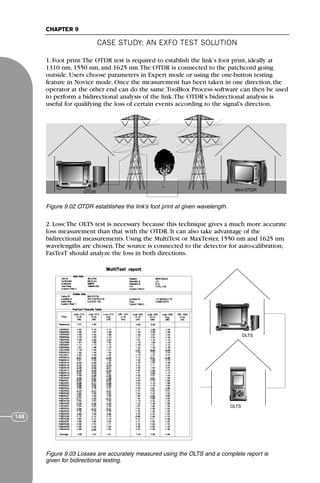
  • 112.
    5. EDFA gain(Both amplitude and spectral width; small signal gains of 30 to 40 dB are typical, while spectral widths of 40 nm are typical in non-extended-range EDFA.) 6. Receiver gain (as high and as stable as possible) 7. Fiber type and specifications (critical for data rate, dispersion, and maximum channel possibility) Even though it is possible to characterize system performance with the previous parameters, many more considerations have to be taken into account to carry out a complete study of the system performance. 5.1.1 Bit Error Rate (BER) Suppose the installer has a tentative design for a fiber-optic data link of the type dealt with in this chapter, that is, the type illustrated in Figure 5.01. How does the installer analyze it to see if it will meet requirements? Performance requirements are usually characterized in terms of an acceptable bit error rate (BER), whose value generally depends on a specific source-to-user application. It might be as high as 10–3 for applications such as digitized voice or as low as 10–12 for scientific data.The tendency is towards lower and lower BER requirements. Will the tentative link design provide the required BER? To answer this question, we must look at the receiver sensitivity.This specification indicates how much optical power the link must receive if it is to deliver the required BER. To determine whether the tentative link design can deliver this power, the installer must analyze it, i.e., step through the components of the link to determine just how much power will reach the receiver.This is done with a fiber-optic data-link power budget. SYSTEM INSTALLATION AND MAINTENANCE CHAPTER 5 97 Receiver User Transmitter Source Fiber-optic cable Figure 5.01 Typical point-to-point link from the source to the user Receiver Stimulus Detector Pattern generator Fiber-optic link under test Pattern, clock Figure 5.02 BER setup using a traditional pattern generator 71136 001-194_cb 11/10/08 8:58 AM K 97
  • 113.
    A power budgetfor a particular example is presented in Table 5.01.The fiber-optic link in question has the following attributes: The entries in Table 5.01 are self-explanatory. Clearly, the optical power at the receiver is greater than that required to achieve the necessary BER.The loss margin entry is significant since it specifies the amount by which the received optical power exceeds that required. In this example, it is 15.75 dB. Good design practice requires that it be at least 10 dB.Why? Because no matter how carefully the power budget is estimated, some entries are always forgotten and some are too optimistic. In other cases, vendor specifications turn out to be inaccurate and an allowance must always be made for future maintenance. 5.1.2 Loss Tests Losses depend on components and are a function of optical signal distance.They are to be expected in each component or subsystem, even with top-quality products. Losses are inevitable in connectors, multiplexers, demultiplexers, and in the fiber itself. The loss test is the principal evaluator of the performance of a system or link. Individual losses can be measured or interpreted according to a variety of procedures and criteria, but the primary result of loss testing is to provide an overall performance figure for the link in question. 5.1.3 Optical Return Loss When light is injected into a fiber-optic component, some of the energy is reflected. The optical return loss is directly associated with bad connectors or splices and defective components.We can also attribute the loss to the reflections that occur at discrete interfaces as a result of air gaps, misalignment, and mismatched refractive indices. SYSTEM INSTALLATION AND MAINTENANCE CHAPTER 5 98 LINK ELEMENT VALUE COMMENT Transmitter LED output power 3 dBm Value specified by vendor Source coupling loss -5 dB Accounts for reflections, area mismatch, etc. Tranmiter-to-cable connector loss -1 dB Transmitter to fiber-optic cable with ST connector. Value accounts for misalignment. Splice loss -0.25 dB Mechanical splice Fiber-optic cable attenuation -20 dB From other specifications or measurements Cable-to-receiver connector loss -1 dB Assumes an ST connector and includes misalignment Total loss -27.25 dB Sum of the five loss figures Optical power delivered to the -24.25 dBm Source power reduced by receiver the total loss Receiver sensitivity -40 dBm Specified in link design Loss margin 15.75 dB Table 5.01 Sample power budget for a fiber-optic data link 71136 001-194_cb 11/10/08 8:58 AM K 98
  • 114.
    The signal willlose power, the integrity of the data will be damaged by multipath interference, and the stability of the source will tend to become lower. The loss is a function of the component quality and accuracy. It fluctuates from one channel to another and this is the main reason why tests must be performed over the entire spectral range.The high-performance lasers used in DWDM systems are very sensitive to reflected light, which can degrade the stability of the laser and the signal- to-noise ratio, or even damage the source. Reflections can appear in the EDFAs and cause major increases in the noise figure.All these problems must be measured before and after the decisive signal is put to the network. Optical Return Loss versus Reflectance The terms optical return loss—often abbreviated to return loss—and reflectance are both commonly used to quantify reflected power.The two are often confused. Optical return loss or ORL is generally used to describe the total reflection in a fiber- optic network system or subsystem, measured at a specific location. ORL (dB) = 10 log10 (incident power/reflected power) ORL, measured in dB, is always positive (the incident power is always greater than the reflected power). For example, if, at a system interface, there is 1 mW of incident power and 1 µW of reflected power, the return loss is 30 dB.A higher value means less reflected power and, thus, better performance. Reflectance is usually used to describe a reflection at a single interface or other site at the component level, for example at a connector. Although ORL and reflectance are defined differently, each represents a ratio between the incident and reflected power.As both are commonly quoted in decibels, conversion from one to the other is simply a matter of changing the sign. Reflectance (dB) = 10 log10 (reflected power from specific interface/incident power). Reflectance, measured in dB, is always negative (reflected power is always smaller than incident power). For example, if, at a connector, there is 1 mW of incident power and 1 µW of reflected power, the reflectance is –30 dB.A greater negative value means less reflected power and, thus, better performance. 5.1.4 Optical Signal-to-Noise Ratio Although the BER is the best single parameter to characterize the performance of a link, it is determined principally by the optical signal-to-noise ratio (OSNR).Therefore, the OSNR is invariably determined whenever a dense WDM system is installed. It characterizes the “head room” between the peak power and the noise floor at the receiver for each channel. It is an indication of the readability of the received signal; a parameter of increasing interest as the limits for long distance applications are pushed farther and farther. SYSTEM INSTALLATION AND MAINTENANCE CHAPTER 5 99 71136 001-194_cb 11/10/08 8:58 AM K 99
  • 115.
    OSNR is graphicallyrepresented (Figure 5.03) as the ratio between signal and noise power as a function of wavelength.The value, measured at the output of the first multiplexer, should be greater than 40 dB for all channels. It will be greatly affected by any optical amplifiers in the link and will drop to about 20 dB at the end of the link depending on the link length, the number of cascaded EDFAs, and the bit rate.An individual EDFA should not degrade the OSNR by more than 3 to 7 dB. Optical noise, which has taken on new importance since the introduction of optical amplifiers in transmission systems, is due mainly to amplified spontaneous emission (ASE) in the EDFAs.Although the manufacturer has almost certainly tested the EDFAs individually, it is important to check their performance on-site, with all optical channels in operation and all cascaded amplifiers present, to confirm that overall performance expectations are being met. Gain variation merits special attention in multi-amplifier systems, as it will directly affect system power flatness.ASE noise figures can be particularly significant in some configurations, since this phenomenon degrades the signal-to-noise ratio in all optical channels. System gain will vary over time because of temperature changes, local stress, component degradation, and network modifications. The OSNR must be determined for each populated channel in a WDM system. Referring to Figure 5.05, it is defined as: OSNR = worst-case value of 10 Log Pι + 10 Log Bµ Nι Bρ where Pι is the optical signal power in the ith channel. Bρ is the reference optical bandwidth. (Bµ and Bρ may be either frequency or wavelength); Bρ is typically 0.1 nm. Nι is the interpolated value of noise power measured in the noise equivalent bandwidth, Bµ, for the ith channel: Nι = N(λι - ∆λ) + N(λι + ∆λ) 2 where ∆λ is the interpolation offset equal to or less than one-half the channel spacing. Deficiencies in ONSR must be dealt with by configuration changes, generally by adding optical amplification at appropriate points in the link. ONSR is obviously a particularly significant parameter to be determined at links between connected operators as a measure of the quality of the signal supplied. SYSTEM INSTALLATION AND MAINTENANCE CHAPTER 5 100 Figure 5.03 SNR is measured half-way from the adjacent peak. dB 71136 001-194_cb 11/10/08 8:58 AM K 100
  • 116.
    5.1.5 Gain Optical signalsare modified many times in passing from a source to an ultimate receiver in a network. In an optical network using EDFAs, the gain for individual channels depends on the channel population at that particular point, so means must be available to check that the signal-to-noise ratio of every channel remains adequate at the receiver; aggregate measurements are not sufficient.And, of course, means must be available to determine the cause of any discrepancies. Although the overall go/no-go criterion may be based on total power and the power in each channel, tracing the cause of weak channels may well require an ability to chek gain flatness at individual amplifiers, as well as to investigate a variety of polarization and non-linear effects.All require accurate spectral information about the signal. 5.1.6 Central Wavelength The central wavelength of each channel in the signal is probably the most important single characteristic, given that its accuracy ultimately determines the ability of the source to communicate with the receiver. The precise value of the central wavelength of each channel must be measured when the network is first installed to ensure that design specifications are met.These values must also be monitored during maintenance programs to detect unacceptable drift.The accuracy of central-wavelength measurement increases in importance as channel bandwidths and spacings are reduced. In a switched dense WDM optical network, a comprehensive, carefully planned policy is needed to govern wavelength usage, eliminate conflicts in wavelength assignment, and minimize possible interaction between wavelengths.The international standard for channel spacing now defines integer multiples of 100 GHz (about 0.8 nm).This spacing was chosen because it offers a good compromise between high capacity and tight component specifications, but it still represents a demanding tolerance for all the equipment in the transmission path. Spacing of 50 GHz is commonly used for new installations. SYSTEM INSTALLATION AND MAINTENANCE CHAPTER 5 101 Figure 5.04 Gain is not flat over the EDFA bandwidth. Figure 5.05 Central wavelength measured on a 50 GHz system. 71136 001-194_cb 11/10/08 8:58 AM K 101
  • 117.
    Since a 100GHz channel separation implies very narrow channel bandwidths, spectral drifts in the distributed feedback lasers used as transmission sources can have devastating effects on signal levels at the receiver end.Therefore, source stability and spectral purity are of paramount importance. Sidelobes are also of particular concern, since they can add noise to adjacent dense WDM channels.Although older, unstabilized lasers used in SONET networks cannot meet these requirements, existing transmission equipment can be upgraded for dense WDM use by replacing these sources with spectrally stabilized DFB models. In some cases, installed equipment can be converted to dense WDM by directly inserting OC-48 laser signals into the stabilized, modulated DFB. 5.1.7 Drift Real optical sources are not absolutely stable because both their output power and central wavelengths can be expected to drift. Figure 5.06 shows a typical result of monitoring a source over a 12-hour period. Drift is caused by such factors as temperature changes, backreflection, and laser chirp phenomena. The primary concern with drift is that the signal must remain within the acceptable channel limits at all times, under all operating conditions. Excessive drift may cause the loss of the signal in the affected channel.The drifting source may even spill over into an adjacent channel and interfere disastrously with the information transfer there. Drift must be measured and controlled to avoid loss of data. 5.1.8 Crosstalk Crosstalk—the unwanted contribution of energy in one channel to others—is another effect whose magnitude is difficult to accurately predict from pre-installation data; it must be observed in real life, with real (or at least simulated) signals present. Crosstalk calculations were discussed in section 4.4.1.They involve a detailed examination of the shape of the passbands of two adjacent channels to check that the amount of signal leaking from one to the other is negligible. Normally, a minimum of 25 dB is required between channels (Figure 5.07), but 13 dB might suffice for a submarine link, and 17 dB values have been tolerated in very long haul applications. SYSTEM INSTALLATION AND MAINTENANCE CHAPTER 5 102 Figure 5.06 The wavelength and power vary over time. Figure 5.07 The bold portion of peak 2 represents crosstalk in adjacent channels. 71136 001-194_cb 11/10/08 8:58 AM K 102
  • 118.
    Calculations based onpre-installation measurements cannot give accurate values; crosstalk must be checked when all the components of a network are assembled. Crosstalk must also be checked periodically during maintenance to assure the quality of signal transmission. 5.1.9 Non-linear Effects Non-linear effects that are not apparent when fibers are tested can become important only once a network is put into operation.The changes brought on by interconnecting equipment and installing it in the field can bring any of the effects outlined in section 3.3.4 to the fore, and care should be taken—especially during installation, but also at appropriate maintenance intervals—to check for non-linear perturbations. Four-Wave Mixing Although four-wave mixing is also a non-linear effect, it requires special attention because of the seriousness of its consequences on a network.When two optical signals interact in this way, energy extracted from them can turn up at wavelengths in use by other channels, thus seriously disturbing network operation.Although the effect is similar to crosstalk, its effects are not limited to the two conflicting channels. Its magnitude depends on the relative polarizations of the two interacting signals as well as their magnitude and channel spacing. Four-wave mixing can be reduced by increasing channel spacing or by using unequal channel spacing; either is difficult to achieve after a network design is finalized. For networks not already in place, using a fiber with an appropriate amount of chromatic dispersion can reduce four-wave mixing. Since four-wave mixing can at least potentially be counterbalanced, it is important to know its exact magnitude. 5.1.10 Polarization Mode Dispersion In the long fiber spans typical of real networks, polarization mode dispersion will arise from a number of causes such as inherent inhomogeneities in the fiber, mechanical perturbations from bends and stress-producing supports, and a variety of temperature effects. Because of the quasi-random nature of all these effects, the most useful characterization of the phenomenon is the expected value of the group-delay variation (<DGD>), the root-mean-square value of pulse broadening.Although <DGD> is a function of both wavelength and temperature, in most cases a single mid-range value will suffice to predict the point at which its effects will degrade network performance. SYSTEM INSTALLATION AND MAINTENANCE CHAPTER 5 103 Figure 5.08 The two side peaks are due to four-wave mixing. 71136 001-194_cb 11/10/08 8:58 AM K 103
  • 119.
    We noted earlierthat the character of PMD—and even the units most useful to express it—depends upon the degree of mode coupling in the optical fiber. In practical terms, the transition between the two states occurs at distances equaling the coupling length, Ic, of the fiber, that is, the length of fiber at which energy transfer between the polarization states becomes appreciable.Values of Ic seldom exceed a kilometer, and values below and around 300 meters are common, so most real-life networks operate under conditions of strong random mode coupling, in which PMD is expressed as an expected time delay per square root of the unit length (e.g., ps/ km). PMD is of particular significance in old cables laid in the late 80s when manufacturing techniques and processes were not as advanced as they are now and the phenomenon and its causes were not well recognized or understood. Now fiber manufacturers are aware of the importance of maintaining near-ideal core geometry throughout the length of fiber, and cable manufacturers take care to avoid placing undue stress on the fiber when winding cable. Finally, carriers and installers now appreciate the effect that the operating environment can have on PMD. But these kilometers of cable laid in the late 80s—with different types and ages intermixed—create complexity and difficulty for network operators who are planning capacity upgrades to OC-192/STM-64. 5.1.11 Chromatic Dispersion When judiciously selected and properly controlled, chromatic dispersion can minimize certain non-linear effects in optical fiber or even take advantage of them (as in dispersion-aided or managed fibers). In some situations, not only can the total dispersion be controlled, but various non-linear effects can also be minimized, even within and along a single fiber. Field measurement of chromatic dispersion will be more and more important in the future, though, as existing networks and infrastructures are investigated for their upgrade possibilities. SYSTEM INSTALLATION AND MAINTENANCE CHAPTER 5 104 Figure 5.09 Typical PMD measurement 71136 001-194_cb 11/10/08 8:58 AM K 104
  • 120.
    5.1.12 Other Phenomena Anumber of other phenomena are important to the characterization and performance of the components of a fiber-optic link.They include • Optical signal-to-noise ratio degradation (dB) • Optical-crosstalk-related parameters - In-band crosstalk ratio (dB) - Out-of-band crosstalk ratio (dB) • Frequency-response-related parameters - Ripple (dB) - Insertion loss (dB) - Channel width (GHz) • Polarization-related-parameters - Differential group delay (ps) - Polarization dependent loss (dB) - End-to-end PDL measurement (dB) Most of these subjects are dealt with in Chapters 3 and 4. 5.2 INSTALLATION AND PRECOMMISSIONING Before installing and turning on the system, certain tests must be carried out on the optical link that will be used. If the new WDM system will be using the equipment already in place, it is essential to check that the new system is compatible with this equipment. Several types of tests will allow the operator to ensure that the system works properly. From the network operator's perspective, it is desirable to keep to a minimum the number of system tests needed to demonstrate overall system functionality and signal- transmission integrity.Although procedures to test and deploy SONET/SDH single- channel optical transmission systems are well documented, emerging technologies such as WDM lack such detailed support. Optical component properties and cable characteristics that could safely be neglected in systems using simpler transmission techniques must be considered. Recent advances such as add/drop optical multiplexers permit wavelength routing over complex networks, complicating installation, acceptance, and maintenance test procedures. Optical cross-connects, although still on the drawing board, will radically change the configuration of future telecommunications networks and will probably entail even more intricate testing. An effort is underway to define a set of system-level tests to characterize the end-to- end network functionality of DWM systems, with due regard to optical signal transmission, multiplexing, supervision, performance monitoring, and survivability. These tests fall into five categories: - Network compatibility - Commissioning - Maintenance and monitoring - Inter-vendor operability - Architecture interconnections SYSTEM INSTALLATION AND MAINTENANCE CHAPTER 5 105 71136 001-194_cb 11/10/08 8:58 AM K 105
  • 121.
    5.2.1 Network Compatibility Networkcompatibility tests ensure that signals from existing non-WDM networks are compatible with the fiber interfaces to the WDM network elements and that the electrical power specifications of the WDM components are equivalent to those in existing networks. Essential field tests include those to measure end-to-end attenuation, optical reflections at the network interfaces, and dispersion when systems are being upgraded. End-to-end attenuation testing at 1310 nm and 1550 nm examines the fiber path for optical discontinuities and determines whether the fiber conforms to system requirements.Testing for reflected power from individual components, such as connectors and fiber joints, determines whether the effects of single and multiple reflections are within specified tolerances. Chromatic and polarization-mode dispersion testing is not routinely done on newer fiber during installation (unless dispersion compensators are present in the system), since these parameters are generally specified by cable manufacturers. However, these tests should be conducted on older installed fiber under consideration for high bit rate (OC-192/STM-64) use, or whenever fiber distances are sufficient to approach system dispersion limits. 5.2.2 Commissioning Transmission performance tests measure transmitter and receiver performance, optical amplifier performance, error behavior, and related effects that accumulate through WDM network elements. Laser wavelengths may vary because of manufacturing variations, thermal shifts, or frequency broadening.When a spectrally broadened signal propagates through a dispersive medium, such as conventional fiber, error rates rise. End-to-end optical testing should be performed at the system level, with all the building block components working together in the optical link.The net dispersion between the transmitter and receiver for all channel wavelengths, including those added or dropped at intermediate points, should be checked to ensure that it is within specified levels. Optical power and OSNR at the receiver should be measured.To achieve balanced OSNR levels among all the channels in DWDM systems, an OSA can be used to monitor the changes in OSNR as the transmitter levels are varied. The number of wavelengths available to a WDM system is limited by amplifier, passband, crosstalk, component drift, fiber non-linearity, and cascaded filter alignment tolerances. Optical amplifiers are widely used to compensate for component and transmission losses, and the impact of noise accumulation and cross-gain saturation needs to be carefully considered to minimize signal power variations.Transmission performance tests check end-to-end optical system performance. Channel wavelength, channel drift, optical signal-to-noise ratio, channel spacing, channel isolation, insertion loss, amplifier noise, gain flatness, bit error rate, jitter, and transmission delay are all critical parameters to be measured. Each of these tests will be defined in greater detail in section 5.3 where we will discuss commissioning tests. 5.2.3 Maintenance and Monitoring Operations, administration, and maintenance tests confirm the capability to perform network operations and management functions, to communicate with management systems and other network elements, to monitor the end-to-end performance of a link, and to isolate faults in replaceable or repairable components. Maintaining a WDM system means ensuring that the optical carriers remain within specifications, that the channel wavelengths are stable, and that the optical power level does not fluctuate more than the system can tolerate.Testing these parameters makes use of optical service channels that communicate among the WDM network SYSTEM INSTALLATION AND MAINTENANCE CHAPTER 5 106 71136 001-194_cb 11/10/08 8:58 AM K 106
  • 122.
    elements (NE/NE) andthe operation systems and network elements (OS/NE) via the embedded data communications channel (DCC), a local area network (LAN), or an optical supervisory channel (OSC). Maintenance tests are discussed in detail in section 5.4. Alarm surveillance and performance monitoring are included in this category.Access to key features and parameters—including system administration and security functions—must be checked, both locally and remotely, according to the specifications.These tests should be comprehensive enough to ensure that the network operator is able to monitor and control the state of the network. It is possible to use a channel dedicated to performing surveillance or transmitting information about the system’s status.This supervisory channel, as well as a complete supervisory system (RFTS), will be looked at in more detail in section 5.5. 5.2.4 Inter-Vendor Operability Inter-vendor operability tests demonstrate the ability of the system to inter-operate with equipment from other vendors. Often, optical transponders must be incorporated at interfaces between differing equipment.To avoid this costly and potentially troublesome addition, both the physical properties of the optical signal and its content (e.g., wavelength, line rate, coding format) must be standardized at the network interface.The ITU and other standards bodies are actively defining such standards for optical interfaces, architectures, and management, and tests are required to ensure that the standards applicable for each interface are met. 5.2.5 Architecture Interconnections Architecture interconnection tests corroborate the functionality and survivability of network interconnections. Recent WDM systems have been designed primarily for point-to-point connectivity over long distances, and optical network survivability is provided almost exclusively in the electronic layer by SONET. But present-day systems, which allow static wavelength, add/drop, and recently OADM capabilities, have become dynamically reconfigurable. High-performance switches and routers will route wavelengths over complex networks. Optical cross-connects and other advanced optical technologies will support topologies that are more flexible. Restoration architectures based on self-healing rings, diverse routing, or mesh-based distributed algorithms are receiving considerable attention. In light of all these advances in technology, service protection is becoming increasingly difficult to investigate exhaustively. Nevertheless, it is an essential aspect of the architecture that must be tested to ensure network reliability, survivability, and service consistency. The evolution of WDM technology will undoubtedly allow operators to approach more and more closely the intrinsic capacity of fiber-optic networks. However, the techniques used by system designers to increase capacity may differ from vendor to vendor. Increasing the number of carriers might be preferred by some (by expanding the operating WDM window and/or by reducing the channel spacing), while increasing the data rate of each carrier could be the choice for others.Whatever the path taken, the need for testing will evolve as fast as the technology, and testing procedures will have to be adapted continually to respond to changing realities. 5.3 COMMISSIONING A number of critical parameters should be measured and recorded when a network is first commissioned to check start-up performance and to provide a base line for future troubleshooting or upgrade planning.This testing period is so crucial that system vendors supply their own test sequences.The tests will be carried out on individual components and also on the system in operation.The objective of the commissioning tests is to demonstrate the general performance and integrity of the system. Basically, there are three series of tests.The first step consists of testing each system component SYSTEM INSTALLATION AND MAINTENANCE CHAPTER 5 107 71136 001-194_cb 11/10/08 8:58 AM K 107
  • 123.
    to check theirperformance and optimize data.The second step focuses on the complete system.We ensure that its performance conforms to requirements.The last step is often forgotten, but is, however, a very important function. It involves disruptive tests. Once all these tests have been carried out and when we can confirm that the entire system and its components conform to standards, we are ready to start operating the system and take advantage of WDM technology. 5.3.1 Transmitters The transmitter output power should be measured, using a power meter or an OSA and, possibly, a calibrated variable attenuator.An estimate should be made of the probable error and the result quoted appropriately; i.e., X±Y dBm. The central frequency should be measured using a calibrated wavelength meter and the result related to the ITU grid. 5.3.2 Receivers The receiver sensitivity parameter of most value is the input power for a specified BER. It is measured using a BER test set, a variable attenuator, and a power meter. It should be measured for all the ITU channels likely to be used in the application. Receiver crosstalk is usually described in terms of the spurious output present in each channel in turn, in the absence of an input signal in that channel, while signals are present in all other channels. Many modern OSAs include the capability to measure this integrated value of crosstalk directly. SYSTEM INSTALLATION AND MAINTENANCE CHAPTER 5 108 Power meter B Source Figure 5.10 The power meter provides source power levels with great accuracy. Power meter P BERT Splitter Receiver 3 dB dB → Figure 5.11 BER tester provides the receiver’s sensitivity limit. OSA MUX DEMUX Figure 5.12 The OSA measures crosstalk at the receiver end. Figure 5.13 Transponder (transmitter/receiver) courtesy of Siemens 71136 001-194_cb 11/10/08 8:58 AM K 108
  • 124.
    5.3.3 Optical Amplifiers Theoutput power of an EDFA is measured at saturation; i.e., when an increase in input power produces no increase in output power.The measurement is taken at 1550 nm using a tunable laser and a calibrated power meter. The gain flatness for large signals can be measured with the same setup, varying the input wavelength through the 1550 nm window in 1 nm steps and noting the output power at each wavelength. The bandwidth of an EDFA is the range between the wavelengths at which its gain falls by 3 dB, measured using an OSA. It should normally exceed 32 nm (i.e., 1530 to 1562 nm). Remnant pump power is a measure of pump energy that escapes from the EDFA. It is measured separately at the input and output of the unit, using an OSA.The input measurement is made at 980 nm, the output at 1480 nm. Amplified spontaneous emission (ASE) is measured similarly, at both the input and output, using an OSA and scanning the complete gain band.The result is generally given as a power spectral density, i.e., in dBm/nm (or, often, in dBm/0.1 nm). 5.3.4 Multiplexers and Demultiplexers The proper operation of multiplexers and demultiplexers is obviously central to obtaining useful network throughput, and quite a number of parameters are significant.All should be measured in a stable environment, in combination with other components whose behavior has been checked. In general, tests must be made at every channel wavelength used—or likely to be used—in the link. SYSTEM INSTALLATION AND MAINTENANCE CHAPTER 5 109 Tunable laser source Power meter IN OUT Figure 5.14 The tunable laser sweeps the EDFA bandwidth. P λ IN OUT OSA -25 dBm 980 1480 1540-1560 ASE Pump Output Figure 5.15 Bandwidth measurement with an OSA 71136 001-194_cb 11/10/08 8:58 AM K 109
  • 125.
    The input power-handling capabilitiesof demultiplexers should be tested to confirm that the output BER is acceptable when they are fed directly from an EDFA. In an installed network, this measurement is accomplished using a BER test set at one end of the link. The output power uniformity of a multiplexer is the peak-to-peak variation in power across all channels, with all transmitters active, measured with an OSA. The maximum variation should be less than 3 dB, to avoid introducing serious inconsistencies among the characteristics of different signal channels. The corresponding parameter in a demultiplexer is the output power level for each channel, measured using a calibrated power meter.The usual acceptance level is –20 dBm. SYSTEM INSTALLATION AND MAINTENANCE CHAPTER 5 110 MUX DEMUX Transponder BER tester dB → Figure 5.16 BER testing on a single WDM rack with an attenuator to simulate the link losses Power meter MUX DEMUX Figure 5.17 The power meter provides the power uniformity of all output ports. 71136 001-194_cb 11/10/08 8:58 AM K 110
  • 126.
    Insertion loss isclosely related to power uniformity. For a multiplexer, it can be measured using either a tunable source or a set of individual channel transmitters and an OSA, looking alternately at the input ports and the output port, to obtain an insertion-loss figure for each channel.An alternate technique uses individual channel transmitters, activated one at a time, and a power meter at the output. The central wavelengths and the bandwidths of the individual channels of both multiplexers and demultiplexers are important characteristics, and crosstalk can be estimated from them.These spectral qualities are measured using an OSA, with a wavelength meter for calibration. In most applications, the central wavelengths should correspond with ITU grid values.The bandwidth of each channel (the width at –3 dB) should be less than 0.2 nm. SYSTEM INSTALLATION AND MAINTENANCE CHAPTER 5 111 OSA MUX OSA Power meter MUX DEMUX a) b) Figure 5.18 Insertion loss is measured using a) an OSA at the mux level and b) a power meter at the demux level. MUX DEMUX DEMUX a) OSA MWM ASE source MUX b) OSA MWM Figure 5.19 Channel central wavelengths are measured using a) an ASE source and an OSA for the demux and b) the OSA with the system sources for the mux. 71136 001-194_cb 11/10/08 8:58 AM K 111
  • 127.
    Directivity is ofparticular importance in multiplexers, and it is usually checked during commissioning by connecting a laser to an input of the multiplexer and by connecting an OSA at every other input port. 5.3.5 System-Level Testing In addition to the various component and sub-assembly tests already outlined, a system-level performance test is obviously an essential part of commissioning a network. Its purpose is to demonstrate overall functionality and the integrity of data transmission in all the channels provided. A typical DWDM multiwavelength composite signal passes through one or more optical amplifiers before arriving at its destination, where it is demultiplexed and the original information channels are retrieved. The single most useful parameter characterizing such a system is the optical signal-to- noise ratio (OSNR), and two different measurement points are suggested. First, a single, time-averaged measurement is taken at the input to the demultiplexer.An OSA is used to examine the signal at this point and the OSNR is determined at different spacing depending on the system vendor requirement (by comparing the channel peak signal with the noise just outside the channel).An average value exceeding 18 dB is usually acceptable. SYSTEM INSTALLATION AND MAINTENANCE CHAPTER 5 112 OSA MUX DEMUX Figure 5.20 Mux directivity is analyzed with the OSA. Source 1 2 N OSA λ λ λ 1 2 N λ λ λ Figure 5.21 The OSA is used at any point along the link to characterize the system. 71136 001-194_cb 11/10/08 8:58 AM K 112
  • 128.
    Second, SNR ismeasured at the inputs and outputs of each of the optical amplifiers in the link, and uses the value to describe the overall link performance.A figure exceeding 21 dB is generally required for a 2.5 Gb/s system. The uniformity of the transmitter power is also of interest. It is generally quoted as the difference in power between the strongest and weakest channels, measured with an OSA at the output of the first optical amplifier (fed by the multiplexer).The OSNR should be high at this point (>28 dB for a 0.1 nm bandwidth) and the power variation among channels should not exceed 2 dB. Both the short- and long-term error performance should be checked.A standard link configuration is used to measure the short-term rate: six channels spaced at 50 GHz, each having a span loss of 25 dB, for example. Using a BER test set, the user can confirm that the bit error rate in each channel is acceptable (under 10–12 for a 25 dB span loss). The long-term error performance is also checked with a BER test set, at a realistic signal level (–15 dBm).The test should span a 24-hour period, so it is usually impractical to check every channel individually.Two good candidates are the channel that exhibits the lowest OSNR and the one with the highest power. SYSTEM INSTALLATION AND MAINTENANCE CHAPTER 5 113 OSA MUX DEMUX Figure 5.22 The OSA is the best instrument to measure OSNR. MUX MUX DEMUX Optical link Protocol analyzer Loopback Figure 5.23 A protocol analyzer displays the performance of every channel over a loopback optical link. 71136 001-194_cb 11/10/08 8:58 AM K 113
  • 129.
    An idea ofthe fragility of the link can be obtained by disturbance testing: removing and reinserting modules from channels at random while observing the signals in the remaining channels. Only the signal in the channel suffering the disturbance should be affected. The wavelength or frequency stability of the channels should be checked using a wavelength meter.The frequency of each channel should stay within ±5 GHz of the nominal frequency for systems using a channel separation of 50 GHz. A system-level cold-start test should also be performed.With BER monitoring equipment on a suitable number of channels, all the power should be turned off.After a suitable period (which will depend on the time constants of the power supplies and the maximum possible delays in control paths, but which should be at least a minute) the power should be restored. It is important to note the time taken for the signal paths to be restored and for all appropriate management functions to return to normal.There should be no spurious alarms. 5.3.6 Alarm Processing Most of the modules used in optical networks—transmitters, amplifiers, etc.—include one or more alarms, which are triggered by variations of various parameters from specific operating conditions. In some cases, alarms of graded levels are provided to give an indication of the urgency of repair. Alarm testing in general implies the deliberate modification of one or more operating parameters in a system that is otherwise in proper working order, to verify that appropriate alarm signals are generated. For a transmitter, parameters monitored include the output power, the temperatures of the heat sink, the laser itself, and the grating, if present, as well as the laser and thermo-electric cooler (TEC). The same parameters may trigger alarms on the laser pump module of an EDFA. In addition, loss of either the input or output signal should generate an alarm. In a receiver, the presence of an output (electrical) signal is monitored, as is the grating temperature, if there is one. Analogous monitoring should be performed in the supervisory channel, including all the relevant signal levels, drive currents, and temperatures. Another set (or level) of alarms deals with disruptive failures: the complete loss of a signal, for example, rather than a value that is not in line with specifications.The alarm system should respond appropriately to disconnecting such things as the input to a transmitter, the input and output of an amplifier, all channels entering a demultiplexer, or a single channel at a receiver. It should, of course, react properly to loss of power at any point in the link. The safe shutdown of EDFAs is a special case of disruptive failure.When the input signal is lost, not only must the appropriate alarm be triggered, but the pumping lasers must also shut down within the time period allowed by the technical specifications for the unit. SYSTEM INSTALLATION AND MAINTENANCE CHAPTER 5 114 71136 001-194_cb 11/10/08 8:58 AM K 114
  • 130.
    5.4 MAINTENANCE Dense WDMsystems have been around only since the mid 90s, so it is still difficult to identify with any certainty the new maintenance issues that will arise. High among problems likely to be encountered, however, is an increase in the bit error rate in a single transmission channel, a situation that could arise because of a drift in the wavelength of a distributed feedback laser source, an uncorrected gain tilt (variation of gain with wavelength) in an EDFA, an increase in EDFA noise, or an unexpected variation in the spectral transmission characteristics of some other component. In the extreme, single-channel degradation may reach the point at which the signal of a particular wavelength is lost completely. Whatever the extent of the loss, field test equipment and procedures must be available to identify the offending part or sub-system quickly and unambiguously. All of the parameters encountered in the manufacture, qualification, and installation phases of network management are of potential concern during maintenance, but several of them in particular are good candidates for frequent monitoring, as they are direct indicators of possible performance degradation. 5.4.1 Optical Signal-to-Noise Ratio Most degradations in transmission quality will be accompanied by a drop in the observed signal-to-noise ratio, so measurements of this parameter, for each transmission channel, are certainly among the most important to be taken during both routine maintenance and troubleshooting operations.The optical signal-to-noise ratio is relatively simple to obtain using an OSA. It is the ratio (or difference, when the values are expressed in dBm) between the peak channel power and the noise power within the channel bandwidth. Most power-measuring test instruments will give OSNR values automatically. 5.4.2 Losses Losses in WDM systems must be examined channel by channel, and the best instrument for the purpose is the OSA, possibly backed up by a wavelength meter for spectral calibration and verification. Standard methods of characterizing optical return loss have been discussed, using a source, coupler, and photodetector to measure the power reflected by the link, which would not be useable during the test.An OSA may be used as a detector to investigate wavelength dependence. However, in the field, useful results can usually be obtained more simply, using a small, portable backreflection meter or at the system level with the remote fiber test system (RFTS) working with actual network signal traffic as much as possible. SYSTEM INSTALLATION AND MAINTENANCE CHAPTER 5 115 BEFORE AFTER Wavelength drift λ1 λ2 λ3 λ4 Gain tilt EDFA noise Crosstalk P1 λ1 t or Figure 5.24 Problems that might occur during transmission 71136 001-194_cb 11/10/08 8:58 AM K 115
  • 131.
    5.4.3 Polarization ModeDispersion Of the three methods to measure polarization mode dispersion—Jones Matrix Eigenanalysis, wavelength scanning, and interferometry—only the third is well suited to field use. It is fast, does not require simultaneous access to both ends of a link, and can measure large values of PMD over long distances. 5.4.4 Chromatic Dispersion Although several methods have been described to measure chromatic dispersion, all four require specialized equipment and care in interpreting results, so the routine measurement of this parameter during maintenance operations is unlikely.The long- term impact of chromatic dispersion on dense WDM systems is not yet well understood, and major developments in field equipment to manage it in installed fiber may yet be needed. By using a programmable variable optical attenuator and a BER test set, parameters such as receiver sensitivity, input power range, signal degradation, and loss of signal thresholds can be checked. 5.4.5 Optical Gain The optical amplifier—almost certainly an EDFA in a dense WDM system—is a key component of any optical link, and maintenance personnel must be able to check its performance in the field. Gain and gain redistribution can be measured using an OSA, preferably one with memory. Input power is measured for each channel and the data is stored.The EDFA output is then examined and the channel levels compared with the stored values, giving both gain and the distribution of gain among the channels. Usually, noise levels (OSNR) can be checked at the same time.The total power can be calculated by integrating the individual channel contributions, or a separate power meter can be used. 5.4.6 Wavelength Accurate measurement of central wavelengths calls for interferometric techniques, i.e., a wavelength meter. For field use in dense WDM systems, the absolute wavelength accuracy should be better than about 0.005 nm. Signals may be weak, so a wide dynamic range, 30 to 40 dB, is needed.An OSA may be needed, in addition to the wavelength meter, to meet this requirement. A wavelength meter can also be used to monitor channels over time to detect wavelength and power drifts. 5.4.7 Crosstalk Measurements of crosstalk in the field are facilitated by the data-storage capability of modern OSAs. By using an optical switch, the operator can test each channel in sequence without changing connections between measurements.The power within each channel is stored and used to calculate crosstalk after all channels have been probed. 5.5 MONITORING Monitoring is not a test in itself, but rather the continual verification of live channels through whatever individual tests are feasible and appropriate. It is used both to detect variations in any optical characteristic of the network that might affect system performance and to gather statistical information. Monitoring functions range from the scheduling and management of tests to the analysis of the data acquired. SYSTEM INSTALLATION AND MAINTENANCE CHAPTER 5 116 71136 001-194_cb 11/10/08 8:58 AM K 116
  • 132.
    Monitoring is particularlyimportant in dense WDM systems, which are very sensitive to optical phenomenal such as dispersion, crosstalk, central wavelength drift, and so on.The ability to perform repeatable tests on critical parameters is essential if the user is to be able to recognize and respond quickly to indications of instability.A good live- channel monitoring system provides constant information about system performance, both specific and statistical. 5.5.1 Optical Supervisory Channel An optical supervisory channel (OSC) may be used, rather than monitoring a live channel, to test a system.An OSC is a single channel dedicated to the continuous observation of operations and transmission efficiency. It is used to detect failures, power losses, or any significant change to signal integrity. Instead of specific—possibly disruptive—tests at scheduled times, the OSC is used to transmit appropriate tests and control signals continuously. Because it can carry control information, its continuity must be assured, so a wavelength outside the EDFA operating band is usually assigned to it. OSC monitoring normally does not result in routine reports or statistics: if the system is operating correctly, no such reporting is needed.The OSC is simply a means to keep a constant eye on the overall network behavior, not to perform individual component tests.A functional and reliable OSC test helps the system controller to maintain constant optical power and to guarantee the quality of network transmission for the most efficient use of network resources. If the OSC detects a variation in signal integrity, a flag is raised to notify the operator. Although binding standards for the OSC do not exist, and a number of possible approaches are under study and in actual use, a consensus in the industry presently favors a wavelength of 1510 nm or 1625 nm.This is because it lies outside the EDFA operating band, yet is close enough to it to provide useful monitoring. Because components for use at 1510 nm are not yet readily available, other wavelengths have been considered, such as 1480 nm and 1310 nm, for OSC functions, depending on the system vendor. In itself, an OSC calls for no specific test equipment; the additional equipment it requires depends entirely on the parameters one chooses to monitor. If losses at splices or connectors are of concern, a power meter or—even better—an OTDR is needed.An OTDR can also check for certain potential fiber problems. Certain fiber strain defects may be easier to detect at the OCR wavelength than in the EDFA band. And optical loss budgets can be monitored with a variable attenuator and an optical loss test set. Another supervisory approach dedicates one of the DWDM channels to the monitoring function.Although this technique lacks the invulnerability to EDFA failure of a separate OSC, it does allow standard SONET/SDH protocols to be used to detect routing errors and transmission defects. One solution to the problem of invulnerability to EDFA failure is to monitor the spectral characteristics of one or several channels in parallel.The addition of spectral measurement instruments to the remote test unit (RTU) of an RFTS would allow easy and appropriate monitoring of transmission systems. SYSTEM INSTALLATION AND MAINTENANCE CHAPTER 5 117 71136 001-194_cb 11/10/08 8:58 AM K 117
  • 133.
    5.5.2 Remote FiberTest System A variety of instruments can be used to monitor networks.The most usual are the multiwavelength meter and the OSA, but in many circumstances, a PMD analyzer, an optical time domain reflectometer (OTDR), or smaller testing tools, such as a power meter, reflectometer, or backreflection meter, may be called for. Many of these capabilities are combined in the RFTS: probably the best solution for a complete monitoring of the live system. RFTS units are seen as key elements in providing many of the supervisory and maintenance functions needed in fiber networks.Their widespread use can be attributed to very real cost/benefit advantages: - A strong call for quality of service (QoS) – continuous monitoring of a network is an important strategic advantage for service providers. - A significant increase in revenue per fiber – the speed advantages of dense WDM networks (both OC-48/STM-16 and OC-192/STM-64) can be realized in information-carrying terms only if performance can be guaranteed at the channel level. - The high cost of maintenance – a test system that provides automatic surveillance of the physical network eases the workload of maintenance crews and directs their attention where it is most needed. Fast and easy fault localization is the key benefit to an effective monitoring system, but the capability to check the suitability of installed fiber before performance enhancements are undertaken can also often be significant. However, few, if any, of the RFTSs now in use on non-DWM networks are actually used to identify transmission faults. Instead, standard transmission protocols like SONET or SDH perform that function, reacting quite rapidly to interruptions (i.e., in less than 120 ms). SONET switching and network topology protocols can then be used to heal the network without interrupting service to its users. SYSTEM INSTALLATION AND MAINTENANCE CHAPTER 5 118 OSS RTU RTU RTU RTU Optical network controller workstation GIS map Central station/server (TSC) Dial-up PSTN Dial-up PSTN Remote optical network controller Ethernet TCP/IP Portable test system Figure 5.25 Typical deployment of a complete RFTS 71136 001-194_cb 11/10/08 8:58 AM K 118
  • 134.
    But dense WDMis not completely covered by protocol-level measures.This new technology brings a new layer—the optical spectrum—into the network hierarchy, and no protection is available for WDM channels at the physical level. In response, system providers are attempting to provide limited spectral supervision of dense WDM transmission systems. Several different transmission system monitoring techniques, incorporated into RFTS units, could bring a completely new dimension to fiber supervision. • Spectral monitoring – In the case of a channel fault As an OTDR detects faulty fiber in a simple link, an OSA can detect and identify a faulty channel in a DWDM system.A diagnosis can be made very quickly on the probable cause of the problem—OSNR, peak power, or channel wavelength—and appropriate corrective action can be taken. Even in the case of a complete loss of a channel, the overview an OSA gives of the other DWDM channels can provide crucial information about potential problems that may be pending because of the automatic redistribution of EDFA gain. • Spectral monitoring – Preventive maintenance Preventive maintenance of transmission systems can also benefit from a spectral monitoring system.Although DFBs are very stable over short periods, they are generally considered to be the key issue determining performance in the medium term (over a year or so). Considering the very tight channel bandwidth (0.1 to 0.2 nm) of today’s most advanced systems, it is a challenge to maintain adequate spectral stability over the entire life of the system: wavelength variations as small as 0.02 nm can cause loss of a signal channel.With its excellent wavelength accuracy (0.003 nm), an integrated multiwavelength meter is therefore a valuable tool to perform long-term drift measurements on DFBs and to highlight potential problems. • PMD monitoring – Optical link evaluation for OC-192/STM-64 bit rates Polarization mode dispersion is also increasingly a major limitation to network performance, and its unpredictable nature has led to the need to continuously monitor the PMD behavior of some links used at OC-192/STM-64 bit rates. PMD analyzers are also of interest for long-term spot checks in a network. Integrating their functions into an RFTS would provide an often-needed capability. One can either monitor the average PMD value over the link or monitor the DGD variation as a function of wavelength.The last method offers a great qualification of the maximum and minimum DGD with regards to every channel. There is tremendous interest in the industry to monitor newly installed systems to recognize symptoms of trouble before they lead to channel or system failure.The optical supervisory channel is now widely deemed to be inadequate to provide the quality of service needed in the competitive world of telecommunications.An evolutionary approach that incorporates needed measurement tools in a self-contained RFTS promises to provide a solution to meet everyone’s objective of building and maintaining efficient, reliable transmission networks. SYSTEM INSTALLATION AND MAINTENANCE CHAPTER 5 119 71136 001-194_cb 11/10/08 8:58 AM K 119
  • 135.
    5.5.3 Monitoring andTroubleshooting: An Example Operators and system maintainers must evaluate transmission quality on the fiber almost continuously.The goal of system testing is to demonstrate overall system functionality and the integrity of data transmission.To minimize the time and effort required, first-stage tests focus on examining the signal at the end of the link to check that optical performance is optimal before testing components individually.The next steps are increasingly specific, as we obtain more information about particular problems. Figure 5.26 outlines the steps in an effective test procedure. 1. The first test should be performed at the demultiplexer at the end of the link, to see if any further tests are needed.A wavelength meter can be used to check the OSNR and the wavelength accuracy of each channel.The OSNR at the end of the link should be greater than 18 dB for an acceptable BER (10–13, for example); OSNRs of 22 dB or less are typical. Depending on the system and the detector type, the channel power should be about –8 dBm.The channel wavelength should be within a few tens of pm of the nominal value (a measurement of this accuracy calls for a wavelength meter). SYSTEM INSTALLATION AND MAINTENANCE CHAPTER 5 120 Source 1 2 N λ λ λ 1 2 N λ λ λ 1 2 3 4 5 Figure 5.26 Testing points during troubleshooting Figure 5.27 OSNR measurement at the end of the link 71136 001-194_cb 11/10/08 8:58 AM K 120
  • 136.
    2. If thefirst step indicates a problem in the link, the transmitter power level at the output of the multiplexer is the next parameter to test: its specified value might be from –5 to 2 dBm, depending on the system provider. If there is a discrepancy at this level, the multiplexer should be checked for excessive loss. 3. The specific results of the previous tests will probably have identified the channel or channels in difficulty.The power and central wavelength of the appropriate source lasers should be checked. SYSTEM INSTALLATION AND MAINTENANCE CHAPTER 5 121 Figure 5.28 High OSNR obtained at the beginning of the link Figure 5.29 Typical DFB spectrum of a WDM system 71136 001-194_cb 11/10/08 8:58 AM K 121
  • 137.
    4. EDFAs arethe next candidates: their gain should be linear and uniformly distributed among the channels.A gain tilt of more than 3 dB may exceed specifications. 5. Digital test systems (SDH, Sonet, IP, or others) can help ensure transmission quality. The minimum input power for a good BER should be over –20 dBm at the detector level.The test is no longer of optical concern and electrical equipment is needed. After checking all these previous parameters and procedures, the system integrator is ready to "turn-key" the new DWDM system and fine-tune the last details before final commissioning. Now that the system is working, it will surely be audited by the end user via a quality control procedure.The idea is to check-list client requirements. Those requirements are strongly influenced by both the recommendations of the standardization bodies and industry trends.The next chapter will take a look at these standardization issues and their impact on customer performance requirements. SYSTEM INSTALLATION AND MAINTENANCE CHAPTER 5 122 Figure 5.30 EDFA gain characterization with input and output signals 71136 001-194_cb 11/10/08 8:58 AM K 122
  • 138.
  • 139.
    N E WS TA N DA R D S F O R D E N S E W D M S YS T E M S CHAPTER 6 124 6.1 WHY DO WE NEED STANDARDS? The emergence of standards is a sure sign that a particular technology has progressed significantly in its evolution from birth to widespread use.Timely, well-configured standards protect users from embarking on projects using design parameters or devices that are unlikely to be supported in the long term. Standards also provide guidance to innovative manufacturers on the most promising areas for product development.Although standards often evolve, each generation provides a stable environment in which useful systems can be implemented using devices and equipment whose fabrication is comfortably within the capabilities of providers at that time. Even more important, adherence to standards permits systems from different service providers to be interconnected and interoperated with relative ease, even though they may use dissimilar equipment and they may serve different needs.Without any standards, interfaces between such systems would be difficult or impossible to achieve; with less-than-optimum standards, performance compromises would be necessary, while with appropriate standards, multi-owner, multi-supplier networks can achieve overall levels of performance consistent with state-of-the-art technology. Finally, standards benefit both telecommunication providers, by encouraging a multi- vendor environment that fosters healthy competition, and equipment suppliers, by furnishing the basis for high manufacturing volumes that decrease unit costs. The influence of standards is well exemplified by the success of the Synchronous Optical Network Standard, or SONET, in North America, and the Synchronous Digital Hierarchy Standard, SDH, in Europe and Asia, which today allow the straightforward interconnection of networks using equipment from different vendors.Together, SONET and SDH standards are followed in virtually every optical network throughout the world. 6.2 HOW ARE STANDARDS DEFINED? International standards in the telecommunication, industry are defined primarily by two organizations.The first, the International Telecommunication Union (ITU), based in Geneva, is concerned with the definition of application standards, while the second, the International Electrotechnical Commission (IEC), deals with product standards. Both work closely with major national and regional standardization agencies such as the Telecommunications Industry Association (TIA) (USA), the European Telecommunication Standard Institute (ETSI) (Europe), and the TTC (Japan). See Table 6.01. Application-Oriented Product-Oriented Level ITU IEC International ETSI CENELEC Europe TTC JISC Japan EIA/TIA North America Table 6.01 Standards development organizations 71136 001-194_cb 11/10/08 8:58 AM K 124
  • 140.
    N E WS TA N DA R D S F O R D E N S E W D M S YS T E M S CHAPTER 6 125 Voting in these international organizations is by nation, with the vote of each participating country representing the views of an appropriate mix of government and telecommunications industry spokespersons from that nation. The decision process is based on the circulation and discussion of draft proposals until unanimous approval is reached.The inertia inherent in such a process means that standards usually lag behind technology by several years, but the eventual result is worth the wait, because the standards, once published, usually apply clearly and unequivocally to mature and well-defined technology.These standards can then be used directly to implement new systems, without the iterative steps that would be needed in the absence of such guidance. 6.3 DWDM STANDARDS DEVELOPMENT ORGANIZATIONS The very rapid development of dense WDM technology and the pressing need to bring its benefits to the field have led to the involvement of many national and international organizations in order to develop the standards needed to govern present installations and to guide future development. In the United States, the TIA,Telcordia Technologies (formerly Bellcore), and the Institute of Electrical and Electronics Engineers (IEEE) perform standards work for several industries, including fiber-optic telecommunications.Two major bodies develop voluntary standards at the international level: the IEC and ITU, both based in Geneva, Switzerland. 6.3.1 International Telecommunication Union (ITU) The ITU is a multilateral United Nations organization that brings together governments and the private sector to coordinate global telecommunications networks and services. It deals mainly with applications.The ITU covers three sectors: radio communications (ITU-R), telecommunications standardization (ITU-T), and telecommunications development (ITU-D).The sector most concerned with optical networks, ITU-T, develops voluntary standards to address technical, operating, and tariff issues in global telecommunications. Fourteen study groups, each composed of representatives from member countries, work continually on specific topics and make recommendations for standards. Every four years, the World Telecommunication Standardization Conference (WTSC) assembles members to define general policy for the sector, establish new study groups, and approve a four-year work program. ITU standards are voluntary, but compliance is widespread, because standards facilitate network interconnectivity and make it possible for telecommunications suppliers to provide services around the world. ITU-T Study Group 15 The ITU-T sector forms ad hoc groups to address specific issues (and dissolves them when the work is complete). Fourteen such study groups are currently active, and SG 15 (Transport Networks, Systems, and Equipment) is the one most involved in DWDM applications. SG 15 focuses on developing international standards relating to transport networks, switching, and transmission systems/equipment, including the relevant signal- processing aspects. Recently, for example, it began to address the transport of Internet Protocol (IP) data signals.Areas of major importance, which have attracted a number of new organizations to the ITU-T, are network access and issues related to optical networking.With about 345 participants from 26 countries and 78 scientific and industrial organizations, and with its focus on transport-related standards, SG 15 is one of the largest ITU-T study groups. 71136 001-194_cb 11/10/08 8:58 AM K 125
  • 141.
    SG 15 iscurrently working on some 89 new or revised recommendations addressing such topics as • digital subscriber line access (xDSL) • signal processing (echo control, equipment for interconnecting GSTN, and IP networks) • SDH/SONET (format, equipment, network architectures, IP over SDH/SONET) • ATM equipment (including IP-over-ATM equipment) • optical technology (systems, amplifiers, components, all-optical networking, IP on optics) • management of transmission systems and equipment (functions, services, and information modeling of network elements, including IP-related aspects) SG 15 is divided into four working parties (WP): Network Access, Network Signal Processing, Multiplexing, and Switching and Transmission.The last,WP 4/15 (Transmission), is responsible for all the aspects concerning transmission media and systems, with particular reference to optical fibers, systems, sub-systems, and components. In the optical field,WP 4/15 plays the role of initial leader for the Optical Transport Network (OTN) and is charged with: • preparing a framework recommendation on optical networking • preparing and updating of a list of optical networking activities • coordinating optical networking activities inside the ITU-T • coordinating activities for IP-over-WDM Formal questions particularly relevant to DWDM systems that have been the subject of recent WP4/15 recommendations include • characteristics and test methods of optical fibers and cables (Question 15) • characteristics of optical systems for inter-office and long distance (Question 16) • characteristics of active and passive optical components and sub-systems (Question 17) • characteristics of optical fiber submarine cable systems (Question 18) • reliability and availability of optical systems (Question 19) • characteristics of optical networking (Question 20) • optical interfaces for equipment and systems relating to the synchronous digital hierarchy • optical safety procedures and requirements for optical transport systems • optical interfaces for multichannel SDH systems with optical amplifiers (G.692) • definition and test methods for the relevant generic parameters of optical amplifier devices and subsystems • generic characteristics of optical amplifier devices and subsystems N E W S TA N DA R D S F O R D E N S E W D M S YS T E M S CHAPTER 6 126 71136 001-194_cb 11/10/08 8:58 AM K 126
  • 142.
    N E WS TA N DA R D S F O R D E N S E W D M S YS T E M S CHAPTER 6 127 Each of these study areas must be examined in considerable depth, with particular attention paid to the way technology is evolving, so that the lag between the leading edge and the commonplace is kept to a minimum. In the area of characterizing optical fibers and cables, for example, the WP recently reviewed and altered recommended test methods to include those pertinent to new fiber types, and added new methods dealing with non-linearity and non-uniformity. Detailed attention is also paid to the way complex phenomena, such as chromatic dispersion and polarization-mode dispersion, are defined and measured, so that component and system measurements can be exchanged among suppliers and users with confidence. An area of particular interest—because of the phenomenal growth rate in Internet access—is the use of the Internet Protocol (IP) directly in optical networks.The WP is studying the question and has recommended a structured approach, one aimed to ensure that routing equipment under development or being installed will now be compatible with future steps to provide IP-over-WDM, which promises a dramatic reduction in the bandwidth needed for Internet communication. Another area under study by the WP is the development of standards for new, high- capacity WDM network applications.A wavelength grid with spacing of 50 GHz has been proposed that is compatible with the present 100 GHz grid. Standards for systems up to 128 channels are included, as are those for lower capacity “inter-office” use and for unequally spaced channels (i.e., partially populated bands). Work has also been undertaken towards developing specifications for TDM systems operating at bit rates greater than 10 Gbps, with due consideration to the eventual upgrade of these links to WDM. In particular, the status of key technologies to support 40 Gbps TDM transmission systems is under review. Of particular interest to WDM testers is work currently underway on the uses of the 1625 nm region (1620 to 1660 nm) for remote fiber test systems (RFTSs), which are discussed in section xx, and for other monitoring applications. 6.3.2 International Electrotechnical Commission (IEC) The ITU addresses application issues: protocols, the definition and characterization of link phenomena, the allocation of compatible channels, etc.The IEC, on the other hand, addresses standards for products. Its concerns are not only limited to telecommunications but also include electronics, magnetics and electromagnetics, electroacoustics, and energy production and distribution. Approximately 50 countries are full members of the IEC; they have equal voting rights and are represented by National Committees.As much as possible, the National Committees—each of which is responsible for including the voices of public and private electrotechnical interests in its country—work together to provide consensus at the international level.There are also associate member countries, which have observer status but no voting rights. By setting international standards and producing technical reports, the IEC provides a solid foundation for national bodies to set regulatory standards.Adherence to standards is voluntary, even for IEC member countries. The IEC has formal links with several other international standardization bodies, including the International Organization for Standardization (ISO), the ITU, the World Trade Organization (WTO), and the European Committee for Electrotechnical Standardization (CENELEC).At the telecommunications level, many of the most active members of the North American TIA are also members of the IEC. 71136 001-194_cb 11/10/08 8:58 AM K 127
  • 143.
    Major decision-making atthe IEC follows an established chain of command from the governing committee, known as the IEC Council, through other administrative bodies, down to technical committees (TCs), subcommittees (SCs), and WGs.There are approximately 200 TCs and SCs, and about 700 WGs, representing the knowledge of about 10 000 experts worldwide, who prepare the technical documents needed in drafting international standards.Any IEC member country, as well as any organization with official links to the IEC, may contribute to standards. The TCs cover a multitude of topics, from household appliances to electro-medical equipment to superconductivity.TC 86, Fiber Optics, is a large committee covering fiber-optic communication systems and components including specifications and test and measurement methods. Its structure is outlined in Table 6.02. N E W S TA N DA R D S F O R D E N S E W D M S YS T E M S CHAPTER 6 128 STRUCTURE OF IEC TECHNICAL COMMITTEE TC86: FIBER OPTICS Liaisons Telecommunication Standardization Sector of the ITU (ITU-T) IEC Subcommittee 100 D (cabled distribution systems) Working Groups WG 1: terminology and symbology WG 4: fiber-optic test equipment calibration WG 7: discrete/integrated optoelectronic semiconductor devices for fiber-optic communications, including hybrid modules Subcommittees SC 86 A: fibers and cables WG 1: fibers WG 3: cables SC 86 B: fiber-optic interconnecting devices and passive components WG 4: test methods WG 6: interconnecting device specifications WG 7: component specifications SC 86 C: fiber-optic systems and active devices WG 1: systems and active devices WG 1: systems WG 3: optical amplifiers Table 6.02 International Electrotechnical Commission (IEC) structure 71136 001-194_cb 11/10/08 8:58 AM K 128
  • 144.
    N E WS TA N DA R D S F O R D E N S E W D M S YS T E M S CHAPTER 6 129 As one would expect, the interests of those developing standards for products are unlikely to be vastly different from the interests of those developing standards for applications.Therefore, it is not surprising that many of the TC 86 activities are on subjects already mentioned as current ITU areas. Such topics include PMD,WDM, optical amplifiers, and fiber specifications. The ITU work on choosing a reference test method for measuring PMD is reflected at a more practical level by the development by IEC TC 86 of PMD-related standards. For example, a technical report (IEC 61282-3) on calculating PMD in fiber-optic systems has been prepared. Published standards include PMD Measurement Techniques for Singlemode Optical Fibers (IEC 61941), which discusses all the commercially available PMD measurement techniques for singlemode optical fibers. Proposals for statistical PMD cable specifications, PMD test methods for optical amplifiers, and PMD measurement methods for optical components are currently under review. Other recent work includes dispersion compensation, PMD in digital and analog systems, and the development of PMD power-penalty relationships. A recently formed sector board, SB 4, addresses several topics related to the infrastructure of telecommunications networks that are relevant to WDM systems, including • standardizing installation conditions and instructions • DWDM techniques for optical amplifiers and fibers • xDSL techniques for installed and new passive infrastructures • major changes in fiber types and their influence on standards • twisted pairs for outdoor applications, optimized for ADSL • new developments in multimedia home cabling Another concern is the attenuation (insertion loss) of DWDM devices. Document IEC 61074 from the IEC SC 86B defines terminology in this area.The same committee is working with the ITU-T on a rigorous definition of central frequency. Generic specifications for optical amplifiers are provided in IEC Document 61291-1. A performance specification template for multichannel optical amplifiers, IEC 61291-4, is under discussion.A “black box" approach is taken to this and other product specifications: specifications that are as free as possible of application detail. IEC 61291-4 discusses automatic gain control and the relevant operating input power range, gain equalization, clamping criteria and spectral hole criteria. It provides generic specifications and—through related standards—performance specification templates for digital, analog, and multichannel optical amplifiers, specific to various application areas (power amplifier, pre-amplifier, line amplifier, etc.). The most important performance characteristics of optical amplifiers are covered: 1. Gain (IEC 61290-1) a) Small-signal gain in the forward and reverse directions b) Maximum value of the small-signal gain (absolute value, spectral profile and variation as a function of temperature) c) Overall spectral variation and wavelength band variation of the small-signal gain d) Small-signal gain stability e) Polarization-dependent gain variation 71136 001-194_cb 11/10/08 8:58 AM K 129
  • 145.
    2. Optical PowerMeasurement (IEC 61290-2) a) Nominal signal output power b) Large-signal output stability c) Saturation output power d) Maximum input and output signal power e) Input and output power range f) Maximum total output power Various limitations to the performance of optical amplifiers are included: 1. The noise figure (in dB) or noise factor (a linear value), which is one of the most important factors limiting the performance of EDFAs, can be measured following IEC 61290-3-1 (using an OSA and the interpolation method) or IEC 61290-3-2 (using an ESA and the Relative Intensity Noise (RIN) subtraction method) or IEC 61290-10-2 (the pulse method with a gated OSA). 2. The gain slope, which causes WDM signals on one side of the spectral band to be amplified more than those on the other. It can be tested following IEC 61290-4-1 (using a broadband source). 3. The return loss, critical because it can perturb adjoining EDFAs. It can be tested following IEC 61290-5-1 (using an OSA), or IEC 61290-5-2 (using an ESA), or IEC 61290-5-3 (with the tolerance method using a reflection generator). 4. Pump leakage to output and input, which also can generate interfering signals. It can be tested following IEC 61290-6-1 (optical demux test method). 5. Out-of-band insertion losses in the forward and reverse direction, which limit the total available power.The appropriate test is IEC 61290-7-1 (filtered power meter test method). Working groups within IEC SC 86C are engaged in defining reflectance and reliability testing, establishing gain and noise figures, and setting performance specifications. One such example is IEC 61290-1-3, Gain by Optical Power Method, which demonstrates that a gain measurement for a single channel made with a power meter and bandpass filter can be as valid as one taken with an optical spectrum analyzer.This is a highly cost-effective approach to gain measurement in production environments, provided that values can be checked periodically with an OSA. There is a major project to update the way fiber is specified, including standard test methods. Documents in the IEC 60793-1-x series propose fiber specifications organized by attribute and suggest appropriate restructured test methods. 6.3.3 Telecommunications Industry Association (TIA) The North American standards and conformity assessment body for all areas of telecommunications, the TIA, has two committees dedicated to fiber-optic telecommunications issues: FO-2.0 (Optical Communications Systems), responsible for system and applications level standards and FO-6.0 (Fiber Optics), responsible for product standards. Each has a number of active subcommittees and working groups, among which FO-2.1.1 (Optically Amplified Devices, Subsystems, and Systems), FO-2.1.2 (Working Group on Single-Mode Transmission Design), FO-6.3.5 (Passive Fiber-Optic Branching Devices), and FO-6.6.5 (Single Mode Fibers) are the most involved with WDM-related issues.TIA is an independent organization under the American National Standards Institute (ANSI), with both private and public membership. Many TIA members are also involved in ITU and IEC, and the Association maintains direct liaison with both. N E W S TA N DA R D S F O R D E N S E W D M S YS T E M S CHAPTER 6 130 71136 001-194_cb 11/10/08 8:58 AM K 130
  • 146.
    N E WS TA N DA R D S F O R D E N S E W D M S YS T E M S CHAPTER 6 131 FO-2.1.1 has recently addressed issues relating to optical amplifiers, including the definition and measurement of noise figure, round-robin test results, and relative intensity noise (RIN) artifacts. A draft entitled Optical Fiber Standard Test Procedure, OFSTP-6—Measurement of Optical Signal-to-Noise Ratio—produced by FO-2.1.2 proposes a scheme using an OSA based on a Michelson interferometer, a diffraction grating, and/or a Fabry-Perot interferometer. It provides values of the resolution bandwidth required to receive less than 0.1 dB error in the signal-power measurement. For example, for a 10 Gbps channel, a bandwidth of ≥0.2 nm is needed; and for 2.5 Gbps or lower, ≥0.09 nm is required. Guidelines and methods for the measurement of PMD and PDL have received recent attention from FO-6.3.5, especially for components to be used in WDM systems. FO-6.6.5 has addressed such issues as non-linear effects in fibers, new low-OH fibers and PMD measurements based on the Jones Matrix Eigenanalysis (JME), and Poincaré Sphere Analysis (PSA) methods. FO-2.1 Subcommittee on Singlemode Systems FO-2.1.1 Working Group on Optically Amplified Devices, Subsystems, and Systems FO-2.1.2 Working Group on Singlemode Transmission Design FO 2.2 Subcommittee on Digital Multimode Systems FO-2.2.1 Modal Dependence of Bandwidth FO-2.3 Opto-Electrooptic Sources, Detectors, and Devices FO-2.4 Subcommittee on Optical Terms, Definition, Document Control, and Safety FO-2.5 Subcommittee on Outside Fiber Cable Plant FO-2.6 Subcommittee on Reliability of Fiber-Optic and Active Optical Components FO-6.1 Fiber-Optic Field Tooling & Test Instrumentation FO-6.1.1 Working Group on Metrology and Calibration FO-6.3 Interconnecting Devices FO-6.3.1 Reliability of Adhesives in Optical Ferrules FO-6.3.3 Ferrule/Fiber Geometrical Measurements FO-6.3.4 Intermateability Standards FO-6.3.5 Passive Fiber-Optic Branching Devices FO-6.3.6 Splices & Enclosures FO-6.3.8 Reliability of Passive Components FO-6.3.10 Connector Specifications FO-6.6 Fibers and Materials FO-6.6.1 Round Robins and Multimode Optical Measurements FO-6.6.2 Fiber Specification Documents FO-6.6.3 Sensor Fibers FO-6.6.5 Single Mode Fibers FO-6.6.6 Step-Index Fibers FO-6.6.7 Fiber Coating FO-6.6.8 Long-Term Fiber Reliability FO-6.6.9 International Standards Harmonization FO-6.7 Fiber-Optic Cables FO-6.7.1 Editorial Task Group FO-6.7.10 Color Coding of FO Cables FO-6.7.14 Hydrogen Susceptibility FO-6.7.15 IEC Liaison/Ribbons FO-6.7.16 Cabled Ribbon Special Task Group FO-6.7.17 Impact Test Task Group FO-6.8 Specification Structure & Processing FO-6.9 Fiber-Optic Sensors FO-6.9.3/6.6.3 Sensor Fibers FO-6.9.4 PN Connector Working Group Table 6.03 TIA subcommittee structure STRUCTURE OF TIA FO-2.0 AND FO-6.0 COMMITTEES Liaisons US Department of Defense (DOD) Telecommunication Standardization Sector of the ITU (ITU-T) IEC TC-86, SC86A, SC86B, SC86C, through technical advisory groups (TAGs) 71136 001-194_cb 11/10/08 8:58 AM K 131
  • 147.
    6.4 OUTSTANDING ISSUES Anumber of tricky technical issues remain open, awaiting appropriate discussion and recommendations at the ITU-T and IEC levels.They include • ITU specification for multichannel systems (one is expected soon addressing compatibility issues) • upgrade of the ITU grid from 100 GHz to 50 GHz channel spacing; with 25 GHz spacing to come eventually • standards for extended range DWM operation, from 1528 to 1602 nm • channel counts of 128 wavelengths, with 256+ to come • span loss targets of 22 dB to 25 dB • optical supervisory or service channel specifications for 40 to 80 km point-to-point links • optical supervisory channel assignment within the DWDM ITU grid, to provide simple optical treatment along with the signal channels • further discussion of the +17 dBm power limitation, in place to meet Class IIIb laser safety requirements (more powerful lasers are available, up to 1 W, but Class IV laser safety would be expensive to manage and, thus, difficult to sell to investors) • consideration of the present 1650 nm limitation, which appears to be immovable because of OTDR, fiber attenuation, and macro-bending considerations As was pointed out earlier, solid standards are a strong contribution for new technology deployment as they provide the required, objective, general overview needed to arbitrate the different industry trends.The newest technology trend for the DWDM system is its movement to metropolitan networks, and even though the standardization organizations are working on this issue, many questions remain open, and new solutions to old problems are appearing every week. In the next chapter, we will take a look at this exciting new application of the DWDM system and will concentrate on its impact on testing issues. N E W S TA N DA R D S F O R D E N S E W D M S YS T E M S CHAPTER 6 132 71136 001-194_cb 11/10/08 8:58 AM K 132
  • 148.
  • 149.
    METROPOLITAN AREA NETWORKS CHAPTER7 134 7.1 A NEW ENVIRONMENT FOR DWDM Most of the deployment of fiber-optic technology in the recent past—especially that of DWDM technology—has been for long-haul service: OC-48 and OC-192 networks spanning distances of 50 kilometers and up.An entirely new area has now opened, however: the metropolitan area network (MAN), which provides communications service within cities and other restricted areas, right down to consumer cable service. Figure 7.01 shows the place MANs occupy in the communications hierarchy. Local exchange carriers face an increasing need for bandwidth, and laying new cable is usually very expensive in the urban environment, in particular for obtaining the rights-of-way, which is complicated by multiple civil jurisdictions and already-taxed cable supports and conduits. Increasing the channel capacity of individual fibers using TDM techniques is often unattractive because of the need for expensive equipment to add and drop low- traffic channels—and thus low- revenue channels— throughout the network. In principle, DWDM techniques can provide the needed increase in capacity for metro areas.The problem has been to do so at a reasonable cost because of the high quantity of equipment to be installed in the metro networks in comparison with the long-haul scenario. However, DWDM equipment is now available for this new market, whose importance will grow significantly: estimated sales of about US$200 million in 1998 are expected to reach close to $2 billion by 2003. Although only about 15% of clients in the residential market are expected to require 1.5 Mbps service between now and 2005, with only 20% of that group needing service at 2 Mbps or faster, demand in the small business sector will be more spectacular. By the end of 2005, up to 85% of small-business users will require data rates better than 2 Mbps, with 20% going as high as 45 Mbps. Copper-based access networks cannot easily accommodate a capacity growth of this magnitude, so, to a significant extent, they are capping the growth in demand and customers are slow to ask for services that are not available for demonstration. Fiber needs to get into the local access network before metro WDM will take off. 7.2 DWDM TECHNOLOGY IN METRO NETWORKS Metro DWDM technology is particularly appropriate for competitive local exchange carriers (CLECs), because of the reconfiguration flexibility it offers, which the supplier can translate into attractive options targeting a variety of market sectors.The transparency of optical transmission suggests that local transmission can be offered using native protocols (IP, Ethernet, etc.), with only a simple layer of SONET-like protection added. Incremental growth costs should be low, and the DWDM equipment needed for short metropolitan links should be significantly less expensive to buy, install, and maintain than the more complex equipment needed in long-haul operations, which are usually operating close to technological limits. BANK BANK Long-haul >200km Interaction 50 to 200 km With or without amplifier Access <60 km Without amplifier Access <60 km Without amplifier Figure 7.01 The WDM environment 71136 001-194_cb 11/10/08 8:58 AM K 134
  • 150.
    METROPOLITAN AREA NETWORKS CHAPTER7 135 That is not to say that metro DWDMs will necessarily be simpler than their long-haul counterparts. In fact, flexibility will be much more significant for local carriers, and particular attention will be needed to design-in as many reconfiguration possibilities as can be imagined, with as few assumptions about transmission protocols as can be managed.A great deal of emphasis must be given to providing sophisticated management tools that will allow this flexibility to be used easily, quickly, and—above all—cost-effectively. Installing metro DWDM does not necessarily imply replacing existing SONET networks: the two can live side by side, with parts of the metro DWDM carrying SONET traffic. Instead, good use must be made of the raw bandwidth offered by DWDM technology. For example, by using the many available channels to deliver services—SONET, IP, or ATM—each in its native format; metro DWDM systems can not only can accept traffic from devices supporting SONET interfaces, such as ATM switches and routers, but can also accommodate other protocols such as Gigabit Ethernet (GigE), FDDI, and ESCON.Although it may not be cost-effective to transmit “time inefficient” signals, such as Gigabit Ethernet, in their raw form on a dedicated long-haul DWDM channel, it may make sense to do so over the short distances typical of a metro system. As the SONET portion of such a network reaches its limits, it can by converted, link by link, for DWDM use, which can grow as needed, at least while channel space is available.The old traffic can still be handled—SONET channels can be provided— while entirely new business is added at very low incremental costs. Although metro DWDM link spans are characteristically short, they are not necessarily short enough to avoid the need for in-line optical amplification (by EDFAs, usually). Because needing or not needing EDFAs in the link represents a major cost break-point, metro DWDM networks are usually classified in one of two ways: interoffice or access. Link distances in the former generally exceed 50 km, and they are subject to many of the optical and equipment constraints typical of long-haul systems. However, the requirement for flexibility remains high. For example, they may provide the top-level service of a CLEC.Although these link distances may require in-line optical amplifiers, they can often operate cost-effectively at low data rates, thus reducing system costs. The short links of an access metro system provide compound benefits. First, EDFAs are not needed, saving considerable cost. Next, because EDFAs are not present, signal characteristics, such as wavelength tilt, are much less critical, so component selection, qualification, and maintenance are all simpler (although with no in-line amplification, insertion and other losses may actually be more critical in these components). Furthermore, non-linear effects in components or fiber are unlikely to present problems. Finally, the removal of EDFAs frees the system designer from using wavelengths outside the EDFA window, either for additional channels or to provide a wide channel spacing that will further relax the component quality needed.Taking full advantage of the potential simplifications offered in an access metro environment requires the investigation of a set of equipment and configuration options that is quite different from the choices that are relevant to the design of long-haul systems. DWDM equipment for metro use is often configured similarly to the existing network, whose capacity it is supplementing in rings (either two counter-rotating rings or a single bidirectional cable) that are compatible with the SDH ring network architecture. Monitoring and protection schemes are available to provide rapid path switching (tens of milliseconds) should a component or the fiber itself fail. 71136 001-194_cb 11/10/08 8:58 AM K 135
  • 151.
    METROPOLITAN AREA NETWORKS CHAPTER7 136 In a ring-based DWDM network, channels must be added and dropped at arbitrary points around the circuit, so channel balancing may be difficult, although its importance will be greatly reduced if EDFAs are not present. However, the topology itself may present apparent problems to certain potential new applications.A tree-like network, for example, is most appropriate for the delivery of CATV services to the home, so it most be possible to extract tree-like behavior from the ring net. Fortunately, means have been devised to simulate tree, point-to-point, broadcast, and other distribution topologies on a DWDM ring network through appropriate use of the many channels available. Still, requirements for specific logical configurations may require some alteration to the physical network. DWDM MANs (Figure 7.02-b) also offer an economic advantage over traditional links (Figure 7.02-a) because the complexity of equipment needed to add or drop a particular signal depends only on the characteristics of that signal.The add/drop equipment does not have to deal with the full bandwidth of all the information on the link. Costs are, therefore, closely related to actual benefits.And, of course, DWDM services can be added to a network link without disturbing the existing traffic—a consideration that is increasingly important as the need grows to provide day-to-day alterations in service. 7.3 MORE THAN JUST AN INCREASE IN CAPACITY Whether the electrical-to-optical network transformation takes place suddenly or over a long period, replacing or supplementing single-channel or TDM metro networks with DWDM systems offers much more than an increase in traffic-carrying capacity. Signals are no longer constrained to specific time slots or to specific protocols— protocols that heretofore have often been determined by network considerations rather than by the needs of the user of the service.A single network can simultaneously carry a variety of protocols—including data that is essentially analog— over a wide range of data rates. User-appropriate protocols—Ethernet, for example— can be handled transparently, without any need for signal conversion and without concern for particular transport-layer needs in the network. The information on each channel and the integrity of transmission can be protected individually, to suit specific needs. In particular, present-day protection protocols such as SONET can be handled without special provisions. Routing can be flexible, to accommodate applications from point-to-point communications to data collection and broadcasting. A B C D O C - 3 O C - 3 O C - 3 O C - 3 5 x O C - 3 O C - 1 2 SONET a) A B C D 1 6 / 3 2 λ s 1 6 / 3 2 λ s 1 6 / 3 2 λ s 1 6 / 3 2 λ s Optical ADMs b) λ1... λ4 λ1... λ12 λ9 λ12 λ5 λ8 TDM OC-48 TDM OC-48 TDM OC-48 TDM OC-48 OADM OADM OADM OADM . . . . . . Figure 7.02 a) The TDM metropolitan ring is overloaded between A an D and b) WDM topology is the logical solution. 71136 001-194_cb 11/10/08 8:58 AM K 136
  • 152.
    METROPOLITAN AREA NETWORKS CHAPTER7 137 DWDM MANs offer all these advantages, plus the ability, in many cases, to interface signals easily with compatible long-haul networks, without concern for bit-rates and protocols. Components and systems are now becoming available for these applications: two-fiber, interoffice spans cost approximately US$30 000 to $50 000 wavelength, and access metro systems are somewhat less. Extensive planning is needed to ensure that DWDM upgrades can provide all the SONET-like protection mechanisms that current customers require, while still offering the service-expanding new features inherent to DWDM technology. Price, immediate functionality, and future expansibility are all important considerations. 7.4 IMPACT ON TESTING NEEDS Regarding the testing requirements for DWDM systems in the metro areas, the parameters to check are the same but the strategic and economic realities will affect the threshold values to be checked and the testing procedures.The first important change is in portability and simplicity. Given the much more populated network structure in the metro regions and the high volume of optical transmission equipment that will be deployed, the testing instrument will be used at a lot of different points, and will be handled by many users.This requires very portable (handheld) instruments and a low price tag because of the number of units that will be needed. Because of the smaller distances and the possibility of non-amplified links working around 1310 nm, the metro DWDM system will demand more relaxed optical specifications when compared with long-haul systems.The impact on test equipment results in simpler instruments that are fast, easy to use, and provide only the required optical measuring performances. The simpler hardware will be accompanied by a more intelligent and powerful software to speed up testing analysis and reporting.Automatic testing will also be very important, because the need for testing many new parameters will put some pressure on testing crews.Automatic procedures will help the new user avoid the typical first measurement mistakes. Metropolitan DWDM networks are just one of the new exciting applications of DWDM technology. In the next chapter, we will describe some of the more relevant trends in the industry that will create a new wave of measurement techniques and equipment. 71136 001-194_cb 11/10/08 8:58 AM K 137
  • 153.
    METROPOLITAN AREA NETWORKS CHAPTER7 138 71136 001-194_cb 11/10/08 8:58 AM K 138
  • 154.
  • 155.
    THE FUTURE CHAPTER 8 140 8.1WHAT IS NEXT? Previous sections have described or hinted at some of the leading-edge technologies that are currently influencing the design and assembly of optical networks. How will this evolution proceed? Practical solutions to, or even the use of, the various optical phenomena that now limit service—polarization mode dispersion, chromatic dispersion, and non-linear effects, in particular—will gradually allow increases to both channel counts and bit rates in WDM systems.The resulting very high aggregate data rates will force service providers in two directions: toward greater “centricity” in raw data handling over common paths in order to take full advantage of the bandwidth that the technology will allow, and toward finer “granularity” in services offered thus tailoring user channels to meet the protocol data rate and reliability needs of specific market segments. It is certainly impossible to predict future technical developments—or even to predict with much accuracy how well and how long current technology will hold up—but Table 8.01 presents an outline of the technologies and techniques that are expected to play important roles in the near future. PAST PRESENT FUTURE Fiber - NZDSF - Dispersion- - Multicolor - Dispersion managed fiber - Ultra-low loss compensation - Better - Solitons compensation - Lower loss Transmission - 0.5 Tb/s -1.2 Tb/s - 2 to 5 Tb/s - 2.5 Gb/s per λ -10 Gb/s per λ - 40 Gb/s per λ - DWDM 32 λ - DWDM 128 λ - Soliton - UDWDM 200+ λs Bandwidth - Electrical - Electrical, optical - Optical Management - Async, SONET - Multiprotocol, ITU - Multiprotocol, ITU λ - Interfaces λ grid grid <10 Gb/s - STS granularity - Interfaces up to - Interfaces up to 40 Gb/s 10 G b/s - STS-3c granularity STS granularity - Fast switching - DCS Table 8.01 Technological progression from yesterday to tomorrow 71136 001-194_cb 11/10/08 8:58 AM K 140
  • 156.
    THE FUTURE CHAPTER 8 141 8.2FIBER The theoretical capacity of fiber is enormous—that of a singlemode fiber is perhaps 50 THz, under realistic assumptions. However, these astronomical rates will require considerable technological developments. Deployment of a 400 channel system seems feasible in the near future, and with each operating at a conservative 2.5 Gbps (allowing for an optical signal-to-noise ratio of 20 dB) a total bandwidth of 1 Tbps does seem attainable. Further foreseen developments will soon raise that figure to 2.5 Tbps. DWDM will continue to be the technology of choice, and the fixed add/drop multiplexers that are now being introduced will give way, first to field-reconfigurable units and later to remotely controllable ones. Network complexity will grow, especially as specialized services requiring specific logical configurations (CATV, for example) are overlaid on traditional services. Channel counts will rise, as will the requirements for laser stability and filter accuracy, and for sophisticated management tools for power and noise. DWDM-based architectures based on packet and cell switching and offering SONET,ATM, SDH, Gigabit Ethernet and IP interfaces will allow large businesses to “own” individual wavelengths on a net, thereby going a long way toward satisfying the growing demand for secure yet flexible communications among company sites. The transmission of Internet Protocol (IP) via optical fiber is on the immediate horizon, and the dramatic savings in possible bandwidth will spur its eventual adoption at all levels of Internet service. Over the past few years, the increase in installed fiber has doubled bandwidth capacity about every six months.To maintain this rate, cables containing many hundreds of fibers will be common in new installations, and fully deployed 128-channel DWDM systems will be widespread. 8.3 COMPONENTS More and more network overhead functions will be built into transmission components: transponders, in particular. Such features as SONET processing, forward error correction, automatic protection switching, bit error rate checking, and signal tracing will be included, all monitored by automated functions provided in an optical supervisory channel. Networks will become increasingly “all-optical” as research leads to new devices able to provide functionalities now available only in electronic equipment. Removing the need to recover and regenerate user traffic to pass through such a device will reduce the hardware complexity of networks, but it will increase the importance of the effects of various optical phenomena on signal integrity because, over increasingly long distances, signals will exist only as optical pulses. But a possible damper on the widespread use of all-optical networks exists: it is still too early to say if transparent pipelines can ever satisfy the needs of service suppliers and regulatory agencies to monitor, test, and manage information transfer right down to the bit level. DFB lasers are expected to be the transmitting sources of choice for dense WDM links for some time, especially as on-chip features are added to improve their performance and to ease their integration into networks. Nevertheless, other technologies are on the horizon. 71136 001-194_cb 11/10/08 8:58 AM K 141
  • 157.
    THE FUTURE CHAPTER 8 142 Multi-electrodelasers have been demonstrated whose operating wavelength can be controlled directly through signals applied to the laser chip. In another approach, a linear array of laser cavities has been produced in a single semiconductor wafer, with each cavity tuned for a specific wavelength and under individual electronic control.A chip incorporating 40 such channels has been reported. In yet another development, the “chirp” phenomenon that is so disruptive of narrowband communications schemes has been harnessed to generate many usable wavelengths—206 in the device reported—simultaneously from a single laser transmitter. New source techniques often require the development and use of improved multiplexing and demultiplexing techniques, as well as innovative network design philosophies. But despite these complications, upcoming source technologies should decrease the cost of dense WDM applications and increase network design possibilities. 8.4 TRENDS Even if soliton-based communication systems are not yet commercial realities, many indicators point to a rapid move from the laboratory to the service providers’ networks.The strongest force for implementation of this technology comes from the ultra-long-haul submarine cable applications.As this market is increasing, the need for a low-cost ultra-distance solution like soliton technology is expected to strongly increase as well. These types of systems will lead to a decreased cost per bit because of the elimination of repeaters or optical amplifiers.The soliton-based system will have to wait sometime before becoming a commercial reality because the optical transmission systems are still in evolution, but the volume of publications and research that is being conducted by both universities and industry is a clear indication that this technology is here to stay. Fiber to the home (FTTH) is a technology in the wings. Its major impediment is transceiver cost: it needs a laser in each home.Although this requirement is currently cost-prohibitive, it is possible that wireless technology (“fiber almost to the home”) will overcome at least some of the difficulties in the short term, providing adequate data rates without the need for extensive deployment of a completely new fiber infrastructure. In 10 years, 50% of homes will have FTTH using some form of wireless or fiber final link. Inexpensive vertical cavity surface emitting lasers (VCSELs) are already available for short-wavelength use, and developments are likely for the 1310 nm and 1550 nm spectral regions. Multimode (MM) WDM is another technology with promise for LAN and other short-haul applications, eventually including FTTH. Potentially it offers both lower cost and better reliability than its current competitors. One thing is certain: the increasing need for bandwidth is not going to abate.The phenomenal growth of Internet traffic has given service providers a taste of what can happen when a totally new service is offered. HDTV is just beginning to demonstrate its appeal to consumers, and millions of home viewers may ultimately decide that an unobtrusive cable is easier to deal with than a rooftop satellite dish. Past attempts to popularize such bandwidth-intensive services as video telephones have failed at least partly because of compromises needed to meet severe bandwidth constraints.When these constraints finally crumble, there is no telling what new conveniences consumers will demand. 71136 001-194_cb 11/10/08 8:58 AM K 142
  • 158.
    THE FUTURE CHAPTER 8 143 Evenwithout considering growth at the consumer level, business use of data networks for everything from inter-office communication to plant monitoring shows no sign of flagging. Indeed, one has only to recall the recent fears of a Y2K “meltdown” to underline the dependence of modern industry on reliable communications.And the ever-increasing cost of travel will make video conferencing a more and more attractive option for businesses large and small, especially if the one-view-at-a-time nature of present techniques can be overcome.Although the ultimate capacity of fiber-optic systems may seem able to meet any conceivable demand safely, we must not forget the predictions made early in the digital computer revolution that, perhaps, half a dozen of these strange devices would serve all the needs of North America. 71136 001-194_cb 11/10/08 8:58 AM K 143
  • 159.
    THE FUTURE CHAPTER 8 144 71136001-194_cb 11/10/08 8:58 AM K 144
  • 160.
  • 161.
    CASE STUDY: ANEXFO TEST SOLUTION CHAPTER 9 146 In the previous chapters, we talked about WDM system components as well as important test parameters at the individual component and complete system levels.A multitude of test combinations exists for a wide range of products. In this chapter, we will use a case study to present some of EXFO’s equipment as well as complete EXFO solutions. The examples used will briefly present the most important steps in implementing a WDM system and manufacturing individual components before installing and maintaining the complete system.These include • qualifying the optical link • quality control of individual component • commissioning • monitoring • maintenance and re-activation in case of fault Obviously, the instruments used in these examples vary from one supplier to another and there are alternatives to the choices that we propose. It is also important to note that these are not standards, but EXFO solutions. EXFO instruments are likely to change in the next few years and even months.Therefore, we suggest that you contact one of our representatives or company headquarters to obtain more details about new and existing testing instruments. A telecommunications company wants to invest in a WDM system to make full use of SONET systems already in place.They have very few optical fibers available and must therefore use several wavelengths on the same fiber in order to increase the bandwidth.They plan a very rapid expansion of their communications network within the next two or three years, which means they will need a system that can be upgraded.They will therefore immediately acquire a 32-wavelength system, but plan to increase to 128 wavelengths in the future. Channel spacing will initially be 100 GHz (0.8 nm), but will decrease to 50 GHz (0.4 nm) with the upgrade. Furthermore, the system will be bidirectional, that is, 16 wavelengths will go in one direction and 16 in the other. They currently use 2.5 Gb/s transmission speeds.With this project, they will increase transmission rates to 10 Gb/s, fully aware that it will be possible to upgrade when equipment for 40 Gb/s will be less expensive.The network has a point-to-point architecture—a single 180 km link with an optical amplifier placed at around 90 km. The fiber being used was installed at the beginning of the nineties and has never been tested in depth for today’s needs. A system cannot be bought and implemented without it being previously tested. Therefore, before buying the system, the customer must know if the optical link is capable of supporting these new wavelength parameters. 9.1 LINK QUALIFICATION Qualifying the optical link is absolutely essential before buying and installing a new system.The physical link plays an important role in system limitations and upgrading capabilities. Using an analogy, even the most performing cars could not reach their full capacity on roads that are not made for them.When testing the link, not only current needs but also future improvements must be taken into account. In this case, testing will be carried out in anticipation of the 128 channels at a transmission rate of 40 Gb/s. 71136 001-194_cb 11/10/08 8:58 AM K 146
  • 162.
    CASE STUDY: ANEXFO TEST SOLUTION CHAPTER 9 147 In the majority of cases, qualification of the link will be performed inside a central office (CO) or a secondary building, where the space available for test equipment can vary from comfortable to very limited. In this case, the company only has a small space inside a secondary building that is not close by.This is why portable instruments are often the units of choice for this first series of tests. Before deploying the system, the customer will have no instruments in place.Therefore, a company such as EXFO must supply all the necessary testing equipment, i.e., sources, couplers, switches, and a variety of detectors. To properly qualify the optical link, we suggest the following tests: • loss • ORL • PMD • chromatic dispersion • non-linear effects Since a system is already working on the link, it is not necessary to perform continuity tests. However, the link must be inspected. It is a good idea to take advantage of the fact that the other system is shutting down to perform a full series of tests. Each test will require connections. It should be noted that the instrument connectors as well as the patchcords connecting the system or the optical link must always be clean.The use of a talk set will facilitate the coordination of testing procedures at both ends of the fiber.All results obtained should be saved for future use or simply for internal use.This is what we propose: Talk set Talk set Figure 9.01 The talk set allows two or more operators to communicate over the cable under test. 71136 001-194_cb 11/10/08 8:58 AM K 147
  • 163.
    CASE STUDY: ANEXFO TEST SOLUTION CHAPTER 9 148 1. Foot print:The OTDR test is required to establish the link’s foot print, ideally at 1310 nm, 1550 nm, and 1625 nm.The OTDR is connected to the patchcord going outside. Users choose parameters in Expert mode or using the one-button testing feature in Novice mode. Once the measurement has been taken in one direction, the operator at the other end can do the same.ToolBox Process software can then be used to perform a bidirectional analysis of the link.The OTDR’s bidirectional analysis is useful for qualifying the loss of certain events according to the signal’s direction. 2. Loss:The OLTS test is necessary because this technique gives a much more accurate loss measurement than that with the OTDR. It can also take advantage of the bidirectional measurements. Using the MultiTest or MaxTester, 1550 nm and 1625 nm wavelengths are chosen.The source is connected to the detector for auto-calibration; FasTesT should analyze the loss in both directions. OTDR Mini-OTDR Figure 9.02 OTDR establishes the link’s foot print at given wavelength. AS ES OLTS OLTS Figure 9.03 Losses are accurately measured using the OLTS and a complete report is given for bidirectional testing. 71136 001-194_cb 11/10/08 8:58 AM K 148
  • 164.
    CASE STUDY: ANEXFO TEST SOLUTION CHAPTER 9 149 3. ORL: By using the ORL test set, the user can measure the ORL level.This measurement is very important because when it is too high, ORL can cause problems such as source instability or high BER at the receiver level.The instrument must therefore be connected to the patchcord going outside; the wavelengths employed in the system must be used. For ITU wavelengths, a 1550 nm wavelength should be used. ORL test set Figure 9.04 Return loss is important for system stability. 71136 001-194_cb 11/10/08 8:58 AM K 149
  • 165.
    CASE STUDY: ANEXFO TEST SOLUTION CHAPTER 9 150 4. PMD:Although PMD is a complex phenomenon, the PMD test is made easy with the PMD analyzer.The PMD value is critical to determine the maximum transmission rate that can be used on the link.The polarized source (1550 nm) is connected to the other end of the link and the analyzer at this end. No communication is necessary between the two, but the source must be turned on before taking an acquisition.When the source is turned on, the user must check that there is enough power on the PMD power bar.The total length of the link obtained with the OTDR is entered to obtain the PMD coefficient.The user can personalize the configuration or use Automatic mode, but more accurate values will be obtained by using the exact measurement range. PMD emulator PMD analyzer High-power polarized LED source Polarized LED source or Figure 9.05 The emulator qualifies the PMD analyzer used to characterize optical link performance. 71136 001-194_cb 11/10/08 8:58 AM K 150
  • 166.
    CASE STUDY: ANEXFO TEST SOLUTION CHAPTER 9 151 5. Non-linear effects:This phenomenon is crucial with the multitude of wavelengths. To test four-wave mixing (the most important non-linear phenomenon), two sources are used: tunable and fixed sources, along with an OSA.The sources will be installed at the other end of the link with a polarization controller and a coupler; the OSA will be at this end.The test involves using two identical polarized sources with similar power and bringing them close together.At a certain distance, two secondary peaks caused by the non-linear effect will be visible.The power of the secondary peaks and the spacing between them are indicators of the link’s quality. If the peaks have a wide spacing or high power, it means that there will be problems with the 128 wavelengths at 50 GHz spacing. In this particular case, the link will have no problems with the 128 wavelengths. The link seems to be of sufficient quality for the 128 WDM channels, but the transmission rate must be limited to 10 Gb/s, since the average PMD of 8.3 ps is higher than the ITU standard of 2.5 ps for 40 Gb/s rates.An order for the system can now be placed. F IQ-2400 IQ-2600 OSA DFB and tunable source WDM coupler Figure 9.06 Bring signals from the tunable laser and DFB laser close together and check if side peaks appear. 71136 001-194_cb 11/10/08 8:58 AM K 151
  • 167.
    CASE STUDY: ANEXFO TEST SOLUTION CHAPTER 9 152 9.2 COMPONENT TESTING: MULTIPLEXER Once the company that manufactures and sells the WDM system has received the order, it must begin to manufacture, buy, and assemble each component to make a complete system.At this stage, several tests will be performed on the components to ensure that they respect the necessary technical specifications.The tests are obviously performed when the components are being manufactured, but also after the purchase and before assembly.A system is composed of numerous types of components that come in various sizes.They may be metal frames or microelectronic chips and may come from all types of domains, i.e., optics, mechanics, electrical, electronic, even magnetic or chemical.The most important final components are the following: • transmitters • detectors • attenuators • switches • optical cross connect (OXC) switch • filters • couplers • DCD (dispersion compensation device) • OADM • mux/demux • Bragg grating • EDFA or any other optical amplifier The following example concentrates on the tests that should be performed to characterize a wavelength selective filter (multiplexer).The multiplexer is an essential tool for WDM, and several parameters must be tested.This is why we use the mux as an example, but it should be noted that the tests to be performed vary greatly from one component to another. (Refer to chapter 4 for more details.) The following tests will be performed: • central wavelength and channel spacing • ripple • channel uniformity • bandwidth • crosstalk • PDL • insertion loss • directivity • ORL For all possible component tests, it is preferable to use a laboratory instrument with the highest technical specifications.The following is the preferred assembly for these types of tests: 71136 001-194_cb 11/10/08 8:58 AM K 152
  • 168.
    CASE STUDY: ANEXFO TEST SOLUTION CHAPTER 9 153 1- Central wavelength and channel spacing: Since the primary function of the multiplexer is to combine all wavelengths (separate in the case of the demux), it is essential to qualify the component as a function of the wavelength.These two important parameters will be measured by using a broadband ASE source and an OSA. The source is connected to one of the input ports of the mux and the OSA to the output port.The central wavelength is then deduced by taking the halfway distance between the wavelengths where there will be 3 dB less than the maximum power.The spacing between each central wavelength will provide the channel spacing.The measured wavelengths should correspond as much as possible to those that will be used in the system, i.e., those in the ITU grid. 2- Ripple:The ripple will be measured using the same setup.This time, the analysis will concentrate on the shape of the spectral response. If the mux were perfect, the filter would have a perfectly rectangular shape at the output port, but in reality, there is a deformation at the channel peak that must be examined. Ripples are typically due to parasitical Fabry-Perot etalons that produce different spectral modulation noises. Ripples are usually sensitive to the input light state of polarization.A non- polarized ASE source provides an average measurement of the ripple amplitude. If this variation in power is too great, there will be significant variations in signal power for a small variation in wavelength. IQ-5240 IQ-2300 IQ-9100 OSA Switch ASE source Figure 9.07 Proposed setup to characterize the multiplexer Figure 9.08 Ripple causes variation in signal power. 71136 001-194_cb 11/10/08 8:58 AM K 153
  • 169.
    CASE STUDY: ANEXFO TEST SOLUTION CHAPTER 9 154 3- Channel uniformity:To avoid differences in the output power of the different multiplexed sources, it is important to check channel uniformity. By using the same test configuration, we must check that the output power of the channels is almost identical and that the channels have the same width.The highest transmission point will represent the maximum power and the channel width is calculated at 3 dB lower (FWHM). 4- Insertion loss:The insertion loss of a component is normally defined as the difference between the power entering and leaving a component or optical path: IL (dB) = Pin (dBm) – Pout (dBm) where IL is insertion loss in decibels, Pin (dBm) is input power in decibels referenced to a milliwatt and Pout (dBm) is output power referenced to a milliwatt.This equation quantifies the power loss in the device at a particular wavelength or in a given spectral region. Normally, insertion loss should be as small as possible. For components, it is not uncommon to measure insertion loss of 0.10 dB or even less. The critical instruments for accurately measuring insertion loss are a stable light source and a linear power meter. Other important points to consider include the type of fiber, type of source, launching conditions, mode filters, and polarization dependence. For both manual and automatic testing, EXFO has a wide range of instruments and accessories to simplify the task of accurately measuring insertion loss.We offer several instruments for benchtop use and as part of a modular platform: LEDs; Fabry-Perot and distributed feedback lasers; tunable lasers optimized for passive component testing; and single- and multichannel power meters. Figure 9.09 Channel width and power must be similar. Figure 9.10 Insertion loss must be taken into account for a loss budget. 71136 001-194_cb 11/10/08 8:58 AM K 154
  • 170.
    CASE STUDY: ANEXFO TEST SOLUTION CHAPTER 9 155 5- Bandwidth: By using a tunable source and a power meter, it is possible to properly define the band edges of each channel over a large dynamic range.The tunable laser, in this case, sweeps across a predefined wavelength range.The large-count power meters simultaneously measure transmitted power.With appropriate input power reference, it is possible to measure spectral insertion loss on 40 channels with a single sweep. F IQ-2600 IQ-1500 IQ-203 MUX Tunable source Power meter Figure 9.11 Bandwidth is an important specification for a multiplexer. 71136 001-194_cb 11/10/08 8:58 AM K 155
  • 171.
    CASE STUDY: ANEXFO TEST SOLUTION CHAPTER 9 156 6- Directivity/near-end crosstalk: Directivity, sometimes referred to as near-end crosstalk, is the measure of a device’s ability to block transmission among the input ports of the multiport filter.As shown in the figure below, directivity represents the power returned to the second input. Normally, this value is very small.The setup shown below can measure the insertion loss at ports 1 and 2 and then measure the directivity of inputs 1 and 2. Using a 3-channel power meter, measurements can be taken without any reconnection. It is important to note that the outputs must have low-reflection terminations for directivity measurement. If not, reflections from the fiber endface will transmit back through the filter and lead to poor test results. F IQ-2600 IQ-1200 MUX Source Power meter Figure 9.12 Directivity measurement 71136 001-194_cb 11/10/08 8:58 AM K 156
  • 172.
    CASE STUDY: ANEXFO TEST SOLUTION CHAPTER 9 157 7- PDL: Polarization dependent loss (PDL) is a measure of component sensitivity to state of polarization (SOP). Normally, it is expressed in dB.When PDL is added to the insertion loss, it represents the worst-case loss for the component.Almost all components are designed to keep PDL to a minimum, and it is not uncommon to see components with PDL specifications at 0.05 dB or less. PDL measurements taken with EXFO equipment are fast and accurate.The modular optical test system enables users to configure their system exactly as they want it.The user can choose between a polarized LED source, tunable laser source, or another external source.The polarization controller randomly scans all SOPs, and the total measurement is performed in five seconds. For PDL measurement using this system, no calibration is required, and the setup is insensitive to fiber movement. F IQ-2600 IQ-5100 IQ-3400 Tunable source PDL controller PDL meter MUX Figure 9.13 Fast, accurate PDL measurement 71136 001-194_cb 11/10/08 8:58 AM K 157
  • 173.
    CASE STUDY: ANEXFO TEST SOLUTION CHAPTER 9 158 8- ORL: Optical return loss (ORL) is a measure of the amount of optical power reflected by a component. It is expressed in dB. ORL = 10 log (incident power/reflected power) A device that has an ORL of 0 dB reflects 100% of the incident power, while a device with 20 dB ORL reflects 1%. Most passive components are designed to minimize reflected power, and it is not uncommon to have components with >60 dB ORL. At 60 dB ORL only 0.0001% of the optical power is reflected. Because of the low reflected power levels, accurately measuring high ORL poses some interesting challenges for instrument manufacturers. For accurate and stable return loss measurements, it is important to have a high-power, stable, and (ideally) non-coherent light source. High and stable power is important to achieve the required sensitivity (80 dB); the coherence properties of the source are necessary to avoid interference problems. If the coherence properties of the source are inadequate, large fluctuations will be observed on the measured ORL.The return loss meter, when used with the light source (optimized for ORL measurements), can perform stable ORL measurements to 80 dB.When used with the medium-coherence tunable laser source, ORL can be measured across the DWDM wavelength range. Most of these tests can be carried out automatically and quickly by using a test system dedicated to passive component testing.This assembly includes broadband sources (DFB and tunable) so that all types of tests can be performed, as well as a polarization controller, couplers, switches, a PDL tester, and an enormous capacity to save data for complete offline analysis. The multiplexer is of very good quality and will be just as efficient in the system as it is alone. Once all the other tests have been performed and the system has been tested in the factory, it will be delivered to the customer, who will have to perform his own series of tests. 9.3 COMMISSIONING When the company has received the system and installed it, it is important to perform a series of tests to check that the connected components provide the required performance and meet the installation requirements. In certain cases, the sum of all the small losses may introduce significant problems in the system.Therefore, we suggest critical testing procedures that will allow users to determine if they are ready or not to start up the system while maximizing the important parameters.These are the last tests that will be performed before the WDM system is turned on for operation. When the system is installed, the equipment in place (sources and multiplexer) can be used for testing.The environment in which the tests will be performed may be clean or dusty, very large or very restricted.Therefore, a good battery-operated portable instrument is definitely a must.The following will be tested: • transmitters • detectors • amplifiers (EDFA) • multiplexers/demultiplexers • the general system • alarms 71136 001-194_cb 11/10/08 8:58 AM K 158
  • 174.
    CASE STUDY: ANEXFO TEST SOLUTION CHAPTER 9 159 We suggest that users follow the test procedure proposed by the system vendor once the system has been delivered.To give an idea of the types of operations that the user will have to perform, here is an EXFO procedure to test the system’s important components: 1- Transmitters:The power and wavelength of each transmitter must correspond to the data supplied by the system vendor and be in accordance with the ITU standards.A power meter is used to accurately measure the power of each laser and a multiwavelength meter for high wavelength accuracy. MUX DEMUX OSA or MWM OR Power meter Figure 9.14 Characterize the system source with a power meter, OSA, or MWM. 71136 001-194_cb 11/10/08 8:58 AM K 159
  • 175.
    CASE STUDY: ANEXFO TEST SOLUTION CHAPTER 9 160 2- Detectors: Since the detectors must be able to detect the channel power to which they are each dedicated without experiencing crosstalk from other channels, an instrument that can make this type of calculation automatically must be used.To do this, we will use the system sources and an OSA.All the sources are connected and a measurement is taken with the OSA.Then, we terminate a source and measure the power coming from other sources inside this channel. MUX DEMUX OSA ASE source FLS-2600 TUNABLE LASER SOURCE Figure 9.15 Crosstalk measurement at the receiver end 71136 001-194_cb 11/10/08 8:58 AM K 160
  • 176.
    CASE STUDY: ANEXFO TEST SOLUTION CHAPTER 9 161 3- EDFA:The amplifier’s output power is measured at saturation, that is, when an increase in power no longer produces amplification.This measurement is taken in the 1550 nm region by using a tunable source with a variable attenuator and a calibrated power meter.The EDFA flatness is also measured with a tunable source that is swept across the entire amplification range and an OSA that recuperates the gain values. FLS-2600 TUNABLE LASER SOURCE OSA Power meter Tunable source Attenuator PUMP IN OUT GAIN GAN MAIN OR EDFA Figure 9.16 EDFA gain characterization 71136 001-194_cb 11/10/08 8:58 AM K 161
  • 177.
    CASE STUDY: ANEXFO TEST SOLUTION CHAPTER 9 162 4- Multiplexer/demultiplexer: It is very important that the 32 channels be stable and of equal power at the mux level just before initiating their propagation in the fiber or demux output port after channel separation.To check that the output power is flat, we turn on all the sources and connect the OSA to the mux or demux output port. In this way, we can measure the signal’s linearity. Next, by using the multiwavelength meter, we can ensure that the wavelengths conform to those of the ITU.As with the demux at the detector level, we can measure the crosstalk induced during wavelength multiplexing in the mux by using the same assembly: system sources and the OSA. Finally, the insertion loss will be measured by using the system sources and connecting the OSA to the input port and then to the multiplexer output port.The instrument subtracts one trace from the other to provide the insertion losses. 5- General system:The system tests will be performed with all the new system’s components working together.To do this, an OSA is connected to each of the system’s physical ports to measure the OSNR of each channel. Depending on the system vendor’s specifications and where users perform tests, values will vary between 18 dB at the very end of the system and 40 dB at the beginning.At the EDFA level, a certain gain should be recorded depending on the type of amplifier. Finally, a long-term test is preferable to check channel stability. By using the multiwavelength meter in drift mode, users will be able to follow the system wavelength drift with extreme wavelength accuracy. MUX DEMUX or OSA MWM Figure 9.17 The multiwavelength meter (MWM) provides very accurate wavelength measurements. 71136 001-194_cb 11/10/08 8:58 AM K 162
  • 178.
    CASE STUDY: ANEXFO TEST SOLUTION CHAPTER 9 163 6- Alarms:To check that all the system’s alarms work properly, simply disconnect each system component one after the other (sources, mux, demux, amplifier, laser pump, and detector) to check that an alarm will be displayed. All tests have been successful and the results are within the limits suggested by the system vendor.We can therefore start operating the system and take advantage of the significant increase in bandwidth (i.e., 32 wavelengths). 9.4 MONITORING 1- Generic Overview The basic idea is very simple.The intelligence of RTUs, which used to be the dummy units, is maximized thanks to their PC-based architecture. RTUs are located at strategic points throughout the fiber-optic network to cover the maximum of the user’s fiber- optic network. The RTUs include advanced OTDRs as well as optical switches to maximize the use of OTDRs. Each fiber connected to a port of the optical switch is then monitored 24/7 or according to an established schedule, by comparing OTDR acquisitions to standard OTDR responses, also called reference traces. For each of those fibers, upper and lower limits, or thresholds, are entered, and if one of the OTDR acquisitions exceeds the threshold, an alarm is automatically generated.This alarm usually includes different generic fields such as date and time, optical distance to the fault (OTDR measurement), loss, CO, affected cable and fiber, and much more. As shown in Figure 9.18, the carefully positioned RTUs report to a central station/server, also called test system controller (TSC).All information sent by RTUs is stored in a relational database for treatment and further SQL queries of all types.This central station also executes all communication functions with RTUs, workstations, and supervisory stations for remote users located anywhere in the field. OSS GIS map SOL database ONC workstation RTU RTU RTU RTU RTU Figure 9.18 Typology of an RFTS system 71136 001-194_cb 11/10/08 8:58 AM K 163
  • 179.
    CASE STUDY: ANEXFO TEST SOLUTION CHAPTER 9 164 Locating Faults This is where the RFTS really shows its strengths. Indeed, through the powerful graphical information system (GIS) embedded in the central station RFTS software, such as GeoMedia or Small World, users have the capability to map their fiber-optic networks and link them to specific data such as • type of fiber • manufacturer • type of connectors • installation date • to and from locations • fiber count • spare fibers • clients affected, etc. Users also have the possibility of entering landmark data, such as manholes, COs, towers, etc., with the exact locations in GPS or other types of coordinates. The optical distance to the fault allows the system to actually extrapolate the physical location of the fault by calculating the optical-to-physical ratio between every landmark of the network.The optical distance can be extremely different from the physical one (on the map) for many possible reasons: • fiber slacks left in manholes or poles • access fiber meandering along streets • helix factor, etc. 2- Connecting and Operating the System Physical Monitoring •Install the RTU (RFTS rack), and connect all fibers to be monitored to the optical switch.These fibers can be active or dark. F IQ-7000 IQ-9000 OTDR Switch Figure 9.19 The OTDR is the principal test instrument in the RFTS system. 71136 001-194_cb 11/10/08 8:58 AM K 164
  • 180.
    CASE STUDY: ANEXFO TEST SOLUTION CHAPTER 9 165 • Take reference traces for all the fibers to be monitored, with the OTDR connected to the optical switch at the RTU level.The reference trace is used to set upper and lower limits, or thresholds, and determine when alarms of different severity (minor, major, critical, etc.) will be generated.These thresholds can be set for • total link power loss • reflective event degradation • non-reflective event degradation • section attenuation • new event detection • launch level degradation, etc. Figure 9.20 Define the limits of the system. Figure 9.21 The reference trace is the basis for comparative analysis. 71136 001-194_cb 11/10/08 8:58 AM K 165
  • 181.
    CASE STUDY: ANEXFO TEST SOLUTION CHAPTER 9 166 • Enter the monitoring sequence. • Port 1 • Port 12 • Port 42 • Port 13 • … • Specify the interval (if any) between each monitoring cycle. • Start OTDR monitoring. Spectral monitoring • Install the RTU (RFTS rack), and connect all fibers to be monitored to the optical switch.These fibers have to be active. Figure 9.22 Monitoring sequence Figure 9.23 Specify the interval between each monitoring cycle. OSA Switch F IQ-5220 IQ-9100 Figure 9.24 The OSA is another test instrument used in the RFTS. 71136 001-194_cb 11/10/08 8:58 AM K 166
  • 182.
    CASE STUDY: ANEXFO TEST SOLUTION CHAPTER 9 167 • Take reference traces for all the fibers to be monitored, with the OSA connected to the optical switch at the RTU level.The reference trace is used to set upper and lower limits and determine when alarms of different severity (minor, major, critical, etc.) will be generated.These thresholds can be set for • central wavelength drift • SNR • signal power Figure 9.25 Define the spectral limits of the systems. 71136 001-194_cb 11/10/08 8:58 AM K 167
  • 183.
    CASE STUDY: ANEXFO TEST SOLUTION CHAPTER 9 168 • Enter the monitoring sequence. • Port 1 • Port 12 • Port 42 • Port 13 • … • Specify the interval (if any) between each monitoring cycle. • Start spectral monitoring. 9.5 MAINTENANCE AND TROUBLESHOOTING There are probably as many maintenance plans as there are system operators. Maintenance can vary in time and in the quantity and choice of tests. In reality, maintenance is very similar to commissioning.The only difference is it can be spread out over a period of six months to two years. During this period, critical specification tests will be performed more often, while less important parameters will be checked less frequently. The frequency of maintenance can always be changed depending on whether critical parameters drift from their original value.This drift will be visible when monitoring. If the system stops working and troubleshooting must be performed, the tests will be mainly concentrated on the defective component. Complete tests carried out during commissioning may be repeated or the manufacturer’s testing procedure borrowed. The test equipment necessary for maintenance is the same as that used for commissioning, but since the person in charge of this operation must move from one location or room to another, the unit must be portable and rugged to endure transport without requiring calibration.The frequency of the tests that we suggest takes into account the importance of the system’s components and the quality of the optical transmission. • Alarm testing every four months • System-level and EDFA testing every six or eight months • Mux/demux testing every 12 months • Source and receiver testing every 16 to 18 months Hopefully troubleshooting will represent only a fraction of the time that you will spend working with this system! Figure 9.26 The monitoring sequence of the OSA is different than the OTDR’s. 71136 001-194_cb 11/10/08 8:58 AM K 168
  • 184.
  • 185.
    Absorption Loss of lightin fiber caused by impurities, resulting from conversion of optical power into heat. Accuracy Defines how close a measurement is to its true value. Add/drop multiplexer (ADM) A component used to multiplex lower-speed electrical and/or optical signals into a high-speed optical channel and vice versa.An add/drop multiplexer can support either time-division multiplexing (TDM) or dense wavelength- division multiplexing (DWDM). It also links individual lines to backbone trunks. Amplified spontaneous emission (ASE) The light emitted from the decay of the upper level of a lasing transition without stimulated emission. In general, this emission is spectrally broad and unpolarized. Amplitude modulation (AM) Transmission technique where the information is encoded in the amplitude of the carrier. ANSI American National Standards Institute. Arrayed waveguide grating (AWG) Also known as a phasar.An integrated optical component which serves as an optical multiplexer/demultiplexer. It is based on the phase differences experienced by different input wavelengths to separate the channels, much like the classical diffraction grating. ASCII American Standard Code for Information Interchange. Asynchronous transfer mode (ATM) A high-speed transmission scheme providing bandwidth on demand for multimedia (voice, video, or data). Asynchronous transmission Occurs when the beginning and end of the data unit being transmitted is individually signaled by the transmitter with start and stop bits. Attenuation The diminution of average optical power.Attenuation results from absorption, scattering, and other radiation losses.Attenuation is generally expressed in dB without a negative sign. Attenuator An optical device that reduces the intensity of a light beam passing through it. Avalanche photodiode (APD) A photodiode that produces current through internal amplification.This is referred to as avalanche multiplication. GLOSSARY 170 71136 001-194_cb 11/10/08 8:58 AM K 170
  • 186.
    Backbone A network designedto interconnect lower-speed channels. Backscattering The portion of scattered light that returns in a generally opposite direction to that of propagation. See Rayleigh scattering. Bandpass Defines the range of frequencies that pass through a filter or other devices. Bandwidth Measure of information-carrying capacity; the greater the bandwidth, the greater the information-carrying capacity. Bend loss The result of macrobends (curvature of fiber) or microbends (small distortions in the fiber) producing increased attenuation by coupling light energy from the fiber core to the cladding. Birefringence The property whereby the effective propagation speed of a light wave in a medium depends upon the orientation of the electric field (state of polarization) of the light. Bit error rate (BER) The number of digital highs on a transmission link that are interpreted as lows, and vice versa, divided by the total number of bits received. In modern networks, BERs much better than 10-9 are expected. Brillouin scattering In stimulated Brillouin backscattering (SBS), the laser signal creates periodic regions of altered refractive index, that is, a periodic grating that travels as an acoustic wave away from the signal.The SBS effect can result in a very noisy and unstable forward-propagating signal, since much of the optical energy is backscattered. Broadband Supporting a wide range of carrier frequencies (e.g., voice, data, or video). Buffer coating Protective material that covers and protects a fiber.The buffer has no optical function. CATV Acronym for cable television. C-band (conventional band) The spectral window from about 1525 nm to 1565 nm corresponding to the strong amplifying range of the silica-based erbium fiber. Central office (CO) Building that houses a telephone company’s communications equipment. GLOSSARY 171 71136 001-194_cb 11/10/08 8:58 AM K 171
  • 187.
    Central wavelength Wavelength ofa source’s peak power. Channel isolation The ratio of the light in an optical channel that corresponds to the desired spectral range against the contribution due to light at other wavelengths. Chirp A change in the characteristic optical frequency of a device as a function of time (e.g., modulated diode laser) or position (e.g., chirped fiber Bragg grating). Chromatic dispersion A phenomenon caused by the wavelength dependence of group velocity in an optical fiber. Since any practical light source has a certain spectral width, chromatic dispersion results in pulse broadening.The coefficient describing chromatic dispersion per unit length is generally given in units of ps/(nm.km). Cladding Low refractive index material surrounding the core of a fiber. Coherence A phenomenon whereby the phases of the photons (or constituent wave trains) of a light beam maintain a definite relationship with each other.A narrow linewidth laser is said to exhibit a high degree of coherence. Connector Hardware installed on cable ends to connect cables to a transmitter, a receiver, or another cable. Connector adapter A device that allows a connectorized fiber to interface with a power meter. Core Center section of the optical fiber carrying and guiding light. Coupler Optical device containing several input and output ports to distribute optical power. CPU Central processing unit. Crosstalk Undesirable signals in a communication channel due to leakage or coupling from another channel. Cutoff wavelength The shortest wavelength for which an optical fiber can only support the propagation of a single transverse mode. Dark current Thermally induced current of a detector in the absence of incident light. GLOSSARY 172 71136 001-194_cb 11/10/08 8:58 AM K 172
  • 188.
    dB–Decibel Standard logarithmic unitfor the ratio of two quantities. In fiber optics, the ratio is optical power and represents loss or gain. dBc Decibel referenced to the carrier optical power. dBm Decibel referenced to a milliwatt. Demultiplexer (Demux) Separates X different channels (wavelengths) of a signal into X different signals. Dense wavelength-division multiplexing (DWDM) WDM technology where channels are closely spaced and typically concentrated within the 1550 nm wavelength region (C-band). Detector Transducer that converts incident optical energy to an electrical signal at a receiver device. Differential group delay (DGD) There are two mutually orthogonal input states of polarization.These are known as the input principal states of polarization, one of which corresponds to the fastest and the other to the slowest pulse propagation time through the fiber.The difference in these two propagation times is known as the differential group delay (DGD). Diffraction grating A bulk optical element that causes a reflection often at one or more wavelength-dependent angles.This element is based upon coherent scattering from an array of fine, parallel, equally spaced reflecting or transmitting lines. Directivity The ratio of light that passes through the desired port against the light that leaks through to an undesired output port in a multiport device (e.g., optical circulator). Dispersion Signal distortion caused by differing path lengths of the modes in the fiber, which results in the broadening of an input pulse along the distance of the fiber and limits the bandwidth. Distributed feedback laser (DFB laser) An injection laser diode that has a Bragg reflection grating in the active region to suppress multiple longitudinal modes and enhance a single longitudinal mode. DSn The hierarchy of channel capacity for the transmission of digital signals used in North America.A DS1 channel supports 1.544 Mb/s and holds 24 DS0 channels at 64 Kb/s.A DS3 is made up of seven DS2 channels (four DS1 channels) that are multiplexed and transmitted at 44.736 Mb/s. GLOSSARY 173 71136 001-194_cb 11/10/08 8:58 AM K 173
  • 189.
    Dynamic range For anoptical instrument, generally defined as the ratio (in dB) of the smallest signal that can be observed (at a specified wavelength separation) in the presence of a strong, nearly saturating signal. EDFA Erbium-doped fiber amplifier. Edge-emitting LED (EELED) A type of LED that emits via a rectangular-shaped edge facet. Designed for WDM component manufacturing and testing. EIA Electronic Industries Association. Electromagnetic interference (EMI) Any electrical or electromagnetic interference that causes degradation, failure in electronic equipment, or undesirable response. Optical fibers neither emit nor are affected by EMI. Erbium-doped fiber amplifier (EDFA) An optical amplifier that uses active erbium-doped fiber and a pump source (laser) to boost or amplify the optical signal. ESA Electrical spectrum analyzer. Fabry-Perot (FP) laser Laser with multi-longitudinal modes. Fault Break in the continuity of the optical fiber’s normal performance. Fiber Bragg grating A spectral filter based on a periodic variation in the refractive index in an optical fiber’s core. It is a key component in devices such as optical multiplexers, dispersion compensators, and gain-flattened EDFAs. Fiber coating Material immediately around the cladding covering the optical fiber to preserve the integrity of the fiber. Fiber distributed data interface (FDDI) ANSI architecture for a metropolitan area network (MAN); a network based on the use of optical fiber to transmit data at 100 Mb/s. Fiber in the loop (FITL) Deployment of fiber cable in the local loop, that is, the area between the telephone company’s central office and the subscriber. Flatness Spectral uniformity of the WDM optical signal. FOA Fiber-optic adapter. GLOSSARY 174 71136 001-194_cb 11/10/08 8:58 AM K 174
  • 190.
    Frequency modulation (FM) Transmissiontechnique where information is encoded in the frequency of the carrier. Fresnel reflection Reflection of a portion of the light incident on a planar interface between two homogeneous media having different refractive indices. For a perpendicularly-cleaved fiber terminated in air, the Fresnel reflection is -14.6 dB if the fiber’s index of refraction is 1.46. Fused biconic tapered (FBT) device A type of optical coupler based on the melting together of two optical fibers along a certain predetermined length (typically 2 to 5 mm).This fusing of fibers results in a certain transfer of energy from one fiber to the other. FWHM Full width half maximum. Gain Gain is the ratio between the average output and input powers, omitting the contribution of the amplified spontaneous emission (ASE) of the amplifier itself. GPIB General purpose interface bus. Graded index fiber An optical fiber whose core refractive index uniformly decreases from its center out to its edge. Normally used to refer to multimode fibers. Group index Ratio of speed of light in a vacuum against the speed of propagation of a light signal in a fiber. HeNe Helium-neon laser. HiBi High birefringence fiber. IEEE Institute of Electrical and Electronics Engineering. It is a professional body that is very active, among other fields, in fiber optics and opto-electronics. Index-matching gel Material with an index of refraction that is almost equal to that of the fiber core; used to reduce Fresnel reflections. Index of refraction Ratio of the speed of light in a vacuum to the speed of light in a given material. Insertion loss (IL) Loss of optical energy resulting from the insertion of a component or device into the optical path. GLOSSARY 175 71136 001-194_cb 11/10/08 8:58 AM K 175
  • 191.
    International Telecommunication Union(ITU) International standards development body for telecommunications, and the source of many network standards. L-band (long band) The spectral window from about 1568 nm to 1610 nm. Local area network (LAN) A communications network that links data processing and telecommunications equipment within a confined geographical area. Different elements include servers, workstations, a network operating system, and a communications link. Laser Acronym for light amplification by stimulated emission of radiation. Source of highly coherent light via stimulated emission. Semiconductor lasers find widespread use in the fiber-optic industry. Light-emitting diode (LED) A semiconductor device that emits incoherent light. Linearity For optical measurement instruments, generally used to refer to the deviation of a measured change of a performance parameter (e.g., power, wavelength) from the expected change. Loss See attenuation. Mach-Zehnder interferometer A device that divides an optical signal into two optical paths having different, generally variable, path lengths.When these two beams recombine, they interfere.These devices are often used as external intensity modulators. Macrobending Curvature of a fiber that causes loss of light. Mandreling Wrapping an optical fiber or cable around a cylinder to induce changes in optical propagation (e.g., loss in singlemode fiber, mode mixing in multimode fiber). Material dispersion Dispersion caused by the wavelength dependence of the optical fiber’s index of refraction. Measurement range Difference between the launch signal level at the interface to the fiber under test and the minimum level at which an event can be accurately identified and measured within defined limits. Metropolitan area network (MAN) A stretched LAN providing data communication over a distance of about 50 km, generally associated with the IEEE 802.6 MAN standard. GLOSSARY 176 71136 001-194_cb 11/10/08 8:58 AM K 176
  • 192.
    Microbending Microscopic bends orbumps in fiber; these cause loss of light by transferring light energy from the guiding core to the cladding. Mode Distribution of electromagnetic energy in an optical fiber, which satisfies Maxwell’s equations; path followed by light in an optical fiber. Mode coupling Energy exchange between modes of light propagating in an optical fiber. Mode field diameter Characteristic diameter of optical energy in an optical fiber. Mode stripper Device used to fully attenuate modes of light propagating in the cladding of the optical fiber. Multimode fiber Optical fiber supporting more than one spatially propagating mode. Multipath interference (MPI) Interference that arises from multiple reflections in an optical path.These reflections cause part of a detected signal to be dephased, which leads to pulse spreading and degraded system performance. Multiplexer (Mux) A device that combines several different signals (typically at different wavelengths) on a single fiber. Narrowband wavelength-division multiplexing (NBWDM) Type of WDM technology where channels are concentrated around the 1550 nm wavelength. See DWDM. Network architecture Description of how communication is established by its terminals, protocols, and software between data-processing equipment at remote sites. National Institute of Standards and Technology (NIST) American national standards laboratory that maintains standards for a variety of industries including fiber optics. One such example is standard setting for optical power. Node Termination point for two or more communication links. Noise floor Optical power level where the signal cannot be distinguished from noise. SNR=1. Nominal wavelength An approximate or target wavelength that is characteristic of an optical device (e.g., filter, laser). It is not guaranteed to be its true wavelength. GLOSSARY 177 71136 001-194_cb 11/10/08 8:58 AM K 177
  • 193.
    Numerical aperture (NA) Light-gatheringcapabilities of a fiber described by the relative maximum half angle (in units of radius) at which light is accepted and propagated through the fiber. It is a function of the refractive indices of the fiber core and cladding. Standard singlemode fiber has an NA of about 0.12. Optical carrier (OC) The main unit used in SONET (synchronous optical NETwork). OC denotes an optical signal and the number following OC represents increments of 51.84 Mbps (capable of holding DS3 signals), which is the minimum transmission rate.The standard SONET format for this transmission rate is called OC-1. Higher transmission rates are exact multiples of OC-1 (e.g.,OC-12, OC-48, and OC-192) Transmission is typically carried out using the protocol at the following rates: OC-3, OC-12, OC-48, and OC-192. OH-peak A wavelength range of around 1390 nm—corresponding to an absorption peak of the hydroxyl ion (OH-)—where silica-based optical fibers tend to exhibit enhanced attenuation.This is caused by water contamination in the manufacturing process. Some manufacturers have managed to reduce this peak, permitting newer fibers to be used across a wide spectral range. Optical cleave The breaking of an optical fiber to predictably produce flat end surfaces that are perpendicular to the longitudinal axis of the fiber. Sometimes referred to as a mirror-like surface across the entire end surface. Optical continuous wave reflectometer (OCWR) An instrument for measuring the total backreflection returning to the source along an optical fiber. For optical components (e.g., isolators, filters, etc.), the OCWR is used to measure return loss (the fraction of light reflected versus the fraction of light transmitted). It can also be used to measure Fresnel reflections of mated connectors. Optical cross connect (OXC) Generally refers to a non-blocking NxN, reconfigurable optical switch where the optical signal entering any input port can be directed to any desired output port. Optical fiber amplifier (OFA) A term used to include all optical amplifier technologies, including EDFA. Optical fiber Fiber made of dielectric material and consisting of the core (light-carrying medium), and the cladding (protective layer) allowing total internal reflection of the light for propagation. Optical loss test set (OLTS) An instrument used to measure end-to-end loss in an optical fiber. It is composed of an optical light source and optical power meter, either as an integrated test set or individual test equipment. Optical return loss (ORL) Ratio of reflected power against incident power from a fiber-optic section or link; measured in positive dB units. GLOSSARY 178 71136 001-194_cb 11/10/08 8:58 AM K 178
  • 194.
    Optical time domainreflectometer (OTDR) An instrument used to characterize an optical fiber wherein an optical pulse is launched into the fiber and the resulting backscatter and reflections are measured as a function of time. It is used to identify faults and other localized losses and to estimate loss. Photodiode Device that absorbs light energy and produces a photocurrent. Photon The packet or element of light exhibiting features of both particles and waves, also referred to as quantum of electromagnetic energy. Peak wavelength The wavelength corresponding to the maximum value of a spectral performance characteristic (e.g., the peak wavelength of an optical source, bandpass filter transmission, etc.). Pigtail Short length of fiber attached to a connector, source, detector, or coupler. p-i-n photodiode A type of photodiode (positive/insulating/negative) with a large intrinsic region in between p- and n-doped semi-conducting regions. Poincaré sphere (PS) A three-dimensional graphical representation of the state of polarization of a light beam. Point-to-point A two-station communications system that directly links two terminals. Polarization A term used to describe the orientation of the electric and magnetic field vectors of a propagating electromagnetic wave. Polarization controller A device that transforms the input state of polarization (SOP) of a light beam into a different, adjustable output SOP. Polarization dependent bandwidth The dependence of the spectral width on the incident state of polarization. Polarization dependent central wavelength The dependence of the peak transmission or reflection wavelength on the state of polarization of the incident light. Polarization dependent loss (PDL) The difference in dB between the maximum and minimum values of loss (attenuation) due to the variation of the polarization states of light propagating through a device. GLOSSARY 179 71136 001-194_cb 11/10/08 8:58 AM K 179
  • 195.
    Polarization mode dispersion(PMD) Dispersion of light causing a delay between the two principal states of polarization propagating along a fiber or through a device due to the birefringence property of the material. Polarizer Device that transmits light having one electric field orientation and blocking all others. Port Opening for light traveling to and from a component. Principal states of polarization (PSPs) The two generally orthogonal states of polarization of a monochromatic light beam launched into a fiber (input PSP) that will propagate through the fiber without spreading or distortion.The SOP of this light beam as it exits the fiber will be in one of two, generally orthogonal, output PSPs. In general, the output PSPs are not the same as the input PSPs and the orientation of these PSPs changes with wavelength. Not to be confused with birefringence. Only in the spectral case of a single HiBi fiber are the PSPs and the axes of birefringence the same. Protocol A set of procedures required to establish, maintain, and control communications. Pulse width Length of the optical probe pulse that is directly related to the pulse duration. Rayleigh scattering A fundamental, wavelength-dependent scattering process that depends strongly on inhomogeneities in material density smaller than a wavelength in size. Receiver Terminal equipment of the fiber network that converts optical signals to electrical signals. Reference power Power level set as a datum power level; in loss testing it is the power level of the test light source. Reflectance Ratio of reflected power against incident power at a single reflection point, or from a device; measured in negative dB units. Reflection A change in the direction of light at an interface between two dissimilar materials so that light returns into the material from which it originated. Reflection generator Device that reflects a fraction of the optical power incident on the device back into the fiber. GLOSSARY 180 71136 001-194_cb 11/10/08 8:58 AM K 180
  • 196.
    Refraction A bending ofthe light propagation direction at an interface between two materials having different indices of refraction. Refractive index See index of refraction. Relative intensity noise (RIN) A measure of noise in the baseband frequencies of an optical carrier. Repeatability Variation of measured quantity when measurement conditions are changed and restored. Repeater Device that regenerates the bits into a digital signal, normally by converting the optical signal to an electronic signal, retimes the bit transitions, and retransmits a new optical signal. Resolution Minimum value of the quantity measured by a test instrument. Responsivity Ratio of photodetector’s electrical output against optical input in amperes/watts. Retardation In a birefringent material such as a waveplate, the difference in phase shift experienced by light propagating along the slow and fast axes. Retardation plate An optical component with two main axes.They separate an incident polarized beam into two perpendicular polarized beams that recombine to form a particular single polarized beam.A retardation plate generates full-, half-, and quarter-wave retardations. Ripple An approximately concentric wave that appears on a surface that has not been polished with an oscillating polishing lap. Sensitivity Minimum optical power required for a specified level of performance. Signal-to-noise ratio (SNR) Ratio of signal power against noise power for the receiver. Singlemode fiber Optical fiber supporting only one spatial mode of light propagation. SOA Semiconductor optical amplifier. GLOSSARY 181 71136 001-194_cb 11/10/08 8:58 AM K 181
  • 197.
    SONET Synchronous optical network.Anetwork that describes a set of common characteristics for optical transmission of digital signals; a Bellcore-proposed protocol for fiber networks. Source Light-emitting diode or laser diode that emits light for launch into an optical fiber; characterized by its central wavelength and spectral width. Spectral width Measure of the wavelength extent for an optical device. In a source, it is the width of the light at half-peak power (full width at half maximum), and in power meters, it is the detector spectral sensitivity range. Splice Method to join two ends of optical fiber in a permanent or temporary manner.Types include fusion splices and mechanical splices. State of polarization (SOP) The orientation of the electric field vector of a propagating optical wave. In general, this vector will trace an ellipse as it propagates. In special cases, it will remain oriented in one direction (linear polarization) or will trace out a circle (left or right circular polarization). Step-index fiber Fiber having a fixed, flat index of refraction within the fiber core and a lower (step) index at the cladding. STM Synchronous transfer mode. Switch Device that transfers light from one or multiple input ports to one or multiple output ports. Synchronous Digital communication having a constant time interval between successive bits or characters and using no redundant information, such as start and stop bits, to identify the beginning and end of the data unit. Synchronous digital hierarchy (SDH) A worldwide, high-speed synchronous protocol standard transmitting up to 40 GB/s, known as SONET in North America. See SONET. Talk set Test set similar to a telephone that uses an optical fiber to establish voice communication. Thin film coating-based filter A type of spectrally selective filter (e.g., optical bandpass filter) based on the application of thin dielectric layers on a glass substrate. Time-division multiplexing (TDM) Optical transmission technique that uses specific positions in time to send data. GLOSSARY 182 71136 001-194_cb 11/10/08 8:58 AM K 182
  • 198.
    Topology Physical arrangement ofstations on a network. Total internal reflection The physical process responsible for keeping a light beam guided within the core of an optical fiber. It arises when light in a higher refractive index medium is incident upon the surface of a lower refractive-index medium at an oblique angle greater than a characteristic critical angle. Transistor-transistor logic (TTL) Type of signaling in which a nominal +5 V is equated with logic 1 and a nominal 0 V is equated with logic 0.A common semiconductor technology for building digital logic integrated circuits. Transmitter Terminal equipment of the fiber network that emits optical signals in response to electrical signal input. Trunk A single circuit between two points, both of which are switching centers and/or individual distribution points. Tunable laser A laser capable of having its central wavelength varied to optimize it for a given application. Wide area network (WAN) A network that links data processing and telecommunications equipment over a larger area than a single work site or metropolitan area. It usually links cities and is based on X.25 packet switching. It may be implemented by a private corporation or a public telecommunications operator. Waveguide dispersion Pulse spreading caused by the dependence of the phase and group velocities on a wavelength due to geometric properties of the waveguide. Wavelength-division multiplexing (WDM) Optical transmission technique that uses different light wavelengths to send data. Combination of two or more optical signals for transmission over a common optical path. Wavelength-independent coupler (WIC) An optical splitter connecting inputs to outputs having a suppressed insertion loss dependence on a wavelength. GLOSSARY 183 71136 001-194_cb 11/10/08 8:58 AM K 183
  • 199.
  • 200.
    ACRONYM INDEX 185 ADM: Add/DropMultiplexer ADSL: Asymmetric Digital Subscriber Line/Asynchronous Digital Subscriber Loop APS: Automatic Protection Switching ATM: Asynchronous Transfer Mode BER: Bit Error Rate BDLA: Bidirectional Line Amplifier BML: Business Management Layer (TMN) CLEC: Competitive Local Exchange Carrier CD: Chromatic Dispersion CO: Central Office CORBA: Common Object Request Broker Architecture (TMN architecture/object model) DBFA: Dual-Band Fiber Amplifier DCD: Dispersion Compensation Device DCF: Dispersion Compensating Fiber DCOM: Distributed Component Object Model (TMN architecture/object model) DSF: Dispersion-Shifted Fiber DWDM: Dense Wavelength-Division Multiplexing EDFA: Erbium-Doped Fiber Amplifier EML: Element Management Layer (TMN) FDF: Fiber Distribution Frame FEC: Forward Error Correction FTTC: Fiber to the Curb FWM: Four-Wave Mixing GIS: Geographical Information System HDSL: High-Rate Digital Subscriber Link HFC: Hybrid Fiber Coax IP: Internet Protocol IXC: Inter-eXchange Carriers LAN: Local Area Network MAC: Media Access Control MIB: Management Information Base (SNMP jargon) NDSF: Non-Dispersion-Shifted Fiber NE: Network Element 71136 001-194_cb 11/10/08 8:58 AM K 185
  • 201.
    NEL: Network ElementLayer (TMN) NML: Network Management Layer (TMN) NOC: Network Operations Center NRZ: Non-Return to Zero NZDSF: Non-Zero Dispersion-Shifted Fiber OADM: Optical Add/Drop Multiplexer OC: Optical Carrier OC-3: 155 Mb/s (SONET transmission rate) OC-12: 622 Mb/s (SONET transmission rate) OC-48: 2.5 Gb/s (SONET transmission rate) OC-192: 10 Gb/s (SONET transmission rate) OC-768: 40 Gb/s (SONET transmission rate) OCH: Optical Channel OLTE: Optical Line Terminating Equipment ONC: Optical Network Controller OO: Object-Oriented OPS: Optical Protection Switching OSC: Optical Supervisory Channel OSNR: Optical Signal-to-Noise Ratio OSS: Operation Support System (management systems) OTAU: Optical Test Access Units (Bellcore/Telcordia standard name for central station) OTDR: Optical Time Domain Reflectometer OXC: Optical Cross Connect PDH: Plesiochronous Digital Hierarchy PMD: Polarization Mode Dispersion POP: Point of Presence POP3: Post Office Protocol Mail PSTN: Public Switched Telephone Network QoS: Quality of Service RFTS: Remote Fiber Test System RTU: Remote Test Unit SBS: Stimulated Brillouin Scattering SDH: Synchronous Digital Hierarchy SMTP: Simple Mail Transfer Protocol ACRONYM INDEX 186 71136 001-194_cb 11/10/08 8:58 AM K 186
  • 202.
    ACRONYM INDEX 187 SNMP: SimpleNetwork Management Protocol (TMN) SONET: Synchronous Optical NETwork SPM: Self-Phase Modulation SQL: Structured Query Language SRS: Stimulated Raman Scattering STM-1: 155 Mb/s (SDH transmission rate) STM-4: 622 Mb/s (SDH transmission rate) STM-16: 2.5 Gb/s (SDH transmission rate) STM-64: 10 Gb/s (SDH transmission rate) STM-256: 40 Gb/s (SDH transmission rate) TCP/IP: Transport Control Protocol/Internetworking Protocol (layer 4 and 3) TDM: Time-Division Multiplexing TMN: Telecommunications Management Network TSC: Test System Controller (Bellcore/Telcordia standard name for central station) VDSL: Very High Speed Digital Subscriber Line VPN: Virtual Private Network WAN: Wide Area Network WDM: Wavelength-Division Multiplexing XPM: Cross-Phase Modulation 71136 001-194_cb 11/10/08 8:58 AM K 187
  • 203.
    ACRONYM INDEX 188 71136 001-194_cb11/10/08 8:58 AM K 188
  • 204.
    FURTHER READING 189 Agrawal, G.P.1992. Fiber-Optic Communication Systems. New York,Toronto:Wiley & Sons. _________. 1989. Nonlinear Fiber Optics. New York:Academic Press. Anderson, G.E.,Telcordia Technologies Inc. (formerly Bellcore). September 26 to 30, 1999. SONET & WDM:A Shotgun Marriage? Technical Proceedings. Chicago: National Fiber Optic Engineers Conference. 1:121-32. Becker, P.C., N.A. Olsson, and J. R. Simpson. 1999. Erbium-Doped Fiber Amplifiers, Fundamentals and Technology, New York:Academic Press. Bellcore. 1996. GR-2919-CORE. Generic Criteria for SONET Point to Point Wavelength Division Multiplexed Systems in the 1550 nm Region. Piscataway, NJ. _________. December 1994. GR-253-CORE. Synchronous Optical Network (SONET) Transport Systems: Common Generic Criteria. Piscataway, NJ. Born, M., and E.Wolf. 1964. Principles of Optics. Oxford: Pergamon Press. Boyd, R.W. 1992. Nonlinear Optics. New York:Academic Press. Bruyere, F., and O.Audoin. 1994.Assessment of System Penalties Induced by Polarization Mode Dispersion in a 5 Gb/s Optically Amplified Transoceanic Link. IEEE Photonics Tech. Lett. 6:443. Buck, J.A. 1995. Fundamentals of Optical Fiber. New York: John Wiley & Sons. Cao, X.D., and Meyerhofer. 1994. Frequency-Domain Interferometer for Measurement of the Polarization in Mode Dispersion in Single-Mode Optical Fibers. Opt. Lett. 19:1837. CCITT Comité Consultatif International Télégraphique et Téléphonique. Recommendation G.652. Characteristics of a Single-Mode Optical Fibre Cable. Chabot, S., EXFO. Network Reliability: Damocles Sword? Technical Proceedings. Chicago: National Fiber Optic Engineers Conference. 2:433-39. Chon, J., H. Luo, C. Huang, R. Huang, J. Chen, and J. Bautista,Wavesplitter Technologies, Inc. September 26 to 30, 1999. Expandable 50-GHz and 100-GHz Dense Wavelength Division Multiplexers Based on Unbalanced and Cascaded-Fiber Mach Zehnder Architectures. Technical Proceedings. Chicago: National Fiber Optic Engineers Conference. 1:89-96. Clark, R.C. 1947.A New Calculus for the Treatment of Optical Systems. J. Opt. Soc.Am. 37:110. Cooperson, D.A., and M. Steinberg, Ryan Hankin Kent, Inc.The Evolution of DWDM into Optical Networking Will Develop the Metro Market in 2000. Technical Proceedings. Chicago: National Fiber Optic Engineers Conference. 2:500-08. Curti, F. et al. 1990. Statistical Treatment of the Evolution of the Principal States of Polarization in Single-Mode Fibers. J. Lightwave Tech. 8:1162. 71136 001-194_cb 11/10/08 8:58 AM K 189
  • 205.
    FURTHER READING 190 Curtis, M.,Ameritech.September 26 to 30, 1999. Enabling Metropolitan Area DWDM Networks. Technical Proceedings. Chicago: National Fiber Optic Engineers Conference. 2:522-30. Cyr, N., G.W. Schinn, and A. Girard, EXFO. September 26 to 30, 1999. Stokes Parameter Analysis Method:The Consolidated Test Method for PMD Measurements. Technical Proceedings. Chicago: National Fiber Optic Engineers Conference. 2:280-89. Damle, R., Sprint Advanced Technology Labs; R. Freund, D. Breuer, Broadband Network Design GmbH (Germany). September 26 to 30, 1999. Outside-In Evaluation of Commercial WDM Systems. Technical Proceedings. Chicago: National Fiber Optic Engineers Conference. 1:450-54. Desurvire, E. 1994. Erbium-Doped Fiber Amplifiers: Principles and Applications. New York: John Wiley & Sons. DiMichele,A.,Abou-Arrage, and B. Kent, Bell Canada; J. Schallenberg, Stentor Canadian Network. September 26 to 30, 1999. Building High Capacity Broadband Metro Networks Using Optical Add-Drop Multiplex Systems. Technical Proceedings. Chicago: National Fiber Optic Engineers Conference. 2:639-48. DiPasquale, R.J.,A.B. Sripad, K.C. Budka, and B.W.A. Rijsman, Lucent Technologies, Inc. September 26 to 30, 1999. Breakthroughs in Robustness & Performance of Network Elements Allow Centrally-Managed Operations of Large SONET Networks. Technical Proceedings. Chicago: National Fiber Optic Engineers Conference. 1:506-15. Electronic Industries Association (EIA). FOTP 50 Standard. Light Launch Conditions for Long Length Graded-Index Optical Fiber Spectral Attenuation Measurements. Escobar, H.E., P. Morkel, and L. Steinhorst, Fujitsu Network Communications; D. Maruhashi, K.Yamane,T.Tsuda, and K.Takatsu, Fujitsu Limited (Japan). September 26 to 30, 1999. High-Capacity DWDM System Performance— Results of 32 Channels OC-192 Over NZ-DSF. Technical Proceedings. Chicago: National Fiber Optic Engineers Conference. 2:53-60. European Telecommunications Standards Institute. May 1996. Swiss Telecom PMD Specification and Information on PMD Statistics. EXFO Electro-Optical Engineering Inc. 1997. Introduction to WDM Testing. Québec: Imprimeries Transcontinental Inc. Foschini, G.J., and C.D. Poole. 1991. Statistical Theory of Polarization Dispersion in Single Mode Fibers. J. Lightwave Tech. 9:1439. Galtarossa,A. et al. 1996. In-Field Comparison among Polarization Mode Dispersion Measurement Techniques. J. Lightwave Tech. 14:42. Gisin, N. 1991. Solutions of the Dynamical Equation for Polarization Dispersion. Opt. Comm. 86:371. Gisin, N., et al. 1996. How Accurately Can One Measure a Statistical Quantity Like Polarization Mode Dispersion? Photon.Tech. Lett. 8: 1671-1673. 71136 001-194_cb 11/10/08 8:58 AM K 190
  • 206.
    FURTHER READING 191 Gisin, N.,and J.P. Pellaux. 1992. Polarization Mode Dispersion:Time Versus Frequency Domains. Opt. Comm. 89:316. Gisin, N. et al. 1994. Definitions and Measurements of Polarization Mode Dispersion: Interferometric Versus Fixed Analyzer Methods. IEEE Photonics Tech. Lett. 6:730. Gisin, N. et al. 1995. Definition of Polarization Mode Dispersion and First Results of the COST 241 Round-Robin Measurements. Pure App. Opt. 4:511. Gisin, N. et al. 1991. Experimental Comparison between Two Different Methods for Measuring Polarization Mode Dispersion in Singlemode Fibers. Electron. Lett. 27:2292. Gisin, N. et al. 1993. Experimental Investigations of the Statistical Properties of Polarization Mode Dispersion in Single Mode Fibers. IEEE Photonics Tech. Lett. 5:819. Gisin, N. et al. Oct. 17-18, 1991. Polarization Mode Dispersion Measurements in Optical Fibers, Cables, Installed Terrestrial Cables and Fiber Ribbon. Proceedings of Optical Fiber Measurement Conference (OFMC).York, England. 85-88. Gisin, N. et al. 1991. Polarization Mode Dispersion of Short and Long Single-Mode Fibers. J. Lightwave Tech. 9:821. Gisin, N. et al. 1993. Polarization Mode Dispersion for Single-Mode Fibers with Polarization-Dependent Losses. Opt. Comm. 101:333. Heffner, B.L. 1993.Accurate,Automated Measurement of Differential Group Delay Dispersion and Principal State Variation User Jones Matrix Eignenanalysis. IEEE Photonics Tech. Lett. 5:814. _________. 1992.Automated Measurement of Polarization Mode Dispersion Varies Jones Matrix Eigenanalysis. IEEE Photonics Tech. Lett. 4:1066. _________. 1992. Deterministic,Analytically Complete Measurement of Polarization- Dependent Transmission through Optical Devices. IEEE Photonics Technology Letters. 4 (5): 451-54. Henmi, N., S. Nakamura, and S. Hasegawa, NEC Corporation (Japan); S. Cortez, NEC America. Multiple WDM Ring-Based Transport-Network Architecture for Future Broadband-Data Services. Technical Proceedings. Chicago: National Fiber Optic Engineers Conference. 2:213-23. Hewlett-Packard Company. 1998. Fiber Optic Test and Measurement. Edited by D. Dickerson. Upper Saddle River, NJ 07458: Prentice Hall PTR. Huard, S. 1997. Polarization of Light. New York:Wiley & Sons. IEC Technical Committee No. 86: Fiber Optics,Working Group 4, Subgroup 5. Calibration of Optical Spectrum Analyzers. Geneva, Switzerland. International Telecommunications Union (ITU): ITU Study Group 15. March 1996. Contribution 301. First Report of ITU-T International PMD Round Robin Measurements in Asia (Japan), Europe, and USA. 71136 001-194_cb 11/10/08 8:58 AM K 191
  • 207.
    FURTHER READING 192 _________. Nov.15, 1995. Contribution D, 523 (4/15). PMD: Comparison of Fiber and Cable Results. _________. May 1996. Polarization Mode Dispersion Measurement for Single Mode Optical Fibers by Interferometric Method. Kashyap, R. 1999. Fiber Bragg Gratings. New York:Academic Press. Laude, J.P., ISA; Jobin,Y., Horiba Group (France); Lange, K., Instruments Sa, Inc., Horiba Group. September 26 to 30, 1999. Dense Wavelength Division Multiplexers and Routers Using Diffraction Gratings. Technical Proceedings. Chicago: National Fiber Optic Engineers Conference. 1:83-88. Leung, J. and J. Nikolopoulos, Nortel Networks (Canada);T. Ray, MCI WorldCom. September 26 to 30, 1999. Implementation of Level 2 Routing in DWDM Networks for Enhanced OAM&P Performance. Technical Proceedings. Chicago: National Fiber Optic Engineers Conference. 1:548-55. Marsh, J.A., GN Nettest. DWDM System Testing: Deployment and Maintenance Issues. Technical Proceedings. Chicago: National Fiber Optic Engineers Conference. 2:199-205. McGuire,A., BT Laboratories (UK); P. Bonenfant, and J. Manchester, Lucent Technologies. September 26 to 30, 1999. IP Over WDM:The Missing Link. Technical Proceedings. Chicago: National Fiber Optic Engineers Conference. 1:97-108. Mitchell,A.F., Z. Zhu, and X. Chang, MFB Communications Inc. September 26 to 30, 1999.Advances in Repeaterless Systems. Technical Proceedings. Chicago: National Fiber Optic Engineers Conference. 1:430-41. Mochizuki, K. et al. 1981. Polarization Mode Fibres. Electron. Lett. 17:153. Noutsios, P., M. O'Sullivan, D. Beckett, and S. Corbeil, Nortel Networks (Canada). Experimental and Theoretical Investigations of High PMD Impairments on an OC-192 Field System. Technical Proceedings. Chicago: National Fiber Optic Engineers Conference. 2:290-303. O'Connor, D., L. Mo, and E. Catovic, Fujitsu Network Communications Inc. September 26 to 30, 1999. Packet Over SONET and DWDM—Survey and Comparison. Technical Proceedings. Chicago: National Fiber Optic Engineers Conference. 1:109-20. Ocakoglu, G., N.Wauters, and P. Falcao, Hermes Europe Railtel (Belgium). September 26 to 30, 1999. Evolution of the Largest Pan-European DWDM Network: Stepping into the 21st Century. Technical Proceedings. Chicago: National Fiber Optic Engineers Conference. 1:455-64. Oliva, S., Sprint Corporation; B. Crowe,Tele-Worx. September 26 to 30, 1999. Bandwidth Management Requirements & Capabilities Today. Technical Proceedings. Chicago: National Fiber Optic Engineers Conference. 1:346-56. Passy, R. et al. 1992. Pressure Dependence of Polarization Mode Dispersion in HiBi Fibers. J. Lightwave Tech. 10:1527. 71136 001-194_cb 11/10/08 8:58 AM K 192
  • 208.
    FURTHER READING 193 Poole, C.D.,and D.L. Favin. 1994. Polarization Mode Dispersion Measurements Based on Transmission Spectra through a Polarizer. J. Lightwave Tech. 12:917. Poole, C.D. et al. 1991. Dynamical Equation for Polarization Dispersion. Opt. Lett. 16:372. Redifer, G.B., Ericsson Inc. DWDM in the Metro Marketplace—Does It Really Cost In? Technical Proceedings. Chicago: National Fiber Optic Engineers Conference. 2:239-43. Rodio, R.J., CIENA Communications, Inc. September 26 to 30, 1999.There's More to Optical Networking than Buying "ITU-Compliant" Lasers. Technical Proceedings. Chicago: National Fiber Optic Engineers Conference. 1:442-49. Ross, J. and R. Bryttegard, Fujitsu Network Communications, Inc.; J. Schmit, and L. Chow,Tellabs Operations, Inc.; S. Kalambar, Lucent Technologies, Inc.; G. Buehler, Siemens AG; N. Davis, Nortel Networks. September 26 to 30, 1999. Achieving Integrated Management for Multi-Vendor, Multi-Technology Transport Networks. Technical Proceedings. Chicago: National Fiber Optic Engineers Conference. 1:183-88. Saito,T.,T. Ota, H. Ogoshi, and T.Tsuda,The Furukawa Electric Co., Ltd. (Japan). September 26 to 30, 1999. 50-GHz Channel Spacing Multiplexer/Demultiplexer Combined by Two 100-GHz Channel Spacing AWGs and FBGs. Technical Proceedings. Chicago: National Fiber Optic Engineers Conference. 1:73-82. Sexton, M., and A. Reid. 1992. Transmission Networking: SONET and the Synchronous Digital Hierarchy. MA, USA and London, England:Artech House. Smith, K., and L. McInerney,TTC. September 26 to 30, 1999.A Comprehensive Strategy for Testing DWDM Systems. Technical Proceedings. Chicago: National Fiber Optic Engineers Conference. 2:187-98. Sudo, S. 1997. Optical Fiber Amplifiers. MA, USA and London, England:Artech House. Telecommunications Industry Association (TIA). FOTP – 113. Polarization Mode Dispersion Measurement for Single-Mode Optical Fibers by Fixed Analyzer. _________. FOTP – 124. Polarization Mode Dispersion Measurement for Single-Mode Optical Fibers by Interferometric Method. _________. FOTP – 122. Polarization Mode Dispersion Measurement for Single-Mode Optical Fibers by Jones Matrix Eigenanalysis. Tetu, M. 1997. Absolute Wavelength Stability Ions. Optical Fiber Communications Conference. Dallas,TX: Optical Society of America.Tutorial FEl: 167-220. Tyrone, Jr., B.H., Southwestern Bell Technology Resources; X. Lee, Nortel Networks; S. Vigot, EXFO. September 26 to 30, 1999.Testing Requirements for Dense WDM Optically Amplified Links. Technical Proceedings. Chicago: National Fiber Optic Engineers Conference. 2:181-86. 71136 001-194_cb 11/10/08 8:58 AM K 193
  • 209.
    FURTHER READING 194 Walsh,A.,Telcordia Technologies,Inc. (formerly Bellcore); S. Gloeckle,Ameritech. September 26 to 30, 1999. Management of Bandwidth on SONET Ring Architectures in the Network View. Technical Proceedings. Chicago: National Fiber Optic Engineers Conference. 1:357-67. Wilder, M.R.,Anritsu Company.Testing Fibers Carrying DWDM Traffic. Technical Proceedings. Chicago: National Fiber Optic Engineers Conference. 2:422-26. Wright,A., R.Yarlagadda,Williams Communications. September 26 to 30, 1999. Field Trail of OC-48 ATM Directly Over DWDM. Technical Proceedings. Chicago: National Fiber Optic Engineers Conference. 1:133-37. Wu, L.-R., Hitachi Telecom (USA), Inc. September 26 to 30, 1999. Increasing WDM Throughput Efficiency with Generic TDM. Technical Proceedings. Chicago: National Fiber Optic Engineers Conference. 1:306-15. 71136 001-194_cb 11/10/08 8:58 AM K 194
  • 210.
    74988 Cover_cb 11/17/0910:18 AM C M Y K 1