Exercise Prescription in COPD
Dr. Hina Vaish (PT)
BPT, MPT (Cardiopulmonary),
Assistant Professor, MMIPR,
Maharishi Markhandeshwar ( Deemed to be
University), Mullana, Ambala.
COPD
• COPD, a common preventable and treatable
disease, is characterized by persistent airflow
limitation that is usually progressive and
associated with an enhanced chronic
inflammatory response in the airways and the
lung to noxious particles or gases.
• COPD includes Chronic Bronchitis and
Emphysema
Š Global Initiative for Chronic Obstructive Lung Disease
6.
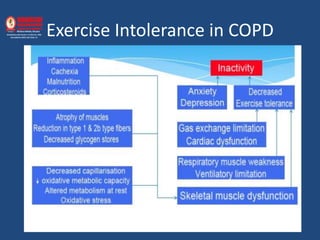
Exercise Intolerance in COPD
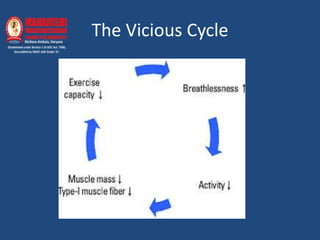
The Vicious Cycle
Benefits of Exercise Training
• Improved exercise capacity
• Improved Dyspnoea
• Improved performance of activities of daily
daily living
• Improved health related quality of life
• Reduced hospitalization
Collins EG , Bauldoff G , Carlin B , et al. Clinical competency guidelines for pulmonary rehabilitation professionals. Position
statement of the American Association of Cardiovascular and Pulmonary Rehabilitation . J Cardiopulm Rehabil Prev . 2014 :
34( 5 ): 291-302 .
Exercise Testing
• A cardiopulmonary exercise test including
ventilation and gas exchange assessment and
a standardized ramp protocol
• Modifications including smaller increments
and/or slower progression, depending on
functional limitations etc.
• The 6-minute walk test is often used for
patients with more severe pulmonary disease
Chris Garvey et al. Pulmonary Rehabilitation Exercise Prescription in Chronic Obstructive Pulmonary Disease: Review of
Selected Guidelines An official statement from the American Association Of Cardiovascular And Pulmonary
Rehabilitation.JCRP.2016:75-83
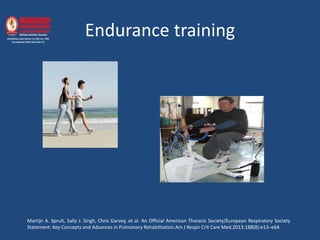
Endurance training
Martijn A. Spruit, Sally J. Singh, Chris Garvey, et al. An Official American Thoracic Society/European Respiratory Society
Statement: Key Concepts and Advances in Pulmonary Rehabilitation.Am J Respir Crit Care Med.2013:188(8):e13–e64.
Endurance training
Frequency 3 to 5 times/week
Intensity High intensity (60%-80% peak work rate)
Interval training should be considered for
individuals who cannot sustain extended
continuous periods of high-intensity exercise.
Duration 20 to 60 min per session for 4-12 weeks
Progression Options include titrating to selected RPE level,
dyspnea scale rates, or predetermined MET level
Martijn A. Spruit, Sally J. Singh, Chris Garvey, et al. An Official American Thoracic Society/European Respiratory Society
Statement: Key Concepts and Advances in Pulmonary Rehabilitation.Am J Respir Crit Care Med.2013:188(8):e13–e64.
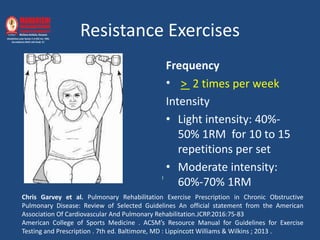
Resistance Exercises
Frequency
• > 2 times per week
Intensity
• Light intensity: 40%-
50% 1RM for 10 to 15
repetitions per set
• Moderate intensity:
60%-70% 1RM
l
Chris Garvey et al. Pulmonary Rehabilitation Exercise Prescription in Chronic Obstructive
Pulmonary Disease: Review of Selected Guidelines An official statement from the American
Association Of Cardiovascular And Pulmonary Rehabilitation.JCRP.2016:75-83
American College of Sports Medicine . ACSM’s Resource Manual for Guidelines for Exercise
Testing and Prescription . 7th ed. Baltimore, MD : Lippincott Williams & Wilkins ; 2013 .
Resistance Exercises
Progression Increase weight, number of repetitions per set, number of sets
per session or reduce rests when individuals can perform 1 to 2
repetitions over the desired number on 2 consecutive sessions
Monitor RPE plus muscle/joint fatigue, soreness, and pain
l
Chris Garvey et al. Pulmonary Rehabilitation Exercise Prescription in Chronic Obstructive Pulmonary Disease: Review of Selected Guidelines An official statement from
the American Association Of Cardiovascular And Pulmonary Rehabilitation.JCRP.2016:75-83
American College of Sports Medicine . ACSM’s Resource Manual for Guidelines for Exercise Testing and Prescription . 7th ed. Baltimore, MD : Lippincott Williams &
Wilkins ; 2013 .
Cont…
• Resistance exercise will confer greater gains in
muscle mass and muscle force and evoke less
dyspnea.
• For osteoporosis: Caution with spine
flexion/rotation and heavy weight training
• For pulmonary hypertension: Low resistance
training with paced breathing, aerobic training
is acceptable
Collins EG , Bauldoff G , Carlin B , et al. Clinical competency guidelines for pulmonary rehabilitation professionals. Position
statement of the American Association of Cardiovascular and Pulmonary Rehabilitation . J Cardiopulm Rehabil Prev . 2014 :
34( 5 ): 291-302 .
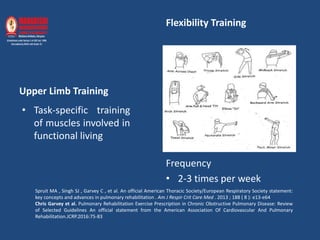
Upper Limb Training
• Task-specific training
of muscles involved in
functional living
Frequency
• 2-3 times per week
Spruit MA , Singh SJ , Garvey C , et al. An official American Thoracic Society/European Respiratory Society statement:
key concepts and advances in pulmonary rehabilitation . Am J Respir Crit Care Med . 2013 ; 188 ( 8 ): e13-e64
Chris Garvey et al. Pulmonary Rehabilitation Exercise Prescription in Chronic Obstructive Pulmonary Disease: Review
of Selected Guidelines An official statement from the American Association Of Cardiovascular And Pulmonary
Rehabilitation.JCRP.2016:75-83
Flexibility Training
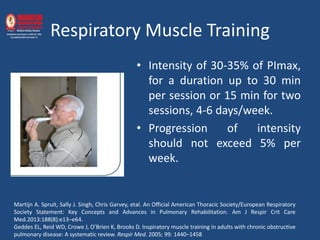
Respiratory Muscle Training
• Intensity of 30-35% of PImax,
for a duration up to 30 min
per session or 15 min for two
sessions, 4-6 days/week.
• Progression of intensity
should not exceed 5% per
week.
Martijn A. Spruit, Sally J. Singh, Chris Garvey, etal. An Official American Thoracic Society/European Respiratory
Society Statement: Key Concepts and Advances in Pulmonary Rehabilitation. Am J Respir Crit Care
Med.2013:188(8):e13–e64.
Geddes EL, Reid WD, Crowe J, O’Brien K, Brooks D. Inspiratory muscle training in adults with chronic obstructive
pulmonary disease: A systematic review. Respir Med. 2005; 99: 1440–1458
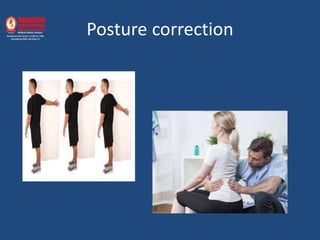
Posture correction
Program duration
• A minimum of (4-12) 08 weeks is
recommended to achieve a substantial effect.
Spruit MA , Singh SJ , Garvey C , et al. An official American Thoracic Society/European Respiratory Society statement: key
concepts and advances in pulmonary rehabilitation . Am J Respir Crit Care Med . 2013 ; 188 ( 8 ): e13-e64
Summary
• Exercise training improves exercise capacity
and symptoms
• Endurance, resistance and respiratory muscle
training are recommended for COPD patients
• Longer programs are thought to produce
greater gains and maintenance of benefits
Thank You

Exercise prescription in COPD

  • 1.
    Exercise Prescription inCOPD Dr. Hina Vaish (PT) BPT, MPT (Cardiopulmonary), Assistant Professor, MMIPR, Maharishi Markhandeshwar ( Deemed to be University), Mullana, Ambala.
  • 2.
    COPD • COPD, acommon preventable and treatable disease, is characterized by persistent airflow limitation that is usually progressive and associated with an enhanced chronic inflammatory response in the airways and the lung to noxious particles or gases. • COPD includes Chronic Bronchitis and Emphysema © Global Initiative for Chronic Obstructive Lung Disease 6.
  • 3.
  • 4.
  • 5.
    Benefits of ExerciseTraining • Improved exercise capacity • Improved Dyspnoea • Improved performance of activities of daily daily living • Improved health related quality of life • Reduced hospitalization Collins EG , Bauldoff G , Carlin B , et al. Clinical competency guidelines for pulmonary rehabilitation professionals. Position statement of the American Association of Cardiovascular and Pulmonary Rehabilitation . J Cardiopulm Rehabil Prev . 2014 : 34( 5 ): 291-302 .
  • 6.
    Exercise Testing • Acardiopulmonary exercise test including ventilation and gas exchange assessment and a standardized ramp protocol • Modifications including smaller increments and/or slower progression, depending on functional limitations etc. • The 6-minute walk test is often used for patients with more severe pulmonary disease Chris Garvey et al. Pulmonary Rehabilitation Exercise Prescription in Chronic Obstructive Pulmonary Disease: Review of Selected Guidelines An official statement from the American Association Of Cardiovascular And Pulmonary Rehabilitation.JCRP.2016:75-83
  • 7.
    Endurance training Martijn A.Spruit, Sally J. Singh, Chris Garvey, et al. An Official American Thoracic Society/European Respiratory Society Statement: Key Concepts and Advances in Pulmonary Rehabilitation.Am J Respir Crit Care Med.2013:188(8):e13–e64.
  • 8.
    Endurance training Frequency 3to 5 times/week Intensity High intensity (60%-80% peak work rate) Interval training should be considered for individuals who cannot sustain extended continuous periods of high-intensity exercise. Duration 20 to 60 min per session for 4-12 weeks Progression Options include titrating to selected RPE level, dyspnea scale rates, or predetermined MET level Martijn A. Spruit, Sally J. Singh, Chris Garvey, et al. An Official American Thoracic Society/European Respiratory Society Statement: Key Concepts and Advances in Pulmonary Rehabilitation.Am J Respir Crit Care Med.2013:188(8):e13–e64.
  • 9.
    Resistance Exercises Frequency • >2 times per week Intensity • Light intensity: 40%- 50% 1RM for 10 to 15 repetitions per set • Moderate intensity: 60%-70% 1RM l Chris Garvey et al. Pulmonary Rehabilitation Exercise Prescription in Chronic Obstructive Pulmonary Disease: Review of Selected Guidelines An official statement from the American Association Of Cardiovascular And Pulmonary Rehabilitation.JCRP.2016:75-83 American College of Sports Medicine . ACSM’s Resource Manual for Guidelines for Exercise Testing and Prescription . 7th ed. Baltimore, MD : Lippincott Williams & Wilkins ; 2013 .
  • 10.
    Resistance Exercises Progression Increaseweight, number of repetitions per set, number of sets per session or reduce rests when individuals can perform 1 to 2 repetitions over the desired number on 2 consecutive sessions Monitor RPE plus muscle/joint fatigue, soreness, and pain l Chris Garvey et al. Pulmonary Rehabilitation Exercise Prescription in Chronic Obstructive Pulmonary Disease: Review of Selected Guidelines An official statement from the American Association Of Cardiovascular And Pulmonary Rehabilitation.JCRP.2016:75-83 American College of Sports Medicine . ACSM’s Resource Manual for Guidelines for Exercise Testing and Prescription . 7th ed. Baltimore, MD : Lippincott Williams & Wilkins ; 2013 .
  • 11.
    Cont… • Resistance exercisewill confer greater gains in muscle mass and muscle force and evoke less dyspnea. • For osteoporosis: Caution with spine flexion/rotation and heavy weight training • For pulmonary hypertension: Low resistance training with paced breathing, aerobic training is acceptable Collins EG , Bauldoff G , Carlin B , et al. Clinical competency guidelines for pulmonary rehabilitation professionals. Position statement of the American Association of Cardiovascular and Pulmonary Rehabilitation . J Cardiopulm Rehabil Prev . 2014 : 34( 5 ): 291-302 .
  • 12.
    Upper Limb Training •Task-specific training of muscles involved in functional living Frequency • 2-3 times per week Spruit MA , Singh SJ , Garvey C , et al. An official American Thoracic Society/European Respiratory Society statement: key concepts and advances in pulmonary rehabilitation . Am J Respir Crit Care Med . 2013 ; 188 ( 8 ): e13-e64 Chris Garvey et al. Pulmonary Rehabilitation Exercise Prescription in Chronic Obstructive Pulmonary Disease: Review of Selected Guidelines An official statement from the American Association Of Cardiovascular And Pulmonary Rehabilitation.JCRP.2016:75-83 Flexibility Training
  • 13.
    Respiratory Muscle Training •Intensity of 30-35% of PImax, for a duration up to 30 min per session or 15 min for two sessions, 4-6 days/week. • Progression of intensity should not exceed 5% per week. Martijn A. Spruit, Sally J. Singh, Chris Garvey, etal. An Official American Thoracic Society/European Respiratory Society Statement: Key Concepts and Advances in Pulmonary Rehabilitation. Am J Respir Crit Care Med.2013:188(8):e13–e64. Geddes EL, Reid WD, Crowe J, O’Brien K, Brooks D. Inspiratory muscle training in adults with chronic obstructive pulmonary disease: A systematic review. Respir Med. 2005; 99: 1440–1458
  • 14.
  • 15.
    Program duration • Aminimum of (4-12) 08 weeks is recommended to achieve a substantial effect. Spruit MA , Singh SJ , Garvey C , et al. An official American Thoracic Society/European Respiratory Society statement: key concepts and advances in pulmonary rehabilitation . Am J Respir Crit Care Med . 2013 ; 188 ( 8 ): e13-e64
  • 16.
    Summary • Exercise trainingimproves exercise capacity and symptoms • Endurance, resistance and respiratory muscle training are recommended for COPD patients • Longer programs are thought to produce greater gains and maintenance of benefits
  • 17.