Executive Summary
From Gaps to Opportunities:
Meeting the Needs of Girls in the Worcester Area
A Needs Assessment of Middle-School Girls
Conducted for the Investing in Girls Group
Prepared by: Kathryn A. Wheeler, Ed.D., and Jessica H. Greenstone, M.S.
Investing in Girls believes that all local girls deserve to grow up happy, healthy, and productive.
Investing in Girls (IIG) is a consortium of private and state agencies in Central Massachusetts
that have come together to determine how the Worcester community can best serve the needs of
girls in the modern world. IIG grew out of a task force on youth violence convened in 2002 by
the office of the mayor of the City of Worcester. Its ultimate goal is to enhance the lives of
young women in Greater Worcester by strengthening the capability of local services and by
building the capacity of the Greater Worcester community as a whole to identify and meet girls’
needs.
In the summer of 2006, with the vision of improving the lives of 10- to14-year-old girls in the
Greater Worcester area through research, advocacy, and collaboration, the Investing in Girls
group joined forces with the Women’s Initiative at the United Way of Central Massachusetts and
the Fred Harris Daniels Foundation. Independently, each of these prominent local philanthropic
organizations had engaged in strategic planning processes to determine where their focus should
be and had concluded that among youth, the needs of middle-school girls were the most pressing.
2
With the recognition that all three groups share a commitment to the healthy development of
girls and to improving the effectiveness and efficiency of local services for girls, a new
partnership was forged. Collectively, the group determined that the members would work
together to develop a plan to address the identified needs of local girls in ways that supported
existing programs and services, but did not duplicate them. This needs assessment will then be
used as the basis for a strategic planning process that will culminate in an action plan.
To understand how Worcester-area middle-school girls compare with girls nationally and to
ensure that the needs assessment is grounded in current thinking about girls’ issues and gender-
responsive programming, we designed the needs assessment to include a review of national
research and local data on middle-school girls.
The specific goals of the needs assessment are to:
(1) identify the needs of middle-school girls and their adult advocates--specifically
parents and service providers of middle-school girls;
(2) gather preliminary information on existing support systems and programs;
(3) determine gaps in programs, services, resources, and training; and
(4) explore potential solutions.
This report will be useful as a tool for development, implementation, and assessment to ensure
that all organizations serving youth directly or indirectly are gender sensitive and responsive to
the needs of young women. Included are schools and universities, community-based
organizations, government agencies, philanthropic and research institutions, religious centers,
and businesses.
The study has three main components.
1) a literature review that included:
a) synthesis of national research on issues affecting girls, best
practices in supporting girls’ needs, and gender-responsive programming
b) compilation, analysis, and summary of local data on girls
2) focus groups: 13 focus groups with 105 girls, parents and providers
3) surveys: 336 people: 222 girls, 58 parents, and 56 providers
In all, this study represents input from almost 450 people, more than half of them girls.
RESEARCH QUESTIONS
Four questions have guided this research:
• What are the top issues and challenges facing middle-school girls?
• What do girls’ adult advocates—in particular parents, educators, and service
providers—say they need to help them better support girls?
• What are existing supports and resources and what are barriers to accessing them?
• What potential new solutions could address current gaps and barriers?
3
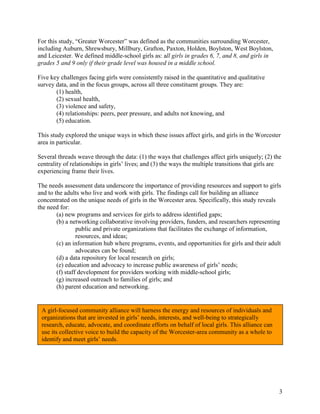
For this study, “Greater Worcester” was defined as the communities surrounding Worcester,
including Auburn, Shrewsbury, Millbury, Grafton, Paxton, Holden, Boylston, West Boylston,
and Leicester. We defined middle-school girls as: all girls in grades 6, 7, and 8, and girls in
grades 5 and 9 only if their grade level was housed in a middle school.
Five key challenges facing girls were consistently raised in the quantitative and qualitative
survey data, and in the focus groups, across all three constituent groups. They are:
(1) health,
(2) sexual health,
(3) violence and safety,
(4) relationships: peers, peer pressure, and adults not knowing, and
(5) education.
This study explored the unique ways in which these issues affect girls, and girls in the Worcester
area in particular.
Several threads weave through the data: (1) the ways that challenges affect girls uniquely; (2) the
centrality of relationships in girls’ lives; and (3) the ways the multiple transitions that girls are
experiencing frame their lives.
The needs assessment data underscore the importance of providing resources and support to girls
and to the adults who live and work with girls. The findings call for building an alliance
concentrated on the unique needs of girls in the Worcester area. Specifically, this study reveals
the need for:
(a) new programs and services for girls to address identified gaps;
(b) a networking collaborative involving providers, funders, and researchers representing
public and private organizations that facilitates the exchange of information,
resources, and ideas;
(c) an information hub where programs, events, and opportunities for girls and their adult
advocates can be found;
(d) a data repository for local research on girls;
(e) education and advocacy to increase public awareness of girls’ needs;
(f) staff development for providers working with middle-school girls;
(g) increased outreach to families of girls; and
(h) parent education and networking.
A girl-focused community alliance will harness the energy and resources of individuals and
organizations that are invested in girls’ needs, interests, and well-being to strategically
research, educate, advocate, and coordinate efforts on behalf of local girls. This alliance can
use its collective voice to build the capacity of the Worcester-area community as a whole to
identify and meet girls’ needs.
4
TURNING GAPS INTO OPPORTUNITIES
THEME CHALLENGE OR GAP OPPORTUNITY
CONTEXT
Girls’ needs, experiences,
challenges, perspectives, and
resources are often unique and
therefore need to be examined
separately from those of boys.
Design, implement, and evaluate new
and existing programs in terms of the
unique desires and needs of girls with
different identity characteristics.
Invite girls to participate in these
processes as a way to ensure that their
needs are being accurately perceived
and effectively filled.
Middle school is a time when many
different types of transition occur
simultaneously—physical growth,
cognitive development, social
changes, and school restructuring.
These transitions pose challenges to
girls.
Create systems for supporting middle-
school girls through times of
transition, such as the entry to middle
school and the anticipation of starting
high school. Peer mentoring programs
are one avenue to consider.
Easily accessible, currently updated
data on girls in the Worcester area
are lacking.
Work collaboratively to develop a
centralized system for collecting data
about local girls in a uniform, ongoing
way. House all local data in a place
that is easily accessible to all
individuals and organizations who
directly and indirectly affect girls
through their work.
“Adults should pay attention to how much they don’t know!”
--Hispanic/Latina girl, 8th
grade
Every adult in the community has a responsibility to act as an
advocate for girls, in both formal and informal ways.
5
THEME CHALLENGE OR GAP OPPORTUNITY
HEALTH
Girls, parents, and providers all
recognize the centrality of health to
girls’ well-being. Prevention and
intervention-focused programs are
needed.
Listen to girls, parents, and providers
who say they want new programs for
girls that focus on health and wellness,
including fitness and sports, stress
reduction, healthy eating, menstruation,
and safe sex. Ensure that prevention
and intervention programs exist.
Girls are experiencing a range of
issues related to mental health, and
the adults in their lives want more
resources and supports to increase
girls’ resilience.
Create additional prevention-focused
mental health resources and training to
supplement existing intervention-
focused support and resources.
Concern with physical appearance
features prominently in girls’
everyday lives.
Help girls resist toxic cultural messages
by teaching them media-literacy skills
that promote critical thinking about
unhealthy sociocultural standards of
female beauty and body ideals.
“[One of the biggest challenges of raising a middle-school girl is] giving her
support she needs to improve her self-esteem and assertiveness—helping
her see herself outside of her social circle.”
--White parent, 8th
grade girl
SEXUAL
HEALTH
Girls in Greater Worcester want and
need more sex education, including
information about menstruation and
puberty. Girls feel pressured to have
sex, and many are sexually active.
Offer more comprehensive sex
education opportunities in and out of
school. Girls need basic information
on menstruation, puberty, reproductive
health, and safe sex.
Girls report that boys sometimes
take advantage of them sexually and
violently, and that sexual
harassment is a common experience
Educate girls--and boys--about sexual
harassment, assault, and abuse in ways
that do not victimize girls and/or
demonize boys. Empower girls to say
no to harassment, abuse, and pressure,
and to say yes to being physically,
emotionally, and sexually safe,
comfortable, and confident.
6
THEME CHALLENGE OR GAP OPPORTUNITY
SEXUAL
HEALTH
(cont’d)
Girls need spaces where they can
explore their sexual feelings and
identities. The needs of lesbian,
gay, bisexual, transgender, and
questioning girls are rarely
addressed.
Provide safe spaces and other
encouragements for girls and their
adult allies to talk in depth about what
is really happening with regard to
sexuality, even if it is not necessarily
what you think should be happening.
Include discussion about complex
issues such as diverse sexual identities.
“There are programs out there, but they don’t address particular issues of
relevance to girls, for example, sex.”
--Latino parent, 8th
grade girl
VIOLENCE
AND SAFETY
Physical violence is a dominant
concern for girls and their adult
advocates, including physical
fighting, gangs, safety in the
community, crime, and a dearth of
safe spaces for girls.
Intensify efforts to prevent violence.
Provide professional development
trainings, community seminars, and
literature to increase knowledge about
the pathways to and early indications of
victimization and violence. Work to
ensure that everyday public and private
spaces such as schools, neighborhoods,
public transportation, and homes are
places where girls can feel physically,
sexually, and emotionally safe.
Girls’ relationships with one another
are sometimes characterized by
emotional violence, conceptualized
by girls as “drama.” Social and
emotional violence in the peer
group makes the school climate
unsafe.
Allow girls to explore tension and
conflict in their relationships with other
girls. Help them brainstorm ways to
create healthier relationships, and to
practice assertiveness rather than
aggressiveness. Let them know that
relational aggression is violence.
Parents, providers, and girls report
concerns about safe transportation
for girls and its effect on their
access to community resources
Collaborate across Greater Worcester
public and private agencies to create a
plan to ensure that girls have safe
access to transportation to school and
out-of-school programs and services.
Explore the potential of partnerships
between schools and community-based
organizations to address the
transportation gap.
“There are not enough safe activities for girls this age. They need
someplace they can go with their friends and enjoy the same interests, but
still be in a safe environment.”
--White parent, 8th
grader
7
THEME CHALLENGE OR GAP OPPORTUNITY
RELATION-
SHIPS
Girls’ relationships with other girls
are a source of happiness and
support, as well as of worry, stress,
and strife.
Have formal and informal dialogues
with girls about their relationships with
one another. Allow girls to examine
those relationships, including their
benefits and the outside factors that
influence these relationships.
Adults, including family members
and nonrelated advocates, care about
girls, and girls know and appreciate
this fact. Yet adults and community
members are unaware of many of the
day-to-day realities of girls’ lives.
Help girls expand their support
networks by providing opportunities
for cross-generational dialogues and
relationship building between girls and
adults. Girls can teach adults what they
don’t know about the complex realities
of their lives, and adults can recognize
that the consequences of not knowing
are graver than the fear of knowing.
Girls, parents, and providers are all
concerned that peer pressure leads
girls to make unhealthy choices.
Provide girls with tools to help them
make healthy choices. Strategize with
them about ways to maintain their self-
confidence and act in harmony with
choices that will promote their well-
being.
Romantic relationships with boys are
both exciting and confusing.
Acknowledge the prominence of
romantic relationships in girls’ lives.
Help girls disentangle their sense of
self-worth from romantic relationships
with boys.
“I feel comfortable talking to a female relative or friend who is not ‘too old’
but is old enough to give sound advice.”
--White girl, 6th
grade
EDUCATION
Girls understand the importance of
education. Some feel positive about
school; others feel disconnected and
unsafe. Girls want to do well in
school, yet face day-to-day struggles.
Identify what aspects of school help
some girls feel good about themselves.
Use this knowledge to work toward an
understanding of what is not working
for other girls. Work collaboratively
with girls to make appropriate
adjustments to curricula and the school
environment.
Girls look ahead to higher education;
they want to go to college but worry
about how to get there and how to
pay for it.
Create more in-school and out-of-
school programs that focus on college
preparation and affordability.
8
THEME CHALLENGE OR GAP OPPORTUNITY
EDUCATION
(cont’d)
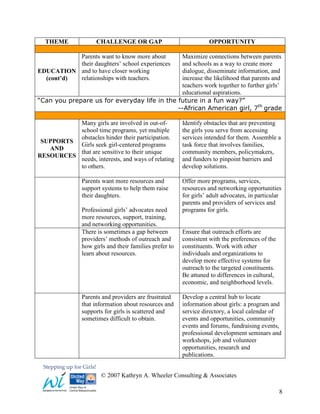
Parents want to know more about
their daughters’ school experiences
and to have closer working
relationships with teachers.
Maximize connections between parents
and schools as a way to create more
dialogue, disseminate information, and
increase the likelihood that parents and
teachers work together to further girls’
educational aspirations.
“Can you prepare us for everyday life in the future in a fun way?”
--African American girl, 7th
grade
SUPPORTS
AND
RESOURCES
Many girls are involved in out-of-
school time programs, yet multiple
obstacles hinder their participation.
Girls seek girl-centered programs
that are sensitive to their unique
needs, interests, and ways of relating
to others.
Identify obstacles that are preventing
the girls you serve from accessing
services intended for them. Assemble a
task force that involves families,
community members, policymakers,
and funders to pinpoint barriers and
develop solutions.
Parents want more resources and
support systems to help them raise
their daughters.
Professional girls’ advocates need
more resources, support, training,
and networking opportunities.
Offer more programs, services,
resources and networking opportunities
for girls’ adult advocates, in particular
parents and providers of services and
programs for girls.
There is sometimes a gap between
providers’ methods of outreach and
how girls and their families prefer to
learn about resources.
Ensure that outreach efforts are
consistent with the preferences of the
constituents. Work with other
individuals and organizations to
develop more effective systems for
outreach to the targeted constituents.
Be attuned to differences in cultural,
economic, and neighborhood levels.
Parents and providers are frustrated
that information about resources and
supports for girls is scattered and
sometimes difficult to obtain.
Develop a central hub to locate
information about girls: a program and
service directory, a local calendar of
events and opportunities, community
events and forums, fundraising events,
professional development seminars and
workshops, job and volunteer
opportunities, research and
publications.
© 2007 Kathryn A. Wheeler Consulting & Associates

Executive Summary--Needs Assessment Report--final final--Oct 4 2007

  • 1.
    Executive Summary From Gapsto Opportunities: Meeting the Needs of Girls in the Worcester Area A Needs Assessment of Middle-School Girls Conducted for the Investing in Girls Group Prepared by: Kathryn A. Wheeler, Ed.D., and Jessica H. Greenstone, M.S. Investing in Girls believes that all local girls deserve to grow up happy, healthy, and productive. Investing in Girls (IIG) is a consortium of private and state agencies in Central Massachusetts that have come together to determine how the Worcester community can best serve the needs of girls in the modern world. IIG grew out of a task force on youth violence convened in 2002 by the office of the mayor of the City of Worcester. Its ultimate goal is to enhance the lives of young women in Greater Worcester by strengthening the capability of local services and by building the capacity of the Greater Worcester community as a whole to identify and meet girls’ needs. In the summer of 2006, with the vision of improving the lives of 10- to14-year-old girls in the Greater Worcester area through research, advocacy, and collaboration, the Investing in Girls group joined forces with the Women’s Initiative at the United Way of Central Massachusetts and the Fred Harris Daniels Foundation. Independently, each of these prominent local philanthropic organizations had engaged in strategic planning processes to determine where their focus should be and had concluded that among youth, the needs of middle-school girls were the most pressing.
  • 2.
    2 With the recognitionthat all three groups share a commitment to the healthy development of girls and to improving the effectiveness and efficiency of local services for girls, a new partnership was forged. Collectively, the group determined that the members would work together to develop a plan to address the identified needs of local girls in ways that supported existing programs and services, but did not duplicate them. This needs assessment will then be used as the basis for a strategic planning process that will culminate in an action plan. To understand how Worcester-area middle-school girls compare with girls nationally and to ensure that the needs assessment is grounded in current thinking about girls’ issues and gender- responsive programming, we designed the needs assessment to include a review of national research and local data on middle-school girls. The specific goals of the needs assessment are to: (1) identify the needs of middle-school girls and their adult advocates--specifically parents and service providers of middle-school girls; (2) gather preliminary information on existing support systems and programs; (3) determine gaps in programs, services, resources, and training; and (4) explore potential solutions. This report will be useful as a tool for development, implementation, and assessment to ensure that all organizations serving youth directly or indirectly are gender sensitive and responsive to the needs of young women. Included are schools and universities, community-based organizations, government agencies, philanthropic and research institutions, religious centers, and businesses. The study has three main components. 1) a literature review that included: a) synthesis of national research on issues affecting girls, best practices in supporting girls’ needs, and gender-responsive programming b) compilation, analysis, and summary of local data on girls 2) focus groups: 13 focus groups with 105 girls, parents and providers 3) surveys: 336 people: 222 girls, 58 parents, and 56 providers In all, this study represents input from almost 450 people, more than half of them girls. RESEARCH QUESTIONS Four questions have guided this research: • What are the top issues and challenges facing middle-school girls? • What do girls’ adult advocates—in particular parents, educators, and service providers—say they need to help them better support girls? • What are existing supports and resources and what are barriers to accessing them? • What potential new solutions could address current gaps and barriers?
  • 3.
    3 For this study,“Greater Worcester” was defined as the communities surrounding Worcester, including Auburn, Shrewsbury, Millbury, Grafton, Paxton, Holden, Boylston, West Boylston, and Leicester. We defined middle-school girls as: all girls in grades 6, 7, and 8, and girls in grades 5 and 9 only if their grade level was housed in a middle school. Five key challenges facing girls were consistently raised in the quantitative and qualitative survey data, and in the focus groups, across all three constituent groups. They are: (1) health, (2) sexual health, (3) violence and safety, (4) relationships: peers, peer pressure, and adults not knowing, and (5) education. This study explored the unique ways in which these issues affect girls, and girls in the Worcester area in particular. Several threads weave through the data: (1) the ways that challenges affect girls uniquely; (2) the centrality of relationships in girls’ lives; and (3) the ways the multiple transitions that girls are experiencing frame their lives. The needs assessment data underscore the importance of providing resources and support to girls and to the adults who live and work with girls. The findings call for building an alliance concentrated on the unique needs of girls in the Worcester area. Specifically, this study reveals the need for: (a) new programs and services for girls to address identified gaps; (b) a networking collaborative involving providers, funders, and researchers representing public and private organizations that facilitates the exchange of information, resources, and ideas; (c) an information hub where programs, events, and opportunities for girls and their adult advocates can be found; (d) a data repository for local research on girls; (e) education and advocacy to increase public awareness of girls’ needs; (f) staff development for providers working with middle-school girls; (g) increased outreach to families of girls; and (h) parent education and networking. A girl-focused community alliance will harness the energy and resources of individuals and organizations that are invested in girls’ needs, interests, and well-being to strategically research, educate, advocate, and coordinate efforts on behalf of local girls. This alliance can use its collective voice to build the capacity of the Worcester-area community as a whole to identify and meet girls’ needs.
  • 4.
    4 TURNING GAPS INTOOPPORTUNITIES THEME CHALLENGE OR GAP OPPORTUNITY CONTEXT Girls’ needs, experiences, challenges, perspectives, and resources are often unique and therefore need to be examined separately from those of boys. Design, implement, and evaluate new and existing programs in terms of the unique desires and needs of girls with different identity characteristics. Invite girls to participate in these processes as a way to ensure that their needs are being accurately perceived and effectively filled. Middle school is a time when many different types of transition occur simultaneously—physical growth, cognitive development, social changes, and school restructuring. These transitions pose challenges to girls. Create systems for supporting middle- school girls through times of transition, such as the entry to middle school and the anticipation of starting high school. Peer mentoring programs are one avenue to consider. Easily accessible, currently updated data on girls in the Worcester area are lacking. Work collaboratively to develop a centralized system for collecting data about local girls in a uniform, ongoing way. House all local data in a place that is easily accessible to all individuals and organizations who directly and indirectly affect girls through their work. “Adults should pay attention to how much they don’t know!” --Hispanic/Latina girl, 8th grade Every adult in the community has a responsibility to act as an advocate for girls, in both formal and informal ways.
  • 5.
    5 THEME CHALLENGE ORGAP OPPORTUNITY HEALTH Girls, parents, and providers all recognize the centrality of health to girls’ well-being. Prevention and intervention-focused programs are needed. Listen to girls, parents, and providers who say they want new programs for girls that focus on health and wellness, including fitness and sports, stress reduction, healthy eating, menstruation, and safe sex. Ensure that prevention and intervention programs exist. Girls are experiencing a range of issues related to mental health, and the adults in their lives want more resources and supports to increase girls’ resilience. Create additional prevention-focused mental health resources and training to supplement existing intervention- focused support and resources. Concern with physical appearance features prominently in girls’ everyday lives. Help girls resist toxic cultural messages by teaching them media-literacy skills that promote critical thinking about unhealthy sociocultural standards of female beauty and body ideals. “[One of the biggest challenges of raising a middle-school girl is] giving her support she needs to improve her self-esteem and assertiveness—helping her see herself outside of her social circle.” --White parent, 8th grade girl SEXUAL HEALTH Girls in Greater Worcester want and need more sex education, including information about menstruation and puberty. Girls feel pressured to have sex, and many are sexually active. Offer more comprehensive sex education opportunities in and out of school. Girls need basic information on menstruation, puberty, reproductive health, and safe sex. Girls report that boys sometimes take advantage of them sexually and violently, and that sexual harassment is a common experience Educate girls--and boys--about sexual harassment, assault, and abuse in ways that do not victimize girls and/or demonize boys. Empower girls to say no to harassment, abuse, and pressure, and to say yes to being physically, emotionally, and sexually safe, comfortable, and confident.
  • 6.
    6 THEME CHALLENGE ORGAP OPPORTUNITY SEXUAL HEALTH (cont’d) Girls need spaces where they can explore their sexual feelings and identities. The needs of lesbian, gay, bisexual, transgender, and questioning girls are rarely addressed. Provide safe spaces and other encouragements for girls and their adult allies to talk in depth about what is really happening with regard to sexuality, even if it is not necessarily what you think should be happening. Include discussion about complex issues such as diverse sexual identities. “There are programs out there, but they don’t address particular issues of relevance to girls, for example, sex.” --Latino parent, 8th grade girl VIOLENCE AND SAFETY Physical violence is a dominant concern for girls and their adult advocates, including physical fighting, gangs, safety in the community, crime, and a dearth of safe spaces for girls. Intensify efforts to prevent violence. Provide professional development trainings, community seminars, and literature to increase knowledge about the pathways to and early indications of victimization and violence. Work to ensure that everyday public and private spaces such as schools, neighborhoods, public transportation, and homes are places where girls can feel physically, sexually, and emotionally safe. Girls’ relationships with one another are sometimes characterized by emotional violence, conceptualized by girls as “drama.” Social and emotional violence in the peer group makes the school climate unsafe. Allow girls to explore tension and conflict in their relationships with other girls. Help them brainstorm ways to create healthier relationships, and to practice assertiveness rather than aggressiveness. Let them know that relational aggression is violence. Parents, providers, and girls report concerns about safe transportation for girls and its effect on their access to community resources Collaborate across Greater Worcester public and private agencies to create a plan to ensure that girls have safe access to transportation to school and out-of-school programs and services. Explore the potential of partnerships between schools and community-based organizations to address the transportation gap. “There are not enough safe activities for girls this age. They need someplace they can go with their friends and enjoy the same interests, but still be in a safe environment.” --White parent, 8th grader
  • 7.
    7 THEME CHALLENGE ORGAP OPPORTUNITY RELATION- SHIPS Girls’ relationships with other girls are a source of happiness and support, as well as of worry, stress, and strife. Have formal and informal dialogues with girls about their relationships with one another. Allow girls to examine those relationships, including their benefits and the outside factors that influence these relationships. Adults, including family members and nonrelated advocates, care about girls, and girls know and appreciate this fact. Yet adults and community members are unaware of many of the day-to-day realities of girls’ lives. Help girls expand their support networks by providing opportunities for cross-generational dialogues and relationship building between girls and adults. Girls can teach adults what they don’t know about the complex realities of their lives, and adults can recognize that the consequences of not knowing are graver than the fear of knowing. Girls, parents, and providers are all concerned that peer pressure leads girls to make unhealthy choices. Provide girls with tools to help them make healthy choices. Strategize with them about ways to maintain their self- confidence and act in harmony with choices that will promote their well- being. Romantic relationships with boys are both exciting and confusing. Acknowledge the prominence of romantic relationships in girls’ lives. Help girls disentangle their sense of self-worth from romantic relationships with boys. “I feel comfortable talking to a female relative or friend who is not ‘too old’ but is old enough to give sound advice.” --White girl, 6th grade EDUCATION Girls understand the importance of education. Some feel positive about school; others feel disconnected and unsafe. Girls want to do well in school, yet face day-to-day struggles. Identify what aspects of school help some girls feel good about themselves. Use this knowledge to work toward an understanding of what is not working for other girls. Work collaboratively with girls to make appropriate adjustments to curricula and the school environment. Girls look ahead to higher education; they want to go to college but worry about how to get there and how to pay for it. Create more in-school and out-of- school programs that focus on college preparation and affordability.
  • 8.
    8 THEME CHALLENGE ORGAP OPPORTUNITY EDUCATION (cont’d) Parents want to know more about their daughters’ school experiences and to have closer working relationships with teachers. Maximize connections between parents and schools as a way to create more dialogue, disseminate information, and increase the likelihood that parents and teachers work together to further girls’ educational aspirations. “Can you prepare us for everyday life in the future in a fun way?” --African American girl, 7th grade SUPPORTS AND RESOURCES Many girls are involved in out-of- school time programs, yet multiple obstacles hinder their participation. Girls seek girl-centered programs that are sensitive to their unique needs, interests, and ways of relating to others. Identify obstacles that are preventing the girls you serve from accessing services intended for them. Assemble a task force that involves families, community members, policymakers, and funders to pinpoint barriers and develop solutions. Parents want more resources and support systems to help them raise their daughters. Professional girls’ advocates need more resources, support, training, and networking opportunities. Offer more programs, services, resources and networking opportunities for girls’ adult advocates, in particular parents and providers of services and programs for girls. There is sometimes a gap between providers’ methods of outreach and how girls and their families prefer to learn about resources. Ensure that outreach efforts are consistent with the preferences of the constituents. Work with other individuals and organizations to develop more effective systems for outreach to the targeted constituents. Be attuned to differences in cultural, economic, and neighborhood levels. Parents and providers are frustrated that information about resources and supports for girls is scattered and sometimes difficult to obtain. Develop a central hub to locate information about girls: a program and service directory, a local calendar of events and opportunities, community events and forums, fundraising events, professional development seminars and workshops, job and volunteer opportunities, research and publications. © 2007 Kathryn A. Wheeler Consulting & Associates