1
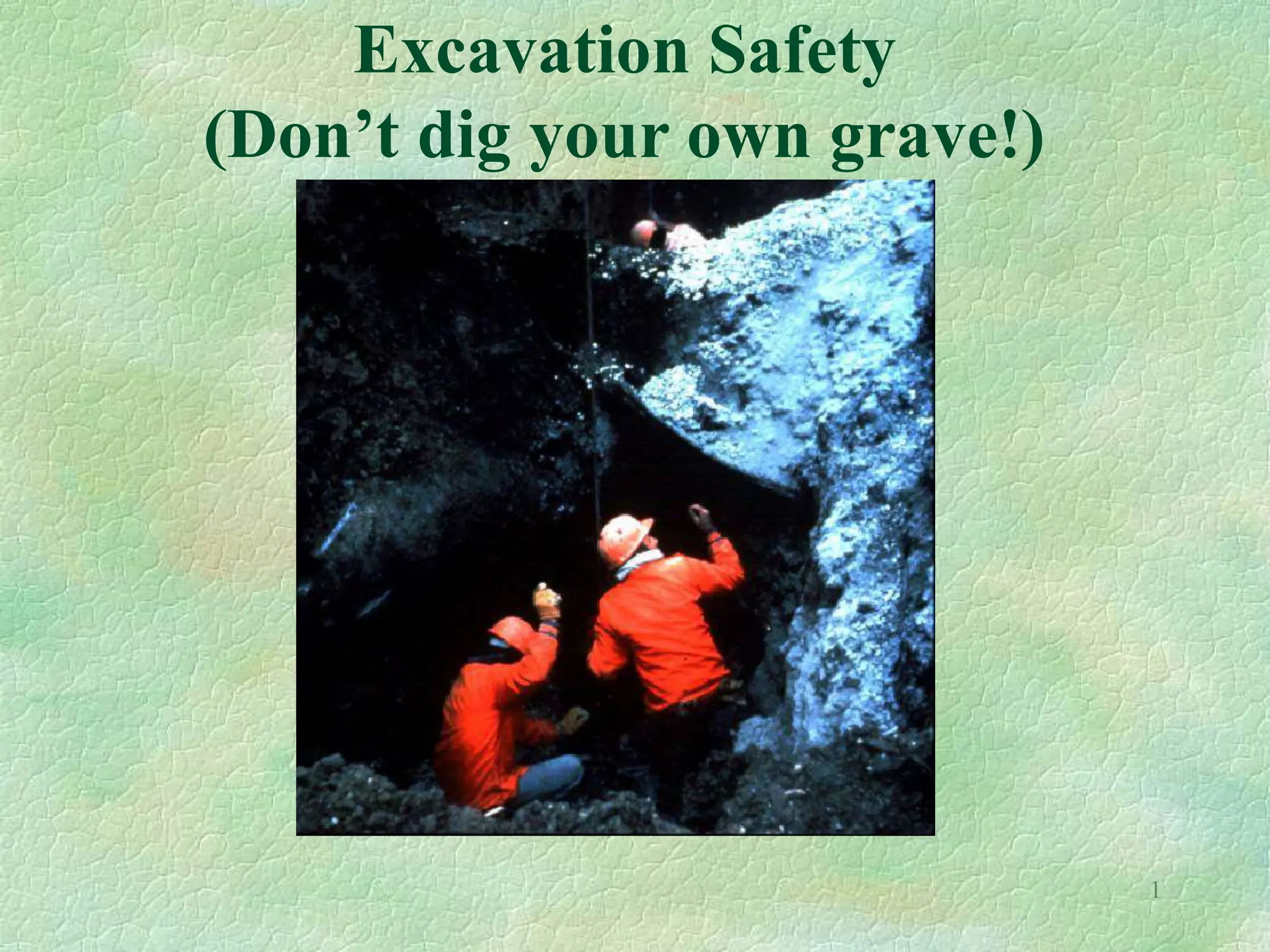
Excavation Safety
(Don’t dig your own grave!)
2
Objectives
 To provide students with:
 An introduction to 29 CFR 1926,
Subpart P-Excavation Standard
 An overview of soil mechanics
 An introduction to trenching and excavation
hazard recognition
3
Data On Excavation Cave-in
Injuries
 BLS Data Shows That Each Year
 Approximately 1000 Injuries Occur
• Decreasing Trend Over Time
• Of These,
– 140 result in permanent disability
– 75 result in death
» 1% of all occupational fatalities
4
OSHA’s Response
 Regional Emphasis Program in late ’70’s
 National Emphasis Program of 9/1985
 CPL 2.69 National Program Directive
• Inspection Conducted When;
– Receive employee complaint
– CSHO observation
– Receipt of referral
» Ask employer to voluntarily abate
» If employer will not voluntarily comply, then call the
“OSHA Duty Officer”
 Compliance Assistance
5
Mechanics Of Trench Injuries
 Mechanisms of energy transfer
 Struck-by
• Force is dependent upon amount of materiel
falling and fall distance
 Caught between
• 850 pounds of force applied against the chest
– Causes slow, agonizing asphyxiation
7
Tension crack
Over-stressed unconfined
trench wall
Vertical stresses due to
weight of column of soil
Surface subsides
8
First cave-in
Additional tension
cracks
Trench wall ready to
collapse a second
time at any moment
Debris from first
cave-in
9
Second
cave-in
Trench wall ready
to collapse a third
time at any moment
Debris from first
and second cave-ins
10
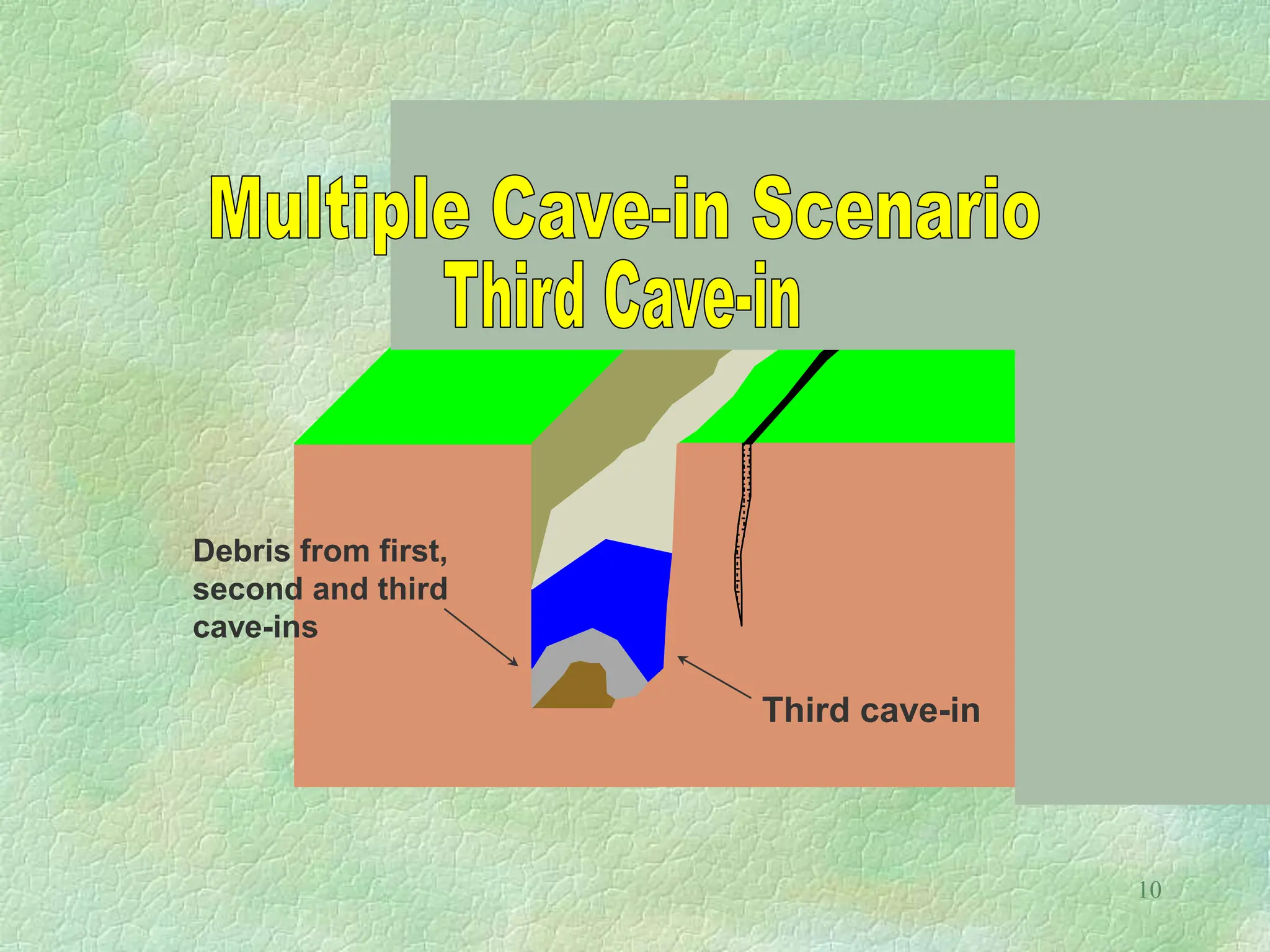
Third cave-in
Debris from first,
second and third
cave-ins
11
SOFT ZONE
STABLE STABLE
SOFT
WEAK
ZONE
12
SAND
POCKETS
13
Sloughing
(Air Drying)
14
Surface Runoff
Soft
Saturated Zone
Water
Accumulation
Ground
Water
Stable
Ground
15
Stable Un-Stable
16
Spoil
Tension
Cracks
Native
Soil
Old Utility Trench
(Parallel Utility)
Old Utility Trench
(Crossing Utility)
Bedding
Material
17
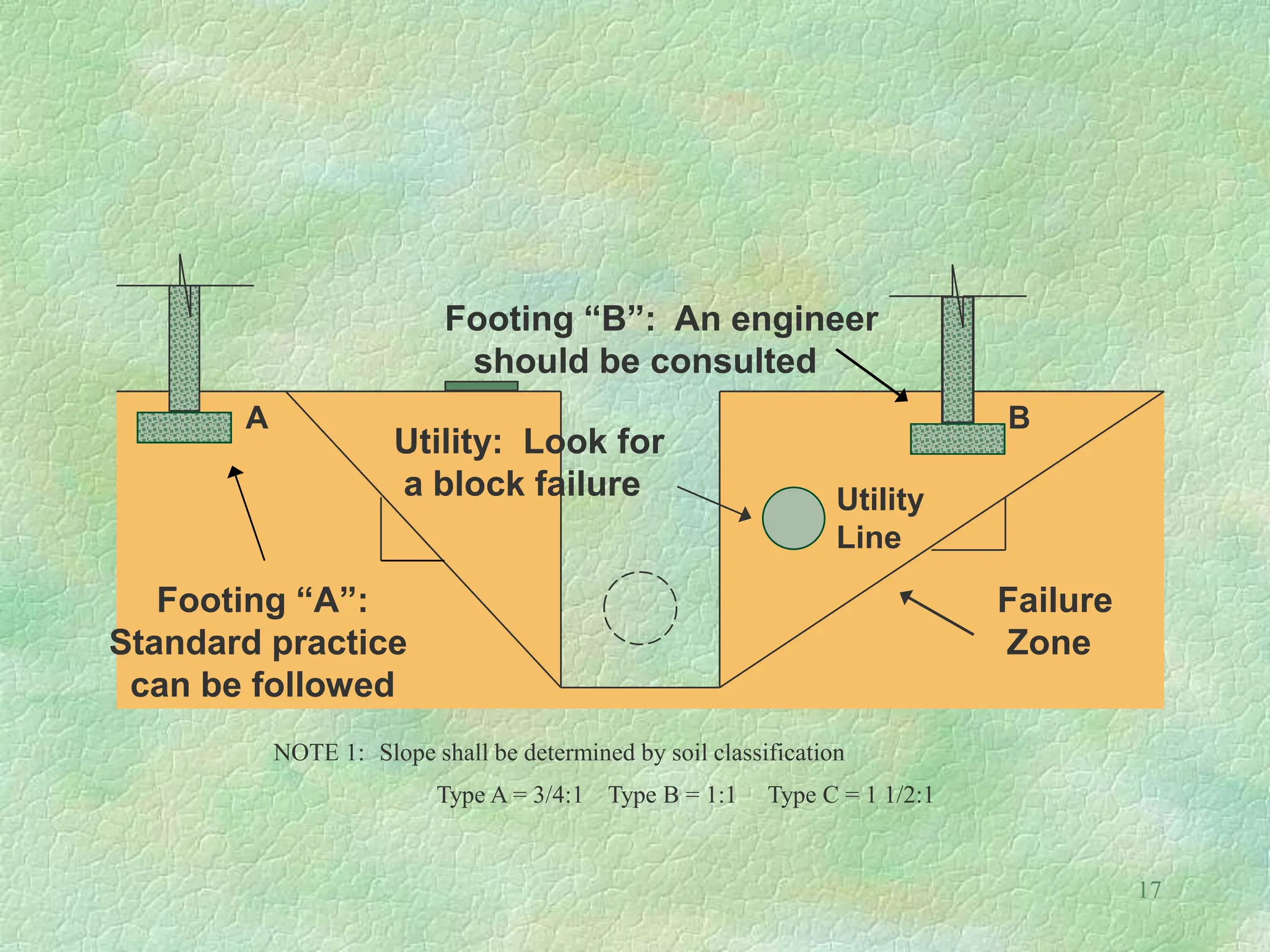
Utility
Line
Footing “B”: An engineer
should be consulted
B
Utility: Look for
a block failure
Footing “A”:
Standard practice
can be followed
Failure
Zone
A
NOTE 1: Slope shall be determined by soil classification
Type A = 3/4:1 Type B = 1:1 Type C = 1 1/2:1
18
Other Excavation Hazards
 Cave-ins are perhaps the most feared
trenching hazard. But other potentially
fatal hazards exist, including
asphyxiation due to lack of oxygen in a
confined space, inhalation of toxic fumes,
drowning, etc. Electrocution or
explosions can occur when workers
contact underground utilities.
19
OSHA Standards Related to
Excavations and Trenching:
29 CFR 1926, Subpart P
 1926.650
• Scope, application, and definitions applicable to
this subpart
 1926.651
• General requirements
 1926.652
• Requirements for protective systems
20
1926.650 Scope & application,
definitions
 Accepted engineering practices
 Aluminum hydraulic shoring
 Bell-bottom pier
 Benching
 Cave-in
 Competent person
 Cross braces
 Excavation
 Faces or sides
 Failure
 Hazardous atmospheres`
 Kick-out
 Protective systems
 Ramp
 Registered professional engineer
 Sheeting
 Shield
 Shoring
 Sloping
 Stable rock
 Structural ramp
 Trench
21
Competent person
 Specific training in, and be
knowledgeable about,
 soils analysis
 the use of protective systems
 requirements of this standard
» Preamble page 45909
 And have the authority to take
corrective action
22
Definitions
 "Excavation" means any man-made cut, cavity, trench, or
depression in an earth surface, formed by earth removal.
 "Trench (Trench excavation)" means a narrow excavation (in
relation to its length) made below the surface of the ground. In
general, the depth is greater than the width, but the width of a
trench (measured at the bottom) is not greater than 15 feet (4.6 m).
If forms or other structures are installed or constructed in an
excavation so as to reduce the dimension measured from the
forms or structure to the side of the excavation to 15 feet (4.6 m) or
less (measured at the bottom of the excavation), the excavation is
also considered to be a trench.
23
1926.651 - General
requirements
 Surface encumbrances
 Underground installations
 Access and egress
 Exposure to vehicular
traffic
 Exposure to falling loads
 Warning system for mobile
equipment
 Hazardous atmospheres
 Protection from hazards
associated with water
accumulation
 Stability of adjacent
structure
 Protection of employees
from loose rock or soil
 Inspections
 Fall protection
24
1926.651(c)(2) Means of egress
 Means of egress from trench excavations.
A stairway, ladder, ramp or other safe
means of egress shall be located in trench
excavations that are 4 feet (1.22 mm) or
more in depth so as to require no more
than 25 feet (7.62 m) of lateral travel for
employees.
25
1926.651(k)-Inspections
 Daily inspections of excavations, the adjacent areas, and
protective systems shall be made by a competent person for
evidence of a situation that could result in possible cave-ins,
indications of failure of protective systems, hazardous
atmospheres, or other hazardous conditions.
 An inspection shall be conducted by the competent person
prior to the start of work and as needed throughout the
shift. Inspections shall also be made after every rainstorm or
other hazard increasing occurrence. These inspections are
only required when employee exposure can be reasonably
anticipated.
26
1926.652 - Requirements for
protective systems
 Protection of employees
in excavations
 Design of sloping and
benching systems
 Design of support
systems, shield systems,
and other protective
systems
 Materials and equipment
 Installation and removal
27
1926.652 (a)-Protection of employees
in excavations
 (1) Each employee in an excavation shall be protected
from cave-ins by an adequate protective system
designed in accordance with paragraph (b) or (c) of this
section except when:
 (i) Excavations are made entirely in stable rock; or
 (ii) Excavations are less than 5 feet (1.52 m) in depth
and examination of the ground by a competent
person provides no indication of a potential cave-in.
28
Sloping
Requirements
Are Based Upon
Soil Type
 Rock
 Type A soil
 Type B soil
 Type C soil
Note that sloping requirement is based upon “worst layer”
soil classification
29
Protective Systems
 Shoring
 Trench Box
30
Worker Protection Systems
 Appendix A
• Soil Classification
 Appendix B
• Sloping & Benching
 Appendix C
• Timber Shoring
 Appendix D
• Aluminum Hydraulic Shoring
34
Soil Classification Definitions
 Type A - Most stable: clay, silty clay, and hardpan (resists penetration). No soil is Type
A if it is fissured, is subject to vibration of any type, has previously been disturbed, or
has seeping water.
 Type B - Medium stability: silt, sandy loam, medium clay and unstable dry rock;
previously disturbed soils unless otherwise classified as Type C; soils that meet the
requirements of Type A soil but are fissured or subject to vibration.
 Type C - Least stable: gravel, loamy sand, soft clay, submerged soil or dense, heavy
unstable rock, and soil from which water is freely seeping.
 Layered geological strata (where soils are configured in layers) - The soil must be
classified on the basis of the soil classification of the weakest soil layer. Each layer may
be classified individually if a more stable layer lies below a less stable layer, i.e. where
a Type C soil rests on top of stable rock.
 STABLE ROCK is natural solid mineral matter that can be excavated with vertical
sides and remain intact while exposed. It is usually identified by a rock name such as
granite or sandstone. Determining whether a deposit is of this type may be difficult
unless it is known whether cracks exist and whether or not the cracks run into or away
from the excavation.
41
Hazard Recognition Slides
42
43
44
45
46
47
48
49
50
51
52
53
54
55
56
57
58
59
60
61
62
63
64
65
66

Excvation Safety for safety officers reference

  • 1.
  • 2.
    2 Objectives  To providestudents with:  An introduction to 29 CFR 1926, Subpart P-Excavation Standard  An overview of soil mechanics  An introduction to trenching and excavation hazard recognition
  • 3.
    3 Data On ExcavationCave-in Injuries  BLS Data Shows That Each Year  Approximately 1000 Injuries Occur • Decreasing Trend Over Time • Of These, – 140 result in permanent disability – 75 result in death » 1% of all occupational fatalities
  • 4.
    4 OSHA’s Response  RegionalEmphasis Program in late ’70’s  National Emphasis Program of 9/1985  CPL 2.69 National Program Directive • Inspection Conducted When; – Receive employee complaint – CSHO observation – Receipt of referral » Ask employer to voluntarily abate » If employer will not voluntarily comply, then call the “OSHA Duty Officer”  Compliance Assistance
  • 5.
    5 Mechanics Of TrenchInjuries  Mechanisms of energy transfer  Struck-by • Force is dependent upon amount of materiel falling and fall distance  Caught between • 850 pounds of force applied against the chest – Causes slow, agonizing asphyxiation
  • 6.
    7 Tension crack Over-stressed unconfined trenchwall Vertical stresses due to weight of column of soil Surface subsides
  • 7.
    8 First cave-in Additional tension cracks Trenchwall ready to collapse a second time at any moment Debris from first cave-in
  • 8.
    9 Second cave-in Trench wall ready tocollapse a third time at any moment Debris from first and second cave-ins
  • 9.
    10 Third cave-in Debris fromfirst, second and third cave-ins
  • 10.
  • 11.
  • 12.
  • 13.
  • 14.
  • 15.
    16 Spoil Tension Cracks Native Soil Old Utility Trench (ParallelUtility) Old Utility Trench (Crossing Utility) Bedding Material
  • 16.
    17 Utility Line Footing “B”: Anengineer should be consulted B Utility: Look for a block failure Footing “A”: Standard practice can be followed Failure Zone A NOTE 1: Slope shall be determined by soil classification Type A = 3/4:1 Type B = 1:1 Type C = 1 1/2:1
  • 17.
    18 Other Excavation Hazards Cave-ins are perhaps the most feared trenching hazard. But other potentially fatal hazards exist, including asphyxiation due to lack of oxygen in a confined space, inhalation of toxic fumes, drowning, etc. Electrocution or explosions can occur when workers contact underground utilities.
  • 18.
    19 OSHA Standards Relatedto Excavations and Trenching: 29 CFR 1926, Subpart P  1926.650 • Scope, application, and definitions applicable to this subpart  1926.651 • General requirements  1926.652 • Requirements for protective systems
  • 19.
    20 1926.650 Scope &application, definitions  Accepted engineering practices  Aluminum hydraulic shoring  Bell-bottom pier  Benching  Cave-in  Competent person  Cross braces  Excavation  Faces or sides  Failure  Hazardous atmospheres`  Kick-out  Protective systems  Ramp  Registered professional engineer  Sheeting  Shield  Shoring  Sloping  Stable rock  Structural ramp  Trench
  • 20.
    21 Competent person  Specifictraining in, and be knowledgeable about,  soils analysis  the use of protective systems  requirements of this standard » Preamble page 45909  And have the authority to take corrective action
  • 21.
    22 Definitions  "Excavation" meansany man-made cut, cavity, trench, or depression in an earth surface, formed by earth removal.  "Trench (Trench excavation)" means a narrow excavation (in relation to its length) made below the surface of the ground. In general, the depth is greater than the width, but the width of a trench (measured at the bottom) is not greater than 15 feet (4.6 m). If forms or other structures are installed or constructed in an excavation so as to reduce the dimension measured from the forms or structure to the side of the excavation to 15 feet (4.6 m) or less (measured at the bottom of the excavation), the excavation is also considered to be a trench.
  • 22.
    23 1926.651 - General requirements Surface encumbrances  Underground installations  Access and egress  Exposure to vehicular traffic  Exposure to falling loads  Warning system for mobile equipment  Hazardous atmospheres  Protection from hazards associated with water accumulation  Stability of adjacent structure  Protection of employees from loose rock or soil  Inspections  Fall protection
  • 23.
    24 1926.651(c)(2) Means ofegress  Means of egress from trench excavations. A stairway, ladder, ramp or other safe means of egress shall be located in trench excavations that are 4 feet (1.22 mm) or more in depth so as to require no more than 25 feet (7.62 m) of lateral travel for employees.
  • 24.
    25 1926.651(k)-Inspections  Daily inspectionsof excavations, the adjacent areas, and protective systems shall be made by a competent person for evidence of a situation that could result in possible cave-ins, indications of failure of protective systems, hazardous atmospheres, or other hazardous conditions.  An inspection shall be conducted by the competent person prior to the start of work and as needed throughout the shift. Inspections shall also be made after every rainstorm or other hazard increasing occurrence. These inspections are only required when employee exposure can be reasonably anticipated.
  • 25.
    26 1926.652 - Requirementsfor protective systems  Protection of employees in excavations  Design of sloping and benching systems  Design of support systems, shield systems, and other protective systems  Materials and equipment  Installation and removal
  • 26.
    27 1926.652 (a)-Protection ofemployees in excavations  (1) Each employee in an excavation shall be protected from cave-ins by an adequate protective system designed in accordance with paragraph (b) or (c) of this section except when:  (i) Excavations are made entirely in stable rock; or  (ii) Excavations are less than 5 feet (1.52 m) in depth and examination of the ground by a competent person provides no indication of a potential cave-in.
  • 27.
    28 Sloping Requirements Are Based Upon SoilType  Rock  Type A soil  Type B soil  Type C soil Note that sloping requirement is based upon “worst layer” soil classification
  • 28.
  • 29.
    30 Worker Protection Systems Appendix A • Soil Classification  Appendix B • Sloping & Benching  Appendix C • Timber Shoring  Appendix D • Aluminum Hydraulic Shoring
  • 30.
    34 Soil Classification Definitions Type A - Most stable: clay, silty clay, and hardpan (resists penetration). No soil is Type A if it is fissured, is subject to vibration of any type, has previously been disturbed, or has seeping water.  Type B - Medium stability: silt, sandy loam, medium clay and unstable dry rock; previously disturbed soils unless otherwise classified as Type C; soils that meet the requirements of Type A soil but are fissured or subject to vibration.  Type C - Least stable: gravel, loamy sand, soft clay, submerged soil or dense, heavy unstable rock, and soil from which water is freely seeping.  Layered geological strata (where soils are configured in layers) - The soil must be classified on the basis of the soil classification of the weakest soil layer. Each layer may be classified individually if a more stable layer lies below a less stable layer, i.e. where a Type C soil rests on top of stable rock.  STABLE ROCK is natural solid mineral matter that can be excavated with vertical sides and remain intact while exposed. It is usually identified by a rock name such as granite or sandstone. Determining whether a deposit is of this type may be difficult unless it is known whether cracks exist and whether or not the cracks run into or away from the excavation.
  • 31.
  • 32.
  • 33.
  • 34.
  • 35.
  • 36.
  • 37.
  • 38.
  • 39.
  • 40.
  • 41.
  • 42.
  • 43.
  • 44.
  • 45.
  • 46.
  • 47.
  • 48.
  • 49.
  • 50.
  • 51.
  • 52.
  • 53.
  • 54.
  • 55.
  • 56.